

-
21 волна
( на сейсмограмме) event, sea, wave* * *волна́ ж.
waveволна́ вычита́ется — the wave interferes destructivelyподня́ть волну́ ( о ветре) мор. — raise a choppy sea (of wind)рабо́тать на (коро́ткой) волне́ — operate at [on] (short) wavelengthволна́ распространя́ется в результа́те многокра́тного отраже́ния — the wave travels by multiple reflectionволна́ распространя́ется по прямолине́йным траекто́риям радио — the wave is propagated in straight linesволна́ скла́дывается — the wave interferes constructivelyальфе́новские во́лны — Alfen wavesатмосфе́рные во́лны — atmospheric wavesбегу́щая волна́ — travelling waveблужда́ющие во́лны — stray wavesбортова́я волна́ мор. — athwart [beam] seaво́лны вероя́тности — waves of probability, probability wavesвертика́льно поляризо́ванная волна́ — vertically polarized waveвзрывна́я волна́ — blast waveвозвра́тная волна́ — back(ward) waveвозду́шная волна́ — air waveволна́ возмуще́ний аргд. — Mach waveволна́ в свобо́дном простра́нстве — free-space waveвстре́чная волна́ мор. — head [meeting] seaгармони́ческая волна́ — harmonic waveгоризонта́льно поляризо́ванная волна́ — horizontally polarized waveгравитацио́нные во́лны — gravitational wavesграни́чная волна́ ( в волноводе) — boundary [critical, limiting, cut-off] waveво́лны де Бро́йля — associated [de Broglie, matter, particle] wavesдетонацио́нная волна́ — detonation waveдефлаграцио́нная волна́ — deflagration waveдециметро́вые во́лны ( диапазон ультравысоких частот) — decimetric waves (ultra-high-frequency [UHF] band, 300 MHz — 3 GHz)дифраги́рованная волна́ — diffracted waveдли́нные во́лны ( диапазон низких частот) — long [kilometric] waves (low-frequency [LF] band, 30—300 kHz)звукова́я волна́ — acoustic [sound] waveземна́я волна́ — ground waveзонди́рующая волна́ — transmitted waveволна́ изги́ба мех. — flexural waveи́мпульсная волна́ — impulse waveинтерференцио́нная волна́ — interferential waveинфракра́сные во́лны — infra-red wavesионосфе́рная волна́ — ionospheric [sky] waveкапилля́рные во́лны — capillary wavesкилометро́вые во́лны — long [kilometric] waves (low-frequency [LF] band, 30—300 kHz)когере́нтная волна́ — coherent waveво́лны конвекцио́нного то́ка — convection current modesкормова́я волна́ — quarter(ing) seaкоро́ткие во́лны ( диапазон высоких частот) — short [decametric] waves (high-frequency [HF] band, 3—30 MHz)крити́ческая волна́ — boundary [critical, limiting, cut-off] waveлевополяризо́ванная волна́ — left-handed polarized [counter-clockwise-polarized] waveлине́йно-поляризо́ванная волна́ — plane-polarized [linearly polarized] waveмагнитогидродинами́ческие во́лны — magnetohydrodynamic wavesмагно́нная волна́ — magnon waveво́лны мате́рии — associated [de Broglie, matter, particle] wavesметро́вые во́лны ( диапазон весьма высоких частот) — metric waves (very-high-frequency [VHF] band, 30 MHz — 300 MHz)миллиметро́вые во́лны ( диапазон чрезвычайно высоких частот) — millimetric waves (extremely-high-frequency [EHF ] band, 30 GHz — 300 GHz)мириаметро́вые во́лны см. сверхдлинные волнымногокра́тно отражё́нная волна́ — multiple reflection waveмонохромати́ческая волна́ — monochromatic waveво́лны на пове́рхности жи́дкости — capillary wavesволна́ напряже́ний ( механических) — stress waveволна́ напряже́ния, прямоуго́льная — rectangular voltage waveнеобыкнове́нная волна́ — extraordinary [E] waveнеодноро́дная волна́ — inhomogeneous waveнеотражё́нная волна́ — direct [non-reflected] waveносова́я волна́ мор. — bow seaобыкнове́нная волна́ — ordinary [O] waveопо́рная волна́ ( в голографии) — reference waveопти́ческая волна́ — optical waveортогона́льная волна́ — orthogonal waveосновна́я волна́ — fundamental [principal] wave, principal modeотражё́нная волна́ — (от земли, предметов и т. п.) reflected wave; ( от ионосферы) ionospheric [sky] waveпа́дающая волна́ — incident waveпараметри́чески свя́занные во́лны — parametrically coupled wavesперви́чная волна́ — primary waveволна́ перенапряже́ния — voltage surgeпла́зменная волна́ — plasma waveпло́ская волна́ — plane waveплоскополяризо́ванная волна́ — plane-polarized [linearly polarized] waveволна́ пло́тности — density waveпове́рхностная волна́1. мех. surface wave2. ( земная) ground waveполяризо́ванная волна́ — polarized waveволна́ поляризо́ванная, циркуля́рно — circularly polarized waveволна́ поляризо́ванная, эллипти́чески — elliptically polarized waveпопере́чная волна́ — transverse waveпопере́чная, магни́тная волна́ — transverse magnetic [TM] wave, transverse magnetic [TM] modeпопере́чная, электри́ческая волна́ — transverse electric [TE] wave, transverse electric [TE] modeпопере́чная, электромагни́тная волна́ — transverse electromagnetic [TEM] waveпопу́тная волна́ — following seaпосторо́нние во́лны — extraneous wavesправополяризо́ванная волна́ — right-handed polarized [clockwise-polarized] waveпреломлё́нная волна́ — refracted waveпреоблада́ющая волна́ — dominant wave, dominant modeпродо́льная волна́ — longitudinal waveпромежу́точные во́лны — medium high-frequency waves (50—200 m)простра́нственная волна́ — ionospheric [sky] waveпроходя́щая волна́ (в волноводах, линиях передачи) — transmitted waveпряма́я волна́1. радио space wave2. эл. forward waveрассе́янная волна́ — scattered waveрасходя́щиеся во́лны — diverging wavesрезульти́рующая волна́ — resultant waveво́лны Рэ́лея — Rayleigh wavesсантиметро́вые во́лны ( диапазон сверхвысоких частот) — centimetric waves (super-high-frequency [SHF] band, 3 GHz — 30 GHz)сверхдли́нные во́лны ( диапазон весьма низких частот) — very long [myriametric] waves (very-low-frequency [VLF] band, 3 KHz — 30 KHz)волна́ с враща́ющейся пло́скостью поляриза́ции — rotated-plane waveволна́ свя́зи — frequency (setting), channelвыбира́ть волну́ свя́зи зара́нее — preset a frequency [a channel]зафикси́ровать волну́ свя́зи зара́нее — detent a frequency [a channel]набра́ть волну́ свя́зи — set up a frequency [a channel]волна́ сдви́га мех. — shear waveсейсми́ческие во́лны — seismic wavesволна́ сжа́тия — compression waveсинусоида́льная волна́ — sine waveсопряжё́нная волна́ — partial [associated] waveспада́ющая волна́ — decaying [collapsing] waveсре́дние во́лны ( диапазон средних частот) — medium [hectometric] waves (medium-frequency [MF] band, 300 kHz—3 MHz)стоя́чая волна́ — standing waveсубмиллиметро́вые во́лны — submillimetric wavesсфери́ческая волна́ — spherical waveсходя́щиеся во́лны — converging [convergent] wavesтемперату́рные во́лны — temperature wavesтепловы́е во́лны — heat wavesволна́ ти́па E — E-wave, TM waveволна́ ти́па EH — EH [TEM] waveволна́ ти́па H — H-wave, TE waveволна́ ти́па TE — TE wave, H-waveволна́ ти́па TM — TM wave, E-waveволна́ то́ка — current waveтропосфе́рная волна́ — tropospheric waveво́лны тяготе́ния — gravitational wavesуда́рная волна́ — shock waveуда́рная, головна́я волна́ — bow shock waveультразвукова́я волна́ — supersonic waveультракоро́ткие во́лны ( все диапазоны короче 10 м) — ultrashort waves (shorter than 10 m)упру́гая волна́ — elastic waveфа́зовые во́лны — associated [de Broglie, matter, particle] wavesфокуси́рованная волна́ — beam (sound) waveфоно́нная волна́ — phonon waveхолоста́я волна́ — idler waveцентри́рованная волна́ — centered [focused] waveциклотро́нная волна́ — cyclotron waveцилиндри́ческая волна́ — cylindrical waveшарова́я волна́ — spherical waveэлектромагни́тные во́лны — electromagnetic waves -
22 координата
coordinate, grid point, ( рабочего органа) point, coordinate position, position* * *координа́та ж.
coordinateвводи́ть координа́ты ( в решающее устройство) — enter [set] the coordinatesгра́фик в координа́тах «x-y [m2]» — an “ x-y ” plotзави́симость в координа́тах «x-y [m2]» даё́т пряму́ю — an “ x-y ” plot yields a straight lineисправля́ть координа́ты — correct the coordinatesнаноси́ть координа́ты ме́ста ( на карту) — plot the positionкоордина́ты определя́ют положе́ние то́чки относи́тельно … — coordinates locate the point relative to …стро́ить гра́фик в координа́тах «x-y [m2]» — plot a curve on the “ x-y ” coordinates, plot on a graph of y versus x, plot y against xура́внивать координа́ты навиг. — adjust the positionкоордина́ты аэросни́мка — plate coordinatesвходна́я координа́та — input coordinateвыходна́я координа́та — output coordinateгеографи́ческие координа́ты — geographic(al) coordinates, geographic(al) position(s), geographic(al) valuesгеодези́ческие координа́ты — geodesic coordinatesгеоцентри́ческие координа́ты — geocentric [terrestrial] coordinatesдека́ртовы координа́ты — Cartesian coordinatesдека́ртовы, косоуго́льные координа́ты — oblique Cartesian coordinatesдека́ртовы, прямоуго́льные координа́ты — rectangular Cartesian coordinatesдугова́я координа́та — angular positionлагра́нжевы координа́ты — material coordinatesкоордина́ты маршру́та — strip coordinatesкоордина́ты ме́ста навиг. — positionнавигацио́нная координа́та — navigational coordinateнача́льные координа́ты — coordinates of the originнебе́сные координа́ты — celestial coordinatesобобщё́нная координа́та — generalized coordinateортогона́льные координа́ты — orthogonal coordinatesпла́новые координа́ты — plane [planimetric] coordinatesпло́ские координа́ты — planimetric coordinatesпо́лные координа́ты — full coordinatesполя́рные координа́ты — polar coordinatesпростра́нственные координа́ты — space coordinates, space positionsреакцио́нная координа́та — reaction coordinateсфери́ческие координа́ты — spherical coordinatesсфери́ческие координа́ты с по́люсом на эква́торе — Greenwich grid directionsтеку́щие координа́ты — running [current] coordinates, current positionкоордина́ты то́чки — position of a pointопределя́ть координа́ты то́чки, напр. ста́нции — establish the position of, e. g., a stationусло́вные ортодроми́ческие координа́ты навиг. — grid directionsфотограмметри́ческие координа́та — photogrammetric coordinatesкоордина́ты цве́тности — chromatically coordinatesкоордина́ты це́ли рлк. — target position -
23 крыло
( семафора) arm, ( здания) extension, ( автомобиля) fender, hand, leaf, mainplane, ( легкового автомобиля) side panel, plane, wing* * *крыло́ с.1. wingпока́чивать кры́льями ав. — rock the wings2. геол. limbкрыло́ автомоби́ля — брит. wing; амер. fenderкрыло́ автомоби́ля, разъё́мное — divided wingкрыло́ зда́ния — aisleкрыло́ лета́тельного аппара́та [ЛА] — ( теоретическое) aerofoil; ( практическое) wingкрыло́ ЛА поднима́ется вверх или вниз — the wing goes up or downкрыло́ ЛА высокорасполо́женное — high(-mounted) [high-set] wing, shoulder(-heignt) wingкрыло́ ЛА изменя́емой геоме́трии — variable-geometry wingкрыло́ ЛА изменя́емой стрелови́дности — variable-sweep wingкрыло́ ЛА, кессо́нное — torsion-box [cell] type wingкрыло́ ЛА, консо́льное — (full-)cantilever wingкрыло́ ЛА, ма́шущее — flapping wingкрыло́ ЛА, монобло́чное — monocoque wingкрыло́ ЛА, низкорасполо́женное — low(-mounted) wingкрыло́ ЛА, обра́тной стрелови́дности — swept-forward wingкрыло́ ЛА, отъё́мное — detachable wingкрыло́ ЛА, переставно́е — adjustable wingкрыло́ ЛА, пло́ское — planar wingкрыло́ ЛА, поворо́тное — all-moving wingкрыло́ ЛА, подви́жное — movable wingкрыло́ ЛА, прямо́е — straight [upswept] wingкрыло́ ЛА, прямоуго́льное — parallel [untapered, rectangular] wingкрыло́ ЛА, скла́дывающееся — folding wingкрыло́ ЛА с кру́ткой — warped wingкрыло́ ЛА с механиза́цией — high-lift wingкрыло́ ЛА с обра́тным попере́чным — V negative dihedral wingкрыло́ ЛА с попере́чным — V dihedral wingкрыло́ ЛА, стрелови́дное — swept(-back) wingкрыло́ ЛА, трапециеви́дное — tapered wingкрыло́ ЛА, треуго́льное — triangular [triangle] wingкрыло́ ЛА, це́льное — one-piece wingкрыло́ ЛА, цельноповоро́тное — all-moving wingкрыло́ ЛА, эвольве́нтное — ogival wingкрыло́ мо́стика ( судна) — bridge wingкрыло́ отва́ла с.-х. — mouldboard wingподво́дное крыло́ — hydrofoilподво́дное, вентили́руемое крыло́ — vented hydrofoilподво́дное, кавити́рующее крыло́ — cavitating hydrofoilподво́дное, некавити́рующее крыло́ — subcavitating hydrofoilподво́дное, пересека́ющее пове́рхность воды́ крыло́ — surface-piercing hydrofoilподво́дное, по́лностью погружё́нное крыло́ — fully-submerged hydrofoilподво́дное, суперкавити́рующее крыло́ — supercavitating hydrofoilкрыло́ разводно́го моста́ — bascule leafкрыло́ семафо́ра — semaphore arm, semaphore bladeкрыло́ семафо́ра, пригласи́тельное — calling-on arm -
24 vierkant
vierkant1〈 het〉————————vierkant21 [met de vorm van een gelijkzijdige rechthoek] square2 [+ lengte-eenheid] square5 [kwadratisch] square♦voorbeelden:1 de kamer meet drie meter in het vierkant • the room is three metres square/three by three (metres)II 〈 bijwoord〉♦voorbeelden:1 iemand vierkant de deur uit gooien • chuck someone out (bodily); 〈 slang〉 give someone the bum's rushzijn voorstel werd vierkant geweigerd • his proposal met with a flat refusalzich vierkant tegen iets verklaren • declare oneself dead set against something -
25 перегородка
partition
-, аэродинамическая — fence
перегородка на верхней поверхности крыла, параллельная потоку и предотвращающая перетекание потока no размаху (рис.11) — а stalionary plate ofana proiecting from the upper surface ot an airfoil, substantiaily рarallе1 to the airflow, used to prevent flow.
-, аэродинамическая (на передней кромке) — le wing fence
-, герметическая — presilire bulkhead
-, герметическая (полусферической формы, устанавливаемая в передней или задней части фюзеляжа) (рис.6) — pressure dome
-, гибкая (аэродинамической компенсации поверхности управления) (рис.18) — flexible curtain
- глушителя — noise suppressor baffle
- жесткости — stiffening partition
-, задняя герметическая — rear pressure dome
-, кабинная — cabin partition.
перегородка в пассажирской кабине может быть снята для переоборудования самолета в туристский вариант. — the partition in the cabin can be removed to convert the airplane into a tourist version.
-, отражательная (в баке) — baffle
перфорированная или пластинчатая перегородка в баке,предотвращающая резкое перетекание жидкости (топлива, масла) из одной части бака в другую при эволюциях самолета, — metal perforated divisions inside of а fuel tank and dividing the tank into many square or rectangular cells. the purpose of оbafflesп is to prevent surging of the fuel.
-, отражательная (дефлектор) — baffle (plate used to deflect/obstruct fluid flow)
- (-) отсекатепь (пограничногo слоя воздухозаборника) — splitter (plate)
-, передвижная (пассажирской кабины) — movable partition
-, передняя герметическая — forward pressure dome
-, переставная (пассажирской кабины) — mavable partition
-, пожарная (противопожарная) — firewall
перегородка, отделяющая отсек двигателя от остальных внутренних полостей самолета, или устанавливаемая в мотогондоле у входной части или пилоне двигателя, — а fire-resistance transverse bulkhead, so set as to isolate the engine compartment from the other parts of the structure and thus confine the fire to the engine compartment.
-, противопожарная (отделяющая горячую и холодную части двигателя в мотогандоле) — fireseal
-, противоотливная (в топливном баке) — anti-g baffle
-, разделительная (воздухозаборника, для отвода пограничного спая) — air intake splitter (plate)
-, съемная (пассажирской кабины) — removable partitionРусско-английский сборник авиационно-технических терминов > перегородка
-
26 Jeanneret, Charles-Edouard (Le Corbusier)
SUBJECT AREA: Architecture and building[br]b. 6 October 1887 La Chaux-de-Fonds, Switzerlandd. 27 August 1965 Cap Martin, France[br]Swiss/French architect.[br]The name of Le Corbusier is synonymous with the International style of modern architecture and city planning, one utilizing functionalist designs carried out in twentieth-century materials with modern methods of construction. Charles-Edouard Jeanneret, born in the watch-making town of La Chaux-de-Fonds in the Jura mountain region, was the son of a watch engraver and dial painter. In the years before 1918 he travelled widely, studying building in many countries. He learned about the use of reinforced concrete in the studio of Auguste Perret and about industrial construction under Peter Behrens. In 1917 he went to live in Paris and spent the rest of his life in France; in 1920 he adopted the name of Le Corbusier, one derived from that of his ancestors (Le Corbesier), and ten years later became a French citizen.Le Corbusier's long working life spanned a career divided into three distinct parts. Between 1905 and 1916 he designed a number of simple and increasingly modern houses; the years 1921 to 1940 were ones of research and debate; and the twenty years from 1945 saw the blossoming of his genius. After 1917 Le Corbusier gained a reputation in Paris as an architect of advanced originality. He was particularly interested in low-cost housing and in improving accommodation for the poor. In 1923 he published Vers une architecture, in which he planned estates of mass-produced houses where all extraneous and unnecessary features were stripped away and the houses had flat roofs and plain walls: his concept of "a machine for living in". These white boxes were lifted up on stilts, his pilotis, and double-height living space was provided internally, enclosed by large areas of factory glazing. In 1922 Le Corbusier exhibited a city plan, La Ville contemporaine, in which tall blocks made from steel and concrete were set amongst large areas of parkland, replacing the older concept of city slums with the light and air of modern living. In 1925 he published Urbanisme, further developing his socialist ideals. These constituted a major reform of the industrial-city pattern, but the ideas were not taken up at that time. The Depression years of the 1930s severely curtailed architectural activity in France. Le Corbusier designed houses for the wealthy there, but most of his work prior to 1945 was overseas: his Centrosoyus Administration Building in Moscow (1929–36) and the Ministry of Education Building in Rio de Janeiro (1943) are examples. Immediately after the end of the Second World War Le Corbusier won international fame for his Unité d'habitation theme, the first example of which was built in the boulevard Michelet in Marseille in 1947–52. His answer to the problem of accommodating large numbers of people in a small space at low cost was to construct an immense all-purpose block of pre-cast concrete slabs carried on a row of massive central supports. The Marseille Unité contains 350 apartments in eight double storeys, with a storey for shops half-way up and communal facilities on the roof. In 1950 he published Le Modular, which described a system of measurement based upon the human male figure. From this was derived a relationship of human and mathematical proportions; this concept, together with the extensive use of various forms of concrete, was fundamental to Le Corbusier's later work. In the world-famous and highly personal Pilgrimage Church of Notre Dame du Haut at Ronchamp (1950–5), Le Corbusier's work was in Expressionist form, a plastic design in massive rough-cast concrete, its interior brilliantly designed and lit. His other equally famous, though less popular, ecclesiastical commission showed a contrasting theme, of "brutalist" concrete construction with uncompromisingly stark, rectangular forms. This is the Dominican Convent of Sainte Marie de la Tourette at Eveux-sur-l'Arbresle near Lyon, begun in 1956. The interior, in particular, is carefully worked out, and the lighting, from both natural and artificial sources, is indirect, angled in many directions to illuminate vistas and planes. All surfaces are carefully sloped, the angles meticulously calculated to give optimum visual effect. The crypt, below the raised choir, is painted in bright colours and lit from ceiling oculi.One of Le Corbusier's late works, the Convent is a tour de force.[br]Principal Honours and DistinctionsHonorary Doctorate Zurich University 1933. Honorary Member RIBA 1937. Chevalier de la Légion d'honneur 1937. American Institute of Architects Gold Medal 1961. Honorary Degree University of Geneva 1964.BibliographyHis chief publications, all of which have been numerously reprinted and translated, are: 1923, Vers une architecture.1935, La Ville radieuse.1946, Propos d'urbanisme.1950, Le Modular.Further ReadingP.Blake, 1963, Le Corbusier: Architecture and Form, Penguin. R.Furneaux-Jordan, 1972, Le Corbusier, Dent.W.Boesiger, 1970, Le Corbusier, 8 vols, Thames and Hudson.——1987, Le Corbusier: Architect of the Century, Arts Council of Great Britain.DYBiographical history of technology > Jeanneret, Charles-Edouard (Le Corbusier)
-
27 Stephenson, Robert
[br]b. 16 October 1803 Willington Quay, Northumberland, Englandd. 12 October 1859 London, England[br]English engineer who built the locomotive Rocket and constructed many important early trunk railways.[br]Robert Stephenson's father was George Stephenson, who ensured that his son was educated to obtain the theoretical knowledge he lacked himself. In 1821 Robert Stephenson assisted his father in his survey of the Stockton \& Darlington Railway and in 1822 he assisted William James in the first survey of the Liverpool \& Manchester Railway. He then went to Edinburgh University for six months, and the following year Robert Stephenson \& Co. was named after him as Managing Partner when it was formed by himself, his father and others. The firm was to build stationary engines, locomotives and railway rolling stock; in its early years it also built paper-making machinery and did general engineering.In 1824, however, Robert Stephenson accepted, perhaps in reaction to an excess of parental control, an invitation by a group of London speculators called the Colombian Mining Association to lead an expedition to South America to use steam power to reopen gold and silver mines. He subsequently visited North America before returning to England in 1827 to rejoin his father as an equal and again take charge of Robert Stephenson \& Co. There he set about altering the design of steam locomotives to improve both their riding and their steam-generating capacity. Lancashire Witch, completed in July 1828, was the first locomotive mounted on steel springs and had twin furnace tubes through the boiler to produce a large heating surface. Later that year Robert Stephenson \& Co. supplied the Stockton \& Darlington Railway with a wagon, mounted for the first time on springs and with outside bearings. It was to be the prototype of the standard British railway wagon. Between April and September 1829 Robert Stephenson built, not without difficulty, a multi-tubular boiler, as suggested by Henry Booth to George Stephenson, and incorporated it into the locomotive Rocket which the three men entered in the Liverpool \& Manchester Railway's Rainhill Trials in October. Rocket, was outstandingly successful and demonstrated that the long-distance steam railway was practicable.Robert Stephenson continued to develop the locomotive. Northumbrian, built in 1830, had for the first time, a smokebox at the front of the boiler and also the firebox built integrally with the rear of the boiler. Then in Planet, built later the same year, he adopted a layout for the working parts used earlier by steam road-coach pioneer Goldsworthy Gurney, placing the cylinders, for the first time, in a nearly horizontal position beneath the smokebox, with the connecting rods driving a cranked axle. He had evolved the definitive form for the steam locomotive.Also in 1830, Robert Stephenson surveyed the London \& Birmingham Railway, which was authorized by Act of Parliament in 1833. Stephenson became Engineer for construction of the 112-mile (180 km) railway, probably at that date the greatest task ever undertaken in of civil engineering. In this he was greatly assisted by G.P.Bidder, who as a child prodigy had been known as "The Calculating Boy", and the two men were to be associated in many subsequent projects. On the London \& Birmingham Railway there were long and deep cuttings to be excavated and difficult tunnels to be bored, notoriously at Kilsby. The line was opened in 1838.In 1837 Stephenson provided facilities for W.F. Cooke to make an experimental electrictelegraph installation at London Euston. The directors of the London \& Birmingham Railway company, however, did not accept his recommendation that they should adopt the electric telegraph and it was left to I.K. Brunel to instigate the first permanent installation, alongside the Great Western Railway. After Cooke formed the Electric Telegraph Company, Stephenson became a shareholder and was Chairman during 1857–8.Earlier, in the 1830s, Robert Stephenson assisted his father in advising on railways in Belgium and came to be increasingly in demand as a consultant. In 1840, however, he was almost ruined financially as a result of the collapse of the Stanhope \& Tyne Rail Road; in return for acting as Engineer-in-Chief he had unwisely accepted shares, with unlimited liability, instead of a fee.During the late 1840s Stephenson's greatest achievements were the design and construction of four great bridges, as part of railways for which he was responsible. The High Level Bridge over the Tyne at Newcastle and the Royal Border Bridge over the Tweed at Berwick were the links needed to complete the East Coast Route from London to Scotland. For the Chester \& Holyhead Railway to cross the Menai Strait, a bridge with spans as long-as 460 ft (140 m) was needed: Stephenson designed them as wrought-iron tubes of rectangular cross-section, through which the trains would pass, and eventually joined the spans together into a tube 1,511 ft (460 m) long from shore to shore. Extensive testing was done beforehand by shipbuilder William Fairbairn to prove the method, and as a preliminary it was first used for a 400 ft (122 m) span bridge at Conway.In 1847 Robert Stephenson was elected MP for Whitby, a position he held until his death, and he was one of the exhibition commissioners for the Great Exhibition of 1851. In the early 1850s he was Engineer-in-Chief for the Norwegian Trunk Railway, the first railway in Norway, and he also built the Alexandria \& Cairo Railway, the first railway in Africa. This included two tubular bridges with the railway running on top of the tubes. The railway was extended to Suez in 1858 and for several years provided a link in the route from Britain to India, until superseded by the Suez Canal, which Stephenson had opposed in Parliament. The greatest of all his tubular bridges was the Victoria Bridge across the River St Lawrence at Montreal: after inspecting the site in 1852 he was appointed Engineer-in-Chief for the bridge, which was 1 1/2 miles (2 km) long and was designed in his London offices. Sadly he, like Brunel, died young from self-imposed overwork, before the bridge was completed in 1859.[br]Principal Honours and DistinctionsFRS 1849. President, Institution of Mechanical Engineers 1849. President, Institution of Civil Engineers 1856. Order of St Olaf (Norway). Order of Leopold (Belgium). Like his father, Robert Stephenson refused a knighthood.Further ReadingL.T.C.Rolt, 1960, George and Robert Stephenson, London: Longman (a good modern biography).J.C.Jeaffreson, 1864, The Life of Robert Stephenson, London: Longman (the standard nine-teenth-century biography).M.R.Bailey, 1979, "Robert Stephenson \& Co. 1823–1829", Transactions of the Newcomen Society 50 (provides details of the early products of that company).J.Kieve, 1973, The Electric Telegraph, Newton Abbot: David \& Charles.PJGR -
28 навесной замок
навесной замок
-Параллельные тексты EN-RU
...be provided with a means permitting it to be locked in the OFF (isolated) position (for example by padlocks).
[IEC 60204-1-2006]... иметь средства для запирания в положении ОТКЛЮЧЕНО (отделено), например, с помощью навесных замков.
[Перевод Интент]
Источник: insight-security.com
In simple terms, a padlock has three major components; the Body, the Shackle and the Locking Mechanism, …it may also incorporate features such as a weatherproof casing, anti drill or anti cropping protection, etc.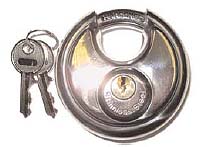
Discus style padlocks - have no angular corners, so are often used with cycle security chains and cables, as well as being a popular choice for securing doors on sheds and beach huts, etc. When used as a door lock, they will typically be used in conjunction with the special shrouded discus hasp and staple set, which offers extra protection to the padlock shackle.
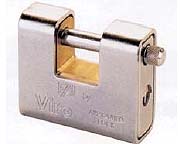
Shutter Locks / Anvil Locks - are typically used to secure the external (or internal) security roller shutters fitted to shop fronts. They are also popular for use with parking posts, motorcycle security chains, etc.
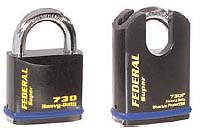
Conventional Style padlocks have a wide range of applications from low security applications like locking your toolbox, to high security uses such as securing factory gates or protecting motorcycles. They are typically available as; Open, Close, or Semi Enclosed Shackle types
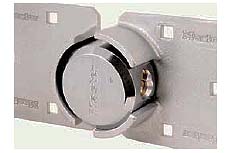
Shackleless type padlock (shown with special hasp)Shackleless Padlocks - this is a bit of a misnomer as the padlock does of course have a shackle, it’s just that it’s on the underside of the lock body and therefore unseen. This type of padlock can be round (like the one pictured) or rectangular, but typically, they are designed to be used with a special matching security hasp. Because of their design, these units are difficult to attack and over recent years, as well as being used on warehouse doors, etc, they have also become very popular for use on vans and other vehicles where they are used to secure opening double doors.
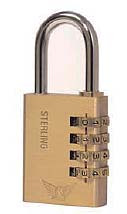
A "Close Shackle" padlock is one with built in shoulders, which are designed to minimise the amount of the shackle exposed, to a saw or bolt cropper attack. This type of padlock will normally have a higher security rating than an equivalent unit with a semi enclosed or open shackle, however subject to size and clearances, may not be practical for instance, to use where you need to secure 2 chain links together or require a padlock for use with a shrouded hasp, etc. To make them easier to use, many Close Shackle padlocks feature "removable shackles" which are fully released from the body of the padlock when it's unlocked.
An "Open Shackle" padlock will typically be easier to use where the shackle needs to pass through 2 chain-links (i.e, a chain securing two opening gates together), etc. As more of the shackle is exposed however, this makes it potentially easier to attack with a saw or bolt croppers.
A "Semi Enclosed Shackle" padlock is something of a compromise, but will often offer more flexibility in use than a Close Shackle padlock and improved security over an Open Shackle model.
Тематики
EN
Русско-английский словарь нормативно-технической терминологии > навесной замок
- 1
- 2
См. также в других словарях:
set — I. verb (set; setting) Etymology: Middle English setten, from Old English settan; akin to Old High German sezzen to set, Old English sittan to sit Date: before 12th century transitive verb 1. to cause to sit ; place in or on a seat 2 … New Collegiate Dictionary
Original Chip Set — The Original Chip Set (OCS) was a chipset used in the earliest Commodore Amiga computers and defined the Amiga s graphics and sound capabilities. It was succeeded by the slightly improved Enhanced Chip Set (ECS) and greatly improved Advanced… … Wikipedia
square set — noun 1. : any of the rectangular sets used in the square set system of mining 2. : a group of four couples arranged in a square for a square dance * * * Mining. a set having 12 timbers joined to form eight 90° solid angles. [1815 25, Amer.] * * * … Useful english dictionary
square set system — noun : a method of timbering a mine in which heavy timbers are framed together in rectangular sets 6 or 7 feet high and from 4 to 6 feet long so as to fill in as the ore body is removed by overhand stoping … Useful english dictionary
Bathhouse Row — Infobox nrhp | name =Bathhouse Row nrhp type = nhl caption = Skylight in Fordyce bathhouse location= Hot Springs, Arkansas lat degrees = 34 | lat minutes = 30 | lat seconds = 49 | lat direction = N long degrees = 93 | long minutes = 3 | long… … Wikipedia
Morris dance — Cotswold morris with handkerchiefs Morris dance is a form of English folk dance usually accompanied by music. It is based on rhythmic stepping and the execution of choreographed figures by a group of dancers. Implements such as sticks, swords,… … Wikipedia
Glossary of architecture — This page is a glossary of architecture. Contents: A B C D E F G H I J K L M N O P Q R S T U V W X Y Z … Wikipedia
orthogonal — orthogonality, n. orthogonally, adv. /awr thog euh nl/, adj. 1. Math. a. Also, orthographic. pertaining to or involving right angles or perpendiculars: an orthogonal projection. b. (of a system of real functions) defined so that the integral of… … Universalium
ITV News at Ten — Format National and international news Presented by Mark Austin … Wikipedia
orthogonal — or•thog•o•nal [[t]ɔrˈθɒg ə nl[/t]] adj. 1) math. Also, orthographic 2) Math. pertaining to or involving right angles or perpendiculars. 2) cry Crystall. referable to a rectangular set of axes • Etymology: 1565–75; obs. orthogon(ium) right… … From formal English to slang
orthogonal — /ɔˈθɒgənəl/ (say aw thoguhnuhl) adjective 1. Mathematics relating to or involving right angles or perpendicular lines: an orthogonal projection. 2. Crystallography referable to a rectangular set of axes. {obsolete orthogon(ium) (from Late Latin,… …
