

-
1 сдвиг частоты
сдвиг частоты
смещение частоты
-
[IEV number 151-13-70]EN
frequency translation
frequency changing
frequency conversion
transfer of all the spectral components of a signal from one position in the frequency spectrum to another, in such a way that the frequency difference for any two components is preserved as well as their relative amplitude and relative phase
NOTE – Frequency translation may be accompanied by frequency inversion.
Source: 702-06-64 MOD, 713-07-20 MOD
[IEV number 151-13-70]FR
transposition en fréquence, f
changement de fréquence, m
conversion de fréquence, f
transfert dans le spectre des fréquences de l'ensemble des composantes spectrales d'un signal de façon que les différences des fréquences des composantes de tout couple de composantes soient conservées, ainsi que leurs amplitudes relatives et leurs phases relatives
NOTE – Une transposition en fréquence peut être accompagnée d'une inversion de fréquence.
Source: 702-06-64 MOD, 713-07-20 MOD
[IEV number 151-13-70]EN
DE
FR
Русско-немецкий словарь нормативно-технической терминологии > сдвиг частоты
-
2 угловая частота
угловая частота
Скорость изменения фазы синусоидального электрического тока, равная частоте синусоидального электрического тока, умноженной на 2π.
Примечание — Аналогично определяют угловые частоты синусоидальных электрического напряжения, электродвижущей силы, магнитного потока и т. д.
[ ГОСТ Р 52002-2003]EN
angular frequency
pulsatance
ω
product of the frequency of a sinusoidal quantity and the factor 2π
NOTE – For the quantity Am cos (ω t + θ0), the angular frequency is ω.
[IEV number 101-14-36 ]FR
pulsation
produit de la fréquence d'une grandeur sinusoïdale par le facteur 2π
NOTE – Pour la grandeur Am cos (ω t + θ0), la pulsation est ω.
[IEV number 101-14-36 ]Практика остановила свой выбор на синусоидальных колебаниях переменных электрических величин. В дальнейшем, говоря о токе, э. д. с., напряжении и магнитном потоке, мы будем считать их изменяющимися по закону синуса.
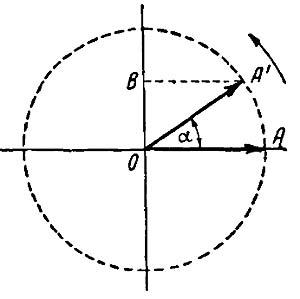
Фиг. 130. Вращение вектора вокруг оси
Пусть мы имеем вектор ОА (фиr. 130), выражающий в масштабе какую-либо переменную синусоидальную величину, например ток. Будем вращать с постоянной скоростью вектор вокруг точки О против часовой стрелки. Конец вектора будет описывать окружность, а угол, на который поворачивается вектор, будет меняться с течением времени.
Угловая скорость или угловая частота ω (омега) вращения равна углу поворота вектора в единицу времени: ω=α/t, откуда α=ωt.
Часто вместо градуса пользуются другой единицей измерения угла – радианом. Радианом называется угол, дуга которого равна радиусу. Если длина окружности С=2πR, то она содержит 2πR/R=2π радиан.
За один оборот радиус-вектор ОА будет иметь один период вращения продолжительностью Т секунд.
Угловая частота в этом случае выразится: ω=α/t=2π/T рад/сек.
Так как 1/Т=f, то ω=2πf рад/сек.
[Кузнецов М. И. Основы электротехники. М, "Высшая Школа", 1964]Тематики
- электротехника, основные понятия
Синонимы
EN
- angular frequency
- angular rate
- angular velocity
- circular frequency
- corner frequency
- cyclic frequency
- phase rate
- pulsatance
- radial frequency
DE
FR
Русско-немецкий словарь нормативно-технической терминологии > угловая частота
-
3 добротность
добротность
1. Количественная характеристика потерь колебательной системы при резонансе, равная
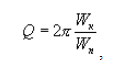
где Wк - полный запас энергии колебаний при резонансе;
Wп - потери энергии за период
[ Физический энциклопедический словарь]
2. Количественная мера потерь колебательной системы. Показывает, во сколько раз амплитуда вынужденных колебаний при резонансе превышает амплитуду на частоте, много меньшей резонансной при одинаковой внешней силе
3. Отношение резонансной частоты спектра колебаний к его ширине на уровне 0,707 от максимального значения амплитуды спектра
Примечание
Определения 2 и 3 являются достаточно точными для систем с высокой добротностью (Q >(5-10)), определение 1 пригодно во всех случаях
[Система неразрушающего контроля. Виды (методы) и технология неразрушающего контроля. Термины и определения (справочное пособие). Москва 2003 г.]
добротность (1)
коэффициент добротности (1)
-
[IEV number 151-15-45]
добротность (2)
коэффициент добротности (2)
-
[IEV number 151-15-46]EN
quality factor (1)
Q factor (1)
for a capacitor or inductor under periodic conditions, ratio of the absolute value of the reactive power to the active power
NOTE 1 – The quality factor is a measure of the losses, usually unwanted, in a capacitor or an inductor.
NOTE 2 – The quality factor depends generally on frequency and voltage.
[IEV number 151-15-45]
quality factor (2)
Q factor (2)
for a resonant circuit at the resonance frequency, 2π times the ratio of the maximum stored energy to the energy dissipated during one period
NOTE – The quality factor is a measure of sharpness of the resonance.
Source: 801-24-12 MOD
[IEV number 151-15-46]FR
facteur de qualité (1), m
facteur de surtension (1), m
pour un condensateur ou une bobine d'inductance en régime périodique, rapport de la valeur absolue de la puissance réactive à la puissance active
NOTE 1 – Le facteur de qualité caractérise les pertes, généralement non désirées, dans un condensateur ou une bobine d'inductance.
NOTE 2 – Le facteur de qualité dépend généralement de la fréquence et de la tension.
[IEV number 151-15-45]
facteur de qualité (2), m
facteur de surtension (2), m
pour un circuit résonant fonctionnant à la fréquence de résonance, 2π fois le rapport de l'énergie maximale emmagasinée dans le circuit à l'énergie dissipée pendant une période
NOTE – Le facteur de qualité caractérise l'acuité de la résonance.
Source: 801-24-12 MOD
[IEV number 151-15-46]Синонимы
EN
DE
FR
Русско-немецкий словарь нормативно-технической терминологии > добротность
-
4 конвертор частоты
конвертор частоты
-
[IEV number 151-13-71]EN
frequency changer
signal converter for effecting a frequency translation of a signal
NOTE – A frequency changer comprises an oscillator and a frequency mixer, generally followed by a band-pass filter.
Source: 702-09-37 MOD, 713-07-22 MOD
[IEV number 151-13-71]FR
changeur de fréquence, m
convertisseur de signal destiné à effectuer une transposition en fréquence d'un signal
NOTE – Un changeur de fréquence comprend un oscillateur et un mélangeur de fréquences, suivi généralement d'un filtre passe-bande.
Source: 702-09-37 MOD, 713-07-22 MOD
[IEV number 151-13-71]EN
DE
FR
Русско-немецкий словарь нормативно-технической терминологии > конвертор частоты
-
5 частотная модуляция
частотная модуляция
ЧМ
Модуляция синусоидального колебания путем изменения частоты в соответствии с амплитудными вариациями модулирующего сигнала.
[ http://www.vidimost.com/glossary.html]
частотная модуляция
-
[IEV number 314-08-02]EN
frequency modulation
process by which the frequency of a carrier wave is varied according to a specified law
NOTE – The result of this process is a frequency modulated signal.
Source: 702-06-37 MOD
[IEV number 314-08-02]FR
modulation de fréquence
opération par laquelle la fréquence d'une onde porteuse varie selon une loi spécifiée
NOTE – Le résultat de cette opération est un signal modulé en fréquence.
Source: 702-06-37 MOD
[IEV number 314-08-02]Тематики
- измерение электр. величин в целом
Синонимы
- ЧМ
EN
DE
FR
Русско-немецкий словарь нормативно-технической терминологии > частотная модуляция
-
6 полное сопротивление относительно земли
полное сопротивление относительно земли
Полное сопротивление (импеданс) между точкой системы или установки, или оборудования и относительной землей на данной частоте.
[ ГОСТ Р МЭК 60050-195-2005]
полное сопротивление относительно земли
Полное сопротивление между определенной точкой системы или установки, или оборудования и эталонной землей на данной частоте.
[ ГОСТ Р МЭК 60050-826-2009]EN
impedance to earth
impedance at a given frequency between a specified point in a system or in an installation or in equipment and reference earth
[IEV number 195-01-17]
impedance to earth
impedance to ground (US)
impedance at a given frequency between a specified point in a system or in an installation or in equipment and reference earth
NOTE 1 – Reference earth is defined in IEC 60050-195. In practice, a reference point can be substituted to earth, for example the chassis.
NOTE 2 – The common mode rejection ratio of an instrument is dependent on the impedances between the input terminals and earth. Each of these impedances is called a common mode impedance.
Source: 195-01-17
[IEV number 312-06-20]FR
impédance de mise à la terre
impédance à une fréquence donnée entre un point spécifié d'un réseau, d'une installation ou d'un matériel et la terre de référence
[IEV number 195-01-17]
impédance de mise à la terre
impédance à une fréquence donnée entre un point spécifié d'un réseau, d'une installation ou d'un matériel et la terre de référence
NOTE 1 – La terre de référence est définie dans la CEI 60050-195. En pratique, on peut lui substituer un point de référence, par exemple la masse.
NOTE 2 – Le facteur de réjection de mode commun d'un appareil dépend de l'impédance entre chacune des bornes d'entrée et la terre. Chacune de ces impédances est appelée impédance de mode commun.
Source: 195-01-17
[IEV number 312-06-20]Тематики
EN
DE
FR
Русско-немецкий словарь нормативно-технической терминологии > полное сопротивление относительно земли
-
7 входное полное сопротивление
входное полное сопротивление
-
[IEV number 312-06-18]EN
input impedance
impedance of the input circuit measured between the input terminals under operating conditions
NOTE 1 – The impedance can be expressed in terms of admittance.
NOTE 2 – In certain instances, for example, sampling devices or self-balancing potentiometers, the impedance can be different according to the instant when it is determined, before, during or after the instant of measurement.
NOTE 3 – When the input circuit is such that the instantaneous value of the current flowing into the input terminals is a non-linear function of the instantaneous value of the input voltage under specified conditions of frequency and voltage, the combination of resistance and reactance which would absorb the same active power and in which would flow a reactive current equal to the fundamental component that is flowing in the actual input circuit, is sometimes called the "equivalent input impedance".
[IEV number 312-06-18]FR
impédance du circuit d'entrée
impédance du circuit d'entrée entre les bornes d'entrée dans les conditions de fonctionnement
NOTE 1 – L'impédance peut être exprimée en termes d'admittance.
NOTE 2 – Dans certains cas, par exemple les dispositifs d'échantillonnage ou les potentiomètres à rééquilibrage automatique, l'impédance peut être différente selon l’instant où elle est déterminée, avant, pendant ou après la mesure.
NOTE 3 – Lorsque le circuit d'entrée est tel que la valeur instantanée du courant traversant les bornes d'entrée est une fonction non linéaire de la valeur instantanée de la tension d'entrée dans des conditions spécifiées de fréquence et de tension, l'impédance d'une combinaison formée par une résistance et une réactance qui absorberaient la même puissance active et dans laquelle circulerait un courant réactif égal à la composante fondamentale qui circule dans le circuit d'entrée réel, est parfois appelée "impédance équivalente d'entrée".
[IEV number 312-06-18]Тематики
- измерение электр. величин в целом
EN
DE
FR
Русско-немецкий словарь нормативно-технической терминологии > входное полное сопротивление
-
8 выходное полное сопротивление
выходное полное сопротивление
-
[IEV number 312-06-19]EN
output impedance
impedance of the output circuit measured between the output terminals under operating conditions
NOTE 1 – The impedance can be expressed in terms of admittance.
NOTE 2 – In certain instances, for example, sampling devices or self-balancing potentiometers, the impedance can be different according to the instant when it is determined, before, during or after the instant of measurement.
NOTE 3 – When the output circuit is such that the instantaneous value of the current flowing into the output terminals is a non-linear function of the instantaneous value of the output voltage under specified conditions of frequency and voltage, the combination of resistance and reactance which would absorb the same active power and in which would flow a reactive current equal to the fundamental component that is flowing in the actual output circuit, is sometimes called the "equivalent output impedance".
[IEV number 312-06-19]FR
impédance du circuit de sortie
impédance du circuit de sortie entre les bornes de sortie dans les conditions de fonctionnement
NOTE 1 – L'impédance peut être exprimée en termes d'admittance.
NOTE 2 – Dans certains cas, par exemple les dispositifs d'échantillonnage ou les potentiomètres à rééquilibrage automatique, l'impédance peut être différente selon l’instant où elle est déterminée, avant, pendant ou après la mesure.
NOTE 3 – Lorsque le circuit de sortie est tel que la valeur instantanée du courant traversant les bornes de sortie est une fonction non linéaire de la valeur instantanée de la tension de sortie dans des conditions spécifiées de fréquence et de tension, l'impédance d'une combinaison formée par une résistance et une réactance qui absorberaient la même puissance active et dans laquelle circulerait un courant réactif égal à la composante fondamentale qui circule dans le circuit de sortie réel, est parfois appelée "impédance équivalente de sortie".
[IEV number 312-06-19]Тематики
- измерение электр. величин в целом
EN
DE
FR
Русско-немецкий словарь нормативно-технической терминологии > выходное полное сопротивление
-
9 синхронность
синхронность
-
[IEV number 151-15-31]EN
synchronism
condition where quantities or phenomena are synchronous
NOTE 1 – The concept of "synchronous" is defined in IEC 60050-101.
NOTE 2 – Periodic quantities are in synchronism when they have the same frequency.
NOTE 3 – For synchronism of some systems, additional conditions must be satisfied.
Source: 702-04-16 MOD, 704-13-18 MOD
[IEV number 151-15-31]FR
synchronisme, m
état de grandeurs ou de phénomènes qui sont synchrones
NOTE 1 – Le concept de "synchrone" est défini dans la CEI 60050-101.
NOTE 2 – Des grandeurs périodiques sont en synchronisme lorsqu'elles ont la même fréquence.
NOTE 3 – Pour le synchronisme de certains systèmes, des conditions supplémentaires sont nécessaires.
Source: 702-04-16 MOD, 704-13-18 MOD
[IEV number 151-15-31]EN
DE
FR
- synchronisme, m
Русско-немецкий словарь нормативно-технической терминологии > синхронность
-
10 смеситель частот
смеситель частот
Электрическая цепь, создающая спектр комбинационных частот при подаче на нее двух или более сигналов разной частоты
[ ГОСТ 24375-80]
смеситель частот
-
[IEV number 151-13-69]EN
(frequency) mixer
non-linear device for producing oscillations or signals the frequencies of which are specified linear combinations of integral multiples of the frequencies of the spectral components of two input oscillations or signals
NOTE – Usually, the output frequencies are the sum or difference of input frequencies.
Source: 713-07-23, 702-09-36 MOD
[IEV number 151-13-69]FR
mélangeur (de fréquences), m
dispositif nonlinéaire destiné à fournir des oscillations ou des signaux dont les fréquences sont des combinaisons linéaires déterminées à coefficients entiers des fréquences des composantes spectrales de deux oscillations ou signaux d'entrée
NOTE – En général, les fréquences de sortie sont la somme ou la différence des fréquences d'entrée.
Source: 713-07-23, 702-09-36 MOD
[IEV number 151-13-69]Тематики
Синонимы
EN
DE
FR
Русско-немецкий словарь нормативно-технической терминологии > смеситель частот
-
11 измерительный преобразователь (с электрическим выходом)
измерительный преобразователь (с электрическим выходом)
-
[IEV number 312-02-15]EN
measuring transducer (with electrical output)
device intended to transform, with a specified accuracy and according to a given law, the measurand, or a quantity already transformed therefrom, into an electrical quantity
NOTE 1 – If the input quantity is electrical, the input and output quantities may not be of the same kind, for example, a voltage and a current.
NOTE 2 – In certain instances, measuring transducers also have a specific name in respect of their function, (for example, amplifier, converter, transformer, frequency transducer, etc.).
Source: ≈ VIM 4.3
[IEV number 312-02-15]FR
transducteur de mesure (à sortie électrique)
dispositif destiné à transformer, avec une précision spécifiée et suivant une loi déterminée, le mesurande, ou la grandeur déjà transformée à partir du mesurande, en une grandeur électrique
NOTE 1 – Si la grandeur d'entrée est électrique, les grandeurs d'entrée et de sortie peuvent ne pas être de même nature, par exemple une tension et un courant.
NOTE 2 – Dans certains cas, les transducteurs de mesure ont également compte tenu de leur fonction, une dénomination spécifique, (par exemple, amplificateur, convertisseur, transformateur, transducteur de fréquence, etc.).
Source: ≈ VIM 4.3
[IEV number 312-02-15]Тематики
- измерение электр. величин в целом
EN
DE
FR
Русско-немецкий словарь нормативно-технической терминологии > измерительный преобразователь (с электрическим выходом)
-
12 катушка индуктивности
катушка индуктивности
Элемент электрической цепи, предназначенный для использования его собственной индуктивности и/или его магнитного поля.
[ ГОСТ Р 52002-2003]
катушка индуктивности
индуктивность
-
[IEV number 151-13-25]EN
inductor
reactor
two-terminal device characterized essentially by its inductance
NOTE 1 – In French, the term "inductance" also denotes the characteristic quantity of an inductor, in English "inductance".
NOTE 2 – In English, the term "reactor" is used for an inductor operated at a fixed frequency.
[IEV number 151-13-25]FR
(bobine d') inductance, f
bipôle caractérisé essentiellement par son inductance
NOTE 1 – En français, le terme "inductance" désigne aussi la grandeur caractéristique du dispositif, en anglais "inductance".
NOTE 2 – En anglais, le terme "reactor" est utilisé pour une bobine d'inductance fonctionnant à une fréquence déterminée.
[IEV number 151-13-25]Тематики
- электротехника, основные понятия
EN
DE
FR
Русско-немецкий словарь нормативно-технической терминологии > катушка индуктивности
-
13 коэффициент подавления общего вида
коэффициент подавления общего вида
-
[IEV number 312-06-21]EN
common mode rejection ratio
CMRR (abbreviation)
ratio of the voltage applied between a specified reference point and the input terminals, when connected together by a specified circuit, to the voltage required between the input terminals to produce the same value of the output
NOTE 1 – The common mode rejection ratio is usually expressed in decibels and can depend on the frequency, the waveform and the method of measurement.
NOTE 2 – Common mode rejection ratio can also apply to quantities other than voltage.
[IEV number 312-06-21]FR
rapport de réjection de mode commun
rapport de la tension appliquée entre un point de référence spécifié et les deux bornes d'entrée connectées l'une à l'autre par un circuit spécifié, à la tension nécessaire entre les bornes d'entrée pour produire la même valeur de sortie
NOTE 1 – Le facteur de réjection de mode commun est généralement exprimé en décibels et peut dépendre de la fréquence, de la forme d’onde et de la méthode de mesure.
NOTE 2 – Le rapport de réjection de mode commun peut aussi s'appliquer à des grandeurs autres que les tensions.
[IEV number 312-06-21]Тематики
- измерение электр. величин в целом
EN
DE
FR
Русско-немецкий словарь нормативно-технической терминологии > коэффициент подавления общего вида
-
14 коэффициент подавления при последовательном включении
коэффициент подавления при последовательном включении
-
[IEV number 312-06-22]EN
series mode rejection ratio
SMRR (abbreviation)
ratio of the series mode voltage causing a specified change in output information, to the voltage initiated by the measurand which would produce the same change
NOTE 1 – The series mode rejection ratio is usually expressed in decibels and may depend on the frequency, the waveform and the method of measurement.
NOTE 2 – Series mode rejection ratio can also apply to quantities other than voltage.
[IEV number 312-06-22]FR
rapport de réjection de mode série
rapport de la tension de mode série, provoquant un changement spécifié d'information de sortie, à la tension résultant du mesurande qui produirait le même changement
NOTE 1 – Le facteur de réjection de mode série est généralement exprimé en décibels et peut dépendre de la fréquence, de la forme d’onde et de la méthode de mesure.
NOTE 2 – Le rapport de réjection de mode commun peut aussi s'appliquer à des grandeurs autres que les tensions.
[IEV number 312-06-22]Тематики
- измерение электр. величин в целом
EN
DE
FR
Русско-немецкий словарь нормативно-технической терминологии > коэффициент подавления при последовательном включении
-
15 производная единица системы единиц физических величин
производная единица системы единиц физических величин
производная единица
Единица производной физической величины системы единиц, образованная в соответствии с уравнением, связывающим ее с основными единицами или с основными и уже определенными производными.
Примеры
1. 1 м/с - единица скорости, образованная из основных единиц СИ - метра и секунды.
2. 1 Н - единица силы, образованная из основных единиц СИ - килограмма, метра, и секунды.
[РМГ 29-99]EN
derived unit
unit of measurement for a derived quantity
NOTE 1 – Some derived units in the International System of Units (SI) have special names, e.g. hertz for frequency and joule for energy, but others have compound names, e.g. metre per second for speed. Compounds including units with special names are also used, e.g. volt per metre for the electric field strength, and newton metre for torque. See in particular ISO 31 and ISO/IEC 80000.
NOTE 2 – Derived units can also be expressed by using multiples and submultiples. For example, the metre per second, symbol m/s, and the centimetre per second, symbol cm/s, are derived units of speed in the SI. The kilometre per hour, symbol km/h, is a unit of speed outside the SI but accepted for use with the SI, because the unit hour is accepted for use with the SI. The knot, equal to one nautical mile per hour, is a unit of speed outside the SI, that is used by special interest groups.
Source: ISO/IEC GUIDE 99:2007 1.11
[IEV number 112-01-19]FR
unité dérivée, f
unité de mesure d'une grandeur dérivée
NOTE 1 – Certaines unités dérivées dans le SI ont des noms spéciaux, par exemple le hertz pour la fréquence et le joule pour l'énergie, tandis que d'autres ont des noms composés, par exemple le mètre par seconde pour la vitesse. Les unités ayant des noms spéciaux sont aussi utilisées dans des noms composés, par exemple le volt par mètre pour le champ électrique et le newton mètre pour le moment de torsion. Voir en particulier l'ISO 31 et l'ISO/CEI 80000.
NOTE 2 – On peut aussi exprimer les unités dérivées en utilisant des multiples et des sous-multiples. Par exemple, le mètre par seconde, symbole m/s, et le centimètre par seconde, symbole cm/s, sont des unités dérivées de vitesse dans le SI. Le kilomètre par heure, symbole km/h, est une unité de vitesse en dehors du SI mais en usage avec le SI, parce que l'heure est une unité en usage avec le SI. Le nœud, égal à un mille marin par heure, est une unité de vitesse en dehors du SI, qui répond aux besoins spécifiques de certains groupes d’utilisateurs.
Source: ISO/IEC GUIDE 99:2007 1.11
[IEV number 112-01-19]Тематики
- метрология, основные понятия
Синонимы
EN
DE
FR
Русско-немецкий словарь нормативно-технической терминологии > производная единица системы единиц физических величин
-
16 ток холостого хода
ток холостого хода
Ток, протекающий через линейный вывод обмотки, к которой приложено номинальное напряжение (или напряжение ответвления) номинальной частоты, при разомкнутых остальных обмотках.
Примечания
1 Для трехфазного трансформатора током холостого хода считают среднеарифметическое значение токов холостого хода трех фаз.
2 Ток холостого хода одной обмотки обычно выражают в процентах номинального тока этой обмотки. Для многообмоточных трансформаторов этот процент относят к обмотке с наибольшей номинальной мощностью
(МЭС 421-06-02)
[ ГОСТ 30830-2002]EN
no-load current
the current flowing through a line terminal of a winding when a given voltage is applied at rated frequency, the other winding(s) being open-circuited
NOTE 1 – Normally the applied voltage is the rated voltage and the energized winding, if fitted with tappings, is connected on its principal tapping.
NOTE 2 – The no-load current of a winding is often expressed as a percentage of the rated current of the same winding
[IEV number 421-06-02]FR
courant à vide
courant arrivant à une borne de ligne d'un enroulement quand une tension donnée à la fréquence assignée est appliquée à cet enroulement, l'autre (ou les autres) enroulement(s) étant à circuit ouvert
NOTE 1 – Normalement, la tension appliquée est la tension assignée et l'enroulement d'excitation, s'il est muni de prises, est connecté sur sa prise principale.
NOTE 2 – Le courant à vide d'un enroulement est souvent exprimé en pourcentage du courant assigné de cet enroulement.
[IEV number 421-06-02]Тематики
Классификация
>>>EN
DE
FR
Русско-немецкий словарь нормативно-технической терминологии > ток холостого хода
-
17 восстанавливающееся и возвращающееся напряжение
восстанавливающееся и возвращающееся напряжение
Напряжение, появляющееся на выводах полюса коммутационного аппарата или плавкого предохранителя после отключения тока..
Примечания
1 Напряжение можно рассматривать на протяжении двух последовательных интервалов времени, на первом из которых напряжение переходное, а на последующем — промышленной частоты.
2 Определение действительно для однополюсного аппарата. Для многополюсного аппарата — это межфазное напряжение на входных выводах аппаратов.
МЭК 60050(441-17-25)
[ ГОСТ Р 50030. 1-2000 ( МЭК 60947-1-99)]EN
recovery voltage
the voltage which appears across the terminals of a pole of a switching device or a fuse after the breaking of the current
NOTE – This voltage may be considered in two successive intervals of time, one during which a transient voltage exists, followed by a second one during which the power frequency or the steady-state recovery voltage alone exists.
[IEV number 441-17-25]FR
tension de rétablissement
tension qui apparaît entre les bornes d'un appareil de connexion ou d'un fusible après l'interruption du courant
NOTE – Cette tension peut être considérée durant deux intervalles de temps consécutifs, l'un durant lequel existe une tension transitoire, suivi par un second intervalle durant lequel la tension de rétablissement à fréquence industrielle ou en régime établi existe seule.
[IEV number 441-17-25]Тематики
- электротехника, основные понятия
EN
DE
FR
Русско-немецкий словарь нормативно-технической терминологии > восстанавливающееся и возвращающееся напряжение
-
18 восстанавливающееся напряжение
восстанавливающееся напряжение
Напряжение, появляющееся на выводах полюса автоматического выключателя после отключения тока.
Примечания
1 Это напряжение можно рассматривать на протяжении двух последовательных интервалов времени, на первом из которых напряжение переходное, а на последующем втором — напряжение промышленной частоты.
2 Это определение действительно для однополюсного выключателя. Для многополюсного выключателя — это напряжение между входными выводами аппарата
(МЭС 441-17-25)
[ ГОСТ Р 50345-99( МЭК 60898-95)]
восстанавливающееся напряжение
-
[Лугинский Я. Н. и др. Англо-русский словарь по электротехнике и электроэнергетике. 2-е издание - М.: РУССО, 1995 - 616 с.]EN
recovery voltage
the voltage which appears across the terminals of a pole of a switching device or a fuse after the breaking of the current
NOTE – This voltage may be considered in two successive intervals of time, one during which a transient voltage exists, followed by a second one during which the power frequency or the steady-state recovery voltage alone exists.
[IEV number 441-17-25]FR
tension de rétablissement
tension qui apparaît entre les bornes d'un appareil de connexion ou d'un fusible après l'interruption du courant
NOTE – Cette tension peut être considérée durant deux intervalles de temps consécutifs, l'un durant lequel existe une tension transitoire, suivi par un second intervalle durant lequel la tension de rétablissement à fréquence industrielle ou en régime établi existe seule
[IEV number 441-17-25]Тематики
- выключатель, переключатель
- высоковольтный аппарат, оборудование...
EN
- cleaning voltage
- recovery voltage
- restoring voltage
- restriking voltage
- transient recovery voltage
- TRV
DE
FR
Русско-немецкий словарь нормативно-технической терминологии > восстанавливающееся напряжение
-
19 восстанавливающееся напряжение (для контактора и пускателя)
восстанавливающееся напряжение
Напряжение, появляющееся на выводах полюса автоматического выключателя после отключения тока.
Примечания
1 Это напряжение можно рассматривать на протяжении двух последовательных интервалов времени, на первом из которых напряжение переходное, а на последующем втором — напряжение промышленной частоты.
2 Это определение действительно для однополюсного выключателя. Для многополюсного выключателя — это напряжение между входными выводами аппарата
3 У вакуумного контактора или пускателя наибольшее восстанавливающееся напряжение возможно не на первом отключаемом полюсе
(МЭС 441-17-25)
[ ГОСТ Р 50030.4.1-2002 (МЭК 60947-4-1-2000)]EN
recovery voltage
the voltage which appears across the terminals of a pole of a switching device or a fuse after the breaking of the current
NOTE – This voltage may be considered in two successive intervals of time, one during which a transient voltage exists, followed by a second one during which the power frequency or the steady-state recovery voltage alone exists.
[IEV number 441-17-25]FR
tension de rétablissement
tension qui apparaît entre les bornes d'un appareil de connexion ou d'un fusible après l'interruption du courant
NOTE – Cette tension peut être considérée durant deux intervalles de temps consécutifs, l'un durant lequel existe une tension transitoire, suivi par un second intervalle durant lequel la tension de rétablissement à fréquence industrielle ou en régime établi existe seule
[IEV number 441-17-25]Тематики
EN
DE
FR
Русско-немецкий словарь нормативно-технической терминологии > восстанавливающееся напряжение (для контактора и пускателя)
-
20 начальный пусковой ток
- Anzugstrom, m
начальный пусковой ток
Наибольшее действующее значение тока, потребляемого заторможенным электродвигателем переменного тока с короткозамкнутым ротором или магнитом переменного тока, у которого якорь установлен так, что создается максимальный воздушный зазор при номинальных напряжении и частоте.
Обозначение
символ IA
Примечание
Переходные процессы не принимают во внимание.
[ ГОСТ Р МЭК 60050-426-2006]EN
initial starting current
Symbol IA
highest r.m.s. value of current absorbed by an a.c. motor when at rest or by an a.c. magnet with its armature clamped in the position of maximum air gap when supplied at rated voltage and rated frequency
NOTE – Transient phenomena are ignored.
[IEV number 426-08-04]FR
courant initial de démarrage
valeur efficace la plus élevée du courant absorbé par un moteur à courant alternatif au repos ou par un électro-aimant à courant alternatif dont l’armature est bloquée dans la position donnant l’entrefer maximal lorsqu’il est alimenté à sa tension et à sa fréquence assignées
NOTE – Les phénomènes transitoires ne sont pas pris en compte.
[IEV number 426-08-04]
Тематики
EN
DE
- Anzugstrom, m
FR
Русско-немецкий словарь нормативно-технической терминологии > начальный пусковой ток
- 1
- 2
См. также в других словарях:
Note — This article is about the musical term. For other uses, see Note (disambiguation). In music, the term note has two primary meanings: A sign used in musical notation to represent the relative duration and pitch of a sound; A pitched sound itself.… … Wikipedia
Frequency frogging — In telecommunication, the term frequency frogging has the following meanings: 1. The interchanging of the frequencies of carrier channels to accomplish specific purposes, such as to prevent feedback and oscillation, to reduce crosstalk, and to… … Wikipedia
Frequency spectrum — Familiar concepts associated with a frequency are colors, musical notes, radio/TV channels, and even the regular rotation of the earth. A source of light can have many colors mixed together and in different amounts (intensities). A rainbow, or… … Wikipedia
Frequency domain — In electronics, control systems engineering, and statistics, frequency domain is a term used to describe the domain for analysis of mathematical functions or signals with respect to frequency, rather than time.[1] Speaking non technically, a time … Wikipedia
Frequency comb — A frequency comb is the graphic representation of the spectrum of a mode locked laser. An octave spanning comb can be used for mapping radio frequencies into the optical frequency range or it can be used to steer a piezoelectric mirror within a… … Wikipedia
Frequency synthesizer — A frequency synthesizer is an electronic system for generating any of a range of frequencies from a single fixed timebase or oscillator. They are found in many modern devices, including radio receivers, mobile telephones, radiotelephones, walkie… … Wikipedia
Frequency (film) — Infobox Film name = Frequency image size = 200px caption = director = Gregory Hoblit producer = Gregory Hoblit Hawk Koch Toby Emmerich Bill Carraro writer = Toby Emmerich narrator = starring = Dennis Quaid James Caviezel Elizabeth Mitchell Andre… … Wikipedia
Frequency partition — In graph theory, a discipline within mathematics, the frequency partition of a graph (simple graph) is a partition of its vertices grouped by their degree.For example, the degree sequence of the left hand graph below is (3, 3, 3, 2, 2, 1) and its … Wikipedia
Frequency shift — In the physical sciences and in telecommunication, the term frequency shift has the following meanings: * Any change in frequency * A Doppler shift * Any change in the frequency of a radio transmitter or oscillator. (Note: In the radio regime,… … Wikipedia
Frequency (video game) — Infobox VG title= Frequency caption = developer= Harmonix Music Systems publisher= designer= Harmonix Music Systems released= vgrelease|NA=November 20, 2001|PAL=June 28, 2002 genre= Music modes= Single player, multiplayer ratings=… … Wikipedia
Note head — Parts of the note In music, a note head is the elliptical part of a note. Noteheads may be coloured completely black or white, indicating the note value (i.e., rhythmic duration). In a whole note, the note head is the only component of the note.… … Wikipedia
