

-
1 продольное повреждение
продольное повреждение
Режим, при котором полные сопротивления каждой из трех фаз не равны между собой, обычно вызываемый разрывом одной или двух фаз.
[Разработка типовых структурных схем микропроцессорных устройств РЗА на объектах ОАО "ФКС ЕЭС". Пояснительная записка. Новосибирск 2006 г.]EN
series fault
a fault for which the impedances of each of the three phases are not equal, usually caused by the interruption of one or two phases
[IEV ref 448-13-06]FR
défaut série
défaut pour lequel les impédances de chacune des trois phases ne sont pas égales, en général par suite de la coupure d'une ou de deux phases
[IEV ref 448-13-06]Тематики
EN
DE
- Fehler durch Leiterunterbrechung, m
FR
Русско-французский словарь нормативно-технической терминологии > продольное повреждение
-
2 токовая погрешность трансформатора тока
токовая погрешность трансформатора тока
Погрешность, которую трансформатор тока вносит в измерение тока, возникающая вследствие того, что действительный коэффициент трансформации не равен номинальному.
Примечание. Токовая погрешность определяется как арифметическая разность между действительным вторичным током и приведенным ко вторичной цепи действительным первичным током, выраженная в процентах приведенного ко вторичной цепи действительного первичного тока.
[ ГОСТ 18685-73]EN
current error
the error which a current transformer introduces into the measurement of a current and which arises from the fact that the actual transformation ratio is not equal to the rated transformation ratio
[IEV number 321-01-21]FR
erreur de courant
erreur de rapport (d'un transformateur de courant)
erreur qu'un transformateur de courant introduit dans la mesure d'un courant et qui provient de ce que le rapport de transformation n'est pas égal au rapport de transformation assigné
[IEV number 321-01-21]Тематики
EN
DE
FR
Русско-французский словарь нормативно-технической терминологии > токовая погрешность трансформатора тока
-
3 небаланс напряжений
небаланс напряжений
Отличие по модулю значения хотя бы одного из фазных или линейных напряжений многофазной системы электроснабжения от значений напряжений других фаз.
[ ГОСТ 23875-88]EN
voltage unbalance
phenomenon due to the differences between voltage deviations on the various phases, at a point of a polyphase system, resulting from differences between the phase currents or geometrical asymmetry in the line
[IEV number 604-01-29]
voltage unbalance (imbalance)
in a polyphase system, a condition in which the magnitudes of the phase voltages or the phase angles between consecutive phases are not all equal (fundamental component)
NOTE In three phase systems, the degree of inequality is usually expressed as the ratio of the negative and zero sequence components to the positive sequence component. In this technical report, voltage unbalance is considered in relation to three-phase systems and negative sequence only
[IEC 61000-3-13, ed. 1.0 (2008-02)]
voltage unbalance
condition in a polyphase system in which the r.m.s. values of the line voltages (fundamental component), and/or the phase angles between consecutive line voltages, are not all equal
NOTE 1 The degree of the inequality is usually expressed as the ratios of the negative- and zero-sequence components to the positive-sequence component.
NOTE 2 In this standard, voltage unbalance is considered in relation to 3-phase systems.
[IEC 61000-4-30, ed. 2.0 (2008-10)]FR
déséquilibre des tensions d'un réseau
phénomène résultant des différences de charge ou des dissymétries géométriques de lignes et qui provoque des différences entre les écarts de tension sur les diverses phases en un point d'un réseau polyphasé
[IEV number 604-01-29]
déséquilibre de tension
dans un réseau d’énergie électrique polyphasé, état dans lequel les valeurs efficaces des tensions entre conducteurs (composante fondamentale), et/ou les différences de phase entre conducteurs successifs, ne sont pas toutes égales
NOTE 1 Le taux de déséquilibre s’exprime habituellement par le rapport de la composante inverse ou homopolaire à la composante directe.
NOTE 2 Dans la présente norme, le déséquilibre de tension est relatif aux réseaux triphasés
[IEC 61000-4-30, ed. 2.0 (2008-10)]Параллельные тексты EN-RU
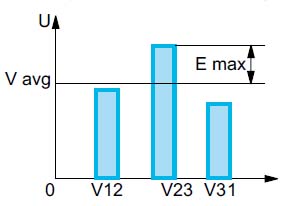
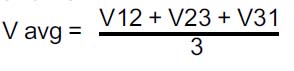
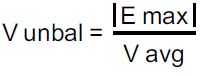
Voltage unbalance
Voltage unbalance on the most unbalanced phase, displayed as a percentage of Vavg.
[Schneider Electric]Небаланс напряжений
Самое значительное отличие по модулю значения одного из линейных напряжений, выраженное в процентах от среднего напряжения Vavg.
[Перевод Интент]
Недопустимые, нерекомендуемые
Тематики
EN
DE
FR
Смотри также
Русско-французский словарь нормативно-технической терминологии > небаланс напряжений
4 номинальное напряжение
номинальное напряжение
Напряжение, установленное изготовителем для прибора
[ ГОСТ Р 52161. 1-2004 ( МЭК 60335-1: 2001)]
номинальное напряжение Uном, кВ
Номинальное междуфазное напряжение электрической сети, для работы в которой предназначены коммутационные аппараты.
[ ГОСТ Р 52726-2007]
номинальное напряжение
Un
Напряжение, применяемое для обозначения или идентификации системы электроснабжения.
[ ГОСТ Р 51317.4.30-2008 (МЭК 61000-4-30:2008)]EN
rated voltage
voltage assigned to the appliance by the manufacturer
[IEC 60335-1, ed. 4.0 (2001-05)]
rated voltage
quantity value assigned, generally by the manufacturer, for a specified operating condition of a machine
[IEC 60034-18-41, ed. 1.0 (2006-10)]
rated voltage
input or output supply voltage for which equipment is designed or specified
[IEC 88528-11, ed. 1.0 (2004-03)]
rated voltage
specified value of the voltage at the terminals of the machine when operating at a rating. If unidirectional, the voltage is the arithmetic mean of the recurring waveform and if alternating it is the root mean square value of the fundamental frequency component of the recurring waveform
NOTE - In the case of a machine with a protective resistor permanently in series, the resistor is considered as an integral part of the machine
[IEC 60349-1, ed. 1.0 (1999-11)]
rated voltage
the value of voltage assigned by the manufacturer to a component, device or equipment and to which operation and performance characteristics are referred
NOTE - Equipment may have more than one rated voltage value or may have a rated voltage range.
[IEC 62497-1, ed. 1.0 (2010-02)]
rated voltage
reference voltage for which the cable is designed, and which serves to define the electrical tests
NOTE 1 - The rated voltage is expressed by the combination of two values: Uo/U expressed in volts (V):
Uo being the r.m.s. value between any insulated conductor and "earth" (metal covering of the cable or the surrounding medium);
U being the r.m.s. value between any two phase conductors of a multicore cable or of a system of single-core cables.
In an alternating-current system, the rated voltage of a cable is at least equal to the nominal voltage of the system for which it is intended.
This condition applies both to the value Uo and to the value U.
In a direct current system, the nominal voltage of the system is not higher than 1,5 times the rated voltage of the cable.
NOTE 2 - The operating voltage of a system may permanently exceed the nominal voltage of such a system by 10 %. A cable can be used at a 10 % higher operating voltage than its rated voltage if the latter is at least equal to the nominal voltage of the system
[IEC 60245-1, ed. 4.0 (2003-12)]
rated voltage
highest allowable voltage between the conductors in a twin and multi conductor cable, or between one conductor and an electrical conductive screen, or between the two ends of a single core cable, or earth in unscreened cables
[IEC 60800, ed. 3.0 (2009-07)]
rated voltage
the r.m.s. line-to-line voltage under rated conditions
Primary side of input transformer: ULN
Converter input: UVN
Converter output: UaN
Motor voltage: UAN
[IEC 61800-4, ed. 1.0 (2002-09)]
rated voltage
input or output voltage (for three-phase supply, the phase-to-phase voltage) as declared by the manufacturer
[IEC 62040-1, ed. 1.0 (2008-06)]
nominal voltage, Un
voltage by which a system is designated or identified
[IEC 61000-4-30, ed. 2.0 (2008-10)]FR
tension assignée
tension attribuée à l'appareil par le fabricant
[IEC 60335-1, ed. 4.0 (2001-05)]
tension nominale
tension assignée, généraleme<>value of voltage assigned by the manufacturer, to a componentnt par le constructeur pour des conditions spécifiées de fonctionnement de la machine
[IEC 60034-18-41, ed. 1.0 (2006-10)]
tension assignée
tension spécifiée aux bornes de la machine quand celle-ci fonctionne au régime assigné. Dans le cas d'une tension redressée, sa valeur est égale à la valeur moyenne de l'onde périodique. Dans le cas d'une tension alternative, sa valeur est égale à la valeur efficace de la composante fondamentale de l'onde périodique
NOTE - Dans le cas d'une machine équipée d'une résistance de protection connectée en permanence en série, la résistance est considérée comme faisant partie intégrante de la machine
[IEC 60349-1, ed. 1.0 (1999-11)]
tension assignée
valeur de la tension, assignée par le constructeur à un composant, à un dispositif ou à un matériel, et à laquelle on se réfère pour le fonctionnement et pour les caractéristiques fonctionnelles
NOTE - Les matériels peuvent avoir plusieurs valeurs ou une plage de tensions assignées.
[IEC 62497-1, ed. 1.0 (2010-02)]
tension assignée
tension de référence pour laquelle le conducteur ou le câble est prévu et qui sert à définir les essais électriques
NOTE 1 - La tension assignée est exprimée par la combinaison de deux valeurs Uo /U, exprimées en volts (V):
Uo étant la valeur efficace entre l'âme d'un conducteur isolé quelconque et la «terre» (revêtement métallique du câble au milieu environnant);
U étant la valeur efficace entre les âmes conductrices de deux conducteurs de phase quelconques d'un câble multiconducteur ou d'un système de câbles monoconducteurs ou de conducteurs.
Dans un système à courant alternatif, la tension assignée d'un conducteur ou d’un câble est au moins égale à la tension nominale du système pour lequel il est prévu.
Cette condition s'applique à la fois à la valeur Uo et à la valeur U.
Dans un système à courant continu, la tension nominale admise du système n’est pas supérieure à 1,5 fois la tension assignée du conducteur ou du câble.
NOTE 2 - La tension de service d'un système peut en permanence dépasser la tension nominale dudit système de 10 %. Un conducteur ou un câble peut être utilisé à une tension de service supérieure de 10 % à sa tension assignée si cette dernière est au moins égale à la tension nominale du système
[IEC 60245-1, ed. 4.0 (2003-12)]
tension assignée
tension maximale admissible entre les âmes dans un câble ayant une paire ou multi conducteur ou entre une âme et un écran conducteur électrique ou avec la terre pour un câble non écranté ou encore entre les deux extrémités d’un câble à âme unique
[IEC 60800, ed. 3.0 (2009-07)]
tension assignée
valeur efficace de la tension de ligne (entre phases) dans les conditions assignées
Primaire du transformateur d’entrée: ULN
Entrée du convertisseur: UVN
Sortie du convertisseur: UaN
Moteur: UAN
[IEC 61800-4, ed. 1.0 (2002-09)]
tension assignée
tension d’alimentation d’entrée ou de sortie (dans le cas d’une alimentation triphasée, tension entre phases) déclarée par le constructeur
[IEC 62040-1, ed. 1.0 (2008-06)]
tension nominale, Un
tension par laquelle un réseau est désigné ou identifié
[IEC 61000-4-30, ed. 2.0 (2008-10)]Тематики
- аппарат, изделие, устройство...
- высоковольтный аппарат, оборудование...
- прибор электрический
- электроснабжение в целом
Синонимы
- Un
EN
FR
Русско-французский словарь нормативно-технической терминологии > номинальное напряжение
5 падение или повышение напряжения при заданном режиме нагрузки
падение или повышение напряжения при заданном режиме нагрузки
Разность между напряжением холостого хода обмотки и напряжением на ее выводах при заданных нагрузке и коэффициенте мощности при условии, что к другой (или к одной из других) обмотке(ок) подведено напряжение, равное:
- номинальному, если трансформатор включен на основное ответвление (в этом случае напряжение холостого хода рассматриваемой обмотки равно номинальному);
- напряжению другого ответвления, на которое включен трансформатор. Падение или повышение напряжения обычно выражают в процентах напряжения холостого хода рассматриваемой обмотки.
Примечание — В многообмоточном трансформаторе падение или повышение напряжения зависит от нагрузки и коэффициента мощности не только данной обмотки, но и других обмоток
(МЭС 421-07-03).
[ ГОСТ 30830-2002]EN
voltage drop or rise for a specified load condition
voltage regulation for a specified load condition
the arithmetic difference between the no-load voltage of a winding and the voltage developed at the terminals of the same winding at a specified load and power factor, the voltage supplied to (one of) the other winding(s) being equal to:
- its rated value if the transformer is connected on the principal tapping (the no-load voltage of the former winding is then equal to its rated value);
- the tapping voltage if the transformer is connected on another tapping.
This difference is generally expressed as a percentage of the no-load voltage of the former winding
NOTE – For multi-winding transformers, the voltage drop or rise depends not only on the load and power factor of the winding itself, but also on the load and power factor of the other windings
[IEV number 421-07-03]FR
hute ou augmentation de tension pour une condition de charge spécifiée
différence arithmétique entre la tension à vide d'un enroulement et la tension en charge aux bornes du même enroulement pour un courant de charge et un facteur de puissance spécifiés, la tension appliquée à l'autre (ou à l'un des autres) enroulement(s) étant égale:
- à sa valeur assignée, si le transformateur est connecté sur la prise principale (la tension à vide du premier enroulement étant alors égale à sa valeur assignée);
- à la tension de prise si le transformateur est connecté sur une autre prise.
Cette différence s'exprime généralement sous la forme d'un pourcentage de la tension à vide du premier enroulement
NOTE – Pour les transformateurs à plus de deux enroulements, la chute ou l'augmentation de tension dépend non seulement de la charge et du facteur de puissance de l'enroulement lui-même, mais aussi de la charge et du facteur de puissance des autres enroulements.
[IEV number 421-07-03]Тематики
Классификация
>>>EN
- voltage drop or rise for a specified load condition
- voltage regulation for a specified load condition
DE
FR
Русско-французский словарь нормативно-технической терминологии > падение или повышение напряжения при заданном режиме нагрузки
6 земля (в электроустановках)
земля
Часть Земли, которая находится в электрическом контакте с заземлителем и электрический потенциал которой не обязательно равен нулю.
[ ГОСТ Р МЭК 60050-195-2005]
(локальная) земля
Часть Земли, которая находится в электрическом контакте с заземлителем и электрический потенциал которой необязательно равен нулю.
[ ГОСТ Р МЭК 60050-826-2009]
Вблизи заземлителя потенциал может быть не равен нулю
[ ГОСТ Р 50571. 1-2009 ( МЭК 60364-1: 2005)]
земля
Проводящая масса земли, электрический потенциал которой в любой точке условно принимают равным нулю
[МЭС 826-04-01].
[ ГОСТ Р 61557-1-2006]EN
(local) earth
part of the Earth which is in electric contact with an earth electrode and the electric potential of which is not necessarily equal to zero
[IEV number 195-01-03]FR
terre (locale)
partie de la Terre en contact électrique avec une prise de terre, et dont le potentiel électrique n'est pas nécessairement égal à zéro
[IEV number 195-01-03]Тематики
Синонимы
EN
DE
FR
Русско-французский словарь нормативно-технической терминологии > земля (в электроустановках)
7 несимметрия напряжений
несимметрия напряжений
Состояние системы энергоснабжения трехфазного переменного тока, в которой среднеквадратические значения основных составляющих междуфазных напряжений или углы сдвига фаз между основными составляющими междуфазных напряжений не равны между собой.
Примечания
1 Степень несимметрии обычно выражают отношением напряжений обратной и нулевой последовательностей к напряжению прямой последовательности.
2 В настоящем стандарте несимметрия напряжений рассматривается применительно только к трехфазным системам энергоснабжения.
[ ГОСТ Р 51317.4.30-2008 (МЭК 61000-4-30:2008)]EN
voltage unbalance
condition in a polyphase system in which the r.m.s. values of the line voltages (fundamental component), and/or the phase angles between consecutive line voltages, are not all equal
NOTE 1 The degree of the inequality is usually expressed as the ratios of the negative- and zero-sequence components to the positive-sequence component.
NOTE 2 In this standard, voltage unbalance is considered in relation to 3-phase systems.
[IEC 61000-4-30, ed. 2.0 (2008-10)]FR
déséquilibre de tension
dans un réseau d’énergie électrique polyphasé, état dans lequel les valeurs efficaces des tensions entre conducteurs (composante fondamentale), et/ou les différences de phase entre conducteurs successifs, ne sont pas toutes égales
NOTE 1 Le taux de déséquilibre s’exprime habituellement par le rapport de la composante inverse ou homopolaire à la composante directe.
NOTE 2 Dans la présente norme, le déséquilibre de tension est relatif aux réseaux triphasés.
[IEC 61000-4-30, ed. 2.0 (2008-10)]Тематики
EN
FR
Русско-французский словарь нормативно-технической терминологии > несимметрия напряжений
8 симметричный вход
симметричный вход
сбалансированный вход
уравновешенный вход
-
[IEV number 312-06-10]EN
symmetrical input
balanced input
three terminal input circuit where the nominal values of the impedances between the common terminal and each of the other two terminals are equal
NOTE – The common terminals of the input and the output need not necessarily both be accessible, nor need they be at the same potential.
[IEV number 312-06-10]FR
entrée symétrique
entrée équilibrée
circuit d'entrée à trois bornes dans lequel les valeurs nominales des impédances entre la borne commune et chacune des deux autres bornes sont égales
NOTE – La borne commune de l'entrée et celle de la sortie ne sont pas nécessairement toutes deux accessibles, ni toutes deux au même potentiel.
[IEV number 312-06-10]Тематики
- измерение электр. величин в целом
Синонимы
EN
DE
FR
Русско-французский словарь нормативно-технической терминологии > симметричный вход
9 симметричный выход
симметричный выход
сбалансированный выход
уравновешенный выход
-
[IEV number 312-06-11]EN
symmetrical output
balanced output
three terminal output circuit where the nominal values of the impedances between the common terminal and each of the other two terminals are equal
NOTE – The common terminals of the input and the output need not necessarily both be accessible, nor need they be at the same potential.
[IEV number 312-06-11]FR
sortie symétrique
sortie équilibrée
circuit de sortie à trois bornes dans lequel les valeurs nominales des impédances entre la borne commune et chacune des deux autres bornes sont égales
NOTE – La borne commune de l'entrée et celle de la sortie ne sont pas nécessairement toutes deux accessibles, ni toutes deux au même potentiel.
[IEV number 312-06-11]Тематики
- измерение электр. величин в целом
Синонимы
EN
DE
FR
Русско-французский словарь нормативно-технической терминологии > симметричный выход
См. также в других словарях:
not equal to — index incapable Burton s Legal Thesaurus. William C. Burton. 2006 … Law dictionary
NOT EQUAL — … Useful english dictionary
not equal sign — noun A relation symbol that indicates that two expressions are different; the ≠ symbol … Wiktionary
Equal — E qual, a. [L. aequalis, fr. aequus even, equal; akin to Skr. ?ka, and perh. to L. unus for older oinos one, E. one.] 1. Agreeing in quantity, size, quality, degree, value, etc.; having the same magnitude, the same value, the same degree, etc.;… … The Collaborative International Dictionary of English
Equal temperament — Equal E qual, a. [L. aequalis, fr. aequus even, equal; akin to Skr. ?ka, and perh. to L. unus for older oinos one, E. one.] 1. Agreeing in quantity, size, quality, degree, value, etc.; having the same magnitude, the same value, the same degree,… … The Collaborative International Dictionary of English
equal — 1. As a verb, equal has inflected forms equalled, equalling in BrE and equaled, equaling in AmE. 2. As an adjective, equal is followed by to (The square on the hypotenuse is equal to the sum of the squares on the other two sides), whereas the… … Modern English usage
Equal — E qual, v. t. [imp. & p. p. {Equaled}or {Equalled}; p. pr. & vb. n. {Equaling} or {Equalling}.] 1. To be or become equal to; to have the same quantity, the same value, the same degree or rank, or the like, with; to be commen?urate with. [1913… … The Collaborative International Dictionary of English
Equal Protection Clause — The Equal Protection Clause, part of the Fourteenth Amendment to the United States Constitution, provides that no state shall… deny to any person within its jurisdiction the equal protection of the laws. [… … Wikipedia
equal — /ee kweuhl/, adj., n., v., equaled, equaling or (esp. Brit.) equalled, equalling. adj. 1. as great as; the same as (often fol. by to or with): The velocity of sound is not equal to that of light. 2. like or alike in quantity, degree, value, etc.; … Universalium
equal — /ˈikwəl / (say eekwuhl) adjective 1. (sometimes followed by to or with) as great as; matching: the velocity of sound is not equal to that of light. 2. like or alike in quantity, degree, value, etc.; of the same rank, ability, merit, etc. 3.… …
equal — I. adjective Etymology: Middle English, from Latin aequalis, from aequus level, equal Date: 14th century 1. a. (1) of the same measure, quantity, amount, or number as another (2) identical in mathematical value or logical denotation ; equivalent… … New Collegiate Dictionary
Перевод: с русского на французский
с французского на русский- С французского на:
- Русский
- С русского на:
- Все языки
- Английский
- Немецкий
- Французский
not+equal

18+
© Академик, 2000-2026
- Обратная связь: Техподдержка, Реклама на сайте
Экспорт словарей на сайты, сделанные на PHP, Joomla, Drupal, WordPress, MODx.