

-
1 размерность физической величины
- Größendimension, f
- Dimension, f
- Dimension einer Grösse
- Dimension einer GroBe
размерность физической величины
размерность величины
Выражение в форме степенного одночлена, составленного из произведений символов основных физических величин в различных степенях и отражающее связь данной физической величины с физическими величинами, принятыми в данной системе величин за основные с коэффициентом пропорциональности, равным 1.
Примечания
1. Степени символов основных величин, входящих в одночлен, в зависимости от связи рассматриваемой физической величины с основными, могут быть целыми, дробными, положительными и отрицательными. Понятие размерность распространяется и на основные величины. Размерность основной величины в отношении самой себя равна единице, т.е. формула размерности основной величины совпадает с ее символом.
2. В соответствии с международным стандартом ИСО 31/0, размерность величин следует обозначать знаком dim [2]. В системе величин LMT размерность величины.x будет: dim х = LlMmTt, где L, М, Т - символы, величин, принятых за основные (соответственно длины, массы, времени).
[РМГ 29-99]EN
dimension of a quantity
quantity dimension
dimension
expression of the dependence of a quantity on the base quantities of a system of quantities as a product of powers of factors corresponding to the base quantities, omitting any numerical factor
NOTE 1 – A power of a factor is the factor raised to an exponent. Each factor is the dimension of a base quantity.
NOTE 2 – The conventional symbolic representation of the dimension of a base quantity is a single upper case letter in roman (upright) sans-serif type. The conventional symbolic representation of the dimension of a derived quantity is the product of powers of the dimensions of the base quantities according to the definition of the derived quantity. The dimension of a quantity Q is denoted by dim Q.
NOTE 3 – In deriving the dimension of a quantity, no account is taken of its scalar, vector or tensor character.
NOTE 4 – In a given system of quantities, – quantities of the same kind have the same dimension, – quantities of different dimensions are always of different kinds, and – quantities having the same dimension are not necessarily of the same kind. For example, in the ISQ, pressure and energy density (volumic energy) have the same dimension L–1MT–2. See also note 5.
NOTE 5 – In the International System of Quantities (ISQ), the symbols representing the dimensions of the base quantities are:
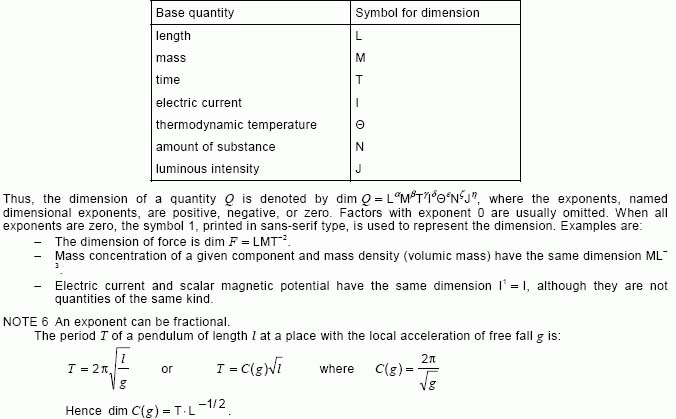
[IEV number 112-01-11]FR
dimension, f
dimension d'une grandeur, f
expression de la dépendance d’une grandeur par rapport aux grandeurs de base d'un système de grandeurs sous la forme d'un produit de puissances de facteurs correspondant aux grandeurs de base, en omettant tout facteur numérique
NOTE 1 – Une puissance d'un facteur est le facteur muni d'un exposant. Chaque facteur exprime la dimension d'une grandeur de base.
NOTE 2 – Par convention, la représentation symbolique de la dimension d'une grandeur de base est une lettre majuscule unique en caractère romain (droit) sans empattement. Par convention, la représentation symbolique de la dimension d'une grandeur dérivée est le produit de puissances des dimensions des grandeurs de base conformément à la définition de la grandeur dérivée. La dimension de la grandeur Q est notée dim Q.
NOTE 3 – Pour établir la dimension d'une grandeur, on ne tient pas compte du caractère scalaire, vectoriel ou tensoriel.
NOTE 4 – Dans un système de grandeurs donné, – les grandeurs de même nature ont la même dimension, – des grandeurs de dimensions différentes sont toujours de nature différente, – des grandeurs ayant la même dimension ne sont pas nécessairement de même nature. Par exemple, dans l'ISQ, la pression et l'énergie volumique ont la même dimension L–1MT–2. Voir aussi la note 5.
NOTE 5 – Dans le Système international de grandeurs (ISQ), les symboles représentant les dimensions des grandeurs de base sont:
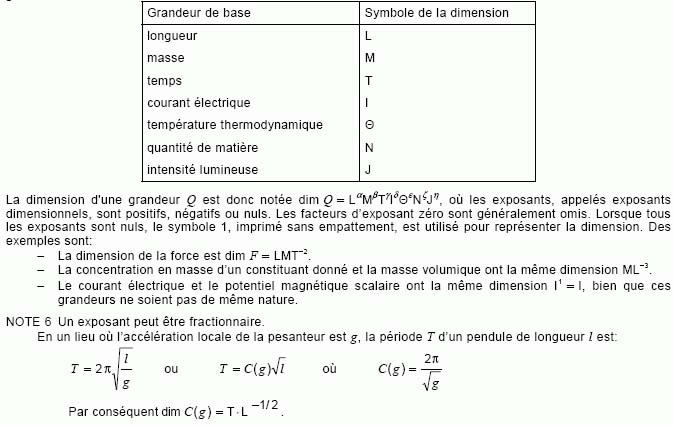
[IEV number 112-01-11]Тематики
- метрология, основные понятия
Синонимы
EN
DE
- Dimension einer Grösse
- Dimension, f
- Größendimension, f
FR
- dimension d'une grandeur, f
- dimension, f
2.9. Размерность физической величины
Размерность величины Нрк. Формула размерности
D. Dimension einer GroBe
E. Dimensions of a quantity
F. Dimension d’une grandeur
Выражение, отражающее связь величины с основными величинами системы, в котором коэффициент пропорциональности принят равным 1.
Примечания:
1. Размерность величины представляет собой произведение основных величин, возведенных в соответствующие степени.
2. Размерность производной величины отражает, во сколько раз изменяется ее размер при изменении размеров основных величин, например, если размерность величины х равна LaM^Tv и длина изменяется от / до /', масса — от m до т' и время — от t до то новый размер величины будет больше прежнего в (/'//)а
(/'//)v раз.
Источник: ГОСТ 16263-70: Государственная система обеспечения единства измерений. Метрология. Термины и определения оригинал документа
Русско-немецкий словарь нормативно-технической терминологии > размерность физической величины
-
2 незащищенный полюс автоматического выключателя
незащищенный полюс автоматического выключателя
Полюс, не оснащенный максимальным расцепителем тока.
[ ГОСТ Р 50031-99]
незащищенный полюс
Полюс, не оснащенный максимальным расцепителем тока, но в остальном способный функционировать так же, как защищенный полюс того же автоматического выключателя:
а) во исполнение этого требования незащищенный полюс может иметь такую же конструкцию, как один или более защищенных полюсов, или особую конструкцию;
б) если отключающая способность незащищенного полюса иная, чем у одного или более защищенных полюсов, это должно быть оговорено изготовителем
[ ГОСТ Р 50345-99( МЭК 60898-95)]
незащищенный полюс (от сверхтока)
-
[IEV number 442-05-41]EN
unprotected pole
pole without overcurrent release (see 3.3.6), but otherwise generally capable of the same performance as a protected pole of the same circuit-breaker
NOTE 1 - To ensure compliance with this requirement, the unprotected pole may be of the same construction as the protected pole(s), or of a particular construction.
NOTE 2 - If the short-circuit capacity of the unprotected pole is different from that of the protected pole(s), this has to be indicated by the manufacturer.
[IEC 60898-1, ed. 1.0 (2002-01)]
(overcurrent) unprotected pole (of a circuit-breaker)
a pole without overcurrent release, but otherwise generally capable of the same performance as a protected pole of the same circuit-breaker
[IEV number 442-05-41]FR
pôle non protégé
pôle sans déclencheur à maximum de courant (voir 3.3.6), mais, hormis cela, généralement capable des mêmes performances qu'un pôle protégé du même disjoncteur
NOTE 1 - Pour assurer cette prescription, le pôle non protégé peut être de la même construction que le ou les pôles protégés ou d'une construction particulière.
NOTE 2 - Si le pouvoir de coupure du pôle non protégé est différent de celui du ou des pôles protégés ceci sera indiqué par le constructeur
[IEC 60898-1, ed. 1.0 (2002-01)]
pôle (d'un disjoncteur) non protégé contre les surintensités
pôle sans déclencheur à maximum de courant, mais à part cela généralement capable des mêmes performances qu'un pôle protégé contre les surintensités du même disjoncteur
[IEV number 442-05-41]Тематики
EN
DE
FR
Русско-немецкий словарь нормативно-технической терминологии > незащищенный полюс автоматического выключателя
-
3 время дифференцирования
- Differenzierzeit, f
время предварения
время дифференцирования
Время, в течение которого входной сигнал, изменяющийся с постоянной скоростью, достигнет значения выходного сигнала, изменяющегося с той же скоростью, в момент начала отсчета.
[ ГОСТ 9988-84]EN
derivative action time
for a derivative element the same as the derivative action coefficient, if its input and output variables have the same unit
Note 1 – Then the derivative action time is given by TD = KD, where KD is the derivative action coefficient.
Note 2 – The derivative action time can also be given as the duration of the time interval that a rampwise variation of the input variable needs to reach the same value as the stepwise varying output variable.
[IEV ref 351-28-26]FR
constante de temps de dérivation
pour un élément à action par dérivation, la constante de temps de dérivation est égale au coefficient d'action par dérivation, si ses variables d'entrée et de sortie sont dans la même unité
Note 1 – La constante de temps de dérivation est alors donnée par TD = KD, où KD est le coefficient d'action par dérivation.
Note 2 – La constante de temps de dérivation peut également être donnée comme la durée de l'intervalle de temps nécessaire pour qu'une variation en rampe de la variable d'entrée atteigne la même valeur que la variable de sortie correspondante.
[IEV ref 351-28-26]Тематики
- автоматизация, основные понятия
Синонимы
EN
DE
- Differenzierzeit, f
FR
Русско-немецкий словарь нормативно-технической терминологии > время дифференцирования
-
4 время интегрирования
- Integrierzeit, f
время интегрирования
Время, в течение которого интегральная составляющая регулятора изменяет выходной сигнал на значение, равное значению скачкообразного изменения входного сигнала.
[ ГОСТ 9988-84]EN
integral action time
for an integral element, the reciprocal of the integral action coefficient, if its input and output variables have the same unit
Note 1 – The integral action time then is given by
TI=1/KI
where KI is the integral action coefficient.
Note 2 – The integral action time can also be given as that duration of the time interval which the output variable needs to reach the same value as a stepwise variation of the input variable.
[IEV ref 351-28-21]FR
constante de temps d'intégration
pour un élément à action par intégration, inverse du coefficient d'action par intégration, si ses variables d'entrée et de sortie sont dans la même unité
Note 1 – La constante de temps d'intégration est alors donnée par
TI=1/KI
où KI est le coefficient d'action par intégration.
Note 2 – La constante de temps d'intégration peut également être donnée comme la durée de l'intervalle de temps nécessaire pour que la variable de sortie atteigne la même valeur qu'une variation en échelon de la variable d'entrée.
[IEV ref 351-28-21]Тематики
- автоматизация, основные понятия
EN
DE
- Integrierzeit, f
FR
Русско-немецкий словарь нормативно-технической терминологии > время интегрирования
-
5 дифференциальный измерительный прибор
дифференциальный измерительный прибор
-
[IEV number 312-02-26]EN
differential measuring instrument
instrument intended to measure the difference between the values of two quantities of the same kind existing at practically the same instant in different circuits
[IEV number 312-02-26]FR
appareil de mesure de différence
appareil destiné à mesurer la différence entre les valeurs de deux grandeurs de même nature existant pratiquement au même instant dans deux circuits différents
[IEV number 312-02-26]Тематики
- измерение электр. величин в целом
EN
DE
FR
Русско-немецкий словарь нормативно-технической терминологии > дифференциальный измерительный прибор
-
6 жила пучковой скрутки
- verwürgter Leiter, m
- Litze, f
жила пучковой скрутки
Ндп. жила дикой скрутки
Ндп. жила шнуровой скрутки
Многопроволочная жила, проволоки или стренги которой скручены в одну сторону без распределения по повивам.
[ ГОСТ 15845-80]
токопроводящая жила пучковой скрутки
жила, состоящая из ряда отдельных проволок, скрученных вместе по спирали в одну сторону и с одним шагом
[IEV number 461-01-09]EN
bunched conductor
stranded conductor in which the wires are assembled together in helical formation in a random manner, all in the same direction and with the same length of lay
[IEV number 461-01-09]FR
âme tordonnée
âme câblée dont les fils individuels sont assemblés en hélice, de même sens et de même pas sans constituer de couches définies
[IEV number 461-01-09]Недопустимые, нерекомендуемые
Тематики
- кабели, провода...
EN
DE
- Litze, f
- verwürgter Leiter, m
FR
Русско-немецкий словарь нормативно-технической терминологии > жила пучковой скрутки
-
7 местная резервная защита подстанции
- örtlicher Reserveschutz (stationsbezogen), m
местная резервная защита подстанции
Резервная защита с питанием от измерительных трансформаторов, расположенных на той же самой подстанции, что и соответствующая основная защита, и не соединенных с той же самой первичной цепью.
[Разработка типовых структурных схем микропроцессорных устройств РЗА на объектах ОАО "ФКС ЕЭС". Пояснительная записка. Новосибирск 2006 г.]EN
substation local backup protection
backup protection which is energized from instrument transformers located within the same substation as the corresponding main protection and not associated with the same primary circuit
[IEV ref 448-11-16]FR
protection de secours locale de poste
protection de secours alimentée par des transformateurs de mesure situés dans le même poste que ceux alimentant la protection principale correspondante mais non raccordés dans la même cellule
[IEV ref 448-11-16]Тематики
EN
DE
- örtlicher Reserveschutz (stationsbezogen), m
FR
Русско-немецкий словарь нормативно-технической терминологии > местная резервная защита подстанции
-
8 НКУ пультовое
- Befehls- und/oder Meldeeinheit
НКУ пультовое
Защищенное НКУ с горизонтальной или наклонной панелью управления или как с той, так и другой панелью, на которых размещены аппараты управления, измерения, сигнализации и т.д.
[ ГОСТ Р 51321. 1-2000 ( МЭК 60439-1-92)]
пультовое НКУ
Защищенное НКУ с горизонтальной или наклонной панелью управления либо имеющее обе панели, на которых размещена аппаратура управления, измерения, сигнализации и т.д.
[ ГОСТ Р МЭК 61439.1-2013]
пульт управления
Система, образованная одним или несколькими аппаратами цепей управления, расположенными на одной панели или в одном корпусе.
Примечание
Панель или корпус пульта управления может содержать также аппаратуру смежного оборудования, например потенциометр, световые индикаторы, контрольные приборы и т. д.
[ ГОСТ 50030.5.1-2005]EN
control station
an assembly of one or more control switches fixed on the same panel or located in the same enclosure
NOTE – A control station panel or enclosure may also contain related equipment, e.g., potentiometers, signal lamps, instruments, etc.
[IEV number 441-12-08]FR
poste de commande
ensemble constitué par un ou plusieurs auxiliaires de commande fixés sur le même panneau ou situés dans la même enveloppe
NOTE – Un panneau ou une enveloppe d'un poste de commande peut aussi contenir des appareils associés, par exemple: potentiomètres, lampes de signalisation, appareils de mesure, etc.
[IEV number 441-12-08]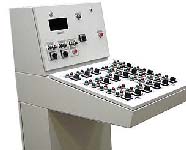
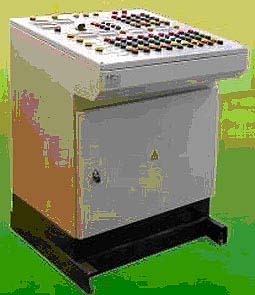
Пульт с вертикальной надстройкой
Пульт без вертикальной надстройки
Тематики
- НКУ (шкафы, пульты,...)
Классификация
>>>Обобщающие термины
Синонимы
EN
DE
- Befehls- und/oder Meldeeinheit
FR
Русско-немецкий словарь нормативно-технической терминологии > НКУ пультовое
-
9 падение или повышение напряжения при заданном режиме нагрузки
падение или повышение напряжения при заданном режиме нагрузки
Разность между напряжением холостого хода обмотки и напряжением на ее выводах при заданных нагрузке и коэффициенте мощности при условии, что к другой (или к одной из других) обмотке(ок) подведено напряжение, равное:
- номинальному, если трансформатор включен на основное ответвление (в этом случае напряжение холостого хода рассматриваемой обмотки равно номинальному);
- напряжению другого ответвления, на которое включен трансформатор. Падение или повышение напряжения обычно выражают в процентах напряжения холостого хода рассматриваемой обмотки.
Примечание — В многообмоточном трансформаторе падение или повышение напряжения зависит от нагрузки и коэффициента мощности не только данной обмотки, но и других обмоток
(МЭС 421-07-03).
[ ГОСТ 30830-2002]EN
voltage drop or rise for a specified load condition
voltage regulation for a specified load condition
the arithmetic difference between the no-load voltage of a winding and the voltage developed at the terminals of the same winding at a specified load and power factor, the voltage supplied to (one of) the other winding(s) being equal to:
- its rated value if the transformer is connected on the principal tapping (the no-load voltage of the former winding is then equal to its rated value);
- the tapping voltage if the transformer is connected on another tapping.
This difference is generally expressed as a percentage of the no-load voltage of the former winding
NOTE – For multi-winding transformers, the voltage drop or rise depends not only on the load and power factor of the winding itself, but also on the load and power factor of the other windings
[IEV number 421-07-03]FR
hute ou augmentation de tension pour une condition de charge spécifiée
différence arithmétique entre la tension à vide d'un enroulement et la tension en charge aux bornes du même enroulement pour un courant de charge et un facteur de puissance spécifiés, la tension appliquée à l'autre (ou à l'un des autres) enroulement(s) étant égale:
- à sa valeur assignée, si le transformateur est connecté sur la prise principale (la tension à vide du premier enroulement étant alors égale à sa valeur assignée);
- à la tension de prise si le transformateur est connecté sur une autre prise.
Cette différence s'exprime généralement sous la forme d'un pourcentage de la tension à vide du premier enroulement
NOTE – Pour les transformateurs à plus de deux enroulements, la chute ou l'augmentation de tension dépend non seulement de la charge et du facteur de puissance de l'enroulement lui-même, mais aussi de la charge et du facteur de puissance des autres enroulements.
[IEV number 421-07-03]Тематики
Классификация
>>>EN
- voltage drop or rise for a specified load condition
- voltage regulation for a specified load condition
DE
FR
Русско-немецкий словарь нормативно-технической терминологии > падение или повышение напряжения при заданном режиме нагрузки
-
10 тип счетчика
1
тип счетчика
термин, используемый для определения совокупности конкретной конструкции счетчика, имеющей:
а) сходные метрологические характеристики;
б) конструктивное подобие элементов, определяющих эти характеристики.
Тип может иметь несколько значений номинального тока и номинального напряжения.
Счетчики обозначаются изготовителем одной или большим числом групп букв или цифр, или комбинацией букв и цифр. Каждый тип имеет только одно обозначение.
Примечание - Данный тип представляют один или несколько образцов счетчиков, предназначенных для проведения испытаний для целей утверждения типа, характеристики которых (номинальные токи и номинальные напряжения) соответствуют значениям, указанным изготовителем.
[ ГОСТ 6570-96]2
тип счетчика
-
[IEV number 314-07-07]EN
meter type
particular design of meter, manufactured by one manufacturer, having:
a) similar metrological properties;
b) the same uniform construction of parts determining these properties;
c) the same ratio of the maximum current to the reference current
NOTE 1 – The type may have several values of reference current and reference voltage.
NOTE 2 – Meters are designated by the manufacturer by one or more groups of letters or numbers, or a combination of letters and numbers. Each type has one designation only.
NOTE 3 – The type is represented by the sample meter(s) intended for the type tests and whose characteristics (reference current and reference voltage) are chosen from the values given in the tables proposed by the manufacturer.
[IEV number 314-07-07]FR
type
ensemble des compteurs fabriqués par un même constructeur et ayant:
a) des qualités métrologiques similaires;
b) l’uniformité constructive des constituants déterminant ces qualités;
c) un même rapport entre courant maximal et courant de référence
NOTE 1 – Le type peut comporter différentes valeurs de courant de référence et de tension de référence.
NOTE 2 – Les compteurs sont désignés par le constructeur, par une ou plusieurs associations soit de lettres, soit de chiffres. A chaque type correspond une seule désignation.
NOTE 3 – Le type est représenté par le ou les compteurs échantillons destinés aux essais de type et dont les caractéristiques (courant de référence et tension de référence) sont choisies parmi celles figurant dans les tableaux proposés par le constructeur.
[IEV number 314-07-07]Тематики
EN
DE
FR
Русско-немецкий словарь нормативно-технической терминологии > тип счетчика
-
11 цикл работы
цикл работы
-
[IEV number 151-15-12]EN
cycle of operation
sequence of operations that may be repeated in the same order and time scale
[IEV number 151-15-12]FR
cycle (de fonctionnement), m
suite de manœuvres susceptibles d'être renouvelées dans le même ordre et avec le même déroulement temporel
[IEV number 151-15-12]EN
DE
FR
- cycle (de fonctionnement), m
Русско-немецкий словарь нормативно-технической терминологии > цикл работы
-
12 асимметричный вход
асимметричный вход
-
[IEV number 312-06-08]EN
asymmetrical input
three terminal input circuit where the nominal values of the impedances between the common terminal and each of the other two terminals are different
NOTE – The common terminals of the input and the output need not necessarily both be accessible, nor need they be at the same potential.
[IEV number 312-06-08]FR
entrée asymétrique
circuit d'entrée à trois bornes dans lequel les valeurs nominales des impédances entre la borne commune et chacune des deux autres bornes sont différentes
NOTE – La borne commune de l'entrée et celle de la sortie ne sont pas nécessairement toutes deux accessibles, ni toutes deux au même potentiel.
[IEV number 312-06-08]Тематики
- измерение электр. величин в целом
EN
DE
FR
Русско-немецкий словарь нормативно-технической терминологии > асимметричный вход
-
13 асимметричный выход
асимметричный выход
-
[IEV number 312-06-09]EN
asymmetrical output
three-terminal output circuit where the nominal values of the impedances between the common terminal and each of the other two terminals are different
NOTE – The common terminals of the input and the output need not necessarily both be accessible, nor need they be at the same potential.
[IEV number 312-06-09]FR
sortie asymétrique
circuit de sortie à trois bornes dans lequel les valeurs nominales des impédances entre la borne commune et chacune des deux autres bornes sont différentes
NOTE – La borne commune de l'entrée et celle de la sortie ne sont pas nécessairement toutes deux accessibles, ni toutes deux au même potentiel.
[IEV number 312-06-09]Тематики
- измерение электр. величин в целом
EN
DE
FR
Русско-немецкий словарь нормативно-технической терминологии > асимметричный выход
-
14 асинхронное реактивное сопротивление
асинхронное реактивное сопротивление
-EN
asynchronous reactance
the quotient of the reactive component of the average voltage at rated frequency, assumed to be sinusoidal and balanced, applied to the armature winding of a machine rotating out of synchronism, and the average current component at the same frequency
[IEV ref 411-50-05]FR
réactance asynchrone
quotient de la composante réactive de la tension moyenne à la fréquence assignée, supposée sinusoïdale et symétrique, appliquée à l'enroulement d'induit d'une machine tournant hors synchronisme, par la composante du courant moyen à la même fréquence
[IEV ref 411-50-05]Тематики
- электротехника, основные понятия
EN
DE
FR
Русско-немецкий словарь нормативно-технической терминологии > асинхронное реактивное сопротивление
-
15 ввод с бумажно-масляной изоляцией
ввод с бумажно-масляной изоляцией
Ввод, в котором основная изоляция состоит из бумаги, пропитанной изоляционной жидкостью.
Примечание. Бумага, в основном, пропитывается трансформаторным маслом.
[ ГОСТ 27744-88]EN
oil-impregnated paper bushing
OIP
bushing in which the major insulation consists of a core wound from paper and subsequently treated and impregnated with an insulating liquid, generally transformer oil
NOTE The core is contained in an insulating envelope, the space between the core and the insulating envelope being filled with the same insulating liquid as that used for impregnation.
[IEC 60137, ed. 6.0 (2008-07)]FR
traversée en papier imprégnée d'huile
OIP (oil-impregnated paper)
traversée dont l'isolation principale est assurée par un corps enroulé en papier ultérieurement traité et imprégné d'un liquide isolant, généralement d'huile de transformateur
NOTE Le corps est placé dans une enveloppe isolante, l'espace entre le corps et l'enveloppe isolante étant rempli du même liquide isolant que celui employé pour l'imprégnation
[IEC 60137, ed. 6.0 (2008-07)]Тематики
EN
DE
FR
- OIP
- traversée en papier imprégné d’huile
Русско-немецкий словарь нормативно-технической терминологии > ввод с бумажно-масляной изоляцией
-
16 вращающаяся электрическая машина
вращающаяся электрическая машина
Электротехническое устройство, предназначенное для преобразования энергии на основе электромагнитной индукции и взаимодействия магнитного поля с электрическим током, содержащее, по крайней мере, две части, участвующие в основном процессе преобразования и имеющие возможность вращаться или поворачиваться относительно друг друга.
[ ГОСТ 27471-87]
электрическая машина
Электрическая машина, служит для преобразования механической энергии в электрическую и электрической в механическую, а также электрической энергии в электрическую же, отличающуюся по напряжению, роду тока, частоте и другим параметрам. Действие Э. м. основано на использовании явления электромагнитной индукции и законов, определяющих взаимодействие электрических токов и магнитных полей.
Для преобразования механической энергии в электрическую служат генераторы электромашинные, электрической энергии в механическую — двигатели электрические. Каждая из этих машин (в соответствии с Ленца правилом) энергетически обратима, т. е. может работать как в генераторном, так и в двигательном режиме; однако выпускаемые промышленностью Э. м. обычно предназначены для выполнения определённой работы (см. также Переменного тока машина, Постоянного тока машина, Асинхронная электрическая машина, Синхронная машина, Коллекторная машина).
Преобразования рода тока, частоты, числа фаз, напряжения осуществляют электромашинными преобразователями(см. Преобразовательная техника), электромашинными усилителями, трансформаторами электрическими.
К Э. м. относят также машины специального назначения, например тахогенератор, тяговый электродвигатель.
[БСЭ]EN
(electrical) rotating machine
an electrical apparatus depending on electromagnetic induction for its operation and having components capable of relative rotary movement and intended for converting energy
NOTE – This term also applies to electrical apparatus operating on the same principle and similar in construction and intended for other purposes, e.g. regulation, supplying or absorbing reactive power. It is not intended to cover electrostatic machines.
[IEV number 411-31-01]FR
machine (électrique) tournante
appareil électrique utilisant l'induction magnétique pour son fonctionnement, constitué d'éléments pouvant effectuer un mouvement relatif de rotation et destiné à la transformation de l'énergie
NOTE – Ce terme s'applique également aux appareils électriques fonctionnant suivant le même principe, de construction analogue et utilisés à d'autres fins, par exemple à des fins de régulation, de fourniture et d'absorption de puissance réactive. Il ne s'étend pas aux machines électrostatiques.
[IEV number 411-31-01]Тематики
Синонимы
EN
- electrical rotating machine
- electrical machine
- electrical rotating machinery
- rotating electrical machine
- rotating machine
DE
FR
Русско-немецкий словарь нормативно-технической терминологии > вращающаяся электрическая машина
-
17 время срабатывания электрического реле
время срабатывания электрического реле
Время от момента, когда входная воздействующая или характеристическая величина электрического реле, находящегося в начальном или исходном состоянии, принимает в заданных условиях определенное значение до момента, когда реле завершает срабатывание
[ ГОСТ 16022-83]EN
operate time
for a relay which is in the release condition (initial condition) the time interval between the instant a specified value of the input energizing quantity (characteristic quantity) is applied under specified condition and the instant when the relay switches
NOTE – This term is used only when the relay has output circuits of the same type and no precision is required according to contact time difference.
[IEV number 446-17-09]FR
temps de fonctionnement
temps d'action (terme déconseillé, utilisé pour les relais de tout ou rien)
pour un relais qui est dans l'état de repos ou dans un état initial, temps écoulé entre l'instant où la grandeur d'alimentation d'entrée ou la grandeur caractéristique prend, dans des conditions spécifiées, une valeur définie et l'instant où le relais commute
NOTE – Ce terme n'est utilisé que lorsque le relais ne comporte que des circuits de sortie de même nature et qu'aucune précision n'est nécessaire quant à la dispersion des temps de contact.
[IEV number 446-17-09]Тематики
EN
DE
FR
122. Время срабатывания электрического реле
D. Betätigungszeit
E. Operate time
F. Temps de fonctionnement;
Temps d’action (pour relais de tout ou rien)
Время от момента, когда входная воздействующая или характеристическая величина электрического реле, находящегося в начальном или исходном состоянии, принимает в заданных условиях определенное значение до момента, когда реле завершает срабатывание
Источник: ГОСТ 16022-83: Реле электрические. Термины и определения оригинал документа
Русско-немецкий словарь нормативно-технической терминологии > время срабатывания электрического реле
-
18 входная воздействующая величина измерительного электрического реле
входная воздействующая величина измерительного электрического реле
Воздействующая величина электрического реле, которая сама представляет характеристическую величину или необходима для ее образования
[ ГОСТ 16022-83]EN
input energizing quantity
for a measuring relay: that energizing quantity which either by itself constitutes the characteristic quantity or helps to constitute it
[IEV number 446-12-02]FR
grandeur d'alimentation d'entrée
pour un relais de mesure: grandeur d'alimentation qui constitue par elle-même la grandeur caractéristique ou qui est nécessaire à sa constitution
[IEV number 446-12-02]Тематики
Классификация
>>>EN
DE
FR
51. Входная воздействующая величина измерительного электрического реле
D. Erregungsgrösse
Е. Input energizing quantity
F. Grandeur d’alimentation d’entrée
Воздействующая величина электрического реле, которая сама представляет характеристическую величину или необходима для ее образования
Источник: ГОСТ 16022-83: Реле электрические. Термины и определения оригинал документа
Русско-немецкий словарь нормативно-технической терминологии > входная воздействующая величина измерительного электрического реле
-
19 входное полное сопротивление
входное полное сопротивление
-
[IEV number 312-06-18]EN
input impedance
impedance of the input circuit measured between the input terminals under operating conditions
NOTE 1 – The impedance can be expressed in terms of admittance.
NOTE 2 – In certain instances, for example, sampling devices or self-balancing potentiometers, the impedance can be different according to the instant when it is determined, before, during or after the instant of measurement.
NOTE 3 – When the input circuit is such that the instantaneous value of the current flowing into the input terminals is a non-linear function of the instantaneous value of the input voltage under specified conditions of frequency and voltage, the combination of resistance and reactance which would absorb the same active power and in which would flow a reactive current equal to the fundamental component that is flowing in the actual input circuit, is sometimes called the "equivalent input impedance".
[IEV number 312-06-18]FR
impédance du circuit d'entrée
impédance du circuit d'entrée entre les bornes d'entrée dans les conditions de fonctionnement
NOTE 1 – L'impédance peut être exprimée en termes d'admittance.
NOTE 2 – Dans certains cas, par exemple les dispositifs d'échantillonnage ou les potentiomètres à rééquilibrage automatique, l'impédance peut être différente selon l’instant où elle est déterminée, avant, pendant ou après la mesure.
NOTE 3 – Lorsque le circuit d'entrée est tel que la valeur instantanée du courant traversant les bornes d'entrée est une fonction non linéaire de la valeur instantanée de la tension d'entrée dans des conditions spécifiées de fréquence et de tension, l'impédance d'une combinaison formée par une résistance et une réactance qui absorberaient la même puissance active et dans laquelle circulerait un courant réactif égal à la composante fondamentale qui circule dans le circuit d'entrée réel, est parfois appelée "impédance équivalente d'entrée".
[IEV number 312-06-18]Тематики
- измерение электр. величин в целом
EN
DE
FR
Русско-немецкий словарь нормативно-технической терминологии > входное полное сопротивление
-
20 выходное полное сопротивление
выходное полное сопротивление
-
[IEV number 312-06-19]EN
output impedance
impedance of the output circuit measured between the output terminals under operating conditions
NOTE 1 – The impedance can be expressed in terms of admittance.
NOTE 2 – In certain instances, for example, sampling devices or self-balancing potentiometers, the impedance can be different according to the instant when it is determined, before, during or after the instant of measurement.
NOTE 3 – When the output circuit is such that the instantaneous value of the current flowing into the output terminals is a non-linear function of the instantaneous value of the output voltage under specified conditions of frequency and voltage, the combination of resistance and reactance which would absorb the same active power and in which would flow a reactive current equal to the fundamental component that is flowing in the actual output circuit, is sometimes called the "equivalent output impedance".
[IEV number 312-06-19]FR
impédance du circuit de sortie
impédance du circuit de sortie entre les bornes de sortie dans les conditions de fonctionnement
NOTE 1 – L'impédance peut être exprimée en termes d'admittance.
NOTE 2 – Dans certains cas, par exemple les dispositifs d'échantillonnage ou les potentiomètres à rééquilibrage automatique, l'impédance peut être différente selon l’instant où elle est déterminée, avant, pendant ou après la mesure.
NOTE 3 – Lorsque le circuit de sortie est tel que la valeur instantanée du courant traversant les bornes de sortie est une fonction non linéaire de la valeur instantanée de la tension de sortie dans des conditions spécifiées de fréquence et de tension, l'impédance d'une combinaison formée par une résistance et une réactance qui absorberaient la même puissance active et dans laquelle circulerait un courant réactif égal à la composante fondamentale qui circule dans le circuit de sortie réel, est parfois appelée "impédance équivalente de sortie".
[IEV number 312-06-19]Тематики
- измерение электр. величин в целом
EN
DE
FR
Русско-немецкий словарь нормативно-технической терминологии > выходное полное сопротивление
См. также в других словарях:
mémé — mémé … Dictionnaire des rimes
même — même … Dictionnaire des rimes
mémé — [ meme ] n. f. • 1884; var. dial. de mémère ♦ Fam. 1 ♦ Enfantin Grand mère. ⇒ mamie. Où est ta mémé ? Mémé, ma mémé est partie. (Appellatif) Bonjour mémé ! ⇒ mémère. 2 ♦ péj. Femme d un certain âge, sans séduction. Les « mémés sur les plages qui… … Encyclopédie Universelle
même — mémé [ meme ] n. f. • 1884; var. dial. de mémère ♦ Fam. 1 ♦ Enfantin Grand mère. ⇒ mamie. Où est ta mémé ? Mémé, ma mémé est partie. (Appellatif) Bonjour mémé ! ⇒ mémère. 2 ♦ péj. Femme d un certain âge, sans séduction. Les « mémés sur les plages … Encyclopédie Universelle
Meme — bezeichnet Meme (Kamerun), einen Bezirk in der Region Sud Ouest von Kamerun Même bezeichnet Même (Fluss), einen Fluss in Frankreich, Nebenfluss der Huisne Sainte Même, eine französische Gemeinde im Département Charente Maritime Saint Même le Tenu … Deutsch Wikipedia
mėmė — mėmė̃ scom. (4) Glv, Jrb, mė̃mė (2) Ds, Tr, mėmė (1) Als menk. tylus, lėtas, mažakalbis žmogus, nevykėlis, žioplys, užaušėlis: Jis toks mėmė̃, t. y. mažkalbis J. Ko tyli kap mėmė̃? Btr. Jis pasidarė tokis mėmė̃, kad žodžio negalėjai iš jo… … Dictionary of the Lithuanian Language
mėmė — Bendroji informacija Kirčiuota forma: mė̃mė Kirčiuotė: 2 Rūšis: naujadaras Kalbos dalis: daiktavardis Kilmė: lietuvių, plg. anglų k. meme. Pateikta: 2013 12 18. Atnaujinta: 2014 01 07. Reikšmė ir vartosena Apibrėžtis: komiškas kultūrinės… … Lietuvių kalbos naujažodžių duomenynas
meme — (n.) 1976, introduced by evolutionary biologist Richard Dawkins in The Selfish Gene, coined by him from Greek sources, e.g. mimeisthai to imitate (see MIME (Cf. mime)), and intended to echo gene. We need a name for the new replicator, a noun that … Etymology dictionary
Même si — est une pièce de théâtre de Christine Angot créée en 1996. Mises en scène Cette section est vide, insuffisamment détaillée ou incomplète. Votre aide est la bienvenue ! 1996 : mise en scène de Denis Lanoy, Théâtre au Présent, Chai du… … Wikipédia en Français
Même — Porté notamment dans le Maine et Loire, le nom peut aussi s écrire Mesme (72). C est une forme populaire et régionale du prénom Maxime … Noms de famille
mėmė — mėmė̃ dkt … Bendrinės lietuvių kalbos žodyno antraštynas
