

-
1 main steam support structure
Engineering: MSSSУниверсальный русско-английский словарь > main steam support structure
-
2 main support structure
Military: MSSУниверсальный русско-английский словарь > main support structure
-
3 конструкция
construction, structure
- (элемент) — structure
-, безопасно разрушаемая — fail-safe structure
принцип безопасно разрушаемей конструкции заложен в проект самолета. — aircraft is designed to "занsafeп principle. fail-safe philosophy is fully employed in aircraft.
-, блочная — module construction
-, вспомогательная — secondary structure
-, кессонная — torsion box structure
-, клееная — bonded structure
-, композиционная — composite structure
-, коробчатая — box structure
- крыла — wing structure
- купола парашюта с расположением нитей ткани параллельно оси полотнища — parachute саперу block construction. arrangement of the gores such that the direction of the weft threads of the fabric is parallel to the gore centreline.
- купола парашюта с расположением нитей ткани под углом (к оси полотнища) — parachute canopy bias eonstruction. arrangement of the gores such that the direction of threads of the fabric makes an angle of 45 grad. with the gore centreline.
-, моноблочная (неразъемная) — single-piece structure
-, несиловая — secondary structure
-, основная (ла) — main structure
- планера самолета, вертолета — airframe structure
- планера самолета (заголовок раздела) — structure
- планера и несущей системы (вертолета) — (helicopter) flight structure
включает несущий и хвостовой винты, органы их управления, фюзеляж и основные элементы крепежа. — flight structure includes гоtors, controls, fuselage, and their related primary attachments.
-, сварная — weldment
узел, части которого соединены сваркой. — an assembly whose соmрonent parts are joined by welding.
-, силовая — load-carrying /-supporting/ structure, primary structure
-, силовая (на которую воздействуют нагрузки на землe и в полете) — structure supporting the flight and ground loads
-, с многоярусной прочностью — multipath structure
- с работающей обшивкой — stressed-skin structure
вид конструкции ла, у которого наружная обшивка несет нагрузки, воздействующие на конструкцию. — а type of aircraft construetion in which the strength of the external skin is utilized to carry structural loads.
-, слоистая — sandwich
элемент конструкции, состоящий из двух параллельных наружных обшивок с заполнителем (между ними) из другого материала. — а structural component сопsisting of two parallel skins attached to either side of a core of а material of different properties.
-, сотовая — honeycomb structure
-, статически неопределимая — statically indeterminate structure
-, статически определимая — statically determinate structure
-, ферменная — truss structure
-, цельнометаллическая — all-metal structure
изменение к. — change in design
изменение к. (доработка) — modification
особенности к. — design features
отличия к. — structural differences
прочность к. — structural strength
элементы к. (планера) — structuresРусско-английский сборник авиационно-технических терминов > конструкция
-
4 расчалка
(bracing) wire
(проволочная)
-, внешняя — external bracing wire
-, внутренняя — internal bracing wire
-, ленточная — streamline wire
проволочная расчалка обтекаемой формы в сечении дпя уменьшения лобового сопротивления. — а wire the cross section of which is elongated to reduce its drag.
- в плоскости стоек (крыла биплана) — incidence wire. wires or cables bracing the main plane structure in the plane of a pair of front and rear struts.
-, несущая (крыла биплана) (рис. 2) — lift (bracing) wire
для передачи подъемной силы несущей поверхности на основную конструкцию ла. — то transfer the lift of the main planes to the main structure.
-, обратная (поддерживающая) — landing (bracing) wire
для противодействия силам, направпенным против подъемной силы несущей поверхности. — то resist forces in the орроsite direction to the lift.
-, проволочная — bracing wire
-, работающая на силу лобового сопротивления — drag wire
для противодействия силам лобового сопротивления. — то resist forces in the general direction of the drag.Русско-английский сборник авиационно-технических терминов > расчалка
-
5 основная конструкция
1) Aviation: basic design2) Astronautics: load-bearing structure, main structure3) Makarov: main frameУниверсальный русско-английский словарь > основная конструкция
-
6 конструкция несущая
Русско-английский глоссарий по космической технике > конструкция несущая
-
7 поворотная платформа
1) Naval: turntable platform2) Military: traverse platform3) Engineering: pivoting floor (экскаватора), racer, saddle, swing frame, swing frame assembly, swinging circle, traversing platform, turntable, revolving platform4) Construction: turntable (напр, экскаватора)5) Railway term: swinging circle (экскаватора)6) Oil: turn-table7) Drilling: turnplate8) Automation: pivot, rotating platform (напр. крана)9) General subject: main structure, upper structureУниверсальный русско-английский словарь > поворотная платформа
-
8 вакуумный автоматический выключатель
вакуумный автоматический выключатель
Выключатель, контакты которого размыкаются и замыкаются в сильно разряженной атмосфере внутри оболочки.
(МЭС 441-14-29)
[ ГОСТ Р 50030. 2-99 ( МЭК 60947-2-98)]EN
vacuum circuit-breaker
circuit-breaker in which the contacts open and close within a highly evacuated envelope.
[IEC 60077-4, ed. 1.0 (2003-02)]FR
disjoncteur à vide
disjoncteur dont les contacts s'ouvrent et se ferment dans une enceinte où règne un vide poussé.
[IEC 60077-4, ed. 1.0 (2003-02)]Параллельные тексты EN-RU
Susol VCB series are premium-type products featuring main structure with high reliability application and a variety of accessories and ability to maximize to be suitable for use as the main circuit breaker to protect key installations in the places such as device industry, power plants, high-rise buildings, large ships.
[LS Industrial Systems]Вакуумные автоматические выключатели Susol являются устройствами премиум-класса, характеризующимися надежной конструкцией, наличием разнообразных дополнительных принадлежностей и возможностью применения в качестве вводного автоматического выключателя, обеспечивающего защиту ключевых электроустановок промышленных предприятий, электростанций, высотных зданий и крупных судов.
[Перевод Интент]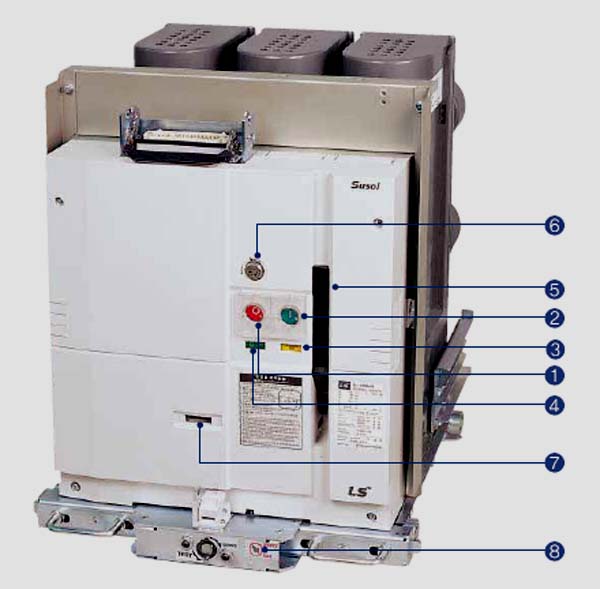
Рис. LS Industrial Systems
Вакуумный автоматический выключатель Susol1
Push ON Button
Кнопка ВКЛ.
2
Push OFF Button
Кнопка ОТКЛ.
3
Charge/Discharge Indicator
Индикатор состояния пружины ВЗВЕДЕНА/РАЗРЯЖЕНА
4
ON/OFF Indicator
Индикатор коммутационного положения автоматического выключателя ВКЛ/ОТКЛ.
5
Manual Charging Handle
Рукоятка ручного взвода пружины
6
Key Lock
Замок
7
Operation Counter
Счетчик коммутационных циклов
8
TEST/SERVICE Position Indicator
Указатель положения автоматического выключателя в корзине ИСПЫТАТЕЛЬНОЕ/ПРИСОЕДИНЕННОЕ
Тематики
Классификация
>>>Обобщающие термины
EN
FR
Русско-английский словарь нормативно-технической терминологии > вакуумный автоматический выключатель
-
9 поверхность корпуса
1) Engineering: housing face, housing surface2) Astronautics: main structureУниверсальный русско-английский словарь > поверхность корпуса
-
10 каркас
main frame, carcass, frame-
work, primary structure, primary skeleton
- крыла — wing main frame
каркас крыла включает следующие элементы: лонжероны, нервюры, стрингеры, элементы конструкции баковкессонов, окантовки лючков (рис.10). — the primary skeleton of the wing. includes spars, ribs, stringers, integral fuef tank structure, tip tank supporting structure and frames around opening.
- мотогондолы — nacelle main frame
каркас мотогондопы вкпючает: лонжероны, шпангоуты, перегородки, противопожарные (пожарные перегородки, стрингеры, окантовки вырезов под крышки капотов (рис.45). — the primary skeleton of naсеlle or pylon. includes items such as frames, bulkheads, firewalls, stringers, keel, frames around openings, etc.
- пилона (рис.45) — pylon main frame
- покрышки (пневматика) — tire carcass
-, пружинный (вытяжного парашюта) — spring-loaded frame /band/
-, радиальный (купола парашюта) — radial bands
- сектора (тормозного диска) — segment base structure
-, усилительный (купола парашюта) — reinforcing bands
- фюзеляжа (рис. 6) — fuselage main frame
- шины (пневматика) — tire carcassРусско-английский сборник авиационно-технических терминов > каркас
-
11 шасси (ла)
landing gear
(разд. 032)
система опор (обычно убираемых в полете), предназначенная для обеспечения требуемого положения самолета на стоянке, передвижения земле (воде), смягчения и частичного поглощения возникающих при этом нагрузок. — units and components which furnish means of supporting and steering the aircraft on the ground or water, and make it possible to retract and store landing gear in flight.
- (в тексте о шасси, на графике) — gear
- (радиоаппаратуры) — chassis
рама, на которой монтируются элементы и проводка электронной схемы. — a frame which mounts electronic components and their associated circuitry.
-, бесподкосное — cantilever landing gear
-, велосипедное — bicycle landing gear
система опор шасси, расположенных одна за другой по продольной оси самолета, на концах крыла устанавливаются опорные колеса (рис. 26). — landing gear units set one behind the other under the longitudinal center of the fuselage, the wings being supported by small outrigger wheels.
- в промежуточном положении (или в движении на выпуск или уборку) — landing gear in transit the red door and intransit lights will be illuminated if any gear door is open and lg not locked.
"- в процессе выпуска/уборки" (табло) — lg in transit (light)
-, вспомогательное (напр., хвостовая опора) — supplementary gear
-, выпускаемое сбросом с замков убранного положения и с дожимом встречным потоком до постановки на замки выпущенного положения — free-fall wind-assisted extending landing gear
-, выпущенное — extended landing gear
- выпущено (надпись) — (lg) down
-, главное (рис. 29) — main landing gear
-, зафиксированное замками выпущенного положения — landing gear locked down
-, зафиксированное замками убранного положения — landing gear locked up
-, колесное — wheel(ed) landing gear
-, комбинированное — all-surface landing gear
-, крыльевое (при наличии фюзеляжных) — main wing landing gear
-, лыжное (вертолета) — skid landing gear
-, лыжное (самолета) — ski landing gear
-, многоколесное — multi-wheel landing gear
"- he выпущено" (не зафиксированы замками выпущенного положения) (табло) — unsafe lg
- не зафиксировано замками выпущенного положения — landing gear not locked down
- не на замках (т.е. не зафиксировано замками выпущенного положения) — unsafe landing gear (unsafe lg)
-, неубирающееся — nonretractable landing gear
шасси, жестко закрепленное к силовым элементам планеpa самолета. — а landing gear which is rigidly attached to the primary structure of an aircraft.
-, однополозное (вертолета) — single-skid landing gear
-, основное — main landing gear
главные стойки, обеспечивающие основную опору ла на земле (рис. 29). — l.g. units providing major support for the aircraft while on the ground.
- основное фюзеляжное (при многоопорной схеме напр., со средней основной ногой) — main body landing gear
-, подкрыльевое (основная стойка) — (main) wing landing gear
-, полозковое (вертолета) — skid landing gear
- (с подвеской колес) полурычажного типа (рис. 27) — semi-levered suspension landing gear
-, поплавковое (рис. 4) — float-type landing gear
- (с подвеской колес) рычажного типа (рис. 27) — levered-suspension landing gear
-, самоориентирующееся — castoring landing gear
- с опорными колесами на концах крыла (рис. 26) — landing gear with wingtip outrigger wheels
- с передним колесом, трехопорное — tricycle nose wheel landing gear
- с подкрыльными колесами, велосипедное (рис. 26) — bicycle landing gear with wingtip outrigger wheels
- с полурычажной подвеской (колес) (рис. 27) — semi-levered suspension landing gear
-, среднее (фюзеляжное) — main body landing gear
- с рычажной подвеской (колес) (рис. 27) — levered-suspension landing gear
- с фюзеляжными и подкрыльевыми стойками — main body and wing landing gear
- с хвостовым колесом (рис. 2) — tail-wheel landing gear
- с хвостовым колесом, трехопорное — tricycle tail wheel landing gear
- тележечного типа (четырехколесное) — (four-wheel) bogie landing gear
основная опора шасси имеет четырехколесную тележку на общей амортизационной стойке и убирается в фюзеляж (или крыло) (рис. 19). — main landing gear consists of two four-wheel bogies (bogie-type main units) on single shock struts, each unit retracting inwards into fuselage (wing).
- тележечное главное (с двумя парами колес) — (two dual) tandem wheel main landing gear
-, трехопорное — tricycle landing gear
-, трехопорное, с носовым колесом — tricycle nose wheel landing gear
-, убирающееся — retractable landing gear
шасси, убирающееся из выпущенного (рабочего) положения в фюзеляж или крыло с целью уменьшения лобового сопротивления ла. — retractable landing gear can be retracted from its operating (extended) position, usually into fuselage or wing structure, to reduce parasite drag.
-, убирающееся вперед по полету — forward-retracting landing gear
landing gear retracts forward to obtain wind-assisted free-fall in emergency.
-, убирающееся в сторону фюзеляжа (основное) — inward retracting (main) landing gear
-, убирающееся назад no noлету — rearward-retracting landing gear
-, убранное — retracted landing gear
- убрано (надпись) — (lg) up
-, узкоколейное — narrow-track landing gear
-, управляемое (на земле) — steerable landing gear
-, условное основное (у самолетика прибора пкп) — symbolic main (landing) gears
-, фюзеляжное (основное, при многоопорной схеме) — (main) body landing gear
-, четырехопорное — quadricycle landing gear
mi-4 helicopter is fitted with a quadricycle landing gear.
-, ширококолейное — wide-track landing gear
аварийный выпуск ш. — emergency landing gear extension
база ш. (рис. 25) — wheelbase
выпуск ш. — landing gear extension
выпуск ш. сбросом с замков убранного положения с дожимом от встречного потока до выпущенного положения — wind-assisted free-fall extension of landing gear
колея ш. (рис. 25) — wheel track
положение ш. — landing gear position
сигнализация (выпущенного, убранного) положения ш. — landing gear (extended, retracted) position indicating (system)
сигнализация положения ш. (предупредительная) — landing gear position warning (system)
цикл уборки и выпуска ш. — landing gear retraction extension cycle
выпускать ш. (гидравлически, пневматически, электрически) — extend landing gear (hydraulically, pneumatically, electrically)
снимать ш. с замка выпущенного положения — release landing gear downlock
снимать ш. с замка убранноro положения — release landing gear up-lock
ставить ш. на замок выпущенного положения — lock landing gear down, down-lock landing gear
ставить ш. на замок убранного положения — lock landing gear up, uplock landing gear
убирать ш. (гидравлически, пневматически, электрически) — retract landing gear (hydrauliсаlly, pneumatically, electrically
фиксировать ш. замком выпущенного (убранного) положения — lock landing gear down (up)Русско-английский сборник авиационно-технических терминов > шасси (ла)
-
12 элементы
auxiliary structure
конструкции, вспомогательные
к вспомогательным элементам конструкции фюзеляжа относятся: полы, внутренние трапы, стационарные перегородки, крыла: носок и задняя кромка, законцовка. — the secondary structure of the fuselage, including floors, internal stairs, and fixed partitions. for wing: leading and trailing edges, wing tip.
- конструкции, основные (фюзеляжа, крыла) — primary structure, main frame
основной каркас фюзеляжа, включающий шпангоуты, переборки, полушпангоуты, лонжероны (у крыла: лонжероны, нервюры), стрингеры, — he primary skeleton of the fuselage. includes: frames, bulkheads, formers, longerons (spars, ribs for wing), stringers, etc.
-, поперечные (конструкции) — transverse structural members
к поперечным элементам конструкции фюзеляжа относятся: шпангоуты, полушпангоуты, у крыла: нервюры — the transverse structural members of the fuselage are frames, formers, bulkheads, and of the wing - ribs.
-, продольные (конструкции) — longitudinal structural members
к продольным элементам конструк. фюзеляжа и крыла относятся лонжероны и стрингеры. — the longitudinal structural members of the fuselage are longerons and stringers, and of the wing-spars and stringers.
-, силовые — primary structure, main frame
- снаряжение (самолета) — operational items
персонал, оборудование и припасы, необходимые для конкретного полета, но не включенные в основной вес пустого самолета. (плавно) скруглять выступающие э. дефекта — personnel, equipment, and supplies necessary for a particular operation but not included in basic empty weight. blend smoothly edges of damage into surrounding surfaceРусско-английский сборник авиационно-технических терминов > элементы
-
13 главная цепь коммутационного аппарата
главная цепь коммутационного аппарата
Все токоведущие части коммутационного аппарата, входящие в цепь, которую он предназначен замыкать или размыкать.
МЭК 60050(441-15-02).
[ ГОСТ Р 50030. 1-2000 ( МЭК 60947-1-99)]
главная цепь аппарата
Токоведущие части аппарата, включенные в электрическую цепь, которую этот аппарат должен коммутировать в соответствии с его основным назначением.
[ ГОСТ 17703-72]
главная цепь
-
[IEV number 442-04-29]EN
main circuit (of a switching device)
all the conductive parts of a switching device included in the circuit which it is designed to close or open
[IEV number 441-15-02]
switching circuit
the circuit which contains the parts which allow the rated current to flow through the switching device
[IEV number 442-04-29]FR
circuit principal (d'un appareil de connexion)
ensemble de pièces conductrices d'un appareil de connexion insérées dans le circuit qu'il a pour fonction de fermer ou d'ouvrir
[IEV number 441-15-02]
circuit de l'interrupteur
circuit comportant les parties permettant le passage du courant assigné dans le dispositif de coupure
[IEV number 442-04-29]Тематики
- аппарат, изделие, устройство...
EN
DE
FR
Русско-английский словарь нормативно-технической терминологии > главная цепь коммутационного аппарата
-
14 БИБЛИОГРАФИЯ
Мы приняли следующие сокращения для наиболее часто упоминаемых книг и журналов:IJP - International Journal of Psycho-analysisJAPA - Journal of the American Psychoanalytic AssociationSE - Standard Edition of the Complete Psychological Works of Sigmund Freud, ed. James Strachey (London: Hogarth Press and the Institute of Psycho-Analysis, 1953—74.)PSOC - Psychoanalytic Study of the Child (New Haven: Yale University Press)PQ - Psychoanalytic QuarterlyWAF - The Writings of Anna Freud, ed. Anna Freud (New York: International Universities Press, 1966—74)PMC - Psychoanalysis The Major Concepts ed. Burness E. Moore and Bernard D. Fine (New Haven: Yale University Press)\О словаре: _about - Psychoanalytic Terms and Concepts\1. Abend, S. M. Identity. PMC. Forthcoming.2. Abend, S. M. (1974) Problems of identity. PQ, 43.3. Abend, S. M., Porder, M. S. & Willick, M. S. (1983) Borderline Patients. New York: Int. Univ. Press.4. Abraham, K. (1916) The first pregenital stage of libido. Selected Papers. London, Hogarth Press, 1948.5. Abraham, K. (1917) Ejaculatio praecox. In: selected Papers. New York Basic Books.6. Abraham, K. (1921) Contributions to the theory of the anal character. Selected Papers. New York: Basic Books, 1953.7. Abraham, K. (1924) A Short study of the development of the libido, viewed in the light of mental disorders. In: Selected Papers. London: Hogarth Press, 1927.8. Abraham, K. (1924) Manic-depressive states and the pre-genital levels of the libido. In: Selected Papers. London: Hogarth Press, 1949.9. Abraham, K. (1924) Selected Papers. London: Hogarth Press, 1948.10. Abraham, K. (1924) The influence of oral erotism on character formation. Ibid.11. Abraham, K. (1925) The history of an impostor in the light of psychoanalytic knowledge. In: Clinical Papers and Essays on Psychoanalysis. New York: Basic Books, 1955, vol. 2.12. Abrams, S. (1971) The psychoanalytic unconsciousness. In: The Unconscious Today, ed. M. Kanzer. New York: Int. Univ. Press.13. Abrams, S. (1981) Insight. PSOC, 36.14. Abse, D W. (1985) The depressive character In Depressive States and their Treatment, ed. V. Volkan New York: Jason Aronson.15. Abse, D. W. (1985) Hysteria and Related Mental Disorders. Bristol: John Wright.16. Ackner, B. (1954) Depersonalization. J. Ment. Sci., 100.17. Adler, A. (1924) Individual Psychology. New York: Harcourt, Brace.18. Akhtar, S. (1984) The syndrome of identity diffusion. Amer. J. Psychiat., 141.19. Alexander, F. (1950) Psychosomatic Medicine. New York: Norton.20. Allen, D. W. (1974) The Feat- of Looking. Charlottesvill, Va: Univ. Press of Virginia.21. Allen, D. W. (1980) Psychoanalytic treatment of the exhibitionist. In: Exhibitionist, Description, Assessment, and Treatment, ed. D. Cox. New York: Garland STPM Press.22. Allport, G. (1937) Personality. New York: Henry Holt.23. Almansi, R. J. (1960) The face-breast equation. JAPA, 6.24. Almansi, R. J. (1979) Scopophilia and object loss. PQ, 47.25. Altman, L. Z. (1969) The Dream in Psychoanalysis. New York: Int. Univ. Press.26. Altman, L. Z. (1977) Some vicissitudes of love. JAPA, 25.27. American Psychiatric Association. (1987) Diagnostic and Statistical Manual of Mental Disorders, 3d ed. revised. Washington, D. C.28. Ansbacher, Z. & Ansbacher, R. (1956) The Individual Psychology of Alfred Adler. New York: Basic Books.29. Anthony, E. J. (1981) Shame, guilt, and the feminine self in psychoanalysis. In: Object and Self, ed. S. Tuttman, C. Kaye & M. Zimmerman. New York: Int. Univ. Press.30. Arlow. J. A. (1953) Masturbation and symptom formation. JAPA, 1.31. Arlow. J. A. (1959) The structure of the deja vu experience. JAPA, 7.32. Arlow. J. A. (1961) Ego psychology and the study of mythology. JAPA, 9.33. Arlow. J. A. (1963) Conflict, regression and symptom formation. IJP, 44.34. Arlow. J. A. (1966) Depersonalization and derealization. In: Psychoanalysis: A General Psychology, ed. R. M. Loewenstein, L. M. Newman, M. Schur & A. J. Solnit. New York: Int. Univ. Press.35. Arlow. J. A. (1969) Fantasy, memory and reality testing. PQ, 38.36. Arlow. J. A. (1969) Unconscious fantasy and disturbances of mental experience. PQ, 38.37. Arlow. J. A. (1970) The psychopathology of the psychoses. IJP, 51.38. Arlow. J. A. (1975) The structural hypothesis. PQ, 44.39. Arlow. J. A. (1977) Affects and the psychoanalytic situation. IJP, 58.40. Arlow. J. A. (1979) Metaphor and the psychoanalytic situation. PQ, 48.41. Arlow. J. A. (1979) The genesis of interpretation. JAPA, 27 (suppl.).42. Arlow. J. A. (1982) Problems of the superego concept. PSOC, 37.43. Arlow. J. A. (1984) Disturbances of the sense of time. PQ, 53.44. Arlow. J. A. (1985) Some technical problems of countertransference. PQ, 54.45. Arlow, J. A. & Brenner, C. (1963) Psychoanalytic Concepts and the Structural Theory, New York: Int. Univ. Press.46. Arlow, J. A. & Brenner, C. (1969) The psychopathology of the psychoses. IJP, 50.47. Asch, S. S. (1966) Depression. PSOC, 21.48. Asch, S. S. (1976) Varieties of negative therapeutic reactions and problems of technique. JAPA, 24.49. Atkins, N. (1970) The Oedipus myth. Adolescence, and the succession of generations. JAPA, 18.50. Atkinson, J. W. & Birch, D. (1970) The Dynamics of Action. New York: Wiley.51. Bachrach, H. M. & Leaff, L. A. (1978) Analyzability. JAPA, 26.52. Bacon, C. (1956) A developmental theory of female homosexuality. In: Perversions,ed, S. Lorand & M. Balint. New York: Gramercy.53. Bak, R. C. (1953) Fetishism. JAPA. 1.54. Bak, R. C. (1968) The phallic woman. PSOC, 23.55. Bak, R. C. & Stewart, W. A. (1974) Fetishism, transvestism, and voyeurism. An American Handbook of Psychiatry, ed. S. Arieti. New York: Basic Books, vol. 3.56. Balint, A. (1949) Love for mother and mother-love. IJP, 30.57. Balter, L., Lothane, Z. & Spencer, J. H. (1980) On the analyzing instrument, PQ, 49.58. Basch, M. F. (1973) Psychoanalysis and theory formation. Ann. Psychoanal., 1.59. Basch, M. F. (1976) The concept of affect. JAPA, 24.60. Basch, M. F. (1981) Selfobject disorders and psychoanalytic theory. JAPA, 29.61. Basch, M. F. (1983) Emphatic understanding. JAPA. 31.62. Balldry, F. Character. PMC. Forthcoming.63. Balldry, F. (1983) The evolution of the concept of character in Freud's writings. JAPA. 31.64. Begelman, D. A. (1971) Misnaming, metaphors, the medical model and some muddles. Psychiatry, 34.65. Behrends, R. S. & Blatt, E. J. (1985) Internalization and psychological development throughout the life cycle. PSOC, 40.66. Bell, A. (1961) Some observations on the role of the scrotal sac and testicles JAPA, 9.67. Benedeck, T. (1949) The psychosomatic implications of the primary unit. Amer. J. Orthopsychiat., 19.68. Beres, C. (1958) Vicissitudes of superego functions and superego precursors in childhood. FSOC, 13.69. Beres, D. Conflict. PMC. Forthcoming.70. Beres, D. (1956) Ego deviation and the concept of schizophrenia. PSOC, 11.71. Beres, D. (1960) Perception, imagination and reality. IJP, 41.72. Beres, D. (1960) The psychoanalytic psychology of imagination. JAPA, 8.73. Beres, D. & Joseph, E. D. (1965) Structure and function in psychoanalysis. IJP, 46.74. Beres, D. (1970) The concept of mental representation in psychoanalysis. IJP, 51.75. Berg, M D. (1977) The externalizing transference. IJP, 58.76. Bergeret, J. (1985) Reflection on the scientific responsi bilities of the International Psychoanalytical Association. Memorandum distributed at 34th IPA Congress, Humburg.77. Bergman, A. (1978) From mother to the world outside. In: Grolnick et. al. (1978).78. Bergmann, M. S. (1980) On the intrapsychic function of falling in love. PQ, 49.79. Berliner, B. (1966) Psychodynamics of the depressive character. Psychoanal. Forum, 1.80. Bernfeld, S. (1931) Zur Sublimierungslehre. Imago, 17.81. Bibring, E. (1937) On the theory of the therapeutic results of psychoanalysis. IJP, 18.82. Bibring, E. (1941) The conception of the repetition compulsion. PQ, 12.83. Bibring, E. (1953) The mechanism of depression. In: Affective Disorders, ed. P. Greenacre. New York: Int. Univ. Press.84. Bibring, E. (1954) Psychoanalysis and the dynamic psychotherapies. JAPA, 2.85. Binswanger, H. (1963) Positive aspects of the animus. Zьrich: Spring.86. Bion Francesca Abingdon: Fleetwood Press.87. Bion, W. R. (1952) Croup dynamics. IJP, 33.88. Bion, W. R. (1961) Experiences in Groups. London: Tavistock.89. Bion, W. R. (1962) A theory of thinking. IJP, 40.90. Bion, W. R. (1962) Learning from Experience. London: William Heinemann.91. Bion, W. R. (1963) Elements of Psychoanalysis. London: William Heinemann.92. Bion, W. R. (1965) Transformations. London: William Heinemann.93. Bion, W. R. (1970) Attention and Interpretation. London: Tavistock.94. Bion, W. R. (1985) All My Sins Remembered, ed. Francesca Bion. Adingdon: Fleetwood Press.95. Bird, B. (1972) Notes on transference. JAPA, 20.96. Blanck, G. & Blanck, R. (1974) Ego Psychology. New York: Columbia Univ. Press.97. Blatt, S. J. (1974) Levels of object representation in anaclitic and introjective depression. PSOC, 29.98. Blau, A. (1955) A unitary hypothesis of emotion. PQ, 24.99. Bleuler, E. (1911) Dementia Praecox or the Group of Schizophrenias. New York: Int. Univ. Press, 1951.100. Blos, P. (1954) Prolonged adolescence. Amer. J. Orthopsychiat., 24.101. Blos, P. (1962) On Adolescence. New York: Free Press.102. Blos, P. (1972) The epigenesia of the adult neurosis. 27.103. Blos, P. (1979) Modification in the traditional psychoanalytic theory of adolescent development. Adolescent Psychiat., 8.104. Blos, P. (1984) Son and father. JAPA_. 32.105. Blum, G. S. (1963) Prepuberty and adolescence, In Studies ed. R. E. Grinder. New York: McMillan.106. Blum, H. P. Symbolism. FMC. Forthcoming.107. Blum, H. P. (1976) Female Psychology. JAPA, 24 (suppl.).108. Blum, H. P. (1976) Masochism, the ego ideal and the psychology of women. JAPA, 24 (suppl.).109. Blum, H. P. (1980) The value of reconstruction in adult psychoanalysis. IJP, 61.110. Blum, H. P. (1981) Forbidden quest and the analytic ideal. PQ, 50.111. Blum, H. P. (1983) Defense and resistance. Foreword. JAFA, 31.112. Blum, H. P., Kramer, Y., Richards, A. K. & Richards, A. D., eds. (1988) Fantasy, Myth and Reality: Essays in Honor of Jacob A. Arlow. Madison, Conn.: Int. Univ. Press.113. Boehm, F. (1930) The femininity-complex In men. IJP,11.114. Boesky, D. Structural theory. PMC. Forthcoming.115. Boesky, D. (1973) Deja raconte as a screen defense. PQ, 42.116. Boesky, D. (1982) Acting out. IJP, 63.117. Boesky, D. (1986) Questions about Sublimation In Psychoanalysis the Science of Mental Conflict, ed. A. D. Richards & M. S. Willick. Hillsdale, N. J.: Analytic Press.118. Bornstein, B. (1935) Phobia in a 2 1/2-year-old child. PQ, 4.119. Bornstein, B. (1951) On latency. PSOC, 6.120. Bornstein, M., ed. (1983) Values and neutrality in psychoanalysis. Psychoanal. Inquiry, 3.121. Bowlby, J. (1960) Grief and morning in infancy and early childhood. PSOC. 15.122. Bowlby, J. (1961) Process of mourning. IJP. 42.123. Bowlby, J. (1980) Attachment and Loss, vol. 3. New York: Basic Books.124. Bradlow, P. A. (1973) Depersonalization, ego splitting, non-human fantasy and shame. IJP, 54.125. Brazelton, T. B., Kozlowsky, B. & Main, M. (1974) The early motherinfant interaction. In: The Effect of the Infant on Its Caregiver, ed. M. Lewis & L. Rosenblum New York Wiley.126. Brenner, C. (1957) The nature and development of the concept of repression in Freud's writings. PSOC, 12.127. Brenner, C. (1959) The masochistic character. JAPA, 7.128. Brenner, C. (1973) An Elementary Textbook of Psycho-analysis. New York Int. Univ. Press.129. Brenner, C. (1974) On the nature and development of affects PQ, 43.130. Brenner, C. (1976) Psychoanalytic Technique and Psychic Conflict. New York: Int. Univ. Press.131. Brenner, C. (1979) The Mind in Conflict. New York: Int. Univ. Press.132. Brenner, C. (1979) Working alliance, therapeutic alliance and transference. JAPA, 27.133. Brenner, C. (1981) Defense and defense mechanisms. PQ, 50.134. Brenner, C. (1983) Defense. In: the Mind in Conflict. New York Int. Univ. Press.135. Bressler, B. (1965) The concept of the self. Psychoanalytic Review, 52.136. Breuer, J. & Freud, S. (1983—95) Studies on Hysteria. SE, 3.137. Breznitz, S., ed. (1983) The Denial of Stress. New York: Int. Univ. Press.138. Brody, S. (1964) Passivity. New York: Int. Univ. Press.139. Brown, H. (1970) Psycholinquistics. New York: Free Press.140. Bruner, J. S. (1964) The course of cognitive growth. Amer. Psychologist. 19.141. Bruner, J., Jolly, A. & Sylva, K. (1976) Play. New York Basic Books.142. Bruner, J. E., Olver, R. R. &Greenfield, P. M. (1966) Studies in Cognitive Growth. New York: Wiley.143. Buie, D H. (1981) Empathy. JAPA, 29.144. Burgner, M. & Edgeumble, R. (1972) Some problems in the conceptualization of early object relationships. PSOC, 27.145. Call, J. ed. (1979) Basic Handbook of Child Psychiatry. New York: Basic Books.146. Carroll, G. (1956) Language, Thought and Reality. Cambridge & London: M. I. T. Press & John Wiley.147. Cavenar, J. O. & Nash, J. L. (1976) The effects of Combat on the normal personality. Comprehensive Psychiat., 17.148. Chassequet-Smirgel, J. (1978) Reflections on the connection between perversion and sadism. IJP, 59.149. Chomsky, N. (1978) Language and unconscious knowledge. In: Psychoanalysis and Language, ed. J. H. Smith. New Haven: Yale Univ. Press, vol. 3.150. Clower, V. (1975) Significance of masturbation in female sexual development and function. In: Masturbation from Infancy to Senescence, ed. I. Marcus & J. Francis. New York: Int. Uni" Press.151. Coen, S. J. & Bradlow, P. A. (1982) Twin transference as a compromise formation. JAPA, 30.152. Compton, A. Object and relationships. PMC. Forthcoming.153. Cullen, W. (1777) First Lines of the Practice of Psysic. Edinburgh: Bell, Brandfute.154. Curtis, B. C. (1969) Psychoanalytic understanding and treatment of impotence. In: Sexual Function and Dysfunction, ed. P. J. Fink & V. B. O. Hummett. Philadelphia: F. A. Davis.155. Darwin, C. (1874) The Descent of Man. New York: Hurst.156. Davidoff-Hirsch, H. (1985) Oedipal and preoedipal phenomena. JAPA, 33.157. Davis, M. & Wallbridge, D. (1981) Boundary and Space. New York: Brunner-Mazel.158. Deutsch, H. (1932) Homosexuality in women. PQ, 1.159. Deutsch, H. (1934) Some forms of emotional disturbance and their relationship to schizophrenia. PQ, 11.160. Deutsch, H. (1937) Absence of grief. PQ, 6.161. Deutsch, H. (1942) Some forms of emotional disturbance and their relationship to schizophrenia. PQ, 11.162. Deutsch, H. (1955) The impostor. In: Neuroses and Character Types. New York: Int. Univ. Press, 1965.163. Devereux, G. (1953) Why Oedipus killed Lains. IJP, 34.164. Dewald, P. (1982) Psychoanalytic perspectives On resistance. In: resistance, Psychodynamics. and Behavioral Approaches, ed. P. Wachtel. New York: Plenum Press.165. Dickes, R. (1963) Fetishistic behavior. JAPA. 11.166. Dickes, R. (1965) The defensive function of an altered state of consciousness. JAPA, 13.167. Dickes, R. (1967) Severe regressive disruption of the therapeutic alliance. JAPA, 15.168. Dickes, R. (1981) Sexual myths and misinformation. In: Understanding Human Behaviour in Health and Illness, ed. R. C. Simon & H. Pardes. Baltimore: Williams & Wilkins.169. Dorpat, T. L. (1985) Denial and Defense in the Therapeutic Situation. New York: Jason Aronson.170. Downey, T. W. (1978) Transitional phenomena in the analysis of early adolescent males. PSOC, 33.171. Dunbar, F. (1954) Emotions and Bodily Functions. New York: Columbia Univ. Press.172. Easson, W. M. (1973) The earliest ego development, primitive memory traces, and the Isakower phenomenon. PQ, 42.173. Edelheit, H. (1971) Mythopoiesis and the primal scene. Psychoanal. Study Society, 5.174. Edgcumbe, R. & Burgner, M. (1972) Some problems in the conceptualization of early object relation ships, part I. PSOC, 27.175. Edgcumbe, R. & Burgner, M. (1975) The phallicnarcissistic phase. PSOC, 30.176. Eidelberg, L. (1960) A third contribution to the study of slips of the tongue. IJP, 41.177. Eidelberg, L. (1968) Encyclopedia of Psychoanalysis. New York: The Free Press; London: Collier-MacMillan.178. Eissler, K. R. (1953) The effect of the structure of the ego on psychoanalytic technique. JAPA, 1.179. Ellenberg, H. F. (1970) The Discovery of the Unconscious. New York: Basic Books.180. Emde, R. N. (1980) Toward a psychoanalytic theory of affect: I. & G. H. Pollock. Washington NYMH.181. Emde R., Gaensbaner, T. & Harmon R. (1976) Emotional Expression in Infancy. New York: Int. Univ. Press.182. Erode R. & Harmon, R. J. (1972) Endogenous and exogenous smiling systems in early infancy. J. Amer. Acad. Child Psychiat., 11.183. Engel, G. L. (1962) Psychological Development in Health and Disease. New York Saunders.184. Engel, G. L. (1967) Psychoanalytic theory of somatic disorder. JAPA, 15.185. Engel, G. L. (1968) A reconsideration of the role of conversion in somatic disease. Compr. Psychiat., 94.186. English, H. B. & English, A. C. (1958) A comprehensive Dictionary of Psychological and Psychoanalytical Terms. New York: David McKay.187. Erard, R. (1983) New wine in old skins. Int. Rev. Psychoanal., 10.188. Erdelyi, M. H. (1985) Psychoanalysis. New York: W. H. Freeman.189. Erikson, E. H. (1950) Childhood and Society. New York: Norton.190. Erikson, E. H. (1956) The concept of ego identity. JAPA, 4.191. Erikson, E. H. (1956) The problem of ego identity. JAPA, 4.192. Esman, A. H. (1973) The primal scene. PSOC, 28.193. Esman, A. H. (1975) The Psychology of Adolescence. New York: Int. Univ. Press.194. Esman, A. H. (1979) Some reflections on boredom. JAPA, 27.195. Esman, A. H. (1983) The "stimulus barrier": a review and reconsideration. PSOC, 38.196. Fairbairn, W. R. D. (1952) Psychoanalytic Studies of the Personality. London: Routledge & Kegan Paul.197. Fairbairn, W. R. D. (1954) An Object-Relations Theory of the Personality. New York: Basic Books.198. Fairbairn, W. R. D. (1963) Synopsis of an Object-Relations theory of the personality. IJP, 44.199. Fawcett, J., Clark, D. C., Scheftner, W. H. & Hedecker, D. (1983) Differences between anhedonia and normal hedonic depressive states. Arch. Gen. Psychiat., 40.200. Fenichel, O. (1934) On the psychology of boredom. Collected Papers. New York: Norton, 1953, vol. 1.201. Fenichel, O. (1941) Problems of Psychoanalytic Technique. Albany, N. Y.: Psychoanalytic Quaterly.202. Fenichel, O. (1945) Character disorders. In: The Psychoanalytic Theory of the Neurosis. New York: Norton.203. Fenichel, O. (1945) The Psychoanalytic Theory of Neurosis New York: Norton.204. Fenichel, O. (1954) Ego strength and ego weakness. Collected Papers. New York: Norton, vol. 2.205. Ferenczi, S. (1909) Introjection and transference. In: Sex in Psychoanalysis. New York: Basic Books.206. Ferenczi, S. (191617) Disease or patho-neurosis. The Theory and Technique of Psychoanalysis. London: Hogarth Press, 1950.207. Ferenczi, S. (1925) Psychoanalysis of sexual habits. In: The Theory and Technique of Psychoanalysis. New York: Basic Books.208. Fine, B. D., Joseph, E. D. & Waldhorn, H. F., eds. (1971) Recollection and Reconstruction in Psychoanalysis. Monograph 4, Kris Study Group. New York: Int. Univ. Press.209. Fink, G. (1967) Analysis of the Isakower phenomenon. JAPA, 15.210. Fink, P. J. (1970) Correlation between "actual" neurosis and the work of Masters and Johson. P. Q, 39.211. Finkenstein, L. (1975) Awe premature ejaculation. P. Q, 44.212. Firestein, S. K. (1978) A review of the literature. In: Termination in Psychoanalysis. New York: Int. Univ. Press.213. Fisher, C. et. al. (1957) A study of the preliminary stages of the construction of dreams and images. JAPA, 5.214. Fisher, C. et. al. (1968) Cycle of penile erection synchronous with dreaming (REM) sleep. Arch. Gen. Psychiat., 12.215. Fliess, R. (1942) The metapsychology of the analyst. PQ, 12.216. Fliess, R. (1953) The Revival of Interest in the Dream. New York: Int. Univ. Press.217. Fodor, N. & Gaynor, F. (1950) Freud: Dictionary of Psycho-analysis. New York: Philosophical Library.218. Fordham, M. (1969) Children as Individuals. London: Hodder & Stoughton.219. Fordham, M. (1976) The Self and Autism. London: Academic Press.220. Fraiberg, S. (1969) Object constancy and mental representation. PSOC, 24.221. Frank, A. Metapsychology. PMS. Forthcoming.222. Frank, A. & Muslin, H. (1967) The development of Freud's concept of primal repression. PSOC, 22.223. Frank, H. (1977) Dynamic patterns for failure in college students. Can. Psychiat. Ass. J., 22.224. French, T. & Fromm, E. (1964) Dream Interpretation. New York: Basic Books.225. Freud, A. (1936) The Ego and the Mechanisms of Defense. New York Int. Univ. Press.226. Freud, A. (1951) Observations on child development. PSOC, 6.227. Freud, A. (1952) The mutual influences in the development of ego and id. WAF, 4.228. Freud, A. (1958) Adolescence. WAF, 5.229. Freud, A. (1962) Assessment of childhood disturbances. PSOC, 17.230. Freud, A. (1962) Comments on psychic trauma. In: Furst (1967).231. Freud, A. (1963) The concept of developmental lines. PSOC, 18.232. Freud, A. (1965) Assessment of pathology, part 2. WAF, 6.233. Freud, A. (1965) Normality and Pathology in Childhood. New York: Int. Univ. Press.234. Freud, A. (1970) The infantile neurosis. WAF, 7.235. Freud, A. (1971) Comments on aggression. IJP, 53.236. Freud, A. (1971) The infantile neurosis. PSOC, 26.237. Freud, A. (1981) Insight. PSOC, 36.238. Freud, S. (1887—1902) Letters to Wilhelm Fliess. New York: Basic Books, 1954.239. Freud, S. (1891) On the interpretation of the aphasias. SE, 3.240. Freud, S. (1893—95) Studies on hysteria. SE, 2.241. Freud, S. (1894) The neuropsychoses of defence. SE, 3.242. Freud, S. (1895) On the ground for detaching a particular syndrome from neurasthenia under the description "anxiety neurosis". SE, 3.243. Freud, S. (1895) Project for a scientific psychology. SE, 1.244. Freud, S. (1896) Draft K, Jameary 1, 1896, Neuroses of defense (A Christmas fairytale). In: Extracts from the Fliess papers (1892—99).245. Freud, S. (1896) Further remarks on the neuropsychosis of defense. SE, 3.246. Freud, S. (1896) Heredity and aetiology of neurosis. SE, 3.247. Freud, S. (1898) Sexuality in the aetiology of the neurosis. SE, 3.248. Freud, S. (1899) Screen memories. SE, 3.249. Freud, S. (1900) The interpretation of dreams. SE, 4—5.250. Freud, S. (1901) Childhood memories and screen memories SE, 6.251. Freud, S. (1901) On dreams. SE, 5.252. Freud, S. (1901) The psychopathology of everyday life. SE, 6.253. Freud, S. (1905) Fragments of an analysis of a case of hysteria. SE, 7.254. Freud, S. (1905) Jokes and their relation to the unconscious. SE, 8.255. Freud, S. (1905) Psysical (or mental) treatment. SE, 7.256. Freud, S. (1905) Three essays on the theory of sexuality. SE. 7.257. Freud, S. (1908) Character and anal erotism. SE, 9.258. Freud, S. (1908) On the sexual theories of children. SE, 9.259. Freud, S. (1908) Preface to Wilhelm Stekel's Nervous Anxiety-States and Their Treatment. SE, 9.260. Freud, S. (1909) Analysis of a phobia in a five-year-old boy. SE, 10.261. Freud, S. (1909) Family romances. SE, 9.262. Freud, S. (1909) Notes upon a case of obsessional neurosis. SE, 10.263. Freud, S. (1910) A special type of choice of object made by men. SE, 11.264. Freud, S. (1910) The autithentical meaning of primal words. SE, 11.265. Freud, S. (1910) The future prospects of psychoanalytic therapy. SE, 11.266. Freud, S. (1910) The psychoanalytic view of psychogenic disturbance of vision. SE, 11.267. Freud, S. (1911) Formulations on the two principles of mental functioning. SE, 12.268. Freud, S. (1911) Notes on a case of paranoia. SE, 12.269. Freud, S. (1911) Psychoanalytic notes on an autobiographical account of a case of paranoia. SE, 12.270. Freud, S. (1911—15) Papers on technique. SE, 12.271. Freud, S. (1912) Contribution to a discussion on masturbation. SE, 12.272. Freud, S. (1912) On the universal tendency to abasement in the sphere of love. SE, 11.273. Freud, S. (1912) The dynamics of transference. SE, 12.274. Freud, S. (1913) Editor's note The disposition to obsessional neurosis. SE, 12.275. Freud, S. (1913) On beginning the treatment. SE, 12.276. Freud, S. (1913) Totem and taboo. SE, 13.277. Freud, S. (1914) Fausse reconnaissance (deja reconte) in psychoanalytic treatment. SE, 13.278. Freud, S. (1914) Mourning and melancholia. SE, 15.279. Freud, S. (1914) Observations on transference love. SE, 12.280. Freud, S. (1914) On narcissism. SE. 14.281. Freud, S. (1914) On the history of the psychoanalytic movement. SE, 14.282. Freud, S. (1914) Remembering, repeating, and working-through. SE, 12.283. Freud, S. (1914—16) Some character types met with in psychoanalysis. (II) Those wrecked by success SE, 14.284. Freud, S. (1915) Das UnbewuЯte. Gesammelte Werke, 10.285. Freud, S. (1915) Instincts and their vicissitudes. SE, 14.286. Freud, S. (1915) Observation on transference-love. SE, I2.287. Freud, S. (1915) Repression. SE, 14.288. Freud, S. (1915) The unconscious. SE, 14.289. Freud, S. (1915—17) Introductory lectures on psychoanalysis. SE, 15 & 16.290. Freud, S. (1916) Introductory lectures on psychoanalysis. SE, 16.291. Freud, S. (1916) Some character types met with in psychoanalytic work. SE, 16.292. Freud, S. (1917) A metapsychological supplement to the theory of dreams. SE, 14.293. Freud, S. (1917) Introductory lectures on psychoanalysis. SE, 16.294. Freud, S. (1917) Mourning and melancholia. SE, 14.295. Freud, S. (1917) On transformations of instinct as exemplified in anal erotism. SE, 17.296. Freud, S. (1918) From the history of an infantile neurosis. SE, 17.297. Freud, S. (1919) "A child is being beaten". SE, 17.298. Freud, S. (1919) Lines of advance in psychoanalytic therapy. SE, 17.299. Freud, S. (1919) The uncanny. SE, 17.300. Freud, S. (1920) Beyond the pleasure principle. SE, 18.301. Freud, S. (1920) The Psychogenesis of a case of homosexuality in a woman. SE, 18.302. Freud, S. (1921) Group psychology and the analysis of the ego. SE, 18.303. Freud, S. (1923) The ego and the id. SE, 19.304. Freud, S. (1923) The infantile genital organization. SE, 19.305. Freud, S. (1924) A short account of psychoanalysis. SE, 19.306. Freud, S. (1924) Neurosis and psychosis. SE, 19.307. Freud, S. (1924) The dissolution of the Oedipus complex SE, 19.308. Freud, S. (1924) The economic problem of masochism. SE, 19.309. Freud, S. (1924) The loss of reality in neurosis and psychosis. SE, 19.310. Freud, S. (1925) Negation. SE, 19.311. Freud, S. (1925) Some psychical consequences of the anatomical distinction between the sexes. SE, 19.312. Freud, S. (1926) Inhibitions, symptoms and anxiety. SE, 20.313. Freud, S. (1926) The question of lay analysis. SE, 20.314. Freud, S. (1927) Fetishism. SE, 21.315. Freud, S. (1930) Civilization and its discontents. SE, 21.316. Freud, S. (1931) Female sexuality. SE, 21.317. Freud, S. (1931) Libidinal types. SE, 21.318. Freud, S. (1933) Femininity. SE, 22,.319. Freud, S. (1933) New introductory lectures on psycho-analysis. SE, 22.320. Freud, S. (1933) The psychology of women. New introductory lectures on psychoanalysis. SE, 22.321. Freud, S. (1936) A disturbance of memory on the Acropolis. SE, 22.322. Freud, S. (1937) Analysis terminable and interminable. SE, 23.323. Freud, S. (1937) Constructions in analysis. SE, 23.324. Freud, S. (1938) An outline on psychoanalysis. SE, 23.325. Freud, S. (1938) Splitting of the ego in the process of defense. SE, 23.326. Freud, S. (1939) Moses and monotheism. SE, 23.327. Freud, S. (1940) An outline of psychoanalysis. SE, 23.328. Frosch, J. (1966) A note on reality constancy. In: Psychoanalysis — A General Psychology, ed. R. M. Loewenstein, L. M. Newman, M. Schur & A. J. Solnit. New York: Int. Univ. Press.329. Frosch, J. (1967) Delusional fixity sense of conviction and the psychotic conflict. IJP, 48.330. Frosch, J. (1977) The relation between acting out and disorders of impulse control. Psychiatry, 40.331. Frosch, J. (1980) Neurosis and psychosis. In: The Course of Life, ed. S. J. Greenspan & G. H. Pollock. Washington, D. C.: National Institute of Health, vol. 3.332. Frosch, J. (1983) The Psychotic Process. New York: Int. Univ. Press.333. Furer, M. (1972) The history of the superego concept in psychoanalysis. In: Moral Value and the Superego concept in Psychoanalysis, ed. S. C. Fost. New York: Int. Univ. Press.334. Furman, E. (1974) A Child s Parent Dies. New Heaven: Yale Univ. Press.335. Furman, E. (1980) Transference and externalization. PSOC, 35.336. Furst, S. Trauma. PMC, Forthcoming.337. Furst, S. (1967) Psychic trauma. In: Psychic Trauma, ed. S. S. Furst. New York: Basic Books.338. Furst, S. (1978) The stimulus barrier and the pathogenecity of trauma. IJP, 59.339. Gaddini, R. (1978) Transitional object and the psychosomatic symptom. In: Grolnich et. al. (1978).340. Galenson, E. & Roiphe, H. (1976) Some suggested revisions concerning early female development. JAPA, 24(5).341. Galenson, E. & Roiphe, H. (1980) The preoedipal development of the boy. JAPA, 28.342. Galenson, E. & Roiphe, H. (1981) Infantile Origins of Sexual Identity. New York: Int. Univ. Press.343. Ganzarain, R. Group psychology. PMC. Forthcoming.344. Ganzarain, R. (1980) Psychotic-like anxieties and primitive defenses. Issues on Ego Psychology, 3(2).345. Ganzarain, R. (1988) A comparative study of Bion's concepts about groups. In: Object Relations Group Psychotherapy. Madison, Ct.: Int. Univ. Press.346. Gediman, H. K. (1971) The concept of the stimulus barrier. IJP, 52.347. Gedo, J. & Goldberg, A. (1973) Models of the Mind. Chicago & London: Univ. of Chicago Press.348. Geerts, A. E. & Prechardt, E., reporters (1978) Colloquium on "trauma". IJP, 59.349. Gero, G. (1943) The idea of psychogenesis in modern psychiatry and in psychoanalysis. Psychoanal. Rev., 30.350. Gill. M. M. (1963) Topography and Systems in Psychoanalytic Theory. Psychol. Issues, Monogr. 10. New York: Int. Univ. Press.351. Gill. M. M. (1967) The primary process in motives and thought. In: Motives and Thought, ed. R. R. Holt. New York: Int. Univ. Press.352. Gill. M. M. (1974) Psychoanalysis and psychotherapy. Int. Rev. Psychoanal., 11.353. Gill, M. M & Rapaport, D. (1942) A case of amnesia and its bearing on the theory of memory. Character and Personality, 11.354. Gillespie, W. (1956) The general theory of Sexual perversion. IJP, 37.355. Glenn, J. (in press) A parameter. In: Annu. Psychoanal.356. Glenn, J. & Kaplan, E. H. (1968) Types of orgasm in women. JAPA, 16.357. Glower, E. (1929) The "screening" function of traumatic memories. IJP, 4.358. Glower, E. (1931) Sublimation, substitution, and social anxiety. IJP, 12.359. Glower, E. (1933) The relation of perversion-formation to the development of reality sense. IJP, 14.360. Glower, E. (1955) The terminal phase. In: The Technique of Psychoanalysis. New York: Int. Univ. Press.361. Goldberg, A. (1975) The evolution of psychoanalytic concepts of depression. In: Depression and Human Existence, ed. E. J. Anthony & T. Benedeck. Boston: Little, Brown.362. Goldberg, A. ed. (1978) The Psychology of the Self. New York: Int. Univ. Press.363. Goldberg, A. (1983) Self psychology and alternate perspectives on internalization. In: Reflections on Self Psychology, ed. J. Lichtenberg & S. Kaplan. Hillsdale, N. J.: Analytic Press.364. Green, A. (1978) Potential space in Psychoanalysis. In: Grolnich et. al. (1978).365. Greenacre, P. (1949) A contribution to the study of screen memories. FSOC, 3/4.366. Greenacre, P. (1950) General problems of acting out. PQ, 19.367. Greenacre, P. (1950) Special problems of early female sexual development. In: Trauma, Growth and Personality New York: Int. Univ. Press.368. Greenacre, P. (1952) Pregenital patterning. IJP, 33.369. Greenacre, P. (1953) Penis awe and its relation to penis envy. In: Drives, Affects, Behavior, ed. R. M. Loewenstein. New York: Int. Univ. Press.370. Greenacre, P. (1956) Experiences of awe in childhood. PSOC,11.371. Greenacre, P. (1957) The childhood of the artist. PSOC, 12.372. Greenacre, P. (1958) The family romance of the artist. In: Emotional Growth. New York: Int. Univ. Press, 1971, vol. 2.373. Greenacre, P. (1958) The relation of the impostor to the artist. In: Emotional Growth. New York: Int. Univ. Press, 1971, vol. 1.374. Greenacre, P. (1968) Perversions. PSOC, 23.375. Greenacre, P. (1969) The fetish and the transitional object, part 1. PSOC, 24.376. Greenacre, P. (1970) The fetish and the transitional object, part 2. IJP 51, vol. 4.377. Greenacre, P. (1970) The transitional object and the fetish. In: Emotional Growth. New York: Int. Univ. Press.378. Greenacre, P. (1972) Crowds and crisis. PSOC, 27.379. Greenacre, P. (1973) The primal scene and the sense of reality. PQ, 42.380. Greenacre, P. (1975) On reconstruction. JAPA, 21.381. Greenberg, J. R. & Mitchell, S. A. (1983) Object Relations in Psychoanalytic Theory. Cambridge: Harvard Univ. Press.382. Greenson, R. R. (1949) The psychology of apathy. PQ, 18.383. Greenson, R. R. (1953) On boredom. JAPA, 1.384. Greenson, R. R. (1960) Empathy and its vicissitudes. IJP, 41.385. Greenson, R. R. (1962) On enthusiasm. JAPA, 10.386. Greenson, R. R. (1965) The working alliance and the transference neurosis. PQ, 34.387. Greenson, R. R. (1967) The technique and Practice of Psycho-analysis. New York: Int. Univ. Press.388. Greenson, R. R. (1978) Exploration in Psychoanalysis. New York: Int. Univ. Press.389. Greenspan, S. & Pollock, G., eds. (1980) The Course of Life. Vol. I. Washington, D. C.: U. S. Government Printing office.390. Grinberg, L., Sor, D. & Tabak de Bianchedi, E. (1975) Introduction to the Work of Bion, trans. A. Hahn. Scotland: Clunie Press.391. Grinker, E. R (1945) Psychiatric disorders in combat crews overseas and in returnees. Med. Clin. North. Amer., 29.392. Grinstein, A. (1983) Freud's Rules of Dream Interpretation. New York: Int. Univ. Press.393. Grolnick, S., Barkin, L. & Muensterberger, W., eds. (1978) Between Reality and Fantasy. New York: Jason Aronson.394. Grosskurth, P. (1986) Melanie Klein. New York: Alfred Knopf.395. Grossman, W. E. & Stewart, W. A. (1976) Penis envy. JAPA, 24 (5).396. Grotstein, J. S. (1981) Splitting and Projective Indentification. New York: Jason Aronson.397. Guntrip, H. (1961) Personality Structure and Human Interaction. New York: Int. Univ. Press.398. Guntrip, H. (1968) Schizoid Phenomena, Object-Relations and the Self. London: Hogarth Press.399. Harley, M. (1967) Transference developments in a five-year old child. In: the Child Analyst at Work, ed. E. Geleerd. New York: Int. Univ. Press.400. Harley, M. (1974) Analyst and Adolescent at Work. New York: Quadrangle.401. Harley, M. (1986) Child analysis, 1947—1984, a retrospective. PSOC, 41.402. Harre, R. and Lamb, R. (1983) The Encyclopedia Dictionary of Psychology. Cambridge: M. I. T. Press.403. Harrison, J. B. (1975) On the maternal origins of awe. PSOC, 30.404. Harrison, J. B. (1979) On Freud's view of the infant-mother relationship and of the oceanic feeling. JAPA, 27.405. Harrison, S. J. (1970) Is psychoanalysis "our science?". JAPA, 18.406. Hartmann, H. PSOC, 5.407. Hartmann, H. (1937) Ego Psychology and the Problem of Adaptation. New York: Int. Univ. Press.408. Hartmann, H. (1939) Ego Psychology and the Problem of Adaptation. New York: Int. Univ. Press, 1958.409. Hartmann, H. (1939) Psychoanalysis and the concept of health. In: Hartmann (1964).410. Hartmann, H. (1947) On rational and irrational action. In: Essays on Ego Psychology. New York: Int. Univ. Press, 1964.411. Hartmann, H. (1948) Comments on the theory of instinctual drives. PQ, 17.412. Hartmann, H. (1950) Comments on the psychoanalytic theory of the ego. New York: Int. Univ. Press.413. Hartmann, H. (1951) Technical implications of ego psychology PQ, 20.414. Hartmann, H. (1952) The mutual influences in the development of ego and id. PSOC, 7.415. Hartmann, H. (1953) Contribution to the metapsychology of schizophrenia. In: Hartmann, PSOC, 8.416. Hartmann, H. (1953) The metapsychology of schizophrenia. PSOC, 8.417. Hartmann, H. (1955) Notes on the theory of sublimation. PSOC, 10.418. Hartmann, H. (1956) The development of the ego concept in Freud's work. IJP, 37.419. Hartmann, H. (1964) Essays in Ego Psychology. New York Int. Univ. Press.420. Hartmann, H. (1964) The development of the ego concept in Freud's work. IJP, 37.421. Hartmann, H., Kris, E. & Loewenstein, R. M. (1946) Comments in the formation of psychic structure. PSOC, 2.422. Hartmann, H., Kris, E. & Loewenstein, R. M. (1949) Notes on the theory of aggression. PSOC, 3/4.423. Hartmann, H. & Loewenstein, R. M. (1962) Notes on the superego. PSOC, 17.424. Hassler, A. D. (1960) Guideposts of migrating fish. Science, 122.425. Hastings, D. W. (1963) Impotence and Frigidity. Boston: Little, Brown.426. Heimann, P. (1952) Certain functions of introjection and projection in early infancy. In: Klein et al. (1952).427. Heimann, P. & Valenstein, A. F. (1962) Notes on the anal stage IJP, 43.428. Heimann, P. & Valenstein, A. F. (1972) The psychoanalytical concept of aggression. IJP, 53.429. Hendrick, I. (1958) Facts and Theories of Psychoanalysis, 3rd ed. New York: Alfred Knopf.430. Hill, M. (1982) Analysis of transference. In: Theory and Technique, vol. 1. New York: Int. Univ. Press.431. Hoffer, W. (1949) Mouth, hand, and ego integration. PSOC, 3/4.432. Holder, A. (1982) Preoedipal contributions to the formation of the superego. PSOC, 37.433. Holt, R. R. (1964) The emergence of cognitive psychology JAPA, 12.434. Holt, R. R. (1967) Beyond vitalism and mechanism. In: Science and Psychoanalysis, ed. J. H. Masserman. Hew York: Grune & Stratton, vol. 2.435. Hook, S. (1959) Psychoanalysis, Scientific Method and Philosophy. New York: Grove Press.436. Horney, K. (1924) On the genesis of the castration complex in women. IJP, 5.437. Horney, K. (1926) The flight from womanhood. IJP, 7.438. Horowitz, M. J. (1972) Modes of representation of thought. JAFA, 20.439. Horowitz, M. J. (1979) States of Mind, 2d. ed. New York: Plenum, 1987, chap. 3.440. Hurvich, M. (1970) On the concept of reality testing. IJP, 51.441. Isaacs, S. (1952) The nature and function of phantasy. In: Klein et. al. (1952).442. Isakower, O. (1938) A contribution to the pathopsychology of phenomena associated with falling asleep. IJP, 19.443. Isakower, O. (1963) Minutes of the faculty meeting. New York Psychoanalytic Institute, Oct. 14—Nov. 20. A. Z. Pteffer, reporter.444. Isay, R. A. (1986) Homosexuality in homosexual and heterosexual men. In: The Psychology of Men, ed. G. Fogel, F. Lane & R. Liebert. New York: Basic Books.445. Jacobi, J. (1959) Complex (Archetype) Symbol in the Work of C. G. Jung. Princeton, N. J.: Princeton Univ. Press.446. Jacobs, T. J. (1986) Transference relationships, relationships between transferences and reconstruction. In: Psycho-analysis, the Science of Mental Conflict, ed. A. D. Richards & M. S. Willick. Hillsdale N. J.: Analytic Press.447. Jacobson, E. (1953) Contribution to the metapsychology of cyclothymic depression. In: Affective Disorders, ed. P. Greenacre. New York: Int. Univ. Press.448. Jacobson, E. (1954) Contribution to the metapsychology of psychotic identifications. JAPA, 2.449. Jacobson, E. (1957) Normal and pathological moods. PSOC, 12.450. Jacobson, E. (1959) Depersonalization. JAPA, 7.451. Jacobson, E. (1964) The Self and the Object World. New York: Int. Univ. Press.452. Jacobson, E. (1967) Psychotic Conflict and Reality. New York: Int. Univ. Press.453. Jacobson, E. (1971) Depression. New York: Int. Univ. Press.454. Jacobson, E. (1971) Depression: Comparative Studies of Normal, Neurotic and Psychotic Conditions. Madison, Conn.: Int. Univ. Press.455. Jacobson, E. (1971) Normal and pathological moods. In: Depression. New York: Int. Univ. Press.456. Jacobson, E. (1975) The regulation of self-esteem. In: Depression and Human Existence. ed. E. J. Anthony & T. Benedeck. Boston: Little, Brown.457. Jaffe, A. (1971) The Myth of Meaning. New York: Putnam.458. Jaffe, D. S. (1970) Forgetting and remembering. P. Q, 39.459. Janet, Dr. Pierre (1924) Principles of Psychotherapy. New York: Macmillan.460. John, E. R. (1976) A model of consciousness. In: Consciousness and Self-Regulation, ed. G. E. Schwartz & D. Shapiro. New York: Plenum Press, 1976, vol. 1.461. Jones, E. (1908) Rationalization in everyday life J Abnorm. Psychol., 3: 161—169.462. Jones, E. (1918) Anal-erotic character traits. In: Papers on Psychoanalysis London— Balliere Tindall & Cox, 1948.463. Jones, E. (1931) The concept of a normal mind. In: Papers on Psychoanalysis, 5th ed., London. Bailliйre, Tindall & Cox, 1948.464. Jones, E. (1933) The phallic phase. IJP, 14.465. Jones, E. (1934) Editorial preface to the Collected Papers of Sigmund Freud, 4. London— Hogarth Press.466. Jones, E. (1941) Evolution and revolution. IJP, 22.467. Jones, E. (1949) Hamlet and Oedipus. New York: Norton.468. Jones, E. (1957) The life and work of Sigmund Freud, vol. 3. New York: Basic Books.469. Joseph, E. D. (1965) Regressive Ego Phenomena in Psychoanalysis. Monograph I, Kris Study Group. New York Int. Univ. Press.470. Joseph, E. D. (1966) Memory and conflict. PQ, 35.471. Joseph, E. D. & Wallerstein, R. S (1982) Psychotherapy. New York: Int. Univ. Press.472. Jung, C. G. (1921—57) Collected Works of C. G. Jung Princeton, N. J.: Princeton Univ. Press.473. Jung, C. G. (1938) Psychological aspects of the mother archetype. In: Collected Works, vol. 9, pt. 1.474. Jung, C. G. (1957) Animus and Anima. Zurich: Spring.475. Jung, C. G. (1963) Memories Dreams, Reflections. New York Pantheon.476. Kamyer, M. (1985) Identification and its vicissitudes. IJP, 66.477. Kandell, E (1976) Cellular Basis of Behavior. San Francisco— W H. Freeman.478. Kanzer, M. (1948) The passing of the Oedipus complex' in Greek drama. IJP, 29.479. Kanzer, M. (1964) On interpreting the Oedipus plays Psychoanal Study Society, 3.480. Kanzer, M. (1981) Freud's "analytic pact". JAPA, 29.481. Kardiner, A. (1941) The Traumatic Neurosis of War New. York: Hoeber.482. Karma, L. (1981) A clinical report of penis envy. JAPA, 29.483. Karush, A., Daniels, C. E., Flood, C. & O'Connor, J. F. (1977) Psychotherapy in Chronic Ulcerative Colitis. Philadelphia: Sannders.484. Katan, A. (1972) The infant's first reaction to strangers. IJP, 53.485. Katan, M. (1940) The role of the word in mania. Bull. Phi la. Assn. Psychoanal., 22.486. Katz, J. (1963) On primary gain and secondary gain. PSOC, 18.487. Katz, J. (1985) Book review of Melanie Klein by Hanna Segal. New York: Viking Press. 1980 JAPA, 33 (suppl.).488. Kaywin, L. (1966) Problems of sublimation. JAPA, 14.489. Kernberg, O. F. (1966) Structural derivations of object relationships. IJP, 47.490. Kernberg, O. F. (1967) Borderline personality organization. JAPA, 15.491. Kernberg, O. F. (1975) Borderline Conditions and Pathological Narcissism. New York: Jason Aronson.492. Kernberg, O. F. (1976) Object Relations Theory and Clinical Psychoanalysis. New York: Jason Aronson.493. Kernberg, O. F. (1977) Boundaries and structure in love relations. JAPA, 25.494. Kernberg, O. F. (1980) Fairbairn's theory and challenge. In: Internal World and External Reality: Object Relations Theory Applied. New York: Jason Aronson.495. Kernberg, O. F. (1980) Internal World and External Reality. New York: Jason Aronson.496. Kernberg, O. F. (1984) Severe Personality Disorders. New Haven: Yale Univ. Press.497. Kessler, J. W. (1970) Contributions of the mentally retarded toward a theory of cognitive development. In: Cognitive Studies, ed. J. Hellmuth. New York Brunner/Mazel.498. Kestenberg, J. S. (1967) Phases of adolescence. J. Amer. Acad. Child. Psychiat., 6.499. Khan, M. (1982) Introduction. In: D. W. Winnicott, Through Paediatrics to Psychoanalysis. London: Hogarth Press.500. Klein, G. S. (1966) The several grades of memory. In: Psychoanalysis. A General Psychology, pd. H. M. Lowenstein, L M. Newman, M. Schur & A. J. Solnit. New York Int. Univ. Press.501. Klein, M. (1932) The Psychoanalysis of Children London: Hogarth Press.502. Klein, M. (1946) Notes on some schizoid mechanisms IJP, 27.503. Klein, M. (1948) Contributions to Psychoanalysis, 1921—45. London: Hogarth Press.504. Klein, M. (1950) Narrative of a Child Analysis. New York Basic Books.505. Klein, M. (1957) Envy and Gratitude. New York: Basic Books.506. Klein, M. (1957) On identification. In: New Directions in Psychoanalysis, ed. M. Klein, P. Heimann & R. Money-Kyrle. New York: Basic Books.507. Klein, M. (1959) On the development of Mental functioning. In: Envy and Gratitude London: Delacorte Press, 1975.508. Klein, M., Heimann, P., Isaacs, S. & Riviere J. (eds.) (1952) Developments in Psychoanalysis. London: Hogarth Press.509. Knight, R. P. (1953) Borderline states. Bull. Menn. Clin., 17.510. Knight, R. P. (1972) Clinician and Therapist: Selected Papers of Robert P. Knight, ed. Stuart C. Miller. New York: Basic Books.511. Kohut, H. (1959) Introspection, empathy, and psycho-analysis. JAPA, 7.512. Kohut, H. (1971) The Analysis of the Self. New York: Int. Univ. Press.513. Kohut, H. (1977) The Restoration of the Self. New York Int. Univ. Press.514. Kohut, H. (1978) The Search for the Self, ed. P. Ornstein. New York: Int. Univ. Press.515. Kohut, H. (1984) How Does Analysis Cure? ed. A Goldben & P. Stepansky. Chicago: Univ. Chicago Press.516. Kohut, H. & Wolf, E. S. (1978) The disorders of the self and their treatment. IJP, 59.517. Krapf, E. E. (1961) The concept of normality and mental, health in psychoanalysis. IJP, 59.518. Kreisler, L. (1984) Fundamentals for a psychosomatic pathology of infants. In: Frontiers of Infant Psychiatry, ed. J. D. Call, E. Galenson & R. L. Tyson. New York: Basic Books, vol. 2.519. Kris, A. O. (1982) Free Association. New Haven: Yale Univ. Press.520. Kris, A. O. (1984) The conflicts of ambivalence. PSOC, 39.521. Kris, E. (1951) Ego psychology and interpretation in psychoanalytic therapy. P. Q, 20.522. Kris, E. (1952) Psychoanalytic Exploration in Art. New York: Int. Univ. Press.523. Kris, E. (1956) On some vicissitudes of insight in psychoanalysis. IJP, 37.524. Kris, E. (1956) The personal myth. JAPA, 4.525. Kris, E. (1956) The recovery of childhood memories in psychoanalysis. PSOC, 11.526. Krupuick, J. L. & Horowitz, M. J. (1981) Stress response syndromes. Arch. Gen. Psychiat., 38.527. Krystal, H. ed. (1968) Massive Psychic Trauma. New York: Int. Univ. Press.528. Krystal, H. (1978) Trauma and affects. PSOC, 33.529. Krystal, H. (1981) The hedonic element in affectivity. J. Psychoanal., 9.530. Krystal, H. (1982) Alexithymia and the affectiveness of psychoanalytic treatment. Int. J. Psychoanal. Psychother., 9.531. Kubie, L. S. (1947) The fallacious use of quantitative concepts in dynamic psychology. P. Q, 16.532. Kubie, L. S. (1962) The fallacious misuse of the concept of sublimation. PQ, 31.533. Kubie, L. S. (1972) Personal communication.534. Kubie, L. S. (1975) The language tools of psychoanalysis. Int. Rev. Psychoanal., 2.535. Labov, W. (1972) Language in the Inner City. Philadelphia: Univ. Penn. Press.536. Lagache, D. (1953) Behavior and psychoanalytic experience In Drives. Affects, Behavior, ed. R. Loewenstein. New York: Int. Univ. Press.537. Langer, S. K. (1962) Problems and techniques of psychoanalytic validation and progress. In: Psychoanalysis as Science, ed. E. Pumplan-Mindlin. Stanford: Stanford Univ. Press.538. Langer, W. (1958) The next assignment. Amer. Imago, 15.539. Langhlin, H. P. (1967) The Neurosis. Washington: Butterworth.540. Laplanche, J. & Pontalis, J. B. (1967) Vocabulaire de la Psychoanalyse. Paris: Presses Universitaires de France.541. Laplanche, J. & Pontalis, J. B. (1973) The Language of Psychoanalysis. London: Hogarth Press.542. Laplanche, J. & Pontalis, J. B. (1983) The Language of psychoanalysis. London: Hogarth Press.543. Laseque, C. (1977) Les exhibitionnistes. L'Union Medicale, Froisieme Serie, 23.544. Leaff, L. A. (1971) Affect versus feeling. JAPA, 19.545. Leon, I. G. (1984) Psychoanalysis, Piaget and attachment. Int. Rev. Psychoanal., 11.546. Lerner, H. E. (1976) Parental Mislabeling of female genitals as a determinant of penis envy and learning inhibitions in women. JAPA, 24 (suppl.).547. Levey, M. (1985) The concept structure in psychoanalysis. Annu. Psychoanal. 12—13.548. Levy, D. (1983) Wittgenstein on the form of psychoanalytic interpretation. Int. Rev. Psycho-anal., 10.549. Levy, S. T. (1984) Principles of Interpretaion. New York: Aronson.550. Levy, S. T. (1984) Psychoanalytic perspectives on emptiness. JAPA, 32.551. Levy, S. T. (1985) Empathy and psychoanalytic technique. JAPA, 33.552. Lewin, B. D. (1933) The body as phallus. PQ, 2.553. Lewin, B. D. (1946) Sleep, the mouth, and the dream screen. PQ, 15.554. Lewin, B. D. (1950) The Psychoanalysis of Elation. New York: Norton.555. Lewin, B. D. (1953) Reconslde ration of the dream screen. PQ, 22.556. Lewis, H. B. (1971) Shame and Guilt in Neurosis. New York: Int. Univ. Press.557. Lichtenberg, J., Bornstein, M. & Silver, D., eds. (1984) Empathy, vols. 1—2. Hillsdale & London: Analytic Press.558. Lichtenberg, J. D. & Kaplan, S. (1983) Reflections on Self Psychology. Hillsdale, N. J.: Analytic Press.559. Lichtenberg, J. D. & Slap, J. W. (1973) Notes on the concept of splitting and defense mechanism of splitting of representations. JAPA, 21.560. Lichtenstein, H. (1961) Identity and sexuality. JAPA, 9.561. Lichtenstein, H. (1970) Changing implications of the concept of psychosexual development. JAPA, 18.562. Lidz, T., Fleck, S. & Cornelison. A. R. (1965) Schizophrenia and the Family. New York: Int. Univ. Press.563. Lifschutz, J. E. (1976) A critique of reporting and assessment in the training analysis. JAPA, 24.564. Limentani, A. (1979) The significance of transsexualism in relation to some basic psychoanalytic concepts. Int. Rev. Psychoanal., 6.565. Loewald, H. W. (1951) Ego and reality. IJP, 32.566. Loewald, H. W. (1959) The waning of the Oedipus complex. JAPA, 27.567. Loewald, H. W. (1962) Internalization, separation, mourning, and the superego. PQ, 31.568. Loewald, H. W. (1971) Some considerations on repetition and repetition compulsion. IJP, 52.569. Loewald, H. W. (1973) On internalization. IJP, 54.570. Loewenstein, R. M. (1951—72) Practice and Precept in Psycho analytic Technique. New Haven: Yale Univ. Press, 1982.571. Loewenstein, R. M. (1951) The problem of interpretation. PQ, 20.572. Loewenstein, R. M. (1957) A contribution to the psychoanalytic theory of masochism. JAPA, 5.573. Loewenstein, R. M., Newman, L. M., Schur, M. & Solnit, A. J., eds. (1966) Psychoanalysis — A General Psychology. New York: Int. Univ. Press.574. Lorand, S. (1950) Clinical Studies in Psychoanalysis. New York: Int. Univ. Press.575. Lowinger, J. (1976) Ego Development. San Francisco: Jossey Bass.576. Luria, A. R. (1978) The human brain and conscious activity. In: Consciousness and Self-Regulation, ed. G. E. Shwarta & D. Shapiro. New York: Plenum Press, 1978, vol. 2.577. Lustman, J. (1977) On splitting. PSOC, 32.578. Lynd, H. M. (1961) On Shame and the Search for Identity New York: Science Editions.579. Madow, Z. & Snow, L. H., eds. (1970) The Psychodynamic Implications of the Physiological Studies on Dreams. Springfield, III: Thomas.580. Mahler, M. S. (1952) On child psychosis and schizophrenia. PSOC, 7.581. Mahler, M. S. (1963) Thoughts and development and individuation. PSOC. 12.582. Mahler, M. S. (1966) Notes on the development of basic moods: the depressive affect in psychoanalysis. In: Psychoanalysis — A General Psychology, ed. R. M. Loewenstein, L. M. Newman, M. Schuz & A. J. Solnit. New York: Int. Univ. Press.583. Mahler, M. S. (1968) On Human Symbiosis and the Vicissitudes of Individuation. New York: Int. Univ. Press.584. Mahler, M. S. (1975) Discussion on Bernard L. Pacella's paper. JAPA, 23.585. Mahler, M. S. (1975) On the current status of infantile neurosis. JAPA, 23.586. Mahler, M. S. (1979) Selected Papers of Margaret S. Mahler, vol. 2. New York: Jason Aronson.587. Mahler, M. S. & Purer, M. (1968) On Human Symbiosis and the Vicissitudes of Individuation. New York: Int. Univ. Press.588. Mahler, M. S. & Gosliner, B. J. (1955) On Symbiotic child psychosis. PSOC, 10.589. Mahler, M. S., Pine, F. & Bergman, A. (1975) The Psychological Birth of the Human Infant. New York: Basic Books.590. Mahony, P. (1979) The boundaries of free association. Psychoanal. Contemp. Thought, 2.591. Malcove, L. (1975) The analytic situation (and Panel discussion). J. Phila. Assn. Psychoanal., 2.592. Marcovitz, E. (1973) On confidentiality in psychoanalysis. Bull. Phila. Assn. Psychoanal., 23.593. Marcus, I. M. & Francis, J. J. (1975) Masturbation. New York: Int. Univ. Press.594. Marty, P. & de M'Uzan, M. (1963) La pensйe opйratoire. Rev. Psychoanaltique, 27 suppl.595. Masson, J. M. (1980) The Oceanic Feeling. Boston: D. Reidel Publishing Company.596. Masters, W. H. & Johnson, V. E. (1966) Human Sexual Response. Boston: Little, Brown.597. McDaugall, J. (1984) The "dis-affected" patient. PQ, 53.598. McDevitt, J. B. (1975) Separation-individuation and object constancy. JAPA, 23.599. Meehl, P. E. (1962) Hedonic capacity. Bull. Menn. Clin., 39.600. Meissner, W. H. (1978) The Paranoid Process. New York: Aronson.601. Meissner, W. W. (1979) Internalization and object relations. JAPA, 27.602. Meissner, W. W. (1981) Internalization in Psychoanalysis. New York: Int. Univ. Press.603. Meissner, W. W. (1981) Metapsychology: who needs it. JAPA, 29.604. Meissner, W. W., Mack, J. E. & Semrad, E. V. (1975) Classical Psychoanalysis. In: Comprehensive Textbook of Psychiatry, ed. A. M. Freedman, H. I. Kaplan & J. Sadock. Baltimore: Williams & Wilkins.605. Menninger, W. (1943) Characterologic and symptomatic expressions related to the anal phase of psycho sexual development. PQ, 12.606. Mesmer, Franz Anton (1965) The Nature of Hypnosis, ed. Ronald E. Shor and Martin T. Orne. New York: Holt, Rinehart and Winston.607. Metcalf, D. & Spitz, R. A. (1978) The transitional object. In: Grolnick et al. (1978).608. Meyer, B. C. (1972) The contribution of psychoanalysis to biography. Psychoanal. Contemp. Sci., 1.609. Meyer, J. (1982) The theory of gender identity disorders. JAPA, 30.610. Meyer, J. (1985) Ego-dystonic homosexuality. In: Comprehensive Textbook of Psychiatry, 4th ed., ed. H. Kaplan & B. Sadock. Baltimore: Williams & Wilkins.611. Meyer, J. (1985) Paraphilia. In: Comprehensive Textbook of Psychiatry, ed. H. Kaplan & B. Sadock. Baltimore, Williams & Wilkins, 4th ed.612. Michaels, R. & Gaeger, R. K. Adaptation. PMC. Forthcoming.613. Milrod, D. (1982) The wished-for-self-image. PSOC, 37.614. Modell, A. H. (1958) The Theoretical implications of hallucinatory experiences in schizophrenia. JAFA, 6.615. Modell, A. H. (1965) Object Love and Reality. New York: Int. Univ. Press.616. Modell, A. H. (1970) The transitional object and the creative act. PQ, 39.617. Modell, A. H. (1975) The ego and the id. IJP, 56.618. Money, J. & Green, R. (1969) Transsexualism and Sex Reassignment. Baltimore: Johns Hopkins Univ. Press.619. Monroe, R. R (1970) Episodic Behavior Disorders. Cambridge: Harvard Univ. Press.620. Moore, B. E. (164) Frigidity. PQ. 33.621. Moore, B. E. (1975) Freud and female sexuality. IJP, 57.622. Moore, B. E. (1975) Toward a clarification on the concept of narcissism. PSOC, 30.623. Moore, B. E. (1976) Freud and female sexuality. IJP, 57.624. Moore, B. E. (1977) Psychic representation and female orgasm. In: Female Psychology, ed. H. P. Blum. New York: Int. Univ. Press.625. Moore, B. E. & Fine, B. D., eds. (1967) A Glossary of Psychoanalytic Terms and Concepts. New York: Amer. Psychoanal. Assn.626. Moore, B. E. & Rubinfine, D. Z. (1969) The mechanism of denial. Kris Study Group Monographs, New York: Int. Univ. Press, vol. 3.627. Moses, R. (1978) Adult psychic trauma. IJP, 59.628. Murray, C. D. (1930) Psychogenic factors in the etiology of ulcerative colitis and bloody diarrhea. Amer. J. Med. Sci., 180.629. Nagera, H., ed. (1966) Early Childhood Disturbances, the Infantile Neurosis, and the Adulthood Disturbances. New York: Int. Univ. Press.630. Nagera, H. (1967) The concepts of structure and structuralization. PSOC, 22.631. Nagera, H. (1969—71) Basic Psychoanalytic Concepts. New York: Int. Univ. Press.632. Nagera, H. (1976) Obsessional Neuroses. New York: Aronson.633. Natterson, J. M. (1980) The Dream in Clinical Practice. New York: Jason Aronson.634. Nemiah, J. C. & Sifneos, P. E. (1970) Affect and fantasy in patients with psychosomatic disorders. In: Modern Trends in Psychosomatic Medicine, ed. O. W. Hill. London: Butterworths, vol. 2.635. Neubaner, P. B. (1979) The role of insight in psychoanalysis JAPA, 27.636. Neubaner, P. B. (1982) Rivalry, envy, and Jealousy. PSOC, 37.637. Novick, J. (1982) Varieties of transference in the analysis of an adolescent. IJP, 42.638. Novick, J. & Kelly, K. (1970) Projection and externalization. PSOC, 25.639. Noy, P. Wollstein, S. & Kaplan-de-Nour, A. (1966) Clinical observations of the psychogenesis of impotence. Brit. J. Med. Psychol., 39.640. Nunberg, H. (1948) The synthetic function of the ego. In: Practice and Theory of Psychoanalysis. New York: Int. Univ. Press, vol. 1.641. Nunberg, H. (1954) Evaluation of the results of psychoanalytic treatment. IJP, 35.642. Nunberg, H. (1955) Principles of Psychoanalysis. New York: Int. Univ. Press.643. Ogden, T. (1982) Projective Identification and Psycho-therapeutic Technique. New York: Jason Aronson.644. Olinick, S. Z. (1964) The negative therapeutic reaction. IJP, 45.645. Olinick, S. Z. (1980) The Psychotheraputic Instrument. New York: Jason Aronson.646. Ornston, D. G. (1978) On projection. PSOC, 33.647. Ornston, D. G. (1982) Strachey's influence. IJP, 63.648. Ornston, D. G. (1985a) Freud's conception is different from Strachey's. JAPA, 33.649. Ornston, D. G. (1985b) The invention of "cathexes" and Strachey's strategy. Int. Rev. Psychoanal., 12.650. Ornston, D. G. (1988) How standard is the "Standard Edition? In Freud in Exile, ed. E. Timns & N. Segal. New Haven: Yale Univ. Press.651. Orr, D. W. (1954) Transference and countertransference. JAPA, 2.652. Ostow, M. (1974) Sexual Deviation. New York: Quadrangle.653. Pacella, B. (1975) Early ego development and the deja vu. JAPA, 23.654. Panel (1957) Acting out and its relation to impulse disorders. M. Kanzer, reporter. JAPA, 5.655. Panel (1958) Problems of identity. D. Z. Rubinfine, reporter. JAPA, 6.656. Panel (1958) Technical aspects of regression during psychoanalysis. K. T. Calder, reporter. JAFA, 11.657. Panel (1963) The concept of the id. E. Marcovitz, reporter. JAPA, 11.658. Panel (1964) Depersonalization. W. A. Stewart, reporter. JAPA, 12.,.659. Panel (1966) Clinical and theoretical aspects of "as-if" characters. J. Weiss, reporter. JAPA, 11.660. Panel (1969) The theory of genital primacy in the light of ego psychology. M. Berezin, reporter. JAPA, 17.661. Panel (1971) Action, acting out, and the symptomatic act. N. Actins, reporter. JAPA, 18.662. Panel (1970) Psychoanalytic theory of affects. L. B. Lofgren, reporter. JAPA, 16.663. Panel (1970) The development of the child's sense of his sexual identity. Virginia, L. Glower, reporter. JAPA, 18.664. Panel (1970) The negative therapeutic reaction. S. L. Olinick, reporter. JAPA, 18.665. Panel (1972) Levels of confidentiality in the psychoanalytic situation. A. S. Watson, reporter JAPA, 20.666. Panel (1974) Toward a theory of affects. P. Castelneuvo-Tedesco, reporter. JAPA, 22. W.667. Panel (1975) The analytic situation. S. T. Shapiro, reporter. J. Phila. Aasn. Psychoanal.,2.668. Panel (1980) New directions in affect theory. E. P. Lester, reporter. JAPA, 30.669. Panel (1981) Insight. K. H. Blacker, reporter. JAPA, 29.670. Panel (1981) Masochism. W. Fischer, reporter. JAPA, 29.671. Panel (1982) Beyond lay analysis. H. Fischer, reporter. JAPA, 30.672. Panel (1983) Clinical aspects of character. M. Willick, reporter. JAPA, 31.673. Panel (1983) Theory of character. S. M. Abend, reporter. JAPA, 31.674. Panel (1984) The neutrality of the analyst in the analytic situation, R. J. Leider, reporter. JAPA, 32. (1985) Perspectives on the nature of psychic reality. E. Roughton, reporter. JAPA, 33.675. Panel (1987) Toward the further understanding of homosexual women. A Wolfson, reporter. JAPA, 35.676. Pao, P.-N. (1971) Elation, hypomania and mania. JAFA, 19.677. Parens, H. (1979) The Development of Aggression in Early Childhood. New York: Jason Aronson.678. Parens, H. (1980) Psychic development during the second and third years of life. In: The Course of Life, ed. S. Greenspan & G. Pollock. Washington: Nat. Inst. Health.679. Parens, H. & Saul, L. J. (1971) Dependence in Man. New York: Int. Univ. Press.680. Person, E. & Ovesey, L. (1974) The transsexual syndrome in males. Amer. J. Psychother., 28.681. Person, E. & Ovesey, L. (1983) Psychoanalytic theories of gender identity. J. Amer. Acad. Psychoanal., 2.682. Peterfreund, E. & Schwartz, J. T. (1971) Information, systems, and Psychoanalysis. New York: Int. Univ. Press.683. Peto, A. (1976) The etiological significance of the primal scene in perversions. PQ, 44.684. Pfeffer, A. Z. (1984) Modes of obsessional thinking. Presented at the New York Psychoanalytic Society, October 23.685. Piaget, J. (1937) The Construction of Reality in the Child. New York: Basic Books, 1954.686. Piaget, J. (1962) Play, Dreams and Imitation in Childhood New York: Norton.687. Piers, G. & Singer, M. B. (1953) Shame and Guilt. Springfield: Thomas; New ed., New York: Norton.688. Pine, F. (1985) Developmental Theory and Clinical Process. New Haven: Yale Univ. Press.689. Poland, W. S. (1984) On the analyst's neutrality. JAFA, 32.690. Pollock, G. H. (1961) Mourning and adaptation. IJP, 42.691. Pollock, G. H. (1978) Process and affect. IJP, 59.692. Potamianau, A. (1985) The personal myth. PSOC, 40.693. Provence, S. & Lipton, R. (1962) Infants in Institutions. New York: Int. Univ. Press.694. Pulver, S. E. Symptomatology. PMC. Forthcoming.695. Pulver, S. E. (1970) Narcissism. JAPA, 18.696. Rado, S. (1949) An adaptational view of sexual behavior In Psychosexual Development in Health and Disease, ed. P. H. Hock & J. Lubin. New York: Grune & Stratton.697. Rangell, L. Affects. PMC. Forthcoming.698. Rangell, L. (1959) The nature of conversion. JAPA, 7.699. Rangell, L. (1963) Structural problems in intrapsychic conflict. PSOC, 18.700. Rangell, L. (1966) An overview of the ending of an analysis. In: Psychoanalysis in Americas, ed. R. E. Litman. New York: Int. Univ. Press.701. Rangell, L. (1968) A point of view on acting out. IJP, 49.702. Rangell, L. (1981) From insight to change. JAPA, 29.703. Rangell, L. (1981) Psychoanalysis and dynamic psychotherapy. PQ, 50.704. Rangell, L. (1983) Defense and resistance in psychoanalysis and life. JAPA, 31 (suppl.).705. Rangell, L. (1985) The object in psychoanalytic theory. JAPA, 33.706. Rank, O. (1909) The Myth of the Birth of the Hero. New York: Nerv. Ment. Dis. Monogr., 18.707. Rank, O. (1924) The Trauma of Birth. New York: Robert Brunner, 1952.708. Rapaport, D. (1942) Emotions and Memory. New York: Int. Univ. Press, 1950.709. Rapaport, D. (1960) The structure of Psychoanalytic Theory. Psychol. Issues, monogr. 6, New York: Int. Univ. Press.710. Rapaport, D. & Gill, M. M. (1959) The points of view and assumptions of metapsychology. In: The Collected Papers of David Rapaport. New York: Basic Books, 1967.711. Rapoport, A. (1955) The role of symbols in human behavior. Psychiatric Research Reports, vol. 2, ed. J. S. Gottlieb et al. Washington: Amer. Psychiat. Assn.712. Rappaport, E. A. (1968) Beyond traumatic neurosis. IJP, 49.713. Reich, A. (1951) On countertransference. In: Psychoanalytic Contributions. New York: Int. Univ. Press, 1973.714. Reich, A. (1953) Narcissistic object choice in women. JAPA, 1.715. Reich, A. (1954) Early identifications as archaic elements in the superego. JAPA, 2.716. Reich, A. (1960) Pathologic forms of self-esteem regulation. PSOC, 15.717. Reich, W. (1933) Character Analysis. New York: Orgone Press, 1949.718. Reich, W. (1933) Some circumscribed character forms. In: Character Analysis. New York: Orgone Institute Press.719. Reik, T. (1919) Ritual. New York: Int. Univ. Press.720. Reiser, M. (1984) Mind, Brain and Body New York: Basic Books.721. Richards, A. D. (1985) Isakower-like experience on the couch. PQ. 54.722. Ricoeur, P. (1970) Freud and Philosophy. New Haven — Yale Univ. Press.723. Ricoeur, P. (1976) Interpretation Theory. Forth Worth-Texas Christian Univ. Press.724. Rinsley, D. B. (1982) Fairbairn's object relations and classical concepts of dynamics and structure. In: Borderline and Other Self Disorders' A Developmental and Object-Relations Respective New York: Jason Aronson.725. Rioch, M. (1970) The work of W. R Bion on groups. Psychiatry, 33.726. Ritvo, S. (1971) Late adolescence. PSOC, 18.727. Ritvo, S. (1974) Current status of the concept of infantile neurosis. PSOC, 29.728. Robbins, F & Sadow, L (1974) A developmental hypothesis of reality processing. JAPA, 22.729. Rodman, F. R. (1987) Introduction In the Spontaneous Gesture — Selected Letters of D. W. Winnicott, ed. F. R. Rodman Cambridge—Harvard Univ. Press.730. Roiphe, H. (1968) On an early genital phase. PSOC, 23.731. Roiphe, H. & Galenson, E. (1981) Infantile Roots of Sexual Identity. New York: Int. Univ. Press.732. Rose, G. (1978) The creativity of everyday life. In: Grolnick et al (1978).733. Rose, H. (1928) A Handbook of Greek Mythology. London: Methuen.734. Rosenblatt, A. D. & Thickstun, J T. (1970) A study of the concept of psychic energy. IJP, 51.735. Rosenthal, S. M. (1968) The involutional depressive syndrome. Amer J. Psychiat., 124.736. Ross, N. (1967) The "as-if" concept. JAPA, 15.737. Ross, N. (1970) The primacy of genitality in the light of ego psychology. JAPA, 18.738. Rothstein, A. (1983) The Structural Hypothesis. New York: Int., Univ. Press.739. Roughton, R. Action and acting out. FMC. Forthcoming.740. Rubinstein, B. B. (1972) On metaphor and related phenomena. In: Psychoanalysis and Contemporary Science, ed. A. R. Holt & E. Peterfreund., New York: Int. Univ. Press, vol. 1.741. Rutter, M. (1972) Maternal Deprivation. Baltimore: Penguin Books.742. Rycroft, C. (1968) A critical Dictionary of Psychoanalysis New York: Basic Books.743. Sachs, D. M. (1979) On the relationship between psycho-analysis and psychoanalytic psychotherapy. Bull. Phila Assn. Psychoanal, 6.744. Sachs, H. (1942) The Creative Unconscious Cambridge, Mass.: Sci. Art. Publishers.745. Samuels, A. (1985) Jung and the Post-Jungians London — Routledge & Kegan Paul.746. Sandler, J. (1960) On the concept of the superego. PSOC, 15.747. Sandler, J., Dare, C. & Holder, A (1973) The negative therapeutic reaction. In: The Patient and the Analyst New York: Int. Univ. Press.748. Sandler, J. & Freud, A. (1985) The Analysis of Defense. New York: Int. Univ. Press.749. Sandler, J., Hodler, A. & Meers, D. (1963) The ego ideal and the ideal self. PSOC, 18.750. Sandler, J., Kennedy, H & Tyson, R. L (1980) The Technique of Child Psychoanalysis. Cambridge—Harvard Univ. Press.751. Sandler, J. & Rosenblatt, B. (1962) The concept of the representational world. PSOC, 17.752. Sandler, J. & Sandier, A. M. (1978) On the development of object relationships and affects. IJP, 59.753. Sarlin, C. N. (1962) Depersonalization and derealization. JAPA, 10.754. Sarlin, C. N. (1970) The current status of the concept of genital primacy. JAPA. 18.755. Sarnoff, C. A. (1978) Latency. New York: Aronson.756. Saussure de, F. (1911) Course in General Linguistic. New York: McGraw Hill.757. Schafer. R. (1968) Aspects of Internalization. New York: Int. Univ. Press.758. Schafer. R. (1974) Problems in Freud's psychology of women. JAPA, 22.759. Schafer. R. (1975) Psychoanalysis without psychodynamics. IJP, 56.760. Schafer. R. (1976) A New Language for Psychoanalysis. New Haven: Yale Univ. Press.761. Schafer. R. (1983) The Analytic Attitude. New York: Basic Books.762. Schechner, R. & Schuman, M. (1976) Ritual, Play and Performance New York: Seabury Press.763. Schlesinger, N. & Robbins, F. P. (1983) A Developmental View of the Psychoanalytic Process. New York; Int. Univ. Press.764. Schneirla, T. C. (1959) An evolutionary and developmental theory of biphasic processes underlying approach and withdrawal. In: Nebraska Symposium on Motivation, ed. H. R. Jones. London: Univ. Nebraska Press.765. Schur, M. (1955) Comments on the metapsychology of somatization. PSOC, 10.766. Schur, M. (1966) The Id and the Regulatory Principles of Mental Functioning. New York: Int. Univ. Press.767. Schuster. D. B. (1969) Bisexuality and body as phallus. PQ, 38.768. Schwartz, H. J., ed. (1984) Psychotherapy of the Combat Veteran. New York: SP Medical and Scientific Books.769. Segal, H. (1957) Notes on symbol formation. IJP, 39.770. Segal, H. (1964) Introduction to the Work of Melanie Klein. London: Hogarth Press, 1973.771. Segal, H. (1973) Introduction to the work of Melanie Klein. London: W. Heinemann.772. Segal, H. (1981) The Work of Hanna Segal. New York: Jason Aronson.773. Segal, H. (1986) Illumination of the dim, shadowy era. Sunday Times, London, May 11, 1986.774. Shane, M. Shane, E. (1982) Psychoanalytic theories of aggression. Psychoanal. Inquiry, 2.775. Shane, M. Shane, E. (1984) The end phase of analysis. JAPA, 32.776. Shane, M. Shane, E. (1985) Change and integration in psychoanalytic developmental theory. In: New Ideas in Psychoanalysis, ed. C. F. Settlage & R. Brockbank. Hillsdale, N. J. Analytic Press.777. Shapiro, T. (1979) Clinical Psycholinguistics. New York: Plenum Press.778. Shapiro, T. (1984) On neutrality. JAPA, 32.779. Shengold, L. (1967) The effects of overstimulation. IJP, 48.780. Shopper, M. (1979) The (re)discovery of the vagina and the importance of the menstrual tampon. In: Female Adolescent Development, ed. M. Sugar. New York: Brunner/Mazel.781. Sifneos, P. E. (1975) Problems of psychotherapy of patients with alexithymic characteristics and physical disease Psychother & Psychosom., 26.782. Slap, J. & Saykin, J. (1984) On the nature and organization of the repressed. Psychoanal. Inquiry, 4.783. Slovenko, R. (1973) Psychiatry and Law. Boston: Little, Brown.784. Smith, J. H. (1976) Language and the genealogy of the absent object. In: Psychiatry and the Humanities, vol. 1, ed. J. H. Smith. New Haven-Yale Univ. Press.785. Smith, J. H. ed. (1978) Psychoanalysis and Language. New Haven: Yale Univ. Press.786. Smith, W. R. (1894) The Religion of the Semites. New York: Meridian Library, 1956.787. Socarides, C. W. (1963) The historical development of theoretical and clinical aspects of female homosexuality. JAPA, 11.788. Socarides, C. W. (1970) A psychoanalytic study of the desire for sexual transformation ("transsexualism"). IJP, 51.789. Socarides, C. W. (1978) Homosexuality. New York: Jason Aronson.790. Socarides, C. W. (1982) Abdication fathers, Homosexual Sons. In: Father and Child, ed. S. H. Cath, A. R. Gurwitt & J. M. Ross. Boston: Little, Brown.791. Solnit, A. J. & Ritvo, S. Instinct theory. PMC. Forthcoming.792. Sophocles. The Oedipus Cycle, tr. D. Fitts & R. Fitzgerald. New York: Harcourt, Brace & World, 1969.793. Sours, J. A. (1974) The anorexia nervosa syndrome. IJP, 55.794. Sours, J. A. (1980) Starving to Death in a Sia of Objects. New York: Aronson.795. Spence, J. T. & Helmrich, R. L. (1978) Masculinity and Femininity. Austin and London: Univ. of Texas Press.796. Sperber, D. (1974) Rethinking Symbolism. Cambridge: Cambridge Univ. Press.797. Sperling, M. (1976) Anorexia nervosa. In: Psychosomatic Disorders in Childhood, ed. O. Sperling. New York: Aronson.798. Spitz, R. A. (1945) Hospitalism. FSOC. 1.799. Spitz, R. A. (1946) Anaclitic depression. PSOC, 2.800. Spitz, R. A. (1946) Hospitalism: A follow-up report. PSOC, 2.801. Spitz, R. A. (1946) The smiling response. Genet. Psychol. Monagr. 34.802. Spitz, R. A. (1955) The primal cavity. PSOC, 10.803. Spitz, R. A. (1957) No and Yes. New York: Int. Univ. Press.804. Spitz, R. A. (1959) A Genetic Field Theory of Ego Formation. New York: Int. Univ. Press.805. Spitz, R. A. (1965) The First Year of Life. New York:Int. Univ. Press.806. Spitz, R. A. & Wolf, K. M. (1946) The smiling response. Genet. Psycholol. Monogr., 34.807. Spruiell, V. The self. PMC. Forthcoming.808. Stamm, J. L. (1962) Altered ego states allied to the depersonalization. JAPA, 10.809. Stein, M. (1971) The principle of multiple function. Bull. Phila. Assn. Psychoanal., 21.810. Stekely, L. (1960) Success, success neurosis and the self. Brit. J. Med. Psychol., 33.811. Sterba, R. E. (1936—37) Hardwцrterbuch der Psychoanalyse. Vienna: Int. Psychoanal. Verlag.812. Stern, D. N. (1974) The goal and structure of mother-infant play. J. Amer. Acad. Child Psychiat., 13.813. Stern, D. N. (1984) Affect attunement. In: Frontiers of Infant Psychiatry. New York: Basic Books, vol. 2.814. Stern, D. N. (1985) The Interpersonal World of the Infant New York: Basic Books.815. Stevens, A. (1982) Archetype. London: Rouledge & Kegan Paul.816. Stoller, R. J. (1971) The term "transvestism". Arch. Gen. Psychiat., 24.817. Stoller, R. J. (1972) The "bedrock" of masculinity and femininity: bisexuality. Arch. Gen. Psychiat., 26.818. Stoller, R. J. (1974) Hostility and mystery in perversion. IJP, 55.819. Stoller, R. J. (1975) Sex and Gender, vol. 2. New York: Jason Aronson.820. Stoller, R. J. (1976) Primary femininity. JAPA, 24 (5).821. Stoller, R. J. (1982) Hear miss. In: Eating, Sleeping, and Sexuality, ed. M. Zalea. New York: Brunner/ Mazel.822. Stoller, R. J. (1985) Observing the Erotic Imagination. New Haven: Yale Univ. Press.823. Stolorow, R. (1984) Self psychology — a structural psychology. In: Reflections on Self Psychology, ed. J. Lichtenberg & S. Kaplan Hillsdale, N. J.: Analytic Press.824. Stolorow, R. Transference. PMC. Forthcoming.825. Stone, L. (1954) The widening scope of indications for psychoanalysis. JAPA, 2.826. Stone, L. (1961) The Psychoanalytic Situation. New York: Int. Univ. Press.827. Stone, L. (1967) The psychoanalytic situation and transference. JAPA, 15.828. Stone, L. (1971) Reflections on the psychoanalytic concept of aggression. FQ, 40.829. Stone, L. (1973) On resistance to the psychoanalytic process. In: Psychoanalysis and Contemporary Science, ed. B. B. Rubinstein. New York: Macmillan, vol. 2.830. Stone, M. H. (1980) Borderline Syndromes. New York: McGrow Hill.831. Strachey, J. (1934) The nature of the therapeutic action of psychoanalysis. IJP, 15.832. Strachey, J. (1962) The emergence of Freud's fundamental hypothesis. SE, 3.833. Strachey, J. (1963) Obituary (Joan Riviere). IJP, 44.834. Strachey, J. (1966) General preface. SE, 1.835. Swank, R. L. (1949) Combat exhaustion. J. Nerv. Ment. Dis., 109.836. Szekely, L. (1960) Success, success neurosis and the self. Brit. J. Med. Psychol., 33.837. Taylor, G. J. (1977) Alexithymia and countertranceference. Psychother & Psychosom., 28.838. Ticho, E. (1972) Termination of psychoanalysis. PQ, 41.839. Tolpin, M. (1970) The infantile neurosis. PSOC, 25.840. Tolpin, M. (1971) On the beginnings of a cohesive self. PSOC. 26.841. Tolpin, M. & Kohut, H. (1980) The disorders of the self. In: The Course of Life, ed. S. Greenspan & G. Pollock. Washington, B. C.: U. S. Dept. Health and Human Services.842. Turkle, S. (1986) A review of Grosskurth, P.: Molanie Klein. New York: Times Books, Review, May 18, 1986.843. Tyson, P. Development. PMC. Forthcoming.844. Tyson, P. (1982) A developmental line of gender identity, gender role, and choice of love object. JAPA, 30.845. Tyson, P. & Tyson, R. L. Development. PMC. Forthcoming.846. Tyson, P. & Tyson, R. L. The psychoanalitic theory of development. PMC. Forthcoming.847. Tyson, P. & Tyson, R. L. (1984) Narcissism and superego development. JAPA, 34.848. Tyson, R. & Sundler, J. (1971) Problems in the selection of patients for psychoanalysis. Brit. J. Med. Psychol., 44.849. Valenstein, A. F. (1979) The concept of "classical" psycho-analysis. JAPA. 27. (suppl.).850. Volkan, V. D. (1981) Linking Objects and Linking Phenomena. New York: Int. Univ. Press.851. Waelder, R. (1930) The principle of multiple function. PQ, 5.852. Waelder, R. (1962) Book review of Psychoanalysis, Scientific Method and Philosophy, ed. S. Hook. JAPA, 10.853. Waelder, R. (1962) Psychoanalysis scientific method, and philosophy. JAPA, 10.854. Waelder, R. (1963) Psychic determinism and the possibility of prediction. PQ, 32.855. Waelder, R. (1967) Trauma and the variety of extraordinary challenges. In: Fuest (1967).856. Waelder, R. (1967) Inhibitions, symptoms and anxiety: forty years later. PQ, 36.857. Waldhorn, H. F. (1960) Assessment of analyzability. PQ, 29.858. Waldhorn, H. F. & Fine, B. (1971) Trauma and symbolism. Kris Study Group monogr. New York: Int. Univ. Press.859. Wallace, E. R. (1983) Freud and Anthropology. New York: Int. Univ. Press.860. Wallerstein, R. Reality. PMC. Forthcoming.861. Wallerstein, R. (1965) The goals of psychoanalysis. JAPA, 13.862. Wallerstein, R. (1975) Psychotherapy and Psychoanalysis. New York: Int. Univ. Press.863. Wallerstein, R. (1983) Defenses, defense mechanisms and the structure of the mind. JAPA, 31 (suppl.).864. Wallerstein, R. (1988) One psychoanalysis or many? IJP, 69.865. Wangh, M. (1979) Some psychoanalytic observations on boredom. IJP, 60.866. Weinshel, E. M. (1968) Some psychoanalytic considerations on moods. IJP, 51.867. Weinshel, E. M. (1971) The ego in health and normality. JAPA, 18.868. Weisman, A. D. (1972) On Dying and Denying. New York: Behavioral Publications.869. Weinstock, H. J. (1962) Successful treatment of ulcerative colitis by psychoanalysis. Brit. J. Psychoanal. Res., 6.870. Welmore, R. J. (1963) The role of grief in psychoanalysis. IJP. 44.871. Werner, H. & Kaplan, B. (1984) Symbol Formation. Hillsdale N. J.: Lawrence Eribaum.872. White. R. W. (1963) Ego and Reality in Psychoanalytic Theory. Psychol. Issues, 3.873. Whitman, R. M. (1963) Remembering and forgetting dreams in psychoanalysis. JAPA, 11.874. Wiedeman, G. Sexuality. PMC. Forthcoming.875. Wiedeman, G. (1962) Survey of psychoanalytic literature on overt male homosexuality. JAPA, 10.876. Wieder, H. (1966) Intellectuality. PSOC, 21.877. Wieder, H. (1978) The psychoanalytic treatment of preadolescents In Child Analysis and Therapy, ed. J. Glenn. New York Aronson.878. Willick, M. S. Defense. PMC. Forthcoming.879. Wilson, C. P. (1967) Stone as a symbol of teeth. PQ, 36.880. Wilson, C. P Hohan, C. & Mintz, I. (1983) Fear of Being Fat. New York: Aronson.881. Wilson, C. P. S Mintz, I. (1982) Abstaining and bulimic anorexics. Primary Care, 9.882. Wilson, E. O. (1978) On Human Nature. Cambridge: Harvard Univ. Press.883. Winnicott, C. (1978) D. W. W.: a reflection. In: Between Reality and Fantasy. New York: Jason Aronson.884. Winnicott, D. W. (1953) Transitional object and transitional phenomena. In: Collected Papers. New York Basic Books, 1958.885. Winnicott, D. W. (1956) Primary maternal preoccupation. In: Winnicott (1958).886. Winnicott, D. W. (1958) Collected Papers. New York: Basic Books, Inc.887. Winnicott, D. W. (1960) Ego distortions in terms of true and false self. In: The Maturational Processes and the Facilitating Environment. New York: Int. Univ. Press, 1965.888. Winnicott, D. W. (1960) The theory of the parent-infant relationship. In: Winnicott (1965).889. Winnicott, D. W. (1965) The Maturational Processes and the Facilitating Environment. New York: Int. Univ. Press.890. Winnicott, D. W. (1971) Playing and Reality. New York: Basic Books.891. Winnicott, D. W. (1971) Therapeutic Consultations in Child Psychiatry. New York: Basic Books.892. Winnicott, D. W. (1977) The Piggle. New York: Int. Univ. Press.893. Winson, J. (1985) Brain and Psyche. New York: Anchor Press.894. Wolf, E. S. (1976) Ambience and abstinence. Annu. Psycho-anal., 4.895. Wolf, E. S. (1980) On the developmental line of self-object relations. In: Advances in Self Psychology, ed. A. Goldberg. New York: Int. Univ. Press.896. Wolf, E. S. (1983) Empathy and countertransference. In: The Future of Psychoanalysis, ed. A. Coldberg. New York: Int. Univ. Press.897. Wolf, E. S. (1984) Disruptions in the psychoanalytic treatment of disorders of the self. In: Kohut's Legacy, ed. P. Stepansky & A. Coldberg, Hillsdale, H. J.: Analytic Press, 1984.898. Wolf, E. S. (1984) Selfobject relations disorders. In: Character Pathology, ed. M. Zales. New York: Bruner/Mazel.899. Wolf, E. S. & Trosman, H. (1974) Freud and Popper-Lynkeus. JAPA, 22.900. Wolfenstein, M. (1966) How is mourning possible? PSOC, 21.901. Wolman, B. B. ed. (1977) The International Encyclopedia of Psychiatry, Psychology, Psychoanalysis, and Neurology. New York: Aesculapius.902. Wolpert, E. A. (1980) Major affective disorders. In: Comprehensive Textbook of Psychiatry, ed. H. I. Kaplan, A. M. Freedman & B. J. Saddock. Boston: Williams & Wilkins, vol. 2.903. Wurmser, L. (1977) A defense of the use of metaphor in analytic theory formation. PQ, 46.904. Wurmser, L. (1981) The Mask of Shame. Baltimore: Johns Hopkins Univ. Press.905. Zetzel, E. R. (1956) Current concepts of transference. TJP, 37.Словарь психоаналитических терминов и понятий > БИБЛИОГРАФИЯ
-
15 основной
балка основной опоры шассиmain landing gear beamбилет по основному тарифуnormal fare ticketвнешнее колесо основной опорыouter main wheelграница основной зоныprimary area boundaryдевиация на основных курсахcardinal headings deviationизогнутое сопло основного контураconvoluted primary nozzleкасание основными колесамиmainwheels touchdownКомиссия по основным системамCommission for basic Systemsконтроль состояния посевов по пути выполнения основного заданияassociated crop control operationосновная ВПП1. primary runway2. main runway основная действующая ВППregular runwayосновная конструкцияbasic designосновная несущая поверхностьmainplaneосновная опораmain strut(шасси) основная опора шассиmain landing gearосновная поверхностьmain planeосновная полетная информацияflight significant informationосновная стойка регистрацииcentral checkосновная ступеньmain stage(насоса) основная схема маркировкиbasic marking patternосновная шина1. busbar2. main distribution bus основное место базированияhome baseосновной аэродромprincipal aerodromeосновной вариантbasic versionосновной вариант воздушного суднаbasic aircraftосновной вычислительhost computerосновной грузовой тарифgeneral cargo rateосновной диапазонbase bandосновной запас топливаmain fuelосновной источник статического давленияprimary static pressure sourceосновной курсcardinal headingосновной лонжеронmain sparосновной параметрbasic parameterосновной перевозчикfirst-level carrierосновной режим воздушного пространстваdominant air modeосновной салонmain compartmentосновной тарифfare basisосновной топливный коллекторmain fuel manifoldосновной элемент конструкцииprimary element of structureосновные агрегатыmajor componentsосновные данныеmain dataосновные особенностиmain featuresосновные радиосредстваbasic radio facilitiesосновные технические данные воздушного суднаaircraft basic specificationsосновные технические параметрыbasic technical dataосновные условия перевозкиgeneral conditions of carriageосновные фонды авиакомпанииairline capital assetsосновные характеристикиbasic characteristicsпротивопожарное патрулирование по пути выполнения основного заданияassociated fire control operationРабочая группа по разработке основных эксплуатационных требованийBasic Operational Requirements Groupреверс основной тягиcore jet reversalшина питания основных потребителейessential-services busшкола основной летной подготовкиbasic flying school -
16 несущая
аэродинамическая несущая поверхностьaerodynamic lifting surfaceбалансир несущего винтаrotor balancerбоковая полоса безопасности, способная нести нагрузкуbearing shoulder(от воздушного судна) вал синхронизации несущих винтовrotor synchronizing shaftвертолет с несколькими несущими винтамиmultirotorвертолет с одним несущим винтом1. single-rotor2. single main rotor helicopter верхний несущий винтupper rotorвоздушное судно с несущим винтомrotary-wing aircraftвоздушное судно с несущим фюзеляжемlift-fuselage aircraftвтулка несущего винта1. main rotor hub2. main rotor head 3. rotor hub задний несущий винтrear main rotorзапас по оборотам несущего винтаrotor speed marginканал с общей несущейcommon carrier channelколонка несущего винтаrotor mastконусность несущего винтаrotor coning angleкрутящий момент несущего винтаrotor torqueлонжерон лопасти несущего винтаrotor blade sparлопасть несущего винтаmain rotor bladeмуфта сцепления двигателя с несущим винтом вертолетаrotor clutch assemblyнести нагрузку1. carry stress2. carry load несущая обшивка1. load-carrying skin2. load-carrying covering несущая ответчикаresponder carrierнесущая поверхность1. lifting surface area2. supporting area 3. bearing area 4. lifting plane несущая расчалкаlift wingнесущая система вертолетаrotorcraft flight structureнесущая способность1. load-bearing ability2. bearing capacity 3. load bearing capacity 4. bearing power 5. bearing strength (покрытия ВПП) несущая способность крылаwing bearing capacityнесущее горизонтальное оперениеlifting tailplaneнесущий винт1. rotary wing2. idling rotor 3. main rotor 4. rotor 5. lifting propeller несущий винт вертолетаhelicopter rotorнесущий винт с приводом от двигателяpower-driven rotorнесущий винт с шарнирно закрепленными лопастямиarticulated rotorнесущий нагрузкуload-bearingосновная несущая поверхностьmainplaneостерегаться лопастей несущего винтаkeep clear of rotor bladesотказ несущего винтаrotor failureпаук автомата перекоса несущего винтаrotor spiderпередний несущий винтfront main rotorповерхность, не несущая нагрузкиnonload-bearing surfaceповерхность, несущая нагрузкуload-bearing surfaceподъемная сила несущего винтаrotor liftпокрытие, несущее нагрузкуload-bearing pavementпромежуточный редуктор несущего винтаrotor intermediate gearраскрутка несущего винтаrotor startingрасстояние между лопастью несущего винта и хвостовой балкойrotor-to-tail boom clearanceсдвоенные несущие винтыdual main rotorsсистема регулирования оборотов несущего винтаrotor governing systemсопротивление воздуха вращению несущего винтаrotor windageстепень помех по отношению к несущей частотеcarrier-to-noise ratioстойка несущей опорыbearing support strut(ротора) тормоз несущего винтаmain rotor brakeтрансмиссия привода несущего винта1. transmission rotor drive system2. rotor drive system тяга несущего винтаrotor thrustуравновешивать крутящий момент несущего винтаcounteract the rotor torqueформуляр несущего винтаrotor recordхорда профиля несущей поверхностиaerofoil section chordшаг несущего винта1. rotor pitch2. main rotor pitch шум от несущего винтаmain rotor noiseэлемент несущей конструкцииload-carrying structural member -
17 несущий
аэродинамическая несущая поверхностьaerodynamic lifting surfaceбалансир несущего винтаrotor balancerбоковая полоса безопасности, способная нести нагрузкуbearing shoulder(от воздушного судна) вал синхронизации несущих винтовrotor synchronizing shaftвертолет с несколькими несущими винтамиmultirotorвертолет с одним несущим винтом1. single-rotor2. single main rotor helicopter верхний несущий винтupper rotorвоздушное судно с несущим винтомrotary-wing aircraftвоздушное судно с несущим фюзеляжемlift-fuselage aircraftвтулка несущего винта1. main rotor hub2. main rotor head 3. rotor hub задний несущий винтrear main rotorзапас по оборотам несущего винтаrotor speed marginканал с общей несущейcommon carrier channelколонка несущего винтаrotor mastконусность несущего винтаrotor coning angleкрутящий момент несущего винтаrotor torqueлонжерон лопасти несущего винтаrotor blade sparлопасть несущего винтаmain rotor bladeмуфта сцепления двигателя с несущим винтом вертолетаrotor clutch assemblyнести нагрузку1. carry stress2. carry load несущая обшивка1. load-carrying skin2. load-carrying covering несущая поверхность1. lifting surface area2. lifting plane 3. supporting area 4. bearing area несущая система вертолетаrotorcraft flight structureнесущая способность1. load-bearing ability2. bearing power 3. bearing strength (покрытия ВПП) 4. load bearing capacity 5. bearing capacity несущая способность крылаwing bearing capacityнесущее горизонтальное оперениеlifting tailplaneнесущий винт1. rotary wing2. main rotor 3. rotor 4. lifting propeller 5. idling rotor несущий винт вертолетаhelicopter rotorнесущий винт с приводом от двигателяpower-driven rotorнесущий винт с шарнирно закрепленными лопастямиarticulated rotorнесущий нагрузкуload-bearingосновная несущая поверхностьmainplaneостерегаться лопастей несущего винтаkeep clear of rotor bladesотказ несущего винтаrotor failureпаук автомата перекоса несущего винтаrotor spiderпередний несущий винтfront main rotorповерхность, не несущая нагрузкиnonload-bearing surfaceповерхность, несущая нагрузкуload-bearing surfaceподъемная сила несущего винтаrotor liftпокрытие, несущее нагрузкуload-bearing pavementпромежуточный редуктор несущего винтаrotor intermediate gearраскрутка несущего винтаrotor startingрасстояние между лопастью несущего винта и хвостовой балкойrotor-to-tail boom clearanceсдвоенные несущие винтыdual main rotorsсистема регулирования оборотов несущего винтаrotor governing systemсопротивление воздуха вращению несущего винтаrotor windageстепень помех по отношению к несущей частотеcarrier-to-noise ratioстойка несущей опорыbearing support strut(ротора) тормоз несущего винтаmain rotor brakeтрансмиссия привода несущего винта1. transmission rotor drive system2. rotor drive system тяга несущего винтаrotor thrustуравновешивать крутящий момент несущего винтаcounteract the rotor torqueформуляр несущего винтаrotor recordхорда профиля несущей поверхностиaerofoil section chordшаг несущего винта1. rotor pitch2. main rotor pitch шум от несущего винтаmain rotor noiseэлемент несущей конструкцииload-carrying structural member -
18 нагрузка
load
- (нервно-психическая и физическая) — workload
-, асимметричная — unsymmetrical load
асимметричная нагрузка на самолет может возникнуть при отказе критического двигателя. — the airplane must be designed for unsymmetrical loads resulting from the failure of the critical engine.
-, аэродинамическая — aerodynamic load
-, безопасная — safe load
-, боковая — side load
для случая боковой нагрузки предполагается что самолет находится в горизонтальном положении при условии касания земли только колесами основных опор. — for the side load condition, the airplane is assumed to be in the level attitude with only the main wheels contacting the ground.
-, вертикальная — vertical load
-, вибрационная — vibration load
-, воздушная — air load
-, вызванная отказом двигателя, асимметричная — unsymmetrical load due to engine failure
- генератора — generator load
-, гидравлическая — hydraulic load
-, гироскопическая — gyroscopic load
-, десантная — air-delivery load
-, десантная (парашютная) — paradrop load
-, динамическая — dynamic load
нагрузка, возникающая при воздействии положительного (ипи отрицательного) ускорения на конструкцию ла. — any load due to acceleration (or deceleration) of an aircraft, and therefore proportional to its mass.
-, динамическая, при полном вытягивании строп парашюта до наполнения купола — (parachute) deployment shock load the load which occurs when the rigging lines become taut prior to inflation of the canopy.
-, динамическая, при раскрытии купола парашюта — (parachute) opening shock load
maximum load developed during rapid inflation of the canopy.
-, длительная — permanent load
-, допускаемая прочностью самолета — load not exceeding airplane structural limitations
-, допустимая — allowable load
-, знакопеременная — alternate load
-, индуктивная (эл.) — inductive load
-, инерционная — inertia load
-, коммерческая bес пассажиров, груза и багажа. — payload (p/l) weight of passengers, cargo, and baggage.
- коммерческая, располагаемая — payload available
-, максимальная коммерческая — maximum payload
разность между максимальным расчетным весом без топлива и весом пустого снаряженного ла. — maximum design zero fuel weight minus operational empty weight.
-, максимальная предельная радиальная (на колесо) — maximum radial limit load (rating of each wheel)
-, максимальная статическая (на колесо) — maximum static load (rating of each wheel)
-, маневренная — maneuvering load
-, минимальная расчетная — minimum design load
при определении минимальных расчетных нагрузок необходимо учитывать влияние возможных усталостных нагрузок и нагрузок от трения и заклинивания. — the minimum design loads must provide а rugged system for service use, including consideration of fatigua, jamming and friction loads.
-, моментная (напр. поворотного срезного болта водила) — torque load
- на вал (ротор) — shaft (rotor) load
- на генератор — generator load
- на гермокабину (от избыточного давления) — pressurized cabin pressure differential load
конструкция самолета допжна выдерживать полетные нагрузки в сочетании с нагрузками от избыточного давления в гермокабине. — the airplane structure must be strong enough to withstand the flight loads combined with pressure differential loads.
- на двигатель — power load on engine
prevent too sudden and great power load being thrown on the engine.
- на единицу площади — load per unit area
- на колесо — wheel load
- на колонку (или штурвал, ручку) при продольном yправлении — elevator pressure (felt when deflecting control column (wheel or stick)
- на конструкцию, выраженная в единицах ускорения (статическая и динамическая) — (static and dynamic) loads on structure expressed in g units
- на крыло, удельная — wing loading
часть веса самолета, приходящаяся на единицу поверхности крыла и равная частномy от деления полетного веса самолета на площадь крыла. — wing loading is gross weight of aeroplane divided by gross wing area.
- на лопасть, удельная — blade loading
- на мотораму — load on engine mount
- на мотораму, боковая — side load on engine mount
- на мощность, удельная часть веса самолета, приходящаяся на единицу силы тяги, развиваемой его силовой установкой при нормальном режиме работы. — power loading the gross weight of an aircraft divided by the horsepower of the engine(s).
- на орган управления (усилие) — control pressure
- на орган управления, пропорциональная величине отклонения поверхности управнения — control pressure proportional to amount of control surface deflection
- на орган управления (штурвал, колонку, ручку управления, педали), создаваемая загрузочным механизмом — control pressure created by feel unit /or spring/
- на орган управления (штурвал, колонку или педали), создаваемая отклоняемой поверхностью управления — control pressure created by control surface
- на педали при путевом управлении — rudder pressure (felt when deflecting pedals)
- на площадь, сметаемую несущим винтом — rotor disc loading
величина подъемной силы (тяги) несущего винта, деленная на площадь ометаемую винтом. — the thrust of the rotor divided by the rotor disc area.
- на поверхность управления — control surface load, backpressure on control surface
- на поверхность управления от порыва ветра — control surface gust load
- на поверхность управления, удельная — control surface loading the mean normal force per unit area carried by an aerofoil.
- на пол — floor load
- на пол, удельная — floor loading
-, направленная к продольной оси самолета, боковая — inward acting side load
-, направленная от продольной оси самолета, боковая — outward acting side load
- на размах, удельная — span loading
полетный вес самолета, деленный на квадрат размаха крыла. — the gross weight of an airplane divided by the square of the span.
- на растяжение — tensile load /stress, strain/
- на руль высоты (усилие при отклонении) — backpressure on elevator
- на руль направления (усилие при отклонении) — backpressure on rudder
- на сжатие — compression load
- на систему управления — control system load
максимальные и минимальные усилия летчика, прикладываемые к органам управления (в условиях полета) и передаваемые в точку крепления проводки управления к рычагу поверхности управления. — the maximum and minimum pilot forces are assumed to act at the appropriate control grips or pads (in a manner simulating flight conditions) and to be reacted at the attachment of the control system to control surface horn.
- на скручивание — torsional load
- на срез — shear load
- на тягу, удельная — thrust loading
отношение веса реактивного самолета к тяге, развиваемой его двигателем (двигателями), — the weight-thrust ratio of а jet aircraft expressed as gross weight (in kg) divided by thrust (in kg).
- на шасси при посадке — ground load on the landing gear at touch-down
- на шину (колеса) — load on tire
- на штурвал (ручку) при управлении no крену — aileron pressure (felt when deflecting control wheel (or stick)
- на элерон (усилие при отклонении) — backpressure on aileron
-, номинальная (эл.) — rated load
-, нормальная — normal load
-, нормальная эксплуатационная (в системах управления) — normal operating load control system load that can be obtained in normal operation.
-, ограниченная весом, коммерческая (платная) — weight limited payload (wlp)
коммерческая нагрузка, oграниченная одним наиболее перечисленных ниже): — payload as restricted by the most critical of the following:
1. взлетным весом снаряженного самолета за вычетом веса пустого снаряженного самолета и минимального запаса расходуемого топлива. — 1. operational takeoff weight minus operational empty weight minus minimum usable fuel.
2. посадочным весом снаряженного самолета за вычетом веса пустого снаряженнаго самолета и анз топлива. — 2. operational landing weight minus operational empty weight minus flight reserve fuel.
3. ограничениями по использованию отсеков. данная нагрузка не должна превышать макс. коммерческую нагрузку. — 3. compartment and other related limits. (it must not exceed maximum payload).
-, ограниченная объемом, коммерческая (платная) — space limited payload (slp)
нагрузка, ограниченная числом мест, объемными и другими пределами кабины, грузовых и багажных отсеков, — payload as restricted by seating,volumetric, and other related limits of the cabin, cargo, and baggage compartments. (it must not exceed maximum payload).
-, омическая (эл.) — resistive load
-, осевая — axial load
-, основная — basic load
- от встречного порыва (ветpa) — load resulting from encountering head-on gust
- от заклинивания (подвижных элементов) — jamming load
- от избыточного давления (в гермокабине) — pressure differential load
- от порыва (ветра) — gust load
случай нагружения конструкции самолета, особенного крыла, в результате воздействия на самолет вертикальных и горизонтальных воздушных течений (порывов), — the load condition which is imposed on an airplane, especially the wings, as a result of the airplane's flying into vertical or horizontal air currents.
- от трения — friction load
-, параллельная линия шарниров (узлов подвески поверхностей управления). — load parallel to (control surface) hinge line
-, переменная (по величине) — varying load, load of variable magnitude
-, пиковая — peak load
-, платная (коммерческая) — payload (p/l)
beс пассажиров, груза и багажа. — weight of passengers, cargo, and baggage.
-, повторная — repeated load
расчеты и испытания конструкции должны продемонстрировать ее способность выдерживать повторные переменные нагрузки возможные при эксплуатации. — the structure must be shown by analysis, tests, or both, to be able to withstand the repeated load of variable magnitude expected in service.
-, погонная — load per unit length
-, полезная — payload (p/l)
вес пассажиров, груза, багажа — weight of passengers, cargo, and baggage.
-, полезная — useful load
разность между взлетным весом снаряженного и весом пустого снаряженного ла. (включает: коммерческую нагрузку, вырабатываемые топливо и др. жидкости, не входящие в состав снаряжения ла). — difference between operational takeoff weight and operational empty weight. (it includes payload, usable fuel, and other usable fluids not included as operational items).
-, полетная — flight load
отношение составляющей аэродинамической силы (действующей перпендикулярно продольной оси самолета) к весу самолета. — flight load factors represent the ratio of the aerodynamic force component (acting normal to the assumed longitudinal axis of the airplane) to the weight of the airplane.
-, полная — full load
включает вес экипажа, снаряжения, топлива и полезной нагрузки.
-, постоянная — permanent load
- предельная, разрушающая (по терминологии икао) — ultimate load
-, продольная — longitudinal load
-, равномерная — uniform load
-, радиальная эксплуатационная (на каждое колесо шасcи) — radial limit load (rating of each wheel)
-, разрушающая (расчетная) — ultimate load
нагрузка, в результате которой возникает, или может возникнуть на основании расчетов, разрушение элемента конструкции. — the load which will, or is computed to, cause failure in any structural member.
-, разрушающая (способная вызывать разрушение) — destructive load
торможение может привести к появлению разрушающей нагрузки на переднее колесо. — braking can cause destructive loads on nosewheel.
-, распределенная — distributed load
-, рассредоточенная — distributed load
-, расчетная — ultimate load
расчетная нагрузка опрелеляется как произведение эксплуатационной нагрузки на коэффициент безопасности. — ultimate load is the limit load multiplied by the prescribed factor of safety.
-, расчетная (по терминологии икао) — proof load
-, расчетная (по усилиям в системе управления) — design load design loads are accepted in the absence of a rational analysis.
-, скручивающая — torsional load
-, служебная — operational items /load/
включает экипаж, парашюты, кислородное оборудование экипажа, масло для двигателей и невырабатываемое топливо. — includes: crew, parachutes, crew's oxygen equipment, engine oil, unusable fuel.
-, служебная (стандартная) — standard items
служебная нагрузка может включать: нерасходуемые топливо и жидкости, масло для двигателей, огнетушители, аварийное кислородное оборудоавние, конструкции в буфете, дополнительное электронное оборудование. — may include, unusable fuel and other fluids, engine oil, toilet fluid, fire extinguishers, emergency oxygen equipment, structure in galley, buffet, supplementary electronic equipment.
- снаряженного (самолета) — operational load
-, сосредоточенная — concentrated load
-, статическая — static load
постоянно действующая нагрузка, постепенно возрастающая от нуля до своего максимума при нулевом ускорении. — а stationary load or one that is gradually increased from zero to its maximum. it is an unaccelerated basic load.
-, суммарная — total load
-, ударная — impact load
-, уравновешивающая — balancing load
-, усталостная — fatigue load
-, фрикционная — friction load
-, центробежная (на ротор) — centrifugal loading (on rotor)
-, частичная — partial load
-, чрезмерная — overload(ing)
-, эксплуатационная — limit load
максимальная нагрузка, воздействующая на самолет в эксплуатации, — the strength requirements are specified in terms of limit loads (the maximum loads to be expected in service).
-, эксплуатационная нормальная (на систему управления) — normal operating load, load obtained in normal operationtained in normal operation
-, электрическая — (electrical) load
весовая отдача по полезной н. — useful load-to-takeoff weight ratio
зависимость платной н. от дальности полета — payload-range curve
под н. — under load
при установившемся режиме работы с полной н. — at steady full-load conditions
распределение н. — load distribution
точка приложения н. — point of load application
характеристика н. — load characteristic
включать (эл.) н. — activate load
включать (эл.) н. на генератор, (аккумулятор) — apply load to (generator, battery)
воспринимать н. — take up load
выдерживать н. — withstand /support/ load
испытывать h. — be subjected to load
нести h. — carry load
передавать н. — transmit load
подключать (эл.) н. к... — apply load to...
прикладывать — apply load to...
работать без н. (об электродвигателе, преобразователе) — run unloaded
сбрасывать (эл.) н. — deactivate load
снимать н. (руля высоты) — relieve elevator pressure, adjust elevator trim tab, relieve pressure by adjusting elevator trim control
создавать (маханическую) н. — impose load on...
устанавливать за счет платной h. — install (smth) with payload penaltyРусско-английский сборник авиационно-технических терминов > нагрузка
-
19 опора
(shaft) support
- (вала) вал вращается в (установлен на) трех подшипниках (опорах). — bearing the shaft rides in three bearings.
- (вала - подшипник вместе с корпусом и поддерживающей конструкцией) — bearing support
- (место установки агрегата) — (accessory) mounting face
- (подвеска двигателя) — engine mount /suspension fitting/
- (подшипник) — bearing
- (специальный прилив для установки агрегата) — (accessory) mounting pad
- (шасси) — landing gear (unit) /leg/
-, амортизирующая хвостовая — shock-absorbing skid block
- вентилятора двигателя, (задняя, передняя) — lp compressor (rear, front) bearing
-, гидравлическая (домкрат под грузовую рампу) — hydraulic jack
-, гнездовая — female support
- двигателя (опора вала двигателя) — bearing support
- двигателя, задняя — rear bearing (support)
опора ротора второй (нд) турбины. — (lp turbine) tail bearing (support).
- двигателя, задняя (подвеска) — engine rear mount /suspension fitting/
-, задняя (турбины ротора вд) — (hp turbine) rear bearing (support)
-, задняя (турбины ротора нд) — (lp turbine) tail bearing (support)
-, каменная (подвеса гироскопа) — jewel bearing
- компрессора, вторая — compressor rear /no. 2/ bearing (support)
- компрессора, задняя (передняя) — compressor rear (front) bearing (support)
- компрессора высокого (низкого) давления, задняя (передняя) — hp (lp) compressor rear (front) bearing (support)
- компрессора, первая — compressor front /no. 1/ bearing (support)
- коромысла (клапанов) — rocker-arm bearing
- ложемента (транспортировочной тележки) — (dolly) support pad
- лопатки (рна) — vane pivot bearing
-, межвальная — intershaft bearing
-, неубирающаяся жесткая хвостовая (рис. 34) — not-retracting rigid skid block
- ног, откидная (катапультного кресла) — movable footrest
-, носовая (шасси) — nose landing gear (nlg)
-, основная (левая, правая шасси) — (left, right) main landing gear (l, r mlg)
-, передняя (вала двигателя) — front bearing (support)
-, передняя (подвеска двигателя) — (engine) forward mount /suspension fitting/
-, передняя (шасси) — nose landing gear (nlg)
- под домкрат (надпись у места установки штока подъемника) (рис. 145) — jacking point
- (гидро) подъемника — jacking pad
опора подъемника устанавливается на вершине штока и входит в гнездо в конструкции ла (рис. 145). — the jacking pad to be inserted in the jacking point socket is mounted on the top of the jack ram.
-, поясничная (спинки сиденья) — lumbar support moving lumbar support knobs up or down positions lumbar support inside seat back.
- привода (агрегата) — (accessory) drive support
-, роликовая (тяги управления) (рис. 21) — (control rod) roller fairlead
- ротора, задняя (передняя) (гтд) — rotor rear (front) bearing (support
- свеса (лопасти несущего винта) — (main rotor blade) droop stop
-, средняя — thrust bearing (support)
основной силовой узел гтд, служащий опорой роторов квд н кнд. — ball thrust bearing takes the combined forward thrust of hp and lp rotors.
-, средняя (узел разделительного корпуса с опорой и центральным приводом) — compressor intermediate casing (incorporating thrust bearing and internal wheelcase)
- с угловым (v-образным вырезом) — vee-block
для установки круглой детали (заготовки) на разметочной плите. — то support cylindrical or true-square bar on the marking-off table.
- турбины ротора высокого давления — hp turbine bearing (support)
- турбины ротора низкого давления, задняя — lp turbine tail bearing (support)
-, хвостовая — skid block
для предохранения хвостовой части фюзеляжа при посадке с касанием земли (впп) хвостовой опорой (рис. 34). — the skid block protects the fuselage tail structure in event of а tail down landing.
-, хвостовая (рис. 34) — tail bumper
-, хвостовая убирающаяся (стойка с нетормозными колесами) (рис. 36) — retractable supplementary tail gear
-, хвостовая (стояночная) (рис. 147) — tail support
- цистерны топливозаправщика — refueller tank supporting bolster
-, шаровая — ball support
- шасси, главная (основная) (рис. 29) — main landing gear (mlg)
- шасси левая (правая) — left (right) landing gear (unit)
- шасси, передняя (рис. 27) — nose landing gear (nlg)
- шасси, подкрыльевая (крыльевая) — main wing landing gear
- шасси, средняя (главная) — main body landing gear
- шасси, фюзеляжная — main body landing gear
давление в о. (подшипника) — bearing pressure
площадь о. — bearing area
реакция о. — support reactionРусско-английский сборник авиационно-технических терминов > опора
-
20 моноплан
monoplane
самолет или планер с одной парой (полу) крыльев — ал aeroplane or glider with one pair of main planes.
- (рис.9). — parasol monoplane
самолет с крылом, установленным над фюзеляжем на специальных стойках (подкоcax). — а monoplane in which the main plane is carried on a separate structure above the fuselage.
-, подкосный — semicantilever monoplane
-, расчалочный — bracfed monoplane
- с высокорасположенным крылом — high-wing monoplane
самолет с крылом, установленным у (или на) верхней части фюзеляжа. — а monoplane in which the main planes are located at or near the top of the fuselage.
- с низкорасположенным крылом — low-wing monoplane
самолет с крылом, установленным у нижней части фюзеляжа. — а monoplane in which the main planes are located at or near the bottom of the fuselage.
-, свободнонесущий — cantilever monoplane
- со средним расположением крыла — mid-wing monoplane
самолет с крылом, установленным примерно на уровне средней части фюзеляжа. — а monoplane in which the main planes are located арproximately midway between the top and bottom of the fuselage.Русско-английский сборник авиационно-технических терминов > моноплан
См. также в других словарях:
Main Street Bridge (Hillsboro, Oregon) — Main Street Bridge Carries light rail Crosses Main Street 18th Avenue Locale Hillsboro, Oregon … Wikipedia
Main Street Historic District (Danbury, Connecticut) — Main Street Historic District U.S. National Register of Historic Places U.S. Historic district … Wikipedia
Main Street Historic District (Medina, New York) — Main Street Historic District U.S. National Register of Historic Places U.S. Historic district … Wikipedia
Main Street Historic District (Miles City, Montana) — Main Street Historic District U.S. National Register of Historic Places U.S. Historic district … Wikipedia
Main Street Tunnel — Western approach to the Main Street Tunnel Carries 4 lanes of traffic Crosses Welland Canal … Wikipedia
Main Street Historic District (Tampico, Illinois) — Main Street Historic District U.S. National Register of Historic Places U.S. Historic district … Wikipedia
Main Street Historic District (Roslyn, New York) — Main Street Historic District U.S. National Register of Historic Places U.S. Historic district … Wikipedia
Main Street Historic District (New Hamburg, New York) — Main Street Historic District U.S. National Register of Historic Places U.S. Historic district … Wikipedia
Main Street Bridge (Columbus) — Main Street Bridge New Main Street Bridge (near completion) Viewed from the south, Downtown, Columbus, Ohio Official name Main Street Bridge Carries three one way general purpose lanes, one pedestrian … Wikipedia
Main Street Historic District (Fort Atkinson) — Main Street Historic District U.S. National Register of Historic Places U.S. Historic district … Wikipedia
Main Place Tower — Main Place Tower, in Buffalo, NY General information Status Complete … Wikipedia
