

-
61 theory
1) теория; теоретические основы2) метод•- automatic control theory
- axiomatic set theory
- circuit theory
- coding theory
- communication theory
- data theory
- decision theory
- formal theory of testing
- function theory
- game theory
- graph theory
- group theory
- informal theory
- information theory
- lattice theory
- logic theory
- number theory
- OSA theory
- probability theory
- proof theory
- queueing theory
- reliability theory
- renewal theory
- sampling theory
- scheduling theory
- set theory
- similarity theory
- stability theory
- statistical theory
- switching theory
- theory of algorithms
- theory of binary decisions
- theory of computing
- theory of messagesEnglish-Russian dictionary of computer science and programming > theory
-
62 -simsound
Тип: ParameterNote: When this parameter is used the game will function as if sound is being played back normally, except that the sound card will not be initialized and nothing will be heard from the speakers. This command will cut off the sound information right before it is about to leave to the sound card for processing. This command was used for testing the sound code in the game. -
63 trial
1. n испытание, проба2. n спец. испытание; опыт3. n переживание, испытание; злоключениеpeople strengthened by trial — люди, закалённые испытаниями
4. n причина недовольства или раздраженияI fear you will find the piano next door a great trial — я боюсь, что рояль в соседней комнате будет вам очень мешать
5. n юр. следствие; судебное разбирательство; суд; слушание делаtrial by court martial — военный суд, трибунал
trial by battle — ордалия, судебный поединок
placed on trial — передал суду; переданный суду
6. n юр. дело, слушаемое в суде; процесс7. n юр. спорт. часто попытка8. n юр. спорт. предварительные или отборочные соревнованияtrial balance — пробный баланс; предварительный баланс
9. n юр. геол. разведка10. a пробный11. a испытательный; проверочный12. a контрольный13. a проверяемый; проходящий испытанияtrial employee — служащий, проходящий испытательный срок
14. a участвующий в рассмотрении дела в суде15. a слушаемый в судеperson for trial — лицо, преданное суду
fugitive from trial — лицо, бежавшее из-под суда
on trial — на испытании; на испытание; под судом
16. a грам. тройственныйСинонимический ряд:1. experimental (adj.) experimental; experimentative; pilot; probationary; tentative; test; untried2. affliction (noun) affliction; burden; calvary; cross; crucible; grief; hardship; misery; misfortune; ordeal; sorrow; tribulation; visitation; woe3. attempt (noun) attempt; effort; endeavor; endeavour; hassle; offer; striving; struggle; try; undertaking4. bother (noun) bother; care; trouble; worry5. experiment (noun) analysis; assay; criterion; essay; examination; experiment; experimentation; proof; standard; test; testing; touchstone; trial and error; trial run6. litigation (noun) case; hearing; indictment; lawsuit; litigation; prosecution7. pain (noun) pain; thornАнтонимический ряд:refreshment; relief; trifle; triviality -
64 test
1. испытание, испытания; проверка; контроль; тестирование; опробование;см. тж. testing/ испытывать; проверять; контролировать; тестировать; опробовать2. тест; проба3. критерий; признакaccelerate-stop testsaccelerated mission testacceleration-deceleration testaerobatic flight testsaeroelastic testsagility testair resonance testair-to-air testair-to-air combat testairframe testairspeed calibration testall-attitude flight testasymmetric loads testsasymmetric wing sweep flight testsauto-guidance testsbefore-flight-rated testsbench testbiaxial fatigue testbird impact testbird ingestion testbird strike testbird strike testsburn-in testburst pressure testcatapult testscentrifugal load testcentrifuge testsclean configuration testclosed-loop testcockpit workload testcombined-systems testscompatibility testcomponent testscompression testcomputer-aided testconstant amplitude testcontinued takeoff testscontrol testconvergence testcooling testcrack-detection testscrash testcreep testcrush testscyclic testsdamage tolerance testdamage resistance testdeparture testdepressed-trajectory testdestruction testdevelopment testsdivergence testsdual-frequency testdurability testdynamometer testselectromagnetic interference testselectromagnetic-vulnerability testemergency survival testEMI testsendurance testengine reingestion testenvironmental testexploratory testsfatigue testflammability testflaps up landing testsflexure testflight clearance testflight simulation testsflight-by-flight fatigue testflight simulation fatigue testsflow field testsflow visualization testsflutter testflutter-proof testsflyover testsforce testsforced oscillation testsforeign object damage testfree oscillation testsfree spinning facility testsfree-flight testfree-to-roll testsfrequency response testsfrequency-sweep testfuel runout testfull-scale testground effect testground resonance testhandling qualities testshard-ride testheat testsheavyweight testhigh-angle-of-attack testshigh-alpha testhover testshover in-ground-effect testhover-in-ground testhovering testshumidity testsicing testimpact testin-plant testsinput-to-output testsiron bird testslanding testlanding flap testslife roll testlimit cycle testslimited-envelope flight testload-deflection testlogic testlow-observability testmaneuvering testsmanual flight testsmodal testmodal survey testmode interaction testsmodel tests of airfoilsmoire interferometry testsnoise testnondestructive testnormal takeoff testsNyquist stability testopen-loop testsoperability testoscillatory testsoverland testsoxygen testsperformance testpilot-in-loop testsplenum-chamber burning testspost-flight testpreflight testpressure testpressurization testproof-lood testproof-of-concept testsradar cross-section testradiographic testrain testramp testsrate of climb testrejected takeoff testreliability testremote-site testrepair testresidual strength testresonance testsreverse-thrust testsrig testrobustness testroll-on-rim testrolling testrotary-balance testsrough ground profile testshake testshakedown testshear testsideslip testssimulation verification testsimulator testsmall-scale testsmoke testspin testsspray ingestion teststability teststall testsstatic testsstatic strength teststeady rolling testssteady state teststealth teststiffness teststore compatibility teststrength testsstructural testssupercritical testsystem integration testtail on/off teststakeoff testtaxy testtensile testtension testtethered testtowing testtransfer function testsvalidation testsvectored thrust testvibration testvulnerability testwater-tank testwaveoff testswheel testwhirl testwind blast testwind tunnel testwing-fatigue testwingborne mode flight testyaw oscillation testszero-speed-zero-altitude testzero-zero test -
65 Chapelon, André
[br]b. 26 October 1892 Saint-Paul-en-Cornillon, Loire, Franced. 29 June 1978 Paris, France[br]French locomotive engineer who developed high-performance steam locomotives.[br]Chapelon's technical education at the Ecole Centrale des Arts et Manufactures, Paris, was interrupted by extended military service during the First World War. From experience of observing artillery from the basket of a captive balloon, he developed a method of artillery fire control which was more accurate than that in use and which was adopted by the French army.In 1925 he joined the motive-power and rolling-stock department of the Paris-Orléans Railway under Chief Mechanical Engineer Maurice Lacoin and was given the task of improving the performance of its main-line 4–6–2 locomotives, most of them compounds. He had already made an intensive study of steam locomotive design and in 1926 introduced his Kylchap exhaust system, based in part on the earlier work of the Finnish engineer Kyläla. Chapelon improved the entrainment of the hot gases in the smokebox by the exhaust steam and so minimized back pressure in the cylinders, increasing the power of a locomotive substantially. He also greatly increased the cross-sectional area of steam passages, used poppet valves instead of piston valves and increased superheating of steam. PO (Paris-Orléans) 4–6–2s rebuilt on these principles from 1929 onwards proved able to haul 800-ton trains, in place of the previous 500-ton trains, and to do so to accelerated schedules with reduced coal consumption. Commencing in 1932, some were converted, at the time of rebuilding, into 4–8–0s to increase adhesive weight for hauling heavy trains over the steeply graded Paris-Toulouse line.Chapelon's principles were quickly adopted on other French railways and elsewhere.H.N. Gresley was particularly influenced by them. After formation of the French National Railways (SNCF) in 1938, Chapelon produced in 1941 a prototype rebuilt PO 2–10–0 freight locomotive as a six-cylinder compound, with four low-pressure cylinders to maximize expansive use of steam and with all cylinders steam-jacketed to minimize heat loss by condensation and radiation. War conditions delayed extended testing until 1948–52. Meanwhile Chapelon had, by rebuilding, produced in 1946 a high-powered, three-cylinder, compound 4–8–4 intended as a stage in development of a proposed range of powerful and thermally efficient steam locomotives for the postwar SNCF: a high-speed 4–6–4 in this range was to run at sustained speeds of 125 mph (200 km/h). However, plans for improved steam locomotives were then overtaken in France by electriflcation and dieselization, though the performance of the 4–8–4, which produced 4,000 hp (3,000 kW) at the drawbar for the first time in Europe, prompted modification of electric locomotives, already on order, to increase their power.Chapelon retired from the SNCF in 1953, but continued to act as a consultant. His principles were incorporated into steam locomotives built in France for export to South America, and even after the energy crisis of 1973 he was consulted on projects to build improved, high-powered steam locomotives for countries with reserves of cheap coal. The eventual fall in oil prices brought these to an end.[br]Bibliography1938, La Locomotive à vapeur, Paris: J.B.Bailière (a comprehensive summary of contemporary knowledge of every function of the locomotive).Further ReadingH.C.B.Rogers, 1972, Chapelon, Genius of French Steam, Shepperton: Ian Allan.1986, "André Chapelon, locomotive engineer: a survey of his work", Transactions of the Newcomen Society 58 (a symposium on Chapelon's work).Obituary, 1978, Railway Engineer (September/October) (makes reference to the technical significance of Chapelon's work).PJGR -
66 Language
Philosophy is written in that great book, the universe, which is always open, right before our eyes. But one cannot understand this book without first learning to understand the language and to know the characters in which it is written. It is written in the language of mathematics, and the characters are triangles, circles, and other figures. Without these, one cannot understand a single word of it, and just wanders in a dark labyrinth. (Galileo, 1990, p. 232)It never happens that it [a nonhuman animal] arranges its speech in various ways in order to reply appropriately to everything that may be said in its presence, as even the lowest type of man can do. (Descartes, 1970a, p. 116)It is a very remarkable fact that there are none so depraved and stupid, without even excepting idiots, that they cannot arrange different words together, forming of them a statement by which they make known their thoughts; while, on the other hand, there is no other animal, however perfect and fortunately circumstanced it may be, which can do the same. (Descartes, 1967, p. 116)Human beings do not live in the object world alone, nor alone in the world of social activity as ordinarily understood, but are very much at the mercy of the particular language which has become the medium of expression for their society. It is quite an illusion to imagine that one adjusts to reality essentially without the use of language and that language is merely an incidental means of solving specific problems of communication or reflection. The fact of the matter is that the "real world" is to a large extent unconsciously built on the language habits of the group.... We see and hear and otherwise experience very largely as we do because the language habits of our community predispose certain choices of interpretation. (Sapir, 1921, p. 75)It powerfully conditions all our thinking about social problems and processes.... No two languages are ever sufficiently similar to be considered as representing the same social reality. The worlds in which different societies live are distinct worlds, not merely the same worlds with different labels attached. (Sapir, 1985, p. 162)[A list of language games, not meant to be exhaustive:]Giving orders, and obeying them- Describing the appearance of an object, or giving its measurements- Constructing an object from a description (a drawing)Reporting an eventSpeculating about an eventForming and testing a hypothesisPresenting the results of an experiment in tables and diagramsMaking up a story; and reading itPlay actingSinging catchesGuessing riddlesMaking a joke; and telling itSolving a problem in practical arithmeticTranslating from one language into anotherLANGUAGE Asking, thanking, cursing, greeting, and praying-. (Wittgenstein, 1953, Pt. I, No. 23, pp. 11 e-12 e)We dissect nature along lines laid down by our native languages.... The world is presented in a kaleidoscopic flux of impressions which has to be organized by our minds-and this means largely by the linguistic systems in our minds.... No individual is free to describe nature with absolute impartiality but is constrained to certain modes of interpretation even while he thinks himself most free. (Whorf, 1956, pp. 153, 213-214)We dissect nature along the lines laid down by our native languages.The categories and types that we isolate from the world of phenomena we do not find there because they stare every observer in the face; on the contrary, the world is presented in a kaleidoscopic flux of impressions which has to be organized by our minds-and this means largely by the linguistic systems in our minds.... We are thus introduced to a new principle of relativity, which holds that all observers are not led by the same physical evidence to the same picture of the universe, unless their linguistic backgrounds are similar or can in some way be calibrated. (Whorf, 1956, pp. 213-214)9) The Forms of a Person's Thoughts Are Controlled by Unperceived Patterns of His Own LanguageThe forms of a person's thoughts are controlled by inexorable laws of pattern of which he is unconscious. These patterns are the unperceived intricate systematizations of his own language-shown readily enough by a candid comparison and contrast with other languages, especially those of a different linguistic family. (Whorf, 1956, p. 252)It has come to be commonly held that many utterances which look like statements are either not intended at all, or only intended in part, to record or impart straightforward information about the facts.... Many traditional philosophical perplexities have arisen through a mistake-the mistake of taking as straightforward statements of fact utterances which are either (in interesting non-grammatical ways) nonsensical or else intended as something quite different. (Austin, 1962, pp. 2-3)In general, one might define a complex of semantic components connected by logical constants as a concept. The dictionary of a language is then a system of concepts in which a phonological form and certain syntactic and morphological characteristics are assigned to each concept. This system of concepts is structured by several types of relations. It is supplemented, furthermore, by redundancy or implicational rules..., representing general properties of the whole system of concepts.... At least a relevant part of these general rules is not bound to particular languages, but represents presumably universal structures of natural languages. They are not learned, but are rather a part of the human ability to acquire an arbitrary natural language. (Bierwisch, 1970, pp. 171-172)In studying the evolution of mind, we cannot guess to what extent there are physically possible alternatives to, say, transformational generative grammar, for an organism meeting certain other physical conditions characteristic of humans. Conceivably, there are none-or very few-in which case talk about evolution of the language capacity is beside the point. (Chomsky, 1972, p. 98)[It is] truth value rather than syntactic well-formedness that chiefly governs explicit verbal reinforcement by parents-which renders mildly paradoxical the fact that the usual product of such a training schedule is an adult whose speech is highly grammatical but not notably truthful. (R. O. Brown, 1973, p. 330)he conceptual base is responsible for formally representing the concepts underlying an utterance.... A given word in a language may or may not have one or more concepts underlying it.... On the sentential level, the utterances of a given language are encoded within a syntactic structure of that language. The basic construction of the sentential level is the sentence.The next highest level... is the conceptual level. We call the basic construction of this level the conceptualization. A conceptualization consists of concepts and certain relations among those concepts. We can consider that both levels exist at the same point in time and that for any unit on one level, some corresponding realizate exists on the other level. This realizate may be null or extremely complex.... Conceptualizations may relate to other conceptualizations by nesting or other specified relationships. (Schank, 1973, pp. 191-192)The mathematics of multi-dimensional interactive spaces and lattices, the projection of "computer behavior" on to possible models of cerebral functions, the theoretical and mechanical investigation of artificial intelligence, are producing a stream of sophisticated, often suggestive ideas.But it is, I believe, fair to say that nothing put forward until now in either theoretic design or mechanical mimicry comes even remotely in reach of the most rudimentary linguistic realities. (Steiner, 1975, p. 284)The step from the simple tool to the master tool, a tool to make tools (what we would now call a machine tool), seems to me indeed to parallel the final step to human language, which I call reconstitution. It expresses in a practical and social context the same understanding of hierarchy, and shows the same analysis by function as a basis for synthesis. (Bronowski, 1977, pp. 127-128)t is the language donn eґ in which we conduct our lives.... We have no other. And the danger is that formal linguistic models, in their loosely argued analogy with the axiomatic structure of the mathematical sciences, may block perception.... It is quite conceivable that, in language, continuous induction from simple, elemental units to more complex, realistic forms is not justified. The extent and formal "undecidability" of context-and every linguistic particle above the level of the phoneme is context-bound-may make it impossible, except in the most abstract, meta-linguistic sense, to pass from "pro-verbs," "kernals," or "deep deep structures" to actual speech. (Steiner, 1975, pp. 111-113)A higher-level formal language is an abstract machine. (Weizenbaum, 1976, p. 113)Jakobson sees metaphor and metonymy as the characteristic modes of binarily opposed polarities which between them underpin the two-fold process of selection and combination by which linguistic signs are formed.... Thus messages are constructed, as Saussure said, by a combination of a "horizontal" movement, which combines words together, and a "vertical" movement, which selects the particular words from the available inventory or "inner storehouse" of the language. The combinative (or syntagmatic) process manifests itself in contiguity (one word being placed next to another) and its mode is metonymic. The selective (or associative) process manifests itself in similarity (one word or concept being "like" another) and its mode is metaphoric. The "opposition" of metaphor and metonymy therefore may be said to represent in effect the essence of the total opposition between the synchronic mode of language (its immediate, coexistent, "vertical" relationships) and its diachronic mode (its sequential, successive, lineal progressive relationships). (Hawkes, 1977, pp. 77-78)It is striking that the layered structure that man has given to language constantly reappears in his analyses of nature. (Bronowski, 1977, p. 121)First, [an ideal intertheoretic reduction] provides us with a set of rules"correspondence rules" or "bridge laws," as the standard vernacular has it-which effect a mapping of the terms of the old theory (T o) onto a subset of the expressions of the new or reducing theory (T n). These rules guide the application of those selected expressions of T n in the following way: we are free to make singular applications of their correspondencerule doppelgangers in T o....Second, and equally important, a successful reduction ideally has the outcome that, under the term mapping effected by the correspondence rules, the central principles of T o (those of semantic and systematic importance) are mapped onto general sentences of T n that are theorems of Tn. (P. Churchland, 1979, p. 81)If non-linguistic factors must be included in grammar: beliefs, attitudes, etc. [this would] amount to a rejection of the initial idealization of language as an object of study. A priori such a move cannot be ruled out, but it must be empirically motivated. If it proves to be correct, I would conclude that language is a chaos that is not worth studying.... Note that the question is not whether beliefs or attitudes, and so on, play a role in linguistic behavior and linguistic judgments... [but rather] whether distinct cognitive structures can be identified, which interact in the real use of language and linguistic judgments, the grammatical system being one of these. (Chomsky, 1979, pp. 140, 152-153)23) Language Is Inevitably Influenced by Specific Contexts of Human InteractionLanguage cannot be studied in isolation from the investigation of "rationality." It cannot afford to neglect our everyday assumptions concerning the total behavior of a reasonable person.... An integrational linguistics must recognize that human beings inhabit a communicational space which is not neatly compartmentalized into language and nonlanguage.... It renounces in advance the possibility of setting up systems of forms and meanings which will "account for" a central core of linguistic behavior irrespective of the situation and communicational purposes involved. (Harris, 1981, p. 165)By innate [linguistic knowledge], Chomsky simply means "genetically programmed." He does not literally think that children are born with language in their heads ready to be spoken. He merely claims that a "blueprint is there, which is brought into use when the child reaches a certain point in her general development. With the help of this blueprint, she analyzes the language she hears around her more readily than she would if she were totally unprepared for the strange gabbling sounds which emerge from human mouths. (Aitchison, 1987, p. 31)Looking at ourselves from the computer viewpoint, we cannot avoid seeing that natural language is our most important "programming language." This means that a vast portion of our knowledge and activity is, for us, best communicated and understood in our natural language.... One could say that natural language was our first great original artifact and, since, as we increasingly realize, languages are machines, so natural language, with our brains to run it, was our primal invention of the universal computer. One could say this except for the sneaking suspicion that language isn't something we invented but something we became, not something we constructed but something in which we created, and recreated, ourselves. (Leiber, 1991, p. 8)Historical dictionary of quotations in cognitive science > Language
-
67 QA
контроль качества
QA
(ITIL Service Transition)
Процесс, отвечающий за обеспечение соответствия качества услуги, процесса или другого сервисного актива требуемому значению. Термин «контроль качетва» также используется для обозначения функции или команды, которая осуществляет этот процесс. Процесс не описывается детально в основных публикациях ITIL.
См. тж. подтверждение и тестирование услуг.
[Словарь терминов ITIL версия 1.0, 29 июля 2011 г.]EN
quality assurance
QA
(ITIL Service Transition)
The process responsible for ensuring that the quality of a service, process or other service asset will provide its intended value. Quality assurance is also used to refer to a function or team that performs quality assurance. This process is not described in detail within the core ITIL publications.
See also service validation and testing.
[Словарь терминов ITIL версия 1.0, 29 июля 2011 г.]Тематики
Синонимы
- QA
EN
обеспечение качества (quality assurance; QA): Общая совокупность организационных мероприятий, проводимых с целью обеспечения требуемого качества всех АФС и поддерживания систем качества на должном уровне.
Источник: ГОСТ Р 52249-2009: Правила производства и контроля качества лекарственных средств оригинал документа
3.88 гарантия качества (quality assurance, QA): Запланированные систематические действия, необходимые для обеспечения должной уверенности в том, что изделие или услуга будет удовлетворять заданным требованиям к качеству.
Источник: ГОСТ Р 54382-2011: Нефтяная и газовая промышленность. Подводные трубопроводные системы. Общие технические требования оригинал документа
Англо-русский словарь нормативно-технической терминологии > QA
-
68 quality assurance
гарантия качества
—
[ http://www.iks-media.ru/glossary/index.html?glossid=2400324]Тематики
- электросвязь, основные понятия
EN
контроль качества
QA
(ITIL Service Transition)
Процесс, отвечающий за обеспечение соответствия качества услуги, процесса или другого сервисного актива требуемому значению. Термин «контроль качетва» также используется для обозначения функции или команды, которая осуществляет этот процесс. Процесс не описывается детально в основных публикациях ITIL.
См. тж. подтверждение и тестирование услуг.
[Словарь терминов ITIL версия 1.0, 29 июля 2011 г.]EN
quality assurance
QA
(ITIL Service Transition)
The process responsible for ensuring that the quality of a service, process or other service asset will provide its intended value. Quality assurance is also used to refer to a function or team that performs quality assurance. This process is not described in detail within the core ITIL publications.
See also service validation and testing.
[Словарь терминов ITIL версия 1.0, 29 июля 2011 г.]Тематики
Синонимы
- QA
EN
обеспечение качества
Все планируемые и систематически осуществляемые виды деятельности в рамках системы качества, а также подтвеждаемые (если это требуется), необходимые для создания достаточной уверенности в том, что объект будет выполнять требования к качеству.
Примечания
1. Существуют как внешние, так и внутренние цели обеспечения качества:
a) внутреннее обеспечение качества: в рамках организации обеспечение качества создает уверенность у руководства;
b) внешнее обеспечение качества: в контрактных и других ситуациях обеспечение качества создает уверенность у потребителя или других лиц.
2. Некоторые действия по управлению качеством и обеспечение качества взаимосвязаны.
3. Если требования к качеству не отражают полностью потребности пользователя, обеспечение качества может не создать достаточной уверенности.
[ИСО 8402-94]
обеспечение качества
Часть менеджмента качества, направленная на создание уверенности, что требования к качеству будут выполнены.
[ ГОСТ Р ИСО 9000-2008]Тематики
- системы менеджмента качества
- управл. качеством и обеспеч. качества
EN
4.34 гарантия качества (quality assurance): Все запланированные и систематические действия, выполняемые в рамках системы качества и продемонстрированные надлежащим образом для обеспечения соответствующей уверенности в том, что объект полностью удовлетворяет требованиям к качеству.
Примечание 1 - Существуют как внутренние, так и внешние цели гарантии качества:
a) внутренняя гарантия качества: в пределах организации гарантия качества обеспечивает уверенность руководству организации;
b) внешняя гарантия качества: в контрактных ситуациях гарантия качества обеспечивает уверенность заказчику или другим сторонам.
Примечание 2 - Некоторые действия по управлению качеством и гарантии качества взаимосвязаны.
Примечание 3 - До тех пор, пока требования к качеству полностью не удовлетворяют потребностям пользователя, гарантия качества не может обеспечить необходимой уверенности.
Источник: ГОСТ Р ИСО/МЭК 12207-2010: Информационная технология. Системная и программная инженерия. Процессы жизненного цикла программных средств оригинал документа
3.21 обеспечение качества (quality assurance): Все запланированные и систематически выполняемые в рамках системы качества работы; при необходимости объективные доказательства, обеспечивающие уверенность в том, что объект будет полностью соответствовать установленным требованиям качества.
Примечания
1 Существуют как внешние, так и внутренние цели обеспечения качества:
a) внутреннее обеспечение качества - внутри организации обеспечение качества создает уверенность у руководства;
b) внешнее обеспечение качества - в договорных или других ситуациях обеспечение качества создает уверенность у потребителя или других лиц.
2 Некоторые виды работ по управлению качеством и обеспечению качества взаимосвязаны.
3 Если требования к качеству не полностью отражают потребности пользователя, то обеспечение качества может не создать достаточной уверенности. (См. 3.5 title="Управление качеством и обеспечение качества - Словарь").
Источник: ГОСТ Р ИСО/МЭК 12207-99: Информационная технология. Процессы жизненного цикла программных средств оригинал документа
3.2.11 обеспечение качества (quality assurance): Часть менеджмента качества (3.2.8), направленная на создание уверенности, что требования к качеству будут выполнены.
Источник: ГОСТ Р ИСО 9000-2008: Системы менеджмента качества. Основные положения и словарь оригинал документа
обеспечение качества (quality assurance; QA): Общая совокупность организационных мероприятий, проводимых с целью обеспечения требуемого качества всех АФС и поддерживания систем качества на должном уровне.
Источник: ГОСТ Р 52249-2009: Правила производства и контроля качества лекарственных средств оригинал документа
3.88 гарантия качества (quality assurance, QA): Запланированные систематические действия, необходимые для обеспечения должной уверенности в том, что изделие или услуга будет удовлетворять заданным требованиям к качеству.
Источник: ГОСТ Р 54382-2011: Нефтяная и газовая промышленность. Подводные трубопроводные системы. Общие технические требования оригинал документа
3.6.42 обеспечение качества (quality assurance): Вся запланированная и систематическая деятельность, выполненная в рамках системы качества, которая может быть продемонстрирована с целью обеспечения доверия к тому, что продукт или услуга будут отвечать установленным требованиям качества.
Примечание - Определение взято из словаря [5].
Источник: ГОСТ Р ИСО 15531-1-2008: Промышленные автоматизированные системы и интеграция. Данные по управлению промышленным производством. Часть 1. Общий обзор оригинал документа
3.47 обеспечение качества (quality assurance): Совокупность планируемых и систематически проводимых мероприятий, необходимых для создания уверенности в том, что продукция или услуга будет соответствовать определенным требованиям к качеству.
[ИСО 8402, пункт 3.5, модифицировано]
Источник: ГОСТ Р МЭК 61513-2011: Атомные станции. Системы контроля и управления, важные для безопасности. Общие требования оригинал документа
3.2.11 обеспечение качества (quality assurance): Часть менеджмента качества (3.2.8), направленная на создание уверенности, что требования к качеству будут выполнены.
Источник: ГОСТ ISO 9000-2011: Системы менеджмента качества. Основные положения и словарь
3.1.22 обеспечение качества (quality assurance): Часть менеджмента качества, направленная на создание уверенности, что требования к качеству будут выполнены.
[ИСО 9000:2000, определение 3.2.11]
Источник: ГОСТ Р ИСО 21247-2007: Статистические методы. Комбинированные системы нуль-приемки и процедуры управления процессом при выборочном контроле продукции оригинал документа
3.2.16 обеспечение качества (quality assurance): Часть менеджмента качества, направленная на создание уверенности, что требования к качеству будут выполнены.
Источник: ГОСТ Р 54147-2010: Стратегический и инновационный менеджмент. Термины и определения оригинал документа
Англо-русский словарь нормативно-технической терминологии > quality assurance
-
69 down state
неработоспособное состояние
Состояние объекта, при котором значение хотя бы одного параметра, характеризующего способность выполнять заданные функции, не соответствует требованиям нормативно-технической и (или) конструкторской (проектной) документации.
Примечание. Для сложных объектов возможно деление их неработоспособных состояний. При этом из множества неработоспособных состояний выделяют частично неработоспособные состояния, при которых объект способен частично выполнять требуемые функции.
[ ГОСТ 27.002-89]
неработоспособное состояние
Состояние объекта, при котором значение хотя бы одного параметра, характеризующего способность выполнять заданные функции, не соответствует требованиям нормативно-технической и/или конструкторской (проектной) документации (ГОСТ 27. 002).
[ОСТ 45.152-99]EN
down state
internal disabled state
a state of an item characterized either by a fault, or by a possible inability to perform a required function during preventive maintenance
NOTE 1 – This state relates to availability performance.
NOTE 2 – In French, the adjective "indisponible" qualifies an item in a down state.
NOTE 3 – In French, in the field of electric power systems, the term "état d'indisponibilité" is used for any disabled state and not only for a down state.
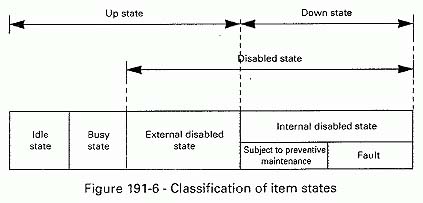
[IEV number 191-06-07]FR
état d'indisponibilité
état d'incapacité interne
état d'une entité caractérisé soit par une panne soit par l'inaptitude éventuelle à accomplir une fonction requise pendant l'entretien
NOTE 1 – Cet état est lié à la notion de disponibilité en tant qu'aptitude.
NOTE 2 – En français, l'adjectif "indisponible" qualifie une entité en état d'indisponibilité.
NOTE 3 – En français, dans le domaine des réseaux d'énergie électrique, le terme "état d'indisponibilité" désigne tout état d'incapacité et non seulement un état d'incapacité interne.
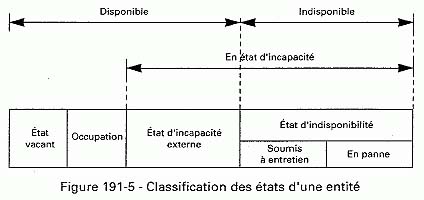
[IEV number 191-06-07]Тематики
- надежность, основные понятия
- тех. обсл. и ремонт средств электросвязи
Обобщающие термины
Синонимы
EN
DE
- nicht verfügbarer Zustand wegen interner Ursachen
- Unbrauchbarkeit wegen interner Ursachen
- Unklarzustand
FR
неработоспособное состояние средства магнитопорошкового контроля
неработоспособность
Состояние магнитопорошкового дефектоскопа, магнитного индикатора или другого средства контроля, при котором значение хотя бы одного параметра, характеризующего способность выполнять заданные функции по обнаружению дефектов, не соответствует требованиям нормативно-технической и (или) конструкторской документации и выходит за пределы допуска таким образом, что нарушает функцию обнаружения дефектов.
[Система неразрушающего контроля. Виды (методы) и технология неразрушающего контроля. Термины и определения (справочное пособие). Москва 2003 г.]Тематики
- виды (методы) и технология неразр. контроля
Синонимы
EN
2.4. Неработоспособное состояние
Down state
Состояние объекта, при котором значение хотя бы одного параметра, характеризующего способность выполнять заданные функции, не соответствует требованиям нормативно-технической и (или) конструкторской (проектной) документации.
Примечание. Для сложных объектов возможно деление их неработоспособных состояний. При этом из множества неработоспособных состояний выделяют частично неработоспособные состояния, при которых объект способен частично выполнять требуемые функции
Источник: ГОСТ 27.002-89: Надежность в технике. Основные понятия. Термины и определения оригинал документа
Англо-русский словарь нормативно-технической терминологии > down state
-
70 maintenance
- техническое обслуживание и текущий ремонт
- техническое обслуживание и (текущий) ремонт
- техническое обслуживание (и текущий ремонт)
- техническое обслуживание (админ.-хоз. деятельность в спорте)
- техническое обслуживание
- техническая эксплуатация
- текущий ремонт
- текущее обслуживание
- сопровождение
- поддержание
- обслуживание техническое
- обслуживание
техническое обслуживание
Совокупность действий, выполняемых для сохранения или восстановления состояния изделия, в котором оно способно отвечать требованиям соответствующих технических условий и выполнять необходимые функции.
[ ГОСТ Р МЭК 60050-426-2006]
техническое обслуживание
Текущие действия, выполняемые для сохранения в полной мере работоспособного состояния установленного электрооборудования.
[ ГОСТ Р МЭК 60050-426-2006]
техническое обслуживание
Комплекс операций и/или организационных действий, направленных на поддержание объекта в состоянии или возвращение объекта в состояние, в котором он способен выполнять требуемую функцию.
[ОСТ 45.152-99 ]
обслуживание техническое
Комплекс работ для поддержания исправности или работоспособности машин и оборудования при их эксплуатации, хранении и транспортировании
[Терминологический словарь по строительству на 12 языках (ВНИИИС Госстроя СССР)]EN
maintenance
1. All action taken to retain materiel in or to restore it to a specified condition. It includes: inspection, testing, servicing, classification as to serviceability, repair, rebuilding, and reclamation.
2. All supply and repair action taken to keep a force in condition to carry out its mission.
3. The routine recurring work required to keep a facility (plant, building, structure, ground facility, utility system, or other real property) in such condition that it may be continuously utilized, at its original or designed capacity and efficiency, for its intended purpose.[Dictionary of Military and Associated Terms. US Department of Defense 2005]Тематики
- тех. обсл. и ремонт средств электросвязи
Синонимы
- ТО
EN
- backup
- concept maintenance
- engineering service
- machine servicing
- maintenance
- maintenance service
- maintenance support
- maintenance work
- maintenance works
- mechanical services
- servicing
- technical maintenance
DE
FR
поддержание
обслуживание
уход за оборудованием
техническое обслуживание и ремонт
—
[Англо-русский глоссарий основных терминов по вакцинологии и иммунизации. Всемирная организация здравоохранения, 2009 г.]Тематики
- вакцинология, иммунизация
Синонимы
EN
текущее обслуживание
Комплекс мер, проводимый в процессе эксплуатации изделия с целью поддержания его в работоспособном состоянии, в число которых входит оперативное тестирование, выявление и устранение неисправностей и др.
[Л.М. Невдяев. Телекоммуникационные технологии. Англо-русский толковый словарь-справочник. Под редакцией Ю.М. Горностаева. Москва, 2002]Тематики
- электросвязь, основные понятия
EN
текущий ремонт
Ремонт, состоящий в замене и/или восстановлении отдельных составных частей.
Примечание
Текущий ремонт является неплановым техническим обслуживанием, постановка объектов на который осуществляется без предварительного назначения и который проводится на месте эксплуатации.
[ОСТ 45.152-99]
текущий ремонт
Ремонт, выполняемый для обеспечения или восстановления работоспособности изделия и состоящий в замене и (или) восстановлении отдельных частей
[ ГОСТ 18322-78]
[СТО Газпром РД 2.5-141-2005]
текущий ремонт
Ндп. малый ремонт
мелкий ремонт
Ремонт, выполняемый для обеспечения или восстановления работоспособности изделия и состоящий в замене и (или) восстановлении отдельных частей.
Примечание. Капитальный, средний и текущий ремонты могут быть плановыми и неплановыми.
Под базовой частью понимают основную часть изделия, предназначенную для его компоновки и установки других составных частей.
[ ГОСТ 18322-78]Недопустимые, нерекомендуемые
Тематики
- газораспределение
- система техн. обслуж. и ремонта техники
- тех. обсл. и ремонт средств электросвязи
Обобщающие термины
EN
- corrective maintenance
- current maintenance
- current repair
- current repairs
- light repair
- maintenance
- maintenance overhaul
- maintenance work
- maintenance works
- minor repairs
- operating repair
- permanent repair
- permanent repairs
- remedial works
- routine overhaul
- routine repair
- routine repairs
- routine servicing
- running maintenance
- running repair
- running repairs
- servicing
техническая эксплуатация
—
[Л.Г.Суменко. Англо-русский словарь по информационным технологиям. М.: ГП ЦНИИС, 2003.]Тематики
EN
техническое обслуживание
Ндп. профилактическое обслуживание
технический уход
техническое содержание
По ГОСТ 18322-78
[ ГОСТ 20375-83]
техническое обслуживание
Ндп. профилактическое обслуживание
технический уход
Комплекс операций или операция по поддержанию работоспособности или исправности изделия при использовании по назначению, ожидании, хранении и транспортировании
Техническое обслуживание содержит регламентированные в конструкторской документации операции для поддержания работоспособности или исправности изделия в течение его срока службы.
Под операцией технического обслуживания в соответствии с ГОСТ 3.1109-82 понимают законченную часть технического обслуживания составной части изделия, выполняемую на одном рабочем месте исполнителем определенной специальности.
Под транспортированием понимают операцию перемещения груза по определенному маршруту от места погрузки до места разгрузки или перегрузки. В транспортирование самоходных изделий не включается их перемещение своим ходом.
Под ожиданием понимают нахождение изделия в состоянии готовности к использованию по назначению.
В техническое обслуживание могут входить мойка изделия, контроль его технического состояния, очистка, смазывание, крепление болтовых соединений, замена некоторых составных частей изделия (например, фильтрующих элементов), регулировка и т. д.
[ ГОСТ 18322-78]
[ПОТ Р М-016-2001]
[РД 153-34.0-03.150-00]
техническое обслуживание
Комплекс операций или операция по поддержанию работоспособности или исправности изделия (технического устройства) при использовании по назначению, ожидании, хранении и транспортировании
[ПБ 12-529-03 Правила безопасности систем газораспределения и газопотребления, утверждены постановлением Госгортехнадзора России от 18. 03. 2003 №9]
[СТО Газпром РД 2.5-141-2005]Недопустимые, нерекомендуемые
Тематики
- газораспределение
- система техн. обслуж. и ремонта техники
- электроагрегаты генераторные
- электробезопасность
EN
- backup
- concept maintenance
- corrective maintenance
- engineering service
- field service
- handling
- maintaining
- maintenance
- maintenance element
- maintenance facilities
- maintenance service
- maintenance support
- maintenance work
- maintenance works
- service
- servicing
- technical service
- technical services
- technical servicing
DE
техническое обслуживание
Все действия, направленные на сохранение или возврат объекта в состояние, в котором он может выполнять требующуюся от него функцию. Данные действия включают в себя сочетание всех технических, а также соответствующих административных, управленческих и контролирующих действий.
[Департамент лингвистических услуг Оргкомитета «Сочи 2014». Глоссарий терминов]EN
maintenance
All actions, which have the objective of retaining or restoring an item in or to a state in which it can perform its required function. The actions include the combination of all technical and corresponding administrative, managerial, and supervision actions.
[Департамент лингвистических услуг Оргкомитета «Сочи 2014». Глоссарий терминов]Тематики
EN
техническое обслуживание (и текущий ремонт)
содержание в исправности
сопровождение
регламентные работы
—
[Л.Г.Суменко. Англо-русский словарь по информационным технологиям. М.: ГП ЦНИИС, 2003.]Тематики
Синонимы
EN
техническое обслуживание и (текущий) ремонт
—
[Я.Н.Лугинский, М.С.Фези-Жилинская, Ю.С.Кабиров. Англо-русский словарь по электротехнике и электроэнергетике, Москва, 1999 г.]Тематики
- электротехника, основные понятия
EN
техническое обслуживание и текущий ремонт
уход
—
[А.С.Гольдберг. Англо-русский энергетический словарь. 2006 г.]Тематики
Синонимы
EN
2.7 сопровождение (maintenance): Составная часть сопровождения системы (см. А.5.2), которая связана с модификацией (изменением) пакета программ.
Источник: ГОСТ Р ИСО/МЭК 12119-2000: Информационная технология. Пакеты программ. Требования к качеству и тестирование оригинал документа
Ндп. Профилактическое обслуживание
D. Wartung
E. Maintenance
По ГОСТ 18322
Источник: ГОСТ 20375-83: Электроагрегаты и передвижные электростанции с двигателями внутреннего сгорания. Термины и определения оригинал документа
3.55 техническое обслуживание (maintenance): Комплекс операций, направленных на определение реального состояния ГТУ, и операций по сохранению/восстановлению заданного работоспособного состояния.
Источник: ГОСТ Р 52527-2006: Установки газотурбинные. Надежность, готовность, эксплуатационная технологичность и безопасность оригинал документа
3.4 текущее обслуживание (maintenance): Повседневные действия, выполняемые для сохранения в полной мере работоспособного состояния установленного электрооборудования (см. раздел 1).
Источник: ГОСТ Р 52350.19-2007: Взрывоопасные среды. Часть 19. Ремонт, проверка и восстановление электрооборудования оригинал документа
3.4 техническое обслуживание (maintenance): Текущие действия, выполняемые для сохранения в полной мере работоспособного состояния установленного электрооборудования (см. раздел 1).
Источник: ГОСТ Р МЭК 60079-19-2011: Взрывоопасные среды. Часть 19. Ремонт, проверка и восстановление электрооборудования оригинал документа
Maintenance
По ГОСТ 18322
Источник: ГОСТ 27.002-89: Надежность в технике. Основные понятия. Термины и определения оригинал документа
3.3 техническое обслуживание (maintenance): Совокупность действий, выполняемых для сохранения или восстановления состояния изделия, в котором оно способно отвечать требованиям соответствующих технических условий и выполнять необходимые функции.
Источник: ГОСТ Р МЭК 60079-17-2010: Взрывоопасные среды. Часть 17. Проверка и техническое обслуживание электроустановок оригинал документа
3.1 техническое обслуживание (maintenance): Действия по поддержанию СИЗ либо иного оборудования в надежном рабочем состоянии путем профилактических мер, например чистки и обеспечения пригодного места для хранения.
2.19 обслуживание (maintenance): Комбинация всех технических, административных и управленческих действий в процессе срока службы актива (2.4) в целях поддержания его в состоянии, в котором он может выполнять требуемые функции, или возвращения его в такое состояние.
Источник: ГОСТ Р ИСО 24511-2009: Деятельность, связанная с услугами питьевого водоснабжения и удаления сточных вод. Руководящие указания для менеджмента коммунальных предприятий и оценке услуг удаления сточных вод оригинал документа
2.19 обслуживание (maintenance): Комбинация всех технических, административных и управленческих действий в процессе срока службы актива (2.4) в целях поддержания его в состоянии, в котором он может выполнять требуемые функции, или возвращения его в такое состояние.
Источник: ГОСТ Р ИСО 24512-2009: Деятельность, связанная с услугами питьевого водоснабжения и удаления сточных вод. Руководящие указания для менеджмента систем питьевого водоснабжения и оценке услуг питьевого водоснабжения оригинал документа
6.3.5 техническое обслуживание (maintenance): Совокупность технических и административных мероприятий, включающих в себя контроль состояния электроустановки для поддержания ее в рабочем состоянии.
Источник: ГОСТ Р 50571.16-2007: Электроустановки низковольтные. Часть 6. Испытания оригинал документа
3.5 техническое обслуживание (maintenance): Совокупность действий, выполняемых для сохранения или восстановления состояния изделия, в котором оно способно отвечать требованиям соответствующих технических условий и выполнять необходимые функции.
Источник: ГОСТ Р МЭК 61241-17-2009: Электрооборудование, применяемое в зонах, опасных по воспламенению горючей пыли. Часть 17. Проверка и техническое обслуживание электроустановок во взрывоопасных средах (кроме подземных выработок) оригинал документа
2.19 обслуживание (maintenance): Комбинация всех технических, административных и управленческих действий в процессе срока службы актива (2.4) в целях поддержания его в состоянии, в котором он может выполнять требуемые функции, или возвращения его в такое состояние.
Источник: ГОСТ Р ИСО 24510-2009: Деятельность, связанная с услугами питьевого водоснабжения и удаления сточных вод. Руководящие указания по оценке и улучшению услуги, оказываемой потребителям оригинал документа
3.1.25 техническое обслуживание (maintenance): Совокупность всех технических и административных действий, включая надзорные действия, направленные на сохранение изделия или восстановление его до состояния, в котором оно может выполнять требуемую функцию.
Источник: ГОСТ Р 54828-2011: Комплектные распределительные устройства в металлической оболочке с элегазовой изоляцией (КРУЭ) на номинальные напряжения 110 кВ и выше. Общие технические условия оригинал документа
Англо-русский словарь нормативно-технической терминологии > maintenance
71 command center exercises
отработка действий командного центра
В рамках практической подготовки каждого функционального подразделения создается соответствующий функциональный командный центр для оперативного тестирования каналов связи, отработки информационного взаимодействия, механизмов принятия решений и интеграции деятельности командного центра и внешних партнеров.
[Департамент лингвистических услуг Оргкомитета «Сочи 2014». Глоссарий терминов]EN
command center exercises
Within the exercise framework for each function, the respective Functional Command Center is integrated for operational testing of communication paths, information flows, decision-making and the integration of Command Center activities with external agencies.
[Департамент лингвистических услуг Оргкомитета «Сочи 2014». Глоссарий терминов]Тематики
EN
Англо-русский словарь нормативно-технической терминологии > command center exercises
72 functional test
проверка работоспособности
проверка технических характеристик
—
[Я.Н.Лугинский, М.С.Фези-Жилинская, Ю.С.Кабиров. Англо-русский словарь по электротехнике и электроэнергетике, Москва, 1999 г.]
проверка работоспособности
-
[Интент]Тематики
- электротехника, основные понятия
Синонимы
EN
функциональное испытание
—
[ http://www.iks-media.ru/glossary/index.html?glossid=2400324]Тематики
- электросвязь, основные понятия
EN
функциональные испытания
Испытания, проводимые с целью определения значений показателей назначения объекта.
[ ГОСТ 16504-81]Тематики
EN
FR
E. Functional test
F. Essais fonctionnels
Испытания, проводимые с целью определения значений показателей назначения объекта
Источник: ГОСТ 16504-81: Система государственных испытаний продукции. Испытания и контроль качества продукции. Основные термины и определения оригинал документа
Англо-русский словарь нормативно-технической терминологии > functional test
73 functioning test
проверка работоспособности
проверка технических характеристик
—
[Я.Н.Лугинский, М.С.Фези-Жилинская, Ю.С.Кабиров. Англо-русский словарь по электротехнике и электроэнергетике, Москва, 1999 г.]
проверка работоспособности
-
[Интент]Тематики
- электротехника, основные понятия
Синонимы
EN
Англо-русский словарь нормативно-технической терминологии > functioning test
74 health check
проверка работоспособности
проверка технических характеристик
—
[Я.Н.Лугинский, М.С.Фези-Жилинская, Ю.С.Кабиров. Англо-русский словарь по электротехнике и электроэнергетике, Москва, 1999 г.]
проверка работоспособности
-
[Интент]Тематики
- электротехника, основные понятия
Синонимы
EN
Англо-русский словарь нормативно-технической терминологии > health check
75 health checking
проверка работоспособности
проверка технических характеристик
—
[Я.Н.Лугинский, М.С.Фези-Жилинская, Ю.С.Кабиров. Англо-русский словарь по электротехнике и электроэнергетике, Москва, 1999 г.]
проверка работоспособности
-
[Интент]Тематики
- электротехника, основные понятия
Синонимы
EN
Англо-русский словарь нормативно-технической терминологии > health checking
76 performance check
проверка работоспособности
проверка технических характеристик
—
[Я.Н.Лугинский, М.С.Фези-Жилинская, Ю.С.Кабиров. Англо-русский словарь по электротехнике и электроэнергетике, Москва, 1999 г.]
проверка работоспособности
-
[Интент]Тематики
- электротехника, основные понятия
Синонимы
EN
проверка технических характеристик
—
[А.С.Гольдберг. Англо-русский энергетический словарь. 2006 г.]Тематики
EN
Англо-русский словарь нормативно-технической терминологии > performance check
77 performance verification
проверка работоспособности
проверка технических характеристик
—
[Я.Н.Лугинский, М.С.Фези-Жилинская, Ю.С.Кабиров. Англо-русский словарь по электротехнике и электроэнергетике, Москва, 1999 г.]
проверка работоспособности
-
[Интент]Тематики
- электротехника, основные понятия
Синонимы
EN
проверка рабочих характеристик
проверка работоспособности
—
[ http://slovarionline.ru/anglo_russkiy_slovar_neftegazovoy_promyishlennosti/]Тематики
Синонимы
EN
Англо-русский словарь нормативно-технической терминологии > performance verification
78 sanity check
проверка работоспособности
проверка технических характеристик
—
[Я.Н.Лугинский, М.С.Фези-Жилинская, Ю.С.Кабиров. Англо-русский словарь по электротехнике и электроэнергетике, Москва, 1999 г.]
проверка работоспособности
-
[Интент]Тематики
- электротехника, основные понятия
Синонимы
EN
Англо-русский словарь нормативно-технической терминологии > sanity check
79 serviceability inspection
проверка работоспособности
проверка технических характеристик
—
[Я.Н.Лугинский, М.С.Фези-Жилинская, Ю.С.Кабиров. Англо-русский словарь по электротехнике и электроэнергетике, Москва, 1999 г.]
проверка работоспособности
-
[Интент]Тематики
- электротехника, основные понятия
Синонимы
EN
Англо-русский словарь нормативно-технической терминологии > serviceability inspection
80 up state
работоспособное состояние
работоспособность
Состояние объекта, при котором значения всех параметров, характеризующих способность выполнять заданные функции, соответствуют требованиям нормативно-технической и (или) конструкторской (проектной) документации.
[ ГОСТ 27.002-89]
[ОСТ 45.152-99]
[СО 34.21.307-2005]EN
up state
a state of an item characterized by the fact that it can perform a required function, assuming that the external resources, if required, are provided
NOTE 1 – This state relates to availability performance.
NOTE 2 – In French, the adjective "disponible" qualifies an item in an up state.
[IEV number 191-06-08 ]FR
état de disponibilité
état d'une entité caractérisé par l'aptitude de cette entité à accomplir une fonction requise, en supposant que la fourniture des moyens extérieurs éventuellement nécessaires est assurée
NOTE 1 – Cet état est lié à la notion de disponibilité en tant qu'aptitude.
NOTE 2 – En français, l'adjectif "disponible" qualifie une entité en état de disponibilité.
[IEV number 191-06-08 ]Тематики
- надежность, основные понятия
- тех. обсл. и ремонт средств электросвязи
Обобщающие термины
Синонимы
EN
- operable condition
- operable state
- serviceable condition
- state of serviceability
- up state
- usable condition
- workable condition
DE
FR
работоспособное состояние средства магнитопорошкового контроля
работоспособность
Состояние магнитопорошкового дефектоскопа, магнитного индикатора или другого средства контроля, при котором значения всех параметров, характеризующих способность выполнять заданные функции по обнаружению дефектов, соответствуют требованиям нормативно-технической и (или) конструкторской документации и не нарушают функцию обнаружения дефектов.
[Система неразрушающего контроля. Виды (методы) и технология неразрушающего контроля. Термины и определения (справочное пособие). Москва 2003 г.]Тематики
- виды (методы) и технология неразр. контроля
Синонимы
EN
2.3. Работоспособное состояние
Up state
Состояние объекта, при котором значения всех параметров, характеризующих способность выполнять заданные функции, соответствуют требованиям нормативно-технической и (или) конструкторской (проектной) документации
Источник: ГОСТ 27.002-89: Надежность в технике. Основные понятия. Термины и определения оригинал документа
Англо-русский словарь нормативно-технической терминологии > up state
СтраницыСм. также в других словарях:
function testing — The examination of a firearm concerning its mechanical condition and operation. It is usually performed to determine if all safety features are operable and/or if the firearm is capable of firing a cartridge … Forensic science glossary
Function point — A function point is a unit of measurement to express the amount of business functionality an information system provides to a user. Function points are the units of measure used by the IFPUG Functional Size Measurement Method. The IFPUG FSM… … Wikipedia
Testing hypotheses suggested by the data — In statistics, hypotheses suggested by the data must be tested differently from hypotheses formed independently of the data.How to do it wrongFor example, suppose fifty different researchers, unaware of each other s work, run clinical trials to… … Wikipedia
function — 1. The special action or physiologic property of an organ or other part of the body. 2. To perform its special work or office, said of an organ or other part of the body. 3. The general properties of any substance, depending on its chemical … Medical dictionary
testing — See test. bench t. t. of a device against specifications in a simulated (nonliving) environment. contrast sensitivity t. examination of the visual recognition of the variation in brightness of an object. genetic t … Medical dictionary
Portable appliance testing — For other uses, see PAT (disambiguation). A common label for certifying that a device has been tested. Portable appliance testing (commonly known as PAT or PAT Inspection or PAT Testing) is a process in the United Kingdom, New Zealand and… … Wikipedia
Certified Pulmonary Function Technologist — A Certified Pulmonary Function Technologist (CPFT) is a technologist who is at least a Certified Respiratory Therapist but may be a Registered Respiratory Therapist that has successfully passed the national certification exam.[1] See also… … Wikipedia
X-Machine Testing — The (Stream) X Machine Testing Methodology is a complete functional testing approach to software and hardware testingM. Holcombe and F. Ipate (1998) Correct Systems Building a Business Process Solution . Springer, Applied Computing Series.] that… … Wikipedia
Animal testing — A white Wistar lab rat Description Around 50–100 million vertebrate animals are used in experiments annually. Subjects Animal testing, scien … Wikipedia
Digital video testing — in broadcast video, for example, is the process of validating and verifying that the video content and other data is being correctly processed, stored and transported. Despite the fact that the data is digital, most digital tv (DTV) system… … Wikipedia
Software testing — is an empirical investigation conducted to provide stakeholders with information about the quality of the product or service under test [ [http://www.kaner.com/pdfs/ETatQAI.pdf Exploratory Testing] , Cem Kaner, Florida Institute of Technology,… … Wikipedia
Перевод: с английского на все языки
со всех языков на английский- Со всех языков на:
- Английский
- С английского на:
- Русский
function testing

18+
© Академик, 2000-2026
- Обратная связь: Техподдержка, Реклама на сайте
Экспорт словарей на сайты, сделанные на PHP, Joomla, Drupal, WordPress, MODx.