

-
21 БИБЛИОГРАФИЯ
Мы приняли следующие сокращения для наиболее часто упоминаемых книг и журналов:IJP - International Journal of Psycho-analysisJAPA - Journal of the American Psychoanalytic AssociationSE - Standard Edition of the Complete Psychological Works of Sigmund Freud, ed. James Strachey (London: Hogarth Press and the Institute of Psycho-Analysis, 1953—74.)PSOC - Psychoanalytic Study of the Child (New Haven: Yale University Press)PQ - Psychoanalytic QuarterlyWAF - The Writings of Anna Freud, ed. Anna Freud (New York: International Universities Press, 1966—74)PMC - Psychoanalysis The Major Concepts ed. Burness E. Moore and Bernard D. Fine (New Haven: Yale University Press)\О словаре: _about - Psychoanalytic Terms and Concepts\1. Abend, S. M. Identity. PMC. Forthcoming.2. Abend, S. M. (1974) Problems of identity. PQ, 43.3. Abend, S. M., Porder, M. S. & Willick, M. S. (1983) Borderline Patients. New York: Int. Univ. Press.4. Abraham, K. (1916) The first pregenital stage of libido. Selected Papers. London, Hogarth Press, 1948.5. Abraham, K. (1917) Ejaculatio praecox. In: selected Papers. New York Basic Books.6. Abraham, K. (1921) Contributions to the theory of the anal character. Selected Papers. New York: Basic Books, 1953.7. Abraham, K. (1924) A Short study of the development of the libido, viewed in the light of mental disorders. In: Selected Papers. London: Hogarth Press, 1927.8. Abraham, K. (1924) Manic-depressive states and the pre-genital levels of the libido. In: Selected Papers. London: Hogarth Press, 1949.9. Abraham, K. (1924) Selected Papers. London: Hogarth Press, 1948.10. Abraham, K. (1924) The influence of oral erotism on character formation. Ibid.11. Abraham, K. (1925) The history of an impostor in the light of psychoanalytic knowledge. In: Clinical Papers and Essays on Psychoanalysis. New York: Basic Books, 1955, vol. 2.12. Abrams, S. (1971) The psychoanalytic unconsciousness. In: The Unconscious Today, ed. M. Kanzer. New York: Int. Univ. Press.13. Abrams, S. (1981) Insight. PSOC, 36.14. Abse, D W. (1985) The depressive character In Depressive States and their Treatment, ed. V. Volkan New York: Jason Aronson.15. Abse, D. W. (1985) Hysteria and Related Mental Disorders. Bristol: John Wright.16. Ackner, B. (1954) Depersonalization. J. Ment. Sci., 100.17. Adler, A. (1924) Individual Psychology. New York: Harcourt, Brace.18. Akhtar, S. (1984) The syndrome of identity diffusion. Amer. J. Psychiat., 141.19. Alexander, F. (1950) Psychosomatic Medicine. New York: Norton.20. Allen, D. W. (1974) The Feat- of Looking. Charlottesvill, Va: Univ. Press of Virginia.21. Allen, D. W. (1980) Psychoanalytic treatment of the exhibitionist. In: Exhibitionist, Description, Assessment, and Treatment, ed. D. Cox. New York: Garland STPM Press.22. Allport, G. (1937) Personality. New York: Henry Holt.23. Almansi, R. J. (1960) The face-breast equation. JAPA, 6.24. Almansi, R. J. (1979) Scopophilia and object loss. PQ, 47.25. Altman, L. Z. (1969) The Dream in Psychoanalysis. New York: Int. Univ. Press.26. Altman, L. Z. (1977) Some vicissitudes of love. JAPA, 25.27. American Psychiatric Association. (1987) Diagnostic and Statistical Manual of Mental Disorders, 3d ed. revised. Washington, D. C.28. Ansbacher, Z. & Ansbacher, R. (1956) The Individual Psychology of Alfred Adler. New York: Basic Books.29. Anthony, E. J. (1981) Shame, guilt, and the feminine self in psychoanalysis. In: Object and Self, ed. S. Tuttman, C. Kaye & M. Zimmerman. New York: Int. Univ. Press.30. Arlow. J. A. (1953) Masturbation and symptom formation. JAPA, 1.31. Arlow. J. A. (1959) The structure of the deja vu experience. JAPA, 7.32. Arlow. J. A. (1961) Ego psychology and the study of mythology. JAPA, 9.33. Arlow. J. A. (1963) Conflict, regression and symptom formation. IJP, 44.34. Arlow. J. A. (1966) Depersonalization and derealization. In: Psychoanalysis: A General Psychology, ed. R. M. Loewenstein, L. M. Newman, M. Schur & A. J. Solnit. New York: Int. Univ. Press.35. Arlow. J. A. (1969) Fantasy, memory and reality testing. PQ, 38.36. Arlow. J. A. (1969) Unconscious fantasy and disturbances of mental experience. PQ, 38.37. Arlow. J. A. (1970) The psychopathology of the psychoses. IJP, 51.38. Arlow. J. A. (1975) The structural hypothesis. PQ, 44.39. Arlow. J. A. (1977) Affects and the psychoanalytic situation. IJP, 58.40. Arlow. J. A. (1979) Metaphor and the psychoanalytic situation. PQ, 48.41. Arlow. J. A. (1979) The genesis of interpretation. JAPA, 27 (suppl.).42. Arlow. J. A. (1982) Problems of the superego concept. PSOC, 37.43. Arlow. J. A. (1984) Disturbances of the sense of time. PQ, 53.44. Arlow. J. A. (1985) Some technical problems of countertransference. PQ, 54.45. Arlow, J. A. & Brenner, C. (1963) Psychoanalytic Concepts and the Structural Theory, New York: Int. Univ. Press.46. Arlow, J. A. & Brenner, C. (1969) The psychopathology of the psychoses. IJP, 50.47. Asch, S. S. (1966) Depression. PSOC, 21.48. Asch, S. S. (1976) Varieties of negative therapeutic reactions and problems of technique. JAPA, 24.49. Atkins, N. (1970) The Oedipus myth. Adolescence, and the succession of generations. JAPA, 18.50. Atkinson, J. W. & Birch, D. (1970) The Dynamics of Action. New York: Wiley.51. Bachrach, H. M. & Leaff, L. A. (1978) Analyzability. JAPA, 26.52. Bacon, C. (1956) A developmental theory of female homosexuality. In: Perversions,ed, S. Lorand & M. Balint. New York: Gramercy.53. Bak, R. C. (1953) Fetishism. JAPA. 1.54. Bak, R. C. (1968) The phallic woman. PSOC, 23.55. Bak, R. C. & Stewart, W. A. (1974) Fetishism, transvestism, and voyeurism. An American Handbook of Psychiatry, ed. S. Arieti. New York: Basic Books, vol. 3.56. Balint, A. (1949) Love for mother and mother-love. IJP, 30.57. Balter, L., Lothane, Z. & Spencer, J. H. (1980) On the analyzing instrument, PQ, 49.58. Basch, M. F. (1973) Psychoanalysis and theory formation. Ann. Psychoanal., 1.59. Basch, M. F. (1976) The concept of affect. JAPA, 24.60. Basch, M. F. (1981) Selfobject disorders and psychoanalytic theory. JAPA, 29.61. Basch, M. F. (1983) Emphatic understanding. JAPA. 31.62. Balldry, F. Character. PMC. Forthcoming.63. Balldry, F. (1983) The evolution of the concept of character in Freud's writings. JAPA. 31.64. Begelman, D. A. (1971) Misnaming, metaphors, the medical model and some muddles. Psychiatry, 34.65. Behrends, R. S. & Blatt, E. J. (1985) Internalization and psychological development throughout the life cycle. PSOC, 40.66. Bell, A. (1961) Some observations on the role of the scrotal sac and testicles JAPA, 9.67. Benedeck, T. (1949) The psychosomatic implications of the primary unit. Amer. J. Orthopsychiat., 19.68. Beres, C. (1958) Vicissitudes of superego functions and superego precursors in childhood. FSOC, 13.69. Beres, D. Conflict. PMC. Forthcoming.70. Beres, D. (1956) Ego deviation and the concept of schizophrenia. PSOC, 11.71. Beres, D. (1960) Perception, imagination and reality. IJP, 41.72. Beres, D. (1960) The psychoanalytic psychology of imagination. JAPA, 8.73. Beres, D. & Joseph, E. D. (1965) Structure and function in psychoanalysis. IJP, 46.74. Beres, D. (1970) The concept of mental representation in psychoanalysis. IJP, 51.75. Berg, M D. (1977) The externalizing transference. IJP, 58.76. Bergeret, J. (1985) Reflection on the scientific responsi bilities of the International Psychoanalytical Association. Memorandum distributed at 34th IPA Congress, Humburg.77. Bergman, A. (1978) From mother to the world outside. In: Grolnick et. al. (1978).78. Bergmann, M. S. (1980) On the intrapsychic function of falling in love. PQ, 49.79. Berliner, B. (1966) Psychodynamics of the depressive character. Psychoanal. Forum, 1.80. Bernfeld, S. (1931) Zur Sublimierungslehre. Imago, 17.81. Bibring, E. (1937) On the theory of the therapeutic results of psychoanalysis. IJP, 18.82. Bibring, E. (1941) The conception of the repetition compulsion. PQ, 12.83. Bibring, E. (1953) The mechanism of depression. In: Affective Disorders, ed. P. Greenacre. New York: Int. Univ. Press.84. Bibring, E. (1954) Psychoanalysis and the dynamic psychotherapies. JAPA, 2.85. Binswanger, H. (1963) Positive aspects of the animus. Zьrich: Spring.86. Bion Francesca Abingdon: Fleetwood Press.87. Bion, W. R. (1952) Croup dynamics. IJP, 33.88. Bion, W. R. (1961) Experiences in Groups. London: Tavistock.89. Bion, W. R. (1962) A theory of thinking. IJP, 40.90. Bion, W. R. (1962) Learning from Experience. London: William Heinemann.91. Bion, W. R. (1963) Elements of Psychoanalysis. London: William Heinemann.92. Bion, W. R. (1965) Transformations. London: William Heinemann.93. Bion, W. R. (1970) Attention and Interpretation. London: Tavistock.94. Bion, W. R. (1985) All My Sins Remembered, ed. Francesca Bion. Adingdon: Fleetwood Press.95. Bird, B. (1972) Notes on transference. JAPA, 20.96. Blanck, G. & Blanck, R. (1974) Ego Psychology. New York: Columbia Univ. Press.97. Blatt, S. J. (1974) Levels of object representation in anaclitic and introjective depression. PSOC, 29.98. Blau, A. (1955) A unitary hypothesis of emotion. PQ, 24.99. Bleuler, E. (1911) Dementia Praecox or the Group of Schizophrenias. New York: Int. Univ. Press, 1951.100. Blos, P. (1954) Prolonged adolescence. Amer. J. Orthopsychiat., 24.101. Blos, P. (1962) On Adolescence. New York: Free Press.102. Blos, P. (1972) The epigenesia of the adult neurosis. 27.103. Blos, P. (1979) Modification in the traditional psychoanalytic theory of adolescent development. Adolescent Psychiat., 8.104. Blos, P. (1984) Son and father. JAPA_. 32.105. Blum, G. S. (1963) Prepuberty and adolescence, In Studies ed. R. E. Grinder. New York: McMillan.106. Blum, H. P. Symbolism. FMC. Forthcoming.107. Blum, H. P. (1976) Female Psychology. JAPA, 24 (suppl.).108. Blum, H. P. (1976) Masochism, the ego ideal and the psychology of women. JAPA, 24 (suppl.).109. Blum, H. P. (1980) The value of reconstruction in adult psychoanalysis. IJP, 61.110. Blum, H. P. (1981) Forbidden quest and the analytic ideal. PQ, 50.111. Blum, H. P. (1983) Defense and resistance. Foreword. JAFA, 31.112. Blum, H. P., Kramer, Y., Richards, A. K. & Richards, A. D., eds. (1988) Fantasy, Myth and Reality: Essays in Honor of Jacob A. Arlow. Madison, Conn.: Int. Univ. Press.113. Boehm, F. (1930) The femininity-complex In men. IJP,11.114. Boesky, D. Structural theory. PMC. Forthcoming.115. Boesky, D. (1973) Deja raconte as a screen defense. PQ, 42.116. Boesky, D. (1982) Acting out. IJP, 63.117. Boesky, D. (1986) Questions about Sublimation In Psychoanalysis the Science of Mental Conflict, ed. A. D. Richards & M. S. Willick. Hillsdale, N. J.: Analytic Press.118. Bornstein, B. (1935) Phobia in a 2 1/2-year-old child. PQ, 4.119. Bornstein, B. (1951) On latency. PSOC, 6.120. Bornstein, M., ed. (1983) Values and neutrality in psychoanalysis. Psychoanal. Inquiry, 3.121. Bowlby, J. (1960) Grief and morning in infancy and early childhood. PSOC. 15.122. Bowlby, J. (1961) Process of mourning. IJP. 42.123. Bowlby, J. (1980) Attachment and Loss, vol. 3. New York: Basic Books.124. Bradlow, P. A. (1973) Depersonalization, ego splitting, non-human fantasy and shame. IJP, 54.125. Brazelton, T. B., Kozlowsky, B. & Main, M. (1974) The early motherinfant interaction. In: The Effect of the Infant on Its Caregiver, ed. M. Lewis & L. Rosenblum New York Wiley.126. Brenner, C. (1957) The nature and development of the concept of repression in Freud's writings. PSOC, 12.127. Brenner, C. (1959) The masochistic character. JAPA, 7.128. Brenner, C. (1973) An Elementary Textbook of Psycho-analysis. New York Int. Univ. Press.129. Brenner, C. (1974) On the nature and development of affects PQ, 43.130. Brenner, C. (1976) Psychoanalytic Technique and Psychic Conflict. New York: Int. Univ. Press.131. Brenner, C. (1979) The Mind in Conflict. New York: Int. Univ. Press.132. Brenner, C. (1979) Working alliance, therapeutic alliance and transference. JAPA, 27.133. Brenner, C. (1981) Defense and defense mechanisms. PQ, 50.134. Brenner, C. (1983) Defense. In: the Mind in Conflict. New York Int. Univ. Press.135. Bressler, B. (1965) The concept of the self. Psychoanalytic Review, 52.136. Breuer, J. & Freud, S. (1983—95) Studies on Hysteria. SE, 3.137. Breznitz, S., ed. (1983) The Denial of Stress. New York: Int. Univ. Press.138. Brody, S. (1964) Passivity. New York: Int. Univ. Press.139. Brown, H. (1970) Psycholinquistics. New York: Free Press.140. Bruner, J. S. (1964) The course of cognitive growth. Amer. Psychologist. 19.141. Bruner, J., Jolly, A. & Sylva, K. (1976) Play. New York Basic Books.142. Bruner, J. E., Olver, R. R. &Greenfield, P. M. (1966) Studies in Cognitive Growth. New York: Wiley.143. Buie, D H. (1981) Empathy. JAPA, 29.144. Burgner, M. & Edgeumble, R. (1972) Some problems in the conceptualization of early object relationships. PSOC, 27.145. Call, J. ed. (1979) Basic Handbook of Child Psychiatry. New York: Basic Books.146. Carroll, G. (1956) Language, Thought and Reality. Cambridge & London: M. I. T. Press & John Wiley.147. Cavenar, J. O. & Nash, J. L. (1976) The effects of Combat on the normal personality. Comprehensive Psychiat., 17.148. Chassequet-Smirgel, J. (1978) Reflections on the connection between perversion and sadism. IJP, 59.149. Chomsky, N. (1978) Language and unconscious knowledge. In: Psychoanalysis and Language, ed. J. H. Smith. New Haven: Yale Univ. Press, vol. 3.150. Clower, V. (1975) Significance of masturbation in female sexual development and function. In: Masturbation from Infancy to Senescence, ed. I. Marcus & J. Francis. New York: Int. Uni" Press.151. Coen, S. J. & Bradlow, P. A. (1982) Twin transference as a compromise formation. JAPA, 30.152. Compton, A. Object and relationships. PMC. Forthcoming.153. Cullen, W. (1777) First Lines of the Practice of Psysic. Edinburgh: Bell, Brandfute.154. Curtis, B. C. (1969) Psychoanalytic understanding and treatment of impotence. In: Sexual Function and Dysfunction, ed. P. J. Fink & V. B. O. Hummett. Philadelphia: F. A. Davis.155. Darwin, C. (1874) The Descent of Man. New York: Hurst.156. Davidoff-Hirsch, H. (1985) Oedipal and preoedipal phenomena. JAPA, 33.157. Davis, M. & Wallbridge, D. (1981) Boundary and Space. New York: Brunner-Mazel.158. Deutsch, H. (1932) Homosexuality in women. PQ, 1.159. Deutsch, H. (1934) Some forms of emotional disturbance and their relationship to schizophrenia. PQ, 11.160. Deutsch, H. (1937) Absence of grief. PQ, 6.161. Deutsch, H. (1942) Some forms of emotional disturbance and their relationship to schizophrenia. PQ, 11.162. Deutsch, H. (1955) The impostor. In: Neuroses and Character Types. New York: Int. Univ. Press, 1965.163. Devereux, G. (1953) Why Oedipus killed Lains. IJP, 34.164. Dewald, P. (1982) Psychoanalytic perspectives On resistance. In: resistance, Psychodynamics. and Behavioral Approaches, ed. P. Wachtel. New York: Plenum Press.165. Dickes, R. (1963) Fetishistic behavior. JAPA. 11.166. Dickes, R. (1965) The defensive function of an altered state of consciousness. JAPA, 13.167. Dickes, R. (1967) Severe regressive disruption of the therapeutic alliance. JAPA, 15.168. Dickes, R. (1981) Sexual myths and misinformation. In: Understanding Human Behaviour in Health and Illness, ed. R. C. Simon & H. Pardes. Baltimore: Williams & Wilkins.169. Dorpat, T. L. (1985) Denial and Defense in the Therapeutic Situation. New York: Jason Aronson.170. Downey, T. W. (1978) Transitional phenomena in the analysis of early adolescent males. PSOC, 33.171. Dunbar, F. (1954) Emotions and Bodily Functions. New York: Columbia Univ. Press.172. Easson, W. M. (1973) The earliest ego development, primitive memory traces, and the Isakower phenomenon. PQ, 42.173. Edelheit, H. (1971) Mythopoiesis and the primal scene. Psychoanal. Study Society, 5.174. Edgcumbe, R. & Burgner, M. (1972) Some problems in the conceptualization of early object relation ships, part I. PSOC, 27.175. Edgcumbe, R. & Burgner, M. (1975) The phallicnarcissistic phase. PSOC, 30.176. Eidelberg, L. (1960) A third contribution to the study of slips of the tongue. IJP, 41.177. Eidelberg, L. (1968) Encyclopedia of Psychoanalysis. New York: The Free Press; London: Collier-MacMillan.178. Eissler, K. R. (1953) The effect of the structure of the ego on psychoanalytic technique. JAPA, 1.179. Ellenberg, H. F. (1970) The Discovery of the Unconscious. New York: Basic Books.180. Emde, R. N. (1980) Toward a psychoanalytic theory of affect: I. & G. H. Pollock. Washington NYMH.181. Emde R., Gaensbaner, T. & Harmon R. (1976) Emotional Expression in Infancy. New York: Int. Univ. Press.182. Erode R. & Harmon, R. J. (1972) Endogenous and exogenous smiling systems in early infancy. J. Amer. Acad. Child Psychiat., 11.183. Engel, G. L. (1962) Psychological Development in Health and Disease. New York Saunders.184. Engel, G. L. (1967) Psychoanalytic theory of somatic disorder. JAPA, 15.185. Engel, G. L. (1968) A reconsideration of the role of conversion in somatic disease. Compr. Psychiat., 94.186. English, H. B. & English, A. C. (1958) A comprehensive Dictionary of Psychological and Psychoanalytical Terms. New York: David McKay.187. Erard, R. (1983) New wine in old skins. Int. Rev. Psychoanal., 10.188. Erdelyi, M. H. (1985) Psychoanalysis. New York: W. H. Freeman.189. Erikson, E. H. (1950) Childhood and Society. New York: Norton.190. Erikson, E. H. (1956) The concept of ego identity. JAPA, 4.191. Erikson, E. H. (1956) The problem of ego identity. JAPA, 4.192. Esman, A. H. (1973) The primal scene. PSOC, 28.193. Esman, A. H. (1975) The Psychology of Adolescence. New York: Int. Univ. Press.194. Esman, A. H. (1979) Some reflections on boredom. JAPA, 27.195. Esman, A. H. (1983) The "stimulus barrier": a review and reconsideration. PSOC, 38.196. Fairbairn, W. R. D. (1952) Psychoanalytic Studies of the Personality. London: Routledge & Kegan Paul.197. Fairbairn, W. R. D. (1954) An Object-Relations Theory of the Personality. New York: Basic Books.198. Fairbairn, W. R. D. (1963) Synopsis of an Object-Relations theory of the personality. IJP, 44.199. Fawcett, J., Clark, D. C., Scheftner, W. H. & Hedecker, D. (1983) Differences between anhedonia and normal hedonic depressive states. Arch. Gen. Psychiat., 40.200. Fenichel, O. (1934) On the psychology of boredom. Collected Papers. New York: Norton, 1953, vol. 1.201. Fenichel, O. (1941) Problems of Psychoanalytic Technique. Albany, N. Y.: Psychoanalytic Quaterly.202. Fenichel, O. (1945) Character disorders. In: The Psychoanalytic Theory of the Neurosis. New York: Norton.203. Fenichel, O. (1945) The Psychoanalytic Theory of Neurosis New York: Norton.204. Fenichel, O. (1954) Ego strength and ego weakness. Collected Papers. New York: Norton, vol. 2.205. Ferenczi, S. (1909) Introjection and transference. In: Sex in Psychoanalysis. New York: Basic Books.206. Ferenczi, S. (191617) Disease or patho-neurosis. The Theory and Technique of Psychoanalysis. London: Hogarth Press, 1950.207. Ferenczi, S. (1925) Psychoanalysis of sexual habits. In: The Theory and Technique of Psychoanalysis. New York: Basic Books.208. Fine, B. D., Joseph, E. D. & Waldhorn, H. F., eds. (1971) Recollection and Reconstruction in Psychoanalysis. Monograph 4, Kris Study Group. New York: Int. Univ. Press.209. Fink, G. (1967) Analysis of the Isakower phenomenon. JAPA, 15.210. Fink, P. J. (1970) Correlation between "actual" neurosis and the work of Masters and Johson. P. Q, 39.211. Finkenstein, L. (1975) Awe premature ejaculation. P. Q, 44.212. Firestein, S. K. (1978) A review of the literature. In: Termination in Psychoanalysis. New York: Int. Univ. Press.213. Fisher, C. et. al. (1957) A study of the preliminary stages of the construction of dreams and images. JAPA, 5.214. Fisher, C. et. al. (1968) Cycle of penile erection synchronous with dreaming (REM) sleep. Arch. Gen. Psychiat., 12.215. Fliess, R. (1942) The metapsychology of the analyst. PQ, 12.216. Fliess, R. (1953) The Revival of Interest in the Dream. New York: Int. Univ. Press.217. Fodor, N. & Gaynor, F. (1950) Freud: Dictionary of Psycho-analysis. New York: Philosophical Library.218. Fordham, M. (1969) Children as Individuals. London: Hodder & Stoughton.219. Fordham, M. (1976) The Self and Autism. London: Academic Press.220. Fraiberg, S. (1969) Object constancy and mental representation. PSOC, 24.221. Frank, A. Metapsychology. PMS. Forthcoming.222. Frank, A. & Muslin, H. (1967) The development of Freud's concept of primal repression. PSOC, 22.223. Frank, H. (1977) Dynamic patterns for failure in college students. Can. Psychiat. Ass. J., 22.224. French, T. & Fromm, E. (1964) Dream Interpretation. New York: Basic Books.225. Freud, A. (1936) The Ego and the Mechanisms of Defense. New York Int. Univ. Press.226. Freud, A. (1951) Observations on child development. PSOC, 6.227. Freud, A. (1952) The mutual influences in the development of ego and id. WAF, 4.228. Freud, A. (1958) Adolescence. WAF, 5.229. Freud, A. (1962) Assessment of childhood disturbances. PSOC, 17.230. Freud, A. (1962) Comments on psychic trauma. In: Furst (1967).231. Freud, A. (1963) The concept of developmental lines. PSOC, 18.232. Freud, A. (1965) Assessment of pathology, part 2. WAF, 6.233. Freud, A. (1965) Normality and Pathology in Childhood. New York: Int. Univ. Press.234. Freud, A. (1970) The infantile neurosis. WAF, 7.235. Freud, A. (1971) Comments on aggression. IJP, 53.236. Freud, A. (1971) The infantile neurosis. PSOC, 26.237. Freud, A. (1981) Insight. PSOC, 36.238. Freud, S. (1887—1902) Letters to Wilhelm Fliess. New York: Basic Books, 1954.239. Freud, S. (1891) On the interpretation of the aphasias. SE, 3.240. Freud, S. (1893—95) Studies on hysteria. SE, 2.241. Freud, S. (1894) The neuropsychoses of defence. SE, 3.242. Freud, S. (1895) On the ground for detaching a particular syndrome from neurasthenia under the description "anxiety neurosis". SE, 3.243. Freud, S. (1895) Project for a scientific psychology. SE, 1.244. Freud, S. (1896) Draft K, Jameary 1, 1896, Neuroses of defense (A Christmas fairytale). In: Extracts from the Fliess papers (1892—99).245. Freud, S. (1896) Further remarks on the neuropsychosis of defense. SE, 3.246. Freud, S. (1896) Heredity and aetiology of neurosis. SE, 3.247. Freud, S. (1898) Sexuality in the aetiology of the neurosis. SE, 3.248. Freud, S. (1899) Screen memories. SE, 3.249. Freud, S. (1900) The interpretation of dreams. SE, 4—5.250. Freud, S. (1901) Childhood memories and screen memories SE, 6.251. Freud, S. (1901) On dreams. SE, 5.252. Freud, S. (1901) The psychopathology of everyday life. SE, 6.253. Freud, S. (1905) Fragments of an analysis of a case of hysteria. SE, 7.254. Freud, S. (1905) Jokes and their relation to the unconscious. SE, 8.255. Freud, S. (1905) Psysical (or mental) treatment. SE, 7.256. Freud, S. (1905) Three essays on the theory of sexuality. SE. 7.257. Freud, S. (1908) Character and anal erotism. SE, 9.258. Freud, S. (1908) On the sexual theories of children. SE, 9.259. Freud, S. (1908) Preface to Wilhelm Stekel's Nervous Anxiety-States and Their Treatment. SE, 9.260. Freud, S. (1909) Analysis of a phobia in a five-year-old boy. SE, 10.261. Freud, S. (1909) Family romances. SE, 9.262. Freud, S. (1909) Notes upon a case of obsessional neurosis. SE, 10.263. Freud, S. (1910) A special type of choice of object made by men. SE, 11.264. Freud, S. (1910) The autithentical meaning of primal words. SE, 11.265. Freud, S. (1910) The future prospects of psychoanalytic therapy. SE, 11.266. Freud, S. (1910) The psychoanalytic view of psychogenic disturbance of vision. SE, 11.267. Freud, S. (1911) Formulations on the two principles of mental functioning. SE, 12.268. Freud, S. (1911) Notes on a case of paranoia. SE, 12.269. Freud, S. (1911) Psychoanalytic notes on an autobiographical account of a case of paranoia. SE, 12.270. Freud, S. (1911—15) Papers on technique. SE, 12.271. Freud, S. (1912) Contribution to a discussion on masturbation. SE, 12.272. Freud, S. (1912) On the universal tendency to abasement in the sphere of love. SE, 11.273. Freud, S. (1912) The dynamics of transference. SE, 12.274. Freud, S. (1913) Editor's note The disposition to obsessional neurosis. SE, 12.275. Freud, S. (1913) On beginning the treatment. SE, 12.276. Freud, S. (1913) Totem and taboo. SE, 13.277. Freud, S. (1914) Fausse reconnaissance (deja reconte) in psychoanalytic treatment. SE, 13.278. Freud, S. (1914) Mourning and melancholia. SE, 15.279. Freud, S. (1914) Observations on transference love. SE, 12.280. Freud, S. (1914) On narcissism. SE. 14.281. Freud, S. (1914) On the history of the psychoanalytic movement. SE, 14.282. Freud, S. (1914) Remembering, repeating, and working-through. SE, 12.283. Freud, S. (1914—16) Some character types met with in psychoanalysis. (II) Those wrecked by success SE, 14.284. Freud, S. (1915) Das UnbewuЯte. Gesammelte Werke, 10.285. Freud, S. (1915) Instincts and their vicissitudes. SE, 14.286. Freud, S. (1915) Observation on transference-love. SE, I2.287. Freud, S. (1915) Repression. SE, 14.288. Freud, S. (1915) The unconscious. SE, 14.289. Freud, S. (1915—17) Introductory lectures on psychoanalysis. SE, 15 & 16.290. Freud, S. (1916) Introductory lectures on psychoanalysis. SE, 16.291. Freud, S. (1916) Some character types met with in psychoanalytic work. SE, 16.292. Freud, S. (1917) A metapsychological supplement to the theory of dreams. SE, 14.293. Freud, S. (1917) Introductory lectures on psychoanalysis. SE, 16.294. Freud, S. (1917) Mourning and melancholia. SE, 14.295. Freud, S. (1917) On transformations of instinct as exemplified in anal erotism. SE, 17.296. Freud, S. (1918) From the history of an infantile neurosis. SE, 17.297. Freud, S. (1919) "A child is being beaten". SE, 17.298. Freud, S. (1919) Lines of advance in psychoanalytic therapy. SE, 17.299. Freud, S. (1919) The uncanny. SE, 17.300. Freud, S. (1920) Beyond the pleasure principle. SE, 18.301. Freud, S. (1920) The Psychogenesis of a case of homosexuality in a woman. SE, 18.302. Freud, S. (1921) Group psychology and the analysis of the ego. SE, 18.303. Freud, S. (1923) The ego and the id. SE, 19.304. Freud, S. (1923) The infantile genital organization. SE, 19.305. Freud, S. (1924) A short account of psychoanalysis. SE, 19.306. Freud, S. (1924) Neurosis and psychosis. SE, 19.307. Freud, S. (1924) The dissolution of the Oedipus complex SE, 19.308. Freud, S. (1924) The economic problem of masochism. SE, 19.309. Freud, S. (1924) The loss of reality in neurosis and psychosis. SE, 19.310. Freud, S. (1925) Negation. SE, 19.311. Freud, S. (1925) Some psychical consequences of the anatomical distinction between the sexes. SE, 19.312. Freud, S. (1926) Inhibitions, symptoms and anxiety. SE, 20.313. Freud, S. (1926) The question of lay analysis. SE, 20.314. Freud, S. (1927) Fetishism. SE, 21.315. Freud, S. (1930) Civilization and its discontents. SE, 21.316. Freud, S. (1931) Female sexuality. SE, 21.317. Freud, S. (1931) Libidinal types. SE, 21.318. Freud, S. (1933) Femininity. SE, 22,.319. Freud, S. (1933) New introductory lectures on psycho-analysis. SE, 22.320. Freud, S. (1933) The psychology of women. New introductory lectures on psychoanalysis. SE, 22.321. Freud, S. (1936) A disturbance of memory on the Acropolis. SE, 22.322. Freud, S. (1937) Analysis terminable and interminable. SE, 23.323. Freud, S. (1937) Constructions in analysis. SE, 23.324. Freud, S. (1938) An outline on psychoanalysis. SE, 23.325. Freud, S. (1938) Splitting of the ego in the process of defense. SE, 23.326. Freud, S. (1939) Moses and monotheism. SE, 23.327. Freud, S. (1940) An outline of psychoanalysis. SE, 23.328. Frosch, J. (1966) A note on reality constancy. In: Psychoanalysis — A General Psychology, ed. R. M. Loewenstein, L. M. Newman, M. Schur & A. J. Solnit. New York: Int. Univ. Press.329. Frosch, J. (1967) Delusional fixity sense of conviction and the psychotic conflict. IJP, 48.330. Frosch, J. (1977) The relation between acting out and disorders of impulse control. Psychiatry, 40.331. Frosch, J. (1980) Neurosis and psychosis. In: The Course of Life, ed. S. J. Greenspan & G. H. Pollock. Washington, D. C.: National Institute of Health, vol. 3.332. Frosch, J. (1983) The Psychotic Process. New York: Int. Univ. Press.333. Furer, M. (1972) The history of the superego concept in psychoanalysis. In: Moral Value and the Superego concept in Psychoanalysis, ed. S. C. Fost. New York: Int. Univ. Press.334. Furman, E. (1974) A Child s Parent Dies. New Heaven: Yale Univ. Press.335. Furman, E. (1980) Transference and externalization. PSOC, 35.336. Furst, S. Trauma. PMC, Forthcoming.337. Furst, S. (1967) Psychic trauma. In: Psychic Trauma, ed. S. S. Furst. New York: Basic Books.338. Furst, S. (1978) The stimulus barrier and the pathogenecity of trauma. IJP, 59.339. Gaddini, R. (1978) Transitional object and the psychosomatic symptom. In: Grolnich et. al. (1978).340. Galenson, E. & Roiphe, H. (1976) Some suggested revisions concerning early female development. JAPA, 24(5).341. Galenson, E. & Roiphe, H. (1980) The preoedipal development of the boy. JAPA, 28.342. Galenson, E. & Roiphe, H. (1981) Infantile Origins of Sexual Identity. New York: Int. Univ. Press.343. Ganzarain, R. Group psychology. PMC. Forthcoming.344. Ganzarain, R. (1980) Psychotic-like anxieties and primitive defenses. Issues on Ego Psychology, 3(2).345. Ganzarain, R. (1988) A comparative study of Bion's concepts about groups. In: Object Relations Group Psychotherapy. Madison, Ct.: Int. Univ. Press.346. Gediman, H. K. (1971) The concept of the stimulus barrier. IJP, 52.347. Gedo, J. & Goldberg, A. (1973) Models of the Mind. Chicago & London: Univ. of Chicago Press.348. Geerts, A. E. & Prechardt, E., reporters (1978) Colloquium on "trauma". IJP, 59.349. Gero, G. (1943) The idea of psychogenesis in modern psychiatry and in psychoanalysis. Psychoanal. Rev., 30.350. Gill. M. M. (1963) Topography and Systems in Psychoanalytic Theory. Psychol. Issues, Monogr. 10. New York: Int. Univ. Press.351. Gill. M. M. (1967) The primary process in motives and thought. In: Motives and Thought, ed. R. R. Holt. New York: Int. Univ. Press.352. Gill. M. M. (1974) Psychoanalysis and psychotherapy. Int. Rev. Psychoanal., 11.353. Gill, M. M & Rapaport, D. (1942) A case of amnesia and its bearing on the theory of memory. Character and Personality, 11.354. Gillespie, W. (1956) The general theory of Sexual perversion. IJP, 37.355. Glenn, J. (in press) A parameter. In: Annu. Psychoanal.356. Glenn, J. & Kaplan, E. H. (1968) Types of orgasm in women. JAPA, 16.357. Glower, E. (1929) The "screening" function of traumatic memories. IJP, 4.358. Glower, E. (1931) Sublimation, substitution, and social anxiety. IJP, 12.359. Glower, E. (1933) The relation of perversion-formation to the development of reality sense. IJP, 14.360. Glower, E. (1955) The terminal phase. In: The Technique of Psychoanalysis. New York: Int. Univ. Press.361. Goldberg, A. (1975) The evolution of psychoanalytic concepts of depression. In: Depression and Human Existence, ed. E. J. Anthony & T. Benedeck. Boston: Little, Brown.362. Goldberg, A. ed. (1978) The Psychology of the Self. New York: Int. Univ. Press.363. Goldberg, A. (1983) Self psychology and alternate perspectives on internalization. In: Reflections on Self Psychology, ed. J. Lichtenberg & S. Kaplan. Hillsdale, N. J.: Analytic Press.364. Green, A. (1978) Potential space in Psychoanalysis. In: Grolnich et. al. (1978).365. Greenacre, P. (1949) A contribution to the study of screen memories. FSOC, 3/4.366. Greenacre, P. (1950) General problems of acting out. PQ, 19.367. Greenacre, P. (1950) Special problems of early female sexual development. In: Trauma, Growth and Personality New York: Int. Univ. Press.368. Greenacre, P. (1952) Pregenital patterning. IJP, 33.369. Greenacre, P. (1953) Penis awe and its relation to penis envy. In: Drives, Affects, Behavior, ed. R. M. Loewenstein. New York: Int. Univ. Press.370. Greenacre, P. (1956) Experiences of awe in childhood. PSOC,11.371. Greenacre, P. (1957) The childhood of the artist. PSOC, 12.372. Greenacre, P. (1958) The family romance of the artist. In: Emotional Growth. New York: Int. Univ. Press, 1971, vol. 2.373. Greenacre, P. (1958) The relation of the impostor to the artist. In: Emotional Growth. New York: Int. Univ. Press, 1971, vol. 1.374. Greenacre, P. (1968) Perversions. PSOC, 23.375. Greenacre, P. (1969) The fetish and the transitional object, part 1. PSOC, 24.376. Greenacre, P. (1970) The fetish and the transitional object, part 2. IJP 51, vol. 4.377. Greenacre, P. (1970) The transitional object and the fetish. In: Emotional Growth. New York: Int. Univ. Press.378. Greenacre, P. (1972) Crowds and crisis. PSOC, 27.379. Greenacre, P. (1973) The primal scene and the sense of reality. PQ, 42.380. Greenacre, P. (1975) On reconstruction. JAPA, 21.381. Greenberg, J. R. & Mitchell, S. A. (1983) Object Relations in Psychoanalytic Theory. Cambridge: Harvard Univ. Press.382. Greenson, R. R. (1949) The psychology of apathy. PQ, 18.383. Greenson, R. R. (1953) On boredom. JAPA, 1.384. Greenson, R. R. (1960) Empathy and its vicissitudes. IJP, 41.385. Greenson, R. R. (1962) On enthusiasm. JAPA, 10.386. Greenson, R. R. (1965) The working alliance and the transference neurosis. PQ, 34.387. Greenson, R. R. (1967) The technique and Practice of Psycho-analysis. New York: Int. Univ. Press.388. Greenson, R. R. (1978) Exploration in Psychoanalysis. New York: Int. Univ. Press.389. Greenspan, S. & Pollock, G., eds. (1980) The Course of Life. Vol. I. Washington, D. C.: U. S. Government Printing office.390. Grinberg, L., Sor, D. & Tabak de Bianchedi, E. (1975) Introduction to the Work of Bion, trans. A. Hahn. Scotland: Clunie Press.391. Grinker, E. R (1945) Psychiatric disorders in combat crews overseas and in returnees. Med. Clin. North. Amer., 29.392. Grinstein, A. (1983) Freud's Rules of Dream Interpretation. New York: Int. Univ. Press.393. Grolnick, S., Barkin, L. & Muensterberger, W., eds. (1978) Between Reality and Fantasy. New York: Jason Aronson.394. Grosskurth, P. (1986) Melanie Klein. New York: Alfred Knopf.395. Grossman, W. E. & Stewart, W. A. (1976) Penis envy. JAPA, 24 (5).396. Grotstein, J. S. (1981) Splitting and Projective Indentification. New York: Jason Aronson.397. Guntrip, H. (1961) Personality Structure and Human Interaction. New York: Int. Univ. Press.398. Guntrip, H. (1968) Schizoid Phenomena, Object-Relations and the Self. London: Hogarth Press.399. Harley, M. (1967) Transference developments in a five-year old child. In: the Child Analyst at Work, ed. E. Geleerd. New York: Int. Univ. Press.400. Harley, M. (1974) Analyst and Adolescent at Work. New York: Quadrangle.401. Harley, M. (1986) Child analysis, 1947—1984, a retrospective. PSOC, 41.402. Harre, R. and Lamb, R. (1983) The Encyclopedia Dictionary of Psychology. Cambridge: M. I. T. Press.403. Harrison, J. B. (1975) On the maternal origins of awe. PSOC, 30.404. Harrison, J. B. (1979) On Freud's view of the infant-mother relationship and of the oceanic feeling. JAPA, 27.405. Harrison, S. J. (1970) Is psychoanalysis "our science?". JAPA, 18.406. Hartmann, H. PSOC, 5.407. Hartmann, H. (1937) Ego Psychology and the Problem of Adaptation. New York: Int. Univ. Press.408. Hartmann, H. (1939) Ego Psychology and the Problem of Adaptation. New York: Int. Univ. Press, 1958.409. Hartmann, H. (1939) Psychoanalysis and the concept of health. In: Hartmann (1964).410. Hartmann, H. (1947) On rational and irrational action. In: Essays on Ego Psychology. New York: Int. Univ. Press, 1964.411. Hartmann, H. (1948) Comments on the theory of instinctual drives. PQ, 17.412. Hartmann, H. (1950) Comments on the psychoanalytic theory of the ego. New York: Int. Univ. Press.413. Hartmann, H. (1951) Technical implications of ego psychology PQ, 20.414. Hartmann, H. (1952) The mutual influences in the development of ego and id. PSOC, 7.415. Hartmann, H. (1953) Contribution to the metapsychology of schizophrenia. In: Hartmann, PSOC, 8.416. Hartmann, H. (1953) The metapsychology of schizophrenia. PSOC, 8.417. Hartmann, H. (1955) Notes on the theory of sublimation. PSOC, 10.418. Hartmann, H. (1956) The development of the ego concept in Freud's work. IJP, 37.419. Hartmann, H. (1964) Essays in Ego Psychology. New York Int. Univ. Press.420. Hartmann, H. (1964) The development of the ego concept in Freud's work. IJP, 37.421. Hartmann, H., Kris, E. & Loewenstein, R. M. (1946) Comments in the formation of psychic structure. PSOC, 2.422. Hartmann, H., Kris, E. & Loewenstein, R. M. (1949) Notes on the theory of aggression. PSOC, 3/4.423. Hartmann, H. & Loewenstein, R. M. (1962) Notes on the superego. PSOC, 17.424. Hassler, A. D. (1960) Guideposts of migrating fish. Science, 122.425. Hastings, D. W. (1963) Impotence and Frigidity. Boston: Little, Brown.426. Heimann, P. (1952) Certain functions of introjection and projection in early infancy. In: Klein et al. (1952).427. Heimann, P. & Valenstein, A. F. (1962) Notes on the anal stage IJP, 43.428. Heimann, P. & Valenstein, A. F. (1972) The psychoanalytical concept of aggression. IJP, 53.429. Hendrick, I. (1958) Facts and Theories of Psychoanalysis, 3rd ed. New York: Alfred Knopf.430. Hill, M. (1982) Analysis of transference. In: Theory and Technique, vol. 1. New York: Int. Univ. Press.431. Hoffer, W. (1949) Mouth, hand, and ego integration. PSOC, 3/4.432. Holder, A. (1982) Preoedipal contributions to the formation of the superego. PSOC, 37.433. Holt, R. R. (1964) The emergence of cognitive psychology JAPA, 12.434. Holt, R. R. (1967) Beyond vitalism and mechanism. In: Science and Psychoanalysis, ed. J. H. Masserman. Hew York: Grune & Stratton, vol. 2.435. Hook, S. (1959) Psychoanalysis, Scientific Method and Philosophy. New York: Grove Press.436. Horney, K. (1924) On the genesis of the castration complex in women. IJP, 5.437. Horney, K. (1926) The flight from womanhood. IJP, 7.438. Horowitz, M. J. (1972) Modes of representation of thought. JAFA, 20.439. Horowitz, M. J. (1979) States of Mind, 2d. ed. New York: Plenum, 1987, chap. 3.440. Hurvich, M. (1970) On the concept of reality testing. IJP, 51.441. Isaacs, S. (1952) The nature and function of phantasy. In: Klein et. al. (1952).442. Isakower, O. (1938) A contribution to the pathopsychology of phenomena associated with falling asleep. IJP, 19.443. Isakower, O. (1963) Minutes of the faculty meeting. New York Psychoanalytic Institute, Oct. 14—Nov. 20. A. Z. Pteffer, reporter.444. Isay, R. A. (1986) Homosexuality in homosexual and heterosexual men. In: The Psychology of Men, ed. G. Fogel, F. Lane & R. Liebert. New York: Basic Books.445. Jacobi, J. (1959) Complex (Archetype) Symbol in the Work of C. G. Jung. Princeton, N. J.: Princeton Univ. Press.446. Jacobs, T. J. (1986) Transference relationships, relationships between transferences and reconstruction. In: Psycho-analysis, the Science of Mental Conflict, ed. A. D. Richards & M. S. Willick. Hillsdale N. J.: Analytic Press.447. Jacobson, E. (1953) Contribution to the metapsychology of cyclothymic depression. In: Affective Disorders, ed. P. Greenacre. New York: Int. Univ. Press.448. Jacobson, E. (1954) Contribution to the metapsychology of psychotic identifications. JAPA, 2.449. Jacobson, E. (1957) Normal and pathological moods. PSOC, 12.450. Jacobson, E. (1959) Depersonalization. JAPA, 7.451. Jacobson, E. (1964) The Self and the Object World. New York: Int. Univ. Press.452. Jacobson, E. (1967) Psychotic Conflict and Reality. New York: Int. Univ. Press.453. Jacobson, E. (1971) Depression. New York: Int. Univ. Press.454. Jacobson, E. (1971) Depression: Comparative Studies of Normal, Neurotic and Psychotic Conditions. Madison, Conn.: Int. Univ. Press.455. Jacobson, E. (1971) Normal and pathological moods. In: Depression. New York: Int. Univ. Press.456. Jacobson, E. (1975) The regulation of self-esteem. In: Depression and Human Existence. ed. E. J. Anthony & T. Benedeck. Boston: Little, Brown.457. Jaffe, A. (1971) The Myth of Meaning. New York: Putnam.458. Jaffe, D. S. (1970) Forgetting and remembering. P. Q, 39.459. Janet, Dr. Pierre (1924) Principles of Psychotherapy. New York: Macmillan.460. John, E. R. (1976) A model of consciousness. In: Consciousness and Self-Regulation, ed. G. E. Schwartz & D. Shapiro. New York: Plenum Press, 1976, vol. 1.461. Jones, E. (1908) Rationalization in everyday life J Abnorm. Psychol., 3: 161—169.462. Jones, E. (1918) Anal-erotic character traits. In: Papers on Psychoanalysis London— Balliere Tindall & Cox, 1948.463. Jones, E. (1931) The concept of a normal mind. In: Papers on Psychoanalysis, 5th ed., London. Bailliйre, Tindall & Cox, 1948.464. Jones, E. (1933) The phallic phase. IJP, 14.465. Jones, E. (1934) Editorial preface to the Collected Papers of Sigmund Freud, 4. London— Hogarth Press.466. Jones, E. (1941) Evolution and revolution. IJP, 22.467. Jones, E. (1949) Hamlet and Oedipus. New York: Norton.468. Jones, E. (1957) The life and work of Sigmund Freud, vol. 3. New York: Basic Books.469. Joseph, E. D. (1965) Regressive Ego Phenomena in Psychoanalysis. Monograph I, Kris Study Group. New York Int. Univ. Press.470. Joseph, E. D. (1966) Memory and conflict. PQ, 35.471. Joseph, E. D. & Wallerstein, R. S (1982) Psychotherapy. New York: Int. Univ. Press.472. Jung, C. G. (1921—57) Collected Works of C. G. Jung Princeton, N. J.: Princeton Univ. Press.473. Jung, C. G. (1938) Psychological aspects of the mother archetype. In: Collected Works, vol. 9, pt. 1.474. Jung, C. G. (1957) Animus and Anima. Zurich: Spring.475. Jung, C. G. (1963) Memories Dreams, Reflections. New York Pantheon.476. Kamyer, M. (1985) Identification and its vicissitudes. IJP, 66.477. Kandell, E (1976) Cellular Basis of Behavior. San Francisco— W H. Freeman.478. Kanzer, M. (1948) The passing of the Oedipus complex' in Greek drama. IJP, 29.479. Kanzer, M. (1964) On interpreting the Oedipus plays Psychoanal Study Society, 3.480. Kanzer, M. (1981) Freud's "analytic pact". JAPA, 29.481. Kardiner, A. (1941) The Traumatic Neurosis of War New. York: Hoeber.482. Karma, L. (1981) A clinical report of penis envy. JAPA, 29.483. Karush, A., Daniels, C. E., Flood, C. & O'Connor, J. F. (1977) Psychotherapy in Chronic Ulcerative Colitis. Philadelphia: Sannders.484. Katan, A. (1972) The infant's first reaction to strangers. IJP, 53.485. Katan, M. (1940) The role of the word in mania. Bull. Phi la. Assn. Psychoanal., 22.486. Katz, J. (1963) On primary gain and secondary gain. PSOC, 18.487. Katz, J. (1985) Book review of Melanie Klein by Hanna Segal. New York: Viking Press. 1980 JAPA, 33 (suppl.).488. Kaywin, L. (1966) Problems of sublimation. JAPA, 14.489. Kernberg, O. F. (1966) Structural derivations of object relationships. IJP, 47.490. Kernberg, O. F. (1967) Borderline personality organization. JAPA, 15.491. Kernberg, O. F. (1975) Borderline Conditions and Pathological Narcissism. New York: Jason Aronson.492. Kernberg, O. F. (1976) Object Relations Theory and Clinical Psychoanalysis. New York: Jason Aronson.493. Kernberg, O. F. (1977) Boundaries and structure in love relations. JAPA, 25.494. Kernberg, O. F. (1980) Fairbairn's theory and challenge. In: Internal World and External Reality: Object Relations Theory Applied. New York: Jason Aronson.495. Kernberg, O. F. (1980) Internal World and External Reality. New York: Jason Aronson.496. Kernberg, O. F. (1984) Severe Personality Disorders. New Haven: Yale Univ. Press.497. Kessler, J. W. (1970) Contributions of the mentally retarded toward a theory of cognitive development. In: Cognitive Studies, ed. J. Hellmuth. New York Brunner/Mazel.498. Kestenberg, J. S. (1967) Phases of adolescence. J. Amer. Acad. Child. Psychiat., 6.499. Khan, M. (1982) Introduction. In: D. W. Winnicott, Through Paediatrics to Psychoanalysis. London: Hogarth Press.500. Klein, G. S. (1966) The several grades of memory. In: Psychoanalysis. A General Psychology, pd. H. M. Lowenstein, L M. Newman, M. Schur & A. J. Solnit. New York Int. Univ. Press.501. Klein, M. (1932) The Psychoanalysis of Children London: Hogarth Press.502. Klein, M. (1946) Notes on some schizoid mechanisms IJP, 27.503. Klein, M. (1948) Contributions to Psychoanalysis, 1921—45. London: Hogarth Press.504. Klein, M. (1950) Narrative of a Child Analysis. New York Basic Books.505. Klein, M. (1957) Envy and Gratitude. New York: Basic Books.506. Klein, M. (1957) On identification. In: New Directions in Psychoanalysis, ed. M. Klein, P. Heimann & R. Money-Kyrle. New York: Basic Books.507. Klein, M. (1959) On the development of Mental functioning. In: Envy and Gratitude London: Delacorte Press, 1975.508. Klein, M., Heimann, P., Isaacs, S. & Riviere J. (eds.) (1952) Developments in Psychoanalysis. London: Hogarth Press.509. Knight, R. P. (1953) Borderline states. Bull. Menn. Clin., 17.510. Knight, R. P. (1972) Clinician and Therapist: Selected Papers of Robert P. Knight, ed. Stuart C. Miller. New York: Basic Books.511. Kohut, H. (1959) Introspection, empathy, and psycho-analysis. JAPA, 7.512. Kohut, H. (1971) The Analysis of the Self. New York: Int. Univ. Press.513. Kohut, H. (1977) The Restoration of the Self. New York Int. Univ. Press.514. Kohut, H. (1978) The Search for the Self, ed. P. Ornstein. New York: Int. Univ. Press.515. Kohut, H. (1984) How Does Analysis Cure? ed. A Goldben & P. Stepansky. Chicago: Univ. Chicago Press.516. Kohut, H. & Wolf, E. S. (1978) The disorders of the self and their treatment. IJP, 59.517. Krapf, E. E. (1961) The concept of normality and mental, health in psychoanalysis. IJP, 59.518. Kreisler, L. (1984) Fundamentals for a psychosomatic pathology of infants. In: Frontiers of Infant Psychiatry, ed. J. D. Call, E. Galenson & R. L. Tyson. New York: Basic Books, vol. 2.519. Kris, A. O. (1982) Free Association. New Haven: Yale Univ. Press.520. Kris, A. O. (1984) The conflicts of ambivalence. PSOC, 39.521. Kris, E. (1951) Ego psychology and interpretation in psychoanalytic therapy. P. Q, 20.522. Kris, E. (1952) Psychoanalytic Exploration in Art. New York: Int. Univ. Press.523. Kris, E. (1956) On some vicissitudes of insight in psychoanalysis. IJP, 37.524. Kris, E. (1956) The personal myth. JAPA, 4.525. Kris, E. (1956) The recovery of childhood memories in psychoanalysis. PSOC, 11.526. Krupuick, J. L. & Horowitz, M. J. (1981) Stress response syndromes. Arch. Gen. Psychiat., 38.527. Krystal, H. ed. (1968) Massive Psychic Trauma. New York: Int. Univ. Press.528. Krystal, H. (1978) Trauma and affects. PSOC, 33.529. Krystal, H. (1981) The hedonic element in affectivity. J. Psychoanal., 9.530. Krystal, H. (1982) Alexithymia and the affectiveness of psychoanalytic treatment. Int. J. Psychoanal. Psychother., 9.531. Kubie, L. S. (1947) The fallacious use of quantitative concepts in dynamic psychology. P. Q, 16.532. Kubie, L. S. (1962) The fallacious misuse of the concept of sublimation. PQ, 31.533. Kubie, L. S. (1972) Personal communication.534. Kubie, L. S. (1975) The language tools of psychoanalysis. Int. Rev. Psychoanal., 2.535. Labov, W. (1972) Language in the Inner City. Philadelphia: Univ. Penn. Press.536. Lagache, D. (1953) Behavior and psychoanalytic experience In Drives. Affects, Behavior, ed. R. Loewenstein. New York: Int. Univ. Press.537. Langer, S. K. (1962) Problems and techniques of psychoanalytic validation and progress. In: Psychoanalysis as Science, ed. E. Pumplan-Mindlin. Stanford: Stanford Univ. Press.538. Langer, W. (1958) The next assignment. Amer. Imago, 15.539. Langhlin, H. P. (1967) The Neurosis. Washington: Butterworth.540. Laplanche, J. & Pontalis, J. B. (1967) Vocabulaire de la Psychoanalyse. Paris: Presses Universitaires de France.541. Laplanche, J. & Pontalis, J. B. (1973) The Language of Psychoanalysis. London: Hogarth Press.542. Laplanche, J. & Pontalis, J. B. (1983) The Language of psychoanalysis. London: Hogarth Press.543. Laseque, C. (1977) Les exhibitionnistes. L'Union Medicale, Froisieme Serie, 23.544. Leaff, L. A. (1971) Affect versus feeling. JAPA, 19.545. Leon, I. G. (1984) Psychoanalysis, Piaget and attachment. Int. Rev. Psychoanal., 11.546. Lerner, H. E. (1976) Parental Mislabeling of female genitals as a determinant of penis envy and learning inhibitions in women. JAPA, 24 (suppl.).547. Levey, M. (1985) The concept structure in psychoanalysis. Annu. Psychoanal. 12—13.548. Levy, D. (1983) Wittgenstein on the form of psychoanalytic interpretation. Int. Rev. Psycho-anal., 10.549. Levy, S. T. (1984) Principles of Interpretaion. New York: Aronson.550. Levy, S. T. (1984) Psychoanalytic perspectives on emptiness. JAPA, 32.551. Levy, S. T. (1985) Empathy and psychoanalytic technique. JAPA, 33.552. Lewin, B. D. (1933) The body as phallus. PQ, 2.553. Lewin, B. D. (1946) Sleep, the mouth, and the dream screen. PQ, 15.554. Lewin, B. D. (1950) The Psychoanalysis of Elation. New York: Norton.555. Lewin, B. D. (1953) Reconslde ration of the dream screen. PQ, 22.556. Lewis, H. B. (1971) Shame and Guilt in Neurosis. New York: Int. Univ. Press.557. Lichtenberg, J., Bornstein, M. & Silver, D., eds. (1984) Empathy, vols. 1—2. Hillsdale & London: Analytic Press.558. Lichtenberg, J. D. & Kaplan, S. (1983) Reflections on Self Psychology. Hillsdale, N. J.: Analytic Press.559. Lichtenberg, J. D. & Slap, J. W. (1973) Notes on the concept of splitting and defense mechanism of splitting of representations. JAPA, 21.560. Lichtenstein, H. (1961) Identity and sexuality. JAPA, 9.561. Lichtenstein, H. (1970) Changing implications of the concept of psychosexual development. JAPA, 18.562. Lidz, T., Fleck, S. & Cornelison. A. R. (1965) Schizophrenia and the Family. New York: Int. Univ. Press.563. Lifschutz, J. E. (1976) A critique of reporting and assessment in the training analysis. JAPA, 24.564. Limentani, A. (1979) The significance of transsexualism in relation to some basic psychoanalytic concepts. Int. Rev. Psychoanal., 6.565. Loewald, H. W. (1951) Ego and reality. IJP, 32.566. Loewald, H. W. (1959) The waning of the Oedipus complex. JAPA, 27.567. Loewald, H. W. (1962) Internalization, separation, mourning, and the superego. PQ, 31.568. Loewald, H. W. (1971) Some considerations on repetition and repetition compulsion. IJP, 52.569. Loewald, H. W. (1973) On internalization. IJP, 54.570. Loewenstein, R. M. (1951—72) Practice and Precept in Psycho analytic Technique. New Haven: Yale Univ. Press, 1982.571. Loewenstein, R. M. (1951) The problem of interpretation. PQ, 20.572. Loewenstein, R. M. (1957) A contribution to the psychoanalytic theory of masochism. JAPA, 5.573. Loewenstein, R. M., Newman, L. M., Schur, M. & Solnit, A. J., eds. (1966) Psychoanalysis — A General Psychology. New York: Int. Univ. Press.574. Lorand, S. (1950) Clinical Studies in Psychoanalysis. New York: Int. Univ. Press.575. Lowinger, J. (1976) Ego Development. San Francisco: Jossey Bass.576. Luria, A. R. (1978) The human brain and conscious activity. In: Consciousness and Self-Regulation, ed. G. E. Shwarta & D. Shapiro. New York: Plenum Press, 1978, vol. 2.577. Lustman, J. (1977) On splitting. PSOC, 32.578. Lynd, H. M. (1961) On Shame and the Search for Identity New York: Science Editions.579. Madow, Z. & Snow, L. H., eds. (1970) The Psychodynamic Implications of the Physiological Studies on Dreams. Springfield, III: Thomas.580. Mahler, M. S. (1952) On child psychosis and schizophrenia. PSOC, 7.581. Mahler, M. S. (1963) Thoughts and development and individuation. PSOC. 12.582. Mahler, M. S. (1966) Notes on the development of basic moods: the depressive affect in psychoanalysis. In: Psychoanalysis — A General Psychology, ed. R. M. Loewenstein, L. M. Newman, M. Schuz & A. J. Solnit. New York: Int. Univ. Press.583. Mahler, M. S. (1968) On Human Symbiosis and the Vicissitudes of Individuation. New York: Int. Univ. Press.584. Mahler, M. S. (1975) Discussion on Bernard L. Pacella's paper. JAPA, 23.585. Mahler, M. S. (1975) On the current status of infantile neurosis. JAPA, 23.586. Mahler, M. S. (1979) Selected Papers of Margaret S. Mahler, vol. 2. New York: Jason Aronson.587. Mahler, M. S. & Purer, M. (1968) On Human Symbiosis and the Vicissitudes of Individuation. New York: Int. Univ. Press.588. Mahler, M. S. & Gosliner, B. J. (1955) On Symbiotic child psychosis. PSOC, 10.589. Mahler, M. S., Pine, F. & Bergman, A. (1975) The Psychological Birth of the Human Infant. New York: Basic Books.590. Mahony, P. (1979) The boundaries of free association. Psychoanal. Contemp. Thought, 2.591. Malcove, L. (1975) The analytic situation (and Panel discussion). J. Phila. Assn. Psychoanal., 2.592. Marcovitz, E. (1973) On confidentiality in psychoanalysis. Bull. Phila. Assn. Psychoanal., 23.593. Marcus, I. M. & Francis, J. J. (1975) Masturbation. New York: Int. Univ. Press.594. Marty, P. & de M'Uzan, M. (1963) La pensйe opйratoire. Rev. Psychoanaltique, 27 suppl.595. Masson, J. M. (1980) The Oceanic Feeling. Boston: D. Reidel Publishing Company.596. Masters, W. H. & Johnson, V. E. (1966) Human Sexual Response. Boston: Little, Brown.597. McDaugall, J. (1984) The "dis-affected" patient. PQ, 53.598. McDevitt, J. B. (1975) Separation-individuation and object constancy. JAPA, 23.599. Meehl, P. E. (1962) Hedonic capacity. Bull. Menn. Clin., 39.600. Meissner, W. H. (1978) The Paranoid Process. New York: Aronson.601. Meissner, W. W. (1979) Internalization and object relations. JAPA, 27.602. Meissner, W. W. (1981) Internalization in Psychoanalysis. New York: Int. Univ. Press.603. Meissner, W. W. (1981) Metapsychology: who needs it. JAPA, 29.604. Meissner, W. W., Mack, J. E. & Semrad, E. V. (1975) Classical Psychoanalysis. In: Comprehensive Textbook of Psychiatry, ed. A. M. Freedman, H. I. Kaplan & J. Sadock. Baltimore: Williams & Wilkins.605. Menninger, W. (1943) Characterologic and symptomatic expressions related to the anal phase of psycho sexual development. PQ, 12.606. Mesmer, Franz Anton (1965) The Nature of Hypnosis, ed. Ronald E. Shor and Martin T. Orne. New York: Holt, Rinehart and Winston.607. Metcalf, D. & Spitz, R. A. (1978) The transitional object. In: Grolnick et al. (1978).608. Meyer, B. C. (1972) The contribution of psychoanalysis to biography. Psychoanal. Contemp. Sci., 1.609. Meyer, J. (1982) The theory of gender identity disorders. JAPA, 30.610. Meyer, J. (1985) Ego-dystonic homosexuality. In: Comprehensive Textbook of Psychiatry, 4th ed., ed. H. Kaplan & B. Sadock. Baltimore: Williams & Wilkins.611. Meyer, J. (1985) Paraphilia. In: Comprehensive Textbook of Psychiatry, ed. H. Kaplan & B. Sadock. Baltimore, Williams & Wilkins, 4th ed.612. Michaels, R. & Gaeger, R. K. Adaptation. PMC. Forthcoming.613. Milrod, D. (1982) The wished-for-self-image. PSOC, 37.614. Modell, A. H. (1958) The Theoretical implications of hallucinatory experiences in schizophrenia. JAFA, 6.615. Modell, A. H. (1965) Object Love and Reality. New York: Int. Univ. Press.616. Modell, A. H. (1970) The transitional object and the creative act. PQ, 39.617. Modell, A. H. (1975) The ego and the id. IJP, 56.618. Money, J. & Green, R. (1969) Transsexualism and Sex Reassignment. Baltimore: Johns Hopkins Univ. Press.619. Monroe, R. R (1970) Episodic Behavior Disorders. Cambridge: Harvard Univ. Press.620. Moore, B. E. (164) Frigidity. PQ. 33.621. Moore, B. E. (1975) Freud and female sexuality. IJP, 57.622. Moore, B. E. (1975) Toward a clarification on the concept of narcissism. PSOC, 30.623. Moore, B. E. (1976) Freud and female sexuality. IJP, 57.624. Moore, B. E. (1977) Psychic representation and female orgasm. In: Female Psychology, ed. H. P. Blum. New York: Int. Univ. Press.625. Moore, B. E. & Fine, B. D., eds. (1967) A Glossary of Psychoanalytic Terms and Concepts. New York: Amer. Psychoanal. Assn.626. Moore, B. E. & Rubinfine, D. Z. (1969) The mechanism of denial. Kris Study Group Monographs, New York: Int. Univ. Press, vol. 3.627. Moses, R. (1978) Adult psychic trauma. IJP, 59.628. Murray, C. D. (1930) Psychogenic factors in the etiology of ulcerative colitis and bloody diarrhea. Amer. J. Med. Sci., 180.629. Nagera, H., ed. (1966) Early Childhood Disturbances, the Infantile Neurosis, and the Adulthood Disturbances. New York: Int. Univ. Press.630. Nagera, H. (1967) The concepts of structure and structuralization. PSOC, 22.631. Nagera, H. (1969—71) Basic Psychoanalytic Concepts. New York: Int. Univ. Press.632. Nagera, H. (1976) Obsessional Neuroses. New York: Aronson.633. Natterson, J. M. (1980) The Dream in Clinical Practice. New York: Jason Aronson.634. Nemiah, J. C. & Sifneos, P. E. (1970) Affect and fantasy in patients with psychosomatic disorders. In: Modern Trends in Psychosomatic Medicine, ed. O. W. Hill. London: Butterworths, vol. 2.635. Neubaner, P. B. (1979) The role of insight in psychoanalysis JAPA, 27.636. Neubaner, P. B. (1982) Rivalry, envy, and Jealousy. PSOC, 37.637. Novick, J. (1982) Varieties of transference in the analysis of an adolescent. IJP, 42.638. Novick, J. & Kelly, K. (1970) Projection and externalization. PSOC, 25.639. Noy, P. Wollstein, S. & Kaplan-de-Nour, A. (1966) Clinical observations of the psychogenesis of impotence. Brit. J. Med. Psychol., 39.640. Nunberg, H. (1948) The synthetic function of the ego. In: Practice and Theory of Psychoanalysis. New York: Int. Univ. Press, vol. 1.641. Nunberg, H. (1954) Evaluation of the results of psychoanalytic treatment. IJP, 35.642. Nunberg, H. (1955) Principles of Psychoanalysis. New York: Int. Univ. Press.643. Ogden, T. (1982) Projective Identification and Psycho-therapeutic Technique. New York: Jason Aronson.644. Olinick, S. Z. (1964) The negative therapeutic reaction. IJP, 45.645. Olinick, S. Z. (1980) The Psychotheraputic Instrument. New York: Jason Aronson.646. Ornston, D. G. (1978) On projection. PSOC, 33.647. Ornston, D. G. (1982) Strachey's influence. IJP, 63.648. Ornston, D. G. (1985a) Freud's conception is different from Strachey's. JAPA, 33.649. Ornston, D. G. (1985b) The invention of "cathexes" and Strachey's strategy. Int. Rev. Psychoanal., 12.650. Ornston, D. G. (1988) How standard is the "Standard Edition? In Freud in Exile, ed. E. Timns & N. Segal. New Haven: Yale Univ. Press.651. Orr, D. W. (1954) Transference and countertransference. JAPA, 2.652. Ostow, M. (1974) Sexual Deviation. New York: Quadrangle.653. Pacella, B. (1975) Early ego development and the deja vu. JAPA, 23.654. Panel (1957) Acting out and its relation to impulse disorders. M. Kanzer, reporter. JAPA, 5.655. Panel (1958) Problems of identity. D. Z. Rubinfine, reporter. JAPA, 6.656. Panel (1958) Technical aspects of regression during psychoanalysis. K. T. Calder, reporter. JAFA, 11.657. Panel (1963) The concept of the id. E. Marcovitz, reporter. JAPA, 11.658. Panel (1964) Depersonalization. W. A. Stewart, reporter. JAPA, 12.,.659. Panel (1966) Clinical and theoretical aspects of "as-if" characters. J. Weiss, reporter. JAPA, 11.660. Panel (1969) The theory of genital primacy in the light of ego psychology. M. Berezin, reporter. JAPA, 17.661. Panel (1971) Action, acting out, and the symptomatic act. N. Actins, reporter. JAPA, 18.662. Panel (1970) Psychoanalytic theory of affects. L. B. Lofgren, reporter. JAPA, 16.663. Panel (1970) The development of the child's sense of his sexual identity. Virginia, L. Glower, reporter. JAPA, 18.664. Panel (1970) The negative therapeutic reaction. S. L. Olinick, reporter. JAPA, 18.665. Panel (1972) Levels of confidentiality in the psychoanalytic situation. A. S. Watson, reporter JAPA, 20.666. Panel (1974) Toward a theory of affects. P. Castelneuvo-Tedesco, reporter. JAPA, 22. W.667. Panel (1975) The analytic situation. S. T. Shapiro, reporter. J. Phila. Aasn. Psychoanal.,2.668. Panel (1980) New directions in affect theory. E. P. Lester, reporter. JAPA, 30.669. Panel (1981) Insight. K. H. Blacker, reporter. JAPA, 29.670. Panel (1981) Masochism. W. Fischer, reporter. JAPA, 29.671. Panel (1982) Beyond lay analysis. H. Fischer, reporter. JAPA, 30.672. Panel (1983) Clinical aspects of character. M. Willick, reporter. JAPA, 31.673. Panel (1983) Theory of character. S. M. Abend, reporter. JAPA, 31.674. Panel (1984) The neutrality of the analyst in the analytic situation, R. J. Leider, reporter. JAPA, 32. (1985) Perspectives on the nature of psychic reality. E. Roughton, reporter. JAPA, 33.675. Panel (1987) Toward the further understanding of homosexual women. A Wolfson, reporter. JAPA, 35.676. Pao, P.-N. (1971) Elation, hypomania and mania. JAFA, 19.677. Parens, H. (1979) The Development of Aggression in Early Childhood. New York: Jason Aronson.678. Parens, H. (1980) Psychic development during the second and third years of life. In: The Course of Life, ed. S. Greenspan & G. Pollock. Washington: Nat. Inst. Health.679. Parens, H. & Saul, L. J. (1971) Dependence in Man. New York: Int. Univ. Press.680. Person, E. & Ovesey, L. (1974) The transsexual syndrome in males. Amer. J. Psychother., 28.681. Person, E. & Ovesey, L. (1983) Psychoanalytic theories of gender identity. J. Amer. Acad. Psychoanal., 2.682. Peterfreund, E. & Schwartz, J. T. (1971) Information, systems, and Psychoanalysis. New York: Int. Univ. Press.683. Peto, A. (1976) The etiological significance of the primal scene in perversions. PQ, 44.684. Pfeffer, A. Z. (1984) Modes of obsessional thinking. Presented at the New York Psychoanalytic Society, October 23.685. Piaget, J. (1937) The Construction of Reality in the Child. New York: Basic Books, 1954.686. Piaget, J. (1962) Play, Dreams and Imitation in Childhood New York: Norton.687. Piers, G. & Singer, M. B. (1953) Shame and Guilt. Springfield: Thomas; New ed., New York: Norton.688. Pine, F. (1985) Developmental Theory and Clinical Process. New Haven: Yale Univ. Press.689. Poland, W. S. (1984) On the analyst's neutrality. JAFA, 32.690. Pollock, G. H. (1961) Mourning and adaptation. IJP, 42.691. Pollock, G. H. (1978) Process and affect. IJP, 59.692. Potamianau, A. (1985) The personal myth. PSOC, 40.693. Provence, S. & Lipton, R. (1962) Infants in Institutions. New York: Int. Univ. Press.694. Pulver, S. E. Symptomatology. PMC. Forthcoming.695. Pulver, S. E. (1970) Narcissism. JAPA, 18.696. Rado, S. (1949) An adaptational view of sexual behavior In Psychosexual Development in Health and Disease, ed. P. H. Hock & J. Lubin. New York: Grune & Stratton.697. Rangell, L. Affects. PMC. Forthcoming.698. Rangell, L. (1959) The nature of conversion. JAPA, 7.699. Rangell, L. (1963) Structural problems in intrapsychic conflict. PSOC, 18.700. Rangell, L. (1966) An overview of the ending of an analysis. In: Psychoanalysis in Americas, ed. R. E. Litman. New York: Int. Univ. Press.701. Rangell, L. (1968) A point of view on acting out. IJP, 49.702. Rangell, L. (1981) From insight to change. JAPA, 29.703. Rangell, L. (1981) Psychoanalysis and dynamic psychotherapy. PQ, 50.704. Rangell, L. (1983) Defense and resistance in psychoanalysis and life. JAPA, 31 (suppl.).705. Rangell, L. (1985) The object in psychoanalytic theory. JAPA, 33.706. Rank, O. (1909) The Myth of the Birth of the Hero. New York: Nerv. Ment. Dis. Monogr., 18.707. Rank, O. (1924) The Trauma of Birth. New York: Robert Brunner, 1952.708. Rapaport, D. (1942) Emotions and Memory. New York: Int. Univ. Press, 1950.709. Rapaport, D. (1960) The structure of Psychoanalytic Theory. Psychol. Issues, monogr. 6, New York: Int. Univ. Press.710. Rapaport, D. & Gill, M. M. (1959) The points of view and assumptions of metapsychology. In: The Collected Papers of David Rapaport. New York: Basic Books, 1967.711. Rapoport, A. (1955) The role of symbols in human behavior. Psychiatric Research Reports, vol. 2, ed. J. S. Gottlieb et al. Washington: Amer. Psychiat. Assn.712. Rappaport, E. A. (1968) Beyond traumatic neurosis. IJP, 49.713. Reich, A. (1951) On countertransference. In: Psychoanalytic Contributions. New York: Int. Univ. Press, 1973.714. Reich, A. (1953) Narcissistic object choice in women. JAPA, 1.715. Reich, A. (1954) Early identifications as archaic elements in the superego. JAPA, 2.716. Reich, A. (1960) Pathologic forms of self-esteem regulation. PSOC, 15.717. Reich, W. (1933) Character Analysis. New York: Orgone Press, 1949.718. Reich, W. (1933) Some circumscribed character forms. In: Character Analysis. New York: Orgone Institute Press.719. Reik, T. (1919) Ritual. New York: Int. Univ. Press.720. Reiser, M. (1984) Mind, Brain and Body New York: Basic Books.721. Richards, A. D. (1985) Isakower-like experience on the couch. PQ. 54.722. Ricoeur, P. (1970) Freud and Philosophy. New Haven — Yale Univ. Press.723. Ricoeur, P. (1976) Interpretation Theory. Forth Worth-Texas Christian Univ. Press.724. Rinsley, D. B. (1982) Fairbairn's object relations and classical concepts of dynamics and structure. In: Borderline and Other Self Disorders' A Developmental and Object-Relations Respective New York: Jason Aronson.725. Rioch, M. (1970) The work of W. R Bion on groups. Psychiatry, 33.726. Ritvo, S. (1971) Late adolescence. PSOC, 18.727. Ritvo, S. (1974) Current status of the concept of infantile neurosis. PSOC, 29.728. Robbins, F & Sadow, L (1974) A developmental hypothesis of reality processing. JAPA, 22.729. Rodman, F. R. (1987) Introduction In the Spontaneous Gesture — Selected Letters of D. W. Winnicott, ed. F. R. Rodman Cambridge—Harvard Univ. Press.730. Roiphe, H. (1968) On an early genital phase. PSOC, 23.731. Roiphe, H. & Galenson, E. (1981) Infantile Roots of Sexual Identity. New York: Int. Univ. Press.732. Rose, G. (1978) The creativity of everyday life. In: Grolnick et al (1978).733. Rose, H. (1928) A Handbook of Greek Mythology. London: Methuen.734. Rosenblatt, A. D. & Thickstun, J T. (1970) A study of the concept of psychic energy. IJP, 51.735. Rosenthal, S. M. (1968) The involutional depressive syndrome. Amer J. Psychiat., 124.736. Ross, N. (1967) The "as-if" concept. JAPA, 15.737. Ross, N. (1970) The primacy of genitality in the light of ego psychology. JAPA, 18.738. Rothstein, A. (1983) The Structural Hypothesis. New York: Int., Univ. Press.739. Roughton, R. Action and acting out. FMC. Forthcoming.740. Rubinstein, B. B. (1972) On metaphor and related phenomena. In: Psychoanalysis and Contemporary Science, ed. A. R. Holt & E. Peterfreund., New York: Int. Univ. Press, vol. 1.741. Rutter, M. (1972) Maternal Deprivation. Baltimore: Penguin Books.742. Rycroft, C. (1968) A critical Dictionary of Psychoanalysis New York: Basic Books.743. Sachs, D. M. (1979) On the relationship between psycho-analysis and psychoanalytic psychotherapy. Bull. Phila Assn. Psychoanal, 6.744. Sachs, H. (1942) The Creative Unconscious Cambridge, Mass.: Sci. Art. Publishers.745. Samuels, A. (1985) Jung and the Post-Jungians London — Routledge & Kegan Paul.746. Sandler, J. (1960) On the concept of the superego. PSOC, 15.747. Sandler, J., Dare, C. & Holder, A (1973) The negative therapeutic reaction. In: The Patient and the Analyst New York: Int. Univ. Press.748. Sandler, J. & Freud, A. (1985) The Analysis of Defense. New York: Int. Univ. Press.749. Sandler, J., Hodler, A. & Meers, D. (1963) The ego ideal and the ideal self. PSOC, 18.750. Sandler, J., Kennedy, H & Tyson, R. L (1980) The Technique of Child Psychoanalysis. Cambridge—Harvard Univ. Press.751. Sandler, J. & Rosenblatt, B. (1962) The concept of the representational world. PSOC, 17.752. Sandler, J. & Sandier, A. M. (1978) On the development of object relationships and affects. IJP, 59.753. Sarlin, C. N. (1962) Depersonalization and derealization. JAPA, 10.754. Sarlin, C. N. (1970) The current status of the concept of genital primacy. JAPA. 18.755. Sarnoff, C. A. (1978) Latency. New York: Aronson.756. Saussure de, F. (1911) Course in General Linguistic. New York: McGraw Hill.757. Schafer. R. (1968) Aspects of Internalization. New York: Int. Univ. Press.758. Schafer. R. (1974) Problems in Freud's psychology of women. JAPA, 22.759. Schafer. R. (1975) Psychoanalysis without psychodynamics. IJP, 56.760. Schafer. R. (1976) A New Language for Psychoanalysis. New Haven: Yale Univ. Press.761. Schafer. R. (1983) The Analytic Attitude. New York: Basic Books.762. Schechner, R. & Schuman, M. (1976) Ritual, Play and Performance New York: Seabury Press.763. Schlesinger, N. & Robbins, F. P. (1983) A Developmental View of the Psychoanalytic Process. New York; Int. Univ. Press.764. Schneirla, T. C. (1959) An evolutionary and developmental theory of biphasic processes underlying approach and withdrawal. In: Nebraska Symposium on Motivation, ed. H. R. Jones. London: Univ. Nebraska Press.765. Schur, M. (1955) Comments on the metapsychology of somatization. PSOC, 10.766. Schur, M. (1966) The Id and the Regulatory Principles of Mental Functioning. New York: Int. Univ. Press.767. Schuster. D. B. (1969) Bisexuality and body as phallus. PQ, 38.768. Schwartz, H. J., ed. (1984) Psychotherapy of the Combat Veteran. New York: SP Medical and Scientific Books.769. Segal, H. (1957) Notes on symbol formation. IJP, 39.770. Segal, H. (1964) Introduction to the Work of Melanie Klein. London: Hogarth Press, 1973.771. Segal, H. (1973) Introduction to the work of Melanie Klein. London: W. Heinemann.772. Segal, H. (1981) The Work of Hanna Segal. New York: Jason Aronson.773. Segal, H. (1986) Illumination of the dim, shadowy era. Sunday Times, London, May 11, 1986.774. Shane, M. Shane, E. (1982) Psychoanalytic theories of aggression. Psychoanal. Inquiry, 2.775. Shane, M. Shane, E. (1984) The end phase of analysis. JAPA, 32.776. Shane, M. Shane, E. (1985) Change and integration in psychoanalytic developmental theory. In: New Ideas in Psychoanalysis, ed. C. F. Settlage & R. Brockbank. Hillsdale, N. J. Analytic Press.777. Shapiro, T. (1979) Clinical Psycholinguistics. New York: Plenum Press.778. Shapiro, T. (1984) On neutrality. JAPA, 32.779. Shengold, L. (1967) The effects of overstimulation. IJP, 48.780. Shopper, M. (1979) The (re)discovery of the vagina and the importance of the menstrual tampon. In: Female Adolescent Development, ed. M. Sugar. New York: Brunner/Mazel.781. Sifneos, P. E. (1975) Problems of psychotherapy of patients with alexithymic characteristics and physical disease Psychother & Psychosom., 26.782. Slap, J. & Saykin, J. (1984) On the nature and organization of the repressed. Psychoanal. Inquiry, 4.783. Slovenko, R. (1973) Psychiatry and Law. Boston: Little, Brown.784. Smith, J. H. (1976) Language and the genealogy of the absent object. In: Psychiatry and the Humanities, vol. 1, ed. J. H. Smith. New Haven-Yale Univ. Press.785. Smith, J. H. ed. (1978) Psychoanalysis and Language. New Haven: Yale Univ. Press.786. Smith, W. R. (1894) The Religion of the Semites. New York: Meridian Library, 1956.787. Socarides, C. W. (1963) The historical development of theoretical and clinical aspects of female homosexuality. JAPA, 11.788. Socarides, C. W. (1970) A psychoanalytic study of the desire for sexual transformation ("transsexualism"). IJP, 51.789. Socarides, C. W. (1978) Homosexuality. New York: Jason Aronson.790. Socarides, C. W. (1982) Abdication fathers, Homosexual Sons. In: Father and Child, ed. S. H. Cath, A. R. Gurwitt & J. M. Ross. Boston: Little, Brown.791. Solnit, A. J. & Ritvo, S. Instinct theory. PMC. Forthcoming.792. Sophocles. The Oedipus Cycle, tr. D. Fitts & R. Fitzgerald. New York: Harcourt, Brace & World, 1969.793. Sours, J. A. (1974) The anorexia nervosa syndrome. IJP, 55.794. Sours, J. A. (1980) Starving to Death in a Sia of Objects. New York: Aronson.795. Spence, J. T. & Helmrich, R. L. (1978) Masculinity and Femininity. Austin and London: Univ. of Texas Press.796. Sperber, D. (1974) Rethinking Symbolism. Cambridge: Cambridge Univ. Press.797. Sperling, M. (1976) Anorexia nervosa. In: Psychosomatic Disorders in Childhood, ed. O. Sperling. New York: Aronson.798. Spitz, R. A. (1945) Hospitalism. FSOC. 1.799. Spitz, R. A. (1946) Anaclitic depression. PSOC, 2.800. Spitz, R. A. (1946) Hospitalism: A follow-up report. PSOC, 2.801. Spitz, R. A. (1946) The smiling response. Genet. Psychol. Monagr. 34.802. Spitz, R. A. (1955) The primal cavity. PSOC, 10.803. Spitz, R. A. (1957) No and Yes. New York: Int. Univ. Press.804. Spitz, R. A. (1959) A Genetic Field Theory of Ego Formation. New York: Int. Univ. Press.805. Spitz, R. A. (1965) The First Year of Life. New York:Int. Univ. Press.806. Spitz, R. A. & Wolf, K. M. (1946) The smiling response. Genet. Psycholol. Monogr., 34.807. Spruiell, V. The self. PMC. Forthcoming.808. Stamm, J. L. (1962) Altered ego states allied to the depersonalization. JAPA, 10.809. Stein, M. (1971) The principle of multiple function. Bull. Phila. Assn. Psychoanal., 21.810. Stekely, L. (1960) Success, success neurosis and the self. Brit. J. Med. Psychol., 33.811. Sterba, R. E. (1936—37) Hardwцrterbuch der Psychoanalyse. Vienna: Int. Psychoanal. Verlag.812. Stern, D. N. (1974) The goal and structure of mother-infant play. J. Amer. Acad. Child Psychiat., 13.813. Stern, D. N. (1984) Affect attunement. In: Frontiers of Infant Psychiatry. New York: Basic Books, vol. 2.814. Stern, D. N. (1985) The Interpersonal World of the Infant New York: Basic Books.815. Stevens, A. (1982) Archetype. London: Rouledge & Kegan Paul.816. Stoller, R. J. (1971) The term "transvestism". Arch. Gen. Psychiat., 24.817. Stoller, R. J. (1972) The "bedrock" of masculinity and femininity: bisexuality. Arch. Gen. Psychiat., 26.818. Stoller, R. J. (1974) Hostility and mystery in perversion. IJP, 55.819. Stoller, R. J. (1975) Sex and Gender, vol. 2. New York: Jason Aronson.820. Stoller, R. J. (1976) Primary femininity. JAPA, 24 (5).821. Stoller, R. J. (1982) Hear miss. In: Eating, Sleeping, and Sexuality, ed. M. Zalea. New York: Brunner/ Mazel.822. Stoller, R. J. (1985) Observing the Erotic Imagination. New Haven: Yale Univ. Press.823. Stolorow, R. (1984) Self psychology — a structural psychology. In: Reflections on Self Psychology, ed. J. Lichtenberg & S. Kaplan Hillsdale, N. J.: Analytic Press.824. Stolorow, R. Transference. PMC. Forthcoming.825. Stone, L. (1954) The widening scope of indications for psychoanalysis. JAPA, 2.826. Stone, L. (1961) The Psychoanalytic Situation. New York: Int. Univ. Press.827. Stone, L. (1967) The psychoanalytic situation and transference. JAPA, 15.828. Stone, L. (1971) Reflections on the psychoanalytic concept of aggression. FQ, 40.829. Stone, L. (1973) On resistance to the psychoanalytic process. In: Psychoanalysis and Contemporary Science, ed. B. B. Rubinstein. New York: Macmillan, vol. 2.830. Stone, M. H. (1980) Borderline Syndromes. New York: McGrow Hill.831. Strachey, J. (1934) The nature of the therapeutic action of psychoanalysis. IJP, 15.832. Strachey, J. (1962) The emergence of Freud's fundamental hypothesis. SE, 3.833. Strachey, J. (1963) Obituary (Joan Riviere). IJP, 44.834. Strachey, J. (1966) General preface. SE, 1.835. Swank, R. L. (1949) Combat exhaustion. J. Nerv. Ment. Dis., 109.836. Szekely, L. (1960) Success, success neurosis and the self. Brit. J. Med. Psychol., 33.837. Taylor, G. J. (1977) Alexithymia and countertranceference. Psychother & Psychosom., 28.838. Ticho, E. (1972) Termination of psychoanalysis. PQ, 41.839. Tolpin, M. (1970) The infantile neurosis. PSOC, 25.840. Tolpin, M. (1971) On the beginnings of a cohesive self. PSOC. 26.841. Tolpin, M. & Kohut, H. (1980) The disorders of the self. In: The Course of Life, ed. S. Greenspan & G. Pollock. Washington, B. C.: U. S. Dept. Health and Human Services.842. Turkle, S. (1986) A review of Grosskurth, P.: Molanie Klein. New York: Times Books, Review, May 18, 1986.843. Tyson, P. Development. PMC. Forthcoming.844. Tyson, P. (1982) A developmental line of gender identity, gender role, and choice of love object. JAPA, 30.845. Tyson, P. & Tyson, R. L. Development. PMC. Forthcoming.846. Tyson, P. & Tyson, R. L. The psychoanalitic theory of development. PMC. Forthcoming.847. Tyson, P. & Tyson, R. L. (1984) Narcissism and superego development. JAPA, 34.848. Tyson, R. & Sundler, J. (1971) Problems in the selection of patients for psychoanalysis. Brit. J. Med. Psychol., 44.849. Valenstein, A. F. (1979) The concept of "classical" psycho-analysis. JAPA. 27. (suppl.).850. Volkan, V. D. (1981) Linking Objects and Linking Phenomena. New York: Int. Univ. Press.851. Waelder, R. (1930) The principle of multiple function. PQ, 5.852. Waelder, R. (1962) Book review of Psychoanalysis, Scientific Method and Philosophy, ed. S. Hook. JAPA, 10.853. Waelder, R. (1962) Psychoanalysis scientific method, and philosophy. JAPA, 10.854. Waelder, R. (1963) Psychic determinism and the possibility of prediction. PQ, 32.855. Waelder, R. (1967) Trauma and the variety of extraordinary challenges. In: Fuest (1967).856. Waelder, R. (1967) Inhibitions, symptoms and anxiety: forty years later. PQ, 36.857. Waldhorn, H. F. (1960) Assessment of analyzability. PQ, 29.858. Waldhorn, H. F. & Fine, B. (1971) Trauma and symbolism. Kris Study Group monogr. New York: Int. Univ. Press.859. Wallace, E. R. (1983) Freud and Anthropology. New York: Int. Univ. Press.860. Wallerstein, R. Reality. PMC. Forthcoming.861. Wallerstein, R. (1965) The goals of psychoanalysis. JAPA, 13.862. Wallerstein, R. (1975) Psychotherapy and Psychoanalysis. New York: Int. Univ. Press.863. Wallerstein, R. (1983) Defenses, defense mechanisms and the structure of the mind. JAPA, 31 (suppl.).864. Wallerstein, R. (1988) One psychoanalysis or many? IJP, 69.865. Wangh, M. (1979) Some psychoanalytic observations on boredom. IJP, 60.866. Weinshel, E. M. (1968) Some psychoanalytic considerations on moods. IJP, 51.867. Weinshel, E. M. (1971) The ego in health and normality. JAPA, 18.868. Weisman, A. D. (1972) On Dying and Denying. New York: Behavioral Publications.869. Weinstock, H. J. (1962) Successful treatment of ulcerative colitis by psychoanalysis. Brit. J. Psychoanal. Res., 6.870. Welmore, R. J. (1963) The role of grief in psychoanalysis. IJP. 44.871. Werner, H. & Kaplan, B. (1984) Symbol Formation. Hillsdale N. J.: Lawrence Eribaum.872. White. R. W. (1963) Ego and Reality in Psychoanalytic Theory. Psychol. Issues, 3.873. Whitman, R. M. (1963) Remembering and forgetting dreams in psychoanalysis. JAPA, 11.874. Wiedeman, G. Sexuality. PMC. Forthcoming.875. Wiedeman, G. (1962) Survey of psychoanalytic literature on overt male homosexuality. JAPA, 10.876. Wieder, H. (1966) Intellectuality. PSOC, 21.877. Wieder, H. (1978) The psychoanalytic treatment of preadolescents In Child Analysis and Therapy, ed. J. Glenn. New York Aronson.878. Willick, M. S. Defense. PMC. Forthcoming.879. Wilson, C. P. (1967) Stone as a symbol of teeth. PQ, 36.880. Wilson, C. P Hohan, C. & Mintz, I. (1983) Fear of Being Fat. New York: Aronson.881. Wilson, C. P. S Mintz, I. (1982) Abstaining and bulimic anorexics. Primary Care, 9.882. Wilson, E. O. (1978) On Human Nature. Cambridge: Harvard Univ. Press.883. Winnicott, C. (1978) D. W. W.: a reflection. In: Between Reality and Fantasy. New York: Jason Aronson.884. Winnicott, D. W. (1953) Transitional object and transitional phenomena. In: Collected Papers. New York Basic Books, 1958.885. Winnicott, D. W. (1956) Primary maternal preoccupation. In: Winnicott (1958).886. Winnicott, D. W. (1958) Collected Papers. New York: Basic Books, Inc.887. Winnicott, D. W. (1960) Ego distortions in terms of true and false self. In: The Maturational Processes and the Facilitating Environment. New York: Int. Univ. Press, 1965.888. Winnicott, D. W. (1960) The theory of the parent-infant relationship. In: Winnicott (1965).889. Winnicott, D. W. (1965) The Maturational Processes and the Facilitating Environment. New York: Int. Univ. Press.890. Winnicott, D. W. (1971) Playing and Reality. New York: Basic Books.891. Winnicott, D. W. (1971) Therapeutic Consultations in Child Psychiatry. New York: Basic Books.892. Winnicott, D. W. (1977) The Piggle. New York: Int. Univ. Press.893. Winson, J. (1985) Brain and Psyche. New York: Anchor Press.894. Wolf, E. S. (1976) Ambience and abstinence. Annu. Psycho-anal., 4.895. Wolf, E. S. (1980) On the developmental line of self-object relations. In: Advances in Self Psychology, ed. A. Goldberg. New York: Int. Univ. Press.896. Wolf, E. S. (1983) Empathy and countertransference. In: The Future of Psychoanalysis, ed. A. Coldberg. New York: Int. Univ. Press.897. Wolf, E. S. (1984) Disruptions in the psychoanalytic treatment of disorders of the self. In: Kohut's Legacy, ed. P. Stepansky & A. Coldberg, Hillsdale, H. J.: Analytic Press, 1984.898. Wolf, E. S. (1984) Selfobject relations disorders. In: Character Pathology, ed. M. Zales. New York: Bruner/Mazel.899. Wolf, E. S. & Trosman, H. (1974) Freud and Popper-Lynkeus. JAPA, 22.900. Wolfenstein, M. (1966) How is mourning possible? PSOC, 21.901. Wolman, B. B. ed. (1977) The International Encyclopedia of Psychiatry, Psychology, Psychoanalysis, and Neurology. New York: Aesculapius.902. Wolpert, E. A. (1980) Major affective disorders. In: Comprehensive Textbook of Psychiatry, ed. H. I. Kaplan, A. M. Freedman & B. J. Saddock. Boston: Williams & Wilkins, vol. 2.903. Wurmser, L. (1977) A defense of the use of metaphor in analytic theory formation. PQ, 46.904. Wurmser, L. (1981) The Mask of Shame. Baltimore: Johns Hopkins Univ. Press.905. Zetzel, E. R. (1956) Current concepts of transference. TJP, 37.Словарь психоаналитических терминов и понятий > БИБЛИОГРАФИЯ
-
22 характеристика
attribute, behavior, characteristic, description, performance diagram, parameter, pattern, property, quality, rating, response, ( объекта) signature* * *характери́стика ж.1. characteristic; ( машины) performanceполуча́ть характери́стику из уравне́ния [по уравне́нию] — generate a characteristic by an equationснима́ть характери́стику — measure a characteristic, measure a responseстро́ить характери́стику — construct [plot] a characteristicстро́ить характери́стику, напр. в координа́тах Va — Ia — construct a curve of, e. g., Ia, against Va, plot, e. g., Ia, against Vaхарактери́стика явля́ется нечё́тной — the characteristic has odd-function symmetryхарактери́стика явля́ется чё́тной — the characteristic has even-function symmetry2. ( характеристическая кривая) (characteristic) curveснима́ть характери́стику по то́чкам — measure a characteristic by the point-by-point method3. (как определение понятия, явления, величины) characterizationамплиту́дная характери́стика ( не путать с амплиту́дно-часто́тной характери́стикой) — amplitude(-ratio) characteristic (not to he confused with the amplitude response or the amplitude — vs. — frequency characteristic)амплиту́дно-часто́тная характери́стика1. ( зависимость абсолютного значения векторной величины от частоты) amplitude(-frequency) characteristic2. ( изменение усиления или ослабления с частотой) (amplitude-)frequency response, amplitude responseаналити́ческая характери́стика — analytical characteristicано́дная характери́стика — брит. anode characteristic; амер. plate characteristicано́дно-се́точная характери́стика — брит. mutual characteristic (of a plate); амер. transfer characteristic (of a plate)антидетонацио́нная характери́стика ( топлива) — antiknock ratingаперту́рная характери́стика ( передающей телевизионной трубки) — resolution characteristicаэродинами́ческие характери́стики — aerodynamic characteristics, aerodynamics, aerodynamic dataаэродинами́ческие, расчё́тные характери́стики — design aerodynamic characteristicsба́зовая характери́стика ( транзистора) — base characteristicбаллисти́ческие характери́стики — ballistic characteristicsхарактери́стика без нагру́зки — unloaded (no-load) characteristicбезразме́рная характери́стика — dimensionless characteristicвеберампе́рная характери́стика — flux-current characteristicхарактери́стика вентиля́тора — fan characteristic, fan performance curveхарактери́стика вентиля́тора, индивидуа́льная — individual fan characteristicхарактери́стика вентиля́тора, теорети́ческая — theoretic(al) fan characteristicхарактери́стика вентиля́тора, универса́льная — universal fan characteristicвентиляцио́нная характери́стика ( шахты) — ventilation characteristicвзлё́тно-поса́дочные характери́стики — take-off and landing characteristicsвлагоразря́дная характери́стика — moisture discharge characteristicвне́шняя характери́стика — external characteristicвозраста́ющая характери́стика ( вид кривой на графике) — upward (sloping part of a) characteristic (curve)вольт-ампе́рная характери́стика — volt-ampere [voltage-current] characteristicво́льтовая характери́стика ( фотоприёмника) — voltage characteristicхарактери́стика вре́мени сраба́тывания ( реле), [m2]зави́симая — dependent time-lagхарактери́стика вре́мени сраба́тывания ( реле), [m2]незави́симая — independent time-lag, definite (operating) timeхарактери́стика вре́мени сраба́тывания ( реле), [m2]ограни́ченно зави́симая — inverse time with definite minimum, definite minimum inverse operating timeвременна́я характери́стика — time responseвремято́ковая характери́стика — current-time curveвходна́я характери́стика — input characteristicsвысо́тные характери́стики — altitude characteristicsвыходна́я характери́стика — output characteristicsгистере́зисная характери́стика — hysteresis characteristicsграфи́ческая характери́стика — characteristics curveхарактери́стика группирова́ния свз. — bunching characteristicхарактери́стики дви́гателя — engine performanceдете́кторная характери́стика ( частотного детектора) — response curve, transfer characteristic (of a discriminator)детонацио́нная характери́стика ( топлива) — knock rating, knock valueдинами́ческая характери́стика1. dynamic characteristic; dynamic response2. авто performance curveдио́дная характери́стика — diode characteristicхарактери́стика добро́тности — Q characteristicжё́сткая характери́стика эл. — flat characteristicхарактери́стика зажига́ния — firm characteristicхарактери́стика запира́ния ( электронной лампы) — cut-off characteristicзаря́дная характери́стика — charge characteristicхарактери́стика затуха́ния — attenuation characteristicидеализи́рованная характери́стика — idealized-characteristicхарактери́стика избира́тельности аргд., тлв. — selectivity characteristicкалибро́вочная характери́стика — calibration curve; ( аналитическое выражение) calibration equationквадрати́чная характери́стика — square-law characteristicхарактери́стика квазиконфо́рмного отображе́ния мат. — dilatation ratioкинемати́ческая характери́стика — motion characteristicколё́сная характери́стика — system of wheels, arrangement of wheels, wheel arrangementколле́кторная характери́стика ( транзистора) — collector characteristicхарактери́стика коро́ткого замыка́ния — short-circuit characteristicкоррозио́нная характери́стика — corrosion performanceкуло́н-во́льтная характери́стика — charge-voltage characteristicкусо́чно-лине́йная характери́стика — piecewise linear characteristicхарактери́стики ЛА в движе́нии кре́на ав. — roll(ing) characteristicsхарактери́стики ЛА в движе́нии тангажа́ ав. — pitch(ing) characteristicsлё́тные характери́стики — flight data, flight performance, flight characteristicsлине́йная характери́стика — linear characteristic; linear responseлогарифми́ческая характери́стика — log-log characteristicмагни́тная характери́стика — magnetic characteristic, B-H curveмехани́ческая характери́стика — speed-torque characteristicхарактери́стика моде́ли, часто́тная аргд. — model responseмодуляцио́нная характери́стика — modulation [drive] characteristicмя́гкая характери́стика эл. — drooping characteristicнагру́зочная характери́стика — load characteristicхарактери́стика напра́вленности — directional characteristic, directivity patternхарактери́стика нараста́ния перехо́дного проце́сса элк. — transient responseхарактери́стика насо́са — pump [head-capacity] characteristicнасыща́ющая характери́стика физ. — saturation characteristicхарактери́стика насыще́ния — saturation characteristicобра́тная характери́стика ( выпрямителя) — back characteristic; ( диода) reverse characteristicхарактери́стика отраже́ний от по́чвы рад. — ground echo patternхарактери́стика отраже́ния зву́ка — echoing characteristicхарактери́стика «от све́та до све́та» тлв. — overall transfer characteristicпа́дающая характери́стика эл. — drooping characteristicпассивацио́нная характери́стика ( металла) — passivation propertyперегру́зочная характери́стика — overload characteristic; ав. g-load curveхарактери́стика переда́чи тлв. — transfer characteristicхарактери́стика переда́чи полутоно́в тлв. — gray-tone [gray-half-tone] responseхарактери́стика перекрыва́ющего разря́да эл. — flashover characteristicперехо́дная характери́стика — ( при любом возмущении) transient response; ( при единичном ступенчатом возмущении) unit-step (function) responseхарактери́стика по зерка́льному кана́лу рад. — image responseпо́лная характери́стика — total characteristicполо́гая характери́стика — quiet (characteristic) curveполуто́новая характери́стика — half-tone characteristicхарактери́стика послесвече́ния — decay [persistence] characteristicхарактери́стика по сосе́днему кана́лу рад. — adjacent-channel responseхарактери́стика пото́ка аргд. — flow conditionsпростра́нственно-часто́тная характери́стика — spatial frequency responseхарактери́стика про́филя, аэродинами́ческая — airfoil characteristicпускова́я характери́стика — starting characteristicрабо́чая характери́стика — operating [working, performance] characteristic, performance (curve)характери́стика разго́на хим. — transient responseразмо́льная характери́стика (напр. угля) — grindability indexхарактери́стика раке́тного то́плива — propellant performanceрасчё́тная характери́стика — estimated performanceхарактери́стика реа́кции — responseхарактери́стика реа́кции систе́мы авт. — ( аналитическое выражение) response (function) of a system; ( графическое представление) response (characteristic) of a system, response (curve) of a systemхарактери́стика реа́кции систе́мы на едини́чное ступе́нчатое возмуще́ние авт. — unit-step (function) response of a systemхарактери́стика реа́кции систе́мы на и́мпульсное возмуще́ние авт. — impulse(-function) response of a systemхарактери́стика реа́кции систе́мы на лине́йно-возраста́ющее возмуще́ние авт. — ramp-function response of a systemхарактери́стика реа́кции систе́мы на показа́тельное возмуще́ние авт.— exponential-function response of a systemхарактери́стика регули́рования — control performanceреологи́ческая характери́стика гидр. — flow characteristicсветова́я характери́стика — опт. light characteristic; ( передающей ТВ трубки) light transfer characteristicхарактери́стика «свет — сигна́л» ( передающей ТВ трубки) — transfer characteristicсе́риесная характери́стика эл. — series [rising] characteristicхарактери́стика се́ти тепл. — system head curveсе́точная характери́стика элк. — grid characteristicсе́точно-ано́дная характери́стика — inverse mutual [transfer, grid-plate, grid-anode] charactristic; ( по напряжению) control characteristicхарактери́стика «сигна́л — свет» ( приёмной трубки) — transfer characteristicхарактери́стика систе́мы, амплиту́дно-фа́зовая ( годограф частотной характеристики) авт. — transfer locus of a systemхарактери́стика систе́мы, перехо́дная авт. — unit-step response (function)перехо́дная характери́стика систе́мы име́ет апериоди́ческий хара́ктер — ( выходная ордината стремится к установившемуся значению монотонно) the system has [shows] an aperiodic [overdamped] transient [unit-step] response; ( имеет один экстрениум и не пересекает установившегося значения) the system has [shows] a critically damped transient [unit-step] responseперехо́дная характери́стика систе́мы име́ет колеба́тельный хара́ктер — the system has an oscillatory unit-step responseхарактери́стика систе́мы, часто́тная амплиту́дная ( модуль частотной характеристики) авт. — amplitude-ratio [gain] (vs. frequency) response (characteristic) of a systemхарактери́стика систе́мы, часто́тная амплиту́дная логарифми́ческая авт. — log-magnitude plot [log-magnitude curve] of a systemхарактери́стика систе́мы, часто́тная веще́ственная авт. — real (part of the) frequency response of a systemхарактери́стика систе́мы, часто́тная логарифми́ческая ( в координатах lg \\ — lg \(\\\)) авт. — Bode diagramхарактери́стика систе́мы, часто́тная мни́мая авт. — imaginary (part of the) frequency response of a systemхарактери́стика систе́мы, часто́тная фа́зовая ( аргумент частотной характеристики) авт. — phase (vs. frequency) response (characteristic) of a systemхарактери́стика систе́мы, часто́тная фа́зовая логарифми́ческая ( в координатах \\ — lg \) авт. — phase-angle [phase-shift] (vs. log-frequency) plot of a systemсквозна́я характери́стика киб. — through characteristicскоростна́я характери́стика — velocity characteristic; ( шины) speed performanceсо́бственная характери́стика — inherent characteristicспада́ющая характери́стика ( вид кривой на графике) — downward sloping (part of a) characteristicспектра́льная характери́стика — spectral (response) characteristic, spectral response (function)срывна́я характери́стика аргд. — stalling characteristicстати́ческая характери́стика — static characteristicсте́ндовая характери́стика — test-bench characteristicступе́нчатая характери́стика — staircase characteristicсчё́тная характери́стика — counter characteristic curve; counting responseхарактери́стика телека́меры, спектра́льная — spectral [taking] characteristic of a TV cameraтемперату́рная характери́стика — temperature characteristicтеплова́я характери́стика — thermal responseтехни́ческая характери́стика — technical dataто́ковая характери́стика — current characteristicхарактери́стика турби́ны — steam consumption diagram, Willans lineтя́говая характери́стика — tractive characteristicхарактери́стики уде́льной про́чности — strength-weight propertiesхарактери́стика управле́ния — control characteristicхарактери́стики управля́емости авто — handling characteristics, handling behaviourусреднё́нная характери́стика — averaged characteristicуста́лостная характери́стика — fatigue characteristicфа́зово-часто́тная характери́стика — phase(-frequency) characteristicфо́новая характери́стика — background characteristicходовы́е характери́стики ж.-д. — rolling characteristicsхарактери́стика холосто́го хо́да — эл. no-load characteristic; ( в теории цепей и связи) open-circuit characteristicчасто́тная характери́стика элк. — frequency responseзава́л часто́тной характери́стики, напр. на высо́ких часто́тах — drop of amplification [gain roll-off] at, e. g., high frequenciesкорректи́ровать [подня́ть] часто́тную характери́стику, напр. усили́теля — compensate the frequency response of, e. g., an amplifierкорректи́ровать [подня́ть] часто́тную характери́стику усили́теля, напр. по высо́ким часто́там — give an amplifier, e. g., a high boost, apply, e. g., high-frequency compensation to an amplifier, raise amplifier gain at the high-frequency end of the rangeкорректи́ровать [подня́ть] часто́тную характери́стику усили́теля, напр. по ни́зким часто́там — apply, e. g., low-frequency compensation to an amplifier, raise amplifier gain at the low-frequency end of the rangeчасто́тная характери́стика име́ет неравноме́рность, напр. 3 дБ по диапазо́ну — the frequency response is flat within 3 dB over the bandwidthчасто́тная характери́стика равноме́рна до, напр. 1 МГц — the frequency response is flat up to, e. g., 1 MHzчасто́тная, равноме́рная по диапазо́ну характери́стика — bandpass responseсхе́ма име́ет равноме́рную по диапазо́ну часто́тную характери́стику — the circuit has [shows] a bandpass responseчислова́я характери́стика — numerical characteristicхарактери́стика чувстви́тельности — sensitivity characteristicшумова́я характери́стика — noise performanceшунтова́я характери́стика — shunt characteristicэквивале́нтная характери́стика — total [lumped] characteristicэксплуатацио́нная характери́стика — operating characteristicэмиссио́нная характери́стика — emission characteristic -
23 функция функци·я
1) function; (обязанность) duty, officeвзять на себя посреднические функции — to assume mediatorial functions; to assume the functions of a mediator
выполнять / осуществлять функции — to discharge / to exercise / to carry out / to fulfil / to perform functions
выполнять вспомогательную функцию по отношению к чему-л. — to be subsidiary to smth.
2) эк. functionфункция денег — money function, function of money
функция прибыли — profit / return function
-
24 система
system (sys, syst)
комплекс элементов, в котором каждый элемент работает или взаимодействует для выполнения общей функции, выполняемой данным комплексом. — any organized arrangement in which each component part acts, reacts, or interacts in accordance with an overall design inherent in the arrangement.
-, аварийная — emergency system
дублирующая система, предназначенная для использования в случае отказа основной, — the emergency system is used to take the place of the main system in case of the main system failure.
-, аварийная гидравлическая (подраздел 029-20 no стандартной системе нумерации tex. документации no гост 18675-73). — auxiliary hydraulic system used to supplement or take the place of the main hydraulic system
- аварийного освещения (подраздел 33-50) — emergency lighting system (section 33-50. emergency lighting)
- аварийного останова (двигателя) — emergency shutdown system
- аварийного открытия замков шасси — emergency landing gear uplock release system
- аварийного покидания ла — emergency-escape system
- аварийного покидания ла (разд. 100) — ejection escape
- аварийного покидания ла, катапультная — ejection-escape system
- аварийного слива топлива (в полете) (подраздел 028-30) — fuel dump system, fuel jettisoning system dump used to dump fuel overboard during flight.
- аварийного торможения (азотная) — emergency air (wheel) brake system
- аварийной и предупредительной сигнализации (сас) — (master) warning and caution system
- аварийной регистрации параметров полета (сарпп) — flight data recorder system (fdr)
- аварийной сигнализации — emergency warning system
система выдает визуальный или звуковой сигнал для предупреждения экипажа о нарушении нормальной работы или условий. — the system provides visual and aural signals to alert the flight crew to special or urgent circumstances.
- аварийной сигнализации и блокировки — warning and interlock system
- аварийной, предупредительной и уведомляющей сигнализации — (master) warning and caution (system)
- автомата загрузки (управления ла) — feel system
- автомата сигнализации углов атаки, скольжения (и перегрузок) (ауасп) — angle-of-attack, slip and асceleration indicating/warning system
- система торможения — anti-skid system
система не допускает возникновения юза (заторможенных) колес шасси, независимо от воздействия летчика на тормозные педали, давление в тормозах сбрасывается при возникновении юза колеса и подается снова для обеспечения торможения при отсутствии юза. — the function of the system is such that regardless of how much the rudder toe pedals may be depressed, brake pressure will be released when excessive wheel deceleration is sensed, when system is armed, and then re-applied at a power level to provide maximum braking without skidding.
- автомата тряски штурвала (при выходе на критический угол атаки) — stick shaker system. with stall warning test switch depressed, the stick shaker (system) should operate.
- автомата тяги (подраздел 022-30) — auto throttle system (at) auto throttle
служит для автоматического регулирования тяги (двигателя) при заходе на посадку или уходе на второй круг. — automatically controls the position of the throttles (eпgins power) during landing/approach and go around procedures.
- автомата усилий (в системе управления ла) — automatic gain control (agc)
- автомата усилий (загрузки управления ла) — feel system
-, автоматизированная — automated system
-, автоматизированная навигационная — automated navigation system (ans)
- автоматики топлива (управление и сигнализация работы топливной системы) — (automatic) fuel management and indicating system
-, автоматическая навигационная (ану) — self-contained dead reckoning system, dr system
- автоматического выброса кислородных масок (срабатывающая при падении давления в кабине) — oxygen mask drop out system (operated by cabin low pressure)
- автоматического выпуска парашюта — automatic parachute deploy-' ment system
- автоматического захода на посадку — automatic approach system
- автоматического контроля исправности (саки) — automatic test system
- автоматического регулирования давления воздуха в гермокабине (сард) — (automatic) cabin (air) pressure control system
- автоматического регулирования двигателя — automatic compressor control system
управляет механизацией компрессора: кпв, вна.
- автоматического регулирования расхода топлива — automatic fuel management system
- автоматического регулирования усилий (ару, на органах управления, напр., рв) — automatic (elevator) load feel control system
- автоматического регулирования частоты вращения несущего винта (вертолета) — main rotor speed governor system
- автоматического торможения — anti-skid control (system)
anti-skid control system releases the brake pressure when it senses a locked or skidding wheel.
- автоматического триммирования — auto trim (control) system
- автоматического уменьшения крена (аук) — bank counteract system
система включается при отказе одного двигателя (на одном крыле), отклоняя интерцептор (спойлер) на противоположном крыле. — with an engine failed, the opposite wing speller is eхtended to counteract dangerous bank.
- автоматического управления (комплекс автопилота и системы траекторного управления) — autopilot and flight director control system, ap/fd flight control system. complete ар control with simultaneous flight director commands the pilot саn monitor.
- автоматического управления запуском (двигателя, сауз) — engine auto start(ing) system
- автоматического управления заходом на посадку — automatic approach system
- автоматического управления и регулирования — automatic control(ling) and regulating system
- автоматического управления параллельной работой генераторов — generator autoparalleling system
the system senses voltages on the generator side of the generator breaker and on the bus.
- автоматического управления (сау) — auto flight control system, ap/fd flight control system
- автоматического управления полетом, бортовая (абсу) (раздел 22) — auto flight (control) system (afcs) auto flight
комплекс агрегатов и элементов, обеспечивающих автематическое управление ла в полете, — those units and components which furnish а means of automatically controlling the flight of the aircraft.
- автоматического управления посадкой (дублированная, резервная) — (dual) autoland system (dual a/l)
- автоматического управления самолетом (относительно 3-х осей) — autopilot system (ар)
(подраздел 022-10, система автопилота) — autopilot
часть абсу, использующая радиотехнические средства, автоматы курса, гировертикали,a также устройства принудительного ввода команд для автоматического продольного и поперечного управления ла. — that portion of the system that uses radio/radar beam, directional and vertical gyro, pitot static and manually induced inputs to the system to automatically control yaw, pitch and roll of the aircraft.
- автоматического управления расходом топлива (автомат расхода) — automatic fuel management system
- автоматического флюгирования воздушного винта — automatic propeller feathering system
- автоматической загрузки (саз) — automatic feel system (afs)
- автоматической отдачи ручки (штурвала) (при выходе на критический угол атаки) — stick (or control wheel) pusher system
- автоматической регистрации параметров полета (сарпп) — flight data recorder system, flight recorder system (fdr)
для записи основных параметров полета при помощи самописцев. — used for recording data not related to specific system. lncludes flight recorders.
- автоматической посадки — automatic banding /autoland/ system (autoland, a/l)
- автоматической стабилизации — automatic stabilization system
- автоматической стабилизации (вертолета) относительно трех осей — three-axis autostabilization system. the helicopter is equipped with a three-axis autostabilization system with the autopilot facilities.
-, автономная — self-contained system
доплеровский измеритель путевой скорости и сноса является автономной системой автоматического счисления — doppler navigation system is а self-contained deadreckoning system.
-, автономная (отдельная) — independent system
-, автономная масляная — self-contained /independent/ oil system
каждый двигатель имеет свою автономную масляную систему. — each engine has а self-contained (independent) oil system.
-, автономная (автоматическая) навигационная (ану) — self-contained dead reckoning (dr) system
- автономного запуска (двигателя) — independent starting system
бортовая система, обеспечивающая запуск двигателей при отсутствии наземных источников энергопитания, — the apu provides а means for independent starting of the engines with а ground power source unavailable.
- автопилота — autopilot system
(подраздел 022-10) — autopilot
-, активная — active system
бортовая радиоэлектронная система, включающая передающее оборудование, напр., радиоответчик. — in radio and radar, a system which requires transmitting equipment, such as a beacon or transponder, to be carried in the aircraft.
- активного демпфирования (сад) — airframe (oscillation) damping system
автоматическое демпфирование колебаний крыла и фюзеляжа для облегчения условий работы соответствующих конструктивных элементов.
- активного ответа (сро) — (active) transponder system
- активного ответа, диспетчерекая — атс transponder system
взаимодействует е радиола катарами увд.
-, антенно-фидерная (афс) — antenna-feeder system
-, астроинерциальная — stellar inertial navigation system (sins)
-, астроинерциальная, малогабаритная (маис) — stellar inertial navigation system (sins)
-, астронавигационная — selestial /stellar/ navigation system
-, астроориентирная — star-tracker system
- аэродинамических параметров (центральная) — (central) air-data computer system
(высота, вертикальная скорость, скорость, температура, число м)
-, аэронавигационная, радиоэлектронная — avionics navigation system
- аэродромного (электрического) питания — external electrical power system
(подраздел 024-40) — external power
эл. сеть ла, служащая для подвода аэродромного питания к бортовой сети ла. — that portion of the system within the aircraft which connects external electrical power to the aircraft's electrical system.
- (продольной) балансировки (самолета) — trim system
-, безбустерная — unassisted control system
-, бесплатформенная инерциальная навигационная (бинс на лазерных гироскопах) — gimballes inertial navigation system (ins)
- бесшумной настройки (рад.) — squelch control system
- бензопитания — fuel supply system
-, бленкерная — warning flag movement
механизм перемещения бленкера (директорного) прибора. — то deflect the flag into or out of view.
- ближней навигации, радиотехническая (рсбн) — short-range radio navigation system
- боевого сброса бомб — normal bomb release system
- блокировки — interlock(ing) system
- блокировки и сигнализации — interlock and warning system
- бпокировки самолетных систем (по обжатию амортстойки шасси) — ground shift system
для включения/выключения систем ла при обжатой амортстойке шасси, — the ground shift system activates/deactivates some aircraft systems with gear shock strut compressed.
- блокировки управления двигателем (no реверсу) — thrust reverser throttle interlock system
- блокировки управления двигателем (no руд) — engine throttle interlock system
- ближней навигации по маякам вор — vor navigation system
- бокового канала (управления ла) — roll (channel) control system
включает вычислитель, дус, рм (элеронов).
-, бортовая — airborne system
любая система, установленная на борту ла. — the airborne computer system gives track guidance.
-, бортовая (б/c) — aircraft electrical system, (from aircraft)
питание ламп напряжением 27 в б/с. — lamps are powered by 27 vdc from aircraft.
-, бустерная (управления) (рис. 20) — power(ed) control system
-, бустерная гидравлическая — hydraulic power(ed) control system
-, бустерная необратимая (рис. 20) — power-operated control system the power-operated control system is irreversible boost system.
-, бустерная обратимая (рис. 20) — power-boost control system the power-boost control system is a reversible boost system.
- вентиляции — ventilation system
- вентиляции подкапотного пространства (двиг.) — nacelle ventilation (and cooling) system
- визуальной индикации глиссады (при заходе на посадку) — visual approach slope indicator system (vasis)
- включена (работает) — system on
- включена (готова к работе) — system armed
- включения готовности (самолетных) систем по обжатию амортстойки — ground shift system
- вкпючения (готовности) управления поворотом передних колес от педалей рн на земле — rudder pedal steering shift system
- внесения изменений (в документацию) — revision system
-, внешняя (подключенная к данной системе) — coupled system
- внутрисамолетной радиотрансляции — passenger address and entertainment system
(подраздел 023-30) — passenger address and entertainment
радиоаппаратура оповещения и развлечения пассажиров, — that portion of the system used to address and entertain the passengers.
- внутрисамолетной связи при техобслуживании — ground service interphone system
-, водоканализационная — water/waste system
(раздел 038) — water/waste
стационарные устройства и агрегаты для водоснабжения и канализации использованной воды и отбросов, — those fixed units and components which store and deliver for use fresh water, and those fixed components which store and furnish a means for removal of water and waste.
- водоснабжения и удаления отходов — water/waste system
- воздухозаборника, противообледенительная — air intake ice protection system, air intake anti-icing system
(подраздел 030-20) — air intakes
часть пос для предотвращения или удаления обледенения воздухозаборников двигателей, — that portion of the system which is used to eliminate or prevent the formation of ice in or around air intakes. includes power plant antiicing.
-, воздушная (система, использующая воздух, отбираемый от двигателей для питания системы скв, пос, запуска двигателей) — pneumatic power system (pneu pwr sys)
- воздушная (разд.036) — pneumatic
- воздушного винта, противообледенительная — propeller ice protection system, propeller anti-icing system
(подраздел 030-60) — propellers/rotors
часть пос для предотвращения образования льда и его удаления с возд. винтов, — that portion of the system which is used to eliminate or prevent the formation of ice on propellers or rotors.
-, воздушно-тепловая противообледенительная — hot air ice protection system
- воздушных параметров полета — flight environment data system
(подраздел 034-10) — flight environment data
устройства, воспринимающие параметры окружающей среды, для использования в целях навигации. включает системы динамического и статического давлений, измерения температуры наружного воздуха, вертикальной и воздушной скорости, высоты и т.п. — that portion of the system which senses environmental conditions and uses the data to influence navigation. lncludes items such as pitot, static, air temperature, rateof-climb, airspeed, high speed warning, altitude, altitude reporting, altimeter correction system, etc.
- воздушных сигналов (свс) — air data computer system (adc)
- воздушных сигналов, цифровая — digital air data computer system (dads)
- впрыска воды — water injection system
(раздел 082) — water injection
система, дозирующая и подающая воду или водную смесь на вход двигателя. — those units and components which furnish, meter and inject water or water mixtures into the induction system.
- впрыска топлива — fuel injection system
-, впускная (двигателя) — induction system
система, состоящая из трубопроводов, коллекторов, карбюраторов, воздухозаборинков и агрегатов, для подачи топливовоздушной смеси в двигатель, — the combined system of piping manifolds, carburetor, air scoops, accessories, etc., which are used to supply the engine with a fuel mixture charge.
- временных изменений — temporary revision system
- всережимного предельного регулирования температуры (газов за турбиной, впрт) — all-power exhaust gas temperatore control system
-, вспомогательная — auxiliary system
-, вспомогательная гидравлическая (для привода второстепенных вспомогательных агрегатов и систем) — utility hydraulic system
- встречного запуска (двигателя в воздухе), автоматическая — automatic (engine) air relight /restart/ system
- встроенного контроля (свк) — built-in test system (bits), integral test system
- встроенного контроля и предупреждения экипажа, обобщенная — integrated built-in test and crew warning system
-, входящая (имеющая отношение к...) — related system. airframe and related systems.
- выпуска парашюта — parachute deployment system
- выработки топлива (из баков) — (tank) fuel usage system
- высокого давления, топливная (от насоса-регулятора до форсунок) — high-pressure (hp) fuel system
-, высотная (вентиляции и герметизации кабин) — air conditioning system
(раздел 021) — air conditioning
устройства, обеспечивающие наддув, обогрев, охлаждение и увлажнение воздуха, используемого для вентиляции герметичной кабины ла. — those units and components which furnish а means of pressurizing, heating, cooling, moisture controlling and filtering the air used to ventilate the areas of the fuselage within the pressure seals.
- высотная (жизнеобеспечения, создания искусственного климата в кабине ла) — environmental control system (ecs)
- высотно-скоростных параметров, информационная (см. комплекс) — flight environment data system (feds)
-, вытяжная парашютная (впс, для извлечения грузовых платформ из грузовой кабины) — extractor parachute system. то withdraw loads from aircraft cargo compartment in flight.
-, выхлопная — exhaust system
(раздел 078) — exhaust
для отвода выходящих газов двигателя в атмосферу, — those units and components which direct the engine exhaust gases overboard.
- вычисления отношения давлений двигателя — engine pressure ratio computer system
служит для определения режима (тяги) двигателя, — the system is used to determine engine rating for all modes of operation.
- географических координат — geographic(al) coordinate system
- геодезических координат — geodetic coordinate system
- герметизации (кабин) — pressurization system
- герметизации (уплотнения дверей, люков) — (door) sealing (system)
- герметизации, обогрева и вентиляции (кабин ла) — air conditioning system
-, гидравлическая (включающая источники и потребители) — hydraulic system
-, гидравлическая (включающая источники и регуляторы давления) — hydraulic power system
(раздел 029) — hydraulic power
агрегаты (насосы, регуляторы, краны), обеспечивающие подачу рабочей жидкости под давлением к общей точке (коллектору) для распределения по др. системам, — units and components (pumps, regulators, lines, valves) which furnish hydraulic fluid under pressure to а common point (manifold) for redistribution to other systems.
- nо. 1, гидравлическая (надпись) — no. 1 hyd sys(t)
-, гидравлическая аварийная — emergency hydraulic system
-, гидравлическая аварийная (вспомогательная, дублирующая, резервная) — auxiliary hydraulic system
-, гидравлическая вспомогательная (дублирующая, резервная) — auxiliary hydraulic system
-, гидравлическая вспомогательная (для привода вспомогательных агрегатов, систем) — utility hydraulic system
-, гидравлическая дублирующая (авар., вспомогат., резервн.) — auxiliary hydraulic system
-, гидравлическая, общая — main hydraulic system
-, гироинерциальная (с гироплатформой и акселерометрами) — inertial navigation system (ins)
-, гироинерциальная, малогабаритная (мис) — inertial navigation system (ins)
-, гироинерциальная с дублированием курса и вертикали — inertial navigation system with attitude and heading reference
-, гироскопическая — gyro system
- громкоговорящего оповещения — passenger address system
- дальней навигации — long-range navigation system
- дальней навигации, радиотехническая (омега) — omega navigation system, omega automatic computerized earth-oriented navigation system
-, дапьномерная (дме) — distance measuring system (dme)
- двигателя, противообледенительная — engine anti-icing system
- двигателя, противопожарная — engine fire extinguishing system
- двигателя, топливная — engine fuel system
система, включающая агрегаты и трубопроводы за пожарным (перекрывным) краном. — the system consists of those components downstream of the fuel fire shut-off valve.
- двойного зажигания — dual ignition system
an ignition system utilizing two separate and duplicate systems.
-, двухотказная (сохраняющая работоспособность при одиночном отказе) — fail-operative system
-, двухочередная противопожарная — two discharge /"two-shot"/ fire extinguishing system
-, динамическая (манометра) — pressure system
-, динамическая (приемников возд. давлений, пвд) — pitot (pressure) system
-, динамическая (пвд), аварийная — auxiliary pitot system (aux pitot)
-, динамическая (пвд), основная — main pitot system
- динамического давления рабочего, основного (переключатепь) — normal pitot pressure system (norm pitot)
-, динамического давления, резервного (переключатель) — auxiliary pitot pressure system (aux pitot)
-, директорная — flight director (fd) system
является пилотажно-навигационной системой, обеспечивающей летчиков визуальной индикацией положения самолета в пространстве и курсовой информацией для полета по заданной траектории. — fd system is a navigation aid to assist pilots by presenting visually accurate aircraft attitude and heading information to follow the preselected flight path.
- директорного управления (сду) — flight director (system), (fd)
- директорных пилотажных приборов — flight director (system)
система включает пилотажный командный прибор, плановый навигационный прибор, вычислительное устройство, блок сравнения, гировертикаль. — flight director (system) incorporates flight director indicator, course indicator, computer, comparator system, vertical reference gyro unit.
- дистанционного управления — remote control system
- для опрыскивания — spraying system
-, доплеровская — doppler system
- доплеровская, навигационная — doppler (navigation) system
система, использующая эффект доплера для получения навигационной информации. — in radar, any system utilizing the doppler effect for obtaining information.
- доплеровского измерителя (дисс) — doppler navigation /computer/ system (dop)
система использует зависимость частоты отраженного сигнала от скорости источника излучения (эффект доплеpa) и позволяет определить путевую скорость и угол сноса (рис. 82). — the system provides outputs of velocity along and across heading to а navigation сошputer. ground speed and drift information is computed and displayed.
- дренажа (слива) — drain(age) system
- дренажа (сообщения с атмосферой) — vent system
- дренажа (слива) топлива — fuel drain system
- дренажа (слива) топливных коллекторов — fuel manifold drain system
-, дренажная (слива) — drainage system
-, дренажная (сообщения с атмосферой) — vent system
-, дренажная (двигателя) — engine drainage system
дренажные устройства двигателя должны располагаться таким образом, чтобы отводимые жидкости (топливо, масло) не создавали опасности возникновения пожара. — the drainage means must be arranged so that no discharged fluid will cause a fire hazard.
-, дублирующая — alternate system
общий термин, подразумевающий как вторую равноценную систему, так и систему, способную выполнять ограниченные функции в случае отказа основной. — each alternate system may be а duplicate power portion or а manually operated mechanical system.
-, дублирующая (вторая равноценная система, напр., пилотажных приборов) — duplicate /duplicating/ system
система включает пилотажные приборы на рабочем месте летчика и аналогичные приборы на рабочих местах др. членов экипажа, — duplicate instrument system incorporates flight instruments for the pilot, and the same instruments duplicated at other flight crew stations.
-, дублирующая аварийная — duplicating emergency system
-, дублирующая (аварийная) гидравлическая — auxiliary hydraulic system
- единиц — system of units
- единиц сгс (сантиметр, грамм, секунда) — cgs (centimeter-gram-second) system of units
система единиц для механич., электрических, магнитных и акустических величин. основн. единицы: сантиметр (ед. длины), грамм (ед. массы) и секунда (ед. времени). — а metric measuring system, sometimes known as the absolute system of measurement where cgs (centimetergram-second) are respectivelу the length units, the weight units, and the time units.
- (управления), жесткая (при помощи тяг) — push-pull (rod) control system
- жизнеобеспечения (искуственного климата в кабинах ла) — environmental control system (ecs)
- забора воздуха — air induction system
система забора воздуха должна обеспечивать потребное количество воздуха, подаваемого в двигатель на всех режимах работы. — the air induction system for each engine must supply air required by that engine under each operating condition.
- загрузки (а системе управления) — (artificial) feel system
- зажигания — ignition system
(раздел 074) — ignition
система, обеспечивающая зажигание топлива или рабочей смеси в камерах сгорания поршневых или газотурбинных двигателей, а также в форсажных камерах гтд. — those units and components which generate, control, furnish, or distribute an electriсаl current to ignite the fuel air mixture in the cylinders of reciprocating engines or in the combustion chambers or thrust augmentors of turbine engines.
- зажигания продолжительногo режима работы — continuous ignition system
работает в полете для предотвращения срыва пламени в камерах сгорания при неблагоприятных условиях. — used in flight to prevent flameout during adverse ambient conditions.
- зажигания, пусковая (или повторно-кратковременного режима работы) — starting (or intermittent) ignition system
used in all engine starts, including air relighting.
- зажигания, экранированная — shielded ignition system
система, элементы которой заключены в металлические оболочки-экраны для уменьшения радиопомех, создаваемых при работе системы. — complete enclosure of all parts, of the ignition system (spark plugs, wires, magnetos, etc.) in suitable interconnected and grounded metal housings to minimize radio interference.
- заливки (заливочная) — priming system
устройство для впрыска легкого топлива в цилиндры или патрубки пд для облегчения его запуска. — prior to starting the engine make several strokes of the priming pump plunger to prime the engine.
-, замкнутая — closed (circuit) system
в производственный вес nycтого самолета включается только вес жидкостей, содержащихся в замкнутых системах. — the manufacturerss emply weight includes only those fluids contained in closed systems.
-, замкнутая масляная — closed (circuit) oil system
- записи — recording system
- заправки топливом — fueling /refueling/ system
- заправки топливом под давлением — pressure fueling system
- заправки топливом, централизованная (под давлением) — single point pressure fueling system
автоматическая и одновременная заправка всех топливных баков осуществляется посредством системы централизованной заправки. — automatic and simultaneous pressure fueling of all fuel tanks is accomplished by the single point pressure fueling system.
- запуска — starting system
(раздел 080) — starting
совокупность деталей и агрегатов силовой установки, служащих для запуска двигателя. — those units, components and associated systems used for starting the engine. includes electrical, inertia, air or other starter systems.
- запуска, воздушная — air /pneumatic/ starting system
- запуска двигателя — engine starting system
- запуска двигателя в воздухе — engine flight restart system
- захода на посадку, автоматическая — automatic approach system
- защиты — protection system
- защиты воздухозаборника от (попадания) посторонних предметов — air intake debris protection system
- защиты воздухозаборников (двиг.), струйная — engine air intake blowaway jet system
- защиты лобовых стекол от запотевания — windshield demisting /defogging/system
- защиты от обледенения и атмосферных осадков — ice and rain protection system
(раздел 030) — ice and rain protection
система для предотвращения образования или удаления льда и удаления атмосферных осадков с различных частей ла. — those units and components which provide а means of preventing or disposing of formation of ice and rain on various parts of the aircraft.
- защиты от опасных (завыщенных оборотов) — overspeed protection system
- защиты стекол от запотевания — window demisting /defogging/ system
- защиты турбины (несущего) винта от раскрутки (сзтв) — main rotor overspeed protection system
- звуковой информации о высоте полета (автоматическая) — (automatic) altitude reporting system
- избирательного вызова (на связь) — selective call(ing) system
- (внесения) изменений (в документацию) — revision system
- измерения (количества) масла (сим) — oil quantity indicating system (oil qty)
- измерения массы и центровки (симц) — on-board weight /mass/ and balance system
для определения массы (в кг) и положения центра тяжести (в % сах) при нахождении ла на земле. — the system measures the aircraft gross weight (in kg) and computes cg (in % mac) when the aircraft is on the ground.
- измерения расхода топлива (ситр) — fuel flowmeter system
при наличии системы измерения расхода топлива, у каждого летчика должен быть предусмотрен канал перепуска. — if а fuel flowmeter system is installed, each metering component must have a means for bypassing the fuel supply.
- измерения расхода топлива (и суммарного запаса топлива) — fuel flow and quantity indicating system
- измерения температуры (выходящих) газов за турбиной (дв.) — exhaust /turbine/ gas temperature indicating /measuring/ system (egt ind, tgt ind)
egt is measured by thermocouples.
- измерения углов атаки и перегрузок (автомат ауасп) — angle of attack and acceleration indicating/warning system
- измерения уровня масла (сим) — oil quantity indicating system
- измерения частоты вращения — tachometer system
- имитации автоматического управления (исау) — auto flight control simulation system
- имитации видимости (сив) — visibility simulation system
шторка различной прозрачности для имитации метеоминимумов.
- имитации визуальной индикации — visual display simulation system
- имитации усилий (на органах управления) — (artificial) feel system
- индикации — indication /indicating/ system
- индикации давления масла (топлива) — oil (fuel) pressure indication system
включает датчики и указатель давления. — includes pressure transmitters and indicators.
- индикации (оборотов) — (rpm) indicating system
- индикации и контроля пространственного положения ла — attitude indicating and monitoring system
- индикации температуры масла — oil temperature indication system
- индикации угла атаки — angle-of-attack (indicating) system
- инертной среды — inert gas system
-, инерциальная навигационная — inertial navigation system (ins)
автономная навигационная система, не связанная с наземными навигационными станциями и радиолокационными системами самолета. система воспринимает и измеряет ускорения действующие на ла. служит для выдачи сигналов места ла, путевой скорости, курса (азимута) и вертикали. — ins provides navigation on self-contained basis, i.e. it do not require any ground based aids, nor relays on radio and/or radar observation from the aircraft. the fundamental principle involved is ability of the system to sense and measure aircraft acceleration.
- инструментальной посадки (илс/сп) — instrument landing system (ils/cp)
- (речевой) информации (cообщений и команд) — voice warning system
- информации о безопасности полета — aviation safety reporting system (asrs)
определяет фактическую или потенциальную опасную ситуацию. — identifies real or potential hazards.
- (речевой) информации об отказах и неисправностях (магнитофонная сист.) — voice warning system, malfunction reporting system
- искусственного климата (в кабине ла) (система гepметизации, отопления, вентиляции) — environmental control system (ecs)
-, исполнительная — actuating /servo/ system
механическая система, вырабатывающая энергию для привода др. механизмов или систем. — а mechanical system that supplies and transmits energy for operation of other mechanisms or systems.
- кабинной индикации и сигнализации — cockpit display/warning system
-, канализационная — waste (disposal) system
(подраздел 038-30) — waste disposal
система отвода и сброс использованной воды и отбросов. включает умывальники, туалеты (унитазы), систему промывки и смыва и т.п. — the system used for disposal of water and waste. includes wash basins, water closets, flushing system, etc.
-, каскадная (гтд) — rotor spool
спарка компрессора и турбины. — compressor and turbine assembly.
-, кислородная — oxygen system
(раздел 035) — oxygen
система, обеспечивающая хранение, регулирование и подачу кислорода пассажирам и членам экипажа. — those units and components which store, regulate, and deliver oxygen to the passengers and crew.
- кислородной подпитки двигателя — engine oxygen supply system
- кольцевания (топливных баков, в магистрали за подкачивающими насосами) — fuel cross-feed system (х-feed)
- коммутации — switching system
-, комплексная — integrated system
-, комплексная навигационная (состоящая из инерциальной, доплеровской и радиолокационной систем) — integral inertial radar navigation system
- коммутации и автоматического регулирования громкости — audio integrating system, audio system
оборудование для регулирования уровня звука и подключения выхода связных и навигационных приемников на наушники и громкоговорители членов экипажа, а также выхода их микрофонов на связные передатчики. — controls the communications and navigation receivers into the flight crew headphones and speakers, and the output of the flight crew microphones into communications transmitters. includes audio selector control panels.
-, комплексная навигационная (навигационный комплекс) — integrated navigation system (intg nav)
- комплексная пилотажная (пилотажный комплекс) — integrated flight system (intg flt sys)
состоит из двух комплектов систем директорного управления, включающих кпп, пhп, эвм, приборный усилитель. — the integrated flight system incorporates two independent flight director systems each consisting of fdi, hsi, steering computer and instrument amplifier.
- комплексной индикации — multi-function display system (mfds)
- кондиционирования воздуха (скв) — air conditioning system (air cond)
(раздел 021) — air conditioning
система, обеспечивающая наддув, обогрев, охлаждение, регулирование влажности и очистку воздуха для вентиляции помещений и отсеков ла, находящихся в пределах герметической кабины. — those units and components which furnish a means of pressurizing, heating, cooling, moisture controlling, filtering and treating the air used to ventilate the areas of the fuselage within the pressure seals.
- контроля (автоматического управления заходом на посадку) — monitoring system
(подраздел 022-40) — system monitor
часть системы автоматического управления, с помощью которой осуществляется контроль режима полета ла при заходе на посадку и при посадке. — that portion of the (auto flight) system that monitors the flight of the aircraft during approach and landing.
- контроля вибрации (двиг.), бортовая — airborne vibration monitor /indicating/ (avm) system
- контроля, встроенная (вск) — built-in test system (bit)
- контроля и индикации работы двигателя — engine monitoring and alert/warning system
- контроля и индикации, централизованная — master monitor display system (mmd)
- контроля мощности двигателя (подраздел 077-10) — power
- контроля расхода топлива (расходомеры и средства индикации и сигнализации) — fuel flowmeter and indicating system
- контроля состояния систем и предупреждающей сигнализации, многофункциональная (комплексная) — multi-function display system/flight warning system (mfds/fws)
- контроля температуры двигателя (подраздел 77-20) — temperature
- координат — coordinate system /frame/, coordinates, axes, system of coordinates, system of coordinates axes
система взаимноперпендикулярных осей для определения положения точки в пространстве или на плоскости. — any scheme for the unique identification of each point of а given continuum.
- координат, главноортодромическая — primary great circle spherical coordinate system
- координат, небесная — celestial coordinate system
- координат, неподвижная — fixed coordinate system
- координат, ортодромическая — transverse-pole spherical coordinate system
сферическая система координат с произвольным расположением полюса. ортодромические широта и долгота координаты точки. — in this system the poles are deliberately displaced from the geographic north and south poles.
- координат, ортодромическая, прямоугольная (применяемая при счислении пути с условной плоскостностью земли) — transverse-pole rectangular coordinate system
- координат, полярная — polar coordinate system
-, координат, поточная — wind axes
- координат, прямоугольная — rectangular coordinate system
- координат, прямоугольная, центр которой связан с объектом (условная с. координат) — rectangular aircraft-centered /vehicle-centered/ coordinate system
- координат (ла), связанная — body axes
а system of coordinate axes fixed in the aircraft.
- координат, связанная с землей — earth axes
система служит для определения положения самолета и образована тремя взаимноперпендикулярными осями с началом в центре земли: одна ось совпадает с осью вращения земли, вторая - линия пересечения плоскостей экватора и гринвичского меридиана, третья - перпендикулярна первым двум. — set of mutually perpendicular reference axes established with the upright axis (z-axis) pointing to the center of the earth used in describing the position of aircraft in flight. the earth axes may remain fixed or may move with the aircraft.
- координат (ла), скоростная — wind axes
а system of coordinate axes with the origin in the aircraft and the direction fixed by that of the relative airflow.
- координат, сферическая — spherical coordinate system, spherical coordinates, system of spherical coordinates
- координат, условная (картографическая) — map-grid coordinates
цвм вычисляет место ла в условных (картографических координатах). — the navigation computer calculates а/с position in шарgrid coordinates
- координат, условная (ортодромическая, с произвольным полюсом) (рис. 111) — transverse-pole coordinate system
- координат, частноортодромическая — navigation leg coordinate system
- коротковолновой связи — hf communication system
- криволинейных координат — system of curvelinear coordinates
- курса и вертикали, базовая (бскв) — (integrated) attitude and heading reference system (ahrs)
для вычисления курса ла и выдачи сигналов курса в др. системы. включает два комплекта инерциальных курсовертикалей (икв) и индукционные датчики (ид). — incorporates two vertical/directional gyro unit (v/d gyro) and flux gates.
-, курсовая (кс) — compass system (cs)Русско-английский сборник авиационно-технических терминов > система
-
25 воздействие
action, effect, exposure, force, forcing, impact, influence, stress* * *возде́йствие с.1. ( действие) action, effect2. ( внешних факторов) exposure (to)подверга́ться возде́йствию — be exposed, be subject toпри возде́йствии — on [from] exposure to (e. g., heat)3. (разрушающее, химически активное и т. п.) attack (e. g., by acid)мета́лл не поддаё́тся возде́йствию кислоты́ — metal stands up to attack by acidмета́лл разруша́ется под возде́йствием кислоты́ — metal succumbs to attack by acid4. ( регулятора на регулируемый объект) action, controlастати́ческое возде́йствие — integral [floating] action, integral [floating] controlвне́шнее возде́йствие — external actionвну́треннее возде́йствие — internal actionвозмуща́ющее возде́йствие — disturbing influence, disturbanceвходно́е возде́йствие — input actionвыходно́е возде́йствие — output actionедини́чное, и́мпульсное возде́йствие — unit impulse function, delta-function, unit impulse inputедини́чное, ступе́нчатое возде́йствие — unit step excitation, unit step function, unit step inputизодро́мное возде́йствие — proportional-plus-integral [PI] action, proportional-plus-integral [PI] controlизодро́мное возде́йствие с предваре́нием — proportional-plus-integral-plus-derivative [PID] action [control]и́мпульсное возде́йствие — impulse excitation, impulse function, impulse inputкорректи́рующее возде́йствие — corrective actionлине́йно-нараста́ющее возде́йствие — ramp excitation, ramp function, ramp inputвозде́йствие по интегра́лу (отклоне́ния) — integral [floating] action, integral [floating] controlпоиско́вое возде́йствие ( в экстремальных системах регулирования) — trial input, test signal (perturbation)возде́йствие по отклоне́нию — proportional action, proportional controlвозде́йствие по произво́дной — derivative [rate] action, derivative [rate] controlвозде́йствие по ско́рости — rate response, rate actionпро́бное возде́йствие ( в экстремальных системах регулирования) — trial input, test signal (perturbation)пропорциона́льное возде́йствие — proportional actionсло́жное возде́йствие — compound actionслуча́йное возде́йствие ( на систему автоматического регулирования) — random input, random functionсоставно́е возде́йствие — compound actionстабилизи́рующее возде́йствие (в следящих системах, приводах и т. п.) — anti-hunt actionступе́нчатое возде́йствие — step excitation, step function, step inputтипово́е возде́йствие (при испытании систем автоматического управления, переходных процессов в целях и т. п.) — standard test excitation, standard test function, standard test input, standard [input] test stimulusуправля́ющее возде́йствие — control action* * * -
26 управление финансами
управление финансами
Управление финансами заключается в определении и соблюдении формата эффективной финансовой отчетности и контроля деятельности ОКОИ. Задачей в этой области является создание оперативной отчетности и контроля над финансовой деятельностью ОКОИ, предоставление своевременной и достоверной информации и консультаций Наблюдательному совету, высшему руководству ОКОИ, внутренним и внешним комиссиям.
[Департамент лингвистических услуг Оргкомитета «Сочи 2014». Глоссарий терминов]
управление финансами
(ITIL Service Strategy)
Общий термин, используемый для описания функции и процессов, отвечающих за управление требованиями к бюджетированию, учёту и взиманию оплаты. «Корпоративное управление финансами» – специальный термин, используемый для обозначения соответствующих функций и процессов в организации вцелом. Термин «управление финансами для ИТ-услуг» обозначает соответствующие функции и процессы с точки зрения поставщика ИТ-услуг.
[Словарь терминов ITIL версия 1.0, 29 июля 2011 г.]EN
financial management
Financial management relates to determination and maintenance of the framework for effective financial reporting and financial control over the OCOG's operations. Its primary objectives include the provision of timely and accurate financial reports, financial information and commercial advice to the OCOG Board, Executive Office and relevant internal and external committees.
[Департамент лингвистических услуг Оргкомитета «Сочи 2014». Глоссарий терминов]
financial management
(ITIL Service Strategy)
A generic term used to describe the function and processes responsible for managing an organization’s budgeting, accounting and charging requirements. Enterprise financial management is the specific term used to describe the function and processes from the perspective of the overall organization. Financial management for IT services is the specific term used to describe the function and processes from the perspective of the IT service provider.
[Словарь терминов ITIL версия 1.0, 29 июля 2011 г.]Тематики
EN
Русско-английский словарь нормативно-технической терминологии > управление финансами
-
27 документ
документ
Объект информационного взаимодействия в социальной среде, предназначен-ный для формального выражения социальных отношений между другими объектами этой среды.
[ ГОСТ Р 52292-2004]
документ
Текст, имеющий наименование, определенную структуру и обозначение, который может быть сохранен, отредактирован, найден и заменен как единое целое.
[ ГОСТ Р ИСО/МЭК 2382-23-2004]
документ
документированная информация
Зафиксированная на материальном носителе информация с реквизитами, позволяющими ее идентифицировать.
[ ГОСТ Р 51141-98]
документ
Зафиксированная на материальном носителе информация с реквизитами, позволяющими ее идентифицировать. Документ может иметь бумажную, электронную (или другую) форму представления и изменять ее в процессе документооборота.
[ОАО РАО "ЕЭС России" СТО 17330282.27.010.001-2008]
документ
Материальный объект, содержащий в зафиксированном виде информацию, оформленную установленным образом на определенном языке и носителе информации, имеющий в соответствии с действующим законодательством правовое значение.
[МУ 64-01-001-2002]
документ
Информация, представленная на соответствующем носителе.
Пример
Записи, спецификация, процедурный документ, чертеж, отчет, стандарт.
Примечания
1. Носитель может быть бумажным, магнитным, электронным или оптическим, компьютерным диском, фотографией или эталонным образцом, или их комбинацией.
2. Комплект документов, например, спецификаций и записей, часто называется "документацией".
3. Некоторые требования (например, требование к разборчивости текста) относятся ко всем видам документов, однако могут быть особые требования к спецификациям(например, требование к управлению пересмотрами) и записям (например, требование к восстановлению).
[ ГОСТ Р ИСО 9000-2008]
документ
Объединяющее звено разнотипной информации, присутствующее на всех стадиях цифровой печати и меняющее свою форму от физического оригинала или цифрового файла в электронных средах до тиражируемой твердой копии на бумаге.
Материальный объект, содержащий в зафиксированном виде информацию, оформленную установленным порядком и имеющую в соответствии с действующим законодательством правовое значение [http://www.rol.ru/files/dict/internet/].
[ http://www.morepc.ru/dict/]
документ
Информационный объект в виде текста. В качестве документов могут выступать: нормативные, распорядительные, организационные, договорные, плановые, другие внутренние и внешние документы.
[Департамент лингвистических услуг Оргкомитета «Сочи 2014». Глоссарий терминов]
документ
Информация, представленная в удобной для чтения форме. Документ может быть бумажным или электронным. Например, политика, соглашение об уровне услуги, запись об инциденте или план компьютерного зала. См. тж. запись.
[Словарь терминов ITIL версия 1.0, 29 июля 2011 г.]
документ
1. Носитель информации, используемый в любых системах управления, в том числе и автоматизированных. Их информационная база — документы разного вида (плановая, статистическая, бухгалтерская, техническая документация и т.д.). 2. В информационно-поисковых системах (ИПС) документом называют любой объект, внесенный в «память» системы: книгу, Д. в обычном смысле слова, статистическую таблицу, заметку из газеты, патент, чертеж и т.д. Каждый Д. в ИПС имеет «поисковый образ«, по которому при поступлении соответствующего запроса его и находит компьютер.
[ http://slovar-lopatnikov.ru/]EN
document
fixed and structured amount of information intended for human perception that can be managed and interchanged as a unit between users and systems
NOTE 1 The term document is not restricted to its meaning in a legal sense.
NOTE 2 A document can be designated in accordance with the type of information and the form of presentation, for example overview diagram, connection table, function chart.
[IEC 61082-1, ed. 2.0 (2006-04)]
document
information on a data medium
NOTE 1 The term document is not restricted to its meaning in a legal sense.
NOTE 2 Normally a document is designated in accordance with the type of information and the form of presentation, for example overview diagram, connection table, function chart.
NOTE 3 Information may appear in a static manner on paper and microform or dynamically on (video) display devices.
[IEC 62023, ed. 1.0 (2000-04)]
document
Information object in textual form. Documents can be regulatory, administrative, organizing, contractual, planning or other internal and external documents.
[Департамент лингвистических услуг Оргкомитета «Сочи 2014». Глоссарий терминов]
document
Information in readable form. A document may be paper or electronic – for example, a policy statement, service level agreement, incident record or diagram of a computer room layout. See also record.
[Словарь терминов ITIL версия 1.0, 29 июля 2011 г.]FR
document
quantité d'informations fixe et structurée destinée à être perçue par les personnes et qui peut être gérée et échangée comme un tout entre utilisateurs et systèmes
NOTE 1 Le terme document n'est pas réduit à sa signification au sens légal.
NOTE 2 Un document peut être désigné selon le type d'information et la forme de présentation, par exemple schéma d'ensemble, tableau de connexion, diagramme fonctionnel.
[IEC 61082-1, ed. 2.0 (2006-04)]
document
information sur un support de données
NOTE 1 Le terme «document» n’est pas réduit à son sens légal.
NOTE 2 Normalement, un document est désigné conformément au type d’information et à la forme de présentation, par exemple schéma de système, tableau des connexions, diagramme fonctionnel.
NOTE 3 Les informations peuvent apparaître d’une manière statique sur papier et microforme ou d’une manière dynamique sur des dispositifs d’affichage (vidéo).
[IEC 62023, ed. 1.0 (2000-04)]
Тематики
- делопроизводство и архивное дело
- информационные технологии в целом
- обработка текста
- производство лекарственных средств
- системы менеджмента качества
- экономика
- электронный обмен информацией
Синонимы
EN
FR
4.10 документ (document): См. элемент документации (4.26).
Источник: ГОСТ Р ИСО/МЭК 15910-2002: Информационная технология. Процесс создания документации пользователя программного средства оригинал документа
2.6 документ (document): Информация и поддерживающий ее носитель.
Примечания
1 В настоящем стандарте записи (см. 2.9) отличаются от документов тем, что они являются свидетельством деятельности, а не свидетельством намерений.
2 Примеры документов включают утверждения политики, планы, процедуры, соглашения об уровнях услуг и контракты.
Источник: ГОСТ Р ИСО/МЭК 20000-1-2010: Информационная технология. Менеджмент услуг. Часть 1. Спецификация оригинал документа
3.3 документ (record): Зафиксированная на материальном носителе идентифицируемая информация, созданная, полученная и сохраняемая организацией или физическим лицом в качестве доказательства при подтверждении правовых обязательств или деловой деятельности.
Источник: ГОСТ Р ИСО 15489-1-2007: Система стандартов по информации, библиотечному и издательскому делу. Управление документами. Общие требования оригинал документа
3.4 документ (document): Информация и соответствующий носитель.
Примечание 1 - Носитель может быть бумажным, магнитным, электронным носителем или оптическим компьютерным диском, фотографией или эталонным образцом, или их комбинацией.
Примечание 2 - Определение соответствует ИСО 9000:2000, 3.7.2.
Источник: ГОСТ Р ИСО 14001-2007: Системы экологического менеджмента. Требования и руководство по применению оригинал документа
3.7.2 документ (document): Информация (3.7.1), представленная на соответствующем носителе.
Пример - Записи (3.7.6), спецификация (3.7.3), процедурный документ, чертеж, отчет, стандарт.
Примечания
1 Носитель может быть бумажным, магнитным, электронным или оптическим, компьютерным диском, фотографией или эталонным образцом, или их комбинацией.
2 Комплект документов, например, спецификаций и записей, часто называется «документацией».
3 Некоторые требования (3.1.2) (например, требование к разборчивости текста) относятся ко всем видам документов, однако могут быть особые требования к спецификациям (например, требование к управлению пересмотрами) и записям (например, требование к восстановлению).
Источник: ГОСТ Р ИСО 9000-2008: Системы менеджмента качества. Основные положения и словарь оригинал документа
3.5 документ (document): Информация, приведенная на соответствующем носителе.
Примечание 1 - Носитель может быть бумажным, магнитным, электронным или оптическим компьютерным диском, фотографией или эталонным образцом, или их комбинацией.
Примечание 2 - Определение соответствует приведенному в ИСО 9000:2000, 3.7.2.
[ИСО 14001:2004, 3.4]
Источник: ГОСТ Р ИСО 14004-2007: Системы экологического менеджмента. Общее руководство по принципам, системам и методам обеспечения функционирования оригинал документа
9. Документ
D. Dokument
E. Document F- Document
Источник: ГОСТ 7.27-80: Система стандартов по информации, библиотечному и издательскому делу. Научно-информационная деятельность. Основные термины и определения оригинал документа
3.7.2 документ (en document; fr document): Информация (3.7.1) и соответствующий носитель.
Примеры: записи (3.7.6), нормативная и техническая документация (3.7.3), процедурный документ, чертеж, отчет, стандарт.
Примечания
1 Носитель может быть бумажным, магнитным, электронным или оптическим компьютерным диском, фотографией или эталонным образцом, или комбинацией из них.
2 Комплект документов, например технических условий и записей, часто называется «документацией».
3 Некоторые требования (3.1.2) (например требование к разборчивости) относятся ко всем видам документов, однако могут быть иные требования к техническим условиям (например требование к управлению пересмотрами) и записям (например требование к восстановлению).
Источник: ГОСТ Р ИСО 9000-2001: Системы менеджмента качества. Основные положения и словарь оригинал документа
3.4 документ (document): Информация и соответствующий носитель.
Примечание 1 - Носитель может быть бумажным, магнитным, электронным или оптическим компьютерным диском, фотографией или эталонным образцом, или их комбинацией.
Примечание 2 - Определение соответствует ИСО 9000:2000, 3.7.2.
Источник: ГОСТ Р 54336-2011: Системы экологического менеджмента в организациях, выпускающих нанопродукцию. Требования оригинал документа
3.7.2 документ (document): Информация (3.7.1), представленная на соответствующем носителе.
Пример - Записи (3.7.6), спецификация (3.7.3), процедурный документ, чертеж, отчет, стандарт.
Примечания
1 Носитель может быть бумажным, магнитным, электронным или оптическим, компьютерным диском, фотографией или эталонным образцом, или их комбинацией.
2 Комплект документов, например спецификаций и записей, часто называется «документацией».
3 Некоторые требования (3.1.2) (например, требование к разборчивости текста) относятся ко всем видам документов, однако могут быть особые требования к спецификациям (например, требование к управлению пересмотрами) и записям (например, требование к восстановлению).
Источник: ГОСТ ISO 9000-2011: Системы менеджмента качества. Основные положения и словарь
3.5 документ (document): Информация и соответствующий носитель.
Примечание - Носитель может быть бумажным, магнитным, электронным или оптическим компьютерным диском, фотографией или эталонным образцом, или их комбинацией.
[ИСО 14001:2004, пункт 3.4]
Источник: ГОСТ Р 54934-2012: Системы менеджмента безопасности труда и охраны здоровья. Требования оригинал документа
3.5 документ (document): Информация и соответствующий носитель.
Примечание - Носитель может быть бумажным, магнитным, электронным носителем или оптическим компьютерным диском, фотографией или эталонным образцом, или их комбинацией.
[ ГОСТ Р ИСО 14001-2007, статья 3.4]
Источник: ГОСТ Р 54337-2011: Системы менеджмента охраны труда в организациях, выпускающих нанопродукцию. Требования оригинал документа
3.2.51 документ (document): Информация и соответствующий носитель.
Источник: ГОСТ Р 54147-2010: Стратегический и инновационный менеджмент. Термины и определения оригинал документа
4.5 документ (document): Информация и ее носители.
Примечание 1 - Носитель может быть бумажным, магнитным, электронным или оптическим компьютерным диском, фотографией или контрольным образцом, или их комбинацией.
Примечание 2 - Термин установлен в ИСО 9000:2006, статья 3.7.2.
[ИСО 14001:2004]
Источник: ГОСТ Р ИСО 14050-2009: Менеджмент окружающей среды. Словарь оригинал документа
Русско-английский словарь нормативно-технической терминологии > документ
-
28 функциональный блок (в НКУ)
функциональный блок
Часть НКУ, содержащая электрические и механические элементы и обеспечивающая выполнение одной функции.
[ ГОСТ Р 51321. 1-2000 ( МЭК 60439-1-92)]
функциональный блок
Часть взаимосвязанных аппаратов ВРУ или панели (многопанельного ВРУ), обеспечивающая выполнение определенной функции по 3.1.1.
Примечание — Аппараты блока могут быть не объединены единой съемной конструктивной основой
[ ГОСТ Р 51732-2001]
функциональный блок
Часть НКУ, содержащая электрические и механические элементы, включая коммутационные устройства, и обеспечивающая выполнение одной функции.
Примечание — Проводники, соединенные с функциональным блоком, но являющиеся внешними по отношению к его отсеку или к оболочке защищенного пространства (например кабели вспомогательных цепей, соединенные с общим отсеком), не являются частью функционального блока.
[ ГОСТ Р МЭК 61439.1-2013]EN
functional unit (of an assembly)
a part of an assembly of switchgear and controlgear comprising all the components of the main circuits and auxiliary circuits that contribute to the fulfilment of a single function
NOTE – Functional units may be distinguished according to the function for which they are intended e.g.: incoming unit, through which electrical energy is normally fed into the assembly, outgoing unit through which electrical energy is normally supplied to one or more external circuits.
[IEV number 441-13-04 ]FR
unité fonctionnelle (d'un ensemble)
partie d'un ensemble comprenant tous les éléments des circuits principaux et des circuits auxiliaires qui concourent à l'exécution d'une seule fonction
NOTE – Les unités fonctionnelles peuvent se différencier selon la fonction pour laquelle elles sont prévues, par exemple: unité d'arrivée par laquelle l'énergie électrique est normalement fournie à un ensemble, unité de départ par laquelle l'énergie électrique est normalement fournie à un ou plusieurs circuits externes.
[IEV number 441-13-04 ]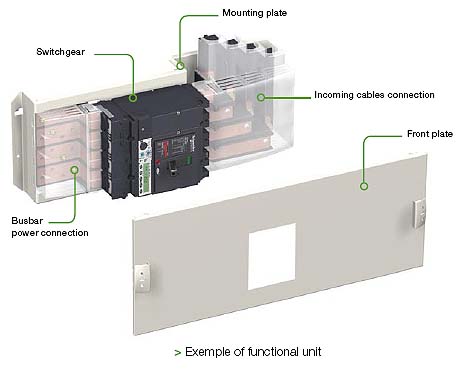
Пример функционального блока
Тематики
- НКУ (шкафы, пульты,...)
Классификация
>>>EN
DE
FR
Русско-английский словарь нормативно-технической терминологии > функциональный блок (в НКУ)
-
29 функциональный операционный план
функциональный операционный план
Документ, отображающий деятельность функций по подготовке и проведению Игр и содержащий перечень внутренних и внешних клиентских групп, уровней клиентского сервиса, результатов деятельности каждой функции. Функциональные операционные планы могут быть интегрированы в общий операционный план и представлены в разрезах планов по функциям, клиентским группам, объектам. Операционные планы ежегодно уточняются и детализируются от общего видения к детальному плану-графику периода Игр.
[Департамент лингвистических услуг Оргкомитета «Сочи 2014». Глоссарий терминов]EN
functional operational plan (FOP)
Document reflecting functional activities for the Games organization and staging, and containing lists of both internal and external client groups, client services levels, outcomes of each function operations. Functional operational plans may be integrated in the comprehensive operational plan or viewed separately for each Function, client group or venue. Operational plans are annually updated and finalized – from general overview to detailed master schedule for the Games period.
[Департамент лингвистических услуг Оргкомитета «Сочи 2014». Глоссарий терминов]Тематики
EN
Русско-английский словарь нормативно-технической терминологии > функциональный операционный план
-
30 направление функций
направление функций
Основное направление деятельности для функций ОКОИ. Оно помогает ОКОИ, органам государственной власти и внешним организациям развиваться на уровне функций и готовит организаторов к планированию деятельности объектов, пообъектному управлению и операционализации. Направление функций охватывает все службы ОКОИ и внешние организации, участвующие в подготовке и проведении Игр.
[Департамент лингвистических услуг Оргкомитета «Сочи 2014». Глоссарий терминов]EN
functional stream
Main activity stream for the OCOG functions. It helps the OCOG, public authorities and external entities to develop on a functional level and prepares the organizers for venue planning, venuisation and operationalization. The Functional stream involves every function of an OCOG and the external entities involved in Games delivery.
[Департамент лингвистических услуг Оргкомитета «Сочи 2014». Глоссарий терминов]Тематики
EN
Русско-английский словарь нормативно-технической терминологии > направление функций
-
31 индикатор
1) indicator
2) indicator function
3) marker
4) scope
5) telltale
– акустический индикатор
– буквенно-цифровой индикатор
– буквенный индикатор
– вибрационный индикатор
– волокнооптический индикатор
– газоразрядный индикатор
– голографический индикатор
– жидкокристаллический индикатор
– звуковой индикатор
– знаковый индикатор
– изотопный индикатор
– индикатор биений
– индикатор вакуума
– индикатор вибрационный
– индикатор влажности
– индикатор внешний
– индикатор внутренний
– индикатор вызова
– индикатор дыма
– индикатор зоны
– индикатор излучения
– индикатор колебаний
– индикатор метана
– индикатор мозаичный
– индикатор мощности
– индикатор на светодиодах
– индикатор направления
– индикатор настройки
– индикатор обледенения
– индикатор ошибки
– индикатор перегрева
– индикатор перегрузки
– индикатор положения
– индикатор полосковый
– индикатор радиоактивности
– индикатор рассогласования
– индикатор резонанса
– индикатор семиполосковый
– индикатор температуры
– индикатор узлов
– индикатор утечки
– индикатор яркостно-модулированный
– лазерный индикатор
– матричный индикатор
– многознаковый индикатор
– многоточечный индикатор
– многоцветный индикатор
– неоновый индикатор
– обощенный индикатор
– оптоэлектронный индикатор
– полупроводниковый индикатор
– пьезоэлектрический индикатор
– радиоактивный индикатор
– радиолокационный индикатор
– световой индикатор
– светодиодный индикатор
– стереоскопический индикатор
– стрелочный индикатор
– твердотельный индикатор
– трехмерный индикатор
– фотонный индикатор
– химический индикатор
– цифровой индикатор
– электроннолучевой индикатор
– электрооптический индикатор
вакуумный люминесцентный индикатор — vacuum florescent display
индикатор бокового уклонения — course deviation indicator
индикатор газа предохранитель — approved gas detector
индикатор дальности своей станции — <tech.> self-distance indictor
индикатор данных вынесенный — remote data indicator
индикатор движущихся целей — <tech.> moving target indicator
индикатор износа ленты — belt fray indicator
индикатор колебаний тлеющий — < radio> ondoscope
индикатор кругового обзора — <tech.> J-scope
индикатор на газонаполненных трубках — <comput.> gas plasma display
индикатор на жидких кристаллах — <comput. - liquid-crystal display> LCD
индикатор обрыва провода — wire breakage detector
индикатор окиси углерода — carbon monoxide detector
индикатор останова программы — program stop light
индикатор отделения кабины — separation capsule indicator
индикатор погасания пламени — loss-of-flame detector
индикатор положения относительно земли — <aeron.> ground position indicator
индикатор пропуска импулсьсов — missing-pulse detector
индикатор работы передатчика — TRANSMIT indicator
индикатор равновесных схем — null indicator
индикатор секторного обзора — <tech.> sector PPI, sector scan indicator
индикатор секторного поиска — <tech.> sector PPI, sector scan indicator
индикатор скольжения ленты — belt slip detector
индикатор точки росы — dew-point indicator
индикатор углов колебаний — nodalizer
индикатор электронного излучения — R.F.envelope indicator
линейный аналоговый индикатор — linear analog indicator
-
32 внешний вызов
1) Engineering: external call2) Information technology: callback function -
33 внешняя (представительная) логика функционального блока IEC 61499
Programming: external IEC 61499 function block logicУниверсальный русско-английский словарь > внешняя (представительная) логика функционального блока IEC 61499
-
34 события внешнего интерфейса
Programming: external interface events (функционального блока. См. Robert W. Lewis: Modelling control systems using IEC 61499. Applying function blocks to distributed systems)Универсальный русско-английский словарь > события внешнего интерфейса
-
35 внешняя логика функционального блока IEC 61499
Programming: (представительная) external IEC 61499 function block logicУниверсальный русско-английский словарь > внешняя логика функционального блока IEC 61499
-
36 дефект
defect, defect center, ( результат повреждения) damage, (в программе, обнаруженный при структурном контроле) exposure, fault, flaw, imperfection, malformation* * *дефе́кт м.1. ( структуры вещества) defect, imperfection2. ( различных изделий и технологических процессов) defect, flawбез дефе́кта — flawless; defectlessвыявля́ть дефе́кт — bring out [expose, reveal, show up] a defectобнару́живать дефе́кт — detect a defectустана́вливать расположе́ние дефе́кта — locate a defectустраня́ть дефе́кт — rectify [correct] a defect3. полигр. incomplete fountдефе́кт аналити́ческой фу́нкции — defect of an analytic functionдефе́кт а́нти-Шо́тки — anti-Schottky defectаперту́рный дефе́кт — aperture defectдефе́кт в ко́рне сварно́го шва — root defectдефе́кт внедре́ния — interstitial defectвну́тренний дефе́кт — internal defect, internal flawдефе́кт в пло́скости листа́ метал. — laminal defectдефе́кт в твё́рдом те́ле — imperfection in a solidдефе́кт каландрова́ния — calendering defectкатио́нный дефе́кт — cation defectква́нтовый дефе́кт — quantum defectдефе́кт констру́кции — construction defectдефе́кт криста́лла — crystal defect, lattice imperfectionвызва́ть дефе́кт в криста́лле — disturb the order in a crystalдефе́кт кристалли́ческой решё́тки — (crystal-)lattice defect, lattice imperfectionдефе́кт литья́ — casting defectдефе́кт лица́ ( кожи) — grain defectsлокализо́ванный дефе́кт — spot defectмакроскопи́ческий дефе́кт — macroscopic defectдефе́кт масс яд. физ. — mass defectнару́жный дефе́кт — external defectдефе́кт отли́вки — casting defectдефе́кт от непра́вильной зали́вки метал. — pouring defectпове́рхностный дефе́кт — surface defectдефе́кт по Френе́лю — Fresnel defectдефе́кт по Фре́нкелю — Frenkel defectдефе́кт по Шо́ттки — Chottky defectдефе́кт прока́тки — rolling defectрадиацио́нный дефе́кт — radiation-induced defectрассе́янные дефе́кты — dispersed defectsдефе́кт сва́рки — welding defectскры́тый дефе́кт — hidden [latent] flawдефе́кт сно́вки — warping defectдефе́кт структу́ры — structural defectдефе́кт ти́па вака́нсия — междоу́злие — interstitial-vacancy pairто́чечный дефе́кт1. физ. point defect2. метал. pin-holeуглово́й дефе́кт мат. — angular defectуглово́й дефе́кт треуго́льника — excess of a triangleдефе́кт укла́дки физ. — stacking faultхими́ческий дефе́кт — chemical defectдефе́кт ядра́ мат. — nullity, defect of kernel -
37 работа
action, activity, (конструкции, материала) behavior, duty, operation, job, labor, ( место работы) office, performance, run, running, service, work, working* * *рабо́та ж.1. ( физический процесс) work, activityрабо́та по, напр. перемеще́нию электро́на в по́ле — the work done by the field on an electron to move it (from … to …)соверша́ть рабо́ту — do work2. (качество, способ исполнения) workmanship3. (конкретное или ограниченное задание, занятие, труд) job4. (величина с качественным оттенком, показатель работы, рабочая характеристика) performance5. ( функционирование) operation, service, useвключа́ть в рабо́ту — switch in useвключа́ть, напр. генера́тор на рабо́ту с вне́шней модуля́цией — set, e. g., an oscillator for external modulationвыключа́ть из рабо́ты — switch out of useконтроли́ровать рабо́ту (особ. периодически) — check the operation of …контроли́ровать рабо́ту (особ. непрерывно) — monitor the operation of …прекраща́ть рабо́ту автомати́чески — cease to operate automatically6. (продукт труда, готовое изделие) workавтомати́ческая рабо́та — automatic operationавтоно́мная рабо́та вчт. — off-line operationакко́рдная рабо́та — piece work, task workармату́рные рабо́ты — installation of reinforcementасинхро́нная рабо́та — asynchronous workingбезавари́йная рабо́та — trouble-free operationрабо́та без обслу́живающего персона́ла — unattended operationбезотка́зная рабо́та — no-failure operationбесперебо́йная рабо́та — continuity of serviceбесшу́мная рабо́та — silence in operation, silent operationбето́нные рабо́ты — concreting, concrete placementбрига́дная рабо́та — team workбуровзрывны́е рабо́ты — drilling and blasting (operations)рабо́та в авари́йных усло́виях — emergency operationвзрывны́е рабо́ты — shotfiring, blastingрабо́та в крити́ческом режи́ме — critical operationрабо́та в откры́том ко́смосе ( выход в открытый космос) — extravehicular activity, EVAрабо́та вразно́с ( о двигателе) — racing, runawayрабо́та в реа́льном масшта́бе вре́мени вчт. — real-time operationвскрышны́е рабо́ты горн. — overburden operations, overburden miningрабо́та вы́хода электро́на, напр. из мета́лла — (electronic) work function, e. g., of a metalсоверша́ть рабо́ту вы́хода электро́на, напр. из мета́лла — do work on escaping, e. g., from a metalгорноспаса́тельные рабо́ты — rescue work, rescue operationsдвухпо́люсная рабо́та — тлг. брит. double-current working; амер. polar (current) workingдвухсме́нная рабо́та — two-shift operationрабо́та ди́плексом свз. — diplex operation, diplex workingдноуглуби́тельные рабо́ты — dredgingдоро́жно-строи́тельные рабо́ты — road-buildingрабо́та ду́плексом свз. — duplex operation, duplex workingземлечерпа́тельные рабо́ты — dredgingземляны́е рабо́ты — earth-moving, excavation, diggingземляны́е рабо́ты с по́мощью я́дерных взры́вов — nuclear digging, nuclear excavationиндика́торная рабо́та — indicator workрабо́та ключо́м — keying, key modulationрабо́та констру́кции — structural behaviourкро́вельные рабо́ты — roofingкруглосу́точная рабо́та — round-the-clock operation, twenty-four-hour serviceлесоперева́лочные рабо́ты — reloading operationsлине́йные рабо́ты — line workмаля́рные рабо́ты — paintingмехани́ческая рабо́та — mechanical workмонта́жные рабо́ты — erection [installation] workрабо́та на борту́ косми́ческого корабля́ — intravehicular activity, IVAнала́дочные рабо́ты — adjustment and alignmentрабо́та на му́фте турби́ны — shaft workнау́чно-иссле́довательская рабо́та — research (work)непреры́вная рабо́та — continuous workнорма́льная рабо́та — normal operationоднопо́люсная рабо́та — тлг. брит. single-current working; амер. neutral workingо́пытно-констру́кторская рабо́та [ОКР] — research and development (work), R&D workо́пытные рабо́ты — development work(s)отва́льные рабо́ты — dumpingотде́лочная рабо́та — finishing workпаралле́льная рабо́та — parallel operationпри паралле́льной рабо́те, напр. генера́торов — with, e. g., generators paralleledпериоди́ческая рабо́та — intermittent [batch] operationпла́новая рабо́та — scheduled workплохая́ рабо́та ( низкое качество исполнения) — poor workmanshipпогру́зочно-разгру́зочные рабо́ты — ( в промышленности) materials handling; ( на транспорте) cargo [freight] handlingпоиско́во-спаса́тельные рабо́ты ( на море или суше) — search and rescue (operations)полевы́е рабо́ты — field workполуду́плексная рабо́та свз. — half-duplex operationрабо́та по поро́де горн. — deadwork, stoneworkрабо́та по схе́ме постоя́нного то́ка свз. — closed circuit workingпромысло́вые рабо́ты — fishing operationsразве́дочные рабо́ты ( для промышленной оценки месторождений полезных ископаемых) — prospectingразде́льная рабо́та — isolated operationпри разде́льной рабо́те, напр. генера́торов — with, e. g., generators isolatedро́вная рабо́та (напр. двигателя) — smooth runningручна́я рабо́та — hand workсверхуро́чная рабо́та — overtime workрабо́та с да́нными вчт. — data handlingрабо́та си́мплексом свз. — simplex [up and down] workingсинфа́зная рабо́та — in-phase operationсинхро́нная рабо́та — synchronous [synchronized] operationска́льные рабо́ты — rock excavationсме́нная рабо́та — shift workсовме́стная рабо́та, напр. армату́ры и бето́на — collaboration of, e. g., steel and concreteрабо́та с перебо́ями — erratic operation; двс. rough runningрабо́та с разделе́нием вре́мени вчт. — time-sharing operationстрои́тельные рабо́ты — civil engineering workтока́рная рабо́та — lathe workрабо́та тона́льно-модули́рованными колеба́ниями свз. — MCW operation, MCW serviceубо́рочные рабо́ты — harvestingштукату́рные рабо́ты — ( внутренние) plastering; ( наружные) stuccoingэлектромонта́жные рабо́ты — electric installation work -
38 предохранять от попадания ... в
Предохранять от попадания (осколков) в-- In addition to these two O-rings there was another O-ring whose function was to keep out the debris from the external O-ring seal.Русско-английский научно-технический словарь переводчика > предохранять от попадания ... в
-
39 дефект
1. м. defect, imperfection2. м. defect, flawбез дефекта — flawless; defectless
3. м. полигр. incomplete fountСинонимический ряд:недостаток (сущ.) изъян; минус; недостаток; недочет; несовершенство; порок; пробел -
40 реле (p) (к)
relay (к)
электромеханическое устройство, контакты которого размыкают и /или замыкают управляемую цепь в зависимости от наличия или величины эл. сигналов в управляющей цепи, — an electromechanical device in which contacts are opened and/or closed by variations in the conditions of one electric circuit and thereby affect the operation of other devices in the same or other electric circuits.
-, арретирующее — latching relay
-, барометрическое (барореле для раскрытия парашюта) — barometric release (mechanism)
-, бесконтактное — contactless relay
- блокировки — blocking relay
-, биметаллическое — bimetallic relay
- блокировки (выключения) — lockout relay
- блокировки (выключения) автомата торможения — anti-skid lockout relay
- блокировки включения систем самолета, двигателя при обжатой передней амортстойке шасси — ground shift relay (actuated with nose oleo compressed)
-, блокировочное — blocking relay
реле, связанное с другими устройствами и, служащее для предотвращения срабатывания ипи повторного включения цепи при нарушении нормальной работы. — a relay wtlich со-operates with other devices to block tripping or to block reclosing on an out-of-step condition. or on power swings.
-, блокировочное — locking-out /lockout/ relay
реле, служащее для выключения оборудования и удержания его в выключенном состоянии при нарушении нормальной работы.данного оборудования, — an electrically operated hand or electrically reset device which functions to shut down and hold an equipment out of service on occurrence of abnormal conditions.
- включения (и выключения) — switching relay
реле, включающее или выключающее к-л. устройство или цепь, — the relay which can place another device or circuit in an operating or nonoperating state.
- включения (одного устройства к другому, напр., преобразователя к шине) — (inverter-to-bus) switching /connection, tie/ relay
- включения муфты стартера — starter meshing relay
- включения наземного питания — external power relay
- включения стартерного pежима (стартера-генератора) — motorizing relay
- времени — time relay
- времени, электромашинное — rotary time-delay relay
-, вызывающее срабатывание системы (цепи) — system /circuit/ actuating relay
-, выключающее — cutout /cut-out/ relay
- выключения (защитного устройства, контактора, оборудования) — tripping relay. used to trip а circuit breaker, contactor, equipment.
- выключения (блокировки оборудования при нарушении нормальных условий работы) — lock-out relay
- выключения зажигания (двиг.) — ignition cut-out relay
-, герметическое — pressure sealed relay
-, гидравлическое (сигнализатор) — hydraulic pressure switch
- давления (сигнализатор давления) — pressure switch
реле, срабатывающее при изменении давления подводимого газа или жидкости — a switch actuated by а change in the pressure of a gas or liquid.
- двухпозиционное (е замыканием контактов в двух крайних положениях) — double-throw relay. а relay which alternately completes а circuit at either of its two extreme positions.
-, двухполюсное — double pole relay
динамического торможения (фотокамеры) — (camera) dynamic braking relay
- дифференциальное — differential relay
реле с несколькими обмотками, которое срабатывает, когда разность величин подводимого напряжения или протекающего тока в обмотках достигает определенного уровня. — a relay with multiple windings that functions when the voltage, current, or power difference between the windings reaches а predetermined value.
-, дифференциально-минимальное (дмр) — differential reverse current cutout relay
- задержки времени — time delay relay
реле, обеспечивающее временной интервал между включением и выключением обмотки и перемещением якоря, — a relay in which there is an appreciable interval of time between the energizing or deenergizing of the coil and the movement of the armature.
-, защитное — protective relay
реле, служащее для защиты цепей в случае нарушения нормального режима работы, — a relay, the principal function оf which is to protect services from interruption or to prevent or limit damage to apparatus.
-, защитное дифференциальнoe — differential protective relay
- защиты от перенапряжения — overvoltage relay
-, командное — control relay
- контроля нагрузки — load monitor relay (lmr)
-, максимальное — overload relay
реле, срабатывающее, если сила тока, протекающего в его обмотке, превышает установленную величину, — a relay designed to operate when its coil current rises above а predetermined value.
- мгновенного действия — instantaneous relay
-, минимальное — reverse current (cut-out) relay
устанавливается в цепи между генератором пост. тока (или выпрямительным устройством) и шиной пост. тока для предотвращения обратного тока в случае, если напряжение на шине превышает выходное напряжение генератора. — reverse current cut-out relays are placed between the dc generator, transformerrectifier, and the dc bus to prevent reverse current flow, if the dc bus potential becomes greater than dc generator or transformerrectifier output.
- на два направления (двухпозиционное) — double-throw relay
- напряжения — voltage relay
реле, срабатывающее при заданной величине подаваемого напряжения, — a relay that functions at а predetermined value of voltage.
- обжатого положения шасси (для включения систем ла) — ground shift mechanism relay
- обратного тока — reverse-current relay
реле, срабатывающее при протекании тока в обратном направлении, — a relay that operates whenever current flows in the reverse direction.
- объединения шин (подсистем лев. и прав. борта) — bus tie relay (btr)
- отключения объединения шин — tie bus isolation relay
- перегрузки (максимальное) — overload relay
- переключения потребителей (pпп) — load monitor relay (lmr)
- переключения стартера-генератора на стартерный режим — motorizing relay
- переключения шин (эл.) — bus tie relay (btr)
- переменного тока — ас operated relay
-, пневматическое (сигнализатор давления) — pneumatic pressure switch
- подает напряжение на... — relay applies voltage to..., relay energizes...
- подает (+27 в) на... — relay applies (+27 v) to..., relay makes /closes/ circuit to supply /apply, feed/ +27 v to...
-, поляризованное — polarized relay
реле, направление перемещения якоря которого зависит от направления тока в его обмотке. — а relay in which the arma'ture movement depends on the direction of the current. its coil symbol is sometimes marked +.
- предельного значения скорости — maximum operating limit speed relay
- предельного значения числa m. — maximum operating limit mach-number relay
-, промежуточное (вспомогательное) — auxiliary relay
- пускового зажигания (двиг.) — starting ignition.relay
-, развязывающее — decoupling relay
-, разделительное — isolation relay
- сигнализатора обледенения — ice detector pressure switch
- сигнализации достижения предельной скорости — maximum operating limit speed (warning) relay
- сигнализации нарушения (параметров) питания — power relay. it may be an overpower or underpower relay.
- сигнализации отказа питания — power fail relay
- с механической блокировкой — latching relay
- соединения шин — bus tie relay (btr)
- с самоблокировкой — interlock relay
реле, в котором один якорь не может изменить свое положение или его обмотка не может оказаться под током, если другой якорь не занимает определенное положение. — a relay in which one armature cannot move or its coil be energized unless the other armature is in a certain position.
-, стопорное (запорное) — latch-in /latching, locking/ relay
реле, контакты которого стопорятся (фиксируются) либо в замкнутом или разомкнутом положении до момента расстопорения вручную или электрически. — а relay with contacts that lock in oither the energized or de-energized position until reset either manually or electrlcally.
- стрельбы — firing control relay, fire relay
- снимает напряжение с... (обесточивает цепь) — relay de-energizes..., relay removes voltage from...
- снимает +27 в с... — rela@ removes +27 v from..., relay breakes /opens/ circuit to remove +27 v from...
- срабатывает (и замыкает цепь) — relay operates (and closes circuit)
- срабатывает и (своими контактами) подает +27 в на клемму 1 — relay operates and applies +27 v to terminal 1
- срабатывает и приводит в действие эл. мотор — relay actuates electric motor
-, струйное
электромагнитное устройство, распределяющее входное давление (воздуха, рабочей жидкости) в двух выходных каналах. — jet relay
-, тепловое — thermal relay
реле, срабатывающее под воздействием нагрева, создаваемого протекаемым током. — а relay (hat responds to the heating effect of an energizing current.
-, управляющее — control relay
-, чувствительное — sensitive relay
-, шаговое — stepping relay
-, электромагнитное — electromagnetic relay
электромагнитный контактор, имеющий обмотку (обмотки) и подвижный якорь, — an electromagnetically operated switch composed of one or more coils and armatures.
-, эпектромашинное — rotary relay
-, электронное — electronic relay
электронная цепь, выполняющая функцию реле, без наличия подвижных деталей. — an electronic circuit that provides the functional equivalent of a relay, but has no moving parts.
отпускание p. (на размыкание контактов) — tripping off
срабатывание р. — operation of relay
включать р. — energize relay
выключать (обесточивать) р. — de-energize relay
переключать(ся) р. — reset relay (manually or electrically)
- притягивать якорь р. — attract relay armature
удерживать р. в заданном положении — hold relay in the given positionРусско-английский сборник авиационно-технических терминов > реле (p) (к)
См. также в других словарях:
External Function — [engl.], externe Funktion … Universal-Lexikon
External ballistics — is the part of the science of ballistics that deals with the behaviour of a non powered projectile in flight. External ballistics is frequently associated with firearms, and deals with the behaviour of the bullet after it exits the barrel and… … Wikipedia
Function overloading — or method overloading is a feature found in various programming languages such as Ada, C#, VB.NET, C++, D and Java that allows the creation of several methods with the same name which differ from each other in terms of the type of the input and… … Wikipedia
Function point — A function point is a unit of measurement to express the amount of business functionality an information system provides to a user. Function points are the units of measure used by the IFPUG Functional Size Measurement Method. The IFPUG FSM… … Wikipedia
External (mathematics) — The term external is useful for describing certain algebraic structures. The term comes from the concept of an external binary operation which is a binary operation that draws from some external set . To be more specific, a left external binary… … Wikipedia
Function-Point-Verfahren — Das Function Point Verfahren (auch Analyse oder Methode, kurz FPA) dient zur Bewertung des fachlich funktionalen Umfangs eines Informationstechnischen Systems, im Folgenden als Anwendung bezeichnet. Das Ergebnis einer Function Point Bewertung… … Deutsch Wikipedia
External ray — In complex analysis, particularly in complex dynamics and geometric function theory, external rays are associated to a compact, full, connected subset K, of the complex plane as the images of radial rays under the Riemann map of the complement of … Wikipedia
Function (mathematics) — f(x) redirects here. For the band, see f(x) (band). Graph of example function, In mathematics, a function associates one quantity, the a … Wikipedia
Function pointer — A function pointer is a type of pointer in C, C++, D, and other C like programming languages, and Fortran 2003.[1] When dereferenced, a function pointer can be used to invoke a function and pass it arguments just like a normal function. In… … Wikipedia
Function composition — For function composition in computer science, see function composition (computer science). g ∘ f, the composition of f and g. For example, (g ∘ f)(c) = #. In mathematics, function composition is the application of one function to the resul … Wikipedia
Function (engineering) — In engineering, in psychology, as well as in common parlance, function denotes the property of something which is used/applied for an objective/goal/purpose/scope.In fact, it is possible to realize the same function using different physical… … Wikipedia
