

-
1 Mehrpol
устройство с n-выводами
-
[IEV number 151-12-14]EN
n-terminal device
device having n terminals with generally n greater than two
NOTE – In French, the term "multipôle" is also used for an n-terminal element, an n-terminal circuit or an n-terminal network. When n is specified, a more specific term is used, as for example "multipôle à n bornes", "tripôle",...
Source: see IEC 60050-131
[IEV number 151-12-14]FR
multipôle, m
dispositif à plus de deux bornes
NOTE – En français, le terme "multipôle" désigne aussi un élément de circuit, un circuit électrique ou un réseau à n bornes. Lorsque n est spécifié, on emploie un terme approprié tel que "multipôle à n bornes", "tripôle"...
Source: voir la CEI 60050-131
[IEV number 151-12-14]EN
DE
FR
Немецко-русский словарь нормативно-технической терминологии > Mehrpol
-
2 n-Pol
устройство с n-выводами
-
[IEV number 151-12-14]EN
n-terminal device
device having n terminals with generally n greater than two
NOTE – In French, the term "multipôle" is also used for an n-terminal element, an n-terminal circuit or an n-terminal network. When n is specified, a more specific term is used, as for example "multipôle à n bornes", "tripôle",...
Source: see IEC 60050-131
[IEV number 151-12-14]FR
multipôle, m
dispositif à plus de deux bornes
NOTE – En français, le terme "multipôle" désigne aussi un élément de circuit, un circuit électrique ou un réseau à n bornes. Lorsque n est spécifié, on emploie un terme approprié tel que "multipôle à n bornes", "tripôle"...
Source: voir la CEI 60050-131
[IEV number 151-12-14]EN
DE
FR
Немецко-русский словарь нормативно-технической терминологии > n-Pol
-
3 Last (1)
1. Любой потребитель электроэнергии
электрическая нагрузка
Любой приемник(потребитель)электрической энергии в электрической цепи 1)
[БЭС]
нагрузка
Устройство, потребляющее мощность
[СТ МЭК 50(151)-78]EN
load (1), noun
device intended to absorb power supplied by another device or an electric power system
[IEV number 151-15-15]FR
charge (1), f
1) Иными словами (электрическая) нагрузка, это любое устройство или группа устройств, потребляющих электрическую энергию (электродвигатель, электролампа, электронагреватель и т. д.)
dispositif destiné à absorber de la puissance fournie par un autre dispositif ou un réseau d'énergie électrique
[IEV number 151-15-15]
[Интент]
Термимн нагрузка удобно использовать как обощающее слово.
В приведенном ниже примере термин нагрузка удачно используется для перевода выражения any other appliance:
Make sure that the power supply and its frequency are adapted to the required electric current of operation, taking into account specific conditions of the location and the current required for any other appliance connected with the same circuit.
Ток, напряжение и частота источника питания должны соответствовать параметрам агрегата с учетом длины и способа прокладки питающей линии, а также с учетом другой нагрузки, подключенной к этой же питающей линии.
[Перевод Интент]
... подключенная к трансформатору нагрузка
[ ГОСТ 12.2.007.4-75*]
Поскольку приемник электрической энергии это любой аппарат, агрегат, механизм, предназначенный для преобразования электрической энергии в другой вид энергии [ПУЭ], то термин нагрузка может характеризовать электроприемник с точки зрения тока, сопротивления или мощности.
2. Потребитель энергоэнергии, с точки зрения потребляемой мощности
нагрузка
Мощность, потребляемая устройством
[СТ МЭК 50(151)-78]EN
load (2), noun
power absorbed by a load
[IEV number 151-15-16]FR
charge (2), f
puissance absorbée par une charge
Source: 151-15-15
[IEV number 151-15-16]
При проектировании электроснабжения энергоемких предприятий следует предусматривать по согласованию с заказчиком и с энергоснабжающей организацией регулирование электрической нагрузки путем отключения или частичной разгрузки крупных электроприемников, допускающих без значительного экономического ущерба для технологического режима перерывы или ограничения в подаче электроэнергии.
[СН 174-75 Инструкция по проектированию электроснабжения промышленных предприятий]
В настоящее время характер коммунально-бытовой нагрузки кардинально изменился в результате широкого распространения новых типов электроприемников (микроволновых печей, кондиционеров, морозильников, люминесцентных светильников, стиральных и посудомоечных машин, персональных компьютеров и др.), потребляющих из питающей сети наряду с активной мощностью (АМ) также и значительную реактивную мощность (РМ).Недопустимые, нерекомендуемые
Тематики
- электроснабжение в целом
- электротехника, основные понятия
Классификация
>>>Близкие понятия
Действия
- аварийное отключение нагрузки
- аварийный сброс нагрузки
- включение нагрузки
- защитное отключение нагрузки
- ограничение допустимых нагрузок
- отключение нагрузки
- отключение неприоритетных нагрузок
- передача нагрузки с одной системы шин на другую
- питание нагрузки
- регулирование электрической нагрузки
Синонимы
Сопутствующие термины
- нагрузки жилых зданий
- нагрузки общественных зданий
- территориальное расположение нагрузок
- ток нагрузки
- токовая нагрузка
- характер коммунально-бытовой наргрузки
- характер нагрузки (индуктивный, емкостной)
EN
DE
FR
Немецко-русский словарь нормативно-технической терминологии > Last (1)
-
4 Leistungsabgabe (2)
1. Любой потребитель электроэнергии
электрическая нагрузка
Любой приемник(потребитель)электрической энергии в электрической цепи 1)
[БЭС]
нагрузка
Устройство, потребляющее мощность
[СТ МЭК 50(151)-78]EN
load (1), noun
device intended to absorb power supplied by another device or an electric power system
[IEV number 151-15-15]FR
charge (1), f
1) Иными словами (электрическая) нагрузка, это любое устройство или группа устройств, потребляющих электрическую энергию (электродвигатель, электролампа, электронагреватель и т. д.)
dispositif destiné à absorber de la puissance fournie par un autre dispositif ou un réseau d'énergie électrique
[IEV number 151-15-15]
[Интент]
Термимн нагрузка удобно использовать как обощающее слово.
В приведенном ниже примере термин нагрузка удачно используется для перевода выражения any other appliance:
Make sure that the power supply and its frequency are adapted to the required electric current of operation, taking into account specific conditions of the location and the current required for any other appliance connected with the same circuit.
Ток, напряжение и частота источника питания должны соответствовать параметрам агрегата с учетом длины и способа прокладки питающей линии, а также с учетом другой нагрузки, подключенной к этой же питающей линии.
[Перевод Интент]
... подключенная к трансформатору нагрузка
[ ГОСТ 12.2.007.4-75*]
Поскольку приемник электрической энергии это любой аппарат, агрегат, механизм, предназначенный для преобразования электрической энергии в другой вид энергии [ПУЭ], то термин нагрузка может характеризовать электроприемник с точки зрения тока, сопротивления или мощности.
2. Потребитель энергоэнергии, с точки зрения потребляемой мощности
нагрузка
Мощность, потребляемая устройством
[СТ МЭК 50(151)-78]EN
load (2), noun
power absorbed by a load
[IEV number 151-15-16]FR
charge (2), f
puissance absorbée par une charge
Source: 151-15-15
[IEV number 151-15-16]
При проектировании электроснабжения энергоемких предприятий следует предусматривать по согласованию с заказчиком и с энергоснабжающей организацией регулирование электрической нагрузки путем отключения или частичной разгрузки крупных электроприемников, допускающих без значительного экономического ущерба для технологического режима перерывы или ограничения в подаче электроэнергии.
[СН 174-75 Инструкция по проектированию электроснабжения промышленных предприятий]
В настоящее время характер коммунально-бытовой нагрузки кардинально изменился в результате широкого распространения новых типов электроприемников (микроволновых печей, кондиционеров, морозильников, люминесцентных светильников, стиральных и посудомоечных машин, персональных компьютеров и др.), потребляющих из питающей сети наряду с активной мощностью (АМ) также и значительную реактивную мощность (РМ).Недопустимые, нерекомендуемые
Тематики
- электроснабжение в целом
- электротехника, основные понятия
Классификация
>>>Близкие понятия
Действия
- аварийное отключение нагрузки
- аварийный сброс нагрузки
- включение нагрузки
- защитное отключение нагрузки
- ограничение допустимых нагрузок
- отключение нагрузки
- отключение неприоритетных нагрузок
- передача нагрузки с одной системы шин на другую
- питание нагрузки
- регулирование электрической нагрузки
Синонимы
Сопутствующие термины
- нагрузки жилых зданий
- нагрузки общественных зданий
- территориальное расположение нагрузок
- ток нагрузки
- токовая нагрузка
- характер коммунально-бытовой наргрузки
- характер нагрузки (индуктивный, емкостной)
EN
DE
FR
Немецко-русский словарь нормативно-технической терминологии > Leistungsabgabe (2)
-
5 Apparat
аппарат
Устройство, в котором за счёт внешних механических, химических и электромеханических, термических или других воздействий производится полезная работа
[Терминологический словарь по строительству на 12 языках (ВНИИИС Госстроя СССР)]
аппарат
-
[IEV number 151-11-22]EN
apparatus
device or assembly of devices which can be used as an independent unit for specific functions
NOTE – In English, the term "apparatus" sometimes implies use by skilled persons for professional purposes.
[IEV number 151-11-22]FR
appareil, m
dispositif ou assemblage de dispositifs qui peut être utilisé comme unité indépendante pour remplir des fonctions particulières
NOTE – En anglais, le terme "apparatus" implique quelquefois une utilisation par des personnes qualifiées dans un but professionnel.
[IEV number 151-11-22]Сопутствующие термины
EN
DE
FR
Немецко-русский словарь нормативно-технической терминологии > Apparat
-
6 Gerät (2)
аппарат
Устройство, в котором за счёт внешних механических, химических и электромеханических, термических или других воздействий производится полезная работа
[Терминологический словарь по строительству на 12 языках (ВНИИИС Госстроя СССР)]
аппарат
-
[IEV number 151-11-22]EN
apparatus
device or assembly of devices which can be used as an independent unit for specific functions
NOTE – In English, the term "apparatus" sometimes implies use by skilled persons for professional purposes.
[IEV number 151-11-22]FR
appareil, m
dispositif ou assemblage de dispositifs qui peut être utilisé comme unité indépendante pour remplir des fonctions particulières
NOTE – En anglais, le terme "apparatus" implique quelquefois une utilisation par des personnes qualifiées dans un but professionnel.
[IEV number 151-11-22]Сопутствующие термины
EN
DE
FR
Немецко-русский словарь нормативно-технической терминологии > Gerät (2)
-
7 Dauerstrombelastbarkeit, f
(длительный) допустимый ток
Максимальное значение электрического тока, который может протекать длительно по проводнику, устройству или аппарату при определенных условиях без превышения определенного значения их температуры в установившемся режиме
[ ГОСТ Р МЭК 60050-826-2009]
Этот ток обозначают IZ
[ ГОСТ Р 50571. 1-2009 ( МЭК 60364-1: 2005)]EN
(continuous) current-carrying capacity
ampacity (US)
maximum value of electric current which can be carried continuously by a conductor, a device or an apparatus, under specified conditions without its steady-state temperature exceeding a specified value
[IEV number 826-11-13]
ampacity
The current in amperes that a conductor can carry continuously under the conditions of use without exceeding its temperature rating.
[National Electrical Cod]FR
courant (permanent) admissible, m
valeur maximale du courant électrique qui peut parcourir en permanence, un conducteur, un dispositif ou un appareil, sans que sa température de régime permanent, dans des conditions données, soit supérieure à la valeur spécifiée
[IEV number 826-11-13]Ampacity, the term is defined as the maximum amount of current a cable can carry before sustaining immediate or progressive deterioration. Also described as current rating or current-carrying capacity, is the RMS electric current which a device can continuously carry while remaining within its temperature rating. The ampacity of a cable depends on:
- its insulation temperature rating;
- conductor electrical properties for current;
- frequency, in the case of alternating currents;
- ability to dissipate heat, which depends on cable geometry and its surroundings;
- ambient temperature.
Electric wires have some resistance, and electric current flowing through them causes voltage drop and power dissipation, which heats the cable. Copper or aluminum can conduct a large amount of current before melting, but long before the conductors melt, their insulation would be damaged by the heat.
The ampacity for a power cable is thus based on physical and electrical properties of the material & construction of the conductor and of its insulation, ambient temperature, and environmental conditions adjacent to the cable. Having a large overall surface area may dissipate heat well if the environment can absorb the heat.
In a long run of cable, different conditions govern, and installation regulations normally specify that the most severe condition along the run governs the cable's rating. Cables run in wet or oily locations may carry a lower temperature rating than in a dry installation. Derating is necessary for multiple circuits in close proximity. When multiple cables are near, each contributes heat to the others and diminishes the amount of cooling air that can flow past the individual cables. The overall ampacity of the insulated conductors in a bundle of more than 3 must be derated, whether in a raceway or cable. Usually the de-rating factor is tabulated in a nation's wiring regulations.
Depending on the type of insulating material, common maximum allowable temperatures at the surface of the conductor are 60, 75 and 90 degrees Celsius, often with an ambient air temperature of 30°C. In the U.S., 105°C is allowed with ambient of 40°C, for larger power cables, especially those operating at more than 2 kV. Likewise, specific insulations are rated 150, 200 or 250°C.
The allowed current in cables generally needs to be decreased (derated) when the cable is covered with fireproofing material.
For example, the United States National Electric Code, Table 310-16, specifies that up to three 8 AWG copper wires having a common insulating material (THWN) in a raceway, cable, or direct burial has an ampacity of 50 A when the ambient air is 30°C, the conductor surface temperature allowed to be 75°C. A single insulated conductor in air has 70 A rating.
Ampacity rating is normally for continuous current, and short periods of overcurrent occur without harm in most cabling systems. The acceptable magnitude and duration of overcurrent is a more complex topic than ampacity.
When designing an electrical system, one will normally need to know the current rating for the following:- Wires
- Printed Circuit Board traces, where included
- Fuses
- Circuit breakers
- All or nearly all components used
Some devices are limited by power rating, and when this power rating occurs below their current limit, it is not necessary to know the current limit to design a system. A common example of this is lightbulb holders.
[http://en.wikipedia.org/wiki/Ampacity]
Тематики
- электротехника, основные понятия
Синонимы
EN
DE
- Dauerstrombelastbarkeit, f
- Strombelastbarkeit, f
FR
- courant admissible, m
- courant permanent admissible, m
Немецко-русский словарь нормативно-технической терминологии > Dauerstrombelastbarkeit, f
-
8 Strombelastbarkeit, f
(длительный) допустимый ток
Максимальное значение электрического тока, который может протекать длительно по проводнику, устройству или аппарату при определенных условиях без превышения определенного значения их температуры в установившемся режиме
[ ГОСТ Р МЭК 60050-826-2009]
Этот ток обозначают IZ
[ ГОСТ Р 50571. 1-2009 ( МЭК 60364-1: 2005)]EN
(continuous) current-carrying capacity
ampacity (US)
maximum value of electric current which can be carried continuously by a conductor, a device or an apparatus, under specified conditions without its steady-state temperature exceeding a specified value
[IEV number 826-11-13]
ampacity
The current in amperes that a conductor can carry continuously under the conditions of use without exceeding its temperature rating.
[National Electrical Cod]FR
courant (permanent) admissible, m
valeur maximale du courant électrique qui peut parcourir en permanence, un conducteur, un dispositif ou un appareil, sans que sa température de régime permanent, dans des conditions données, soit supérieure à la valeur spécifiée
[IEV number 826-11-13]Ampacity, the term is defined as the maximum amount of current a cable can carry before sustaining immediate or progressive deterioration. Also described as current rating or current-carrying capacity, is the RMS electric current which a device can continuously carry while remaining within its temperature rating. The ampacity of a cable depends on:
- its insulation temperature rating;
- conductor electrical properties for current;
- frequency, in the case of alternating currents;
- ability to dissipate heat, which depends on cable geometry and its surroundings;
- ambient temperature.
Electric wires have some resistance, and electric current flowing through them causes voltage drop and power dissipation, which heats the cable. Copper or aluminum can conduct a large amount of current before melting, but long before the conductors melt, their insulation would be damaged by the heat.
The ampacity for a power cable is thus based on physical and electrical properties of the material & construction of the conductor and of its insulation, ambient temperature, and environmental conditions adjacent to the cable. Having a large overall surface area may dissipate heat well if the environment can absorb the heat.
In a long run of cable, different conditions govern, and installation regulations normally specify that the most severe condition along the run governs the cable's rating. Cables run in wet or oily locations may carry a lower temperature rating than in a dry installation. Derating is necessary for multiple circuits in close proximity. When multiple cables are near, each contributes heat to the others and diminishes the amount of cooling air that can flow past the individual cables. The overall ampacity of the insulated conductors in a bundle of more than 3 must be derated, whether in a raceway or cable. Usually the de-rating factor is tabulated in a nation's wiring regulations.
Depending on the type of insulating material, common maximum allowable temperatures at the surface of the conductor are 60, 75 and 90 degrees Celsius, often with an ambient air temperature of 30°C. In the U.S., 105°C is allowed with ambient of 40°C, for larger power cables, especially those operating at more than 2 kV. Likewise, specific insulations are rated 150, 200 or 250°C.
The allowed current in cables generally needs to be decreased (derated) when the cable is covered with fireproofing material.
For example, the United States National Electric Code, Table 310-16, specifies that up to three 8 AWG copper wires having a common insulating material (THWN) in a raceway, cable, or direct burial has an ampacity of 50 A when the ambient air is 30°C, the conductor surface temperature allowed to be 75°C. A single insulated conductor in air has 70 A rating.
Ampacity rating is normally for continuous current, and short periods of overcurrent occur without harm in most cabling systems. The acceptable magnitude and duration of overcurrent is a more complex topic than ampacity.
When designing an electrical system, one will normally need to know the current rating for the following:- Wires
- Printed Circuit Board traces, where included
- Fuses
- Circuit breakers
- All or nearly all components used
Some devices are limited by power rating, and when this power rating occurs below their current limit, it is not necessary to know the current limit to design a system. A common example of this is lightbulb holders.
[http://en.wikipedia.org/wiki/Ampacity]
Тематики
- электротехника, основные понятия
Синонимы
EN
DE
- Dauerstrombelastbarkeit, f
- Strombelastbarkeit, f
FR
- courant admissible, m
- courant permanent admissible, m
Немецко-русский словарь нормативно-технической терминологии > Strombelastbarkeit, f
-
9 negative Elektrode
отрицательный электрод
-
[IEV number 151-13-04]EN
negative electrode
for a device having two electrodes, that electrode having the lower electric potential
NOTE – In some cases (e.g. electronic tubes and semiconductor devices), the term "negative electrode" is applied to one or another electrode, depending on the electric operating condition of the device. In other cases (e.g. electrochemical cells), the term "negative electrode" is assigned to a specific electrode.
[IEV number 151-13-04]FR
électrode négative, f
pour un dispositif à deux électrodes, celle des électrodes dont le potentiel électrique est le plus bas
NOTE – Dans certains cas (par exemple pour les tubes électroniques et les dispositifs semiconducteurs), le terme "électrode négative" désigne l’une ou l’autre électrode selon le régime électrique du dispositif. Dans d’autres cas (par exemple pour les éléments électrochimiques), le terme "électrode négative" désigne une électrode particulière.
[IEV number 151-13-04]EN
DE
FR
- électrode négative, f
Немецко-русский словарь нормативно-технической терминологии > negative Elektrode
-
10 positive Elektrode
положительный электрод
-
[IEV number 151-13-05]EN
positive electrode
for a device having two electrodes, that electrode having the higher electric potential
NOTE – In some cases (e.g. electronic tubes and semiconductor devices), the term "positive electrode" is applied to one or another electrode, depending on the electric operating condition of the device. In other cases (e.g. electrochemical cells), the term "positive electrode" is assigned to a specific electrode.
[IEV number 151-13-05]FR
électrode positive, f
pour un dispositif à deux électrodes, celle des électrodes dont le potentiel électrique est le plus élevé
NOTE – Dans certains cas (par exemple pour les tubes électroniques et les dispositifs semiconducteurs), le terme "électrode positive" désigne l’une ou l’autre électrode selon le régime électrique du dispositif. Dans d’autres cas (par exemple pour les éléments électrochimiques), le terme "électrode positive" désigne une électrode particulière.
[IEV number 151-13-05]EN
DE
FR
- électrode positive, f
Немецко-русский словарь нормативно-технической терминологии > positive Elektrode
-
11 Zubehör
принадлежность
<>аксессуар
-
[IEV number 151-11-24]EN
accessory
device supplementing a main device or apparatus, but not forming part of it, that is needed for its operation or to confer on it specific characteristics
[IEV number 151-11-24]FR
accessoire, m
dispositif supplémentaire qui ne fait pas partie d'un dispositif ou appareil principal mais qui est nécessaire à son fonctionnement ou pour lui apporter des caractéristiques particulières
[IEV number 151-11-24]EN
DE
FR
Немецко-русский словарь нормативно-технической терминологии > Zubehör
-
12 Anode
анод (устройства)
электрод, через который электрический ток входит в среду, имеющую удельную проводимость, отличную от удельной проводимости анода
[СТ МЭК50(151)-78]
анод
-
[IEV number 151-13-02]EN
anode
electrode capable of emitting positive charge carriers to and/or receiving negative charge carriers from the medium of lower conductivity
NOTE 1 – The direction of electric current is from the external circuit, through the anode, to the medium of lower conductivity.
NOTE 2 – In some cases (e.g. electrochemical cells), the term "anode" is applied to one or another electrode, depending on the electric operating condition of the device. In other cases (e.g. electronic tubes and semiconductor devices), the term "anode" is assigned to a specific electrode.
[IEV number 151-13-02]FR
anode, f
électrode capable d’émettre des porteurs de charge positifs vers le milieu de plus faible conductivité ou de collecter des porteurs de charge négatifs qui en proviennent
NOTE 1 – Le sens du courant électrique va du circuit extérieur vers le milieu de plus faible conductivité à travers l’anode.
NOTE 2 – Dans certains cas (par exemple pour les éléments électrochimiques), le terme "anode" désigne l’une ou l’autre électrode selon le régime électrique du dispositif. Dans d’autres cas (par exemple pour les tubes électroniques et les dispositifs semiconducteurs), le terme "anode" désigne une électrode particulière.
[IEV number 151-13-02]Тематики
- электротехника, основные понятия
EN
DE
FR
- anode, f
Немецко-русский словарь нормативно-технической терминологии > Anode
-
13 Messumformer (mit elektrischem Ausgang)
измерительный преобразователь (с электрическим выходом)
-
[IEV number 312-02-15]EN
measuring transducer (with electrical output)
device intended to transform, with a specified accuracy and according to a given law, the measurand, or a quantity already transformed therefrom, into an electrical quantity
NOTE 1 – If the input quantity is electrical, the input and output quantities may not be of the same kind, for example, a voltage and a current.
NOTE 2 – In certain instances, measuring transducers also have a specific name in respect of their function, (for example, amplifier, converter, transformer, frequency transducer, etc.).
Source: ≈ VIM 4.3
[IEV number 312-02-15]FR
transducteur de mesure (à sortie électrique)
dispositif destiné à transformer, avec une précision spécifiée et suivant une loi déterminée, le mesurande, ou la grandeur déjà transformée à partir du mesurande, en une grandeur électrique
NOTE 1 – Si la grandeur d'entrée est électrique, les grandeurs d'entrée et de sortie peuvent ne pas être de même nature, par exemple une tension et un courant.
NOTE 2 – Dans certains cas, les transducteurs de mesure ont également compte tenu de leur fonction, une dénomination spécifique, (par exemple, amplificateur, convertisseur, transformateur, transducteur de fréquence, etc.).
Source: ≈ VIM 4.3
[IEV number 312-02-15]Тематики
- измерение электр. величин в целом
EN
DE
FR
Немецко-русский словарь нормативно-технической терминологии > Messumformer (mit elektrischem Ausgang)
-
14 Kathode
катод
-
[IEV number 151-13-03]
катод
Плоская заготовка, получаемая методом электролиза, предназначенная для переплава.
[ ГОСТ 25501-82]
катод
Отрицательный электрод рентгеновской трубки
[Система неразрушающего контроля. Виды (методы) и технология неразрушающего контроля. Термины и определения (справочное пособие). Москва 2003 г.]EN
cathode
electrode capable of emitting negative charge carriers to and/or receiving positive charge carriers from the medium of lower conductivity
NOTE 1 – The direction of electric current is from the medium of lower conductivity, through the cathode, to the external circuit.
NOTE 2 – In some cases (e.g. electrochemical cells), the term "cathode" is applied to one or another electrode, depending on the electric operating condition of the device. In other cases (e.g. electronic tubes and semiconductor devices), the term "cathode" is assigned to a specific electrode.
[IEV number 151-13-03]FR
cathode, f
électrode capable d’émettre des porteurs de charge négatifs vers le milieu de plus faible conductivité ou de collecter des porteurs de charge positifs qui en proviennent
NOTE 1 – Le sens du courant électrique va du milieu de plus faible conductivité vers le circuit extérieur à travers la cathode.
NOTE 2 – Dans certains cas (par exemple pour les éléments électrochimiques), le terme "cathode" désigne l’une ou l’autre électrode selon le régime électrique du dispositif. Dans d’autres cas (par exemple pour les tubes électroniques et les dispositifs semiconducteurs), le terme "cathode" désigne une électrode particulière.
[IEV number 151-13-03]Тематики
EN
DE
FR
- cathode, f
Немецко-русский словарь нормативно-технической терминологии > Kathode
-
15 Bodeneinbaueinheit
напольное устройство для подключения
Специальное устройство, предназначенное для установки электрических аппаратов и электроустановочных изделий, применяемое в напольных, устанавливаемых под полом и заподлицо с полом системах.
[ ГОСТ Р МЭК 61084-1 2007]
напольное устройство для подключения
-
[IEV number 442-02-42]EN
floor service unit
specific apparatus mounting device used when installing a floor system
[IEV number 442-02-42]FR
bloc de distribution au plancher
dispositif de montage d'appareil spécifique utilisé pour les systèmes installés au plancher
[IEV number 442-02-42]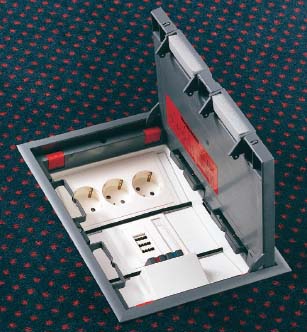
Рис. THORSMAN
Напольное устройство для подключения, установленное заподлицо с полом
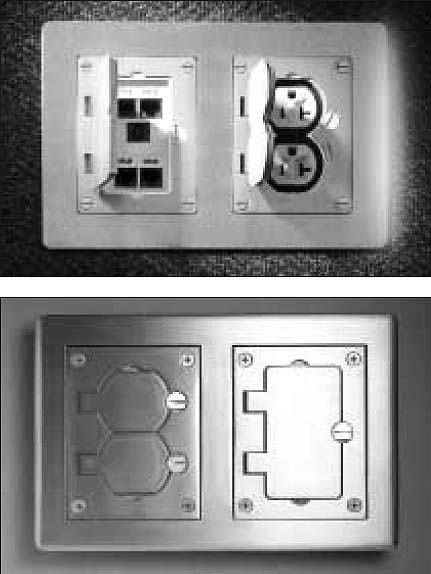
Рис. Wiremold/Legrand
Напольное устройство для подключения, установленное заподлицо с полом
Параллельные тексты EN-RU
An Activation for Every Application!
The Walkerduct Pro Series System offers a complete range of service fittings to meet all power, data and communication requirements.
The flush service fittings are available in brushed aluminum, brass and nonmetallic finishes for single-, double- and triple-duct runs.
Fittings are available for feeding directly out of the underfloor duct preset while keeping the connections to a minimum visibility.
[Wiremold/Legrand]Напольные устройства подключения для любых применений!
Система Walkerduct Pro Series System содержит полный комплект напольных устройств для подключения, допускающих встраивание любых электрических и телекоммуникационных розеток.
В состав серии входят алюминиевые (с матовой поверхностью), латунные и пластмассовые устанавливаемые заподлицо с полом устройства, соединяемые с одно-, двух- и трехканальными коробами.
Кабели попадают в напольные устройства непосредственно из расположенных под чистым полом специальных (глухих) коробов через закрепленные на них монтажные коробки. При этом напольные устройства остаются практически незаметными.
[Перевод Интент]
Тематики
- изделие электромонтажное
- электропроводка, электромонтаж
EN
DE
FR
Немецко-русский словарь нормативно-технической терминологии > Bodeneinbaueinheit
-
16 Leichtflüssigkeitsabscheider
сепаратор легких жидкостей
—
[ http://www.eionet.europa.eu/gemet/alphabetic?langcode=en]EN
separator of light liquids
A mechanical device for separating and removing residues from fuel and lubricating oil from waste water coming from filling stations and industrial plants in order to avoid pollution of water bodies; this system is based on the different specific weights of water and fuel residues that float on the water and can be easily removed. (Source: RRDA)
[http://www.eionet.europa.eu/gemet/alphabetic?langcode=en]Тематики
EN
DE
FR
Немецко-русский словарь нормативно-технической терминологии > Leichtflüssigkeitsabscheider
-
17 Elektronenröhre
электронная лампа
Прибор, состоящий из герметичного стеклянного корпуса, внутри которого расположены анод и катод.
Раньше в схемах компьютеров, телевизоров и радиоприемников широко использовались электронные лампы. Их вытеснили транзисторы, а затем - Интегральные Схемы (ИС). В настоящее время широко используется большая электронная лампа, именуемая Электронно-Лучевой Трубкой (ЭЛТ). Кроме этого, электронные лампы применяются в ряде схем.
[Гипертекстовый энциклопедический словарь по информатике Э. Якубайтиса]
[ http://www.morepc.ru/dict/]
электронная лампа
-
[IEV number 151-13-60]EN
electronic tube
device in which electric conduction takes place by movement of electrons or ions between electrodes through a vacuum or gaseous medium within a gas-tight envelope
NOTE – Examples of electronic tubes are triodes, tetrodes, cathode-ray tubes. Excluded are several specific devices, e.g. particle accelerators, electronic microscopes, tubes for lighting, gas lasers.
Source: 531-11-02 MOD
[IEV number 151-13-60]FR
tube électronique, m
dispositif dans lequel la conduction électrique est assurée par un déplacement d'électrons ou d'ions entre des électrodes, dans le vide ou dans un milieu gazeux, à l'intérieur d'une enveloppe étanche aux gaz
NOTE – Des exemples de tubes électroniques sont les triodes, les tétrodes, les tubes cathodiques. Sont exclus divers dispositifs particuliers tels que les accélérateurs de particules, les microscopes électroniques, les tubes d'éclairage, les lasers à gaz.
Source: 531-11-02 MOD
[IEV number 151-13-60]EN
DE
FR
Немецко-русский словарь нормативно-технической терминологии > Elektronenröhre
См. также в других словарях:
Device independence — is the process of making a software application be able to function on a wide variety of devices regardless of the local hardware on which the software is used. Contents 1 Desktop computing 2 Virtualization and Emulation 3 World Wide Web Usage … Wikipedia
Device under test — (DUT), also known as unit under test (UUT), is a term commonly used to refer to a manufactured product undergoing testing. In semiconductor testing In semiconductor testing, DUT refers to a specific die on a wafer or the resulting packaged part.… … Wikipedia
device — [di vīs′] n. [ME & OFr devis, division, will < OFr deviser: see DEVISE] 1. a thing devised; plan; scheme, esp. a sly or underhanded scheme; trick 2. an invention or contrivance, esp. a mechanical one, for some specific purpose 3. something… … English World dictionary
Device driver synthesis and verification — The device driver is a program which allows the software or higher level computer programs to interact with a hardware device. These software components act as a link between the devices and the operating systems, communicating with each of these … Wikipedia
Device driver — Operating systems Common features … Wikipedia
Device file — In Unix like operating systems, a device file or special file is an interface for a device driver that appears in a file system as if it were an ordinary file. There are also special device files in MS DOS and Microsoft Windows. They allow… … Wikipedia
Device file system — In Unix like operating systems, a device file system or special file system allows software to interact with a device driver using standard input/output system calls, which simplifies many tasks.It includes device files , device nodes , or device … Wikipedia
device dependence — The requirement that a specific hardware component be present for a program to work. Device dependent software is often difficult to move or port to another computer because of its reliance on specific hardware. See also device independence … Dictionary of networking
device — A piece of equipment or a mechanism designed for a specific purpose or function. See anti roll device antiroll device economy device electronic sensing device enrichment device sensing device triggering device … Dictionary of automotive terms
Device independent file format — DVI stands for device independent. There also is an article about device independent. Device independent (DVI) Evince previewing a DVI file. Note that referenced images are not displayed, because they are not part of the DVI file. Images will be… … Wikipedia
Specific inhalation challenge — The Specific Inhalation Challenge (SIC) is defined as a diagnosis tool to assess airway responsiveness to sensitizing substances as opposed tononspecific stimuli such as pharmacological agents (i.e. histamine, methacholine),cold air and exercise … Wikipedia
