

-
101 Caro, Heinrich
[br]b. 13 February 1834 Poznan, Polandd. 11 October 1911 Dresden, Germany[br]German dyestuffi chemist.[br]Caro received vocational training as a dyer at the Gewerbeinstitut in Berlin from 1852, at the same time attending chemistry lectures at the university there. In 1855 he was hired as a colourist by a firm of calico printers in Mulheim an der Ruhr, where he was able to demonstrate the value of scientific training in solving practical problems. Two years later, the year after Perkin's discovery of aniline dyes, he was sent to England in order to learn the latest dyeing techniques. He took up a post an analytical chemist with the chemical firm Roberts, Dale \& Co. in Manchester; after finding a better way of synthesizing Perkin's mauve, he became a partner in the business. Caro was able to enlarge both his engineering experience and his chemical knowledge there, particularly by studying Hofmann's researches on the aniline dyes. He made several discoveries, including induline, Bismark brown and Martius yellow.Like other German chemists, however, he found greater opportunities opening up in Germany, and in 1866 he returned to take up a post in Bunsen's laboratory in Heidelberg. In 1868 Caro obtained the important directorship of Badische Anilin-Soda- Fabrik (BASF), the first true industrial research organization and leading centre of dyestuffs research. A steady stream of commercial successes followed. In 1869, after Graebe and Liebermann had showed him their laboratory synthesis of the red dye alizarin, Caro went on to develop a cheaper and commercially viable method. During the 1870s he collaborated with Adolf von Baeyer to make methylene blue and related dyes, and then went on to the azo dyes. His work on indigo was important, but was not crowned with commercial success; that came in 1897 when his successor at BASF discovered a suitable process for producing indigo on a commercial scale. Caro had resigned his post in 1889, by which time he had made notable contributions to German supremacy in the fast-developing dyestuffs industry.[br]Further ReadingA.Bernthsen, 1912, obituary, Berichte derDeutschen Chemischen Gesellschaft, 45; 1,987–2,042 (a substantial obituary).LRD -
102 Cross, Charles Frederick
[br]b. 11 December 1855 Brentwood, Middlesex, Englandd. 15 April 1935 Hove, England[br]English chemist who contributed to the development of viscose rayon from cellulose.[br]Cross was educated at the universities of London, Zurich and Manchester. It was at Owens College, Manchester, that Cross first met E.J. Bevan and where these two first worked together on the nature of cellulose. After gaining some industrial experience, Cross joined Bevan to set up a partnership in London as analytical and consulting chemists, specializing in the chemistry and technology of cellulose and lignin. They were at the Jodrell laboratory, Kew Gardens, for a time and then set up their own laboratory at Station Avenue, Kew Gardens. In 1888, the first edition of their joint publication A Textbook of Paper-making, appeared. It went into several editions and became the standard reference and textbook on the subject. The long introductory chapter is a discourse on cellulose.In 1892, Cross, Bevan and Clayton Beadle took out their historic patent on the solution and regeneration of cellulose. The modern artificial-fibre industry stems from this patent. They made their discovery at New Court, Carey Street, London: wood-pulp (or another cheap form of cellulose) was dissolved in a mixture of carbon disulphide and aqueous alkali to produce sodium xanthate. After maturing, it was squirted through fine holes into dilute acid, which set the liquid to give spinnable fibres of "viscose". However, it was many years before the process became a commercial operation, partly because the use of a natural raw material such as wood involved variations in chemical content and each batch might react differently. At first it was thought that viscose might be suitable for incandescent lamp filaments, and C.H.Stearn, a collaborator with Cross, continued to investigate this possibility, but the sheen on the fibres suggested that viscose might be made into artificial silk. The original Viscose Spinning Syndicate was formed in 1894 and a place was rented at Erith in Kent. However, it was not until some skeins of artificial silk (a term to which Cross himself objected) were displayed in Paris that textile manufacturers began to take an interest in it. It was then that Courtaulds decided to investigate this new fibre, although it was not until 1904 that they bought the English patents and developed the first artificial silk that was later called "rayon". Cross was also concerned with the development of viscose films and of cellulose acetate, which became a rival to rayon in the form of "Celanese". He retained his interest in the paper industry and in publishing, in 1895 again collaborating with Bevan and publishing a book on Cellulose and other technical articles. He was a cultured man and a good musician. He was elected a Fellow of the Royal Society in 1917.[br]Principal Honours and DistinctionsFRS 1917.Bibliography1888, with E.J.Bevan, A Text-book of Papermaking. 1892, British patent no. 8,700 (cellulose).Further ReadingObituary Notices of the Royal Society, 1935, London. Obituary, 1935, Journal of the Chemical Society 1,337. Chambers Concise Dictionary of Scientists, 1989, Cambridge.Edwin J.Beer, 1962–3, "The birth of viscose rayon", Transactions of the Newcomen Society 35 (an account of the problems of developing viscose rayon; Beer worked under Cross in the Kew laboratories).C.Singer (ed.), 1978, A History of Technology, Vol. VI, Oxford: Clarendon Press.RLHBiographical history of technology > Cross, Charles Frederick
-
103 Edison, Thomas Alva
SUBJECT AREA: Architecture and building, Automotive engineering, Electricity, Electronics and information technology, Metallurgy, Photography, film and optics, Public utilities, Recording, Telecommunications[br]b. 11 February 1847 Milan, Ohio, USAd. 18 October 1931 Glenmont[br]American inventor and pioneer electrical developer.[br]He was the son of Samuel Edison, who was in the timber business. His schooling was delayed due to scarlet fever until 1855, when he was 8½ years old, but he was an avid reader. By the age of 14 he had a job as a newsboy on the railway from Port Huron to Detroit, a distance of sixty-three miles (101 km). He worked a fourteen-hour day with a stopover of five hours, which he spent in the Detroit Free Library. He also sold sweets on the train and, later, fruit and vegetables, and was soon making a profit of $20 a week. He then started two stores in Port Huron and used a spare freight car as a laboratory. He added a hand-printing press to produce 400 copies weekly of The Grand Trunk Herald, most of which he compiled and edited himself. He set himself to learn telegraphy from the station agent at Mount Clements, whose son he had saved from being run over by a freight car.At the age of 16 he became a telegraphist at Port Huron. In 1863 he became railway telegraphist at the busy Stratford Junction of the Grand Trunk Railroad, arranging a clock with a notched wheel to give the hourly signal which was to prove that he was awake and at his post! He left hurriedly after failing to hold a train which was nearly involved in a head-on collision. He usually worked the night shift, allowing himself time for experiments during the day. His first invention was an arrangement of two Morse registers so that a high-speed input could be decoded at a slower speed. Moving from place to place he held many positions as a telegraphist. In Boston he invented an automatic vote recorder for Congress and patented it, but the idea was rejected. This was the first of a total of 1180 patents that he was to take out during his lifetime. After six years he resigned from the Western Union Company to devote all his time to invention, his next idea being an improved ticker-tape machine for stockbrokers. He developed a duplex telegraphy system, but this was turned down by the Western Union Company. He then moved to New York.Edison found accommodation in the battery room of Law's Gold Reporting Company, sleeping in the cellar, and there his repair of a broken transmitter marked him as someone of special talents. His superior soon resigned, and he was promoted with a salary of $300 a month. Western Union paid him $40,000 for the sole rights on future improvements on the duplex telegraph, and he moved to Ward Street, Newark, New Jersey, where he employed a gathering of specialist engineers. Within a year, he married one of his employees, Mary Stilwell, when she was only 16: a daughter, Marion, was born in 1872, and two sons, Thomas and William, in 1876 and 1879, respectively.He continued to work on the automatic telegraph, a device to send out messages faster than they could be tapped out by hand: that is, over fifty words per minute or so. An earlier machine by Alexander Bain worked at up to 400 words per minute, but was not good over long distances. Edison agreed to work on improving this feature of Bain's machine for the Automatic Telegraph Company (ATC) for $40,000. He improved it to a working speed of 500 words per minute and ran a test between Washington and New York. Hoping to sell their equipment to the Post Office in Britain, ATC sent Edison to England in 1873 to negotiate. A 500-word message was to be sent from Liverpool to London every half-hour for six hours, followed by tests on 2,200 miles (3,540 km) of cable at Greenwich. Only confused results were obtained due to induction in the cable, which lay coiled in a water tank. Edison returned to New York, where he worked on his quadruplex telegraph system, tests of which proved a success between New York and Albany in December 1874. Unfortunately, simultaneous negotiation with Western Union and ATC resulted in a lawsuit.Alexander Graham Bell was granted a patent for a telephone in March 1876 while Edison was still working on the same idea. His improvements allowed the device to operate over a distance of hundreds of miles instead of only a few miles. Tests were carried out over the 106 miles (170 km) between New York and Philadelphia. Edison applied for a patent on the carbon-button transmitter in April 1877, Western Union agreeing to pay him $6,000 a year for the seventeen-year duration of the patent. In these years he was also working on the development of the electric lamp and on a duplicating machine which would make up to 3,000 copies from a stencil. In 1876–7 he moved from Newark to Menlo Park, twenty-four miles (39 km) from New York on the Pennsylvania Railway, near Elizabeth. He had bought a house there around which he built the premises that would become his "inventions factory". It was there that he began the use of his 200- page pocket notebooks, each of which lasted him about two weeks, so prolific were his ideas. When he died he left 3,400 of them filled with notes and sketches.Late in 1877 he applied for a patent for a phonograph which was granted on 19 February 1878, and by the end of the year he had formed a company to manufacture this totally new product. At the time, Edison saw the device primarily as a business aid rather than for entertainment, rather as a dictating machine. In August 1878 he was granted a British patent. In July 1878 he tried to measure the heat from the solar corona at a solar eclipse viewed from Rawlins, Wyoming, but his "tasimeter" was too sensitive.Probably his greatest achievement was "The Subdivision of the Electric Light" or the "glow bulb". He tried many materials for the filament before settling on carbon. He gave a demonstration of electric light by lighting up Menlo Park and inviting the public. Edison was, of course, faced with the problem of inventing and producing all the ancillaries which go to make up the electrical system of generation and distribution-meters, fuses, insulation, switches, cabling—even generators had to be designed and built; everything was new. He started a number of manufacturing companies to produce the various components needed.In 1881 he built the world's largest generator, which weighed 27 tons, to light 1,200 lamps at the Paris Exhibition. It was later moved to England to be used in the world's first central power station with steam engine drive at Holborn Viaduct, London. In September 1882 he started up his Pearl Street Generating Station in New York, which led to a worldwide increase in the application of electric power, particularly for lighting. At the same time as these developments, he built a 1,300yd (1,190m) electric railway at Menlo Park.On 9 August 1884 his wife died of typhoid. Using his telegraphic skills, he proposed to 19-year-old Mina Miller in Morse code while in the company of others on a train. He married her in February 1885 before buying a new house and estate at West Orange, New Jersey, building a new laboratory not far away in the Orange Valley.Edison used direct current which was limited to around 250 volts. Alternating current was largely developed by George Westinghouse and Nicola Tesla, using transformers to step up the current to a higher voltage for long-distance transmission. The use of AC gradually overtook the Edison DC system.In autumn 1888 he patented a form of cinephotography, the kinetoscope, obtaining film-stock from George Eastman. In 1893 he set up the first film studio, which was pivoted so as to catch the sun, with a hinged roof which could be raised. In 1894 kinetoscope parlours with "peep shows" were starting up in cities all over America. Competition came from the Latham Brothers with a screen-projection machine, which Edison answered with his "Vitascope", shown in New York in 1896. This showed pictures with accompanying sound, but there was some difficulty with synchronization. Edison also experimented with captions at this early date.In 1880 he filed a patent for a magnetic ore separator, the first of nearly sixty. He bought up deposits of low-grade iron ore which had been developed in the north of New Jersey. The process was a commercial success until the discovery of iron-rich ore in Minnesota rendered it uneconomic and uncompetitive. In 1898 cement rock was discovered in New Village, west of West Orange. Edison bought the land and started cement manufacture, using kilns twice the normal length and using half as much fuel to heat them as the normal type of kiln. In 1893 he met Henry Ford, who was building his second car, at an Edison convention. This started him on the development of a battery for an electric car on which he made over 9,000 experiments. In 1903 he sold his patent for wireless telegraphy "for a song" to Guglielmo Marconi.In 1910 Edison designed a prefabricated concrete house. In December 1914 fire destroyed three-quarters of the West Orange plant, but it was at once rebuilt, and with the threat of war Edison started to set up his own plants for making all the chemicals that he had previously been buying from Europe, such as carbolic acid, phenol, benzol, aniline dyes, etc. He was appointed President of the Navy Consulting Board, for whom, he said, he made some forty-five inventions, "but they were pigeonholed, every one of them". Thus did Edison find that the Navy did not take kindly to civilian interference.In 1927 he started the Edison Botanic Research Company, founded with similar investment from Ford and Firestone with the object of finding a substitute for overseas-produced rubber. In the first year he tested no fewer than 3,327 possible plants, in the second year, over 1,400, eventually developing a variety of Golden Rod which grew to 14 ft (4.3 m) in height. However, all this effort and money was wasted, due to the discovery of synthetic rubber.In October 1929 he was present at Henry Ford's opening of his Dearborn Museum to celebrate the fiftieth anniversary of the incandescent lamp, including a replica of the Menlo Park laboratory. He was awarded the Congressional Gold Medal and was elected to the American Academy of Sciences. He died in 1931 at his home, Glenmont; throughout the USA, lights were dimmed temporarily on the day of his funeral.[br]Principal Honours and DistinctionsMember of the American Academy of Sciences. Congressional Gold Medal.Further ReadingM.Josephson, 1951, Edison, Eyre \& Spottiswode.R.W.Clark, 1977, Edison, the Man who Made the Future, Macdonald \& Jane.IMcN -
104 Fourdrinier, Henry
SUBJECT AREA: Paper and printing[br]b. 11 February 1766 London, Englandd. 3 September 1854 Mavesyn Ridware, near Rugeley, Staffordshire, England[br]English pioneer of the papermaking machine.[br]Fourdrinier's father was a paper manufacturer and stationer of London, from a family of French Protestant origin. Henry took up the same trade and, with his brother Sealy (d. 1847), devoted many years to developing the papermaking machine. Their first patent was taken out in 1801, but success was still far off. A machine for making paper had been invented a few years previously by Nicolas Robert at the Didot's mill at Essonnes, south of Paris. Robert quarrelled with the Didots, who then contacted their brother-in-law in England, John Gamble, in an attempt to raise capital for a larger machine. Gamble and the Fourdriniers called in the engineer Bryan Donkin, and between them they patented a much improved machine in 1807. In the new machine, the paper pulp flowed on to a moving continuous woven wire screen and was then squeezed between rollers to remove much of the water. The paper thus formed was transferred to a felt blanket and passed through a second press to remove more water, before being wound while still wet on to a drum. For the first time, a continuous sheet of paper could be made. Other inventors soon made further improvements: in 1817 John Dickinson obtained a patent for sizing baths to improve the surface of the paper; while in 1820 Thomas Crompton patented a steam-heated drum round which the paper was passed to speed up the drying process. The development cost of £60,000 bankrupted the brothers. Although Parliament extended the patent for fourteen years, and the machine was widely adopted, they never reaped much profit from it. Tsar Alexander of Russia became interested in the papermaking machine while on a visit to England in 1814 and promised Henry Fourdrinier £700 per year for ten years for super-intending the erection of two machines in Russia; Henry carried out the work, but he received no payment. At the age of 72 he travelled to St Petersburg to seek recompense from the Tsar's successor Nicholas I, but to no avail. Eventually, on a motion in the House of Commons, the British Government awarded Fourdrinier a payment of £7,000. The paper trade, sensing the inadequacy of this sum, augmented it with a further sum which they subscribed so that an annuity could be purchased for Henry, then the only surviving brother, and his two daughters, to enable them to live in modest comfort. From its invention in ancient China (see Cai Lun), its appearance in the Middle Ages in Europe and through the first three and a half centuries of printing, every sheet of paper had to made by hand. The daily output of a hand-made paper mill was only 60–100 lb (27–45 kg), whereas the new machine increased that tenfold. Even higher speeds were achieved, with corresponding reductions in cost; the old mills could not possibly have kept pace with the new mechanical printing presses. The Fourdrinier machine was thus an essential element in the technological developments that brought about the revolution in the production of reading matter of all kinds during the nineteenth century. The high-speed, giant paper-making machines of the late twentieth century work on the same principle as the Fourdrinier of 1807.[br]Further ReadingR.H.Clapperton, 1967, The Paper-making Machine, Oxford: Pergamon Press. D.Hunter, 1947, Papermaking. The History and Technique of an Ancient Craft, London.LRD -
105 Gestetner, David
SUBJECT AREA: Paper and printing[br]b. March 1854 Csorna, Hungaryd. 8 March 1939 Nice, France[br]Hungarian/British pioneer of stencil duplicating.[br]For the first twenty-five years of his life, Gestetner was a rolling stone and accordingly gathered no moss. Leaving school in 1867, he began working for an uncle in Sopron, making sausages. Four years later he apprenticed himself to another uncle, a stockbroker, in Vienna. The financial crisis of 1873 prompted a move to a restaurant, also in the family, but tiring of a menial existence, he emigrated to the USA, travelling steerage. He began to earn a living by selling Japanese kites: these were made of strong Japanese paper coated with lacquer, and he noted their long fibres and great strength, an observation that was later to prove useful when he was searching for a suitable medium for stencil duplicating. However, he did not prosper in the USA and he returned to Europe, first to Vienna and finally to London in 1879. He took a job with Fairholme \& Co., stationers in Shoe Lane, off Holborn; at last Gestetner found an outlet for his inventive genius and he began his life's work in developing stencil duplicating. His first patent was in 1879 for an application of the hectograph, an early method of duplicating documents. In 1881, he patented the toothed-wheel pen, or Cyclostyle, which made good ink-passing perforations in the stencil paper, with which he was able to pioneer the first practicable form of stencil duplicating. He then adopted a better stencil tissue of Japanese paper coated with wax, and later an improved form of pen. This assured the success of Gestetner's form of stencil duplicating and it became established practice in offices in the late 1880s. Gestetner began to manufacture the apparatus in premises in Sun Street, at first under the name of Fairholme, since they had defrayed the patent expenses and otherwise supported him financially, in return for which Gestetner assigned them his patent rights. In 1882 he patented the wheel pen in the USA and appointed an agent to sell the equipment there. In 1884 he moved to larger premises, and three years later to still larger premises. The introduction of the typewriter prompted modifications that enabled stencil duplicating to become both the standard means of printing short runs of copy and an essential piece of equipment in offices. Before the First World War, Gestetner's products were being sold around the world; in fact he created one of the first truly international distribution networks. He finally moved to a large factory to the north-east of London: when his company went public in 1929, it had a share capital of nearly £750,000. It was only with the development of electrostatic photocopying and small office offset litho machines that stencil duplicating began to decline in the 1960s. The firm David Gestetner had founded adapted to the new conditions and prospers still, under the direction of his grandson and namesake.[br]Further ReadingW.B.Proudfoot, 1972, The Origin of Stencil Duplicating London: Hutchinson (gives a good account of the method and the development of the Gestetner process, together with some details of his life).H.V.Culpan, 1951, "The House of Gestetner", in Gestetner 70th Anniversary Celebration Brochure, London: Gestetner.LRD -
106 Poncelet, Jean Victor
SUBJECT AREA: Mechanical, pneumatic and hydraulic engineering[br]b. 1 July 1788 Metz, Franced. 22 December 1867 Paris, France[br]French mathematician and military and hydraulic engineer.[br]Poncelet studied mathematics at the Ecole Polytechnique in Paris from 1807 to 1810. He joined the Army, gaining admission to the Corps of Engineers. He worked on the fortifications on the Isle of Walcheren in Holland, and in 1812 he found himself on the Russian front, engulfed in the disastrous defeat of the French at Krasnoi. Poncelet was left for dead on the field, but he was found by the Russians and taken to Saratov, where he was imprisoned for two years. He had ample opportunity there to ponder mathematical problems, a mental process from which stemmed his pioneering advances in projective geometry.After his release he returned to this native city of Metz, where he undertook routine military engineering and teaching tasks. These left him time to pursue his mathematical studies in projective geometry. This bore fruit in a series of publications, most notably the first volume of his Traité des propriétés projectives des figures (1822, Paris), the first book to be devoted to the new discipline of projective geometry. With his election to the Académie des Sciences in 1834, Poncelet moved to Paris and devoted much of his time to developing courses in applied mechanics in the Faculty of Science, resulting in a number of books, especially the Introduction à la mécanique industrielle, physique ou expérimentale (1841, Paris: Metz). In 1848 he had attained the rank of general and was made Commandant of the Ecole Polytechnique, a post he held for two years. After his retirement in 1850 he was deeply involved in the industrial machines and tools division at both the Great Exhibition in London in 1851 and the similar exhibition in Paris in 1855.Most of Poncelet's work in applied mechanics and technology was conceived during the period 1825–40. His technological innovations were centred on hydraulic engineering, and in 1826 he invented an inward-flow turbine. At the same time he directed his attention to the vertical undershot water-wheel, with wooden blades set radially and substituted curved metal blades: he used tight-fitting masonry and floors in the wheel pits so that all the water would be swept into the spaces between the blades. In addition, he ensured that the water flowing from the blades fell clear of the wheel and did not run in tail water. This greatly improved the efficiency of the water-wheel.[br]BibliographyH.Tribout, 1936, Un Grand Savant: le général Jean-Victor Poncelet, Paris, pp. 204–20 (the most complete list of his published works).Further ReadingI.Didion, 1870, "Notice sur la vie et les ouvrages du général J.-V.Poncelet", Mémoires de l'Académie de Metz 50:101–59.M.Daumas (ed), 1968, Histoire des techniques, Vol. 3, Paris (briefly describes his technological work).LRD -
107 banyo
"1.bathroom, bath. 2. bath, washing oneself in a bathtub. 3. bathtub. 4. soaking all or a part of one´s body in a medium; subjecting one´s body to a medium (usually as a therapeutic measure): çamur banyosu mud bath; buhar banyosu steam bath. 5. soaking a material in water or a chemically treated solution: su verme banyosu quenching bath. 6. solution used in a therapeutic bath or in a chemical soaking process. - almak to take a bath, bathe, Brit. bath. - etmek /ı/ phot. to put (film, photographic paper) in a bath (while developing it). - kazanı hot-water heater. - küveti/teknesi bathtub. - yapmak to take a bath, bathe, Brit. bath. - yaptırmak /a/ to bathe, give a bath to, Brit. bath." -
108 вырубка и сжигание леса как метод увеличения сельскохозяйственных площадей
вырубка и сжигание леса как метод увеличения сельскохозяйственных площадей
—
[ http://www.eionet.europa.eu/gemet/alphabetic?langcode=en]EN
slash and burn culture
A traditional farming system that has been used by generations of farmers in tropical forests and the savannah of north and east Africa. It is known to be an ecologically sound form of cultivation, and because the soil is poor in tropical rain forests it is a sustainable method of farming. It is still practised today, primarily in the developing countries. Small areas of bush or forests are cleared and the smaller trees burned. This unlocks the nutrients in the vegetation and gives the soil fertilizer that is easily taken up by plants. A few years later the soil is degraded and the farmer moves on to do the same at another site. The original ground is left fallow for anything up to 20 years so that the forest can regenerate. With the growth in population and in the subsequent need for more farming land to produce food, the method is increasingly being used today to clear large areas of tropical forests for cattle ranching, and in most cases the ground is not left fallow for long enough and, with modern mechanized farming systems, not enough tree stumps or suitable habitats for plant life are left to start the regeneration process. (Source: WRIGHT)
[http://www.eionet.europa.eu/gemet/alphabetic?langcode=en]Тематики
EN
DE
FR
Русско-английский словарь нормативно-технической терминологии > вырубка и сжигание леса как метод увеличения сельскохозяйственных площадей
-
109 глобальный стратегический план
глобальный стратегический план
Документ, который ОКОИ совместно с партнерами разрабатывает на раннем этапе операционного планирования. В этом плане заложено определение глобальной задачи, перспектив, целей и условий их достижения, перечислены варианты стратегий, преимущества и ограничения местного рынка, основные риски по каждой функции, принципы составления стратегических планов деятельности ФНД, обозначена роль правительства и других партнеров, определены изначальный бюджет и штатное расписание с расчетом на перспективу.
[Департамент лингвистических услуг Оргкомитета «Сочи 2014». Глоссарий терминов]EN
global strategic plan (GSP)
Document produced by the OCOG and its partners during the early stage of the operational planning phase. Contents include: overall mission, vision, objectives, requirements definition process, available strategic options, local market opportunities and constraints, key functional area risks, steps to developing functional area strategic plans, role of government and other partners, initial budget, initial staffing plan.
[Департамент лингвистических услуг Оргкомитета «Сочи 2014». Глоссарий терминов]Тематики
EN
Русско-английский словарь нормативно-технической терминологии > глобальный стратегический план
-
110 национальное планирование
национальное планирование
—
[ http://www.eionet.europa.eu/gemet/alphabetic?langcode=en]EN
national planning
The step by step method and process of defining, developing and outlining various possible courses of actions to meet existing or future needs, goals and objectives for a country or a large body of people associated with a particular territory, often sharing similar ethnic backgrounds, customs and language. (Source: RHW / BLD)
[http://www.eionet.europa.eu/gemet/alphabetic?langcode=en]Тематики
EN
DE
FR
Русско-английский словарь нормативно-технической терминологии > национальное планирование
-
111 оптимизация
оптимизация
Процесс отыскания варианта, соответствующего критерию оптимальности
[Терминологический словарь по строительству на 12 языках (ВНИИИС Госстроя СССР)]
оптимизация
1. Процесс нахождения экстремума функции, т.е. выбор наилучшего варианта из множества возможных, процесс выработки оптимальных решений; 2. Процесс приведения системы в наилучшее (оптимальное) состояние. Иначе говоря, первое определение трактует термин «О.» как факт выработки и принятия оптимального решения (в широком смысле этих слов); мы выясняем, какое состояние изучаемой системы будет наилучшим с точки зрения предъявляемых к ней требований (критерия оптимальности) и рассматриваем такое состояние как цель. В этом смысле применяется также термин «субоптимизация» в случаях, когда отыскивается оптимум по какому-либо одному критерию из нескольких в векторной задаче оптимизации (см. Оптимальность по Парето, Векторная оптимизация). Второе определение имеет в виду процесс выполнения этого решения: т.е. перевод системы от существующего к искомому оптимальному состоянию. В зависимости от вида используемых критериев оптимальности (целевых функций или функционалов) и ограничений модели (множества допустимых решений) различают скалярную О., векторную О., мно¬гокритериальную О., стохастическую О (см. Стохастическое программирование), гладкую и негладкую (см. Гладкая функция), дискретную и непрерывную (см. Дискретность, Непрерывность), выпуклую и вогнутую (см. Выпуклость, вогнутость) и др. Численные методы О., т.е. методы построения алгоритмов нахождения оп¬тимальных значений целевых функций и соответствующих точек области допустимых значений — развитой отдел современной вычислительной математики. См. Оптимальная задача.
[ http://slovar-lopatnikov.ru/]Параллельные тексты EN-RU из ABB Review. Перевод компании Интент
The quest for the optimumВопрос оптимизацииThroughout the history of industry, there has been one factor that has spurred on progress more than any other. That factor is productivity. From the invention of the first pump to advanced computer-based optimization methods, the key to the success of new ideas was that they permitted more to be achieved with less. This meant that consumers could, over time and measured in real terms, afford to buy more with less money. Luxuries restricted to a tiny minority not much more than a generation ago are now available to almost everybody in developed countries, with many developing countries rapidly catching up.На протяжении всей истории промышленности существует один фактор, подстегивающий ее развитие сильнее всего. Он называется «производительность». Начиная с изобретения первого насоса и заканчивая передовыми методами компьютерной оптимизации, успех новых идей зависел от того, позволяют ли они добиться большего результата меньшими усилиями. На языке потребителей это значит, что они всегда хотят купить больше, а заплатить меньше. Меньше чем поколение назад, многие предметы считались роскошью и были доступны лишь немногим. Сейчас в развитых странах, число которых быстро увеличивается, подобное может позволить себе почти каждый.With industry and consumers expecting the trend towards higher productivity to continue, engineering companies are faced with the challenge of identifying and realizing further optimization potential. The solution often lies in taking a step back and looking at the bigger picture. Rather than optimizing every step individually, many modern optimization techniques look at a process as a whole, and sometimes even beyond it. They can, for example, take into account factors such as the volatility of fuel quality and price, the performance of maintenance and service practices or even improved data tracking and handling. All this would not be possible without the advanced processing capability of modern computer and control systems, able to handle numerous variables over large domains, and so solve optimization problems that would otherwise remain intractable.На фоне общей заинтересованности в дальнейшем росте производительности, машиностроительные и проектировочные компании сталкиваются с необходимостью определения и реализации возможностей по оптимизации своей деятельности. Для того чтобы найти решение, часто нужно сделать шаг назад, поскольку большое видится на расстоянии. И поэтому вместо того, чтобы оптимизировать каждый этап производства по отдельности, многие современные решения охватывают процесс целиком, а иногда и выходят за его пределы. Например, они могут учитывать такие факторы, как изменение качества и цены топлива, результативность ремонта и обслуживания, и даже возможности по сбору и обработке данных. Все это невозможно без использования мощных современных компьютеров и систем управления, способных оперировать множеством переменных, связанных с крупномасштабными объектами, и решать проблемы оптимизации, которые другим способом решить нереально.Whether through a stunning example of how to improve the rolling of metal, or in a more general overview of progress in optimization algorithms, this edition of ABB Review brings you closer to the challenges and successes of real world computer-based optimization tasks. But it is not in optimization and solving alone that information technology is making a difference: Who would have thought 10 years ago, that a technician would today be able to diagnose equipment and advise on maintenance without even visiting the factory? ABB’s Remote Service makes this possible. In another article, ABB Review shows how the company is reducing paperwork while at the same time leveraging quality control through the computer-based tracking of production. And if you believed that so-called “Internet communities” were just about fun, you will be surprised to read how a spin-off of this idea is already leveraging production efficiency in real terms. Devices are able to form “social networks” and so facilitate maintenance.Рассказывая об ошеломляющем примере того, как был усовершенствован процесс прокатки металла, или давая общий обзор развития алгоритмов оптимизации, этот выпуск АББ Ревю знакомит вас с практическими задачами и достигнутыми успехами оптимизации на основе компьютерных технологий. Но информационные технологии способны не только оптимизировать процесс производства. Кто бы мог представить 10 лет назад, что сервисный специалист может диагностировать производственное оборудование и давать рекомендации по его обслуживанию, не выходя из офиса? Это стало возможно с пакетом Remote Service от АББ. В другой статье этого номера АББ Ревю рассказывается о том, как компания смогла уменьшить бумажный документооборот и одновременно повысить качество управления с помощью компьютерного контроля производства. Если вы считаете, что так называемые «интернет-сообщества» служат только для развлечения,то очень удивитесь, узнав, что на основе этой идеи можно реально повысить производительность. Формирование «социальной сети» из автоматов значительно облегчает их обслуживание.This edition of ABB Review also features several stories of service and consulting successes, demonstrating how ABB’s expertise has helped customers achieve higher levels of productivity. In a more fundamental look at the question of what reliability is really about, a thought-provoking analysis sets out to find the definition of that term that makes the greatest difference to overall production.В этом номере АББ Ревю есть несколько статей, рассказывающих об успешных решениях по организации дистанционного сервиса и консультирования. Из них видно, как опыт АББ помогает нашим заказчикам повысить производительность своих предприятий. Углубленные размышления о самой природе термина «надежность» приводят к парадоксальным выводам, способным в корне изменить представления об оптимизации производства.Robots have often been called “the extended arm of man.” They are continuously advancing productivity by meeting ever-tightening demands on precision and efficiency. This edition of ABB Review dedicates two articles to robots.Робот – это могучее «продолжение» человеческой руки. Применение роботов способствует постоянному повышению производительности, поскольку они отвечают самым строгим требованиям точности и эффективности. Две статьи в этом номере АББ Ревю посвящены роботам.Further technological breakthroughs discussed in this issue look at how ABB is keeping water clean or enabling gas to be shipped more efficiently.Говоря о других технологических достижениях, обсуждаемых на страницах журнала, следует упомянуть о том, как компания АББ обеспечивает чистоту воды, а также более эффективную перевозку сжиженного газа морским транспортом.The publication of this edition of ABB Review is timed to coincide with ABB Automation and Power World 2009, one of the company’s greatest customer events. Readers visiting this event will doubtlessly recognize many technologies and products that have been covered in this and recent editions of the journal. Among the new products ABB is launching at the event is a caliper permitting the flatness of paper to be measured optically. We are proud to carry a report on this product on the very day of its launch.Публикация этого номера АББ Ревю совпала по времени с крупнейшей конференцией для наших заказчиков «ABB Automation and Power World 2009». Читатели, посетившие ее, смогли воочию увидеть многие технологии и изделия, описанные в этом и предыдущих выпусках журнала. Среди новинок, представленных АББ на этой конференции, был датчик, позволяющий измерять толщину бумаги оптическим способом. Мы рады сообщить, что сегодня он готов к выпуску.Тематики
EN
DE
FR
Русско-английский словарь нормативно-технической терминологии > оптимизация
112 прямой пуск вращающегося электродвигателя
- full voltage starter application
- DOL
- direct-on-line starting
- direct starting
- direct operation of a motor
- direct line starting
- across-the-line starting (US)
прямой пуск вращающегося электродвигателя
Пуск вращающегося электродвигателя путем непосредственного подключения его к питающей сети.
[ ГОСТ 27471-87]EN
direct-on-line starting
across-the-line starting (US)
the process of starting a motor by connecting it directly to the supply at rated voltage
[IEV number 411-52-15]FR
démarrage direct
mode de démarrage d'un moteur, consistant à lui appliquer directement sa pleine tension assignée
[IEV number 411-52-15]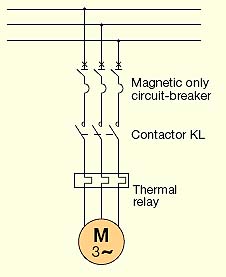
Рис. ABB
Схема прямого пуска электродвигателяMagnetic only circuit-breaker - Автоматический выключатель с электромагнитным расцепителем
Contactor KL - Контактор KL
Thermal relay - Тепловое реле
Параллельные тексты EN-RU
Direct-on-line starting
Direct-on-line starting, which is often abbreviated as DOL, is perhaps the most traditional system and consists in connecting the motor directly to the supply network, thus carrying out starting at full voltage.Direct-on-line starting represents the simplest and the most economical system to start a squirrel-cage asynchronous motor and it is the most used.
As represented in Figure 5, it provides the direct connection to the supply network and therefore starting is carried out at full voltage and with constant frequency, developing a high starting torque with very reduced acceleration times.
The typical applications are relevant to small power motors also with full load starting.
These advantages are linked to some problems such as, for example, the high inrush current, which - in the first instants - can reach values of about 10 to 12 times the rated current, then can decrease to about 6 to 8 times the rated current and can persist to reach the maximum torque speed.The effects of such currents can be identified with the high electro-dynamical stresses on the motor connection cables and could affect also the windings of the motor itself; besides, the high inrush torques can cause violent accelerations which stress the transmission components (belts and joints) generating distribution problems with a reduction in the mechanical life of these elements.
Finally, also the possible electrical problems due to voltage drops on the supply line of the motor or of the connected equipment must be taken into consideration.
[ABB]Прямой пуск
Прямой пуск, который по-английски часто сокращенно обозначают как DOL, является, пожалуй наиболее распространенным способом пуска. Он заключается в непосредственном (т. е. прямом) подключении двигателя к питающей сети. Это означает, что пуск двигателя осуществляется при полном напряжении.Схема прямого пуска является наиболее простым, экономичным и чаще всего применяемым решением для электродвигателей с короткозамкнутым ротором.
Схема прямого подключения к сети представлена на рисунке 5. Пуск осуществляется при полном напряжении и постоянной частоте сети. Электродвигатель развивает высокий пусковой момент при коротком времени разгона.
Типичные области применения – маломощные электродвигатели, в том числе с пуском при полной нагрузке.
Однако, наряду с преимуществами имеются и определенные недостатки, например, бросок пускового тока, достигающий в первоначальный момент 10…12-кратного значения от номинального тока электродвигателя. Затем ток двигателя уменьшается примерно до 6…8-кратного значения номинального тока и будет держаться на этом уровне до тех пор, пока скорость двигателя не достигнет максимального значения.
Такое изменение тока оказывает значительное электродинамическое воздействие на кабель, подключенный к двигателю. Кроме того пусковой ток воздействует на обмотки двигателя. Высокий начальный пусковой момент может привести к значительному ускорению и следовательно к значительной нагрузке элементов привода (ремней, крепления узлов), что вызывает сокращение их срока службы.
И, наконец, следует принять во внимание возможное возникновение проблем, связанных с падением напряжения в линии питания двигателя и подключенного к этой линии оборудования.
[Перевод Интент]
Тематики
Синонимы
EN
- across-the-line starting (US)
- direct line starting
- direct operation of a motor
- direct starting
- direct-on-line starting
- DOL
- full voltage starter application
DE
FR
Русско-английский словарь нормативно-технической терминологии > прямой пуск вращающегося электродвигателя
113 разрешение на планирование
разрешение на планирование
—
[ http://www.eionet.europa.eu/gemet/alphabetic?langcode=en]EN
planning permission
An authorization, license or equivalent control document issued by a government agency that approves a step by step method and process of defining, developing and outlining various possible courses of action to meet existing or future needs, goals and objectives. (Source: TOE / ISEP)
[http://www.eionet.europa.eu/gemet/alphabetic?langcode=en]Тематики
EN
DE
FR
Русско-английский словарь нормативно-технической терминологии > разрешение на планирование
114 управление и планирование сельских районов
управление и планирование сельских районов
—
[ http://www.eionet.europa.eu/gemet/alphabetic?langcode=en]EN
rural management and planning
The activity or process of overseeing and preparing for the future physical arrangement and condition of any agricultural or pastoral area, which may involve protecting and developing natural and human resources that affect an area's economic vitality. (Source: RHW / NPH)
[http://www.eionet.europa.eu/gemet/alphabetic?langcode=en]Тематики
EN
DE
FR
Русско-английский словарь нормативно-технической терминологии > управление и планирование сельских районов
СтраницыСм. также в других словарях:
Developing tank — A developing tank is a light tight container used for developing film. A developing tank allows photographic film to be developed in a daylight environment. This is useful because most film is panchromatic and therefore can not be exposed to any… … Wikipedia
Developing countries' debt — is external debt incurred by the governments of Third World countries, generally in quantities beyond the governments political ability to repay. Unpayable debt is a term used to describe external debt when the interest on the debt exceeds what… … Wikipedia
Process philosophy — (or Ontology of Becoming) identifies metaphysical reality with change and dynamism. Since the time of Plato and Aristotle, philosophers have posited true reality as timeless , based on permanent substances, whilst processes are denied or… … Wikipedia
Process management — is the ensemble of activities of planning and monitoring the performance of a process, especially in the sense of business process, often confused with reengineering. [Jörg Becker, Martin Kugeler, Michael Rosemann (eds.).Process Management. ISBN… … Wikipedia
Process drama — as a teaching methodology has developed primarily from the work of Brian Way, Dorothy Heathcote and Gavin Bolton (Bolton, 1979, 1984, 1992; Bolton Heathcote, 1; Heathcote Bolton, 1995) and through the work of other leading drama practitioners… … Wikipedia
Process engineering — is often a synonym for chemical engineering and focuses on the design, operation and maintenance of chemical and material manufacturing processes. Process engineering and process engineers are found in a vast range of industries, such as the… … Wikipedia
developing — n. the process of treating a photosensitive material with chemicals in order to make a latent image visible. Syn: development. [WordNet 1.5 +PJC] … The Collaborative International Dictionary of English
Electrostatic developing process — Способ проявления электростатического изображения … Краткий толковый словарь по полиграфии
Developing country — A developing country, also known as a less developed country[1], is a nation with a low level of material well being. Since no single definition of the term developing country is recognized internationally, the levels of development may vary… … Wikipedia
Developing 8 Countries — D8 member states Bangladesh Prime Minister Sheikh Hasina … Wikipedia
Process calculus — In computer science, the process calculi (or process algebras) are a diverse family of related approaches to formally modelling concurrent systems. Process calculi provide a tool for the high level description of interactions, communications, and … Wikipedia
 18+© Академик, 2000-2025
- Обратная связь: Техподдержка, Реклама на сайте
Экспорт словарей на сайты, сделанные на PHP, Joomla, Drupal, WordPress, MODx.