

-
21 current carrying capacity of the conductors
допустимый длительный ток кабеля (провода)
-
[Интент]
допустимый длительный ток (проводника)
Максимальный электрический ток, который проводник способен проводить в продолжительном режиме без превышения его установившейся температурой определённого значения.
Допустимый длительный ток является одной из основных характеристик проводника. Он представляет собой максимальный электрический ток, который проводник может проводить длительно (неделями, месяцами, годами) не перегреваясь. Значение допустимого длительного тока зависит от сечения проводника, материалов из которых выполнены проводник и его изоляция, способов монтажа проводника в электроустановке здания. Допустимый длительный ток проводника фактически является его номинальным током. В электроустановках зданий выполняют защиту проводников от сверхтоков, протекание которых по проводникам сопровождается их перегревом.
[ http://www.volt-m.ru/glossary/letter/%C4/view/11/]EN
current carrying capacity
maximum current a cable circuit (one or several conductors) can support resulting in a specified increase of the surface temperature of the conductor beyond the ambient temperature, not exceeding the maximum allowed operating temperature of the cable
[IEC 61156-1, ed. 3.0 (2007-06< size="2">)]FR
courant maximal admissible
courant maximal qu’un circuit de câble (un ou plusieurs conducteurs) peut supporter avec une augmentation spécifiée de la température de surface du conducteur au delà de la température ambiante, et ne dépassant pas la température maximale de fonctionnement autorisée du câble
[IEC 61156-1, ed. 3.0 (2007-06< size="2">)]Номинальный ток устройств защиты от короткого замыкания может превышать допустимый длительный ток кабеля.
[ ГОСТ Р 50571. 5-94 ( МЭК 364-4-43-77)]Допустимые длительные токи для проводов и кабелей, проложенных в коробах, а также в лотках пучками, должны приниматься...
[ПУЭ]Тематики
- кабели, провода...
- электроустановки
EN
- ampere capacity
- current carrying capacity
- current carrying capacity of the cable
- current carrying capacity of the conductors
- current-carrying capacity of the cable
FR
Англо-русский словарь нормативно-технической терминологии > current carrying capacity of the conductors
-
22 cable current transformer
кабельный трансформатор тока
-EN
cable type current transformer
a current transformer without primary conductor and primary insulation of its own, which can be mounted over an insulated cable
[IEV number 321-02-04]FR
transformateur de courant pour câble
transformateur de courant sans enroulement primaire et sans isolation propre qui peut être monté sur un câble isolé
[IEV number 321-02-04]Тематики
EN
DE
FR
Англо-русский словарь нормативно-технической терминологии > cable current transformer
-
23 cable type current transformer
кабельный трансформатор тока
-EN
cable type current transformer
a current transformer without primary conductor and primary insulation of its own, which can be mounted over an insulated cable
[IEV number 321-02-04]FR
transformateur de courant pour câble
transformateur de courant sans enroulement primaire et sans isolation propre qui peut être monté sur un câble isolé
[IEV number 321-02-04]Тематики
EN
DE
FR
Англо-русский словарь нормативно-технической терминологии > cable type current transformer
-
24 cable
- язык CABLE
- телеграфировать (в криптографии)
- прокладывать кабель
- провод
- нить гибкая
- многожильный провод
- манильский буровой канат
- кабельное изделие
- кабель
- закреплять канатом
- жила
- гибкая нить
гибкая нить
Стержень, способный сопротивляться только растяжению.
[Сборник рекомендуемых терминов. Выпуск 82. Строительная механика. Академия наук СССР. Комитет научно-технической терминологии. 1970 г.]Тематики
- строительная механика, сопротивление материалов
EN
DE
FR
токопроводящая жила
жила
Элемент кабельного изделия, предназначенный для прохождения электрического тока
[ ГОСТ 15845-80]
токопроводящая жила (кабеля)
Элемент кабеля, специфической функцией которого является передача электрического тока
[IEV number 461-01-01]
жила токопроводящая
Изолированный одно- или многопроволочный металлический проводник внутри электрического кабеля
[Терминологический словарь по строительству на 12 языках (ВНИИИС Госстроя СССР)]
жила
-
[IEV number 151-12-37]EN
conductor (of a cable)
part of a cable which has the specific function of carrying current
[IEV number 461-01-01]
strand
one of the wires of a stranded conductor
Source: 466-10-02 MOD
[IEV number 151-12-37]FR
âme
conducteur (d'un câble) (terme déconseillé dans ce sens)
partie d'un câble dont la fonction spécifique est de conduire le courant
[IEV number 461-01-01]
brin, m
un des fils d'un conducteur câblé
Source: 466-10-02 MOD
[IEV number 151-12-37]Все жилы двухжильных кабелей должны быть одинакового сечения.
Все жилы трех- и четырехжильных кабелей должны быть одинакового сечения или одна жила должна быть меньшего сечения (нулевая или жила заземления)
Номинальное сечение, мм2
основная жила: 25
нулевая жила: 16
жила заземления: 10
Изолированные жилы многожильных кабелей должны иметь отличительную расцветку или обозначение цифрами, начиная с нуля.
[ ГОСТ 433-73]
Токопроводящие жилы должны быть изолированы поливинилхлоридным пластикатом.
Изолированные жилы должны быть скручены в кабель.
[ ГОСТ 10348-80]Недопустимые, нерекомендуемые
Тематики
- кабели, провода...
Действия
Синонимы
Сопутствующие термины
EN
- cable
- cable conductors
- conductor
- conductor core
- conductor of a cable
- conductors
- core
- electric conductor
- strand
DE
- Einzeldraht
- Leiter (eines Kabels), m
- stromführende Ader
FR
электрический кабель
кабель
Кабельное изделие, содержащее одну или более изолированных жил (проводников), заключенных в металлическую или неметаллическую оболочку, поверх которой в зависимости от условий прокладки и эксплуатации может иметься соответствующий защитный покров, в который может входить броня, и пригодное, в частности, для прокладки в земле и под водой.
[ ГОСТ 15845-80]
кабель
1. Одна или несколько изолированных токопроводящих жил или проводников, заключённых в герметическую оболочку с верхним защитным покрытием
2. Гибкий несущий элемент висячих систем, кабель-кранов и канатных подвесных дорог
[Терминологический словарь по строительству на 12 языках (ВНИИИС Госстроя СССР)]
кабель электрический
Кабель 1. для передачи на расстояние электрической энергии либо сигналов высокого или низкого напряжений
[Терминологический словарь по строительству на 12 языках (ВНИИИС Госстроя СССР)]
кабель
Один или несколько скрученных изолированных гибких проводников, предназначенных для обматывания объектов контроля в целях их продольного или тороидного намагничивания.
кабель
Экранированный проводник, соединяющий электронный блок с преобразователем или электронные блоки между собой
кабель
-
[IEV number 151-12-38]EN
cable
assembly of one or more conductors and/or optical fibres, with a protective covering and possibly filling, insulating and protective material
[IEV number 151-12-38]FR
câble, m
assemblage d'un ou plusieurs conducteurs ou fibres optiques, muni d'une enveloppe protectrice et éventuellement de matériaux de remplissage, d'isolation et de protection
[IEV number 151-12-38]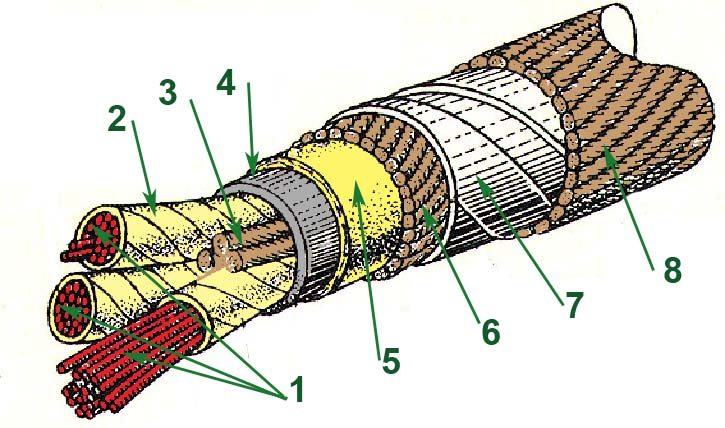
Пример конструкции кабеля:
1 - Токопроводящие жилы;
2 - Бумага, пропитанная маслом;
3 - Джутовый заполнитель;
4 - Свинцовая оболочка;
5 - Бумажная лента;
6 - Прослойка из джута;
7 - Стальная ленточная броня;
8 - Джутовый покров.
Кабели на напряжение до 1 кВ и выше...
[ГОСТ 12.2.007.14-75]
... силовые кабели с медными или алюминиевыми жилами с резиновой изоляцией, в свинцовой, поливинилхлоридной или резиновой оболочке, с защитными покровами или без них, предназначенные для неподвижной прокладки в электрических сетях напряжением 660 В переменного тока частотой 50 Гц или 1000 В постоянного тока и на напряжение 3000, 6000 и 10000 В постоянного тока.
Кабели предназначены для прокладки:
- на трассах с неограниченной разностью уровней.
- внутри помещений, в каналах, туннелях, в местах, не подверженных вибрации, в условиях отсутствия механических воздействий на кабель..
- в земле (траншеях), если кабель не подвергается значительным растягивающим усилиям
Строительная длина кабелей должна быть не менее 125 м. Допускаются маломерные отрезки длиной не менее 20 м в количестве не более 10 % от общей длины сдаваемой партии кабелей.
[ ГОСТ 433-73]
... монтажные многожильные кабели с поливинилхлоридной изоляцией и оболочкой, предназначенные для фиксированного межприборного монтажа электрических устройств, работающих при номинальном переменном напряжении до 500 В частоты до 400 Гц или постоянном напряжении до 750 В.
Требования к стойкости при механических воздействиях
- Кабели должны быть механически прочными при воздействии вибрационных нагрузок в диапазоне частот 1-5000 Гц с ускорением до 392 м/с2 (40 g).
- Кабели должны быть механически прочными при воздействии многократных ударов с ускорением 1471 м/с2 (150 g) при длительности удара 1-3 мс.
- Кабели должны быть механически прочными при воздействии одиночных ударов с ускорением 9810 м/с2(1000 g) и линейных нагрузок с ускорением до 4905 м/с2 (500 g).
Требования к стойкости при климатических воздействиях
-Кабели должны быть стойкими к воздействию повышенной температуры 343 К (70°С), при этом за повышенную температуру принимают температуру наиболее нагреваемого элемента конструкции кабеля.
- Кабели должны быть стойкими к воздействию пониженной температуры - 223 К (минус 50°С).
- Кабели должны быть стойкими к воздействию относительной влажности воздуха до 98 % при температуре 308 К (35°С).
- Кабели климатического исполнения Т должны быть стойкими к воздействию плесневых грибов.
[ ГОСТ 10348-80]
Тематики
- кабели, провода...
Классификация
>>>Обобщающие термины
Действия
- вводить кабель в отверстие
- вводить кабель в эксплуатацию
- наматывать кабель на барабан
- подключать кабель
- присоединять кабель
- прокладывать кабель
Синонимы
Сопутствующие термины
- неподвижная прокладка
- прокладка кабеля
- прокладка кабеля в земляной траншее
- прокладка кабеля непосредственно в грунте
- фиксированный межприборный монтаж электрических устройств
EN
DE
FR
кабельное изделие
Электрическое изделие, предназначенное для передачи по нему электрической энергии, электрических сигналов информации или служащее для изготовления обмоток электрических устройств, отличающееся гибкостью.
[ ГОСТ 15845-80]Параллельные тексты EN-RU
conductor (of a cable)
part of a cable which has the specific function of carrying current
[IEV number 461-01-01]токопроводящая жила
Элемент кабельного изделия, предназначенный для прохождения электрического тока
[ ГОСТ 15845-80]Тематики
- кабели, провода...
EN
манильский буровой канат
—
[ http://slovarionline.ru/anglo_russkiy_slovar_neftegazovoy_promyishlennosti/]Тематики
EN
многожильный провод
—
[Я.Н.Лугинский, М.С.Фези-Жилинская, Ю.С.Кабиров. Англо-русский словарь по электротехнике и электроэнергетике, Москва]Тематики
- электротехника, основные понятия
EN
нить гибкая
Стержень, воспринимающий только растягивающие усилия и свободно провисающий при концевом закреплении под действием собственного веса
[Терминологический словарь по строительству на 12 языках (ВНИИИС Госстроя СССР)]EN
DE
FR
провод
-
[IEV number 151-12-28]EN
wire
flexible cylindrical conductor, with or without an insulating covering, the length of which is large with respect to its cross-sectional dimensions
NOTE – The cross-section of a wire may have any shape, but the term "wire" is not generally used for ribbons or tapes.
[IEV number 151-12-28]FR
fil, m
conducteur cylindrique flexible, avec ou sans revêtement isolant, dont la longueur est grande par rapport aux dimensions de la section droite
NOTE – La section droite d'un fil peut avoir une forme quelconque, mais le terme "fil" n'est généralement pas employé pour une bande ou un ruban.
[IEV number 151-12-28]Тематики
- кабели, провода...
Действия
EN
DE
FR
прокладывать кабель
-Параллельные тексты EN-RU
The electrical connection wires must run through ducts with minimum protection of IP33 (in accordance with EN 60529).
В соответствии с требованиями EN 60529 кабели и провода должны быть проложены в коробах, обеспечивающих степень защиты не менее IP33.
[Перевод Интент]Тематики
- кабели, провода...
EN
язык CABLE
Расширенный язык Basic фирмы Computer Associates.
[ http://www.morepc.ru/dict/]Тематики
EN
Англо-русский словарь нормативно-технической терминологии > cable
-
25 cable conductors
токопроводящая жила
жила
Элемент кабельного изделия, предназначенный для прохождения электрического тока
[ ГОСТ 15845-80]
токопроводящая жила (кабеля)
Элемент кабеля, специфической функцией которого является передача электрического тока
[IEV number 461-01-01]
жила токопроводящая
Изолированный одно- или многопроволочный металлический проводник внутри электрического кабеля
[Терминологический словарь по строительству на 12 языках (ВНИИИС Госстроя СССР)]
жила
-
[IEV number 151-12-37]EN
conductor (of a cable)
part of a cable which has the specific function of carrying current
[IEV number 461-01-01]
strand
one of the wires of a stranded conductor
Source: 466-10-02 MOD
[IEV number 151-12-37]FR
âme
conducteur (d'un câble) (terme déconseillé dans ce sens)
partie d'un câble dont la fonction spécifique est de conduire le courant
[IEV number 461-01-01]
brin, m
un des fils d'un conducteur câblé
Source: 466-10-02 MOD
[IEV number 151-12-37]Все жилы двухжильных кабелей должны быть одинакового сечения.
Все жилы трех- и четырехжильных кабелей должны быть одинакового сечения или одна жила должна быть меньшего сечения (нулевая или жила заземления)
Номинальное сечение, мм2
основная жила: 25
нулевая жила: 16
жила заземления: 10
Изолированные жилы многожильных кабелей должны иметь отличительную расцветку или обозначение цифрами, начиная с нуля.
[ ГОСТ 433-73]
Токопроводящие жилы должны быть изолированы поливинилхлоридным пластикатом.
Изолированные жилы должны быть скручены в кабель.
[ ГОСТ 10348-80]Недопустимые, нерекомендуемые
Тематики
- кабели, провода...
Действия
Синонимы
Сопутствующие термины
EN
- cable
- cable conductors
- conductor
- conductor core
- conductor of a cable
- conductors
- core
- electric conductor
- strand
DE
- Einzeldraht
- Leiter (eines Kabels), m
- stromführende Ader
FR
Англо-русский словарь нормативно-технической терминологии > cable conductors
-
26 current protection
защита от перегрузки
-
[Интент]
защита от перегрузки
-
[Лугинский Я. Н. и др. Англо-русский словарь по электротехнике и электроэнергетике. 2-е издание - М.: РУССО, 1995 - 616 с.]Параллельные тексты EN-RU
Overload protection
Where overload protection is provided, detection of overload(s) shall be provided in each live conductor except for the neutral conductor.
However, where the motor overload detection is not used for cable overload protection, the number of overload detection devices may be reduced at the request of the user.
[IEC 60204-1-2006]Защита от перегрузки
Для реализации защиты от перегрузки применяют устройства определения перегрузки, которые должны быть включены в каждый токоведущий проводник, за исключением нулевого рабочего проводника.
При этом, в тех случаях, когда устройства определения перегрузки электродвигателя не используются для защиты кабеля от перегрузки, по согласованию с потребителем число таких устройств может быть уменьшено.
[Перевод Интент]
Недопустимые, нерекомендуемые
Примечание(1)- Мнение автора карточкиТематики
Синонимы
EN
Англо-русский словарь нормативно-технической терминологии > current protection
-
27 current overload protection
защита от перегрузки
-
[Интент]
защита от перегрузки
-
[Лугинский Я. Н. и др. Англо-русский словарь по электротехнике и электроэнергетике. 2-е издание - М.: РУССО, 1995 - 616 с.]Параллельные тексты EN-RU
Overload protection
Where overload protection is provided, detection of overload(s) shall be provided in each live conductor except for the neutral conductor.
However, where the motor overload detection is not used for cable overload protection, the number of overload detection devices may be reduced at the request of the user.
[IEC 60204-1-2006]Защита от перегрузки
Для реализации защиты от перегрузки применяют устройства определения перегрузки, которые должны быть включены в каждый токоведущий проводник, за исключением нулевого рабочего проводника.
При этом, в тех случаях, когда устройства определения перегрузки электродвигателя не используются для защиты кабеля от перегрузки, по согласованию с потребителем число таких устройств может быть уменьшено.
[Перевод Интент]
Недопустимые, нерекомендуемые
Примечание(1)- Мнение автора карточкиТематики
Синонимы
EN
Англо-русский словарь нормативно-технической терминологии > current overload protection
-
28 current transfers
-
29 cable conductor
-
30 current diagram
-
31 cable current transformer
Универсальный англо-русский словарь > cable current transformer
-
32 cable-type current transformer
Автоматика: кабельный трансформатор токаУниверсальный англо-русский словарь > cable-type current transformer
-
33 cable-type current transformer
English-Russian dictionary of mechanical engineering and automation > cable-type current transformer
-
34 cable current transformer
Англо-русский словарь по электроэнергетике > cable current transformer
-
35 continuous current-carrying capacity
длительная пропускная способность по току
—
[Я.Н.Лугинский, М.С.Фези-Жилинская, Ю.С.Кабиров. Англо-русский словарь по электротехнике и электроэнергетике, Москва, 1999 г.]Тематики
- электротехника, основные понятия
EN
(длительный) допустимый ток
Максимальное значение электрического тока, который может протекать длительно по проводнику, устройству или аппарату при определенных условиях без превышения определенного значения их температуры в установившемся режиме
[ ГОСТ Р МЭК 60050-826-2009]
Этот ток обозначают IZ
[ ГОСТ Р 50571. 1-2009 ( МЭК 60364-1: 2005)]EN
(continuous) current-carrying capacity
ampacity (US)
maximum value of electric current which can be carried continuously by a conductor, a device or an apparatus, under specified conditions without its steady-state temperature exceeding a specified value
[IEV number 826-11-13]
ampacity
The current in amperes that a conductor can carry continuously under the conditions of use without exceeding its temperature rating.
[National Electrical Cod]FR
courant (permanent) admissible, m
valeur maximale du courant électrique qui peut parcourir en permanence, un conducteur, un dispositif ou un appareil, sans que sa température de régime permanent, dans des conditions données, soit supérieure à la valeur spécifiée
[IEV number 826-11-13]Ampacity, the term is defined as the maximum amount of current a cable can carry before sustaining immediate or progressive deterioration. Also described as current rating or current-carrying capacity, is the RMS electric current which a device can continuously carry while remaining within its temperature rating. The ampacity of a cable depends on:
- its insulation temperature rating;
- conductor electrical properties for current;
- frequency, in the case of alternating currents;
- ability to dissipate heat, which depends on cable geometry and its surroundings;
- ambient temperature.
Electric wires have some resistance, and electric current flowing through them causes voltage drop and power dissipation, which heats the cable. Copper or aluminum can conduct a large amount of current before melting, but long before the conductors melt, their insulation would be damaged by the heat.
The ampacity for a power cable is thus based on physical and electrical properties of the material & construction of the conductor and of its insulation, ambient temperature, and environmental conditions adjacent to the cable. Having a large overall surface area may dissipate heat well if the environment can absorb the heat.
In a long run of cable, different conditions govern, and installation regulations normally specify that the most severe condition along the run governs the cable's rating. Cables run in wet or oily locations may carry a lower temperature rating than in a dry installation. Derating is necessary for multiple circuits in close proximity. When multiple cables are near, each contributes heat to the others and diminishes the amount of cooling air that can flow past the individual cables. The overall ampacity of the insulated conductors in a bundle of more than 3 must be derated, whether in a raceway or cable. Usually the de-rating factor is tabulated in a nation's wiring regulations.
Depending on the type of insulating material, common maximum allowable temperatures at the surface of the conductor are 60, 75 and 90 degrees Celsius, often with an ambient air temperature of 30°C. In the U.S., 105°C is allowed with ambient of 40°C, for larger power cables, especially those operating at more than 2 kV. Likewise, specific insulations are rated 150, 200 or 250°C.
The allowed current in cables generally needs to be decreased (derated) when the cable is covered with fireproofing material.
For example, the United States National Electric Code, Table 310-16, specifies that up to three 8 AWG copper wires having a common insulating material (THWN) in a raceway, cable, or direct burial has an ampacity of 50 A when the ambient air is 30°C, the conductor surface temperature allowed to be 75°C. A single insulated conductor in air has 70 A rating.
Ampacity rating is normally for continuous current, and short periods of overcurrent occur without harm in most cabling systems. The acceptable magnitude and duration of overcurrent is a more complex topic than ampacity.
When designing an electrical system, one will normally need to know the current rating for the following:- Wires
- Printed Circuit Board traces, where included
- Fuses
- Circuit breakers
- All or nearly all components used
Some devices are limited by power rating, and when this power rating occurs below their current limit, it is not necessary to know the current limit to design a system. A common example of this is lightbulb holders.
[http://en.wikipedia.org/wiki/Ampacity]
Тематики
- электротехника, основные понятия
Синонимы
EN
DE
- Dauerstrombelastbarkeit, f
- Strombelastbarkeit, f
FR
- courant admissible, m
- courant permanent admissible, m
Англо-русский словарь нормативно-технической терминологии > continuous current-carrying capacity
-
36 continuous current
(длительный) допустимый ток
Максимальное значение электрического тока, который может протекать длительно по проводнику, устройству или аппарату при определенных условиях без превышения определенного значения их температуры в установившемся режиме
[ ГОСТ Р МЭК 60050-826-2009]
Этот ток обозначают IZ
[ ГОСТ Р 50571. 1-2009 ( МЭК 60364-1: 2005)]EN
(continuous) current-carrying capacity
ampacity (US)
maximum value of electric current which can be carried continuously by a conductor, a device or an apparatus, under specified conditions without its steady-state temperature exceeding a specified value
[IEV number 826-11-13]
ampacity
The current in amperes that a conductor can carry continuously under the conditions of use without exceeding its temperature rating.
[National Electrical Cod]FR
courant (permanent) admissible, m
valeur maximale du courant électrique qui peut parcourir en permanence, un conducteur, un dispositif ou un appareil, sans que sa température de régime permanent, dans des conditions données, soit supérieure à la valeur spécifiée
[IEV number 826-11-13]Ampacity, the term is defined as the maximum amount of current a cable can carry before sustaining immediate or progressive deterioration. Also described as current rating or current-carrying capacity, is the RMS electric current which a device can continuously carry while remaining within its temperature rating. The ampacity of a cable depends on:
- its insulation temperature rating;
- conductor electrical properties for current;
- frequency, in the case of alternating currents;
- ability to dissipate heat, which depends on cable geometry and its surroundings;
- ambient temperature.
Electric wires have some resistance, and electric current flowing through them causes voltage drop and power dissipation, which heats the cable. Copper or aluminum can conduct a large amount of current before melting, but long before the conductors melt, their insulation would be damaged by the heat.
The ampacity for a power cable is thus based on physical and electrical properties of the material & construction of the conductor and of its insulation, ambient temperature, and environmental conditions adjacent to the cable. Having a large overall surface area may dissipate heat well if the environment can absorb the heat.
In a long run of cable, different conditions govern, and installation regulations normally specify that the most severe condition along the run governs the cable's rating. Cables run in wet or oily locations may carry a lower temperature rating than in a dry installation. Derating is necessary for multiple circuits in close proximity. When multiple cables are near, each contributes heat to the others and diminishes the amount of cooling air that can flow past the individual cables. The overall ampacity of the insulated conductors in a bundle of more than 3 must be derated, whether in a raceway or cable. Usually the de-rating factor is tabulated in a nation's wiring regulations.
Depending on the type of insulating material, common maximum allowable temperatures at the surface of the conductor are 60, 75 and 90 degrees Celsius, often with an ambient air temperature of 30°C. In the U.S., 105°C is allowed with ambient of 40°C, for larger power cables, especially those operating at more than 2 kV. Likewise, specific insulations are rated 150, 200 or 250°C.
The allowed current in cables generally needs to be decreased (derated) when the cable is covered with fireproofing material.
For example, the United States National Electric Code, Table 310-16, specifies that up to three 8 AWG copper wires having a common insulating material (THWN) in a raceway, cable, or direct burial has an ampacity of 50 A when the ambient air is 30°C, the conductor surface temperature allowed to be 75°C. A single insulated conductor in air has 70 A rating.
Ampacity rating is normally for continuous current, and short periods of overcurrent occur without harm in most cabling systems. The acceptable magnitude and duration of overcurrent is a more complex topic than ampacity.
When designing an electrical system, one will normally need to know the current rating for the following:- Wires
- Printed Circuit Board traces, where included
- Fuses
- Circuit breakers
- All or nearly all components used
Some devices are limited by power rating, and when this power rating occurs below their current limit, it is not necessary to know the current limit to design a system. A common example of this is lightbulb holders.
[http://en.wikipedia.org/wiki/Ampacity]
Тематики
- электротехника, основные понятия
Синонимы
EN
DE
- Dauerstrombelastbarkeit, f
- Strombelastbarkeit, f
FR
- courant admissible, m
- courant permanent admissible, m
непрерывный ток
—
[Я.Н.Лугинский, М.С.Фези-Жилинская, Ю.С.Кабиров. Англо-русский словарь по электротехнике и электроэнергетике, Москва, 1999]Тематики
- электротехника, основные понятия
EN
Англо-русский словарь нормативно-технической терминологии > continuous current
-
37 conductor of a cable
токопроводящая жила
жила
Элемент кабельного изделия, предназначенный для прохождения электрического тока
[ ГОСТ 15845-80]
токопроводящая жила (кабеля)
Элемент кабеля, специфической функцией которого является передача электрического тока
[IEV number 461-01-01]
жила токопроводящая
Изолированный одно- или многопроволочный металлический проводник внутри электрического кабеля
[Терминологический словарь по строительству на 12 языках (ВНИИИС Госстроя СССР)]
жила
-
[IEV number 151-12-37]EN
conductor (of a cable)
part of a cable which has the specific function of carrying current
[IEV number 461-01-01]
strand
one of the wires of a stranded conductor
Source: 466-10-02 MOD
[IEV number 151-12-37]FR
âme
conducteur (d'un câble) (terme déconseillé dans ce sens)
partie d'un câble dont la fonction spécifique est de conduire le courant
[IEV number 461-01-01]
brin, m
un des fils d'un conducteur câblé
Source: 466-10-02 MOD
[IEV number 151-12-37]Все жилы двухжильных кабелей должны быть одинакового сечения.
Все жилы трех- и четырехжильных кабелей должны быть одинакового сечения или одна жила должна быть меньшего сечения (нулевая или жила заземления)
Номинальное сечение, мм2
основная жила: 25
нулевая жила: 16
жила заземления: 10
Изолированные жилы многожильных кабелей должны иметь отличительную расцветку или обозначение цифрами, начиная с нуля.
[ ГОСТ 433-73]
Токопроводящие жилы должны быть изолированы поливинилхлоридным пластикатом.
Изолированные жилы должны быть скручены в кабель.
[ ГОСТ 10348-80]Недопустимые, нерекомендуемые
Тематики
- кабели, провода...
Действия
Синонимы
Сопутствующие термины
EN
- cable
- cable conductors
- conductor
- conductor core
- conductor of a cable
- conductors
- core
- electric conductor
- strand
DE
- Einzeldraht
- Leiter (eines Kabels), m
- stromführende Ader
FR
Англо-русский словарь нормативно-технической терминологии > conductor of a cable
-
38 rated cable charging current
номинальный ток отключения ненагруженного кабеля
-
[Перевод Интент]Тематики
- высоковольтный аппарат, оборудование...
EN
Англо-русский словарь нормативно-технической терминологии > rated cable charging current
-
39 part of a cable
элемент кабельного изделия
Любая конструктивная часть кабельного изделия.
[ ГОСТ 15845-80]Параллельные тексты EN-RU
conductor (of a cable)
part of a cable which has the specific function of carrying current
[IEV number 461-01-01]токопроводящая жила
Элемент кабельного изделия, предназначенный для прохождения электрического тока
[ ГОСТ 15845-80]Тематики
- кабели, провода...
EN
Англо-русский словарь нормативно-технической терминологии > part of a cable
-
40 return cable
обратный кабель
—
[Я.Н.Лугинский, М.С.Фези-Жилинская, Ю.С.Кабиров. Англо-русский словарь по электротехнике и электроэнергетике, Москва, 1999]Тематики
- электротехника, основные понятия
EN
7.6.50. В качестве обратного провода, соединяющего свариваемое изделие с источником сварочного тока в указанных в 7.6.48 установках стационарного использования, могут служить гибкие и жесткие провода, а также, где это возможно, стальные или алюминиевые шины любого профиля достаточного сечения, сварочные плиты, стеллажи и свариваемая конструкция (см. также 7.6.51 и 7.6.52).
В электросварочных установках с переносными и передвижными сварочными трансформаторами обратный провод должен быть изолированным так же, как и прямой, присоединяемый к электрододержателю.
Элементы, используемые в качестве обратного провода, должно надежно соединяться сваркой или с помощью болтов, струбцин либо зажимов.
7.6.51. В установках для автоматической дуговой сварки в случае необходимости (например, при сварке круговых швов) допускается соединение обратного провода со свариваемым изделием при помощи скользящего контакта соответствующей конструкции.
7.6.52. В качестве обратного провода не допускается использование металлических строительных конструкций зданий, трубопроводов и технологического оборудования, а также проводников сети заземления.
[ПУЭ]
Параллельные тексты EN-RU
Direct current supply gives also the great advantage of having the contact line consisting of a single conductor since the rails provide the return conductor.
[ABB]Еще одно преимущество применения постоянного тока в рельсовом транспорте заключается в том, что используется только один контактный провод, поскольку функцию обратного провода выполняют рельсы.
[Перевод Интент]Тематики
EN
Англо-русский словарь нормативно-технической терминологии > return cable
См. также в других словарях:
Current TV — s official logo Launched August 1, 2005 Owned by Current Media, Inc. Slogan Your World. View. Headquarters San Francisco, California Website … Wikipedia
Cable Street — (pronEng|ˈkeɪbəl striːt) is a mile long road in the East End of London, with several historic landmarks nearby, made famous by the Battle of Cable Street of 1936.LocationCable Street runs between the edge of The City and Limehouse: parallel to,… … Wikipedia
Cable television in the United States — is a common form of television delivery, generally by subscription. Cable television first became available in the United States in 1948, with subscription services in 1949. Data by SNL Kagan shows that as of 2006 about 58.4% of all American… … Wikipedia
Cable ferry — Coin operated cable ferry at Espevær in Bømlo, Norway A cable ferry is guided and in many cases propelled across a river or other larger body of water by cables connected to both shores. They are also called chain ferries, floating bridges, or… … Wikipedia
Cable Company of Trinidad and Tobago — This article refers to CCTT, the Trinidadian telecommunications company. For the Canadian technical organization please see Canadian Council of Technicians and Technologists. The Cable Company of Trinidad and Tobago (CCTT) or the Trinidad Tobago… … Wikipedia
Cable modem termination system — Cable modem terminations system A cable modem termination system or CMTS is a piece of equipment typically located in a cable company s headend or hubsite, and used to provide high speed data services, such as cable Internet or voice over… … Wikipedia
Cable jetting — is a technique to install cables in ducts [http://www.plumettaz.ch/en/products/optical fiber/jetting explanation.asp] . It is commonly used to install cables with optical fibers in underground polyethylene ducts and is an alternative to pulling … Wikipedia
Cable & Wireless (Caribbean) — Cable Wireless (West Indies) Ltd. is a leading wholly owned telecommunications subsidiary of the British based parent company Cable Wireless plc. This regional subsidiary covers 15 former British colonies of the Caribbean region and is made up of … Wikipedia
Cable de categoría 6 — Cable de categoría 6, o Cat 6 (ANSI/TIA/EIA 568 B.2 1) es un estándar de cables para Gigabit Ethernet y otros protocolos de redes que es retrocompatible con los estándares de categoría 5/5e y categoría 3. La categoría 6 posee características y… … Wikipedia Español
Cable bifilar — Saltar a navegación, búsqueda Cable bifilar Un cable bifilar es una línea de transmision en la cual la distancia entre dos conductores paralelos es mantenida constante gracias a un material dieléctrico. El mismo material que mantiene el espaciado … Wikipedia Español
Current — may refer to: Contents 1 Ongoing events 2 Science and Mathematics 3 Business 4 Ships 5 Media … Wikipedia
