

-
1 table de code
сущ.выч. кодовая таблица -
2 courant admissible, m
(длительный) допустимый ток
Максимальное значение электрического тока, который может протекать длительно по проводнику, устройству или аппарату при определенных условиях без превышения определенного значения их температуры в установившемся режиме
[ ГОСТ Р МЭК 60050-826-2009]
Этот ток обозначают IZ
[ ГОСТ Р 50571. 1-2009 ( МЭК 60364-1: 2005)]EN
(continuous) current-carrying capacity
ampacity (US)
maximum value of electric current which can be carried continuously by a conductor, a device or an apparatus, under specified conditions without its steady-state temperature exceeding a specified value
[IEV number 826-11-13]
ampacity
The current in amperes that a conductor can carry continuously under the conditions of use without exceeding its temperature rating.
[National Electrical Cod]FR
courant (permanent) admissible, m
valeur maximale du courant électrique qui peut parcourir en permanence, un conducteur, un dispositif ou un appareil, sans que sa température de régime permanent, dans des conditions données, soit supérieure à la valeur spécifiée
[IEV number 826-11-13]Ampacity, the term is defined as the maximum amount of current a cable can carry before sustaining immediate or progressive deterioration. Also described as current rating or current-carrying capacity, is the RMS electric current which a device can continuously carry while remaining within its temperature rating. The ampacity of a cable depends on:
- its insulation temperature rating;
- conductor electrical properties for current;
- frequency, in the case of alternating currents;
- ability to dissipate heat, which depends on cable geometry and its surroundings;
- ambient temperature.
Electric wires have some resistance, and electric current flowing through them causes voltage drop and power dissipation, which heats the cable. Copper or aluminum can conduct a large amount of current before melting, but long before the conductors melt, their insulation would be damaged by the heat.
The ampacity for a power cable is thus based on physical and electrical properties of the material & construction of the conductor and of its insulation, ambient temperature, and environmental conditions adjacent to the cable. Having a large overall surface area may dissipate heat well if the environment can absorb the heat.
In a long run of cable, different conditions govern, and installation regulations normally specify that the most severe condition along the run governs the cable's rating. Cables run in wet or oily locations may carry a lower temperature rating than in a dry installation. Derating is necessary for multiple circuits in close proximity. When multiple cables are near, each contributes heat to the others and diminishes the amount of cooling air that can flow past the individual cables. The overall ampacity of the insulated conductors in a bundle of more than 3 must be derated, whether in a raceway or cable. Usually the de-rating factor is tabulated in a nation's wiring regulations.
Depending on the type of insulating material, common maximum allowable temperatures at the surface of the conductor are 60, 75 and 90 degrees Celsius, often with an ambient air temperature of 30°C. In the U.S., 105°C is allowed with ambient of 40°C, for larger power cables, especially those operating at more than 2 kV. Likewise, specific insulations are rated 150, 200 or 250°C.
The allowed current in cables generally needs to be decreased (derated) when the cable is covered with fireproofing material.
For example, the United States National Electric Code, Table 310-16, specifies that up to three 8 AWG copper wires having a common insulating material (THWN) in a raceway, cable, or direct burial has an ampacity of 50 A when the ambient air is 30°C, the conductor surface temperature allowed to be 75°C. A single insulated conductor in air has 70 A rating.
Ampacity rating is normally for continuous current, and short periods of overcurrent occur without harm in most cabling systems. The acceptable magnitude and duration of overcurrent is a more complex topic than ampacity.
When designing an electrical system, one will normally need to know the current rating for the following:- Wires
- Printed Circuit Board traces, where included
- Fuses
- Circuit breakers
- All or nearly all components used
Some devices are limited by power rating, and when this power rating occurs below their current limit, it is not necessary to know the current limit to design a system. A common example of this is lightbulb holders.
[http://en.wikipedia.org/wiki/Ampacity]
Тематики
- электротехника, основные понятия
Синонимы
EN
DE
- Dauerstrombelastbarkeit, f
- Strombelastbarkeit, f
FR
- courant admissible, m
- courant permanent admissible, m
Франко-русский словарь нормативно-технической терминологии > courant admissible, m
-
3 courant permanent admissible, m
(длительный) допустимый ток
Максимальное значение электрического тока, который может протекать длительно по проводнику, устройству или аппарату при определенных условиях без превышения определенного значения их температуры в установившемся режиме
[ ГОСТ Р МЭК 60050-826-2009]
Этот ток обозначают IZ
[ ГОСТ Р 50571. 1-2009 ( МЭК 60364-1: 2005)]EN
(continuous) current-carrying capacity
ampacity (US)
maximum value of electric current which can be carried continuously by a conductor, a device or an apparatus, under specified conditions without its steady-state temperature exceeding a specified value
[IEV number 826-11-13]
ampacity
The current in amperes that a conductor can carry continuously under the conditions of use without exceeding its temperature rating.
[National Electrical Cod]FR
courant (permanent) admissible, m
valeur maximale du courant électrique qui peut parcourir en permanence, un conducteur, un dispositif ou un appareil, sans que sa température de régime permanent, dans des conditions données, soit supérieure à la valeur spécifiée
[IEV number 826-11-13]Ampacity, the term is defined as the maximum amount of current a cable can carry before sustaining immediate or progressive deterioration. Also described as current rating or current-carrying capacity, is the RMS electric current which a device can continuously carry while remaining within its temperature rating. The ampacity of a cable depends on:
- its insulation temperature rating;
- conductor electrical properties for current;
- frequency, in the case of alternating currents;
- ability to dissipate heat, which depends on cable geometry and its surroundings;
- ambient temperature.
Electric wires have some resistance, and electric current flowing through them causes voltage drop and power dissipation, which heats the cable. Copper or aluminum can conduct a large amount of current before melting, but long before the conductors melt, their insulation would be damaged by the heat.
The ampacity for a power cable is thus based on physical and electrical properties of the material & construction of the conductor and of its insulation, ambient temperature, and environmental conditions adjacent to the cable. Having a large overall surface area may dissipate heat well if the environment can absorb the heat.
In a long run of cable, different conditions govern, and installation regulations normally specify that the most severe condition along the run governs the cable's rating. Cables run in wet or oily locations may carry a lower temperature rating than in a dry installation. Derating is necessary for multiple circuits in close proximity. When multiple cables are near, each contributes heat to the others and diminishes the amount of cooling air that can flow past the individual cables. The overall ampacity of the insulated conductors in a bundle of more than 3 must be derated, whether in a raceway or cable. Usually the de-rating factor is tabulated in a nation's wiring regulations.
Depending on the type of insulating material, common maximum allowable temperatures at the surface of the conductor are 60, 75 and 90 degrees Celsius, often with an ambient air temperature of 30°C. In the U.S., 105°C is allowed with ambient of 40°C, for larger power cables, especially those operating at more than 2 kV. Likewise, specific insulations are rated 150, 200 or 250°C.
The allowed current in cables generally needs to be decreased (derated) when the cable is covered with fireproofing material.
For example, the United States National Electric Code, Table 310-16, specifies that up to three 8 AWG copper wires having a common insulating material (THWN) in a raceway, cable, or direct burial has an ampacity of 50 A when the ambient air is 30°C, the conductor surface temperature allowed to be 75°C. A single insulated conductor in air has 70 A rating.
Ampacity rating is normally for continuous current, and short periods of overcurrent occur without harm in most cabling systems. The acceptable magnitude and duration of overcurrent is a more complex topic than ampacity.
When designing an electrical system, one will normally need to know the current rating for the following:- Wires
- Printed Circuit Board traces, where included
- Fuses
- Circuit breakers
- All or nearly all components used
Some devices are limited by power rating, and when this power rating occurs below their current limit, it is not necessary to know the current limit to design a system. A common example of this is lightbulb holders.
[http://en.wikipedia.org/wiki/Ampacity]
Тематики
- электротехника, основные понятия
Синонимы
EN
DE
- Dauerstrombelastbarkeit, f
- Strombelastbarkeit, f
FR
- courant admissible, m
- courant permanent admissible, m
Франко-русский словарь нормативно-технической терминологии > courant permanent admissible, m
-
4 mettre
vmettre aux abois — см. aux abois
mettre aux aguets — см. aux aguets
mettre le cap sur... — см. mettre le cap sur...
mettre à chef — см. mener à chef
mettre au ciel — см. élever au ciel
mettre au courant — см. au courant
mettre la croix sur... — см. faire la croix sur...
mettre qn, qch au cul de qn — см. envoyer qn, qch au cul de qn
mettre à cul — см. jeter à cul
mettre de la différence entre... — см. faire de la différence entre...
mettre des entraves à... — см. apporter des entraves à...
c'est l'étincelle qui a mis le feu aux poudres — см. il ne faut qu'une étincelle pour allumer un grand incendie
mettre aux gages — см. aux gages
mettre le grappin sur... — см. jeter le grappin sur...
se mettre à la hauteur de... — см. être à la hauteur de...
se mettre au lit — см. aller au lit
mettre à la merci de... — см. se mettre à la merci de...
il ne faut pas mettre la faucille en la moisson d'autrui — см. il ne faut pas jeter la faux en la moisson d'autrui
mettre obstacle à... — см. faire obstacle à...
mettre sur orbite — см. sur orbite
mettre la paix entre... — см. faire la paix de qn
mettre en passe — см. en passe
vendre la peau de l'ours, avant de l'avoir mis par terre — см. vendre la peau de l'ours, avant de l'avoir tué
mettre au propre — см. au propre
se mettre en quête — см. en quête
il ne faut pas compter sur les souliers d'un mort pour se mettre en route — см. ne comptons pas sur les souliers d'un mort pour être bien chaussés
se mettre en tas — см. être en tas
mettre au tas — см. jeter au tas
mettre en taule — см. en taule
-
5 avoir
vl'avoir manqué belle — см. le beau
l'avoir belle — см. le beau
avoir la casquette — см. ras le bol
avoir des hardiesses avec... — см. avoir des hardiesses avec...
en avoir jusqu'ici, jusque-là — см. en avoir jusque-là
avoir oublié d'avoir... — см. avoir oublié d'avoir
avoir oublié d'être... — см. avoir oublié d'être
avoir ouï-dire — см. avoir ouï dire
- l'avoir- en avoir- y a pas -
6 passer
v. tableau «Verbes de mouvement»;vi. 1. (à côté, à travers, par, devant) le préfixe про-; идти́* ipf., проходи́ть ◄-'дит►/пройти́*; проезжа́ть/прое́хать ◄-е́ду, -ет► (transport); пролета́ть/ пролете́ть ◄-чу, -тит► (avion, oiseaux, etc.); проплыва́ть/проплы́ть ◄-ву, -ёт, -ла► (en nageant); бежа́ть ◄-гу, -жит, -гут►/про=, мча́ться ◄мчу-, -ит-►/про=, мелькну́ть/про= (en coup de vent); пролеза́ть/проле́зть ◄-'зу, -'ет, -лез► (à quatre pattes);défense de passer — прохо́д <прое́зд> запрещён; l'ennemi ne passera pas — враг не пройдёт; il regardait les autos passer — он смотре́л ∫, как проезжа́ют ми́мо маши́ны <на проезжа́ющие маши́ны>; il regardait passer les cigognes — он смотре́л ∫, как пролета́ют ми́мо а́исты <на пролета́ющих а́истов>; un chaland qui passe — проплыва́ющая <плыву́щая ми́мо> ба́ржа́ ║ en passant — на ходу́; мимохо́дом; прое́здом; неча́янно (par inadvertance); j'ai renversé un piéton en passant — я сбил ∫ на ходу́ <неча́янно> пешехо́да; il ne vient qu'en passant — он быва́ет то́лько прое́здом <нае́здами (de temps à autre)); soit dit en passant — ме́жду про́чим ║ passer à la cuisine — пройти́ на ку́хню ║ passer à table — пройти́ к столу́, сади́ться за стол; passer à côté du théâtre — пройти́ (прое́хать) ми́мо теа́тра; il est passé à travers champs — он прошёл (прое́хал) по́лем; passer sous... — пролеза́ть под (+); подлеза́ть/подле́зть под (+ A); passer sous la table — проле́зть под столо́м, подле́зть под стол: passez devant, je vous suis — проходи́те <иди́те вперёд>, ∫ я по́сле вас <я за ва́ми>; passer par le Sud — прое́хать ю́жным направле́нием <ю́гом>; la Moscova passe à Moscou — Москва́-река́ протека́ет че́рез Москву́; la route passe par Orel — доро́га идёт <прохо́дит> че́рез Орёл; un filet de lumière passe sous la porte — из-под двери́ пробива́ется поло́ска све́та; le café passe — ко́фе прохо́дит < идёт> че́рез фильтрil n'y a pas moyen de passer — пройти́ <прое́хать> нельзя́;
2. (d'un endroit dans un autre;le préf. пере-); переходи́ть/ перейти́; переезжа́ть/перее́хать; переправля́ться/перепра́виться; перебира́ться/перебра́ться ◄-беру́-, -ёт-, -ла-, etc.► (avec difficulté); перелеза́ть/переле́зть (en grimpant);passer d'une rive à l'autre de la Volga — перепра́виться <перебра́ться> с одного́ бе́рега Во́лги на друго́й; passer de main en main — переходи́ть из рук в ру́ки; passer par la fenêtre — переле́зть че́рез окно́; влезть в окно́passer de France en Espagne — перее́хать из Фра́нции в Испа́нию;
3. (pour un temps;le préfixe за-) заходи́ть/зайти́ (à pied); заезжа́ть/зае́хать (transport); забега́ть/забежа́ть fam.; загля́дывать/загляну́ть ◄-ну, -'ет► fam.;je passe te prendre en voiture — я зае́ду за тобо́й на маши́не; je passe chez vous — я зайду́ <зае́ду, забегу́, загляну́> к вам; je passe chez le docteur — я побыва́ю у врача́; attends-moi, je passe dans dix minutes — подожди́ меня́, я бу́ду че́рез де́сять мину́т; ne faire que passer — загляну́ть <зайти́, зае́хать, забежа́ть> мимохо́дом <на мину́т[к]у>; je ne fais que passer — я то́лько на мину́т[к]уje passerai prendre ce livre chez toi — я зайду́ <забегу́> к тебе́ за э́той кни́гой;
4. (s'écouler):le temps a passéoù... — прошло́ [то] вре́мя, когда́...; les jours passent vite — дни иду́т <прохо́дят> бы́строcomme le temps passe! — как идёт <бежи́т> вре́мя!;
5. (être égaré) дева́ться ◄-ва́ю-►/де́ться ◄-'ну-, -'ет-►;je ne sais pas où il est passé — я не зна́ю, куда́ он де́лся <подева́лся>
6. (disparaître) проходи́ть;cela vous passer— ега э́то у вас пройдёт; mon mal de tête est passé — головна́я боль <голова́> у меня́ прошла́; sa colère est passée — его́ гнев прошёл; l'envie m'en a passé — жела́ние у меня́ пропа́ло; cette étoffe a (est) passé◄— е► de mode — э́та ткань вы́шла из мо́дыla jeunesse passe — мо́лодость прохо́дит;
7. (perdre ses couleurs) линя́ть/по=, ↑вы-;cette étoffe a passé — э́та ткань полиня́ла
8. (être admis) проходи́ть; быть* при́нятым;cette réplique ne passe pas — э́та ре́плика не сраба́тывает; je suis passé de justesse à l'écrit — я е́ле-е́ле прошёл на пи́сьменном экза́мене; votre devoir peut passer — ва́ша дома́шняя рабо́та удовлетвори́тельнаla loi est passée — зако́н прошёл <был при́нят>;
9. (spectacle) идти́; проходи́ть;quand passe cette pièce? — когда́ идёт э́та пье́са?où passe ce film? — где идёт э́тот фильм?;
10. (se manifester un instant) промелькну́ть pf.;un éclair de malice passa dans ses yeux — в его́ глаза́х [про]мелькну́ла и́скорка лука́встваun souffle d'air froid passer a ∑ — пове́яло <потяну́ло> хо́лодом;
11.:passe encore de + inf [— ну] пусть...; поло́жим...; допу́стим...; ещё куда́ ни шло: passer encore de n'être pas à l'heure — пусть <поло́жим>, он не смог прийти́ во́время; не прийти́ во́время — э́то ещё куда́ ни шло; passons! — не сто́ит <не бу́дем> об э́том [говори́ть]!; нева́жно!passe pour cette fois — на э́тот раз сойдёт;
12. fig. (avec une prép. ou un adv.):(à):passer à l'exécution (à l'acte) — перейти́ к исполне́нию (к де́йствию); passer aux ordres — явля́ться/яви́ться за приказа́ниями; passer au point mort — перейти́ в нейтра́льное положе́ние; passer à l'ennemi — переходи́ть (↑перебега́ть/перебежа́ть) на сто́рону проти́вника; passer au second plan — отходи́ть/отойти́ на второ́й <за́дний> план; passer à côté de la question — обходи́ть/обойти́ вопро́с; passer à travers tous les obstacles — проходи́ть че́рез все препя́тствия; passer à la postérité — перехо́дить к <передава́ться/переда́ться> пото́мству ║ (après, avant)*. passer après — сле́довать/по= (за +); идти́ (за +); passer avant — предше́ствовать ipf. (+ D), идти́ до (+ G); faire passer avant qch. — ста́вить/по= вы́ше чего́-л.passer à l'ordre du jour — перейти́ к пове́стке дня;
║ (comme):passer comme une lettre à la poste — пройти́ как по ма́слу: пройти́ без сучка́, без задо́ринки
║ (dans):passer dans les mœurs — входи́ть/войти́ в обы́чай
║ (de... à (en)):passer de seconde en première — переходи́ть из второ́го в пе́рвый класс (école); passer du coq à l'âne — переска́кивать с пя́того на деся́тое; passer de vie à trépas — сконча́ться pf., преста́виться pf. vx.passer de l'état liquide à l'état gazeux — переходи́ть из жи́дкого состоя́ния в газообра́зное;
║ (dessus):le camion lui est passé dessus — его́ перее́хал грузови́кpasser dessus — перее́хать pf. кого́-л.;
║ (devant):passer devant les yeux — проходи́ть <мелькну́ть/ про=> пе́ред глаза́миpasser devant le nez — уходи́ть /уйти́ <уплыва́ть/уплы́ть> из-под но́са;
║ (en):il passa en jugement ∑ — его́ суди́ли; passer en première (en code) — включа́ть/ включи́ть пе́рвую ско́рость (фа́ры бли́жнего све́та) auto.passer en justice (en jugement) — идти́ <попада́ть/попа́сть> под суд;
║ (outre):passer outre à... — пренебрега́ть/пренебре́чь чём-л.; не счита́ться/не по= с (+); не соблюда́ть/ не соблюсти́ (+ G); не учи́тывать/не уче́сть (+ A); оставля́ть/оста́вить без внима́ния (+ A)passer outre — идти́ <проходи́ть> да́льше <ми́мо>;
║ ( par):passer par de rudes épreuves (une rude école) — проходи́ть [че́рез] суро́вые <тя́жкие; испыта́ния (суро́вую шко́лу); il faut en passer par là — че́рез э́то придётся пройти́; passer par la tête — взбрести́ pf. в го́лову, приходи́ть/прийти́ на умpasser par toutes les couleurs — меня́ться/измени́ться в лице́;
║ (par-dessus):passer par-dessus les préjugés — переша́гивать/ перешагну́ть че́рез предрассу́дки
║ (pour):il passe pour un savant — он слывёт учёным челове́ком; se faire passer pour... — выдава́ть/вы́дать себя́ за (+ A); il se fait passer pour un artiste — он выдаёт себя́ за арти́ста; faire passer qn. pour... — выдава́ть кого́-л. за (+ A); il le fait passer pour son neveu — он выдаёт его́ за своего́ племя́нникаpasser pour... — слыть/про= (+ ; за + A), счита́ться ipf. (+);
║ (sous):passer sous les yeux — прохо́дить <происходи́ть/произойти́> на глаза́х; cela m'est passé sous le nez — э́то у меня́ пря́мо из-под но́са ушло́ <уплы́ло>; sa jupe passe sous son manteau — у неё из-под пальто́ видна́ <выгля́дывает> ю́бкаpasser sous une voiture — попада́ть/попа́сть под маши́ну;
║ (sur):je passe rapidement sur les détails — я не бу́ду заде́рживаться <остана́вливаться> на подро́бностях ● j'en passe et des meilleures — о други́х я [уже́] и не говорю́; я мог бы ещё и не то [по]рассказа́ть; у passerpasser sur le corps (ventre) de qn. — переша́гивать че́рез кого́-л.;
1) проходи́ть че́рез э́то;il n'épargne personne dans ses critiques, tout le monde y passe — он никого́ не щади́т в свое́й кри́тике; всем от него́ достаётся [на оре́хи fam.]
2) (être consacré à) уходи́ть;toute sa fortune va y passer — на э́то уйдёт всё его́ состоя́ние
3) (mourir):il a failli — у passer — он чуть бы́ло ∫ не отпра́вился на тот свет <но́ги не протяну́л, концы́ не отда́л>
13. (suivi d'un attribut) станови́ться ◄-'вит-►/стать ◄-'ну► (+); получа́ть/получи́ть ◄-'ит► зва́ние milit.; быть произведённым [в чин] vx.;il est passé maître dans l'art... — он стал ма́стером <знатоко́м> (+ G); passer inaperçu — пройти́ незаме́ченнымil est passé capitaine — он получи́л зва́ние капита́на; ∑ его́ произвела́ ∫ в чин капита́на <в капита́ны> vx.;
■ vt.1. (lieu) переходи́ть; проходи́ть; проезжа́ть; переправля́ться (че́рез + A);passer la porte — пройти́ в дверь; переступа́ть/переступи́ть [че́рез] поро́г; passer la douane — пройти́ тамо́женный досмо́тр; quand vous aurez passé le pont... — когда́ вы перейдёте (перее́дете) [че́рез] <мину́ете> мост...; passer fa rivière à gué — перейти́ <перепра́виться че́рез> ре́ку вброд; passer la rivière à la nage — переплыва́ть/переплы́ть ре́ку; перепра́виться че́рез ре́ку вплавь; passer le cappasser la frontière — перейти́ грани́цу;
1) огиба́ть/обогну́ть мыс2) перешагну́ть pf. рубе́ж;passer son chemin — идти́ ipf. свое́й дорого́й
2. (temps) composés perfectifs avec le préfixe про-: проводи́ть ◄-'дит-►/провести́*;il a passé trente ans de sa vie à Paris — он про́жил в Пари́же три́дцать лет; il a passé deux mois à l'hôpital — он про́был два ме́сяца в больни́це; il passe son temps à lire (à jouer) — он прово́дит всё вре́мя за чте́нием (за игро́й); il a passé la nuit à lire — он чита́л всю ночь напролёт; il a passé toute la soirée à bavarder — он проболта́л весь ве́чер; il passe sa vie à... — он прово́дит жизнь за (+); он тра́тит жизнь на (+ A); pour passer le temps — для времяпрепровожде́ния; passer un mauvais quart d'heure — пережива́ть/ пережи́ть неприя́тную мину́туnous passerons la journée ensemble — мы проведём [весь] день вме́сте;
║ (âge):il a passé la cinquantaine ∑ — ему́ перевали́ло за пятьдеся́т ║ il ne passera pas l'hiver — он не протя́нет <не дотя́нет> до весны́il a passé l'âge — он вы́шел из э́того во́зраста;
3. (subir un examen) сдава́ть ◄сдаю́, -ёт►/сдать*; держа́ть ◄-жу, -'ит►/вы= (fig. surtout); проходи́ть;quand passes-tu l'oral? — когда́ ты сдаёшь у́стный [экза́мен]?; passer une visite médicale — проходи́ть медици́нский осмо́тр; passer une radio — проходи́ть ∫ рентгенологи́ческое обсле́дование <рентге́н fam.>; де́лать/с= рентге́новский сни́мокil a passé l'examen — он сдал <вы́держал> экза́мен;
4. (dépasser) превосходи́ть ◄-'дит-►/превзойти́*; быть вы́ше; переходи́ть; выходи́ть/вы́йти* (за + A);cela passe mes forces — э́то вы́ше мои́х сил; э́то мне не под си́лу; passer l'entendement — быть вы́ше понима́ния; passer la mesure — перейти́ ме́ру; зарыва́ться/зарва́ться fam.; ● passer la rampe — доходи́ть/дойти́ до зри́телей; производи́ть/произвести́ эффе́ктcela passe toute attente — э́то превосхо́дит все ожида́ния;
5. (omettre) пропуска́ть/пропусти́ть ◄-'стит►;laisser passer une occasion — упуска́ть/упусти́ть [благоприя́тный] слу́чай; je passe les détails sous silence — я ∫ опуска́ю подро́бности <ума́лчиваю о подро́бностях>; je vous passe les détails — изба́влю вас от подро́бностейpasser une page — пропусти́ть страни́цу;
6. (mettre) натя́гивать/натяну́ть ◄-'ет► [на себя́]; наки́дывать/наки́нуть, набра́сывать/набро́сить [на себя́] (rapidement);passer sa robe de chambre — набро́сить <наки́нуть> хала́тpasser son pantalon — натяну́ть брю́ки;
7. (conclure) заключа́ть/заключи́ть;passer [une] commande — де́лать зака́зpasser un contrat (un marché) — заключи́ть контра́кт (сде́лку);
passer le thé (un bouillon) — процеди́ть чай (бульо́н)passer de la farine — просе́ять му́ку;
9. (faire voir) пока́зывать/показа́ть ◄-жу, -'ет►; ста́вить/по=; дава́ть/дать vx.;passer une pièce — ста́вить пье́су; passer un disque — ста́вить <крути́ть> пласти́нкуpasser un film — пока́зывать (↑демонстри́ровать ipf. et pf.; — крути́ть ipf. fam.) фильм;
10. (enclencher) включа́ть;passer les vitesses (la troisième) — включи́ть ско́рость (тре́тью ско́рость)
11. (faire traverser) переправля́ть; перевози́ть ◄-'зит►/перевезти́*;passer des marchandises en transit — перево́зить гру́зы транзи́том
12. (inscrire) переводи́ть ◄-'дит-►/перевести́*; вноси́ть ◄-'сит►/ внести́*:passer une somme en compte — перевести́ су́мму на счёт
13. (à) передава́ть/ переда́ть;passer la parole à qn. — переда́ть <предоставля́ть/предоста́вить> сло́во кому́-л.; ● passer la main — слага́ть/сложи́ть с себя́ обя́занности; уступа́ть/уступи́ть ме́сто; passer le rhume à qn. — заража́ть/зарази́ть кого́-л. на́сморком ;passer le sel à son voisin (le livre au professeur) — переда́ть соль сосе́ду (кни́гу преподава́телю);
passer un savon à qn. — устра́ивать/устро́ить кому́-л. головомо́йку; зада́ть pf. кому́-л. нагоня́й; passer de la pommade à qn. — ума́сливать/ума́слить <уле́щивать/улести́ть> кого́-л. (flatter qn.)il a passé le rhume à sa sœur ∑ — сестра́ ∫ зарази́лась от него́ на́сморком <подхвати́ла <подцепи́ла fam.> от него́ на́сморк);
14. (dans, à) высо́вывать/вы́сунуть; просо́вывать/просу́нуть; продева́ть/про деть ◄-'ну►;passer le doigt dans la fente — засу́нуть pf. па́лец в щель; passer un lacet — проде́ть <вдеть pf.> шнуро́кpasser la tête à la portière [d'un train] — вы́сунуть го́лову из окна́ [ваго́на];
15. (à) надева́ть;passer une bague au doigt — наде́ть кольцо́ на па́лец
16. (dans, sur) провести́ по (+ D); гла́дить/по= (по + D);passer la main dans le dos de qn. fig. — гла́дить кого́-л. по шёрстке, льстить/по= (+ D); ● passer l'éponge — проща́ть/прости́ть; не держа́ть ipf. зла pop. élevé.passer la main dans les cheveux — провести́ руко́й по волоса́м; пригла́живать/ пригла́дить во́лосы;
17. (à, par) обраба́тывать/обрабо́тать (+);passer les légumes à l'eau — промыва́ть/промы́ть о́вощи водо́й <в воде́>; passer qch. au feu — держа́ть/по= restr. что-л. на огне́; passer le linge à l'eau de Javel — полоска́ть, пропола́скивать/прополоска́ть бельё в хлори́рованной воде́; passer le linge au bleu — сини́ть, подси́нивать/ подсини́ть бельё; ● passer au tamis — разбира́ть/разобра́ть по ко́сточкам; passer qn. à tabac — изби́ть pf. кого́-л. [в поли́ции]; passer au fil de l'épée — проткну́ть <пронзи́ть> pf. шпа́гой; passer les troupes en revue — принима́ть/приня́ть [вое́нный] пара́д; производи́ть/произвести́ смотр войска́м vx.; passer qch. en revue — пересма́тривать/пересмотре́ть <просма́тривать/просмотре́ть> что-л.passer le parquet à la cire — натира́ть/натере́ть парке́т во́ском;
18. (sur) класть ◄-ду, -ёт, клал►/положи́ть ◄-'ит► (на + A); покрыва́ть/покры́ть ◄-кро́ю, -'ет►(+);passer deux couches de peinture sur le mur — покрыва́ть сте́ну двумя́ слоя́ми кра́ски
19. (à) проща́ть/прости́ть (+ D), спуска́ть/спусти́ть ◄-'стит► (+ D); потво́рствовать ipf. (+ D); потака́ть ipf. (+ D);passez-moi le mot (l'expression) — извини́те за выраже́ниеpasser à l'enfant tous ses caprices — потака́ть всем капри́зам ребёнка;
20. (satisfaire) удовлетворя́ть/удовлетвори́ть;passer sa colère sur qn. — срыва́ть/сорва́ть [свой] гнев на ком-л.passer son envie — удовлетвори́ть свою́ при́хоть;
■ vpr.- se passer
- passé -
7 degré de protection procuré par une enveloppe
степень защиты
Способ защиты, обеспечиваемый оболочкой от доступа к опасным частям, попадания внешних твердых предметов и (или) воды и проверяемый стандартными методами испытаний.
[ ГОСТ 14254-96( МЭК 529-89)]
степень защиты, обеспечиваемая оболочкой (IP)
Числовые обозначения после кода IP, которые в соответствии с МЭК 60529 [12] характеризуют оболочку электрооборудования, обеспечивающую:
- защиту персонала от прикасания или доступа к находящимся под напряжением или движущимся частям (за исключением гладких вращающихся валов и т.п.), расположенным внутри оболочки;
- защиту электрооборудования от проникания в него твердых посторонних тел и,
- если указано в обозначении, защиту электрооборудования от вредного проникания воды.
[ ГОСТ Р МЭК 60050-426-2006]EN
degree of protection of enclosure
IP (abbreviation)
numerical classification according to IEC 60529 preceded by the symbol IP applied to the enclosure of electrical apparatus to provide:
– protection of persons against contact with, or approach to, live parts and against contact with moving parts (other than smooth rotating shafts and the like) inside the enclosure,
– protection of the electrical apparatus against ingress of solid foreign objects, and
– where indicated by the classification, protection of the electrical apparatus against harmful ingress of water
[IEV number 426-04-02 ]FR
degré de protection procuré par une enveloppe
IP (abréviation)
classification numérique selon la CEI 60529, précédée du symbole IP, appliquée à une enveloppe de matériel électrique pour apporter:
– une protection des personnes contre tout contact ou proximité avec des parties actives et contre tout contact avec une pièce mobile (autre que les roulements en faible rotation) à l'intérieur d'une enveloppe
– une protection du matériel électrique contre la pénétration de corps solide étrangers, et
– selon l’indication donnée par la classification, une protection du matériel électrique contre la pénétration dangereuse de l’eau
[IEV number 426-04-02 ]Элементы кода IP и их обозначения по ГОСТ 14254-96( МЭК 529-89)
Цифры кода IP
Значение для защиты оборудования от проникновения внешних твердых предметов
Значение для защиты людей от доступа к опасным частям
Первая характеристическая цифра
0
Нет защиты
Нет защиты
1
диаметром ≥ 50 мм
тыльной стороной руки
2
диаметром ≥ 12,5 мм
пальцем
3
диаметром ≥ 2,5 мм
инструментом
4
диаметром ≥ 1,0 мм
проволокой
5
пылезащищенное
проволокой
6
пыленепроницаемое
проволокой
От вредного воздействия в результате проникновения воды
Вторая характеристическая цифра
0
Нет защиты
-
1
Вертикальное каплепадение
2
Каплепадение (номинальный угол 15°)
3
Дождевание
4
Сплошное обрызгивание
5
Действие струи
6
Сильное действие струи
7
Временное непродолжительное погружение
8
Длительное погружение
Дополнительная буква (при необходимости)
-
От доступа к опасным частям
A
тыльной стороной руки
B
пальцем
C
инструментом
проволокой
Вспомогательная буква (при необходимости)
Вспомогательная информация относящаяся к:
-
H
высоковольтным аппаратам
M
состоянию движения во время испытаний защиты от воды
S
состоянию неподвижности во время испытаний защиты от воды
W
Требования в части стойкости оболочек и электрооборудования в целом к климатическим, механическим внешним воздействующим факторам (ВВФ) и специальным средам (кроме проникновения внешних твердых предметов и воды) установлены вне рамок настоящего стандарта.
Параллельные тексты EN-RU
The code IP indicates the degrees of protection provided by an enclosure against access to hazardous parts, ingress of solid foreign objects and ingress of water.
The degree of protection of an enclosure is identified, in compliance with the specifications of the Standard IEC 60529, by the code letters IP (International Protection) followed by two numerals and two additional letters.
The first characteristic numeral indicates the degree of protection against ingress of solid foreign objects and against contact of persons with hazardous live parts inside the enclosure.
The second characteristic numeral indicates the degree of protection against ingress of water with harmful effects.
[ABB]Код IP обозначает степень защиты, обеспечиваемую оболочкой от попадания внутрь твердых посторонних предметов и воды.
Степень защиты оболочки обозначается в соответствии со стандартом МЭК 60529 буквенным обозначением IP (International Protection, т. е. Международная защита) после которого следуют две цифры, к которым в некоторых случаях добавляются еще две буквы.
Первая характеристическая цифра обозначает степень защиты от проникновения твердых посторонних предметов и от контакта людей с находящимися внутри оболочки опасными токоведущими частями.
Вторая характеристическая цифра обозначает степень защиты оболочки с точки зрения вредного воздействия, оказываемого проникновением воды.
[Перевод Интент]The protection of enclosures against ingress of dirt or against the ingress of water is defined in IEC529 (BSEN60529:1991). Conversely, an enclosure which protects equipment against ingress of particles will also protect a person from potential hazards within that enclosure, and this degree of protection is also defined as a standard.
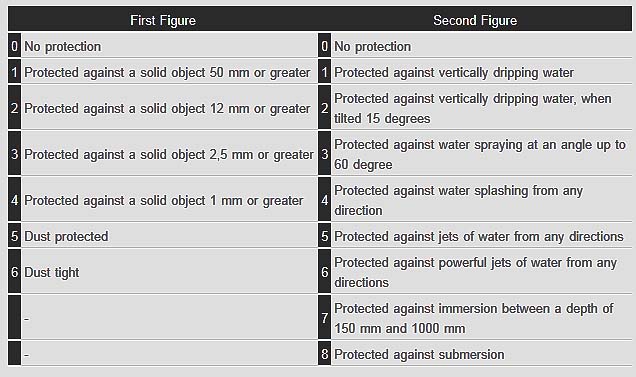
The degrees of protection are most commonly expressed as ‘IP’ followed by two numbers, e.g. IP65, where the numbers define the degree of protection. The first digit shows the extent to which the equipment is protected against particles, or to which persons are protected from enclosed hazards. The second digit indicates the extent of protection against water.
The wording in the table is not exactly as used in the standards document, but the dimensions are accurateIP Degree of Protection according to EN/IEC 60529
Correlations between IP (IEC) and NEMA 250 standards
IP10 -> NEMA 1
IP11 -> NEMA 2
IP54 -> NEMA 3 R
IP52 -> NEMA 5-12-12 K
IP54 -> NEMA 3-3 S
IP56 -> NEMA 4-4 X
IP67 -> NEMA 6-6 P[ http://electrical-engineering-portal.com/ip-protection-degree-iec-60529-explained]
Тематики
- безопасность машин и труда в целом
- электробезопасность
- электротехника, основные понятия
Действия
- степень защиты
- степень защиты, обеспечиваемая оболочкой
- степень защиты, обеспечиваемая оболочкой (код IP)
EN
- amount of protection
- degree of protection IP
- degree of protection of an enclosure
- degree of protection of enclosure
- degree of protection provided by enclosure
- enclosure rating
- ingress protection rating
- IP
- IP degree of protection,
- IP rating
- IP Sealing Specification
- IP security
- IPSec
- level of protection
- mechanical rating
- protection
- protection index
- protection rating
DE
- IP-Schutzgrad, m
- Schutzart des Gehäuses, f
FR
Франко-русский словарь нормативно-технической терминологии > degré de protection procuré par une enveloppe
-
8 IP
степень защиты
Способ защиты, обеспечиваемый оболочкой от доступа к опасным частям, попадания внешних твердых предметов и (или) воды и проверяемый стандартными методами испытаний.
[ ГОСТ 14254-96( МЭК 529-89)]
степень защиты, обеспечиваемая оболочкой (IP)
Числовые обозначения после кода IP, которые в соответствии с МЭК 60529 [12] характеризуют оболочку электрооборудования, обеспечивающую:
- защиту персонала от прикасания или доступа к находящимся под напряжением или движущимся частям (за исключением гладких вращающихся валов и т.п.), расположенным внутри оболочки;
- защиту электрооборудования от проникания в него твердых посторонних тел и,
- если указано в обозначении, защиту электрооборудования от вредного проникания воды.
[ ГОСТ Р МЭК 60050-426-2006]EN
degree of protection of enclosure
IP (abbreviation)
numerical classification according to IEC 60529 preceded by the symbol IP applied to the enclosure of electrical apparatus to provide:
– protection of persons against contact with, or approach to, live parts and against contact with moving parts (other than smooth rotating shafts and the like) inside the enclosure,
– protection of the electrical apparatus against ingress of solid foreign objects, and
– where indicated by the classification, protection of the electrical apparatus against harmful ingress of water
[IEV number 426-04-02 ]FR
degré de protection procuré par une enveloppe
IP (abréviation)
classification numérique selon la CEI 60529, précédée du symbole IP, appliquée à une enveloppe de matériel électrique pour apporter:
– une protection des personnes contre tout contact ou proximité avec des parties actives et contre tout contact avec une pièce mobile (autre que les roulements en faible rotation) à l'intérieur d'une enveloppe
– une protection du matériel électrique contre la pénétration de corps solide étrangers, et
– selon l’indication donnée par la classification, une protection du matériel électrique contre la pénétration dangereuse de l’eau
[IEV number 426-04-02 ]Элементы кода IP и их обозначения по ГОСТ 14254-96( МЭК 529-89)
Цифры кода IP
Значение для защиты оборудования от проникновения внешних твердых предметов
Значение для защиты людей от доступа к опасным частям
Первая характеристическая цифра
0
Нет защиты
Нет защиты
1
диаметром ≥ 50 мм
тыльной стороной руки
2
диаметром ≥ 12,5 мм
пальцем
3
диаметром ≥ 2,5 мм
инструментом
4
диаметром ≥ 1,0 мм
проволокой
5
пылезащищенное
проволокой
6
пыленепроницаемое
проволокой
От вредного воздействия в результате проникновения воды
Вторая характеристическая цифра
0
Нет защиты
-
1
Вертикальное каплепадение
2
Каплепадение (номинальный угол 15°)
3
Дождевание
4
Сплошное обрызгивание
5
Действие струи
6
Сильное действие струи
7
Временное непродолжительное погружение
8
Длительное погружение
Дополнительная буква (при необходимости)
-
От доступа к опасным частям
A
тыльной стороной руки
B
пальцем
C
инструментом
проволокой
Вспомогательная буква (при необходимости)
Вспомогательная информация относящаяся к:
-
H
высоковольтным аппаратам
M
состоянию движения во время испытаний защиты от воды
S
состоянию неподвижности во время испытаний защиты от воды
W
Требования в части стойкости оболочек и электрооборудования в целом к климатическим, механическим внешним воздействующим факторам (ВВФ) и специальным средам (кроме проникновения внешних твердых предметов и воды) установлены вне рамок настоящего стандарта.
Параллельные тексты EN-RU
The code IP indicates the degrees of protection provided by an enclosure against access to hazardous parts, ingress of solid foreign objects and ingress of water.
The degree of protection of an enclosure is identified, in compliance with the specifications of the Standard IEC 60529, by the code letters IP (International Protection) followed by two numerals and two additional letters.
The first characteristic numeral indicates the degree of protection against ingress of solid foreign objects and against contact of persons with hazardous live parts inside the enclosure.
The second characteristic numeral indicates the degree of protection against ingress of water with harmful effects.
[ABB]Код IP обозначает степень защиты, обеспечиваемую оболочкой от попадания внутрь твердых посторонних предметов и воды.
Степень защиты оболочки обозначается в соответствии со стандартом МЭК 60529 буквенным обозначением IP (International Protection, т. е. Международная защита) после которого следуют две цифры, к которым в некоторых случаях добавляются еще две буквы.
Первая характеристическая цифра обозначает степень защиты от проникновения твердых посторонних предметов и от контакта людей с находящимися внутри оболочки опасными токоведущими частями.
Вторая характеристическая цифра обозначает степень защиты оболочки с точки зрения вредного воздействия, оказываемого проникновением воды.
[Перевод Интент]The protection of enclosures against ingress of dirt or against the ingress of water is defined in IEC529 (BSEN60529:1991). Conversely, an enclosure which protects equipment against ingress of particles will also protect a person from potential hazards within that enclosure, and this degree of protection is also defined as a standard.
The degrees of protection are most commonly expressed as ‘IP’ followed by two numbers, e.g. IP65, where the numbers define the degree of protection. The first digit shows the extent to which the equipment is protected against particles, or to which persons are protected from enclosed hazards. The second digit indicates the extent of protection against water.
The wording in the table is not exactly as used in the standards document, but the dimensions are accurateIP Degree of Protection according to EN/IEC 60529
Correlations between IP (IEC) and NEMA 250 standards
IP10 -> NEMA 1
IP11 -> NEMA 2
IP54 -> NEMA 3 R
IP52 -> NEMA 5-12-12 K
IP54 -> NEMA 3-3 S
IP56 -> NEMA 4-4 X
IP67 -> NEMA 6-6 P[ http://electrical-engineering-portal.com/ip-protection-degree-iec-60529-explained]
Тематики
- безопасность машин и труда в целом
- электробезопасность
- электротехника, основные понятия
Действия
- степень защиты
- степень защиты, обеспечиваемая оболочкой
- степень защиты, обеспечиваемая оболочкой (код IP)
EN
- amount of protection
- degree of protection IP
- degree of protection of an enclosure
- degree of protection of enclosure
- degree of protection provided by enclosure
- enclosure rating
- ingress protection rating
- IP
- IP degree of protection,
- IP rating
- IP Sealing Specification
- IP security
- IPSec
- level of protection
- mechanical rating
- protection
- protection index
- protection rating
DE
- IP-Schutzgrad, m
- Schutzart des Gehäuses, f
FR
Франко-русский словарь нормативно-технической терминологии > IP
-
9 travail
m1. рабо́та, труд ◄-а'►;le travail intellectuel (de recherche) — у́мственный (иссле́довательский) труд; la productivité du travail — производи́тельность труда́; le travail en usine — заводско́й труд; le travail à la chaîne — рабо́та ∫ на пото́чной ли́нии <на конве́йере>; travail à mi-temps — рабо́та на полста́вки; travail à forfait (à la tâche) — подря́дная (сде́льная) рабо́та, подря́д (сде́льщина); travail à domicile — рабо́та на дому́, надо́мная рабо́та; travail de nuit (de jour) — ночна́я (дневна́я) рабо́та, рабо́та в ночну́ю (дневну́ю) сме́ну; un arrêt de travail — остано́вка рабо́ты; cabinet (table) de travail — рабо́чий кабине́т (стол); certificat de travail — спра́вка с ме́ста рабо́ты; трудо́вая кни́жка RS (livret); contrat de travail — трудов|о́й контра́кт, -бе соглаше́ние; hypothèse (instrument) de travail — рабо́ч|ая гипо́теза (-ий инструме́нт); langue de travail — рабо́чий язы́к [на конфере́нции]; lieu (plan) de travail — ме́сто (план) рабо́ты; séance (journée) de travail — рабо́ч|ее заседа́ние (-ий день); unité de travail phys. — едини́ца рабо́ты; vêtement (tenue) de travail — рабо́чая оде́жда; un bourreau de travail — трудя́га, работя́га; челове́к, вка́лывающий на рабо́те; j'en ai pour une journée (une semaine) de travail ∑ — у меня́ на э́то уйдёт день (неде́ля) рабо́ты; la bourse du travail — би́ржа труда́; code (conflit) du travail — трудово́й ко́декс (конфли́кт); Confédération générale du travail (C.G.T.) — Всео́бщая конфедера́ция труда́ (ВКТ); division du travail — разде́ление труда́; droit au travail — пра́во на труд; droit du travail — трудово́е пра́во; durée du travail — продолжи́тельность труда́; inspection du travail — инспе́кция по труду́; législation du travail — трудово́е законода́тельство; ministère du travail — министе́рство труда́; office du travail — бюро́ трудоустро́йства <по трудоустро́йству>; Organisation internationale du travail (OIT) — Междунаро́дная организа́ция труда́ (MOT); produit (protection) du travail — проду́кт (охра́на) труда́ ║ faire (exécuter) un travail — де́лать/с= (выполня́ть/ вы́полнить) каку́ю-л. рабо́ту; il est à son travail — он рабо́тает, он [сиди́т] за рабо́той; j'ai beaucoup de travail — у меня́ мно́го рабо́ты; il cherche du travail — он и́щет рабо́ту; il vit de son travail (du travail de ses mains) — он живёт ∫ свои́м трудо́м <трудо́м свои́х рук>; il est sans travail — он [сиди́т] без рабо́ты, он безрабо́тный; se mettre au travail — бра́ться/взя́ться <принима́ться/приняться> за рабо́ту; être en plein travail — по́лностью уйти́ <погрузи́ться> pf. в рабо́ту; au travail! — за рабо́ту!; ● un travail de Sisyphe — сизи́фов труд; inspecteur des travaux finis — люби́тель ∫ покритикова́ть чужу́ю рабо́ту <приходи́ть на всё гото́вое>le travail manuel (physique) — ручна́я (физи́ческ|ая) рабо́та, ручно́й ◄-ий► труд;
2. (concret) рабо́та; обрабо́тка;les travaux d'aiguille — рукоде́лие, рукоде́льная рабо́та; les travaux du ménage — дома́шняя рабо́та; les travaux pratiques — практи́ческие заня́тия; les grands travaux — кру́пные стро́йки; крупномасшта́бные рабо́ты; les travaux agricoles — сельскохозя́йственные рабо́ты; les travaux d'art — иску́сственные сооруже́ния; les travaux d'entretien — рабо́та по ухо́ду, техни́ческий ухо́д и обслу́живание; les travaux de construction (de terrassement) — строи́тельные (земляны́е) рабо́ты; les travaux publics — обще́ственные рабо́ты; les travaux d'urbanisme — градострои́тельство, градострои́тельные рабо́ты; les travaux forcés — принуди́тельные <ка́торжные vx.> рабо́ты; le congrès a commencé ses travaux — конгре́сс на́чал свою́ рабо́ту; exposition de travaux d'élèves — вы́ставка рабо́т шко́льников; attention! travaux! — осторо́жно, веду́тся рабо́ты!; un travail de longue haleine — труд [, рассчи́танный] ∫ на го́ды <на до́лгий срок>; un travail de bénédictin — напряжённый и кропотли́вый у́мственный труд; un travail de cochon ↓— неря́шливая рабо́та, рабо́та че́рез пень-коло́ду; un travail de fourmi — кропотли́вый <муравьи́ный> труд; un travail de romain — ка́торжный труд; c'est du joli travail! — ну и <ничего́ себе́> работёнка!; ● les travaux d'approche — зонди́рование по́чвы; les travaux d'Herculele travail du bois (du fer) — обрабо́тка де́рева (железа́);
1) по́двиги Гера́кла2) fig. гига́нтский труд 3. (ouvrage) [нау́чн|ый] труд, [-ая]ц рабо́та;un important travail historique — фундамента́льное иссле́дование по исто́рииun travail sur l'agriculture — труд по се́льскому хозя́йству;
4. méd. ро́ды ◄-'ов► pl. seult., ро́довые схва́тки ◄о►, поту́ги pl.;la salle de travail — роди́льное отделе́ниеune femme en travail — рожа́ющая же́нщина, ро́женица;
5. (déformation) измене́ние, деформа́ция;║ le travail du vin dans les tonneaux — броже́ние вина́ в бо́чках в. (pour ferrer les chevaux) — стано́кle travail d'une pièce de bois — деформа́ция <оседа́ние, проги́б> деревя́нной ба́лки
См. также в других словарях:
code table — kodų lentelė statusas T sritis informatika apibrėžtis ↑Koduotė, pateikta lentelės pavidalu. Paveiksle pavaizduota „Windows 1257“ kodų lentelė. Iliustraciją žr. priede. priedas( ai) Grafinis formatas atitikmenys: angl. character map; code page;… … Enciklopedinis kompiuterijos žodynas
code page — kodų lentelė statusas T sritis informatika apibrėžtis ↑Koduotė, pateikta lentelės pavidalu. Paveiksle pavaizduota „Windows 1257“ kodų lentelė. Iliustraciją žr. priede. priedas( ai) Grafinis formatas atitikmenys: angl. character map; code page;… … Enciklopedinis kompiuterijos žodynas
Code page 437 — Code page 437, as rendered by the IBM PC using a VGA adapter. IBM PC or MS DOS code page 437, often abbreviated CP437 and also known as DOS US, OEM US or sometimes misleadingly referred to as the OEM font, High ASCII or Extended ASCII,[1][2] is… … Wikipedia
Table des caracteres Unicode/UFE70 — Table des caractères Unicode/UFE70 Tables Unicode 0000 – 0FFF 8000 – 8FFF 1000 – 1FFF 9000 – 9FFF 2000 – 2FFF … Wikipédia en Français
Table des caractères Unicode/UFE70 — Tables Unicode 0000 – 0FFF 8000 – 8FFF 1000 – 1FFF 9000 – 9FFF 2000 – 2FFF … Wikipédia en Français
Table des caractères unicode/ufe70 — Tables Unicode 0000 – 0FFF 8000 – 8FFF 1000 – 1FFF 9000 – 9FFF 2000 – 2FFF … Wikipédia en Français
Code Linéaire — En mathématiques, plus précisément en théorie des codes, un code linéaire est un code correcteur. Il est structuré comme un sous espace vectoriel sur un corps fini. L espace utilisé est souvent F2n le terme usuel est alors celui de code linéaire… … Wikipédia en Français
Code lineaire — Code linéaire En mathématiques, plus précisément en théorie des codes, un code linéaire est un code correcteur. Il est structuré comme un sous espace vectoriel sur un corps fini. L espace utilisé est souvent F2n le terme usuel est alors celui de… … Wikipédia en Français
Table des caracteres Unicode/UD800 — Table des caractères Unicode/UD800 Tables Unicode 0000 – 0FFF 8000 – 8FFF 1000 – 1FFF 9000 – 9FFF 2000 – 2FFF … Wikipédia en Français
Table des caractères Unicode/UD800 — Tables Unicode 0000 – 0FFF 8000 – 8FFF 1000 – 1FFF 9000 – 9FFF 2000 – 2FFF … Wikipédia en Français
Table des caractères unicode/ud800 — Tables Unicode 0000 – 0FFF 8000 – 8FFF 1000 – 1FFF 9000 – 9FFF 2000 – 2FFF … Wikipédia en Français
