

-
1 bleaching process
Англо-русский словарь промышленной и научной лексики > bleaching process
-
2 bleaching cycle
см. также bleaching processАнгло-русский словарь промышленной и научной лексики > bleaching cycle
-
3 Bleaching
The series of operations through which grey cloths pass in order to whiten them. In the early history of bleaching the process was carried out in open fields, and it was only possible to bleach fabrics in the summer months. All fibres have some colour, and to obtain a pure white cloth this natural colouring matter has to be bleached out. Thus the main object of bleaching is to remove from the fibre all colour and impurities, and the processes employed will depend upon these impurities and the material itself. There are a great number of methods in use, but all are for the purpose of removing fatty and waxy matters, mineral matter and colouring matter. The diagram gives the sequence of operations usual for bleaching cotton fabrics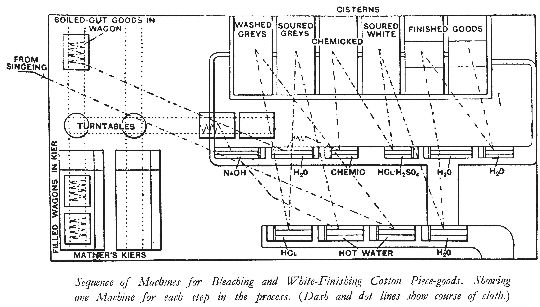
-
4 coloring process
Англо-русский словарь промышленной и научной лексики > coloring process
-
5 electrochromic process
электрохромный процесс (окрашивания и обесцвечивания, в том числе анодных оксидных плёнок при наложении напряжения); см. bleaching process; coloring processАнгло-русский словарь промышленной и научной лексики > electrochromic process
-
6 valkaisumenetelmä
• bleaching process -
7 процесс отбелки
Русско-английский словарь по деревообрабатывающей промышленности > процесс отбелки
-
8 процесс отбеливания
процесс отбеливания
—
[ http://www.eionet.europa.eu/gemet/alphabetic?langcode=en]EN
bleaching process
1) Removing colored components from a textile. Common bleaches are hydrogen peroxide, sodium hypochloride, and sodium chlorite. 2) The brightening and delignification of pulp by the addition of oxidizing chemicals such as chlorine or reducing chemicals such as sodium hypochloride. (Source: LEE)
[http://www.eionet.europa.eu/gemet/alphabetic?langcode=en]Тематики
EN
DE
FR
Русско-английский словарь нормативно-технической терминологии > процесс отбеливания
-
9 Tennant, Charles
[br]b. 3 May 1768 Ochiltree, Ayrshire, Scotlandd. 1 October 1838 Glasgow, Scotland[br]Scottish inventor of bleaching powder.[br]After education at the local school, Tennant went to Kilbachan to learn the manufacture of silk. He then went on to Wellmeadow, where he acquired a knowledge of the old bleaching process, which enabled him to establish his own bleachfield at Darnly. The process consisted of boiling the fabric in weak alkali and then laying it flat on the ground to expose it to sun and air for several months. This process, expensive in time and space, would have formed an intolerable bottleneck in the rapidly expanding textile industry, but a new method was on the way. The French chemist Berthollet demonstrated in 1786 the use of chlorine as a bleaching agent and James Watt learned of this while on a visit to Paris. On his return to Glasgow, Watt passed details of the new process on to Tennant, who set about devising his own version of it. First he obtained a bleaching liquor by passing chlorine through a stirred mixture of lime and water. He was granted a patent for this process in 1798, but it was promptly infringed by bleachers in Lancashire. Tennant's efforts to enforce the patent were unsuccessful as it was alleged that others had employed a similar process some years previously. Nevertheless, the Lancashire bleachers had the good grace to present Tennant with a service of plate in recognition of the benefits he had brought to the industry.In 1799 Tennant improved on his process by substituting dry slaked lime for the liquid, to form bleaching powder. This was patented the same year and proved to be a vital element in the advance of the textile industry. The following year, Tennant established his chemical plant at St Roll ox, outside Glasgow, to manufacture bleaching powder and alkali substances. The plant prospered and became for a time the largest chemical works in Europe.[br]Further ReadingL.F.Haber, 1958, The Chemical Industry During the Nineteenth Century, London: Oxford University Press.F.S.Taylor, 1957, A History of Industrial Chemistry, London: Heinemann.Walker, 1862, Memoirs of Distinguished Men of Science of Great Britain Living in 1807– 1808, London, p. 186.LRD -
10 отбеливание
2) Medicine: bleaching3) Engineering: bleach-out process, bleaching process, crofting (льняного полотна на солнце), refining, rehalogenization (фотографическое)4) Agriculture: decoloration, decoloring8) Polygraphy: etch-bleach9) Electronics: bleach process10) Seismology: whitening11) Drilling: decolorizing12) Automation: blanching (в кислоте)13) Makarov: blanching (напр. черешкового сельдерея окучиванием или загущением) -
11 Berthollet, Claude-Louis
SUBJECT AREA: Textiles[br]b. 9 November 1748 Talloise, near Lake Annecy, Franced. 6 November 1822 Arceuil, France[br]French chemist who made important innovations in textile chemistry.[br]Berthollet qualified as a medical doctor and pursued chemical researches, notably into "muriatic acid" (chlorine), then recently discovered by Scheele. He was one of the first chemists to embrace the new system of chemistry advanced by Lavoisier. Berthollet held several official appointments, among them inspector of dye works (from 1784) and Director of the Manufacture Nationale des Gobelins. These appointments enabled him to continue his researches and embark on a series of publications on the practical applications of chlorine, prussic acid (hydrocyanic acid) and ammonia. He clearly demonstrated the benefits of the French practice of appointing scientists to the state manufactories.There were two practical results of Berthollet's studies of chlorine. First, he produced a powerful explosive by substituting potassium chlorate, formed by the action of chlorine on potash, in place of nitre (potassium nitrate) in gunpowder. Then, mainly from humanitarian motives, he followed up Scheele's observation of the bleaching properties of chlorine water, in order to release for cultivation the considerable areas of land that had hitherto been required by the old bleaching process. The chlorine method greatly speeded up bleaching; this was a vital factor in the revolution in the textile industries.After a visit to Egypt in 1799, Berthollet carried out many experiments on dyeing, seeking to place this ancient craft onto a scientific basis. His work is summed up in his Eléments de l'art de la teinture, Paris, 1791.[br]Bibliography1791, Eléments de Van de la teinture, Paris (covers his work on dyeing).Berthollet published two books of importance in the early history of physical chemistry: 1801, Recherches sur les lois de l'affinité, Paris.1803, Essai de statique chimique, Paris.Annales de Chimie.Further ReadingE.F.Jomard, 1844, Notice sur la vie et les ouvrages de Claude-Louis Berthollet, Annecy.E.Farber, 1961, Great Chemists, New York: Interscience, pp. 32–4 (includes a short biographical account).LRDBiographical history of technology > Berthollet, Claude-Louis
-
12 процесс отбелки
1) Forestry: bleaching process2) Textile: bleaching -
13 Rot Steep
A bleaching process of steeping cotton fabrics in water to remove impurities before bleaching. -
14 проходной способ отбелки
Универсальный русско-английский словарь > проходной способ отбелки
-
15 способ отбеливания
Engineering: bleach-out process, bleaching processУниверсальный русско-английский словарь > способ отбеливания
-
16 комбинированная отбелка по способу це-эс
Универсальный русско-английский словарь > комбинированная отбелка по способу це-эс
-
17 комбинированная отбелка по способу Баттерворта
Универсальный русско-английский словарь > комбинированная отбелка по способу Баттерворта
-
18 комбинированная отбелка по способу Корте
Универсальный русско-английский словарь > комбинированная отбелка по способу Корте
-
19 комбинированная отбелка хлопчатобумажной ткани по способу Мора
Универсальный русско-английский словарь > комбинированная отбелка хлопчатобумажной ткани по способу Мора
-
20 однопроцессный проходной способ отбелки
Универсальный русско-английский словарь > однопроцессный проходной способ отбелки
См. также в других словарях:
Bleaching of wood pulp — is the chemical processing carried out on various types of wood pulp to decrease the color of the pulp, so that it becomes whiter. The main use of wood pulp is to make paper where whiteness (similar to but not exactly the same as brightness ) is… … Wikipedia
Bleaching — Bleach ing, n. The act or process of whitening, by removing color or stains; esp. the process of whitening fabrics by chemical agents. Ure. [1913 Webster] {Bleaching powder}, a powder for bleaching, consisting of chloride of lime, or some other… … The Collaborative International Dictionary of English
Bleaching powder — Bleaching Bleach ing, n. The act or process of whitening, by removing color or stains; esp. the process of whitening fabrics by chemical agents. Ure. [1913 Webster] {Bleaching powder}, a powder for bleaching, consisting of chloride of lime, or… … The Collaborative International Dictionary of English
bleaching — noun ( s) : the act or process of bleaching; especially : the process of improving the whiteness of a textile material by other means than scouring only … Useful english dictionary
Process — In anatomy, a process is a projection from a structure. The process of the mandible is the part of the lower jaw that projects forward. In a more general sense, a process is a series of actions or events that are part of a system or of a… … Medical dictionary
bleaching — noun the process of removing stains or of whitening fabrics, especially by the use of chemical agents … Wiktionary
bleaching — bleach·ing (blēchґing) the act or process of removing stains or color by chemical means … Medical dictionary
Kraft process — The Kraft process (also known as Kraft pulping or sulfate process) describes a technology for conversion of wood into wood pulp consisting of almost pure cellulose fibers. The process entails treatment of wood chips with a mixture of sodium… … Wikipedia
Tooth bleaching — Intervention Teeth Whitening Kits for Home Use MeSH … Wikipedia
Textile bleaching — is one of the stages in the manufacture of textiles. All raw textile materials, when they are in natural form, are known as greige material. This greige material will be with its natural color, odour and impurities that are not suitable for… … Wikipedia
Coral bleaching — Bleached branching Acropora sp. at Heron Island, Great Barrier Reef, in 2005 … Wikipedia
