

-
101 BOIG
BOIG, basic operational intelligence guideEnglish-Russian dictionary of planing, cross-planing and slotting machines > BOIG
-
102 Mind
It becomes, therefore, no inconsiderable part of science... to know the different operations of the mind, to separate them from each other, to class them under their proper heads, and to correct all that seeming disorder in which they lie involved when made the object of reflection and inquiry.... It cannot be doubted that the mind is endowed with several powers and faculties, that these powers are distinct from one another, and that what is really distinct to the immediate perception may be distinguished by reflection and, consequently, that there is a truth and falsehood which lie not beyond the compass of human understanding. (Hume, 1955, p. 22)Let us then suppose the mind to be, as we say, white Paper, void of all Characters, without any Ideas: How comes it to be furnished? Whence comes it by that vast store, which the busy and boundless Fancy of Man has painted on it, with an almost endless variety? Whence has it all the materials of Reason and Knowledge? To this I answer, in one word, from Experience. (Locke, quoted in Herrnstein & Boring, 1965, p. 584)The kind of logic in mythical thought is as rigorous as that of modern science, and... the difference lies, not in the quality of the intellectual process, but in the nature of things to which it is applied.... Man has always been thinking equally well; the improvement lies, not in an alleged progress of man's mind, but in the discovery of new areas to which it may apply its unchanged and unchanging powers. (Leґvi-Strauss, 1963, p. 230)MIND. A mysterious form of matter secreted by the brain. Its chief activity consists in the endeavor to ascertain its own nature, the futility of the attempt being due to the fact that it has nothing but itself to know itself with. (Bierce, quoted in Minsky, 1986, p. 55)[Philosophy] understands the foundations of knowledge and it finds these foundations in a study of man-as-knower, of the "mental processes" or the "activity of representation" which make knowledge possible. To know is to represent accurately what is outside the mind, so to understand the possibility and nature of knowledge is to understand the way in which the mind is able to construct such representation.... We owe the notion of a "theory of knowledge" based on an understanding of "mental processes" to the seventeenth century, and especially to Locke. We owe the notion of "the mind" as a separate entity in which "processes" occur to the same period, and especially to Descartes. We owe the notion of philosophy as a tribunal of pure reason, upholding or denying the claims of the rest of culture, to the eighteenth century and especially to Kant, but this Kantian notion presupposed general assent to Lockean notions of mental processes and Cartesian notions of mental substance. (Rorty, 1979, pp. 3-4)Under pressure from the computer, the question of mind in relation to machine is becoming a central cultural preoccupation. It is becoming for us what sex was to Victorians-threat, obsession, taboo, and fascination. (Turkle, 1984, p. 313)7) Understanding the Mind Remains as Resistant to Neurological as to Cognitive AnalysesRecent years have been exciting for researchers in the brain and cognitive sciences. Both fields have flourished, each spurred on by methodological and conceptual developments, and although understanding the mechanisms of mind is an objective shared by many workers in these areas, their theories and approaches to the problem are vastly different....Early experimental psychologists, such as Wundt and James, were as interested in and knowledgeable about the anatomy and physiology of the nervous system as about the young science of the mind. However, the experimental study of mental processes was short-lived, being eclipsed by the rise of behaviorism early in this century. It was not until the late 1950s that the signs of a new mentalism first appeared in scattered writings of linguists, philosophers, computer enthusiasts, and psychologists.In this new incarnation, the science of mind had a specific mission: to challenge and replace behaviorism. In the meantime, brain science had in many ways become allied with a behaviorist approach.... While behaviorism sought to reduce the mind to statements about bodily action, brain science seeks to explain the mind in terms of physiochemical events occurring in the nervous system. These approaches contrast with contemporary cognitive science, which tries to understand the mind as it is, without any reduction, a view sometimes described as functionalism.The cognitive revolution is now in place. Cognition is the subject of contemporary psychology. This was achieved with little or no talk of neurons, action potentials, and neurotransmitters. Similarly, neuroscience has risen to an esteemed position among the biological sciences without much talk of cognitive processes. Do the fields need each other?... [Y]es because the problem of understanding the mind, unlike the wouldbe problem solvers, respects no disciplinary boundaries. It remains as resistant to neurological as to cognitive analyses. (LeDoux & Hirst, 1986, pp. 1-2)Since the Second World War scientists from different disciplines have turned to the study of the human mind. Computer scientists have tried to emulate its capacity for visual perception. Linguists have struggled with the puzzle of how children acquire language. Ethologists have sought the innate roots of social behaviour. Neurophysiologists have begun to relate the function of nerve cells to complex perceptual and motor processes. Neurologists and neuropsychologists have used the pattern of competence and incompetence of their brain-damaged patients to elucidate the normal workings of the brain. Anthropologists have examined the conceptual structure of cultural practices to advance hypotheses about the basic principles of the mind. These days one meets engineers who work on speech perception, biologists who investigate the mental representation of spatial relations, and physicists who want to understand consciousness. And, of course, psychologists continue to study perception, memory, thought and action.... [W]orkers in many disciplines have converged on a number of central problems and explanatory ideas. They have realized that no single approach is likely to unravel the workings of the mind: it will not give up its secrets to psychology alone; nor is any other isolated discipline-artificial intelligence, linguistics, anthropology, neurophysiology, philosophy-going to have any greater success. (Johnson-Laird, 1988, p. 7)Historical dictionary of quotations in cognitive science > Mind
-
103 switchboard
- распределительный щит
- распределительное устройство
- НКУ распределения и управления
- коммутационный щит
- коммутаторная панель
- коммутатор
коммутатор
Устройство, обеспечивающее посредством включения, отключения и переключения электрических цепей выбор требуемой выходной цепи и соединение с ней входной цепи
[Терминологический словарь по строительству на 12 языках (ВНИИИС Госстроя СССР)]Тематики
- аппарат, изделие, устройство...
EN
DE
FR
коммутаторная панель
распределительный щит
Устройство, конструктивно объединяющее несколько коммутационных элементов, предназначенных для включения, отключения и переключения электрических цепей и каналов связи в ручном режиме.
[Л.М. Невдяев. Телекоммуникационные технологии. Англо-русский толковый словарь-справочник. Под редакцией Ю.М. Горностаева. Москва, 2002]Тематики
- электросвязь, основные понятия
Синонимы
EN
коммутационный щит
—
[Я.Н.Лугинский, М.С.Фези-Жилинская, Ю.С.Кабиров. Англо-русский словарь по электротехнике и электроэнергетике, Москва, 1999 г.]Тематики
- электротехника, основные понятия
EN
низковольтное устройство распределения и управления (НКУ)
Низковольтные коммутационные аппараты и устройства управления, измерения, сигнализации, защиты, регулирования, собранные совместно, со всеми внутренними электрическими и механическими соединениями и конструктивными элементами.
[ ГОСТ Р МЭК 61439-1-2012]
низковольтное устройство распределения и управления
Комбинация низковольтных коммутационных аппаратов с устройствами управления, измерения, сигнализации, защиты, регулирования и т. п., полностью смонтированных изготовителем НКУ (под его ответственность на единой конструктивной основе) со всеми внутренними электрическими и механическими соединениями с соответствующими конструктивными элементами
Примечания
1. В настоящем стандарте сокращение НКУ используют для обозначения низковольтных комплектных устройств распределения и управления.
2. Аппараты, входящие в состав НКУ, могут быть электромеханическими или электронными.
3. По различным причинам, например по условиям транспортирования или изготовления, некоторые операции сборки могут быть выполнены на месте установки, вне предприятия-изготовителя.
[ ГОСТ Р 51321. 1-2000 ( МЭК 60439-1-92)]EN
power switchgear and controlgear assembly (PSC-assembly)
low-voltage switchgear and controlgear assembly used to distribute and control energy for all types of loads, intended for industrial, commercial and similar applications where operation by ordinary persons is not intended
[IEC 61439-2, ed. 1.0 (2009-01)]
low-voltage switchgear and controlgear assembly
combination of one or more low-voltage switching devices together with associated control, measuring, signalling, protective, regulation equipment, etc., completely assembled under the responsibility of the manufacturer with all the internal electrical and mechanical interconnections and structural parts.
[IEC 61892-3, ed. 2.0 (2007-11)]
switchgear and controlgear
a general term covering switching devices and their combination with associated control, measuring, protective and regulating equipment, also assemblies of such devices and equipment with associated interconnections, accessories, enclosures and supporting structures
[IEV number 441-11-01]
switchgear and controlgear
electric equipment intended to be connected to an electric circuit for the purpose of carrying out one or more of the following functions: protection, control, isolation, switching
NOTE – The French and English terms can be considered as equivalent in most cases. However, the French term has a broader meaning than the English term and includes for example connecting devices, plugs and socket-outlets, etc. In English, these latter devices are known as accessories.
[IEV number 826-16-03 ]
switchboard
A large single electric control panel, frame, or assembly of panels on which are mounted (either on the back or on the face, or both) switches, overcurrent and other protective devices, buses, and usually instruments; not intended for installation in a cabinet but may be completely enclosed in metal; usually is accessible from both the front and rear.
[ McGraw-Hill Dictionary of Architecture & Construction]
switchboard
One or more panels accommodating control switches, indicators, and other apparatus for operating electric circuits
[ The American Heritage Dictionary of the English Language]FR
ensemble d'appareillage de puissance (ensemble PSC)
ensemble d'appareillage à basse tension utilisé pour répartir et commander l'énergie pour tous les types de charges et prévu pour des applications industrielles, commerciales et analogues dans lesquelles l'exploitation par des personnes ordinaires n'est pas prévue
[IEC 61439-2, ed. 1.0 (2009-01)]
appareillage, m
matériel électrique destiné à être relié à un circuit électrique en vue d'assurer une ou plusieurs des fonctions suivantes: protection, commande, sectionnement, connexion
NOTE – Les termes français et anglais peuvent être considérés comme équivalents dans la plupart des cas. Toutefois, le terme français couvre un domaine plus étendu que le terme anglais, et comprend notamment les dispositifs de connexion, les prises de courant, etc. En anglais, ces derniers sont dénommés "accessories".
[IEV number 826-16-03 ]
appareillage
terme général applicable aux appareils de connexion et à leur combinaison avec des appareils de commande, de mesure, de protection et de réglage qui leur sont associés, ainsi qu'aux ensembles de tels appareils avec les connexions, les accessoires, les enveloppes et les charpentes correspondantes
[IEV number 441-11-01]
A switchboard as defined in the National Electrical Code is a large single panel, frame, or assembly of panels on which are mounted, on the face or back or both switches, overcurrent and other protective devices, buses, and, usually, instruments.
Switchboards are generally accessible from the rear as well as from the front and are not intended to be installed in cabinets.
The types of switchboards, classified by basic features of construction, are as follows:
1. Live-front vertical panels
2. Dead-front boards
3. Safety enclosed boards( metal-clad)
[American electricians’ handbook]
The switchboard plays an essential role in the availability of electric power, while meeting the needs of personal and property safety.
Its definition, design and installation are based on precise rules; there is no place for improvisation.
The IEC 61439 standard aims to better define " low-voltage switchgear and controlgear assemblies", ensuring that the specified performances are reached.
It specifies in particular:
> the responsibilities of each player, distinguishing those of the original equipment manufacturer - the organization that performed the original design and associated verification of an assembly in accordance with the standard, and of the assembly manufacturer - the organization taking responsibility for the finished assembly;
> the design and verification rules, constituting a benchmark for product certification.
All the component parts of the electrical switchboard are concerned by the IEC 61439 standard.
Equipment produced in accordance with the requirements of this switchboard standard ensures the safety and reliability of the installation.
A switchboard must comply with the requirements of standard IEC 61439-1 and 2 to guarantee the safety and reliability of the installation.
Managers of installations, fully aware of the professional and legal liabilities weighing on their company and on themselves, demand a high level of safety for the electrical installation.
What is more, the serious economic consequences of prolonged halts in production mean that the electrical switchboard must provide excellent continuity of service, whatever the operating conditions.
[Schneider Electric]НКУ играет главную роль в обеспечении электроэнергией, удовлетворяя при этом всем требованиям по безопасности людей и сохранности имущества.
Выбор конструкции, проектирование и монтаж основаны на чётких правилах, не допускающих никакой импровизации.
Требования к низковольтным комплектным устройствам распределения и управления сформулированы в стандарте МЭК 61439 (ГОСТ Р 51321. 1-2000).
В частности, он определяет:
> распределение ответственности между изготовителем НКУ - организацией, разработавшей конструкцию НКУ и проверившей его на соответствие требованиям стандарта, и сборщиком – организацией, выполнившей сборку НКУ;
> конструкцию, технические характеристики, виды и методы испытаний НКУ.
В стандарте МЭК 61439 (ГОСТ Р 51321. 1-2000) описываются все компоненты НКУ.
Оборудование, изготовленное в соответствии с требованиями этого стандарта, обеспечивает безопасность и надежность электроустановки.
Для того чтобы гарантировать безопасность эксплуатации и надежность работы электроустановки, распределительный щит должен соответствовать требованиям стандарта МЭК 61439-1 и 2.
Лица, ответственные за электроустановки, должны быть полностью осведомлены о профессиональной и юридической ответственности, возложенной на их компанию и на них лично, за обеспечение высокого уровня безопасности эксплуатации этих электроустановок.
Кроме того, поскольку длительные перерывы производства приводят к серьезным экономическим последствиям, электрический распределительный щит должен обеспечивать надежную и бесперебойную работу независимо от условий эксплуатации.
[Перевод Интент]LV switchgear assemblies are undoubtedly the components of the electric installation more subject to the direct intervention of personnel (operations, maintenance, etc.) and for this reason users demand from them higher and higher safety requirements.
The compliance of an assembly with the state of the art and therefore, presumptively, with the relevant technical Standard, cannot be based only on the fact that the components which constitute it comply with the state of the art and therefore, at least presumptively, with the relevant technical standards.
In other words, the whole assembly must be designed, built and tested in compliance with the state of the art.
Since the assemblies under consideration are low voltage equipment, their rated voltage shall not exceed 1000 Va.c. or 1500 Vd.c. As regards currents, neither upper nor lower limits are provided in the application field of this Standard.
The Standard IEC 60439-1 states the construction, safety and maintenance requirements for low voltage switchgear and controlgear assemblies, without dealing with the functional aspects which remain a competence of the designer of the plant for which the assembly is intended.
[ABB]Низковольтные комплектные устройства (НКУ), вне всякого сомнения, являются частями электроустановок, которые наиболее подвержены непосредственному вмешательству оперативного, обслуживающего и т. п. персонала. Вот почему требования потребителей к безопасности НКУ становятся все выше и выше.
Соответствие НКУ современному положению дел и вследствие этого, гипотетически, соответствующим техническим стандартам, не может основываться только на том факте, что составляющие НКУ компоненты соответствуют современному состоянию дел и поэтому, по крайней мере, гипотетически, - соответствующим техническим стандартам
Другими словами, НКУ должно быть разработано, изготовлено и испытано в соответствии с современными требованиями.
Мы рассматриваем низковольтные комплектные устройства и это означает, что их номинальное напряжение не превышает 1000 В переменного тока или 1500 В постоянного тока. Что касается тока, то ни верхнее, ни нижнее значение стандартами, относящимися к данной области, не оговариваются
Стандарт МЭК 60439-1 устанавливает требования к конструкции, безопасности и техническому обслуживанию низковольтных комплектных устройств без учета их функций, полагая, что функции НКУ являются компетенцией проектировщиков электроустановки, частью которых эти НКУ являются.
[Перевод Интент]Тематики
- НКУ (шкафы, пульты,...)
Классификация
>>>Действия
Синонимы
Сопутствующие термины
EN
- assembly
- electrical switchboard
- low voltage controlgear and assembly
- low voltage switchboard
- low voltage switchgear and controlgear assembly
- low-voltage switchgear and controlgear assembly
- LV switchgear and controlgear assembly
- LV switchgear assembly
- panel
- power switchgear and controlgear assembly
- PSC-assembly
- switchboard
- switchgear and controlgear
- switchgear/controlgear
DE
- Schaltanlagen und/oder Schaltgeräte
FR
распределительное устройство
Распределительным устройством (РУ) называется электроустановка, служащая для приема и распределения электроэнергии и содержащая сборные и соединительные шины, коммутационные аппараты, вспомогательные устройства (компрессорные, аккумуляторные и др.), а также устройства защиты, автоматики и измерительные приборы.
[РД 34.20.185-94]
распределительное устройство
Электроустановка, предназначенная для приема и распределения электрической энергии на одном напряжении и содержащая коммутационные аппараты и соединяющие их сборные шины [секции шин], устройства управления и защиты.
Примечание. К устройствам управления относятся аппараты и связывающие их элементы обеспечивающие контроль, измерение, сигнализацию и выполнение команд.
[ ГОСТ 24291-90]
[ ГОСТ Р 53685-2009]
электрическое распределительное устройство
распределительное устройство
Устройство, предназначенное для приема и распределения электроэнергии на одном напряжении и содержащее коммутационные аппараты и соединяющие их сборные соединительные устройства.
Примечание. В состав распределительного устройства дополнительно могут входить устройства защиты и управления
[ОСТ 45.55-99]
распределительное устройство
Электроустановка, служащая для приема и распределения электроэнергии и содержащая коммутационные аппараты, сборные и соединительные шины, вспомогательные устройства (компрессорные, аккумуляторные и др.), а также устройства защиты, автоматики и измерительные приборы.
[ПОТ Р М-016-2001]
[РД 153-34.0-03.150-00]
устройство распределительное
Совокупность аппаратов и приборов для приёма и распределения электроэнергии одного напряжения, вырабатываемой электростанцией или преобразуемой подстанцией
[Терминологический словарь по строительству на 12 языках (ВНИИИС Госстроя СССР)]EN
switching substation
a substation which includes switchgear and usually busbars, but no power transformers
[IEV number 605-01-02]FR
poste de sectionnement
poste de coupure
poste comprenant des organes de manoeuvre et généralement des jeux de barres, à l'exclusion de transformateurs de puissance
[IEV number 605-01-02]В качестве РУ 6—10 кВ используется сборка высокого напряжения с однополюсными разъединителями и вертикальным расположением фаз одного присоединения и одна камера КСО с выключателем нагрузки и предохранителями для подключения трансформатора. Для РУ 0,4 кВ применяются сборки низкого напряжения с предохранителями и вертикальным расположением фаз одного присоединения.
На ПС применяются открытые (ОРУ), закрытые (ЗРУ) или комплектные (КРУ) распределительные устройства.
[ http://energy-ua.com/elektricheskie-p/klassifikatsiya.html]
В общем случае ПС и РУ являются составной частью электроустановок, которые различаются:
-
по назначению:
- генерирующие,
- преобразовательно-распределительные,
-
потребительские.
Генерирующие электроустановки служат для выработки электроэнергии, преобразовательно-распределительные электроустановки преобразуют электроэнергию в удобный для передачи и потребления вид, передают ее и распределяют между потребителями;
-
по роду тока:
- постоянного тока,
- переменного тока.
-
по напряжению:
- до 1000 В,
- выше 1000 В.
Шкала номинальных напряжений ограничена сравнительно небольшим числом стандартных значений, благодаря чему изготавливается небольшое число типоразмеров машин и оборудования, а электросети выполняются более экономичными. В установках трехфазного тока номинальным напряжением принято считать напряжение между фазами (междуфазовое напряжение). Согласно ГОСТ 29322—92 установлена следующая шкала номинальных напряжений:
для электросетей переменного тока частотой 50 Гц междуфазовое напряжение должно быть: 12, 24, 36, 42, 127, 220, 380 В; 3, 6, 10, 20, 35, 110, 150, 220, 330, 500, 750 и 1150 кВ;
для электросетей постоянного тока: 12, 24, 36, 48, 60, 110, 220, 440, 660, 825, 3000 В и выше.-
по способу присоединения к электросети ПС разделяются на:
- тупиковые (блочные),
- ответвительные (блочные),
- проходные (транзитные)
- узловые.
Тупиковые ПС получают питание по одной или двум тупиковым ВЛ.
Ответвительные ПС присоединяются ответвлением к одной или двум проходящим ВЛ с односторонним или двухсторонним питанием.
Проходные ПС включаются в рассечку одной или двух проходящих ВЛ с односторонним или двухсторонним питанием.
Узловые ПС кроме питающих имеют отходящие радиальные или транзитные ВЛ.-
по способу управления ПС могут быть:
- только с телесигнализацией,
- телеуправляемыми с телесигнализацией,
- с телесигнализацией и управлением с общеподстанционного пункта управления (ОПУ).
Подстанции оперативно обслуживаются постоянным дежурным персоналом на щите управления, дежурными на дому или оперативно-выездными бригадами (ОВБ). Ремонт ПС осуществляется специализированными выездными бригадами централизованного ремонта или местным персоналом подстанции.
В РУ напряжением до 1000 В провода, шины, аппараты, приборы и конструкции выбирают как по нормальным условиям работы (напряжению и току), так и по термическим и динамическим воздействиям токов коротких замыканий (КЗ) или предельно допустимой отключаемой мощности.
В РУ и ПС напряжением выше 1000 В расстояния между электрооборудованием, аппаратами, токоведущими частями, изоляторами, ограждениями и конструкциями устанавливаются так, чтобы при нормальном режиме работы электроустановки возникающие физические явления (температура нагрева, электрическая дуга, выброс газов, искрение и др.) не могли привести к повреждению оборудования и КЗ.[ http://energy-ua.com/elektricheskie-p/klassifikatsiya.html]
Several different classifications of switchgear can be made:- By the current rating.
-
By interrupting rating (maximum short circuit current that the device can safely interrupt)
- Circuit breakers can open and close on fault currents
- Load-break/Load-make switches can switch normal system load currents
- Isolators may only be operated while the circuit is dead, or the load current is very small.
-
By voltage class:
- Low voltage (less than 1,000 volts AC)
- Medium voltage (1,000–35,000 volts AC)
- High voltage (more than 35,000 volts AC)
-
By insulating medium:
-
By construction type:
- Indoor (further classified by IP (Ingress Protection) class or NEMA enclosure type)
- Outdoor
- Industrial
- Utility
- Marine
- Draw-out elements (removable without many tools)
- Fixed elements (bolted fasteners)
- Live-front
- Dead-front
- Open
- Metal-enclosed
- Metal-clad
- Metal enclosed & Metal clad
- Arc-resistant
-
By IEC degree of internal separation
- No Separation (Form 1)
- Busbars separated from functional units (Form 2a, 2b, 3a, 3b, 4a, 4b)
- Terminals for external conductors separated from busbars (Form 2b, 3b, 4a, 4b)
- Terminals for external conductors separated from functional units but not from each other (Form 3a, 3b)
- Functional units separated from each other (Form 3a, 3b, 4a, 4b)
- Terminals for external conductors separated from each other (Form 4a, 4b)
- Terminals for external conductors separate from their associated functional unit (Form 4b)
-
By interrupting device:
-
By operating method:
- Manually operated
- Motor/stored energy operated
- Solenoid operated
-
By type of current:
-
By application:
-
By purpose
- Isolating switches (disconnectors)
- Load-break switches.
- Grounding (earthing) switches
A single line-up may incorporate several different types of devices, for example, air-insulated bus, vacuum circuit breakers, and manually operated switches may all exist in the same row of cubicles.
Ratings, design, specifications and details of switchgear are set by a multitude of standards. In North America mostly IEEE and ANSI standards are used, much of the rest of the world uses IEC standards, sometimes with local national derivatives or variations.
[Robert W. Smeaton (ed) Switchgear and Control Handbook 3rd Ed., Mc Graw Hill, new York 1997]
[ http://en.wikipedia.org/wiki/High_voltage_switchgear]Тематики
- электрификация, электроснабж. железных дорог
- электроагрегаты генераторные
- электробезопасность
- электроснабжение в целом
Синонимы
EN
- distribution
- energy distribution board
- gear
- switch-gear
- switchboard
- switchgear
- switching substation
- switchyard
DE
FR
распределительный щит
Комплектное устройство, содержащее различную коммутационную аппаратуру, соединенное с одной или более отходящими электрическими цепями, питающееся от одной или более входящих цепей, вместе с зажимами для присоединения нейтральных и защитных проводников.
[ ГОСТ Р МЭК 60050-826-2009]
щит распределительный
Электротехническое устройство, объединяющее коммутационную, регулирующую и защитную аппаратуру, а также контрольно-измерительные и сигнальные приборы
[Терминологический словарь по строительству на 12 языках (ВНИИИС Госстроя СССР)]
распределительный щит
—
[А.С.Гольдберг. Англо-русский энергетический словарь. 2006 г.]EN
distribution board
assembly containing different types of switchgear and controlgear associated with one or more outgoing electric circuits fed from one or more incoming electric circuits, together with terminals for the neutral and protective conductors.
[IEV number 826-16-08]FR
tableau de répartition, m
ensemble comportant différents types d'appareillage associés à un ou plusieurs circuits électriques de départ alimentés par un ou plusieurs circuits électriques d'arrivée, ainsi que des bornes pour les conducteurs neutre et de protection.
[IEV number 826-16-08]Distribution switchboards, including the Main LV Switchboard (MLVS), are critical to the dependability of an electrical installation. They must comply with well-defined standards governing the design and construction of LV switchgear assemblies
A distribution switchboard is the point at which an incoming-power supply divides into separate circuits, each of which is controlled and protected by the fuses or switchgear of the switchboard. A distribution switchboard is divided into a number of functional units, each comprising all the electrical and mechanical elements that contribute to the fulfilment of a given function. It represents a key link in the dependability chain.
Consequently, the type of distribution switchboard must be perfectly adapted to its application. Its design and construction must comply with applicable standards and working practises.
[Schneider Electric]Распределительные щиты, включая главный распределительный щит низкого напряжения (ГРЩ), играют решающую роль в обеспечении надежности электроустановки. Они должны отвечать требованиям соответствующих стандартов, определяющих конструкцию и порядок изготовления НКУ распределения электроэнергии.
В распределительном щите выполняется прием электроэнергии и ее распределение по отдельным цепям, каждая из которых контролируется и защищается плавкими предохранителями или автоматическими выключателями.
Распределительный щит состоит из функциональных блоков, включающих в себя все электрические и механические элементы, необходимые для выполнения требуемой функции. Распределительный щит представляет собой ключевое звено в цепи обеспечения надежности.
Тип распределительного щита должен соответствовать области применения. Конструкция и изготовление распределительного щита должны удовлетворять требованиям применимых стандартов и учитывать накопленную практику применения.
[Перевод Интент]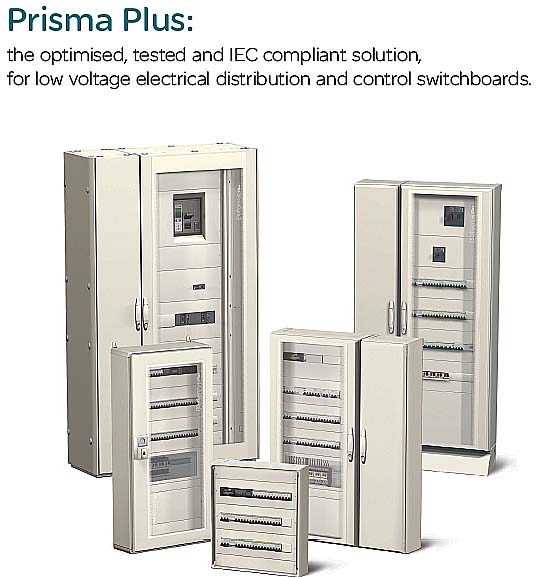
Рис. Schneider Electric
With Prisma Plus G you can be sure to build 100% Schneider Electric switchboards that are safe, optimised:
> All components (switchgear, distribution blocks, prefabricated connections, etc.) are perfectly rated and coordinated to work together;
> All switchboard configurations, even the most demanding ones, have been tested.
You can prove that your switchboard meets the current standards, at any time.
You can be sure to build a reliable electrical installation and give your customers full satisfaction in terms of dependability and safety for people and the installation.
Prisma Plus G with its discreet design, blends harmoniously into all tertiary and industrial buildings, including in entrance halls and passageways.
With Prisma Plus G you can build just the right switchboard for your customer, sized precisely to fit costs and needs.
With this complete, prefabricated and tested system, it's easy to upgrade your installation and still maintain the performance levels.
> The wall-mounted and floor-standing enclosures combine easily with switchboards already in service.
> Devices can be replaced or added at any time.
[Schneider Electric]С помощью оболочек Prisma Plus G можно создавать безопасные распределительные щиты, на 100 % состоящие из изделий Schneider Electric:
> все изделия (коммутационная аппаратура, распределительные блоки, готовые заводские соединения и т. д.) полностью совместимы механически и электрически;
> все варианты компоновки распределительных щитов, в том числе для наиболее ответственных применений, прошли испытания.В любое время вы можете доказать, что ваши распределительные щиты полностью соответствуют требованиям действующих стандартов.
Вы можете быть полностью уверены в том, что создаете надежные электроустановки, удовлетворяющие всем требованиям безопасности для людей и оборудования
Благодаря строгому дизайну, распределительные щиты Prisma Plus G гармонично сочетаются с интерьером любого общественного или промышленного здания. Они хорошо смотрятся и в вестибюле, и в коридоре.
Применяя оболочки Prisma Plus G можно создавать распределительные щиты, точно соответствующие требованиям заказчика как с точки зрения технических характеристик, так и стоимости.
С помощью данной испытанной системы, содержащей все необходимые компоненты заводского изготовления можно легко модернизировать существующую электроустановку и поддерживать её уровни производительности.> Навесные и напольные оболочки можно легко присоединить к уже эксплуатируемым распределительным щитам.
> Аппаратуру можно заменять или добавлять в любое время.
[Перевод Интент]The switchboard, central to the electrical installation.
Both the point of arrival of energy and a device for distribution to the site applications, the LV switchboard is the intelligence of the system, central to the electrical installation.
[Schneider Electric]Распределительный щит – «сердце» электроустановки.
Низковольтное комплектное устройство распределения является «сердцем» электроустановки, поскольку именно оно принимает электроэнергию из сети и распределяет её по территориально распределенным нагрузкам.
[Перевод Интент]Тематики
- НКУ (шкафы, пульты,...)
- электроснабжение в целом
EN
- branch distribution panel
- distributing board
- distributing panel
- distributing switchboard
- distribution bench
- distribution board
- distribution panel
- distribution switchboard
- gear
- keyboard
- PNL
- SB
- sw & d
- switchboard
- switchboard panel
DE
- elektrischer Verteiler, m
- Schalttafel
- Verteiler, m
FR
- tableau de distribution
- tableau de répartition, m
Англо-русский словарь нормативно-технической терминологии > switchboard
См. также в других словарях:
basic intelligence — pagrindinė žvalgybos informacija statusas T sritis Gynyba apibrėžtis Žvalgybos informacija, kuri gali būti naudojama kaip nurodomoji (bazinė) medžiaga planuojant arba kaip pagrindas vėlesniam informacijos apdorojimui. atitikmenys: angl. basic… … NATO terminų aiškinamasis žodynas
basic intelligence — Fundamental intelligence concerning the general situation, resources, capabilities, and vulnerabilities of foreign countries or areas which may be used as reference material in the planning of operations at any level and in evaluating subsequent… … Military dictionary
Intelligence dissemination management — This article is part of a series on intelligence cycle management, and deals with the dissemination of processed intelligence. For a hierarchical list of articles, see the intelligence cycle management hierarchy. It is a classic maxim of… … Wikipedia
Intelligence analysis management — This article deals with the roles of processing/analysis in the real world intelligence cycle as a part of intelligence cycle management. See Intelligence analysis for a discussion of the techniques of analysis. For a hierarchical list of… … Wikipedia
Intelligence cycle management — This article is at the top level of a series of articles about Intelligence Cycle Management.Within the context of government, military and business affairs, intelligence (the gathering and analysis of accurate, reliable information) is intended… … Wikipedia
Intelligence analysis — This article deals with the intellectual process of analysis itself, as opposed to intelligence analysis management, which, in turn, is a subcomponent of intelligence cycle management. For a complete hierarchical list of articles in this series,… … Wikipedia
intelligence — 1. The product resulting from the collection, processing, integration, analysis, evaluation, and interpretation of available information concerning foreign countries or areas. 2. Information and knowledge about an adversary obtained through… … Military dictionary
Intelligence collection management — is the process of managing and organizing the collection of intelligence information from various sources. The collection department of an intelligence organization may attempt basic validation of that which it collects, but is not intended to… … Wikipedia
Basic writing — Basic writing, or developmental writing, is a discipline of composition studies which focuses on the writing of students sometimes otherwise called remedial or underprepared , usually freshman college students. Contents 1 Defining Basic Writing 2 … Wikipedia
BaSIC — Role Playing Cet article fait partie de la série Jeu de rôle Jeux : Liste par genre • Catégories par genre • Liste alphabétique • Autres : Éditeurs • Magazines … Wikipédia en Français
Basic Role-Playing — (« jeu de rôle basique » en anglais), ou BRP, est le nom donné au système de jeu de rôle qu utilise l éditeur Chaosium pour ses jeux de rôles, en référence au nom du livret qui en définissait les principes, publié pour la première fois… … Wikipédia en Français
