

-
81 essential
A n ( object) objet m indispensable ; (quality, element) qualité f essentielle ; I packed a few essentials j'ai emballé quelques objets indispensables ; food and other essentials de la nourriture et d'autres articles indispensables ; a car is not an essential une auto n'est pas indispensable ; there are two essentials in comedy il y a deux éléments essentiels dans la comédie ; money is an essential l'argent est un élément essentiel.C adj1 ( vital) [services] de base ; [role] essentiel/-ielle ; [ingredient] indispensable ; essential goods produits de première nécessité ; essential maintenance work les travaux d'entretien indispensables ; it is essential to do il est indispensable de faire ; it is essential that il est indispensable que (+ subj) ; to be essential for sth être indispensable à qch ; it is essential for us to agree il est indispensable que nous soyons d'accord ;2 ( basic) [feature, element] essentiel/-ielle ; [difference] fondamental ; [reading] indispensable ; humanity's essential goodness la bonté intrinsèque de l'humanité ; his essential humility son humilité intrinsèque. -
82 fundamental
fundamental [‚fʌndə'mentəl](a) (basic → concept, rule, principle) fondamental, de base; (→ difference, quality) fondamental, essentiel; (→ change, mistake) fondamental;∎ a knowledge of economics is fundamental to a proper understanding of this problem il est essentiel ou fondamental d'avoir des connaissances en économie pour bien comprendre ce problème;∎ fundamental research recherche f fondamentale∎ it's of fundamental importance c'est d'une importance capitale2 noun(a) (usu pl) the fundamentals of chemistry les principes mpl de base de la chimie;∎ when it comes to the fundamentals quand on en vient à l'essentiel►► Physics fundamental particle particule f élémentaire;Physics fundamental unit unité f fondamentaleUn panorama unique de l'anglais et du français > fundamental
-
83 margin
1. Fin, Gen Mgtthe difference between the cost and the selling price of a product or service2. (ANZ) HRa payment made to workers over and above the basic wage in recognition of special skills -
84 Carnot, Nicolas Léonard Sadi
SUBJECT AREA: Steam and internal combustion engines[br]b. 1 June 1796 Paris, Franced. 24 August 1831 Paris, France[br]French laid the foundations for modern thermodynamics through his book Réflexions sur la puissance motrice du feu when he stated that the efficiency of an engine depended on the working substance and the temperature drop between the incoming and outgoing steam.[br]Sadi was the eldest son of Lazare Carnot, who was prominent as one of Napoleon's military and civil advisers. Sadi was born in the Palais du Petit Luxembourg and grew up during the Napoleonic wars. He was tutored by his father until in 1812, at the minimum age of 16, he entered the Ecole Polytechnique to study stress analysis, mechanics, descriptive geometry and chemistry. He organized the students to fight against the allies at Vincennes in 1814. He left the Polytechnique that October and went to the Ecole du Génie at Metz as a student second lieutenant. While there, he wrote several scientific papers, but on the Restoration in 1815 he was regarded with suspicion because of the support his father had given Napoleon. In 1816, on completion of his studies, Sadi became a second lieutenant in the Metz engineering regiment and spent his time in garrison duty, drawing up plans of fortifications. He seized the chance to escape from this dull routine in 1819 through an appointment to the army general staff corps in Paris, where he took leave of absence on half pay and began further courses of study at the Sorbonne, Collège de France, Ecole des Mines and the Conservatoire des Arts et Métiers. He was inter-ested in industrial development, political economy, tax reform and the fine arts.It was not until 1821 that he began to concentrate on the steam-engine, and he soon proposed his early form of the Carnot cycle. He sought to find a general solution to cover all types of steam-engine, and reduced their operation to three basic stages: an isothermal expansion as the steam entered the cylinder; an adiabatic expansion; and an isothermal compression in the condenser. In 1824 he published his Réflexions sur la puissance motrice du feu, which was well received at the time but quickly forgotten. In it he accepted the caloric theory of heat but pointed out the impossibility of perpetual motion. His main contribution to a correct understanding of a heat engine, however, lay in his suggestion that power can be produced only where there exists a temperature difference due "not to an actual consumption of caloric but to its transportation from a warm body to a cold body". He used the analogy of a water-wheel with the water falling around its circumference. He proposed the true Carnot cycle with the addition of a final adiabatic compression in which motive power was con sumed to heat the gas to its original incoming temperature and so closed the cycle. He realized the importance of beginning with the temperature of the fire and not the steam in the boiler. These ideas were not taken up in the study of thermodynartiics until after Sadi's death when B.P.E.Clapeyron discovered his book in 1834.In 1824 Sadi was recalled to military service as a staff captain, but he resigned in 1828 to devote his time to physics and economics. He continued his work on steam-engines and began to develop a kinetic theory of heat. In 1831 he was investigating the physical properties of gases and vapours, especially the relationship between temperature and pressure. In June 1832 he contracted scarlet fever, which was followed by "brain fever". He made a partial recovery, but that August he fell victim to a cholera epidemic to which he quickly succumbed.[br]Bibliography1824, Réflexions sur la puissance motrice du feu; pub. 1960, trans. R.H.Thurston, New York: Dover Publications; pub. 1978, trans. Robert Fox, Paris (full biographical accounts are provided in the introductions of the translated editions).Further ReadingDictionary of Scientific Biography, 1971, Vol. III, New York: C.Scribner's Sons. T.I.Williams (ed.), 1969, A Biographical Dictionary of Scientists, London: A. \& C.Black.Chambers Concise Dictionary of Scientists, 1989, Cambridge.D.S.L.Cardwell, 1971, from Watt to Clausius. The Rise of Thermodynamics in the Early Industrial Age, London: Heinemann (discusses Carnot's theories of heat).RLHBiographical history of technology > Carnot, Nicolas Léonard Sadi
-
85 Artificial Intelligence
In my opinion, none of [these programs] does even remote justice to the complexity of human mental processes. Unlike men, "artificially intelligent" programs tend to be single minded, undistractable, and unemotional. (Neisser, 1967, p. 9)Future progress in [artificial intelligence] will depend on the development of both practical and theoretical knowledge.... As regards theoretical knowledge, some have sought a unified theory of artificial intelligence. My view is that artificial intelligence is (or soon will be) an engineering discipline since its primary goal is to build things. (Nilsson, 1971, pp. vii-viii)Most workers in AI [artificial intelligence] research and in related fields confess to a pronounced feeling of disappointment in what has been achieved in the last 25 years. Workers entered the field around 1950, and even around 1960, with high hopes that are very far from being realized in 1972. In no part of the field have the discoveries made so far produced the major impact that was then promised.... In the meantime, claims and predictions regarding the potential results of AI research had been publicized which went even farther than the expectations of the majority of workers in the field, whose embarrassments have been added to by the lamentable failure of such inflated predictions....When able and respected scientists write in letters to the present author that AI, the major goal of computing science, represents "another step in the general process of evolution"; that possibilities in the 1980s include an all-purpose intelligence on a human-scale knowledge base; that awe-inspiring possibilities suggest themselves based on machine intelligence exceeding human intelligence by the year 2000 [one has the right to be skeptical]. (Lighthill, 1972, p. 17)4) Just as Astronomy Succeeded Astrology, the Discovery of Intellectual Processes in Machines Should Lead to a Science, EventuallyJust as astronomy succeeded astrology, following Kepler's discovery of planetary regularities, the discoveries of these many principles in empirical explorations on intellectual processes in machines should lead to a science, eventually. (Minsky & Papert, 1973, p. 11)5) Problems in Machine Intelligence Arise Because Things Obvious to Any Person Are Not Represented in the ProgramMany problems arise in experiments on machine intelligence because things obvious to any person are not represented in any program. One can pull with a string, but one cannot push with one.... Simple facts like these caused serious problems when Charniak attempted to extend Bobrow's "Student" program to more realistic applications, and they have not been faced up to until now. (Minsky & Papert, 1973, p. 77)What do we mean by [a symbolic] "description"? We do not mean to suggest that our descriptions must be made of strings of ordinary language words (although they might be). The simplest kind of description is a structure in which some features of a situation are represented by single ("primitive") symbols, and relations between those features are represented by other symbols-or by other features of the way the description is put together. (Minsky & Papert, 1973, p. 11)[AI is] the use of computer programs and programming techniques to cast light on the principles of intelligence in general and human thought in particular. (Boden, 1977, p. 5)The word you look for and hardly ever see in the early AI literature is the word knowledge. They didn't believe you have to know anything, you could always rework it all.... In fact 1967 is the turning point in my mind when there was enough feeling that the old ideas of general principles had to go.... I came up with an argument for what I called the primacy of expertise, and at the time I called the other guys the generalists. (Moses, quoted in McCorduck, 1979, pp. 228-229)9) Artificial Intelligence Is Psychology in a Particularly Pure and Abstract FormThe basic idea of cognitive science is that intelligent beings are semantic engines-in other words, automatic formal systems with interpretations under which they consistently make sense. We can now see why this includes psychology and artificial intelligence on a more or less equal footing: people and intelligent computers (if and when there are any) turn out to be merely different manifestations of the same underlying phenomenon. Moreover, with universal hardware, any semantic engine can in principle be formally imitated by a computer if only the right program can be found. And that will guarantee semantic imitation as well, since (given the appropriate formal behavior) the semantics is "taking care of itself" anyway. Thus we also see why, from this perspective, artificial intelligence can be regarded as psychology in a particularly pure and abstract form. The same fundamental structures are under investigation, but in AI, all the relevant parameters are under direct experimental control (in the programming), without any messy physiology or ethics to get in the way. (Haugeland, 1981b, p. 31)There are many different kinds of reasoning one might imagine:Formal reasoning involves the syntactic manipulation of data structures to deduce new ones following prespecified rules of inference. Mathematical logic is the archetypical formal representation. Procedural reasoning uses simulation to answer questions and solve problems. When we use a program to answer What is the sum of 3 and 4? it uses, or "runs," a procedural model of arithmetic. Reasoning by analogy seems to be a very natural mode of thought for humans but, so far, difficult to accomplish in AI programs. The idea is that when you ask the question Can robins fly? the system might reason that "robins are like sparrows, and I know that sparrows can fly, so robins probably can fly."Generalization and abstraction are also natural reasoning process for humans that are difficult to pin down well enough to implement in a program. If one knows that Robins have wings, that Sparrows have wings, and that Blue jays have wings, eventually one will believe that All birds have wings. This capability may be at the core of most human learning, but it has not yet become a useful technique in AI.... Meta- level reasoning is demonstrated by the way one answers the question What is Paul Newman's telephone number? You might reason that "if I knew Paul Newman's number, I would know that I knew it, because it is a notable fact." This involves using "knowledge about what you know," in particular, about the extent of your knowledge and about the importance of certain facts. Recent research in psychology and AI indicates that meta-level reasoning may play a central role in human cognitive processing. (Barr & Feigenbaum, 1981, pp. 146-147)Suffice it to say that programs already exist that can do things-or, at the very least, appear to be beginning to do things-which ill-informed critics have asserted a priori to be impossible. Examples include: perceiving in a holistic as opposed to an atomistic way; using language creatively; translating sensibly from one language to another by way of a language-neutral semantic representation; planning acts in a broad and sketchy fashion, the details being decided only in execution; distinguishing between different species of emotional reaction according to the psychological context of the subject. (Boden, 1981, p. 33)Can the synthesis of Man and Machine ever be stable, or will the purely organic component become such a hindrance that it has to be discarded? If this eventually happens-and I have... good reasons for thinking that it must-we have nothing to regret and certainly nothing to fear. (Clarke, 1984, p. 243)The thesis of GOFAI... is not that the processes underlying intelligence can be described symbolically... but that they are symbolic. (Haugeland, 1985, p. 113)14) Artificial Intelligence Provides a Useful Approach to Psychological and Psychiatric Theory FormationIt is all very well formulating psychological and psychiatric theories verbally but, when using natural language (even technical jargon), it is difficult to recognise when a theory is complete; oversights are all too easily made, gaps too readily left. This is a point which is generally recognised to be true and it is for precisely this reason that the behavioural sciences attempt to follow the natural sciences in using "classical" mathematics as a more rigorous descriptive language. However, it is an unfortunate fact that, with a few notable exceptions, there has been a marked lack of success in this application. It is my belief that a different approach-a different mathematics-is needed, and that AI provides just this approach. (Hand, quoted in Hand, 1985, pp. 6-7)We might distinguish among four kinds of AI.Research of this kind involves building and programming computers to perform tasks which, to paraphrase Marvin Minsky, would require intelligence if they were done by us. Researchers in nonpsychological AI make no claims whatsoever about the psychological realism of their programs or the devices they build, that is, about whether or not computers perform tasks as humans do.Research here is guided by the view that the computer is a useful tool in the study of mind. In particular, we can write computer programs or build devices that simulate alleged psychological processes in humans and then test our predictions about how the alleged processes work. We can weave these programs and devices together with other programs and devices that simulate different alleged mental processes and thereby test the degree to which the AI system as a whole simulates human mentality. According to weak psychological AI, working with computer models is a way of refining and testing hypotheses about processes that are allegedly realized in human minds.... According to this view, our minds are computers and therefore can be duplicated by other computers. Sherry Turkle writes that the "real ambition is of mythic proportions, making a general purpose intelligence, a mind." (Turkle, 1984, p. 240) The authors of a major text announce that "the ultimate goal of AI research is to build a person or, more humbly, an animal." (Charniak & McDermott, 1985, p. 7)Research in this field, like strong psychological AI, takes seriously the functionalist view that mentality can be realized in many different types of physical devices. Suprapsychological AI, however, accuses strong psychological AI of being chauvinisticof being only interested in human intelligence! Suprapsychological AI claims to be interested in all the conceivable ways intelligence can be realized. (Flanagan, 1991, pp. 241-242)16) Determination of Relevance of Rules in Particular ContextsEven if the [rules] were stored in a context-free form the computer still couldn't use them. To do that the computer requires rules enabling it to draw on just those [ rules] which are relevant in each particular context. Determination of relevance will have to be based on further facts and rules, but the question will again arise as to which facts and rules are relevant for making each particular determination. One could always invoke further facts and rules to answer this question, but of course these must be only the relevant ones. And so it goes. It seems that AI workers will never be able to get started here unless they can settle the problem of relevance beforehand by cataloguing types of context and listing just those facts which are relevant in each. (Dreyfus & Dreyfus, 1986, p. 80)Perhaps the single most important idea to artificial intelligence is that there is no fundamental difference between form and content, that meaning can be captured in a set of symbols such as a semantic net. (G. Johnson, 1986, p. 250)Artificial intelligence is based on the assumption that the mind can be described as some kind of formal system manipulating symbols that stand for things in the world. Thus it doesn't matter what the brain is made of, or what it uses for tokens in the great game of thinking. Using an equivalent set of tokens and rules, we can do thinking with a digital computer, just as we can play chess using cups, salt and pepper shakers, knives, forks, and spoons. Using the right software, one system (the mind) can be mapped into the other (the computer). (G. Johnson, 1986, p. 250)19) A Statement of the Primary and Secondary Purposes of Artificial IntelligenceThe primary goal of Artificial Intelligence is to make machines smarter.The secondary goals of Artificial Intelligence are to understand what intelligence is (the Nobel laureate purpose) and to make machines more useful (the entrepreneurial purpose). (Winston, 1987, p. 1)The theoretical ideas of older branches of engineering are captured in the language of mathematics. We contend that mathematical logic provides the basis for theory in AI. Although many computer scientists already count logic as fundamental to computer science in general, we put forward an even stronger form of the logic-is-important argument....AI deals mainly with the problem of representing and using declarative (as opposed to procedural) knowledge. Declarative knowledge is the kind that is expressed as sentences, and AI needs a language in which to state these sentences. Because the languages in which this knowledge usually is originally captured (natural languages such as English) are not suitable for computer representations, some other language with the appropriate properties must be used. It turns out, we think, that the appropriate properties include at least those that have been uppermost in the minds of logicians in their development of logical languages such as the predicate calculus. Thus, we think that any language for expressing knowledge in AI systems must be at least as expressive as the first-order predicate calculus. (Genesereth & Nilsson, 1987, p. viii)21) Perceptual Structures Can Be Represented as Lists of Elementary PropositionsIn artificial intelligence studies, perceptual structures are represented as assemblages of description lists, the elementary components of which are propositions asserting that certain relations hold among elements. (Chase & Simon, 1988, p. 490)Artificial intelligence (AI) is sometimes defined as the study of how to build and/or program computers to enable them to do the sorts of things that minds can do. Some of these things are commonly regarded as requiring intelligence: offering a medical diagnosis and/or prescription, giving legal or scientific advice, proving theorems in logic or mathematics. Others are not, because they can be done by all normal adults irrespective of educational background (and sometimes by non-human animals too), and typically involve no conscious control: seeing things in sunlight and shadows, finding a path through cluttered terrain, fitting pegs into holes, speaking one's own native tongue, and using one's common sense. Because it covers AI research dealing with both these classes of mental capacity, this definition is preferable to one describing AI as making computers do "things that would require intelligence if done by people." However, it presupposes that computers could do what minds can do, that they might really diagnose, advise, infer, and understand. One could avoid this problematic assumption (and also side-step questions about whether computers do things in the same way as we do) by defining AI instead as "the development of computers whose observable performance has features which in humans we would attribute to mental processes." This bland characterization would be acceptable to some AI workers, especially amongst those focusing on the production of technological tools for commercial purposes. But many others would favour a more controversial definition, seeing AI as the science of intelligence in general-or, more accurately, as the intellectual core of cognitive science. As such, its goal is to provide a systematic theory that can explain (and perhaps enable us to replicate) both the general categories of intentionality and the diverse psychological capacities grounded in them. (Boden, 1990b, pp. 1-2)Because the ability to store data somewhat corresponds to what we call memory in human beings, and because the ability to follow logical procedures somewhat corresponds to what we call reasoning in human beings, many members of the cult have concluded that what computers do somewhat corresponds to what we call thinking. It is no great difficulty to persuade the general public of that conclusion since computers process data very fast in small spaces well below the level of visibility; they do not look like other machines when they are at work. They seem to be running along as smoothly and silently as the brain does when it remembers and reasons and thinks. On the other hand, those who design and build computers know exactly how the machines are working down in the hidden depths of their semiconductors. Computers can be taken apart, scrutinized, and put back together. Their activities can be tracked, analyzed, measured, and thus clearly understood-which is far from possible with the brain. This gives rise to the tempting assumption on the part of the builders and designers that computers can tell us something about brains, indeed, that the computer can serve as a model of the mind, which then comes to be seen as some manner of information processing machine, and possibly not as good at the job as the machine. (Roszak, 1994, pp. xiv-xv)The inner workings of the human mind are far more intricate than the most complicated systems of modern technology. Researchers in the field of artificial intelligence have been attempting to develop programs that will enable computers to display intelligent behavior. Although this field has been an active one for more than thirty-five years and has had many notable successes, AI researchers still do not know how to create a program that matches human intelligence. No existing program can recall facts, solve problems, reason, learn, and process language with human facility. This lack of success has occurred not because computers are inferior to human brains but rather because we do not yet know in sufficient detail how intelligence is organized in the brain. (Anderson, 1995, p. 2)Historical dictionary of quotations in cognitive science > Artificial Intelligence
-
86 Mind
It becomes, therefore, no inconsiderable part of science... to know the different operations of the mind, to separate them from each other, to class them under their proper heads, and to correct all that seeming disorder in which they lie involved when made the object of reflection and inquiry.... It cannot be doubted that the mind is endowed with several powers and faculties, that these powers are distinct from one another, and that what is really distinct to the immediate perception may be distinguished by reflection and, consequently, that there is a truth and falsehood which lie not beyond the compass of human understanding. (Hume, 1955, p. 22)Let us then suppose the mind to be, as we say, white Paper, void of all Characters, without any Ideas: How comes it to be furnished? Whence comes it by that vast store, which the busy and boundless Fancy of Man has painted on it, with an almost endless variety? Whence has it all the materials of Reason and Knowledge? To this I answer, in one word, from Experience. (Locke, quoted in Herrnstein & Boring, 1965, p. 584)The kind of logic in mythical thought is as rigorous as that of modern science, and... the difference lies, not in the quality of the intellectual process, but in the nature of things to which it is applied.... Man has always been thinking equally well; the improvement lies, not in an alleged progress of man's mind, but in the discovery of new areas to which it may apply its unchanged and unchanging powers. (Leґvi-Strauss, 1963, p. 230)MIND. A mysterious form of matter secreted by the brain. Its chief activity consists in the endeavor to ascertain its own nature, the futility of the attempt being due to the fact that it has nothing but itself to know itself with. (Bierce, quoted in Minsky, 1986, p. 55)[Philosophy] understands the foundations of knowledge and it finds these foundations in a study of man-as-knower, of the "mental processes" or the "activity of representation" which make knowledge possible. To know is to represent accurately what is outside the mind, so to understand the possibility and nature of knowledge is to understand the way in which the mind is able to construct such representation.... We owe the notion of a "theory of knowledge" based on an understanding of "mental processes" to the seventeenth century, and especially to Locke. We owe the notion of "the mind" as a separate entity in which "processes" occur to the same period, and especially to Descartes. We owe the notion of philosophy as a tribunal of pure reason, upholding or denying the claims of the rest of culture, to the eighteenth century and especially to Kant, but this Kantian notion presupposed general assent to Lockean notions of mental processes and Cartesian notions of mental substance. (Rorty, 1979, pp. 3-4)Under pressure from the computer, the question of mind in relation to machine is becoming a central cultural preoccupation. It is becoming for us what sex was to Victorians-threat, obsession, taboo, and fascination. (Turkle, 1984, p. 313)7) Understanding the Mind Remains as Resistant to Neurological as to Cognitive AnalysesRecent years have been exciting for researchers in the brain and cognitive sciences. Both fields have flourished, each spurred on by methodological and conceptual developments, and although understanding the mechanisms of mind is an objective shared by many workers in these areas, their theories and approaches to the problem are vastly different....Early experimental psychologists, such as Wundt and James, were as interested in and knowledgeable about the anatomy and physiology of the nervous system as about the young science of the mind. However, the experimental study of mental processes was short-lived, being eclipsed by the rise of behaviorism early in this century. It was not until the late 1950s that the signs of a new mentalism first appeared in scattered writings of linguists, philosophers, computer enthusiasts, and psychologists.In this new incarnation, the science of mind had a specific mission: to challenge and replace behaviorism. In the meantime, brain science had in many ways become allied with a behaviorist approach.... While behaviorism sought to reduce the mind to statements about bodily action, brain science seeks to explain the mind in terms of physiochemical events occurring in the nervous system. These approaches contrast with contemporary cognitive science, which tries to understand the mind as it is, without any reduction, a view sometimes described as functionalism.The cognitive revolution is now in place. Cognition is the subject of contemporary psychology. This was achieved with little or no talk of neurons, action potentials, and neurotransmitters. Similarly, neuroscience has risen to an esteemed position among the biological sciences without much talk of cognitive processes. Do the fields need each other?... [Y]es because the problem of understanding the mind, unlike the wouldbe problem solvers, respects no disciplinary boundaries. It remains as resistant to neurological as to cognitive analyses. (LeDoux & Hirst, 1986, pp. 1-2)Since the Second World War scientists from different disciplines have turned to the study of the human mind. Computer scientists have tried to emulate its capacity for visual perception. Linguists have struggled with the puzzle of how children acquire language. Ethologists have sought the innate roots of social behaviour. Neurophysiologists have begun to relate the function of nerve cells to complex perceptual and motor processes. Neurologists and neuropsychologists have used the pattern of competence and incompetence of their brain-damaged patients to elucidate the normal workings of the brain. Anthropologists have examined the conceptual structure of cultural practices to advance hypotheses about the basic principles of the mind. These days one meets engineers who work on speech perception, biologists who investigate the mental representation of spatial relations, and physicists who want to understand consciousness. And, of course, psychologists continue to study perception, memory, thought and action.... [W]orkers in many disciplines have converged on a number of central problems and explanatory ideas. They have realized that no single approach is likely to unravel the workings of the mind: it will not give up its secrets to psychology alone; nor is any other isolated discipline-artificial intelligence, linguistics, anthropology, neurophysiology, philosophy-going to have any greater success. (Johnson-Laird, 1988, p. 7)Historical dictionary of quotations in cognitive science > Mind
-
87 PDM
- широтно-импульсная модуляция
- фазоразностная модуляция
- управление данными об изделии
- поверхностная акустическая волна
- модуляция по длительности импульса
- модуль распределения питания
модуль распределения питания
-
[Интент]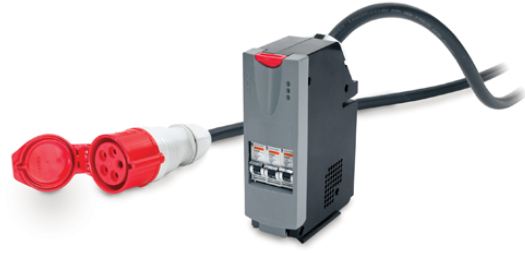
Рис. APC
Модуль для подачи питания на трехфазную нагрузку
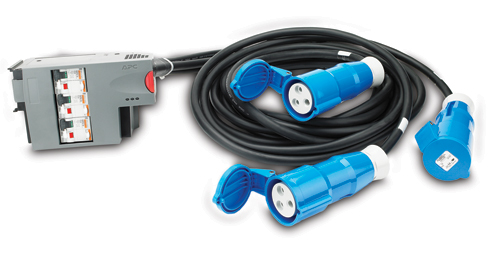
Рис. APC
Модуль для подачи питания на однофазные нагрузкиПараллельные тексты EN-RU
Factory assembled and tested Power Distribution Modules include circuit breaker, power cord, power connection, and circuit monitoring.
Собранные и проверенные на заводе-изготовиетеле модули распределения питания включают в себя автоматический выключатель, кабель, кабельную розетку и средства контроля состояния линии питания.
A variety of breaker and connector options can be chosen to supply either three-phase or single-phase power to the load.
Широкий выбор автоматических выключателей и кабельных розеток позволяет легко подобрать нужный модуль для подачи питания на трехфазные и однофазные нагрузки.
When demand rises and expansion becomes necessary, simply plug in new Power Distribution Modules. The factory-assembled modules, which include circuit breaker, power cord, and power connection, can be installed in mere minutes. There are multiple power ratings and power cord lengths for low to high power, guaranteeing compatibility and quick, easy, and convenient installation.
[APC]Когда потребляемая мощность увеличивается и необходимо расширение системы бесперебойного питания, то достаточно просто вставить новые модули распределения питания. Собранные на заводе-изготовителе модули, состоящие из автоматического выключателя, кабеля и кабельной розетки, можно установить за несколько минут. Модули поставляются на различные номинальные токи и с кабелями различной длины, что позволяет легко подобрать нужный модуль, быстро и без особого труда его установить.
[Перевод Интент]
How to install the PDM
Note: Some Power Distribution Units have filler plates installed. When a PDM is to be installed, the filler plate must be removed from the busbar.
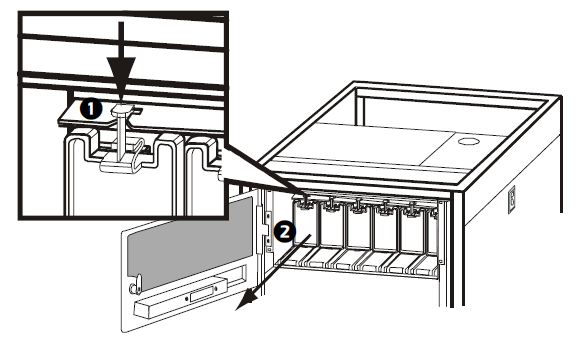
1 Press down on the clip.
2 Pull out the plate from the unit. (Do not throw away the filler plate. Keep it for potential later use).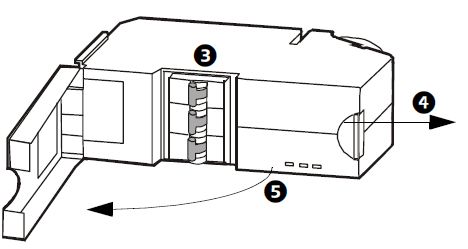
3 Verify that all the breakers are in the OFF position.
4 Press the red button to release the latch.
5 Pull open the latch.Vertical Rack Distribution Panel
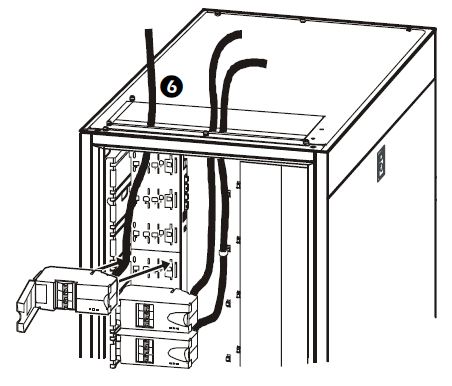
Horizontal Rack Distribution Panel
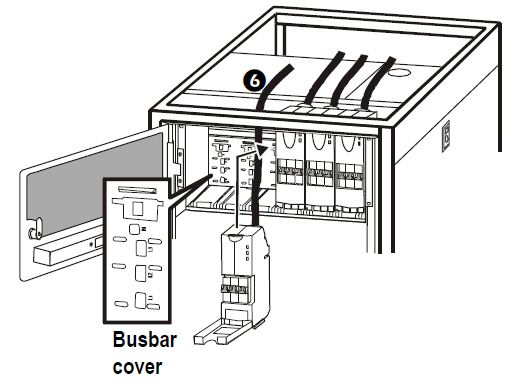
6 Feed the cable(s) up through the top opening in the enclosure and into the cable power troughs (if applicable) on top of enclosures.
How to install a PDM circuit breaker handle tie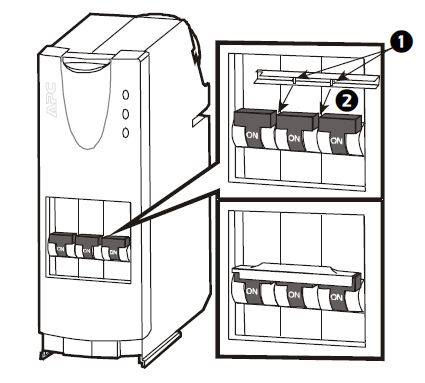
1 Locate the handle tie above the circuit breaker handles aligning the two tabs between the three handles.
2 Push the handle tie towards the circuit breaker handles until it snaps into position. Check to make sure that the handle tie is secure.
3 The handle tie can be removed by pulling it from the circuit breaker handles.Тематики
- НКУ (шкафы, пульты,...)
- источники и системы электропитания
EN
модуляция по длительности импульса
широтно-импульсная модуляция
ШИМ
—
[Е.С.Алексеев, А.А.Мячев. Англо-русский толковый словарь по системотехнике ЭВМ. Москва 1993]Тематики
Синонимы
EN
управление данными об изделии
Системы PDM обобщают такие технологии, как:
EDM (engineering data management) - управление инженерными данными,
PIM (product information management) - управление информацией об изделии,
TDM (technical data management) - управление техническими данными,
TIM (technical information management) - управление технической информацией,
а также другие системы, которые используются для манипулирования информацией, всесторонне определяющей конкретное изделие. Короче говоря, любая информация, необходимая на том или ином этапе жизненного цикла изделия, может управляться системой PDM, которая предоставляет корректные данные всем пользователям и всем промышленным информационным системам по мере надобности. Наряду с данными, PDM управляет и проектом - процессом разработки изделия, контролируя собственно информацию об изделии - "продукте", о состоянии объектов данных, об утверждении вносимых изменений, осуществляя авторизацию и другие операции, которые влияют на данные об изделии и режимы доступа к ним каждого конкретного пользователя.
Таким образом, речь идет о полном, централизованном и постоянном автоматизированном контроле за всей совокупностью данных, описывающих как само изделие, так и процессы его конструирования, производства, эксплуатации и утилизации.
[ http://www.morepc.ru/dict/]Тематики
EN
фазоразностная модуляция
—
[Л.Г.Суменко. Англо-русский словарь по информационным технологиям. М.: ГП ЦНИИС, 2003.]Тематики
EN
широтно-импульсная модуляция
ШИМ
Последовательный сигнал, информативным в котором является ширина импульса при постоянной частоте следования.
[ http://www.morepc.ru/dict/]
широтно-импульсная модуляция
-
[Я.Н.Лугинский, М.С.Фези-Жилинская, Ю.С.Кабиров. Англо-русский словарь по электротехнике и электроэнергетике, Москва]Тематики
- электротехника, основные понятия
Синонимы
EN
06.04.13 поверхностная акустическая волна [ surface acoustic wave; SAW]: Электроакустический эффект, используемый в системах автоматической идентификации, когда микроволновые радиосигналы малой мощности с помощью пьезоэлектрического кристалла в радиочастотной метке преобразуются в ультразвуковые поверхностные акустические волны.
Примечание - Информация об уникальной идентификации содержится в фазово-временных вариациях отраженного радиочастотной меткой сигнала.
<2>4 Сокращения
ARQ
Автоматический запрос повтора [Automatic Repeat Request]
ASK
Амплитудная манипуляция [Amplitude Shift Keying]
BPSK
Бинарная фазовая манипуляция [Binary Phase Shift Keying]
CDMA
Множественный доступ с кодовым разделением каналов [Code Division Multiple Access]
CSMA
Множественный доступ с анализом состояния канала передачи данных [Carrier Sense Multiple Access]
CSMA/CD
Множественный доступ с анализом состояния канала передачи данных и обнаружением конфликтов [Carrier Sense Multiple Access with Collision Detection]
DBPSK
Дифференциальная бинарная фазовая манипуляция [Differential binary phase shift keying]
DSSS
Широкополосная модуляция с непосредственной передачей псевдослучайной последовательности [Direct sequence spread spectrum modulation]
EIRP (ЭИИМ)
Эквивалентная изотропно-излучаемая мощность [Equivalent Isotropically Radiated Power]
EMI
Электромагнитная помеха [ElectroMagnetic Interference]
ETR
Технический отчет ETSI [European Telecommunications Report]
ETS
Телекоммуникационный стандарт ETSI [European Telecommunications Standard]
ETSI
Европейский институт по стандартизации в области телекоммуникаций [European Telecommunications Standards Institute]
FHSS
Широкополосная модуляция с дискретной перестройкой несущей частоты [Frequency Hopping Spread Spectrum]
FSK
Частотная манипуляция [Frequency Shift Keying]
GHz (ГГц)
Гигагерц [Gigahertz]
GMSK
Минимальная гауссовская манипуляция [Gaussian Minimum Shift Keying]
kHz (кГц)
Килогерц [Kilohertz]
MSK
Минимальнофазовая частотная манипуляция [Minimum shift keying]
MHz (МГц)
Мегагерц [Megahertz]
OBE
Навесное оборудование [On-Board Equipment]
PDM
Модуляция импульса по длительности, широтно-импульсная модуляция [Pulse Duration Modulation]
PM
Фазовая модуляция [Phase modulation]
PPM (ФИМ)
Фазоимпульсная модуляция [Modulation (pulse position)]
PSK
Фазовая манипуляция [Phase Shift Keying]
PWM
Широтно-импульсная модуляция [Pulse Width Modulation]
RF/DC
Обмен данными системы радиочастотной идентификации [Radio frequency data communication]
RFI
Радиопомеха [Radio frequency interference]
RSSI
Индикатор уровня принимаемого сигнала [Receiving Signal Strength Indicator]
S/N
Отношение сигнала к шуму [Signal/noise ratio]
SAW
Поверхностная акустическая волна [Surface Acoustic Wave]
SIN AD
Отношение сигнала к шуму и искажению [Signal to Noise & Distortion]
SRD
Устройство малого радиуса действия [Short Range Device]
TBR
Технические основы регулирования [Technical Basis for Regulation]
TDD
Дуплексная связь с временным разделением каналов [Time Division Duplexing]
TDM
Временное разделение каналов [Time Division Multiplexing]
<2>Библиография
[1]
МЭК 60050-713
(IEC 60050-713)
Международный электротехнический словарь. Часть 713. Радиосвязь: приемники, передатчики, сети и их режим работы
( International Electrotechnical Vocabulary - Part 713: Radiocommunications: transmitters, receivers, networks and operation)
[2]
МЭК 60050-705
(IEC 60050-705)
Международный электротехнический словарь. Глава 705: Распространение радиоволн ( International Electrotechnical Vocabulary - Chapter 705: Radio wave propagation)
[3]
МЭК 60050-702
(IEC 60050-702)
Международный электротехнический словарь. Глава 702: Колебания, сигналы и соответствующие устройства
( International Electrotechnical Vocabulary - Chapter 702: Oscillations, signals and related devices)
[4]
МЭК 60050-121
(IEC 60050-121)
Международный электротехнический словарь. Глава 121: Электромагнетизм ( International Electrotechnical Vocabulary - Part 121: Electromagnetism)
[5]
МЭК 60050-712
(IEC 60050-712)
Международный электротехнический словарь. Глава 712: Антенны ( International Electrotechnical Vocabulary - Chapter 712: Antennas)
[6]
МЭК 60050-221
(IEC 60050-221)
Международный электротехнический словарь. Глава 221: Магнитные материалы и компоненты
( International Electrotechnical Vocabulary - Chapter 221: Magnetic materials and components)
[7]
ИСО/МЭК 2382-9:1995
(ISO/IEC2382-9:1995)
Информационная технология. Словарь. Часть 9. Обмен данными ( Information technology - Vocabulary - Part 9: Data communication)
[8]
МЭК 60050-725
(IEC 60050-725)
Международный электротехнический словарь. Глава 725: Космическая радиосвязь ( International Electrotechnical Vocabulary - Chapter 725: Space radiocommunications)
[9]
МЭК 60050-714
(IEC 60050-714)
Международный электротехнический словарь. Глава 714: Коммутация и сигнализация в электросвязи
( International Electrotechnical Vocabulary - Chapter 714: Switching and signalling in telecommunications)
[10]
МЭК 60050-704
(IEC 60050-704)
Международный Электротехнический словарь. Глава 704. Техника передачи ( International Electrotechnical Vocabulary - Chapter 704: Transmission)
[11]
МЭК 60050-161
(IEC 60050-161)
Международный электротехнический словарь. Глава 161: Электромагнитная совместимость ( International Electrotechnical Vocabulary. Chapter 161: Electromagnetic compatibility)
[12]
ИСО/МЭК 8824-1
(ISO/IEC 8824-1)
Информационные технологии. Абстрактная синтаксическая нотация версии один
(АСН.1). Часть 1. Спецификация основной нотации
(Information technology - Abstract Syntax Notation One (ASN.1): Specification of basic notation)1)
[13]
ИСО/МЭК 9834-1
(ISO/IEC 9834-1)
Информационные технологии. Взаимосвязь открытых систем. Процедуры действий уполномоченных по регистрации ВОС. Часть 1. Общие процедуры и верхние дуги дерева идентификатора объекта АСН.1
( Information technology - Open Systems Interconnection - Procedures for the operation of OSI Registration Authorities: General procedures and top arcs of the ASN. 1 Object Identifier tree)
[14]
ИСО/МЭК 15962]
(ISO/IEC 15962)
Информационные технологии. Радиочастотная идентификация (RFID) для управления предметами. Протокол данных: правила кодирования данных и функции логической памяти
( Information technology - Radio frequency identification ( RFID) for item management - Data protocol: data encoding rules and logical memory functions)
[15]
ИСО/МЭК 19762-1
(ISO/IEC 19762-1)
Информационные технологии. Технологии автоматической идентификации и сбора данных (АИСД). Гармонизированный словарь. Часть 1. Общие термины в области АIDC ( Information technology - Automatic identification and data capture ( AIDC) techniques - Harmonized vocabulary - Part 1: General terms relating to AIDC)
[16]
ИСО/МЭК 19762-2
(ISO/IEC 19762-2)
Информационные технологии. Технологии автоматической идентификации и сбора данных (АИСД). Гармонизированный словарь. Часть 2. Оптические носители данных (ОНД)
( Information technology - Automatic identification and data capture ( AIDC) techniques - Harmonized vocabulary - Part 2: Optically readable media ( ORM))
[17]
ИСО/МЭК 19762-3
(ISO/IEC 19762-3)
Информационные технологии. Технологии автоматической идентификации и сбора данных (АИСД). Гармонизированный словарь. Часть 3. Радиочастотная идентификация (РЧИ)
( Information technology - Automatic identification and data capture ( AIDC) techniques - Harmonized vocabulary - Part 3: Radio frequency identification ( RFID))
[18]
ИСО/МЭК 19762-5
(ISO/IEC 19762-5)
Информационные технологии. Технологии автоматической идентификации и сбора данных (АИСД). Гармонизированный словарь. Часть 5. Системы определения места нахождения
( Information technology - Automatic identification and data capture ( AIDC) techniques - Harmonized vocabulary - Part 5: Locating systems)
[19]
ИСО/МЭК 18000-6
(ISO/IEC 18000-6)
Информационные технологии. Радиочастотная идентификация для управления предметами. Часть 6. Параметры радиоинтерфейса для диапазона частот 860 - 960 МГц ( Information technology - Radio frequency identification for item management - Part 6: Parameters for air interface communications at 860 MHz to 960 MHz)
_____________
1)В оригинале ИСО/МЭК 19762-4 стандарты [12] - [19] включены в раздел «Библиография», однако следует учитывать, что в основном тексте стандарта ссылок на них нет.
<2>
Источник: ГОСТ Р ИСО/МЭК 19762-4-2011: Информационные технологии. Технологии автоматической идентификации и сбора данных (АИСД). Гармонизированный словарь. Часть 4. Общие термины в области радиосвязи оригинал документа
Англо-русский словарь нормативно-технической терминологии > PDM
-
88 SRD
- устройство малого радиуса действия
- саморегестрирующий дозиметр
- расхождения в отгруженной и полученной продукции
- поверхностная акустическая волна
расхождения в отгруженной и полученной продукции
(напр. ядерных материалов)
[А.С.Гольдберг. Англо-русский энергетический словарь. 2006 г.]Тематики
EN
саморегестрирующий дозиметр
—
[А.С.Гольдберг. Англо-русский энергетический словарь. 2006 г.]Тематики
EN
3.2 устройство малого радиуса действия (short range device, SRD): Устройство, содержащее радиопередатчик и/или радиоприемник, и/или их части, применяемое в системах сигнализации, дистанционного управления и т.п. для радиопередачи и/или радиоприема аналоговых речевых и музыкальных сигналов и аналоговых и/или цифровых данных или комбинированных аналоговых речевых и музыкальных сигналов и данных (аналоговых и/или цифровых), использующее любой вид модуляции.
Примечание - Устройства малого радиуса действия могут быть стационарными, подвижными и портативными.
Источник: ГОСТ Р 52459.3-2009: Совместимость технических средств электромагнитная. Технические средства радиосвязи. Часть 3. Частные требования к устройствам малого радиуса действия, работающим на частотах от 9 кГц до 40 ГГц оригинал документа
06.04.13 поверхностная акустическая волна [ surface acoustic wave; SAW]: Электроакустический эффект, используемый в системах автоматической идентификации, когда микроволновые радиосигналы малой мощности с помощью пьезоэлектрического кристалла в радиочастотной метке преобразуются в ультразвуковые поверхностные акустические волны.
Примечание - Информация об уникальной идентификации содержится в фазово-временных вариациях отраженного радиочастотной меткой сигнала.
<2>4 Сокращения
ARQ
Автоматический запрос повтора [Automatic Repeat Request]
ASK
Амплитудная манипуляция [Amplitude Shift Keying]
BPSK
Бинарная фазовая манипуляция [Binary Phase Shift Keying]
CDMA
Множественный доступ с кодовым разделением каналов [Code Division Multiple Access]
CSMA
Множественный доступ с анализом состояния канала передачи данных [Carrier Sense Multiple Access]
CSMA/CD
Множественный доступ с анализом состояния канала передачи данных и обнаружением конфликтов [Carrier Sense Multiple Access with Collision Detection]
DBPSK
Дифференциальная бинарная фазовая манипуляция [Differential binary phase shift keying]
DSSS
Широкополосная модуляция с непосредственной передачей псевдослучайной последовательности [Direct sequence spread spectrum modulation]
EIRP (ЭИИМ)
Эквивалентная изотропно-излучаемая мощность [Equivalent Isotropically Radiated Power]
EMI
Электромагнитная помеха [ElectroMagnetic Interference]
ETR
Технический отчет ETSI [European Telecommunications Report]
ETS
Телекоммуникационный стандарт ETSI [European Telecommunications Standard]
ETSI
Европейский институт по стандартизации в области телекоммуникаций [European Telecommunications Standards Institute]
FHSS
Широкополосная модуляция с дискретной перестройкой несущей частоты [Frequency Hopping Spread Spectrum]
FSK
Частотная манипуляция [Frequency Shift Keying]
GHz (ГГц)
Гигагерц [Gigahertz]
GMSK
Минимальная гауссовская манипуляция [Gaussian Minimum Shift Keying]
kHz (кГц)
Килогерц [Kilohertz]
MSK
Минимальнофазовая частотная манипуляция [Minimum shift keying]
MHz (МГц)
Мегагерц [Megahertz]
OBE
Навесное оборудование [On-Board Equipment]
PDM
Модуляция импульса по длительности, широтно-импульсная модуляция [Pulse Duration Modulation]
PM
Фазовая модуляция [Phase modulation]
PPM (ФИМ)
Фазоимпульсная модуляция [Modulation (pulse position)]
PSK
Фазовая манипуляция [Phase Shift Keying]
PWM
Широтно-импульсная модуляция [Pulse Width Modulation]
RF/DC
Обмен данными системы радиочастотной идентификации [Radio frequency data communication]
RFI
Радиопомеха [Radio frequency interference]
RSSI
Индикатор уровня принимаемого сигнала [Receiving Signal Strength Indicator]
S/N
Отношение сигнала к шуму [Signal/noise ratio]
SAW
Поверхностная акустическая волна [Surface Acoustic Wave]
SIN AD
Отношение сигнала к шуму и искажению [Signal to Noise & Distortion]
SRD
Устройство малого радиуса действия [Short Range Device]
TBR
Технические основы регулирования [Technical Basis for Regulation]
TDD
Дуплексная связь с временным разделением каналов [Time Division Duplexing]
TDM
Временное разделение каналов [Time Division Multiplexing]
<2>Библиография
[1]
МЭК 60050-713
(IEC 60050-713)
Международный электротехнический словарь. Часть 713. Радиосвязь: приемники, передатчики, сети и их режим работы
( International Electrotechnical Vocabulary - Part 713: Radiocommunications: transmitters, receivers, networks and operation)
[2]
МЭК 60050-705
(IEC 60050-705)
Международный электротехнический словарь. Глава 705: Распространение радиоволн ( International Electrotechnical Vocabulary - Chapter 705: Radio wave propagation)
[3]
МЭК 60050-702
(IEC 60050-702)
Международный электротехнический словарь. Глава 702: Колебания, сигналы и соответствующие устройства
( International Electrotechnical Vocabulary - Chapter 702: Oscillations, signals and related devices)
[4]
МЭК 60050-121
(IEC 60050-121)
Международный электротехнический словарь. Глава 121: Электромагнетизм ( International Electrotechnical Vocabulary - Part 121: Electromagnetism)
[5]
МЭК 60050-712
(IEC 60050-712)
Международный электротехнический словарь. Глава 712: Антенны ( International Electrotechnical Vocabulary - Chapter 712: Antennas)
[6]
МЭК 60050-221
(IEC 60050-221)
Международный электротехнический словарь. Глава 221: Магнитные материалы и компоненты
( International Electrotechnical Vocabulary - Chapter 221: Magnetic materials and components)
[7]
ИСО/МЭК 2382-9:1995
(ISO/IEC2382-9:1995)
Информационная технология. Словарь. Часть 9. Обмен данными ( Information technology - Vocabulary - Part 9: Data communication)
[8]
МЭК 60050-725
(IEC 60050-725)
Международный электротехнический словарь. Глава 725: Космическая радиосвязь ( International Electrotechnical Vocabulary - Chapter 725: Space radiocommunications)
[9]
МЭК 60050-714
(IEC 60050-714)
Международный электротехнический словарь. Глава 714: Коммутация и сигнализация в электросвязи
( International Electrotechnical Vocabulary - Chapter 714: Switching and signalling in telecommunications)
[10]
МЭК 60050-704
(IEC 60050-704)
Международный Электротехнический словарь. Глава 704. Техника передачи ( International Electrotechnical Vocabulary - Chapter 704: Transmission)
[11]
МЭК 60050-161
(IEC 60050-161)
Международный электротехнический словарь. Глава 161: Электромагнитная совместимость ( International Electrotechnical Vocabulary. Chapter 161: Electromagnetic compatibility)
[12]
ИСО/МЭК 8824-1
(ISO/IEC 8824-1)
Информационные технологии. Абстрактная синтаксическая нотация версии один
(АСН.1). Часть 1. Спецификация основной нотации
(Information technology - Abstract Syntax Notation One (ASN.1): Specification of basic notation)1)
[13]
ИСО/МЭК 9834-1
(ISO/IEC 9834-1)
Информационные технологии. Взаимосвязь открытых систем. Процедуры действий уполномоченных по регистрации ВОС. Часть 1. Общие процедуры и верхние дуги дерева идентификатора объекта АСН.1
( Information technology - Open Systems Interconnection - Procedures for the operation of OSI Registration Authorities: General procedures and top arcs of the ASN. 1 Object Identifier tree)
[14]
ИСО/МЭК 15962]
(ISO/IEC 15962)
Информационные технологии. Радиочастотная идентификация (RFID) для управления предметами. Протокол данных: правила кодирования данных и функции логической памяти
( Information technology - Radio frequency identification ( RFID) for item management - Data protocol: data encoding rules and logical memory functions)
[15]
ИСО/МЭК 19762-1
(ISO/IEC 19762-1)
Информационные технологии. Технологии автоматической идентификации и сбора данных (АИСД). Гармонизированный словарь. Часть 1. Общие термины в области АIDC ( Information technology - Automatic identification and data capture ( AIDC) techniques - Harmonized vocabulary - Part 1: General terms relating to AIDC)
[16]
ИСО/МЭК 19762-2
(ISO/IEC 19762-2)
Информационные технологии. Технологии автоматической идентификации и сбора данных (АИСД). Гармонизированный словарь. Часть 2. Оптические носители данных (ОНД)
( Information technology - Automatic identification and data capture ( AIDC) techniques - Harmonized vocabulary - Part 2: Optically readable media ( ORM))
[17]
ИСО/МЭК 19762-3
(ISO/IEC 19762-3)
Информационные технологии. Технологии автоматической идентификации и сбора данных (АИСД). Гармонизированный словарь. Часть 3. Радиочастотная идентификация (РЧИ)
( Information technology - Automatic identification and data capture ( AIDC) techniques - Harmonized vocabulary - Part 3: Radio frequency identification ( RFID))
[18]
ИСО/МЭК 19762-5
(ISO/IEC 19762-5)
Информационные технологии. Технологии автоматической идентификации и сбора данных (АИСД). Гармонизированный словарь. Часть 5. Системы определения места нахождения
( Information technology - Automatic identification and data capture ( AIDC) techniques - Harmonized vocabulary - Part 5: Locating systems)
[19]
ИСО/МЭК 18000-6
(ISO/IEC 18000-6)
Информационные технологии. Радиочастотная идентификация для управления предметами. Часть 6. Параметры радиоинтерфейса для диапазона частот 860 - 960 МГц ( Information technology - Radio frequency identification for item management - Part 6: Parameters for air interface communications at 860 MHz to 960 MHz)
_____________
1)В оригинале ИСО/МЭК 19762-4 стандарты [12] - [19] включены в раздел «Библиография», однако следует учитывать, что в основном тексте стандарта ссылок на них нет.
<2>
Источник: ГОСТ Р ИСО/МЭК 19762-4-2011: Информационные технологии. Технологии автоматической идентификации и сбора данных (АИСД). Гармонизированный словарь. Часть 4. Общие термины в области радиосвязи оригинал документа
Англо-русский словарь нормативно-технической терминологии > SRD
См. также в других словарях:
Difference and Repetition — … Wikipedia
Difference in differences — (DID) (sometimes Diff in Diffs ) is a quasi experimental technique used in econometrics that measures the effect of a treatment at a given period in time. It is often used to measure the change induced by a particular treatment or event, though… … Wikipedia
Difference (philosophy) — Difference is a key concept of continental philosophy, denoting the process or set of properties by which one entity is distinguished from another within a relational field or a given conceptual system. In the Western philosophical system,… … Wikipedia
Basic Allowance for Housing — (B A H) is a United States military entitlement given to many military members. It was previously called Basic allowance for quarters (BAQ).How It WorksBAH is given to members so that they can provide housing for themselves and their dependents… … Wikipedia
Basic encoding rules — Le codage Basic Encoding Rules (règles d encodage basiques) ou son acronyme BER est un des format d encodage définie par le standard ASN.1. Sommaire 1 Description 2 Comparaison par rapport à des formats alternatifs 3 Utilisation … Wikipédia en Français
Difference set — For the concept of set difference, see complement (set theory). In combinatorics, a (v,k,λ) difference set is a subset D of a group G such that the order of G is v, the size of D is k, and every nonidentity element of G can be expressed as a… … Wikipedia
difference — noun 1 way in which people/things are not the same ADJECTIVE ▪ big, broad, considerable, dramatic, enormous, great, huge, large, major, profound … Collocations dictionary
Basic Role-Playing — Infobox RPG title=Basic Role Playing (BRP) caption= Basic Role Playing cover page designer=Greg Stafford and Lynn Willis publisher=Chaosium date=1980, 1981 genre=Universal system= footnotes= ISBN=1 56882 168 9 Basic Role Playing ( BRP ) is a role … Wikipedia
Difference-map algorithm — Iterations 0, 100, 200, 300 and 400 in the difference map reconstruction of a grayscale image from its Fourier transform modulus The difference map algorithm is a search algorithm for general constraint satisfaction problems. It is a meta… … Wikipedia
Difference map algorithm — The difference map algorithm is a search algorithm for general constraint satisfaction problems. It is a meta algorithm in the sense that it is built from more basic algorithms that perform projections onto constraint sets. From a mathematical… … Wikipedia
Difference between chemistry and physics — Marie Curie is the only individual to be awarded Nobel Prizes in both chemistry and physics Chemistry and physics are branches of science that both study matter. The difference in the two lies in the scope and in the approach. Consequently,… … Wikipedia
