

-
1 длительный допустимый ток
- Strombelastbarkeit, f
- Dauerstrombelastbarkeit, f
(длительный) допустимый ток
Максимальное значение электрического тока, который может протекать длительно по проводнику, устройству или аппарату при определенных условиях без превышения определенного значения их температуры в установившемся режиме
[ ГОСТ Р МЭК 60050-826-2009]
Этот ток обозначают IZ
[ ГОСТ Р 50571. 1-2009 ( МЭК 60364-1: 2005)]EN
(continuous) current-carrying capacity
ampacity (US)
maximum value of electric current which can be carried continuously by a conductor, a device or an apparatus, under specified conditions without its steady-state temperature exceeding a specified value
[IEV number 826-11-13]
ampacity
The current in amperes that a conductor can carry continuously under the conditions of use without exceeding its temperature rating.
[National Electrical Cod]FR
courant (permanent) admissible, m
valeur maximale du courant électrique qui peut parcourir en permanence, un conducteur, un dispositif ou un appareil, sans que sa température de régime permanent, dans des conditions données, soit supérieure à la valeur spécifiée
[IEV number 826-11-13]Ampacity, the term is defined as the maximum amount of current a cable can carry before sustaining immediate or progressive deterioration. Also described as current rating or current-carrying capacity, is the RMS electric current which a device can continuously carry while remaining within its temperature rating. The ampacity of a cable depends on:
- its insulation temperature rating;
- conductor electrical properties for current;
- frequency, in the case of alternating currents;
- ability to dissipate heat, which depends on cable geometry and its surroundings;
- ambient temperature.
Electric wires have some resistance, and electric current flowing through them causes voltage drop and power dissipation, which heats the cable. Copper or aluminum can conduct a large amount of current before melting, but long before the conductors melt, their insulation would be damaged by the heat.
The ampacity for a power cable is thus based on physical and electrical properties of the material & construction of the conductor and of its insulation, ambient temperature, and environmental conditions adjacent to the cable. Having a large overall surface area may dissipate heat well if the environment can absorb the heat.
In a long run of cable, different conditions govern, and installation regulations normally specify that the most severe condition along the run governs the cable's rating. Cables run in wet or oily locations may carry a lower temperature rating than in a dry installation. Derating is necessary for multiple circuits in close proximity. When multiple cables are near, each contributes heat to the others and diminishes the amount of cooling air that can flow past the individual cables. The overall ampacity of the insulated conductors in a bundle of more than 3 must be derated, whether in a raceway or cable. Usually the de-rating factor is tabulated in a nation's wiring regulations.
Depending on the type of insulating material, common maximum allowable temperatures at the surface of the conductor are 60, 75 and 90 degrees Celsius, often with an ambient air temperature of 30°C. In the U.S., 105°C is allowed with ambient of 40°C, for larger power cables, especially those operating at more than 2 kV. Likewise, specific insulations are rated 150, 200 or 250°C.
The allowed current in cables generally needs to be decreased (derated) when the cable is covered with fireproofing material.
For example, the United States National Electric Code, Table 310-16, specifies that up to three 8 AWG copper wires having a common insulating material (THWN) in a raceway, cable, or direct burial has an ampacity of 50 A when the ambient air is 30°C, the conductor surface temperature allowed to be 75°C. A single insulated conductor in air has 70 A rating.
Ampacity rating is normally for continuous current, and short periods of overcurrent occur without harm in most cabling systems. The acceptable magnitude and duration of overcurrent is a more complex topic than ampacity.
When designing an electrical system, one will normally need to know the current rating for the following:- Wires
- Printed Circuit Board traces, where included
- Fuses
- Circuit breakers
- All or nearly all components used
Some devices are limited by power rating, and when this power rating occurs below their current limit, it is not necessary to know the current limit to design a system. A common example of this is lightbulb holders.
[http://en.wikipedia.org/wiki/Ampacity]
Тематики
- электротехника, основные понятия
Синонимы
EN
DE
- Dauerstrombelastbarkeit, f
- Strombelastbarkeit, f
FR
- courant admissible, m
- courant permanent admissible, m
Русско-немецкий словарь нормативно-технической терминологии > длительный допустимый ток
-
2 размерность физической величины
- Größendimension, f
- Dimension, f
- Dimension einer Grösse
- Dimension einer GroBe
размерность физической величины
размерность величины
Выражение в форме степенного одночлена, составленного из произведений символов основных физических величин в различных степенях и отражающее связь данной физической величины с физическими величинами, принятыми в данной системе величин за основные с коэффициентом пропорциональности, равным 1.
Примечания
1. Степени символов основных величин, входящих в одночлен, в зависимости от связи рассматриваемой физической величины с основными, могут быть целыми, дробными, положительными и отрицательными. Понятие размерность распространяется и на основные величины. Размерность основной величины в отношении самой себя равна единице, т.е. формула размерности основной величины совпадает с ее символом.
2. В соответствии с международным стандартом ИСО 31/0, размерность величин следует обозначать знаком dim [2]. В системе величин LMT размерность величины.x будет: dim х = LlMmTt, где L, М, Т - символы, величин, принятых за основные (соответственно длины, массы, времени).
[РМГ 29-99]EN
dimension of a quantity
quantity dimension
dimension
expression of the dependence of a quantity on the base quantities of a system of quantities as a product of powers of factors corresponding to the base quantities, omitting any numerical factor
NOTE 1 – A power of a factor is the factor raised to an exponent. Each factor is the dimension of a base quantity.
NOTE 2 – The conventional symbolic representation of the dimension of a base quantity is a single upper case letter in roman (upright) sans-serif type. The conventional symbolic representation of the dimension of a derived quantity is the product of powers of the dimensions of the base quantities according to the definition of the derived quantity. The dimension of a quantity Q is denoted by dim Q.
NOTE 3 – In deriving the dimension of a quantity, no account is taken of its scalar, vector or tensor character.
NOTE 4 – In a given system of quantities, – quantities of the same kind have the same dimension, – quantities of different dimensions are always of different kinds, and – quantities having the same dimension are not necessarily of the same kind. For example, in the ISQ, pressure and energy density (volumic energy) have the same dimension L–1MT–2. See also note 5.
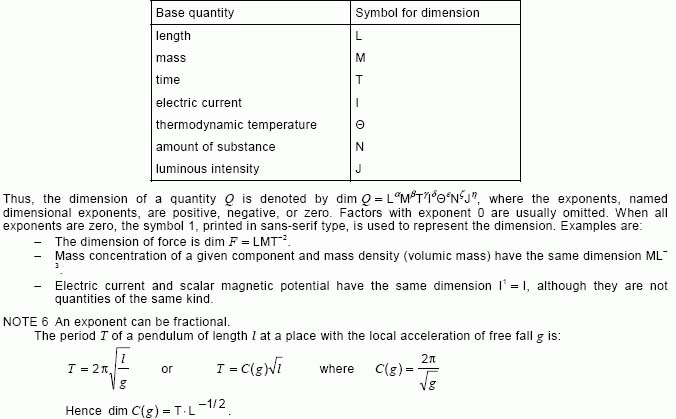
NOTE 5 – In the International System of Quantities (ISQ), the symbols representing the dimensions of the base quantities are:
[IEV number 112-01-11]FR
dimension, f
dimension d'une grandeur, f
expression de la dépendance d’une grandeur par rapport aux grandeurs de base d'un système de grandeurs sous la forme d'un produit de puissances de facteurs correspondant aux grandeurs de base, en omettant tout facteur numérique
NOTE 1 – Une puissance d'un facteur est le facteur muni d'un exposant. Chaque facteur exprime la dimension d'une grandeur de base.
NOTE 2 – Par convention, la représentation symbolique de la dimension d'une grandeur de base est une lettre majuscule unique en caractère romain (droit) sans empattement. Par convention, la représentation symbolique de la dimension d'une grandeur dérivée est le produit de puissances des dimensions des grandeurs de base conformément à la définition de la grandeur dérivée. La dimension de la grandeur Q est notée dim Q.
NOTE 3 – Pour établir la dimension d'une grandeur, on ne tient pas compte du caractère scalaire, vectoriel ou tensoriel.
NOTE 4 – Dans un système de grandeurs donné, – les grandeurs de même nature ont la même dimension, – des grandeurs de dimensions différentes sont toujours de nature différente, – des grandeurs ayant la même dimension ne sont pas nécessairement de même nature. Par exemple, dans l'ISQ, la pression et l'énergie volumique ont la même dimension L–1MT–2. Voir aussi la note 5.
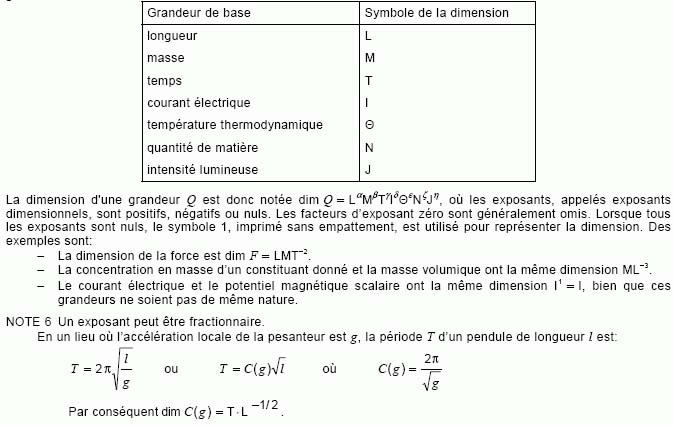
NOTE 5 – Dans le Système international de grandeurs (ISQ), les symboles représentant les dimensions des grandeurs de base sont:
[IEV number 112-01-11]Тематики
- метрология, основные понятия
Синонимы
EN
DE
- Dimension einer Grösse
- Dimension, f
- Größendimension, f
FR
- dimension d'une grandeur, f
- dimension, f
2.9. Размерность физической величины
Размерность величины Нрк. Формула размерности
D. Dimension einer GroBe
E. Dimensions of a quantity
F. Dimension d’une grandeur
Выражение, отражающее связь величины с основными величинами системы, в котором коэффициент пропорциональности принят равным 1.
Примечания:
1. Размерность величины представляет собой произведение основных величин, возведенных в соответствующие степени.
2. Размерность производной величины отражает, во сколько раз изменяется ее размер при изменении размеров основных величин, например, если размерность величины х равна LaM^Tv и длина изменяется от / до /', масса — от m до т' и время — от t до то новый размер величины будет больше прежнего в (/'//)а
(/'//)v раз.
Источник: ГОСТ 16263-70: Государственная система обеспечения единства измерений. Метрология. Термины и определения оригинал документа
Русско-немецкий словарь нормативно-технической терминологии > размерность физической величины
См. также в других словарях:
type case — noun A tray with compartments for storing printing types • • • Main Entry: ↑type … Useful english dictionary
type|case — «TYP KAS», noun. a flat, compartmented box for holding sorted printing type … Useful english dictionary
Type case — A type case is a compartmentalized wooden box used to store movable type used in letterpress printing.Fred Williams, [http://www.apa letterpress.com/T%20 %20P%20ARTICLES/Type/California%20Job%20Case.html Origin of the California Job Case] ,… … Wikipedia
Type case — Наборная касса; Наборная шрифтовая касса … Краткий толковый словарь по полиграфии
case — case1 caseless, adj. caselessly, adv. /kays/, n. 1. an instance of the occurrence, existence, etc., of something: Sailing in such a storm was a case of poor judgment. 2. the actual state of things: That is not the case. 3. a question or problem… … Universalium
Type (biology) — Type specimen for Cimbrophlebia brooksi, a fossil scorpion fly. By convention, the red label denotes a type specimen. In biology, a type is one particular specimen (or in some cases a group of specimens) of an organism to which the scientific… … Wikipedia
Case-control — is a type of epidemiological study design. Case control studies are used to identify factors that may contribute to a medical condition by comparing subjects who have that condition (the cases ) with patients who do not have the condition but are … Wikipedia
Case — may refer to:Academia* Case analysis, division of a problem into separate cases * Case study, examination of a single instance or event * Center for Social and Economic ResearchBusiness* Business case, captures the reasoning for initiating a… … Wikipedia
Case Western Reserve University — Motto Thinking Beyond the Possible Established WRU: 1826 CIT: 1880 CWRU: 1967 Type … Wikipedia
Case modding — Case modification (commonly referred to as case modding where an individual project is referred to as a case mod) is the modification of a computer chassis (often just referred to as the case), or a video game console chassis. Modifying a… … Wikipedia
Case — (k[=a]s), n. [OF. casse, F. caisse (cf. It. cassa), fr. L. capsa chest, box, case, fr. capere to take, hold. See {Capacious}, and cf. 4th {Chase}, {Cash}, {Enchase}, 3d {Sash}.] [1913 Webster] 1. A box, sheath, or covering; as, a case for holding … The Collaborative International Dictionary of English
