

-
41 предел огнестойкости по потере несущей способности
предел огнестойкости по потере несущей способности
tR
—
[Англо-русский словарь по проектированию строительных конструкций. МНТКС, Москва, 2011]Тематики
Синонимы
- tR
EN
Русско-английский словарь нормативно-технической терминологии > предел огнестойкости по потере несущей способности
-
42 функции манипуляции временем
функции манипуляции временем
—
[Л.Г.Суменко. Англо-русский словарь по информационным технологиям. М.: ГП ЦНИИС, 2003.]Тематики
EN
Русско-английский словарь нормативно-технической терминологии > функции манипуляции временем
-
43 функция защиты по напряжению с задержкой срабатывания
функция защиты по напряжению с задержкой срабатывания
функция защиты от повышения и понижения напряжения с задержкой срабатывания
-
[Интент]Тематики
Синонимы
- функция защиты от повышения и понижения напряжения с задержкой срабатывания
EN
Русско-английский словарь нормативно-технической терминологии > функция защиты по напряжению с задержкой срабатывания
-
44 функция Ab (реле времени)
функция Ab (реле времени)
Один импульс после задержки, отсчитываемой от подачи питания
[Интент]EN
function Ab
one-shot cycle
[Crouzed]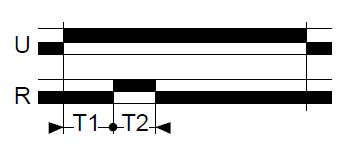
Параллельные тексты EN-RU
The output changes states at the end of the set time T1, for a period T2.
[Crouzed]Выход реле изменяет свое состояние по окончании выдержки времени Т1, отсчитываемой от момента подачи питания на реле и сохраняет его в течение времени Т2.
[Перевод Интент]
Тематики
EN
Русско-английский словарь нормативно-технической терминологии > функция Ab (реле времени)
-
45 генератор развертки
генератор развертки
Узел электронного блока, формирующий сигналы горизонтальной или вертикалькой развертки для получения на дисплее (экране) изображения электрических сигналов (обычно импульсных).
[Система неразрушающего контроля. Виды (методы) и технология неразрушающего контроля. Термины и определения (справочное пособие). Москва 2003 г.]
генератор развертки
-
[IEV number 314-06-02]EN
time base
device used to produce a spot displacement according to a specified function of time
[IEV number 314-06-02]FR
base de temps
dispositif utilisé pour obtenir un déplacement du spot selon une fonction spécifiée du temps
[IEV number 314-06-02]Тематики
- измерение электр. величин в целом
EN
DE
FR
генератор развёртки
—
[Я.Н.Лугинский, М.С.Фези-Жилинская, Ю.С.Кабиров. Англо-русский словарь по электротехнике и электроэнергетике, Москва, 1999 г.]Тематики
- электротехника, основные понятия
EN
Русско-английский словарь нормативно-технической терминологии > генератор развертки
-
46 временная корреляционная функция
Русско-английский физический словарь > временная корреляционная функция
-
47 служебная кодовая комбинация
function character телеграф., ( ИКМ) internal time-slotРусско-английский научно-технический словарь Масловского > служебная кодовая комбинация
-
48 TVCF
time-dependent velocity correlation function — временная корреляционная функция скорости, ВКФС ( в методе молекулярной динамики) -
49 характеристика
attribute, behavior, characteristic, description, performance diagram, parameter, pattern, property, quality, rating, response, ( объекта) signature* * *характери́стика ж.1. characteristic; ( машины) performanceполуча́ть характери́стику из уравне́ния [по уравне́нию] — generate a characteristic by an equationснима́ть характери́стику — measure a characteristic, measure a responseстро́ить характери́стику — construct [plot] a characteristicстро́ить характери́стику, напр. в координа́тах Va — Ia — construct a curve of, e. g., Ia, against Va, plot, e. g., Ia, against Vaхарактери́стика явля́ется нечё́тной — the characteristic has odd-function symmetryхарактери́стика явля́ется чё́тной — the characteristic has even-function symmetry2. ( характеристическая кривая) (characteristic) curveснима́ть характери́стику по то́чкам — measure a characteristic by the point-by-point method3. (как определение понятия, явления, величины) characterizationамплиту́дная характери́стика ( не путать с амплиту́дно-часто́тной характери́стикой) — amplitude(-ratio) characteristic (not to he confused with the amplitude response or the amplitude — vs. — frequency characteristic)амплиту́дно-часто́тная характери́стика1. ( зависимость абсолютного значения векторной величины от частоты) amplitude(-frequency) characteristic2. ( изменение усиления или ослабления с частотой) (amplitude-)frequency response, amplitude responseаналити́ческая характери́стика — analytical characteristicано́дная характери́стика — брит. anode characteristic; амер. plate characteristicано́дно-се́точная характери́стика — брит. mutual characteristic (of a plate); амер. transfer characteristic (of a plate)антидетонацио́нная характери́стика ( топлива) — antiknock ratingаперту́рная характери́стика ( передающей телевизионной трубки) — resolution characteristicаэродинами́ческие характери́стики — aerodynamic characteristics, aerodynamics, aerodynamic dataаэродинами́ческие, расчё́тные характери́стики — design aerodynamic characteristicsба́зовая характери́стика ( транзистора) — base characteristicбаллисти́ческие характери́стики — ballistic characteristicsхарактери́стика без нагру́зки — unloaded (no-load) characteristicбезразме́рная характери́стика — dimensionless characteristicвеберампе́рная характери́стика — flux-current characteristicхарактери́стика вентиля́тора — fan characteristic, fan performance curveхарактери́стика вентиля́тора, индивидуа́льная — individual fan characteristicхарактери́стика вентиля́тора, теорети́ческая — theoretic(al) fan characteristicхарактери́стика вентиля́тора, универса́льная — universal fan characteristicвентиляцио́нная характери́стика ( шахты) — ventilation characteristicвзлё́тно-поса́дочные характери́стики — take-off and landing characteristicsвлагоразря́дная характери́стика — moisture discharge characteristicвне́шняя характери́стика — external characteristicвозраста́ющая характери́стика ( вид кривой на графике) — upward (sloping part of a) characteristic (curve)вольт-ампе́рная характери́стика — volt-ampere [voltage-current] characteristicво́льтовая характери́стика ( фотоприёмника) — voltage characteristicхарактери́стика вре́мени сраба́тывания ( реле), [m2]зави́симая — dependent time-lagхарактери́стика вре́мени сраба́тывания ( реле), [m2]незави́симая — independent time-lag, definite (operating) timeхарактери́стика вре́мени сраба́тывания ( реле), [m2]ограни́ченно зави́симая — inverse time with definite minimum, definite minimum inverse operating timeвременна́я характери́стика — time responseвремято́ковая характери́стика — current-time curveвходна́я характери́стика — input characteristicsвысо́тные характери́стики — altitude characteristicsвыходна́я характери́стика — output characteristicsгистере́зисная характери́стика — hysteresis characteristicsграфи́ческая характери́стика — characteristics curveхарактери́стика группирова́ния свз. — bunching characteristicхарактери́стики дви́гателя — engine performanceдете́кторная характери́стика ( частотного детектора) — response curve, transfer characteristic (of a discriminator)детонацио́нная характери́стика ( топлива) — knock rating, knock valueдинами́ческая характери́стика1. dynamic characteristic; dynamic response2. авто performance curveдио́дная характери́стика — diode characteristicхарактери́стика добро́тности — Q characteristicжё́сткая характери́стика эл. — flat characteristicхарактери́стика зажига́ния — firm characteristicхарактери́стика запира́ния ( электронной лампы) — cut-off characteristicзаря́дная характери́стика — charge characteristicхарактери́стика затуха́ния — attenuation characteristicидеализи́рованная характери́стика — idealized-characteristicхарактери́стика избира́тельности аргд., тлв. — selectivity characteristicкалибро́вочная характери́стика — calibration curve; ( аналитическое выражение) calibration equationквадрати́чная характери́стика — square-law characteristicхарактери́стика квазиконфо́рмного отображе́ния мат. — dilatation ratioкинемати́ческая характери́стика — motion characteristicколё́сная характери́стика — system of wheels, arrangement of wheels, wheel arrangementколле́кторная характери́стика ( транзистора) — collector characteristicхарактери́стика коро́ткого замыка́ния — short-circuit characteristicкоррозио́нная характери́стика — corrosion performanceкуло́н-во́льтная характери́стика — charge-voltage characteristicкусо́чно-лине́йная характери́стика — piecewise linear characteristicхарактери́стики ЛА в движе́нии кре́на ав. — roll(ing) characteristicsхарактери́стики ЛА в движе́нии тангажа́ ав. — pitch(ing) characteristicsлё́тные характери́стики — flight data, flight performance, flight characteristicsлине́йная характери́стика — linear characteristic; linear responseлогарифми́ческая характери́стика — log-log characteristicмагни́тная характери́стика — magnetic characteristic, B-H curveмехани́ческая характери́стика — speed-torque characteristicхарактери́стика моде́ли, часто́тная аргд. — model responseмодуляцио́нная характери́стика — modulation [drive] characteristicмя́гкая характери́стика эл. — drooping characteristicнагру́зочная характери́стика — load characteristicхарактери́стика напра́вленности — directional characteristic, directivity patternхарактери́стика нараста́ния перехо́дного проце́сса элк. — transient responseхарактери́стика насо́са — pump [head-capacity] characteristicнасыща́ющая характери́стика физ. — saturation characteristicхарактери́стика насыще́ния — saturation characteristicобра́тная характери́стика ( выпрямителя) — back characteristic; ( диода) reverse characteristicхарактери́стика отраже́ний от по́чвы рад. — ground echo patternхарактери́стика отраже́ния зву́ка — echoing characteristicхарактери́стика «от све́та до све́та» тлв. — overall transfer characteristicпа́дающая характери́стика эл. — drooping characteristicпассивацио́нная характери́стика ( металла) — passivation propertyперегру́зочная характери́стика — overload characteristic; ав. g-load curveхарактери́стика переда́чи тлв. — transfer characteristicхарактери́стика переда́чи полутоно́в тлв. — gray-tone [gray-half-tone] responseхарактери́стика перекрыва́ющего разря́да эл. — flashover characteristicперехо́дная характери́стика — ( при любом возмущении) transient response; ( при единичном ступенчатом возмущении) unit-step (function) responseхарактери́стика по зерка́льному кана́лу рад. — image responseпо́лная характери́стика — total characteristicполо́гая характери́стика — quiet (characteristic) curveполуто́новая характери́стика — half-tone characteristicхарактери́стика послесвече́ния — decay [persistence] characteristicхарактери́стика по сосе́днему кана́лу рад. — adjacent-channel responseхарактери́стика пото́ка аргд. — flow conditionsпростра́нственно-часто́тная характери́стика — spatial frequency responseхарактери́стика про́филя, аэродинами́ческая — airfoil characteristicпускова́я характери́стика — starting characteristicрабо́чая характери́стика — operating [working, performance] characteristic, performance (curve)характери́стика разго́на хим. — transient responseразмо́льная характери́стика (напр. угля) — grindability indexхарактери́стика раке́тного то́плива — propellant performanceрасчё́тная характери́стика — estimated performanceхарактери́стика реа́кции — responseхарактери́стика реа́кции систе́мы авт. — ( аналитическое выражение) response (function) of a system; ( графическое представление) response (characteristic) of a system, response (curve) of a systemхарактери́стика реа́кции систе́мы на едини́чное ступе́нчатое возмуще́ние авт. — unit-step (function) response of a systemхарактери́стика реа́кции систе́мы на и́мпульсное возмуще́ние авт. — impulse(-function) response of a systemхарактери́стика реа́кции систе́мы на лине́йно-возраста́ющее возмуще́ние авт. — ramp-function response of a systemхарактери́стика реа́кции систе́мы на показа́тельное возмуще́ние авт.— exponential-function response of a systemхарактери́стика регули́рования — control performanceреологи́ческая характери́стика гидр. — flow characteristicсветова́я характери́стика — опт. light characteristic; ( передающей ТВ трубки) light transfer characteristicхарактери́стика «свет — сигна́л» ( передающей ТВ трубки) — transfer characteristicсе́риесная характери́стика эл. — series [rising] characteristicхарактери́стика се́ти тепл. — system head curveсе́точная характери́стика элк. — grid characteristicсе́точно-ано́дная характери́стика — inverse mutual [transfer, grid-plate, grid-anode] charactristic; ( по напряжению) control characteristicхарактери́стика «сигна́л — свет» ( приёмной трубки) — transfer characteristicхарактери́стика систе́мы, амплиту́дно-фа́зовая ( годограф частотной характеристики) авт. — transfer locus of a systemхарактери́стика систе́мы, перехо́дная авт. — unit-step response (function)перехо́дная характери́стика систе́мы име́ет апериоди́ческий хара́ктер — ( выходная ордината стремится к установившемуся значению монотонно) the system has [shows] an aperiodic [overdamped] transient [unit-step] response; ( имеет один экстрениум и не пересекает установившегося значения) the system has [shows] a critically damped transient [unit-step] responseперехо́дная характери́стика систе́мы име́ет колеба́тельный хара́ктер — the system has an oscillatory unit-step responseхарактери́стика систе́мы, часто́тная амплиту́дная ( модуль частотной характеристики) авт. — amplitude-ratio [gain] (vs. frequency) response (characteristic) of a systemхарактери́стика систе́мы, часто́тная амплиту́дная логарифми́ческая авт. — log-magnitude plot [log-magnitude curve] of a systemхарактери́стика систе́мы, часто́тная веще́ственная авт. — real (part of the) frequency response of a systemхарактери́стика систе́мы, часто́тная логарифми́ческая ( в координатах lg \\ — lg \(\\\)) авт. — Bode diagramхарактери́стика систе́мы, часто́тная мни́мая авт. — imaginary (part of the) frequency response of a systemхарактери́стика систе́мы, часто́тная фа́зовая ( аргумент частотной характеристики) авт. — phase (vs. frequency) response (characteristic) of a systemхарактери́стика систе́мы, часто́тная фа́зовая логарифми́ческая ( в координатах \\ — lg \) авт. — phase-angle [phase-shift] (vs. log-frequency) plot of a systemсквозна́я характери́стика киб. — through characteristicскоростна́я характери́стика — velocity characteristic; ( шины) speed performanceсо́бственная характери́стика — inherent characteristicспада́ющая характери́стика ( вид кривой на графике) — downward sloping (part of a) characteristicспектра́льная характери́стика — spectral (response) characteristic, spectral response (function)срывна́я характери́стика аргд. — stalling characteristicстати́ческая характери́стика — static characteristicсте́ндовая характери́стика — test-bench characteristicступе́нчатая характери́стика — staircase characteristicсчё́тная характери́стика — counter characteristic curve; counting responseхарактери́стика телека́меры, спектра́льная — spectral [taking] characteristic of a TV cameraтемперату́рная характери́стика — temperature characteristicтеплова́я характери́стика — thermal responseтехни́ческая характери́стика — technical dataто́ковая характери́стика — current characteristicхарактери́стика турби́ны — steam consumption diagram, Willans lineтя́говая характери́стика — tractive characteristicхарактери́стики уде́льной про́чности — strength-weight propertiesхарактери́стика управле́ния — control characteristicхарактери́стики управля́емости авто — handling characteristics, handling behaviourусреднё́нная характери́стика — averaged characteristicуста́лостная характери́стика — fatigue characteristicфа́зово-часто́тная характери́стика — phase(-frequency) characteristicфо́новая характери́стика — background characteristicходовы́е характери́стики ж.-д. — rolling characteristicsхарактери́стика холосто́го хо́да — эл. no-load characteristic; ( в теории цепей и связи) open-circuit characteristicчасто́тная характери́стика элк. — frequency responseзава́л часто́тной характери́стики, напр. на высо́ких часто́тах — drop of amplification [gain roll-off] at, e. g., high frequenciesкорректи́ровать [подня́ть] часто́тную характери́стику, напр. усили́теля — compensate the frequency response of, e. g., an amplifierкорректи́ровать [подня́ть] часто́тную характери́стику усили́теля, напр. по высо́ким часто́там — give an amplifier, e. g., a high boost, apply, e. g., high-frequency compensation to an amplifier, raise amplifier gain at the high-frequency end of the rangeкорректи́ровать [подня́ть] часто́тную характери́стику усили́теля, напр. по ни́зким часто́там — apply, e. g., low-frequency compensation to an amplifier, raise amplifier gain at the low-frequency end of the rangeчасто́тная характери́стика име́ет неравноме́рность, напр. 3 дБ по диапазо́ну — the frequency response is flat within 3 dB over the bandwidthчасто́тная характери́стика равноме́рна до, напр. 1 МГц — the frequency response is flat up to, e. g., 1 MHzчасто́тная, равноме́рная по диапазо́ну характери́стика — bandpass responseсхе́ма име́ет равноме́рную по диапазо́ну часто́тную характери́стику — the circuit has [shows] a bandpass responseчислова́я характери́стика — numerical characteristicхарактери́стика чувстви́тельности — sensitivity characteristicшумова́я характери́стика — noise performanceшунтова́я характери́стика — shunt characteristicэквивале́нтная характери́стика — total [lumped] characteristicэксплуатацио́нная характери́стика — operating characteristicэмиссио́нная характери́стика — emission characteristic -
50 сигнал
cue, indication, message, U signal, signal, signal waveform* * *сигна́л м.
signalвосстана́вливать сигна́л — regenerate a signalвосстана́вливать фо́рму сигна́ла — regenerate a signalсигна́л выделя́ется, напр. на нагру́зочном сопротивле́нии — the signal is developed, e. g., across the load resistorдетекти́ровать сигна́л — detect [demodulate] a signalзаде́рживать сигна́л — delay a signalзаме́шивать [сме́шивать] сигна́л жарг. — combine [mix] a signal (with …)запомина́ть сигна́л в инверти́рованной фо́рме вчт. — store a signal in inverted [negated] form, store an inverted [negated] signalсигна́л име́ет ограни́ченную полосу́ часто́т — the signal is band-limitedинверти́ровать сигна́л — invert [negate] a signalсигна́л искажа́ется шу́мом — the signal is corrupted by noiseквантова́ть сигна́л по вре́мени — sample a signalквантова́ть сигна́л по у́ровню — quantize a signalограни́чивать сигна́л све́рху — limit the signal, flatten the signal at the positive peakограни́чивать сигна́л сни́зу — clip the signal, flatten the signal at the negative peakпо сигна́лу — in response [according] to a signalавтопило́т управля́ет самолё́том по сигна́лу от … — the autopilot flies [controls, steers] the airplane in response [according] to a signal from …опера́ция счи́тывания начина́ется по сигна́лу «x [m2]» — the “x ” signal initiates a read operation, the “x ” signal causes a read operation to be initiatedпо сигна́лу «x [m2]» схе́ма сраба́тывает — the “x ” signal causes the circuit to operateпреобразо́вывать ана́логовый сигна́л в дискре́тный — digitize an analog signalсигна́л разветвля́ется в то́чке A — at A point the signal tracks [follows] different pathsсигна́л си́льно заби́т шума́ми — the signal is deeply buried in noise, the signal is obscured by noiseскла́дывать сигна́лы A и B — combine signals A and B, combine signal A with signal Bсогласо́вывать сигна́лы по вре́мени — time signalsформирова́ть сигна́л — generate [produce, provide] a signalавари́йный сигна́л — alarm (signal), emergency signalакусти́ческий сигна́л — audible [audio, acoustic(al) ] signalамплиту́дно-модули́рованный сигна́л — amplitude-modulated [AM] signalсигна́л бе́дствия — distress signalви́димый сигна́л — visual signalвходно́й сигна́л — input [incoming] signalвходно́й, синусоида́льный сигна́л ( вид стандартного испытательного сигнала) — sinusoidal excitationвызывно́й сигна́л тлф. — call [ringing] signalвыходно́й сигна́л — output signalвыходно́й сигна́л повторя́ет входно́й сигна́л — the output (signal) follows [tracks] the input (signal)сигна́л гаше́ния — blank(ing) signalгеодези́ческий сигна́л — observing towerгетероди́нный сигна́л — ( в приёмниках) heterodyne [local-oscillator] signal, heterodyne [local-oscillator] frequency; ( в передатчиках) injection [conversion] signal, injection [conversion] frequencyсигна́л гото́вности — ready signalсигна́л гото́вности к приё́му ( в фототелеграфии) — ready-to-receive signalсигна́л гото́вности к приё́му набо́ра но́мера — dial toneабоне́нту посыла́ется сигна́л гото́вности ста́нции к приё́му набо́ра но́мера — a dial tone informs the user that it is proper to make the callгруппово́й сигна́л ( в многоканальной связи) — composite signalсигна́л для вхожде́ния в сеть радио — netting callсигна́л забо́я оши́бки телегр. — erasure signalсигна́л закры́тия (сеа́нса) свя́зи — closing-down [end-of-work] sign(al)сигна́л за́нятости тлф. — (audible) busy signal, busy toneсигна́л за́нятости, мига́ющий тлф. — busy flash signalсигна́л за́писи вчт. — write signalзапреща́ющий сигна́л — inhibit signalсигна́л запро́са — challenging [interrogation] signalзатуха́ющий сигна́л — decaying signalзвуково́й сигна́л — audible [sound, audio] signalзвуково́й, автомоби́льный сигна́л — motor car hornзонди́рующий сигна́л ( в дискретных системах передачи) — sounding signalзу́ммерный сигна́л — buzzer signalизбира́тельный сигна́л — selective signalизбы́точный сигна́л — redundant signalсигна́л изображе́ния тлв. — picture signalсигна́л изображе́ния и синхрониза́ции тлв. — composite [sync-and-picture] signalи́мпульсный сигна́л ( результат квантования по времени) — sampled signal, signal sampleи́мпульсный, входно́й сигна́л ( форма испытательного сигнала) — impulse input (function)и́мпульсный, выходно́й сигна́л ( отклик на выходной сигнал) — impulse (function) responseиндивидуа́льный сигна́л ( в многоканальной связи) — channel signalинформацио́нный сигна́л — intelligence signalсигна́л ка́дровой синхрониза́ции — frame [vertical] sync signalкванто́ванный сигна́л (по амплитуде, по уровню) — quantized signalконтро́льный сигна́л — monitor(ing) signalсигна́л контро́ля посы́лки вы́зова — call-confirmation signalсигна́л конца́ ле́нты вчт. — end-of-tape [EOT] signalсигна́л конца́ сообще́ния вчт. — end-of-message [EOM] signalлине́йный сигна́л ( вид испытательного сигнала) — ramp input, ramp functionло́жный сигна́л — spurious [false] signalсигна́л, модули́рованный по амплиту́де — amplitude-modulated [AM] signalсигна́л, модули́рованный по фа́зе — phase-modulated [FM] signalсигна́л, модули́рованный по частоте́ — frequency-modulated [FM] signalмодули́рующий сигна́л1. modulating signal2. (в проводной высокочстотной, а также радиосвязи — информационный сигнал до переноса в другой частотный диапазон или до модуляции несущей или поднесущей) baseband signalмо́дулирующий, тона́льный сигна́л ( в системах передачи данных) — baseband signalсигна́л на вы́ходе телека́меры — camera signalсигна́л недосту́пности но́мера тлф. — out-of-order [trouble] toneсигна́л неиспра́вности — fault signalнепреры́вный сигна́л — analog [continuous] signalнеразбо́рчивый сигна́л радио — unreadable signalсигна́л обра́тной свя́зи — feedback signalсигна́л обры́ва програ́ммы радио — program(me) failure alarmобъединё́нный сигна́л ( в многоканальной связи) — combined signalразделя́ть объединё́нный сигна́л по кана́лам — separate the combined signal into channelsограни́ченный сигна́л — bounded signalсигна́л, ограни́ченный по частоте́ — band-limited signalоднополо́сный сигна́л [ОПС] — single-sideband SSB signal (см. тж. ОПС)сигна́л опознава́ния цве́та ( в системе СЕКАМ) тлв. — colour identification signalопознава́тельный сигна́л — identification signalопо́рный сигна́л — reference signalопти́ческий сигна́л — optical signalсигна́л остано́вки — stop sign(al)сигна́л отбо́я тлф. — ringoff [clearing] signalсигна́л отбо́я со стороны́ вызыва́емого абоне́нта тлф. — clear-forward signalсигна́л отве́та АТС ( приглашение к набору) — proceed-to-select signalсигна́л отве́та ( приглашение к передаче) [m2]ручно́й ста́нции — proceed-to-transmit signalсигна́л отпира́ния ЭЛТ — (CRT) unblank signalотражё́нный сигна́л — echo (signal), return signal (e. g., from the target)сигна́л оши́бки — error signalсигна́л оши́бки ориента́ции (напра́вленной) анте́нны — pointing error signalсигна́л перено́са вчт. — carry (signal)сигна́л переполне́ния вчт. — overflow signalпериоди́ческий сигна́л — periodic signalпобо́чный сигна́л радио — spurious signalподавля́емый сигна́л — victim signalсигна́л подтвержде́ния — acknowledgement [ACK] signalпожа́рный сигна́л — fire-alarm signalпозывно́й сигна́л радио — call sign(al), call letterполе́зный сигна́л (в противовес наводке, шумам или помехе) — legitimate [valid] signalпо́лный сигна́л тлв. — composite colour [picture] signalсигна́л поме́хи ( от глушащих станций) — electronic countermeasure [ECM] signalпотенциа́льный сигна́л — level signalпредупреди́тельный сигна́л — warning signalпреры́вистый сигна́л — intermittent signalсигна́л ( сигнальная комбинация) пробе́ла — space signalпростра́нственно-модули́рованный сигна́л — spatially modulated signalпсевдослуча́йный сигна́л — pseudorandom signalпусково́й сигна́л — starting signalсигна́л рассогласова́ния — error signalсигна́л с акти́вной па́узой — non-return-to-zero [NRZ] signalсветово́й сигна́л — light signal; ( световое табло) light annunciator, illuminated call-outсинфа́зный сигна́л — common-mode [in-phase] signalсинхронизи́рующий сигна́л — synchronizing signalсигна́л систе́мы поса́дки по прибо́рам, просто́й — ( для международной системы) raw ILS signal; ( для советской системы) raw СП signalсоставно́й сигна́л — composite signalсигна́л с пасси́вной па́узой — return-to-zero [RZ] signalсигна́л с пода́вленной несу́щей — suppressed-carrier signalстациона́рный сигна́л — stationary [non-time-varying] signalсигна́л стира́ния оши́бки ( в буквопечатающих аппаратах) — erasure signalстроби́рующий сигна́л — gate [gating] signalступе́нчатый сигна́л ( результат квантования по уровню) — quantized signal, quantized waveformступе́нчатый, входно́й сигна́л ( форма испытательного сигнала) — step input (junction)ступе́нчатый, выходно́й сигна́л ( отклик на входной сигнал) — step (function) responseсигна́л счи́тывания вчт. — read(ing) [sense] signalсигна́л тона́льного вы́зова тлф. — call toneсигна́л то́чного вре́мени — (standard) time signalпередава́ть сигна́лы то́чного вре́мени ( по радио) — broadcast [distribute] (standard) time signalsтрево́жный сигна́л — alarm signalсигна́л уклоне́ния от ку́рса навиг. — off course warningуправля́ющий сигна́л — control signalупрежда́ющий сигна́л — anticipatory signalсигна́л установле́ния соедине́ния тлф., телемех. — call-connected signalхрони́рующий сигна́л — timing signalсигна́л цве́тности тлв. — ( до модуляции поднесущей) chrominance [video colour-difference] signal; ( после модуляции поднесущей) chroma [modulated subcarrier] signalсигна́л цветны́х поло́с, испыта́тельный тлв. — colour-bar-chart signalцветово́й сигна́л тлв. — colour signalчасто́тно-модули́рованный сигна́л — frequency-modulated [FM] signalшумово́й сигна́л — noise (signal) -
51 время повторной готовности для заданной функции электрического реле
время повторной готовности для заданной функции электрического реле
Время, необходимое для того, чтобы электрическое реле в заданных условиях восстановило с некоторым приближением свои характеристики указанных выдержек времени при следующем срабатывании.
Примечание. Степень приближения определяется в процентах
[ ГОСТ 16022-83]EN
recovery time
for a given function and under specified conditions, the time needed by a relay to recover from an operate condition so that the following operating time is within a given percentage of the previous measuring time
[IEV number 446-17-21]FR
temps de récupération
pour une fonction considérée et dans des conditions spécifiées, temps nécessaire pour qu'un relais recouvre, avec une certaine approximation exprimée en pourcentage et au cours d'un nouveau fonctionnement, ses caractéristiques de temporisation indiquées
[IEV number 446-17-21]Тематики
EN
DE
FR
Русско-английский словарь нормативно-технической терминологии > время повторной готовности для заданной функции электрического реле
-
52 годограф
1) Geology: time path curve, time-distance, time-travel curve2) Engineering: T-X plot, locus diagram, locus function, time plot, time-distance plot, time-distance relationship, time-offset plot3) Construction: depth-velocity curve, travel-time curve (кривая времени пробега волны в сейсморазведке), vertical velocity curve5) Oil: arrival-time curve, graph, hodograph curve, time curve (кривая времени пробега сейсмических волн), time path, travel time curve, travel-time curve6) Geophysics: moveout curve, moveout function, traveltime curve, traveltime graph7) Seismology: curve of arrival time versus distance, hodochrone, reflection-time surface, time graph, time-distance curve, time-distance graph, time-distance line, travel-time graph, travel-time plot8) Makarov: T-X curve (в сейсмологии), TD curve (в сейсмологии), hodograph (в механике), hodograph curve (в сейсмологии), time-distance curve (в сейсмологии), travel-time curve (в сейсмологии)9) oil&gas: time-depth graph10) General subject: velocity diagram, velocity profile curve -
53 задержка срабатывания
- tripping time
- tripping delay
- trip time delay
- time delay
- pick-up delay
- operate delay
- intervention time
задержка срабатывания
-
[Интент]Параллельные тексты EN-RU
As implemented in the LTM R controller, all motor protection function trip time delays are definite time, except for the Thermal Overload function, which also offers inverse thermal trip time delays.
[Schneider Electric]Применительно к контроллеру LTM R, все задержки срабатывания защиты электродвигателя являются фиксированными, кроме функции защиты от перегрузки, определяемой по тепловому состоянию, которая может использовать и обратнозависимые задержки срабатывания.
[Перевод Интент]When the overfluxing value exceeds this threshold the P63x will determine the tripping time according to the overfluxing magnitude value and the set characteristic.
[Schneider Electric]Если значение перевозбуждения становится выше заданного предельного значения, то устройство P63x определяет задержку срабатывания в зависимости от значения перевозбуждения и заданной характеристики.
[Перевод Интент]
Тематики
- автоматизация, основные понятия
- выключатель автоматический
- релейная защита
EN
Русско-английский словарь нормативно-технической терминологии > задержка срабатывания
-
54 БИБЛИОГРАФИЯ
Мы приняли следующие сокращения для наиболее часто упоминаемых книг и журналов:IJP - International Journal of Psycho-analysisJAPA - Journal of the American Psychoanalytic AssociationSE - Standard Edition of the Complete Psychological Works of Sigmund Freud, ed. James Strachey (London: Hogarth Press and the Institute of Psycho-Analysis, 1953—74.)PSOC - Psychoanalytic Study of the Child (New Haven: Yale University Press)PQ - Psychoanalytic QuarterlyWAF - The Writings of Anna Freud, ed. Anna Freud (New York: International Universities Press, 1966—74)PMC - Psychoanalysis The Major Concepts ed. Burness E. Moore and Bernard D. Fine (New Haven: Yale University Press)\О словаре: _about - Psychoanalytic Terms and Concepts\1. Abend, S. M. Identity. PMC. Forthcoming.2. Abend, S. M. (1974) Problems of identity. PQ, 43.3. Abend, S. M., Porder, M. S. & Willick, M. S. (1983) Borderline Patients. New York: Int. Univ. Press.4. Abraham, K. (1916) The first pregenital stage of libido. Selected Papers. London, Hogarth Press, 1948.5. Abraham, K. (1917) Ejaculatio praecox. In: selected Papers. New York Basic Books.6. Abraham, K. (1921) Contributions to the theory of the anal character. Selected Papers. New York: Basic Books, 1953.7. Abraham, K. (1924) A Short study of the development of the libido, viewed in the light of mental disorders. In: Selected Papers. London: Hogarth Press, 1927.8. Abraham, K. (1924) Manic-depressive states and the pre-genital levels of the libido. In: Selected Papers. London: Hogarth Press, 1949.9. Abraham, K. (1924) Selected Papers. London: Hogarth Press, 1948.10. Abraham, K. (1924) The influence of oral erotism on character formation. Ibid.11. Abraham, K. (1925) The history of an impostor in the light of psychoanalytic knowledge. In: Clinical Papers and Essays on Psychoanalysis. New York: Basic Books, 1955, vol. 2.12. Abrams, S. (1971) The psychoanalytic unconsciousness. In: The Unconscious Today, ed. M. Kanzer. New York: Int. Univ. Press.13. Abrams, S. (1981) Insight. PSOC, 36.14. Abse, D W. (1985) The depressive character In Depressive States and their Treatment, ed. V. Volkan New York: Jason Aronson.15. Abse, D. W. (1985) Hysteria and Related Mental Disorders. Bristol: John Wright.16. Ackner, B. (1954) Depersonalization. J. Ment. Sci., 100.17. Adler, A. (1924) Individual Psychology. New York: Harcourt, Brace.18. Akhtar, S. (1984) The syndrome of identity diffusion. Amer. J. Psychiat., 141.19. Alexander, F. (1950) Psychosomatic Medicine. New York: Norton.20. Allen, D. W. (1974) The Feat- of Looking. Charlottesvill, Va: Univ. Press of Virginia.21. Allen, D. W. (1980) Psychoanalytic treatment of the exhibitionist. In: Exhibitionist, Description, Assessment, and Treatment, ed. D. Cox. New York: Garland STPM Press.22. Allport, G. (1937) Personality. New York: Henry Holt.23. Almansi, R. J. (1960) The face-breast equation. JAPA, 6.24. Almansi, R. J. (1979) Scopophilia and object loss. PQ, 47.25. Altman, L. Z. (1969) The Dream in Psychoanalysis. New York: Int. Univ. Press.26. Altman, L. Z. (1977) Some vicissitudes of love. JAPA, 25.27. American Psychiatric Association. (1987) Diagnostic and Statistical Manual of Mental Disorders, 3d ed. revised. Washington, D. C.28. Ansbacher, Z. & Ansbacher, R. (1956) The Individual Psychology of Alfred Adler. New York: Basic Books.29. Anthony, E. J. (1981) Shame, guilt, and the feminine self in psychoanalysis. In: Object and Self, ed. S. Tuttman, C. Kaye & M. Zimmerman. New York: Int. Univ. Press.30. Arlow. J. A. (1953) Masturbation and symptom formation. JAPA, 1.31. Arlow. J. A. (1959) The structure of the deja vu experience. JAPA, 7.32. Arlow. J. A. (1961) Ego psychology and the study of mythology. JAPA, 9.33. Arlow. J. A. (1963) Conflict, regression and symptom formation. IJP, 44.34. Arlow. J. A. (1966) Depersonalization and derealization. In: Psychoanalysis: A General Psychology, ed. R. M. Loewenstein, L. M. Newman, M. Schur & A. J. Solnit. New York: Int. Univ. Press.35. Arlow. J. A. (1969) Fantasy, memory and reality testing. PQ, 38.36. Arlow. J. A. (1969) Unconscious fantasy and disturbances of mental experience. PQ, 38.37. Arlow. J. A. (1970) The psychopathology of the psychoses. IJP, 51.38. Arlow. J. A. (1975) The structural hypothesis. PQ, 44.39. Arlow. J. A. (1977) Affects and the psychoanalytic situation. IJP, 58.40. Arlow. J. A. (1979) Metaphor and the psychoanalytic situation. PQ, 48.41. Arlow. J. A. (1979) The genesis of interpretation. JAPA, 27 (suppl.).42. Arlow. J. A. (1982) Problems of the superego concept. PSOC, 37.43. Arlow. J. A. (1984) Disturbances of the sense of time. PQ, 53.44. Arlow. J. A. (1985) Some technical problems of countertransference. PQ, 54.45. Arlow, J. A. & Brenner, C. (1963) Psychoanalytic Concepts and the Structural Theory, New York: Int. Univ. Press.46. Arlow, J. A. & Brenner, C. (1969) The psychopathology of the psychoses. IJP, 50.47. Asch, S. S. (1966) Depression. PSOC, 21.48. Asch, S. S. (1976) Varieties of negative therapeutic reactions and problems of technique. JAPA, 24.49. Atkins, N. (1970) The Oedipus myth. Adolescence, and the succession of generations. JAPA, 18.50. Atkinson, J. W. & Birch, D. (1970) The Dynamics of Action. New York: Wiley.51. Bachrach, H. M. & Leaff, L. A. (1978) Analyzability. JAPA, 26.52. Bacon, C. (1956) A developmental theory of female homosexuality. In: Perversions,ed, S. Lorand & M. Balint. New York: Gramercy.53. Bak, R. C. (1953) Fetishism. JAPA. 1.54. Bak, R. C. (1968) The phallic woman. PSOC, 23.55. Bak, R. C. & Stewart, W. A. (1974) Fetishism, transvestism, and voyeurism. An American Handbook of Psychiatry, ed. S. Arieti. New York: Basic Books, vol. 3.56. Balint, A. (1949) Love for mother and mother-love. IJP, 30.57. Balter, L., Lothane, Z. & Spencer, J. H. (1980) On the analyzing instrument, PQ, 49.58. Basch, M. F. (1973) Psychoanalysis and theory formation. Ann. Psychoanal., 1.59. Basch, M. F. (1976) The concept of affect. JAPA, 24.60. Basch, M. F. (1981) Selfobject disorders and psychoanalytic theory. JAPA, 29.61. Basch, M. F. (1983) Emphatic understanding. JAPA. 31.62. Balldry, F. Character. PMC. Forthcoming.63. Balldry, F. (1983) The evolution of the concept of character in Freud's writings. JAPA. 31.64. Begelman, D. A. (1971) Misnaming, metaphors, the medical model and some muddles. Psychiatry, 34.65. Behrends, R. S. & Blatt, E. J. (1985) Internalization and psychological development throughout the life cycle. PSOC, 40.66. Bell, A. (1961) Some observations on the role of the scrotal sac and testicles JAPA, 9.67. Benedeck, T. (1949) The psychosomatic implications of the primary unit. Amer. J. Orthopsychiat., 19.68. Beres, C. (1958) Vicissitudes of superego functions and superego precursors in childhood. FSOC, 13.69. Beres, D. Conflict. PMC. Forthcoming.70. Beres, D. (1956) Ego deviation and the concept of schizophrenia. PSOC, 11.71. Beres, D. (1960) Perception, imagination and reality. IJP, 41.72. Beres, D. (1960) The psychoanalytic psychology of imagination. JAPA, 8.73. Beres, D. & Joseph, E. D. (1965) Structure and function in psychoanalysis. IJP, 46.74. Beres, D. (1970) The concept of mental representation in psychoanalysis. IJP, 51.75. Berg, M D. (1977) The externalizing transference. IJP, 58.76. Bergeret, J. (1985) Reflection on the scientific responsi bilities of the International Psychoanalytical Association. Memorandum distributed at 34th IPA Congress, Humburg.77. Bergman, A. (1978) From mother to the world outside. In: Grolnick et. al. (1978).78. Bergmann, M. S. (1980) On the intrapsychic function of falling in love. PQ, 49.79. Berliner, B. (1966) Psychodynamics of the depressive character. Psychoanal. Forum, 1.80. Bernfeld, S. (1931) Zur Sublimierungslehre. Imago, 17.81. Bibring, E. (1937) On the theory of the therapeutic results of psychoanalysis. IJP, 18.82. Bibring, E. (1941) The conception of the repetition compulsion. PQ, 12.83. Bibring, E. (1953) The mechanism of depression. In: Affective Disorders, ed. P. Greenacre. New York: Int. Univ. Press.84. Bibring, E. (1954) Psychoanalysis and the dynamic psychotherapies. JAPA, 2.85. Binswanger, H. (1963) Positive aspects of the animus. Zьrich: Spring.86. Bion Francesca Abingdon: Fleetwood Press.87. Bion, W. R. (1952) Croup dynamics. IJP, 33.88. Bion, W. R. (1961) Experiences in Groups. London: Tavistock.89. Bion, W. R. (1962) A theory of thinking. IJP, 40.90. Bion, W. R. (1962) Learning from Experience. London: William Heinemann.91. Bion, W. R. (1963) Elements of Psychoanalysis. London: William Heinemann.92. Bion, W. R. (1965) Transformations. London: William Heinemann.93. Bion, W. R. (1970) Attention and Interpretation. London: Tavistock.94. Bion, W. R. (1985) All My Sins Remembered, ed. Francesca Bion. Adingdon: Fleetwood Press.95. Bird, B. (1972) Notes on transference. JAPA, 20.96. Blanck, G. & Blanck, R. (1974) Ego Psychology. New York: Columbia Univ. Press.97. Blatt, S. J. (1974) Levels of object representation in anaclitic and introjective depression. PSOC, 29.98. Blau, A. (1955) A unitary hypothesis of emotion. PQ, 24.99. Bleuler, E. (1911) Dementia Praecox or the Group of Schizophrenias. New York: Int. Univ. Press, 1951.100. Blos, P. (1954) Prolonged adolescence. Amer. J. Orthopsychiat., 24.101. Blos, P. (1962) On Adolescence. New York: Free Press.102. Blos, P. (1972) The epigenesia of the adult neurosis. 27.103. Blos, P. (1979) Modification in the traditional psychoanalytic theory of adolescent development. Adolescent Psychiat., 8.104. Blos, P. (1984) Son and father. JAPA_. 32.105. Blum, G. S. (1963) Prepuberty and adolescence, In Studies ed. R. E. Grinder. New York: McMillan.106. Blum, H. P. Symbolism. FMC. Forthcoming.107. Blum, H. P. (1976) Female Psychology. JAPA, 24 (suppl.).108. Blum, H. P. (1976) Masochism, the ego ideal and the psychology of women. JAPA, 24 (suppl.).109. Blum, H. P. (1980) The value of reconstruction in adult psychoanalysis. IJP, 61.110. Blum, H. P. (1981) Forbidden quest and the analytic ideal. PQ, 50.111. Blum, H. P. (1983) Defense and resistance. Foreword. JAFA, 31.112. Blum, H. P., Kramer, Y., Richards, A. K. & Richards, A. D., eds. (1988) Fantasy, Myth and Reality: Essays in Honor of Jacob A. Arlow. Madison, Conn.: Int. Univ. Press.113. Boehm, F. (1930) The femininity-complex In men. IJP,11.114. Boesky, D. Structural theory. PMC. Forthcoming.115. Boesky, D. (1973) Deja raconte as a screen defense. PQ, 42.116. Boesky, D. (1982) Acting out. IJP, 63.117. Boesky, D. (1986) Questions about Sublimation In Psychoanalysis the Science of Mental Conflict, ed. A. D. Richards & M. S. Willick. Hillsdale, N. J.: Analytic Press.118. Bornstein, B. (1935) Phobia in a 2 1/2-year-old child. PQ, 4.119. Bornstein, B. (1951) On latency. PSOC, 6.120. Bornstein, M., ed. (1983) Values and neutrality in psychoanalysis. Psychoanal. Inquiry, 3.121. Bowlby, J. (1960) Grief and morning in infancy and early childhood. PSOC. 15.122. Bowlby, J. (1961) Process of mourning. IJP. 42.123. Bowlby, J. (1980) Attachment and Loss, vol. 3. New York: Basic Books.124. Bradlow, P. A. (1973) Depersonalization, ego splitting, non-human fantasy and shame. IJP, 54.125. Brazelton, T. B., Kozlowsky, B. & Main, M. (1974) The early motherinfant interaction. In: The Effect of the Infant on Its Caregiver, ed. M. Lewis & L. Rosenblum New York Wiley.126. Brenner, C. (1957) The nature and development of the concept of repression in Freud's writings. PSOC, 12.127. Brenner, C. (1959) The masochistic character. JAPA, 7.128. Brenner, C. (1973) An Elementary Textbook of Psycho-analysis. New York Int. Univ. Press.129. Brenner, C. (1974) On the nature and development of affects PQ, 43.130. Brenner, C. (1976) Psychoanalytic Technique and Psychic Conflict. New York: Int. Univ. Press.131. Brenner, C. (1979) The Mind in Conflict. New York: Int. Univ. Press.132. Brenner, C. (1979) Working alliance, therapeutic alliance and transference. JAPA, 27.133. Brenner, C. (1981) Defense and defense mechanisms. PQ, 50.134. Brenner, C. (1983) Defense. In: the Mind in Conflict. New York Int. Univ. Press.135. Bressler, B. (1965) The concept of the self. Psychoanalytic Review, 52.136. Breuer, J. & Freud, S. (1983—95) Studies on Hysteria. SE, 3.137. Breznitz, S., ed. (1983) The Denial of Stress. New York: Int. Univ. Press.138. Brody, S. (1964) Passivity. New York: Int. Univ. Press.139. Brown, H. (1970) Psycholinquistics. New York: Free Press.140. Bruner, J. S. (1964) The course of cognitive growth. Amer. Psychologist. 19.141. Bruner, J., Jolly, A. & Sylva, K. (1976) Play. New York Basic Books.142. Bruner, J. E., Olver, R. R. &Greenfield, P. M. (1966) Studies in Cognitive Growth. New York: Wiley.143. Buie, D H. (1981) Empathy. JAPA, 29.144. Burgner, M. & Edgeumble, R. (1972) Some problems in the conceptualization of early object relationships. PSOC, 27.145. Call, J. ed. (1979) Basic Handbook of Child Psychiatry. New York: Basic Books.146. Carroll, G. (1956) Language, Thought and Reality. Cambridge & London: M. I. T. Press & John Wiley.147. Cavenar, J. O. & Nash, J. L. (1976) The effects of Combat on the normal personality. Comprehensive Psychiat., 17.148. Chassequet-Smirgel, J. (1978) Reflections on the connection between perversion and sadism. IJP, 59.149. Chomsky, N. (1978) Language and unconscious knowledge. In: Psychoanalysis and Language, ed. J. H. Smith. New Haven: Yale Univ. Press, vol. 3.150. Clower, V. (1975) Significance of masturbation in female sexual development and function. In: Masturbation from Infancy to Senescence, ed. I. Marcus & J. Francis. New York: Int. Uni" Press.151. Coen, S. J. & Bradlow, P. A. (1982) Twin transference as a compromise formation. JAPA, 30.152. Compton, A. Object and relationships. PMC. Forthcoming.153. Cullen, W. (1777) First Lines of the Practice of Psysic. Edinburgh: Bell, Brandfute.154. Curtis, B. C. (1969) Psychoanalytic understanding and treatment of impotence. In: Sexual Function and Dysfunction, ed. P. J. Fink & V. B. O. Hummett. Philadelphia: F. A. Davis.155. Darwin, C. (1874) The Descent of Man. New York: Hurst.156. Davidoff-Hirsch, H. (1985) Oedipal and preoedipal phenomena. JAPA, 33.157. Davis, M. & Wallbridge, D. (1981) Boundary and Space. New York: Brunner-Mazel.158. Deutsch, H. (1932) Homosexuality in women. PQ, 1.159. Deutsch, H. (1934) Some forms of emotional disturbance and their relationship to schizophrenia. PQ, 11.160. Deutsch, H. (1937) Absence of grief. PQ, 6.161. Deutsch, H. (1942) Some forms of emotional disturbance and their relationship to schizophrenia. PQ, 11.162. Deutsch, H. (1955) The impostor. In: Neuroses and Character Types. New York: Int. Univ. Press, 1965.163. Devereux, G. (1953) Why Oedipus killed Lains. IJP, 34.164. Dewald, P. (1982) Psychoanalytic perspectives On resistance. In: resistance, Psychodynamics. and Behavioral Approaches, ed. P. Wachtel. New York: Plenum Press.165. Dickes, R. (1963) Fetishistic behavior. JAPA. 11.166. Dickes, R. (1965) The defensive function of an altered state of consciousness. JAPA, 13.167. Dickes, R. (1967) Severe regressive disruption of the therapeutic alliance. JAPA, 15.168. Dickes, R. (1981) Sexual myths and misinformation. In: Understanding Human Behaviour in Health and Illness, ed. R. C. Simon & H. Pardes. Baltimore: Williams & Wilkins.169. Dorpat, T. L. (1985) Denial and Defense in the Therapeutic Situation. New York: Jason Aronson.170. Downey, T. W. (1978) Transitional phenomena in the analysis of early adolescent males. PSOC, 33.171. Dunbar, F. (1954) Emotions and Bodily Functions. New York: Columbia Univ. Press.172. Easson, W. M. (1973) The earliest ego development, primitive memory traces, and the Isakower phenomenon. PQ, 42.173. Edelheit, H. (1971) Mythopoiesis and the primal scene. Psychoanal. Study Society, 5.174. Edgcumbe, R. & Burgner, M. (1972) Some problems in the conceptualization of early object relation ships, part I. PSOC, 27.175. Edgcumbe, R. & Burgner, M. (1975) The phallicnarcissistic phase. PSOC, 30.176. Eidelberg, L. (1960) A third contribution to the study of slips of the tongue. IJP, 41.177. Eidelberg, L. (1968) Encyclopedia of Psychoanalysis. New York: The Free Press; London: Collier-MacMillan.178. Eissler, K. R. (1953) The effect of the structure of the ego on psychoanalytic technique. JAPA, 1.179. Ellenberg, H. F. (1970) The Discovery of the Unconscious. New York: Basic Books.180. Emde, R. N. (1980) Toward a psychoanalytic theory of affect: I. & G. H. Pollock. Washington NYMH.181. Emde R., Gaensbaner, T. & Harmon R. (1976) Emotional Expression in Infancy. New York: Int. Univ. Press.182. Erode R. & Harmon, R. J. (1972) Endogenous and exogenous smiling systems in early infancy. J. Amer. Acad. Child Psychiat., 11.183. Engel, G. L. (1962) Psychological Development in Health and Disease. New York Saunders.184. Engel, G. L. (1967) Psychoanalytic theory of somatic disorder. JAPA, 15.185. Engel, G. L. (1968) A reconsideration of the role of conversion in somatic disease. Compr. Psychiat., 94.186. English, H. B. & English, A. C. (1958) A comprehensive Dictionary of Psychological and Psychoanalytical Terms. New York: David McKay.187. Erard, R. (1983) New wine in old skins. Int. Rev. Psychoanal., 10.188. Erdelyi, M. H. (1985) Psychoanalysis. New York: W. H. Freeman.189. Erikson, E. H. (1950) Childhood and Society. New York: Norton.190. Erikson, E. H. (1956) The concept of ego identity. JAPA, 4.191. Erikson, E. H. (1956) The problem of ego identity. JAPA, 4.192. Esman, A. H. (1973) The primal scene. PSOC, 28.193. Esman, A. H. (1975) The Psychology of Adolescence. New York: Int. Univ. Press.194. Esman, A. H. (1979) Some reflections on boredom. JAPA, 27.195. Esman, A. H. (1983) The "stimulus barrier": a review and reconsideration. PSOC, 38.196. Fairbairn, W. R. D. (1952) Psychoanalytic Studies of the Personality. London: Routledge & Kegan Paul.197. Fairbairn, W. R. D. (1954) An Object-Relations Theory of the Personality. New York: Basic Books.198. Fairbairn, W. R. D. (1963) Synopsis of an Object-Relations theory of the personality. IJP, 44.199. Fawcett, J., Clark, D. C., Scheftner, W. H. & Hedecker, D. (1983) Differences between anhedonia and normal hedonic depressive states. Arch. Gen. Psychiat., 40.200. Fenichel, O. (1934) On the psychology of boredom. Collected Papers. New York: Norton, 1953, vol. 1.201. Fenichel, O. (1941) Problems of Psychoanalytic Technique. Albany, N. Y.: Psychoanalytic Quaterly.202. Fenichel, O. (1945) Character disorders. In: The Psychoanalytic Theory of the Neurosis. New York: Norton.203. Fenichel, O. (1945) The Psychoanalytic Theory of Neurosis New York: Norton.204. Fenichel, O. (1954) Ego strength and ego weakness. Collected Papers. New York: Norton, vol. 2.205. Ferenczi, S. (1909) Introjection and transference. In: Sex in Psychoanalysis. New York: Basic Books.206. Ferenczi, S. (191617) Disease or patho-neurosis. The Theory and Technique of Psychoanalysis. London: Hogarth Press, 1950.207. Ferenczi, S. (1925) Psychoanalysis of sexual habits. In: The Theory and Technique of Psychoanalysis. New York: Basic Books.208. Fine, B. D., Joseph, E. D. & Waldhorn, H. F., eds. (1971) Recollection and Reconstruction in Psychoanalysis. Monograph 4, Kris Study Group. New York: Int. Univ. Press.209. Fink, G. (1967) Analysis of the Isakower phenomenon. JAPA, 15.210. Fink, P. J. (1970) Correlation between "actual" neurosis and the work of Masters and Johson. P. Q, 39.211. Finkenstein, L. (1975) Awe premature ejaculation. P. Q, 44.212. Firestein, S. K. (1978) A review of the literature. In: Termination in Psychoanalysis. New York: Int. Univ. Press.213. Fisher, C. et. al. (1957) A study of the preliminary stages of the construction of dreams and images. JAPA, 5.214. Fisher, C. et. al. (1968) Cycle of penile erection synchronous with dreaming (REM) sleep. Arch. Gen. Psychiat., 12.215. Fliess, R. (1942) The metapsychology of the analyst. PQ, 12.216. Fliess, R. (1953) The Revival of Interest in the Dream. New York: Int. Univ. Press.217. Fodor, N. & Gaynor, F. (1950) Freud: Dictionary of Psycho-analysis. New York: Philosophical Library.218. Fordham, M. (1969) Children as Individuals. London: Hodder & Stoughton.219. Fordham, M. (1976) The Self and Autism. London: Academic Press.220. Fraiberg, S. (1969) Object constancy and mental representation. PSOC, 24.221. Frank, A. Metapsychology. PMS. Forthcoming.222. Frank, A. & Muslin, H. (1967) The development of Freud's concept of primal repression. PSOC, 22.223. Frank, H. (1977) Dynamic patterns for failure in college students. Can. Psychiat. Ass. J., 22.224. French, T. & Fromm, E. (1964) Dream Interpretation. New York: Basic Books.225. Freud, A. (1936) The Ego and the Mechanisms of Defense. New York Int. Univ. Press.226. Freud, A. (1951) Observations on child development. PSOC, 6.227. Freud, A. (1952) The mutual influences in the development of ego and id. WAF, 4.228. Freud, A. (1958) Adolescence. WAF, 5.229. Freud, A. (1962) Assessment of childhood disturbances. PSOC, 17.230. Freud, A. (1962) Comments on psychic trauma. In: Furst (1967).231. Freud, A. (1963) The concept of developmental lines. PSOC, 18.232. Freud, A. (1965) Assessment of pathology, part 2. WAF, 6.233. Freud, A. (1965) Normality and Pathology in Childhood. New York: Int. Univ. Press.234. Freud, A. (1970) The infantile neurosis. WAF, 7.235. Freud, A. (1971) Comments on aggression. IJP, 53.236. Freud, A. (1971) The infantile neurosis. PSOC, 26.237. Freud, A. (1981) Insight. PSOC, 36.238. Freud, S. (1887—1902) Letters to Wilhelm Fliess. New York: Basic Books, 1954.239. Freud, S. (1891) On the interpretation of the aphasias. SE, 3.240. Freud, S. (1893—95) Studies on hysteria. SE, 2.241. Freud, S. (1894) The neuropsychoses of defence. SE, 3.242. Freud, S. (1895) On the ground for detaching a particular syndrome from neurasthenia under the description "anxiety neurosis". SE, 3.243. Freud, S. (1895) Project for a scientific psychology. SE, 1.244. Freud, S. (1896) Draft K, Jameary 1, 1896, Neuroses of defense (A Christmas fairytale). In: Extracts from the Fliess papers (1892—99).245. Freud, S. (1896) Further remarks on the neuropsychosis of defense. SE, 3.246. Freud, S. (1896) Heredity and aetiology of neurosis. SE, 3.247. Freud, S. (1898) Sexuality in the aetiology of the neurosis. SE, 3.248. Freud, S. (1899) Screen memories. SE, 3.249. Freud, S. (1900) The interpretation of dreams. SE, 4—5.250. Freud, S. (1901) Childhood memories and screen memories SE, 6.251. Freud, S. (1901) On dreams. SE, 5.252. Freud, S. (1901) The psychopathology of everyday life. SE, 6.253. Freud, S. (1905) Fragments of an analysis of a case of hysteria. SE, 7.254. Freud, S. (1905) Jokes and their relation to the unconscious. SE, 8.255. Freud, S. (1905) Psysical (or mental) treatment. SE, 7.256. Freud, S. (1905) Three essays on the theory of sexuality. SE. 7.257. Freud, S. (1908) Character and anal erotism. SE, 9.258. Freud, S. (1908) On the sexual theories of children. SE, 9.259. Freud, S. (1908) Preface to Wilhelm Stekel's Nervous Anxiety-States and Their Treatment. SE, 9.260. Freud, S. (1909) Analysis of a phobia in a five-year-old boy. SE, 10.261. Freud, S. (1909) Family romances. SE, 9.262. Freud, S. (1909) Notes upon a case of obsessional neurosis. SE, 10.263. Freud, S. (1910) A special type of choice of object made by men. SE, 11.264. Freud, S. (1910) The autithentical meaning of primal words. SE, 11.265. Freud, S. (1910) The future prospects of psychoanalytic therapy. SE, 11.266. Freud, S. (1910) The psychoanalytic view of psychogenic disturbance of vision. SE, 11.267. Freud, S. (1911) Formulations on the two principles of mental functioning. SE, 12.268. Freud, S. (1911) Notes on a case of paranoia. SE, 12.269. Freud, S. (1911) Psychoanalytic notes on an autobiographical account of a case of paranoia. SE, 12.270. Freud, S. (1911—15) Papers on technique. SE, 12.271. Freud, S. (1912) Contribution to a discussion on masturbation. SE, 12.272. Freud, S. (1912) On the universal tendency to abasement in the sphere of love. SE, 11.273. Freud, S. (1912) The dynamics of transference. SE, 12.274. Freud, S. (1913) Editor's note The disposition to obsessional neurosis. SE, 12.275. Freud, S. (1913) On beginning the treatment. SE, 12.276. Freud, S. (1913) Totem and taboo. SE, 13.277. Freud, S. (1914) Fausse reconnaissance (deja reconte) in psychoanalytic treatment. SE, 13.278. Freud, S. (1914) Mourning and melancholia. SE, 15.279. Freud, S. (1914) Observations on transference love. SE, 12.280. Freud, S. (1914) On narcissism. SE. 14.281. Freud, S. (1914) On the history of the psychoanalytic movement. SE, 14.282. Freud, S. (1914) Remembering, repeating, and working-through. SE, 12.283. Freud, S. (1914—16) Some character types met with in psychoanalysis. (II) Those wrecked by success SE, 14.284. Freud, S. (1915) Das UnbewuЯte. Gesammelte Werke, 10.285. Freud, S. (1915) Instincts and their vicissitudes. SE, 14.286. Freud, S. (1915) Observation on transference-love. SE, I2.287. Freud, S. (1915) Repression. SE, 14.288. Freud, S. (1915) The unconscious. SE, 14.289. Freud, S. (1915—17) Introductory lectures on psychoanalysis. SE, 15 & 16.290. Freud, S. (1916) Introductory lectures on psychoanalysis. SE, 16.291. Freud, S. (1916) Some character types met with in psychoanalytic work. SE, 16.292. Freud, S. (1917) A metapsychological supplement to the theory of dreams. SE, 14.293. Freud, S. (1917) Introductory lectures on psychoanalysis. SE, 16.294. Freud, S. (1917) Mourning and melancholia. SE, 14.295. Freud, S. (1917) On transformations of instinct as exemplified in anal erotism. SE, 17.296. Freud, S. (1918) From the history of an infantile neurosis. SE, 17.297. Freud, S. (1919) "A child is being beaten". SE, 17.298. Freud, S. (1919) Lines of advance in psychoanalytic therapy. SE, 17.299. Freud, S. (1919) The uncanny. SE, 17.300. Freud, S. (1920) Beyond the pleasure principle. SE, 18.301. Freud, S. (1920) The Psychogenesis of a case of homosexuality in a woman. SE, 18.302. Freud, S. (1921) Group psychology and the analysis of the ego. SE, 18.303. Freud, S. (1923) The ego and the id. SE, 19.304. Freud, S. (1923) The infantile genital organization. SE, 19.305. Freud, S. (1924) A short account of psychoanalysis. SE, 19.306. Freud, S. (1924) Neurosis and psychosis. SE, 19.307. Freud, S. (1924) The dissolution of the Oedipus complex SE, 19.308. Freud, S. (1924) The economic problem of masochism. SE, 19.309. Freud, S. (1924) The loss of reality in neurosis and psychosis. SE, 19.310. Freud, S. (1925) Negation. SE, 19.311. Freud, S. (1925) Some psychical consequences of the anatomical distinction between the sexes. SE, 19.312. Freud, S. (1926) Inhibitions, symptoms and anxiety. SE, 20.313. Freud, S. (1926) The question of lay analysis. SE, 20.314. Freud, S. (1927) Fetishism. SE, 21.315. Freud, S. (1930) Civilization and its discontents. SE, 21.316. Freud, S. (1931) Female sexuality. SE, 21.317. Freud, S. (1931) Libidinal types. SE, 21.318. Freud, S. (1933) Femininity. SE, 22,.319. Freud, S. (1933) New introductory lectures on psycho-analysis. SE, 22.320. Freud, S. (1933) The psychology of women. New introductory lectures on psychoanalysis. SE, 22.321. Freud, S. (1936) A disturbance of memory on the Acropolis. SE, 22.322. Freud, S. (1937) Analysis terminable and interminable. SE, 23.323. Freud, S. (1937) Constructions in analysis. SE, 23.324. Freud, S. (1938) An outline on psychoanalysis. SE, 23.325. Freud, S. (1938) Splitting of the ego in the process of defense. SE, 23.326. Freud, S. (1939) Moses and monotheism. SE, 23.327. Freud, S. (1940) An outline of psychoanalysis. SE, 23.328. Frosch, J. (1966) A note on reality constancy. In: Psychoanalysis — A General Psychology, ed. R. M. Loewenstein, L. M. Newman, M. Schur & A. J. Solnit. New York: Int. Univ. Press.329. Frosch, J. (1967) Delusional fixity sense of conviction and the psychotic conflict. IJP, 48.330. Frosch, J. (1977) The relation between acting out and disorders of impulse control. Psychiatry, 40.331. Frosch, J. (1980) Neurosis and psychosis. In: The Course of Life, ed. S. J. Greenspan & G. H. Pollock. Washington, D. C.: National Institute of Health, vol. 3.332. Frosch, J. (1983) The Psychotic Process. New York: Int. Univ. Press.333. Furer, M. (1972) The history of the superego concept in psychoanalysis. In: Moral Value and the Superego concept in Psychoanalysis, ed. S. C. Fost. New York: Int. Univ. Press.334. Furman, E. (1974) A Child s Parent Dies. New Heaven: Yale Univ. Press.335. Furman, E. (1980) Transference and externalization. PSOC, 35.336. Furst, S. Trauma. PMC, Forthcoming.337. Furst, S. (1967) Psychic trauma. In: Psychic Trauma, ed. S. S. Furst. New York: Basic Books.338. Furst, S. (1978) The stimulus barrier and the pathogenecity of trauma. IJP, 59.339. Gaddini, R. (1978) Transitional object and the psychosomatic symptom. In: Grolnich et. al. (1978).340. Galenson, E. & Roiphe, H. (1976) Some suggested revisions concerning early female development. JAPA, 24(5).341. Galenson, E. & Roiphe, H. (1980) The preoedipal development of the boy. JAPA, 28.342. Galenson, E. & Roiphe, H. (1981) Infantile Origins of Sexual Identity. New York: Int. Univ. Press.343. Ganzarain, R. Group psychology. PMC. Forthcoming.344. Ganzarain, R. (1980) Psychotic-like anxieties and primitive defenses. Issues on Ego Psychology, 3(2).345. Ganzarain, R. (1988) A comparative study of Bion's concepts about groups. In: Object Relations Group Psychotherapy. Madison, Ct.: Int. Univ. Press.346. Gediman, H. K. (1971) The concept of the stimulus barrier. IJP, 52.347. Gedo, J. & Goldberg, A. (1973) Models of the Mind. Chicago & London: Univ. of Chicago Press.348. Geerts, A. E. & Prechardt, E., reporters (1978) Colloquium on "trauma". IJP, 59.349. Gero, G. (1943) The idea of psychogenesis in modern psychiatry and in psychoanalysis. Psychoanal. Rev., 30.350. Gill. M. M. (1963) Topography and Systems in Psychoanalytic Theory. Psychol. Issues, Monogr. 10. New York: Int. Univ. Press.351. Gill. M. M. (1967) The primary process in motives and thought. In: Motives and Thought, ed. R. R. Holt. New York: Int. Univ. Press.352. Gill. M. M. (1974) Psychoanalysis and psychotherapy. Int. Rev. Psychoanal., 11.353. Gill, M. M & Rapaport, D. (1942) A case of amnesia and its bearing on the theory of memory. Character and Personality, 11.354. Gillespie, W. (1956) The general theory of Sexual perversion. IJP, 37.355. Glenn, J. (in press) A parameter. In: Annu. Psychoanal.356. Glenn, J. & Kaplan, E. H. (1968) Types of orgasm in women. JAPA, 16.357. Glower, E. (1929) The "screening" function of traumatic memories. IJP, 4.358. Glower, E. (1931) Sublimation, substitution, and social anxiety. IJP, 12.359. Glower, E. (1933) The relation of perversion-formation to the development of reality sense. IJP, 14.360. Glower, E. (1955) The terminal phase. In: The Technique of Psychoanalysis. New York: Int. Univ. Press.361. Goldberg, A. (1975) The evolution of psychoanalytic concepts of depression. In: Depression and Human Existence, ed. E. J. Anthony & T. Benedeck. Boston: Little, Brown.362. Goldberg, A. ed. (1978) The Psychology of the Self. New York: Int. Univ. Press.363. Goldberg, A. (1983) Self psychology and alternate perspectives on internalization. In: Reflections on Self Psychology, ed. J. Lichtenberg & S. Kaplan. Hillsdale, N. J.: Analytic Press.364. Green, A. (1978) Potential space in Psychoanalysis. In: Grolnich et. al. (1978).365. Greenacre, P. (1949) A contribution to the study of screen memories. FSOC, 3/4.366. Greenacre, P. (1950) General problems of acting out. PQ, 19.367. Greenacre, P. (1950) Special problems of early female sexual development. In: Trauma, Growth and Personality New York: Int. Univ. Press.368. Greenacre, P. (1952) Pregenital patterning. IJP, 33.369. Greenacre, P. (1953) Penis awe and its relation to penis envy. In: Drives, Affects, Behavior, ed. R. M. Loewenstein. New York: Int. Univ. Press.370. Greenacre, P. (1956) Experiences of awe in childhood. PSOC,11.371. Greenacre, P. (1957) The childhood of the artist. PSOC, 12.372. Greenacre, P. (1958) The family romance of the artist. In: Emotional Growth. New York: Int. Univ. Press, 1971, vol. 2.373. Greenacre, P. (1958) The relation of the impostor to the artist. In: Emotional Growth. New York: Int. Univ. Press, 1971, vol. 1.374. Greenacre, P. (1968) Perversions. PSOC, 23.375. Greenacre, P. (1969) The fetish and the transitional object, part 1. PSOC, 24.376. Greenacre, P. (1970) The fetish and the transitional object, part 2. IJP 51, vol. 4.377. Greenacre, P. (1970) The transitional object and the fetish. In: Emotional Growth. New York: Int. Univ. Press.378. Greenacre, P. (1972) Crowds and crisis. PSOC, 27.379. Greenacre, P. (1973) The primal scene and the sense of reality. PQ, 42.380. Greenacre, P. (1975) On reconstruction. JAPA, 21.381. Greenberg, J. R. & Mitchell, S. A. (1983) Object Relations in Psychoanalytic Theory. Cambridge: Harvard Univ. Press.382. Greenson, R. R. (1949) The psychology of apathy. PQ, 18.383. Greenson, R. R. (1953) On boredom. JAPA, 1.384. Greenson, R. R. (1960) Empathy and its vicissitudes. IJP, 41.385. Greenson, R. R. (1962) On enthusiasm. JAPA, 10.386. Greenson, R. R. (1965) The working alliance and the transference neurosis. PQ, 34.387. Greenson, R. R. (1967) The technique and Practice of Psycho-analysis. New York: Int. Univ. Press.388. Greenson, R. R. (1978) Exploration in Psychoanalysis. New York: Int. Univ. Press.389. Greenspan, S. & Pollock, G., eds. (1980) The Course of Life. Vol. I. Washington, D. C.: U. S. Government Printing office.390. Grinberg, L., Sor, D. & Tabak de Bianchedi, E. (1975) Introduction to the Work of Bion, trans. A. Hahn. Scotland: Clunie Press.391. Grinker, E. R (1945) Psychiatric disorders in combat crews overseas and in returnees. Med. Clin. North. Amer., 29.392. Grinstein, A. (1983) Freud's Rules of Dream Interpretation. New York: Int. Univ. Press.393. Grolnick, S., Barkin, L. & Muensterberger, W., eds. (1978) Between Reality and Fantasy. New York: Jason Aronson.394. Grosskurth, P. (1986) Melanie Klein. New York: Alfred Knopf.395. Grossman, W. E. & Stewart, W. A. (1976) Penis envy. JAPA, 24 (5).396. Grotstein, J. S. (1981) Splitting and Projective Indentification. New York: Jason Aronson.397. Guntrip, H. (1961) Personality Structure and Human Interaction. New York: Int. Univ. Press.398. Guntrip, H. (1968) Schizoid Phenomena, Object-Relations and the Self. London: Hogarth Press.399. Harley, M. (1967) Transference developments in a five-year old child. In: the Child Analyst at Work, ed. E. Geleerd. New York: Int. Univ. Press.400. Harley, M. (1974) Analyst and Adolescent at Work. New York: Quadrangle.401. Harley, M. (1986) Child analysis, 1947—1984, a retrospective. PSOC, 41.402. Harre, R. and Lamb, R. (1983) The Encyclopedia Dictionary of Psychology. Cambridge: M. I. T. Press.403. Harrison, J. B. (1975) On the maternal origins of awe. PSOC, 30.404. Harrison, J. B. (1979) On Freud's view of the infant-mother relationship and of the oceanic feeling. JAPA, 27.405. Harrison, S. J. (1970) Is psychoanalysis "our science?". JAPA, 18.406. Hartmann, H. PSOC, 5.407. Hartmann, H. (1937) Ego Psychology and the Problem of Adaptation. New York: Int. Univ. Press.408. Hartmann, H. (1939) Ego Psychology and the Problem of Adaptation. New York: Int. Univ. Press, 1958.409. Hartmann, H. (1939) Psychoanalysis and the concept of health. In: Hartmann (1964).410. Hartmann, H. (1947) On rational and irrational action. In: Essays on Ego Psychology. New York: Int. Univ. Press, 1964.411. Hartmann, H. (1948) Comments on the theory of instinctual drives. PQ, 17.412. Hartmann, H. (1950) Comments on the psychoanalytic theory of the ego. New York: Int. Univ. Press.413. Hartmann, H. (1951) Technical implications of ego psychology PQ, 20.414. Hartmann, H. (1952) The mutual influences in the development of ego and id. PSOC, 7.415. Hartmann, H. (1953) Contribution to the metapsychology of schizophrenia. In: Hartmann, PSOC, 8.416. Hartmann, H. (1953) The metapsychology of schizophrenia. PSOC, 8.417. Hartmann, H. (1955) Notes on the theory of sublimation. PSOC, 10.418. Hartmann, H. (1956) The development of the ego concept in Freud's work. IJP, 37.419. Hartmann, H. (1964) Essays in Ego Psychology. New York Int. Univ. Press.420. Hartmann, H. (1964) The development of the ego concept in Freud's work. IJP, 37.421. Hartmann, H., Kris, E. & Loewenstein, R. M. (1946) Comments in the formation of psychic structure. PSOC, 2.422. Hartmann, H., Kris, E. & Loewenstein, R. M. (1949) Notes on the theory of aggression. PSOC, 3/4.423. Hartmann, H. & Loewenstein, R. M. (1962) Notes on the superego. PSOC, 17.424. Hassler, A. D. (1960) Guideposts of migrating fish. Science, 122.425. Hastings, D. W. (1963) Impotence and Frigidity. Boston: Little, Brown.426. Heimann, P. (1952) Certain functions of introjection and projection in early infancy. In: Klein et al. (1952).427. Heimann, P. & Valenstein, A. F. (1962) Notes on the anal stage IJP, 43.428. Heimann, P. & Valenstein, A. F. (1972) The psychoanalytical concept of aggression. IJP, 53.429. Hendrick, I. (1958) Facts and Theories of Psychoanalysis, 3rd ed. New York: Alfred Knopf.430. Hill, M. (1982) Analysis of transference. In: Theory and Technique, vol. 1. New York: Int. Univ. Press.431. Hoffer, W. (1949) Mouth, hand, and ego integration. PSOC, 3/4.432. Holder, A. (1982) Preoedipal contributions to the formation of the superego. PSOC, 37.433. Holt, R. R. (1964) The emergence of cognitive psychology JAPA, 12.434. Holt, R. R. (1967) Beyond vitalism and mechanism. In: Science and Psychoanalysis, ed. J. H. Masserman. Hew York: Grune & Stratton, vol. 2.435. Hook, S. (1959) Psychoanalysis, Scientific Method and Philosophy. New York: Grove Press.436. Horney, K. (1924) On the genesis of the castration complex in women. IJP, 5.437. Horney, K. (1926) The flight from womanhood. IJP, 7.438. Horowitz, M. J. (1972) Modes of representation of thought. JAFA, 20.439. Horowitz, M. J. (1979) States of Mind, 2d. ed. New York: Plenum, 1987, chap. 3.440. Hurvich, M. (1970) On the concept of reality testing. IJP, 51.441. Isaacs, S. (1952) The nature and function of phantasy. In: Klein et. al. (1952).442. Isakower, O. (1938) A contribution to the pathopsychology of phenomena associated with falling asleep. IJP, 19.443. Isakower, O. (1963) Minutes of the faculty meeting. New York Psychoanalytic Institute, Oct. 14—Nov. 20. A. Z. Pteffer, reporter.444. Isay, R. A. (1986) Homosexuality in homosexual and heterosexual men. In: The Psychology of Men, ed. G. Fogel, F. Lane & R. Liebert. New York: Basic Books.445. Jacobi, J. (1959) Complex (Archetype) Symbol in the Work of C. G. Jung. Princeton, N. J.: Princeton Univ. Press.446. Jacobs, T. J. (1986) Transference relationships, relationships between transferences and reconstruction. In: Psycho-analysis, the Science of Mental Conflict, ed. A. D. Richards & M. S. Willick. Hillsdale N. J.: Analytic Press.447. Jacobson, E. (1953) Contribution to the metapsychology of cyclothymic depression. In: Affective Disorders, ed. P. Greenacre. New York: Int. Univ. Press.448. Jacobson, E. (1954) Contribution to the metapsychology of psychotic identifications. JAPA, 2.449. Jacobson, E. (1957) Normal and pathological moods. PSOC, 12.450. Jacobson, E. (1959) Depersonalization. JAPA, 7.451. Jacobson, E. (1964) The Self and the Object World. New York: Int. Univ. Press.452. Jacobson, E. (1967) Psychotic Conflict and Reality. New York: Int. Univ. Press.453. Jacobson, E. (1971) Depression. New York: Int. Univ. Press.454. Jacobson, E. (1971) Depression: Comparative Studies of Normal, Neurotic and Psychotic Conditions. Madison, Conn.: Int. Univ. Press.455. Jacobson, E. (1971) Normal and pathological moods. In: Depression. New York: Int. Univ. Press.456. Jacobson, E. (1975) The regulation of self-esteem. In: Depression and Human Existence. ed. E. J. Anthony & T. Benedeck. Boston: Little, Brown.457. Jaffe, A. (1971) The Myth of Meaning. New York: Putnam.458. Jaffe, D. S. (1970) Forgetting and remembering. P. Q, 39.459. Janet, Dr. Pierre (1924) Principles of Psychotherapy. New York: Macmillan.460. John, E. R. (1976) A model of consciousness. In: Consciousness and Self-Regulation, ed. G. E. Schwartz & D. Shapiro. New York: Plenum Press, 1976, vol. 1.461. Jones, E. (1908) Rationalization in everyday life J Abnorm. Psychol., 3: 161—169.462. Jones, E. (1918) Anal-erotic character traits. In: Papers on Psychoanalysis London— Balliere Tindall & Cox, 1948.463. Jones, E. (1931) The concept of a normal mind. In: Papers on Psychoanalysis, 5th ed., London. Bailliйre, Tindall & Cox, 1948.464. Jones, E. (1933) The phallic phase. IJP, 14.465. Jones, E. (1934) Editorial preface to the Collected Papers of Sigmund Freud, 4. London— Hogarth Press.466. Jones, E. (1941) Evolution and revolution. IJP, 22.467. Jones, E. (1949) Hamlet and Oedipus. New York: Norton.468. Jones, E. (1957) The life and work of Sigmund Freud, vol. 3. New York: Basic Books.469. Joseph, E. D. (1965) Regressive Ego Phenomena in Psychoanalysis. Monograph I, Kris Study Group. New York Int. Univ. Press.470. Joseph, E. D. (1966) Memory and conflict. PQ, 35.471. Joseph, E. D. & Wallerstein, R. S (1982) Psychotherapy. New York: Int. Univ. Press.472. Jung, C. G. (1921—57) Collected Works of C. G. Jung Princeton, N. J.: Princeton Univ. Press.473. Jung, C. G. (1938) Psychological aspects of the mother archetype. In: Collected Works, vol. 9, pt. 1.474. Jung, C. G. (1957) Animus and Anima. Zurich: Spring.475. Jung, C. G. (1963) Memories Dreams, Reflections. New York Pantheon.476. Kamyer, M. (1985) Identification and its vicissitudes. IJP, 66.477. Kandell, E (1976) Cellular Basis of Behavior. San Francisco— W H. Freeman.478. Kanzer, M. (1948) The passing of the Oedipus complex' in Greek drama. IJP, 29.479. Kanzer, M. (1964) On interpreting the Oedipus plays Psychoanal Study Society, 3.480. Kanzer, M. (1981) Freud's "analytic pact". JAPA, 29.481. Kardiner, A. (1941) The Traumatic Neurosis of War New. York: Hoeber.482. Karma, L. (1981) A clinical report of penis envy. JAPA, 29.483. Karush, A., Daniels, C. E., Flood, C. & O'Connor, J. F. (1977) Psychotherapy in Chronic Ulcerative Colitis. Philadelphia: Sannders.484. Katan, A. (1972) The infant's first reaction to strangers. IJP, 53.485. Katan, M. (1940) The role of the word in mania. Bull. Phi la. Assn. Psychoanal., 22.486. Katz, J. (1963) On primary gain and secondary gain. PSOC, 18.487. Katz, J. (1985) Book review of Melanie Klein by Hanna Segal. New York: Viking Press. 1980 JAPA, 33 (suppl.).488. Kaywin, L. (1966) Problems of sublimation. JAPA, 14.489. Kernberg, O. F. (1966) Structural derivations of object relationships. IJP, 47.490. Kernberg, O. F. (1967) Borderline personality organization. JAPA, 15.491. Kernberg, O. F. (1975) Borderline Conditions and Pathological Narcissism. New York: Jason Aronson.492. Kernberg, O. F. (1976) Object Relations Theory and Clinical Psychoanalysis. New York: Jason Aronson.493. Kernberg, O. F. (1977) Boundaries and structure in love relations. JAPA, 25.494. Kernberg, O. F. (1980) Fairbairn's theory and challenge. In: Internal World and External Reality: Object Relations Theory Applied. New York: Jason Aronson.495. Kernberg, O. F. (1980) Internal World and External Reality. New York: Jason Aronson.496. Kernberg, O. F. (1984) Severe Personality Disorders. New Haven: Yale Univ. Press.497. Kessler, J. W. (1970) Contributions of the mentally retarded toward a theory of cognitive development. In: Cognitive Studies, ed. J. Hellmuth. New York Brunner/Mazel.498. Kestenberg, J. S. (1967) Phases of adolescence. J. Amer. Acad. Child. Psychiat., 6.499. Khan, M. (1982) Introduction. In: D. W. Winnicott, Through Paediatrics to Psychoanalysis. London: Hogarth Press.500. Klein, G. S. (1966) The several grades of memory. In: Psychoanalysis. A General Psychology, pd. H. M. Lowenstein, L M. Newman, M. Schur & A. J. Solnit. New York Int. Univ. Press.501. Klein, M. (1932) The Psychoanalysis of Children London: Hogarth Press.502. Klein, M. (1946) Notes on some schizoid mechanisms IJP, 27.503. Klein, M. (1948) Contributions to Psychoanalysis, 1921—45. London: Hogarth Press.504. Klein, M. (1950) Narrative of a Child Analysis. New York Basic Books.505. Klein, M. (1957) Envy and Gratitude. New York: Basic Books.506. Klein, M. (1957) On identification. In: New Directions in Psychoanalysis, ed. M. Klein, P. Heimann & R. Money-Kyrle. New York: Basic Books.507. Klein, M. (1959) On the development of Mental functioning. In: Envy and Gratitude London: Delacorte Press, 1975.508. Klein, M., Heimann, P., Isaacs, S. & Riviere J. (eds.) (1952) Developments in Psychoanalysis. London: Hogarth Press.509. Knight, R. P. (1953) Borderline states. Bull. Menn. Clin., 17.510. Knight, R. P. (1972) Clinician and Therapist: Selected Papers of Robert P. Knight, ed. Stuart C. Miller. New York: Basic Books.511. Kohut, H. (1959) Introspection, empathy, and psycho-analysis. JAPA, 7.512. Kohut, H. (1971) The Analysis of the Self. New York: Int. Univ. Press.513. Kohut, H. (1977) The Restoration of the Self. New York Int. Univ. Press.514. Kohut, H. (1978) The Search for the Self, ed. P. Ornstein. New York: Int. Univ. Press.515. Kohut, H. (1984) How Does Analysis Cure? ed. A Goldben & P. Stepansky. Chicago: Univ. Chicago Press.516. Kohut, H. & Wolf, E. S. (1978) The disorders of the self and their treatment. IJP, 59.517. Krapf, E. E. (1961) The concept of normality and mental, health in psychoanalysis. IJP, 59.518. Kreisler, L. (1984) Fundamentals for a psychosomatic pathology of infants. In: Frontiers of Infant Psychiatry, ed. J. D. Call, E. Galenson & R. L. Tyson. New York: Basic Books, vol. 2.519. Kris, A. O. (1982) Free Association. New Haven: Yale Univ. Press.520. Kris, A. O. (1984) The conflicts of ambivalence. PSOC, 39.521. Kris, E. (1951) Ego psychology and interpretation in psychoanalytic therapy. P. Q, 20.522. Kris, E. (1952) Psychoanalytic Exploration in Art. New York: Int. Univ. Press.523. Kris, E. (1956) On some vicissitudes of insight in psychoanalysis. IJP, 37.524. Kris, E. (1956) The personal myth. JAPA, 4.525. Kris, E. (1956) The recovery of childhood memories in psychoanalysis. PSOC, 11.526. Krupuick, J. L. & Horowitz, M. J. (1981) Stress response syndromes. Arch. Gen. Psychiat., 38.527. Krystal, H. ed. (1968) Massive Psychic Trauma. New York: Int. Univ. Press.528. Krystal, H. (1978) Trauma and affects. PSOC, 33.529. Krystal, H. (1981) The hedonic element in affectivity. J. Psychoanal., 9.530. Krystal, H. (1982) Alexithymia and the affectiveness of psychoanalytic treatment. Int. J. Psychoanal. Psychother., 9.531. Kubie, L. S. (1947) The fallacious use of quantitative concepts in dynamic psychology. P. Q, 16.532. Kubie, L. S. (1962) The fallacious misuse of the concept of sublimation. PQ, 31.533. Kubie, L. S. (1972) Personal communication.534. Kubie, L. S. (1975) The language tools of psychoanalysis. Int. Rev. Psychoanal., 2.535. Labov, W. (1972) Language in the Inner City. Philadelphia: Univ. Penn. Press.536. Lagache, D. (1953) Behavior and psychoanalytic experience In Drives. Affects, Behavior, ed. R. Loewenstein. New York: Int. Univ. Press.537. Langer, S. K. (1962) Problems and techniques of psychoanalytic validation and progress. In: Psychoanalysis as Science, ed. E. Pumplan-Mindlin. Stanford: Stanford Univ. Press.538. Langer, W. (1958) The next assignment. Amer. Imago, 15.539. Langhlin, H. P. (1967) The Neurosis. Washington: Butterworth.540. Laplanche, J. & Pontalis, J. B. (1967) Vocabulaire de la Psychoanalyse. Paris: Presses Universitaires de France.541. Laplanche, J. & Pontalis, J. B. (1973) The Language of Psychoanalysis. London: Hogarth Press.542. Laplanche, J. & Pontalis, J. B. (1983) The Language of psychoanalysis. London: Hogarth Press.543. Laseque, C. (1977) Les exhibitionnistes. L'Union Medicale, Froisieme Serie, 23.544. Leaff, L. A. (1971) Affect versus feeling. JAPA, 19.545. Leon, I. G. (1984) Psychoanalysis, Piaget and attachment. Int. Rev. Psychoanal., 11.546. Lerner, H. E. (1976) Parental Mislabeling of female genitals as a determinant of penis envy and learning inhibitions in women. JAPA, 24 (suppl.).547. Levey, M. (1985) The concept structure in psychoanalysis. Annu. Psychoanal. 12—13.548. Levy, D. (1983) Wittgenstein on the form of psychoanalytic interpretation. Int. Rev. Psycho-anal., 10.549. Levy, S. T. (1984) Principles of Interpretaion. New York: Aronson.550. Levy, S. T. (1984) Psychoanalytic perspectives on emptiness. JAPA, 32.551. Levy, S. T. (1985) Empathy and psychoanalytic technique. JAPA, 33.552. Lewin, B. D. (1933) The body as phallus. PQ, 2.553. Lewin, B. D. (1946) Sleep, the mouth, and the dream screen. PQ, 15.554. Lewin, B. D. (1950) The Psychoanalysis of Elation. New York: Norton.555. Lewin, B. D. (1953) Reconslde ration of the dream screen. PQ, 22.556. Lewis, H. B. (1971) Shame and Guilt in Neurosis. New York: Int. Univ. Press.557. Lichtenberg, J., Bornstein, M. & Silver, D., eds. (1984) Empathy, vols. 1—2. Hillsdale & London: Analytic Press.558. Lichtenberg, J. D. & Kaplan, S. (1983) Reflections on Self Psychology. Hillsdale, N. J.: Analytic Press.559. Lichtenberg, J. D. & Slap, J. W. (1973) Notes on the concept of splitting and defense mechanism of splitting of representations. JAPA, 21.560. Lichtenstein, H. (1961) Identity and sexuality. JAPA, 9.561. Lichtenstein, H. (1970) Changing implications of the concept of psychosexual development. JAPA, 18.562. Lidz, T., Fleck, S. & Cornelison. A. R. (1965) Schizophrenia and the Family. New York: Int. Univ. Press.563. Lifschutz, J. E. (1976) A critique of reporting and assessment in the training analysis. JAPA, 24.564. Limentani, A. (1979) The significance of transsexualism in relation to some basic psychoanalytic concepts. Int. Rev. Psychoanal., 6.565. Loewald, H. W. (1951) Ego and reality. IJP, 32.566. Loewald, H. W. (1959) The waning of the Oedipus complex. JAPA, 27.567. Loewald, H. W. (1962) Internalization, separation, mourning, and the superego. PQ, 31.568. Loewald, H. W. (1971) Some considerations on repetition and repetition compulsion. IJP, 52.569. Loewald, H. W. (1973) On internalization. IJP, 54.570. Loewenstein, R. M. (1951—72) Practice and Precept in Psycho analytic Technique. New Haven: Yale Univ. Press, 1982.571. Loewenstein, R. M. (1951) The problem of interpretation. PQ, 20.572. Loewenstein, R. M. (1957) A contribution to the psychoanalytic theory of masochism. JAPA, 5.573. Loewenstein, R. M., Newman, L. M., Schur, M. & Solnit, A. J., eds. (1966) Psychoanalysis — A General Psychology. New York: Int. Univ. Press.574. Lorand, S. (1950) Clinical Studies in Psychoanalysis. New York: Int. Univ. Press.575. Lowinger, J. (1976) Ego Development. San Francisco: Jossey Bass.576. Luria, A. R. (1978) The human brain and conscious activity. In: Consciousness and Self-Regulation, ed. G. E. Shwarta & D. Shapiro. New York: Plenum Press, 1978, vol. 2.577. Lustman, J. (1977) On splitting. PSOC, 32.578. Lynd, H. M. (1961) On Shame and the Search for Identity New York: Science Editions.579. Madow, Z. & Snow, L. H., eds. (1970) The Psychodynamic Implications of the Physiological Studies on Dreams. Springfield, III: Thomas.580. Mahler, M. S. (1952) On child psychosis and schizophrenia. PSOC, 7.581. Mahler, M. S. (1963) Thoughts and development and individuation. PSOC. 12.582. Mahler, M. S. (1966) Notes on the development of basic moods: the depressive affect in psychoanalysis. In: Psychoanalysis — A General Psychology, ed. R. M. Loewenstein, L. M. Newman, M. Schuz & A. J. Solnit. New York: Int. Univ. Press.583. Mahler, M. S. (1968) On Human Symbiosis and the Vicissitudes of Individuation. New York: Int. Univ. Press.584. Mahler, M. S. (1975) Discussion on Bernard L. Pacella's paper. JAPA, 23.585. Mahler, M. S. (1975) On the current status of infantile neurosis. JAPA, 23.586. Mahler, M. S. (1979) Selected Papers of Margaret S. Mahler, vol. 2. New York: Jason Aronson.587. Mahler, M. S. & Purer, M. (1968) On Human Symbiosis and the Vicissitudes of Individuation. New York: Int. Univ. Press.588. Mahler, M. S. & Gosliner, B. J. (1955) On Symbiotic child psychosis. PSOC, 10.589. Mahler, M. S., Pine, F. & Bergman, A. (1975) The Psychological Birth of the Human Infant. New York: Basic Books.590. Mahony, P. (1979) The boundaries of free association. Psychoanal. Contemp. Thought, 2.591. Malcove, L. (1975) The analytic situation (and Panel discussion). J. Phila. Assn. Psychoanal., 2.592. Marcovitz, E. (1973) On confidentiality in psychoanalysis. Bull. Phila. Assn. Psychoanal., 23.593. Marcus, I. M. & Francis, J. J. (1975) Masturbation. New York: Int. Univ. Press.594. Marty, P. & de M'Uzan, M. (1963) La pensйe opйratoire. Rev. Psychoanaltique, 27 suppl.595. Masson, J. M. (1980) The Oceanic Feeling. Boston: D. Reidel Publishing Company.596. Masters, W. H. & Johnson, V. E. (1966) Human Sexual Response. Boston: Little, Brown.597. McDaugall, J. (1984) The "dis-affected" patient. PQ, 53.598. McDevitt, J. B. (1975) Separation-individuation and object constancy. JAPA, 23.599. Meehl, P. E. (1962) Hedonic capacity. Bull. Menn. Clin., 39.600. Meissner, W. H. (1978) The Paranoid Process. New York: Aronson.601. Meissner, W. W. (1979) Internalization and object relations. JAPA, 27.602. Meissner, W. W. (1981) Internalization in Psychoanalysis. New York: Int. Univ. Press.603. Meissner, W. W. (1981) Metapsychology: who needs it. JAPA, 29.604. Meissner, W. W., Mack, J. E. & Semrad, E. V. (1975) Classical Psychoanalysis. In: Comprehensive Textbook of Psychiatry, ed. A. M. Freedman, H. I. Kaplan & J. Sadock. Baltimore: Williams & Wilkins.605. Menninger, W. (1943) Characterologic and symptomatic expressions related to the anal phase of psycho sexual development. PQ, 12.606. Mesmer, Franz Anton (1965) The Nature of Hypnosis, ed. Ronald E. Shor and Martin T. Orne. New York: Holt, Rinehart and Winston.607. Metcalf, D. & Spitz, R. A. (1978) The transitional object. In: Grolnick et al. (1978).608. Meyer, B. C. (1972) The contribution of psychoanalysis to biography. Psychoanal. Contemp. Sci., 1.609. Meyer, J. (1982) The theory of gender identity disorders. JAPA, 30.610. Meyer, J. (1985) Ego-dystonic homosexuality. In: Comprehensive Textbook of Psychiatry, 4th ed., ed. H. Kaplan & B. Sadock. Baltimore: Williams & Wilkins.611. Meyer, J. (1985) Paraphilia. In: Comprehensive Textbook of Psychiatry, ed. H. Kaplan & B. Sadock. Baltimore, Williams & Wilkins, 4th ed.612. Michaels, R. & Gaeger, R. K. Adaptation. PMC. Forthcoming.613. Milrod, D. (1982) The wished-for-self-image. PSOC, 37.614. Modell, A. H. (1958) The Theoretical implications of hallucinatory experiences in schizophrenia. JAFA, 6.615. Modell, A. H. (1965) Object Love and Reality. New York: Int. Univ. Press.616. Modell, A. H. (1970) The transitional object and the creative act. PQ, 39.617. Modell, A. H. (1975) The ego and the id. IJP, 56.618. Money, J. & Green, R. (1969) Transsexualism and Sex Reassignment. Baltimore: Johns Hopkins Univ. Press.619. Monroe, R. R (1970) Episodic Behavior Disorders. Cambridge: Harvard Univ. Press.620. Moore, B. E. (164) Frigidity. PQ. 33.621. Moore, B. E. (1975) Freud and female sexuality. IJP, 57.622. Moore, B. E. (1975) Toward a clarification on the concept of narcissism. PSOC, 30.623. Moore, B. E. (1976) Freud and female sexuality. IJP, 57.624. Moore, B. E. (1977) Psychic representation and female orgasm. In: Female Psychology, ed. H. P. Blum. New York: Int. Univ. Press.625. Moore, B. E. & Fine, B. D., eds. (1967) A Glossary of Psychoanalytic Terms and Concepts. New York: Amer. Psychoanal. Assn.626. Moore, B. E. & Rubinfine, D. Z. (1969) The mechanism of denial. Kris Study Group Monographs, New York: Int. Univ. Press, vol. 3.627. Moses, R. (1978) Adult psychic trauma. IJP, 59.628. Murray, C. D. (1930) Psychogenic factors in the etiology of ulcerative colitis and bloody diarrhea. Amer. J. Med. Sci., 180.629. Nagera, H., ed. (1966) Early Childhood Disturbances, the Infantile Neurosis, and the Adulthood Disturbances. New York: Int. Univ. Press.630. Nagera, H. (1967) The concepts of structure and structuralization. PSOC, 22.631. Nagera, H. (1969—71) Basic Psychoanalytic Concepts. New York: Int. Univ. Press.632. Nagera, H. (1976) Obsessional Neuroses. New York: Aronson.633. Natterson, J. M. (1980) The Dream in Clinical Practice. New York: Jason Aronson.634. Nemiah, J. C. & Sifneos, P. E. (1970) Affect and fantasy in patients with psychosomatic disorders. In: Modern Trends in Psychosomatic Medicine, ed. O. W. Hill. London: Butterworths, vol. 2.635. Neubaner, P. B. (1979) The role of insight in psychoanalysis JAPA, 27.636. Neubaner, P. B. (1982) Rivalry, envy, and Jealousy. PSOC, 37.637. Novick, J. (1982) Varieties of transference in the analysis of an adolescent. IJP, 42.638. Novick, J. & Kelly, K. (1970) Projection and externalization. PSOC, 25.639. Noy, P. Wollstein, S. & Kaplan-de-Nour, A. (1966) Clinical observations of the psychogenesis of impotence. Brit. J. Med. Psychol., 39.640. Nunberg, H. (1948) The synthetic function of the ego. In: Practice and Theory of Psychoanalysis. New York: Int. Univ. Press, vol. 1.641. Nunberg, H. (1954) Evaluation of the results of psychoanalytic treatment. IJP, 35.642. Nunberg, H. (1955) Principles of Psychoanalysis. New York: Int. Univ. Press.643. Ogden, T. (1982) Projective Identification and Psycho-therapeutic Technique. New York: Jason Aronson.644. Olinick, S. Z. (1964) The negative therapeutic reaction. IJP, 45.645. Olinick, S. Z. (1980) The Psychotheraputic Instrument. New York: Jason Aronson.646. Ornston, D. G. (1978) On projection. PSOC, 33.647. Ornston, D. G. (1982) Strachey's influence. IJP, 63.648. Ornston, D. G. (1985a) Freud's conception is different from Strachey's. JAPA, 33.649. Ornston, D. G. (1985b) The invention of "cathexes" and Strachey's strategy. Int. Rev. Psychoanal., 12.650. Ornston, D. G. (1988) How standard is the "Standard Edition? In Freud in Exile, ed. E. Timns & N. Segal. New Haven: Yale Univ. Press.651. Orr, D. W. (1954) Transference and countertransference. JAPA, 2.652. Ostow, M. (1974) Sexual Deviation. New York: Quadrangle.653. Pacella, B. (1975) Early ego development and the deja vu. JAPA, 23.654. Panel (1957) Acting out and its relation to impulse disorders. M. Kanzer, reporter. JAPA, 5.655. Panel (1958) Problems of identity. D. Z. Rubinfine, reporter. JAPA, 6.656. Panel (1958) Technical aspects of regression during psychoanalysis. K. T. Calder, reporter. JAFA, 11.657. Panel (1963) The concept of the id. E. Marcovitz, reporter. JAPA, 11.658. Panel (1964) Depersonalization. W. A. Stewart, reporter. JAPA, 12.,.659. Panel (1966) Clinical and theoretical aspects of "as-if" characters. J. Weiss, reporter. JAPA, 11.660. Panel (1969) The theory of genital primacy in the light of ego psychology. M. Berezin, reporter. JAPA, 17.661. Panel (1971) Action, acting out, and the symptomatic act. N. Actins, reporter. JAPA, 18.662. Panel (1970) Psychoanalytic theory of affects. L. B. Lofgren, reporter. JAPA, 16.663. Panel (1970) The development of the child's sense of his sexual identity. Virginia, L. Glower, reporter. JAPA, 18.664. Panel (1970) The negative therapeutic reaction. S. L. Olinick, reporter. JAPA, 18.665. Panel (1972) Levels of confidentiality in the psychoanalytic situation. A. S. Watson, reporter JAPA, 20.666. Panel (1974) Toward a theory of affects. P. Castelneuvo-Tedesco, reporter. JAPA, 22. W.667. Panel (1975) The analytic situation. S. T. Shapiro, reporter. J. Phila. Aasn. Psychoanal.,2.668. Panel (1980) New directions in affect theory. E. P. Lester, reporter. JAPA, 30.669. Panel (1981) Insight. K. H. Blacker, reporter. JAPA, 29.670. Panel (1981) Masochism. W. Fischer, reporter. JAPA, 29.671. Panel (1982) Beyond lay analysis. H. Fischer, reporter. JAPA, 30.672. Panel (1983) Clinical aspects of character. M. Willick, reporter. JAPA, 31.673. Panel (1983) Theory of character. S. M. Abend, reporter. JAPA, 31.674. Panel (1984) The neutrality of the analyst in the analytic situation, R. J. Leider, reporter. JAPA, 32. (1985) Perspectives on the nature of psychic reality. E. Roughton, reporter. JAPA, 33.675. Panel (1987) Toward the further understanding of homosexual women. A Wolfson, reporter. JAPA, 35.676. Pao, P.-N. (1971) Elation, hypomania and mania. JAFA, 19.677. Parens, H. (1979) The Development of Aggression in Early Childhood. New York: Jason Aronson.678. Parens, H. (1980) Psychic development during the second and third years of life. In: The Course of Life, ed. S. Greenspan & G. Pollock. Washington: Nat. Inst. Health.679. Parens, H. & Saul, L. J. (1971) Dependence in Man. New York: Int. Univ. Press.680. Person, E. & Ovesey, L. (1974) The transsexual syndrome in males. Amer. J. Psychother., 28.681. Person, E. & Ovesey, L. (1983) Psychoanalytic theories of gender identity. J. Amer. Acad. Psychoanal., 2.682. Peterfreund, E. & Schwartz, J. T. (1971) Information, systems, and Psychoanalysis. New York: Int. Univ. Press.683. Peto, A. (1976) The etiological significance of the primal scene in perversions. PQ, 44.684. Pfeffer, A. Z. (1984) Modes of obsessional thinking. Presented at the New York Psychoanalytic Society, October 23.685. Piaget, J. (1937) The Construction of Reality in the Child. New York: Basic Books, 1954.686. Piaget, J. (1962) Play, Dreams and Imitation in Childhood New York: Norton.687. Piers, G. & Singer, M. B. (1953) Shame and Guilt. Springfield: Thomas; New ed., New York: Norton.688. Pine, F. (1985) Developmental Theory and Clinical Process. New Haven: Yale Univ. Press.689. Poland, W. S. (1984) On the analyst's neutrality. JAFA, 32.690. Pollock, G. H. (1961) Mourning and adaptation. IJP, 42.691. Pollock, G. H. (1978) Process and affect. IJP, 59.692. Potamianau, A. (1985) The personal myth. PSOC, 40.693. Provence, S. & Lipton, R. (1962) Infants in Institutions. New York: Int. Univ. Press.694. Pulver, S. E. Symptomatology. PMC. Forthcoming.695. Pulver, S. E. (1970) Narcissism. JAPA, 18.696. Rado, S. (1949) An adaptational view of sexual behavior In Psychosexual Development in Health and Disease, ed. P. H. Hock & J. Lubin. New York: Grune & Stratton.697. Rangell, L. Affects. PMC. Forthcoming.698. Rangell, L. (1959) The nature of conversion. JAPA, 7.699. Rangell, L. (1963) Structural problems in intrapsychic conflict. PSOC, 18.700. Rangell, L. (1966) An overview of the ending of an analysis. In: Psychoanalysis in Americas, ed. R. E. Litman. New York: Int. Univ. Press.701. Rangell, L. (1968) A point of view on acting out. IJP, 49.702. Rangell, L. (1981) From insight to change. JAPA, 29.703. Rangell, L. (1981) Psychoanalysis and dynamic psychotherapy. PQ, 50.704. Rangell, L. (1983) Defense and resistance in psychoanalysis and life. JAPA, 31 (suppl.).705. Rangell, L. (1985) The object in psychoanalytic theory. JAPA, 33.706. Rank, O. (1909) The Myth of the Birth of the Hero. New York: Nerv. Ment. Dis. Monogr., 18.707. Rank, O. (1924) The Trauma of Birth. New York: Robert Brunner, 1952.708. Rapaport, D. (1942) Emotions and Memory. New York: Int. Univ. Press, 1950.709. Rapaport, D. (1960) The structure of Psychoanalytic Theory. Psychol. Issues, monogr. 6, New York: Int. Univ. Press.710. Rapaport, D. & Gill, M. M. (1959) The points of view and assumptions of metapsychology. In: The Collected Papers of David Rapaport. New York: Basic Books, 1967.711. Rapoport, A. (1955) The role of symbols in human behavior. Psychiatric Research Reports, vol. 2, ed. J. S. Gottlieb et al. Washington: Amer. Psychiat. Assn.712. Rappaport, E. A. (1968) Beyond traumatic neurosis. IJP, 49.713. Reich, A. (1951) On countertransference. In: Psychoanalytic Contributions. New York: Int. Univ. Press, 1973.714. Reich, A. (1953) Narcissistic object choice in women. JAPA, 1.715. Reich, A. (1954) Early identifications as archaic elements in the superego. JAPA, 2.716. Reich, A. (1960) Pathologic forms of self-esteem regulation. PSOC, 15.717. Reich, W. (1933) Character Analysis. New York: Orgone Press, 1949.718. Reich, W. (1933) Some circumscribed character forms. In: Character Analysis. New York: Orgone Institute Press.719. Reik, T. (1919) Ritual. New York: Int. Univ. Press.720. Reiser, M. (1984) Mind, Brain and Body New York: Basic Books.721. Richards, A. D. (1985) Isakower-like experience on the couch. PQ. 54.722. Ricoeur, P. (1970) Freud and Philosophy. New Haven — Yale Univ. Press.723. Ricoeur, P. (1976) Interpretation Theory. Forth Worth-Texas Christian Univ. Press.724. Rinsley, D. B. (1982) Fairbairn's object relations and classical concepts of dynamics and structure. In: Borderline and Other Self Disorders' A Developmental and Object-Relations Respective New York: Jason Aronson.725. Rioch, M. (1970) The work of W. R Bion on groups. Psychiatry, 33.726. Ritvo, S. (1971) Late adolescence. PSOC, 18.727. Ritvo, S. (1974) Current status of the concept of infantile neurosis. PSOC, 29.728. Robbins, F & Sadow, L (1974) A developmental hypothesis of reality processing. JAPA, 22.729. Rodman, F. R. (1987) Introduction In the Spontaneous Gesture — Selected Letters of D. W. Winnicott, ed. F. R. Rodman Cambridge—Harvard Univ. Press.730. Roiphe, H. (1968) On an early genital phase. PSOC, 23.731. Roiphe, H. & Galenson, E. (1981) Infantile Roots of Sexual Identity. New York: Int. Univ. Press.732. Rose, G. (1978) The creativity of everyday life. In: Grolnick et al (1978).733. Rose, H. (1928) A Handbook of Greek Mythology. London: Methuen.734. Rosenblatt, A. D. & Thickstun, J T. (1970) A study of the concept of psychic energy. IJP, 51.735. Rosenthal, S. M. (1968) The involutional depressive syndrome. Amer J. Psychiat., 124.736. Ross, N. (1967) The "as-if" concept. JAPA, 15.737. Ross, N. (1970) The primacy of genitality in the light of ego psychology. JAPA, 18.738. Rothstein, A. (1983) The Structural Hypothesis. New York: Int., Univ. Press.739. Roughton, R. Action and acting out. FMC. Forthcoming.740. Rubinstein, B. B. (1972) On metaphor and related phenomena. In: Psychoanalysis and Contemporary Science, ed. A. R. Holt & E. Peterfreund., New York: Int. Univ. Press, vol. 1.741. Rutter, M. (1972) Maternal Deprivation. Baltimore: Penguin Books.742. Rycroft, C. (1968) A critical Dictionary of Psychoanalysis New York: Basic Books.743. Sachs, D. M. (1979) On the relationship between psycho-analysis and psychoanalytic psychotherapy. Bull. Phila Assn. Psychoanal, 6.744. Sachs, H. (1942) The Creative Unconscious Cambridge, Mass.: Sci. Art. Publishers.745. Samuels, A. (1985) Jung and the Post-Jungians London — Routledge & Kegan Paul.746. Sandler, J. (1960) On the concept of the superego. PSOC, 15.747. Sandler, J., Dare, C. & Holder, A (1973) The negative therapeutic reaction. In: The Patient and the Analyst New York: Int. Univ. Press.748. Sandler, J. & Freud, A. (1985) The Analysis of Defense. New York: Int. Univ. Press.749. Sandler, J., Hodler, A. & Meers, D. (1963) The ego ideal and the ideal self. PSOC, 18.750. Sandler, J., Kennedy, H & Tyson, R. L (1980) The Technique of Child Psychoanalysis. Cambridge—Harvard Univ. Press.751. Sandler, J. & Rosenblatt, B. (1962) The concept of the representational world. PSOC, 17.752. Sandler, J. & Sandier, A. M. (1978) On the development of object relationships and affects. IJP, 59.753. Sarlin, C. N. (1962) Depersonalization and derealization. JAPA, 10.754. Sarlin, C. N. (1970) The current status of the concept of genital primacy. JAPA. 18.755. Sarnoff, C. A. (1978) Latency. New York: Aronson.756. Saussure de, F. (1911) Course in General Linguistic. New York: McGraw Hill.757. Schafer. R. (1968) Aspects of Internalization. New York: Int. Univ. Press.758. Schafer. R. (1974) Problems in Freud's psychology of women. JAPA, 22.759. Schafer. R. (1975) Psychoanalysis without psychodynamics. IJP, 56.760. Schafer. R. (1976) A New Language for Psychoanalysis. New Haven: Yale Univ. Press.761. Schafer. R. (1983) The Analytic Attitude. New York: Basic Books.762. Schechner, R. & Schuman, M. (1976) Ritual, Play and Performance New York: Seabury Press.763. Schlesinger, N. & Robbins, F. P. (1983) A Developmental View of the Psychoanalytic Process. New York; Int. Univ. Press.764. Schneirla, T. C. (1959) An evolutionary and developmental theory of biphasic processes underlying approach and withdrawal. In: Nebraska Symposium on Motivation, ed. H. R. Jones. London: Univ. Nebraska Press.765. Schur, M. (1955) Comments on the metapsychology of somatization. PSOC, 10.766. Schur, M. (1966) The Id and the Regulatory Principles of Mental Functioning. New York: Int. Univ. Press.767. Schuster. D. B. (1969) Bisexuality and body as phallus. PQ, 38.768. Schwartz, H. J., ed. (1984) Psychotherapy of the Combat Veteran. New York: SP Medical and Scientific Books.769. Segal, H. (1957) Notes on symbol formation. IJP, 39.770. Segal, H. (1964) Introduction to the Work of Melanie Klein. London: Hogarth Press, 1973.771. Segal, H. (1973) Introduction to the work of Melanie Klein. London: W. Heinemann.772. Segal, H. (1981) The Work of Hanna Segal. New York: Jason Aronson.773. Segal, H. (1986) Illumination of the dim, shadowy era. Sunday Times, London, May 11, 1986.774. Shane, M. Shane, E. (1982) Psychoanalytic theories of aggression. Psychoanal. Inquiry, 2.775. Shane, M. Shane, E. (1984) The end phase of analysis. JAPA, 32.776. Shane, M. Shane, E. (1985) Change and integration in psychoanalytic developmental theory. In: New Ideas in Psychoanalysis, ed. C. F. Settlage & R. Brockbank. Hillsdale, N. J. Analytic Press.777. Shapiro, T. (1979) Clinical Psycholinguistics. New York: Plenum Press.778. Shapiro, T. (1984) On neutrality. JAPA, 32.779. Shengold, L. (1967) The effects of overstimulation. IJP, 48.780. Shopper, M. (1979) The (re)discovery of the vagina and the importance of the menstrual tampon. In: Female Adolescent Development, ed. M. Sugar. New York: Brunner/Mazel.781. Sifneos, P. E. (1975) Problems of psychotherapy of patients with alexithymic characteristics and physical disease Psychother & Psychosom., 26.782. Slap, J. & Saykin, J. (1984) On the nature and organization of the repressed. Psychoanal. Inquiry, 4.783. Slovenko, R. (1973) Psychiatry and Law. Boston: Little, Brown.784. Smith, J. H. (1976) Language and the genealogy of the absent object. In: Psychiatry and the Humanities, vol. 1, ed. J. H. Smith. New Haven-Yale Univ. Press.785. Smith, J. H. ed. (1978) Psychoanalysis and Language. New Haven: Yale Univ. Press.786. Smith, W. R. (1894) The Religion of the Semites. New York: Meridian Library, 1956.787. Socarides, C. W. (1963) The historical development of theoretical and clinical aspects of female homosexuality. JAPA, 11.788. Socarides, C. W. (1970) A psychoanalytic study of the desire for sexual transformation ("transsexualism"). IJP, 51.789. Socarides, C. W. (1978) Homosexuality. New York: Jason Aronson.790. Socarides, C. W. (1982) Abdication fathers, Homosexual Sons. In: Father and Child, ed. S. H. Cath, A. R. Gurwitt & J. M. Ross. Boston: Little, Brown.791. Solnit, A. J. & Ritvo, S. Instinct theory. PMC. Forthcoming.792. Sophocles. The Oedipus Cycle, tr. D. Fitts & R. Fitzgerald. New York: Harcourt, Brace & World, 1969.793. Sours, J. A. (1974) The anorexia nervosa syndrome. IJP, 55.794. Sours, J. A. (1980) Starving to Death in a Sia of Objects. New York: Aronson.795. Spence, J. T. & Helmrich, R. L. (1978) Masculinity and Femininity. Austin and London: Univ. of Texas Press.796. Sperber, D. (1974) Rethinking Symbolism. Cambridge: Cambridge Univ. Press.797. Sperling, M. (1976) Anorexia nervosa. In: Psychosomatic Disorders in Childhood, ed. O. Sperling. New York: Aronson.798. Spitz, R. A. (1945) Hospitalism. FSOC. 1.799. Spitz, R. A. (1946) Anaclitic depression. PSOC, 2.800. Spitz, R. A. (1946) Hospitalism: A follow-up report. PSOC, 2.801. Spitz, R. A. (1946) The smiling response. Genet. Psychol. Monagr. 34.802. Spitz, R. A. (1955) The primal cavity. PSOC, 10.803. Spitz, R. A. (1957) No and Yes. New York: Int. Univ. Press.804. Spitz, R. A. (1959) A Genetic Field Theory of Ego Formation. New York: Int. Univ. Press.805. Spitz, R. A. (1965) The First Year of Life. New York:Int. Univ. Press.806. Spitz, R. A. & Wolf, K. M. (1946) The smiling response. Genet. Psycholol. Monogr., 34.807. Spruiell, V. The self. PMC. Forthcoming.808. Stamm, J. L. (1962) Altered ego states allied to the depersonalization. JAPA, 10.809. Stein, M. (1971) The principle of multiple function. Bull. Phila. Assn. Psychoanal., 21.810. Stekely, L. (1960) Success, success neurosis and the self. Brit. J. Med. Psychol., 33.811. Sterba, R. E. (1936—37) Hardwцrterbuch der Psychoanalyse. Vienna: Int. Psychoanal. Verlag.812. Stern, D. N. (1974) The goal and structure of mother-infant play. J. Amer. Acad. Child Psychiat., 13.813. Stern, D. N. (1984) Affect attunement. In: Frontiers of Infant Psychiatry. New York: Basic Books, vol. 2.814. Stern, D. N. (1985) The Interpersonal World of the Infant New York: Basic Books.815. Stevens, A. (1982) Archetype. London: Rouledge & Kegan Paul.816. Stoller, R. J. (1971) The term "transvestism". Arch. Gen. Psychiat., 24.817. Stoller, R. J. (1972) The "bedrock" of masculinity and femininity: bisexuality. Arch. Gen. Psychiat., 26.818. Stoller, R. J. (1974) Hostility and mystery in perversion. IJP, 55.819. Stoller, R. J. (1975) Sex and Gender, vol. 2. New York: Jason Aronson.820. Stoller, R. J. (1976) Primary femininity. JAPA, 24 (5).821. Stoller, R. J. (1982) Hear miss. In: Eating, Sleeping, and Sexuality, ed. M. Zalea. New York: Brunner/ Mazel.822. Stoller, R. J. (1985) Observing the Erotic Imagination. New Haven: Yale Univ. Press.823. Stolorow, R. (1984) Self psychology — a structural psychology. In: Reflections on Self Psychology, ed. J. Lichtenberg & S. Kaplan Hillsdale, N. J.: Analytic Press.824. Stolorow, R. Transference. PMC. Forthcoming.825. Stone, L. (1954) The widening scope of indications for psychoanalysis. JAPA, 2.826. Stone, L. (1961) The Psychoanalytic Situation. New York: Int. Univ. Press.827. Stone, L. (1967) The psychoanalytic situation and transference. JAPA, 15.828. Stone, L. (1971) Reflections on the psychoanalytic concept of aggression. FQ, 40.829. Stone, L. (1973) On resistance to the psychoanalytic process. In: Psychoanalysis and Contemporary Science, ed. B. B. Rubinstein. New York: Macmillan, vol. 2.830. Stone, M. H. (1980) Borderline Syndromes. New York: McGrow Hill.831. Strachey, J. (1934) The nature of the therapeutic action of psychoanalysis. IJP, 15.832. Strachey, J. (1962) The emergence of Freud's fundamental hypothesis. SE, 3.833. Strachey, J. (1963) Obituary (Joan Riviere). IJP, 44.834. Strachey, J. (1966) General preface. SE, 1.835. Swank, R. L. (1949) Combat exhaustion. J. Nerv. Ment. Dis., 109.836. Szekely, L. (1960) Success, success neurosis and the self. Brit. J. Med. Psychol., 33.837. Taylor, G. J. (1977) Alexithymia and countertranceference. Psychother & Psychosom., 28.838. Ticho, E. (1972) Termination of psychoanalysis. PQ, 41.839. Tolpin, M. (1970) The infantile neurosis. PSOC, 25.840. Tolpin, M. (1971) On the beginnings of a cohesive self. PSOC. 26.841. Tolpin, M. & Kohut, H. (1980) The disorders of the self. In: The Course of Life, ed. S. Greenspan & G. Pollock. Washington, B. C.: U. S. Dept. Health and Human Services.842. Turkle, S. (1986) A review of Grosskurth, P.: Molanie Klein. New York: Times Books, Review, May 18, 1986.843. Tyson, P. Development. PMC. Forthcoming.844. Tyson, P. (1982) A developmental line of gender identity, gender role, and choice of love object. JAPA, 30.845. Tyson, P. & Tyson, R. L. Development. PMC. Forthcoming.846. Tyson, P. & Tyson, R. L. The psychoanalitic theory of development. PMC. Forthcoming.847. Tyson, P. & Tyson, R. L. (1984) Narcissism and superego development. JAPA, 34.848. Tyson, R. & Sundler, J. (1971) Problems in the selection of patients for psychoanalysis. Brit. J. Med. Psychol., 44.849. Valenstein, A. F. (1979) The concept of "classical" psycho-analysis. JAPA. 27. (suppl.).850. Volkan, V. D. (1981) Linking Objects and Linking Phenomena. New York: Int. Univ. Press.851. Waelder, R. (1930) The principle of multiple function. PQ, 5.852. Waelder, R. (1962) Book review of Psychoanalysis, Scientific Method and Philosophy, ed. S. Hook. JAPA, 10.853. Waelder, R. (1962) Psychoanalysis scientific method, and philosophy. JAPA, 10.854. Waelder, R. (1963) Psychic determinism and the possibility of prediction. PQ, 32.855. Waelder, R. (1967) Trauma and the variety of extraordinary challenges. In: Fuest (1967).856. Waelder, R. (1967) Inhibitions, symptoms and anxiety: forty years later. PQ, 36.857. Waldhorn, H. F. (1960) Assessment of analyzability. PQ, 29.858. Waldhorn, H. F. & Fine, B. (1971) Trauma and symbolism. Kris Study Group monogr. New York: Int. Univ. Press.859. Wallace, E. R. (1983) Freud and Anthropology. New York: Int. Univ. Press.860. Wallerstein, R. Reality. PMC. Forthcoming.861. Wallerstein, R. (1965) The goals of psychoanalysis. JAPA, 13.862. Wallerstein, R. (1975) Psychotherapy and Psychoanalysis. New York: Int. Univ. Press.863. Wallerstein, R. (1983) Defenses, defense mechanisms and the structure of the mind. JAPA, 31 (suppl.).864. Wallerstein, R. (1988) One psychoanalysis or many? IJP, 69.865. Wangh, M. (1979) Some psychoanalytic observations on boredom. IJP, 60.866. Weinshel, E. M. (1968) Some psychoanalytic considerations on moods. IJP, 51.867. Weinshel, E. M. (1971) The ego in health and normality. JAPA, 18.868. Weisman, A. D. (1972) On Dying and Denying. New York: Behavioral Publications.869. Weinstock, H. J. (1962) Successful treatment of ulcerative colitis by psychoanalysis. Brit. J. Psychoanal. Res., 6.870. Welmore, R. J. (1963) The role of grief in psychoanalysis. IJP. 44.871. Werner, H. & Kaplan, B. (1984) Symbol Formation. Hillsdale N. J.: Lawrence Eribaum.872. White. R. W. (1963) Ego and Reality in Psychoanalytic Theory. Psychol. Issues, 3.873. Whitman, R. M. (1963) Remembering and forgetting dreams in psychoanalysis. JAPA, 11.874. Wiedeman, G. Sexuality. PMC. Forthcoming.875. Wiedeman, G. (1962) Survey of psychoanalytic literature on overt male homosexuality. JAPA, 10.876. Wieder, H. (1966) Intellectuality. PSOC, 21.877. Wieder, H. (1978) The psychoanalytic treatment of preadolescents In Child Analysis and Therapy, ed. J. Glenn. New York Aronson.878. Willick, M. S. Defense. PMC. Forthcoming.879. Wilson, C. P. (1967) Stone as a symbol of teeth. PQ, 36.880. Wilson, C. P Hohan, C. & Mintz, I. (1983) Fear of Being Fat. New York: Aronson.881. Wilson, C. P. S Mintz, I. (1982) Abstaining and bulimic anorexics. Primary Care, 9.882. Wilson, E. O. (1978) On Human Nature. Cambridge: Harvard Univ. Press.883. Winnicott, C. (1978) D. W. W.: a reflection. In: Between Reality and Fantasy. New York: Jason Aronson.884. Winnicott, D. W. (1953) Transitional object and transitional phenomena. In: Collected Papers. New York Basic Books, 1958.885. Winnicott, D. W. (1956) Primary maternal preoccupation. In: Winnicott (1958).886. Winnicott, D. W. (1958) Collected Papers. New York: Basic Books, Inc.887. Winnicott, D. W. (1960) Ego distortions in terms of true and false self. In: The Maturational Processes and the Facilitating Environment. New York: Int. Univ. Press, 1965.888. Winnicott, D. W. (1960) The theory of the parent-infant relationship. In: Winnicott (1965).889. Winnicott, D. W. (1965) The Maturational Processes and the Facilitating Environment. New York: Int. Univ. Press.890. Winnicott, D. W. (1971) Playing and Reality. New York: Basic Books.891. Winnicott, D. W. (1971) Therapeutic Consultations in Child Psychiatry. New York: Basic Books.892. Winnicott, D. W. (1977) The Piggle. New York: Int. Univ. Press.893. Winson, J. (1985) Brain and Psyche. New York: Anchor Press.894. Wolf, E. S. (1976) Ambience and abstinence. Annu. Psycho-anal., 4.895. Wolf, E. S. (1980) On the developmental line of self-object relations. In: Advances in Self Psychology, ed. A. Goldberg. New York: Int. Univ. Press.896. Wolf, E. S. (1983) Empathy and countertransference. In: The Future of Psychoanalysis, ed. A. Coldberg. New York: Int. Univ. Press.897. Wolf, E. S. (1984) Disruptions in the psychoanalytic treatment of disorders of the self. In: Kohut's Legacy, ed. P. Stepansky & A. Coldberg, Hillsdale, H. J.: Analytic Press, 1984.898. Wolf, E. S. (1984) Selfobject relations disorders. In: Character Pathology, ed. M. Zales. New York: Bruner/Mazel.899. Wolf, E. S. & Trosman, H. (1974) Freud and Popper-Lynkeus. JAPA, 22.900. Wolfenstein, M. (1966) How is mourning possible? PSOC, 21.901. Wolman, B. B. ed. (1977) The International Encyclopedia of Psychiatry, Psychology, Psychoanalysis, and Neurology. New York: Aesculapius.902. Wolpert, E. A. (1980) Major affective disorders. In: Comprehensive Textbook of Psychiatry, ed. H. I. Kaplan, A. M. Freedman & B. J. Saddock. Boston: Williams & Wilkins, vol. 2.903. Wurmser, L. (1977) A defense of the use of metaphor in analytic theory formation. PQ, 46.904. Wurmser, L. (1981) The Mask of Shame. Baltimore: Johns Hopkins Univ. Press.905. Zetzel, E. R. (1956) Current concepts of transference. TJP, 37.Словарь психоаналитических терминов и понятий > БИБЛИОГРАФИЯ
-
55 переходная функция
1) Engineering: transient function, transition function2) Mechanics: time response characteristic4) Makarov: blending function, unit step functionУниверсальный русско-английский словарь > переходная функция
-
56 время трогания при возврате для заданной функции электрического реле
время трогания при возврате для заданной функции электрического реле
Время от момента, когда входная воздействующая или характеристическая величина электрического реле принимает в заданных условиях определенное значение, вызывающее трогание при возврате электрического реле, до момента, когда оно тронется при возврате
[ ГОСТ 16022-83]EN
-
FR
-
Тематики
EN
DE
FR
131. Время трогания при возврате для заданной функции электрического реле
D. Schaltzeit beim Rückfallen für eine gegebene Funktion
E. Disengaging time for a given function
F. Temps de dégagement pour une fonction considérée
Время от момента, когда входная воздействующая или характеристическая величина электрического реле принимает в заданных условиях определенное значение, вызывающее трогание при возврате электрического реле, до момента, когда оно тронется при возврате
Источник: ГОСТ 16022-83: Реле электрические. Термины и определения оригинал документа
Русско-английский словарь нормативно-технической терминологии > время трогания при возврате для заданной функции электрического реле
-
57 максимальное время возврата для заданной функции электрического реле
максимальное время возврата для заданной функции электрического реле
Наибольший интервал времени от момента, когда условия возбуждения электрического реле позволяют ему вернуться, до момента его возврата
[ ГОСТ 16022-83]Тематики
EN
DE
FR
132. Максимальное время возврата для заданной функции электрического реле
D. Höchstwert der Rücklaufzeit
E. Maximum resetting time for a given function
F. Temps maximal de retour pour une fonction considerée
Наибольший интервал времени от момента, когда условия возбуждения электрического реле позволяют ему вернуться, до момента его возврата
Источник: ГОСТ 16022-83: Реле электрические. Термины и определения оригинал документа
Русско-английский словарь нормативно-технической терминологии > максимальное время возврата для заданной функции электрического реле
-
58 машинное оборудование
машинное оборудование
термин " машинное оборудование" означает:
- сборочную единицу, состоящую из соединенных частей или компонентов, по крайней мере, одна из которых находится в движении, имеет соответствующие приводы, схему управления, цепь питания, и т.д., соединенные вместе с целью специального применения, в частности, для производства, обработки, перемещения или упаковки материала;
- группу машин, которые для достижения той же цели организованы и управляется таким образом, что они функционируют как единое целое;
- взаимозаменяемое оборудование, модифицирующее функции машины, которое отдельно поставляется на рынок и предназначено для установки на машине или на серии различных машин или на приводном устройстве самим оператором, при условии, что данное оборудование не является запасной частью или инструментом.
[Директива 98/37/ЕЭС по машинному оборудованию]EN
machinery
‘machinery’ means:
— an assembly of linked parts or components, at least one of which moves, with the appropriate
actuators, control and power circuits, etc., joined together for a specific application, in particular
for the processing, treatment, moving or packaging of a material,
— an assembly of machines which, in order to achieve the same end, are arranged and controlled so that they function as an integral whole,
— interchangeable equipment modifying the function of a machine, which is placed on the market for the purpose of being assembled with a machine or a series of different machines or with a tractor by the operator himself in so far as this equipment is not a spare part or a tool
[DIRECTIVE 98/37/EC OF THE EUROPEAN PARLIAMENT AND OF THE COUNCIL]Параллельные тексты EN-RU
3. The following are excluded from the scope of this Directive:
3. Из области применения данной Директивы исключаются:
— machinery whose only power source is directly applied manual effort, unless it is a machine used for lifting or lowering loads,
- машинное оборудование, для которых источником энергии является исключительно непосредственное применение ручной силы, за исключением механизмов для подъема и опускания грузов;
— machinery for medical use used in direct contact with patients,
- медицинские приборы;
— special equipment for use in fairgrounds and/or amusement parks,
- специальное оборудование для использования в аттракционах и/или парках для развлечений;
— steam boilers, tanks and pressure vessels,
- паровые котлы, резервуары и сосуды под давлением;
— machinery specially designed or put into service for nuclear purposes which, in the event of failure, may result in an emission of radioactivity,
- машинное оборудование, специально сконструированное или используемое в атомной отрасли, которые в случае аварии могут привести к выделению радиоактивных веществ;
— radioactive sources forming part of a machine,
- радиоактивные источники, составляющие часть машин;
— firearms,
- стрелковое оружие;
— storage tanks and pipelines for petrol, diesel fuel, inflammable liquids and dangerous substances,
- емкости для хранения или трубопроводы для бензина, дизельного топлива, огнеопасных жидкостей и опасных веществ;
— means of transport, i.e. vehicles and their trailers intended solely for transporting passengers by air or on road, rail or water networks, as well as means of transport in so far as such means are designed for transporting goods by air, on public road or rail networks or on water. Vehicles used in the mineral extraction industry shall not be excluded,
- транспортные средства, т.е. средства перевозки и их прицепы, предназначенные исключительно для перевозки пассажиров по воздуху, автодороге, железной дороге, или водными путями, а также транспортные средства, сконструированные для транспортировки грузов по воздуху, по общедоступным дорогам, железным дорогам или водным путям. Средства транспортировки, используемые в горнодобывающей промышленности, не исключаются из области применения настоящей Директивы;
— seagoing vessels and mobile offshore units together with equipment on board such vessels or units,
- морские суда и мобильные береговые агрегаты вместе с оборудованием на борту, такие как танки или установки;
— cableways, including funicular railways, for the public or private transportation of persons,
- канатные дороги, включая фуникулерные железные дороги для общественного или частного пользования, предназначенные для транспортировки людей;
— agricultural and forestry tractors, as defined in Article 1(1) of Directive 74/150/EEC (1),
(1) Council Directive 74/150/EEC of 4 March 1974 on the approximation of the laws of the Member States relating to the type-approval of wheeled agricultural or forestry tractors (OJ L 84, 28.3.1974, p. 10). Directive as last amended by Decision 95/1/EC, Euratom, ECSC (OJ L 1.1.1995, p. 1).-сельскохозяйственные и лесные тракторы, подпадающие под определение статьи 1 (1) Директивы Совета 74/150/ЕЭС(1);
(1) Директива Совета 74/150/ЕЭС от 4 марта 1974 г. по сближению законодательных актов Государств-членов, относящихся к одобрению типов колесных сельскохозяйственных или лесных тракторов (Официальный журнал Европейских сообществ № L 84, 28.3.1974 г., стр.10). Директива, измененная последний раз Решением 95/1/ЕЭС, Евроатом, ECSC (Официальный журнал Европейских сообществ № L 1/1/1995 г., стр 1)— machines specially designed and constructed for military or police purposes,
- машины, специально сконструированные и созданные для военных и полицейских целей;
— lifts which permanently serve specific levels of buildings and constructions, having a car moving between guides which are rigid and inclined at an angle of more than 15 degrees to the horizontal and designed for the transport of:
(i) persons;
(ii) persons and goods;
(iii) goods alone if the car is accessible, that is to say, a person may enter it without difficulty, and fitted with controls situated inside the car or within reach of a person inside,- лифты и подъемные устройства, постоянно обслуживающие определенные уровни зданий и конструкций, имеющие транспортную тележку, движущуюся между жесткими направляющими, которые имеют угол наклона более 15 градусов к горизонтальной поверхности и сконструированы для транспортировки:
(i) людей;
(ii) людей и имущества;
(iii) только имущества, в том случае, если кабина лифта открыта, т.е. человек может легко войти в такое транспортное средство и манипулировать средствами управления, находящимися внутри кабины или в пределах досягаемости для человека;— means of transport of persons using rack and pinion rail mounted vehicles,
- транспортные средства для перевозки людей, с использованием зубчатых или реечных рельс, по которым перемещается транспортные средства;
— mine winding gear,
- шахтные канатные подъемные устройства;
— theatre elevators,
- театральные подъемники;
— construction site hoists intended for lifting persons or persons and goods.
- строительные подъемники, предназначенные для подъема людей или людей и грузов.
4. Where, for machinery or safety components, the risks referred to in this Directive are wholly or partly covered by specific Community Directives, this Directive shall not apply, or shall cease to apply, in the case of such machinery or safety components and of such risks on the implementation of these specific Directives.
4. Когда для машинного оборудования и компонентов безопасности риски, определенные в настоящей Директиве, полностью или частично покрываются специальными Директивами Сообщества, настоящая Директива не применяется или прекращает свое действие, такое машинное оборудование и компоненты безопасности и такие риски подпадают под действие этих специальных Директив.
5. Where, for machinery, the risks are mainly of electrical origin, such machinery shall be covered exclusively by Directive 73/23/EEC (2).
(2) Council Directive 73/23/EEC of 19 February 1973 on the harmonisation of the laws of Member States relating to electrical equipment designed for use within certain voltage limits (OJ L 77, 26.3.1973, p. 29). Directive as last amended by Directive 93/68/EEC (OJ L 220, 30.8.1993, p. 1).5. Когда риски применения машинного оборудования связаны с электрическими источниками, то такое оборудование охватываются исключительно Директивой 73/23/ЕЭС(2).
(2) Директива Совета 73/23/ЕЭС/ от 19 февраля 1973 года о гармонизации законов Государств-Участников в отношении электрооборудования, предназначенного для использования в условиях определенных пределов напряжения (Официальный журнал Европейских сообществ № L 77, 26.03.1973, стр. 29). Директива с последней поправкой Директивой 93/68/ЕЭС (Официальный журнал Европейских сообществ № L 220, 30.08.1993, стр.1).Article 2
1. Member States shall take all appropriate measures to ensure that machinery or safety components covered by this Directive may be placed on the market and put into service only if they do not endanger the health or safety of persons and, where appropriate, domestic animals or property, when properly installed and maintained and used for their intended purpose.Статья 2
1. Государства - члены должны предпринимать все необходимые меры для обеспечения того, чтобы машинное оборудование или компоненты безопасности, попадающие под действие настоящей Директивы, поставлялись на рынок и вводились в эксплуатацию, только если они не составляют угрозу для здоровья и безопасности людей и домашних животных, или имуществу при условии надлежащей установки и обслуживания, а также использования по прямому назначению.2. This Directive shall not affect Member States’ entitlement to lay down, in due observance of the Treaty, such requirements as they may deem necessary to ensure that persons and in particular workers are protected when using the machinery or safety components in question, provided that this does not mean that the machinery or safety components are modified in a way not specified in the Directive.
2. Настоящая Директива не ограничивает права Государств - членов устанавливать при должном соблюдении Договора такие требования, которые они посчитают необходимыми для обеспечения защиты людей, особенно работников, при использовании машинного оборудования или компонентов безопасности, при условии, что модификация такого машинного оборудования и компонентов безопасности была произведена в соответствии с положениями настоящей Директивы.
3. At trade fairs, exhibitions, demonstrations, etc., Member States shall not prevent the showing of machinery or safety components which do not conform to the provisions of this Directive, provided that a visible sign clearly indicates that such machinery or safety components do not conform and that they are not for sale until they have been brought into conformity by the manufacturer or his authorised representative established in the Community. During demonstrations, adequate safety measures shall be taken to ensure the protection of persons.
3. На торговых ярмарках, выставках, демонстрациях и т.п. Государства - члены не должны препятствовать демонстрации машинного оборудования или компонентов безопасности, которые не соответствуют положениям настоящей Директивы, при условии, что видимый знак четко указывает, что такое машинное оборудование или компоненты безопасности не соответствуют данной Директиве, и что они не предназначаются для продажи до тех пор, пока изготовитель или его уполномоченный представитель в Сообществе не приведет их в полное соответствие с Директивой. Во время демонстраций должны приниматься адекватные меры для обеспечения безопасности граждан.
Article 3
Machinery and safety components covered by this Directive shall satisfy the essential health and safety requirements set out in Annex I.Статья 3
Машинное оборудование, а также компоненты безопасности, относящиеся к области действия настоящей Директивы, должны полностью удовлетворять основным требованиям по обеспечению здоровья и безопасности, изложенным в Приложении 1.Article 4
1. Member States shall not prohibit, restrict or impede the placing on the market and putting into service in their territory of machinery and safety components which comply with this Directive.Статья 4
1. Государства - члены не должны запрещать, ограничивать или препятствовать поставке на рынок машинного оборудования, а также компонентов безопасности, которые соответствуют
требованиям настоящей Директивы.2. Member States shall not prohibit, restrict or impede the placing on the market of machinery where the manufacturer or his authorised representative established in the Community declares in accordance with point B of Annex II that it is intended to be incorporated into machinery or assembled with other machinery to constitute machinery covered by this Directive, except where it can function independently.
‘Interchangeable equipment’, as referred to in the third indent of Article 1(2)(a), must in all cases bear the CE marking and be accompanied by the EC declaration of conformity referred to in Annex II, point A.2. Государства - члены не должны запрещать, ограничивать или препятствовать поставке на рынок машинного оборудования, если изготовитель или его уполномоченный представитель в Сообществе заявляет в соответствии с Приложением II B, что они предназначены для включения в машинное оборудование или компоноваться с другим оборудованием, так, что в соединении они составят машинное оборудование, отвечающее требованиям настоящей Директивы, за исключением тех случаев, когда они могут функционировать независимо.
"Взаимозаменяемое оборудование" в смысле третьего абзаца с черточкой в Статье 1 (2) (a) должно во всех случаях иметь маркировку "СЕ" и сопровождаться декларацией соответствия, определенной в Приложении II, пункте А.3. Member States may not prohibit, restrict or impede the placing on the market of safety components as defined in Article 1(2) where they are accompanied by an EC declaration of conformity by the manufacturer or his authorised representative established in the Community as referred to in Annex II, point C.
3. Государства - члены не имеют права запрещать, ограничивать или препятствовать распространению на рынке компонентов безопасности, определенных Статьей 1 (2), если эти компоненты сопровождаются декларацией соответствия ЕС, заявленной изготовителем или его уполномоченным представителем в Сообществе, как определено в Приложении II, пункте С.
Article 5
1. Member States shall regard the following as conforming to all the provisions of this Directive, including the procedures for checking the conformity provided for in Chapter II:
— machinery bearing the CE marking and accompanied by the EC declaration of conformity referred to in Annex II, point A,
— safety components accompanied by the EC declaration of conformity referred to in Annex II, point C.Статья 5
1. Государства - члены должны считать нижеследующее соответствующим всем положениям настоящей Директивы, включая процедуры проверки соответствия, предусмотренной в Главе II:
- машинное оборудование, имеющее маркировку "СЕ" и сопровождаемое декларацией соответствия ЕС, как указано в Приложении II, пункте A;
- компоненты безопасности, сопровождаемые декларацией соответствия ЕС, как указано в Приложении II, пункте C.
При отсутствии гармонизированных стандартов Государства - члены должны предпринимать любые меры, которые они сочтут необходимыми, для привлечения внимания заинтересованных сторон к существующим национальным техническим стандартам и спецификациям, которые считаются важными или относятся к выполнению основных требований по обеспечению здоровья и безопасности в соответствии с Приложением 1.2. Where a national standard transposing a harmonised standard, the reference for which has been published in the Official Journal of the European Communities, covers one or more of the essential safety requirements, machinery or safety components constructed in accordance with this standard shall be presumed to comply with the relevant essential requirements.
Member States shall publish the references of national standards transposing harmonised standards.2. В тех случаях, когда национальный стандарт, заменяющий гармонизированный стандарт, ссылка на который была опубликована в Официальном журнале Европейских сообществ, покрывает одно или несколько основных требований безопасности, машинное оборудование или компоненты безопасности, сконструированные в соответствии с таким стандартом, должны считаться соответствующими основным требованиям.
Государства - члены должны публиковать ссылки на национальные стандарты, заменяющие гармонизированные стандарты.3. Member States shall ensure that appropriate measures are taken to enable the social partners to have an influence at national level on the process of preparing and monitoring the harmonised standards.
3. Государства - члены должны обеспечивать принятие необходимых мер для того, чтобы их социальные партнеры получали возможность влиять на национальном уровне на процессы подготовки и отслеживания гармонизированных стандартов.
Article 6
1. Where a Member State or the Commission considers that the harmonised standards referred to in Article 5(2) do not entirely satisfy the essential requirements referred to in Article 3, the Commission or the Member State concerned shall bring the matter before the committee set up under Directive 83/189/EEC, giving the reasons therefor. The committee shall deliver an opinion without delay.
Upon receipt of the committee’s opinion, the Commission shall inform the Member States whether or not it is necessary to withdraw those standards from the published information referred to in Article 5(2).Статья 6
1. В случае, если Государство - член или Комиссия считают, что гармонизированные стандарты, рассмотренные в Статье 5 (2), не полностью соответствуют основным требованиям, определенным в Статье 3, Комиссия или заинтересованное Государство - член должны поставить этот вопрос на рассмотрение комитета, созданного в соответствии с Директивой 83/189/ЕЭС, обосновав причины такого обращения. Комитет должен безотлагательно вынести решение.
После получения такого решения комитета Комиссия должна информировать Государства – члены, необходимо или нет отозвать эти стандарты из опубликованной информации, определенной в Статье 5 (2).2. A standing committee shall be set up, consisting of representatives appointed by the Member States and chaired by a representative of the Commission.
The standing committee shall draw up its own rules of procedure.
Any matter relating to the implementation and practical application of this Directive may be brought before the standing committee, in accordance with the following procedure:
The representative of the Commission shall submit to the committee a draft of the measures to be taken. The committee shall deliver its opinion on the draft, within a time limit which the chairman may lay down according to the urgency of the matter, if necessary by taking a vote.
The opinion shall be recorded in the minutes; in addition, each Member State shall have the right to ask to have its position recorded in the minutes.
The Commission shall take the utmost account of the opinion delivered by the committee.
It shall inform the committee of the manner in which its opinion has been taken into account.2. Должен быть создан постоянно действующий комитет, состоящий из представителей, назначенных Государствами – членами, и возглавляемый представителем Комиссии.
Постоянно действующий комитет будет сам устанавливать порядок действий и процедуры.
Любой вопрос, относящийся к выполнению и практическому применению настоящей Директивы, может быть поставлен на рассмотрение постоянно действующего комитета, в соответствии со следующими правилами:
Представитель Комиссии должен представить комитету проект предполагаемых к принятию мер. Комитет должен выразить свое мнение по проекту за время, установленное председателем в соответствии со срочностью вопроса, при необходимости определяемого путем голосования.
Это мнение должно быть зафиксировано в протоколе; кроме того, каждое Государство - член имеет право потребовать отразить свою позицию в протоколе. Комиссия должна максимально учитывать мнение, вынесенное комитетом.
Она должна проинформировать комитет, каким образом было учтено его мнение.Article 7
1. Where a Member State ascertains that:
— machinery bearing the CE marking, or
— safety components accompanied by the EC declaration of conformity, used in accordance with their intended purpose are liable to endanger the safety of persons, and, where appropriate, domestic animals or property, it shall take all appropriate measures to withdraw such machinery or safety components from the market, to prohibit the placing on the market, putting into service or use thereof, or to restrict free movement thereof.
Member States shall immediately inform the Commission of any such measure, indicating the reason for its decision and, in particular, whether non-conformity is due to:
(a) failure to satisfy the essential requirements referred to in Article 3;
(b) incorrect application of the standards referred to in Article 5(2);
(c) shortcomings in the standards themselves referred to in Article 5(2).Статья 7
1. Если Государство - член устанавливает, что:
- машинное оборудование, имеющее маркировку "СЕ", либо
- компоненты безопасности, сопровождаемые декларацией соответствия ЕС, используемые в соответствии с их назначением, могут нести угрозу безопасности людям, и, если это имеет место, домашним животным или собственности, оно должно принять все необходимые меры для изъятия такого машинного оборудования, либо компонентов безопасности с рынка, запретить их поставку на рынок, ввод в эксплуатацию или использование, либо ограничить их свободное обращение.
Государства - члены должны немедленно информировать Комиссию о любых подобных мерах, указать причины такого решения и, в особенности, информировать о том, явилось ли это несоответствие результатом:
a) неспособности удовлетворить основным требованиям, определенным в Статье 3;
b) неправильного применения стандартов, определенных в Статье 5 (п.2);
c) недостатков самих стандартов, определенных в Статье 5 (п. 2).2. The Commission shall enter into consultation with the parties concerned without delay. Where the Commission considers, after this consultation, that the measure is justified, it shall immediately so inform the Member State which took the initiative and the other Member States. Where the Commission considers, after this consultation, that the action is unjustified, it shall immediately so inform the Member State which took the initiative and the manufacturer or his authorised representative established within the Community.
Where the decision referred to in paragraph 1 is based on a shortcoming in the standards, and where the Member State at the origin of the decision maintains its position, the Commission shall immediately inform the committee in order to initiate the procedures referred to in Article 6(1).2. Комиссия должна безотлагательно провести консультацию с заинтересованными сторонами. В случае, если после проведения такой консультации, Комиссия полагает, что такая мера обоснована, она должна немедленно информировать об этом Государство - член, которое выдвинуло эту инициативу, а также остальные Государства - члены. Если Комиссия после проведения такой консультации полагает, что действия не были обоснованными, она немедленно извещает об этом Государство - член, проявившее инициативу, и изготовителя, либо его уполномоченного представителя в Сообществе.
Если решение, указанное в параграфе 1, основано на недостатках в стандартах, и если Государство - член на основании такого решения сохраняет свои позиции, то Комиссия должна немедленно информировать комитет для того, чтобы начать процедуры, описанные в Статье 6 (п. 1).3. Where:
— machinery which does not comply bears the CE marking,
— a safety component which does not comply is accompanied by an EC declaration of conformity,
the competent Member State shall take appropriate action against whom so ever has affixed the marking or drawn up the declaration and shall so inform the Commission and other Member States.3. Если:
- машинное оборудование, не соответствующие требованиям, имеют маркировку "СЕ",
- компоненты безопасности, не соответствующие требованиям, имеют декларацию соответствия ЕС,
компетентное Государство - член должно начать соответствующие действия против любого, кто поставил маркировку, или составил декларацию, и должно проинформировать об этом Комиссию и другие Государства - члены.4. The Commission shall ensure that Member States are kept informed of the progress and outcome of this procedure.
4. Комиссия должна обеспечить, чтобы Государства – члены были постоянно информированы о ходе и результатах данной процедуры.
CHAPTER II
CONFORMITY ASSESSMENT PROCEDURES
Article 8
1. The manufacturer or his authorised representative established in the Community must, in order to certify that machinery and safety components are in conformity with this Directive, draw up for all machinery or safety components manufactured an EC declaration of conformity based on the model given in Annex II, point A or C as appropriate.
In addition, for machinery alone, the manufacturer or his authorised representatives established in the Community must affix to the machine the CE marking.Глава II
Процедуры оценки соответствия
Статья 8
1. Для подтверждения того, что машинное оборудование, а также компоненты безопасности соответствуют положениям настоящей Директивы, изготовитель или его уполномоченный представитель в Сообществе должен составить декларацию ЕС о соответствии на произведенное машинное оборудование и компоненты безопасности по образцу, приведенному в Приложении II, соответственно пунктам A или C.
Корме того, на машинное оборудование изготовитель или его уполномоченный представитель в Сообществе должен нанести маркировку "СЕ" в соответствии со Статьей 10.2. Before placing on the market, the manufacturer, or his authorised representative established in the Community, shall:
(a) if the machinery is not referred to in Annex IV, draw up the file provided for in Annex V;
(b) if the machinery is referred to in Annex IV and its manufacturer does not comply, or only partly complies, with the standards referred to in Article 5(2) or if there are no such standards, submit an example of the machinery for the EC type-examination referred to in Annex VI;
(c) if the machinery is referred to in Annex IV and is manufactured in accordance with the standards referred to in Article 5(2):
— either draw up the file referred to in Annex VI and forward it to a notified body, which will acknowledge receipt of the file as soon as possible and keep it,
— submit the file referred to in Annex VI to the notified body, which will simply verify that the standards referred to in Article 5(2) have been correctly applied and will draw up a certificate of adequacy for the file,
— or submit the example of the machinery for the EC type-examination referred to in Annex VI.2. Перед поставкой на рынок изготовитель или его уполномоченный представитель в Сообществе должен:
(a) в случае, если машинное оборудование не указано в Приложении IV, составить документацию, предусмотренную Приложением V;
(b) если машинное оборудование указано в Приложении IV, и их изготовитель не выполняет, либо выполняет лишь частично требования стандартов, упомянутых в Статье 5 (2), либо, если таких стандартов не существует, то представить образец машинного оборудования для его испытания ЕС, определенного в Приложении VI;
(c) если машинное оборудование указано в Приложении IV и изготовлено в соответствии со стандартами, определенными в Статье 5 (п. 2):
- либо составить документацию, указанную в Приложении VI, и передать ее нотифицированному органу, который подтверждает получение документации в возможно короткие сроки, а также сохраняет ее;
- представить документацию, указанную в Приложении VI, нотифицированному органу, который просто проверит, что стандарты, упомянутые в Статье 5 (2), были применены правильно и составит сертификат соответствия по этой документации;
- либо представить образец машинного оборудования для испытания ЕС типового образца, определенного в Приложении VI.3. Where the first indent of paragraph 2(c) of this Article applies, the provisions of the first sentence of paragraphs 5 and 7 of Annex VI shall also apply.
Where the second indent of paragraph 2(c) of this Article applies, the provisions of paragraphs 5, 6 and 7 of Annex VI shall also apply.3. В тех случаях, когда может быть применен первый абзац параграфа 2 (с) этой Статьи должны также применяться положения первого предложения параграфов 5 и 7 Приложения VI.
В тех случаях, когда может быть применен второй абзац пункта 2 (с), должны также применяться положения параграфов 5, 6 и 7 Приложения VI.4. Where paragraph 2(a) and the first and second indents of paragraph 2(c) apply, the EC declaration of conformity shall solely state conformity with the essential requirements of the Directive.
Where paragraph 2(b) and the third indent of paragraph 2(c) apply, the EC declaration of conformity shall state conformity with the example that underwent EC type-examination.4. В тех случаях, когда применяется параграф 2 (а) и первый и второй абзацы параграфа 2 (c), декларация ЕС о соответствии должна удостоверить соответствие основным требованиям настоящей Директивы.
В случае, когда применяется параграф 2 (b) и третий абзац параграфа 2 (c), декларация ЕС о соответствии должна удостоверить соответствие образцу, прошедшему испытание ЕС типового образца.5. Safety components shall be subject to the certification procedures applicable to machinery pursuant to paragraphs 2, 3 and 4. Furthermore, during EC type-examination, the notified body shall verify the suitability of the safety component for fulfilling the safety functions declared by the manufacturer.
5.Компоненты безопасности должны подвергаться процедурам сертификации, применимым к машинному оборудованию в соответствии с параграфами 2, 3, 4. Более того, во время испытания ЕС типового образца нотифицированный орган должен проверить пригодность компонентов безопасности для выполнения тех функций безопасности, которые заявлены изготовителем.
6. (a) Where the machinery is subject to other Directives concerning other aspects and which also provide for the affixing of the CE marking, the latter shall indicate that the machinery is also presumed to conform to the provisions of those other Directives.
(b) However, where one or more of those Directives allow the manufacturer, during a transitional period, to choose which arrangements to apply, the CE marking shall indicate conformity only to the Directives applied by the manufacturer. In this case, particulars of the Directives applied, as published in the Official Journal of the European Communities, must be given in the documents, notices or instructions required by the directives and accompanying such machinery.6. (a) В тех случаях, когда машинное оборудование подпадает под действие Директив по другим аспектам, которые также предусматривают нанесение маркировки "СЕ", последняя указывает, что такое машинное оборудование соответствуют положениям этих прочих директив.
(b) Тем не менее, когда одна или несколько таких Директив позволяют изготовителям в течение переходного периода выбирать, какие из положений применить, маркировка "СЕ" будет указывать на соответствие только тем Директивам, которые применялись изготовителем. В этом случае подробная информация о примененных Директивах, опубликованных в Официальном журнале Европейских сообществ, должен приводиться в документах, аннотациях или инструкциях, требуемых в соответствии с Директивами, и сопровождать такое машинное оборудование.7. Where neither the manufacturer nor his authorised representative established in the Community fulfils the obligations of paragraphs 1 to 6, these obligations shall fall to any person placing the machinery or safety component on the market in the Community. The same obligations shall apply to any person assembling machinery or parts thereof or safety components of various origins or constructing machinery or safety components for his own use.
7. Если ни изготовитель, ни его уполномоченный представитель в Сообществе не выполнят своих обязательств по предыдущим параграфам, то эти обязательства должны быть выполнены любыми лицами, поставляющими машинное оборудование или компоненты безопасности на рынок Сообщества. Такие же обязательства возлагаются на любые лица, осуществляющие сборку машинного оборудования, либо его частей или компонентов безопасности различного происхождения, либо создающие машинное оборудование или компоненты безопасности для собственного пользования.
8. The obligations referred to in paragraph 7 shall not apply to persons who assemble with a machine or tractor interchangeable equipment as provided for in Article 1, provided that the parts are compatible and each of the constituent parts of the assembled machine bears the CE marking and is accompanied by the EC declaration of conformity.
8. Обязательства, изложенные в параграфе 7, не применяются к лицам, которые собирают с машиной, механизмом или транспортным средством взаимозаменяемое оборудование, указанное в Статье 1, при условии, что эти части совместимы, и каждая из частей машины в сборе имеет маркировку "СЕ" и Декларацию ЕС о соответствии.
Article 9
1. Member States shall notify the Commission and the other Member States of the approved bodies which they have appointed to carry out the procedures referred to in Article 8 together with the specific tasks which these bodies have been appointed to carry out and the identification numbers assigned to them beforehand by the Commission.
The Commission shall publish in the Official Journal of the European Communities a list of the notified bodies and their identification numbers and the tasks for which they have been notified. The Commission shall ensure that this list is kept up to date.Статья 9
1. Государства - члены должны уведомить Комиссию и другие Государства - члены об утвержденных органах, которые назначаются для выполнения процедур, описанных в Статье 8, также как и для различных особых задач, которые этим органам предназначено выполнять, и об идентификационных номерах, предварительно присвоенных им Комиссией.В Официальном журнале Европейских сообществ Комиссия должна публиковать список таких нотифицированных органов и их идентификационные номера, а также задачи, для решения которых они предназначены. Комиссия должна обеспечить своевременность обновления списка.
2. Member States shall apply the criteria laid down in Annex VII in assessing the bodies to be indicated in such notification. Bodies meeting the assessment criteria laid down in the relevant harmonised standards shall be presumed to fulfil those criteria.
2. Государства - члены должны применять критерии, изложенные в Приложении VII, для определения органов, которые будут указаны в таких назначениях. Органы, удовлетворяющие критериям, изложенным в соответствующих гармонизированных стандартах, считаются соответствующими критериям.
3. A Member State which has approved a body must withdraw its notification if it finds that the body no longer meets the criteria referred to in Annex VII. It shall immediately inform the Commission and the other Member States accordingly.
3. Государство - член, утвердившее такой орган, должно отменить его назначение, если оно обнаружит, что он больше не соответствует критериям, изложенным в Приложении VII. Государство - член должно немедленно известить об этом Комиссию и другие Государства - члены.
CHAPTER III
CE MARKING
Article 10
1. The CE conformity marking shall consist of the initials ‘CE’. The form of the marking to be used is shown in Annex III.ГЛАВА III
МАРКИРОВКА "СЕ"
Статья 10
1. Маркировка "СЕ" состоит из заглавных букв "СЕ". Форма маркировки, которая будет использоваться, указана в Приложении III.2. The CE marking shall be affixed to machinery distinctly and visibly in accordance with point 1.7.3 of Annex I.
2. Маркировка "СЕ" должна наноситься на машинное оборудование четко, на видном месте в соответствии с пунктом 1.7.3. Приложения I.
3. The affixing of markings on the machinery which are likely to deceive third parties as to the meaning and form of the CE marking shall be prohibited. Any other marking may be affixed to the machinery provided that the visibility and legibility of the CE marking is not thereby reduced.
3. Нанесение маркировок на машинное оборудование таким образом, что это может ввести в заблуждение относительно значения и формы маркировки "СЕ", запрещено. Любые другие маркировки могут быть нанесены на машинное оборудование таким образом, чтобы не мешать видимости и различимости маркировки "СЕ".
4. Without prejudice to Article 7:
(a) where a Member State establishes that the CE marking has been affixed unduly, the manufacturer or his authorised representative established within the Community shall be obliged to make the product conform as regards the provisions concerning the CE marking and to end the infringement under the conditions imposed by the Member State;
(b) where non-conformity continues, the Member State must take all appropriate measures to restrict or prohibit the placing on the market of the product in question or to ensure that it is withdrawn from the market in accordance with the procedure laid down in Article 7.4. Без ограничения применения Статьи 7:
(a) если Государство - член устанавливает, что маркировка "СЕ" была нанесена неправильно, изготовитель или его уполномоченный представитель в Сообществе будет обязан привести продукцию в соответствии с положениями, касающимися маркировки "СЕ" и положить конец нарушениям на условиях, установленных Государством - членом;
(b) если такое несоответствие будет продолжаться, то Государство - член должно принять все соответствующие меры для ограничения или запрещения поставки на рынок такой продукции, либо обеспечить изъятие ее с рынка в соответствии с процедурами, изложенными в Статье 7.CHAPTER IV
FINAL PROVISIONS
Article 11
Any decision taken pursuant to this Directive which restricts the placing on the market and putting into service of machinery or a safety component shall state the exact grounds on which it is based. Such a decision shall be notified as soon as possible to the party concerned, who shall at the same time be informed of the legal remedies available to him under the laws in force in the Member State concerned and of the time limits to which such remedies are subject.ГЛАВА IV
ЗАКЛЮЧИТЕЛЬНЫЕ ПОЛОЖЕНИЯ
Статья 11
Любое решение, принятое в исполнение настоящей Директивы, ограничивающее поставку на рынок и ввод в эксплуатацию машинного оборудования или компонентов безопасности, должно указывать точные причины, на которых оно основано. Такое решение должно быть по возможности быстро доведено до сведения заинтересованных сторон, их также следует проинформировать о законных мерах, которые могут быть предприняты по действующему законодательству в соответствующем Государстве - члене и о сроках, в которые данные меры применяются.Article 12
The Commission will take the necessary steps to have information on all the relevant decisions relating to the management of this Directive made available.Статья 12
Комиссия предпримет все необходимые шаги для получения информации по всем соответствующим решениям, касающимся применения и распространения настоящей Директивы.Article 13
1. Member States shall communicate to the Commission the texts of the provisions of national law which they adopt in the field governed by this Directive.
2. The Commission shall, before 1 January 1994, examine the progress made in the standardisation work relating to this Directive and propose any appropriate measures.Статья 13
1. Государства - члены должны передать Комиссии тексты положений национальных законодательных актов, принимаемых в сфере, определяемой настоящей Директивой.
2. Комиссия должна до 1 января 1994 г. изучить развитие работ по стандартизации, относящиеся к области действия настоящей Директивы и предложить любые целесообразные меры.Тематики
EN
Русско-английский словарь нормативно-технической терминологии > машинное оборудование
-
59 годограф
locus diagram, locus function, hodograph, locus, time plot, time-distance [time-offset] plot, T-X plot, time-distance relationship* * *годо́граф м.
locusамплиту́дный годо́граф — amplitude locusгодо́граф ве́ктора — hodographкорнево́й годо́граф — root locusгодо́граф орби́ты — orbit hodographгодо́граф переда́точной фу́нкции — transfer (function) locusгодо́граф постоя́нного вре́мени — constant-time locusчасто́тный годо́граф — frequency locusчасто́тный, двойно́й годо́граф — dual locus diagram* * * -
60 переключатель
selector switch, switch
электрическое устройство, служащее для соединения одного или нескольких проводников с любым из нескольких др. проводников, подключенных к устройству (переключателю). — а multiposition switch that permits one or more conductars to be connected to any of several other conductors.
- (кран переключения) — selector valve
-, барабанный (передней стойки шасси) — drum switch
- ввода информации (системы "омега" c положениями ппм, лбу, ветер и т.д.) — display selector switch (with wpt, хтк, wind, etc., positions)
- видов работ — function selector switch
- включения электропитания — on/off (power) switch sets the ons on or off.
- выбора индикации (на уви системы омега) — display selector switch (dss)
для выбора параметров, высвечиваемых на цифровом табло. положения: ппм, зпу/пу, зк/ус, ветер, мс, контроль и др. — selects data for presentation on the numerical displays. positions: wpt, хтк/тке, brg/dis, dsrtk/tk hdg/da, gs/ete, wind, pos, test.
-, галетный — wafer rotary selector switch
-, галетный (безразрывный) — wafer rotary selector switch (make before break)
-, галетный (с разрывом цепи перед включением) — wafer rotary selector switch (break before make)
- (выбора) двигателей при запуске — engine start selector valve
-, движковый (приводимый в действие большим пальцем руки) — thumb (-actuated) switch
-, двухгалетный — two-wafer rotary switch
-, двухпозиционный — two-position switch
- диапазонов (радио) — band selector switch
- динамики (ппд) — pitot selector valve
- дневного/ночного освещения — day/night switch
для регулирования яркости подсвета, — day/night switch is used to control brilliance.
-, жидкостной маятниковый (коррекции гироскопических приборов, напр., гпк) — liquid level switch
- зажигания — ignition switch
the ignition switch is set to "both" (l+2).
- индикации курса (сист. омега) — heading display selector switch with positions: mag, true.
- индикации расстояний (в мор, милях/км) и скоростей полета (в узлах/км) (сист. омега) — distance (nm/km) airspeed (knot/km) display selector switch
- кольцевания (питания двигателей топливом) — fuel cross-feed switch
- кольцевания (эл. шин) — (bus) crosstie switch
- коммутируемых в аппаратуре сопряжения сигналов (пульта выбора режимов сист. омега) — remote switch with positions: cmptr, ons 1, ons 2.
-, концевой (сигнализатор) — warning (limit) switch
- коррекции (магнитной и гпк) — mag-dg mode selector (switch)
-, кулачковый — cam actuated switch
- масштабов (рлс) — range switch
- масштабов и меток (рлс) — off-stby/range (selector) switc h
to provide range and range marker selection for indicator
- мэт (механизма эффекта триммирования) — trim switch
-, нажимной — momentary switch
-, нажимной замыкающий — momentary make (selector) switch
- однополюсный, на два направления (замыкающий) — single-pole double-throw switch (make)
- однополюсный, на два направления (с нажимным замыканием обоих направлений, с выключением в нейтральном положении) — single-pole double-throw switch (with both sides momentary make, center off)
- однополюсный, на два направления (с нажимным замыканием одного направления) — single-pole double-throw switch (with one side momentary make)
- "параметры" — data selector (switch)
- "параметры" (инерциальной сист.) — data selector
положения: ппм, ик/пг, soct/z, wc/yc, зпу/пу, soct/t, u/6 — positions: wpt, hdg/sts, dis/xtk, gs/da, d dis/time, wind
-, поворотный — rotary selector switch
-, полевой — field-effect switch
- попеременного включенияпереключения, нажимной, кнопочный — momentary alternate action pushbutton switch
- полярности зоны курсового маяка — то-from (localizer) selector switch
- ппм (промежут. пунктов маршрута) — wpt selector (switch)
- прд1-11(рлс) — xmtr 1-2 switch
- пределов (измерения, напр., вольтметра) — measurement range selector switch
- приемников воздушных давлений (пbд) — pitot/static tube selector
переключатепь на_два положения: основной и аварийный. — the pitot selector may be set to main or aux.
- радиосвязей (абонентского аппарата спу) — function (selector) switch
- радиосредств (абонентского аппарата спу) — function (selector) switch
- регулирования подсвета клавишного набора поля пуи (или уви) — cdu keyboard dimmer control switch. with positions, day, night
- режимов — mode selector switch
- режимов (работы системы омега) — automatic /manual/ remote switch, a/m/r mode (selector) switch
position оaп activates automatic sequential selection of route legs, position оmп entails manual selection of route legs, position оrп enables transmission and/or reception of specified data between systems such as dual ons, ins/ons, etc.
- режимов (автоматического радиокомпаса) — function switch
имеет следующие положения: выкл., комп., ант. и рамка. — the function switch of adf may be set to off, comp, ant, loop positions.
- режимов (пульта управления) — mode selector (switch)
- режимов рлс (гроза) с попожениями: готов, земля, метео, контур, контроль — mode selector switch positions: stby, terrain, weather, contour, test.
- режимов самолетного ответчика — transponder mode selector
для работы на внутренних и международных линиях, — position transponder selector to а (domestic) or в (international)
- рода работы — mode selector switch
- рода работы (арк) — (adf) function switch
- рода работы (на уви, с пожениями авт-ручн-контроль) — n&- function switch (auto) (а), man (м) and test (т) positions)
-, рычажный — toggle actuated selector switch
- с включением в среднем положении — switch with center on position
- с выключением в нейтральном (среднем) положении — switch with center off position
- с замкнутыми выводами в нейтрали — switch with center on position
- сигнализации остатка теплива и включения топливомера (указателя) наличия топлива в группах баков, — fuel low/quantity indicator switch. permits selective indication of fuel quantity and provides low level warning.
- с механическим включением — mechanically actuated switch
- с нажимным включением в крайних положениях — switch with momentary on at (both) extremes
- с разомкнутыми выводами в нейтрали — switch with center off position
- снятия усилий (на ручке управления циклическим шагом вертолета) — trim switch
- статики (системы пвд) — static (source) selector
- статики (системы пвд) — static (source) selector
"- статики" (надпись) — static
имеет два положения осн и авар. — may be set to normal or aux position.
- стояночного торможения — parking brake (park brake) switc h
- телефон - телеграф (тел тлг) — voice - c-w switch
- триммера (вертолета, на четыре направления - вправо, влево, вперед, назад) — (four-directional) trim switch (for lateral, fore-aft cycle)
- триммерного эффекта элеронов — aileron trim control switch.
вызывает смещение нейтрали загрузочного механизма элеронов, — movement of trim control switch shifts neutral position of the load feel mechanism.
-, четырехполюсный, на два положения — four-pole double-throw switch
-, четырехпозиционный с двумя контактами нажимного включения — four-position switch with 2 momentary contacts
- шин (эл.) устанавливать п. в (положение) — bus selector switch set the switch to (position)Русско-английский сборник авиационно-технических терминов > переключатель
См. также в других словарях:
time function — laiko funkcija statusas T sritis automatika atitikmenys: angl. time function vok. Zeitfunktion, f rus. временная функция, f; функция времени, f pranc. fonction de temps, f … Automatikos terminų žodynas
Compile time function execution — (or compile time function evaluation, CTFE) is the ability of a compiler, that would normally compile a function to machine code and execute it at run time, to execute the function at compile time. This is possible if the arguments to the… … Wikipedia
Time t — The time t datatype is a data type in the ISO C library defined for storing system time values. Such values are returned from the standard time() library function. This type is a typedef defined in the standard lt;time.h gt; header. ISO C defines … Wikipedia
Time-temperature superposition — The Time temperature superposition principle is a concept in polymer physics. [Hiemenz, Paul C., and Timothy P. Lodge. Polymer Chemistry. 2nd ed. Florida: Taylor Francis Group, 2007. 486 491.] [Li, Rongzhi. Time Temperature Superposition Method… … Wikipedia
Time-frequency analysis — is a body of techniques for characterizing and manipulating signals whose component frequencies vary in time, such as transient signals.Whereas the technique of the Fourier transform can be used to obtain the frequency spectrum of a signal whose… … Wikipedia
Time series — Time series: random data plus trend, with best fit line and different smoothings In statistics, signal processing, econometrics and mathematical finance, a time series is a sequence of data points, measured typically at successive times spaced at … Wikipedia
Time-dependent density functional theory — (TDDFT) is a quantum mechanical method used inphysics and chemistry to investigate the proprieties of many body systems beyond the ground statestructure. It s an extension of density functional theory (DFT) to the time dependent domain asa method … Wikipedia
Time utility function — Time/utility functions were introduced by E. Douglas Jensen in 1977 as a way to overcome the limited expressiveness in classic deadline constraints in real time systems. Time/utility function time constraints (or TUFs) and utility accrual (UA)… … Wikipedia
Time Bokan — Time Fighters (Time Bokan) タイムボカン TV anime Directed by Hiroshi Sasagawa Studio Tatsunoko Productions Network F … Wikipedia
Time Reversal Signal Processing — is a technique for focusing waves. A Time Reversal Mirror (TRM) is a device that can focus waves using the time reversal method. TRMs are also known as time reversal mirror arrays, as they are usually arrays of transducers, but they do not have… … Wikipedia
Function overloading — or method overloading is a feature found in various programming languages such as Ada, C#, VB.NET, C++, D and Java that allows the creation of several methods with the same name which differ from each other in terms of the type of the input and… … Wikipedia
