

-
21 балка трёхпоясная
балка трёхпоясная
Составная балка треугольного поперечного сечения с поясами, размещёнными в вершинах треугольника
[Терминологический словарь по строительству на 12 языках (ВНИИИС Госстроя СССР)]Тематики
EN
DE
FR
Русско-французский словарь нормативно-технической терминологии > балка трёхпоясная
-
22 биоразнообразие
биоразнообразие
—
[ http://www.eionet.europa.eu/gemet/alphabetic?langcode=en]EN
biodiversity
1) Genetic diversity: the variation between individuals and between populations within a species; species diversity: the different types of plants, animals and other life forms within a region; community or ecosystem diversity: the variety of habitats found within an area (grassland, marsh, and woodland for instance. 2) An umbrella term to describe collectively the variety and variability of nature. It encompasses three basic levels of organisation in living systems: the genetic, species, and ecosystem levels. Plant and animal species are the most commonly recognized units of biological diversity, thus public concern has been mainly devoted to conserving species diversity. (Source: WRES / GILP96)
[http://www.eionet.europa.eu/gemet/alphabetic?langcode=en]Тематики
EN
DE
FR
Русско-французский словарь нормативно-технической терминологии > биоразнообразие
-
23 блок объёмный линзовый
блок объёмный линзовый
Объёмный блок, составленный из двух оболочек в виде шаровых сегментов, сомкнутых своими основаниями
[Терминологический словарь по строительству на 12 языках (ВНИИИС Госстроя СССР)]Тематики
EN
DE
FR
Русско-французский словарь нормативно-технической терминологии > блок объёмный линзовый
-
24 влажность почвы
влажность почвы
—
[ http://www.eionet.europa.eu/gemet/alphabetic?langcode=en]EN
soil moisture
1) Water stored in soils.
2) One of the most important elements involved in pedological processes and plant growth. There are three basic forms:
a) water adhering in thin films by molecular attraction to the surface of soil particles and not available for plants is termed hygroscopic water.
b) Water forming thicker films and occupying the smaller pore spaces is termed capillary water. Since it is held against the force of gravity it is permanently available for plant growth and it is this type of soil water which contains plant nutrients in solution.
c) Water in excess of hygroscopic and capillary water is termed gravitational water, which is of a transitory nature because it flows away under the influence of gravity. When the excess has drained away the amount of water retained in the soil is termed its field capacity, when some of its pore spaces are still free of water.
(Source: LANDY / DUNSTE)
[http://www.eionet.europa.eu/gemet/alphabetic?langcode=en]Тематики
EN
DE
FR
Русско-французский словарь нормативно-технической терминологии > влажность почвы
-
25 водная эрозия
водная эрозия
—
[ http://www.eionet.europa.eu/gemet/alphabetic?langcode=en]EN
water erosion
The breakdown of solid rock into smaller particles and its removal by water. As weathering, erosion is a natural geological process, but more rapid soil erosion results from poor land-use practices, leading to the loss of fertile topsoil and to the silting of dams, lakes, rivers and harbours. There are three classes of erosion by water. a) Splash erosion occurs when raindrops strike bare soil, causing it to splash, as mud, to flow into spaces in the soil and to turn the upper layer of soil into a structureless, compacted mass that dries with a hard, largely impermeable crust. b) Surface flow occurs when soil is removed with surface run-off during heavy rain. c) Channelized flow occurs when a flowing mixture of water and soil cuts a channel, which is then deepened by further scouring. A minor erosion channel is called a rill, a larger channel a gully. (Source: ALL)
[http://www.eionet.europa.eu/gemet/alphabetic?langcode=en]Тематики
EN
DE
FR
Русско-французский словарь нормативно-технической терминологии > водная эрозия
-
26 выключатель с переключающим контактом
выключатель с переключающим контактом
-
[Интент]EN
changeover switch
A changeover switch, more commonly called an SPDT switch, is a type of switch that can be positioned in two closed states. The switch has three pins: the "common" (C) pin, the "normally closed" (NC) pin, which is connected to the common pin when the switch is not pressed, and the "normally open" (NO) pin, which is connected to the common pin when the switch is pressed.
[Wikimedia]
single-pole-double-throw switch
SPDT
device with a single input and two outputs, which is transferring the through connection from one output to the other output with switch actuation
[IEC 62047-5, ed. 1.0 (2011-07)]FR
commutateur unipolaire bidirectionnel
SPDT
dispositif à une seule entrée et deux sorties, qui transfère la connexion d’une sortie à l’autre sur l'actionnement du commutateur
[IEC 62047-5, ed. 1.0 (2011-07)]Тематики
- выключатель, переключатель
EN
FR
Русско-французский словарь нормативно-технической терминологии > выключатель с переключающим контактом
-
27 галоформ
галоформ
—
[ http://www.eionet.europa.eu/gemet/alphabetic?langcode=en]EN
haloform
A haloalkane, containing three halogen atoms, e.g. iodoform, CHI3; a haloform reaction is a reaction to produce haloforms from a ketone. For example, if propanone is treated with bleaching powder, the chlorinated ketone so formed reacts to form chloroform. (Source: UVAROV)
[http://www.eionet.europa.eu/gemet/alphabetic?langcode=en]Тематики
EN
DE
FR
Русско-французский словарь нормативно-технической терминологии > галоформ
-
28 граница между воздухом и поверхностью океана
граница между воздухом и поверхностью океана
—
[ http://www.eionet.europa.eu/gemet/alphabetic?langcode=en]EN
ocean-air interface
The sea and the atmosphere are fluids in contact with one another, but in different energy states - the liquid and the gaseous. The free surface boundary between them inhibits, but by no means totally prevents, exchange of mass and energy between the two. Almost all interchanges across this boundary occur most effectively when turbulent conditions prevail. A roughened sea surface, large differences in properties between the water and the air, or an unstable air column that facilitates the transport of air volumes from sea surface to high in the atmosphere. Both heat and water (vapor) tend to migrate across the boundary in the direction from sea to air. Heat is exchanged by three processes: radiation, conduction, and evaporation. The largest net exchange is through evaporation, the process of transferring water from sea to air by vaporization of the water. (Source: PARCOR)
[http://www.eionet.europa.eu/gemet/alphabetic?langcode=en]Тематики
EN
DE
FR
Русско-французский словарь нормативно-технической терминологии > граница между воздухом и поверхностью океана
-
29 двухполюсный автоматический выключатель
двухполюсный автоматический выключатель
-EN
two-pole circuit-breaker
circuit-breaker with two independent electrically separated conducting paths for the main circuit
NOTE 1 The two paths may be connected in series for use in a single phase circuit where the establishment and the seperation of the two paths are simultaneous.
NOTE 2 The construction arrangement of this device is in principle identical to two phases of a three phase circuit-breaker.
[IEC 62505-1, ed. 1.0 (2009-03)]FR
disjoncteur bipolaire
disjoncteur constitué de deux circuits principaux indépendants conducteurs, électriquement séparés
NOTE 1 Les deux pôles peuvent être connectés en série pour une utilisation dans un circuit monophasé où l'établissement et la coupure des deux circuits sont simultanés.
NOTE 2 La disposition constructive de cet appareil est en principe identique à deux phases d'un disjoncteur triphasé.
[IEC 62505-1, ed. 1.0 (2009-03)] Рис. Schneider Electric
Недопустимые, нерекомендуемые
Тематики
Классификация
>>>Обобщающие термины
EN
FR
Русско-французский словарь нормативно-технической терминологии > двухполюсный автоматический выключатель
30 длительный допустимый ток
- courant permanent admissible, m
- courant admissible, m
(длительный) допустимый ток
Максимальное значение электрического тока, который может протекать длительно по проводнику, устройству или аппарату при определенных условиях без превышения определенного значения их температуры в установившемся режиме
[ ГОСТ Р МЭК 60050-826-2009]
Этот ток обозначают IZ
[ ГОСТ Р 50571. 1-2009 ( МЭК 60364-1: 2005)]EN
(continuous) current-carrying capacity
ampacity (US)
maximum value of electric current which can be carried continuously by a conductor, a device or an apparatus, under specified conditions without its steady-state temperature exceeding a specified value
[IEV number 826-11-13]
ampacity
The current in amperes that a conductor can carry continuously under the conditions of use without exceeding its temperature rating.
[National Electrical Cod]FR
courant (permanent) admissible, m
valeur maximale du courant électrique qui peut parcourir en permanence, un conducteur, un dispositif ou un appareil, sans que sa température de régime permanent, dans des conditions données, soit supérieure à la valeur spécifiée
[IEV number 826-11-13]Ampacity, the term is defined as the maximum amount of current a cable can carry before sustaining immediate or progressive deterioration. Also described as current rating or current-carrying capacity, is the RMS electric current which a device can continuously carry while remaining within its temperature rating. The ampacity of a cable depends on:
- its insulation temperature rating;
- conductor electrical properties for current;
- frequency, in the case of alternating currents;
- ability to dissipate heat, which depends on cable geometry and its surroundings;
- ambient temperature.
Electric wires have some resistance, and electric current flowing through them causes voltage drop and power dissipation, which heats the cable. Copper or aluminum can conduct a large amount of current before melting, but long before the conductors melt, their insulation would be damaged by the heat.
The ampacity for a power cable is thus based on physical and electrical properties of the material & construction of the conductor and of its insulation, ambient temperature, and environmental conditions adjacent to the cable. Having a large overall surface area may dissipate heat well if the environment can absorb the heat.
In a long run of cable, different conditions govern, and installation regulations normally specify that the most severe condition along the run governs the cable's rating. Cables run in wet or oily locations may carry a lower temperature rating than in a dry installation. Derating is necessary for multiple circuits in close proximity. When multiple cables are near, each contributes heat to the others and diminishes the amount of cooling air that can flow past the individual cables. The overall ampacity of the insulated conductors in a bundle of more than 3 must be derated, whether in a raceway or cable. Usually the de-rating factor is tabulated in a nation's wiring regulations.
Depending on the type of insulating material, common maximum allowable temperatures at the surface of the conductor are 60, 75 and 90 degrees Celsius, often with an ambient air temperature of 30°C. In the U.S., 105°C is allowed with ambient of 40°C, for larger power cables, especially those operating at more than 2 kV. Likewise, specific insulations are rated 150, 200 or 250°C.
The allowed current in cables generally needs to be decreased (derated) when the cable is covered with fireproofing material.
For example, the United States National Electric Code, Table 310-16, specifies that up to three 8 AWG copper wires having a common insulating material (THWN) in a raceway, cable, or direct burial has an ampacity of 50 A when the ambient air is 30°C, the conductor surface temperature allowed to be 75°C. A single insulated conductor in air has 70 A rating.
Ampacity rating is normally for continuous current, and short periods of overcurrent occur without harm in most cabling systems. The acceptable magnitude and duration of overcurrent is a more complex topic than ampacity.
When designing an electrical system, one will normally need to know the current rating for the following:- Wires
- Printed Circuit Board traces, where included
- Fuses
- Circuit breakers
- All or nearly all components used
Some devices are limited by power rating, and when this power rating occurs below their current limit, it is not necessary to know the current limit to design a system. A common example of this is lightbulb holders.
[http://en.wikipedia.org/wiki/Ampacity]
Тематики
- электротехника, основные понятия
Синонимы
EN
DE
- Dauerstrombelastbarkeit, f
- Strombelastbarkeit, f
FR
- courant admissible, m
- courant permanent admissible, m
Русско-французский словарь нормативно-технической терминологии > длительный допустимый ток
31 Европейский Союз
Европейский Союз
—
[ http://www.eionet.europa.eu/gemet/alphabetic?langcode=en]EN
European Union
The 15 nations (Belgium, Denmark, France, Germany, Greece, Ireland, Italy, Luxembourg, the Netherlands, Portugal, Spain, the UK, Austria, Finland and Sweden) that have joined together to form an economic community with common monetary, political and social aspirations. The EU came into being on 1 November 1993 according to the terms of the Maastricht Treaty; it comprises the three European Communities, extended by the adoption of a common foreign and security policy which requires cooperation between member states in foreign policy and security and cooperation in justice and home affairs. (Source: DICLAW)
[http://www.eionet.europa.eu/gemet/alphabetic?langcode=en]Тематики
EN
DE
FR
Русско-французский словарь нормативно-технической терминологии > Европейский Союз
32 защита без определения поврежденной фазы
защита без определения поврежденной фазы
-
[В.А.Семенов. Англо-русский словарь по релейной защите]
защита без определения поврежденной фазы
Защита, обычно с абсолютной селективностью, которая не обладает фазной селективностью.
Примечание - Защита с абсолютной селективностью без определения поврежденной фазы обычно предполагает использование определенных средств, таких как суммирующий трансформатор или фильтр симметричных составляющих, для получения однофазной величины из всех трех фаз.
[Разработка типовых структурных схем микропроцессорных устройств РЗА на объектах ОАО "ФКС ЕЭС". Пояснительная записка. Новосибирск 2006 г.]EN
non-phase segregated protection
a protection, generally unit protection, which is not phase selective
Note – Non-phase segregated unit protection generally employs means of deriving a single phase quantity representative of all three power phases, such as a summation transformer or phase sequence network.
[IEV ref 448-11-12]FR
protection sans discrimination de phase
protection, en général à sélectivité absolue de section, qui n'est pas à sélectivité de phase
Note – Les protections à sélectivité absolue de section sans discrimination de phase utilisent en général des moyens permettant d'obtenir une grandeur monophasée représentative des trois phases de réseau, tel qu'un transformateur sommateur ou un filtre de composantes symétriques.
[IEV ref 448-11-12]Тематики
EN
DE
- nicht leiterselektiver Schutz, m
FR
Русско-французский словарь нормативно-технической терминологии > защита без определения поврежденной фазы
33 защитное устройство
защитное устройство
Устройство, срабатывание которого предотвращает опасную ситуацию в условиях ненормальной работы.
[ ГОСТ Р 52161. 1-2004 ( МЭК 60335-1: 2001)]EN
protective device
device, the operation of which prevents a hazardous situation under abnormal operation conditions
[IEC 60335-1, ed. 4.0 (2001-05)]FR
dispositif de protection
dispositif dont le fonctionnement évite une situation dangereuse dans des conditions anormales de fonctionnement
[IEC 60335-1, ed. 4.0 (2001-05)]Параллельные тексты EN-RU
The design of LV installations leads to basic protection devices being fitted for three types of faults:
-
overloads
-
short-circuits
-
insulation faults
Низковольтные электроустановки должны быть оснащены устройствами защиты:
-
от перегрузки;
-
коротких замыканий;
-
нарушения изоляции.
Тематики
Обобщающие термины
Синонимы
EN
FR
Русско-французский словарь нормативно-технической терминологии > защитное устройство
34 зоны защиты с относительной селективностью
зоны защиты с относительной селективностью
Области действия в энергосистеме измерительных органов защиты с относительной селективностью, обычно дистанционной.
Примечание - Защиты с относительной селективностью, обычно дистанционные, часто имеют две, три или даже более зон. Эти защиты обычно выполнены таким образом, что самая короткая зона соответствует полному сопротивлению, несколько меньшему, чем полное сопротивление защищаемого участка, и обычно предусматривает срабатывание без замедления. Зоны с уставками, соответствующими большей области действия, обычно, в целях обеспечения селективности, имеют выдержки времени.
[Разработка типовых структурных схем микропроцессорных устройств РЗА на объектах ОАО "ФКС ЕЭС". Пояснительная записка. Новосибирск 2006 г.]
зоны дистанционной защиты
Зона досягаемости (предел измерений) измерительных элементов дистанционной защиты в электроэнергетических системах
[Циглер Г. Цифровая дистанционная защита: принципы и применение. М.: Энергоиздат. 2005]EN
zones of non-unit protection
zones of protection (US)
the reaches of the measuring elements of non-unit protection, generally distance protection, in a power system
Note – These non-unit protections, generally distance protection, often have two, three or even more zones available. These are usually arranged such that the shortest zone corresponds to an impedance slightly smaller than the impedance of the protected section, and is normally instantaneous in operation. Zones with longer reach settings are normally time-delayed to obtain selectivity.
[IEV ref 448-14-02]FR
zones d'une protection à sélectivité relative de section
portées des éléments de mesure d'une protection à sélectivité relative de section, en général une protection de distance, dans un réseau d'énergie
Note – Ces protections à sélectivité relative de section, en général des protections de distance, comportent souvent deux ou trois zones ou même plus. Ces zones sont en général disposées de sorte que la plus courte zone corresponde à une impédance légèrement inférieure à celle de la section protégée et que le fonctionnement correspondant soit normalement instantané. Les zones à réglages de portée plus longs sont en général temporisées pour que la sélectivité soit assurée.
[IEV ref 448-14-02]Тематики
Синонимы
EN
DE
- Stufen des Selektivschutzes mit relativer Selektivität, f, pl
- Zonen des Selektivschutzes mit relativer Selektivität, f, pl
FR
Русско-французский словарь нормативно-технической терминологии > зоны защиты с относительной селективностью
35 исчезающие виды
исчезающие виды
—
[ http://www.eionet.europa.eu/gemet/alphabetic?langcode=en]EN
endangered species (IUCN)
One of the three degrees of "rarity" drawn up by the International Union for the Conservation of Natural Resources. All plants and animals in these categories need special protection. Endangered species are those species in danger of extinction unless steps are taken to change the cause of threat and decline. (Source: BRACK)
[http://www.eionet.europa.eu/gemet/alphabetic?langcode=en]Тематики
EN
DE
FR
Русско-французский словарь нормативно-технической терминологии > исчезающие виды
36 комплектное распределительное устройство в металлической оболочке
- pareillage d’armoire
- appareillage sous enveloppe métallique
- appareillage recouvert de métal
- appareillage à compartiments (avec cloisons non métalliques)
комплектное распределительное устройство в металлической оболочке
-EN
metal-enclosed switchgear
switchgear assemblies with an external metallic enclosure intended to be earthed and complete except for external connections
NOTE The metal-enclosed switchgear is subdivided into three types:
– metal-clad switchgear;
– compartmented switchgear (with one or more non-metallic partitions);
– cubicle switchgear
[IEC 61992-1, ed. 2.0 (2006-02)]
metal-clad switchgear
metal-enclosed switchgear in which components are arranged in separate compartments with metal partitions intended to be earthed
NOTE 1 This term applies to metal-enclosed switchgear with metal partitions providing the degree of protection (or higher) included in IEC 61992-6 and having separate compartments at least for the following components:
– each main switching device;
– components connected to one side of a main switching device, for example, feeder circuit;
– components connected to the other side of the main switching device, for example, busbars; where more than one set of busbars is provided, each set is in a separate compartment.
NOTE 2 Metal-enclosed switchgear having metal partitions and meeting all the requirements of NOTE 1 may utilise an insulating shutter barrier as a part of a shutter arrangement, the combination of which provides the degree of protection included in Table 1 of IEC 61992-6 (or higher) and satisfies the requirements of the standard for partitions and shutters made of insulating material.
[IEC 61992-1, ed. 2.0 (2006-02)]
compartmented switchgear (with non-metallic partitions)
metal-enclosed switchgear in which components are arranged in separate compartments as for metal-clad switchgear, but with one or more non-metallic partitions providing the degree of protection (or higher) included in Table 1 of IEC 61992-6
NOTE Metal-enclosed switchgear in which the main circuit components are individually embedded in solid insulating material can be considered as an alternative, provided that the conditions specified in IEC 60466 are met.
[IEC 61992-1, ed. 2.0 (2006-02)]
cubicle switchgear
switchgear, other than metal-clad and compartmented switchgear
NOTE This term applies to switchgear having a metal enclosure and having
– a number of compartments fewer than required for metal-clad or compartmented switchgear, or
– partitions having a degree of protection lower than those indicated in Table 1 of IEC 61992-6, or
– no partitions.
[IEC 61992-1, ed. 2.0 (2006-02)]FR
appareillage sous enveloppe métallique
ensemble d’appareillage avec une enveloppe métallique externe destinée à être mise à la terre, entièrement terminé, à l’exception des connexions extérieures
NOTE L’appareillage sous enveloppe métallique se subdivise en trois types:
– appareillage recouvert de métal;
– appareillage à compartiments (avec une ou plusieurs cloisons non métalliques);
– appareillage d’armoire.
[IEC 61992-1, ed. 2.0 (2006-02)]
appareillage recouvert de métal
appareillage sous enveloppe métallique dans lequel les éléments constitutifs sont disposés dans des compartiments séparés par des cloisons métalliques destinées à être mises à la terre
NOTE 1 Ce terme s’applique à l’appareillage sous enveloppe métallique avec des cloisons métalliques offrant le degré de protection de la CEI 61992-6 (ou un degré supérieur) et ayant des compartiments séparés au moins pour les éléments constitutifs suivants:
– chaque appareil principal de connexion;
– les éléments constitutifs connectés à une face de l'appareil principal de connexion, par exemple le circuit d’alimentation;
– les éléments constitutifs connectés à l’autre face de l'appareil principal de connexion, par exemple les jeux de barres; lorsqu’il y a plus d’un jeu de barres, chaque jeu est dans un compartiment séparé.
NOTE 2 L’appareillage sous enveloppe métallique qui possède des cloisons métalliques et qui répond à toutes les dispositions de la note 1 peut utiliser une barrière en volet isolant comme une partie d’une disposition de volet, dont la combinaison fournit un degré de protection inclus au Tableau 1 de la CEI 61992-6 (ou un degré supérieur) et satisfait aux exigences de la norme pour les cloisons et les volets en matériau isolant.
[IEC 61992-1, ed. 2.0 (2006-02)]
appareillage à compartiments (avec cloisons non métalliques)
appareillage sous enveloppe métallique dans lequel les éléments constitutifs sont disposés dans des compartiments séparés comme pour l’appareillage recouvert de métal, mais avec une ou plusieurs cloisons non métalliques fournissant le degré de protection du Tableau 1 de la CEI 61992-6 (ou un degré supérieur)
NOTE L’appareillage sous enveloppe métallique dans lequel les éléments constitutifs du circuit principal sont noyés individuellement dans un matériau isolant solide peut être considéré comme une alternative, si les conditions spécifiées dans la CEI 60466 sont satisfaites.
[IEC 61992-1, ed. 2.0 (2006-02)]
pareillage d’armoire
appareillage, autre que l’appareillage recouvert de métal ou à compartiments
NOTE Ce terme s’applique à l’appareillage ayant une enveloppe métallique et ayant:
– soit un nombre de compartiments inférieur à celui exigé pour les appareillages recouverts de métal ou à compartiments;
– soit des cloisons d’un degré de protection inférieur à ceux du Tableau 1 de la CEI 61992-6;
– soit pas de cloisons.
[IEC 61992-1, ed. 2.0 (2006-02)]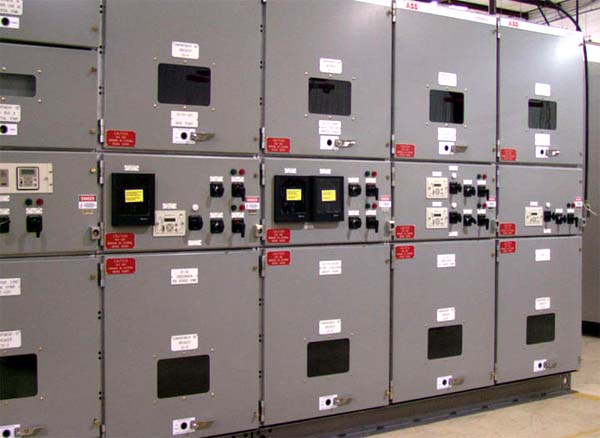
Комплектное распределительное устройство в металлической оболочке
Рис. ABBГОСТ 14693-90 - Устройства комплектные распределительные негерметизированные в металлической оболочке на напряжение до 10 кВ
Тематики
- комплектное распред. устройство (КРУ)
Синонимы
EN
- compartmented switchgear (with non-metallic partitions)
- cubicle switchgear
- MCSG
- MESG
- metal clad switch gear
- metal clad switchgear
- metal-enclosed switchgear
- metalclad switch gear
- metalclad switchgear
FR
Русско-французский словарь нормативно-технической терминологии > комплектное распределительное устройство в металлической оболочке
37 коэффициент замыкания на землю
коэффициент замыкания на землю
Отношение наибольшего фазного напряжения в месте металлического замыкания на землю к напряжению в той же точке при отсутствии замыкания.
[ ГОСТ 24291-90]
коэффициент замыкания на землю
Для данного места трехфазной системы заданной конфигурации отношение максимального значения фазного напряжения промышленной частоты на исправном линейном проводнике во время замыкания на землю одного или нескольких линейных проводников в какой-либо точке системы к значению напряжения промышленной частоты в данном месте при отсутствии какого-либо замыкания на землю.
[ ГОСТ Р МЭК 60050-195-2005]
коэффициент замыкания на землю
Отношение напряжения на неповрежденной фазе в рассматриваемой точке трехфазной электрической сети (обычно в точке установки электрооборудования) при замыкании на землю одной или двух других фаз к фазному напряжению рабочей частоты, которое установилось бы в данной точке при устранении замыкания.
Примечание. При определении коэффициента замыкания на землю место замыкания и состояние схемы электрической сети выбираются такими, которые дают наибольшее значение коэффициента
[ ГОСТ 1516.1-76]
коэффициент замыкания на землю
Коэффициент, определяющий отношение влияния на одну или более фаз в любой точке сети во время замыкания на землю другой исправной фазы при наивысшем значении ее напряжения в заданном месте при заданном местоположении трехфазной сети и для заданной конфигурации соответственно в отсутствие любого подобного замыкания. [IEV 604-03-06]
[ ГОСТ Р МЭК 60044-7-2010]EN
earth fault factor
at a given location of a three-phase system, and for a given system configuration, ratio of the highest root-mean-square value of line-to-earth power frequency voltage on a healthy line conductor during an earth fault affecting one or more line conductors at any point on the system, to the root-mean-square value of line-to-earth power frequency voltage which would be obtained at the given location in the absence of any such earth fault
Source: 604-03-06 MOD
[IEV number 195-05-14]FR
facteur de court-circuit à la terre
en un emplacement donné d'un réseau triphasé, et pour un schéma d'exploitation donné de ce réseau, rapport entre d'une part la tension efficace la plus élevée, à la fréquence du réseau, entre un conducteur de ligne saine et la terre pendant un défaut à la terre affectant un ou plusieurs conducteurs de ligne en un point quelconque du réseau, et d'autre part la valeur efficace de la tension phase-terre à la fréquence du réseau qui serait obtenue à l'emplacement considéré en l'absence d'un tel défaut à la terre
Source: 604-03-06 MOD
[IEV number 195-05-14]Тематики
EN
DE
FR
82 коэффициент замыкания на землю
Отношение наибольшего фазного напряжения в месте металлического замыкания на землю к напряжению в той же точке при отсутствии замыкания
604-03-06*
de Erdfehlerfactor
en earth fault factor
fr facteur de défaut à la terre
Источник: ГОСТ 24291-90: Электрическая часть электростанции и электрической сети. Термины и определения оригинал документа
Русско-французский словарь нормативно-технической терминологии > коэффициент замыкания на землю
38 коэффициент нулевой последовательности напряжения (тока)
коэффициент нулевой последовательности напряжения (тока)
Величина, равная отношению напряжения (тока) нулевой последовательности к фазному напряжению (току) прямой последовательности в многофазной системе электроснабжения.
Примечание. Для целей стандартизации допускается относить к номинальному напряжению (току).
[ ГОСТ 23875-88]EN
unbalance factor
in a three-phase system, the degree of unbalance expressed by the ratio (in per cent) between the r.m.s. values of the negative sequence (or the zero sequence) component and the positive sequence component of voltage or current
[IEV number 604-01-30]FR
taux de déséquilibre
dans un réseau triphasé, expression du degré de déséquilibre par le rapport, exprimé en pourcentage, entre la valeur efficace de chacune des composantes inverse ou homopolaire et celle de la composante directe de la tension ou du courant
[IEV number 604-01-30]Тематики
EN
DE
FR
Смотри также
43. Коэффициент нулевой последовательности напряжения (тока)
D. Unsymmetriegrad
E. Unbalance factor
F. Taux de déséquilibre
Величина, равная отношению напряжения (тока) нулевой последовательности к фазному напряжению (току) прямой последовательности в многофазной системе электроснабжения.
Примечание. Для целей стандартизации допускается относить к номинальному напряжению (току)
Источник: ГОСТ 23875-88: Качество электрической энергии. Термины и определения оригинал документа
Русско-французский словарь нормативно-технической терминологии > коэффициент нулевой последовательности напряжения (тока)
39 коэффициент обратной последовательности напряжения (тока)
коэффициент обратной последовательности напряжения (тока)
Величина, равная отношению напряжения (тока) обратной последовательности к напряжению (току) прямой последовательности в многофазной системе электроснабжения.
Примечание. Для целей стандартизации допускается относить к номинальному напряжению (току).
[ ГОСТ 23875-88]EN
unbalance factor
in a three-phase system, the degree of unbalance expressed by the ratio (in per cent) between the r.m.s. values of the negative sequence (or the zero sequence) component and the positive sequence component of voltage or current
[IEV number 604-01-30]FR
taux de déséquilibre
dans un réseau triphasé, expression du degré de déséquilibre par le rapport, exprimé en pourcentage, entre la valeur efficace de chacune des composantes inverse ou homopolaire et celle de la composante directe de la tension ou du courant
[IEV number 604-01-30]Тематики
EN
DE
FR
Смотри также
42. Коэффициент обратной последовательности напряжения (тока)
D. Unsymmetriegrad
E. Unbalance factor
F. Taux de déséquilibre
Величина, равная отношению напряжения (тока) обратной последовательности к напряжению (току) прямой последовательности в многофазной системе электроснабжения.
Примечание. Для целей стандартизации допускается относить к номинальному напряжению (току)
Источник: ГОСТ 23875-88: Качество электрической энергии. Термины и определения оригинал документа
Русско-французский словарь нормативно-технической терминологии > коэффициент обратной последовательности напряжения (тока)
40 кран трехходовой
кран трехходовой
Пробковый кран, сообщающий между собой три трубопровода
[Терминологический словарь по строительству на 12 языках (ВНИИИС Госстроя СССР)]Тематики
EN
DE
FR
Русско-французский словарь нормативно-технической терминологии > кран трехходовой
СтраницыСм. также в других словарях:
Three — (thr[=e]), a. [OE. [thorn]re, [thorn]reo, [thorn]ri, AS. [thorn]r[=i], masc., [thorn]re[ o], fem. and neut.; akin to OFries. thre, OS. thria, threa, D. drie, G. drei, OHG. dr[=i], Icel. [thorn]r[=i]r, Dan. & Sw. tre, Goth. [thorn]reis, Lith. trys … The Collaborative International Dictionary of English
three — /three/, n. 1. a cardinal number, 2 plus 1. 2. a symbol for this number, as 3 or III. 3. a set of this many persons or things. 4. a playing card, die face, or half of a domino face with three pips. adj. 5. amounting to three in number. 6. three… … Universalium
three — O.E. þreo, fem. and neut. (masc. þri, þrie), from P.Gmc. *thrijiz (Cf. O.Fris. thre, M.Du., Du. drie, O.H.G. dri, Ger. drei, O.N. þrir, Dan. tre), from PIE *trejes (Cf. Skt. trayas, Avestan thri, Gk. treis … Etymology dictionary
three — S1 [θri:] number [: Old English; Origin: thrie, threo] 1.) the number 3 ▪ They ve won their last three games. ▪ We d better go. It s almost three (=three o clock) . ▪ My little sister s only three (=three years old) . 2.) in threes in groups of… … Dictionary of contemporary English
three — three; three·ling; three·pence; three·pen·ny; three·pen·ny·worth; three·fold; three·some; … English syllables
Three — Three, n. 1. The number greater by a unit than two; three units or objects. [1913 Webster] 2. A symbol representing three units, as 3 or iii. [1913 Webster] {Rule of three}. (Arith.) See under {Rule}, n. [1913 Webster] [1913 Webster] … The Collaborative International Dictionary of English
Three Rs — (pronounced three ars ), can refer to: * Animal testing, an abbreviation for, reduce, replace, refine * The three Rs, a widely used abbreviation for the basic elements of a primary school curriculum: reading, ’riting (writing), and ’rithmetic… … Wikipedia
three-D — adjective a three D movie, picture, etc. looks as if it has height, depth, and width: a three D backdrop effect ╾ ,three D noun uncount: They re showing the film in three D … Usage of the words and phrases in modern English
three — [thrē] adj. [ME < OE threo, thrie, akin to Ger drei < IE base * trei > L tres, Gr treis, Sans tri] totaling one more than two n. 1. the cardinal number between two and four; 3; III 2. any group of three people or things 3. something… … English World dictionary
three-D — three D, 3 D [ˌθri: ˈdi:] adj a three D film or picture is made so that it appears to be three dimensional >three D n [U] ▪ a film in 3 D … Dictionary of contemporary English
three — ► CARDINAL NUMBER ▪ one more than two; 3. (Roman numeral: iii or III.) ● three parts Cf. ↑three parts DERIVATIVES threefold adjective & adverb. ORIGIN Old English … English terms dictionary
 18+© Академик, 2000-2026
- Обратная связь: Техподдержка, Реклама на сайте
Экспорт словарей на сайты, сделанные на PHP, Joomla, Drupal, WordPress, MODx.
Перевод: с русского на французский
с французского на русский- С французского на:
- Русский
- С русского на:
- Все языки
- Английский
- Итальянский
- Латинский
- Монгольский
- Немецкий
- Персидский
- Французский
- Эстонский