

-
1 израсходованная вода
израсходованная вода
—
[ http://www.eionet.europa.eu/gemet/alphabetic?langcode=en]EN
water for consumption
Consumptive water use starts with withdrawal, but in this case without any return, e.g. irrigation, steam escaping into the atmosphere, water contained in final products, i.e. it is no longer available directly for subsequent use. (Source: GOOD)
[http://www.eionet.europa.eu/gemet/alphabetic?langcode=en]Тематики
EN
DE
FR
Русско-французский словарь нормативно-технической терминологии > израсходованная вода
-
2 тепловое реле
тепловое реле
-
[Интент]
электротепловое реле
Электрическое реле, работа которого основана на тепловом действии электрического тока
[ ГОСТ 16022-83]EN
thermal electrical relay
dependent-time measuring relay which is intended to protect an equipment from electrical thermal damage by the measurement of the current flowing in the protected equipment and by a characteristic curve simulating its thermal behaviour
[IEC 62271-1, ed. 1.0 (2007-10)]FR
relais électrique thermique
relais de mesure à temps dépendant destiné à protéger un équipement contre les dommages thermiques d'origine électrique par la mesure du courant circulant dans l'équipement protégé et par une courbe caractéristique simulant son comportement thermique
[IEC 62271-1, ed. 1.0 (2007-10)]Параллельные тексты EN-RU
Meanwhile, EMPR (Electronic Motor Protection Relay), also called as ‘Electronic Overcurrent Relay’ or ‘Electronic Overload Relay) may replace TOR to protect a low voltage motor.
[LS Industrial Systems]При этом, для зашиты низковольтного электродвигателя, тепловое реле (TOR) можно заменить на электронное реле защиты электродвигателя (EMPR), которое также называют "электронное реле защиты от сверхтока" или электронное реле защиты от перегрузки.
[Перевод Интент]It is better to use a fan with thermal switches.
In this case the positioning of the fans should be taken care so as to not place the fan’s thermal switch close to heat dissipating devices so as to avoid any malfunctioning of thermal switch.
[Schneider Electric]
Лучше использовать вентиляторы с тепловым реле.
В этом случае вентиляторы следует разместить таким образом, чтобы рядом с тепловым реле не было аппаратов с сильным выделением тепла. Это позволит избежать неправильного срабатывания теплового реле.
[Перевод Интент]Тематики
- расцепитель, тепловое реле
- реле электрическое
EN
- thermal electrical relay
- thermal overload relay
- thermal protection
- thermal relay
- thermal switch
- thermoswitch
- TOR
DE
FR
Русско-французский словарь нормативно-технической терминологии > тепловое реле
-
3 длительный допустимый ток
- courant permanent admissible, m
- courant admissible, m
(длительный) допустимый ток
Максимальное значение электрического тока, который может протекать длительно по проводнику, устройству или аппарату при определенных условиях без превышения определенного значения их температуры в установившемся режиме
[ ГОСТ Р МЭК 60050-826-2009]
Этот ток обозначают IZ
[ ГОСТ Р 50571. 1-2009 ( МЭК 60364-1: 2005)]EN
(continuous) current-carrying capacity
ampacity (US)
maximum value of electric current which can be carried continuously by a conductor, a device or an apparatus, under specified conditions without its steady-state temperature exceeding a specified value
[IEV number 826-11-13]
ampacity
The current in amperes that a conductor can carry continuously under the conditions of use without exceeding its temperature rating.
[National Electrical Cod]FR
courant (permanent) admissible, m
valeur maximale du courant électrique qui peut parcourir en permanence, un conducteur, un dispositif ou un appareil, sans que sa température de régime permanent, dans des conditions données, soit supérieure à la valeur spécifiée
[IEV number 826-11-13]Ampacity, the term is defined as the maximum amount of current a cable can carry before sustaining immediate or progressive deterioration. Also described as current rating or current-carrying capacity, is the RMS electric current which a device can continuously carry while remaining within its temperature rating. The ampacity of a cable depends on:
- its insulation temperature rating;
- conductor electrical properties for current;
- frequency, in the case of alternating currents;
- ability to dissipate heat, which depends on cable geometry and its surroundings;
- ambient temperature.
Electric wires have some resistance, and electric current flowing through them causes voltage drop and power dissipation, which heats the cable. Copper or aluminum can conduct a large amount of current before melting, but long before the conductors melt, their insulation would be damaged by the heat.
The ampacity for a power cable is thus based on physical and electrical properties of the material & construction of the conductor and of its insulation, ambient temperature, and environmental conditions adjacent to the cable. Having a large overall surface area may dissipate heat well if the environment can absorb the heat.
In a long run of cable, different conditions govern, and installation regulations normally specify that the most severe condition along the run governs the cable's rating. Cables run in wet or oily locations may carry a lower temperature rating than in a dry installation. Derating is necessary for multiple circuits in close proximity. When multiple cables are near, each contributes heat to the others and diminishes the amount of cooling air that can flow past the individual cables. The overall ampacity of the insulated conductors in a bundle of more than 3 must be derated, whether in a raceway or cable. Usually the de-rating factor is tabulated in a nation's wiring regulations.
Depending on the type of insulating material, common maximum allowable temperatures at the surface of the conductor are 60, 75 and 90 degrees Celsius, often with an ambient air temperature of 30°C. In the U.S., 105°C is allowed with ambient of 40°C, for larger power cables, especially those operating at more than 2 kV. Likewise, specific insulations are rated 150, 200 or 250°C.
The allowed current in cables generally needs to be decreased (derated) when the cable is covered with fireproofing material.
For example, the United States National Electric Code, Table 310-16, specifies that up to three 8 AWG copper wires having a common insulating material (THWN) in a raceway, cable, or direct burial has an ampacity of 50 A when the ambient air is 30°C, the conductor surface temperature allowed to be 75°C. A single insulated conductor in air has 70 A rating.
Ampacity rating is normally for continuous current, and short periods of overcurrent occur without harm in most cabling systems. The acceptable magnitude and duration of overcurrent is a more complex topic than ampacity.
When designing an electrical system, one will normally need to know the current rating for the following:- Wires
- Printed Circuit Board traces, where included
- Fuses
- Circuit breakers
- All or nearly all components used
Some devices are limited by power rating, and when this power rating occurs below their current limit, it is not necessary to know the current limit to design a system. A common example of this is lightbulb holders.
[http://en.wikipedia.org/wiki/Ampacity]
Тематики
- электротехника, основные понятия
Синонимы
EN
DE
- Dauerstrombelastbarkeit, f
- Strombelastbarkeit, f
FR
- courant admissible, m
- courant permanent admissible, m
Русско-французский словарь нормативно-технической терминологии > длительный допустимый ток
-
4 гальваническая развязка
гальваническая развязка
Мероприятие или техническое средство, применение которого направлено на исключение гальванической связи между проводящими частями.
[РД-91.020.00-КТН-276-07]
гальваническая развязка
Схемотехническое решение, при котором исключается гальваническая связь между электрическими цепями. Гальваническая развязка осуществляется трансформаторами или оптоэлектронными приборами.
[Интент]EN
galvanic separation
prevention of electric conduction between two electric circuits intended to exchange power and/or signals
NOTE – Galvanic separation can be provided e.g. by an isolating transformer or an opto-coupler.
[IEV number 151-12-26]FR
séparation électrique, f
séparation galvanique (terme déconseillé), f
action ou moyen d’empêcher la conduction électrique entre deux circuits électriques prévus pour échanger de la puissance ou des signaux
NOTE – Une séparation électrique peut être obtenue, par exemple, au moyen d’un transformateur de séparation (de circuits) ou d’un optocoupleur.
[IEV number 151-12-26]Параллельные тексты EN-RU
Electrical isolation means that no current flow can occur from one electric circuit to a neighboring other electric circuit.
In case of power supplies, this means that no electric connection exists between the input side and the output side.
[ABB]Гальваническая развязка означает, что электрический ток не может протекать из какой-либо цепи в соседнюю цепь.
Для источников электропитания это означает, что не существует электрической связи между входной и выходной сторонами.
[Перевод Интент]The measured values are electrically isolated.
[Schneider Electric]Измеряемые величины гальванически развязаны от цепей устройства.
[Перевод Интент]Недопустимые, нерекомендуемые
Тематики
- электротехника, основные понятия
Близкие понятия
EN
DE
- galvanische Trennung
- Wellenimpedanz, (Leitungs-)
FR
Русско-французский словарь нормативно-технической терминологии > гальваническая развязка
-
5 интергармоническая частота
интергармоническая частота
Любая частота, не кратная основной частоте.По аналогии с порядком кратности гармоник порядок интергармонической частоты основан на отношении к основной частоте. Если это отношение меньше единицы, то такую гармоническую частоту называют субгармонической. В соответствии с рекомендацией МЭК порядок интергармонических частот обозначается буквой «m»
EN
interharmonic frequency
frequency which is a non-integer multiple of the reference fundamental frequency
NOTE 1 By extension of the harmonic order, the interharmonic order is the ratio of interharmonic frequency to the reference fundamental frequency, this ratio is not an integer (recommended notation " m ").
NOTE 2 In the case where " m 1" the term of sub-harmonic frequency may also be used (see IEV 551-20-10).
[IEC 60146-1-1, ed. 4.0 (2009-06)]FR
fréquence interharmonique
fréquence qui est un multiple non entier de la fréquence fondamentale de référence
NOTE 1 Par extension du rang harmonique, le rang interharmonique désigne le rapport de la fréquence interharmonique à la fréquence fondamentale de référence. Ce rapport n’est pas un entier (notation recommandée « m »).
NOTE 2 Lorsque « m < 1 », le terme de fréquence sous-harmonique peut également être employé (voir VEI 551-20-10).
[IEC 60146-1-1, ed. 4.0 (2009-06)]Тематики
EN
FR
Русско-французский словарь нормативно-технической терминологии > интергармоническая частота
-
6 нефтесвязующее вещество
нефтесвязующее вещество
—
[ http://www.eionet.europa.eu/gemet/alphabetic?langcode=en]EN
oil binding agent
Highly absorbent agents used for physically removing spilled oil in case of leakages and oil accidents occurring in water bodies, industry, work-shops, on roads, etc. Materials that have been found useful for this service vary from simple, naturally occurring materials such as straw, sawdust, and peat to synthetic agents, such as polyurethane foam and polystyrene powder. (Source: FUNKE / PZ)
[http://www.eionet.europa.eu/gemet/alphabetic?langcode=en]Тематики
EN
DE
FR
Русско-французский словарь нормативно-технической терминологии > нефтесвязующее вещество
-
7 номинальное напряжение
номинальное напряжение
Напряжение, установленное изготовителем для прибора
[ ГОСТ Р 52161. 1-2004 ( МЭК 60335-1: 2001)]
номинальное напряжение Uном, кВ
Номинальное междуфазное напряжение электрической сети, для работы в которой предназначены коммутационные аппараты.
[ ГОСТ Р 52726-2007]
номинальное напряжение
Un
Напряжение, применяемое для обозначения или идентификации системы электроснабжения.
[ ГОСТ Р 51317.4.30-2008 (МЭК 61000-4-30:2008)]EN
rated voltage
voltage assigned to the appliance by the manufacturer
[IEC 60335-1, ed. 4.0 (2001-05)]
rated voltage
quantity value assigned, generally by the manufacturer, for a specified operating condition of a machine
[IEC 60034-18-41, ed. 1.0 (2006-10)]
rated voltage
input or output supply voltage for which equipment is designed or specified
[IEC 88528-11, ed. 1.0 (2004-03)]
rated voltage
specified value of the voltage at the terminals of the machine when operating at a rating. If unidirectional, the voltage is the arithmetic mean of the recurring waveform and if alternating it is the root mean square value of the fundamental frequency component of the recurring waveform
NOTE - In the case of a machine with a protective resistor permanently in series, the resistor is considered as an integral part of the machine
[IEC 60349-1, ed. 1.0 (1999-11)]
rated voltage
the value of voltage assigned by the manufacturer to a component, device or equipment and to which operation and performance characteristics are referred
NOTE - Equipment may have more than one rated voltage value or may have a rated voltage range.
[IEC 62497-1, ed. 1.0 (2010-02)]
rated voltage
reference voltage for which the cable is designed, and which serves to define the electrical tests
NOTE 1 - The rated voltage is expressed by the combination of two values: Uo/U expressed in volts (V):
Uo being the r.m.s. value between any insulated conductor and "earth" (metal covering of the cable or the surrounding medium);
U being the r.m.s. value between any two phase conductors of a multicore cable or of a system of single-core cables.
In an alternating-current system, the rated voltage of a cable is at least equal to the nominal voltage of the system for which it is intended.
This condition applies both to the value Uo and to the value U.
In a direct current system, the nominal voltage of the system is not higher than 1,5 times the rated voltage of the cable.
NOTE 2 - The operating voltage of a system may permanently exceed the nominal voltage of such a system by 10 %. A cable can be used at a 10 % higher operating voltage than its rated voltage if the latter is at least equal to the nominal voltage of the system
[IEC 60245-1, ed. 4.0 (2003-12)]
rated voltage
highest allowable voltage between the conductors in a twin and multi conductor cable, or between one conductor and an electrical conductive screen, or between the two ends of a single core cable, or earth in unscreened cables
[IEC 60800, ed. 3.0 (2009-07)]
rated voltage
the r.m.s. line-to-line voltage under rated conditions
Primary side of input transformer: ULN
Converter input: UVN
Converter output: UaN
Motor voltage: UAN
[IEC 61800-4, ed. 1.0 (2002-09)]
rated voltage
input or output voltage (for three-phase supply, the phase-to-phase voltage) as declared by the manufacturer
[IEC 62040-1, ed. 1.0 (2008-06)]
nominal voltage, Un
voltage by which a system is designated or identified
[IEC 61000-4-30, ed. 2.0 (2008-10)]FR
tension assignée
tension attribuée à l'appareil par le fabricant
[IEC 60335-1, ed. 4.0 (2001-05)]
tension nominale
tension assignée, généraleme<>value of voltage assigned by the manufacturer, to a componentnt par le constructeur pour des conditions spécifiées de fonctionnement de la machine
[IEC 60034-18-41, ed. 1.0 (2006-10)]
tension assignée
tension spécifiée aux bornes de la machine quand celle-ci fonctionne au régime assigné. Dans le cas d'une tension redressée, sa valeur est égale à la valeur moyenne de l'onde périodique. Dans le cas d'une tension alternative, sa valeur est égale à la valeur efficace de la composante fondamentale de l'onde périodique
NOTE - Dans le cas d'une machine équipée d'une résistance de protection connectée en permanence en série, la résistance est considérée comme faisant partie intégrante de la machine
[IEC 60349-1, ed. 1.0 (1999-11)]
tension assignée
valeur de la tension, assignée par le constructeur à un composant, à un dispositif ou à un matériel, et à laquelle on se réfère pour le fonctionnement et pour les caractéristiques fonctionnelles
NOTE - Les matériels peuvent avoir plusieurs valeurs ou une plage de tensions assignées.
[IEC 62497-1, ed. 1.0 (2010-02)]
tension assignée
tension de référence pour laquelle le conducteur ou le câble est prévu et qui sert à définir les essais électriques
NOTE 1 - La tension assignée est exprimée par la combinaison de deux valeurs Uo /U, exprimées en volts (V):
Uo étant la valeur efficace entre l'âme d'un conducteur isolé quelconque et la «terre» (revêtement métallique du câble au milieu environnant);
U étant la valeur efficace entre les âmes conductrices de deux conducteurs de phase quelconques d'un câble multiconducteur ou d'un système de câbles monoconducteurs ou de conducteurs.
Dans un système à courant alternatif, la tension assignée d'un conducteur ou d’un câble est au moins égale à la tension nominale du système pour lequel il est prévu.
Cette condition s'applique à la fois à la valeur Uo et à la valeur U.
Dans un système à courant continu, la tension nominale admise du système n’est pas supérieure à 1,5 fois la tension assignée du conducteur ou du câble.
NOTE 2 - La tension de service d'un système peut en permanence dépasser la tension nominale dudit système de 10 %. Un conducteur ou un câble peut être utilisé à une tension de service supérieure de 10 % à sa tension assignée si cette dernière est au moins égale à la tension nominale du système
[IEC 60245-1, ed. 4.0 (2003-12)]
tension assignée
tension maximale admissible entre les âmes dans un câble ayant une paire ou multi conducteur ou entre une âme et un écran conducteur électrique ou avec la terre pour un câble non écranté ou encore entre les deux extrémités d’un câble à âme unique
[IEC 60800, ed. 3.0 (2009-07)]
tension assignée
valeur efficace de la tension de ligne (entre phases) dans les conditions assignées
Primaire du transformateur d’entrée: ULN
Entrée du convertisseur: UVN
Sortie du convertisseur: UaN
Moteur: UAN
[IEC 61800-4, ed. 1.0 (2002-09)]
tension assignée
tension d’alimentation d’entrée ou de sortie (dans le cas d’une alimentation triphasée, tension entre phases) déclarée par le constructeur
[IEC 62040-1, ed. 1.0 (2008-06)]
tension nominale, Un
tension par laquelle un réseau est désigné ou identifié
[IEC 61000-4-30, ed. 2.0 (2008-10)]Тематики
- аппарат, изделие, устройство...
- высоковольтный аппарат, оборудование...
- прибор электрический
- электроснабжение в целом
Синонимы
- Un
EN
FR
Русско-французский словарь нормативно-технической терминологии > номинальное напряжение
-
8 приказ
приказ
—
[ http://www.eionet.europa.eu/gemet/alphabetic?langcode=en]EN
order
1) A direction or command of a court. In this sense it is often used synonymously with judgment.
2) The document bearing the seal of the court recording its judgment in a case.
(Source: DICLAW)
[http://www.eionet.europa.eu/gemet/alphabetic?langcode=en]Тематики
EN
DE
FR
Русско-французский словарь нормативно-технической терминологии > приказ
-
9 провал напряжения
провал напряжения
Внезапное значительное снижение напряжения в системе электроснабжения с последующим его восстановлением.
[ ГОСТ 23875-88]
провал напряжения
Внезапное понижение напряжения в точке электрической сети ниже 0,9 Uном, за которым следует восстановление напряжения до первоначального или близкого к нему уровня через промежуток времени от десяти миллисекунд до нескольких десятков секунд.
[ ГОСТ 13109-97]
провал напряжения
Динамическое изменение напряжения в сети электропитания в виде снижения напряжения за нижний допустимый предел
[ ГОСТ 19542-93]
провал напряжения
Временное уменьшение напряжения в конкретной точке электрической системы ниже порогового значения.
Примечание — Прерывание напряжения является особым случаем провала напряжения. Отличие прерывания напряжения от провала напряжения может быть установлено последующей обработкой результатов измерений.
[ ГОСТ Р 51317.4.30-2008 (МЭК 61000-4-30:2008)]EN
voltage dip
a sudden reduction of the voltage at a point in an electrical system followed by voltage recovery after a short period of time from a few cycles to a few seconds
Source: 604-01-25
[IEV number 161-08-10]
voltage dip
temporary reduction of the voltage magnitude at a point in the electrical system below a threshold
NOTE 1 Interruptions are a special case of a voltage dip. Post-processing may be used to distinguish between voltage dips and interruptions.
NOTE 2 A voltage dip is also referred to as sag. The two terms are considered interchangeable; however, this standard will only use the term voltage dip
[IEC 61000-4-30, ed. 2.0 (2008-10)]FR
creux de tension
baisse brutale de la tension en un point d'un réseau d'énergie électrique, suivie d'un rétablissement de la tension après un court laps de temps de quelques périodes à quelques secondes
Source: 604-01-25
[IEV number 161-08-10]
creux de tension
baisse temporaire de l’amplitude de la tension en un point du réseau d’énergie électrique en dessous d’un seuil donné
NOTE 1 Les interruptions sont un cas particulier des creux de tension. Les traitements ultérieurs permettent de faire la distinction entre creux de tension et interruption.
NOTE 2 La Note 2 s'applique uniquement à la version anglaise.
[IEC 61000-4-30, ed. 2.0 (2008-10)]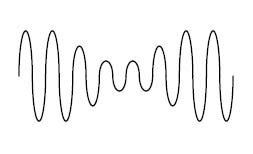
Провал напряженияНедопустимые, нерекомендуемые
Примечание(1)- Мнение автора карточкиТематики
Обобщающие термины
EN
DE
FR
Смотри также
D. Spannungseinbruch
E. Voltage dip
F. Greux de tension
Внезапное значительное снижение напряжения в системе электроснабжения с последующим его восстановлением
Источник: ГОСТ 23875-88: Качество электрической энергии. Термины и определения оригинал документа
Русско-французский словарь нормативно-технической терминологии > провал напряжения
10 пуск переключением со звезды на треугольник
пуск переключением со звезды на треугольник
-EN
star-delta starting
the process of starting a three-phase motor by connecting it to the supply with the primary winding initially connected in star, then reconnected in delta for the running condition
[IEV number 411-52-16]FR
démarrage étoile-triangle
mode de démarrage d'un moteur triphasé à tension réduite, consistant à relier à la source à tension constante les enroulements statoriques, d'abord en couplage étoile, puis à passer au couplage triangle pour le fonctionnement normal
[IEV number 411-52-16]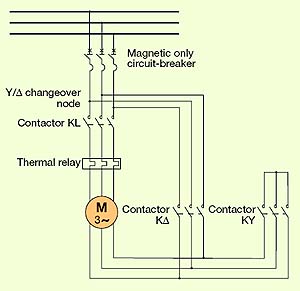
Magnetic only circuit-breaker - Автоматический выключатель с электромагнитным расцепителем
Y/Δ changeover node - Узел переключения со звезды на треугольник
Contactor KL - Контактор KL
Thermal relay - Тепловое реле
Contactor KΔ - Контактор KΔ
Contactor KY- Контактор KY
Параллельные тексты EN-RU Star-delta Y/Δ starting
Star-delta starting is the best known system and perhaps the commonest starting system at reduced voltage; it is used to start the motor reducing the mechanical stresses and limiting the current values during starting; on the other hand, it makes available a reduced inrush torque.This system can be used for motors with terminal box with 6 terminals and double supply voltage.
It is particularly suitable for no-load starting or with low and constant load torque or lightly increasing load torque, such as in the case of fans or low power centrifugal pumps.
Making reference to the diagram of Figure 6, the starting modality foresees the initial phase with star-connection of the windings to be realized through the closing of the circuit-breaker, of the line contactor KL and of the star contactor KY.
After a suitable predetermined period of time, the opening of the contactor KY and the closing of KΔ allow switching to delta-connection, which is also the configuration of normal running position.
[ABB]Пуск переключением со звезды на треугольник
Пуск переключением со звезды на треугольник является самым известным способом и, возможно, самой распространенной схемой пуска на пониженном напряжении. С одной стороны, этот способ используется для снижения механических нагрузок и ограничения пускового тока, а с другой - обеспечивает уменьшение пускового момента.Такая возможность может быть реализована в двигателях с шестью зажимами в выводной коробке, что позволяет питать его от двух напряжений.
Особенно этот способ подходит для ненагруженного пуска и пуска с низким постоянным или немного увеличивающимся вращающим моментом, например, для пуска вентиляторов или маломощных центробежных насосов.
Схема пуска переключением со звезды на треугольник представлена на рисунке 6. В начальный момент пуска обмотки статора соединяют звездой путем замыкания контактов автоматического выключателя, линейного контактора KL и контактора KY со схемой "звезда".
По истечении заданного времени контакты контактора KY размыкаются и замыкаются контакты контактора КΔ со схемой треугольник.
В результате выполняется переключение обмоток статора со схемы «звезда» на схему «треугольник».
Обе схемы соединения обмоток являются схемами нормального рабочего режима.
[Перевод Интент]Тематики
Обобщающие термины
EN
- star-delta starting
- Y/Δ starting
DE
FR
Русско-французский словарь нормативно-технической терминологии > пуск переключением со звезды на треугольник
См. также в других словарях:
for this case alone — index ad hoc Burton s Legal Thesaurus. William C. Burton. 2006 … Law dictionary
crack this case — solve a crime, discover who is guilty David will crack this case; he s a thorough investigator … English idioms
Case study — This article is about the method of doing research. For the teaching method, see Case method. For the method of teaching law, see Casebook method. A case study is an intensive analysis of an individual unit (e.g., a person, group, or event)… … Wikipedia
case — 1. There are two distinct nouns: a) The one meaning ‘an example of an occurrence’: In this case they are wrong. From this use there have developed several idiomatic phrases (in case, in any case, in some cases, in the case of) as well as several… … Modern English usage
This is SportsCenter — is the name of a series of comical television commercials run by ESPN to promote their SportsCenter sports news show. A few are available free on iTunes. The ads are presented in a deadpan mockumentary style, lampooning various aspects of sports … Wikipedia
in this case — in this situation, if so, if we consider this situation … English contemporary dictionary
Case citation — Various case citations redirect here. If you are looking for the actual text of an opinion, it is usually linked in the external links at the bottom of the article on that case. For Wikipedia s template for case citation, see {{Template:Cite… … Wikipedia
case — case1 W1S1 [keıs] n ▬▬▬▬▬▬▬ 1¦(example)¦ 2¦(situation)¦ 3 (just) in case 4 in any case 5 in that case 6¦(reason/argument)¦ 7¦(law/crime)¦ 8¦(box/container)¦ 9 it s a case of something 10¦(disease)¦ … Dictionary of contemporary English
case — noun 1 example ADJECTIVE ▪ classic, textbook, typical ▪ clear, obvious, simple ▪ It was a simple case of mistaken identity … Collocations dictionary
case — I n. legal action argument 1) to hear, try a case (the court will not hear this case) 2) to argue, plead a case (the lawyer argued the case skillfully) 3) to make (out), present, state; take a case (she made out a good case for her client; the… … Combinatory dictionary
Case Information Statement — Civil procedure in the United States Federal Rules of Civil Procedure Doctrines of civil procedure Jurisdiction Subject matter jurisdiction Diversity jurisdiction Personal jurisdiction Removal jurisdiction Venue Change of venue … Wikipedia
Перевод: с русского на французский
с французского на русский- С французского на:
- Русский
- С русского на:
- Все языки
- Английский
- Итальянский
- Немецкий
- Французский
this+case

18+
© Академик, 2000-2026
- Обратная связь: Техподдержка, Реклама на сайте
Экспорт словарей на сайты, сделанные на PHP, Joomla, Drupal, WordPress, MODx.