

-
1 courant admissible, m
(длительный) допустимый ток
Максимальное значение электрического тока, который может протекать длительно по проводнику, устройству или аппарату при определенных условиях без превышения определенного значения их температуры в установившемся режиме
[ ГОСТ Р МЭК 60050-826-2009]
Этот ток обозначают IZ
[ ГОСТ Р 50571. 1-2009 ( МЭК 60364-1: 2005)]EN
(continuous) current-carrying capacity
ampacity (US)
maximum value of electric current which can be carried continuously by a conductor, a device or an apparatus, under specified conditions without its steady-state temperature exceeding a specified value
[IEV number 826-11-13]
ampacity
The current in amperes that a conductor can carry continuously under the conditions of use without exceeding its temperature rating.
[National Electrical Cod]FR
courant (permanent) admissible, m
valeur maximale du courant électrique qui peut parcourir en permanence, un conducteur, un dispositif ou un appareil, sans que sa température de régime permanent, dans des conditions données, soit supérieure à la valeur spécifiée
[IEV number 826-11-13]Ampacity, the term is defined as the maximum amount of current a cable can carry before sustaining immediate or progressive deterioration. Also described as current rating or current-carrying capacity, is the RMS electric current which a device can continuously carry while remaining within its temperature rating. The ampacity of a cable depends on:
- its insulation temperature rating;
- conductor electrical properties for current;
- frequency, in the case of alternating currents;
- ability to dissipate heat, which depends on cable geometry and its surroundings;
- ambient temperature.
Electric wires have some resistance, and electric current flowing through them causes voltage drop and power dissipation, which heats the cable. Copper or aluminum can conduct a large amount of current before melting, but long before the conductors melt, their insulation would be damaged by the heat.
The ampacity for a power cable is thus based on physical and electrical properties of the material & construction of the conductor and of its insulation, ambient temperature, and environmental conditions adjacent to the cable. Having a large overall surface area may dissipate heat well if the environment can absorb the heat.
In a long run of cable, different conditions govern, and installation regulations normally specify that the most severe condition along the run governs the cable's rating. Cables run in wet or oily locations may carry a lower temperature rating than in a dry installation. Derating is necessary for multiple circuits in close proximity. When multiple cables are near, each contributes heat to the others and diminishes the amount of cooling air that can flow past the individual cables. The overall ampacity of the insulated conductors in a bundle of more than 3 must be derated, whether in a raceway or cable. Usually the de-rating factor is tabulated in a nation's wiring regulations.
Depending on the type of insulating material, common maximum allowable temperatures at the surface of the conductor are 60, 75 and 90 degrees Celsius, often with an ambient air temperature of 30°C. In the U.S., 105°C is allowed with ambient of 40°C, for larger power cables, especially those operating at more than 2 kV. Likewise, specific insulations are rated 150, 200 or 250°C.
The allowed current in cables generally needs to be decreased (derated) when the cable is covered with fireproofing material.
For example, the United States National Electric Code, Table 310-16, specifies that up to three 8 AWG copper wires having a common insulating material (THWN) in a raceway, cable, or direct burial has an ampacity of 50 A when the ambient air is 30°C, the conductor surface temperature allowed to be 75°C. A single insulated conductor in air has 70 A rating.
Ampacity rating is normally for continuous current, and short periods of overcurrent occur without harm in most cabling systems. The acceptable magnitude and duration of overcurrent is a more complex topic than ampacity.
When designing an electrical system, one will normally need to know the current rating for the following:- Wires
- Printed Circuit Board traces, where included
- Fuses
- Circuit breakers
- All or nearly all components used
Some devices are limited by power rating, and when this power rating occurs below their current limit, it is not necessary to know the current limit to design a system. A common example of this is lightbulb holders.
[http://en.wikipedia.org/wiki/Ampacity]
Тематики
- электротехника, основные понятия
Синонимы
EN
DE
- Dauerstrombelastbarkeit, f
- Strombelastbarkeit, f
FR
- courant admissible, m
- courant permanent admissible, m
Франко-русский словарь нормативно-технической терминологии > courant admissible, m
-
2 courant permanent admissible, m
(длительный) допустимый ток
Максимальное значение электрического тока, который может протекать длительно по проводнику, устройству или аппарату при определенных условиях без превышения определенного значения их температуры в установившемся режиме
[ ГОСТ Р МЭК 60050-826-2009]
Этот ток обозначают IZ
[ ГОСТ Р 50571. 1-2009 ( МЭК 60364-1: 2005)]EN
(continuous) current-carrying capacity
ampacity (US)
maximum value of electric current which can be carried continuously by a conductor, a device or an apparatus, under specified conditions without its steady-state temperature exceeding a specified value
[IEV number 826-11-13]
ampacity
The current in amperes that a conductor can carry continuously under the conditions of use without exceeding its temperature rating.
[National Electrical Cod]FR
courant (permanent) admissible, m
valeur maximale du courant électrique qui peut parcourir en permanence, un conducteur, un dispositif ou un appareil, sans que sa température de régime permanent, dans des conditions données, soit supérieure à la valeur spécifiée
[IEV number 826-11-13]Ampacity, the term is defined as the maximum amount of current a cable can carry before sustaining immediate or progressive deterioration. Also described as current rating or current-carrying capacity, is the RMS electric current which a device can continuously carry while remaining within its temperature rating. The ampacity of a cable depends on:
- its insulation temperature rating;
- conductor electrical properties for current;
- frequency, in the case of alternating currents;
- ability to dissipate heat, which depends on cable geometry and its surroundings;
- ambient temperature.
Electric wires have some resistance, and electric current flowing through them causes voltage drop and power dissipation, which heats the cable. Copper or aluminum can conduct a large amount of current before melting, but long before the conductors melt, their insulation would be damaged by the heat.
The ampacity for a power cable is thus based on physical and electrical properties of the material & construction of the conductor and of its insulation, ambient temperature, and environmental conditions adjacent to the cable. Having a large overall surface area may dissipate heat well if the environment can absorb the heat.
In a long run of cable, different conditions govern, and installation regulations normally specify that the most severe condition along the run governs the cable's rating. Cables run in wet or oily locations may carry a lower temperature rating than in a dry installation. Derating is necessary for multiple circuits in close proximity. When multiple cables are near, each contributes heat to the others and diminishes the amount of cooling air that can flow past the individual cables. The overall ampacity of the insulated conductors in a bundle of more than 3 must be derated, whether in a raceway or cable. Usually the de-rating factor is tabulated in a nation's wiring regulations.
Depending on the type of insulating material, common maximum allowable temperatures at the surface of the conductor are 60, 75 and 90 degrees Celsius, often with an ambient air temperature of 30°C. In the U.S., 105°C is allowed with ambient of 40°C, for larger power cables, especially those operating at more than 2 kV. Likewise, specific insulations are rated 150, 200 or 250°C.
The allowed current in cables generally needs to be decreased (derated) when the cable is covered with fireproofing material.
For example, the United States National Electric Code, Table 310-16, specifies that up to three 8 AWG copper wires having a common insulating material (THWN) in a raceway, cable, or direct burial has an ampacity of 50 A when the ambient air is 30°C, the conductor surface temperature allowed to be 75°C. A single insulated conductor in air has 70 A rating.
Ampacity rating is normally for continuous current, and short periods of overcurrent occur without harm in most cabling systems. The acceptable magnitude and duration of overcurrent is a more complex topic than ampacity.
When designing an electrical system, one will normally need to know the current rating for the following:- Wires
- Printed Circuit Board traces, where included
- Fuses
- Circuit breakers
- All or nearly all components used
Some devices are limited by power rating, and when this power rating occurs below their current limit, it is not necessary to know the current limit to design a system. A common example of this is lightbulb holders.
[http://en.wikipedia.org/wiki/Ampacity]
Тематики
- электротехника, основные понятия
Синонимы
EN
DE
- Dauerstrombelastbarkeit, f
- Strombelastbarkeit, f
FR
- courant admissible, m
- courant permanent admissible, m
Франко-русский словарь нормативно-технической терминологии > courant permanent admissible, m
-
3 constructeur d'origine
изготовитель НКУ
Организация, которая выполнила разработку конструкции, изготовление и необходимую проверку на соответствие НКУ требованиям конкретного стандарта.
[ ГОСТ Р МЭК 61439-1-2013]EN
original manufacturer
organization that has carried out the original design and the associated verification of an assembly in accordance with the relevant assembly standard
[IEC 61439-1, ed. 2.0 (2011-08)]FR
constructeur d'origine
organisme qui a réalisé la conception d'origine et la vérification associée d’un ensemble conformément à la norme d’ensembles applicable
[IEC 61439-1, ed. 2.0 (2011-08)]Параллельные тексты EN-RU
6.1 ASSEMBLY designation marking
The ASSEMBLY manufacturer shall provide each ASSEMBLY with one or more labels, marked in a durable manner and located in a place such that they are visible and legible when the ASSEMBLY is installed and in operation.
Compliance is checked according to the test of 10.2.7 and by inspection.
The following information regarding the ASSEMBLY shall be provided on the designation label(s):
a) ASSEMBLY manufacturer's name or trade mark (see 3.10.2);
b) type designation or identification number or any other means of identification, making it possible to obtain relevant information from the ASSEMBLY manufacturer;
c) means of identifying date of manufacture;
d) IEC 61439-X (the specific part “X” shall be identified).
NOTE The relevant ASSEMBLY standard may specify where additional information is to be provided on the designation label.
[BS EN 61439-1:2009]6.1 Маркировка
Изготовитель НКУ должен предусмотреть на каждом НКУ одну или несколько табличек со стойкой к внешним воздействиям маркировкой, которые после установки и в процессе эксплуатации НКУ должны быть расположены на видном месте.
Соответствие проверяют испытанием по 10.2.7 и внешним осмотром.
На паспортной табличке должна быть приведена информация об НКУ, указанная в перечислениях а) — d):
a) наименование изготовителя или его товарный знак (см. 3.10.2):
b) обозначение типа, идентификационный или другой знак, позволяющий получить необходимую информацию от изготовителя;
c) обозначение даты изготовления;
d) обозначение настоящего стандарта.
Примечание — На паспортной табличке может быть приведено обозначение конкретного стандарта на НКУ, если требуется дополнительная информация.
[ ГОСТ Р МЭК 61439.1-2013]
Тематики
- НКУ (шкафы, пульты,...)
Синонимы
EN
- assembly manufacturer
- ASSEMBLY manufacturer
- original equipment manufacturer
- original manufacturer
- panel builder
- panel-builder
- switchboard manufacturer
FR
разработчик НКУ
-
[Интент]
разработчик НКУ
Организация, которая выполнила разработку конструкции и необходимую проверку на соответствие НКУ требованиям конкретного стандарта.
[ ГОСТ Р МЭК 61439.1-2012]EN
original manufacturer
organization that has carried out the original design and the associated verification of an assembly in accordance with the relevant assembly standard
[IEC 61439-1, ed. 2.0 (2011-08)]FR
constructeur d'origine
organisme qui a réalisé la conception d'origine et la vérification associée d’un ensemble conformément à la norme d’ensembles applicable
[IEC 61439-1, ed. 2.0 (2011-08)]Тематики
- НКУ (шкафы, пульты,...)
EN
FR
Франко-русский словарь нормативно-технической терминологии > constructeur d'origine
-
4 série homogène (d'éléments de remplacement)
однородная серия плавких вставок
Ряд плавких вставок в пределах данного типоразмера, отличающихся одна от другой лишь тем, что испытания одной вставки этого ряда или ограниченного числа таких вставок можно считать достаточными для всех плавких вставок этого ряда.
Примечание:
Характеристики, по которым можно различать плавкие вставки одной серии, и характерные особенности для испытания этих плавких вставок указывают для соответствующих испытаний (см. таблицы 7 В и 7С).
[ ГОСТ Р 50339. 0-2003 ( МЭК 60269-1-98)]
однородная серия плавких вставок предохранителей
Серия плавких вставок данного типоразмера, отличающихся друг от друга только такими параметрами и характеристиками, для которых результаты испытаний одной или сокращенного числа отдельных плавких вставок этой серии могут быть распространены на все плавкие вставки этой серии.
[ ГОСТ 17242-86]EN
homogeneous series (of fuse-link)
series of fuse-links, deviating from each other only in such characteristics that, for a given test, the testing of one or a reduced number of particular fuse-link(s) of that series may be taken as representative for all the fuse-links of the homogeneous series.
NOTE The relevant publications specify the characteristics by which the fuse-links of a homogeneous series may deviate, the particular fuse-links to be tested and the specific test concerned.
[IEC 60282-2, ed. 3.0 (2008-04)]FR
série homogène (d'éléments de remplacement)
série d'éléments de remplacement dont chacun ne diffère de l'autre que par des caractéristiques telles que, pour un essai donné, l'essai d'un seul ou d'un nombre réduit d'éléments de remplacement déterminés de la série peut être considéré comme représentatif de tous les éléments de remplacement de la série
NOTE Les publications particulières spécifient les caractéristiques par lesquelles les éléments de remplacement d’une série homogène peuvent différer les uns des autres, les éléments de remplacement spécifiques à essayer et l’essai particulier à considérer.
[IEC 60282-2, ed. 3.0 (2008-04)]Тематики
EN
FR
Франко-русский словарь нормативно-технической терминологии > série homogène (d'éléments de remplacement)
-
5 relais à impulsion retardée, m
реле задержки импульса
-
[Интент]EN
pulse delayed relay
time relay in which the time delay starts when applying the power supply; the output momentarily switches for an interval to the operate condition after the time delay has elapsed (see Figure 8)
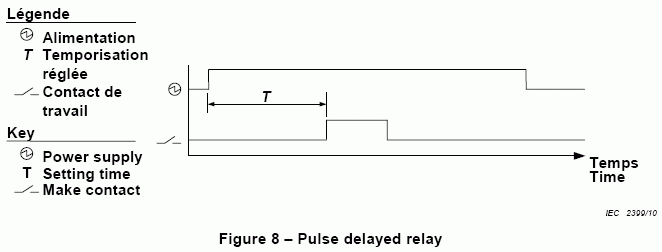
NOTE – Manufacturer should specify if interval is fixed or variable
[IEV ref 445-01-11]FR
relais à impulsion retardée, m
relais temporisé dont la temporisation démarre dès l’application de l’alimentation et dont la sortie passe momentanément à l’état de travail pour une durée donnée dès que la temporisation réglée est écoulée (voir Figure 8)
NOTE – Il convient pour le fabricant d’indiquer si la durée de l’intervalle est fixe ou réglable.
[IEV ref 445-01-11]Тематики
EN
DE
- impulsverzögertes Relais, n
FR
- relais à impulsion retardée, m
Франко-русский словарь нормативно-технической терминологии > relais à impulsion retardée, m
-
6 relais à impulsion retardée avec signal de commande, m
- реле задержки импульса, отсчитываемой от подачи напряжения на управляющий вход
реле задержки импульса, отсчитываемой от подачи напряжения на управляющий вход
-
[Интент]EN
pulse delayed relay with control signal
time relay in which the time delay starts when applying the power supply and the control signal; the output momentarily switches for an interval to the operate condition after the setting time has elapsed (see Figure 9)
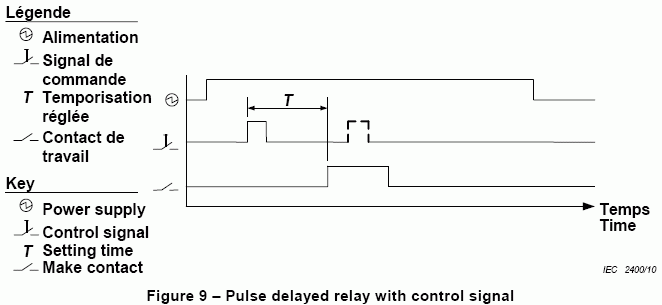
NOTE 1 – Cycling the control signal during the time delay will not retrigger the time delay.
NOTE 2 – Manufacturer should specify if interval is fixed or variable.
[IEV ref 445-01-12]FR
relais à impulsion retardée avec signal de commande, m
relais temporisé dont la temporisation démarre dès l’application de l’alimentation et du signal de commande et dont la sortie passe momentanément à l’état de travail pour un intervalle donné dès que la temporisation est écoulée (voir Figure 9)
NOTE 1 – La répétition du signal de commande pendant le délai peut ne pas réinitialiser la temporisation.
NOTE 2 – Il convient pour le fabricant d’indiquer si la durée de l’intervalle est fixe ou réglable.
[IEV ref 445-01-12]Тематики
EN
DE
- impulsverzögertes Relais mit Steuersignal, n
FR
- relais à impulsion retardée avec signal de commande, m
Франко-русский словарь нормативно-технической терминологии > relais à impulsion retardée avec signal de commande, m
См. также в других словарях:
specify — spe‧ci‧fy [ˈspesfaɪ] verb specified PTandPP [transitive] to state something in an exact and detailed way: • It is useful to specify the due date for payment. • The work must be completed within the specified period agreed in the contract.… … Financial and business terms
Specify — Spec i*fy, v. t. [imp. & p. p. {Specified}; p. pr. & vb. n. {Specifying}.] [F. sp[ e]cifier, or OF. especifier, fr. LL. specificare. See {Species}, { fy}.] To mention or name, as a particular thing; to designate in words so as to distinguish from … The Collaborative International Dictionary of English
specify — [spes′ə fī΄] vt. specified, specifying [ME specifien < OFr specifier < LL specificare < specificus,SPECIFIC] 1. to mention, describe, or define in detail; state definitely [to specify the time and place] 2. to include as an item in a set … English World dictionary
specify — I verb advert to, circumscribe, cite, clearly define, demarcate, denotare, designate, detail, differentiate, disclose, enumerare, enumerate, explain, express, give full particulars, go into detail, indicate, instance, itemize, list, mark out,… … Law dictionary
specify — (v.) c.1300, from O.Fr. specifier (13c.), from L.L. specificare mention particularly, from specifus (see SPECIFIC (Cf. specific)). Related: Specified; specifying … Etymology dictionary
specify — *mention, name, instance Analogous words: cite, *quote: stipulate (see corresponding noun under CONDITION) … New Dictionary of Synonyms
specify — [v] designate; decide definitely be specific, blueprint*, button down*, cite, come to the point, condition, define, detail, determine, draw a picture*, enumerate, establish, finger*, fix, get down to brass tacks*, get to the point*, go into… … New thesaurus
specify — ► VERB (specifies, specified) 1) make specific; state or identify clearly and definitely. 2) include in an architect s or engineer s specifications. DERIVATIVES specifiable adjective specifier noun … English terms dictionary
specify — v. 1) (D; tr.) to specify by (to specify smb. by name) 2) (L) the contract specifies that a penalty must be paid if the work is not completed on time 3) (Q) the instructions specify how the medicine is to be taken * * * [ spesɪfaɪ] (L) the… … Combinatory dictionary
specify — verb ADVERB ▪ clearly ▪ fully ▪ carefully ▪ exactly, precisely ▪ She did not specify precisely how many people were involved in the incident … Collocations dictionary
specify — spe|ci|fy W3 [ˈspesıfaı] v past tense and past participle specified present participle specifying third person singular specifies [T] [Date: 1200 1300; : Old French; Origin: specifier, from Late Latin specificare, from specificus; SPECIFIC1] to… … Dictionary of contemporary English
