

-
101 язык
м. languageдексриптивный язык; описательный язык — descriptive language
Синонимический ряд:стиль (сущ.) слог; стиль -
102 job evaluation
HRa technique that strives to provide a systematic, rational, and consistent approach to defining the relative worth of jobs within an organization. Job evaluation is a system for analyzing and comparing different jobs and placing them in a ranking order according to the overall demands of each one. It is not concerned with the volume of work, or with the person doing it, or with determining pay. It is used in order to provide the basis for an equitable and defensible pay structure, particularly in determining equal pay for equal value. Job evaluation programs can be divided into two main categories: nonanalytical and analytical. In nonanalytical programs a job is compared with others as a whole, but such programs have a limited use, because they are unlikely to succeed as a defense against an equal value claim. In an analytical program, a job is split up into a number of different aspects and each factor is measured separately. The main types of analytical programs are factor comparison, point-factor rating, competency-based programs, and the profile method. -
103 οἰκονομία
οἰκονομία, ας, ἡ (οἰκονομέω; X., Pla.+; ins., pap; Is 22:19, 21; TestJob, ParJer, Philo, Joseph.)① responsibility of management, management of a household, direction, office (X., Oec. 1, 1; Herodian 6, 1, 1; Jos., Ant. 2, 89; PTebt 27, 21 [114 B.C.]; PLond III, 904, 25 p. 125 [104 A.D.]; Orig., C. Cels. 8, 57, 22).ⓐ lit., of the work of an οἰκονόμος ‘estate manager’ Lk 16:2–4 (this passage shows that it is not always poss. to draw a sharp distinction betw. the office itself and the activities associated w. it).—WPöhlmann, Der verlorene Sohn u. das Haus ’93.ⓑ Paul applies the idea of administration to the office of an apostle οἰκονομίαν πεπίστευμαι I have been entrusted with a commission/task 1 Cor 9:17 (cp. Theoph. Ant. 1, 11 [p. 82, 8]); ἀνθρωπίνων οἰκονομίαν μυστηρίων πεπίστευνται they have been entrusted with the administration of merely human mysteries Dg 7:1. Of a supervisor (bishop): ὸ̔ν πέμπει ὁ οἰκοδεσπότης εἰς ἰδίαν οἰκ. (οἰκ. ἰδίου οἴκου) the one whom the master of the house sent to administer his own household IEph 6:1. This is prob. also the place for κατὰ τὴν οἰκ. τοῦ θεοῦ τὴν δοθεῖσάν μοι εἰς ὑμᾶς according to the divine office which has been granted to me for you Col 1:25, as well as ἠκούσατε τὴν οἰκονομίαν τ. χάριτος τ. θεοῦ τῆς δοθείσης μοι εἰς ὑμᾶς you have heard of the administration of God’s grace that was granted to me for you Eph 3:2 (on the other hand, this latter vs. may be parallel to the usage in vs. 9; s. 2b below).② state of being arranged, arrangement, order, plan (X., Cyr. 5, 3, 25; Polyb. 4, 67, 9; 10, 16, 2; Diod S 1, 81, 3)ⓐ ἡ τῆς σαρκὸς οἰκονομία of the arrangement or structure of the parts of the body beneath the skin; they are laid bare by scourging MPol 2:2.—(Iren. 5, 3, 2 [Harv. II, 326, 3]).ⓑ of God’s unique plan private plan, plan of salvation, i.e. arrangements for redemption of humans (in the pap of arrangements and directions of authorities: UPZ 162 IX, 2 [117 B.C.]; CPR 11, 26, and in PGM [e.g. 4, 293] of the measures by which one wishes to attain some goal by extrahuman help.—Just., D. 31, 1 τοῦ πάθους … οἰκ.; Hippol., Did.) ἡ οἰκ. τοῦ μυστηρίου the plan of the mystery Eph 3:9 (v.l. κοινωνία; on the thought cp. vs. 2 and s. JReumann, NovT 3, ’59, 282–92.—Just., D. 134, 2 οἰκονομίαι … μυστηρίων). Also in the linguistically difficult passage 1:10 οἰκ. certainly refers to the plan of salvation which God is bringing to reality through Christ, in the fullness of the times. κατʼ οἰκονομίαν θεοῦ according to God’s plan of redemption IEph 18:2 (cp. Ath. 21, 4 κατὰ θείαν οἰκ.—Pl.: Iren. 1, 10, 1 [Harv. I 90, 8]) προσδηλώσω ὑμῖν ἧς ἠρξάμην οἰκονομίας εἰς τὸν καινὸν ἄνθρωπον Ἰησοῦν Χριστόν I will explain to you further the divine plan which I began (to discuss), with reference to the new human being Jesus Christ IEph 20:1. AcPl Ha 3, 23 of God’s marvelous plan = way of doing things; 6, 26 ο̣ἰ̣κο̣ν̣[ομίαν πληρῶσω κτλ.] (so that I might carry out God’s) plan for me; pl. 5, 27 [ὡς καὶ ἐκεῖ τὰς τοῦ κυρίου οἰκο]νομίας πληρῶσε (=πληρῶσαι) [Paul has gone off to carry out God’s] purpose [also there] (in Macedonia) (apparently a ref. to the various missionary assignments given by God to Paul; for the formulation cp. τὴν οἰκ. τελέσας Orig., C. Cels. 2, 65, 4).ⓒ also of God’s arrangements in nature pl. αἱ οἰκ. θεοῦ Dg 4:5 (cp. Tat. 12, 2; 18, 2 ὕλης οἰκ.; Did., Gen. 92, 6 πάντα ὑπὸ τὴν αὐτοῦ οἰκ. ἐστίν.—Of the order in creation Theoph. Ant. 2, 12 [p. 130, 2]).③ program of instruction, training (in the way of salvation); this mng. (found also Clem. Alex., Paed. 1, 8, 69, 3; 70, 1 p. 130 St.) seems to fit best in 1 Ti 1:4, where it is said of the erroneous teachings of certain persons ἐκζητήσεις παρέχουσιν μᾶλλον ἢ οἰκονομίαν θεοῦ τὴν ἐν πίστει they promote useless speculations rather than divine training that is in faith (οἰκοδομήν and οἰκοδομίαν [q.v.] as vv.ll. are simply ‘corrections’ to alleviate the difficulty). If οἰκ. is to be taken in the sense of 1b above, the thought of the verse would be somewhat as follows: ‘endless speculative inquiry merely brings about contention instead of the realization of God’s purpose which has to do with faith.’—OLillger, Das patristische Wort, diss. Erlangen ’55; JReumann, The Use of ΟΙΚΟΝΟΜΙΑ and Related Terms etc., diss. U. of Pennsylvania ’57.—DELG s.v. νέμω. M-M. EDNT. TW. Spicq. Sv. -
104 Computers
The brain has been compared to a digital computer because the neuron, like a switch or valve, either does or does not complete a circuit. But at that point the similarity ends. The switch in the digital computer is constant in its effect, and its effect is large in proportion to the total output of the machine. The effect produced by the neuron varies with its recovery from [the] refractory phase and with its metabolic state. The number of neurons involved in any action runs into millions so that the influence of any one is negligible.... Any cell in the system can be dispensed with.... The brain is an analogical machine, not digital. Analysis of the integrative activities will probably have to be in statistical terms. (Lashley, quoted in Beach, Hebb, Morgan & Nissen, 1960, p. 539)It is essential to realize that a computer is not a mere "number cruncher," or supercalculating arithmetic machine, although this is how computers are commonly regarded by people having no familiarity with artificial intelligence. Computers do not crunch numbers; they manipulate symbols.... Digital computers originally developed with mathematical problems in mind, are in fact general purpose symbol manipulating machines....The terms "computer" and "computation" are themselves unfortunate, in view of their misleading arithmetical connotations. The definition of artificial intelligence previously cited-"the study of intelligence as computation"-does not imply that intelligence is really counting. Intelligence may be defined as the ability creatively to manipulate symbols, or process information, given the requirements of the task in hand. (Boden, 1981, pp. 15, 16-17)The task is to get computers to explain things to themselves, to ask questions about their experiences so as to cause those explanations to be forthcoming, and to be creative in coming up with explanations that have not been previously available. (Schank, 1986, p. 19)In What Computers Can't Do, written in 1969 (2nd edition, 1972), the main objection to AI was the impossibility of using rules to select only those facts about the real world that were relevant in a given situation. The "Introduction" to the paperback edition of the book, published by Harper & Row in 1979, pointed out further that no one had the slightest idea how to represent the common sense understanding possessed even by a four-year-old. (Dreyfus & Dreyfus, 1986, p. 102)A popular myth says that the invention of the computer diminishes our sense of ourselves, because it shows that rational thought is not special to human beings, but can be carried on by a mere machine. It is a short stop from there to the conclusion that intelligence is mechanical, which many people find to be an affront to all that is most precious and singular about their humanness.In fact, the computer, early in its career, was not an instrument of the philistines, but a humanizing influence. It helped to revive an idea that had fallen into disrepute: the idea that the mind is real, that it has an inner structure and a complex organization, and can be understood in scientific terms. For some three decades, until the 1940s, American psychology had lain in the grip of the ice age of behaviorism, which was antimental through and through. During these years, extreme behaviorists banished the study of thought from their agenda. Mind and consciousness, thinking, imagining, planning, solving problems, were dismissed as worthless for anything except speculation. Only the external aspects of behavior, the surface manifestations, were grist for the scientist's mill, because only they could be observed and measured....It is one of the surprising gifts of the computer in the history of ideas that it played a part in giving back to psychology what it had lost, which was nothing less than the mind itself. In particular, there was a revival of interest in how the mind represents the world internally to itself, by means of knowledge structures such as ideas, symbols, images, and inner narratives, all of which had been consigned to the realm of mysticism. (Campbell, 1989, p. 10)[Our artifacts] only have meaning because we give it to them; their intentionality, like that of smoke signals and writing, is essentially borrowed, hence derivative. To put it bluntly: computers themselves don't mean anything by their tokens (any more than books do)-they only mean what we say they do. Genuine understanding, on the other hand, is intentional "in its own right" and not derivatively from something else. (Haugeland, 1981a, pp. 32-33)he debate over the possibility of computer thought will never be won or lost; it will simply cease to be of interest, like the previous debate over man as a clockwork mechanism. (Bolter, 1984, p. 190)t takes us a long time to emotionally digest a new idea. The computer is too big a step, and too recently made, for us to quickly recover our balance and gauge its potential. It's an enormous accelerator, perhaps the greatest one since the plow, twelve thousand years ago. As an intelligence amplifier, it speeds up everything-including itself-and it continually improves because its heart is information or, more plainly, ideas. We can no more calculate its consequences than Babbage could have foreseen antibiotics, the Pill, or space stations.Further, the effects of those ideas are rapidly compounding, because a computer design is itself just a set of ideas. As we get better at manipulating ideas by building ever better computers, we get better at building even better computers-it's an ever-escalating upward spiral. The early nineteenth century, when the computer's story began, is already so far back that it may as well be the Stone Age. (Rawlins, 1997, p. 19)According to weak AI, the principle value of the computer in the study of the mind is that it gives us a very powerful tool. For example, it enables us to formulate and test hypotheses in a more rigorous and precise fashion than before. But according to strong AI the computer is not merely a tool in the study of the mind; rather the appropriately programmed computer really is a mind in the sense that computers given the right programs can be literally said to understand and have other cognitive states. And according to strong AI, because the programmed computer has cognitive states, the programs are not mere tools that enable us to test psychological explanations; rather, the programs are themselves the explanations. (Searle, 1981b, p. 353)What makes people smarter than machines? They certainly are not quicker or more precise. Yet people are far better at perceiving objects in natural scenes and noting their relations, at understanding language and retrieving contextually appropriate information from memory, at making plans and carrying out contextually appropriate actions, and at a wide range of other natural cognitive tasks. People are also far better at learning to do these things more accurately and fluently through processing experience.What is the basis for these differences? One answer, perhaps the classic one we might expect from artificial intelligence, is "software." If we only had the right computer program, the argument goes, we might be able to capture the fluidity and adaptability of human information processing. Certainly this answer is partially correct. There have been great breakthroughs in our understanding of cognition as a result of the development of expressive high-level computer languages and powerful algorithms. However, we do not think that software is the whole story.In our view, people are smarter than today's computers because the brain employs a basic computational architecture that is more suited to deal with a central aspect of the natural information processing tasks that people are so good at.... hese tasks generally require the simultaneous consideration of many pieces of information or constraints. Each constraint may be imperfectly specified and ambiguous, yet each can play a potentially decisive role in determining the outcome of processing. (McClelland, Rumelhart & Hinton, 1986, pp. 3-4)Historical dictionary of quotations in cognitive science > Computers
-
105 Cybernetics
1) The Parallel Nature of Feedback in Living Individuals and Communication MachinesIt is my thesis that the physical functioning of the living individual and the operation of some of the newer communication machines are precisely parallel in their analogous attempts to control entropy through feedback. Both of them have sensory receptors as one stage of their cycle of operation: that is, in both of them there exists a special apparatus for collecting information from the outer world at low energy levels, and for making it available in the operation of the individual or of the machine.In both cases these external messages are not taken neat, but through the internal transforming powers of the apparatus, whether it be alive or dead. The information is then turned into a new form available for the further stages of performance. In both the animal and the machine this performance is made to be effective on the outer world. In both of them, their performed action on the outer world, and not merely their intended action, is reported back to the central regulatory apparatus. (Wiener, 1954, pp. 26-27)[The job of the cyberneticist] is the study of information transfer: the converting of information from one form to another-the human voice into radio waves and back into sound once more, or a complex mathematical equation into a set of punched holes on a tape, to be fed into a computer and then into a set of traces on reels of magnetic tape in the computer's "memory store."... To him, protein synthesis is just such another case. The mechanism for ensuring the exact replication of a protein chain by a new cell is that of transferring the information about the protein structure from the parent to the daughter cell. (Rose, 1970, p. 162)The theme of all these tales [("Fisherman and the Jinni" in the Thousand Nights and a Night; The Sorcerer's Apprentice; and "The Monkey's Paw" by W. W. Jacobs)] is the danger of magic. This seems to lie in the fact that the operation of magic is singularly literal-minded, and that if it grants you anything at all it grants what you ask for, not what you should have asked for or what you intend....The magic of automation, and in particular the magic of an automatization in which the devices learn, may be expected to be similarly literal-minded. If you are playing a game according to certain rules and set the playing-machine to play for victory, you will get victory if you get anything at all, and the machine will not pay the slightest attention to any consideration except victory according to the rules. If you are playing a war game with a certain conventional interpretation of victory, victory will be the goal at any cost, even that of the extermination of your own side, unless this condition of survival is explicitly contained in the definition of victory according to which you program the machine. (Wiener, 1964, pp. 59-60)Historical dictionary of quotations in cognitive science > Cybernetics
-
106 Programming Language
1) Theories of Human Mental Processes Can Be Expressed in Programming LanguagesIt [the information-processing revolution] has introduced computer programming languages as formal ["mathematical"] languages for expressing theories of human mental processes; and it has introduced the computers themselves as a device to simulate these processes and thereby make behavioral predictions for testing of the theories. (Simon, 1979, p. ix)LISP is now the second oldest programming language in present widespread use (after FORTRAN).... Its core occupies some kind of local optimum in the space of programming languages given that static friction discourages purely notational changes. Recursive use of conditional expressions, representation of symbolic information externally by lists and internally by list structure, and representation of program in the same way will probably have a very long life. (McCarthy, quoted in Barr & Feigenbaum, 1982, p. 5)Although it sounds implausible, it might turn out that above a certain level of complexity, a machine ceased to be predictable, even in principle, and started doing things on its own account, or, to use a very revealing phrase, it might begin to have a mind of its own. (Lucas, quoted in Hand, 1985, p. 4)Historical dictionary of quotations in cognitive science > Programming Language
-
107 cradyvelcradi
Construction: cradi+ve+cradi radio transmitter/receiver (though velcradi should be adequate) Structure: x1 = cradi4 (radio receiver), x2 = cradi2 (radio program), x3 = cradi3 (radio station) -
108 samru'e
Construction: skami+pruce "computer program [currently executing; process]" Structure: x1 = pruce1 (process), x2 = pruce2 (input to process), x3 = pruce3 (process result), x4 = pruce4 (process stage), x5 = skami1 (computer) -
109 samselpla
Construction: skami+se+platu "computer program [not necessarily executing; source code]" Structure: x1 = platu2 (plan made), x2 = platu1 (planner), x3 = platu3 (planned out) -
110 tercradi
Construction: te+cradi radio station Structure: x1 = cradi3 (radio station), x2 = cradi2 (radio program), x3 = cradi1 (broadcaster [radio]), x4 = cradi4 (radio receiver) -
111 tertivni
Construction: te+tivni television channel Structure: x1 = tivni3 (television channel), x2 = tivni2 (television program), x3 = tivni1 (television), x4 = tivni4 (television receiver) -
112 velcradi
Construction: ve+cradi radio receiver Structure: x1 = cradi4 (radio receiver), x2 = cradi2 (radio program), x3 = cradi3 (radio station), x4 = cradi1 (broadcaster [radio]) -
113 veljoicradi
Construction: ve+joi+cradi radio transmitter/receiver (possible new stylistic) Structure: x1 = cradi4 (radio receiver), x2 = cradi2 (radio program), x3 = cradi3 (radio station) -
114 veltivni
Construction: ve+tivni television receiver Structure: x1 = tivni4 (television receiver), x2 = tivni2 (television program), x3 = tivni3 (television channel), x4 = tivni1 (television) -
115 композиция
- SDR 9
- SDR 7,4
- SDR 6
- SDR 41
- SDR 33
- SDR 26
- SDR 21
- SDR 17,6
- SDR 17
- SDR 13,6
- SDR 11
- PN 8
- PN 6,3
- PN 6
- PN 5
- PN 4
- PN 3,2
- PN 25
- PN 20
- PN 2,5
- PN 16
- PN 12,5
- PN 10
- composition
композиция
Осмысленное, сложное и/или оригинальное оформление всех движений в программе по фигурному катанию в соответствии с принципами пропорциональности, единства, объемности, рисунка, структуры и выразительности.
[Департамент лингвистических услуг Оргкомитета «Сочи 2014». Глоссарий терминов]EN
composition
Intentional, developed and/or original arrangement of all types of movements in figure skating program according to the principles of proportion, unity, space, pattern, structure and phrasing.
[Департамент лингвистических услуг Оргкомитета «Сочи 2014». Глоссарий терминов]Тематики
EN
3.20 композиция: Гомогенная гранулированная смесь базового полимера (ПЭ), включающая в себя добавки (антиоксиданты, пигменты, стабилизаторы и др.), вводимые на стадии производства композиции, в концентрациях, необходимых для обеспечения изготовления и использования труб, соответствующих требованиям настоящего стандарта».
Пункт 4.1. Первый абзац изложить в новой редакции:
«4.1 Размеры труб из композиций полиэтилена ПЭ 32 приведены в таблице 1, из композиций полиэтилена ПЭ 63, ПЭ 80, ПЭ 100 - в таблицах 2 и 3»;
таблица 1. Наименование. Заменить слова: «из полиэтилена 32» на «из композиций полиэтилена 32»;
головка. Заменить значения максимального рабочего давления воды при 20 °С: 0,25 на 2,5; 0,4 на 4; 0,6 на 6; 1 на 10;
таблицы 2 и 3 изложить в новой редакции:
Таблица 2 - Средний наружный диаметр и овальность труб из композиций полиэтилена ПЭ 63, ПЭ 80, ПЭ 100
В миллиметрах
Номинальный размер DN/OD
Средний наружный диаметр dem
Овальность после экструзии***, не более
dem, min
Предельное отклонение*
10
10,0
+0,3
1,2
12
12,0
+0,3
1,2
16
16,0
+0,3
1,2
20
20,0
+0,3
1,2
25
25,0
+0,3
1,2
32
32,0
+0,3
1,3
40
40,0
+0,4**
1,4
50
50,0
+0,4**
1,4
63
63,0
+0,4
1,5
(75)
75,0
+0,5
1,6
90
90,0
+0,6
1,8
110
110,0
+0,7
2,2
(125)
125,0
+0,8
2,5
(140)
140,0
+0,9
2,8
160
160,0
+1,0
3,2
(180)
180,0
+1,1
3,6
(200)
200,0
+1,2
4,0
225
225,0
+1,4
4,5
250
250,0
+1,5
5,0
280
280,0
+1,7
9,8
315
315,0
+1,9
11,1
355
355,0
+2,2
12,5
400
400,0
+2,4
14,0
450
450,0
+2,7
15,6
500
500,0
+3,0
17,5
(560)
560,0
+3,4
19,6
630
630,0
+3,8
22,1
710
710,0
+6,4
24,9
800
800,0
+7,2
28,0
900
900,0
+8,1
31,5
1000
1000,0
+9,0
35,0
1200
1200,0
+10,8
42,0
1400
1400,0
+12,6
49,0
1600
1600,0
+14,4
56,0
1800
1800,0
+16,2
63,0
2000
2000,0
+18,0
70,0
* Соответствует ГОСТ ИСО 11922-1, квалитет В - для размеров DN/OD ≤ 630, квалитет А - для размеров DN/OD ≥ 710.
** Предельное отклонение увеличено до 0,4 мм по сравнению с указанным в ГОСТ ИСО 11922-1.
*** Соответствует ГОСТ ИСО 11922-1, квалитет N, определяет изготовитель после экструзии.
Примечание - Размеры, взятые в скобки, - нерекомендуемые.
Таблица 3 - Толщины стенок и номинальные давления труб из композиций полиэтилена ПЭ 63, ПЭ 80, ПЭ 100
В миллиметрах
Наименование полиэтилена
SDR 41
SDR 33
SDR 26
SDR 21
Номинальное давление, 105 Па (бар)
ПЭ 63
PN 2,5
PN 3,2
PN 4
PN 5
ПЭ 80
PN 3,2
PN 4
PN 5
PN 6,3
ПЭ 100
PN 4
PN 5
PN 6,3
PN 8
Номинальный размер DN/OD
Толщина стенки е
номин.
пред. откл.
номин.
пред. откл.
номин.
пред. откл.
номин.
пред. откл.
10
-
-
-
-
-
-
-
-
12
-
-
-
-
-
-
-
-
16
-
-
-
-
-
-
-
-
20
-
-
-
-
-
-
-
-
25
-
-
-
-
-
-
-
-
32
-
-
-
-
-
-
-
-
40
-
-
-
-
-
-
2,0*
+0,3
50
-
-
-
-
2,0
+0,3
2,4
+0,4
63
-
-
2,0
+0,3
2,5
+0,4
3,0
+0,4
75
2,0*
+0,3
2,3
+0,4
2,9
+0,4
3,6
+0,5
90
2,2
+0,4
2,8
+0,4
3,5
+0,5
4,3
+0,6
110
2,7
+0,4
3,4
+0,5
4,2
+0,6
5,3
+0,7
125
3,1
+0,5
3,9
+0,5
4,8
+0,6
6,0
+0,7
140
3,5
+0,5
4,3
+0,6
5,4
+0,7
6,7
+0,8
160
4,0
+0,5
4,9
+0,6
6,2
+0,8
7,7
+0,9
180
4,4
+0,6
5,5
+0,7
6,9
+0,8
8,6
+1,0
200
4,9
+0,6
6,2
+0,8
7,7
+0,9
9,6
+1,1
225
5,5
+0,7
6,9
+0,8
8,6
+1,0
10,8
+1,2
250
6,2
+0,8
7,7
+0,9
9,6
+1,1
11,9
+1,3
280
6,9
+0,8
8,6
+1,0
10,7
+1,2
13,4
+1,5
315
7,7
+0,9
9,7
+1,1
12,1
+1,4
15,0
+1,6
355
8,7
+1,0
10,9
+1,2
13,6
+1,5
16,9
+1,8
400
9,8
+1,1
12,3
+1,4
15,3
+1,7
19,1
+2,1
450
11,0
+1,2
13,8
+1,5
17,2
+1,9
21,5
+2,3
500
12,3
+1,4
15,3
+1,7
19,1
+2,1
23,9
+2,5
560
13,7
+1,5
17,2
+1,9
21,4
+2,3
26,7
+2,8
630
15,4
+1,7
19,3
+2,1
24,1
+2,6
30,0
+3,1
710
17,4
+1,9
21,8
+2,3
27,2
+2,9
33,9
+3,5
800
19,6
+2,1
24,5
+2,6
30,6
+3,2
38,1
+4,0
900
22,0
+2,3
27,6
+2,9
34,4
+3,6
42,9
+4,4
1000
24,5
+2,6
30,6
+3,2
38,2
+4,0
47,7
+4,9
1200
29,4
+3,1
36,7
+3,8
45,9
+4,7
57,2
+5,9
1400
34,3
+3,6
42,9
+4,4
53,5
+5,5
66,7
+6,8
1600
39,2
+4,1
49,0
+5,0
61,2
+6,3
76,2
+7,8
1800
44,0
+4,5
55,1
+5,7
68,8
+7,0
85,8
+8,7
2000
48,9
+5,0
61,2
+6,3
76,4
+7,8
95,3
+9,7
Наименование полиэтилена
SDR 17,6
SDR 17
SDR 13,6
SDR 11
Номинальное давление, 105 Па (бар)
ПЭ 63
PN 6
-
PN 8
PN 10
ПЭ 80
(PN 7,5)
PN 8
PN 10
PN 12,5
ПЭ 100
(PN 9,5)
PN 10
PN 12,5
PN 16
Номинальный размер DN/OD
Толщина стенки е
номин.
пред. откл.
номин.
пред. откл.
номин.
пред. откл.
номин.
пред. откл.
10
-
-
-
-
-
-
-
-
12
-
-
-
-
-
-
-
-
16
-
-
-
-
-
-
-
-
20
-
-
-
-
-
-
2,0*
+0,3
25
-
-
-
-
2,0*
+0,3
2,3
+0,4
32
-
-
2,0*
+0,3
2,4
+0,4
3,0*
+0,4
40
2,3
+0,4
2,4
+0,4
3,0
+0,4
3,7
+0,5
50
2,9
+0,4
3,0
+0,4
3,7
+0,5
4,6
+0,6
63
3,6
+0,5
3,8
+0,5
4,7
+0,6
5,8
+0,7
75
4,3
+0,6
4,5
+0,6
5,6
+0,7
6,8
+0,8
90
5,1
+0,7
5,4
+0,7
6,7
+0,8
8,2
+1,0
110
6,3
+0,8
6,6
+0,8
8,1
+1,0
10,0
+1,1
125
7,1
+0,9
7,4
+0,9
9,2
+1,1
11,4
+1,3
140
8,0
+1,0
8,3
+1,0
10,3
+1,2
12,7
+1,4
160
9,1
+1,1
9,5
+1,1
11,8
+1,3
14,6
+1,6
180
10,2
+1,2
10,7
+1,2
13,3
+1,5
16,4
+1,8
200
11,4
+1,3
11,9
+1,3
14,7
+1,6
18,2
+2,0
225
12,8
+1,4
13,4
+1,5
16,6
+1,8
20,5
+2,2
250
14,2
+1,6
14,8
+1,6
18,4
+2,0
22,7
+2,4
280
15,9
+1,7
16,6
+1,8
20,6
+2,2
25,4
+2,7
315
17,9
+1,9
18,7
+2,0
23,2
+2,5
28,6
+3,0
355
20,1
+2,2
21,1
+2,3
26,1
+2,8
32,2
+3,4
400
22,7
+2,4
23,7
+2,5
29,4
+3,1
36,3
+3,8
450
25,5
+2,7
26,7
+2,8
33,1
+3,5
40,9
+4,2
500
28,3
+3,0
29,7
+3,1
36,8
+3,8
45,4
+4,7
560
31,7
+3,3
33,2
+3,5
41,2
+4,3
50,8
+5,2
630
35,7
+3,7
37,4
+3,9
46,3
+4,8
57,2
+5,9
710
40,2
+4,2
42,1
+4,4
52,2
+5,4
64,5
+6,6
800
45,3
+4,7
47,4
+4,9
58,8
+6,0
72,6
+7,4
900
51,0
+5,2
53,3
+5,5
66,1
+6,8
81,7
+8,3
1000
56,6
+5,8
59,3
+6,1
73,5
+7,5
90,8
+9,2
1200
68,0
+6,9
71,1
+7,3
88,2
+9,0
108,9
+11,0
1400
-
-
83,0
+8,4
102,9
+10,4
-
-
1600
-
-
94,8
+9,6
117,5
+11,9
-
-
1800
-
-
106,6
+10,8
-
-
-
-
2000
-
-
118,5
+12,0
-
-
-
-
Наименование полиэтилена
SDR 9
SDR 7,4
SDR 6
Номинальное давление, 105 Па (бар)
ПЭ 63
-
-
-
ПЭ 80
PN 16
PN 20
PN 25
ПЭ 100
PN 20
PN 25
-
Номинальный размер DN/OD
Толщина стенки е
номин.
пред. откл.
номин.
пред. откл.
номин.
пред. откл.
10
-
-
-
-
2,0*
+0,3
12
-
-
-
-
2,0
+0,3
16
2,0*
+0,3
2,3*
+0,4
2,7
+0,4
20
2,3
+0,4
3,0*
+0,4
3,4
+0,5
25
2,8
+0,4
3,5
+0,5
4,2
+0,6
32
3,6
+0,5
4,4
+0,6
5,4
+0,7
40
4,5
+0,6
5,5
+0,7
6,7
+0,8
50
5,6
+0,7
6,9
+0,8
8,3
+1,0
63
7,1
+0,9
8,6
+1,0
10,5
+1,2
75
8,4
+1,0
10,3
+1,2
12,5
+1,4
90
10,1
+1,2
12,3
+1,4
15,0
+1,7
110
12,3
+1,4
15,1
+1,7
18,3
+2,0
125
14,0
+1,5
17,1
+1,9
20,8
+2,2
140
15,7
+1,7
19,2
+2,1
23,3
+2,5
160
17,9
+1,9
21,9
+2,3
26,6
+2,8
180
20,1
+2,2
24,6
+2,6
29,9
+3,1
200
22,4
+2,4
27,4
+2,9
33,2
+3,5
225
25,2
+2,7
30,8
+3,2
37,4
+3,9
250
27,9
+2,9
34,2
+3,6
41,5
+4,3
280
31,3
+3,3
38,3
+4,0
46,5
+4,8
315
35,2
+3,7
43,1
+4,5
52,3
+5,4
355
39,7
+4,1
48,5
+5,0
59,0
+6,0
400
44,7
+4,6
54,7
+5,6
66,4
+6,8
450
50,3
+5,2
61,5
+6,3
-
-
500
55,8
+5,7
68,3
+7,0
-
-
560
62,5
+6,4
76,5
+7,8
-
-
630
70,3
+7,2
86,1
+8,7
-
-
710
79,3
+8,1
97,0
+9,8
-
-
800
89,3
+9,1
109,3
+11,1
-
-
900
100,5
+10,2
-
-
-
-
1000
111,6
+11,3
-
-
-
-
* Номинальная толщина стенки труб увеличена в соответствии с условиями применения по сравнению с указанной в ГОСТ ИСО 4065 для данного SDR.
Примечания
1 Номинальные давления PN, указанные в скобках, выбраны из ряда R40 по ГОСТ 8032.
2 Полиэтилен ПЭ 63 не рекомендуется для изготовления труб диаметром более 250 мм.
Пункт 4.1. Исключить слова: «При этом допускается изготовлять трубы с предельными отклонениями, указанными в скобках».
Пункт 4.2. Первый абзац. Заменить значение: «плюс 1 %» на «±1 %»;
второй абзац. Заменить значения: «плюс 3 %» на «±3 %» и «плюс 1,5 %» на «±1,5 %».
Пункт 4.4 исключить.
Пункт 5.1 изложить в новой редакции:
«5.1 Трубы изготовляют из композиций полиэтилена (см. 3.20) минимальной длительной прочностью MRS 3,2 МПа (ПЭ 32), MRS 6,3 МПа (ПЭ 63), MRS 8,0 МПа (ПЭ 80), MRS 10,0 МПа (ПЭ 100) (приложение Г) по технологической документации, утвержденной в установленном порядке. Введение добавок на стадии экструзии труб не допускается. Допускается изготовлять трубы из композиций полиэтилена с использованием вторичного гранулированного полиэтилена ПЭ 32, ПЭ 63, ПЭ 80 или ПЭ 100, полученного из труб собственного производства.
Классификация композиции полиэтилена по уровню минимальной длительной прочности MRS по таблице 4а (кроме ПЭ 32) должна быть установлена изготовителем композиции в соответствии с ГОСТ ИСО 12162.
Таблица 4а - Классификация композиций полиэтилена
Обозначение композиции полиэтилена
Минимальная длительная прочность MRS, МПа
Расчетное напряжение σs,МПа
ПЭ 100
10,0
8,0
ПЭ 80
8,0
6,3
ПЭ 63
6,3
5,0
ПЭ 32
3,2
2,5
Значение MRS и классификацию композиции полиэтилена устанавливают, исходя из значения нижнего доверительного предела прогнозируемой гидростатической прочности σLPL, в соответствии с ГОСТ ИСО 12162. Значение σLPL должно быть определено на основе анализа данных длительных гидростатических испытаний образцов труб, выполненных по ГОСТ 24157. При определении длительной гидростатической прочности композиций полиэтилена ПЭ 100 прямая, описывающая временную зависимость прочности при 80 °С не должна иметь перегиба ранее 5000 ч».
Раздел 5 дополнить пунктом - 5.1а:
«5.1а Трубы должны соответствовать Единым санитарно-эпидемиологическим и гигиеническим требованиям к товарам, подлежащим санитарно-эпидемиологическому и гигиеническому контролю (надзору)».
Пункт 5.2. Таблица 5. Графа «Значение показателя для труб из». Для показателя 1 заменить слова: «с синими продольными полосами в количестве не менее четырех» на «с синими продольными маркировочными полосами в количестве не менее трех»;
после слов «не регламентируются» дополнить словами: «Цвет защитной оболочки - синий»;
показатели 2, 3 и 4 изложить в новой редакции, показатель 5 дополнить знаком сноски «*»; дополнить показателем 7 и сноской «**»:
Наименование показателя
Значение показателя для труб из
Метод испытания
ПЭ 32
ПЭ 63
ПЭ 80
ПЭ 100
2 Относительное удлинение при разрыве, %, не менее
250
350
350
350
По ГОСТ 11262 и 8.4 настоящего стандарта
3 Изменение длины после прогрева (для труб номинальной толщиной 16 мм и менее), %, не более
3
По ГОСТ 27078 и 8.5 настоящего стандарта
4 Стойкость при постоянном внутреннем давлении при 20 °С, ч, не менее
При начальном напряжении в стенке трубы 6,5 МПа 100
При начальном напряжении в стенке трубы 8,0 МПа 100
При начальном напряжении в стенке трубы 9,0 МПа 100
При начальном напряжении в стенке трубы 12,0 МПа 100
По ГОСТ 24157 и 8.6 настоящего стандарта
7 Термостабильность при 200 °С**, мин, не менее
20
По приложению Ж
* В случае пластического разрушения до истечения 165 ч - см. таблицу 5а.
** Допускается проводить испытание при 210 °С или при 220 °С. В случае разногласий испытание проводят при температуре 200 °С.
Пункт 5.3.1. Третий абзац исключить;
дополнить абзацами и примечанием:
«Маркировка не должна приводить к возникновению трещин и других повреждений, ухудшающих прочностные характеристики трубы.
При нанесении маркировки методом печати цвет маркировки должен отличаться от основного цвета трубы. Размер шрифта и качество нанесения маркировки должны обеспечивать ее разборчивость без применения увеличительных приборов.
Примечание - Изготовитель не несет ответственности за маркировку, ставшую неразборчивой в результате следующих действий при монтаже и эксплуатации: окрашивание, снятие верхнего слоя, использование покрытия или применение моющих средств, за исключением согласованных или установленных изготовителем.
Маркировка труб с соэкструзионными слоями и труб с защитной оболочкой - в соответствии с В.2.3 и В.3.4 (приложение В)».
Пункт 5.4.1. Первый абзац. Заменить значение: «до 1 т» на «до 3 т»; дополнить словами: «По согласованию с потребителем из пакетов допускается формировать блок-пакеты массой до 5 т»;
первый и четвертый абзацы. Заменить слова: «и труднодоступных районов» на «и приравненных к ним местностей» (2 раза);
третий абзац. Заменить значение: 20 на 16.
Пункт 6.1. Первый абзац. Заменить слова: «Трубы из полиэтилена» на «Полиэтилен, из которого изготовляют трубы,»; заменить ссылку: ГОСТ 12.1.005 на ГОСТ 12.1.007.
Пункт 6.2. Второй абзац после слов «соответствовать ГОСТ 12.3.030» изложить в новой редакции: «Предельно допустимые концентрации основных продуктов термоокислительной деструкции в воздухе рабочей зоны и класс опасности приведены в таблице 6»;
таблицу 6 изложить в новой редакции:
Таблица 6
Наименование продукта
Предельно допустимая концентрация (ПДК) в воздухе рабочей зоны по ГОСТ 12.1.005*, мг/м3
Класс опасности по ГОСТ 12.1.007
Действие на организм
Формальдегид
0,5
2
Выраженное раздражающее, сенсибилизирующее
Ацетальдегид
5
3
Общее токсическое
Углерода оксид
20
4
Общее токсическое
Органические кислоты (в пересчете на уксусную кислоту)
5
3
Общее токсическое
Аэрозоль полиэтилена
10
4
Общее токсическое
* В Российской Федерации действует ГОСТ 29325,
б) как расчетное значение из нескольких (в соответствии с таблицей 7а) измерений диаметра, равномерно расположенных в выбранном поперечном сечении.
Таблица 7а - Количество измерений диаметра для данного номинального размера
Номинальный размер трубы DN/OD
Количество измерений диаметра в данном поперечном сечении
≤40
4
>40 и ≤600
6
>600 и ≤1600
8
>1600
12
Измерения проводят с погрешностью в соответствии с таблицей 7б.
Таблица 7б - Погрешность измерения диаметра
В миллиметрах
Номинальный размер трубы DN/OD
Допускаемая погрешность единичного измерения
Среднеарифметическое значение округляют до*
≤600
0,1
0,1
600 < DN ≤ 1600
0,2
0,2
>1600
1
1
* Округление среднего значения проводят в большую сторону.
В случае перечисления б), рассчитывают среднеарифметическое значение полученных измерений, округляют в соответствии с таблицей 7б и записывают результат как средний наружный диаметр dеm».
Пункт 8.3.4. Второй абзац. Заменить слова: «в таблицах 1 - 4» на «в таблицах 1, 3».
Пункт 8.3.5. Заменить слова: «определяемыми по ГОСТ 29325» на «измеряемыми».
Пункт 8.3.6. Второй абзац дополнить словами: «в процессе производства».
Пункт 8.4 изложить в новой редакции:
«8.4 Относительное удлинение при разрыве определяют по ГОСТ 11262* на образцах-лопатках, при этом толщина образца должна быть равна толщине стенки трубы. Отрезок трубы, изготовленный из пробы, отобранной по 7.2, разделяют на равное количество секторов, вырезают полосы, располагаемые приблизительно равномерно по окружности трубы, в количестве, указанном в таблице 7в.
________
* В Российской Федерации действуют ГОСТ Р 53652.1-2009 и ГОСТ Р 53652.3-2009.
Таблица 7в - Количество образцов
Номинальный наружный диаметр, dn, мм
20 ≤ dn < 75
75 ≤ dn < 280
280 ≤ dn < 450
dn ≥ 450
Количество полос для изготовления образцов
3
5
5
8
Примечание - Для труб диаметром 40 мм и менее допускается вырезать полосы из двух или трех отрезков труб.
Тип образца, метод изготовления и скорость испытания выбирают в соответствии с таблицей 8.
Таблица 8
Номинальная толщина стенки трубы е, мм
Тип образца по ГОСТ 11262
Способ изготовления
Скорость испытания, мм/мин
е ≤ 5
1
Вырубка штампом-про- сечкой или механическая обработка по ГОСТ 26277
100 ± 10
5 < е ≤12
2
Вырубка штампом-про- сечкой или механическая обработка по ГОСТ 26277
50 ± 5
е > 12
2
Механическая обработка по ГОСТ 26277
25 ±2
или е > 12
3 по рисунку 1
Механическая обработка по ГОСТ 26277
10 ± 1
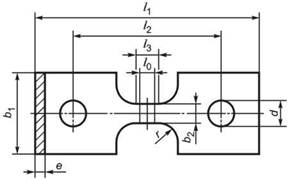
Рисунок 1 - Образец типа 3
Таблица 9 - Размеры образца типа 3
Параметр
Размеры, мм
Общая длина l1, не менее
250
Начальное расстояние между центрами несущих болтов l2
165 ± 5
Длина рабочей части (параллельная часть) l3
25 ± 1
Расчетная длина l0
20 ± 1
Ширина головки b1
100 ± 3
Ширина рабочей части (параллельная часть) b2,
25 ± 1
Толщина е
Соответствует толщине стенки трубы
Радиус закругления r
25 ± 1
Диаметр отверстия d
30 ± 5
При изготовлении ось образца должна быть параллельна оси трубы и располагаться по центру полосы, при этом штамп-просечку устанавливают на внутреннюю сторону полосы.
Перед испытанием образцы кондиционируют по ГОСТ 12423 при температуре испытания (23 ± 2) °С при номинальной толщине образца, мм:
еn < 3 ………………………………………………..… в течение 1 ч ± 5 мин
3 ≤ еп < 8 ……………………………………………………… » 3 ч ± 15 мин
8 ≤ еn < 16 …………………………………………………….. » 6 ч ± 30 мин
16 ≤ еn < 32 …………………………………………………… » (10 ± 1) ч
еn ≥ 32 …………………………………………………………. » (16 ± 1) ч.
Примечание - При достижении относительного удлинения 500 % испытание может быть прекращено до наступления разрыва образца.
За результат испытания принимают минимальное значение относительного удлинения при разрыве, вычисленное до третьей значащей цифры».
Пункт 8.5 дополнить словами: «на трубах номинальной толщиной стенки 16 мм и менее. При этом образцы перед испытанием кондиционируют в стандартной атмосфере 23 по ГОСТ 12423 при номинальной толщине испытуемой трубы, мм:
еn < 3 ………………………………………………….. в течение 1 ч
3 ≤ еп < 8 ……………………………………………………… » ≥3 ч
8 ≤ еn < 16 …………………………………………………….. » ≥6 ч».
Пункт 8.6. Заменить слова: «на трех пробах» на «на пробах»; исключить слова: «Расчет испытательного давления проводят с точностью 0,01 МПа»; дополнить словами: «Среда испытания - «вода в воде».
Пункт 9.1. Последний абзац. Заменить слова: «и труднодоступные районы» на «и приравненные к ним местности».
Пункт 9.2. Первый абзац изложить в новой редакции:
«Трубы хранят по ГОСТ 15150, раздел 10 в условиях 5 ( ОЖ4) или 8 (ОЖ3). При этом трубы, изготовленные из несажевых композиций полиэтилена, хранят в условиях 8 (ОЖ3) в течение не более 12 мес, по истечению указанного срока они должны быть испытаны по показателям 2, 5, 7 таблицы 5».
Пункт 10.2. Исключить слово: «хранения».
Приложение А. Пункт А. 1. Исключить слово: «нормативных».
Приложение Б. Таблицу Б.2 изложить в новой редакции:
Таблица Б.2 - Расчетная масса 1 м труб из композиций полиэтилена ПЭ 63, ПЭ 80, ПЭ 100
Номинальный размер DN/OD
Расчетная масса 1 м труб, кг
SDR 41
SDR 33
SDR 26
SDR 21
SDR 17,6
SDR 17
SDR 13,6
SDR 11
SDR 9
SDR 7,4
SDR 6
10
-
-
-
-
-
-
-
-
-
-
0,051
12
-
-
-
-
-
-
-
-
-
-
0,064
16
-
-
-
-
-
-
-
-
0,090
0,102
0,115
20
-
-
-
-
-
-
-
0,116
0,132
0,162
0,180
25
-
-
-
-
-
-
0,148
0,169
0,198
0,240
0,277
32
-
-
-
-
-
0,193
0,229
0,277
0,325
0,385
0,453
40
-
-
-
0,244
0,281
0,292
0,353
0,427
0,507
0,600
0,701
50
-
-
0,308
0,369
0,436
0,449
0,545
0,663
0,786
0,935
1,47
63
-
0,392
0,488
0,573
0,682
0,715
0,869
1,05
1,25
1,47
1,73
75
0,469
0,543
0,668
0,821
0,97
1,01
1,23
1,46
1,76
2,09
2,45
90
0,630
0,782
0,969
1,18
1,40
1,45
1,76
2,12
2,54
3,00
3,52
110
0,930
1,16
1,42
1,77
2,07
2,16
2,61
3,14
3,78
4,49
5,25
125
1,22
1,50
1,83
2,26
2,66
2,75
3,37
4,08
4,87
5,78
6,77
140
1,53
1,87
2,31
2,83
3,35
3,46
4,22
5,08
6,12
7,27
8,49
160
1,98
2,41
3,03
3,71
4,35
4,51
5,50
6,67
7,97
9,46
11,1
180
2,47
3,05
3,78
4,66
5,47
5,71
6,98
8,43
10,1
12,0
14,0
200
3,03
3,82
4,68
5,77
6,78
7,04
8,56
10,4
12,5
14,8
17,3
225
3,84
4,76
5,88
7,29
8,55
8,94
10,9
13,2
15,8
18,7
21,9
250
4,81
5,90
7,29
8,92
10,6
11,0
13,4
16,2
19,4
23,1
27,0
280
5,96
7,38
9,09
11,3
13,2
13,8
16,8
20,3
24,4
28,9
33,9
315
7,49
9,35
11,6
14,2
16,7
17,4
21,3
25,7
30,8
36,6
42,8
355
9,53
11,8
14,6
18,0
21,2
22,2
27,0
32,6
39,2
46,4
54,4
400
12,1
15,1
18,6
22,9
26,9
28,0
34,2
41,4
49,7
59,0
69,0
450
15,2
19,0
23,5
29,0
34,0
35,5
43,3
52,4
62,9
74,6
-
500
19,0
23,4
29,0
35,8
42,0
43,9
53,5
64,7
77,5
92,1
-
560
23,6
29,4
36,3
44,8
52,6
55,0
67,1
81,0
97,3
116
-
630
29,9
37,1
46,0
56,5
66,6
69,6
84,8
103
123
146
-
710
38,1
47,3
58,5
72,1
84,7
88,4
108
131
157
186
-
800
48,3
59,9
74,1
91,4
108
112
137
166
199
236
-
900
60,9
75,9
93,8
116
136
142
173
210
252
-
-
1000
75,4
93,5
116
143
168
175
214
259
311
-
-
1200
108
134
167
206
242
252
308
373
-
-
-
1400
148
183
227
280
-
343
419
-
-
-
-
1600
193
239
296
365
-
448
547
-
-
-
-
1800
243
303
375
462
-
567
-
-
-
-
-
2000
300
374
462
571
-
700
-
-
-
-
-
Примечание после таблицы Б.2. Заменить слова: «плотности полиэтилена» на «плотности композиции полиэтилена», «полиэтилена плотностью» на «композиции полиэтилена плотностью».
Приложение В изложить в новой редакции:
Источник: 2:
Русско-английский словарь нормативно-технической терминологии > композиция
См. также в других словарях:
Program structure tree — A program structure tree is hierarchical a diagram that displays the nesting relationship of single entry single exit (SESE) regions, showing the organization of a computer program.External links* … Wikipedia
Program Specific Information — (PSI) is metadata, part of MPEG transport stream.The PSI data contains four tables: PAT (Program Association Table), CAT (Conditional Access Table), PMT (Program Map Table) and NIT (Network Information Table). This last table is normally not used … Wikipedia
Structure and Interpretation of Classical Mechanics — ( SICM ) is a classical mechanics textbook written by Gerald Jay Sussman and Jack Wisdom with Meinhard E. Mayer. It was published by MIT Press in 2001. The book (ISBN 0 262 19455 4) is used at Massachusetts Institute of Technology (MIT) to teach… … Wikipedia
Program stream — (PS or MPEG PS) is a container format for multiplexing digital audio, video and more. The PS format is specified in MPEG 1 Systems and MPEG 2 Part 1, Systems (ISO/IEC standard [http://neuron2.net/library/mpeg2/iso13818 1.pdf 13818 1] ). Program… … Wikipedia
Program Management — is the process of managing multiple ongoing inter dependent projects. An example would be that of designing, manufacturing and providing support infrastructure for an automobile manufacturer. This requires hundreds, or even thousands, of separate … Wikipedia
Structure and Interpretation of Computer Programs — ( SICP ) is a textbook published in 1985 about general computer programming concepts from MIT Press written by Massachusetts Institute of Technology professors Harold Abelson and Gerald Jay Sussman, with Julie Sussman. It has been used as the… … Wikipedia
Structure theorem — may refer to: * Structured program theorem, a result in programming language theory * Structure theorem for finitely generated modules over a principal ideal domain, a result in abstract algebra (a subject area in mathematics) … Wikipedia
Structure d'impact de Chassenon — Astroblème de Rochechouart Chassenon Astroblème de Rochechouart Chassenon Image de synthèse du cratère quelques années après l’impact. Localisation Astre … Wikipédia en Français
Structure d'impact de Rochechouart — Astroblème de Rochechouart Chassenon Astroblème de Rochechouart Chassenon Image de synthèse du cratère quelques années après l’impact. Localisation Astre … Wikipédia en Français
Structure d'impact de Rochechouart-Chassenon — Astroblème de Rochechouart Chassenon Astroblème de Rochechouart Chassenon Image de synthèse du cratère quelques années après l’impact. Localisation Astre … Wikipédia en Français
Structure editor — A structure editor, also structured editor, is any document editor that is cognizant of the document’s underlying structure. Structure editors can be used to edit hierarchical or marked up text, computer programs, diagrams, chemical formulas, and … Wikipedia
