

-
21 soft dollaring
See:Another reason managers are interested in controlling client commissions deserves special attention. "Soft dollaring" has got to be one of the most misunderstood and controversial practices in the money management business. The very term "soft dollars" suggests something shady and conjures up images of money exchanging hands in dark alleyways. Among laymen, soft dollars may be confused with "soft money" political contributions. There is a thin connection between "soft dollars" and "soft money." Since brokerage firms are not subject to the same rules pertaining to political contributions as municipal underwriting firms, large "soft money" contributions from owners of brokerage firms do find their way into politicians' coffers more easily than contributions from underwriters. However, it is important to not confuse the two terms.So what is "soft dollaring?" Soft dollaring is the practice whereby money managers use client brokerage commissions to purchase investment research. When a manager pays for products or services with his own money, directly from the research provider, this is referred to as "hard dollars." Payment with client commissions, financed through a brokerage firm, is referred to as "soft dollars." Through soft dollar arrangements money managers are permitted to shift an expense related to the management of assets they would otherwise have to bear, onto their clients. The amount of this research expense the money management industry transfers onto its clients is in the billions annually. As a result, any analysis of the economics of the money management industry should include the effects of soft dollaring; however, we are unaware of any that has. In the institutional marketplace, strange as it may seem, it is possible for a money manager to profit more from soft dollars than from the negotiated asset management fee he receives.The general rule under the federal and state securities laws is that a fiduciary, the money manager, cannot use client assets for his own benefit or the benefit of other clients. To simplify matters greatly, soft dollaring is a legally prescribed exception to this rule. Congress, the SEC and other regulators have agreed that as long as the research purchased assists the manager in making investment decisions, the clients benefit and its legally acceptable. A tremendous amount of strained analysis has gone into the precise policies and procedures that managers must follow in purchasing research with client commission dollars. Over the years a distinction has been made between "proprietary" research or in-house research distributed to brokerage customers without a price tag attached and "independent third-party" research or research written by a third party and sold to managers at a stated price. Third party research has been most frequently criticized because its cost is separately stated and the benefit to managers most obvious. In this latter case, a breach of fiduciary duty seems most glaring. However, it is well known that proprietary research, offered for "free, " is produced to stimulate sales of dealer inventory. So presumably this research lacks credibility and is less beneficial to clients. There have been distinctions drawn between products and services, such as computers, which are "mixed-use, " i.e., which may serve dual purposes, providing both research and administrative uses. An adviser must make a reasonable allocation of the cost of the product according to its uses, the SEC has said. Some portion must be paid for with "hard" dollars and the other with "soft." There are several articles in our Library of Articles that describe soft dollar practices, rule changes and our proposal to Chairman Levitt to reform the soft dollar business.The issue that soft dollaring raises is: when is it acceptable for a manager to benefit from his client's commissions? For purposes of this article we would like to introduce a new and more useful perspective for pensions in their analysis of soft dollars or any other brokerage issue. That is, all brokerage commissions controlled by managers, benefit managers in some way. Brokerage decision-making by managers rarely, if ever, is simply based upon what firm can execute the trade at the best price. Brokerage is a commodity. Almost all brokerage firms offer reasonably competent, "best execution" services. If they didn't, they'd get sued and soon be out of business. Most savvy brokerage marketers don't even try to differentiate their firms with long-winded explanations about best-execution capabilities. Best execution is a given and impossible to prove. If you want to understand how your money manager allocates brokerage, study his business as a whole, including his marketing and affiliates-not just the investment process.The new English-Russian dictionary of financial markets > soft dollaring
-
22 internalisation des coűts externes
внутренний экономический учет возможного экологического ущерба
—
[ http://www.eionet.europa.eu/gemet/alphabetic?langcode=en]EN
internalisation of external costs
The process of getting those who produce goods or services with adverse effects on the environment or on society to incorporate a knowledge of possible negative repercussions into future economic decisions. (Source: ODE)
[http://www.eionet.europa.eu/gemet/alphabetic?langcode=en]Тематики
EN
DE
FR
Франко-русский словарь нормативно-технической терминологии > internalisation des coűts externes
-
23 acidification des sols
закисление почвы
—
[ http://www.eionet.europa.eu/gemet/alphabetic?langcode=en]EN
soil acidification
A naturally occurring process in humid climates that has long been the subject of research, whose findings suggest acid precipitation effects. The generally accepted impact of soil acidification on the productivity of terrestrial plants is summarised as follows: as soil becomes more acidic the basic cations (Ca, Mg) on the soil exchange are replaced by hydrogen ions or solubilized metals. The basic cation, now in solution, can be leached through the soil. As time progresses the soil becomes less fertile and more acidic. Resultant decreases in soil pH cause reduced, less-active population of soil microorganisms, which in turn slow decomposition of plant residues and cycling of essential plant nutrients. (Source: PARCOR)
[http://www.eionet.europa.eu/gemet/alphabetic?langcode=en]Тематики
EN
DE
FR
Франко-русский словарь нормативно-технической терминологии > acidification des sols
-
24 prévision météorologique
метеорологический прогноз
—
[ http://www.eionet.europa.eu/gemet/alphabetic?langcode=en]EN
meteorological forecasting
A branch of science that studies the dynamics of the atmosphere and the direct effects of the atmosphere upon the Earth's surface, oceans and inhabitants, focusing particularly on weather and weather conditions. (Source: INP / NOA / EEN)
[http://www.eionet.europa.eu/gemet/alphabetic?langcode=en]Тематики
EN
DE
FR
прогнозирование погоды
—
[ http://www.eionet.europa.eu/gemet/alphabetic?langcode=en]EN
weather forecasting
The act or process of predicting and highlighting meteorological conditions that are expected for a specific time period and for a specific area or portion of air space, by using objective models based on certain atmospheric parameters, along with the skill and experience of a meteorologist. (Source: FEM / AUS)
[http://www.eionet.europa.eu/gemet/alphabetic?langcode=en]Тематики
EN
DE
FR
Франко-русский словарь нормативно-технической терминологии > prévision météorologique
-
25 aménagement du territoire
- региональное планирование
- планирование и управление землепользованием
- планирование землепользования
- планирование земель
планирование земель
—
[ http://www.eionet.europa.eu/gemet/alphabetic?langcode=en]EN
land planning
The activity of designing, organizing or preparing for the future use of solid areas of the earth's surface, especially regions valued for natural resources, utilized as agricultural resources or considered for human settlement. (Source: RHW)
[http://www.eionet.europa.eu/gemet/alphabetic?langcode=en]Тематики
EN
DE
FR
планирование землепользования
—
[ http://www.eionet.europa.eu/gemet/alphabetic?langcode=en]EN
land use planning
The interdisciplinary process of evaluating, organising, and controlling the present and the future development and use of lands and their resources in terms of their suitability on sustained yield basis. Includes an overall ecological evaluation in terms of specific kinds of uses as well as evaluations of social, economic, and physical contexts to the land concerned. (Source: UNUN)
[http://www.eionet.europa.eu/gemet/alphabetic?langcode=en]Тематики
EN
DE
FR
планирование и управление землепользованием
—
[ http://www.eionet.europa.eu/gemet/alphabetic?langcode=en]EN
land management and planning
Operations for preparing and controlling the implementation of plans for organizing human activities on land. (Source: GOOD)
[http://www.eionet.europa.eu/gemet/alphabetic?langcode=en]Тематики
EN
DE
FR
региональное планирование
—
[ http://www.eionet.europa.eu/gemet/alphabetic?langcode=en]EN
land setup
The formulation of regional objectives, plans and programmes and the harmonization of the regional effects of sectorial planning. (Source: ECHO2)
[http://www.eionet.europa.eu/gemet/alphabetic?langcode=en]Тематики
EN
DE
FR
Франко-русский словарь нормативно-технической терминологии > aménagement du territoire
-
26 démarrage direct
прямой пуск вращающегося электродвигателя
Пуск вращающегося электродвигателя путем непосредственного подключения его к питающей сети.
[ ГОСТ 27471-87]EN
direct-on-line starting
across-the-line starting (US)
the process of starting a motor by connecting it directly to the supply at rated voltage
[IEV number 411-52-15]FR
démarrage direct
mode de démarrage d'un moteur, consistant à lui appliquer directement sa pleine tension assignée
[IEV number 411-52-15]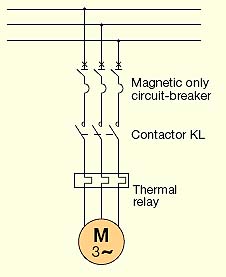
Рис. ABB
Схема прямого пуска электродвигателяMagnetic only circuit-breaker - Автоматический выключатель с электромагнитным расцепителем
Contactor KL - Контактор KL
Thermal relay - Тепловое реле
Параллельные тексты EN-RU
Direct-on-line starting
Direct-on-line starting, which is often abbreviated as DOL, is perhaps the most traditional system and consists in connecting the motor directly to the supply network, thus carrying out starting at full voltage.Direct-on-line starting represents the simplest and the most economical system to start a squirrel-cage asynchronous motor and it is the most used.
As represented in Figure 5, it provides the direct connection to the supply network and therefore starting is carried out at full voltage and with constant frequency, developing a high starting torque with very reduced acceleration times.
The typical applications are relevant to small power motors also with full load starting.
These advantages are linked to some problems such as, for example, the high inrush current, which - in the first instants - can reach values of about 10 to 12 times the rated current, then can decrease to about 6 to 8 times the rated current and can persist to reach the maximum torque speed.The effects of such currents can be identified with the high electro-dynamical stresses on the motor connection cables and could affect also the windings of the motor itself; besides, the high inrush torques can cause violent accelerations which stress the transmission components (belts and joints) generating distribution problems with a reduction in the mechanical life of these elements.
Finally, also the possible electrical problems due to voltage drops on the supply line of the motor or of the connected equipment must be taken into consideration.
[ABB]Прямой пуск
Прямой пуск, который по-английски часто сокращенно обозначают как DOL, является, пожалуй наиболее распространенным способом пуска. Он заключается в непосредственном (т. е. прямом) подключении двигателя к питающей сети. Это означает, что пуск двигателя осуществляется при полном напряжении.Схема прямого пуска является наиболее простым, экономичным и чаще всего применяемым решением для электродвигателей с короткозамкнутым ротором.
Схема прямого подключения к сети представлена на рисунке 5. Пуск осуществляется при полном напряжении и постоянной частоте сети. Электродвигатель развивает высокий пусковой момент при коротком времени разгона.
Типичные области применения – маломощные электродвигатели, в том числе с пуском при полной нагрузке.
Однако, наряду с преимуществами имеются и определенные недостатки, например, бросок пускового тока, достигающий в первоначальный момент 10…12-кратного значения от номинального тока электродвигателя. Затем ток двигателя уменьшается примерно до 6…8-кратного значения номинального тока и будет держаться на этом уровне до тех пор, пока скорость двигателя не достигнет максимального значения.
Такое изменение тока оказывает значительное электродинамическое воздействие на кабель, подключенный к двигателю. Кроме того пусковой ток воздействует на обмотки двигателя. Высокий начальный пусковой момент может привести к значительному ускорению и следовательно к значительной нагрузке элементов привода (ремней, крепления узлов), что вызывает сокращение их срока службы.
И, наконец, следует принять во внимание возможное возникновение проблем, связанных с падением напряжения в линии питания двигателя и подключенного к этой линии оборудования.
[Перевод Интент]
Тематики
Синонимы
EN
- across-the-line starting (US)
- direct line starting
- direct operation of a motor
- direct starting
- direct-on-line starting
- DOL
- full voltage starter application
DE
FR
Франко-русский словарь нормативно-технической терминологии > démarrage direct
-
27 Kosteninternalisierung
внутренний экономический учет возможного экологического ущерба
—
[ http://www.eionet.europa.eu/gemet/alphabetic?langcode=en]EN
internalisation of external costs
The process of getting those who produce goods or services with adverse effects on the environment or on society to incorporate a knowledge of possible negative repercussions into future economic decisions. (Source: ODE)
[http://www.eionet.europa.eu/gemet/alphabetic?langcode=en]Тематики
EN
DE
FR
Немецко-русский словарь нормативно-технической терминологии > Kosteninternalisierung
-
28 Bodenversauerung
закисление почвы
—
[ http://www.eionet.europa.eu/gemet/alphabetic?langcode=en]EN
soil acidification
A naturally occurring process in humid climates that has long been the subject of research, whose findings suggest acid precipitation effects. The generally accepted impact of soil acidification on the productivity of terrestrial plants is summarised as follows: as soil becomes more acidic the basic cations (Ca, Mg) on the soil exchange are replaced by hydrogen ions or solubilized metals. The basic cation, now in solution, can be leached through the soil. As time progresses the soil becomes less fertile and more acidic. Resultant decreases in soil pH cause reduced, less-active population of soil microorganisms, which in turn slow decomposition of plant residues and cycling of essential plant nutrients. (Source: PARCOR)
[http://www.eionet.europa.eu/gemet/alphabetic?langcode=en]Тематики
EN
DE
FR
Немецко-русский словарь нормативно-технической терминологии > Bodenversauerung
-
29 Wettervorhersage
метеорологический прогноз
—
[ http://www.eionet.europa.eu/gemet/alphabetic?langcode=en]EN
meteorological forecasting
A branch of science that studies the dynamics of the atmosphere and the direct effects of the atmosphere upon the Earth's surface, oceans and inhabitants, focusing particularly on weather and weather conditions. (Source: INP / NOA / EEN)
[http://www.eionet.europa.eu/gemet/alphabetic?langcode=en]Тематики
EN
DE
FR
прогнозирование погоды
—
[ http://www.eionet.europa.eu/gemet/alphabetic?langcode=en]EN
weather forecasting
The act or process of predicting and highlighting meteorological conditions that are expected for a specific time period and for a specific area or portion of air space, by using objective models based on certain atmospheric parameters, along with the skill and experience of a meteorologist. (Source: FEM / AUS)
[http://www.eionet.europa.eu/gemet/alphabetic?langcode=en]Тематики
EN
DE
FR
Немецко-русский словарь нормативно-технической терминологии > Wettervorhersage
-
30 Anlauf mit direktem Einschalten
прямой пуск вращающегося электродвигателя
Пуск вращающегося электродвигателя путем непосредственного подключения его к питающей сети.
[ ГОСТ 27471-87]EN
direct-on-line starting
across-the-line starting (US)
the process of starting a motor by connecting it directly to the supply at rated voltage
[IEV number 411-52-15]FR
démarrage direct
mode de démarrage d'un moteur, consistant à lui appliquer directement sa pleine tension assignée
[IEV number 411-52-15]
Рис. ABB
Схема прямого пуска электродвигателяMagnetic only circuit-breaker - Автоматический выключатель с электромагнитным расцепителем
Contactor KL - Контактор KL
Thermal relay - Тепловое реле
Параллельные тексты EN-RU
Direct-on-line starting
Direct-on-line starting, which is often abbreviated as DOL, is perhaps the most traditional system and consists in connecting the motor directly to the supply network, thus carrying out starting at full voltage.Direct-on-line starting represents the simplest and the most economical system to start a squirrel-cage asynchronous motor and it is the most used.
As represented in Figure 5, it provides the direct connection to the supply network and therefore starting is carried out at full voltage and with constant frequency, developing a high starting torque with very reduced acceleration times.
The typical applications are relevant to small power motors also with full load starting.
These advantages are linked to some problems such as, for example, the high inrush current, which - in the first instants - can reach values of about 10 to 12 times the rated current, then can decrease to about 6 to 8 times the rated current and can persist to reach the maximum torque speed.The effects of such currents can be identified with the high electro-dynamical stresses on the motor connection cables and could affect also the windings of the motor itself; besides, the high inrush torques can cause violent accelerations which stress the transmission components (belts and joints) generating distribution problems with a reduction in the mechanical life of these elements.
Finally, also the possible electrical problems due to voltage drops on the supply line of the motor or of the connected equipment must be taken into consideration.
[ABB]Прямой пуск
Прямой пуск, который по-английски часто сокращенно обозначают как DOL, является, пожалуй наиболее распространенным способом пуска. Он заключается в непосредственном (т. е. прямом) подключении двигателя к питающей сети. Это означает, что пуск двигателя осуществляется при полном напряжении.Схема прямого пуска является наиболее простым, экономичным и чаще всего применяемым решением для электродвигателей с короткозамкнутым ротором.
Схема прямого подключения к сети представлена на рисунке 5. Пуск осуществляется при полном напряжении и постоянной частоте сети. Электродвигатель развивает высокий пусковой момент при коротком времени разгона.
Типичные области применения – маломощные электродвигатели, в том числе с пуском при полной нагрузке.
Однако, наряду с преимуществами имеются и определенные недостатки, например, бросок пускового тока, достигающий в первоначальный момент 10…12-кратного значения от номинального тока электродвигателя. Затем ток двигателя уменьшается примерно до 6…8-кратного значения номинального тока и будет держаться на этом уровне до тех пор, пока скорость двигателя не достигнет максимального значения.
Такое изменение тока оказывает значительное электродинамическое воздействие на кабель, подключенный к двигателю. Кроме того пусковой ток воздействует на обмотки двигателя. Высокий начальный пусковой момент может привести к значительному ускорению и следовательно к значительной нагрузке элементов привода (ремней, крепления узлов), что вызывает сокращение их срока службы.
И, наконец, следует принять во внимание возможное возникновение проблем, связанных с падением напряжения в линии питания двигателя и подключенного к этой линии оборудования.
[Перевод Интент]
Тематики
Синонимы
EN
- across-the-line starting (US)
- direct line starting
- direct operation of a motor
- direct starting
- direct-on-line starting
- DOL
- full voltage starter application
DE
FR
Немецко-русский словарь нормативно-технической терминологии > Anlauf mit direktem Einschalten
-
31 internalisation of external costs
внутренний экономический учет возможного экологического ущерба
—
[ http://www.eionet.europa.eu/gemet/alphabetic?langcode=en]EN
internalisation of external costs
The process of getting those who produce goods or services with adverse effects on the environment or on society to incorporate a knowledge of possible negative repercussions into future economic decisions. (Source: ODE)
[http://www.eionet.europa.eu/gemet/alphabetic?langcode=en]Тематики
EN
DE
FR
Англо-русский словарь нормативно-технической терминологии > internalisation of external costs
-
32 soil acidification
закисление почвы
—
[ http://www.eionet.europa.eu/gemet/alphabetic?langcode=en]EN
soil acidification
A naturally occurring process in humid climates that has long been the subject of research, whose findings suggest acid precipitation effects. The generally accepted impact of soil acidification on the productivity of terrestrial plants is summarised as follows: as soil becomes more acidic the basic cations (Ca, Mg) on the soil exchange are replaced by hydrogen ions or solubilized metals. The basic cation, now in solution, can be leached through the soil. As time progresses the soil becomes less fertile and more acidic. Resultant decreases in soil pH cause reduced, less-active population of soil microorganisms, which in turn slow decomposition of plant residues and cycling of essential plant nutrients. (Source: PARCOR)
[http://www.eionet.europa.eu/gemet/alphabetic?langcode=en]Тематики
EN
DE
FR
Англо-русский словарь нормативно-технической терминологии > soil acidification
-
33 DOL
- эффект операционного рычага
- пускатель прямого действия
- прямой пуск вращающегося электродвигателя
- Министерство труда (США)
- концентрация растворённого кислорода
концентрация растворённого кислорода
—
[А.С.Гольдберг. Англо-русский энергетический словарь. 2006 г.]Тематики
EN
Министерство труда (США)
—
[А.С.Гольдберг. Англо-русский энергетический словарь. 2006 г.]Тематики
EN
прямой пуск вращающегося электродвигателя
Пуск вращающегося электродвигателя путем непосредственного подключения его к питающей сети.
[ ГОСТ 27471-87]EN
direct-on-line starting
across-the-line starting (US)
the process of starting a motor by connecting it directly to the supply at rated voltage
[IEV number 411-52-15]FR
démarrage direct
mode de démarrage d'un moteur, consistant à lui appliquer directement sa pleine tension assignée
[IEV number 411-52-15]
Рис. ABB
Схема прямого пуска электродвигателяMagnetic only circuit-breaker - Автоматический выключатель с электромагнитным расцепителем
Contactor KL - Контактор KL
Thermal relay - Тепловое реле
Параллельные тексты EN-RU
Direct-on-line starting
Direct-on-line starting, which is often abbreviated as DOL, is perhaps the most traditional system and consists in connecting the motor directly to the supply network, thus carrying out starting at full voltage.Direct-on-line starting represents the simplest and the most economical system to start a squirrel-cage asynchronous motor and it is the most used.
As represented in Figure 5, it provides the direct connection to the supply network and therefore starting is carried out at full voltage and with constant frequency, developing a high starting torque with very reduced acceleration times.
The typical applications are relevant to small power motors also with full load starting.
These advantages are linked to some problems such as, for example, the high inrush current, which - in the first instants - can reach values of about 10 to 12 times the rated current, then can decrease to about 6 to 8 times the rated current and can persist to reach the maximum torque speed.The effects of such currents can be identified with the high electro-dynamical stresses on the motor connection cables and could affect also the windings of the motor itself; besides, the high inrush torques can cause violent accelerations which stress the transmission components (belts and joints) generating distribution problems with a reduction in the mechanical life of these elements.
Finally, also the possible electrical problems due to voltage drops on the supply line of the motor or of the connected equipment must be taken into consideration.
[ABB]Прямой пуск
Прямой пуск, который по-английски часто сокращенно обозначают как DOL, является, пожалуй наиболее распространенным способом пуска. Он заключается в непосредственном (т. е. прямом) подключении двигателя к питающей сети. Это означает, что пуск двигателя осуществляется при полном напряжении.Схема прямого пуска является наиболее простым, экономичным и чаще всего применяемым решением для электродвигателей с короткозамкнутым ротором.
Схема прямого подключения к сети представлена на рисунке 5. Пуск осуществляется при полном напряжении и постоянной частоте сети. Электродвигатель развивает высокий пусковой момент при коротком времени разгона.
Типичные области применения – маломощные электродвигатели, в том числе с пуском при полной нагрузке.
Однако, наряду с преимуществами имеются и определенные недостатки, например, бросок пускового тока, достигающий в первоначальный момент 10…12-кратного значения от номинального тока электродвигателя. Затем ток двигателя уменьшается примерно до 6…8-кратного значения номинального тока и будет держаться на этом уровне до тех пор, пока скорость двигателя не достигнет максимального значения.
Такое изменение тока оказывает значительное электродинамическое воздействие на кабель, подключенный к двигателю. Кроме того пусковой ток воздействует на обмотки двигателя. Высокий начальный пусковой момент может привести к значительному ускорению и следовательно к значительной нагрузке элементов привода (ремней, крепления узлов), что вызывает сокращение их срока службы.
И, наконец, следует принять во внимание возможное возникновение проблем, связанных с падением напряжения в линии питания двигателя и подключенного к этой линии оборудования.
[Перевод Интент]
Тематики
Синонимы
EN
- across-the-line starting (US)
- direct line starting
- direct operation of a motor
- direct starting
- direct-on-line starting
- DOL
- full voltage starter application
DE
FR
пускатель прямого действия
Пускатель, одноступенчато подающий сетевое напряжение на выводы двигателя.
(МЭС 441-14-40)
[ ГОСТ Р 50030.4.1-2002 (МЭК 60947-4-1-2000)]
Пускатели переменного тока для прямого непосредственного пуска (с полным напряжением)
Пускатели, предназначенные для пуска двигателя, разгона его до номинальной скорости, защиты двигателя и подключенных к нему цепей от рабочих перегрузок и отключения питания двигателя.
[ ГОСТ Р 50030.4.1-2002 (МЭК 60947-4-1-2000)]EN
direct-on-line starter
a starter which connects the line voltage across the motor terminals in one step
[IEV number 441-14-40]FR
démarreur direct
démarreur qui applique la tension d'alimentation sur les bornes du moteur en une seule manoeuvre
[IEV number 441-14-40]Параллельные тексты EN-RU
Direct-on-line starters
Starters which connect the line voltage across the motor terminals in one step, intended to start and accelerate a motor to normal speed.
They shall ensure switching and protection functions as prescribed in the general definition.
[ABB]Пускатели прямого действия
Пускатели, одноступенчато подающие сетевое напряжение на зажимы двигателя и предназначенные для его пуска и разгона до номинальной скорости.
Кроме того, они должны обеспечивать коммутацию и защиту в соответствии с общим определением.
[Перевод Интент]Тематики
EN
DE
FR
эффект операционного рычага
эффект производственного рычага
Эффект операционного рычага - выражение того факта, что любое изменение выручки от реализации порождает изменение прибыли. Сила воздействия операционного рычага вычисляется как частное от деления выручки от реализации после возмещения переменных затрат на прибыль.
[ http://www.lexikon.ru/dict/fin/a.html]Тематики
Синонимы
EN
Англо-русский словарь нормативно-технической терминологии > DOL
-
34 direct starting
прямой пуск
—
[Я.Н.Лугинский, М.С.Фези-Жилинская, Ю.С.Кабиров. Англо-русский словарь по электротехнике и электроэнергетике, Москва, 1999 г.]Тематики
- электротехника, основные понятия
EN
прямой пуск вращающегося электродвигателя
Пуск вращающегося электродвигателя путем непосредственного подключения его к питающей сети.
[ ГОСТ 27471-87]EN
direct-on-line starting
across-the-line starting (US)
the process of starting a motor by connecting it directly to the supply at rated voltage
[IEV number 411-52-15]FR
démarrage direct
mode de démarrage d'un moteur, consistant à lui appliquer directement sa pleine tension assignée
[IEV number 411-52-15]
Рис. ABB
Схема прямого пуска электродвигателяMagnetic only circuit-breaker - Автоматический выключатель с электромагнитным расцепителем
Contactor KL - Контактор KL
Thermal relay - Тепловое реле
Параллельные тексты EN-RU
Direct-on-line starting
Direct-on-line starting, which is often abbreviated as DOL, is perhaps the most traditional system and consists in connecting the motor directly to the supply network, thus carrying out starting at full voltage.Direct-on-line starting represents the simplest and the most economical system to start a squirrel-cage asynchronous motor and it is the most used.
As represented in Figure 5, it provides the direct connection to the supply network and therefore starting is carried out at full voltage and with constant frequency, developing a high starting torque with very reduced acceleration times.
The typical applications are relevant to small power motors also with full load starting.
These advantages are linked to some problems such as, for example, the high inrush current, which - in the first instants - can reach values of about 10 to 12 times the rated current, then can decrease to about 6 to 8 times the rated current and can persist to reach the maximum torque speed.The effects of such currents can be identified with the high electro-dynamical stresses on the motor connection cables and could affect also the windings of the motor itself; besides, the high inrush torques can cause violent accelerations which stress the transmission components (belts and joints) generating distribution problems with a reduction in the mechanical life of these elements.
Finally, also the possible electrical problems due to voltage drops on the supply line of the motor or of the connected equipment must be taken into consideration.
[ABB]Прямой пуск
Прямой пуск, который по-английски часто сокращенно обозначают как DOL, является, пожалуй наиболее распространенным способом пуска. Он заключается в непосредственном (т. е. прямом) подключении двигателя к питающей сети. Это означает, что пуск двигателя осуществляется при полном напряжении.Схема прямого пуска является наиболее простым, экономичным и чаще всего применяемым решением для электродвигателей с короткозамкнутым ротором.
Схема прямого подключения к сети представлена на рисунке 5. Пуск осуществляется при полном напряжении и постоянной частоте сети. Электродвигатель развивает высокий пусковой момент при коротком времени разгона.
Типичные области применения – маломощные электродвигатели, в том числе с пуском при полной нагрузке.
Однако, наряду с преимуществами имеются и определенные недостатки, например, бросок пускового тока, достигающий в первоначальный момент 10…12-кратного значения от номинального тока электродвигателя. Затем ток двигателя уменьшается примерно до 6…8-кратного значения номинального тока и будет держаться на этом уровне до тех пор, пока скорость двигателя не достигнет максимального значения.
Такое изменение тока оказывает значительное электродинамическое воздействие на кабель, подключенный к двигателю. Кроме того пусковой ток воздействует на обмотки двигателя. Высокий начальный пусковой момент может привести к значительному ускорению и следовательно к значительной нагрузке элементов привода (ремней, крепления узлов), что вызывает сокращение их срока службы.
И, наконец, следует принять во внимание возможное возникновение проблем, связанных с падением напряжения в линии питания двигателя и подключенного к этой линии оборудования.
[Перевод Интент]
Тематики
Синонимы
EN
- across-the-line starting (US)
- direct line starting
- direct operation of a motor
- direct starting
- direct-on-line starting
- DOL
- full voltage starter application
DE
FR
Англо-русский словарь нормативно-технической терминологии > direct starting
-
35 across-the-line starting (US)
прямой пуск вращающегося электродвигателя
Пуск вращающегося электродвигателя путем непосредственного подключения его к питающей сети.
[ ГОСТ 27471-87]EN
direct-on-line starting
across-the-line starting (US)
the process of starting a motor by connecting it directly to the supply at rated voltage
[IEV number 411-52-15]FR
démarrage direct
mode de démarrage d'un moteur, consistant à lui appliquer directement sa pleine tension assignée
[IEV number 411-52-15]
Рис. ABB
Схема прямого пуска электродвигателяMagnetic only circuit-breaker - Автоматический выключатель с электромагнитным расцепителем
Contactor KL - Контактор KL
Thermal relay - Тепловое реле
Параллельные тексты EN-RU
Direct-on-line starting
Direct-on-line starting, which is often abbreviated as DOL, is perhaps the most traditional system and consists in connecting the motor directly to the supply network, thus carrying out starting at full voltage.Direct-on-line starting represents the simplest and the most economical system to start a squirrel-cage asynchronous motor and it is the most used.
As represented in Figure 5, it provides the direct connection to the supply network and therefore starting is carried out at full voltage and with constant frequency, developing a high starting torque with very reduced acceleration times.
The typical applications are relevant to small power motors also with full load starting.
These advantages are linked to some problems such as, for example, the high inrush current, which - in the first instants - can reach values of about 10 to 12 times the rated current, then can decrease to about 6 to 8 times the rated current and can persist to reach the maximum torque speed.The effects of such currents can be identified with the high electro-dynamical stresses on the motor connection cables and could affect also the windings of the motor itself; besides, the high inrush torques can cause violent accelerations which stress the transmission components (belts and joints) generating distribution problems with a reduction in the mechanical life of these elements.
Finally, also the possible electrical problems due to voltage drops on the supply line of the motor or of the connected equipment must be taken into consideration.
[ABB]Прямой пуск
Прямой пуск, который по-английски часто сокращенно обозначают как DOL, является, пожалуй наиболее распространенным способом пуска. Он заключается в непосредственном (т. е. прямом) подключении двигателя к питающей сети. Это означает, что пуск двигателя осуществляется при полном напряжении.Схема прямого пуска является наиболее простым, экономичным и чаще всего применяемым решением для электродвигателей с короткозамкнутым ротором.
Схема прямого подключения к сети представлена на рисунке 5. Пуск осуществляется при полном напряжении и постоянной частоте сети. Электродвигатель развивает высокий пусковой момент при коротком времени разгона.
Типичные области применения – маломощные электродвигатели, в том числе с пуском при полной нагрузке.
Однако, наряду с преимуществами имеются и определенные недостатки, например, бросок пускового тока, достигающий в первоначальный момент 10…12-кратного значения от номинального тока электродвигателя. Затем ток двигателя уменьшается примерно до 6…8-кратного значения номинального тока и будет держаться на этом уровне до тех пор, пока скорость двигателя не достигнет максимального значения.
Такое изменение тока оказывает значительное электродинамическое воздействие на кабель, подключенный к двигателю. Кроме того пусковой ток воздействует на обмотки двигателя. Высокий начальный пусковой момент может привести к значительному ускорению и следовательно к значительной нагрузке элементов привода (ремней, крепления узлов), что вызывает сокращение их срока службы.
И, наконец, следует принять во внимание возможное возникновение проблем, связанных с падением напряжения в линии питания двигателя и подключенного к этой линии оборудования.
[Перевод Интент]
Тематики
Синонимы
EN
- across-the-line starting (US)
- direct line starting
- direct operation of a motor
- direct starting
- direct-on-line starting
- DOL
- full voltage starter application
DE
FR
Англо-русский словарь нормативно-технической терминологии > across-the-line starting (US)
-
36 direct line starting
прямой пуск вращающегося электродвигателя
Пуск вращающегося электродвигателя путем непосредственного подключения его к питающей сети.
[ ГОСТ 27471-87]EN
direct-on-line starting
across-the-line starting (US)
the process of starting a motor by connecting it directly to the supply at rated voltage
[IEV number 411-52-15]FR
démarrage direct
mode de démarrage d'un moteur, consistant à lui appliquer directement sa pleine tension assignée
[IEV number 411-52-15]
Рис. ABB
Схема прямого пуска электродвигателяMagnetic only circuit-breaker - Автоматический выключатель с электромагнитным расцепителем
Contactor KL - Контактор KL
Thermal relay - Тепловое реле
Параллельные тексты EN-RU
Direct-on-line starting
Direct-on-line starting, which is often abbreviated as DOL, is perhaps the most traditional system and consists in connecting the motor directly to the supply network, thus carrying out starting at full voltage.Direct-on-line starting represents the simplest and the most economical system to start a squirrel-cage asynchronous motor and it is the most used.
As represented in Figure 5, it provides the direct connection to the supply network and therefore starting is carried out at full voltage and with constant frequency, developing a high starting torque with very reduced acceleration times.
The typical applications are relevant to small power motors also with full load starting.
These advantages are linked to some problems such as, for example, the high inrush current, which - in the first instants - can reach values of about 10 to 12 times the rated current, then can decrease to about 6 to 8 times the rated current and can persist to reach the maximum torque speed.The effects of such currents can be identified with the high electro-dynamical stresses on the motor connection cables and could affect also the windings of the motor itself; besides, the high inrush torques can cause violent accelerations which stress the transmission components (belts and joints) generating distribution problems with a reduction in the mechanical life of these elements.
Finally, also the possible electrical problems due to voltage drops on the supply line of the motor or of the connected equipment must be taken into consideration.
[ABB]Прямой пуск
Прямой пуск, который по-английски часто сокращенно обозначают как DOL, является, пожалуй наиболее распространенным способом пуска. Он заключается в непосредственном (т. е. прямом) подключении двигателя к питающей сети. Это означает, что пуск двигателя осуществляется при полном напряжении.Схема прямого пуска является наиболее простым, экономичным и чаще всего применяемым решением для электродвигателей с короткозамкнутым ротором.
Схема прямого подключения к сети представлена на рисунке 5. Пуск осуществляется при полном напряжении и постоянной частоте сети. Электродвигатель развивает высокий пусковой момент при коротком времени разгона.
Типичные области применения – маломощные электродвигатели, в том числе с пуском при полной нагрузке.
Однако, наряду с преимуществами имеются и определенные недостатки, например, бросок пускового тока, достигающий в первоначальный момент 10…12-кратного значения от номинального тока электродвигателя. Затем ток двигателя уменьшается примерно до 6…8-кратного значения номинального тока и будет держаться на этом уровне до тех пор, пока скорость двигателя не достигнет максимального значения.
Такое изменение тока оказывает значительное электродинамическое воздействие на кабель, подключенный к двигателю. Кроме того пусковой ток воздействует на обмотки двигателя. Высокий начальный пусковой момент может привести к значительному ускорению и следовательно к значительной нагрузке элементов привода (ремней, крепления узлов), что вызывает сокращение их срока службы.
И, наконец, следует принять во внимание возможное возникновение проблем, связанных с падением напряжения в линии питания двигателя и подключенного к этой линии оборудования.
[Перевод Интент]
Тематики
Синонимы
EN
- across-the-line starting (US)
- direct line starting
- direct operation of a motor
- direct starting
- direct-on-line starting
- DOL
- full voltage starter application
DE
FR
Англо-русский словарь нормативно-технической терминологии > direct line starting
-
37 direct operation of a motor
прямой пуск вращающегося электродвигателя
Пуск вращающегося электродвигателя путем непосредственного подключения его к питающей сети.
[ ГОСТ 27471-87]EN
direct-on-line starting
across-the-line starting (US)
the process of starting a motor by connecting it directly to the supply at rated voltage
[IEV number 411-52-15]FR
démarrage direct
mode de démarrage d'un moteur, consistant à lui appliquer directement sa pleine tension assignée
[IEV number 411-52-15]
Рис. ABB
Схема прямого пуска электродвигателяMagnetic only circuit-breaker - Автоматический выключатель с электромагнитным расцепителем
Contactor KL - Контактор KL
Thermal relay - Тепловое реле
Параллельные тексты EN-RU
Direct-on-line starting
Direct-on-line starting, which is often abbreviated as DOL, is perhaps the most traditional system and consists in connecting the motor directly to the supply network, thus carrying out starting at full voltage.Direct-on-line starting represents the simplest and the most economical system to start a squirrel-cage asynchronous motor and it is the most used.
As represented in Figure 5, it provides the direct connection to the supply network and therefore starting is carried out at full voltage and with constant frequency, developing a high starting torque with very reduced acceleration times.
The typical applications are relevant to small power motors also with full load starting.
These advantages are linked to some problems such as, for example, the high inrush current, which - in the first instants - can reach values of about 10 to 12 times the rated current, then can decrease to about 6 to 8 times the rated current and can persist to reach the maximum torque speed.The effects of such currents can be identified with the high electro-dynamical stresses on the motor connection cables and could affect also the windings of the motor itself; besides, the high inrush torques can cause violent accelerations which stress the transmission components (belts and joints) generating distribution problems with a reduction in the mechanical life of these elements.
Finally, also the possible electrical problems due to voltage drops on the supply line of the motor or of the connected equipment must be taken into consideration.
[ABB]Прямой пуск
Прямой пуск, который по-английски часто сокращенно обозначают как DOL, является, пожалуй наиболее распространенным способом пуска. Он заключается в непосредственном (т. е. прямом) подключении двигателя к питающей сети. Это означает, что пуск двигателя осуществляется при полном напряжении.Схема прямого пуска является наиболее простым, экономичным и чаще всего применяемым решением для электродвигателей с короткозамкнутым ротором.
Схема прямого подключения к сети представлена на рисунке 5. Пуск осуществляется при полном напряжении и постоянной частоте сети. Электродвигатель развивает высокий пусковой момент при коротком времени разгона.
Типичные области применения – маломощные электродвигатели, в том числе с пуском при полной нагрузке.
Однако, наряду с преимуществами имеются и определенные недостатки, например, бросок пускового тока, достигающий в первоначальный момент 10…12-кратного значения от номинального тока электродвигателя. Затем ток двигателя уменьшается примерно до 6…8-кратного значения номинального тока и будет держаться на этом уровне до тех пор, пока скорость двигателя не достигнет максимального значения.
Такое изменение тока оказывает значительное электродинамическое воздействие на кабель, подключенный к двигателю. Кроме того пусковой ток воздействует на обмотки двигателя. Высокий начальный пусковой момент может привести к значительному ускорению и следовательно к значительной нагрузке элементов привода (ремней, крепления узлов), что вызывает сокращение их срока службы.
И, наконец, следует принять во внимание возможное возникновение проблем, связанных с падением напряжения в линии питания двигателя и подключенного к этой линии оборудования.
[Перевод Интент]
Тематики
Синонимы
EN
- across-the-line starting (US)
- direct line starting
- direct operation of a motor
- direct starting
- direct-on-line starting
- DOL
- full voltage starter application
DE
FR
Англо-русский словарь нормативно-технической терминологии > direct operation of a motor
-
38 direct-on-line starting
прямой пуск вращающегося электродвигателя
Пуск вращающегося электродвигателя путем непосредственного подключения его к питающей сети.
[ ГОСТ 27471-87]EN
direct-on-line starting
across-the-line starting (US)
the process of starting a motor by connecting it directly to the supply at rated voltage
[IEV number 411-52-15]FR
démarrage direct
mode de démarrage d'un moteur, consistant à lui appliquer directement sa pleine tension assignée
[IEV number 411-52-15]
Рис. ABB
Схема прямого пуска электродвигателяMagnetic only circuit-breaker - Автоматический выключатель с электромагнитным расцепителем
Contactor KL - Контактор KL
Thermal relay - Тепловое реле
Параллельные тексты EN-RU
Direct-on-line starting
Direct-on-line starting, which is often abbreviated as DOL, is perhaps the most traditional system and consists in connecting the motor directly to the supply network, thus carrying out starting at full voltage.Direct-on-line starting represents the simplest and the most economical system to start a squirrel-cage asynchronous motor and it is the most used.
As represented in Figure 5, it provides the direct connection to the supply network and therefore starting is carried out at full voltage and with constant frequency, developing a high starting torque with very reduced acceleration times.
The typical applications are relevant to small power motors also with full load starting.
These advantages are linked to some problems such as, for example, the high inrush current, which - in the first instants - can reach values of about 10 to 12 times the rated current, then can decrease to about 6 to 8 times the rated current and can persist to reach the maximum torque speed.The effects of such currents can be identified with the high electro-dynamical stresses on the motor connection cables and could affect also the windings of the motor itself; besides, the high inrush torques can cause violent accelerations which stress the transmission components (belts and joints) generating distribution problems with a reduction in the mechanical life of these elements.
Finally, also the possible electrical problems due to voltage drops on the supply line of the motor or of the connected equipment must be taken into consideration.
[ABB]Прямой пуск
Прямой пуск, который по-английски часто сокращенно обозначают как DOL, является, пожалуй наиболее распространенным способом пуска. Он заключается в непосредственном (т. е. прямом) подключении двигателя к питающей сети. Это означает, что пуск двигателя осуществляется при полном напряжении.Схема прямого пуска является наиболее простым, экономичным и чаще всего применяемым решением для электродвигателей с короткозамкнутым ротором.
Схема прямого подключения к сети представлена на рисунке 5. Пуск осуществляется при полном напряжении и постоянной частоте сети. Электродвигатель развивает высокий пусковой момент при коротком времени разгона.
Типичные области применения – маломощные электродвигатели, в том числе с пуском при полной нагрузке.
Однако, наряду с преимуществами имеются и определенные недостатки, например, бросок пускового тока, достигающий в первоначальный момент 10…12-кратного значения от номинального тока электродвигателя. Затем ток двигателя уменьшается примерно до 6…8-кратного значения номинального тока и будет держаться на этом уровне до тех пор, пока скорость двигателя не достигнет максимального значения.
Такое изменение тока оказывает значительное электродинамическое воздействие на кабель, подключенный к двигателю. Кроме того пусковой ток воздействует на обмотки двигателя. Высокий начальный пусковой момент может привести к значительному ускорению и следовательно к значительной нагрузке элементов привода (ремней, крепления узлов), что вызывает сокращение их срока службы.
И, наконец, следует принять во внимание возможное возникновение проблем, связанных с падением напряжения в линии питания двигателя и подключенного к этой линии оборудования.
[Перевод Интент]
Тематики
Синонимы
EN
- across-the-line starting (US)
- direct line starting
- direct operation of a motor
- direct starting
- direct-on-line starting
- DOL
- full voltage starter application
DE
FR
Англо-русский словарь нормативно-технической терминологии > direct-on-line starting
-
39 full voltage starter application
прямой пуск вращающегося электродвигателя
Пуск вращающегося электродвигателя путем непосредственного подключения его к питающей сети.
[ ГОСТ 27471-87]EN
direct-on-line starting
across-the-line starting (US)
the process of starting a motor by connecting it directly to the supply at rated voltage
[IEV number 411-52-15]FR
démarrage direct
mode de démarrage d'un moteur, consistant à lui appliquer directement sa pleine tension assignée
[IEV number 411-52-15]
Рис. ABB
Схема прямого пуска электродвигателяMagnetic only circuit-breaker - Автоматический выключатель с электромагнитным расцепителем
Contactor KL - Контактор KL
Thermal relay - Тепловое реле
Параллельные тексты EN-RU
Direct-on-line starting
Direct-on-line starting, which is often abbreviated as DOL, is perhaps the most traditional system and consists in connecting the motor directly to the supply network, thus carrying out starting at full voltage.Direct-on-line starting represents the simplest and the most economical system to start a squirrel-cage asynchronous motor and it is the most used.
As represented in Figure 5, it provides the direct connection to the supply network and therefore starting is carried out at full voltage and with constant frequency, developing a high starting torque with very reduced acceleration times.
The typical applications are relevant to small power motors also with full load starting.
These advantages are linked to some problems such as, for example, the high inrush current, which - in the first instants - can reach values of about 10 to 12 times the rated current, then can decrease to about 6 to 8 times the rated current and can persist to reach the maximum torque speed.The effects of such currents can be identified with the high electro-dynamical stresses on the motor connection cables and could affect also the windings of the motor itself; besides, the high inrush torques can cause violent accelerations which stress the transmission components (belts and joints) generating distribution problems with a reduction in the mechanical life of these elements.
Finally, also the possible electrical problems due to voltage drops on the supply line of the motor or of the connected equipment must be taken into consideration.
[ABB]Прямой пуск
Прямой пуск, который по-английски часто сокращенно обозначают как DOL, является, пожалуй наиболее распространенным способом пуска. Он заключается в непосредственном (т. е. прямом) подключении двигателя к питающей сети. Это означает, что пуск двигателя осуществляется при полном напряжении.Схема прямого пуска является наиболее простым, экономичным и чаще всего применяемым решением для электродвигателей с короткозамкнутым ротором.
Схема прямого подключения к сети представлена на рисунке 5. Пуск осуществляется при полном напряжении и постоянной частоте сети. Электродвигатель развивает высокий пусковой момент при коротком времени разгона.
Типичные области применения – маломощные электродвигатели, в том числе с пуском при полной нагрузке.
Однако, наряду с преимуществами имеются и определенные недостатки, например, бросок пускового тока, достигающий в первоначальный момент 10…12-кратного значения от номинального тока электродвигателя. Затем ток двигателя уменьшается примерно до 6…8-кратного значения номинального тока и будет держаться на этом уровне до тех пор, пока скорость двигателя не достигнет максимального значения.
Такое изменение тока оказывает значительное электродинамическое воздействие на кабель, подключенный к двигателю. Кроме того пусковой ток воздействует на обмотки двигателя. Высокий начальный пусковой момент может привести к значительному ускорению и следовательно к значительной нагрузке элементов привода (ремней, крепления узлов), что вызывает сокращение их срока службы.
И, наконец, следует принять во внимание возможное возникновение проблем, связанных с падением напряжения в линии питания двигателя и подключенного к этой линии оборудования.
[Перевод Интент]
Тематики
Синонимы
EN
- across-the-line starting (US)
- direct line starting
- direct operation of a motor
- direct starting
- direct-on-line starting
- DOL
- full voltage starter application
DE
FR
Англо-русский словарь нормативно-технической терминологии > full voltage starter application
- 1
- 2
См. также в других словарях:
Effects-Based Operations — (EBO) is a United States military concept which emerged after the 1991 Gulf War for the planning and conduct of operations combining military and non military methods to achieve a particular effect. The doctrine was developed in light of the… … Wikipedia
Process — Proc ess, n. [F. proc[ e]s, L. processus. See {Proceed}.] [1913 Webster] 1. The act of proceeding; continued forward movement; procedure; progress; advance. Long process of time. Milton. [1913 Webster] The thoughts of men are widened with the… … The Collaborative International Dictionary of English
Process milling — Process Proc ess, n. [F. proc[ e]s, L. processus. See {Proceed}.] [1913 Webster] 1. The act of proceeding; continued forward movement; procedure; progress; advance. Long process of time. Milton. [1913 Webster] The thoughts of men are widened with … The Collaborative International Dictionary of English
Process theory — is a commonly used form of scientific research study in which events or occurrences are said to be the result of certain input states leading to a certain outcome (output) state, following a set process.Process theory holds that if an outcome is… … Wikipedia
Process decision program chart — (PDPC) is a technique designed to help prepare contingency plans. The emphasis of the PDPC is to identify the consequential impact of failure on activity plans, and create appropriate contingency plans to limit risks. Process diagrams and… … Wikipedia
Effects of global warming — This article is about (primarily) effects during the 21st century. For longer term effects, see Long term effects of global warming. The variou … Wikipedia
Process corners — In semiconductor manufacturing, a process corner is an example of a design of experiments (DoE) technique that refers to a variation of fabrication parameters used in applying an integrated circuit design to a semiconductor wafer. Process corners … Wikipedia
Effects of stress on memory — The effects of stress on memory include interference with one’s capacity to encode and ability retrieve information.[1] When stress occurs, the body reacts by secreting stress hormones into the blood stream. Over secretion of stress hormones most … Wikipedia
Effects and aftermath of rape — Physical force is not necessarily used in rape, and physical injuries are not always a consequence. Deaths associated with rape are known to occur, though the prevalence of fatalities varies considerably across the world. For victims the more… … Wikipedia
Effects of the 2008–2010 automotive industry crisis on the United States — Main article: Automotive industry crisis of 2008–2010 An automobile dealership in Orland, California which closed after General Motors cut ties with it and several hundred other dealers as part of its Chapter 11 bankruptcy restructuring efforts… … Wikipedia
Effects of MDMA on the human body — This article discusses the effects of MDMA (3,4 methylenedioxy N methylamphetamine, commonly known as Ecstasy ) on the human brain and body. More general information on MDMA, such as history and legal status, can be found in the main entry for… … Wikipedia
