

-
1 procede d' application
метод окрашивания
Способ нанесения лакокрасочного материала на окрашиваемую поверхность.
Примечание. К методам окрашивания относят окрашивание окунанием, распылением, валиком, кистью и др.
[ ГОСТ 28246-2006]Тематики
EN
DE
FR
Франко-русский словарь нормативно-технической терминологии > procede d' application
-
2 processus géologique
геологический процесс
—
[ http://www.eionet.europa.eu/gemet/alphabetic?langcode=en]EN
geological process
Dynamic actions or events that occur at the Earth's surface due to application of natural forces resulting from gravity, temperature changes, freezing and thawing, chemical reactions, seismic shaking, and the agencies of wind and moving water, ice and snow. Where and when a force exceeds the strength of the earth material, the material is changed by deformation, translocation, or chemical reactions. (Source: DUNSTE)
[http://www.eionet.europa.eu/gemet/alphabetic?langcode=en]Тематики
EN
DE
FR
Франко-русский словарь нормативно-технической терминологии > processus géologique
-
3 démarrage direct
прямой пуск вращающегося электродвигателя
Пуск вращающегося электродвигателя путем непосредственного подключения его к питающей сети.
[ ГОСТ 27471-87]EN
direct-on-line starting
across-the-line starting (US)
the process of starting a motor by connecting it directly to the supply at rated voltage
[IEV number 411-52-15]FR
démarrage direct
mode de démarrage d'un moteur, consistant à lui appliquer directement sa pleine tension assignée
[IEV number 411-52-15]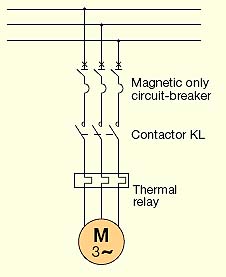
Рис. ABB
Схема прямого пуска электродвигателяMagnetic only circuit-breaker - Автоматический выключатель с электромагнитным расцепителем
Contactor KL - Контактор KL
Thermal relay - Тепловое реле
Параллельные тексты EN-RU
Direct-on-line starting
Direct-on-line starting, which is often abbreviated as DOL, is perhaps the most traditional system and consists in connecting the motor directly to the supply network, thus carrying out starting at full voltage.Direct-on-line starting represents the simplest and the most economical system to start a squirrel-cage asynchronous motor and it is the most used.
As represented in Figure 5, it provides the direct connection to the supply network and therefore starting is carried out at full voltage and with constant frequency, developing a high starting torque with very reduced acceleration times.
The typical applications are relevant to small power motors also with full load starting.
These advantages are linked to some problems such as, for example, the high inrush current, which - in the first instants - can reach values of about 10 to 12 times the rated current, then can decrease to about 6 to 8 times the rated current and can persist to reach the maximum torque speed.The effects of such currents can be identified with the high electro-dynamical stresses on the motor connection cables and could affect also the windings of the motor itself; besides, the high inrush torques can cause violent accelerations which stress the transmission components (belts and joints) generating distribution problems with a reduction in the mechanical life of these elements.
Finally, also the possible electrical problems due to voltage drops on the supply line of the motor or of the connected equipment must be taken into consideration.
[ABB]Прямой пуск
Прямой пуск, который по-английски часто сокращенно обозначают как DOL, является, пожалуй наиболее распространенным способом пуска. Он заключается в непосредственном (т. е. прямом) подключении двигателя к питающей сети. Это означает, что пуск двигателя осуществляется при полном напряжении.Схема прямого пуска является наиболее простым, экономичным и чаще всего применяемым решением для электродвигателей с короткозамкнутым ротором.
Схема прямого подключения к сети представлена на рисунке 5. Пуск осуществляется при полном напряжении и постоянной частоте сети. Электродвигатель развивает высокий пусковой момент при коротком времени разгона.
Типичные области применения – маломощные электродвигатели, в том числе с пуском при полной нагрузке.
Однако, наряду с преимуществами имеются и определенные недостатки, например, бросок пускового тока, достигающий в первоначальный момент 10…12-кратного значения от номинального тока электродвигателя. Затем ток двигателя уменьшается примерно до 6…8-кратного значения номинального тока и будет держаться на этом уровне до тех пор, пока скорость двигателя не достигнет максимального значения.
Такое изменение тока оказывает значительное электродинамическое воздействие на кабель, подключенный к двигателю. Кроме того пусковой ток воздействует на обмотки двигателя. Высокий начальный пусковой момент может привести к значительному ускорению и следовательно к значительной нагрузке элементов привода (ремней, крепления узлов), что вызывает сокращение их срока службы.
И, наконец, следует принять во внимание возможное возникновение проблем, связанных с падением напряжения в линии питания двигателя и подключенного к этой линии оборудования.
[Перевод Интент]
Тематики
Синонимы
EN
- across-the-line starting (US)
- direct line starting
- direct operation of a motor
- direct starting
- direct-on-line starting
- DOL
- full voltage starter application
DE
FR
Франко-русский словарь нормативно-технической терминологии > démarrage direct
См. также в других словарях:
Process Driven Development — (PDD) is a methodology for constructing non trivial custom software applications by analyzing the business processes in which they will be used. It complements the use case driven approach to software development by helping the software architect … Wikipedia
Application Discovery and Understanding — (ADU) is the process of automatically analyzing artifacts of a software application and determining metadata structures associated with the application in the form of lists of data elements and business rules. The relationships discovered between … Wikipedia
Process mining — techniques allow for the analysis of business processes based on event logs. They are often used when no formal description of the process can be obtained by other means, or when the quality of an existing documentation is questionable. For… … Wikipedia
Process management — is the ensemble of activities of planning and monitoring the performance of a process, especially in the sense of business process, often confused with reengineering. [Jörg Becker, Martin Kugeler, Michael Rosemann (eds.).Process Management. ISBN… … Wikipedia
Application lifecycle management — (ALM) regards the process of delivering software as a continuously repeating cycle of inter related steps: definition, design, development, testing, deployment and management. Each of these steps needs to be carefully monitored and controlled.… … Wikipedia
Application Level Events — (ALE) is a standard created by EPCglobal, an organization of industry leaders devoted to the development of standards for the Electronic Product Code (EPC) and Radio Frequency Identification (RFID) technologies and standards. The ALE… … Wikipedia
application — ap‧pli‧ca‧tion [ˌæplɪˈkeɪʆn] noun 1. [countable] a formal, usually written, request for something or for permission to do something: an application to do something • It hassubmitted an application to establish a distribution company. • The… … Financial and business terms
Process Oriented Psychology — (POP) refers to a body of theory and practice that encompasses a broad range of psychotherapeutic, personal growth, and group process applications. It is more commonly called Process Work in the United States, the longer name being used in Europe … Wikipedia
Application performance management — Application Performance Management, or APM, refers to the discipline within systems management that focuses on monitoring and managing the performance and service availability of software applications.APM can be defined as process and use of… … Wikipedia
Application Composite — Pour les articles homonymes, voir Mashup. Une application composite (ou mashup ou encore mash up) est une application qui combine du contenu ou du service provenant de plusieurs applications plus ou moins hétérogènes. On parle de mashup dans le… … Wikipédia en Français
Process-centered design — (PCD) is a design methodology, which proposes a business centric approach for designing user interfaces. Because of the multi stage business analysis steps involved right from the beginning of the PCD life cycle, it is believed to achieve the… … Wikipedia
