

-
21 Zonca, Vittorio
[br]b. c. 1568 Italyd. 1603 Italy[br]Italian architect who wrote a book on machines.[br]All that is known of Zonca is included on the frontispiece of the book that is his only claim to fame. He is there described as architect to the "Magnificent Community of Padua". He compiled a book on machines entitled Novo teatro de machine ed edificii (New Display of Machines and Edifices), illustrated with numerous fine engravings. It was printed in Padua in 1607, four years after his death, by Francesco Bertelli, who said of the book that it "came into my hands", as though he knew nothing of the author.During the sixteenth and early seventeenth centuries, a number of illustrated books on technical subjects appeared, compiled by knowledgeable and educated authors. These books greatly helped the spread of information about the technical arts throughout Europe. There were several books on mechanical devices, notably those by Ramelli, Besson and Zonca. In some ways, Zonca's is the most interesting, for it seems closest to the mechanical practice of the time. Several of the machines he describes are referred to as being in use in Padua or Venice and he suggests ways of improving them. The range of machines is wider than in other similar works and includes pumps, cranes, powder mills, printing and bookbinding presses and textile machines. Perhaps the most interesting of these is the water-driven silk-threading machine, since some of its components resemble those in use in the twentieth century. Spinning mills were widely used in the silk industry in sixteenth-century Italy, and Zonca offers a full description of one. He also shows the first example of an oblique treadwheel, driven by oxen for the grinding of grain. Even so, despite all the practical detail, the book ends, like others of its kind, with fantasy, in a description of a perpetual-motion machine.[br]Further ReadingA.G.Keller, 1964, A Theatre of Machines, London: Chapman \& Hall (provides brief details and illustrations from the books by Ramelli, Besson and Zonca).LRD -
22 padlock
навесной замок
-Параллельные тексты EN-RU
...be provided with a means permitting it to be locked in the OFF (isolated) position (for example by padlocks).
[IEC 60204-1-2006]... иметь средства для запирания в положении ОТКЛЮЧЕНО (отделено), например, с помощью навесных замков.
[Перевод Интент]
Источник: insight-security.com
In simple terms, a padlock has three major components; the Body, the Shackle and the Locking Mechanism, …it may also incorporate features such as a weatherproof casing, anti drill or anti cropping protection, etc.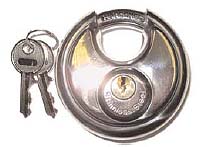
Discus style padlocks - have no angular corners, so are often used with cycle security chains and cables, as well as being a popular choice for securing doors on sheds and beach huts, etc. When used as a door lock, they will typically be used in conjunction with the special shrouded discus hasp and staple set, which offers extra protection to the padlock shackle.
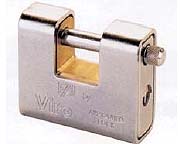
Shutter Locks / Anvil Locks - are typically used to secure the external (or internal) security roller shutters fitted to shop fronts. They are also popular for use with parking posts, motorcycle security chains, etc.
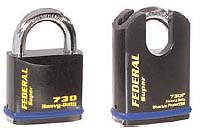
Conventional Style padlocks have a wide range of applications from low security applications like locking your toolbox, to high security uses such as securing factory gates or protecting motorcycles. They are typically available as; Open, Close, or Semi Enclosed Shackle types
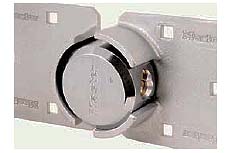
Shackleless type padlock (shown with special hasp)Shackleless Padlocks - this is a bit of a misnomer as the padlock does of course have a shackle, it’s just that it’s on the underside of the lock body and therefore unseen. This type of padlock can be round (like the one pictured) or rectangular, but typically, they are designed to be used with a special matching security hasp. Because of their design, these units are difficult to attack and over recent years, as well as being used on warehouse doors, etc, they have also become very popular for use on vans and other vehicles where they are used to secure opening double doors.
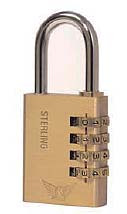
A "Close Shackle" padlock is one with built in shoulders, which are designed to minimise the amount of the shackle exposed, to a saw or bolt cropper attack. This type of padlock will normally have a higher security rating than an equivalent unit with a semi enclosed or open shackle, however subject to size and clearances, may not be practical for instance, to use where you need to secure 2 chain links together or require a padlock for use with a shrouded hasp, etc. To make them easier to use, many Close Shackle padlocks feature "removable shackles" which are fully released from the body of the padlock when it's unlocked.
An "Open Shackle" padlock will typically be easier to use where the shackle needs to pass through 2 chain-links (i.e, a chain securing two opening gates together), etc. As more of the shackle is exposed however, this makes it potentially easier to attack with a saw or bolt croppers.
A "Semi Enclosed Shackle" padlock is something of a compromise, but will often offer more flexibility in use than a Close Shackle padlock and improved security over an Open Shackle model.
Тематики
EN
Англо-русский словарь нормативно-технической терминологии > padlock
- 1
- 2
См. также в других словарях:
Practical joke — involving completely blocking someone s doorway with phone books … Wikipedia
Practical Aesthetics — is an acting technique originally conceived by David Mamet and William H. Macy, based on the teachings of Stanislavsky, Sanford Meisner, and the Stoic Philosopher Epictetus.Lehmann Haupt, Christopher (October 23, 1997). A Dramatist s How To Guide … Wikipedia
Practical arguments — are a logical structure used to determine the validity or dependencies of a claim.See argument for uses and general information.OverviewAn argument can be thought of as two or more contradicting tree structures. *The root of each tree is a claim; … Wikipedia
Practical Performance Car Magazine — ( PPC ) is a British car magazine published monthly by Blockhead Media. The magazine uses the strap lines Performance Tuning for Grown Ups and Building, tuning buying real world performance cars [http://www.ppcmag.co.uk] .The magazine takes an… … Wikipedia
Practical number — In mathematics, and in particular number theory, a practical number or panarithmic number is a positive integer n such that all smaller positive integers can be represented as sums of distinct divisors of n . For example, 12 is a practical number … Wikipedia
Practical reason — In philosophy, practical reason is the use of reason to decide how to act. This contrasts with theoretical reason (often called speculative reason), which is the use of reason to decide what to believe. For example: agents use practical reason to … Wikipedia
example — noun 1 sth that is typical/demonstrates a point ADJECTIVE ▪ characteristic, classic, prime, quintessential, stellar (AmE), supreme, textbook, typical, ultimate … Collocations dictionary
Practical engineer — A Practical Engineer is a professional degree awarded by technological colleges in Israel and validated by the National Institute for Technological Training of the Ministry of Industry, Trade Labor (State of Israel). [… … Wikipedia
Practical Mechanics — Infobox Magazine title = Practical Mechanics image size = 250px image caption = Cover to Practical Mechanics , The Car Any Amateur Can Make! publisher = category = Science and technology magazines total circulation = circulation year = frequency … Wikipedia
practical — {{Roman}}I.{{/Roman}} noun (BrE) ADJECTIVE ▪ chemistry, physics, etc. ▪ laboratory VERB + PRACTICAL ▪ sit (BrE), take … Collocations dictionary
Practical Devices Corporation — Infobox Company name = Practical Devices Corporation type = Private foundation = Toronto, Canada (2001) location city = Toronto, Ontario location country = Canada area served = Worldwide industry = Electronics products = Headphone amplifiers,… … Wikipedia
