

-
81 работа
work
(выполняемая человеком или совершаемая машиной) — instructions for accomplishing the work.
указания no выполнению работ(ы). содержание работы, тепловая энергия горячего воздуха, подаваемого в турбохолодильник, преобразуется в работу, вызывая охлажние воздуха на выходе из tх — description of work. h energy passing through the cooling turbine is converted into work, thus causing a temperature drop across the turbine.
- (нагруженного элемента конструкции) — stress carrying
"-" (надпись у выключателя противопожарной системы) — (fire) agent arm
- (обрабатываемая заготовка или деталь) тиски применяются для зажима обрабатываемого материала или работы. — job. vices are used to grip firmly the material or job upon which work is being done.
"-" (положение рычага останова двигателя) — run, fuel on, open
"-" (режим работы навигационной инерциальной системы) — navigate (nav) mode. set the ins mode selector switch to nav position.
- (фунхционирование, действие, операция) — operation, action
данная глава содержит щие сведения о принципе работы насоса. — this chapter contains general information on principle of the pump operation.
- абсу в штурвальном рожиме — afcs operation under manual control
-, автоматическая — automatic operation
-, автоматическая (двигателя после нар) — (engine) governed run
- агрегата — unit operation
-, безотказная (бееперебой — trouble-free operation
-, бесшумная — noise-free operation
- в автоматическом режиме — automatic operation
- (выполняемая) в заводских условиях или в мастерских — shop work
инструкции по ремонту составлены для механизмов, выполняющих работу в стационарных мастерских, а не дпя механиков-эксплуатационников. — the overhaul instructions are prepared for mechanic who normally performs shop work and not for the aircraft service mechanic.
-, внерегламентная — unscheduled maintenance check
-, внеочередная регламентная — unscheduled maintenance check
- в ручном режиме — manual operation
- выполняемая при нахождении самолета вне эксплуатации сроком до (одного) mесяца — maintenance of aircraft during an inaction period of (one) month
-, выполняемая своими силами (на своих базах) — work accomplished "in house"
работа, выполняется своими силами, вместо того, чтобы выполнять эту работу силами изготовителя. — work accomplished in house versus "return to vendor" philosophy.
- генераторов, непараллельная — unparalleled operation of generators
- генераторов, непараллельная (табло) — unparalleled generators: generators unparalleled (gen unparl'd)
- генераторов, параллельная — paralleled operation of generators, generators operating paral leled
- генераторов, параллельная (табло) — paralleled generators, generators paralleled (gen parl'd)
- генераторов, раздельная (в отличие от параллельной) — independent operation of generators
- двигателя — engine operation /running/
работа двигателя во всем диапазоне эксплуатационных (полетных) режимов, — the engine operation throughout the flight power range.
- двигателя (этап) — engine run
30-часовой этап работы двигателя на чередующихся режимах: взлетном и мпр. — 30-hour run (of engine) consisting of alternate periods at takeoff power and at maximum cruising power.
-, заключительная — conclusive operation
- летчика (нагрузка) — pilot work load
наличие автоматического включения реверса тяги облегчает работу летчика при посадке, — installation of automatic thrust reversal control reduces pilot work load during landing.
- на большом газе (двиг.) — engine run /operation/ at full throttle
- на валу — shaft work
- на взлетном режиме (двиг.) — (engine) operation at takeoff power, takeoff power operation
-, надежная — reliable /dependable/ operation
- на завышенных оборотах (двиг.) (этап испытаний) — overspeed run
работа двигателя на завыщенных оборотах должна чередоваться с работой на стабилизирующих режимах. — the overspeed runs must be alternated with stabilizing runs.
- на максимальном продолжительном режиме (мпр) (двиг.) — engine operation at maximum continuous power
- на малом газе (двиг.) — (engine) operation at idle power, idling
работа на возможно малых оборотах, не приводящая к останову двигателя, — engine running at lowest speed possible, without stopping.
- на малых оборотах (двиг.) — engine low speed operation
- на "номинальном" режиме (на mпp) (двиг.) — (engine) operation at maximum continuous power
- (вертолета) на привязи — (helicopter) tie-down run
-, научно-исследовательская — research work
-, на холостом ходу (двиг.) — idling
-, непрерывная — continuous operation
-, неустойчивая — unstable operation
-, осмотровая — inspection
-, плановая (оперативная по регламенту техобслуживания) — line maintenance
-, погрузочно-разгрузочная — cargo handling (operation)
-, подготовительная работа по подготовке обо_ рудования к установке на ла. — preparatory procedure
-, полезная — useful work
- по разработке бортового оборудования ла — development work on airborne equipment
- по техническому обслуживанию (осмотру) — inspection and maintenance work /action/
-, профилактическая (техобслуживания) — preventive maintenance operation
-, регламентная — scheduled maintenance action /check, inspection/
выполнение программы надежности является лучшим методом для обеспечения надежности работы систем в периоды между регламентными работами. — the reliability program is the best method of controlling the interval between scheduled maintenance actions.
-, регламентная (50-) часовая — (50-)hour scheduled maintenance check
-, регламентная (50-) часовая (в летных часах) — (50-)flight hour (fh) maintenаncе cheek
-, ремонтная (текущий ремонт) — repair work
-, совместная — work in unison
systems operate conjointly or in unison.
-, с перебоями (двиг.) — rough (engine) operation
двигатель работает с перебоями при неисправности системы зажигания или питания топливом, — an engine that is running or firing unevenly, usually due to а faulty condition in either the fuel or ignition systems.
-, строго регламентированная — hard-time (ht) process /action/
вид профилактической технической проверки в результате которой изделие (агрегат) должен быть снят с самолета и направлен в ремонт до истечения срока регламентных работ по данному изделию, — нт is а failure preventive primary maintenance (overhaul control) process which requires that the item be removed from the airplane and overhauled (or replaced) before exceeding the specified time (interval).
- схемы (раздел описания работы электр. схемы системы блока и т.п.) — detailed circuit description
-, текущая — current work
-, типовая — routine
- "уравновешивающая" (этап испытаний двиг.) — stabilizing run
работа двигателя на повышенном режиме должна чередоваться е работой на уравновешивающем режиме. — overspeed runs must be alternated with stabilizing runs.
- установившаяся — steady operation
-, устойчивая — stable operation
-, экспериментальная — experimental work
.нарушение нормальной р. (агрегата системы) — malfunction
объем р. — scope of work
описание и р. (раздел руководства) — description and operation
порядок выполнения р. (раздел бюллетеня) — accomplishment instructions
при р. с (на) прибором, (самелете) — when working on indicator (airplane)
схема р. — functional diagram
часы р. — hours of operation
выполнять р. — accomplish work
выполнять р. на агрегате (работать с агрегатом) — perform work on unit
зажимать р. в тисках — grip а job in the vice
нарушать нормальную р. (агрегата, системы) — cause malfunction
проводить р. на /с/... — work оп...Русско-английский сборник авиационно-технических терминов > работа
-
82 benchmarking
Mktga systematic process of comparing the activities and work processes of an organization or department with those of outstanding organizations or departments in order to identify ways to improve performance. Benchmarking was first developed by the Xerox Corporation in the late 1970s in order to learn from the achievements of Japanese competitors and was described by a Xerox manager, Robert C. Camp, in his book Benchmarking: The Search for Industry Best Practices That Lead to Superior Performance (1989).The use of benchmarking has become widespread and individual organizations have developed distinct approaches toward it. Benchmarking programs commonly include the following stages: identifying the area requiring benchmarking and the process to use, collecting and analyzing the data, implementing changes, and monitoring and reviewing improvements. Benchmarking is used in business appraisal, often as part of a total quality management or business process reengineering program.\Types of benchmarking include: internal benchmarking, a method of comparing one operating unit or function with another within the same industry; functional benchmarking, in which internal functions are compared with those of the best external practitioners of those functions, regardless of the industry they are in; competitive benchmarking, in which information is gathered about direct competitors, through techniques such as reverse engineering; and strategic benchmarking, a type of competitive benchmarking aimed at strategic action and organizational change. -
83 Bentham, Sir Samuel
SUBJECT AREA: Ports and shipping[br]b. 11 January 1757 Englandd. 31 May 1831 London, England[br]English naval architect and engineer.[br]He was the son of Jeremiah Bentham, a lawyer. His mother died when he was an infant and his early education was at Westminster. At the age of 14 he was apprenticed to a master shipwright at Woolwich and later at Chatham Dockyard, where he made some small improvements in the fittings of ships. In 1778 he completed his apprenticeship and sailed on the Bienfaisant on a summer cruise of the Channel Fleet where he suggested and supervised several improvements to the steering gear and gun fittings.Unable to find suitable employment at home, he sailed for Russia to study naval architecture and shipbuilding, arriving at St Petersburg in 1780, whence he travelled throughout Russia as far as the frontier of China, examining mines and methods of working metals. He settled in Kritchev in 1782 and there established a small shipyard with a motley work-force. In 1784 he was appointed to command a battalion. He set up a yard on the "Panopticon" principle, with all workshops radiating from his own central office. He increased the armament of his ships greatly by strengthening the hulls and fitting guns without recoil, which resulted in a great victory over the Turks at Liman in 1788. For this he was awarded the Cross of St George and promoted to Brigadier- General. Soon after, he was appointed to a command in Siberia, where he was responsible for opening up the resources of the country greatly by developing river navigation.In 1791 he returned to England, where he was at first involved in the development of the Panopticon for his brother as well as with several other patents. In 1795 he was asked to look into the mechanization of the naval dockyards, and for the next eighteen years he was involved in improving methods of naval construction and machinery. He was responsible for the invention of the steam dredger, the caisson method of enclosing the entrances to docks, and the development of non-recoil cannonades of large calibre.His intervention in the maladministration of the naval dockyards resulted in an enquiry that brought about the clearing-away of much corruption, making him very unpopular. As a result he was sent to St Petersburg to arrange for the building of a number of ships for the British navy, in which the Russians had no intention of co-operating. On his return to England after two years he was told that his office of Inspector-General of Navy Works had been abolished and he was appointed to the Navy Board; he had several disagreements with John Rennie and in 1812 was told that this office, too, had been abolished. He went to live in France, where he stayed for thirteen years, returning in 1827 to arrange for the publication of some of his papers.There is some doubt about his use of his title: there is no record of his having received a knighthood in England, but it was assumed that he was authorized to use the title, granted to him in Russia, after his presentation to the Tsar in 1809.[br]Further ReadingMary Sophia Bentham, Life of Brigadier-General Sir Samuel Bentham, K.S.G., Formerly Inspector of Naval Works (written by his wife, who died before completing it; completed by their daughter).IMcN -
84 Harrison, John
[br]b. 24 March 1693 Foulby, Yorkshire, Englandd. 24 March 1776 London, England[br]English horologist who constructed the first timekeeper of sufficient accuracy to determine longitude at sea and invented the gridiron pendulum for temperature compensation.[br]John Harrison was the son of a carpenter and was brought up to that trade. He was largely self-taught and learned mechanics from a copy of Nicholas Saunderson's lectures that had been lent to him. With the assistance of his younger brother, James, he built a series of unconventional clocks, mainly of wood. He was always concerned to reduce friction, without using oil, and this influenced the design of his "grasshopper" escapement. He also invented the "gridiron" compensation pendulum, which depended on the differential expansion of brass and steel. The excellent performance of his regulator clocks, which incorporated these devices, convinced him that they could also be used in a sea dock to compete for the longitude prize. In 1714 the Government had offered a prize of £20,000 for a method of determining longitude at sea to within half a degree after a voyage to the West Indies. In theory the longitude could be found by carrying an accurate timepiece that would indicate the time at a known longitude, but the requirements of the Act were very exacting. The timepiece would have to have a cumulative error of no more than two minutes after a voyage lasting six weeks.In 1730 Harrison went to London with his proposal for a sea clock, supported by examples of his grasshopper escapement and his gridiron pendulum. His proposal received sufficient encouragement and financial support, from George Graham and others, to enable him to return to Barrow and construct his first sea clock, which he completed five years later. This was a large and complicated machine that was made out of brass but retained the wooden wheelwork and the grasshopper escapement of the regulator clocks. The two balances were interlinked to counteract the rolling of the vessel and were controlled by helical springs operating in tension. It was the first timepiece with a balance to have temperature compensation. The effect of temperature change on the timekeeping of a balance is more pronounced than it is for a pendulum, as two effects are involved: the change in the size of the balance; and the change in the elasticity of the balance spring. Harrison compensated for both effects by using a gridiron arrangement to alter the tension in the springs. This timekeeper performed creditably when it was tested on a voyage to Lisbon, and the Board of Longitude agreed to finance improved models. Harrison's second timekeeper dispensed with the use of wood and had the added refinement of a remontoire, but even before it was tested he had embarked on a third machine. The balance of this machine was controlled by a spiral spring whose effective length was altered by a bimetallic strip to compensate for changes in temperature. In 1753 Harrison commissioned a London watchmaker, John Jefferys, to make a watch for his own personal use, with a similar form of temperature compensation and a modified verge escapement that was intended to compensate for the lack of isochronism of the balance spring. The time-keeping of this watch was surprisingly good and Harrison proceeded to build a larger and more sophisticated version, with a remontoire. This timekeeper was completed in 1759 and its performance was so remarkable that Harrison decided to enter it for the longitude prize in place of his third machine. It was tested on two voyages to the West Indies and on both occasions it met the requirements of the Act, but the Board of Longitude withheld half the prize money until they had proof that the timekeeper could be duplicated. Copies were made by Harrison and by Larcum Kendall, but the Board still continued to prevaricate and Harrison received the full amount of the prize in 1773 only after George III had intervened on his behalf.Although Harrison had shown that it was possible to construct a timepiece of sufficient accuracy to determine longitude at sea, his solution was too complex and costly to be produced in quantity. It had, for example, taken Larcum Kendall two years to produce his copy of Harrison's fourth timekeeper, but Harrison had overcome the psychological barrier and opened the door for others to produce chronometers in quantity at an affordable price. This was achieved before the end of the century by Arnold and Earnshaw, but they used an entirely different design that owed more to Le Roy than it did to Harrison and which only retained Harrison's maintaining power.[br]Principal Honours and DistinctionsRoyal Society Copley Medal 1749.Bibliography1767, The Principles of Mr Harrison's Time-keeper, with Plates of the Same, London. 1767, Remarks on a Pamphlet Lately Published by the Rev. Mr Maskelyne Under theAuthority of the Board of Longitude, London.1775, A Description Concerning Such Mechanisms as Will Afford a Nice or True Mensuration of Time, London.Further ReadingR.T.Gould, 1923, The Marine Chronometer: Its History and Development, London; reprinted 1960, Holland Press.—1978, John Harrison and His Timekeepers, 4th edn, London: National Maritime Museum.H.Quill, 1966, John Harrison, the Man who Found Longitude, London. A.G.Randall, 1989, "The technology of John Harrison's portable timekeepers", Antiquarian Horology 18:145–60, 261–77.J.Betts, 1993, John Harrison London (a good short account of Harrison's work). S.Smiles, 1905, Men of Invention and Industry; London: John Murray, Chapter III. Dictionary of National Biography, Vol. IX, pp. 35–6.DV -
85 Jacquard, Joseph-Marie
SUBJECT AREA: Textiles[br]b. 7 July 1752 Lyons, Franced. 7 August 1834 Oullines, France[br]French developer of the apparatus named after him and used for selecting complicated patterns in weaving.[br]Jacquard was apprenticed at the age of 12 to bookbinding, and later to type-founding and cutlery. His parents, who had some connection with weaving, left him a small property upon their death. He made some experiments with pattern weaving, but lost all his inheritance; after marrying, he returned to type-founding and cutlery. In 1790 he formed the idea for his machine, but it was forgotten amidst the excitement of the French Revolution, in which he fought for the Revolutionists at the defence of Lyons. The machine he completed in 1801 combined earlier inventions and was for weaving net. He was sent to Paris to demonstrate it at the National Exposition and received a bronze medal. In 1804 Napoleon granted him a patent, a pension of 1,500 francs and a premium on each machine sold. This enabled him to study and work at the Conservatoire des Arts et Métiers to perfect his mechanism for pattern weaving. A method of selecting any combination of leashes at each shoot of the weft had to be developed, and Jacquard's mechanism was the outcome of various previous inventions. By taking the cards invented by Falcon in 1728 that were punched with holes like the paper of Bouchon in 1725, to select the needles for each pick, and by placing the apparatus above the loom where Vaucanson had put his mechanism, Jacquard combined the best features of earlier inventions. He was not entirely successful because his invention failed in the way it pressed the card against the needles; later modifications by Breton in 1815 and Skola in 1819 were needed before it functioned reliably. However, the advantage of Jacquard's machine was that each pick could be selected much more quickly than on the earlier draw looms, which meant that John Kay's flying shuttle could be introduced on fine pattern looms because the weaver no longer had to wait for the drawboy to sort out the leashes for the next pick. Robert Kay's drop box could also be used with different coloured wefts. The drawboy could be dispensed with because the foot-pedal operating the Jacquard mechanism could be worked by the weaver. Patterns could be changed quickly by replacing one set of cards with another, but the scope of the pattern was more limited than with the draw loom. Some machines that were brought into use aroused bitter hostility. Jacquard suffered physical violence, barely escaping with his life, and his machines were burnt by weavers at Lyons. However, by 1812 his mechanism began to be generally accepted and had been applied to 11,000 draw-looms in France. In 1819 Jacquard received a gold medal and a Cross of Honour for his invention. His machines reached England c.1816 and still remain the basic way of weaving complicated patterns.[br]Principal Honours and DistinctionsFrench Cross of Honour 1819. National Exposition Bronze Medal 1801.Further ReadingA.Barlow, 1878, The History and Principles of Weaving by Hand and by Power, London.C.Singer (ed.), 1958, A History of Technology, Vol. IV, Oxford: Clarendon Press.R.L.Hills, 1970, Power in the Industrial Revolution, Manchester (covers the introduction of pattern weaving and the power loom).RLH -
86 Rillieux, Norbert
SUBJECT AREA: Agricultural and food technology[br]b. 1800 New Orleans, Louisiana, USAd. 1894 France[br]African-American inventor of a sugar-evaporation process.[br]A free black, he was the son of Vincent Rillieux, a white engineer, and Constance Vivant, a quadroon. The family was prosperous enough to send him to France to be educated, at the Ecole Centrale in Paris. There he studied engineering and later taught mechanical engineering, developing a special interest in thermodynamics and steampower. In 1830 he devised a vacuum evaporation system with industrial possibilities, but he was unable to interest any French firms in the device. He therefore returned to New Orleans and ob-tained his first patent in 1843. Two years later he was able to have the evaporation system installed on a plantation to refine sugar. It soon demonstrated its worth, for planters were able to recoup the cost of the plant within a year through raised production and reduced operating costs. It came to be the generally accepted method for processing sugar-cane juice, and the price of refined sugar fell so that white sugar ceased to be a luxury food for the rich.Rillieux's patents protected him from repeated efforts to counterfeit the process, which thus earned him considerable wealth. However, because of increasing hostility and discriminatory laws against blacks in New Orleans, he did not long enjoy it and he returned to France, taking up the study of egyptology.[br]Further ReadingP.P.James, 1989, The Real McCoy: AfricanAmerican Invention and Innovation 1619– 1930, Washington, DC: Smithsonian Institution, pp. 41–3.LRD -
87 Arbeitsweise
f1. functioning2. method of operating3. mode of operation4. mode of practice -
88 обслуживание
аэродромное обслуживаниеaerodrome service(диспетчерское) аэронавигационное диспетчерское обслуживаниеaeronautical information controlаэронавигационное обслуживаниеair navigation serviceбаза для обслуживания полетовair baseбаза оперативного технического обслуживанияline maintenance baseбесплатное обслуживаниеfree serviceбригада аэродромного обслуживанияramp crewбригада наземного обслуживания1. ground crew2. air base group бригада технического обслуживанияmaintenance crewбригада технического обслуживания воздушных судовaircraft maintenance teamвнерегламентное обслуживаниеincidental serviceвоздушное судно для обслуживания местных авиалинийfeederlinerвремя, необходимое на полное обслуживание и загрузкуground turn-around timeвремя простоя на техническим обслуживанииmaintenance ground timeвыполнение профилактического обслуживанияupkeepвыставка технического оборудования для обслуживания воздушных судовaircraft maintenance engineering exhibitionгидросистема для обслуживания вспомогательных устройствutility hydraulic systemгосударство, предоставляющее обслуживаниеprovider stateдиспетчерское обслуживание воздушного пространстваair controlзона обслуживанияservice areaзона радиолокационного обслуживанияradar service areaзона технического обслуживанияmaintenance areaинженер по техническому обслуживанию воздушных судовaircraft maintenance engineerинструкция по техническому обслуживаниюmaintenance instructionинформационное обслуживание авиационных маршрутовaeronautical en-route information serviceкарта - наряд на выполнение регламентного технического обслуживанияscheduled maintenance recordкарта - наряд на выполнение технического обслуживанияmaintenance releaseкарта - наряд на техническое обслуживаниеmaintenance recordкатегория обслуживанияgrade of serviceконсультативное обслуживаниеadvisory service(полетов) консультативное обслуживание верхнего воздушного пространстваupper advisory serviceконсультативное обслуживание воздушного движенияtraffic advisory serviceконтракт на обслуживание в аэропортуairport handling contractконтроль за выполнением технического обслуживанияmaintenance supervisionКонференция по вопросам обслуживания пассажировPassenger Services Conferenceмаршрут консультативного обслуживанияadvisory routeмашина для обслуживания кухни1. galley service truck2. catering truck место на крыле для выполнения технического обслуживанияoverwing walkwayметод технического обслуживанияmaintenance methodназемное оборудование для обслуживанияground service equipmentназемное обслуживание1. ground handling2. ground servicing наземное обслуживание рейсовground handling operationназемные средства обслуживанияground handling facilitiesне обеспечивать диспетчерское обслуживаниеfail to maintain controlобеспечивать диспетчерское обслуживаниеmaintain controlобеспечивать обслуживаниеprovide serviceоборудование для обслуживания воздушного суднаaircraft servicing equipmentоборудование для обслуживания грузовcargo-handling equipmentоборудование для обслуживания пассажировpassenger-handling equipmentоборудование для технического обслуживанияmaintenance facilitiesобслуживание воздушного суднаaircraft servicingобслуживание в процессе стоянкиstanding operationобслуживание пассажировcare of passengersобслуживание пассажиров в городском аэровокзалеcity-terminal coach serviceобслуживание по смешанному классуmixed serviceобслуживание по туристическому классу1. no frills service2. economy class service 3. coach service объединение для технического обслуживанияtechnical poolоперативная форма технического обслуживанияfine maintenance checkоперативное полетно-информационное обслуживаниеoperational flight information serviceОтдел обслуживания проектов на местахField Services Branchотдел перонного обслуживанияapron handling agencyпанель обслуживанияservice centerпередвижная станция технического обслуживанияmobile ship stationпериодическая форма технического обслуживанияperiodic maintenance checkпосадка для выполнения обслуживанияoperating stop(воздушного судна) Правила аэронавигационного обслуживанияProcedures for Air Navigation Servicesправила обслуживания воздушного движенияair traffic services proceduresпредполетное информационное обслуживаниеpreflight information serviceпрекращать диспетчерское обслуживаниеterminate the controlпрекращение диспетчерского обслуживанияtermination of controlприспособление для обслуживания стабилизатораstabilizer servicing deviceпродолжительность обслуживанияservicing timeпродолжительность обслуживания воздушного суднаaircraft service periodпрямые расходы на техническое обслуживаниеdirect maintenance costsпункт обслуживания воздушного движенияair traffic services unitработы по техническому обслуживаниюmaintenance operationsрадиовещательное обслуживание авиационного движенияaeronautical broadcasting serviceрадиолокационное обслуживаниеradar serviceрасходы на оперативное обслуживаниеoperational expensesрасходы на техническое обслуживаниеmaintenance costsреактивное воздушное судно для обслуживания местных авиалинийfeederjetрегламент технического обслуживания1. maintenance schedule2. maintenance program рейс с обслуживанием по первому классуfirst-class flightсбор за аэронавигационное обслуживание на трассе полетаen-route facility chargeсбор за наземное обслуживаниеground handling chargeсбор за обслуживание1. charge for service2. handling fee 3. service charge Сектор общего обслуживанияGeneral Services Unitсовместное обслуживаниеpooled serviceспутниковое радиовещательное обслуживаниеbroadcasting-satellite serviceстационарная установка для обслуживания воздушного суднаaircraft servicing installationстремянка для технического обслуживанияmaintenance standсхема обслуживания воздушного движенияair traffic service chartтариф за полное обслуживаниеinclusive fareтелеграфное обслуживание с дистанционным управлениемremote keying serviceтехническое обслуживание1. maintenance service2. maintenance work 3. servicing 4. maintenance A технология технического обслуживания воздушного суднаaircraft maintenance practiceтранспортные средства для обслуживания воздушного суднаaircraft service truck'sунифицированная складирующаяся стремянка для обслуживанияunified folding maintenance platformуровень технического обслуживанияmaintenance competencyустановка на место обслуживанияdocking manoeuvreустановленный порядок обслуживанияroutine servicingцех технического обслуживанияmaintenance shopцех технического обслуживания воздушных судовaircraft maintenance divisionэксперт по обслуживанию воздушного движенияair traffic services expertэксперт по техническому обслуживаниюmaintenance expert -
89 производство
запускать воздушное судно в производствоput the aircraft into productionинспектор по производству полетовoperations inspectorинструктор по производству полетовflight operations instructorинструкция по производству полетовoperation instructionконтроль за производством полетовoperating supervisionлицензия на производствоproduction certificateпроизводство воздушных судовaircraft productionруководство по производству полетов в зоне аэродромаaerodrome rulesсебестоимость производства воздушного суднаaircraft first costтехнология производства1. fabrication method2. manufacturing procedure 3. production technology фирма по производству воздушных судовaircraft companyэксперт по производству налетовflight operations expert -
90 снижение
снижение сущ1. cutdown2. descending 3. downgrading 4. fall 5. letdown 6. pushdown аварийное снижение1. emergency descent2. emergency descent operation высота начала сниженияdescent topдопуск на снижениеdegradation allowanceзамедлять снижениеslow descentзапасная траектория сниженияalternate descend pathзапланированное снижениеplanned descentзаход на посадку с непрерывным снижениемcontinuous descent approachкривая снижения уровня шумаnoise level attenuation curveкрутое снижениеsteep descentмеры по снижению шумаnoise abatement measuresминимальная высота снижения1. minimum descent height2. minimum descent altitude начинать снижениеcommence descentнеуправляемое снижение1. uncontrolled descent2. uncontrolled descent operation оборудование для снижения шумаhush kitпервоначальный этап сниженияinitial descentполет со снижением1. nose-down flying2. descending operation 3. descending flight 4. downward flight пологое снижениеshallow descentпрекращать снижениеarrest descentпроведение работ по снижению высоты препятствий для полетовobstacle clearingпроизводить снижениеdrift downразворот со снижениемdescending turnразрешение на начало сниженияinitial descent clearanceразрешение на снижениеdescent clearanceрезкое снижениеfalloffсваливание из-за снижения эффективности рулейmush stallсистема снижения подачи топливаfuel dip systemскорость при аварийном сниженииemergency descent speedскорость снижения1. rate of descent2. descent velocity скорость снижения перед касаниемsink rateскорость снижения при заходе на посадкуapproach rate of descentснижение в режиме авторотацииautorotative descentснижение в режиме планированияgliding descentснижение в режиме торможенияbraked descentснижение на крейсерском режимеcruise descentснижение на режиме авторотацииautorotative descend operationснижение по спиралиspiral descentснижение режима работыthrottle retardingснижение с работающим двигателемpower-on descentснижение с работающими двигателямиpower-on descend operationснижение характеристикperformance lossснижение шума при опробовании двигателей на землеground run-up noise abatementснижение эффективностиmushingсо снижениемin descentсо снижением высотыwith decrease in the altitudeспособ резкого сниженияmethod of steepest descentспособ снижения шумаnoise abatement techniqueсхема сниженияlet-down procedureтехнология снижения шумовacoustic technologyтраектория сниженияdescent pathтребования по снижению шумаnoise reduction requirementsугол сниженияangle of descentуказатель скорости снижения на ВППrising runway indicatorуменьшение тяги с целью снижения шумаnoise abatement thrust cutbackустанавливать режим сниженияestablish descentустройство для снижения уровня шумаnoise abatement deviceучасток маршрута со снижениемdown legучасток сниженияdescent segmentэксплуатационные методы снижения авиационного шумаaircraft noise abatement operating proceduresэксплуатационные приемы снижения шумаnoise abatement procedures -
91 контактор (контактный)
- power contactor
- mechanical contactor
- magnetic contactor
- M/C
- electromechanical contactor
- electric contactor
- contactor
- contact-maker
контактор (механический) 1
Контактный коммутационный аппарат с единственным положением покоя, с управлением не вручную, способным включать, проводить и отключать токи в нормальных условиях цепи, в том числе при рабочих перегрузках.
МЭК 60050(441-14-33).
Примечание. Контакторы можно характеризовать способом, которым обеспечивается создание усилия для замыкания главных контактов
[ ГОСТ Р 50030. 1-2000 ( МЭК 60947-1-99)]
контактор
Двухпозиционный аппарат с самовозвратом, предназначенный для частых коммутаций токов, не превышающих токи перегрузки, и приводимый в действие двигательным приводом.
Примечание. Для аналогичных аппаратов без самовозврата следует применять термин «Контактор без самовозврата».
[ ГОСТ 17703-72]
контактор
Выключатель для дистанционного включения, отключения и переключения силовых электрических цепей
[Терминологический словарь по строительству на 12 языках (ВНИИИС Госстроя СССР)]EN
(mechanical) contactor
a mechanical switching device having only one position of rest, operated otherwise than by hand, capable of making, carrying and breaking currents under normal circuit conditions including operating overload conditions
NOTE – Contactors may be designated according to the method by which the force for closing the main contacts is provided.
[IEV number 441-14-33]FR
contacteur (mécanique)
appareil mécanique de connexion ayant une seule position de repos, commandé autrement qu'à la main, capable d'établir, de supporter et d'interrompre des courants dans les conditions normales du circuit, y compris les conditions de surcharge en service
NOTE – Les contacteurs peuvent être désignés suivant la façon dont est fourni l'effort nécessaire à la fermeture des contacts principaux.
[IEV number 441-14-33]1 Должно быть " контактный"
См., например, выключатель (контактный) - (mechanical) switch
Коммутационные аппараты следует классифицировать на контактные и полупроводниковые (solid-state)
[Интент]1. Контактор на относительно небольшой номинальный ток, это такой же коммутационный аппарат, как и пускатель, но без теплового реле (можно сказать, что пускатель это контактор плюс тепловое реле).
2. Контактор на большой номинальный ток выглядит совсем иначе
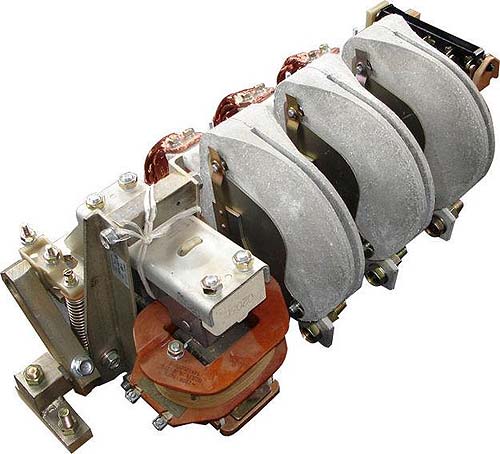
Отечественный контактор КТ-6063Число полюсов: 3
Номинальное напряжение главной цепи: 380 В
Номинальный ток главной цепи: 1000 А
Номинальное напряжение катушки: 380 В переменного тока
Контакторы электромагнитные серии КТ 6000 с естественным воздушным охлаждением предназначены для включения и отключения приемников электрической энергии на номинальное напряжение до 380 В переменного тока частоты 50 и 60Гц.
Используются в составе оборудования для включения мощных электрических машин и в аппаратуре автоматического включения резерва (АВР).3. Контакторами называют также коммутационные аппараты, коммутационная способность которых больше коммутационной способности реле (см. рис. ниже)
[Интент]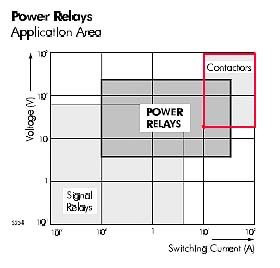
Рис. Tyco ElectronicsПараллельные тексты EN-RU
Although contactors are not strictly relays they have the same design principles. Like relays, they are remote controlled switches.
The difference is the considerably higher input power consumption, higher switching capacity, and larger size.
[Tyco Electronics]Хотя, строго говоря, контакторы не являются реле, их конструкция имеет много общего с конструкцией реле. Также как и реле, они представляют собой коммутационный аппарат с дистационным управлением.
Отличие состоит в том, что их входная цепь потребляет значительно больший ток, они имеют существенно большую коммутационную способность и их размеры также больше размеров реле.
[Перевод Интент]Недопустимые, нерекомендуемые
Тематики
Действия
Неправильно:- замыкать контактор; - размыкать контакторСинонимы
EN
- contact-maker
- contactor
- electric contactor
- electromechanical contactor
- M/C
- magnetic contactor
- mechanical contactor
- power contactor
DE
FR
Русско-английский словарь нормативно-технической терминологии > контактор (контактный)
-
92 регулирование по методу нормы прибыли
регулирование по методу нормы прибыли
RoRR
Метод установления тарифных ставок коммунальной распределительной компании. При RoRR, коммунальным предприятиям разрешается возмещать свои операционные расходы, налоги и износ, а также им дается возможность получать разумную норму прибыли по используемым активам (т.е. тарифной базе) при предоставлении услуг своим потребителям.
[Англо-русский глосcарий энергетических терминов ERRA]EN
rate-of-return regulation | RoRR
A method of setting a utility distribution company's rates. Under RoRR utilities are allowed to recover their operating expenses, taxes and depreciation, plus are provided the opportunity to earn a fair rate of return on the assets utilized (i.e. rate base) in providing service to their customers.
[Англо-русский глосcарий энергетических терминов ERRA]Тематики
Синонимы
EN
Русско-английский словарь нормативно-технической терминологии > регулирование по методу нормы прибыли
См. также в других словарях:
Operating model — is a term that is used in many contexts. An operating model is the abstract representation of how an organization operates across process, organization, technology domains in order to deliver value defined by the organization in scope. Any… … Wikipedia
Operating system-level virtualization — is a server virtualization method where the kernel of an operating system allows for multiple isolated user space instances, instead of just one. Such instances (often called containers, VEs, VPSs or jails) may look and feel like a real server,… … Wikipedia
Operating Industries Inc., Landfill — Superfund site Geography City Monterey Park County Los Angeles County State California … Wikipedia
Operating temperature — An operating temperature is the temperature at which an electrical or mechanical device operates. The device will operate effectively within a specified temperature range which varies based on the device function and application context, and… … Wikipedia
Operating leverage — Sachin Jadhav explained the Definition of Operating Levarage as, The operating leverage is a measure of how revenue growth translates into growth in operating income. It is a measure of leverage, and of how risky (volatile) a company s operating… … Wikipedia
Method Man — For the song, see Method Man (song). For the film, see Method Man (film). Method Man December 21, 2010 Background information Birth name … Wikipedia
Method (computer programming) — In object oriented programming, a method is a subroutine (or procedure or function) associated with a class. Methods define the behavior to be exhibited by instances of the associated class at program run time. Methods have the special property… … Wikipedia
Method of complements — Complement numbers on an adding machine c. 1910 In mathematics and computing, the method of complements is a technique used to subtract one number from another using only addition of positive numbers. This method was commonly used in mechanical… … Wikipedia
Method of Four Russians — In computer science, the Method of Four Russians is a technique for speeding up algorithms involving Boolean matrices, or more generally algorithms involving matrices in which each cell may take on only a bounded number of possible values.… … Wikipedia
Operating Company/Property Company Deal - Opco/Propco Deal — A type of business arrangement in which a subsidiary company (the property company) owns all the revenue generating properties instead of the main company (operating company). Opco/propco deals allow all financing and credit rating related issues … Investment dictionary
Operating Cash Flow - OCF — The cash generated from the operations of a company, generally defined as revenues less all operating expenses, but calculated through a series of adjustments to net income. The OCF can be found on the statement of cash flows. Also known as cash… … Investment dictionary
