

-
1 номинальное напряжение ОПН
номинальное напряжение
Uн
Действующее значение напряжения промышленной частоты, которое ограничитель может выдерживать в течение 10 с в процессе рабочих испытаний. Номинальное напряжение должно быть не менее 1,25 наибольшего длительно допустимого рабочего напряжения.
[ ГОСТ Р 52725-2007]EN
rated voltage of an arrester
Ur
maximum permissible r.m.s. value of power-frequency voltage between its terminals at which it is designed to operate correctly under temporary overvoltage conditions as established in the operating duty tests
NOTE 1 The rated voltage is used as a reference parameter for the specification of operating characteristics.
NOTE 2 The rated voltage as defined in this standard is the 10 s power-frequency voltage used in the operating duty test after high-current or long-duration impulses. Tests used to establish the voltage rating in IEC 60099-1, as well as some national standards, involve the application of repetitive impulses at nominal current with power-frequency voltage applied. Attention is drawn to the fact that these two methods used to established rating do not necessarily produce equivalent values (a resolution to this discrepancy is under consideration).
[IEC 60099-4, ed. 2.0 (2004-05)]FR
tension assignée d'un parafoudre
Ur
valeur maximale de la tension efficace à fréquence industrielle admissible entre ses bornes pour laquelle le parafoudre est prévu pour fonctionner correctement dans des conditions de surtension temporaires comme il est défini dans les essais de fonctionnement
NOTE 1 La tension assignée est utilisée comme paramètre de référence pour la spécification des caractéristiques de fonctionnement.
NOTE 2 La tension assignée comme définie dans la présente norme est la tension à fréquence industrielle de 10 s, utilisée pour vérifier la stabilité après application des chocs de courant de grande amplitude ou de longue durée lors de l'essai de fonctionnement. Les essais utilisés pour définir la tension assignée dans la CEI 60099-1, ainsi que dans certaines normes nationales, impliquent l'application de chocs répétés au courant nominal pendant que la tension à fréquence industrielle est appliquée. On attire l'attention sur le fait que ces deux méthodes utilisées pour définir les valeurs assignées ne produisent pas nécessairement des valeurs équivalentes (une résolution de cette différence est à l'étude).
[IEC 60099-4, ed. 2.0 (2004-05)]Тематики
- высоковольтный аппарат, оборудование...
EN
FR
Русско-французский словарь нормативно-технической терминологии > номинальное напряжение ОПН
-
2 номинальное напряжение
номинальное напряжение
Напряжение, установленное изготовителем для прибора
[ ГОСТ Р 52161. 1-2004 ( МЭК 60335-1: 2001)]
номинальное напряжение Uном, кВ
Номинальное междуфазное напряжение электрической сети, для работы в которой предназначены коммутационные аппараты.
[ ГОСТ Р 52726-2007]
номинальное напряжение
Un
Напряжение, применяемое для обозначения или идентификации системы электроснабжения.
[ ГОСТ Р 51317.4.30-2008 (МЭК 61000-4-30:2008)]EN
rated voltage
voltage assigned to the appliance by the manufacturer
[IEC 60335-1, ed. 4.0 (2001-05)]
rated voltage
quantity value assigned, generally by the manufacturer, for a specified operating condition of a machine
[IEC 60034-18-41, ed. 1.0 (2006-10)]
rated voltage
input or output supply voltage for which equipment is designed or specified
[IEC 88528-11, ed. 1.0 (2004-03)]
rated voltage
specified value of the voltage at the terminals of the machine when operating at a rating. If unidirectional, the voltage is the arithmetic mean of the recurring waveform and if alternating it is the root mean square value of the fundamental frequency component of the recurring waveform
NOTE - In the case of a machine with a protective resistor permanently in series, the resistor is considered as an integral part of the machine
[IEC 60349-1, ed. 1.0 (1999-11)]
rated voltage
the value of voltage assigned by the manufacturer to a component, device or equipment and to which operation and performance characteristics are referred
NOTE - Equipment may have more than one rated voltage value or may have a rated voltage range.
[IEC 62497-1, ed. 1.0 (2010-02)]
rated voltage
reference voltage for which the cable is designed, and which serves to define the electrical tests
NOTE 1 - The rated voltage is expressed by the combination of two values: Uo/U expressed in volts (V):
Uo being the r.m.s. value between any insulated conductor and "earth" (metal covering of the cable or the surrounding medium);
U being the r.m.s. value between any two phase conductors of a multicore cable or of a system of single-core cables.
In an alternating-current system, the rated voltage of a cable is at least equal to the nominal voltage of the system for which it is intended.
This condition applies both to the value Uo and to the value U.
In a direct current system, the nominal voltage of the system is not higher than 1,5 times the rated voltage of the cable.
NOTE 2 - The operating voltage of a system may permanently exceed the nominal voltage of such a system by 10 %. A cable can be used at a 10 % higher operating voltage than its rated voltage if the latter is at least equal to the nominal voltage of the system
[IEC 60245-1, ed. 4.0 (2003-12)]
rated voltage
highest allowable voltage between the conductors in a twin and multi conductor cable, or between one conductor and an electrical conductive screen, or between the two ends of a single core cable, or earth in unscreened cables
[IEC 60800, ed. 3.0 (2009-07)]
rated voltage
the r.m.s. line-to-line voltage under rated conditions
Primary side of input transformer: ULN
Converter input: UVN
Converter output: UaN
Motor voltage: UAN
[IEC 61800-4, ed. 1.0 (2002-09)]
rated voltage
input or output voltage (for three-phase supply, the phase-to-phase voltage) as declared by the manufacturer
[IEC 62040-1, ed. 1.0 (2008-06)]
nominal voltage, Un
voltage by which a system is designated or identified
[IEC 61000-4-30, ed. 2.0 (2008-10)]FR
tension assignée
tension attribuée à l'appareil par le fabricant
[IEC 60335-1, ed. 4.0 (2001-05)]
tension nominale
tension assignée, généraleme<>value of voltage assigned by the manufacturer, to a componentnt par le constructeur pour des conditions spécifiées de fonctionnement de la machine
[IEC 60034-18-41, ed. 1.0 (2006-10)]
tension assignée
tension spécifiée aux bornes de la machine quand celle-ci fonctionne au régime assigné. Dans le cas d'une tension redressée, sa valeur est égale à la valeur moyenne de l'onde périodique. Dans le cas d'une tension alternative, sa valeur est égale à la valeur efficace de la composante fondamentale de l'onde périodique
NOTE - Dans le cas d'une machine équipée d'une résistance de protection connectée en permanence en série, la résistance est considérée comme faisant partie intégrante de la machine
[IEC 60349-1, ed. 1.0 (1999-11)]
tension assignée
valeur de la tension, assignée par le constructeur à un composant, à un dispositif ou à un matériel, et à laquelle on se réfère pour le fonctionnement et pour les caractéristiques fonctionnelles
NOTE - Les matériels peuvent avoir plusieurs valeurs ou une plage de tensions assignées.
[IEC 62497-1, ed. 1.0 (2010-02)]
tension assignée
tension de référence pour laquelle le conducteur ou le câble est prévu et qui sert à définir les essais électriques
NOTE 1 - La tension assignée est exprimée par la combinaison de deux valeurs Uo /U, exprimées en volts (V):
Uo étant la valeur efficace entre l'âme d'un conducteur isolé quelconque et la «terre» (revêtement métallique du câble au milieu environnant);
U étant la valeur efficace entre les âmes conductrices de deux conducteurs de phase quelconques d'un câble multiconducteur ou d'un système de câbles monoconducteurs ou de conducteurs.
Dans un système à courant alternatif, la tension assignée d'un conducteur ou d’un câble est au moins égale à la tension nominale du système pour lequel il est prévu.
Cette condition s'applique à la fois à la valeur Uo et à la valeur U.
Dans un système à courant continu, la tension nominale admise du système n’est pas supérieure à 1,5 fois la tension assignée du conducteur ou du câble.
NOTE 2 - La tension de service d'un système peut en permanence dépasser la tension nominale dudit système de 10 %. Un conducteur ou un câble peut être utilisé à une tension de service supérieure de 10 % à sa tension assignée si cette dernière est au moins égale à la tension nominale du système
[IEC 60245-1, ed. 4.0 (2003-12)]
tension assignée
tension maximale admissible entre les âmes dans un câble ayant une paire ou multi conducteur ou entre une âme et un écran conducteur électrique ou avec la terre pour un câble non écranté ou encore entre les deux extrémités d’un câble à âme unique
[IEC 60800, ed. 3.0 (2009-07)]
tension assignée
valeur efficace de la tension de ligne (entre phases) dans les conditions assignées
Primaire du transformateur d’entrée: ULN
Entrée du convertisseur: UVN
Sortie du convertisseur: UaN
Moteur: UAN
[IEC 61800-4, ed. 1.0 (2002-09)]
tension assignée
tension d’alimentation d’entrée ou de sortie (dans le cas d’une alimentation triphasée, tension entre phases) déclarée par le constructeur
[IEC 62040-1, ed. 1.0 (2008-06)]
tension nominale, Un
tension par laquelle un réseau est désigné ou identifié
[IEC 61000-4-30, ed. 2.0 (2008-10)]Тематики
- аппарат, изделие, устройство...
- высоковольтный аппарат, оборудование...
- прибор электрический
- электроснабжение в целом
Синонимы
- Un
EN
FR
Русско-французский словарь нормативно-технической терминологии > номинальное напряжение
-
3 анормальный режим энергосистемы
аномалия энергосистемы
анормальный режим энергосистемы
Режим работы энергосистемы, при котором его электрические рабочие параметры, например, напряжение, ток, мощность, частота, устойчивость находятся вне нормы.
[Разработка типовых структурных схем микропроцессорных устройств РЗА на объектах ОАО "ФКС ЕЭС". Пояснительная записка. Новосибирск 2006 г.]
анормальный режим энергосистемы
—
[В.А.Семенов. Англо-русский словарь по релейной защите]EN
power system abnormality
power system electrical operating conditions, e.g. voltage, current, power, frequency, stability, outside of normal conditions
[IEV ref 448-13-01]FR
situation anormale d'un réseau d'énergie
conditions de fonctionnement électrique du réseau d'énergie, par exemple tension, courant, puissance, fréquence, stabilité, en dehors des conditions normales
[IEV ref 448-13-01]Тематики
EN
DE
- Netzanomalie, f
FR
Русско-французский словарь нормативно-технической терминологии > анормальный режим энергосистемы
-
4 входное полное сопротивление
входное полное сопротивление
-
[IEV number 312-06-18]EN
input impedance
impedance of the input circuit measured between the input terminals under operating conditions
NOTE 1 – The impedance can be expressed in terms of admittance.
NOTE 2 – In certain instances, for example, sampling devices or self-balancing potentiometers, the impedance can be different according to the instant when it is determined, before, during or after the instant of measurement.
NOTE 3 – When the input circuit is such that the instantaneous value of the current flowing into the input terminals is a non-linear function of the instantaneous value of the input voltage under specified conditions of frequency and voltage, the combination of resistance and reactance which would absorb the same active power and in which would flow a reactive current equal to the fundamental component that is flowing in the actual input circuit, is sometimes called the "equivalent input impedance".
[IEV number 312-06-18]FR
impédance du circuit d'entrée
impédance du circuit d'entrée entre les bornes d'entrée dans les conditions de fonctionnement
NOTE 1 – L'impédance peut être exprimée en termes d'admittance.
NOTE 2 – Dans certains cas, par exemple les dispositifs d'échantillonnage ou les potentiomètres à rééquilibrage automatique, l'impédance peut être différente selon l’instant où elle est déterminée, avant, pendant ou après la mesure.
NOTE 3 – Lorsque le circuit d'entrée est tel que la valeur instantanée du courant traversant les bornes d'entrée est une fonction non linéaire de la valeur instantanée de la tension d'entrée dans des conditions spécifiées de fréquence et de tension, l'impédance d'une combinaison formée par une résistance et une réactance qui absorberaient la même puissance active et dans laquelle circulerait un courant réactif égal à la composante fondamentale qui circule dans le circuit d'entrée réel, est parfois appelée "impédance équivalente d'entrée".
[IEV number 312-06-18]Тематики
- измерение электр. величин в целом
EN
DE
FR
Русско-французский словарь нормативно-технической терминологии > входное полное сопротивление
-
5 выходное полное сопротивление
выходное полное сопротивление
-
[IEV number 312-06-19]EN
output impedance
impedance of the output circuit measured between the output terminals under operating conditions
NOTE 1 – The impedance can be expressed in terms of admittance.
NOTE 2 – In certain instances, for example, sampling devices or self-balancing potentiometers, the impedance can be different according to the instant when it is determined, before, during or after the instant of measurement.
NOTE 3 – When the output circuit is such that the instantaneous value of the current flowing into the output terminals is a non-linear function of the instantaneous value of the output voltage under specified conditions of frequency and voltage, the combination of resistance and reactance which would absorb the same active power and in which would flow a reactive current equal to the fundamental component that is flowing in the actual output circuit, is sometimes called the "equivalent output impedance".
[IEV number 312-06-19]FR
impédance du circuit de sortie
impédance du circuit de sortie entre les bornes de sortie dans les conditions de fonctionnement
NOTE 1 – L'impédance peut être exprimée en termes d'admittance.
NOTE 2 – Dans certains cas, par exemple les dispositifs d'échantillonnage ou les potentiomètres à rééquilibrage automatique, l'impédance peut être différente selon l’instant où elle est déterminée, avant, pendant ou après la mesure.
NOTE 3 – Lorsque le circuit de sortie est tel que la valeur instantanée du courant traversant les bornes de sortie est une fonction non linéaire de la valeur instantanée de la tension de sortie dans des conditions spécifiées de fréquence et de tension, l'impédance d'une combinaison formée par une résistance et une réactance qui absorberaient la même puissance active et dans laquelle circulerait un courant réactif égal à la composante fondamentale qui circule dans le circuit de sortie réel, est parfois appelée "impédance équivalente de sortie".
[IEV number 312-06-19]Тематики
- измерение электр. величин в целом
EN
DE
FR
Русско-французский словарь нормативно-технической терминологии > выходное полное сопротивление
-
6 длительный допустимый ток
- courant permanent admissible, m
- courant admissible, m
(длительный) допустимый ток
Максимальное значение электрического тока, который может протекать длительно по проводнику, устройству или аппарату при определенных условиях без превышения определенного значения их температуры в установившемся режиме
[ ГОСТ Р МЭК 60050-826-2009]
Этот ток обозначают IZ
[ ГОСТ Р 50571. 1-2009 ( МЭК 60364-1: 2005)]EN
(continuous) current-carrying capacity
ampacity (US)
maximum value of electric current which can be carried continuously by a conductor, a device or an apparatus, under specified conditions without its steady-state temperature exceeding a specified value
[IEV number 826-11-13]
ampacity
The current in amperes that a conductor can carry continuously under the conditions of use without exceeding its temperature rating.
[National Electrical Cod]FR
courant (permanent) admissible, m
valeur maximale du courant électrique qui peut parcourir en permanence, un conducteur, un dispositif ou un appareil, sans que sa température de régime permanent, dans des conditions données, soit supérieure à la valeur spécifiée
[IEV number 826-11-13]Ampacity, the term is defined as the maximum amount of current a cable can carry before sustaining immediate or progressive deterioration. Also described as current rating or current-carrying capacity, is the RMS electric current which a device can continuously carry while remaining within its temperature rating. The ampacity of a cable depends on:
- its insulation temperature rating;
- conductor electrical properties for current;
- frequency, in the case of alternating currents;
- ability to dissipate heat, which depends on cable geometry and its surroundings;
- ambient temperature.
Electric wires have some resistance, and electric current flowing through them causes voltage drop and power dissipation, which heats the cable. Copper or aluminum can conduct a large amount of current before melting, but long before the conductors melt, their insulation would be damaged by the heat.
The ampacity for a power cable is thus based on physical and electrical properties of the material & construction of the conductor and of its insulation, ambient temperature, and environmental conditions adjacent to the cable. Having a large overall surface area may dissipate heat well if the environment can absorb the heat.
In a long run of cable, different conditions govern, and installation regulations normally specify that the most severe condition along the run governs the cable's rating. Cables run in wet or oily locations may carry a lower temperature rating than in a dry installation. Derating is necessary for multiple circuits in close proximity. When multiple cables are near, each contributes heat to the others and diminishes the amount of cooling air that can flow past the individual cables. The overall ampacity of the insulated conductors in a bundle of more than 3 must be derated, whether in a raceway or cable. Usually the de-rating factor is tabulated in a nation's wiring regulations.
Depending on the type of insulating material, common maximum allowable temperatures at the surface of the conductor are 60, 75 and 90 degrees Celsius, often with an ambient air temperature of 30°C. In the U.S., 105°C is allowed with ambient of 40°C, for larger power cables, especially those operating at more than 2 kV. Likewise, specific insulations are rated 150, 200 or 250°C.
The allowed current in cables generally needs to be decreased (derated) when the cable is covered with fireproofing material.
For example, the United States National Electric Code, Table 310-16, specifies that up to three 8 AWG copper wires having a common insulating material (THWN) in a raceway, cable, or direct burial has an ampacity of 50 A when the ambient air is 30°C, the conductor surface temperature allowed to be 75°C. A single insulated conductor in air has 70 A rating.
Ampacity rating is normally for continuous current, and short periods of overcurrent occur without harm in most cabling systems. The acceptable magnitude and duration of overcurrent is a more complex topic than ampacity.
When designing an electrical system, one will normally need to know the current rating for the following:- Wires
- Printed Circuit Board traces, where included
- Fuses
- Circuit breakers
- All or nearly all components used
Some devices are limited by power rating, and when this power rating occurs below their current limit, it is not necessary to know the current limit to design a system. A common example of this is lightbulb holders.
[http://en.wikipedia.org/wiki/Ampacity]
Тематики
- электротехника, основные понятия
Синонимы
EN
DE
- Dauerstrombelastbarkeit, f
- Strombelastbarkeit, f
FR
- courant admissible, m
- courant permanent admissible, m
Русско-французский словарь нормативно-технической терминологии > длительный допустимый ток
-
7 классификационное напряжение ОПН
классификационное напряжение ОПН
Uкл
Максимальное (амплитудное) значение напряжения промышленной частоты, деленное на √2, которое должно быть приложено к ОПН для получения классификационного тока. Классификационное напряжение многоэлементного ОПН определяется как сумма классификационных напряжений отдельных элементов.
[ ГОСТ Р 52725-2007]EN
reference voltage of an arrester, Uref
peak value of power-frequency voltage divided by √2 which is applied to the arrester to obtain the reference current
NOTE 1 The reference voltage of a multi-unit arrester is the sum of the reference voltages of the individual units.
NOTE 2 Measurement of the reference voltage is necessary for the selection of a correct test sample in the operating duty test.
IEC 60099-4, ed. 2.0 (2004-05)FR
tension de référence d'un parafoudre, Uref
valeur de crête divisée par √2 de la tension à fréquence industrielle qui est appliquée aux bornes du parafoudre pour que celui-ci soit parcouru par le courant de référence.
NOTE 1 La tension de référence d'un parafoudre à plusieurs éléments est la somme des tensions de référence des éléments séparés.
NOTE 2 La mesure de la tension de référence est nécessaire au choix d'un échantillon d'essai convenable dans l'essai de fonctionnement.
IEC 60099-4, ed. 2.0 (2004-05)Тематики
- высоковольтный аппарат, оборудование...
EN
FR
Русско-французский словарь нормативно-технической терминологии > классификационное напряжение ОПН
-
8 нелинейность амплитудно-частотной характеристики дискриминаторного пьезоэлектрического (электромеханического) фильтра в рабочей полосе
- nonlinéarité d'une caractéristique amplitude-fréquence d'un discriminateur dans la bande de fonctionnement
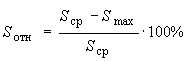
нелинейность амплитудно-частотной характеристики дискриминаторного пьезоэлектрического (электромеханического) фильтра в рабочей полосе (S отн, N)
Относительная разность между средней и максимальной дифференциальной крутизной в рабочей полосе дискриминаторного пьезоэлектрического (электромеханического) фильтра, выраженная в процентах.
Примечание
Значение нелинейности амплитудно-частотной характеристики в рабочей полосе определяют по формуле
 ,
,
где S max - максимальная дифференциальная крутизна характеристики фильтра.
[ ГОСТ 18670-84]Тематики
EN
- non-linearity of amplitude-frequency characteristic of discriminator over the operating band
FR
- nonlinéarité d'une caractéristique amplitude-fréquence d'un discriminateur dans la bande de fonctionnement
Русско-французский словарь нормативно-технической терминологии > нелинейность амплитудно-частотной характеристики дискриминаторного пьезоэлектрического (электромеханического) фильтра в рабочей полосе
См. также в других словарях:
operating frequency — darbinis dažnis statusas T sritis automatika atitikmenys: angl. operating frequency; working frequency vok. Arbeitsfrequenz, f; Betriebsfrequenz, f rus. рабочая частота, f pranc. fréquence de service, f; fréquence de travail, f … Automatikos terminų žodynas
operating frequency — veikimo dažnis statusas T sritis automatika atitikmenys: angl. operating frequency vok. Betriebsfrequenz, f rus. рабочая частота, f; частота функционирования, f pranc. fréquence de fonctionnement, f; fréquence opérationnelle, f … Automatikos terminų žodynas
Frequency domain sensor — Frequency domain (FD) sensor is an instrument developed for measuring soil moisture content. The instrument has an oscillating circuit, the sensing part of the sensor is embedded in the soil, and the operating frequency will depend on the value… … Wikipedia
frequency agile radar — Radar whose operating frequency can be changed with every scan of an antenna by means of tuning magnetrons … Aviation dictionary
Operating reserve — Energy portal … Wikipedia
Frequency mixer — This article is about non linear mixing operating in the frequency domain. For other types of mixers, see electronic mixer. Frequency Mixer Symbol. In electronics a mixer or frequency mixer is a nonlinear electrical circuit that creates new… … Wikipedia
Frequency distribution — In statistics, a frequency distribution is an arrangement of the values that one or more variables take in a sample. Each entry in the table contains the frequency or count of the occurrences of values within a particular group or interval, and… … Wikipedia
Frequency counter — A frequency counter is an electronic instrument, or component of one, that is used for measuring frequency. Since frequency is defined as the number of events of a particular sort occurring in a set period of time, measuring it is usually… … Wikipedia
Frequency compatibility — In telecommunication, the term frequency compatibility has the following meanings: 1. Of an electronic device, the extent to which it will operate at its designed performance level in its intended operational environment (including the presence… … Wikipedia
frequency valve — [1] A valve located in the fuel distributor of some vehicles with a continuous injection system and catalytic converter. This valve continually adjusts the air/fuel ratio to varying engine operating conditions, because it is controlled by a… … Dictionary of automotive terms
High Frequency Active Auroral Research Program — HAARP is often confused with Project HARP, the High Altitude Research Project (a joint project of The Pentagon and the Canadian Department of National Defence).The High Frequency Active Auroral Research Program (HAARP) is an investigation project … Wikipedia
