

-
121 permis négociable
продаваемые разрешения на выбросы загрязняющих веществ
—
[ http://www.eionet.europa.eu/gemet/alphabetic?langcode=en]EN
tradeable permit
Tradable emissions permits are used in an environmental regulatory scheme where the sources of the pollutant to be regulated (most often an air pollutant) are given permits to release a specified number of tons of the pollutant. The government issues only a limited number of permits consistent with the desired level of emissions. The owners of the permits may keep them and release the pollutants, or reduce their emissions and sell the permits. The fact that the permits have value as an item to be sold gives the owner an incentive to reduce their emissions. (Source: WEATHE)
[http://www.eionet.europa.eu/gemet/alphabetic?langcode=en]Тематики
EN
DE
FR
Франко-русский словарь нормативно-технической терминологии > permis négociable
-
122 production forestičre
производство лесопродукции
—
[ http://www.eionet.europa.eu/gemet/alphabetic?langcode=en]EN
forest production
Forests produce a range of products including firewood and charcoal, lumber, paper, and crops such as coffee, oil palm, and rubber. With careful planning of growth and harvesting, wood and other forest products are, in principle, renewable resources. But achieving renewability takes time - often decades, sometimes centuries. Without careful management, pressure for short-term exploitation can lead to tree removal, soil degradation, and conversion of woodland to other uses. Consumption of forest resources can lead to environmental problems as well as loss of critical habitat and species. (Source: WRES)
[http://www.eionet.europa.eu/gemet/alphabetic?langcode=en]Тематики
EN
DE
FR
Франко-русский словарь нормативно-технической терминологии > production forestičre
-
123 démarrage direct
прямой пуск вращающегося электродвигателя
Пуск вращающегося электродвигателя путем непосредственного подключения его к питающей сети.
[ ГОСТ 27471-87]EN
direct-on-line starting
across-the-line starting (US)
the process of starting a motor by connecting it directly to the supply at rated voltage
[IEV number 411-52-15]FR
démarrage direct
mode de démarrage d'un moteur, consistant à lui appliquer directement sa pleine tension assignée
[IEV number 411-52-15]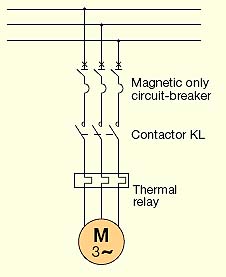
Рис. ABB
Схема прямого пуска электродвигателяMagnetic only circuit-breaker - Автоматический выключатель с электромагнитным расцепителем
Contactor KL - Контактор KL
Thermal relay - Тепловое реле
Параллельные тексты EN-RU
Direct-on-line starting
Direct-on-line starting, which is often abbreviated as DOL, is perhaps the most traditional system and consists in connecting the motor directly to the supply network, thus carrying out starting at full voltage.Direct-on-line starting represents the simplest and the most economical system to start a squirrel-cage asynchronous motor and it is the most used.
As represented in Figure 5, it provides the direct connection to the supply network and therefore starting is carried out at full voltage and with constant frequency, developing a high starting torque with very reduced acceleration times.
The typical applications are relevant to small power motors also with full load starting.
These advantages are linked to some problems such as, for example, the high inrush current, which - in the first instants - can reach values of about 10 to 12 times the rated current, then can decrease to about 6 to 8 times the rated current and can persist to reach the maximum torque speed.The effects of such currents can be identified with the high electro-dynamical stresses on the motor connection cables and could affect also the windings of the motor itself; besides, the high inrush torques can cause violent accelerations which stress the transmission components (belts and joints) generating distribution problems with a reduction in the mechanical life of these elements.
Finally, also the possible electrical problems due to voltage drops on the supply line of the motor or of the connected equipment must be taken into consideration.
[ABB]Прямой пуск
Прямой пуск, который по-английски часто сокращенно обозначают как DOL, является, пожалуй наиболее распространенным способом пуска. Он заключается в непосредственном (т. е. прямом) подключении двигателя к питающей сети. Это означает, что пуск двигателя осуществляется при полном напряжении.Схема прямого пуска является наиболее простым, экономичным и чаще всего применяемым решением для электродвигателей с короткозамкнутым ротором.
Схема прямого подключения к сети представлена на рисунке 5. Пуск осуществляется при полном напряжении и постоянной частоте сети. Электродвигатель развивает высокий пусковой момент при коротком времени разгона.
Типичные области применения – маломощные электродвигатели, в том числе с пуском при полной нагрузке.
Однако, наряду с преимуществами имеются и определенные недостатки, например, бросок пускового тока, достигающий в первоначальный момент 10…12-кратного значения от номинального тока электродвигателя. Затем ток двигателя уменьшается примерно до 6…8-кратного значения номинального тока и будет держаться на этом уровне до тех пор, пока скорость двигателя не достигнет максимального значения.
Такое изменение тока оказывает значительное электродинамическое воздействие на кабель, подключенный к двигателю. Кроме того пусковой ток воздействует на обмотки двигателя. Высокий начальный пусковой момент может привести к значительному ускорению и следовательно к значительной нагрузке элементов привода (ремней, крепления узлов), что вызывает сокращение их срока службы.
И, наконец, следует принять во внимание возможное возникновение проблем, связанных с падением напряжения в линии питания двигателя и подключенного к этой линии оборудования.
[Перевод Интент]
Тематики
Синонимы
EN
- across-the-line starting (US)
- direct line starting
- direct operation of a motor
- direct starting
- direct-on-line starting
- DOL
- full voltage starter application
DE
FR
Франко-русский словарь нормативно-технической терминологии > démarrage direct
-
124 polluant radioactif
радиоактивное загрязняющее вещество
—
[ http://www.eionet.europa.eu/gemet/alphabetic?langcode=en]EN
radioactive pollutant
A substance undergoing spontaneous decay or disintegration of atomic nuclei and giving off radiant energy in the form of particles or waves, often associated with an explosion of a nuclear weapon or an accidental release from a nuclear power plant, holding facility or transporting container. (Source: DEE / ISEP)
[http://www.eionet.europa.eu/gemet/alphabetic?langcode=en]Тематики
EN
DE
FR
Франко-русский словарь нормативно-технической терминологии > polluant radioactif
-
125 législation cadre
рамочное законодательство
—
[ http://www.eionet.europa.eu/gemet/alphabetic?langcode=en]EN
framework legislation
A body of rules prescribed by a government, often composed in a series of inter-related parts, to establish or lay the foundation for a new project, agency or organizational structure. (Source: RHW)
[http://www.eionet.europa.eu/gemet/alphabetic?langcode=en]Тематики
EN
DE
FR
Франко-русский словарь нормативно-технической терминологии > législation cadre
-
126 plante
растение
—
[ http://www.eionet.europa.eu/gemet/alphabetic?langcode=en]EN
plant (biology)
Any living organism that typically synthesizes its food from inorganic substances, possesses cellulose cell walls, responds slowly and often permanently to a stimulus, lacks specialized sense organs and nervous system, and has no powers of locomotion. (Source: CED)
[http://www.eionet.europa.eu/gemet/alphabetic?langcode=en]Тематики
EN
DE
FR
Франко-русский словарь нормативно-технической терминологии > plante
-
127 zone de chasse contrôlée
регионы разрешенной охоты
—
[ http://www.eionet.europa.eu/gemet/alphabetic?langcode=en]EN
controlled hunting zone
An administered geographic area in which the pursuit, capture and killing of wild animals for food or sport, is allowed, often with certain restrictions or regulations. (Source: ISEP / RHW)
[http://www.eionet.europa.eu/gemet/alphabetic?langcode=en]Тематики
EN
DE
FR
Франко-русский словарь нормативно-технической терминологии > zone de chasse contrôlée
-
128 déchet de caoutchouc
резиновые отходы
—
[ http://www.eionet.europa.eu/gemet/alphabetic?langcode=en]EN
rubber waste
Any refuse or unwanted material made of synthetic or natural rubber, often the byproduct of rubber processing. (Source: RHW)
[http://www.eionet.europa.eu/gemet/alphabetic?langcode=en]Тематики
EN
DE
FR
Франко-русский словарь нормативно-технической терминологии > déchet de caoutchouc
См. также в других словарях:
often — often, frequently, oft, oftentimes may be used with little or no distinction to mean again and again in more or less close succession. But often stresses the number of times a thing occurs, without regard to the interval of recurrence; frequently … New Dictionary of Synonyms
Often — Of ten, a. Frequent; common; repeated. [R.] Thine often infirmities. 1 Tim. v. 23. [1913 Webster] And weary thee with often welcomes. Beau. & Fl. [1913 Webster] … The Collaborative International Dictionary of English
often — In current English this is more usually pronounced with the t silent. The comparative forms oftener and oftenest are permissible, although more often and most often are more commonly used … Modern English usage
often — (also archaic or N. Amer. oftentimes) ► ADVERB (oftener, oftenest) 1) frequently. 2) in many instances. USAGE The comparative and superlative forms oftener and oftenest are not incorrect, but are rarely used now in British English, the more usual … English terms dictionary
Often — Of ten ([o^]f n; 115), adv. [Compar. {Oftener} ([o^]f n*[ e]r); superl. {Oftenest}.] [Formerly also ofte, fr. oft. See {Oft}., adv.] Frequently; many times; not seldom. [1913 Webster] … The Collaborative International Dictionary of English
often — index chronic Burton s Legal Thesaurus. William C. Burton. 2006 … Law dictionary
often — (adv.) c.1300, extended form of OFT (Cf. oft), originally before vowels and h , probably by influence of M.E. selden seldom. In common use from 16c., replacing oft … Etymology dictionary
often — [adv] frequently again and again, a number of times, generally, many a time, much, oftentimes, ofttimes, over and over, recurrently, regularly, repeatedly, time after time, time and again, usually; concept 541 Ant. infrequently, rarely, seldom … New thesaurus
often — [ôf′ən, äf′ən; ôf′tən, äf′tən] adv. [ME var. of OFT] many times; repeatedly; frequently adj. Archaic frequent … English World dictionary
often — of|ten W1S1 [ˈɔfən, ˈɔftən US ˈo:f ] adv [Date: 1200 1300; Origin: oft] 1.) if something happens often, it happens regularly or many times = ↑frequently ▪ She often works at the weekend. ▪ If you wash your hair too often, it can get too dry. ▪… … Dictionary of contemporary English
often — of|ten [ ɔfn ] adverb *** 1. ) on many occasions or in many situations: Often, students with family problems have difficulties at school. Boredom often leads to bad behavior. The home is often the most likely place in which someone is injured.… … Usage of the words and phrases in modern English
