

-
1 mehradriges Kabel, n
многожильный кабель
многожильный провод
многожильный шнур
Кабель (провод, шнур), в котором число жил более трех.
[ ГОСТ 15845-80]EN
multicore cable
cable having more than one core
Note – The French term «câble multipolaire» is more specifically used to designate the cable constituting the phases of a multiphase system (example: three-core cable).
[EV ref 461-06-04]
multiconductor cable
cable having more than one conductor, some of which may be uninsulated
[IEV ref 461-06-03]FR
câble multiconducteur
câble multipolaire
câble comprenant plus d'un conducteur isolé
Note – Le terme câble multipolaire est plus particulièrement utilisé pour désigner le câble constituant les phases d'un système polyphasé (exemple: câble tripolaire).
[EV ref 461-06-04]
câble multiconducteur
câble multipolaire
câble comprenant plus d'une âme, dont éventuellement certaines non isolées
[IEV ref 461-06-03]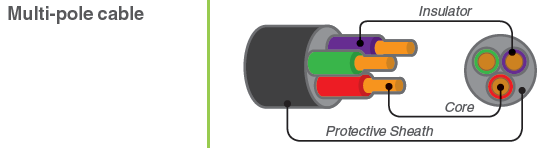
Core - (токопроводящая) жила;
Insulator - изоляция жилы;
Protective Sheath - оболочка кабеля.Недопустимые, нерекомендуемые
Примечание(1) Мнение автора карточкиТематики
- кабели, провода...
EN
- bundled cable
- multi-pole cable
- multiconductor cable
- multicore cable
- multiple cable
- multiple-conductor cable
- multiple-core cable
- multistrand cable
- N-conductor cable
- polycore cable
DE
- mehradriges Kabel, n
- Mehrleiterkabel, n
FR
Немецко-русский словарь нормативно-технической терминологии > mehradriges Kabel, n
-
2 Mehrleiterkabel, n
многожильный кабель
многожильный провод
многожильный шнур
Кабель (провод, шнур), в котором число жил более трех.
[ ГОСТ 15845-80]EN
multicore cable
cable having more than one core
Note – The French term «câble multipolaire» is more specifically used to designate the cable constituting the phases of a multiphase system (example: three-core cable).
[EV ref 461-06-04]
multiconductor cable
cable having more than one conductor, some of which may be uninsulated
[IEV ref 461-06-03]FR
câble multiconducteur
câble multipolaire
câble comprenant plus d'un conducteur isolé
Note – Le terme câble multipolaire est plus particulièrement utilisé pour désigner le câble constituant les phases d'un système polyphasé (exemple: câble tripolaire).
[EV ref 461-06-04]
câble multiconducteur
câble multipolaire
câble comprenant plus d'une âme, dont éventuellement certaines non isolées
[IEV ref 461-06-03]Core - (токопроводящая) жила;
Insulator - изоляция жилы;
Protective Sheath - оболочка кабеля.Недопустимые, нерекомендуемые
Примечание(1) Мнение автора карточкиТематики
- кабели, провода...
EN
- bundled cable
- multi-pole cable
- multiconductor cable
- multicore cable
- multiple cable
- multiple-conductor cable
- multiple-core cable
- multistrand cable
- N-conductor cable
- polycore cable
DE
- mehradriges Kabel, n
- Mehrleiterkabel, n
FR
Немецко-русский словарь нормативно-технической терминологии > Mehrleiterkabel, n
-
3 Dauerstrombelastbarkeit, f
(длительный) допустимый ток
Максимальное значение электрического тока, который может протекать длительно по проводнику, устройству или аппарату при определенных условиях без превышения определенного значения их температуры в установившемся режиме
[ ГОСТ Р МЭК 60050-826-2009]
Этот ток обозначают IZ
[ ГОСТ Р 50571. 1-2009 ( МЭК 60364-1: 2005)]EN
(continuous) current-carrying capacity
ampacity (US)
maximum value of electric current which can be carried continuously by a conductor, a device or an apparatus, under specified conditions without its steady-state temperature exceeding a specified value
[IEV number 826-11-13]
ampacity
The current in amperes that a conductor can carry continuously under the conditions of use without exceeding its temperature rating.
[National Electrical Cod]FR
courant (permanent) admissible, m
valeur maximale du courant électrique qui peut parcourir en permanence, un conducteur, un dispositif ou un appareil, sans que sa température de régime permanent, dans des conditions données, soit supérieure à la valeur spécifiée
[IEV number 826-11-13]Ampacity, the term is defined as the maximum amount of current a cable can carry before sustaining immediate or progressive deterioration. Also described as current rating or current-carrying capacity, is the RMS electric current which a device can continuously carry while remaining within its temperature rating. The ampacity of a cable depends on:
- its insulation temperature rating;
- conductor electrical properties for current;
- frequency, in the case of alternating currents;
- ability to dissipate heat, which depends on cable geometry and its surroundings;
- ambient temperature.
Electric wires have some resistance, and electric current flowing through them causes voltage drop and power dissipation, which heats the cable. Copper or aluminum can conduct a large amount of current before melting, but long before the conductors melt, their insulation would be damaged by the heat.
The ampacity for a power cable is thus based on physical and electrical properties of the material & construction of the conductor and of its insulation, ambient temperature, and environmental conditions adjacent to the cable. Having a large overall surface area may dissipate heat well if the environment can absorb the heat.
In a long run of cable, different conditions govern, and installation regulations normally specify that the most severe condition along the run governs the cable's rating. Cables run in wet or oily locations may carry a lower temperature rating than in a dry installation. Derating is necessary for multiple circuits in close proximity. When multiple cables are near, each contributes heat to the others and diminishes the amount of cooling air that can flow past the individual cables. The overall ampacity of the insulated conductors in a bundle of more than 3 must be derated, whether in a raceway or cable. Usually the de-rating factor is tabulated in a nation's wiring regulations.
Depending on the type of insulating material, common maximum allowable temperatures at the surface of the conductor are 60, 75 and 90 degrees Celsius, often with an ambient air temperature of 30°C. In the U.S., 105°C is allowed with ambient of 40°C, for larger power cables, especially those operating at more than 2 kV. Likewise, specific insulations are rated 150, 200 or 250°C.
The allowed current in cables generally needs to be decreased (derated) when the cable is covered with fireproofing material.
For example, the United States National Electric Code, Table 310-16, specifies that up to three 8 AWG copper wires having a common insulating material (THWN) in a raceway, cable, or direct burial has an ampacity of 50 A when the ambient air is 30°C, the conductor surface temperature allowed to be 75°C. A single insulated conductor in air has 70 A rating.
Ampacity rating is normally for continuous current, and short periods of overcurrent occur without harm in most cabling systems. The acceptable magnitude and duration of overcurrent is a more complex topic than ampacity.
When designing an electrical system, one will normally need to know the current rating for the following:- Wires
- Printed Circuit Board traces, where included
- Fuses
- Circuit breakers
- All or nearly all components used
Some devices are limited by power rating, and when this power rating occurs below their current limit, it is not necessary to know the current limit to design a system. A common example of this is lightbulb holders.
[http://en.wikipedia.org/wiki/Ampacity]
Тематики
- электротехника, основные понятия
Синонимы
EN
DE
- Dauerstrombelastbarkeit, f
- Strombelastbarkeit, f
FR
- courant admissible, m
- courant permanent admissible, m
Немецко-русский словарь нормативно-технической терминологии > Dauerstrombelastbarkeit, f
-
4 Strombelastbarkeit, f
(длительный) допустимый ток
Максимальное значение электрического тока, который может протекать длительно по проводнику, устройству или аппарату при определенных условиях без превышения определенного значения их температуры в установившемся режиме
[ ГОСТ Р МЭК 60050-826-2009]
Этот ток обозначают IZ
[ ГОСТ Р 50571. 1-2009 ( МЭК 60364-1: 2005)]EN
(continuous) current-carrying capacity
ampacity (US)
maximum value of electric current which can be carried continuously by a conductor, a device or an apparatus, under specified conditions without its steady-state temperature exceeding a specified value
[IEV number 826-11-13]
ampacity
The current in amperes that a conductor can carry continuously under the conditions of use without exceeding its temperature rating.
[National Electrical Cod]FR
courant (permanent) admissible, m
valeur maximale du courant électrique qui peut parcourir en permanence, un conducteur, un dispositif ou un appareil, sans que sa température de régime permanent, dans des conditions données, soit supérieure à la valeur spécifiée
[IEV number 826-11-13]Ampacity, the term is defined as the maximum amount of current a cable can carry before sustaining immediate or progressive deterioration. Also described as current rating or current-carrying capacity, is the RMS electric current which a device can continuously carry while remaining within its temperature rating. The ampacity of a cable depends on:
- its insulation temperature rating;
- conductor electrical properties for current;
- frequency, in the case of alternating currents;
- ability to dissipate heat, which depends on cable geometry and its surroundings;
- ambient temperature.
Electric wires have some resistance, and electric current flowing through them causes voltage drop and power dissipation, which heats the cable. Copper or aluminum can conduct a large amount of current before melting, but long before the conductors melt, their insulation would be damaged by the heat.
The ampacity for a power cable is thus based on physical and electrical properties of the material & construction of the conductor and of its insulation, ambient temperature, and environmental conditions adjacent to the cable. Having a large overall surface area may dissipate heat well if the environment can absorb the heat.
In a long run of cable, different conditions govern, and installation regulations normally specify that the most severe condition along the run governs the cable's rating. Cables run in wet or oily locations may carry a lower temperature rating than in a dry installation. Derating is necessary for multiple circuits in close proximity. When multiple cables are near, each contributes heat to the others and diminishes the amount of cooling air that can flow past the individual cables. The overall ampacity of the insulated conductors in a bundle of more than 3 must be derated, whether in a raceway or cable. Usually the de-rating factor is tabulated in a nation's wiring regulations.
Depending on the type of insulating material, common maximum allowable temperatures at the surface of the conductor are 60, 75 and 90 degrees Celsius, often with an ambient air temperature of 30°C. In the U.S., 105°C is allowed with ambient of 40°C, for larger power cables, especially those operating at more than 2 kV. Likewise, specific insulations are rated 150, 200 or 250°C.
The allowed current in cables generally needs to be decreased (derated) when the cable is covered with fireproofing material.
For example, the United States National Electric Code, Table 310-16, specifies that up to three 8 AWG copper wires having a common insulating material (THWN) in a raceway, cable, or direct burial has an ampacity of 50 A when the ambient air is 30°C, the conductor surface temperature allowed to be 75°C. A single insulated conductor in air has 70 A rating.
Ampacity rating is normally for continuous current, and short periods of overcurrent occur without harm in most cabling systems. The acceptable magnitude and duration of overcurrent is a more complex topic than ampacity.
When designing an electrical system, one will normally need to know the current rating for the following:- Wires
- Printed Circuit Board traces, where included
- Fuses
- Circuit breakers
- All or nearly all components used
Some devices are limited by power rating, and when this power rating occurs below their current limit, it is not necessary to know the current limit to design a system. A common example of this is lightbulb holders.
[http://en.wikipedia.org/wiki/Ampacity]
Тематики
- электротехника, основные понятия
Синонимы
EN
DE
- Dauerstrombelastbarkeit, f
- Strombelastbarkeit, f
FR
- courant admissible, m
- courant permanent admissible, m
Немецко-русский словарь нормативно-технической терминологии > Strombelastbarkeit, f
-
5 mehrfach verseilter Leiter, m
многократно скрученная токопроводящая жила
токопроводящая жила, состоящая из ряда групп проволок, расположенных по спирали одним или несколькими повивами; проволоки в каждой группе скручены методом пучковой или повивной скрутки Примечание. Французский термин «toron» означает: элемент многократно скрученной токопроводящей жилы, состоящий из концентрически расположенных проволок Французский термин «tordon» означает: элемент многократно скрученной токопроводящей жилы, в котором проволоки скручены пучком
[IEV number 461-01-10]EN
multiple-stranded conductor
stranded conductor consisting of a number of groups of wires assembled together in one or more helical layers, the wires in each group being either bunched or stranded
[IEV number 461-01-10]FR
âme en torons
âme câblée constituée de plusieurs torons ou tordons assemblés en hélice en une ou plusieurs couches
[IEV number 461-01-10]
Тематики
- кабели, провода...
EN
DE
- mehrfach verseilter Leiter, m
FR
Немецко-русский словарь нормативно-технической терминологии > mehrfach verseilter Leiter, m
См. также в других словарях:
Conductor (class field theory) — In algebraic number theory, the conductor of a finite abelian extension of local or global fields provides a quantitative measure of the ramification in the extension. The definition of the conductor is related to the Artin map. Contents 1 Local… … Wikipedia
multiple — Parallel Par al*lel, n. 1. A line which, throughout its whole extent, is equidistant from another line; a parallel line, a parallel plane, etc. [1913 Webster] Who made the spider parallels design, Sure as De Moivre, without rule or line ? Pope.… … The Collaborative International Dictionary of English
in multiple — Parallel Par al*lel, n. 1. A line which, throughout its whole extent, is equidistant from another line; a parallel line, a parallel plane, etc. [1913 Webster] Who made the spider parallels design, Sure as De Moivre, without rule or line ? Pope.… … The Collaborative International Dictionary of English
многожильный кабель — многожильный провод многожильный шнур Кабель (провод, шнур), в котором число жил более трех. [ГОСТ 15845 80] EN multicore cable cable having more than one core Note – The French term «câble multipolaire» is more… … Справочник технического переводчика
Well logging — Gamma ray logging Spontaneous potential logging Resistivity logging Density logging Sonic logging Caliper logging Mud logging LWD/MWD v · … Wikipedia
Wireline Logging — consists of measuring and recording the physical properties of the rocks in oil wells. Logging consists of introducing sensors in a borehole via a wireline , an electromechanical cable. Power and control is provided to the sensors inside the… … Wikipedia
Midac — is an acronym created in 1981 by a Sydney based business, Combined Resources Computing (CRC). It stands for Microprocessor Intelligent Data Acquisition and Control. CRC was established in order to complete several building automation projects… … Wikipedia
линия (электропередачи) с расщеплёнными проводами фаз — — [Я.Н.Лугинский, М.С.Фези Жилинская, Ю.С.Кабиров. Англо русский словарь по электротехнике и электроэнергетике, Москва, 1999 г.] Тематики электротехника, основные понятия EN multiple conductor line … Справочник технического переводчика
Wireless energy transfer — or wireless power is the transmission of electrical energy from a power source to an electrical load without artificial interconnecting conductors. Wireless transmission is useful in cases where interconnecting wires are inconvenient, hazardous,… … Wikipedia
List of Tesla patents — Below is a list of Tesla patents. Dr. Nikola Tesla was an inventor who obtained around 300 patents [Snezana Sarbo, [http://www.tesla symp06.org/papers/Tesla Symp06 Sarboh.pdfNikola Tesla s Patents] , Sixth International Symposium Nikola Tesla,… … Wikipedia
Glossary of rail terminology — Rail transport Operations Track Maintenance High speed Gauge Stations … Wikipedia
