

-
1 memory function
1) Полимеры: функция, описывающая механическую "память" (полимеров)2) Макаров: функция памяти -
2 memory function
<av> ■ Memoryfunktion f ; Nullstopp m -
3 memory function
функция, описывающая механическую "память" -
4 memory function
жад функциясыThe English-Kazakh dictionary of Informatics and computer technology dictionary > memory function
-
5 creep memory function
Макаров: ядро ползучести -
6 history memory function
Нефть и газ: функция статистической памятиУниверсальный англо-русский словарь > history memory function
-
7 relaxation memory function
Макаров: ядро релаксацииУниверсальный англо-русский словарь > relaxation memory function
-
8 thermal electrical relay with partial memory function
Автоматика: электротепловое реле с функцией частичной памятиУниверсальный англо-русский словарь > thermal electrical relay with partial memory function
-
9 thermal electrical relay with total memory function
Автоматика: электротепловое реле с функцией полной памятиУниверсальный англо-русский словарь > thermal electrical relay with total memory function
-
10 history memory function
English-Russian dictionary oil project > history memory function
-
11 thermal electrical relay with partial memory function
English-Russian dictionary of relay protection > thermal electrical relay with partial memory function
-
12 thermal electrical relay with total memory function
English-Russian dictionary of relay protection > thermal electrical relay with total memory function
-
13 memory
noun1) Gedächtnis, dashave a good/poor memory for faces — ein gutes/schlechtes Personengedächtnis haben
2) (recollection, person or thing remembered, act of remembering) Erinnerung, die (of an + Akk.)have a vague memory of something — sich nur ungenau an etwas (Akk.) erinnern
it slipped or escaped my memory — es ist mir entfallen
from memory — aus dem Gedächtnis od. Kopf
in memory of — zur Erinnerung an (+ Akk.); attrib.
a trip down memory lane — eine Reise in die Vergangenheit
3) (Computing) Speicher, der* * *['meməri]plural - memories; noun1) (the power to remember things: a good memory for details.) das Gedächtnis2) (the mind's store of remembered things: Her memory is full of interesting stories.) das Gedächtnis3) (something remembered: memories of her childhood.) die Erinnerung4) (the time as far back as can be remembered: the greatest fire in memory.) das Gedenken5) (a part of computer in which information is stored for immediate use; a computer with 8 megabytes of memory)•- academic.ru/46134/memorize">memorize- memorise
- from memory
- in memory of / to the memory of* * *memo·ry[ˈmeməri, AM -mɚi]nto have a \memory like an elephant ein Elefantengedächtnis habenloss of \memory Gedächtnisschwund mto have a good \memory for names/numbers ein gutes Namen-/Zahlengedächtnis habena bad/good/photographic \memory ein schlechtes/gutes/fotografisches Gedächtnisimpaired \memory Gedächtnisschwäche fwithin living/sb's \memory soweit man/jd zurückdenken kannthis is still within my \memory daran kann ich mich noch erinnernto commit sth to \memory sich dat etw einprägento recite sth from \memory etw aus dem Gedächtnis rezitierento search one's \memory versuchen, sich akk zu erinnernin \memory of sb/sth zum Gedenken an jdn/etwto bring back memories Erinnerungen wachrufen* * *['memərɪ]n1) Gedächtnis nt; (= faculty) Erinnerungsvermögen ntto commit sth to memory — sich (dat) etw einprägen; poem etw auswendig lernen
I have a bad memory for faces/names — ich habe ein schlechtes Personengedächtnis/Namensgedächtnis
See:→ living2) (= thing remembered) Erinnerung f (of an +acc)he had happy memories of his father — er verband angenehme Erinnerungen mit seinem Vater
3) (COMPUT) (Arbeits-, Haupt)speicher m4)sb's memory — jds Andenken nt ehren
in memory of — zur Erinnerung or zum Gedenken (form) an (+acc)
* * *memory [ˈmemərı] s1. Gedächtnis n, Erinnerung(svermögen) f(n):from memory aus dem Gedächtnis, auswendig;speak from memory frei sprechen;call to memory sich etwas ins Gedächtnis zurückrufen;escape sb’s memory jemandes Gedächtnis entfallen;the memory goes first zuerst wird man vergesslich;have a good (weak) memory ein gutes (schwaches) Gedächtnis haben;have a bad memory for names ein schlechtes Namensgedächtnis haben;have a bad memory for faces sich keine Gesichter merken können, ein schlechtes Personengedächtnis haben;retain a clear memory of sth etwas in klarer Erinnerung behalten;if my memory serves me (right) wenn ich mich recht erinnere;before memory, beyond memory vor undenklichen Zeiten;the best of my memory soweit ich mich erinnern kann; → commit 2, erase 3, jog1 A 1, living A 1, sieve A 1, sponge A 1, wipe out 22. Andenken n, Erinnerung f:of an akk):memories of one’s youth Jugenderinnerungen4. COMPUT Speicher m:memory access Speicherzugriff m;memory bank Speicherbank f;memory capacity Speicherkapazität f;memory expansion Speichererweiterung f;memory function Speicherfunktion f;memory location Speicherplatz m;memory protection Speicherschutz m;memory unit Speichereinheit f* * *noun1) Gedächtnis, dashave a good/poor memory for faces — ein gutes/schlechtes Personengedächtnis haben
2) (recollection, person or thing remembered, act of remembering) Erinnerung, die (of an + Akk.)have a vague memory of something — sich nur ungenau an etwas (Akk.) erinnern
it slipped or escaped my memory — es ist mir entfallen
from memory — aus dem Gedächtnis od. Kopf
in memory of — zur Erinnerung an (+ Akk.); attrib.
3) (Computing) Speicher, der* * *n.Andenken - n.Erinnerung f.Gedächtnis n. -
14 function
1) функция; назначение2) работать, функционировать, действовать•- admittance functionbetween functions — между операциями, в периоды между операциями
- advanced CAD function
- alert function
- analytic function
- assumed function
- auxiliary function
- averaged function
- basis function
- characteristic function
- chip-carrying function
- closed-loop transfer function
- complementary function
- control function
- coupling function
- custom macro function
- cut-and-paste function
- decision function
- describing function
- descriptive function
- Dirac function
- dispatching functions
- dissipative function
- distribution function
- dynamic transfer function
- error transfer function
- evaluation function
- explicit function
- feed forward function
- feed function
- feedback transfer function
- force function
- forward transfer function
- frequency distribution function
- frequency function
- frequency response function
- given function
- Hamiltonian function
- hindrance function
- holding function
- implicit function
- influence function
- input function
- instantly posted function
- interface functions
- interrelated functions
- interstage function
- inverse function
- involute function
- IPG function
- jump function
- key hardware functions
- key software functions
- kitting function
- look-ahead function
- machine-dependent functions
- machine-incorporated functions
- machining time monitoring function
- memory-related functions
- meshing error function
- message function
- metering function
- miscellaneous functions
- monitored function
- monitoring function
- neural transfer function
- noncomputable function
- objective function
- offsetting function
- open-loop transfer function
- operational functions
- optimal decision function
- output function
- overall transfer function
- penalty function
- peripheral functions
- pick-and-place functions
- position function
- positioning function
- power function
- preparatory G-function
- primary function
- probability density function
- probability distribution function
- profit function
- programming-planning functions
- programming-related functions
- qualitative functions
- ramp function
- random function
- restorative function
- return transfer function
- robot-dependent functions
- safety function
- sensor-motor function
- sigma function
- sigmoid function
- spindle speed function
- spindle-await function
- standby function
- step function
- storage function
- support function
- switching function
- system function
- target function
- tool function
- transfer function
- unit-impulse function
- unit-pulse function
- unit-step function
- universal function
- universal miscellaneous functions
- weight function
- weighting function
- window function
- zero-order function
- zero-return function
- zero-set functionEnglish-Russian dictionary of mechanical engineering and automation > function
-
15 Memory
To what extent can we lump together what goes on when you try to recall: (1) your name; (2) how you kick a football; and (3) the present location of your car keys? If we use introspective evidence as a guide, the first seems an immediate automatic response. The second may require constructive internal replay prior to our being able to produce a verbal description. The third... quite likely involves complex operational responses under the control of some general strategy system. Is any unitary search process, with a single set of characteristics and inputoutput relations, likely to cover all these cases? (Reitman, 1970, p. 485)[Semantic memory] Is a mental thesaurus, organized knowledge a person possesses about words and other verbal symbols, their meanings and referents, about relations among them, and about rules, formulas, and algorithms for the manipulation of these symbols, concepts, and relations. Semantic memory does not register perceptible properties of inputs, but rather cognitive referents of input signals. (Tulving, 1972, p. 386)The mnemonic code, far from being fixed and unchangeable, is structured and restructured along with general development. Such a restructuring of the code takes place in close dependence on the schemes of intelligence. The clearest indication of this is the observation of different types of memory organisation in accordance with the age level of a child so that a longer interval of retention without any new presentation, far from causing a deterioration of memory, may actually improve it. (Piaget & Inhelder, 1973, p. 36)4) The Logic of Some Memory Theorization Is of Dubious Worth in the History of PsychologyIf a cue was effective in memory retrieval, then one could infer it was encoded; if a cue was not effective, then it was not encoded. The logic of this theorization is "heads I win, tails you lose" and is of dubious worth in the history of psychology. We might ask how long scientists will puzzle over questions with no answers. (Solso, 1974, p. 28)We have iconic, echoic, active, working, acoustic, articulatory, primary, secondary, episodic, semantic, short-term, intermediate-term, and longterm memories, and these memories contain tags, traces, images, attributes, markers, concepts, cognitive maps, natural-language mediators, kernel sentences, relational rules, nodes, associations, propositions, higher-order memory units, and features. (Eysenck, 1977, p. 4)The problem with the memory metaphor is that storage and retrieval of traces only deals [ sic] with old, previously articulated information. Memory traces can perhaps provide a basis for dealing with the "sameness" of the present experience with previous experiences, but the memory metaphor has no mechanisms for dealing with novel information. (Bransford, McCarrell, Franks & Nitsch, 1977, p. 434)7) The Results of a Hundred Years of the Psychological Study of Memory Are Somewhat DiscouragingThe results of a hundred years of the psychological study of memory are somewhat discouraging. We have established firm empirical generalisations, but most of them are so obvious that every ten-year-old knows them anyway. We have made discoveries, but they are only marginally about memory; in many cases we don't know what to do with them, and wear them out with endless experimental variations. We have an intellectually impressive group of theories, but history offers little confidence that they will provide any meaningful insight into natural behavior. (Neisser, 1978, pp. 12-13)A schema, then is a data structure for representing the generic concepts stored in memory. There are schemata representing our knowledge about all concepts; those underlying objects, situations, events, sequences of events, actions and sequences of actions. A schema contains, as part of its specification, the network of interrelations that is believed to normally hold among the constituents of the concept in question. A schema theory embodies a prototype theory of meaning. That is, inasmuch as a schema underlying a concept stored in memory corresponds to the mean ing of that concept, meanings are encoded in terms of the typical or normal situations or events that instantiate that concept. (Rumelhart, 1980, p. 34)Memory appears to be constrained by a structure, a "syntax," perhaps at quite a low level, but it is free to be variable, deviant, even erratic at a higher level....Like the information system of language, memory can be explained in part by the abstract rules which underlie it, but only in part. The rules provide a basic competence, but they do not fully determine performance. (Campbell, 1982, pp. 228, 229)When people think about the mind, they often liken it to a physical space, with memories and ideas as objects contained within that space. Thus, we speak of ideas being in the dark corners or dim recesses of our minds, and of holding ideas in mind. Ideas may be in the front or back of our minds, or they may be difficult to grasp. With respect to the processes involved in memory, we talk about storing memories, of searching or looking for lost memories, and sometimes of finding them. An examination of common parlance, therefore, suggests that there is general adherence to what might be called the spatial metaphor. The basic assumptions of this metaphor are that memories are treated as objects stored in specific locations within the mind, and the retrieval process involves a search through the mind in order to find specific memories....However, while the spatial metaphor has shown extraordinary longevity, there have been some interesting changes over time in the precise form of analogy used. In particular, technological advances have influenced theoretical conceptualisations.... The original Greek analogies were based on wax tablets and aviaries; these were superseded by analogies involving switchboards, gramophones, tape recorders, libraries, conveyor belts, and underground maps. Most recently, the workings of human memory have been compared to computer functioning... and it has been suggested that the various memory stores found in computers have their counterparts in the human memory system. (Eysenck, 1984, pp. 79-80)Primary memory [as proposed by William James] relates to information that remains in consciousness after it has been perceived, and thus forms part of the psychological present, whereas secondary memory contains information about events that have left consciousness, and are therefore part of the psychological past. (Eysenck, 1984, p. 86)Once psychologists began to study long-term memory per se, they realized it may be divided into two main categories.... Semantic memories have to do with our general knowledge about the working of the world. We know what cars do, what stoves do, what the laws of gravity are, and so on. Episodic memories are largely events that took place at a time and place in our personal history. Remembering specific events about our own actions, about our family, and about our individual past falls into this category. With amnesia or in aging, what dims... is our personal episodic memories, save for those that are especially dear or painful to us. Our knowledge of how the world works remains pretty much intact. (Gazzaniga, 1988, p. 42)The nature of memory... provides a natural starting point for an analysis of thinking. Memory is the repository of many of the beliefs and representations that enter into thinking, and the retrievability of these representations can limit the quality of our thought. (Smith, 1990, p. 1)Historical dictionary of quotations in cognitive science > Memory
-
16 memory allocation
процесс выделения памяти переменным и/или объектам программы во время её трансляции (обычно на этапе генерации промежуточного или целевого кода) или по запросу (memory allocation request - запрос на выделение памяти) на этапе исполнения. Различают статическое (в ОЗУ и ПЗУ) и динамическое (только в ОЗУ), а также байт-ориентированное (byte-oriented memory allocation) и блок-ориентированное (block-oriented memory allocation) распределение памяти. В последнем случае память выделяется блоками фиксированного размера, что значительно упрощает и ускоряет работу с пулом свободной памяти.Syn:Англо-русский толковый словарь терминов и сокращений по ВТ, Интернету и программированию. > memory allocation
-
17 function At
функция At (реле времени)
Задержка срабатывания реле, отсчитываемая от момента снятия напряжения с управляющего входа с возможностью прерывания отсчета задержки подачей напряжения на управляющий вход.
[Интент]EN
function At
Power on delay relay (summation) with control signal
[Schneider Electric]
function At
Timing on energisation with memory
[Crouzed]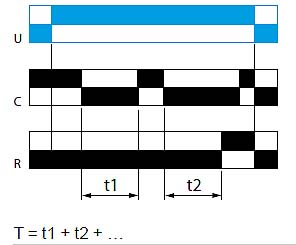
Рис. Schneider ElectricТематики
EN
Англо-русский словарь нормативно-технической терминологии > function At
-
18 memory free function
Англо-русский толковый словарь терминов и сокращений по ВТ, Интернету и программированию. > memory free function
-
19 memory stop function
<av> ■ Memoryfunktion f ; Nullstopp m -
20 thermal memory
тепловая память
-
[Интент]Параллельные тексты EN-RU
The thermal memory continuously accounts for the amount of heat in the cables, both before and after tripping, whatever the value of the current(presence of an overload or not).
The thermal memory optimizes the long-time protection function of the circuit breaker by taking into account the temperature rise in the cables.
The thermal memory assumes a cable cooling time of approximately 20 minutes.
[Schneider Electric]Функция тепловой памяти постоянно вычисляет количество тепла, накопленного в кабелях, как до, так и после срабатывания автоматического выключателя, независимо от того, имеет место перегрузка или нет.
Тепловая память оптимизирует время отключения, выполняемого защитой от перегрузки, в соответствии со степенью нагрева кабелей.
Функция тепловой памят
и работает с учетом того, что время охлаждения кабеля составляет около 20 мин.
[Перевод Интент]The thermal memory is a means to simulate temperature rise and cooling caused by changes in the flow of current in the conductors.
[Schneider Electric]Тепловая память является средством имитации изменения температуры проводников вследствие протекания по ним тока и с учетом процесса их охлаждения.
[Перевод Интент]
Тематики
EN
Англо-русский словарь нормативно-технической терминологии > thermal memory
См. также в других словарях:
Memory improvement — The hippocampus regulates memory function. Memory improvement is the act of improving one s memory. Medical research of memory deficits and age related memory loss has resulted in new explanations and treatment techniques to improve memory,… … Wikipedia
memory abnormality — Introduction any of the disorders that affect the ability to remember. Disorders of memory must have been known to the ancients and are mentioned in several early medical texts, but it was not until the closing decades of the 19th… … Universalium
memory — /mem euh ree/, n., pl. memories. 1. the mental capacity or faculty of retaining and reviving facts, events, impressions, etc., or of recalling or recognizing previous experiences. 2. this faculty as possessed by a particular individual: to have a … Universalium
Memory and aging — One of the key concerns of older adults is the experience of memory loss, especially as it is one of the hallmark symptoms of Alzheimer s disease. However, memory loss is qualitatively different in normal aging from the kind of memory loss… … Wikipedia
Memory loss — Not to be confused with amnesia. Memory loss can be partial or total and it is normal when it comes with aging. Sudden memory loss is usually a result of brain trauma and it may be permanent or temporary. When it is caused by medical conditions… … Wikipedia
Memory bound function — Memory bound refers to a situation in which the time to complete a given computational problem is decided primarily by the amount of available memory to hold data. In other words, the limiting factor of solving a given problem is the memory… … Wikipedia
Memory disorder — Memory can be defined as an organism s ability to encode, retain, and recall information. Disorders of memory can range from mild to severe, yet are all a result of damage to neuroanatomical structures; either in part or in full. This damage… … Wikipedia
Memory — • Memory is the capability of the mind, to store up conscious processes, and reproduce them later with some degree of fidelity Catholic Encyclopedia. Kevin Knight. 2006. Memory Memory … Catholic encyclopedia
Memory consolidation — is a category of processes that stabilize a memory trace after the initial acquisition.[1] Consolidation is distinguished into two specific processes, synaptic consolidation, which occurs within the first few hours after learning, and system… … Wikipedia
memory — memory, remembrance, recollection, reminiscence, mind, souvenir are comparable though not wholly synonymous terms since all involve the ideas of remembering and of being remembered. Memory applies chiefly to the power or function of remembering… … New Dictionary of Synonyms
Memory and social interactions — Memory underpins and enables social interactions in a variety of ways. In order to engage in successful social interaction, organisms must be able to remember how they should interact with one another, who they have interacted with previously,… … Wikipedia
