

-
121 line
1) линия; кривая2) линия, производственная линия; участок3) серия, гамма (напр. станков)4) строка; кадр УП ( станка с ЧПУ)5) магистраль; трубопровод; канал6) облицовка; футеровка || облицовывать; футеровать7) устанавливать соосно; выставлять по одной линии•- adaptive manufacturing lineline per minute — строк в минуту, число строк в минуту (единица скорости работы, напр. печатающего устройства)
- addendum line
- adiabatic line
- air line
- arithmetical mean line of the profile
- assembling line
- assembly line
- asynchronized line
- automated grinding line
- automated line
- automated machine assembly line
- automatic rotary line
- base line
- basic line
- belt pitch line
- block and head line
- blurred line
- boring line
- branch line
- broach line
- broaching line
- broken line
- build line
- calibration line
- carousel buffer line
- catenary line
- center line of blade profile
- center line of fluid flow
- center line of mass
- center line of root
- center line of rotation
- center line of spindle
- center line
- central reference line
- checked line
- CNC cell line
- CNC transfer line
- code line
- coding line
- coil line
- coiled line
- command line
- concurrent lines
- constant-pressure line
- construction lines
- contact line
- continuous line of shafting
- continuous line
- control line
- conveyor line
- conveyorized line
- coolant line
- cooling lines
- crane clearance line
- curve line
- curved line
- cutting plane line
- dash line
- dash-and-dot line
- datum line
- dedendum line
- dedicated line
- delay line
- delivery line
- desired line of cut
- die line
- digital line
- dimension line
- discharge line
- DNC line
- dot-and-dash line
- dotted line
- double-belt assembly line
- drain line
- drilling line
- driven-roller line
- earthed line
- echo line
- effective line of action
- elastic line
- equiclearance contour line
- exhaust line
- extension line
- extraheavy line
- face line of tooth
- faint grid lines
- feed line
- final assembly line
- finish line
- flank line
- flexible flow line
- flexible transfer line
- flow line
- FMS line
- free-form line
- fuel line
- full line
- generating line
- generator line
- ghost lines
- graduation line
- grinding line
- grounded line
- guide line
- hair line
- hard automation line
- heavy line
- helical line
- helix line
- hidden line
- high-volume laser production line
- housing line
- hydraulic line
- hyperboloid generating line
- in line with
- index line
- indexing line
- influence line
- initial straight line of reference
- inlet line
- instantaneous line of contact
- instruction main line
- intake line
- intermediate language line
- isobaric line
- isochoric line
- isomancost line
- isothermal line
- junction line
- killed line
- knuckle line
- large prismatic machining line
- layout line
- lead line
- leader line
- less robotized line
- level line
- line of action
- line of contact
- line of debris
- line of engagement
- line of fluid flow
- line of machines
- line of profile peaks
- line of profile valleys
- line of slide
- lines of NC code
- live line
- load line
- local line
- lubrication line
- machine-tool product line
- machining center line
- machining center-based line
- machining line
- manufacturing line
- margin line
- match line
- mean line
- metalforming machines line
- metalforming machines transfer line
- milling line
- mismatch contour line
- mixed line
- multiple lines of reasoning
- multiple product line
- multiproduct flow line
- multirobot machining line
- multistation line
- Nagare line
- nonsynchronous transfer line
- numerically controlled line of machines
- oil line
- outlet line
- output limit line
- overlapped scan lines
- paced assembly line
- paint line
- pallet line
- pallet table line
- pallet transfer line
- pallet transporter line
- palletized transfer line
- parameter line
- part manual line
- parting line
- perpendicular line
- phantom line
- pilot line
- piston manufacturing line
- pitch line
- plumb line
- power line
- pre-filled line
- press line
- pressure line
- pressure lubrication line
- pressure purge line
- pressure relief line
- primary contact line
- prismatic machining line
- prismatic parts FMS line
- product line
- production line
- pump line
- pumping line
- purge line
- quasi-synchronous line
- recirculated line
- reference line
- reference rack pitch line
- representative line
- return lubrication line
- robot welding line
- robotized line
- robot-manned line
- root line
- rotary transfer line
- rotational parts FMS line
- rotational parts line
- sampling line
- sawing line
- scale line
- scanning lines
- scavenging line
- screw line
- scribe line
- scribed line
- secondary contact line
- secondary pumping line
- semiautomated line
- sequential production line
- service line
- shaft line
- shear line
- shearing line
- sheet line
- side line
- signal main line
- simulated production line
- single-component transfer line
- skew lines
- sky line
- slanting line
- slide line
- small prismatic machining line
- solid line
- special boring line
- spiral line
- split lines
- spot-welding line
- steel fabrication line
- straight line
- suction line
- suction lubrication line
- superimposed line
- supply line
- synchronized line
- synchronized transfer line
- synchronous line
- synchronous transfer line
- tank return line
- tape line
- thin line
- tip line
- to line out
- to line up
- tooth bearing contour line
- tooth center line
- top line
- tow line
- transfer line
- transfer machining line
- transmission line
- transporter line
- transverse line of action
- trunk line
- turning line
- unbalanced production line
- unit line
- utility line
- vacuum line
- vehicle conveyor line
- vortex line
- walking-beam transfer line
- way-type line
- wear distribution line
- weld line
- welding assembly line
- working hydraulic line
- working line
- zero lineEnglish-Russian dictionary of mechanical engineering and automation > line
-
122 work
1) работа; действие; деятельность || работать; действовать2) обработка || обрабатывать3) заготовка; обрабатываемая деталь4) pl завод; мастерские5) pl конструкции, строительные конструкции6) pl подвижные органы; действующие элементы ( конструкции)7) исполнение•work being cut — заготовка, обрабатываемая резанием; разрезаемая заготовка
- angular workwork being turned between centers — деталь, обтачиваемая в центрах; центровая деталь
- assembly work
- axial work
- back work
- back-end work
- bar fed work
- bar work
- batch production work
- batch repetition work
- batch work
- between-centers shaft work
- between-centers work
- boring work
- bright work
- broaching work
- cam work
- C-axis work
- center work
- centerless work
- chucked work
- chucking work
- circuit-board work
- close tolerance work
- combined shaft and chucking work
- contour work
- contour-cutting work
- contouring work
- coordinate grid work
- copying work
- corner-to-corner work
- creep feed work
- cutting work
- cylindrical work
- development work
- diagrammatic work
- die work
- dovetail work
- drilling work
- elementary work of force
- erecting work
- erection work
- expended work
- external work
- facing work
- fine work
- finishing work
- first operation work
- five-axis work
- fixtured work
- flat surface work
- flat work
- frame work
- gaging work
- graphic work
- grinding work
- hard work
- heavy-duty work
- high-volume repetition work
- high-volume work
- horizontal work
- hot work
- in-cycle secong operation work
- information work
- internal work
- investigative work
- irregular work
- key work
- large-batch-size work
- lathe work
- layout work
- light production work
- link work
- load/offload work
- low-level CAD work
- low-volume work
- machine work
- maintaining work
- maintenance work
- mandrel work
- mandrel-held work
- measurement-based work
- medium-batch work
- medium-sized work
- medium-volume work
- milling work
- motion work
- multisided work
- NC milling work
- negative work
- night-unattended work
- nonexacting work
- off-center work
- one-hit work
- ornate scroll work
- out-of-tolerance work
- pallet work
- pallet-mounted work
- parallel work
- piece work
- pilot design work
- planer work
- point-to-point work
- precision work
- prismatic work
- process work
- product development work
- production work
- programming work
- prototype work
- pulling work
- pushing work
- R and D work
- radial work
- reaming work
- repetition work
- robot development work
- rotary work
- rotating tool-type work
- rough work
- roughing work
- round work
- safe work
- scheduled work
- scientific information work
- scientific work
- scroll work
- second-op work
- second-operation work
- semifinishing work
- shaft work
- shift work
- short-batch work
- short-run batch work
- short-run work
- single-shift work
- site work
- sizing work
- small section work
- small-batch work
- small-envelope milling work
- small-sized work
- starting work
- stationary tool-type work
- stop work
- taper work
- tapered work
- thicknessing work
- TL work
- to work off
- to work out
- tool room work
- tool work
- turned work
- useful work
- vertical work
- volume production work
- work of forceEnglish-Russian dictionary of mechanical engineering and automation > work
-
123 program
программа, см. тж application || программироватьa program is too big to fit in memory — программа не умещается в отведённой памяти ( машинное сообщение)
- program in- absolute program
- accessory program
- active program
- administration program
- application program
- A-program
- archive program
- assembler program
- assembler-program
- assembly language program
- assembly program
- automatic recovery program
- background program
- benchmark program
- binary program
- blue-ribbon program
- bootstrap program
- brittle program
- C++ program
- C++-program
- called program
- calling program
- cataloged program
- chain additions program
- chain maintenance program
- channel program
- check program
- checking program
- common program
- communication program
- compaction program
- compiled object program
- compiler program
- compiling program
- complete program
- compressor program
- computer program
- concordance program
- concurrent program
- concurrently running programs
- concurrent-scheduling supervisor program
- condensing program
- configuration program
- consulting program
- control program
- conversational program
- conversion program
- copy-protected program
- copyrighted program
- core-resident program
- correct program
- crash-proof program
- curve-fitting program
- data abstraction program
- data access program
- data flow program
- data set utility program
- data-vet program
- debugging program
- decision program
- development program
- diagnosis program
- diagnostic program
- digital simulation program
- disk-resident program
- editor program
- embedded program
- emulator program
- epistemic logic program
- executable program
- executive program
- exerciser program
- externally stored program
- fail-recognition program
- fault-diagnosis program
- fault-location program
- fine-grained program
- fixed program
- foreground program
- format program
- FORTRAN program
- FORTRAN-program
- fragmented programs
- free-standing program
- function program
- gap filling program
- general-purpose program
- generating program
- generator program
- graphic display program
- hardware program
- hardware-maintenance program
- help program
- heuristic program
- high frequency program
- high volume program
- host program
- illustrative program
- impenetrable program
- inactive program
- independent program
- initial input program
- initial loading program
- in-line program
- integer program
- interactive program
- interconsole message program
- internally stored program
- interpreter program
- interpretive program
- introspective program
- job control program
- job program
- knowledge-based program
- language-understanding program
- learning program
- librarian program
- library program
- license program
- linear program
- link-edited program
- load program
- load-and-go program
- loading program
- logical program
- logical relational program
- machine language program
- machine program
- macroassembly program
- macrogenerating program
- mail program
- main program
- manager program
- manufacturer programs
- map program
- mask-level digitization program
- master program
- mathematical program
- menu-driven program
- message control program
- message processing program
- micromodular program
- minimal access program
- minimum access program
- minimum latency program
- modular-sized program
- monitor program
- monitoring program
- monolithic program
- multisupplier program
- mutated program
- network control program
- networking program
- nonexpansible program
- nonprocedural program
- nucleus initialization program
- object program
- operating program
- optimally coded program
- overlay program
- overlays program
- packaged program
- paint program
- panel program
- PASCAL program
- PASCAL-program
- patched program
- placement program
- plugged program
- polling program
- pop-up program
- portable program
- position-independent program
- postedit program
- postmortem program
- precanned program
- precompiler program
- pre-edit program
- prewired program
- prime program program
- printed program
- print-intensive program
- problem-state program
- problem program
- procedural program
- processing program
- production program
- program for Windows
- program in assembler
- program in C++
- program in FORTRAN
- program in PASCAL
- proper program
- prototype program
- pseudoapplication program
- punched tape program
- read-in program
- real-world program
- reduction program
- reenterable program
- reentrant program
- relocatable program
- report program
- resident program
- restructuring program
- reusable program
- robot program
- robust program
- routine program
- routing program
- running program
- runtime program
- salvation program
- sample program
- scrutinous program
- segmented program
- self-adapting program
- self-contained program
- self-diagnostic program
- self-modification program
- self-modifying program
- self-monitoring program
- self-organizing program
- self-relocatable program
- self-relocating program
- self-resetting program
- self-test program
- self-triggering program
- sequence-scheduling supervisor program
- service program
- shareable program
- shell program
- simulation program
- slave program
- snapshot dump program
- snapshot trace program
- software program
- sort program
- sort/merge program
- sorting program
- source language program
- source program
- spaghetti program
- specific program
- spreadsheet program
- stand-alone program
- standard program
- standby program
- start-up program
- steering program
- stored program
- structured program
- subject program
- superconsistent program
- supervisor program
- supervisory program
- support program
- surface program
- suspended program
- symbolic program
- system program
- systems program
- tape-to-printer program
- teaching program
- test program
- throwaway program
- total-load program
- trace program
- trace-interpretive program
- tracing program
- tracking program
- transaction program
- translating program
- translation program
- translator program
- troubleshooting program
- TSR program
- unmaintable program
- unreadable program
- updated program
- user program
- utility program
- wavelet program
- wired-in programEnglish-Russian dictionary of computer science and programming > program
-
124 method
n
- abbreviated method
- accelerated method
- accounting method
- accretion method
- accrual method
- accrued benefit valuation method
- actual cost method
- actuarial method
- adequate method
- ad hoc method
- advanced method
- advertising method
- age-life method of depreciation
- amortization method
- approximation method
- assessment method
- automated processing method
- backtracking method
- balance method
- batch method of production
- bidding methods
- block booking method
- bookkeeping method
- branch-and-bound method
- by-product method of cost accounting
- calculation method
- capital-intensive method of production
- case study method
- cash receipts and disbursements method of accounting
- common methods of fraud
- completed contract method
- complete elimination method
- composition ratio method
- continual review method
- control method
- conventional method
- conventional production methods
- costing method
- cost-based methods
- cost depletion method
- cost-plus method
- cost-recovery method
- cost-saving method
- credit-scoring method
- critical path method
- declining-balance depreciation method
- depreciation method
- design methods
- direct method of depreciation
- direct method of standardization
- direct write-off method
- discounted cash flow method
- distributing method
- distribution method
- double-declining-balance depreciation method
- double description method
- double entry method
- economical method
- effective method
- efficient method
- estimating method
- evaluation method
- fabrication method
- fifo costing method
- first in, first out costing method
- forecasting method
- general method
- generalized method
- genetic engineering method
- graduation method
- graph method
- gross method
- gross profit method
- index method
- indexing method
- industrial method
- inspection method
- installment sale method
- inventory method
- inventory valuation method
- investment valuation method
- irregular method of write-off
- item-by-item method
- job method of cost accounting
- job order method of cost accounting
- joint product method of cost accounting
- kid-glove methods
- labour-hour method of depreciation
- lean production methods
- least-squares method
- lifo costing method
- last in, first out costing method
- loading method
- machine-hour method
- machine-hour rate depreciation method
- machining method
- mail questionnaire method
- major category method
- manual methods
- manufacturing method
- matching transactions method
- materials moving methods
- net method
- network method
- normal method
- numerical method
- one-factor-at-a-time method
- operating method
- output method of depreciation
- packaging method
- packing method
- patentable method
- patented method
- payback method
- periodic inventory method
- perpetual inventory method
- perturbation method
- physical volume method
- playback method
- point method
- prediction methods
- present value method
- pricing method
- prime cost method
- process method of cost accounting
- processing method
- production methods
- production method of depreciation
- production control method
- profit split method
- progressive methods
- quality control method
- quantitative method
- random observation method
- ranking method
- reducing balance method of depreciation
- reinterview method
- replacement method of depreciation
- resale price method
- retirement method of depreciation
- risk management method
- safe method
- sample method
- sampling method
- saturation method
- scheduling method
- scientific method
- searching method
- sequential method
- service output depreciation method
- short method
- simplex method
- sinking fund method of depreciation
- special method
- standard method
- statistical method
- stochastic approximation method
- straight line method
- straight-line method of depreciation
- straight line depreciation method
- straight-line flow method
- sum of the digits method of depreciation
- sum of the years' digits method of depreciation
- systematical method
- table method
- tally sheet method
- taxation method
- teaching methods
- team development method
- test method
- testing method
- total inventory method
- trial and error method
- turnover method
- unit method of depreciation
- unit of production method of depreciation
- unit of production depreciation method
- valuation method
- variational method
- working method
- working hours method of depreciation
- workshop method
- method of accounting
- method of amortization
- method of analysis
- method of assessment
- method of average
- method of calculation
- method of characteristics
- method of collaboration
- method of comparison
- methods of construction
- method of conveyance
- method of cooperation
- method of delivery
- method of depreciation
- method of designated routes
- method of display
- method of distribution
- methods of dodging taxes
- method of estimation
- method of evaluation
- method of exclusion
- method of feasible directions
- method of finance
- method of financing
- method of forwarding
- method of identification
- method of indirect export
- method of indirect import
- method of inspection
- method of leading averages
- method of leading variables
- method of levying duties
- methods of management
- method of manufacture
- method of operation
- method of ordering
- method of packaging
- method of packing
- method of payment
- method of planning
- method of production
- method of promotion
- method of quality determination
- methods of regulation
- method of reimbursement
- method of sales promotion
- method of sampling
- method of settlement
- method of shipment
- method of shipping
- method of smoothing
- method of solution
- method of stowage
- method of stowing
- method of successive approximation
- methods of trading
- methods of training
- method of transportation
- method of working
- cost or market whichever is lower method of inventory valuation
- adopt a method
- apply a method
- develop a method
- employ a method
- follow a method
- introduce a method
- practise a method
- realize a method
- repeal a method
- revise a method
- work out a methodEnglish-russian dctionary of contemporary Economics > method
-
125 Benz, Karl
[br]b. 25 November 1844 Pfaffenrot, Black Forest, Germanyd. 4 April 1929 Ladenburg, near Mannheim, Germany[br]German inventor of one of the first motor cars.[br]The son of a railway mechanic, it is said that as a child one of his hobbies was the repair of Black Forest clocks. He trained as a mechanical engineer at the Karlsruhe Lyzeum and Polytechnikum under Ferdinand Redtenbacher (d. 1863), who pointed out to him the need for a more portable power source than the steam engine. He went to Maschinenbau Gesellschaft Karlsruhe for workshop experience and then joined Schweizer \& Cie, Mannheim, for two years. In 1868 he went to the Benkiser Brothers at Pforzheim. In 1871 he set up a small machine-tool works at Mannheim, but in 1877, in financial difficulties, he turned to the idea of an entirely new product based on the internal-combustion engine. At this time, N.A. Otto held the patent for the four-stroke internal-combustion engine, so Benz had to put his hopes on a two-stroke design. He avoided the trouble with Dugald Clerk's engine and designed one in which the fuel would not ignite in the pump and in which the cylinder was swept with fresh air between each two firing strokes. His first car had a sparking plug and coil ignition. By 1879 he had developed the engine to a stage where it would run satisfactorily with little attention. On 31 December 1879, with his wife Bertha working the treadle of her sewing machine to charge the batteries, he demonstrated his engine in street trials in Mannheim. In the summer of 1888, unknown to her husband, Bertha drove one of his cars the 80 km (50 miles) to Pforzheim and back with her two sons, aged 13 and 15. She and the elder boy pushed the car up hills while the younger one steered. They bought petrol from an apothecary in Wiesloch and had a brake block repaired in Bauschlott by the village cobbler. Karl Benz's comments on her return from this venture are not recorded! Financial problems prevented immediate commercial production of the automobile, but in 1882 Benz set up the Gasmotorenfabrik Mannheim. After trouble with some of his partners, he left in 1883 and formed a new company, Benz \& Cie, Rheinische Gasmotorenfabrik. Otto's patent was revoked in 1886 and in that year Benz patented a motor car with a gas engine drive. He manufactured a 0.8hp car, the engine running at 250 rpm with a horizontal flywheel, exhibited at the Paris Fair in 1889. He was not successful in finding anyone in France who would undertake manufacture. This first car was a three-wheeler, and soon after he produced a four-wheeled car, but he quarrelled with his co-directors, and although he left the board in 1902 he rejoined it soon after.[br]Further ReadingSt J.Nixon, 1936, The Invention of the Automobile. E.Diesel et al., 1960, From Engines to Autos. E.Johnson, 1986, The Dawn of Motoring.IMcN -
126 Hopkinson, John
[br]b. 27 July 1849 Manchester, Englandd. 27 August 1898 Petite Dent de Veisivi, Switzerland[br]English mathematician and electrical engineer who laid the foundations of electrical machine design.[br]After attending Owens College, Manchester, Hopkinson was admitted to Trinity College, Cambridge, in 1867 to read for the Mathematical Tripos. An appointment in 1872 with the lighthouse department of the Chance Optical Works in Birmingham directed his attention to electrical engineering. His most noteworthy contribution to lighthouse engineering was an optical system to produce flashing lights that distinguished between individual beacons. His extensive researches on the dielectric properties of glass were recognized when he was elected to a Fellowship of the Royal Society at the age of 29. Moving to London in 1877 he became established as a consulting engineer at a time when electricity supply was about to begin on a commercial scale. During the remainder of his life, Hopkinson's researches resulted in fundamental contributions to electrical engineering practice, dynamo design and alternating current machine theory. In making a critical study of the Edison dynamo he developed the principle of the magnetic circuit, a concept also arrived at by Gisbert Kapp around the same time. Hopkinson's improvement of the Edison dynamo by reducing the length of the field magnets almost doubled its output. In 1890, in addition to-his consulting practice, Hopkinson accepted a post as the first Professor of Electrical Engineering and Head of the Siemens laboratory recently established at King's College, London. Although he was not involved in lecturing, the position gave him the necessary facilities and staff and student assistance to continue his researches. Hopkinson was consulted on many proposals for electric traction and electricity supply, including schemes in London, Manchester, Liverpool and Leeds. He also advised Mather and Platt when they were acting as contractors for the locomotives and generating plant for the City and South London tube railway. As early as 1882 he considered that an ideal method of charging for the supply of electricity should be based on a two-part tariff, with a charge related to maximum demand together with a charge for energy supplied. Hopkinson was one the foremost expert witnesses of his day in patent actions and was himself the patentee of over forty inventions, of which the three-wire system of distribution and the series-parallel connection of traction motors were his most successful. Jointly with his brother Edward, John Hopkinson communicated the outcome of his investigations to the Royal Society in a paper entitled "Dynamo Electric Machinery" in 1886. In this he also described the later widely used "back to back" test for determining the characteristics of two identical machines. His interest in electrical machines led him to more fundamental research on magnetic materials, including the phenomenon of recalescence and the disappearance of magnetism at a well-defined temperature. For his work on the magnetic properties of iron, in 1890 he was awarded the Royal Society Royal Medal. He was a member of the Alpine Club and a pioneer of rock climbing in Britain; he died, together with three of his children, in a climbing accident.[br]Principal Honours and DistinctionsFRS 1878. Royal Society Royal Medal 1890. President, Institution of Electrical Engineers 1890 and 1896.Bibliography7 July 1881, British patent no. 2,989 (series-parallel control of traction motors). 27 July 1882, British patent no. 3,576 (three-wire distribution).1901, Original Papers by the Late J.Hopkinson, with a Memoir, ed. B.Hopkinson, 2 vols, Cambridge.Further ReadingJ.Greig, 1970, John Hopkinson Electrical Engineer, London: Science Museum and HMSO (an authoritative account).—1950, "John Hopkinson 1849–1898", Engineering 169:34–7, 62–4.GW -
127 Mind
It becomes, therefore, no inconsiderable part of science... to know the different operations of the mind, to separate them from each other, to class them under their proper heads, and to correct all that seeming disorder in which they lie involved when made the object of reflection and inquiry.... It cannot be doubted that the mind is endowed with several powers and faculties, that these powers are distinct from one another, and that what is really distinct to the immediate perception may be distinguished by reflection and, consequently, that there is a truth and falsehood which lie not beyond the compass of human understanding. (Hume, 1955, p. 22)Let us then suppose the mind to be, as we say, white Paper, void of all Characters, without any Ideas: How comes it to be furnished? Whence comes it by that vast store, which the busy and boundless Fancy of Man has painted on it, with an almost endless variety? Whence has it all the materials of Reason and Knowledge? To this I answer, in one word, from Experience. (Locke, quoted in Herrnstein & Boring, 1965, p. 584)The kind of logic in mythical thought is as rigorous as that of modern science, and... the difference lies, not in the quality of the intellectual process, but in the nature of things to which it is applied.... Man has always been thinking equally well; the improvement lies, not in an alleged progress of man's mind, but in the discovery of new areas to which it may apply its unchanged and unchanging powers. (Leґvi-Strauss, 1963, p. 230)MIND. A mysterious form of matter secreted by the brain. Its chief activity consists in the endeavor to ascertain its own nature, the futility of the attempt being due to the fact that it has nothing but itself to know itself with. (Bierce, quoted in Minsky, 1986, p. 55)[Philosophy] understands the foundations of knowledge and it finds these foundations in a study of man-as-knower, of the "mental processes" or the "activity of representation" which make knowledge possible. To know is to represent accurately what is outside the mind, so to understand the possibility and nature of knowledge is to understand the way in which the mind is able to construct such representation.... We owe the notion of a "theory of knowledge" based on an understanding of "mental processes" to the seventeenth century, and especially to Locke. We owe the notion of "the mind" as a separate entity in which "processes" occur to the same period, and especially to Descartes. We owe the notion of philosophy as a tribunal of pure reason, upholding or denying the claims of the rest of culture, to the eighteenth century and especially to Kant, but this Kantian notion presupposed general assent to Lockean notions of mental processes and Cartesian notions of mental substance. (Rorty, 1979, pp. 3-4)Under pressure from the computer, the question of mind in relation to machine is becoming a central cultural preoccupation. It is becoming for us what sex was to Victorians-threat, obsession, taboo, and fascination. (Turkle, 1984, p. 313)7) Understanding the Mind Remains as Resistant to Neurological as to Cognitive AnalysesRecent years have been exciting for researchers in the brain and cognitive sciences. Both fields have flourished, each spurred on by methodological and conceptual developments, and although understanding the mechanisms of mind is an objective shared by many workers in these areas, their theories and approaches to the problem are vastly different....Early experimental psychologists, such as Wundt and James, were as interested in and knowledgeable about the anatomy and physiology of the nervous system as about the young science of the mind. However, the experimental study of mental processes was short-lived, being eclipsed by the rise of behaviorism early in this century. It was not until the late 1950s that the signs of a new mentalism first appeared in scattered writings of linguists, philosophers, computer enthusiasts, and psychologists.In this new incarnation, the science of mind had a specific mission: to challenge and replace behaviorism. In the meantime, brain science had in many ways become allied with a behaviorist approach.... While behaviorism sought to reduce the mind to statements about bodily action, brain science seeks to explain the mind in terms of physiochemical events occurring in the nervous system. These approaches contrast with contemporary cognitive science, which tries to understand the mind as it is, without any reduction, a view sometimes described as functionalism.The cognitive revolution is now in place. Cognition is the subject of contemporary psychology. This was achieved with little or no talk of neurons, action potentials, and neurotransmitters. Similarly, neuroscience has risen to an esteemed position among the biological sciences without much talk of cognitive processes. Do the fields need each other?... [Y]es because the problem of understanding the mind, unlike the wouldbe problem solvers, respects no disciplinary boundaries. It remains as resistant to neurological as to cognitive analyses. (LeDoux & Hirst, 1986, pp. 1-2)Since the Second World War scientists from different disciplines have turned to the study of the human mind. Computer scientists have tried to emulate its capacity for visual perception. Linguists have struggled with the puzzle of how children acquire language. Ethologists have sought the innate roots of social behaviour. Neurophysiologists have begun to relate the function of nerve cells to complex perceptual and motor processes. Neurologists and neuropsychologists have used the pattern of competence and incompetence of their brain-damaged patients to elucidate the normal workings of the brain. Anthropologists have examined the conceptual structure of cultural practices to advance hypotheses about the basic principles of the mind. These days one meets engineers who work on speech perception, biologists who investigate the mental representation of spatial relations, and physicists who want to understand consciousness. And, of course, psychologists continue to study perception, memory, thought and action.... [W]orkers in many disciplines have converged on a number of central problems and explanatory ideas. They have realized that no single approach is likely to unravel the workings of the mind: it will not give up its secrets to psychology alone; nor is any other isolated discipline-artificial intelligence, linguistics, anthropology, neurophysiology, philosophy-going to have any greater success. (Johnson-Laird, 1988, p. 7)Historical dictionary of quotations in cognitive science > Mind
-
128 supply
- электроснабжение
- предложение
- поставки
- подводить электропитание
- подача
- источник электропитания радиоэлектронной аппаратуры
- источник питания (в электроснабжении)
- источник (электро)питания
- блок питания
блок питания
устройство питания
—
[Е.С.Алексеев, А.А.Мячев. Англо-русский толковый словарь по системотехнике ЭВМ. Москва 1993]
блок питания
блок электропитания
источник питания
источник электропитания
—
[Я.Н.Лугинский, М.С.Фези-Жилинская, Ю.С.Кабиров. Англо-русский словарь по электротехнике и электроэнергетике, Москва, 1999 г.]Тематики
Синонимы
EN
источник (электро)питания
Устройство, преобразующее различные виды энергии (химической, тепловой, электромагнитной) в электрическую. См. UPS.
[Л.М. Невдяев. Телекоммуникационные технологии. Англо-русский толковый словарь-справочник. Под редакцией Ю.М. Горностаева. Москва, 2002]Тематики
- электросвязь, основные понятия
EN
источник питания
Характеристики внешних источников питания следует принимать по техническим условиям на присоединение, выдаваемым энегоснабжающей организацией в соответствии с Правилами пользования электрической энергией...
источник питания электроэнергией
-
[Интент]
источник электропитания
—
[Я.Н.Лугинский, М.С.Фези-Жилинская, Ю.С.Кабиров. Англо-русский словарь по электротехнике и электроэнергетике, Москва, 1999 г.]
Основными источниками питания должны служить электростанции и сети районных энергосистем. Исключение представляют большие предприятия с большим теплопотреблением, где основным источником питания может быть собственная электростанция (ТЭЦ). Но и в этом случае обязательно должна предусматриваться связь системы электроснабжения предприятия с сетью энергосистемы.
[СН 174-75 Инструкция по проектированию электроснабжения промышленных предприятий]
1.1.2 Зануление следует выполнять электрическим соединением металлических частей электроустановок с заземленной точкой источника питания электроэнергией при помощи нулевого защитного проводника.
[ ГОСТ 12.1.030-81]
Параллельные тексты EN-RUIt is recommended that, where practicable, the electrical equipment of a machine is connected to a single incoming supply. Where another supply is necessary for certain parts of the equipment (for example, electronic equipment that operates at a different voltage), that supply should be derived, as far as is practicable, from devices (for example, transformers, converters) forming part of the electrical equipment of the machine.
[IEC 60204-1-2006]Рекомендуется, там где это возможно, чтобы электрооборудование машины получало электропитание от одного источника. Если для каких-либо частей электрооборудования машины (например для электронного оборудования, работающего на другом напряжении) необходим отдельный источник питания, то, насколько это возможно, он должен являться частью (такой, например, как трансформатор, конвертор) электрооборудования этой же машины.
[Перевод Интент]
Power supplies
The required power supplies can be determined based on the criteria for definition of the installation (receivers, power, location, etc.) and the operating conditions (safety, evacuation of the public, continuity, etc.).
They are as follows:
- Main power supply
- Replacement power supply
- Power supply for safety services
- Auxiliary power supply
[Legrand]Источники электропитания
Источники электропитания определяют по различным критериям, в соответствии с характеристиками конкретной электроустановки. Определяют типы электроприемников, их мощность, территориальное расположение и др. При этом учитывают условия эксплуатации (безопасность, требования к аварийной эвакуации людей, непрерывность технологического процесса и т. д.).
Применяют следующие источники:
- основной источник питания;
- резервный источник питания;
- аварийный источник питания систем безопасности;
- дополнительный источник питания.
[Перевод Интент]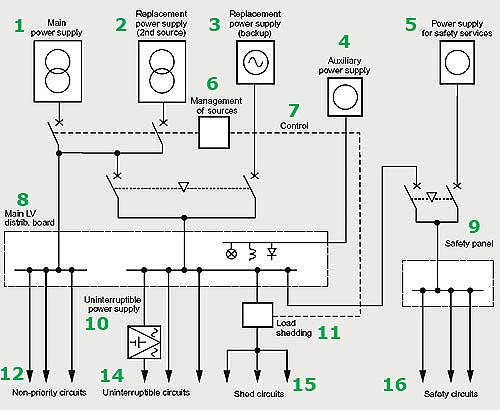
Рис. Legrand
Типовая схема электроснабжения: 1 - Main power supply - Основной источник питания
2 - Replacement power supply (2nd source) - Резервный источник питания (2-й источник)
3 - Replacement power supply (backup) - Резервный источник питания (независимый)
4 - Auxiliary power supply - Дополнительный источник питания
5 - Power supply for safety services - Аварийный источник питания для систем безопасности
6 - Management of sources - Управление источниками питания
7 - Control - Цепь управления
8 - Main LV distrib. board - Главный распределительный щит (ГРЩ)
9 - Safety panel - Панель безопасности
10 - Uninterruptible power supply - Источник бесперебойного питания
11 - Load shedding - Отключение нагрузки
12 - Non-priority circuits - Цепи неприоритетной нагрузки
14 - Uninterruptible circuits - Цепи бесперебойного питания
15 - Shed circuits - Цепи отключаемой нагрузки
16 - Safety circuits - Цепи систем безопасностиТематики
Близкие понятия
Действия
Синонимы
Сопутствующие термины
- аварийный источник питания
- взаимно резервируемые источники питания
- внешний источник питания
- дополнительный источник питания
- источник бесперебойного питания
- источник питания с ограничением тока
- независимый источник питания
- основной источник питания
- резервный источник питания
EN
источник электропитания радиоэлектронной аппаратуры
источник электропитания РЭА
Нерекомендуемый термин - источник питания
Устройство силовой электроники, входящее в состав радиоэлектронной аппаратуры и преобразующее входную электроэнергию для согласования ее параметров с входными параметрами составных частей радиоэлектронной аппаратуры.
[< size="2"> ГОСТ Р 52907-2008]
источник питания
Часть устройства, обеспечивающая электропитание остальных модулей устройства.
[ http://www.lexikon.ru/dict/net/index.html]EN
power supply
An electronic module that converts power from some power source to a form which is needed by the equipment to which power is being supplied.
[Comprehensive dictionary of electrical engineering / editor-in-chief Phillip A. Laplante.-- 2nd ed.]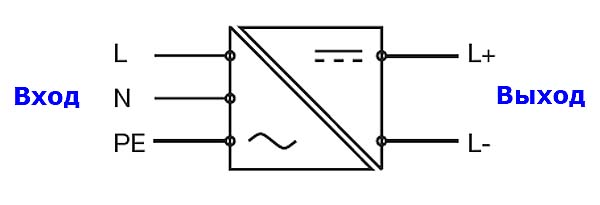
Рис. ABB
Структурная схема источника электропитанияThe input side and the output side are electrically isolated against each other
Вход и выход гальванически развязаны
Терминология относящая к входу
Primary side
Первичная сторона
Input voltage
Входное напряжение
Primary grounding
Current consumption
Потребляемый ток
Inrush current
Пусковой ток
Input fuse
Предохранитель входной цепи
Frequency
Частота
Power failure buffering
Power factor correction (PFC)
Коррекция коэффициента мощности
Терминология относящая к выходу
Secondary side
Вторичная сторона
Output voltage
Выходное напряжение
Secondary grounding
Short-circuit current
То короткого замыкания
Residual ripple
Output characteristics
Выходные характеристики
Output current
Выходной ток
Различают первичные и вторичные источники питания.
К первичным относят преобразователи различных видов энергии в электрическую, например:
- аккумулятор (преобразует химическую энергию.
Вторичные источники не генерируют электроэнергию, а служат лишь для её преобразования с целью обеспечения требуемых параметров (напряжения, тока, пульсаций напряжения и т. п.)Задачи вторичного источника питания
- Обеспечение передачи мощности — источник питания должен обеспечивать передачу заданной мощности с наименьшими потерями и соблюдением заданных характеристик на выходе без вреда для себя. Обычно мощность источника питания берут с некоторым запасом.
- Преобразование формы напряжения — преобразование переменного напряжения в постоянное, и наоборот, а также преобразование частоты, формирование импульсов напряжения и т. д. Чаще всего необходимо преобразование переменного напряжения промышленной частоты в постоянное.
- Преобразование величины напряжения — как повышение, так и понижение. Нередко необходим набор из нескольких напряжений различной величины для питания различных цепей.
- Стабилизация — напряжение, ток и другие параметры на выходе источника питания должны лежать в определённых пределах, в зависимости от его назначения при влиянии большого количества дестабилизирующих факторов: изменения напряжения на входе, тока нагрузки и т. д. Чаще всего необходима стабилизация напряжения на нагрузке, однако иногда (например для зарядки аккумуляторов) необходима стабилизация тока.
- Защита — напряжение или ток нагрузки в случае неисправности (например, короткого замыкания) каких-либо цепей может превысить допустимые пределы и вывести электроприбор или сам источник питания из строя. Также во многих случаях требуется защита от прохождения тока по неправильному пути: например прохождения тока через землю при прикосновении человека или постороннего предмета к токоведущим частям.
- Гальваническая развязка цепей — одна из мер защиты от протекания тока по неверному пути.
- Регулировка — в процессе эксплуатации может потребоваться изменение каких-либо параметров для обеспечения правильной работы электроприбора.
- Управление — может включать регулировку, включение/отключение каких-либо цепей или источника питания в целом. Может быть как непосредственным (с помощью органов управления на корпусе устройства), так и дистанционным, а также программным (обеспечение включения/выключения, регулировка в заданное время или с наступлением каких-либо событий).
- Контроль — отображение параметров на входе и на выходе источника питания, включения/выключения цепей, срабатывания защит. Также может быть непосредственным или дистанционным.
Трансформаторный (сетевой) источник питания
Чаще всего состоит из следующих частей:- Сетевого трансформатора, преобразующего величину напряжения, а также осуществляющего гальваническую развязку;
- Выпрямителя, преобразующего переменное напряжение в пульсирующее;
- Фильтра для снижения уровня пульсаций;
- Стабилизатора напряжения для приведения выходного напряжения в соответствие с номиналом, также выполняющего функцию сглаживания пульсаций за счёт их «срезания».
В сетевых источниках питания применяются чаще всего линейные стабилизаторы напряжения, а в некоторых случаях и вовсе отказываются от стабилизации.
Достоинства такой схемы:- Простота построения и обслуживания
- Надёжность
- Низкий уровень радиопомех.
Недостатки:
- Большой вес и габариты, особенно при большой мощности: по большей части за счёт габаритов трансформатора и сглаживающего фильтра
- Металлоёмкость
- Применение линейных стабилизаторов напряжения вводит компромисс между стабильностью выходного напряжения и КПД: чем больше диапазон изменения напряжения, тем больше потери мощности.
- При отсутствии стабилизатора на выход источника питания проникают пульсации с частотой 100Гц.
В целом ничто не мешает применить в трансформаторном источнике питания импульсный стабилизатор напряжения, однако большее распространение получила схема с полностью импульсным преобразованием напряжения.
Импульсный источник питания
Широко распространённая схема импульсного источника питания состоит из следующих частей:- Входного фильтра, призванного предотвращать распространение импульсных помех в питающей сети
- Входного выпрямителя, преобразующего переменное напряжение в пульсирующее
- Фильтра, сглаживающего пульсации выпрямленного напряжения
- Прерывателя (обычно мощного транзистора, работающего в ключевом режиме)
- Цепей управления прерывателем (генератора импульсов, широтно-импульсного модулятора)
- Импульсного трансформатора, который служит накопителем энергии импульсного преобразователя, формирования нескольких номиналов напряжения, а также для гальванической развязки цепей (входных от выходных, а также, при необходимости, выходных друг от друга)
- Выходного выпрямителя
- Выходных фильтров, сглаживающих высокочастотные пульсации и импульсные помехи.
Достоинства такого блока питания:
- Можно достичь высокого коэффициента стабилизации
- Высокий КПД. Основные потери приходятся на переходные процессы, которые длятся значительно меньшее время, чем устойчивое состояние.
- Малые габариты и масса, обусловленные как меньшим выделением тепла на регулирующем элементе, так и меньшими габаритами трансформатора, благодаря тому, что последний работает на более высокой частоте.
- Меньшая металлоёмкость, благодаря чему мощные импульсные источники питания стоят дешевле трансформаторных, несмотря на бо́льшую сложность
- Возможность включения в сети широкого диапазона напряжений и частот, или даже постоянного тока. Благодаря этому возможна унификация техники, производимой для различных стран мира, а значит и её удешевление при массовом производстве.
Однако имеют такие источники питания и недостатки, ограничивающие их применение:
- Импульсные помехи. В связи с этим часто недопустимо применение импульсных источников питания для некоторых видов аппаратуры.
- Невысокий cosφ, что требует включения компенсаторов коэффициента мощности.
- Работа большей части схемы без гальванической развязки, что затрудняет обслуживание и ремонт.
- Во многих импульсных источниках питания входной фильтр помех часто соединён с корпусом, а значит такие устройства требуют заземления.
[Википедия]
Недопустимые, нерекомендуемые
Тематики
Обобщающие термины
Синонимы
EN
подача
1. Порция одноврем. загружаемых в шахтную печь рудных материалов, флюсов и тв. топлива с определ. соотношением компонентов.
2. Операция перемещения заготовки в одном из направлений (продольном, поперечном, или др.) в промежутках между единичными обжатиями при ковке. В количественном отношении подача — величина перемещения заготовки (абсолютная подача) или отношение поперечного размера заготовки к ее высотному размеру в зоне обжатия (между бойками) — относительная подача.
3. Длина кольцевого участка гильзы или заготовки, обжимаемого и раскатываемого за цикл пилигримовой прокатки труб.
4. Относительное перемещение режущего инструмента и обрабатываемой на станке заготовки. Различают подачу непрерывную (например, на токарных, сверлильных, фрезерных станках) и прерывную или периодическую подачу (например, на строгальных, долбежных станках).
[ http://www.manual-steel.ru/eng-a.html]Тематики
EN
подводить электропитание
—
[Я.Н.Лугинский, М.С.Фези-Жилинская, Ю.С.Кабиров. Англо-русский словарь по электротехнике и электроэнергетике, Москва, 1999 г.]Тематики
- электротехника, основные понятия
EN
поставки
1. Означают продажу, включая перепродажу электроэнергии потребителям (Директива 2003/54/ЕС).
2. Продажа электроэнергии, как правило, включает снятие показаний счетчиков и выписывание счетов, в отличие от другой деятельности, такой как генерация, передача, эксплуатация системы и распределение.
[Англо-русский глосcарий энергетических терминов ERRA]EN
supply
1. Means the sale, including resale, of electricity to customers (Directive 2003/54/EC).
2. The sale of electricity, usually including metering and billing, in contrast to other activities such as generation, transmission, system operation and distribution.
[Англо-русский глосcарий энергетических терминов ERRA]Тематики
EN
предложение
Совокупность слов, образующих текстовую единицу, выражающую законченную мысль. Обычно начинается с заглавной буквы и заканчивается знаком препинания, таким как точка, вопросительный или восклицательный знак.
[ http://www.morepc.ru/dict/]
предложение
Одно из основных понятий экономики рынка. Можно определить П. блага (товара) как количество этого блага, которое может быть представлено для продажи на рынке по данной цене. Соответственно, совокупное П. на рынке — общее количество благ, которые могут быть представлены для продажи при данной структуре цен. В нормальных условиях, когда загрузка производственных мощностей близка к полной, выпуск каждой дополнительной единицы продукции требует дополнительных затрат. Чтобы побудить к этому производителя, надо предложить ему повышенную цену (См. Кривая предложения). С другой стороны, потребитель заинтересован в возможно более низкой цене (см. Кривая спроса). Взаимодействие этих интересов и формирует рыночный механизм.
[ http://slovar-lopatnikov.ru/]Тематики
EN
электроснабжение
Обеспечение потребителей электрической энергией.
[ ГОСТ 19431-84]Качество электрической энергии (КЭ) тесно связано с надежностью электроснабжения, поскольку нормальным режимом электроснабжения потребителей является такой режим, при котором потребители получают электроэнергию бесперебойно, в количестве, заранее согласованном с энергоснабжающей организацией, и нормированного качества.
[В. В. Суднова. Качество электрической энергии]Тематики
Действия
Сопутствующие термины
- бесперебойность электроснабжения
- надежность электроснабжения
- нарушение электроснабжения
- нормальный режим электроснабжения
- проект электроснабжения
- электроснабжение от автономного источника питания электроэнергией
EN
Англо-русский словарь нормативно-технической терминологии > supply
СтраницыСм. также в других словарях:
Virtual Machine Based Rootkit — (VMBR) sind Rootkits, die ein vorhandenes Betriebssystem in eine virtuelle Umgebung verschieben. Dadurch ist das Betriebssystem in der virtuellen Umgebung gefangen. Die virtuelle Umgebung ist somit eine Software Ebene unter dem Betriebssystem,… … Deutsch Wikipedia
Machine vision — (MV System) is the application of computer vision to industry and manufacturing. Whereas computer vision is mainly focused on machine based image processing, machine vision most often requires also digital input/output devices and computer… … Wikipedia
Machine code — or machine language is a system of impartible instructions executed directly by a computer s central processing unit. Each instruction performs a very specific task, typically either an operation on a unit of data (in a register or in memory, e.g … Wikipedia
Machine learning — is a subfield of artificial intelligence that is concerned with the design and development of algorithms and techniques that allow computers to learn . In general, there are two types of learning: inductive, and deductive. Inductive machine… … Wikipedia
machine tool — machine tooled, adj. a power operated machine, as a lathe, used for general cutting and shaping of metal and other substances. [1860 65] * * * Stationary, power driven machine used to cut, shape, or form materials such as metal and wood. Machine… … Universalium
Machine Robo Rescue — 出撃!マシンロボレスキュー (Shutsugeki! Mashin Robo Resukyū) Genre Adventure, Mecha TV anime Directed by Hideki Sonoda … Wikipedia
Machine Wars — was a short lived toy series in the Transformers toyline, introduced in 1997. The series was initially exclusive to KB Toys and its subsidiaries, although overstock/unsold surplus eventually appeared at other retailers.[1] Machine Wars was Hasbro … Wikipedia
Machine embroidery — is a term that can be used to describe two different actions. The first is using a sewing machine to manually create (either freehand or with built in stitches) a design on a piece of fabric or other similar item. The second is to use a specially … Wikipedia
Machine Sazi Tabriz F.C. — Machine Sazi Tabriz F.C. Full name Machine Sazi Tabriz Cultural and Sport Club Nickname(s) Green Cassocks (Persian: سبز قباها) Machine Makers (Persian: ماشين سازان) … Wikipedia
Machine vision optical filters — are optical filters used in machine vision applications.Choosing the correct optical filter for machine visionMany of those developing machine vision applications know that considerable emphasis has been placed on choosing the correct lighting to … Wikipedia
Machine elf — Machine elves (also known as fractal elves, self transforming machine elves) is a term coined by the late ethnobotanist, writer and philosopher Terence McKenna to describe the apparent entities that are often reported by individuals using… … Wikipedia
Перевод: с английского на все языки
со всех языков на английский- Со всех языков на:
- Английский
- С английского на:
- Все языки
- Болгарский
- Испанский
- Итальянский
- Немецкий
- Персидский
- Русский
- Украинский
machine-based

18+
© Академик, 2000-2026
- Обратная связь: Техподдержка, Реклама на сайте
Экспорт словарей на сайты, сделанные на PHP, Joomla, Drupal, WordPress, MODx.