

-
1 grandeur d'alimentation
воздействующая величина электрического реле
Электрическая величина, которая одна или в сочетании с другими электрическими величинами должна быть приложена к электрическому реле в заданных условиях для достижения ожидаемого функционирования
[ ГОСТ 16022-83]EN
energizing quantity
an electrical quantity (either current or voltage) which alone, or in combination with other such quantities, applied to a relay under specified conditions enables it to fulfil its purpose
[IEV number 446-12-01]
energizing quantity (for elementary relays)electrical quantity which, when applied to the input circuit of an elementary relay under specified conditions, enables it to fulfill its purpose
NOTE – For elementary relays the energizing quantity is usually a voltage. Therefore, the input voltage as energizing quantity is used in the definitions given below. Where a relay is energized by a given current instead, the respective terms and definitions apply with "current" used instead of "voltage".
[IEV number 444-03-01]FR
grandeur d'alimentation
grandeur électrique, courant ou tension, qui, seule ou en combinaison avec d'autres grandeurs électriques, courant ou tension, doit être appliquée dans des conditions spécifiées à un relais pour en obtenir le comportement attendu
[IEV number 446-12-01]
grandeur d'alimentation (pour les relais élémentaires), f
grandeur électrique qui, appliquée au circuit d'entrée d'un relais élémentaire dans des conditions spécifiées, lui permet d'accomplir sa fonction
NOTE – Pour les relais élémentaires, la grandeur d'alimentation est en général une tension. En conséquence, on utilise la tension d'entrée comme grandeur d'alimentation dans les définitions données ci-dessous. Lorsqu'un relais est alimenté par un courant, les termes et définitions respectifs sont à utiliser avec le terme "courant" au lieu du terme "tension".
[IEV number 444-03-01]Тематики
Классификация
>>>EN
DE
FR
Франко-русский словарь нормативно-технической терминологии > grandeur d'alimentation
-
2 dimension d'une grandeur, f
размерность физической величины
размерность величины
Выражение в форме степенного одночлена, составленного из произведений символов основных физических величин в различных степенях и отражающее связь данной физической величины с физическими величинами, принятыми в данной системе величин за основные с коэффициентом пропорциональности, равным 1.
Примечания
1. Степени символов основных величин, входящих в одночлен, в зависимости от связи рассматриваемой физической величины с основными, могут быть целыми, дробными, положительными и отрицательными. Понятие размерность распространяется и на основные величины. Размерность основной величины в отношении самой себя равна единице, т.е. формула размерности основной величины совпадает с ее символом.
2. В соответствии с международным стандартом ИСО 31/0, размерность величин следует обозначать знаком dim [2]. В системе величин LMT размерность величины.x будет: dim х = LlMmTt, где L, М, Т - символы, величин, принятых за основные (соответственно длины, массы, времени).
[РМГ 29-99]EN
dimension of a quantity
quantity dimension
dimension
expression of the dependence of a quantity on the base quantities of a system of quantities as a product of powers of factors corresponding to the base quantities, omitting any numerical factor
NOTE 1 – A power of a factor is the factor raised to an exponent. Each factor is the dimension of a base quantity.
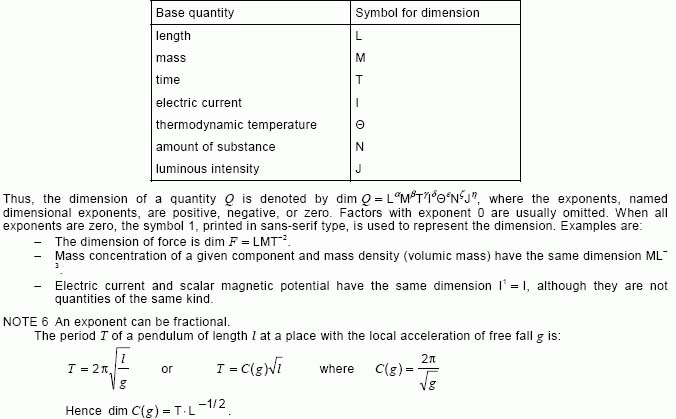
NOTE 2 – The conventional symbolic representation of the dimension of a base quantity is a single upper case letter in roman (upright) sans-serif type. The conventional symbolic representation of the dimension of a derived quantity is the product of powers of the dimensions of the base quantities according to the definition of the derived quantity. The dimension of a quantity Q is denoted by dim Q.
NOTE 3 – In deriving the dimension of a quantity, no account is taken of its scalar, vector or tensor character.
NOTE 4 – In a given system of quantities, – quantities of the same kind have the same dimension, – quantities of different dimensions are always of different kinds, and – quantities having the same dimension are not necessarily of the same kind. For example, in the ISQ, pressure and energy density (volumic energy) have the same dimension L–1MT–2. See also note 5.
NOTE 5 – In the International System of Quantities (ISQ), the symbols representing the dimensions of the base quantities are:
[IEV number 112-01-11]FR
dimension, f
dimension d'une grandeur, f
expression de la dépendance d’une grandeur par rapport aux grandeurs de base d'un système de grandeurs sous la forme d'un produit de puissances de facteurs correspondant aux grandeurs de base, en omettant tout facteur numérique
NOTE 1 – Une puissance d'un facteur est le facteur muni d'un exposant. Chaque facteur exprime la dimension d'une grandeur de base.
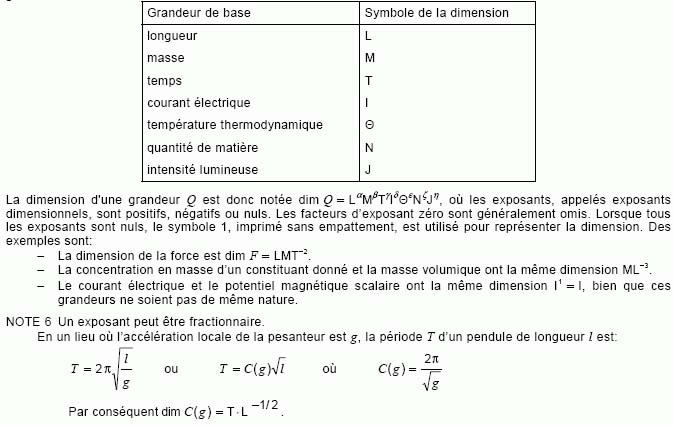
NOTE 2 – Par convention, la représentation symbolique de la dimension d'une grandeur de base est une lettre majuscule unique en caractère romain (droit) sans empattement. Par convention, la représentation symbolique de la dimension d'une grandeur dérivée est le produit de puissances des dimensions des grandeurs de base conformément à la définition de la grandeur dérivée. La dimension de la grandeur Q est notée dim Q.
NOTE 3 – Pour établir la dimension d'une grandeur, on ne tient pas compte du caractère scalaire, vectoriel ou tensoriel.
NOTE 4 – Dans un système de grandeurs donné, – les grandeurs de même nature ont la même dimension, – des grandeurs de dimensions différentes sont toujours de nature différente, – des grandeurs ayant la même dimension ne sont pas nécessairement de même nature. Par exemple, dans l'ISQ, la pression et l'énergie volumique ont la même dimension L–1MT–2. Voir aussi la note 5.
NOTE 5 – Dans le Système international de grandeurs (ISQ), les symboles représentant les dimensions des grandeurs de base sont:
[IEV number 112-01-11]Тематики
- метрология, основные понятия
Синонимы
EN
DE
- Dimension einer Grösse
- Dimension, f
- Größendimension, f
FR
- dimension d'une grandeur, f
- dimension, f
Франко-русский словарь нормативно-технической терминологии > dimension d'une grandeur, f
-
3 dimension, f
размерность физической величины
размерность величины
Выражение в форме степенного одночлена, составленного из произведений символов основных физических величин в различных степенях и отражающее связь данной физической величины с физическими величинами, принятыми в данной системе величин за основные с коэффициентом пропорциональности, равным 1.
Примечания
1. Степени символов основных величин, входящих в одночлен, в зависимости от связи рассматриваемой физической величины с основными, могут быть целыми, дробными, положительными и отрицательными. Понятие размерность распространяется и на основные величины. Размерность основной величины в отношении самой себя равна единице, т.е. формула размерности основной величины совпадает с ее символом.
2. В соответствии с международным стандартом ИСО 31/0, размерность величин следует обозначать знаком dim [2]. В системе величин LMT размерность величины.x будет: dim х = LlMmTt, где L, М, Т - символы, величин, принятых за основные (соответственно длины, массы, времени).
[РМГ 29-99]EN
dimension of a quantity
quantity dimension
dimension
expression of the dependence of a quantity on the base quantities of a system of quantities as a product of powers of factors corresponding to the base quantities, omitting any numerical factor
NOTE 1 – A power of a factor is the factor raised to an exponent. Each factor is the dimension of a base quantity.
NOTE 2 – The conventional symbolic representation of the dimension of a base quantity is a single upper case letter in roman (upright) sans-serif type. The conventional symbolic representation of the dimension of a derived quantity is the product of powers of the dimensions of the base quantities according to the definition of the derived quantity. The dimension of a quantity Q is denoted by dim Q.
NOTE 3 – In deriving the dimension of a quantity, no account is taken of its scalar, vector or tensor character.
NOTE 4 – In a given system of quantities, – quantities of the same kind have the same dimension, – quantities of different dimensions are always of different kinds, and – quantities having the same dimension are not necessarily of the same kind. For example, in the ISQ, pressure and energy density (volumic energy) have the same dimension L–1MT–2. See also note 5.
NOTE 5 – In the International System of Quantities (ISQ), the symbols representing the dimensions of the base quantities are:
[IEV number 112-01-11]FR
dimension, f
dimension d'une grandeur, f
expression de la dépendance d’une grandeur par rapport aux grandeurs de base d'un système de grandeurs sous la forme d'un produit de puissances de facteurs correspondant aux grandeurs de base, en omettant tout facteur numérique
NOTE 1 – Une puissance d'un facteur est le facteur muni d'un exposant. Chaque facteur exprime la dimension d'une grandeur de base.
NOTE 2 – Par convention, la représentation symbolique de la dimension d'une grandeur de base est une lettre majuscule unique en caractère romain (droit) sans empattement. Par convention, la représentation symbolique de la dimension d'une grandeur dérivée est le produit de puissances des dimensions des grandeurs de base conformément à la définition de la grandeur dérivée. La dimension de la grandeur Q est notée dim Q.
NOTE 3 – Pour établir la dimension d'une grandeur, on ne tient pas compte du caractère scalaire, vectoriel ou tensoriel.
NOTE 4 – Dans un système de grandeurs donné, – les grandeurs de même nature ont la même dimension, – des grandeurs de dimensions différentes sont toujours de nature différente, – des grandeurs ayant la même dimension ne sont pas nécessairement de même nature. Par exemple, dans l'ISQ, la pression et l'énergie volumique ont la même dimension L–1MT–2. Voir aussi la note 5.
NOTE 5 – Dans le Système international de grandeurs (ISQ), les symboles représentant les dimensions des grandeurs de base sont:
[IEV number 112-01-11]Тематики
- метрология, основные понятия
Синонимы
EN
DE
- Dimension einer Grösse
- Dimension, f
- Größendimension, f
FR
- dimension d'une grandeur, f
- dimension, f
Франко-русский словарь нормативно-технической терминологии > dimension, f
-
4 transducteur de mesure (à sortie électrique)
измерительный преобразователь (с электрическим выходом)
-
[IEV number 312-02-15]EN
measuring transducer (with electrical output)
device intended to transform, with a specified accuracy and according to a given law, the measurand, or a quantity already transformed therefrom, into an electrical quantity
NOTE 1 – If the input quantity is electrical, the input and output quantities may not be of the same kind, for example, a voltage and a current.
NOTE 2 – In certain instances, measuring transducers also have a specific name in respect of their function, (for example, amplifier, converter, transformer, frequency transducer, etc.).
Source: ≈ VIM 4.3
[IEV number 312-02-15]FR
transducteur de mesure (à sortie électrique)
dispositif destiné à transformer, avec une précision spécifiée et suivant une loi déterminée, le mesurande, ou la grandeur déjà transformée à partir du mesurande, en une grandeur électrique
NOTE 1 – Si la grandeur d'entrée est électrique, les grandeurs d'entrée et de sortie peuvent ne pas être de même nature, par exemple une tension et un courant.
NOTE 2 – Dans certains cas, les transducteurs de mesure ont également compte tenu de leur fonction, une dénomination spécifique, (par exemple, amplificateur, convertisseur, transformateur, transducteur de fréquence, etc.).
Source: ≈ VIM 4.3
[IEV number 312-02-15]Тематики
- измерение электр. величин в целом
EN
DE
FR
Франко-русский словарь нормативно-технической терминологии > transducteur de mesure (à sortie électrique)
-
5 production biologique
биологическое производство
—
[ http://www.eionet.europa.eu/gemet/alphabetic?langcode=en]EN
biological production
1) The amount and rate of production which occur in a given ecosystem over a given time period. It may apply to a single organism, a population, or entire communities and ecosystems.
2) The quantity of organic matter or its equivalent in dry matter, carbon, or energy content which is accumulated during a given period of time.
(Source: PARCOR / MGH)
[http://www.eionet.europa.eu/gemet/alphabetic?langcode=en]Тематики
EN
DE
FR
Франко-русский словарь нормативно-технической терминологии > production biologique
-
6 courant électrique total
ток
Скалярная величина, равная сумме электрического тока проводимости, электрического тока переноса и электрического тока смещения сквозь рассматриваемую поверхность.
[ ГОСТ Р 52002-2003]EN
total electric current
scalar quantity given by the flux of the total current density Jt through a given directed surface S:

where endA is the vector surface element
NOTE – The total electric current It is given by
It = I + ID
where I is the electric current and ID the displacement current.
[IEV number 121-11-45]FR
courant électrique total, m
grandeur scalaire égale au flux de la densité de courant total Jt à travers une surface orientée donnée S:
où endA est l'élément vectoriel de surface
NOTE – Le courant électrique total It est donné par
It = I + ID
où I est le courant électrique et ID le courant de déplacement.
[IEV number 121-11-45]Тематики
- электротехника, основные понятия
Действия
- включать ток
- длительно пропускать ток
- коммутировать ток
- ограничивать ток
- отключать ток
- потреблять ток
- проводить ток
- пропускать ток
Синонимы
EN
DE
FR
Франко-русский словарь нормативно-технической терминологии > courant électrique total
-
7 systéme coherent d´unités (de mesure)
когерентная система единиц физических величин
когерентная система единиц
Система единиц физических величин, состоящая из основных единиц и когерентных производных единиц.
Примечание. Кратные и дольные единицы от системных единиц не входят в когерентную систему.
[РМГ 29-99]EN
coherent system of units
system of units, based on a given system of quantities, in which the unit of measurement for each derived quantity is a coherent derived unit
NOTE 1 – A system of units can be coherent only with respect to a system of quantities and the adopted base units.
NOTE 2 – For a coherent system of units, numerical value equations have the same form, including numerical factors, as the corresponding quantity equations.
NOTE 3 – An example of coherent system of units is the set of coherent SI units with the relations between them.
Source: ISO/IEC GUIDE 99:2007 1.14
[IEV number 112-01-22]FR
système cohérent d'unités, m
système d'unités, fondé sur un système de grandeurs donné, dans lequel l'unité de mesure de chaque grandeur dérivée est une unité dérivée cohérente
NOTE 1 – Un système d'unités ne peut être cohérent que par rapport à un système de grandeurs et aux unités de base adoptées.
NOTE 2 – Pour un système cohérent d'unités, les équations aux valeurs numériques ont la même forme, y compris les facteurs numériques, que les équations aux grandeurs correspondantes.
NOTE 3 – Un exemple de système cohérent d’unités est l’ensemble des unités SI cohérentes muni des relations entre elles.
Source: ISO/IEC GUIDE 99:2007 1.14
[IEV number 112-01-22]
Тематики
- метрология, основные понятия
Синонимы
EN
DE
FR
- systéme coherent d´unités (de mesure)
Франко-русский словарь нормативно-технической терминологии > systéme coherent d´unités (de mesure)
-
8 signal analogique
аналоговый сигнал данных
аналоговый сигнал
Сигнал данных, у которого каждый из представляющих параметров описывается функцией времени и непрерывным множеством возможных значений.
[ ГОСТ 17657-79 ]
аналоговый сигнал
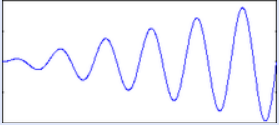
Сигнал, информационный параметр которого изменяется непрерывно.
[ Источник]
аналоговый сигнал
Сигнал, представленный непрерывным (в отличие от дискретного) изменением той или иной физической величины (например, человеческая речь). Информация передается изменением частоты, амплитуды или фазы.
[ http://www.iks-media.ru/glossary/index.html?glossid=2400324]EN
analogue signal
analog signal (US)
signal whose information parameter may assume any value within a given range
[ IEV ref 351-21-53]FR
signal analogique
signal dont le paramètre informationnel peut prendre toutes les valeurs dans un intervalle continu donné
[ IEV ref 351-21-53]Аналоговые сигналы используют для представления непрерывно изменяющихся физических величин. Например, аналоговый электрический сигнал, снимаемый с термопары, несет информацию об изменении температуры, сигнал с микрофона — об изменениях давления в звуковой волне, и т. п.
[http://ru.wikipedia.org/]Тематики
- автоматизация, основные понятия
- передача данных
Обобщающие термины
Синонимы
EN
DE
- analoges Signal, n
FR
Франко-русский словарь нормативно-технической терминологии > signal analogique
-
9 potentiel vecteur magnétique
векторный магнитный потенциал
Векторная величина, ротор которой равен магнитной индукции.
[ ГОСТ Р 52002-2003]EN
magnetic vector potential
vector potential of the magnetic flux density
NOTE 1 – The rotation of the magnetic vector potential A is the magnetic flux density B:
rotA = B
NOTE 2 – The magnetic vector potential is not unique since any irrotational vector field quantity can be added to a given magnetic vector potential without changing its rotation. Under static conditions the magnetic vector potential is often chosen so that its divergence is zero.
[IEV number 121-11-23]FR
potentiel vecteur magnétique, m
potentiel vecteur de l'induction magnétique
NOTE 1 – Le rotationnel du potentiel vecteur magnétique A est l'induction magnétique B:
rotA = B
NOTE 2 – Le potentiel vecteur magnétique n'est pas unique puisqu’un champ vectoriel irrotationnel quelconque peut être ajouté à un potentiel vecteur magnétique donné sans changer son rotationnel. En régime statique le potentiel vecteur magnétique est souvent choisi de telle sorte que sa divergence soit nulle.
[IEV number 121-11-23]Тематики
- электротехника, основные понятия
Синонимы
EN
- m.v.p.
- magnetic vector potential
DE
FR
Франко-русский словарь нормативно-технической терминологии > potentiel vecteur magnétique
-
10 relation dose-effet
взаимоотношение дозы и эффекта
—
[ http://www.eionet.europa.eu/gemet/alphabetic?langcode=en]EN
dose-effect relationship
The relation between the quantity of a given substance and a measurable or observable effect. (Source: KOREN)
[http://www.eionet.europa.eu/gemet/alphabetic?langcode=en]Тематики
EN
DE
FR
Франко-русский словарь нормативно-технической терминологии > relation dose-effet
-
11 circuit d'entrée
входная цепь электрического реле
Совокупность электрических проводящих частей электрического реле, присоединенных к выводам, к которым приложена воздействующая величина
[ ГОСТ 16022-83]EN
input circuit
the whole of the electrical parts within a relay (including those parts, if any, intentionally coupled by inductive or capacitive means) and which are connected to those terminals to which a given input energizing quantity is applied
[IEV number 446-12-05]FR
circuit d'entrée
ensemble des parties électriques d'un relais, comprenant, lorsqu'elles existent, les parties intentionnellement couplées entre elles par voie inductive ou capacitive, reliées aux bornes auxquelles est appliquée la grandeur d'alimentation d'entrée considérée
[IEV number 446-12-05]Тематики
Классификация
>>>EN
DE
FR
Франко-русский словарь нормативно-технической терминологии > circuit d'entrée
-
12 capacitif, adj
емкостный
-
[IEV number 151-15-54]EN
capacitive, adj
qualifies an electric device or an electric circuit the predominant quantity of which, under given conditions, is a capacitance
[IEV number 151-15-54]FR
capacitif, adj
qualifie un dispositif électrique ou un circuit électrique dont la grandeur essentielle, dans des conditions données, est la capacité
[IEV number 151-15-54]EN
- capacitive, adj
DE
FR
- capacitif, adj
Франко-русский словарь нормативно-технической терминологии > capacitif, adj
-
13 inductif, adj
индуктивный
-
[IEV number 151-15-53]EN
inductive, adj
qualifies an electric device or an electric circuit the predominant quantity of which, under given conditions, is an inductance
[IEV number 151-15-53]FR
inductif, adj
qualifie un dispositif électrique ou un circuit électrique dont la grandeur essentielle, dans des conditions données, est l'inductance
[IEV number 151-15-53]EN
DE
FR
- inductif, adj
Франко-русский словарь нормативно-технической терминологии > inductif, adj
-
14 résistif, adj
резистивный
обладающий активным сопротивлением
-
[IEV number 151-15-52]EN
resistive, adj
qualifies an electric device or an electric circuit the predominant quantity of which, under given conditions, is a resistance
[IEV number 151-15-52]FR
résistif, adj
qualifie un dispositif électrique ou un circuit électrique dont la grandeur essentielle, dans des conditions données, est la résistance
[IEV number 151-15-52]Синонимы
EN
DE
FR
- résistif, adj
Франко-русский словарь нормативно-технической терминологии > résistif, adj
-
15 gestion commune des déchets banals et spéciaux
принцип раздельного сбора городского мусора
—
[ http://www.eionet.europa.eu/gemet/alphabetic?langcode=en]EN
dual waste management
To reduce the quantity of packaging waste, and thereby of overall MSW, Germany introduced a far-reaching legislation to reduce waste, based on the producer's responsibility principle. Industry was given the option to set up a third party organization which would carry out the collection and sorting of sales packaging for care of manufacturers and retailers. Thus, Some 600 companies created "Duales System Deutschland" in 1990 ("Dual" because it meant creating a second collection system in parallel to the existing waste collection system of the local authorities). Duales System Deutschland (DSD), now has overall responsibility for the separate collection and recycling of packaging. At present, the Dual System is the only nationwide system for the collection and sorting of sales packaging. Packaging participating in this collection system is marked with the Green Dot. (Source: EPEBE)
[http://www.eionet.europa.eu/gemet/alphabetic?langcode=en]Тематики
EN
DE
FR
Франко-русский словарь нормативно-технической терминологии > gestion commune des déchets banals et spéciaux
-
16 potentiel magnétique (scalaire)
скалярный магнитный потенциал
Разность скалярных магнитных потенциалов данной точки и другой, определенной, произвольно выбранной.
[ ГОСТ Р 52002-2003]EN
scalar magnetic potential
scalar potential of an irrotational magnetic field strength
NOTE 1 – The negative of the gradient of the scalar magnetic potential is the irrotational magnetic field strength.
NOTE 2 – The scalar magnetic potential is not unique since any constant scalar quantity can be added to a given scalar magnetic potential without changing its gradient.
[IEV number 121-11-58]FR
potentiel magnétique (scalaire), m
potentiel scalaire d’un champ magnétique irrotationnel
NOTE 1 – L'opposé du gradient du potentiel magnétique scalaire est le champ magnétique irrotationnel.
NOTE 2 – Le potentiel magnétique scalaire n'est pas unique puisqu’une grandeur scalaire constante quelconque peut être ajoutée à un potentiel magnétique scalaire donné sans changer son gradient.
[IEV number 121-11-58]Тематики
- электротехника, основные понятия
EN
DE
FR
Франко-русский словарь нормативно-технической терминологии > potentiel magnétique (scalaire)
-
17 courant de conduction
ток проводимости
Явление направленного движения свободных носителей электрического заряда в веществе или в пустоте, количественно характеризуемое скалярной величиной, равной производной по времени от электрического заряда, переносимого свободными носителями заряда сквозь рассматриваемую поверхность.
[ ГОСТ Р 52002-2003]EN
(electric) current
(conduction) current
scalar quantity equal to the flux of the electric current density J through a given directed surface S:
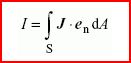
where endA is the vector surface element
NOTE 1 – The electric current through a surface is equal to the limit of the quotient of the electric charge transferred through that surface during a time interval by the duration of this interval when this duration tends to zero.
NOTE 2 – For charge carriers confined to a surface, the electric current is defined through a curve of this surface (see the note to term “lineic electric current”).
[IEV number 121-11-13]FR
courant (électrique), m
courant (de conduction), m
grandeur scalaire égale au flux de la densité de courant électrique J à travers une surface orientée donnée S:
où endA est l'élément vectoriel de surface
NOTE 1 – Le courant électrique à travers une surface est égal à la limite du quotient de la charge électrique traversant cette surface pendant un intervalle de temps par la durée de cet intervalle lorsque cette durée tend vers zéro.
NOTE 2 – Pour des porteurs de charge confinés sur une surface, le courant électrique est défini à travers une courbe de cette surface (voir la note au terme "densité linéique de courant").
[IEV number 121-11-13]Тематики
- электротехника, основные понятия
Синонимы
EN
DE
- (elektrische) Stromstärke
- Leitungsstromstärke
- Stromstärke, (elektrische)
FR
Франко-русский словарь нормативно-технической терминологии > courant de conduction
-
18 courant de déplacement
ток смещения
Совокупность электрического тока смещения в пустоте и электрического тока поляризации, количественно характеризуемая скалярной величиной, равной производной по времени от потока электрического смещения сквозь рассматриваемую поверхность.
[ ГОСТ Р 52002-2003]EN
displacement current
scalar quantity equal to the flux of the displacement current density JD through a given directed surface S:
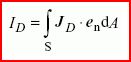
where endA is the vector surface element
[IEV number 121-11-43]FR
courant de déplacement, m
grandeur scalaire égale au flux de la densité de courant de déplacement JD à travers une surface orientée donnée S:
où endA est l'élément vectoriel de surface
[IEV number 121-11-43]Тематики
- электротехника, основные понятия
Синонимы
EN
DE
FR
Франко-русский словарь нормативно-технической терминологии > courant de déplacement
-
19 élément de courant
элемент тока
Векторная величина, равная произведению электрического тока проводимости вдоль линейного проводника и бесконечно малого отрезка этого проводника.
[ ГОСТ Р 52002-2003]EN
current element
at a given point of a filiform tube of current, vector quantity equal to the product of the electric current and the vector line element at that point
NOTE – A current element is expressed by Idr or by Ietds where I is the electric current and dr = etds the vector line element.
[IEV number 121-11-17]FR
élément de courant, m
en un point donné d’un tube de courant filiforme, grandeur vectorielle égale au produit du courant électrique par l'élément vectoriel d'arc en ce point
NOTE – Un élément de courant est représenté par Idr ou par Ietds où I est le courant électrique et dr = etds l'élément vectoriel d'arc.
[IEV number 121-11-17]Тематики
- электротехника, основные понятия
Синонимы
EN
DE
FR
Франко-русский словарь нормативно-технической терминологии > élément de courant
См. также в других словарях:
consensus value of a given quantity — sutartinė tam tikro dydžio vertė statusas T sritis Standartizacija ir metrologija apibrėžtis Pamatinės medžiagos dydžio vertė, nustatyta atlikus tarplaboratorinius tyrimus arba patvirtinta bendru atitinkamų įstaigų ar ekspertų susitarimu.… … Penkiakalbis aiškinamasis metrologijos terminų žodynas
Quantity Demanded — A term used in economics to describe the total amount of goods or services that are demanded at any given point in time. The quantity demanded depends on the price of a good or service in the marketplace, regardless of whether that market is in… … Investment dictionary
Quantity — • Interpretations of quantity as either a physical or theoretical abstraction Catholic Encyclopedia. Kevin Knight. 2006. Quantity Quantity … Catholic encyclopedia
Quantity — Quan ti*ty, n.; pl. {Quantities}. [F. quantite, L. quantitas, fr. quantus bow great, how much, akin to quam bow, E. how, who. See {Who}.] [1913 Webster] 1. The attribute of being so much, and not more or less; the property of being measurable, or … The Collaborative International Dictionary of English
Quantity of estate — Quantity Quan ti*ty, n.; pl. {Quantities}. [F. quantite, L. quantitas, fr. quantus bow great, how much, akin to quam bow, E. how, who. See {Who}.] [1913 Webster] 1. The attribute of being so much, and not more or less; the property of being… … The Collaborative International Dictionary of English
Quantity of matter — Quantity Quan ti*ty, n.; pl. {Quantities}. [F. quantite, L. quantitas, fr. quantus bow great, how much, akin to quam bow, E. how, who. See {Who}.] [1913 Webster] 1. The attribute of being so much, and not more or less; the property of being… … The Collaborative International Dictionary of English
Quantity of motion — Quantity Quan ti*ty, n.; pl. {Quantities}. [F. quantite, L. quantitas, fr. quantus bow great, how much, akin to quam bow, E. how, who. See {Who}.] [1913 Webster] 1. The attribute of being so much, and not more or less; the property of being… … The Collaborative International Dictionary of English
Quantity — is a kind of property which exists as magnitude or multitude. It is among the basic classes of things along with quality, substance, change, and relation. Quantity was first introduced as quantum, an entity having quantity. Being a fundamental… … Wikipedia
Given — Giv en, p. p. & a. from {Give}, v. [1913 Webster] 1. (Math. & Logic) Granted; assumed; supposed to be known; set forth as a known quantity, relation, or premise. [1913 Webster] 2. Disposed; inclined; used with an adv.; as, virtuously given. Shak … The Collaborative International Dictionary of English
Given name — Given Giv en, p. p. & a. from {Give}, v. [1913 Webster] 1. (Math. & Logic) Granted; assumed; supposed to be known; set forth as a known quantity, relation, or premise. [1913 Webster] 2. Disposed; inclined; used with an adv.; as, virtuously given … The Collaborative International Dictionary of English
Quantity adjustment — In economics, the concept of quantity adjustment refers to one possible result of supply and demand disequilibrium in a market, either due to or in the absence of external constraints on the market. In the textbook story, if the quantity demanded … Wikipedia
