

-
41 F82
рус Специфические расстройства развития моторной функцииeng Specific developmental disorder of motor function. A disorder in which the main feature is a serious impairment in the development of motor coordination that is not solely explicable in terms of general intellectual retardation or of any specific congenital or acquired neurological disorder. Nevertheless, in most cases a careful clinical examination shows marked neurodevelopmental immaturities such as choreiform movements of unsupported limbs or mirror movements and other associated motor features, as well as signs of impaired fine and gross motor coordination. Clumsy child syndrome. Developmental: coordination disorder, dyspraxia. (Excludes: ) abnormalities of gait and mobility ( R26.-), lack of coordination ( R27.-), secondary to mental retardation ( F70-F79) -
42 F82.9
рус Специфические расстройства развития моторной функцииeng Specific developmental disorder of motor function. A disorder in which the main feature is a serious impairment in the development of motor coordination that is not solely explicable in terms of general intellectual retardation or of any specific congenital or acquired neurological disorder. Nevertheless, in most cases a careful clinical examination shows marked neurodevelopmental immaturities such as choreiform movements of unsupported limbs or mirror movements and other associated motor features, as well as signs of impaired fine and gross motor coordination. Clumsy child syndrome. Developmental: coordination disorder, dyspraxia. (Excludes: ) abnormalities of gait and mobility ( R26.-), lack of coordination ( R27.-), secondary to mental retardation ( F70-F79) -
43 F83
рус Смешанные специфические расстройства психологического развитияeng Mixed specific developmental disorders. A residual category for disorders in which there is some admixture of specific developmental disorders of speech and language, of scholastic skills, and of motor function, but in which none predominates sufficiently to constitute the prime diagnosis. This mixed category should be used only when there is a major overlap between each of these specific developmental disorders. The disorders are usually, but not always, associated with some degree of general impairment of cognitive functions. Thus, the category should be used when there are dysfunctions meeting the criteria for two or more of F80.-, F81.- and F82. -
44 F83.9
рус Смешанные специфические расстройства психологического развитияeng Mixed specific developmental disorders. A residual category for disorders in which there is some admixture of specific developmental disorders of speech and language, of scholastic skills, and of motor function, but in which none predominates sufficiently to constitute the prime diagnosis. This mixed category should be used only when there is a major overlap between each of these specific developmental disorders. The disorders are usually, but not always, associated with some degree of general impairment of cognitive functions. Thus, the category should be used when there are dysfunctions meeting the criteria for two or more of F80.-, F81.- and F82. -
45 Однозначно сопоставляться
The function $H$ is uniquely associated to a vector field $v$Русско-английский словарь по прикладной математике и механике > Однозначно сопоставляться
-
46 Сопоставляется однозначно
The function $H$ is uniquely associated to a vector field...Русско-английский словарь по прикладной математике и механике > Сопоставляется однозначно
-
47 вербальное представление
В вербальном представлении, напечатанном, вещательном или записанном на магнитофоне, иллюстрации принимают форму визуализации посредством графиков, чертежей и рисунков, включенных в печатный материал или предложенных отдельно (слайды, фильмы). — In a verbal presentation, whether printed, broadcast or recorded, illustration takes the form of visualizing through graphs, drawings, and pictures included in printed matter or offered separately (slides, films).
Можем рассмотреть определение игры непосредственно в терминах стратегий и связанных с ними выигрышей. Второй способ представления игры называется нормальной (или стратегической) формой. — We may think of specifying the game directly in terms of strategies and their associated payoffs. This second way to represent a game is known as the normal (or strategic) form.
Развернутая форма фиксирует, кто и когда делает ход, какие действия может предпринять каждый игрок, что известно игрокам в тот момент, когда они делают ходы, какой исход является функцией действий, предпринятых игроками, а также выигрыши игроков в результате каждого возможного исхода. — The extensive form captures who moves when, what actions each player can take, what players know when they move, what the outcome is a function of the actions taken by the players, and the players' payoffs from each possible outcome.
представление неопределенности на состояниях природы — state of nature representation of uncertainty
представление показателей ценового искажения, количественное — quantification of price distortion
Уравнение (5) дает количественное представление показателей (квантификацию) ценового искажения, но с нормативной точки зрения приемлемой мерой искажения являются потери в общественном благосостоянии. — Equation (5) provides a quantification of price distortion, but from a normative viewpoint the appropriate measure of distortion is the loss of social welfare.
представление полезности, расширенное — extended utility representation
Пригодность расширенного представления полезности в основном является результатом поведения множеств безразличия в окрестности линии денежной определённости - множества случайных переменных, которые в каждом состоянии дают одинаковую сумму. — The usefulness of an extended utility representation is primarily a result of the behavior of the indifference sets around the money certainty line, the set of random variables that pay the same amount in every state.
представление производных, матричное — matrix notation for derivatives
Возможно, самое важное математическое правило сохранения непосредственности учитывает матричное представление. — Perhaps the most important mathematical rule to keep straight regards matrix notation.
В матричном представлении эффекты представляются следующим образом. — In matrix notation, the wealth effects are represented as follows.
В качестве образовательной деятельности представление учебного материала должно вовлекать студентов в интеллектуальную деятельность, которая заставляет их проверять свои идеи, размышлять, сравнивать и применять критический анализ к тому, что они изучают. — As an educational endeavor the presentation of learning matter must engage students in an intellectual activity that makes them try out ideas, reflect, compare and apply critical judgement to what is studied.
Russian-English Dictionary "Microeconomics" > вербальное представление
-
48 assessment of competence
HRthe measurement of an employee’s performance against an agreed set of standards for work-based activities. In the United Kingdom, assessment of competence is generally made against indicators of the successful achievement of a particular job function. There are four dimensions to assessment: the knowledge and understanding required to carry out a task; the performance indicators to be looked for; the scope or range of situations across which an employee is expected to perform; and any particular evidence requirements. Vocational qualifications for a wide range of jobs in the United Kingdom are based on a set of occupational standards that contain these elements. A wide variety of techniques or instruments exists to assess competence. These include specific work-based ability and aptitude tests, as well as traditional methods of performance appraisal and evaluation. Recent years have seen a dramatic rise in the use of direct observation at work by trained assessors, the collection of personal portfolios, and peer assessment techniques such as 360 degree appraisal. All require the careful review of work behavior against a set of indicators that have been clearly shown to be associated with successful performance. -
49 Gramme, Zénobe Théophile
[br]b. 4 April 1826 Jehay-Bodignée, Belgiumd. 20 January 1901 Bois de Colombes, Paris, France[br]Belgian engineer whose improvements to the dynamo produced a machine ready for successful commercial exploitation.[br]Gramme trained as a carpenter and showed an early talent for working with machinery. Moving to Paris he found employment in the Alliance factory as a model maker. With a growing interest in electricity he left to become an instrument maker with Heinrich Daniel Rühmkorff. In 1870 he patented the uniformly wound ring-armature dynamo with which his name is associated. Together with Hippolyte Fontaine, in 1871 Gramme opened a factory to manufacture his dynamos. They rapidly became a commercial success for both arc lighting and electrochemical purposes, international publicity being achieved at exhibitions in Vienna, Paris and Philadelphia. It was the realization that a Gramme machine was capable of running as a motor, i.e. the reversibility of function, that illustrated the entire concept of power transmission by electricity. This was first publicly demonstrated in 1873. In 1874 Gramme reduced the size and increased the efficiency of his generators by relying completely on the principle of self-excitation. It was the first practical machine in which were combined the features of continuity of commutation, self-excitation, good lamination of the armature core and a reasonably good magnetic circuit. This dynamo, together with the self-regulating arc lamps then available, made possible the innumerable electric-lighting schemes that followed. These were of the greatest importance in demonstrating that electric lighting was a practical and economic means of illumination. Gramme also designed an alternator to operate Jablochkoff candles. For some years he took an active part in the operations of the Société Gramme and also experimented in his own workshop without collaboration, but made no further contribution to electrical technology.[br]Principal Honours and DistinctionsKnight Commander, Order of Leopold of Belgium 1897. Chevalier de la Légion d'honneur. Chevalier, Order of the Iron Crown, Austria.Bibliography9 June 1870, British patent no. 1,668 (the ring armature machine).1871, Comptes rendus 73:175–8 (Gramme's first description of his invention).Further ReadingW.J.King, 1962, The Development of Electrical Technology in the 19th Century, Washington, DC: Smithsonian Institution, Paper 30, pp. 377–90 (an extensive account of Gramme's machines).S.P.Thompson, 1901, obituary, Electrician 66: 509–10.C.C.Gillispie (ed.), 1972, Dictionary of Scientific Biography, Vol. V, New York, p. 496.GWBiographical history of technology > Gramme, Zénobe Théophile
-
50 принадлежность
1. accessories2. membership -
51 колонка
▪ The first column of the table, Key No., indexes the controls or indicators to the locations shown on the associated figures, and the Type column briefly explains what each control or indicator is. The Function column explains what each control or indicator does.вписывать что-то в колонку — to insert smth in a column, enter smth in a column, record smth in a column▪ Enter the name and grade of the equipment operator in the "Operator" column.▪ This column will be signed by the dispatcher at the end of equipment use.Поставки машин и оборудования. Русско-английский словарь > колонка
-
52 полностью
Бизнес, юриспруденция. Русско-английский словарь > полностью
-
53 κραιπάλη
κραιπάλη, ης, ἡ (also κρεπάλη, q.v.; both ‘carousing, intoxication’ and its result ‘drunken headache, hangover’ are associated in the use of the term, since it means ‘dizziness, staggering’ when the head refuses to function [Aristoph.; Plut., Mor. 127f; Lucian, Bis Accus. 16; Soranus p. 16, 26; Aretaeus p. 110, 2]) unbridled indulgence in a drinking party, drinking bout (Aristoph., Ach. 277; Vesp. 1255) ἐν κ. καὶ μέθῃ w. dissipation and drunkenness Lk 21:34 (cp. Herodian 2, 6, 6 παρὰ μέθην κ. κρ.; Is 24:20). πολυτέλεια μεθυσμάτων καὶ κραιπαλῶν extravagance in drunkenness and carousing Hm 6, 2, 5.—HCadbury, Style 54.—DELG. M-M. -
54 χάρις
χάρις, ιτος, ἡ (Hom.+) acc. quite predom. χάριν, but χάριτα Ac 24:27; 25:9 v.l.; Jd 4 and pl. χάριτας Ac 24:27 v.l.; 1 Cl 23:1 (Eur., Hel. 1378; Hdt. 6, 41; X., Hell. 3, 5, 16; ins, pap; Zech 4:7; 6:14; EpArist 272, pl. 230.—B-D-F §47, 3; W-S. §9, 7; Mayser 271f; Thackeray 150; Helbing 40f; Mlt-H. 132.—It seems that χάρις is not always clearly differentiated in mng. fr. χαρά; Apollodorus [II B.C.]: 244 Fgm. 90 Jac. says in the second book περὶ θεῶν: κληθῆναι δὲ αὐτὰς ἀπὸ μὲν τ. χαρᾶς Χάριτας• καὶ γὰρ πολλάκις … οἱ ποιηταὶ τ. χάριν χαρὰν καλοῦσιν ‘the [deities] Charites are so called from χαρά [joy], for poets freq. equate χάρις with χαρά’. Cp. the wordplay AcPl Ha 8, 7 χαρᾶς καὶ χάριτος the house was filled with gaiety and gratitude.).① a winning quality or attractiveness that invites a favorable reaction, graciousness, attractiveness, charm, winsomeness (Hom.+; Jos., Ant. 2, 231) of human form and appearance παῖς λίαν εὐειδής ἐν χάριτι an exceptionally fine-looking and winsome youth AcPl Ha 3, 13. Of speech (Demosth. 51, 9; Ps.-Demetr. [I A.D.], Eloc. §127; 133; 135 al.; Eccl 10:12; Sir 21:16; Jos., Ant. 18, 208) οἱ λόγοι τῆς χάριτος (gen. of quality) the gracious words Lk 4:22. ὁ λόγος ὑμῶν πάντοτε ἐν χάριτι let your conversation always be winsome Col 4:6 (cp. Plut., Mor. 514f; s. also HAlmqvist, Plut. u. das NT ’46, 121f; Epict. 3, 22, 90). τὸ πρόσωπον αὐτοῦ χάριτος ἐπληροῦτο MPol 12:1 can also be placed here in case χάρις means nothing more than graciousness (s. 4 below); prob. also GJs 7:3 (s. 3b).② a beneficent disposition toward someone, favor, grace, gracious care/help, goodwill (almost a t.t. in the reciprocity-oriented world dominated by Hellenic influence [cp. e.g. OGI 669, 29] as well as by the Semitic sense of social obligation expressed in the term חֶסֶד [NGlueck, Das Wort ḥesed in alttestamentlichen Sprachgebrauche etc. 1927]. Of a different order and spirit is the subset of reciprocity known as Roman patronage, in which superiority of the donor over the client is clearly maintained)ⓐ act., that which one grants to another, the action of one who volunteers to do someth. not otherwise obligatory χάρις θεοῦ ἦν ἐπʼ αὐτό Lk 2:40. ἡ χάρις τοῦ θεοῦ (cp. τῇ τοῦ θεοῦ Κλαυδίου χάριτι OGI 669, 29) Ac 11:2 D; 14:26. τοῦ κυρίου 15:40.—Esp. of the beneficent intention of God (cp. χ. in reference to God: Apollon. Rhod. 3, 1005 σοὶ θεόθεν χάρις ἔσσεται; Dio Chrys. 80 [30], 40 χ. τῶν θεῶν; Ael. Aristid. 13 p. 320 D.; 53 p. 620; Sextus 436b; likew. in LXX, Philo, Joseph.; SibOr 4, 46=189; 5, 330; Ezk. Trag. 162 [Eus., PE 9, 29, 12].—χ. to denote beneficent dispensations of the emperor: OGI 669, 44 [I A.D.]; BGU 19 I, 21 [II A.D.] χάρ. τοῦ θεοῦ Αὐτοκράτορος; 1085 II, 4) and of Christ, who give (undeserved) gifts to people; God: δικαιούμενοι δωρεὰν τῇ αὐτοῦ χάριτι Ro 3:24. Cp. 5:15a, 20f; 6:1; 11:5 (ἐκλογή 1), 6abc; Gal 1:15 (διά A 3e); Eph 1:6f (KKuhn, NTS 7, ’61, 337 [reff. to Qumran lit.]); 2:5, 7, 8; cp. Pol 1:3; 2 Th 1:12; 2:16; 2 Ti 1:9; Tit 2:11 (ἡ χάρ. τοῦ θεοῦ σωτήριος; s. Dibelius, Hdb. exc. after Tit 2:14); 3:7; Hb 2:9 (χωρίς 2aα); 4:16a (DdeSilva, JBL 115, ’96, 100–103); 1 Cl 50:3; ISm 9:2; IPol 7:3. ἐν χάρ[ιτι θεοῦ] AcPl Ha 7, 23 (restoration uncertain). κατὰ χάριν as a favor, out of goodwill (cp. Pla., Leg. 740c; schol. on Soph., Oed. Col. 1751 p. 468 Papag.) Ro 4:4 (opp. κατὰ ὀφείλημα), 16.—The beneficence or favor of Christ: διὰ τῆς χάριτος τοῦ κυρίου Ἰησοῦ πιστεύομεν σωθῆναι Ac 15:11. Cp. Ro 5:15b; 2 Cor 8:9; 1 Ti 1:14; IPhld 8:1. On Ac 2:47 in this sense s. TAnderson, NTS 34, ’88, 604–10.ⓑ pass., that which one experiences fr. another (Arrian, Anab. Alex. 3, 26, 4) χάριν ἔχειν have favor 3J 4 v.l. πρός τινα with someone=win his respect Ac 2:47 (cp. 2a end; cp. Pind., O. 7, 89f χάριν καὶ ποτʼ ἀστῶν καὶ ποτὶ ξείνων grant him respect in the presence of his townfolk as well as strangers); παρά τινι (Appian, Bell. Civ. 2, 89 §376) Hm 10, 3, 1, cp. 5, 1, 5. εὑρεῖν χάριν παρά τινι (Philo, Leg. All. 3, 77, end) Lk 1:30; Hs 5, 2, 10; ἐνώπιόν τινος Ac 7:46; GJs 11:2 (JosAs 15:14). ἐν τοῖς μέλλουσι μετανοεῖν among those who are about to repent Hm 12, 3, 3. Ἰησοῦς προέκοπτεν χάριτι παρὰ θεῷ καὶ ἀνθρώποις Lk 2:52 (an indication of exceptional ἀρετή, cp. Pind. above). Cp. Ac 4:33; 7:10 (ἐναντίον Φαραώ); Hb 4:16b.—ποία ὑμῖν χάρις ἐστίν; what credit is that to you? Lk 6:32–34; s. D 1:3; 2 Cl 13:4. Cp. 1 Cor 9:16 v.l. In these passages the mng. comes close to reward (s. Wetter [5 below] 209ff w. reff.).—Also by metonymy that which brings someone (God’s) favor or wins a favorable response fr. God 1 Pt 2:19, 20.ⓒ In Christian epistolary lit. fr. the time of Paul χάρις is found w. the sense (divine) favor in fixed formulas at the beginning and end of letters (Zahn on Gal 1:3; vDobschütz on 1 Th 1:1; ELohmeyer, ZNW 26, 1927, 158ff; APujol, De Salutat. Apost. ‘Gratia vobis et pax’: Verb. Dom. 12, ’32, 38–40; 76–82; WFoerster, TW II ’34, 409ff; Goodsp., Probs. 141f. S. also the lit. s.v. χαίρω 2b). At the beginning of a letter χάρις ὑμῖν καὶ εἰρήνη (sc. εἴη; New Docs 8, 127f) Ro 1:7; 1 Cor 1:3; 2 Cor 1:2; Gal 1:3; Eph 1:2; Phil 1:2; Col 1:2; 1 Th 1:1; 2 Th 1:2; Phlm 3; Rv 1:4; without ὑμῖν Tit 1:4. χάρις ὑμῖν καὶ εἰρήνη πληθυνθείη 1 Pt 1:2; 2 Pt 1:2; 1 Cl ins. χάρις, ἔλεος, εἰρήνη 1 Ti 1:2; 2 Ti 1:2; 2J 3 (on the triplet cp. En 5:7 φῶς καὶ χάρις καὶ εἰρήνη).—At the end ἡ χάρις (τοῦ κυρίου ἡμῶν Ἰησοῦ Χριστοῦ etc.) μεθʼ ὑμῶν (or μετὰ πάντων ὑμῶν etc.) Ro 16:20, 23 (24) v.l.; 1 Cor 16:23; 2 Cor 13:13; Gal 6:18; Eph 6:24; Phil 4:23; Col 4:18; 1 Th 5:28; 2 Th 3:18; 1 Ti 6:21; 2 Ti 4:22; Tit 3:15; Phlm 25; Hb 13:25; Rv 22:21; 1 Cl 65:2. ἔσται ἡ χάρις μετὰ πάντων τῶν φοβουμένων τὸν Κύριον GJs 25:2. ὁ κύριος τῆς δόξης καὶ πάσης χάριτος μετὰ τοῦ πνεύματος ὑμῶν B 21:9. χάρις ὑμῖν, ἔλεος, εἰρήνη, ὑπομονὴ διὰ παντός ISm 12:2. ἔρρωσθε ἐν χάριτι θεοῦ 13:2.③ practical application of goodwill, (a sign of) favor, gracious deed/gift, benefactionⓐ on the part of humans (X., Symp. 8, 36, Ages. 4, 3; Appian, Bell. Civ. 1, 49 §213; Dionys. Hal. 2, 15, 4) χάριν (-ιτα) καταθέσθαι τινί (κατατίθημι 2) Ac 24:27; 25:9. αἰτεῖσθαι χάριν 25:3 (in these passages from Ac χ. suggests [political] favor, someth. one does for another within a reciprocity system. Cp. Appian, Bell. Civ. 1, 108 §506 ἐς χάριν Σύλλα=as a favor to Sulla; ApcSed 8:1 οὐκ ἐποίησάς μοι χάριν=you did me no favor). ἵνα δευτέραν χάριν σχῆτε that you might have a second proof of my goodwill 2 Cor 1:15 (unless χάρις here means delight [so in poetry, Pind. et al., but also Pla., Isocr.; L-S-J-M s.v. χάρις IV; cp. also the quot. fr. Apollodorus at the beg. of the present entry, and the fact that χαρά is v.l. in 2 Cor 1:15]; in that case δευτέρα means double; but s. comm.). Of the collection for Jerusalem (cp. Appian, Bell. Civ. 3, 42 §173 χάριτας λαμβάνειν=receive gifts) 1 Cor 16:3; 2 Cor 8:4, 6f, 19 (DdeSilva, JBL 115, ’96, 101). Cp. B 21:7.—Eph 4:29 may suggest a demonstration of human favor (cp. Plut., Mor. 514e χάριν παρασκευάζοντες ἀλλήλοις), but a ref. to the means by which divine grace is mediated is not to be ruled out (s. b below).ⓑ on the part of God and Christ; the context will show whether the emphasis is upon the possession of divine favor as a source of blessings for the believer, or upon a store of favor that is dispensed, or a favored status (i.e. standing in God’s favor) that is brought about, or a gracious deed wrought by God in Christ, or a gracious work that grows fr. more to more (so in contrast to the old covenant Mel., P. 3, 16 al.). God is called ὁ θεὸς πάσης χάριτος 1 Pt 5:10, i.e. God, who is noted for any conceivable benefit or favor; cp. B 21:9.—χάριν διδόναι τινί show favor to someone (Anacr. 110 Diehl; Appian, Ital. 5 §10): τὸν δόντα αὐτῷ τὴν χάριν GJs 14:2. ταπεινοῖς δίδωσι χάριν (Pr 3:34) Js 4:6b; 1 Pt 5:5; 1 Cl 30:2; without a dat. Js 4:6a (Menand., Epitr. 231 S. [55 Kö.]). Perh. καὶ ἔβαλλε κύριος … χάριν ἐπʼ αὐτήν GJs 7:3 (but s. 1 above). The Logos is πλήρης χάριτος J 1:14. Those who belong to him receive of the fullness of his grace, χάριν ἀντὶ χάριτος vs. 16 (ἀντί 2). Cp. vs. 17. τὴν χάριν ταύτην ἐν ᾗ ἑστήκαμεν this favor (of God) we now enjoy Ro 5:2 (Goodsp.).—5:17; 1 Cor 1:4; 2 Cor 4:15 (divine beneficence in conversion); cp. Ac 11:23; 6:1; Gal 1:6 (by Christ’s gracious deed); 2:21; 5:4; Col 1:6; 2 Ti 2:1; Hb 12:15; 13:9; 1 Pt 1:10, 13; 3:7 (συνκληρονόμοι χάριτος ζωῆς fellow-heirs of the gift that spells life; s. ζωή 2bα); 5:12; 2 Pt 3:18; Jd 4; IPhld 11:1; ISm 6:2. Christians stand ὑπὸ χάριν under God’s gracious will as expressed in their release from legal constraint Ro 6:14f, or they come ὑπὸ τὸν ζυγὸν τῆς χάριτος αὐτοῦ 1 Cl 16:17 (ζυγός 1). The proclamation of salvation is the message of divine beneficence τὸ εὐαγγέλιον τῆς χάριτος τοῦ θεοῦ Ac 20:24 or ὁ λόγος τῆς χάριτος αὐτοῦ (=τοῦ κυρίου) 14:3; 20:32. Even the gospel message can be called ἡ χάρις τοῦ θεοῦ 13:43; cp. 18:27; MPol 2:3. τὸ πνεῦμα τῆς χάριτος the Spirit from or through whom (God’s) favor is shown Hb 10:29 (AArgyle, Grace and the Covenant: ET 60, ’48/49, 26f).—Pl. benefits, favors (Diod S 3, 2, 4; 3, 73, 6; Sb 8139, 4 [ins of I B.C.] of Isis; Jos., C. Ap. 2, 190) 1 Cl 23:1.—Nelson Glueck, Das Wort ḥesed etc. 1927, but s. FAndersen, ‘Yahweh, the Kind and Sensitive God’: God Who is Rich in Mercy, ed. PO’Brien/DPeterson ’86.④ exceptional effect produced by generosity, favor. Of effects produced by divine beneficence which go beyond those associated with a specific Christian’s status (ins μεγάλαι χάριτες τοῦ θεου: FCumont, Syria 7, 1926, 347ff), in the congregations of Macedonia 2 Cor 8:1 and Corinth 9:14; cp. vs. 8; in Rome AcPl Ha 7, 8. The Christian confessor is in full possession of divine grace ISm 11:1. Paul knows that through the χάρις of God he has been called to be an apostle, and that he has been fitted out w. the powers and capabilities requisite for this office fr. the same source: Ro 1:5; 12:3; 15:15; 1 Cor 3:10; 15:10ab (for the subject matter cp. Polyb. 12, 12b, 3 αὐτὸν [Alex. the Great] ὑπὸ τοῦ δαιμονίου τετευχέναι τούτων ὧν ἔτυχεν=whatever he has received he has received from what is divine. [For this reason he does not deserve any divine honors.]); 2 Cor 12:9; Gal 2:9; Eph 3:2, 7f; Phil 1:7.—The χάρις of God manifests itself in various χαρίσματα: Ro 12:6; Eph 4:7; 1 Pt 4:10. This brings into view a number of passages in which χάρις is evidently to be understood in a very concrete sense. It is hardly to be differentiated fr. δύναμις (θεοῦ) or fr. γνῶσις or δόξα (q.v. 1b. On this subj. s. Wetter [5 below] p. 94ff; esp. 130ff; pap in the GLumbroso Festschr. 1925, 212ff: χάρις, δύναμις, πνεῦμα w. essentially the same mng.; PGM 4, 2438; 3165; Herm. Wr. 1, 32; Just., D. 87, 5 ἀπὸ χάριτος τῆς δυνάμεως τοῦ πνεύματος). οὐκ ἐν σοφίᾳ σαρκικῇ ἀλλʼ ἐν χάριτι θεοῦ 2 Cor 1:12. οὐκ ἐγὼ δὲ ἀλλὰ ἡ χάρις τοῦ θεοῦ σὺν ἐμοί 1 Cor 15:10c. αὐξάνετε ἐν χάριτι καὶ γνώσει τοῦ κυρίου 2 Pt 3:18; cp. 1 Cl 55:3; B 1:2 (τῆς δωρεᾶς πνευματικῆς χάρις). Stephen is said to be πλήρης χάριτος καὶ δυνάμεως Ac 6:8. Divine power fills the Christian confessor or martyr w. a radiant glow MPol 12:1 (but s. 1 above). As the typical quality of the age to come, contrasted w. the κόσμος D 10:6.⑤ response to generosity or beneficence, thanks, gratitude (a fundamental component in the Gr-Rom. reciprocity system; exx. fr. later times: Diod S 11, 71, 4 [χάριτες=proofs of gratitude]; Appian, Syr. 3, 12; 13. Cp. Wetter [below] p. 206f) χάριν ἔχειν τινί be grateful to someone (Eur., Hec. 767; X., An. 2, 5, 14; Pla., Phlb. 54d; Ath. 2, 1; PLips 104, 14 [I B.C.] χάριν σοι ἔχω) foll. by ὅτι (Epict. 3, 5, 10; Jos., C. Ap. 1, 270; 2, 49) Lk 17:9 (ERiggenbach, NKZ 34, 1923, 439–43); mostly of gratitude to God or Christ; χάρις in our lit. as a whole, in the sense gratitude, refers to appropriate respone to the Deity for benefits conferred (Hom., Pind., Thu. et al.; ins, pap, LXX; Jos., Ant. 7, 208) χάριν ἔχω τῷ θεῷ (POxy 113, 13 [II A.D.] χάριν ἔχω θεοῖς πᾶσιν.—Epict. 4, 7, 9) 2 Ti 1:3; foll. by ὅτι because 1 Ti 1:12 (Herm. Wr. 6, 4 κἀγὼ χάριν ἔχω τῷ θεῷ …, ὅτι; Jos., Ant. 4, 316); χάριν ἔχειν ἐπί τινι be grateful for someth. Phlm 7 v.l. (to humans). ἔχωμεν χάριν let us be thankful (to God) Hb 12:28 (the reason for it is given by the preceding ptc. παραλαμβάνοντες). Elliptically (B-D-F §128, 6; cp. Rob. 1201f) χάρις (ἔστω) τῷ θεῷ (X., Oec. 8, 16 πολλὴ χάρις τοῖς θεοῖς; Epict. 4, 4, 7 χάρις τῷ θεῳ; BGU 843, 6 [I/II A.D.] χάρις τοῖς θεοῖς al. in pap since III B.C..—Philo, Rer. Div. Her. 309) Ro 7:25; MPol 3:1. Foll. by ὅτι (X., An. 3, 3, 14 τοῖς θεοῖς χάρις ὅτι; PFay 124, 16 τοῖς θεοῖς ἐστιν χάρις ὅτι; Epict. 4, 5, 9) Ro 6:17. Foll. by ἐπί τινι for someth. (UPZ 108, 30 [99 B.C.]) 2 Cor 9:15. The reason for the thanks is given in the ptc. agreeing w. τῷ θεῷ 2:14; 8:16; 1 Cor 15:57 (cp. Jos., Ant. 6, 145; Philo, Somn. 2, 213). Thankfulness (Appian, Bell. Civ. 3, 15 §51 πρός τινα=toward someone) χάριτι in thankfulness 10:30. So prob. also ἐν τῇ χάριτι in a thankful spirit Col 3:16 (Dibelius, Hdb. ad loc.). πλησθῆναι χαρᾶς καὶ χάριτος AcPl Ha 8, 7. S. εὐχαριστέω, end. Also PSchubert, Form and Function of the Pauline Thanksgivings ’39.—OLoew, Χάρις, diss., Marburg 1908; GWetter, Charis 1913; AvHarnack, Sanftmut, Huld u. Demut in der alten Kirche: JKaftan Festschr. 1920, 113ff; NBonwetsch, Zur Geschichte des Begriffs Gnade in der alten Kirche: Harnack Festgabe 1921, 93–101; EBurton, Gal ICC 1921, 423f; WWhitley, The Doctrine of Grace ’32; JMoffatt, Grace in the NT ’31; RWinkler, D. Gnade im NT: ZST 10, ’33, 642–80; RHomann, D. Gnade in d. Syn. Ev.: ibid. 328–48; JWobbe, D. Charisgedanke b. Pls ’32; RBultmann, Theologie des NT ’48, 283–310 (Paul); HBoers, Ἀγάπη and Χάρις in Paul’s Thought: CBQ 59, ’97, 693–713; on 2 Cor 8: FDanker, Augsburg Comm. 2 Cor, 116–34; PRousselot, La Grâce d’après St. Jean et d’après St. Paul: SR 18, 1928, 87–108, Christent. u. Wissensch. 8, ’32, 402–30; JMontgomery, Hebrew Hesed and Gk. Charis: HTR 32, ’39, 97–102; Dodd 61f; TTorrance, The Doctrine of Grace in the Apost. Fathers, ’48; JRenié, Studia Anselmiana 27f, ’51, 340–50; CRSmith, The Bible Doctrine of Grace, ’56; EFlack, The Concept of Grace in Bibl. Thought: Bibl. Studies in Memory of HAlleman, ed. Myers, ’60, 137–54; DDoughty, NTS 19, ’73, 163–80.—B. 1166. DELG. M-M. EDNT. TW. Spicq. Sv. -
55 Neural Network
1. A neural network is composed of a number of very simple processing elements [("neurodes")] that communicate through a rich set of interconnections with variable weights or strengths.2. Memories are stored or represented in a neural network in the pattern of variable interconnection weights among the neurodes. Information is processed by a spreading, constantly changing pattern of activity distributed across many neurodes.3. A neural network is taught or trained rather than programmed. It is even possible to construct systems capable of independent or autonomous learning....4. Instead of having a separate memory and controller, plus a stored external program that dictates the operation of the system as in a digital computer, the operation of a neural network is implicitly controlled by three properties: the transfer function of the neurodes, the details of the structure of the connections among the neurodes, and the learning law the system follows.5. A neural network naturally acts as an associative memory. That is, it inherently associated items it is taught, physically grouping similar items together in its structure. A neural network operated as a memory is content addressable; it can retrieve stored information from incomplete, noisy, or partially incorrect input cues.6. A neural network is able to generalize; it can learn the characteristics of a general category of objects based on a series of specific examples from that category.7. A neural network keeps working even after a significant fraction of its neurodes and interconnections have become defective.8. A neural network innately acts as a processor for time-dependent spatial patterns, or spatiotemporal patterns. (Caudill & Butler, 1990, pp. 7-8)Historical dictionary of quotations in cognitive science > Neural Network
-
56 аварийный выключатель (в автоматическом выключателе)
- alarm switch
- AL
аварийный выключатель
Вспомогательный выключатель, срабатывающий только при отключении1) автоматического выключателя, с которым он связан.
[ ГОСТ Р 50030. 2-99 ( МЭК 60947-2-98)]EN
alarm switch
an auxiliary switch which operates only upon the tripping of the circuit-breaker with which it is associated
[IEC 60947-2, ed. 4.0 (2006-05)]FR
interrupteur de défaut
interrupteur auxiliaire ne fonctionnant que lors du déclenchement du disjoncteur auquel il est associé
[IEC 60947-2, ed. 4.0 (2006-05)]
1) Должно быть "при срабатывании". При ручном отключении автоматического выключателя аварийный выключатель не срабатывает.
[Интент]
Параллельные тексты EN-RU

Диаграмма состояния контакта сигнализации AX
Контакт имеет два положения: одно положение - в положении автоматического выключателя ВКЛ. (ON) и ОТКЛ. (OFF); второе положение - в положениях автоматического выключателя СРАБОТАЛ (TRIP).
Рис. LS Industrial SystemsAlarm switches offer provisions for immediate audio or visual indication of a tripped breaker due to overload, short-circuit, operation of shunt trip, or undervoltage trip conditions, operation of push button.
They are particularly useful in automated plants where operators must be signaled about changes in the electrical distribution system.
This switch features a closed contact when the circuit breaker is tripped automatically.
In other words, this switch does not function when the breaker is operated manually.
Its contact is open when the circuit breaker is reset.
[LS Industrial Systems]Контакт сигнализации предназначен для реализации звуковой или световой сигнализации срабатывания автоматического выключателя, произошедшей вследствие перегрузки, короткого замыкания, срабатывания минимального расцепителя напряжения, независимого расцепителя или при нажатии кнопки ПРОВЕРКА.
Такие контакты часто применяют в автоматизированных электроустановках, операторы которых должны контролировать изменения, происходящие в системе распределения электроэнергии.
Данный контакт замыкается только при срабатывании автоматического выключателя.
Другими словами, контакт сигнализации не изменяет своего состояния при ручном включении или отключении автоматического выключателя.
Контакт сигнализации размыкается при переводе автоматического выключателя из положения СРАБОТАЛ в положение ОТКЛЮЧЕН.
[Перевод Интент]
В низковольтных автоматических выключателеях аварийный выключатель (контакт сигнализации) является дополнительной принадлежностью, которая встраивается в гнездо автоматического выключателя
Дополнительные (электрические) принадлежности, встраиваемые в специальные гнезда автоматического выключателя:
1 - Левое гнездо;
2 - Автоматический выключатель;
3 - Правое гнездо.
Рис. LS Industrial SystemsТематики
Классификация
>>>Синонимы
EN
- AL
- alarm switch
FR
Русско-английский словарь нормативно-технической терминологии > аварийный выключатель (в автоматическом выключателе)
-
57 основное оборудование (в электроэнергетике)
основное оборудование (в электроэнергетике)
Физический объект, выполняющий функцию передачи энергии.
[ ГОСТ Р 54325-2011 (IEC/TS 61850-2:2003)]EN
equipment
entity that performs an energy transport function for example transformer, circuit breaker, line. It may be stand alone or interfaced to an automation system via an integral device or associated external device
[IEC 61850-2, ed. 1.0 (2003-08)]Тематики
EN
Русско-английский словарь нормативно-технической терминологии > основное оборудование (в электроэнергетике)
-
58 распределительный щит
- switchboard panel
- switchboard
- sw & d
- SB
- PNL
- keyboard
- gear
- distribution switchboard
- distribution panel
- distribution board
- distribution bench
- distributing switchboard
- distributing panel
- distributing board
- branch distribution panel
распределительный щит
Комплектное устройство, содержащее различную коммутационную аппаратуру, соединенное с одной или более отходящими электрическими цепями, питающееся от одной или более входящих цепей, вместе с зажимами для присоединения нейтральных и защитных проводников.
[ ГОСТ Р МЭК 60050-826-2009]
щит распределительный
Электротехническое устройство, объединяющее коммутационную, регулирующую и защитную аппаратуру, а также контрольно-измерительные и сигнальные приборы
[Терминологический словарь по строительству на 12 языках (ВНИИИС Госстроя СССР)]
распределительный щит
—
[А.С.Гольдберг. Англо-русский энергетический словарь. 2006 г.]EN
distribution board
assembly containing different types of switchgear and controlgear associated with one or more outgoing electric circuits fed from one or more incoming electric circuits, together with terminals for the neutral and protective conductors.
[IEV number 826-16-08]FR
tableau de répartition, m
ensemble comportant différents types d'appareillage associés à un ou plusieurs circuits électriques de départ alimentés par un ou plusieurs circuits électriques d'arrivée, ainsi que des bornes pour les conducteurs neutre et de protection.
[IEV number 826-16-08]Distribution switchboards, including the Main LV Switchboard (MLVS), are critical to the dependability of an electrical installation. They must comply with well-defined standards governing the design and construction of LV switchgear assemblies
A distribution switchboard is the point at which an incoming-power supply divides into separate circuits, each of which is controlled and protected by the fuses or switchgear of the switchboard. A distribution switchboard is divided into a number of functional units, each comprising all the electrical and mechanical elements that contribute to the fulfilment of a given function. It represents a key link in the dependability chain.
Consequently, the type of distribution switchboard must be perfectly adapted to its application. Its design and construction must comply with applicable standards and working practises.
[Schneider Electric]Распределительные щиты, включая главный распределительный щит низкого напряжения (ГРЩ), играют решающую роль в обеспечении надежности электроустановки. Они должны отвечать требованиям соответствующих стандартов, определяющих конструкцию и порядок изготовления НКУ распределения электроэнергии.
В распределительном щите выполняется прием электроэнергии и ее распределение по отдельным цепям, каждая из которых контролируется и защищается плавкими предохранителями или автоматическими выключателями.
Распределительный щит состоит из функциональных блоков, включающих в себя все электрические и механические элементы, необходимые для выполнения требуемой функции. Распределительный щит представляет собой ключевое звено в цепи обеспечения надежности.
Тип распределительного щита должен соответствовать области применения. Конструкция и изготовление распределительного щита должны удовлетворять требованиям применимых стандартов и учитывать накопленную практику применения.
[Перевод Интент]
Рис. Schneider Electric
With Prisma Plus G you can be sure to build 100% Schneider Electric switchboards that are safe, optimised:
> All components (switchgear, distribution blocks, prefabricated connections, etc.) are perfectly rated and coordinated to work together;
> All switchboard configurations, even the most demanding ones, have been tested.
You can prove that your switchboard meets the current standards, at any time.
You can be sure to build a reliable electrical installation and give your customers full satisfaction in terms of dependability and safety for people and the installation.
Prisma Plus G with its discreet design, blends harmoniously into all tertiary and industrial buildings, including in entrance halls and passageways.
With Prisma Plus G you can build just the right switchboard for your customer, sized precisely to fit costs and needs.
With this complete, prefabricated and tested system, it's easy to upgrade your installation and still maintain the performance levels.
> The wall-mounted and floor-standing enclosures combine easily with switchboards already in service.
> Devices can be replaced or added at any time.
[Schneider Electric]С помощью оболочек Prisma Plus G можно создавать безопасные распределительные щиты, на 100 % состоящие из изделий Schneider Electric:
> все изделия (коммутационная аппаратура, распределительные блоки, готовые заводские соединения и т. д.) полностью совместимы механически и электрически;
> все варианты компоновки распределительных щитов, в том числе для наиболее ответственных применений, прошли испытания.В любое время вы можете доказать, что ваши распределительные щиты полностью соответствуют требованиям действующих стандартов.
Вы можете быть полностью уверены в том, что создаете надежные электроустановки, удовлетворяющие всем требованиям безопасности для людей и оборудования
Благодаря строгому дизайну, распределительные щиты Prisma Plus G гармонично сочетаются с интерьером любого общественного или промышленного здания. Они хорошо смотрятся и в вестибюле, и в коридоре.
Применяя оболочки Prisma Plus G можно создавать распределительные щиты, точно соответствующие требованиям заказчика как с точки зрения технических характеристик, так и стоимости.
С помощью данной испытанной системы, содержащей все необходимые компоненты заводского изготовления можно легко модернизировать существующую электроустановку и поддерживать её уровни производительности.> Навесные и напольные оболочки можно легко присоединить к уже эксплуатируемым распределительным щитам.
> Аппаратуру можно заменять или добавлять в любое время.
[Перевод Интент]The switchboard, central to the electrical installation.
Both the point of arrival of energy and a device for distribution to the site applications, the LV switchboard is the intelligence of the system, central to the electrical installation.
[Schneider Electric]Распределительный щит – «сердце» электроустановки.
Низковольтное комплектное устройство распределения является «сердцем» электроустановки, поскольку именно оно принимает электроэнергию из сети и распределяет её по территориально распределенным нагрузкам.
[Перевод Интент]Тематики
- НКУ (шкафы, пульты,...)
- электроснабжение в целом
EN
- branch distribution panel
- distributing board
- distributing panel
- distributing switchboard
- distribution bench
- distribution board
- distribution panel
- distribution switchboard
- gear
- keyboard
- PNL
- SB
- sw & d
- switchboard
- switchboard panel
DE
- elektrischer Verteiler, m
- Schalttafel
- Verteiler, m
FR
- tableau de distribution
- tableau de répartition, m
Русско-английский словарь нормативно-технической терминологии > распределительный щит
-
59 регламент REACH
- REACH regulation
- REACH (Registration, Evaluation and Authorisation of Chemicals) regulation EC/1907/2006
регламент ЕС № 1907/2006, касающийся правил регистрации, оценки, санкционирования и ограничения химических веществ (REACH)
-Параллельные тексты EN-RU REACH (Registration, Evaluation and Authorisation of Chemicals) regulation EC/1907/2006
In Europe, the purpose of the REACH regulation EC/1907/2006, which came into force on 1 June 2007, is to give the public better protection against chemicals that are available on the market and to make good the lack of knowledge about these chemicals.
Initially this regulation made manufacturers and importers of chemicals responsible for providing information on the safety of these substances for health and the environment and the uses made of them: this is the registration phase, which is the basis of the REACH system.
At the same time the function of the REACH regulation is to set up a framework for controlling the risks associated with the use of dangerous substances.
Certain substances may therefore be subject to usage restrictions or may even be prohibited.
Manufacturers and importers of chemicals must obtain authorisation to use substances classified in the “substance of very high concern” category.
A substance could be classified in this category if there is a risk for human health and/or the environment.
The aim of this Authorisation is to assure that the risks from substances of very high concern are properly controlled and that these substances are progressively replaced by suitable alternative substances.
[Legrand]Регламент ЕС № 1907/2006, касающийся правил регистрации, оценки, санкционирования и ограничения химических веществ (REACH)
Целью введения европейского регламента ЕС № 1907/2006 (REACH), вступившего в силу 1 июня 2007 года, является обеспечение более высокого уровня безопасности потребителей при использовании имеющихся на рынке химических веществ и предоставление отсутствовавшей ранее информации по этим химическим веществам.
В первую очередь данная норма обязала изготовителей и импортеров предоставлять информацию о безопасности химических веществ и их соединений, в отношении здоровья людей и окружающей среды. Информация предоставляется на этапе регистрации, которая лежит в основе системы REACH.
В то же время задача регламента REACH заключается в создании структуры для управления рисками, связанными с использованием опасных веществ.
В отношении некоторых веществ могут быть введены определенные ограничения использования. Какие-то вещества могут быть запрещены.
Изготовители и импортеры должны получать разрешение на использование веществ, отнесенных к категории «особо опасные вещества».
К данной категории относят вещества, представляющие опасность для здоровья человека и/или окружающей среды.
Целью такого санкционирования является обеспечение надлежащего контроля за веществами, относящихся к категории «особо опасные» и постепенная замена этих веществ альтернативными.
[Перевод Интент]Синонимы
- регламент ЕС № 1907/2006, касающийся правил регистрации, оценки, санкционирования и ограничения химических веществ (REACH)
EN
- REACH (Registration, Evaluation and Authorisation of Chemicals) regulation EC/1907/2006
- REACH regulation
Русско-английский словарь нормативно-технической терминологии > регламент REACH
-
60 фотоэлектрическая установка
фотоэлектрическая установка
-
[Интент]Параллельные тексты EN-RU
Photovoltaic plants
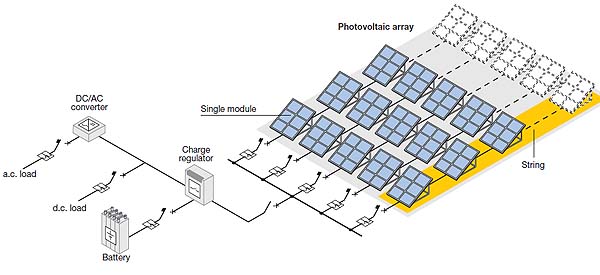
A photovoltaic plant permits to convert the energy associated with solar irradiation into electrical energy of direct type; these plants are constituted by panels of semiconducting material, which can generate electrical power once exposed to the rays of the sun.
Photovoltaic plants can be grid-connected or supply a single load (stand alone plant).
In this last case an accumulator battery shall be present to provide power supply in case of lack of solar radiation.
The basic element of a photovoltaic plant is the photovoltaic cell constituted by semiconducting material (amorphous silicon or monocrystalline silicon); this cell, exposed to the rays of the sun, is able to supply a maximum current Impp at a maximum voltage Vmpp, which a maximum power called Wp corresponds to.
More photovoltaic cells are connected in series to form a string to raise the voltage level; by connecting more strings in parallel, the current level is increased.
For example, if a single cell can provide 5A at 35.5 Vd.c., in order to reach the level of 100A at 500 Vd.c., it is necessary to connect 20 strings in parallel, each of them constituted by 15 cells.
Generally speaking, a stand alone photovoltaic plant is constituted by the following devices:
- photovoltaic array: constituted by the photovoltaic cells suitably interconnected and used for the conversion of sunlight energy into electrical energy;
- charge regulator: it is an electronic device able to regulate charging and discharging of accumulators;
- accumulator batteries: they can provide power supply in case of lack of solar radiation;
- DC/AC inverter: it has the function of turning direct current into alternating current by controlling it and stabilizing its frequency and waveform.
The following figure shows the block diagram of a stand alone photovoltaic plant..
[ABB]Фотоэлектрические установки
Фотоэлектрические установки осуществляют прямое преобразование солнечной энергии в электрическую. Такие установки состоят из панелей полупроводникового материала, вырабатывающего электрическую энергию под воздействием солнечного излучения.
Фотоэлектрические установки являться частью общей энергосистемы или снабжать электроэнергией отдельную нагрузку (автономную установку).
В последнем случае в состав системы должна входить аккумуляторная батарея, обеспечивающая бесперебойную подачу электроэнергии в случае недостаточного солнечного излучения.
Основной частью фотоэлектрической установки являются фотоэлементы, изготовленные из полупроводникового материала (аморфного или монокристаллического кремния). При облучении солнечными лучами фотоэлемент генерирует максимальный ток Iмакс. при максимальном напряжении Uмакс, что соответствует максимальной мощности Wмакс..
Для увеличения выходного напряжения несколько фотоэлементов соединяют последовательно в ряд. Для увеличения тока несколько рядов соединяют параллельно.
Так, например, если один фотоэлемент может произвести ток 5 А при напряжении 35,5 В пост. тока, то для получения источника электроэнергии с током 100 А при напряжении 500 В пост. тока требуется соединить параллельно 20 рядов по 15 фотоэлементов в каждом.
Обычно автономная фотоэлектрическая установка состоит из следующих устройств:
- фотоэлектрическая батарея: состоит из соединенных между собой фотоэлементов, преобразующих солнечную энергию в электрическую;
- регулятор заряда: электронное устройство, предназначенное для регулирования заряда и разряда аккумуляторов;
- аккумуляторная батарея: обеспечивает электропитание нагрузки при недостаточном солнечном излучении.
- инвертор: преобразует постоянный ток в переменный ток стабильной частоты и формы.
На следующем рисунке показана функциональная схема автономной фотоэлектрической установки
[Перевод Интент]Русско-английский словарь нормативно-технической терминологии > фотоэлектрическая установка
СтраницыСм. также в других словарях:
Lymphocyte function-associated antigen — (LFA) can refer to: * LFA 1 * LFA 2 * LFA 3 … Wikipedia
lymphocyte function-associated antigen-1 — n LFA 1 … Medical dictionary
Associated Press of Pakistan — (APP) is a government operated national news agency of Pakistan. It is not associated with the Associated Press agency (AP).HistoryThe authentic history of the Associated Press of Pakistan as told by the Founder of the Associated Press of… … Wikipedia
function — n 1 Function, office, duty, province are comparable when they mean the act, acts, activities, or operations expected of a person or thing by virtue of his or its nature, structure, status, or position. Function is the most comprehensive of these… … New Dictionary of Synonyms
function — [fuŋk′shən] n. [OFr < L functio < pp. of fungi, to perform < IE base * bheug , to enjoy > Sans bhuṅktē, (he) enjoys] 1. the normal or characteristic action of anything; esp., any of the natural, specialized actions of a system, organ … English World dictionary
function — I noun appropriate activity, assignment, business, chore, design, duty, employment, exploitation, mission, munus, occupation, office, officium, performance, purpose, pursuit, responsibility, role, task, usage, use, utility, work associated… … Law dictionary
function — function, functionalism Although the use of the concepts of function and functionalism is usually associated with the work of Talcott Parsons in modern sociology, there is a long tradition of functional explanation in studying societies, and a… … Dictionary of sociology
Function overloading — or method overloading is a feature found in various programming languages such as Ada, C#, VB.NET, C++, D and Java that allows the creation of several methods with the same name which differ from each other in terms of the type of the input and… … Wikipedia
function — A specific set of skills and resources that can be used to perform one or more activities that make up a postal process. Usually, several functions are associated with a single process … Glossary of postal terms
Function (mathematics) — f(x) redirects here. For the band, see f(x) (band). Graph of example function, In mathematics, a function associates one quantity, the a … Wikipedia
Associated Legendre function — Note: This article describes a very general class of functions. An important subclass of these functions mdash;those with integer ell and m mdash;are commonly called associated Legendre polynomials , even though they are not polynomials when m is … Wikipedia
Перевод: со всех языков на английский
с английского на все языки- С английского на:
- Все языки
- Со всех языков на:
- Все языки
- Английский
- Арабский
- Индонезийский
- Немецкий
- Русский
- Тамильский
- Французский
function-associated

18+
© Академик, 2000-2026
- Обратная связь: Техподдержка, Реклама на сайте
Экспорт словарей на сайты, сделанные на PHP, Joomla, Drupal, WordPress, MODx.