

-
41 определение данных
1. data specificationспецификация данных; определение данных — data specification
совокупность данных; данные объединенные в пул — pooled data
2. data definitionродовой тип данных; данные родового типа — generic data type
Русско-английский большой базовый словарь > определение данных
-
42 оценочные данные
1. evaluation dataспецификация данных; определение данных — data specification
совокупность данных; данные объединенные в пул — pooled data
2. rating dataродовой тип данных; данные родового типа — generic data type
Русско-английский большой базовый словарь > оценочные данные
-
43 передача данных
1. data transmissionспецификация данных; определение данных — data specification
совокупность данных; данные объединенные в пул — pooled data
2. data communicationродовой тип данных; данные родового типа — generic data type
3. data transferобласть определения данных; предметная область — data domain
данные о схеме; данные в схематическом виде — schematic data
4. comms5. data base communications -
44 приемник системы преобразования данных
спецификация данных; определение данных — data specification
совокупность данных; данные объединенные в пул — pooled data
Русско-английский большой базовый словарь > приемник системы преобразования данных
-
45 рабочие данные
1. operatinal dataспецификация данных; определение данных — data specification
совокупность данных; данные объединенные в пул — pooled data
2. operational dataродовой тип данных; данные родового типа — generic data type
-
46 сохранность данных
1. data integrityспецификация данных; определение данных — data specification
совокупность данных; данные объединенные в пул — pooled data
2. data retentionродовой тип данных; данные родового типа — generic data type
3. data securityРусско-английский большой базовый словарь > сохранность данных
-
47 винт (воздушный)
propeller
лопастный агрегат, приводимый во вращение двигателем для преобразования мощности (крутящего момента) двигателя в тягу (рис. 58) — function of propeller is conversion of engine shaft torque into thrust.
-, автоматический (ав) — automatically controllable propeller
-, авторотирующий — windmilling propeller
-, воздушный — propeller
-, гидравлический — hydraulically-controlled propeller
воздушный винт изменяемого шага, у которого перестановка лопастей в обоих направлениях (на больший шаг и на меньший) или только в одном направлении производится под действием масла, подаваемого в механизм винта. — a propeller the blades of which are adjusted hydraulically to a low and a high pitch angle.
-, гидромеханический — hydro-mechanical propeller
- двухсторонней схемы — propeller with double-acting system
-, зафлюгированный — feathered propeller
- изменяемого шага (виш, управляемый автоматически и принудительно) — variable-pitch propeller
воздушный винт, лопасти которого во время работы могут принудительно или автоматически поворачиваться вокруг своих осей (изменять шаг) — a propeller the pitch setting of which can be changed by the flight crew or by automatic means while the propeller is rotating.
- изменяемого шага с наземной регулировкой — ground adjustable-pitch propeller
- изменяемого шага (с принудительным управлением) — manually controllable propeller
-, моноблочный — integral propeller
-, находящийся на упоре полетного малого шага — propeller blades set in flightfine-pitch stop position
- неизменяемого шага — fixed-pitch propeller
воздушный винт, попасти которого не могут поворачиваться вокруг своих осей. — a propeller having no provision for changing the pitch setting.
-, неотбалансированный — out-of-balance propeller
-, неуравновешенный — out-of-balance propeller
- переменного шага — controllable /variable/ pitch propeller
-, разбалансированный — out-of-balance propeller
-, реверсивный — reversible-pitch propeller
воздушный винт, лопасти которого во время работы могут быть установлены в такое положение, при котором его вращение создает отрицательную сипу тяги. — reversible-pitch propellers. 200 complete cycles of control must be made from the lowest normal pitch to the maximum reverse pitch.
- с наземной регулировкой шага — ground adjustable-pitch propeller
- с неодинаковым уводом лопастей от плоскости вращения — out-of-track propeller a propeller having the blade tilt ot one blade different from that of the other(s).
- с неодинаковым шагом лопастей — out-of-pitch propeller a propeller having the blade angle of one blade different from that of any other.
- с упором земного малого шага — ground-fine-pitch propeller
- с упором полетного малого шага — flight-low/-fine/-pitch propeller
-, типичный (для испытаний) — representative propeller
-, толкающий — pusher propeller a propeller producing compression in the propeller shaft.
-, тянущий — tractor propeller a propeller producing tension in the propeller shaft.
- фиксированного шага — adjustable-pitch propeller
воздушный винт, попасти которого могут быть установлены под любым углом к плоскости вращения, но во время работы винта поворачиваться вокруг своих осей не могут. — a propeller, the blades of which can be adjusted to a desired pitch when not rotating.
-, флюгерный (флюгируемый) — feathering propeller
воздушный винт изменяемого шага, попасти которого могут быть установлены в положение "по потоку", характеризуемое тем, что в случае выключенного двигателя винт в полете прекращает вращаться и имеет минимальное лобовое сопротивление. — the propeller the blades of which can be set nearly parallel with the line of flight of the airplane for the purpose to decrease air resistance in case of engine failure, so that the propeller will not be rotated by the air.
-, четырехлопастный — four-blade(d) propeller
-, электромеханический — electrically-operated propeller
балансировка в. — propeller balancing
зазор между в. и элементами конструкции самолета — propeller structural clearance
клиренс в. — propeller clearance
обдувка от в. — slipstream
обороты (воздушного) в. — propeller speed
плоскость вращения в. — propeller disc plane
площадь диска в. — propeller disc area
площадь ометаемая воздушным в. — propeller disc area
поступь в. — propeller effective pitch
спед за в. — propeller wake
характеристика воздушного винта в. — propeller characteristic
шаг в. — propeller pitch
балансировать в. — balance the propeller
вводить винт во флюгер вращать в. по (через) 30о — feather the propeller turn the.propeller in increments of approx. 30 deg.
выводить в. из реверса — unreverse the propeller
выводить в. из флюгера — unfeather the propeller
застопорить в. — brake the propeller
затяжелять в. — set the propeller blades to higher pitch
зафлюгировать в. — feather the propeller
изменять шаг в. — change the propeller pitch
облегчать в. — move the propeller blades to lower pitch
отбалансировать в. — balance the propeller
поворачивать в. постепенно через...град. — turn the propeller in increments of... deg.
расфлюгировать в. — unfeather the propeller
реверсировать в. — reverse the propeller
снимать в. с упора полетного малого шага — unlatch the propeller flight low-pitch stop
ставить в. на упор малого полетного шага — latch the propeller flight lowpitch stop
флюгировать в. — feather the propellerРусско-английский сборник авиационно-технических терминов > винт (воздушный)
-
48 коэффициент
coefficient (coeff.), factor
безразмерное число, в основном отношение к-п. величин, характеризующих заданные условия. — а number indicating the amount of some change under certain specified сoпditions, often expressed as a ratio.
- безопасности — factor of safety
число, равное отношению расчетной нагрузки к эксплуатационной. расчетная нагрузка - произведение эксплуатационной нагрузки на коэффициент безопасности. — а number indicating the ratio between the ultimate load and limit load (maximum load expected in service). ultimate load is limit load multiplied by factor of safety.
- восстановления давления — pressure recovery factor
- двухконтурности (дтрд) — bypass ratio
- загрузки пассажирами, безубыточный — passenger break-even load factor
- запаса длины впп — field length factor
- запаса длины летной полосы — field length factor
- запаса длины летной полосы в направлении взлета — takeoff field length factor
- запаса длины летной полосы в направлении посадки — landing field length factor
- запаса длины летной полосы при всех работающих двигателей — field length factor for all-engines-operating сase
- запаса длины летной полосы при одном отказавшем двигателе — field length factor for one-engine-inoperative ease
- запаса прочности — reserve factor
отношение фактической прочности конструкции к минимально-потребной в данных условиях. — а ratio of the actual strength of the structure to the minimum required to specific condition.
- заполнения (в вычислительном уст-ве) — duty factor in computer, the ratio of active time to total time.
- заполнения (воздушного) винта — propeller solidity ratio
отношение суммарной площади всех лопастей винта к сметаемой ими площади. — the ratio of the total projected blade area to the area of the projected outline of the propeller disc.
- заполнения несущего винта (вертолета) — rotor solidity ratio solidity of rotor is a ratio of the total blade area to the disc area.
- лобового сопротивления (сх) — drag coefficient (cd)
коэффициент, характеризующий лобовое сопротивление рассматриваемого аэродинамического профиля. — а coefficient representing the drag on а given airfoil.
- маневренной перегрузки — maneuvering load factor
- момента крена — rolling-moment coefficient
- момента рыскания — yawing-moment coefficient
- момента тангажа — pitching-moment coefficient
- мощности — power factor
- мощности (воздушного винта) — activity factor
- мощности лопасти (возд. винта) — blade activity factor
безразмерная функция поверхности лопасти, характеризующая способность лопасти использовать прикладываемую мощность. — а non-dimensional function of the blade surface used to express capacity of a blade for absorbing power.
- несущей поверхности (покрытия аэродрома), калифорнийский — californian bearing ratio (с.в.r.)
-, относительный (воздушного винта) — figure of merit
- перегрузки (n) — load factor (n)
число, показывающее, во сколько раз нагрузки, действующие на самолет (или его отдельные части), превышает нагрузки в равномерном горизонтальном полете или нагрузки от веса при стоянке. — the ratio to the weight of an aircraft of а specified exterпаl load. such load may arise from aerodynamic forces, gravity, ground or water reaction, or from combinations of these forces.
- перегрузки, максимальный эксплуатационный — limit load factor
- перегрузки, (полетный) — flight load factor
отношение составляющей аэродинамической нагрузки (действующей перпендикулярно продольной оси ла) к весу ла. — the ratio of the aerodynamic force component (acting normal to the assumed longitudiпа1 axis of the airplane) to the weight of the airplane.
- перегрузки (полетной), отрицательный — negative load factor
- перегрузки (полетной), положительный — positive load factor
в данном случае аэродинамичеекая сила воздействует на ла снизу вверх. — in positive load factor the aerodynamic force acts upward with respect to the airplane.
- перегрузки при маневре — maneuvering load factor
- перегрузки при маневре, максимальный эксплуатационный — limit maneuvering load factor
- перегрузки, расчетный — ultimate load factor
- передачи (коэффициент передаточного числа в системе управления ла) — gain
- подъемной силы (су) безразмерная величина, определяемая по формуле. — lift coefficient (cl) а coefficient representing the lift of а given airfoil or other body. the lift coefficient is obtained ьу dividing the lift by the free-stream dynamic pressure and by the representative area under consideration.
- полезного действия (кпд) — efficiency (n)
the ratio of the useful output of the quantity to its total input.
- полезного действия, общий — overall efficiency
- полезного действия,тепловой — thermal efficiency
-, поправочный — correction factor
например, для учета влияния погодных (сезонных) условий (температура наружного воздуха, атмосферные осадки, обледенение) на характеристики тормозного участка впп в пределах установленных эксплуатационных ограничений. — the correction factors must account for the particular surface characteristics of the stopway and the variations in these characteristics with seasonal weather conditions (such as temperature, rain, snow, and ice) within the established operational limits.
- предельной перегрузки — ultimate load factor
- преобразования (в преобразователе) — conversion efficiency ratio of dc output power to ас input power.
- профильного сопротивления — profile drag coefficient
- прочности грунта, калифорнийский — californian bearing ratio (c.b.r.)
(к. несущей способности покрытия аэродрома, впп) — c.b.r. is used to measure subsoil strength of the runways and airfields.
- связи (эл.) — coupling coefficient
- сжимаемости — coefficient of compressibility
относительное уменьшение объема газа при повышении давления в изотермическом процессе. — the relative decrease of the volume of а gaseous system with increasing pressure in an isothermal process.
- совершенства (воздушного винта) — figure of merit
- сопротивления (лобовой, сx) — drag coefficient (cd)
- сопротивления (сx) груза на внешней подвеске (вертолета) — drag coefficient (cd) representing а drag caused by an externally-slung load
- стоячей волны — standing wave ratio (swr)
- схождения карты — chart convergence factor (ccf)
- сцепления (между шиной колеса и поверхностью впп) — coefficient of friction
-, сцепления (между шиной и впп при торможении) — braking coefficient of friction
- трансформации (в трансформаторе) — transformation ratio compensation windings are used to correct for variations in the resolvers transformation ratio.
- трения — coefficient of friction
- трения торможения — braking coefficient of friction
коэффициент трения между шиной и поверхностью взлетно-посадочной полосы при торможении самолета. — braking coefficient of friction between the aircraft wheel tires and runway (surface).
- трения торможения, осредненный приведенный — (mean) corrected braking coefficient of friction
- тяги (воздушного винта) — thrust coefficient (ст)
- усиления (эл.) — amplification factor
the ratio of output magnitude to input magnitude.
- усиления антенны — antenna gain
- усиления (передаточное число в системе управления) — gain
- усиления, самонастраивающийся (системы управления) — adaptive gain
- утечки — leakage factor
- шарнирного момента — hinge moment factor
- шарнирного момента от порыва ветра на земле, предельный — limit hinge moment factor (к) for ground gusts
в отношении элеронов и рулей высоты, коэффициент имеет положительный знак, если момент, воздействующий на поверхность управления, вызывает ее опускание. — for ailerons and elevators, а positive value of к indicates а moment tending to depress the surface, and а negative value of к - to raise the surface.
- шума — noise factor
для данной полосы частот, отношение суммарной величины помех на выходе к величине помехи на входе. — for а given bandwidth, the ratio оf total noise at the output, to the noise at the input.
- эксплуатационной маневренной перегрузки (максимальный), или эксплуатационной перегрузки при маневрировании (отрицательный или попожительный) — (negative, positive) limit maneuvering load factor rotorcraft must be designed for positive limit maneuvering load factor of 3.5 and negafive limit maneuvering load factor of 1.0.Русско-английский сборник авиационно-технических терминов > коэффициент
-
49 преобразование данных
[lang name="Russian"]спецификация данных; определение данных — data specification
[lang name="Russian"]совокупность данных; данные объединенные в пул — pooled data
-
50 регистрация данных
1. data recordingспецификация данных; определение данных — data specification
совокупность данных; данные объединенные в пул — pooled data
2. data loggingродовой тип данных; данные родового типа — generic data type
Русско-английский военно-политический словарь > регистрация данных
-
51 адресно-временной код
присваивать код — assign a code to …
Русско-английский словарь по информационным технологиям > адресно-временной код
-
52 ввод данных
1. data entryспецификация данных; определение данных — data specification
совокупность данных; данные объединенные в пул — pooled data
2. data inputродовой тип данных; данные родового типа — generic data type
Русско-английский словарь по информационным технологиям > ввод данных
-
53 передача данных
1. data transferспецификация данных; определение данных — data specification
совокупность данных; данные объединенные в пул — pooled data
2. data transmissionродовой тип данных; данные родового типа — generic data type
Русско-английский словарь по информационным технологиям > передача данных
-
54 преобразование данных
спецификация данных; определение данных — data specification
совокупность данных; данные объединенные в пул — pooled data
Русско-английский словарь по информационным технологиям > преобразование данных
-
55 зависимость от высоты
Авиация и космонавтика. Русско-английский словарь > зависимость от высоты
-
56 χάρις
χάρις, ιτος, ἡ (Hom.+) acc. quite predom. χάριν, but χάριτα Ac 24:27; 25:9 v.l.; Jd 4 and pl. χάριτας Ac 24:27 v.l.; 1 Cl 23:1 (Eur., Hel. 1378; Hdt. 6, 41; X., Hell. 3, 5, 16; ins, pap; Zech 4:7; 6:14; EpArist 272, pl. 230.—B-D-F §47, 3; W-S. §9, 7; Mayser 271f; Thackeray 150; Helbing 40f; Mlt-H. 132.—It seems that χάρις is not always clearly differentiated in mng. fr. χαρά; Apollodorus [II B.C.]: 244 Fgm. 90 Jac. says in the second book περὶ θεῶν: κληθῆναι δὲ αὐτὰς ἀπὸ μὲν τ. χαρᾶς Χάριτας• καὶ γὰρ πολλάκις … οἱ ποιηταὶ τ. χάριν χαρὰν καλοῦσιν ‘the [deities] Charites are so called from χαρά [joy], for poets freq. equate χάρις with χαρά’. Cp. the wordplay AcPl Ha 8, 7 χαρᾶς καὶ χάριτος the house was filled with gaiety and gratitude.).① a winning quality or attractiveness that invites a favorable reaction, graciousness, attractiveness, charm, winsomeness (Hom.+; Jos., Ant. 2, 231) of human form and appearance παῖς λίαν εὐειδής ἐν χάριτι an exceptionally fine-looking and winsome youth AcPl Ha 3, 13. Of speech (Demosth. 51, 9; Ps.-Demetr. [I A.D.], Eloc. §127; 133; 135 al.; Eccl 10:12; Sir 21:16; Jos., Ant. 18, 208) οἱ λόγοι τῆς χάριτος (gen. of quality) the gracious words Lk 4:22. ὁ λόγος ὑμῶν πάντοτε ἐν χάριτι let your conversation always be winsome Col 4:6 (cp. Plut., Mor. 514f; s. also HAlmqvist, Plut. u. das NT ’46, 121f; Epict. 3, 22, 90). τὸ πρόσωπον αὐτοῦ χάριτος ἐπληροῦτο MPol 12:1 can also be placed here in case χάρις means nothing more than graciousness (s. 4 below); prob. also GJs 7:3 (s. 3b).② a beneficent disposition toward someone, favor, grace, gracious care/help, goodwill (almost a t.t. in the reciprocity-oriented world dominated by Hellenic influence [cp. e.g. OGI 669, 29] as well as by the Semitic sense of social obligation expressed in the term חֶסֶד [NGlueck, Das Wort ḥesed in alttestamentlichen Sprachgebrauche etc. 1927]. Of a different order and spirit is the subset of reciprocity known as Roman patronage, in which superiority of the donor over the client is clearly maintained)ⓐ act., that which one grants to another, the action of one who volunteers to do someth. not otherwise obligatory χάρις θεοῦ ἦν ἐπʼ αὐτό Lk 2:40. ἡ χάρις τοῦ θεοῦ (cp. τῇ τοῦ θεοῦ Κλαυδίου χάριτι OGI 669, 29) Ac 11:2 D; 14:26. τοῦ κυρίου 15:40.—Esp. of the beneficent intention of God (cp. χ. in reference to God: Apollon. Rhod. 3, 1005 σοὶ θεόθεν χάρις ἔσσεται; Dio Chrys. 80 [30], 40 χ. τῶν θεῶν; Ael. Aristid. 13 p. 320 D.; 53 p. 620; Sextus 436b; likew. in LXX, Philo, Joseph.; SibOr 4, 46=189; 5, 330; Ezk. Trag. 162 [Eus., PE 9, 29, 12].—χ. to denote beneficent dispensations of the emperor: OGI 669, 44 [I A.D.]; BGU 19 I, 21 [II A.D.] χάρ. τοῦ θεοῦ Αὐτοκράτορος; 1085 II, 4) and of Christ, who give (undeserved) gifts to people; God: δικαιούμενοι δωρεὰν τῇ αὐτοῦ χάριτι Ro 3:24. Cp. 5:15a, 20f; 6:1; 11:5 (ἐκλογή 1), 6abc; Gal 1:15 (διά A 3e); Eph 1:6f (KKuhn, NTS 7, ’61, 337 [reff. to Qumran lit.]); 2:5, 7, 8; cp. Pol 1:3; 2 Th 1:12; 2:16; 2 Ti 1:9; Tit 2:11 (ἡ χάρ. τοῦ θεοῦ σωτήριος; s. Dibelius, Hdb. exc. after Tit 2:14); 3:7; Hb 2:9 (χωρίς 2aα); 4:16a (DdeSilva, JBL 115, ’96, 100–103); 1 Cl 50:3; ISm 9:2; IPol 7:3. ἐν χάρ[ιτι θεοῦ] AcPl Ha 7, 23 (restoration uncertain). κατὰ χάριν as a favor, out of goodwill (cp. Pla., Leg. 740c; schol. on Soph., Oed. Col. 1751 p. 468 Papag.) Ro 4:4 (opp. κατὰ ὀφείλημα), 16.—The beneficence or favor of Christ: διὰ τῆς χάριτος τοῦ κυρίου Ἰησοῦ πιστεύομεν σωθῆναι Ac 15:11. Cp. Ro 5:15b; 2 Cor 8:9; 1 Ti 1:14; IPhld 8:1. On Ac 2:47 in this sense s. TAnderson, NTS 34, ’88, 604–10.ⓑ pass., that which one experiences fr. another (Arrian, Anab. Alex. 3, 26, 4) χάριν ἔχειν have favor 3J 4 v.l. πρός τινα with someone=win his respect Ac 2:47 (cp. 2a end; cp. Pind., O. 7, 89f χάριν καὶ ποτʼ ἀστῶν καὶ ποτὶ ξείνων grant him respect in the presence of his townfolk as well as strangers); παρά τινι (Appian, Bell. Civ. 2, 89 §376) Hm 10, 3, 1, cp. 5, 1, 5. εὑρεῖν χάριν παρά τινι (Philo, Leg. All. 3, 77, end) Lk 1:30; Hs 5, 2, 10; ἐνώπιόν τινος Ac 7:46; GJs 11:2 (JosAs 15:14). ἐν τοῖς μέλλουσι μετανοεῖν among those who are about to repent Hm 12, 3, 3. Ἰησοῦς προέκοπτεν χάριτι παρὰ θεῷ καὶ ἀνθρώποις Lk 2:52 (an indication of exceptional ἀρετή, cp. Pind. above). Cp. Ac 4:33; 7:10 (ἐναντίον Φαραώ); Hb 4:16b.—ποία ὑμῖν χάρις ἐστίν; what credit is that to you? Lk 6:32–34; s. D 1:3; 2 Cl 13:4. Cp. 1 Cor 9:16 v.l. In these passages the mng. comes close to reward (s. Wetter [5 below] 209ff w. reff.).—Also by metonymy that which brings someone (God’s) favor or wins a favorable response fr. God 1 Pt 2:19, 20.ⓒ In Christian epistolary lit. fr. the time of Paul χάρις is found w. the sense (divine) favor in fixed formulas at the beginning and end of letters (Zahn on Gal 1:3; vDobschütz on 1 Th 1:1; ELohmeyer, ZNW 26, 1927, 158ff; APujol, De Salutat. Apost. ‘Gratia vobis et pax’: Verb. Dom. 12, ’32, 38–40; 76–82; WFoerster, TW II ’34, 409ff; Goodsp., Probs. 141f. S. also the lit. s.v. χαίρω 2b). At the beginning of a letter χάρις ὑμῖν καὶ εἰρήνη (sc. εἴη; New Docs 8, 127f) Ro 1:7; 1 Cor 1:3; 2 Cor 1:2; Gal 1:3; Eph 1:2; Phil 1:2; Col 1:2; 1 Th 1:1; 2 Th 1:2; Phlm 3; Rv 1:4; without ὑμῖν Tit 1:4. χάρις ὑμῖν καὶ εἰρήνη πληθυνθείη 1 Pt 1:2; 2 Pt 1:2; 1 Cl ins. χάρις, ἔλεος, εἰρήνη 1 Ti 1:2; 2 Ti 1:2; 2J 3 (on the triplet cp. En 5:7 φῶς καὶ χάρις καὶ εἰρήνη).—At the end ἡ χάρις (τοῦ κυρίου ἡμῶν Ἰησοῦ Χριστοῦ etc.) μεθʼ ὑμῶν (or μετὰ πάντων ὑμῶν etc.) Ro 16:20, 23 (24) v.l.; 1 Cor 16:23; 2 Cor 13:13; Gal 6:18; Eph 6:24; Phil 4:23; Col 4:18; 1 Th 5:28; 2 Th 3:18; 1 Ti 6:21; 2 Ti 4:22; Tit 3:15; Phlm 25; Hb 13:25; Rv 22:21; 1 Cl 65:2. ἔσται ἡ χάρις μετὰ πάντων τῶν φοβουμένων τὸν Κύριον GJs 25:2. ὁ κύριος τῆς δόξης καὶ πάσης χάριτος μετὰ τοῦ πνεύματος ὑμῶν B 21:9. χάρις ὑμῖν, ἔλεος, εἰρήνη, ὑπομονὴ διὰ παντός ISm 12:2. ἔρρωσθε ἐν χάριτι θεοῦ 13:2.③ practical application of goodwill, (a sign of) favor, gracious deed/gift, benefactionⓐ on the part of humans (X., Symp. 8, 36, Ages. 4, 3; Appian, Bell. Civ. 1, 49 §213; Dionys. Hal. 2, 15, 4) χάριν (-ιτα) καταθέσθαι τινί (κατατίθημι 2) Ac 24:27; 25:9. αἰτεῖσθαι χάριν 25:3 (in these passages from Ac χ. suggests [political] favor, someth. one does for another within a reciprocity system. Cp. Appian, Bell. Civ. 1, 108 §506 ἐς χάριν Σύλλα=as a favor to Sulla; ApcSed 8:1 οὐκ ἐποίησάς μοι χάριν=you did me no favor). ἵνα δευτέραν χάριν σχῆτε that you might have a second proof of my goodwill 2 Cor 1:15 (unless χάρις here means delight [so in poetry, Pind. et al., but also Pla., Isocr.; L-S-J-M s.v. χάρις IV; cp. also the quot. fr. Apollodorus at the beg. of the present entry, and the fact that χαρά is v.l. in 2 Cor 1:15]; in that case δευτέρα means double; but s. comm.). Of the collection for Jerusalem (cp. Appian, Bell. Civ. 3, 42 §173 χάριτας λαμβάνειν=receive gifts) 1 Cor 16:3; 2 Cor 8:4, 6f, 19 (DdeSilva, JBL 115, ’96, 101). Cp. B 21:7.—Eph 4:29 may suggest a demonstration of human favor (cp. Plut., Mor. 514e χάριν παρασκευάζοντες ἀλλήλοις), but a ref. to the means by which divine grace is mediated is not to be ruled out (s. b below).ⓑ on the part of God and Christ; the context will show whether the emphasis is upon the possession of divine favor as a source of blessings for the believer, or upon a store of favor that is dispensed, or a favored status (i.e. standing in God’s favor) that is brought about, or a gracious deed wrought by God in Christ, or a gracious work that grows fr. more to more (so in contrast to the old covenant Mel., P. 3, 16 al.). God is called ὁ θεὸς πάσης χάριτος 1 Pt 5:10, i.e. God, who is noted for any conceivable benefit or favor; cp. B 21:9.—χάριν διδόναι τινί show favor to someone (Anacr. 110 Diehl; Appian, Ital. 5 §10): τὸν δόντα αὐτῷ τὴν χάριν GJs 14:2. ταπεινοῖς δίδωσι χάριν (Pr 3:34) Js 4:6b; 1 Pt 5:5; 1 Cl 30:2; without a dat. Js 4:6a (Menand., Epitr. 231 S. [55 Kö.]). Perh. καὶ ἔβαλλε κύριος … χάριν ἐπʼ αὐτήν GJs 7:3 (but s. 1 above). The Logos is πλήρης χάριτος J 1:14. Those who belong to him receive of the fullness of his grace, χάριν ἀντὶ χάριτος vs. 16 (ἀντί 2). Cp. vs. 17. τὴν χάριν ταύτην ἐν ᾗ ἑστήκαμεν this favor (of God) we now enjoy Ro 5:2 (Goodsp.).—5:17; 1 Cor 1:4; 2 Cor 4:15 (divine beneficence in conversion); cp. Ac 11:23; 6:1; Gal 1:6 (by Christ’s gracious deed); 2:21; 5:4; Col 1:6; 2 Ti 2:1; Hb 12:15; 13:9; 1 Pt 1:10, 13; 3:7 (συνκληρονόμοι χάριτος ζωῆς fellow-heirs of the gift that spells life; s. ζωή 2bα); 5:12; 2 Pt 3:18; Jd 4; IPhld 11:1; ISm 6:2. Christians stand ὑπὸ χάριν under God’s gracious will as expressed in their release from legal constraint Ro 6:14f, or they come ὑπὸ τὸν ζυγὸν τῆς χάριτος αὐτοῦ 1 Cl 16:17 (ζυγός 1). The proclamation of salvation is the message of divine beneficence τὸ εὐαγγέλιον τῆς χάριτος τοῦ θεοῦ Ac 20:24 or ὁ λόγος τῆς χάριτος αὐτοῦ (=τοῦ κυρίου) 14:3; 20:32. Even the gospel message can be called ἡ χάρις τοῦ θεοῦ 13:43; cp. 18:27; MPol 2:3. τὸ πνεῦμα τῆς χάριτος the Spirit from or through whom (God’s) favor is shown Hb 10:29 (AArgyle, Grace and the Covenant: ET 60, ’48/49, 26f).—Pl. benefits, favors (Diod S 3, 2, 4; 3, 73, 6; Sb 8139, 4 [ins of I B.C.] of Isis; Jos., C. Ap. 2, 190) 1 Cl 23:1.—Nelson Glueck, Das Wort ḥesed etc. 1927, but s. FAndersen, ‘Yahweh, the Kind and Sensitive God’: God Who is Rich in Mercy, ed. PO’Brien/DPeterson ’86.④ exceptional effect produced by generosity, favor. Of effects produced by divine beneficence which go beyond those associated with a specific Christian’s status (ins μεγάλαι χάριτες τοῦ θεου: FCumont, Syria 7, 1926, 347ff), in the congregations of Macedonia 2 Cor 8:1 and Corinth 9:14; cp. vs. 8; in Rome AcPl Ha 7, 8. The Christian confessor is in full possession of divine grace ISm 11:1. Paul knows that through the χάρις of God he has been called to be an apostle, and that he has been fitted out w. the powers and capabilities requisite for this office fr. the same source: Ro 1:5; 12:3; 15:15; 1 Cor 3:10; 15:10ab (for the subject matter cp. Polyb. 12, 12b, 3 αὐτὸν [Alex. the Great] ὑπὸ τοῦ δαιμονίου τετευχέναι τούτων ὧν ἔτυχεν=whatever he has received he has received from what is divine. [For this reason he does not deserve any divine honors.]); 2 Cor 12:9; Gal 2:9; Eph 3:2, 7f; Phil 1:7.—The χάρις of God manifests itself in various χαρίσματα: Ro 12:6; Eph 4:7; 1 Pt 4:10. This brings into view a number of passages in which χάρις is evidently to be understood in a very concrete sense. It is hardly to be differentiated fr. δύναμις (θεοῦ) or fr. γνῶσις or δόξα (q.v. 1b. On this subj. s. Wetter [5 below] p. 94ff; esp. 130ff; pap in the GLumbroso Festschr. 1925, 212ff: χάρις, δύναμις, πνεῦμα w. essentially the same mng.; PGM 4, 2438; 3165; Herm. Wr. 1, 32; Just., D. 87, 5 ἀπὸ χάριτος τῆς δυνάμεως τοῦ πνεύματος). οὐκ ἐν σοφίᾳ σαρκικῇ ἀλλʼ ἐν χάριτι θεοῦ 2 Cor 1:12. οὐκ ἐγὼ δὲ ἀλλὰ ἡ χάρις τοῦ θεοῦ σὺν ἐμοί 1 Cor 15:10c. αὐξάνετε ἐν χάριτι καὶ γνώσει τοῦ κυρίου 2 Pt 3:18; cp. 1 Cl 55:3; B 1:2 (τῆς δωρεᾶς πνευματικῆς χάρις). Stephen is said to be πλήρης χάριτος καὶ δυνάμεως Ac 6:8. Divine power fills the Christian confessor or martyr w. a radiant glow MPol 12:1 (but s. 1 above). As the typical quality of the age to come, contrasted w. the κόσμος D 10:6.⑤ response to generosity or beneficence, thanks, gratitude (a fundamental component in the Gr-Rom. reciprocity system; exx. fr. later times: Diod S 11, 71, 4 [χάριτες=proofs of gratitude]; Appian, Syr. 3, 12; 13. Cp. Wetter [below] p. 206f) χάριν ἔχειν τινί be grateful to someone (Eur., Hec. 767; X., An. 2, 5, 14; Pla., Phlb. 54d; Ath. 2, 1; PLips 104, 14 [I B.C.] χάριν σοι ἔχω) foll. by ὅτι (Epict. 3, 5, 10; Jos., C. Ap. 1, 270; 2, 49) Lk 17:9 (ERiggenbach, NKZ 34, 1923, 439–43); mostly of gratitude to God or Christ; χάρις in our lit. as a whole, in the sense gratitude, refers to appropriate respone to the Deity for benefits conferred (Hom., Pind., Thu. et al.; ins, pap, LXX; Jos., Ant. 7, 208) χάριν ἔχω τῷ θεῷ (POxy 113, 13 [II A.D.] χάριν ἔχω θεοῖς πᾶσιν.—Epict. 4, 7, 9) 2 Ti 1:3; foll. by ὅτι because 1 Ti 1:12 (Herm. Wr. 6, 4 κἀγὼ χάριν ἔχω τῷ θεῷ …, ὅτι; Jos., Ant. 4, 316); χάριν ἔχειν ἐπί τινι be grateful for someth. Phlm 7 v.l. (to humans). ἔχωμεν χάριν let us be thankful (to God) Hb 12:28 (the reason for it is given by the preceding ptc. παραλαμβάνοντες). Elliptically (B-D-F §128, 6; cp. Rob. 1201f) χάρις (ἔστω) τῷ θεῷ (X., Oec. 8, 16 πολλὴ χάρις τοῖς θεοῖς; Epict. 4, 4, 7 χάρις τῷ θεῳ; BGU 843, 6 [I/II A.D.] χάρις τοῖς θεοῖς al. in pap since III B.C..—Philo, Rer. Div. Her. 309) Ro 7:25; MPol 3:1. Foll. by ὅτι (X., An. 3, 3, 14 τοῖς θεοῖς χάρις ὅτι; PFay 124, 16 τοῖς θεοῖς ἐστιν χάρις ὅτι; Epict. 4, 5, 9) Ro 6:17. Foll. by ἐπί τινι for someth. (UPZ 108, 30 [99 B.C.]) 2 Cor 9:15. The reason for the thanks is given in the ptc. agreeing w. τῷ θεῷ 2:14; 8:16; 1 Cor 15:57 (cp. Jos., Ant. 6, 145; Philo, Somn. 2, 213). Thankfulness (Appian, Bell. Civ. 3, 15 §51 πρός τινα=toward someone) χάριτι in thankfulness 10:30. So prob. also ἐν τῇ χάριτι in a thankful spirit Col 3:16 (Dibelius, Hdb. ad loc.). πλησθῆναι χαρᾶς καὶ χάριτος AcPl Ha 8, 7. S. εὐχαριστέω, end. Also PSchubert, Form and Function of the Pauline Thanksgivings ’39.—OLoew, Χάρις, diss., Marburg 1908; GWetter, Charis 1913; AvHarnack, Sanftmut, Huld u. Demut in der alten Kirche: JKaftan Festschr. 1920, 113ff; NBonwetsch, Zur Geschichte des Begriffs Gnade in der alten Kirche: Harnack Festgabe 1921, 93–101; EBurton, Gal ICC 1921, 423f; WWhitley, The Doctrine of Grace ’32; JMoffatt, Grace in the NT ’31; RWinkler, D. Gnade im NT: ZST 10, ’33, 642–80; RHomann, D. Gnade in d. Syn. Ev.: ibid. 328–48; JWobbe, D. Charisgedanke b. Pls ’32; RBultmann, Theologie des NT ’48, 283–310 (Paul); HBoers, Ἀγάπη and Χάρις in Paul’s Thought: CBQ 59, ’97, 693–713; on 2 Cor 8: FDanker, Augsburg Comm. 2 Cor, 116–34; PRousselot, La Grâce d’après St. Jean et d’après St. Paul: SR 18, 1928, 87–108, Christent. u. Wissensch. 8, ’32, 402–30; JMontgomery, Hebrew Hesed and Gk. Charis: HTR 32, ’39, 97–102; Dodd 61f; TTorrance, The Doctrine of Grace in the Apost. Fathers, ’48; JRenié, Studia Anselmiana 27f, ’51, 340–50; CRSmith, The Bible Doctrine of Grace, ’56; EFlack, The Concept of Grace in Bibl. Thought: Bibl. Studies in Memory of HAlleman, ed. Myers, ’60, 137–54; DDoughty, NTS 19, ’73, 163–80.—B. 1166. DELG. M-M. EDNT. TW. Spicq. Sv. -
57 ὡς
ὡς (Hom.+; loanw. in rabb.) relative adv. of the relative pron. ὅς. It is used as① a comparative particle, marking the manner in which someth. proceeds, as, likeⓐ corresponding to οὕτως=‘so, in such a way’: σωθήσεται, οὕτως ὡς διὰ πυρός he will be saved, (but only) in such a way as (one, in an attempt to save oneself, must go) through fire (and therefore suffer fr. burns) 1 Cor 3:15. τὴν ἑαυτοῦ γυναῖκα οὕτως ἀγαπάτω ὡς ἑαυτόν Eph 5:33; cp. vs. 28. ἡμέρα κυρίου ὡς κλέπτης οὕτως ἔρχεται 1 Th 5:2. The word οὕτως can also be omitted ἀσφαλίσασθε ὡς οἴδατε make it as secure as you know how = as you can Mt 27:65. ὡς οὐκ οἶδεν αὐτός (in such a way) as he himself does not know = he himself does not know how, without his knowing (just) how Mk 4:27. ὡς ἀνῆκεν (in such a way) as is fitting Col 3:18. Cp. 4:4; Eph 6:20; Tit 1:5 (cp. Just., A I, 3, 1 ὡς πρέπον ἐστίν). ὡς πᾶσα γυνὴ γεννᾷ GJs 11:2; ὡς ἀπεκαλύφθη AcPlCor 1:8.ⓑ special usesα. in ellipses (TestAbr A 12 p. 90, 22 [Stone p. 28] θρόνος … ἐξαστράπτων ὡς πῦρ; TestJob 20:3 χρήσασθαι … ὡς ἐβούλετο; JosAs 12:7 πρὸς σὲ κατέφυγον ὡς παιδίον ἐπὶ τὸν πατέρα) ἐλάλουν ὡς νήπιος I used to speak as a child (is accustomed to speak) 1 Cor 13:11a; cp. bc; Mk 10:15; Eph 6:6a; Phil 2:22; Col 3:22. ὡς τέκνα φωτὸς περιπατεῖτε walk as (is appropriate for) children of light Eph 5:8; cp. 6:6b. ὡς ἐν ἡμέρᾳ as (it is one’s duty to walk) in the daylight Ro 13:13. The Israelites went through the Red Sea ὡς διὰ ξηρᾶς γῆς as (one travels) over dry land Hb 11:29. οὐ λέγει ὡς ἐπὶ πολλῶν ἀλλʼ ὡς ἐφʼ ἑνός he speaks not as one would of a plurality (s. ἐπί 8), but as of a single thing Gal 3:16.—Ro 15:15; 1 Pt 5:3. Also referring back to οὕτως (GrBar 6:16 ὡς γὰρ τὰ δίστομα οὕτως καὶ ὁ ἀλέκτωρ μηνύει τοῖς ἐν τῷ κόσμῳ like articulate beings the rooster informs earth’s inhabitants) οὕτως τρέχω ὡς οὐκ ἀδήλως I run as (a person) with a fixed goal 1 Cor 9:26a. Cp. ibid. b; Js 2:12.β. ὡς and the words that go w. it can be the subj. or obj., of a clause: γενηθήτω σοι ὡς θέλεις let it be done (= it will be done) for you as you wish Mt 15:28. Cp. 8:13; Lk 14:22 v.l. (for ὅ; cp. ὡς τὸ θέλημά σου OdeSol 11:21). The predicate belonging to such a subj. is to be supplied in οὐχ ὡς ἐγὼ θέλω (γενηθήτω) Mt 26:39a.—ἐποίησεν ὡς προσέταξεν αὐτῷ ὁ ἄγγελος he did as (= that which) the angel commanded him (to do) Mt 1:24; cp. 26:19 (on the structure s. RPesch, BZ 10, ’66, 220–45; 11, ’67, 79–95; cp. the formula Job 42:9 and the contrasting negation Ex 1:17; s. also Ex 3:21f); 28:15.—Practically equivalent to ὅ, which is a v.l. for it Mk 14:72 (JBirdsall, NovT 2, ’58, 272–75; cp. Lk 14:22 above).γ. ἕκαστος ὡς each one as or according to what Ro 12:3; 1 Cor 3:5; 7:17ab; Rv 22:12. ὡς ἦν δυνατὸς ἕκαστος each person interpreted them as best each could Papias (2:16).δ. in indirect questions (X., Cyr. 1, 5, 11 ἀπαίδευτοι ὡς χρὴ συμμάχοις χρῆσθαι) ἐξηγοῦντο ὡς ἐγνώσθη αὐτοῖς ἐν τῇ κλάσει τοῦ ἄρτου they told how he had made himself known to them when they broke bread together Lk 24:35. Cp. Mk 12:26 v.l. (for πῶς); Lk 8:47; 23:55; Ac 10:38; 20:20; Ro 11:2; 2 Cor 7:15.② a conjunction marking a point of comparison, as. This ‘as’ can have a ‘so’ expressly corresponding to it or not, as the case may be; further, both sides of the comparison can be expressed in complete clauses, or one or even both may be abbreviated.ⓐ ὡς is correlative w. οὕτως=so. οὕτως … ὡς (so, in such a way) … as: οὐδέποτε ἐλάλησεν οὕτως ἄνθρωπος ὡς οὗτος λαλεῖ ὁ ἄνθρωπος J 7:46. ὡς … οὕτως Ac 8:32 (Is 53:7); 23:11; Ro 5:15 (ὡς τὸ παράπτωμα, οὕτως καὶ τὸ χάρισμα, both halves to be completed), 18. ὡς κοινωνοί ἐστε τῶν παθημάτων, οὕτως καὶ τῆς παρακλήσεως as you are comrades in suffering, so (shall you be) in comfort as well 2 Cor 1:7. Cp. 7:14; 11:3 v.l.—ὡς … καί as … so (Plut., Mor. 39e; Ath. 15, 2) Mt 6:10; Ac 7:51; 2 Cor 13:2; Gal 1:9; Phil 1:20.ⓑ The clause beginning w. ὡς can easily be understood and supplied in many cases; when this occurs, the noun upon which the comparison depends can often stand alone, and in these cases ὡς acts as a particle denoting comparison. οἱ δίκαιοι ἐκλάμψουσιν ὡς ὁ ἥλιος the righteous will shine out as the sun (shines) Mt 13:43. ὡς ἐπὶ λῃστὴν ἐξήλθατε συλλαβεῖν με as (one goes out) against a robber, (so) you have gone out to arrest me 26:55 (Mel., P. 79, 574 ὡς ἐπὶ φόνιον λῄστην). γίνεσθε φρόνιμοι ὡς οἱ ὄφεις be (as) wise as serpents (are) 10:16b. Cp. Lk 12:27; 21:35; 22:31; J 15:6; 2 Ti 2:17; 1 Pt 5:8.ⓒ Semitic infl. is felt in the manner in which ὡς, combined w. a subst., takes the place of a subst. or an adj.α. a substantiveא. as subj. (cp. Da 7:13 ὡς υἱὸς ἀνθρώπου ἤρχετο; cp. 10:16, 18) ἐνώπιον τοῦ θρόνου (ἦν) ὡς θάλασσα ὑαλίνη before the throne there was something like a sea of glass Rv 4:6. Cp. 8:8; 9:7a. ἀφʼ ἑνὸς ἐγενήθησαν ὡς ἡ ἄμμος from one man they have come into being as the sand, i.e. countless descendants Hb 11:12.ב. as obj. (JosAs 17:6 εἶδεν Ἀσενὲθ ὡς ἅρμα πυρός) ᾂδουσιν ὡς ᾠδὴν καινήν they were singing, as it were, a new song Rv 14:3. ἤκουσα ὡς φωνήν I heard what sounded like a shout 19:1, 6abc; cp. 6:1.β. as adjective, pred. (mostly εἶναι, γίνεσθαι ὡς; the latter also in rendering of ךְּ to express the basic reality of something: GDelling, Jüd. Lehre u. Frömmigkeit ’67, p. 58, on ParJer 9:7) ἐὰν μὴ γένησθε ὡς τὰ παιδία if you do not become child-like Mt 18:3. ὡς ἄγγελοί εἰσιν they are similar to angels 22:30. πᾶσα σὰρξ ὡς χόρτος 1 Pt 1:24. Cp. Mk 6:34; 12:25; Lk 22:26ab; Ro 9:27 (Is 10:22); 29a (Is 1:9a); 1 Cor 4:13; 7:7f, 29–31; 9:20f; 2 Pt 3:8ab (Ps 89:4); Rv 6:12ab al. (cp. GrBar 14:1 ἐγένετο φωνὴ ὡς βροντή). Sim. also ποίησόν με ὡς ἕνα τῶν μισθίων σου treat me like one of your day laborers Lk 15:19.—The adj. or adjectival expr. for which this form stands may be used as an attribute πίστιν ὡς κόκκον σινάπεως faith like a mustard seed=faith no greater than a tiny mustard seed Mt 17:20; Lk 17:6. προφήτης ὡς εἷς τῶν προφητῶν Mk 6:15. Cp. Ac 3:22; 7:37 (both Dt 18:15); 10:11; 11:5. ἐγένετο ὡς εἷς τῶν φευγόντων AcPl Ha 5, 18. ἀρνίον ὡς ἐσφαγμένον a lamb that appeared to have been slaughtered Rv 5:6.—In expressions like τρίχας ὡς τρίχας γυναικῶν 9:8a the second τρίχας can be omitted as self-evident (Ps 54:7 v.l.): ἡ φωνὴ ὡς σάλπιγγος 4:1; cp. 1:10; 9:8b; 13:2a; 14:2c; 16:3.ⓓ other noteworthy usesα. ὡς as can introduce an example ὡς καὶ Ἠλίας ἐποίησεν Lk 9:54 v.l.; cp. 1 Pt 3:6; or, in the combination ὡς γέγραπται, a scripture quotation Mk 1:2 v.l.; 7:6; Lk 3:4; Ac 13:33; cp. Ro 9:25; or even an authoritative human opinion Ac 17:28; 22:5; 25:10; or any other decisive reason Mt 5:48; 6:12 (ὡς καί).β. ὡς introduces short clauses: ὡς εἰώθει as his custom was Mk 10:1. Cp. Hs 5, 1, 2. ὡς λογίζομαι as I think 1 Pt 5:12. ὡς ἐνομίζετο as was supposed Lk 3:23 (Diog. L. 3, 2 ὡς Ἀθήνησιν ἦν λόγος [about Plato’s origin]; TestAbr A 5 p. 82, 32 [Stone p. 12] ὡς ἐμοὶ δοκεῖ; Just., A I, 6, 2 ὡς ἐδιδάχθημεν). ὡς ἦν as he was Mk 4:36. ὡς ἔφην Papias (2:15) (ApcMos 42; cp. Just., A I, 21, 6 ὡς προέφημεν).γ. The expr. οὕτως ἐστὶν ἡ βασιλεία τοῦ θεοῦ ὡς ἄνθρωπος βάλῃ τὸν σπόρον Mk 4:26 may well exhibit colloquial syntax; but some think that ἄν (so one v.l. [=ἐάν, which is read by many mss.]) once stood before ἄνθρωπος and was lost inadvertently. S. the comm., e.g. EKlostermann, Hdb. z. NT4 ’50 ad loc.; s. also Jülicher, Gleichn. 539; B-D-F §380, 4; Mlt. 185 w. notes; Rdm.2 154; Rob. 928; 968.③ marker introducing the perspective from which a pers., thing, or activity is viewed or understood as to character, function, or role, asⓐ w. focus on quality, circumstance, or roleα. as (JosAs 26:7 ἔγνω … Λευὶς … ταῦτα πάντα ὡς προφήτης; Just., A I, 7, 4 ἵνα ὡς ἄδικος κολάζηται) τί ἔτι κἀγὼ ὡς ἁμαρτωλὸς κρίνομαι; why am I still being condemned as a sinner? Ro 3:7. ὡς σοφὸς ἀρχιτέκτων 1 Cor 3:10. ὡς ἀρτιγέννητα βρέφη as newborn children (in reference to desire for maternal milk) 1 Pt 2:2. μή τις ὑμῶν πασχέτω ὡς φονεύς 4:15a; cp. b, 16.—1:14; 1 Cor 7:25; 2 Cor 6:4; Eph 5:1; Col 3:12; 1 Th 2:4, 7a.—In the oblique cases, genitive (ApcSed 16:2 ὡς νέου αὐτοῦ ἐπαράβλεπον τὰ πταίσματα αὐτοῦ; Just., A I, 14, 4 ὑμέτερον ἔστω ὡς δυνατῶν βασιλέων): τιμίῳ αἵματι ὡς ἀμνοῦ ἀμώμου Χριστοῦ with the precious blood of Christ, as of a lamb without blemish 1 Pt 1:19. δόξαν ὡς μονογενοῦς παρὰ πατρός glory as of an only-begotten son, coming from the Father J 1:14. Cp. Hb 12:27. Dative (Ath. 14, 2 θύουσιν ὡς θεοῖς; 28, 3 πιστεύειν ὡς μυθοποιῷ; Stephan. Byz. s.v. Κυνόσαργες: Ἡρακλεῖ ὡς θεῷ θύων): λαλῆσαι ὑμῖν ὡς πνευματικοῖς 1 Cor 3:1a; cp. bc; 10:15; 2 Cor 6:13; Hb 12:5; 1 Pt 2:13f; 3:7ab; 2 Pt 1:19. Accusative (JosAs 22:8 ἠγάπα αὐτὸν ὡς ἄνδρα προφήτην; Just., A I, 4, 4 τὸ ὄνομα ὡς ἔλεγχον λαμβάνετε; Tat. 27, 1 ὡς ἀθεωτάτους ἡμᾶς ἐκκηρύσσετε; Ath. 16, 4 οὐ προσκυνῶ αὐτὰ ὡς θεοὺς): οὐχ ὡς θεὸν ἐδόξασαν Ro 1:21; 1 Cor 4:14; 8:7; Tit 1:7; Phlm 16; Hb 6:19; 11:9. παρακαλῶ ὡς παροίκους καὶ παρεπιδήμους 1 Pt 2:11 (from the perspective of their conversion experience the recipients of the letter are compared to temporary residents and disenfranchised foreigners, cp. the imagery 1 Pt 1:19 above and s. παρεπίδημος and πάροικος 2).—This is prob. also the place for ὸ̔ ἐὰν ποιῆτε, ἐργάζεσθε ὡς τῷ κυρίῳ whatever you have to do, do it as work for the Lord Col 3:23. Cp. Eph 5:22. εἴ τις λαλεῖ ὡς λόγια θεοῦ if anyone preaches, (let the pers. do so) as if (engaged in proclaiming the) words of God 1 Pt 4:11a; cp. ibid. b; 2 Cor 2:17bc; Eph 6:5, 7.β. ὡς w. ptc. gives the reason for an action as one who, because (X., Cyr. 7, 5, 13 κατεγέλων τῆς πολιορκίας ὡς ἔχοντες τὰ ἐπιτήδεια; Appian, Liby. 56 §244 μέμφεσθαι τοῖς θεοῖς ὡς ἐπιβουλεύουσι=as being hostile; Polyaenus 2, 1, 1; 3, 10, 3 ὡς ἔχων=just as if he had; TestAbr B 8 p. 112, 17 [Stone p. 72] ὡς αὐτῷ ὄντι φίλῳ μου (do it for) him [Abraham] as a friend of mine; TestJob 17:5 καθʼ ἡμῶν ὡς τυραννούντων against us as though we were tyrants; ApcMos 23 ὡς νομίζοντες on the assumption that (we would not be discovered); Jos., Ant. 1, 251; Ath. 16, 1 ὁ δὲ κόσμος οὐχ ὡς δεομένου τοῦ θεοῦ γέγονεν; SIG 1168, 35); Paul says: I appealed to the Emperor οὐχ ὡς τοῦ ἔθνους μου ἔχων τι κατηγορεῖν not that I had any charge to bring against my (own) people Ac 28:19 (PCairZen 44, 23 [257 B.C.] οὐχ ὡς μενῶν=not as if it were my purpose to remain there). ὡς foll. by the gen. abs. ὡς τὰ πάντα ἡμῖν τῆς θείας δυνάμεως αὐτοῦ δεδωρημένης because his divine power has granted us everything 2 Pt 1:3. Cp. Dg. 5:16.—Only in isolated instances does ὡς show causal force when used w. a finite verb for, seeing that (PLeid 16, 1, 20; Lucian, Dial. Mort. 17, 2, end, Vit. Auct. 25; Aesop, Fab. 109 P.=148 H.; 111 H-H.: ὡς εὐθέως ἐξελεύσομαι=because; Tetrast. Iamb. 1, 6, 3; Nicetas Eugen. 6, 131 H. Cp. Herodas 10, 3: ὡς=because [with the copula ‘is’ to be supplied]) Mt 6:12 (ὡς καί as Mk 7:37 v.l.; TestDan 3:1 v.l.; the parallel Lk 11:4 has γάρ). AcPlCor 1:6 ὡς οὖν ὁ κύριος ἠλέησεν ἡμᾶς inasmuch as the Lord has shown us mercy (by permitting us). So, more oft., καθώς (q.v. 3).γ. ὡς before the predicate acc. or nom. w. certain verbs functions pleonastically and further contributes to the aspect of perspective ὡς προφήτην ἔχουσιν τὸν Ἰωάννην Mt 21:26. Cp. Lk 16:1. λογίζεσθαί τινα ὡς foll. by acc. look upon someone as 1 Cor 4:1; 2 Cor 10:2 (for this pass. s. also c below). Cp. 2 Th 3:15ab; Phil 2:7; Js 2:9.ⓑ w. focus on a conclusion existing only in someone’s imagination or based solely on someone’s assertion (PsSol 8:30; Jos., Bell. 3, 346; Just., A I, 27, 5; Mel., P. 58, 422) προσηνέγκατέ μοι τὸν ἄνθρωπον τοῦτον ὡς ἀποστρέφοντα τὸν λαόν, καὶ ἰδοὺ … you have brought this fellow before me as one who (as you claim) is misleading the people, and now … Lk 23:14. τί καυχᾶσαι ὡς μὴ λαβών; why do you boast, as though you (as you think) had not received? 1 Cor 4:7. Cp. Ac 3:12; 23:15, 20; 27:30. ὡς μὴ ἐρχομένου μου as though I were not coming (acc. to their mistaken idea) 1 Cor 4:18. ὡς μελλούσης τῆς πόλεως αἴρεσθαι assuming that the city was being destroyed AcPl Ha 5, 16.ⓒ w. focus on what is objectively false or erroneous ἐπιστολὴ ὡς διʼ ἡμῶν a letter (falsely) alleged to be from us 2 Th 2:2a (Diod S 33, 5, 5 ἔπεμψαν ὡς παρὰ τῶν πρεσβευτῶν ἐπιστολήν they sent a letter which purported to come from the emissaries; Diog. L. 10:3 falsified ἐπιστολαὶ ὡς Ἐπικούρου; Just., A, II, 5, 5 ὡς ἀπʼ αὐτοῦ σπορᾷ γενομένους υἱούς). τοὺς λογιζομένους ἡμᾶς ὡς κατὰ σάρκα περιπατοῦντας 2 Cor 10:2 (s. also aγ above). Cp. 11:17; 13:7. Israel wishes to become righteous οὐκ ἐκ πίστεως ἀλλʼ ὡς ἐξ ἔργων not through faith but through deeds (the latter way being objectively wrong) Ro 9:32 (Rdm.2 26f). ὡς ἐκ παραδόσεως ἀγράφου εἰς αὐτὸν ἥκοντα (other matters he recounts) as having reached him through unwritten tradition (Eus. about Papias) Papias (2:11).④ conj., marker of result in connection with indication of purpose=ὥστε so that (Trag., Hdt.+, though nearly always w. the inf.; so also POxy 1040, 11; PFlor 370, 10; Wsd 5:12; TestJob 39:7; ApcMos 38; Jos., Ant. 12, 229; Just., A I, 56, 2; Tat. 12, 2. W. the indic. X., Cyr. 5, 4, 11 οὕτω μοι ἐβοήθησας ὡς σέσῳσμαι; Philostrat., Vi. Apoll. 8, 7 p. 324, 25f; Jos., Bell. 3, 343; Ath. 15, 3; 22, 2) Hb 3:11; 4:3 (both Ps 94:11). ὡς αὐτὸν καθόλου τὸ φῶς μὴ βλέπειν Papias (3:2) (s. φῶς 1a). ὡς πάντας ἄχθεσθαι (s. ἄχθομαι) AcPl Ha 4, 14. ὡς πάντας … ἀγαλλιᾶσθαι 6, 31 al.⑤ marker of discourse content, that, the fact that after verbs of knowing, saying (even introducing direct discourse: Maximus Tyr. 5:4f), hearing, etc.=ὅτι that (X., An. 1, 3, 5; Menand., Sam. 590 S. [245 Kö.]; Aeneas Tact. 402; 1342; PTebt 10, 6 [119 B.C.]; 1 Km 13:11; EpArist; Philo, Op. M. 9; Jos., Ant. 7, 39; 9, 162; 15, 249 al.; Just., A I, 60, 2; Tat. 39, 2; 41, 1; Ath. 30, 4.—ORiemann, RevPhilol n.s. 6, 1882, 73–75; HKallenberg, RhM n.s. 68, 1913, 465–76; B-D-F §396) ἀναγινώσκειν Mk 12:26 v.l. (for πῶς); Lk 6:4 (w. πῶς as v.l.). μνησθῆναι Lk 24:6 (D ὅσα); cp. 22:61 (=Lat. quomodo, as in ms. c of the Old Itala; cp. Plautus, Poen. 3, 1, 54–56). ἐπίστασθαι (Jos., Ant. 7, 372) Ac 10:28; 20:18b v.l. (for πῶς). εἰδέναι (MAI 37, 1912, 183 [= Kl. T. 110, 81, 10] ἴστε ὡς [131/132 A.D.]) 1 Th 2:11a. μάρτυς ὡς Ro 1:9; Phil 1:8; 1 Th 2:10.—ὡς ὅτι s. ὅτι 5b.⑥ w. numerals, a degree that approximates a point on a scale of extent, about, approximately, nearly (Hdt., Thu. et al.; PAmh 72, 12; PTebt 381, 4 [VSchuman, ClW 28, ’34/35, 95f: pap]; Jos., Ant. 6, 95; Ruth 1:4; 1 Km 14:2; TestJob 31:2; JosAs 1:6) ὡς δισχίλιοι Mk 5:13. Cp. 8:9; Lk 1:56; 8:42; J 1:39; 4:6; 6:10, 19; 19:14, 39; 21:8; Ac 4:4; 5:7, 36; 13:18, 20; 27:37 v.l. (Hemer, Acts 149 n. 140); Rv 8:1.⑦ a relatively high point on a scale involving exclamation, how! (X., Cyr. 1, 3, 2 ὦ μῆτερ, ὡς καλός μοι ὁ πάππος! Himerius, Or. 54 [=Or. 15], 1 ὡς ἡδύ μοι τὸ θέατρον=how pleasant … ! Ps 8:2; 72:1; TestJob 7:12) ὡς ὡραῖοι οἱ πόδες τῶν εὐαγγελιζομένων ἀγαθά Ro 10:15 (cp. Is 52:7). Cp. 11:33. ὡς μεγάλη μοι ἡ σήμερον ἡμέρα GJs 19:2.⑧ temporal conjunction (B-D-F §455, 2; 3; Harnack, SBBerlAk 1908, 392).ⓐ w. the aor. when, after (Hom., Hdt. et al.; Diod S 14, 80, 1; pap [POxy 1489, 4 al.]; LXX; TestAbr B 3 p. 107, 6 [Stone p. 62]; JosAs 3:2; ParJer 3:1; ApcMos 22; Jos., Bell. 1, 445b; Just., D. 2, 4; 3, 1) ὡς ἐπλήσθησαν αἱ ἡμέραι Lk 1:23. ὡς ἐγεύσατο ὁ ἀρχιτρίκλινος J 2:9.—Lk 1:41, 44; 2:15, 39; 4:25; 5:4; 7:12; 15:25; 19:5; 22:66; 23:26; J 4:1, 40; 6:12, 16; 7:10; 11:6, 20, 29, 32f; 18:6; 19:33; 21:9; Ac 5:24; 10:7, 25; 13:29; 14:5; 16:10, 15; 17:13; 18:5; 19:21; 21:1, 12; 22:25; 27:1, 27; 28:4. AcPl Ha 3, 20.ⓑ w. pres. or impf. while, when, as long as (Menand., Fgm. 538, 2 K. ὡς ὁδοιπορεῖς; Cyrill. Scyth. [VI A.D.] ed. ESchwartz ’39 p. 143, 1; 207, 22 ὡς ἔτι εἰμί=as long as I live) ὡς ὑπάγεις μετὰ τοῦ ἀντιδίκου σου while you are going with your opponent Lk 12:58. ὡς ἐλάλει ἡμῖν, ὡς διήνοιγεν ἡμῖν τὰς γραφάς while he was talking, while he was opening the scriptures to us 24:32.—J 2:23; 8:7; 12:35f ( as long as; cp. ἕως 2a); Ac 1:10; 7:23; 9:23; 10:17; 13:25; 19:9; 21:27; 25:14; Gal 6:10 ( as long as); 2 Cl 8:1; 9:7; IRo 2:2; ISm 9:1 (all four as long as).—ὡς w. impf., and in the next clause the aor. ind. w. the same subject (Diod S 15, 45, 4 ὡς ἐθεώρουν …, συνεστήσαντο ‘when [or ‘as soon as’] they noticed …, they put together [a fleet]’; SIG 1169, 58 ὡς ἐνεκάθευδε, εἶδε ‘while he was sleeping [or ‘when he went to sleep’] [in the temple] he saw [a dream or vision]’) Mt 28:9 v.l.; J 20:11; Ac 8:36; 16:4; 22:11.— Since (Soph., Oed. R. 115; Thu. 4, 90, 3) ὡς τοῦτο γέγονεν Mk 9:21.ⓒ ὡς ἄν or ὡς ἐάν w. subjunctive of the time of an event in the future when, as soon as.α. ὡς ἄν (Hyperid. 2, 43, 4; Herodas 5, 50; Lucian, Cronosolon 11; PHib 59, 1 [c. 245 B.C.] ὡς ἂν λάβῃς; UPZ 71, 18 [152 B.C.]; PTebt 26, 2. Cp. Witkowski 87; Gen 12:12; Josh 2:14; Is 8:21; Da 3:15 Theod.; Ath. 31, 3 [ἐάν Schwartz]) Ro 15:24; 1 Cor 11:34; Phil 2:23.β. ὡς ἐάν (PFay 111, 16 [95/96 A.D.] ὡς ἐὰν βλέπῃς) 1 Cl 12:5f; Hv 3, 8, 9; 3, 13, 2.ⓓ w. the superlative ὡς τάχιστα (a bookish usage; s. B-D-F §244, 1; Rob. 669) as quickly as possible Ac 17:15 (s. ταχέως 1c).⑨ a final particle, expressing intention/purpose, with a view to, in order toⓐ w. subjunctive (Hom.+; TestAbr A 4 p. 80, 33 [Stone p. 8]; SibOr 3, 130; Synes., Hymni 3, 44 [NTerzaghi ’39]) ὡς τελειώσω in order that I might finish Ac 20:24 v.l. (s. Mlt. 249).ⓑ w. inf. (X.; Arrian [very oft.: ABoehner, De Arriani dicendi genere, diss. Erlangen 1885 p. 56]; PGen 28, 12 [II A.D.]; ZPE 8, ’71, 177: letter of M. Ant. 57, cp. 44–46; 3 Macc 1:2; Joseph.; cp. the use of the opt. Just., D. 2, 3) Lk 9:52. ὡς τελειῶσαι Ac 20:24. ὡς ἔπος εἰπεῖν Hb 7:9 (s. ἔπος).ⓒ used w. prepositions to indicate the direction intended (Soph., Thu., X. [Kühner-G. I 472 note 1]; Polyb. 1, 29, 1; LRadermacher, Philol 60, 1901, 495f) πορεύεσθαι ὡς ἐπὶ τὴν θάλασσαν Ac 17:14 v.l.—WStählin, Symbolon, ’58, 99–104. S. also ὡσάν, ὡσαύτως, ὡσεί 2, ὥσπερ b, ὡσπερεί, ὥστε 2b. DELG. M-M. -
58 фотоэлектрическая установка
фотоэлектрическая установка
-
[Интент]Параллельные тексты EN-RU
Photovoltaic plants
A photovoltaic plant permits to convert the energy associated with solar irradiation into electrical energy of direct type; these plants are constituted by panels of semiconducting material, which can generate electrical power once exposed to the rays of the sun.
Photovoltaic plants can be grid-connected or supply a single load (stand alone plant).
In this last case an accumulator battery shall be present to provide power supply in case of lack of solar radiation.
The basic element of a photovoltaic plant is the photovoltaic cell constituted by semiconducting material (amorphous silicon or monocrystalline silicon); this cell, exposed to the rays of the sun, is able to supply a maximum current Impp at a maximum voltage Vmpp, which a maximum power called Wp corresponds to.
More photovoltaic cells are connected in series to form a string to raise the voltage level; by connecting more strings in parallel, the current level is increased.
For example, if a single cell can provide 5A at 35.5 Vd.c., in order to reach the level of 100A at 500 Vd.c., it is necessary to connect 20 strings in parallel, each of them constituted by 15 cells.
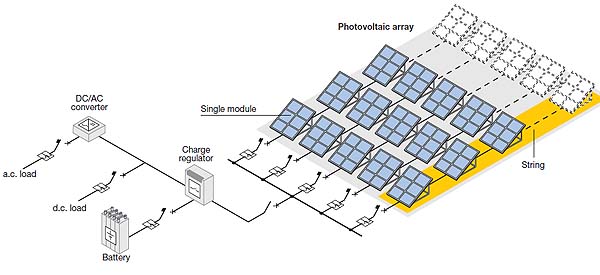
Generally speaking, a stand alone photovoltaic plant is constituted by the following devices:
- photovoltaic array: constituted by the photovoltaic cells suitably interconnected and used for the conversion of sunlight energy into electrical energy;
- charge regulator: it is an electronic device able to regulate charging and discharging of accumulators;
- accumulator batteries: they can provide power supply in case of lack of solar radiation;
- DC/AC inverter: it has the function of turning direct current into alternating current by controlling it and stabilizing its frequency and waveform.
The following figure shows the block diagram of a stand alone photovoltaic plant..
[ABB]Фотоэлектрические установки
Фотоэлектрические установки осуществляют прямое преобразование солнечной энергии в электрическую. Такие установки состоят из панелей полупроводникового материала, вырабатывающего электрическую энергию под воздействием солнечного излучения.
Фотоэлектрические установки являться частью общей энергосистемы или снабжать электроэнергией отдельную нагрузку (автономную установку).
В последнем случае в состав системы должна входить аккумуляторная батарея, обеспечивающая бесперебойную подачу электроэнергии в случае недостаточного солнечного излучения.
Основной частью фотоэлектрической установки являются фотоэлементы, изготовленные из полупроводникового материала (аморфного или монокристаллического кремния). При облучении солнечными лучами фотоэлемент генерирует максимальный ток Iмакс. при максимальном напряжении Uмакс, что соответствует максимальной мощности Wмакс..
Для увеличения выходного напряжения несколько фотоэлементов соединяют последовательно в ряд. Для увеличения тока несколько рядов соединяют параллельно.
Так, например, если один фотоэлемент может произвести ток 5 А при напряжении 35,5 В пост. тока, то для получения источника электроэнергии с током 100 А при напряжении 500 В пост. тока требуется соединить параллельно 20 рядов по 15 фотоэлементов в каждом.
Обычно автономная фотоэлектрическая установка состоит из следующих устройств:
- фотоэлектрическая батарея: состоит из соединенных между собой фотоэлементов, преобразующих солнечную энергию в электрическую;
- регулятор заряда: электронное устройство, предназначенное для регулирования заряда и разряда аккумуляторов;
- аккумуляторная батарея: обеспечивает электропитание нагрузки при недостаточном солнечном излучении.
- инвертор: преобразует постоянный ток в переменный ток стабильной частоты и формы.
На следующем рисунке показана функциональная схема автономной фотоэлектрической установки
[Перевод Интент]Русско-английский словарь нормативно-технической терминологии > фотоэлектрическая установка
СтраницыСм. также в других словарях:
conversion — conversional, conversionary /keuhn verr zheuh ner ee, sheuh /, adj. /keuhn verr zheuhn, sheuhn/, n. 1. the act or process of converting; state of being converted. 2. change in character, form, or function. 3. spiritual change from sinfulness to… … Universalium
Conversion disorder — Classification and external resources ICD 10 F44 ICD 9 300.11 … Wikipedia
Conversión de coordenadas ecuatoriales a coordenadas horizontales — Se trata de convertir coordenadas celestes desde coordenadas ecuatoriales a coordenadas horizontales pasando a través de las Coordenadas horarias. Conversión de coordenadas ecuatoriales a coordenadas horarias Conversión de coordenadas horarias a… … Wikipedia Español
Conversión de coordenadas horizontales a coordenadas ecuatoriales — Se trata de convertir coordenadas celestes desde coordenadas horizontales a coordenadas ecuatoriales pasando a través de las Coordenadas horarias. Conversión de coordenadas horizontales a coordenadas horarias Conversión de coordenadas horarias a… … Wikipedia Español
Conversión de coordenadas eclípticas a coordenadas ecuatoriales — Se trata de convertir coordenadas celestes de un tipo en otro. Contenido 1 Las fórmulas 2 El cálculo y resolución de las ambigüedades 3 Un applet en Java Script 4 … Wikipedia Español
Conversión de coordenadas ecuatoriales a coordenadas eclípticas — Se trata de convertir coordenadas celestes de un tipo en otro. Contenido 1 Las fórmulas 2 El cálculo y resolución de ambigüedades 3 Un applet en Java Script 4 … Wikipedia Español
Conversión de coordenadas ecuatoriales a coordenadas galácticas — Se trata de convertir coordenadas celestes de un tipo en otro. Contenido 1 Las fórmulas 2 El cálculo y resolución de ambigüedades 3 Un applet en Java Script 4 … Wikipedia Español
Conversión de coordenadas ecuatoriales a coordenadas horarias — Se trata de convertir coordenadas celestes de un tipo en otro. Como la declinación es común a ambos sistemas se trata de hallar una relación entre la ascensión recta A de las coordenadas ecuatoriales y el ángulo horario H de las coordenadas… … Wikipedia Español
Conversión de coordenadas horarias a coordenadas horizontales — Se trata de convertir coordenadas celestes de un tipo en otro. Contenido 1 Las fórmulas 2 El cálculo y resolución de ambigüedades 3 Un applet en Java Script 4 … Wikipedia Español
Conversión de coordenadas horizontales a coordenadas horarias — Se trata de convertir coordenadas celestes de un tipo en otro. Contenido 1 Las fórmulas 2 El cálculo y resolución de ambigüedades 3 Un applet en Java Script 4 … Wikipedia Español
Conversión de coordenadas galácticas a coordenadas ecuatoriales — Se trata de convertir coordenadas celestes de un tipo en otro. Contenido 1 Las fórmulas 2 El cálculo y resolución de ambigüedades 3 Un applet en Java Script 4 … Wikipedia Español
Перевод: со всех языков на английский
с английского на все языки- С английского на:
- Все языки
- Со всех языков на:
- Все языки
- Английский
- Арабский
- Болгарский
- Испанский
- Немецкий
- Русский
- Украинский
- Французский
function+conversion

18+
© Академик, 2000-2026
- Обратная связь: Техподдержка, Реклама на сайте
Экспорт словарей на сайты, сделанные на PHP, Joomla, Drupal, WordPress, MODx.