

-
1 входное полное сопротивление
входное полное сопротивление
-
[IEV number 312-06-18]EN
input impedance
impedance of the input circuit measured between the input terminals under operating conditions
NOTE 1 – The impedance can be expressed in terms of admittance.
NOTE 2 – In certain instances, for example, sampling devices or self-balancing potentiometers, the impedance can be different according to the instant when it is determined, before, during or after the instant of measurement.
NOTE 3 – When the input circuit is such that the instantaneous value of the current flowing into the input terminals is a non-linear function of the instantaneous value of the input voltage under specified conditions of frequency and voltage, the combination of resistance and reactance which would absorb the same active power and in which would flow a reactive current equal to the fundamental component that is flowing in the actual input circuit, is sometimes called the "equivalent input impedance".
[IEV number 312-06-18]FR
impédance du circuit d'entrée
impédance du circuit d'entrée entre les bornes d'entrée dans les conditions de fonctionnement
NOTE 1 – L'impédance peut être exprimée en termes d'admittance.
NOTE 2 – Dans certains cas, par exemple les dispositifs d'échantillonnage ou les potentiomètres à rééquilibrage automatique, l'impédance peut être différente selon l’instant où elle est déterminée, avant, pendant ou après la mesure.
NOTE 3 – Lorsque le circuit d'entrée est tel que la valeur instantanée du courant traversant les bornes d'entrée est une fonction non linéaire de la valeur instantanée de la tension d'entrée dans des conditions spécifiées de fréquence et de tension, l'impédance d'une combinaison formée par une résistance et une réactance qui absorberaient la même puissance active et dans laquelle circulerait un courant réactif égal à la composante fondamentale qui circule dans le circuit d'entrée réel, est parfois appelée "impédance équivalente d'entrée".
[IEV number 312-06-18]Тематики
- измерение электр. величин в целом
EN
DE
FR
Русско-французский словарь нормативно-технической терминологии > входное полное сопротивление
-
2 выходное полное сопротивление
выходное полное сопротивление
-
[IEV number 312-06-19]EN
output impedance
impedance of the output circuit measured between the output terminals under operating conditions
NOTE 1 – The impedance can be expressed in terms of admittance.
NOTE 2 – In certain instances, for example, sampling devices or self-balancing potentiometers, the impedance can be different according to the instant when it is determined, before, during or after the instant of measurement.
NOTE 3 – When the output circuit is such that the instantaneous value of the current flowing into the output terminals is a non-linear function of the instantaneous value of the output voltage under specified conditions of frequency and voltage, the combination of resistance and reactance which would absorb the same active power and in which would flow a reactive current equal to the fundamental component that is flowing in the actual output circuit, is sometimes called the "equivalent output impedance".
[IEV number 312-06-19]FR
impédance du circuit de sortie
impédance du circuit de sortie entre les bornes de sortie dans les conditions de fonctionnement
NOTE 1 – L'impédance peut être exprimée en termes d'admittance.
NOTE 2 – Dans certains cas, par exemple les dispositifs d'échantillonnage ou les potentiomètres à rééquilibrage automatique, l'impédance peut être différente selon l’instant où elle est déterminée, avant, pendant ou après la mesure.
NOTE 3 – Lorsque le circuit de sortie est tel que la valeur instantanée du courant traversant les bornes de sortie est une fonction non linéaire de la valeur instantanée de la tension de sortie dans des conditions spécifiées de fréquence et de tension, l'impédance d'une combinaison formée par une résistance et une réactance qui absorberaient la même puissance active et dans laquelle circulerait un courant réactif égal à la composante fondamentale qui circule dans le circuit de sortie réel, est parfois appelée "impédance équivalente de sortie".
[IEV number 312-06-19]Тематики
- измерение электр. величин в целом
EN
DE
FR
Русско-французский словарь нормативно-технической терминологии > выходное полное сопротивление
-
3 длительный допустимый ток
- courant permanent admissible, m
- courant admissible, m
(длительный) допустимый ток
Максимальное значение электрического тока, который может протекать длительно по проводнику, устройству или аппарату при определенных условиях без превышения определенного значения их температуры в установившемся режиме
[ ГОСТ Р МЭК 60050-826-2009]
Этот ток обозначают IZ
[ ГОСТ Р 50571. 1-2009 ( МЭК 60364-1: 2005)]EN
(continuous) current-carrying capacity
ampacity (US)
maximum value of electric current which can be carried continuously by a conductor, a device or an apparatus, under specified conditions without its steady-state temperature exceeding a specified value
[IEV number 826-11-13]
ampacity
The current in amperes that a conductor can carry continuously under the conditions of use without exceeding its temperature rating.
[National Electrical Cod]FR
courant (permanent) admissible, m
valeur maximale du courant électrique qui peut parcourir en permanence, un conducteur, un dispositif ou un appareil, sans que sa température de régime permanent, dans des conditions données, soit supérieure à la valeur spécifiée
[IEV number 826-11-13]Ampacity, the term is defined as the maximum amount of current a cable can carry before sustaining immediate or progressive deterioration. Also described as current rating or current-carrying capacity, is the RMS electric current which a device can continuously carry while remaining within its temperature rating. The ampacity of a cable depends on:
- its insulation temperature rating;
- conductor electrical properties for current;
- frequency, in the case of alternating currents;
- ability to dissipate heat, which depends on cable geometry and its surroundings;
- ambient temperature.
Electric wires have some resistance, and electric current flowing through them causes voltage drop and power dissipation, which heats the cable. Copper or aluminum can conduct a large amount of current before melting, but long before the conductors melt, their insulation would be damaged by the heat.
The ampacity for a power cable is thus based on physical and electrical properties of the material & construction of the conductor and of its insulation, ambient temperature, and environmental conditions adjacent to the cable. Having a large overall surface area may dissipate heat well if the environment can absorb the heat.
In a long run of cable, different conditions govern, and installation regulations normally specify that the most severe condition along the run governs the cable's rating. Cables run in wet or oily locations may carry a lower temperature rating than in a dry installation. Derating is necessary for multiple circuits in close proximity. When multiple cables are near, each contributes heat to the others and diminishes the amount of cooling air that can flow past the individual cables. The overall ampacity of the insulated conductors in a bundle of more than 3 must be derated, whether in a raceway or cable. Usually the de-rating factor is tabulated in a nation's wiring regulations.
Depending on the type of insulating material, common maximum allowable temperatures at the surface of the conductor are 60, 75 and 90 degrees Celsius, often with an ambient air temperature of 30°C. In the U.S., 105°C is allowed with ambient of 40°C, for larger power cables, especially those operating at more than 2 kV. Likewise, specific insulations are rated 150, 200 or 250°C.
The allowed current in cables generally needs to be decreased (derated) when the cable is covered with fireproofing material.
For example, the United States National Electric Code, Table 310-16, specifies that up to three 8 AWG copper wires having a common insulating material (THWN) in a raceway, cable, or direct burial has an ampacity of 50 A when the ambient air is 30°C, the conductor surface temperature allowed to be 75°C. A single insulated conductor in air has 70 A rating.
Ampacity rating is normally for continuous current, and short periods of overcurrent occur without harm in most cabling systems. The acceptable magnitude and duration of overcurrent is a more complex topic than ampacity.
When designing an electrical system, one will normally need to know the current rating for the following:- Wires
- Printed Circuit Board traces, where included
- Fuses
- Circuit breakers
- All or nearly all components used
Some devices are limited by power rating, and when this power rating occurs below their current limit, it is not necessary to know the current limit to design a system. A common example of this is lightbulb holders.
[http://en.wikipedia.org/wiki/Ampacity]
Тематики
- электротехника, основные понятия
Синонимы
EN
DE
- Dauerstrombelastbarkeit, f
- Strombelastbarkeit, f
FR
- courant admissible, m
- courant permanent admissible, m
Русско-французский словарь нормативно-технической терминологии > длительный допустимый ток
-
4 ограничитель перенапряжений
ограничитель перенапряжений нелинейный
ОПН
Аппарат, предназначенный для защиты изоляции электрооборудования от грозовых и коммутационных перенапряжений, представляющий собой последовательно и/или параллельно соединенные металлооксидные варисторы без каких-либо последовательных или параллельных искровых промежутков, заключенные в изоляционный корпус
[ ГОСТ Р 52725-2007]EN
metal-oxide surge arrester without gaps
arrester having non-linear metal-oxide resistors connected in series and/or in parallel without any integrated series or parallel spark gaps
[IEC 60099-4, ed. 2.0 (2004-05)]FR
parafoudre à oxyde métallique sans éclateur
parafoudre à résistances variables à oxyde métallique connectées en série et/ou en parallèle, ne comportant pas d'éclateurs en série ou en parallèle
[IEC 60099-4, ed. 2.0 (2004-05)]В электрических сетях часто возникают импульсные всплески напряжения, вызванные коммутациями электроаппаратов, атмосферными разрядами или иными причинами. Несмотря на кратковременность такого перенапряжения, его может быть достаточно для пробоя изоляции и, как следствие, короткого замыкания, приводящего к разрушительным последствиям.Для того, чтобы устранить вероятность короткого замыкания, можно применять более надежную изоляцию, но это приводит к значительному увеличению стоимости оборудования. В связи с этим в электрических сетях целесообразно применять разрядники.
Ограничитель перенапряжения нелинейный (ОПН) — это элемент защиты без искровых промежутков. Активная часть ОПН состоит из легированного металла, при подаче напряжения он ведет себя как множество последовательно соединенных варисторов. Принцип действия ОПН основан на том, что проводимость варисторов нелинейно зависит от приложенного напряжения. При отсутствии перенапряжений ОПН не пропускает ток, но как только на участке сети возникает перенапряжение, сопротивление ОПН резко снижается, чем и обуславливается эффект защиты от перенапряжения. После окончания действия перенапряжения на выводах ОПН, его сопротивление опять возрастает. Переход из «закрытого» в «открытое» состояние занимает единицы наносекунд (в отличие от разрядников с искровыми промежутками, у которых это время срабатывания может достигать единиц микросекунд). Кроме высокой скорости срабатывания ОПН обладает еще рядом преимуществ. Одним из них является стабильность характеристики варисторов после неоднократного срабатывания вплоть до окончания указанного времени эксплуатации, что, кроме прочего, устраняет необходимость в эксплуатационном обслуживании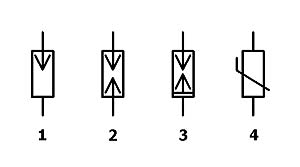
На электрических принципиальных схемах в России разрядники обозначаются согласно ГОСТ 2.727—68.
1. Общее обозначение разрядника
2. Разрядник трубчатый
3. Разрядник вентильный и магнитовентильный
4. ОПН
[http://ru.wikipedia.org/wiki/%D0%9E%D0%9F%D0%9D]Параллельные тексты EN-RU
Surge arresters
To limit the occurrence of over voltages, an over voltage arrester is available upon request.
The encapsulated surge arrester is designed on the basis of metallic oxide conductive resistors.
These blow out if there is an overload, and the system protection turns off the faulty electrical circuit in a controlled manner.
The surge arrester is in single-pole design.
It has its own enclosure sealed by a sealed bushing.
Connections for equipment to monitor the arrester.
[Siemens]Ограничитель перенапряжений
По запросу КРУЭ оснащается ограничителями перенапряжений.
Ограничитель перенапряжений выполнен на базе металлооксидных варисторов и помещен в оболочку.
При возникновении перенапряжения варисторы переходят в проводящее состояние, в результате чего система защиты отключает неисправную электрическую цепь.
Ограничитель перенапряжений выполнен в виде однополюсного модуля.
Ограничитель имеет собственную оболочку, герметично закрытую проходным изолятором.
Ограничитель перенапряжений имеет выводы для подключения приборов контроля его состояния.
[Перевод Интент]The GIS lay out in option of zinc oxide lightning arrester under metal enclosure insulated with gas SF6.
The zinc oxide lightning arrester earths currents of considerable amplitude injected by accidental phenomena: lightning and operating overvoltages.
The non-linear resistance of the zinc oxide maintains a residual voltage lower than the GIS insulation voltage during the flow of high currents.
An impulse counter records the number of times high current passes through the conductor and the maximum amplitude attained.
[Siemens]В КРУЭ может быть установлен ограничитель перенапряжений, выполненный на основе оксидноцинковых варисторов, размещенных в металлической оболочке, заполненной элегазом.
Оксидноцинковый ограничитель перенапряжений отводит на землю значительные по амплитуде токи, которые могут появиться в результате атмосферных и коммутационных перенапряжений.
При протекании значительного тока значение поддерживаемого нелинейным оксидноцинковым варистором остающегося напряжения ниже напряжения изоляции КРУЭ.
Отдельный счетчик подсчитывает каждый проход тока через ограничитель и его амплитуду.
[Перевод Интент]Transport and storage
Lightning arresters are filled with SF6 or nitrogen gas under pressure in the factory.
They are also fitted with a moisture filter.
Maintain the lightning arrester in a vertical position during transport and storage.
[Siemens]Транспортирование и хранение
Ограничители перенапряжений заправлены на заводе-изготовителе элегазом или азотом под давлением.
Ограничители оснащены фильтром-осушителем.
При транспортировании и хранении ограничители перенапряжений должны находиться в вертикальном положении.
[Перевод Интент]Недопустимые, нерекомендуемые
Примечание(1)- Мнение автора карточкиТематики
Синонимы
EN
FR
Русско-французский словарь нормативно-технической терминологии > ограничитель перенапряжений
-
5 возобновляемый сырьевой материал
возобновляемый сырьевой материал
—
[ http://www.eionet.europa.eu/gemet/alphabetic?langcode=en]EN
renewable raw material
Resources that have a natural rate of availability and yield a continual flow of services which may be consumed in any time period without endangering future consumption possibilities as long as current use does not exceed net renewal during the period under consideration. (Source: WHIT)
[http://www.eionet.europa.eu/gemet/alphabetic?langcode=en]Тематики
EN
DE
FR
Русско-французский словарь нормативно-технической терминологии > возобновляемый сырьевой материал
См. также в других словарях:
Flow — Flow, n. 1. A stream of water or other fluid; a current; as, a flow of water; a flow of blood. [1913 Webster] 2. A continuous movement of something abundant; as, a flow of words. [1913 Webster] 3. Any gentle, gradual movement or procedure of… … The Collaborative International Dictionary of English
flow bog — Flow Flow, n. 1. A stream of water or other fluid; a current; as, a flow of water; a flow of blood. [1913 Webster] 2. A continuous movement of something abundant; as, a flow of words. [1913 Webster] 3. Any gentle, gradual movement or procedure of … The Collaborative International Dictionary of English
flow moss — Flow Flow, n. 1. A stream of water or other fluid; a current; as, a flow of water; a flow of blood. [1913 Webster] 2. A continuous movement of something abundant; as, a flow of words. [1913 Webster] 3. Any gentle, gradual movement or procedure of … The Collaborative International Dictionary of English
Flow measurement — is the quantification of bulk fluid movement. Flow can be measured in a variety of ways. Positive displacement flow meters acumulate a fixed volume of fluid and then count the number of times the volume is filled to measure flow. Other flow… … Wikipedia
Flow Dynamics — is a funk, hip hop and soul based electronic project created by David McKinney, a founding member of Australian live electronic group Rhibosome. Flow Dynamics has several releases on the UK record label Freestyle Records run by Adrian Gibson,… … Wikipedia
Flow (Graffiteur) — Pour les articles homonymes, voir Flow. Flow est un pionnier du mouvement du graffiti montréalais. Né dans la première moitié des années 70, Flow débutant sous le nom d artiste de Checker T en 1988. Il fera sa marque (au propre comme au figuré)… … Wikipédia en Français
Flow (psychology) — Flow is the mental state of operation in which the person is fully immersed in what he or she is doing by a feeling of energized focus, full involvement, and success in the process of the activity. Proposed by positive psychologist Mihály… … Wikipedia
flow — ► VERB 1) move steadily and continuously in a current or stream. 2) move or issue forth steadily and freely: people flowed into the courtyard. 3) (often as adj. flowing) hang loosely and elegantly. 4) (of the sea or a tidal river) move towards… … English terms dictionary
flow — [flō] vi. [ME flouen < OE flowan, akin to ON floa, to flood, OHG flouwen, to wash < IE base * pleu , to run, flow, fly > FLOOD, FLY1, FLEE, FLEET2, FLOAT, L pluere, to rain] 1. to … English World dictionary
Flow-based programming — In computer science, flow based programming (FBP) is a programming paradigm that defines applications as networks of black box processes, which exchange data across predefined connections by message passing. These black box processes can be… … Wikipedia
flow — v. & n. v.intr. 1 glide along as a stream (the Thames flows under London Bridge). 2 a (of a liquid, esp. water) gush out; spring. b (of blood, liquid, etc.) be spilt. 3 (of blood, money, electric current, etc.) circulate. 4 (of people or things)… … Useful english dictionary
