

-
41 ODE
1) Компьютерная техника: Omega Descriptive Environment, оптический элемент данных2) Военный термин: optical designation evaluation3) Техника: orientation-dependent etch4) Математика: Ordinary Difference Equation, обыкновенное дифференциальное уравнение (ordinary differential equation)5) Сокращение: Ordnance Development & Engineering (Singapore)6) Вычислительная техника: Online Data Entry, Object Database and Environment (AT&T, DB)7) Деловая лексика: One Day Early8) Макаров: ordinary differential equation9) Электрические машины: противоположный конец вала (opposite drive end)10) Правительство: Ohio Department Of Education, Oregon Department of Education12) Программное обеспечение: Open Dynamics Engine -
42 VEF
1) Морской термин: допустимая разница между количеством груза в коносаменте и фактическим количеством груза на судне2) Религия: Virginia Evangelizing Fellowship3) Университет: Vocational Education Foundation4) Нефть: vessel experience factor (a calculated factor, based on the experience of recent voyages, that reflects the average difference between vessel and shore measurements in terms of percent)5) Онкология: Ventricular ejection fraction (tests lung function)6) Фирменный знак: Vancouver Enterprise Forum, Vermont Egg Farms, Inc., Vietnam Education Foundation7) Образование: Virtual Education Fair8) Химическое оружие: variable explanation format9) Каспий: vessel experience factor10) Общественная организация: Virginia Engineering Foundation -
43 ecd
1) Военный термин: Engineering Change Decision, Exercise Control Directorate, earliest completion date, electronic communications division, electronic components and devices, environmental conditions determination2) Техника: electric control drive, electro chromic display, electrochemical debarring, electron capture device, electron current detector, entry corridor display, envelope cycle difference, электрохромное устройство, electro chromic device, electro-chromic device, electrochromic device3) Юридический термин: Essex County Detective4) Металлургия: эффективная глубина цементированного слоя (effective case depth)5) Физика: Energy Conversion Devices6) Физиология: Extreme Crash Diet7) Вычислительная техника: Edit/Compile/Debug, редактирование/компиляция/отладка, Energy Conversion Devices (Hersteller, OUM)8) Нефть: equivalent circulating density, equivalent circulation density, equivalent circulation density management, эквивалентная плотность циркуляции бурового раствора (параметр; equivalent circulating density)10) Банковское дело: депозитный сертификат в евровалюте (eurocertificate of deposit)11) Реклама: Executive Creative Director (креативный директор)12) Деловая лексика: Envision Clarify And Deliver, европейский депозитный сертификат (Euro certificate of deposit)13) Бурение: эквивалентная плотность циркуляции (equivalent circulating density), equivalent mud weight ((Phydr+Ppr loss)/TVD), ЭЦП (equivalent circulating density), эквивалентная плотность циркулирующего бурового раствора, эквивалентная циркуляционная плотность14) Инвестиции: eurocertificate of deposit15) Сетевые технологии: Early Congestion Detection16) Медицинская техника: endocardial cushion defect (ЭхоКГ)17) Химическое оружие: electron capture defector, electron capture detector18) Макаров: electrochromic display, electronic circular dichroism, emergency-constrained dispatch, energy conversion device19) Расширение файла: Enhanced Color Display, Enhanced Compact Disk20) Молекулярная биология: Extracellular domain21) Международная торговля: Exporter Counseling Division -
44 ode
1) Компьютерная техника: Omega Descriptive Environment, оптический элемент данных2) Военный термин: optical designation evaluation3) Техника: orientation-dependent etch4) Математика: Ordinary Difference Equation, обыкновенное дифференциальное уравнение (ordinary differential equation)5) Сокращение: Ordnance Development & Engineering (Singapore)6) Вычислительная техника: Online Data Entry, Object Database and Environment (AT&T, DB)7) Деловая лексика: One Day Early8) Макаров: ordinary differential equation9) Электрические машины: противоположный конец вала (opposite drive end)10) Правительство: Ohio Department Of Education, Oregon Department of Education12) Программное обеспечение: Open Dynamics Engine -
45 time
(a) (in general) temps mtime frame délai m;time limit délai;∎ the work must be completed within the time limit le travail doit être terminé avant la date limite;time management gestion f du temps de travail;time to market temps m d'accès au marché;time and methods study étude des temps et des méthodes;time and motion consultant expert m en productivité, spécialiste m f de l'organisation scientifique du travail;time and motion studies organisation f scientifique du travail, OST f;time and motion study étude de productivité (qui porte sur l'organisation scientifique du travail); MARKETING time pricing fixation f des prix en fonction du moment;COMPUTING time sharing partage m de temps;time slot créneau m horaire;STOCK EXCHANGE time value valeur f temporelle(b) (by clock) heure f;∎ time of arrival/departure heure d'arrivée/de départtime card feuille f de présence;time clock pointeuse f;time difference décalage m horaire;time rate rémunération f au temps passé;time sheet fiche f horaire;time work travail m à l'heure;STOCK EXCHANGE time bargain marché m à terme;FINANCE time bill traite f à terme;American time deposit dépôt m à terme;time draft traite à terme;time loan emprunt m à terme;INSURANCE time policy police f à terme;time value valeur f temporelle∎ we pay time and a half on weekends nous payons les heures du week-end une fois et demie le tarif normal;∎ overtime is paid at double time les heures supplémentaires sont payées ou comptées doubleAvnet Applied Computing (AAC) … officially opened a new engineering laboratory built to provide a resource-rich environment where original equipment manufacturer customers and AAC engineers can work side-by-side to cut the time to market of their designs.
-
46 channel
1) радиоканал, полоса частот шириной 10 кГц, предоставленная службам радиосвязи2) ТВ-канал, полоса частот шириной 6 МГц, предоставленная службам ТВ-вещания3) тракт4) дорожка•- adjacent channel
- aeronautical emergency channel
- air channel
- air-air channel
- air-ground channel
- allocated channel
- alpha channel
- analog channel
- analog data channel
- associated channel
- associated signaling channel
- asynchronous channel
- audio channel
- automatic's line channel
- auxiliary channel
- average-speed signaling channel
- backward channel
- balanced channel
- band-limited channel
- base cable channel
- base RF-channel
- baseband channel
- B-channel
- bidirectional interaction channel
- bidirectional intercom channel
- binary symmetric channel
- binomial channel
- blank channel
- block multiplexor channel
- blue channel
- branching channel
- brightness channel
- broadband channel
- broadband multiplexing channel
- broadcast TV-radio channel
- buffered I/O channel
- bypass channel
- byte-multiplexor channel
- cable channel
- calling channel
- camera channel
- carrier-current channel
- chroma channel
- chrominance channel
- clear channel
- coherent channel
- color channel
- color-difference channel
- color-sync channel
- common-user channel
- communication channel
- complex high-frequency line channel
- confidence channel
- continuous channel
- continuous-discrete channel
- control channel
- covertness-protected channel
- cue channel
- data transfer channel
- data transmission channel
- D-channel
- D-echo channel
- dedicated channel
- deep-sound channel
- delta channel
- department communication channel
- digital data channel
- direct channel
- direct control channel
- direct receiving channel
- direct satellite channel
- discrete channel
- discrete-continuous channel
- dispatch communication channel
- double-pole channel
- drop-insertion channel
- duplex communication channel
- E-channel
- electric communication channel
- electric protection channel
- elementary channel
- emergency-radio channel
- engineering channel
- enhanced discrete channel
- even channel
- exchange channel
- fast channel
- fast-acting channel
- fax-modem channel
- feedback channel
- fiber optic communication channel
- firing channel
- fixed-tuned channel
- forcible-borrowed channel
- forward channel
- forward wideband delivery channel
- four-wire channel
- frequency signaling channel
- full-rate traffic channel
- green channel
- group channel
- guard channel
- half-duplex channel
- half-rate traffic channel
- H-channel
- head channel
- health channel
- HF broadband channel
- HF multiplexed channel
- high voltage aerial cable line channel
- highest grade channel
- high-frequency channel
- high-speed signaling channel
- high-voltage aerial line channel
- high-voltage cable line channel
- high-voltage tone line channel
- hydroacoustic channel
- I channel
- ideal channel
- image channel
- in-band orderwire channel
- induced channel
- information bearer channel
- information channel
- infrared channel
- input channel
- input-output channel
- interaction channel
- intercepting-protected channel
- interference channel
- intermodulation channel
- internal phase channel
- internal wire channel
- intrabasin channel
- intradistrict telegraph channel
- intraregional telegraph channel
- ionospheric channel
- isolated bundled phase channel
- jamming channel
- labeled channel
- labeled-statistical channel
- leased channel
- left front channel
- left rear channel
- left stereophonic channel
- line channel
- linear random channel
- line-of-sight channel
- local channel
- logical channel
- long-communication bypass channel
- long-distance channel
- low-frequency channel
- luminance channel
- M channel
- marine radio communication channel
- memory channel
- memoryless channel
- meteor-burst channel
- mobile communication channel
- monochrome channel
- multipath channel
- multiplexing channel
- noiseless channel
- noisy channel
- noncoherent channel
- nonfixed channel
- nonswitched channel
- nonsynchronous channel
- off-hook channel
- one-piece channel
- one-way channel
- open channel
- optimal channel
- optoelectronic channel
- ordinary channel
- outband channel
- output channel
- parallel access channel
- parallel optical channel
- parasitic channel
- peripheral-interface channel
- phase line channel
- phase-phase pitch line channel
- physical channel
- picture channel
- pilot channel
- pipeline control channel
- pitch communication channel
- planar channel
- positioned channel
- primary channel
- protection channel
- Q channel
- quadrature channel
- radio communication channel
- radiotelegraph channel
- radiotelephone channel
- read/write channel
- reception channel
- red channel
- relay channel
- relay protected channel
- return channel
- reverse channel
- reverse control channel
- Ricean channel
- right channel
- right front channel
- right rear channel
- right stereophonic channel
- road safety channel
- road servicing channel
- S channel
- safety channel
- satellite communication channel
- scatter channel
- secondary channel
- selector channel
- send channel
- sensor channel
- separate resonance channel
- series optical channel
- service communication channel
- shared channel
- ship-to-shore channel
- shore-to-ship channel
- side channel
- signal channel
- signaling channel
- single-beam channel
- single-ended channel
- slow channel
- slow-acting channel
- sound broadcasting channel
- sound channel
- space-craft channel
- special cable-line channel
- speech channel
- standard broadcast channel
- subvoice grade channel
- sum channel
- supervisory channel
- switched channel
- symmetrical channel
- synchronous channel
- telecommunication channel
- telemechanic channel
- telemetering channel
- telephone channel
- television channel
- time-derived channel
- toll cable channel
- tone frequency channel
- top channel
- traffic channel
- train dispatch communication channel
- train radio communication line channel
- transfer channel
- transmission channel
- transmission service channel
- transparent channel
- trunk channel
- TV-frequency channel
- TV-observation channel
- two-wire channel
- video channel
- virtual signaling channel
- voice channel
- voice-band channel
- waste channel
- wave channel
- wire communication channel
- wireless channel
- working channel
- write channelEnglish-Russian dictionary of telecommunications and their abbreviations > channel
-
47 heavy
-
48 division
1. n деление; разделение2. n распределение; раздача3. n разногласия, расхождение во мнениях; раздоры4. n голосованиеto come to a division — голосовать, прибегать к голосованию
5. n разделение голосов во время голосования6. n классификация, деление7. n бот. тип8. n спорт. место9. n категория, подразделение; отдел, раздел10. n сектор11. n тех. отсек12. n перегородка, барьер13. n межа, граница14. n округ15. n юр. отделение, отдел, контора16. n спец. отдел17. n спец. цена деления18. n спец. воен. дивизия19. n спец. мор. дивизион20. n спец. тех. измельчение, диспергированиеСинонимический ряд:1. allotment (noun) allotment; apportionment; cutting; disbursal; dispensation; distribution; divergence; dividing; split2. arm (noun) arm; organ; wing3. boundary (noun) boundary; demarcation; mark; rank4. branch (noun) branch; category; department; offshoot; subdivision; unit5. disagreement (noun) alienation; breach; difference; difficulty; disagreement; movement; trouble; words6. discord (noun) conflict; contention; disaccord; discord; disharmony; dispeace; dissension; dissent; dissidence; dissonance; disunity; inharmony; mischief; strife; unpeace; variance7. divider (noun) divider; partition; separator8. section (noun) compartment; cut; dominion; fraction; group; member; moiety; parcel; part; piece; portion; province; region; section; segment9. separation (noun) detachment; dissolution; disunion; divorce; divorcement; rupture; separation; split-up10. subsidiary (noun) affiliate; subsidiaryАнтонимический ряд:agreement; combination; concord; oneness; singleness; union; unity -
49 simulation
2. имитация, искусственное воспроизведениеsimulation derived6-DOF simulationair-to-air simulationair-to-air combat simulationaircraft simulationaircraft-surface simulationall-digital simulationclosed-loop simulationcomputational simulationcomputer simulationdirectional simulationdomed simulationdynamic simulationelectro optical simulationengineering simulationfailure simulationfar-field simulationfault simulationfine grid simulationfinite difference simulationfire simulationfixed-base simulationfixed-wing simulationflight simulationflight test simulationFLIR simulationflow-field simulationFroude simulationfull-mission simulationground simulationground operation simulationground-based simulationhardware-in-the-loop simulationhelicopter simulationhigh-angle-of-attack simulationin-flight simulationinfrared simulationintelligent simulationiron bird simulationjet-exhaust simulationlaboratory simulationlanding simulationlightning simulationLock simulationlow-altitude simulationman-in-the-loop simulationmaneuvering simulationmanned simulationmanned combat simulationmission simulationMonte-Carlo simulationmotion simulationmultiaircraft simulationmultiship simulationNavier-Stokes simulationnonpiloted simulationnumerical simulationon-board simulationout-of-the-window visual simulationoutside-world simulationpart-task simulationpilot simulationpiloted simulationradar simulationrefuelling simulationrotorcraft simulationSAR simulationsensor simulationsix-degree-of-freedom simulationstochastic simulationStrouhal simulationsynthetic aperture radar simulationthree-degree-of-freedom simulationtotal simulationtotal mission simulationvisual simulationweather simulationwindshear simulationwind tunnel simulation -
50 value added
Gen Mgt [m1]1. originally, the difference between the cost of bought-in materials and the eventual selling price of the finished product2. loosely, the features that differentiate one product or service from another and thus create value for the customer. Value added is a customer perception of what makes a product or service desirable over others and worth a higher price. Value added is more difficult to measure without a physical end product, but value can be added to services as well as physical goods, through the process of value engineering. -
51 Arnold, Aza
SUBJECT AREA: Textiles[br]b. 4 October 1788 Smithfield, Pawtucket, Rhode Island, USAd. 1865 Washington, DC, USA[br]American textile machinist who applied the differential motion to roving frames, solving the problem of winding on the delicate cotton rovings.[br]He was the son of Benjamin and Isabel Arnold, but his mother died when he was 2 years old and after his father's second marriage he was largely left to look after himself. After attending the village school he learnt the trade of a carpenter, and following this he became a machinist. He entered the employment of Samuel Slater, but left after a few years to engage in the unsuccessful manufacture of woollen blankets. He became involved in an engineering shop, where he devised a machine for taking wool off a carding machine and making it into endless slivers or rovings for spinning. He then became associated with a cotton-spinning mill, which led to his most important invention. The carded cotton sliver had to be reduced in thickness before it could be spun on the final machines such as the mule or the waterframe. The roving, as the mass of cotton fibres was called at this stage, was thin and very delicate because it could not be twisted to give strength, as this would not allow it to be drawn out again during the next stage. In order to wind the roving on to bobbins, the speed of the bobbin had to be just right but the diameter of the bobbin increased as it was filled. Obtaining the correct reduction in speed as the circumference increased was partially solved by the use of double-coned pulleys, but the driving belt was liable to slip owing to the power that had to be transmitted.The final solution to the problem came with the introduction of the differential drive with bevel gears or a sun-and-planet motion. Arnold had invented this compound motion in 1818 but did not think of applying it to the roving frame until 1820. It combined the direct-gearing drive from the main shaft of the machine with that from the cone-drum drive so that the latter only provided the difference between flyer and bobbin speeds, which meant that most of the transmission power was taken away from the belt. The patent for this invention was issued to Arnold on 23 January 1823 and was soon copied in Britain by Henry Houldsworth, although J.Green of Mansfield may have originated it independendy in the same year. Arnold's patent was widely infringed in America and he sued the Proprietors of the Locks and Canals, machine makers for the Lowell manufacturers, for $30,000, eventually receiving $3,500 compensation. Arnold had his own machine shop but he gave it up in 1838 and moved the Philadelphia, where he operated the Mulhausen Print Works. Around 1850 he went to Washington, DC, and became a patent attorney, remaining as such until his death. On 24 June 1856 he was granted patent for a self-setting and self-raking saw for sawing machines.[br]Bibliography28 June 1856, US patent no. 15,163 (self-setting and self-raking saw for sawing machines).Further ReadingDictionary of American Biography, Vol. 1.W.English, 1969, The Textile Industry, London (a description of the principles of the differential gear applied to the roving frame).D.J.Jeremy, 1981, Transatlantic Industrial Revolution. The Diffusion of Textile Technologies Between Britain and America, 1790–1830, Oxford (a discussion of the introduction and spread of Arnold's gear).RLH -
52 Carnot, Nicolas Léonard Sadi
SUBJECT AREA: Steam and internal combustion engines[br]b. 1 June 1796 Paris, Franced. 24 August 1831 Paris, France[br]French laid the foundations for modern thermodynamics through his book Réflexions sur la puissance motrice du feu when he stated that the efficiency of an engine depended on the working substance and the temperature drop between the incoming and outgoing steam.[br]Sadi was the eldest son of Lazare Carnot, who was prominent as one of Napoleon's military and civil advisers. Sadi was born in the Palais du Petit Luxembourg and grew up during the Napoleonic wars. He was tutored by his father until in 1812, at the minimum age of 16, he entered the Ecole Polytechnique to study stress analysis, mechanics, descriptive geometry and chemistry. He organized the students to fight against the allies at Vincennes in 1814. He left the Polytechnique that October and went to the Ecole du Génie at Metz as a student second lieutenant. While there, he wrote several scientific papers, but on the Restoration in 1815 he was regarded with suspicion because of the support his father had given Napoleon. In 1816, on completion of his studies, Sadi became a second lieutenant in the Metz engineering regiment and spent his time in garrison duty, drawing up plans of fortifications. He seized the chance to escape from this dull routine in 1819 through an appointment to the army general staff corps in Paris, where he took leave of absence on half pay and began further courses of study at the Sorbonne, Collège de France, Ecole des Mines and the Conservatoire des Arts et Métiers. He was inter-ested in industrial development, political economy, tax reform and the fine arts.It was not until 1821 that he began to concentrate on the steam-engine, and he soon proposed his early form of the Carnot cycle. He sought to find a general solution to cover all types of steam-engine, and reduced their operation to three basic stages: an isothermal expansion as the steam entered the cylinder; an adiabatic expansion; and an isothermal compression in the condenser. In 1824 he published his Réflexions sur la puissance motrice du feu, which was well received at the time but quickly forgotten. In it he accepted the caloric theory of heat but pointed out the impossibility of perpetual motion. His main contribution to a correct understanding of a heat engine, however, lay in his suggestion that power can be produced only where there exists a temperature difference due "not to an actual consumption of caloric but to its transportation from a warm body to a cold body". He used the analogy of a water-wheel with the water falling around its circumference. He proposed the true Carnot cycle with the addition of a final adiabatic compression in which motive power was con sumed to heat the gas to its original incoming temperature and so closed the cycle. He realized the importance of beginning with the temperature of the fire and not the steam in the boiler. These ideas were not taken up in the study of thermodynartiics until after Sadi's death when B.P.E.Clapeyron discovered his book in 1834.In 1824 Sadi was recalled to military service as a staff captain, but he resigned in 1828 to devote his time to physics and economics. He continued his work on steam-engines and began to develop a kinetic theory of heat. In 1831 he was investigating the physical properties of gases and vapours, especially the relationship between temperature and pressure. In June 1832 he contracted scarlet fever, which was followed by "brain fever". He made a partial recovery, but that August he fell victim to a cholera epidemic to which he quickly succumbed.[br]Bibliography1824, Réflexions sur la puissance motrice du feu; pub. 1960, trans. R.H.Thurston, New York: Dover Publications; pub. 1978, trans. Robert Fox, Paris (full biographical accounts are provided in the introductions of the translated editions).Further ReadingDictionary of Scientific Biography, 1971, Vol. III, New York: C.Scribner's Sons. T.I.Williams (ed.), 1969, A Biographical Dictionary of Scientists, London: A. \& C.Black.Chambers Concise Dictionary of Scientists, 1989, Cambridge.D.S.L.Cardwell, 1971, from Watt to Clausius. The Rise of Thermodynamics in the Early Industrial Age, London: Heinemann (discusses Carnot's theories of heat).RLHBiographical history of technology > Carnot, Nicolas Léonard Sadi
-
53 Clement (Clemmet), Joseph
SUBJECT AREA: Mechanical, pneumatic and hydraulic engineering[br]bapt. 13 June 1779 Great Asby, Westmoreland, Englandd. 28 February 1844 London, England[br]English machine tool builder and inventor.[br]Although known as Clement in his professional life, his baptism at Asby and his death were registered under the name of Joseph Clemmet. He worked as a slater until the age of 23, but his interest in mechanics led him to spend much of his spare time in the local blacksmith's shop. By studying books on mechanics borrowed from his cousin, a watchmaker, he taught himself and with the aid of the village blacksmith made his own lathe. By 1805 he was able to give up the slating trade and find employment as a mechanic in a small factory at Kirkby Stephen. From there he moved to Carlisle for two years, and then to Glasgow where, while working as a turner, he took lessons in drawing; he had a natural talent and soon became an expert draughtsman. From about 1809 he was employed by Leys, Mason \& Co. of Aberdeen designing and making power looms. For this work he built a screw-cutting lathe and continued his self-education. At the end of 1813, having saved about £100, he made his way to London, where he soon found employment as a mechanic and draughtsman. Within a few months he was engaged by Joseph Bramah, and after a trial period a formal agreement dated 1 April 1814 was made by which Clement was to be Chief Draughtsman and Superintendent of Bramah's Pimlico works for five years. However, Bramah died in December 1814 and after his sons took over the business it was agreed that Clement should leave before the expiry of the five-year period. He soon found employment as Chief Draughtsman with Henry Maudslay \& Co. By 1817 Clement had saved about £500, which enabled him to establish his own business at Prospect Place, Newington Butts, as a mechanical draughtsman and manufacturer of high-class machinery. For this purpose he built lathes for his own use and invented various improvements in their detailed design. In 1827 he designed and built a facing lathe which incorporated an ingenious system of infinitely variable belt gearing. He had also built his own planing machine by 1820 and another, much larger one in 1825. In 1828 Clement began making fluted taps and dies and standardized the screw threads, thus anticipating on a small scale the national standards later established by Sir Joseph Whitworth. Because of his reputation for first-class workmanship, Clement was in the 1820s engaged by Charles Babbage to carry out the construction of his first Difference Engine.[br]Principal Honours and DistinctionsSociety of Arts Gold Medal 1818 (for straightline mechanism), 1827 (for facing lathe); Silver Medal 1828 (for lathe-driving device).BibliographyExamples of Clement's draughtsmanship can be found in the Transactions of the Society of Arts 33 (1817), 36 (1818), 43 (1925), 46 (1828) and 48 (1829).Further ReadingS.Smiles, 1863, Industrial Biography, London, reprinted 1967, Newton Abbot (virtually the only source of biographical information on Clement).L.T.C.Rolt, 1965, Tools for the Job, London (repub. 1986); W.Steeds, 1969, A History of Machine Tools 1700–1910, Oxford (both contain descriptions of his machine tools).RTSBiographical history of technology > Clement (Clemmet), Joseph
-
54 interface related station level functions
интерфейсные функции станционного уровня системы автоматизации подстанции
Функции, представляющие интерфейс человек - машина локального оператора системы автоматизации подстанции на интерфейсе удаленного центра управления или на удаленном интерфейсе телеконтроля в целях мониторинга и технического обслуживания.
Примечание. Эти функции связываются через логические интерфейсы 1 и 6 с уровнем присоединения, через логический интерфейс 7 - с техническими сервисами, а через интерфейс панели дистанционного управления - с внешним миром.
[ ГОСТ Р 54325-2011 (IEC/TS 61850-2:2003)]EN
interface related station level functions
functions representing the interface of the SAS local station-operator HMI to a remote control centre Tele-Control Interface (TCI) or to the remote engineering Tele-Monitoring Interface (TMI) for monitoring and maintenance purposes. These functions communicate via the logical interfaces 1 and 6 with the bay level and via logical interface 7 to technical services and via the remote control interface to the outside world. Logically, there is no difference if the HMI is local or remote. In the context of the substation, there exists at least a virtual interface for the SAS at the boundary of the substation. The same is true for both the TCI and TMI. These virtual interfaces may be realised in some implementations such as proxy servers
[IEC 61850-2, ed. 1.0 (2003-08)]Тематики
EN
Англо-русский словарь нормативно-технической терминологии > interface related station level functions
-
55 PDM
- широтно-импульсная модуляция
- фазоразностная модуляция
- управление данными об изделии
- поверхностная акустическая волна
- модуляция по длительности импульса
- модуль распределения питания
модуль распределения питания
-
[Интент]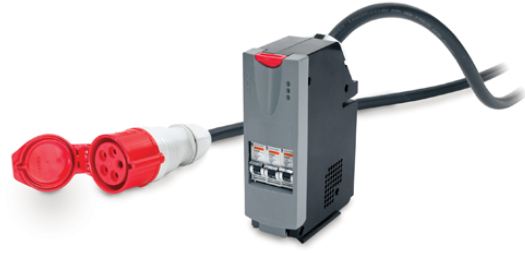
Рис. APC
Модуль для подачи питания на трехфазную нагрузку
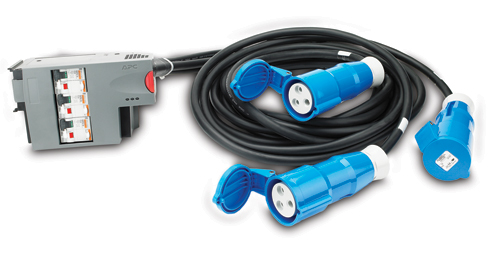
Рис. APC
Модуль для подачи питания на однофазные нагрузкиПараллельные тексты EN-RU
Factory assembled and tested Power Distribution Modules include circuit breaker, power cord, power connection, and circuit monitoring.
Собранные и проверенные на заводе-изготовиетеле модули распределения питания включают в себя автоматический выключатель, кабель, кабельную розетку и средства контроля состояния линии питания.
A variety of breaker and connector options can be chosen to supply either three-phase or single-phase power to the load.
Широкий выбор автоматических выключателей и кабельных розеток позволяет легко подобрать нужный модуль для подачи питания на трехфазные и однофазные нагрузки.
When demand rises and expansion becomes necessary, simply plug in new Power Distribution Modules. The factory-assembled modules, which include circuit breaker, power cord, and power connection, can be installed in mere minutes. There are multiple power ratings and power cord lengths for low to high power, guaranteeing compatibility and quick, easy, and convenient installation.
[APC]Когда потребляемая мощность увеличивается и необходимо расширение системы бесперебойного питания, то достаточно просто вставить новые модули распределения питания. Собранные на заводе-изготовителе модули, состоящие из автоматического выключателя, кабеля и кабельной розетки, можно установить за несколько минут. Модули поставляются на различные номинальные токи и с кабелями различной длины, что позволяет легко подобрать нужный модуль, быстро и без особого труда его установить.
[Перевод Интент]
How to install the PDM
Note: Some Power Distribution Units have filler plates installed. When a PDM is to be installed, the filler plate must be removed from the busbar.
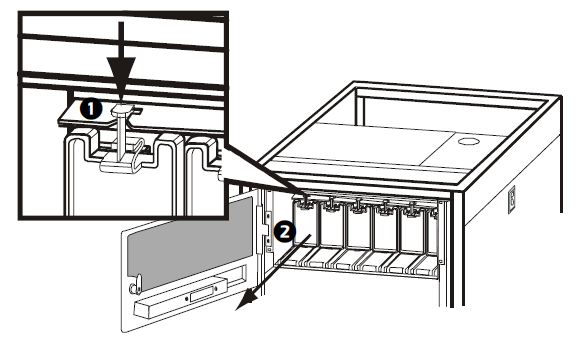
1 Press down on the clip.
2 Pull out the plate from the unit. (Do not throw away the filler plate. Keep it for potential later use).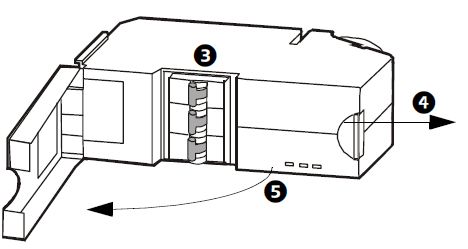
3 Verify that all the breakers are in the OFF position.
4 Press the red button to release the latch.
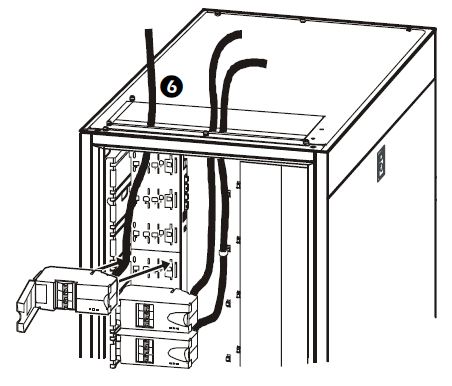
5 Pull open the latch.Vertical Rack Distribution Panel
Horizontal Rack Distribution Panel
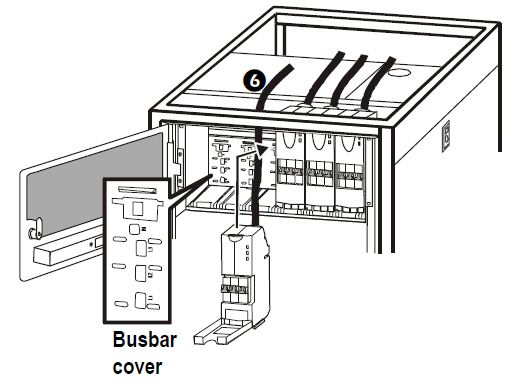
6 Feed the cable(s) up through the top opening in the enclosure and into the cable power troughs (if applicable) on top of enclosures.
How to install a PDM circuit breaker handle tie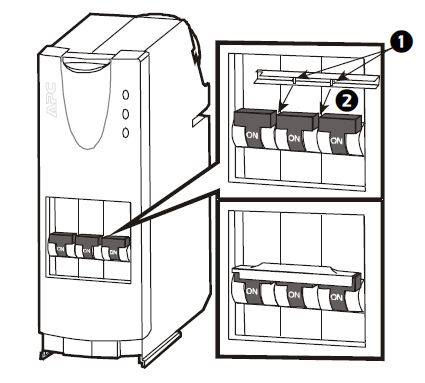
1 Locate the handle tie above the circuit breaker handles aligning the two tabs between the three handles.
2 Push the handle tie towards the circuit breaker handles until it snaps into position. Check to make sure that the handle tie is secure.
3 The handle tie can be removed by pulling it from the circuit breaker handles.Тематики
- НКУ (шкафы, пульты,...)
- источники и системы электропитания
EN
модуляция по длительности импульса
широтно-импульсная модуляция
ШИМ
—
[Е.С.Алексеев, А.А.Мячев. Англо-русский толковый словарь по системотехнике ЭВМ. Москва 1993]Тематики
Синонимы
EN
управление данными об изделии
Системы PDM обобщают такие технологии, как:
EDM (engineering data management) - управление инженерными данными,
PIM (product information management) - управление информацией об изделии,
TDM (technical data management) - управление техническими данными,
TIM (technical information management) - управление технической информацией,
а также другие системы, которые используются для манипулирования информацией, всесторонне определяющей конкретное изделие. Короче говоря, любая информация, необходимая на том или ином этапе жизненного цикла изделия, может управляться системой PDM, которая предоставляет корректные данные всем пользователям и всем промышленным информационным системам по мере надобности. Наряду с данными, PDM управляет и проектом - процессом разработки изделия, контролируя собственно информацию об изделии - "продукте", о состоянии объектов данных, об утверждении вносимых изменений, осуществляя авторизацию и другие операции, которые влияют на данные об изделии и режимы доступа к ним каждого конкретного пользователя.
Таким образом, речь идет о полном, централизованном и постоянном автоматизированном контроле за всей совокупностью данных, описывающих как само изделие, так и процессы его конструирования, производства, эксплуатации и утилизации.
[ http://www.morepc.ru/dict/]Тематики
EN
фазоразностная модуляция
—
[Л.Г.Суменко. Англо-русский словарь по информационным технологиям. М.: ГП ЦНИИС, 2003.]Тематики
EN
широтно-импульсная модуляция
ШИМ
Последовательный сигнал, информативным в котором является ширина импульса при постоянной частоте следования.
[ http://www.morepc.ru/dict/]
широтно-импульсная модуляция
-
[Я.Н.Лугинский, М.С.Фези-Жилинская, Ю.С.Кабиров. Англо-русский словарь по электротехнике и электроэнергетике, Москва]Тематики
- электротехника, основные понятия
Синонимы
EN
06.04.13 поверхностная акустическая волна [ surface acoustic wave; SAW]: Электроакустический эффект, используемый в системах автоматической идентификации, когда микроволновые радиосигналы малой мощности с помощью пьезоэлектрического кристалла в радиочастотной метке преобразуются в ультразвуковые поверхностные акустические волны.
Примечание - Информация об уникальной идентификации содержится в фазово-временных вариациях отраженного радиочастотной меткой сигнала.
<2>4 Сокращения
ARQ
Автоматический запрос повтора [Automatic Repeat Request]
ASK
Амплитудная манипуляция [Amplitude Shift Keying]
BPSK
Бинарная фазовая манипуляция [Binary Phase Shift Keying]
CDMA
Множественный доступ с кодовым разделением каналов [Code Division Multiple Access]
CSMA
Множественный доступ с анализом состояния канала передачи данных [Carrier Sense Multiple Access]
CSMA/CD
Множественный доступ с анализом состояния канала передачи данных и обнаружением конфликтов [Carrier Sense Multiple Access with Collision Detection]
DBPSK
Дифференциальная бинарная фазовая манипуляция [Differential binary phase shift keying]
DSSS
Широкополосная модуляция с непосредственной передачей псевдослучайной последовательности [Direct sequence spread spectrum modulation]
EIRP (ЭИИМ)
Эквивалентная изотропно-излучаемая мощность [Equivalent Isotropically Radiated Power]
EMI
Электромагнитная помеха [ElectroMagnetic Interference]
ETR
Технический отчет ETSI [European Telecommunications Report]
ETS
Телекоммуникационный стандарт ETSI [European Telecommunications Standard]
ETSI
Европейский институт по стандартизации в области телекоммуникаций [European Telecommunications Standards Institute]
FHSS
Широкополосная модуляция с дискретной перестройкой несущей частоты [Frequency Hopping Spread Spectrum]
FSK
Частотная манипуляция [Frequency Shift Keying]
GHz (ГГц)
Гигагерц [Gigahertz]
GMSK
Минимальная гауссовская манипуляция [Gaussian Minimum Shift Keying]
kHz (кГц)
Килогерц [Kilohertz]
MSK
Минимальнофазовая частотная манипуляция [Minimum shift keying]
MHz (МГц)
Мегагерц [Megahertz]
OBE
Навесное оборудование [On-Board Equipment]
PDM
Модуляция импульса по длительности, широтно-импульсная модуляция [Pulse Duration Modulation]
PM
Фазовая модуляция [Phase modulation]
PPM (ФИМ)
Фазоимпульсная модуляция [Modulation (pulse position)]
PSK
Фазовая манипуляция [Phase Shift Keying]
PWM
Широтно-импульсная модуляция [Pulse Width Modulation]
RF/DC
Обмен данными системы радиочастотной идентификации [Radio frequency data communication]
RFI
Радиопомеха [Radio frequency interference]
RSSI
Индикатор уровня принимаемого сигнала [Receiving Signal Strength Indicator]
S/N
Отношение сигнала к шуму [Signal/noise ratio]
SAW
Поверхностная акустическая волна [Surface Acoustic Wave]
SIN AD
Отношение сигнала к шуму и искажению [Signal to Noise & Distortion]
SRD
Устройство малого радиуса действия [Short Range Device]
TBR
Технические основы регулирования [Technical Basis for Regulation]
TDD
Дуплексная связь с временным разделением каналов [Time Division Duplexing]
TDM
Временное разделение каналов [Time Division Multiplexing]
<2>Библиография
[1]
МЭК 60050-713
(IEC 60050-713)
Международный электротехнический словарь. Часть 713. Радиосвязь: приемники, передатчики, сети и их режим работы
( International Electrotechnical Vocabulary - Part 713: Radiocommunications: transmitters, receivers, networks and operation)
[2]
МЭК 60050-705
(IEC 60050-705)
Международный электротехнический словарь. Глава 705: Распространение радиоволн ( International Electrotechnical Vocabulary - Chapter 705: Radio wave propagation)
[3]
МЭК 60050-702
(IEC 60050-702)
Международный электротехнический словарь. Глава 702: Колебания, сигналы и соответствующие устройства
( International Electrotechnical Vocabulary - Chapter 702: Oscillations, signals and related devices)
[4]
МЭК 60050-121
(IEC 60050-121)
Международный электротехнический словарь. Глава 121: Электромагнетизм ( International Electrotechnical Vocabulary - Part 121: Electromagnetism)
[5]
МЭК 60050-712
(IEC 60050-712)
Международный электротехнический словарь. Глава 712: Антенны ( International Electrotechnical Vocabulary - Chapter 712: Antennas)
[6]
МЭК 60050-221
(IEC 60050-221)
Международный электротехнический словарь. Глава 221: Магнитные материалы и компоненты
( International Electrotechnical Vocabulary - Chapter 221: Magnetic materials and components)
[7]
ИСО/МЭК 2382-9:1995
(ISO/IEC2382-9:1995)
Информационная технология. Словарь. Часть 9. Обмен данными ( Information technology - Vocabulary - Part 9: Data communication)
[8]
МЭК 60050-725
(IEC 60050-725)
Международный электротехнический словарь. Глава 725: Космическая радиосвязь ( International Electrotechnical Vocabulary - Chapter 725: Space radiocommunications)
[9]
МЭК 60050-714
(IEC 60050-714)
Международный электротехнический словарь. Глава 714: Коммутация и сигнализация в электросвязи
( International Electrotechnical Vocabulary - Chapter 714: Switching and signalling in telecommunications)
[10]
МЭК 60050-704
(IEC 60050-704)
Международный Электротехнический словарь. Глава 704. Техника передачи ( International Electrotechnical Vocabulary - Chapter 704: Transmission)
[11]
МЭК 60050-161
(IEC 60050-161)
Международный электротехнический словарь. Глава 161: Электромагнитная совместимость ( International Electrotechnical Vocabulary. Chapter 161: Electromagnetic compatibility)
[12]
ИСО/МЭК 8824-1
(ISO/IEC 8824-1)
Информационные технологии. Абстрактная синтаксическая нотация версии один
(АСН.1). Часть 1. Спецификация основной нотации
(Information technology - Abstract Syntax Notation One (ASN.1): Specification of basic notation)1)
[13]
ИСО/МЭК 9834-1
(ISO/IEC 9834-1)
Информационные технологии. Взаимосвязь открытых систем. Процедуры действий уполномоченных по регистрации ВОС. Часть 1. Общие процедуры и верхние дуги дерева идентификатора объекта АСН.1
( Information technology - Open Systems Interconnection - Procedures for the operation of OSI Registration Authorities: General procedures and top arcs of the ASN. 1 Object Identifier tree)
[14]
ИСО/МЭК 15962]
(ISO/IEC 15962)
Информационные технологии. Радиочастотная идентификация (RFID) для управления предметами. Протокол данных: правила кодирования данных и функции логической памяти
( Information technology - Radio frequency identification ( RFID) for item management - Data protocol: data encoding rules and logical memory functions)
[15]
ИСО/МЭК 19762-1
(ISO/IEC 19762-1)
Информационные технологии. Технологии автоматической идентификации и сбора данных (АИСД). Гармонизированный словарь. Часть 1. Общие термины в области АIDC ( Information technology - Automatic identification and data capture ( AIDC) techniques - Harmonized vocabulary - Part 1: General terms relating to AIDC)
[16]
ИСО/МЭК 19762-2
(ISO/IEC 19762-2)
Информационные технологии. Технологии автоматической идентификации и сбора данных (АИСД). Гармонизированный словарь. Часть 2. Оптические носители данных (ОНД)
( Information technology - Automatic identification and data capture ( AIDC) techniques - Harmonized vocabulary - Part 2: Optically readable media ( ORM))
[17]
ИСО/МЭК 19762-3
(ISO/IEC 19762-3)
Информационные технологии. Технологии автоматической идентификации и сбора данных (АИСД). Гармонизированный словарь. Часть 3. Радиочастотная идентификация (РЧИ)
( Information technology - Automatic identification and data capture ( AIDC) techniques - Harmonized vocabulary - Part 3: Radio frequency identification ( RFID))
[18]
ИСО/МЭК 19762-5
(ISO/IEC 19762-5)
Информационные технологии. Технологии автоматической идентификации и сбора данных (АИСД). Гармонизированный словарь. Часть 5. Системы определения места нахождения
( Information technology - Automatic identification and data capture ( AIDC) techniques - Harmonized vocabulary - Part 5: Locating systems)
[19]
ИСО/МЭК 18000-6
(ISO/IEC 18000-6)
Информационные технологии. Радиочастотная идентификация для управления предметами. Часть 6. Параметры радиоинтерфейса для диапазона частот 860 - 960 МГц ( Information technology - Radio frequency identification for item management - Part 6: Parameters for air interface communications at 860 MHz to 960 MHz)
_____________
1)В оригинале ИСО/МЭК 19762-4 стандарты [12] - [19] включены в раздел «Библиография», однако следует учитывать, что в основном тексте стандарта ссылок на них нет.
<2>
Источник: ГОСТ Р ИСО/МЭК 19762-4-2011: Информационные технологии. Технологии автоматической идентификации и сбора данных (АИСД). Гармонизированный словарь. Часть 4. Общие термины в области радиосвязи оригинал документа
Англо-русский словарь нормативно-технической терминологии > PDM
См. также в других словарях:
Engineering tolerance — is the permissible limit or limits of variation in a physical dimension, a measured value or physical property of a material, manufactured object, system, or service, other measured values (such as temperature, humidity, etc.). in engineering and … Wikipedia
Engineering technology — (ET) is a field of study which focuses on the applications of engineering and modern technology, rather than the theoretical.EducationIn the United States, Engineering Technology programs are accredited through the Technology Accreditation… … Wikipedia
Engineering ethics — is the field of applied ethics which examines and sets standards for engineers obligations to the public, their clients, employers and the profession. This article addresses the subject for both professional engineers and other… … Wikipedia
Difference (philosophy) — Difference is a key concept of continental philosophy, denoting the process or set of properties by which one entity is distinguished from another within a relational field or a given conceptual system. In the Western philosophical system,… … Wikipedia
Engineering News-Record — (widely known as ENR) is a weekly magazine that provides news, analysis, data and opinion for the construction industry worldwide.It has been published since 1874.It is owned by The McGraw Hill Companies.The magazine s subscribers include… … Wikipedia
Difference engine — For the novel by William Gibson and Bruce Sterling, see The Difference Engine. The London Science Museum s difference engine, built from Babbage s design. The design has the same precision on all columns, but when calculating converging… … Wikipedia
Social engineering (political science) — Social engineering is a concept in political science that refers to efforts to influence popular attitudes and social behavior on a large scale, whether by governments or private groups. In the political arena the counterpart of social… … Wikipedia
Electrical engineering — Electrical engineering, sometimes referred to as electrical and electronic engineering, is a field of engineering that deals with the study and application of electricity, electronics and electromagnetism. The field first became an identifiable… … Wikipedia
Finite difference — A finite difference is a mathematical expression of the form f(x + b) − f(x + a). If a finite difference is divided by b − a, one gets a difference quotient. The approximation of derivatives by finite differences… … Wikipedia
Finite-difference time-domain method — Finite difference time domain (FDTD) is a popular computational electrodynamics modeling technique. It is considered easy to understand and easy to implement in software. Since it is a time domain method, solutions can cover a wide frequency… … Wikipedia
Greek letters used in mathematics, science, and engineering — Greek alphabet Αα Alpha Νν Nu Ββ Beta … Wikipedia
