

-
1 abgeleitete Einheit
производная единица системы единиц физических величин
производная единица
Единица производной физической величины системы единиц, образованная в соответствии с уравнением, связывающим ее с основными единицами или с основными и уже определенными производными.
Примеры
1. 1 м/с - единица скорости, образованная из основных единиц СИ - метра и секунды.
2. 1 Н - единица силы, образованная из основных единиц СИ - килограмма, метра, и секунды.
[РМГ 29-99]EN
derived unit
unit of measurement for a derived quantity
NOTE 1 – Some derived units in the International System of Units (SI) have special names, e.g. hertz for frequency and joule for energy, but others have compound names, e.g. metre per second for speed. Compounds including units with special names are also used, e.g. volt per metre for the electric field strength, and newton metre for torque. See in particular ISO 31 and ISO/IEC 80000.
NOTE 2 – Derived units can also be expressed by using multiples and submultiples. For example, the metre per second, symbol m/s, and the centimetre per second, symbol cm/s, are derived units of speed in the SI. The kilometre per hour, symbol km/h, is a unit of speed outside the SI but accepted for use with the SI, because the unit hour is accepted for use with the SI. The knot, equal to one nautical mile per hour, is a unit of speed outside the SI, that is used by special interest groups.
Source: ISO/IEC GUIDE 99:2007 1.11
[IEV number 112-01-19]FR
unité dérivée, f
unité de mesure d'une grandeur dérivée
NOTE 1 – Certaines unités dérivées dans le SI ont des noms spéciaux, par exemple le hertz pour la fréquence et le joule pour l'énergie, tandis que d'autres ont des noms composés, par exemple le mètre par seconde pour la vitesse. Les unités ayant des noms spéciaux sont aussi utilisées dans des noms composés, par exemple le volt par mètre pour le champ électrique et le newton mètre pour le moment de torsion. Voir en particulier l'ISO 31 et l'ISO/CEI 80000.
NOTE 2 – On peut aussi exprimer les unités dérivées en utilisant des multiples et des sous-multiples. Par exemple, le mètre par seconde, symbole m/s, et le centimètre par seconde, symbole cm/s, sont des unités dérivées de vitesse dans le SI. Le kilomètre par heure, symbole km/h, est une unité de vitesse en dehors du SI mais en usage avec le SI, parce que l'heure est une unité en usage avec le SI. Le nœud, égal à un mille marin par heure, est une unité de vitesse en dehors du SI, qui répond aux besoins spécifiques de certains groupes d’utilisateurs.
Source: ISO/IEC GUIDE 99:2007 1.11
[IEV number 112-01-19]Тематики
- метрология, основные понятия
Синонимы
EN
DE
FR
Немецко-русский словарь нормативно-технической терминологии > abgeleitete Einheit
-
2 Basiseinheit
основная единица системы единиц физических величин
основная единица
Единица основной физической величины в данной системе единиц.
Пример. Основные единицы Международной системы единиц (СИ): метр (м), килограмм (кг), секунда.
[РМГ 29-99]EN
base unit
unit of measurement that is adopted by convention for a base quantity
NOTE 1 – In each coherent system of units, there is only one base unit for each base quantity. In the SI for example, the metre is the base unit of length. The centimetre and the kilometre are also units of length, but they are not base units in the SI. However, in the CGS systems, the centimetre is the base unit of length.
NOTE 2 – A base unit may also serve for a derived quantity of the same dimension. For example, rainfall, when defined as volume per area (areic volume), has the metre as a coherent derived unit in the SI. The ampere, base unit of electric current, is also the coherent derived unit of scalar magnetic potential.
NOTE 3 – For the quantity “number of entities”, the number one, symbol 1, can be regarded as a base unit in any system of units.
Source: ISO/IEC GUIDE 99:2007 1.10
[IEV number 112-01-18]FR
unité de base, f
unité de mesure adoptée par convention pour une grandeur de base
NOTE 1 – Dans chaque système cohérent d'unités, il y a une seule unité de base pour chaque grandeur de base. Dans le SI par exemple, le mètre est l'unité de base de longueur. Le centimètre et le kilomètre sont aussi des unités de longueur, mais ils ne sont pas des unités de base dans le SI. Cependant, dans les systèmes CGS, le centimètre est l'unité de base de longueur.
NOTE 2 – Une unité de base peut aussi servir pour une grandeur dérivée de même dimension. Par exemple, la hauteur de pluie, définie comme un volume surfacique (volume par aire) a le mètre comme unité dérivée cohérente dans le SI. L’ampère, unité de base de courant électrique, est aussi l’unité dérivée cohérente de potentiel magnétique scalaire.
NOTE 3 – Pour la grandeur « nombre d'entités », on peut considérer le nombre un, de symbole 1, comme une unité de base dans tout système d'unités.
Source: ISO/IEC GUIDE 99:2007 1.10
[IEV number 112-01-18]Тематики
- метрология, основные понятия
Синонимы
EN
DE
FR
Немецко-русский словарь нормативно-технической терминологии > Basiseinheit
-
3 Energieart
тип энергии
—
[ http://www.eionet.europa.eu/gemet/alphabetic?langcode=en]EN
energy type
According to the source, energy can be classified as hydroenergy, solar energy, tidal energy, wind energy, waves energy, geothermal energy, etc. According to the type of fuel used for its production, energy can be classified as nuclear energy, coal derived energy, petroleum derived energy, biomass derived energy, etc. (Source: RRDA)
[http://www.eionet.europa.eu/gemet/alphabetic?langcode=en]Тематики
EN
DE
FR
Немецко-русский словарь нормативно-технической терминологии > Energieart
-
4 kohärentes Einheitensystem
когерентная система единиц физических величин
когерентная система единиц
Система единиц физических величин, состоящая из основных единиц и когерентных производных единиц.
Примечание. Кратные и дольные единицы от системных единиц не входят в когерентную систему.
[РМГ 29-99]EN
coherent system of units
system of units, based on a given system of quantities, in which the unit of measurement for each derived quantity is a coherent derived unit
NOTE 1 – A system of units can be coherent only with respect to a system of quantities and the adopted base units.
NOTE 2 – For a coherent system of units, numerical value equations have the same form, including numerical factors, as the corresponding quantity equations.
NOTE 3 – An example of coherent system of units is the set of coherent SI units with the relations between them.
Source: ISO/IEC GUIDE 99:2007 1.14
[IEV number 112-01-22]FR
système cohérent d'unités, m
système d'unités, fondé sur un système de grandeurs donné, dans lequel l'unité de mesure de chaque grandeur dérivée est une unité dérivée cohérente
NOTE 1 – Un système d'unités ne peut être cohérent que par rapport à un système de grandeurs et aux unités de base adoptées.
NOTE 2 – Pour un système cohérent d'unités, les équations aux valeurs numériques ont la même forme, y compris les facteurs numériques, que les équations aux grandeurs correspondantes.
NOTE 3 – Un exemple de système cohérent d’unités est l’ensemble des unités SI cohérentes muni des relations entre elles.
Source: ISO/IEC GUIDE 99:2007 1.14
[IEV number 112-01-22]
Тематики
- метрология, основные понятия
Синонимы
EN
DE
FR
- systéme coherent d´unités (de mesure)
Немецко-русский словарь нормативно-технической терминологии > kohärentes Einheitensystem
-
5 abgeleitete Grösse
производная физическая величина
производная величина
Физическая величина, входящая в систему величин и определяемая через основные величины этой системы.
Примеры производных величин механики системы LMT: скорость v поступательного движения, определяемая (по модулю) уравнением v = dl/dt, где l - путь, t - время; сила F, приложенная к материальной точке, определяемая (по модулю) уравнением F = та, где т- масса точки, а - ускорение, вызванное действием силы F.
[РМГ 29-99]
производная физическая величина
Величина, входящая в систему физических величин и определяемая через основные величины этой системы (ОСТ 45.159-2000.1 Термины и определения (Минсвязи России)).
[ http://www.iks-media.ru/glossary/index.html?glossid=2400324]Тематики
- метрология, основные понятия
Синонимы
EN
DE
FR
Немецко-русский словарь нормативно-технической терминологии > abgeleitete Grösse
-
6 Dimension einer Grösse
размерность физической величины
размерность величины
Выражение в форме степенного одночлена, составленного из произведений символов основных физических величин в различных степенях и отражающее связь данной физической величины с физическими величинами, принятыми в данной системе величин за основные с коэффициентом пропорциональности, равным 1.
Примечания
1. Степени символов основных величин, входящих в одночлен, в зависимости от связи рассматриваемой физической величины с основными, могут быть целыми, дробными, положительными и отрицательными. Понятие размерность распространяется и на основные величины. Размерность основной величины в отношении самой себя равна единице, т.е. формула размерности основной величины совпадает с ее символом.
2. В соответствии с международным стандартом ИСО 31/0, размерность величин следует обозначать знаком dim [2]. В системе величин LMT размерность величины.x будет: dim х = LlMmTt, где L, М, Т - символы, величин, принятых за основные (соответственно длины, массы, времени).
[РМГ 29-99]EN
dimension of a quantity
quantity dimension
dimension
expression of the dependence of a quantity on the base quantities of a system of quantities as a product of powers of factors corresponding to the base quantities, omitting any numerical factor
NOTE 1 – A power of a factor is the factor raised to an exponent. Each factor is the dimension of a base quantity.
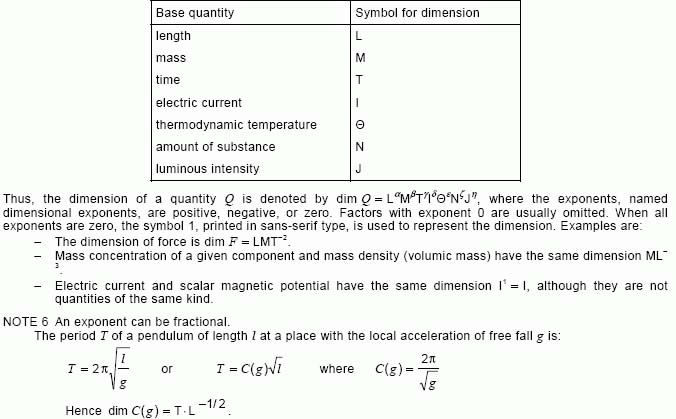
NOTE 2 – The conventional symbolic representation of the dimension of a base quantity is a single upper case letter in roman (upright) sans-serif type. The conventional symbolic representation of the dimension of a derived quantity is the product of powers of the dimensions of the base quantities according to the definition of the derived quantity. The dimension of a quantity Q is denoted by dim Q.
NOTE 3 – In deriving the dimension of a quantity, no account is taken of its scalar, vector or tensor character.
NOTE 4 – In a given system of quantities, – quantities of the same kind have the same dimension, – quantities of different dimensions are always of different kinds, and – quantities having the same dimension are not necessarily of the same kind. For example, in the ISQ, pressure and energy density (volumic energy) have the same dimension L–1MT–2. See also note 5.
NOTE 5 – In the International System of Quantities (ISQ), the symbols representing the dimensions of the base quantities are:
[IEV number 112-01-11]FR
dimension, f
dimension d'une grandeur, f
expression de la dépendance d’une grandeur par rapport aux grandeurs de base d'un système de grandeurs sous la forme d'un produit de puissances de facteurs correspondant aux grandeurs de base, en omettant tout facteur numérique
NOTE 1 – Une puissance d'un facteur est le facteur muni d'un exposant. Chaque facteur exprime la dimension d'une grandeur de base.
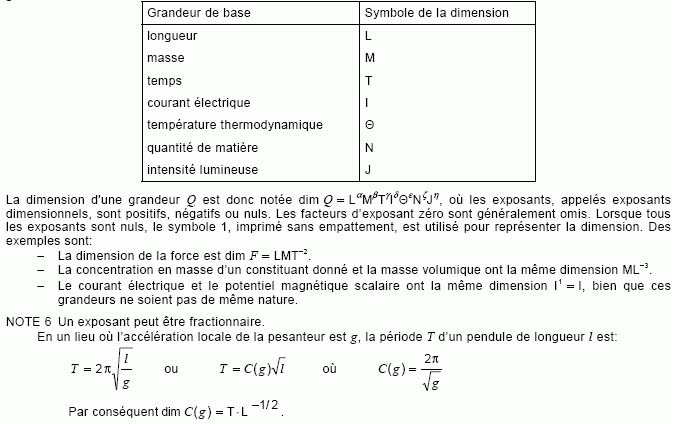
NOTE 2 – Par convention, la représentation symbolique de la dimension d'une grandeur de base est une lettre majuscule unique en caractère romain (droit) sans empattement. Par convention, la représentation symbolique de la dimension d'une grandeur dérivée est le produit de puissances des dimensions des grandeurs de base conformément à la définition de la grandeur dérivée. La dimension de la grandeur Q est notée dim Q.
NOTE 3 – Pour établir la dimension d'une grandeur, on ne tient pas compte du caractère scalaire, vectoriel ou tensoriel.
NOTE 4 – Dans un système de grandeurs donné, – les grandeurs de même nature ont la même dimension, – des grandeurs de dimensions différentes sont toujours de nature différente, – des grandeurs ayant la même dimension ne sont pas nécessairement de même nature. Par exemple, dans l'ISQ, la pression et l'énergie volumique ont la même dimension L–1MT–2. Voir aussi la note 5.
NOTE 5 – Dans le Système international de grandeurs (ISQ), les symboles représentant les dimensions des grandeurs de base sont:
[IEV number 112-01-11]Тематики
- метрология, основные понятия
Синонимы
EN
DE
- Dimension einer Grösse
- Dimension, f
- Größendimension, f
FR
- dimension d'une grandeur, f
- dimension, f
Немецко-русский словарь нормативно-технической терминологии > Dimension einer Grösse
-
7 Dimension, f
размерность физической величины
размерность величины
Выражение в форме степенного одночлена, составленного из произведений символов основных физических величин в различных степенях и отражающее связь данной физической величины с физическими величинами, принятыми в данной системе величин за основные с коэффициентом пропорциональности, равным 1.
Примечания
1. Степени символов основных величин, входящих в одночлен, в зависимости от связи рассматриваемой физической величины с основными, могут быть целыми, дробными, положительными и отрицательными. Понятие размерность распространяется и на основные величины. Размерность основной величины в отношении самой себя равна единице, т.е. формула размерности основной величины совпадает с ее символом.
2. В соответствии с международным стандартом ИСО 31/0, размерность величин следует обозначать знаком dim [2]. В системе величин LMT размерность величины.x будет: dim х = LlMmTt, где L, М, Т - символы, величин, принятых за основные (соответственно длины, массы, времени).
[РМГ 29-99]EN
dimension of a quantity
quantity dimension
dimension
expression of the dependence of a quantity on the base quantities of a system of quantities as a product of powers of factors corresponding to the base quantities, omitting any numerical factor
NOTE 1 – A power of a factor is the factor raised to an exponent. Each factor is the dimension of a base quantity.
NOTE 2 – The conventional symbolic representation of the dimension of a base quantity is a single upper case letter in roman (upright) sans-serif type. The conventional symbolic representation of the dimension of a derived quantity is the product of powers of the dimensions of the base quantities according to the definition of the derived quantity. The dimension of a quantity Q is denoted by dim Q.
NOTE 3 – In deriving the dimension of a quantity, no account is taken of its scalar, vector or tensor character.
NOTE 4 – In a given system of quantities, – quantities of the same kind have the same dimension, – quantities of different dimensions are always of different kinds, and – quantities having the same dimension are not necessarily of the same kind. For example, in the ISQ, pressure and energy density (volumic energy) have the same dimension L–1MT–2. See also note 5.
NOTE 5 – In the International System of Quantities (ISQ), the symbols representing the dimensions of the base quantities are:
[IEV number 112-01-11]FR
dimension, f
dimension d'une grandeur, f
expression de la dépendance d’une grandeur par rapport aux grandeurs de base d'un système de grandeurs sous la forme d'un produit de puissances de facteurs correspondant aux grandeurs de base, en omettant tout facteur numérique
NOTE 1 – Une puissance d'un facteur est le facteur muni d'un exposant. Chaque facteur exprime la dimension d'une grandeur de base.
NOTE 2 – Par convention, la représentation symbolique de la dimension d'une grandeur de base est une lettre majuscule unique en caractère romain (droit) sans empattement. Par convention, la représentation symbolique de la dimension d'une grandeur dérivée est le produit de puissances des dimensions des grandeurs de base conformément à la définition de la grandeur dérivée. La dimension de la grandeur Q est notée dim Q.
NOTE 3 – Pour établir la dimension d'une grandeur, on ne tient pas compte du caractère scalaire, vectoriel ou tensoriel.
NOTE 4 – Dans un système de grandeurs donné, – les grandeurs de même nature ont la même dimension, – des grandeurs de dimensions différentes sont toujours de nature différente, – des grandeurs ayant la même dimension ne sont pas nécessairement de même nature. Par exemple, dans l'ISQ, la pression et l'énergie volumique ont la même dimension L–1MT–2. Voir aussi la note 5.
NOTE 5 – Dans le Système international de grandeurs (ISQ), les symboles représentant les dimensions des grandeurs de base sont:
[IEV number 112-01-11]Тематики
- метрология, основные понятия
Синонимы
EN
DE
- Dimension einer Grösse
- Dimension, f
- Größendimension, f
FR
- dimension d'une grandeur, f
- dimension, f
Немецко-русский словарь нормативно-технической терминологии > Dimension, f
-
8 Größendimension, f
размерность физической величины
размерность величины
Выражение в форме степенного одночлена, составленного из произведений символов основных физических величин в различных степенях и отражающее связь данной физической величины с физическими величинами, принятыми в данной системе величин за основные с коэффициентом пропорциональности, равным 1.
Примечания
1. Степени символов основных величин, входящих в одночлен, в зависимости от связи рассматриваемой физической величины с основными, могут быть целыми, дробными, положительными и отрицательными. Понятие размерность распространяется и на основные величины. Размерность основной величины в отношении самой себя равна единице, т.е. формула размерности основной величины совпадает с ее символом.
2. В соответствии с международным стандартом ИСО 31/0, размерность величин следует обозначать знаком dim [2]. В системе величин LMT размерность величины.x будет: dim х = LlMmTt, где L, М, Т - символы, величин, принятых за основные (соответственно длины, массы, времени).
[РМГ 29-99]EN
dimension of a quantity
quantity dimension
dimension
expression of the dependence of a quantity on the base quantities of a system of quantities as a product of powers of factors corresponding to the base quantities, omitting any numerical factor
NOTE 1 – A power of a factor is the factor raised to an exponent. Each factor is the dimension of a base quantity.
NOTE 2 – The conventional symbolic representation of the dimension of a base quantity is a single upper case letter in roman (upright) sans-serif type. The conventional symbolic representation of the dimension of a derived quantity is the product of powers of the dimensions of the base quantities according to the definition of the derived quantity. The dimension of a quantity Q is denoted by dim Q.
NOTE 3 – In deriving the dimension of a quantity, no account is taken of its scalar, vector or tensor character.
NOTE 4 – In a given system of quantities, – quantities of the same kind have the same dimension, – quantities of different dimensions are always of different kinds, and – quantities having the same dimension are not necessarily of the same kind. For example, in the ISQ, pressure and energy density (volumic energy) have the same dimension L–1MT–2. See also note 5.
NOTE 5 – In the International System of Quantities (ISQ), the symbols representing the dimensions of the base quantities are:
[IEV number 112-01-11]FR
dimension, f
dimension d'une grandeur, f
expression de la dépendance d’une grandeur par rapport aux grandeurs de base d'un système de grandeurs sous la forme d'un produit de puissances de facteurs correspondant aux grandeurs de base, en omettant tout facteur numérique
NOTE 1 – Une puissance d'un facteur est le facteur muni d'un exposant. Chaque facteur exprime la dimension d'une grandeur de base.
NOTE 2 – Par convention, la représentation symbolique de la dimension d'une grandeur de base est une lettre majuscule unique en caractère romain (droit) sans empattement. Par convention, la représentation symbolique de la dimension d'une grandeur dérivée est le produit de puissances des dimensions des grandeurs de base conformément à la définition de la grandeur dérivée. La dimension de la grandeur Q est notée dim Q.
NOTE 3 – Pour établir la dimension d'une grandeur, on ne tient pas compte du caractère scalaire, vectoriel ou tensoriel.
NOTE 4 – Dans un système de grandeurs donné, – les grandeurs de même nature ont la même dimension, – des grandeurs de dimensions différentes sont toujours de nature différente, – des grandeurs ayant la même dimension ne sont pas nécessairement de même nature. Par exemple, dans l'ISQ, la pression et l'énergie volumique ont la même dimension L–1MT–2. Voir aussi la note 5.
NOTE 5 – Dans le Système international de grandeurs (ISQ), les symboles représentant les dimensions des grandeurs de base sont:
[IEV number 112-01-11]Тематики
- метрология, основные понятия
Синонимы
EN
DE
- Dimension einer Grösse
- Dimension, f
- Größendimension, f
FR
- dimension d'une grandeur, f
- dimension, f
Немецко-русский словарь нормативно-технической терминологии > Größendimension, f
-
9 Brennstoff aus Müll
- топливо, произведенное из отходов
топливо, произведенное из отходов
—
[ http://www.eionet.europa.eu/gemet/alphabetic?langcode=en]EN
refuse derived fuel
Fuel produced from domestic refuse, after glass and metals have been removed from it, by compressing it to form briquettes used to fuel boilers. (Source: PORT)
[http://www.eionet.europa.eu/gemet/alphabetic?langcode=en]Тематики
EN
DE
FR
Немецко-русский словарь нормативно-технической терминологии > Brennstoff aus Müll
-
10 Anlasser mit Spartransformator
автотрансформаторный пускатель
Пускатель для асинхронного двигателя, использующий для его запуска одно или несколько пониженных напряжений, отводимых от автотрансформатора.
(МЭС 441-14-45)
[ ГОСТ Р 50030.4.1-2002 (МЭК 60947-4-1-2000)]EN
auto-transformer starter
starter for an induction motor which uses for starting one or more reduced voltages derived from an auto-transformer
NOTE - An auto-transformer is defined as follows in 3.1.2 of IEC 60076-1: “A transformer in which at least two windings have a common part."
[IEV number 441-14-45]
[IEC 60947-4-1, ed. 3.0 (2009-09)]FR
démarreur par autotransformateur
démarreur pour moteur à induction qui utilise pour le démarrage une ou plusieurs tensions réduites prélevées sur un autotransformateur
NOTE - Un autotransformateur est défini comme suit au 3.1.2 de la CEI 60076-1: «transformateur dont au moins deux enroulements ont une partie commune.»
[IEV number 441-14-45]
[IEC 60947-4-1, ed. 3.0 (2009-09)]Тематики
- аппарат, изделие, устройство...
- контакторы и пускатели
EN
DE
FR
Немецко-русский словарь нормативно-технической терминологии > Anlasser mit Spartransformator
-
11 Amin
амин
—
[ http://www.eionet.europa.eu/gemet/alphabetic?langcode=en]EN
amine
One of a class of organic compounds which can be considered to be derived from ammonia by replacement of one or more hydrogens by organic radicals. (Source: MGH)
[http://www.eionet.europa.eu/gemet/alphabetic?langcode=en]Тематики
EN
DE
FR
Немецко-русский словарь нормативно-технической терминологии > Amin
-
12 terrestrische biologische Ressourcen
биологические ресурсы суши
—
[ http://www.eionet.europa.eu/gemet/alphabetic?langcode=en]EN
terrestrial biological resource
Any source of supply derived from plants, animals or other wildlife inhabiting land or ground, which may be used by humans for food, clothes and other necessities. (Source: RHW)
[http://www.eionet.europa.eu/gemet/alphabetic?langcode=en]Тематики
EN
DE
FR
Немецко-русский словарь нормативно-технической терминологии > terrestrische biologische Ressourcen
-
13 Haushaltsabwasser
бытовые жидкие отходы
—
[ http://www.eionet.europa.eu/gemet/alphabetic?langcode=en]EN
domestic waste water
Wastewater principally derived from households, business buildings, institutions, etc., which may or may not contain surface runoff, groundwater or storm water. (Source: WWC)
[http://www.eionet.europa.eu/gemet/alphabetic?langcode=en]Тематики
EN
DE
FR
Немецко-русский словарь нормативно-технической терминологии > Haushaltsabwasser
-
14 Industrieabwasser
воды сточные производственные
Сточные воды, образующиеся в результате технологических процессов и подлежащие удалению с территории предприятий
[Терминологический словарь по строительству на 12 языках (ВНИИИС Госстроя СССР)]Тематики
EN
DE
FR
промышленные стоки
—
[ http://www.eionet.europa.eu/gemet/alphabetic?langcode=en]EN
industrial effluent
Materials generally discarded from industrial operations or derived from manufacturing processes. (Source: LANDY)
[http://www.eionet.europa.eu/gemet/alphabetic?langcode=en]Тематики
EN
DE
FR
Немецко-русский словарь нормативно-технической терминологии > Industrieabwasser
-
15 energiebedingte Umweltbelastung
воздействие производства энергии на окружающую среду
—
[ http://www.eionet.europa.eu/gemet/alphabetic?langcode=en]EN
environmental impact of energy
Energy and environmental problems are closely related, since it is nearly impossible to produce, transport, or consume energy without significant environmental impact. The environmental problems directly related to energy production and consumption include air pollution, water pollution, thermal pollution, and solid waste disposal. The emission of air pollutants from fossil fuel combustion is the major cause of urban air pollution. Diverse water pollution problems are associated with energy usage. One major problem is oil spills. In all petroleum-handling operations, there is a finite probability of spilling oil either on the earth or in a body of water. Coal mining can also pollute water. Changes in groundwater flow produced by mining operations often bring otherwise unpolluted waters into contact with certain mineral materials which are leached from the soil and produce an acid mine drainage. Solid waste is also a by-product of some forms of energy usage. Coal mining requires the removal of large quantities of earth as well as coal. In general, environmental problems increase with energy use and this combined with the limited energy resource base is the crux of the energy crisis. An energy impact assessment should compare these costs with the benefits to be derived from energy use. (Source: RAU)
[http://www.eionet.europa.eu/gemet/alphabetic?langcode=en]Тематики
EN
DE
FR
Немецко-русский словарь нормативно-технической терминологии > energiebedingte Umweltbelastung
-
16 Sekundärrelais
вторичное электрическое реле
Электрическое реле, которое возбуждает ся током или напряжением с помощью измерительного трансформатора или пре образователя
[ ГОСТ 16022-83]EN
secondary relay
measuring relay energized by the quantity (e.g. electric current or voltage) derived from an instrument transformer or transducer
[IEC 60255-1, ed. 1.0 (2009-08)]FR
relais secondaire
relais de mesure alimenté par la grandeur (par exemple le courant électrique ou la tension) issue d’un transformateur de mesure ou d’un transducteur
[IEC 60255-1, ed. 1.0 (2009-08)]Тематики
EN
DE
FR
18. Вторичное электрическое реле
D. Sekundärrelais
E. Secondary relay
F. Relais secondaire
Электрическое реле, которое возбуждается током или напряжением с помощью измерительного трансформатора или преобразователя
Источник: ГОСТ 16022-83: Реле электрические. Термины и определения оригинал документа
Немецко-русский словарь нормативно-технической терминологии > Sekundärrelais
-
17 Stadtökologie
городская экология
—
[ http://www.eionet.europa.eu/gemet/alphabetic?langcode=en]EN
urban ecology
Concept derived from biology: the city is viewed as a total environment, as a life-supporting system for the large number of people concentrated there, and within this people organize themselves and adapt to a constantly changing environment. Regarded as the same as human ecology. (Source: GOOD)
[http://www.eionet.europa.eu/gemet/alphabetic?langcode=en]Тематики
EN
DE
FR
Немецко-русский словарь нормативно-технической терминологии > Stadtökologie
-
18 Umwelterklärung (Ökoaudit)
заключение по состоянию окружающей среды (экоаудит)
—
[ http://www.eionet.europa.eu/gemet/alphabetic?langcode=en]EN
environmental statement (eco-audit)
Assessment made by a company or organization of the financial benefits and disadvantages to be derived from adopting a more environmentally sound policy. (Source: PHC)
[http://www.eionet.europa.eu/gemet/alphabetic?langcode=en]Тематики
EN
DE
FR
Немецко-русский словарь нормативно-технической терминологии > Umwelterklärung (Ökoaudit)
-
19 Teernutzung
использование дегтя
—
[ http://www.eionet.europa.eu/gemet/alphabetic?langcode=en]EN
tar use
Any employment or utilization of dark, heavy, viscous substances or residue derived from the distillation of certain organic materials, often to produce benzene, soap, dyes, cosmetics and other products. (Source: ENC)
[http://www.eionet.europa.eu/gemet/alphabetic?langcode=en]Тематики
EN
DE
FR
Немецко-русский словарь нормативно-технической терминологии > Teernutzung
-
20 Ausbeutung des Meeresgrundes
использование ресурсов морского дна
—
[ http://www.eionet.europa.eu/gemet/alphabetic?langcode=en]EN
sea bed exploitation
Marine mineral resources extend far beyond those presently exploited; minerals are derived from two separate types of marine sources: from sedimentary deposits underlying the continental shelves and from inshore deposits on the surface of the continental shelves. By far the most valuable of the mineral resources exploited from marine environments is petroleum. Offshore placer deposits on the surface of the continental shelves yield gold, platinum, and tin. On the floors of the world's oceans manganese nodules are found as a result of pelagic sedimentation or precipitation; they are small, irregular, black to brown, friable, laminated concretionary masses consisting primarily of manganese salts and manganese-oxide minerals. (Source: PARCOR / BJGEO)
[http://www.eionet.europa.eu/gemet/alphabetic?langcode=en]Тематики
EN
DE
FR
Немецко-русский словарь нормативно-технической терминологии > Ausbeutung des Meeresgrundes
См. также в других словарях:
derived — UK US /dɪˈraɪvd/ adjective ► coming from or caused by something else: »derived products … Financial and business terms
derived — derived; un·derived; … English syllables
derived — index derivative, secondary Burton s Legal Thesaurus. William C. Burton. 2006 … Law dictionary
Derived — In phylogenetics, a trait is derived if it is present in an organism, but was absent in the last common ancestor of the group being considered.For the sake of precision, the term derived is preferred to advanced, a term which may inaccurately… … Wikipedia
Derived — Derive De*rive , v. t. [imp. & p. p. {Derived}; p. pr. & vb. n. {Deriving}.] [F. d[ e]river, L. derivare; de + rivus stream, brook. See {Rival}.] 1. To turn the course of, as water; to divert and distribute into subordinate channels; to diffuse;… … The Collaborative International Dictionary of English
derived — adjective Date: 1969 being, possessing, or marked by a character (as the large brain in humans) not present in the ancestral form < derived features > … New Collegiate Dictionary
derived — a character or character state not present in the ancestral stock; apomorphic. The term should not be applied to organisms or taxa since they are a mix of plesiomorphic and derived character states … Dictionary of ichthyology
derived — adjective a) Of, or pertaining to, conditions unique to the descendant species of a clade, and not found in earlier ancestral species. The French language is derived from Latin. b) Possessing features believed to be more advanced or improved than … Wiktionary
derived — adjective formed or developed from something else; not original (Freq. 1) the belief that classes and organizations are secondary and derived John Dewey • Ant: ↑underived • Similar to: ↑derivable, ↑derivative, ↑plagiaristic, ↑ … Useful english dictionary
Derived demand — is a term in economics, where demand for one good or service occurs as a result of demand for another. This may occur as the former is a part of production of the second. For example, demand for coal leads to derived demand for mining, as coal… … Wikipedia
derived demand — ➔ demand * * * derived demand UK US noun [C or U] ► ECONOMICS demand for something such as a material or skill, that is based on demand for something produced from it: »A car manufacturer will have a derived demand for manufacturing equipment,… … Financial and business terms
