

-
1 тип энергии
тип энергии
—
[ http://www.eionet.europa.eu/gemet/alphabetic?langcode=en]EN
energy type
According to the source, energy can be classified as hydroenergy, solar energy, tidal energy, wind energy, waves energy, geothermal energy, etc. According to the type of fuel used for its production, energy can be classified as nuclear energy, coal derived energy, petroleum derived energy, biomass derived energy, etc. (Source: RRDA)
[http://www.eionet.europa.eu/gemet/alphabetic?langcode=en]Тематики
EN
DE
FR
Русско-немецкий словарь нормативно-технической терминологии > тип энергии
-
2 размерность физической величины
- Größendimension, f
- Dimension, f
- Dimension einer Grösse
- Dimension einer GroBe
размерность физической величины
размерность величины
Выражение в форме степенного одночлена, составленного из произведений символов основных физических величин в различных степенях и отражающее связь данной физической величины с физическими величинами, принятыми в данной системе величин за основные с коэффициентом пропорциональности, равным 1.
Примечания
1. Степени символов основных величин, входящих в одночлен, в зависимости от связи рассматриваемой физической величины с основными, могут быть целыми, дробными, положительными и отрицательными. Понятие размерность распространяется и на основные величины. Размерность основной величины в отношении самой себя равна единице, т.е. формула размерности основной величины совпадает с ее символом.
2. В соответствии с международным стандартом ИСО 31/0, размерность величин следует обозначать знаком dim [2]. В системе величин LMT размерность величины.x будет: dim х = LlMmTt, где L, М, Т - символы, величин, принятых за основные (соответственно длины, массы, времени).
[РМГ 29-99]EN
dimension of a quantity
quantity dimension
dimension
expression of the dependence of a quantity on the base quantities of a system of quantities as a product of powers of factors corresponding to the base quantities, omitting any numerical factor
NOTE 1 – A power of a factor is the factor raised to an exponent. Each factor is the dimension of a base quantity.
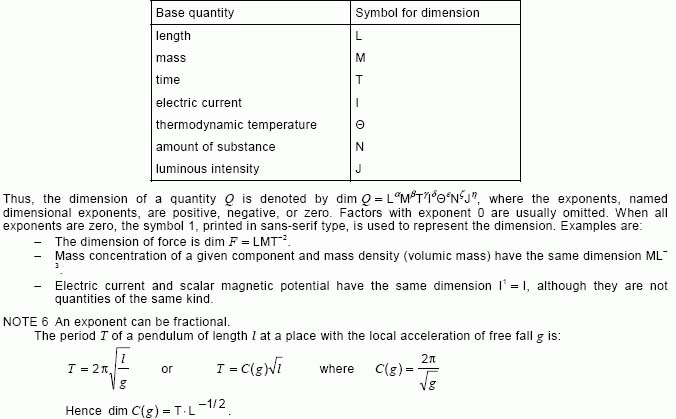
NOTE 2 – The conventional symbolic representation of the dimension of a base quantity is a single upper case letter in roman (upright) sans-serif type. The conventional symbolic representation of the dimension of a derived quantity is the product of powers of the dimensions of the base quantities according to the definition of the derived quantity. The dimension of a quantity Q is denoted by dim Q.
NOTE 3 – In deriving the dimension of a quantity, no account is taken of its scalar, vector or tensor character.
NOTE 4 – In a given system of quantities, – quantities of the same kind have the same dimension, – quantities of different dimensions are always of different kinds, and – quantities having the same dimension are not necessarily of the same kind. For example, in the ISQ, pressure and energy density (volumic energy) have the same dimension L–1MT–2. See also note 5.
NOTE 5 – In the International System of Quantities (ISQ), the symbols representing the dimensions of the base quantities are:
[IEV number 112-01-11]FR
dimension, f
dimension d'une grandeur, f
expression de la dépendance d’une grandeur par rapport aux grandeurs de base d'un système de grandeurs sous la forme d'un produit de puissances de facteurs correspondant aux grandeurs de base, en omettant tout facteur numérique
NOTE 1 – Une puissance d'un facteur est le facteur muni d'un exposant. Chaque facteur exprime la dimension d'une grandeur de base.
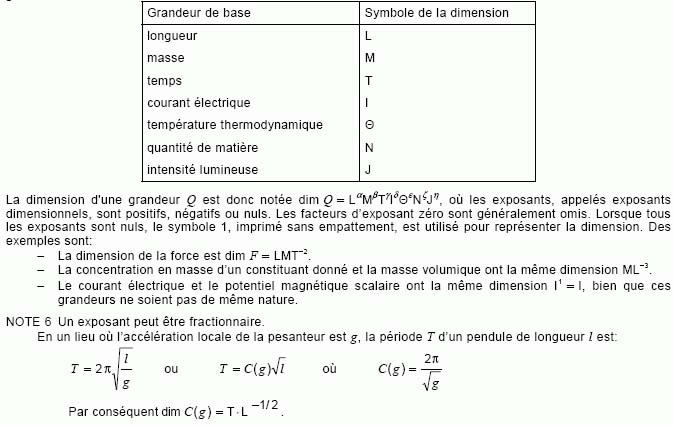
NOTE 2 – Par convention, la représentation symbolique de la dimension d'une grandeur de base est une lettre majuscule unique en caractère romain (droit) sans empattement. Par convention, la représentation symbolique de la dimension d'une grandeur dérivée est le produit de puissances des dimensions des grandeurs de base conformément à la définition de la grandeur dérivée. La dimension de la grandeur Q est notée dim Q.
NOTE 3 – Pour établir la dimension d'une grandeur, on ne tient pas compte du caractère scalaire, vectoriel ou tensoriel.
NOTE 4 – Dans un système de grandeurs donné, – les grandeurs de même nature ont la même dimension, – des grandeurs de dimensions différentes sont toujours de nature différente, – des grandeurs ayant la même dimension ne sont pas nécessairement de même nature. Par exemple, dans l'ISQ, la pression et l'énergie volumique ont la même dimension L–1MT–2. Voir aussi la note 5.
NOTE 5 – Dans le Système international de grandeurs (ISQ), les symboles représentant les dimensions des grandeurs de base sont:
[IEV number 112-01-11]Тематики
- метрология, основные понятия
Синонимы
EN
DE
- Dimension einer Grösse
- Dimension, f
- Größendimension, f
FR
- dimension d'une grandeur, f
- dimension, f
2.9. Размерность физической величины
Размерность величины Нрк. Формула размерности
D. Dimension einer GroBe
E. Dimensions of a quantity
F. Dimension d’une grandeur
Выражение, отражающее связь величины с основными величинами системы, в котором коэффициент пропорциональности принят равным 1.
Примечания:
1. Размерность величины представляет собой произведение основных величин, возведенных в соответствующие степени.
2. Размерность производной величины отражает, во сколько раз изменяется ее размер при изменении размеров основных величин, например, если размерность величины х равна LaM^Tv и длина изменяется от / до /', масса — от m до т' и время — от t до то новый размер величины будет больше прежнего в (/'//)а
(/'//)v раз.
Источник: ГОСТ 16263-70: Государственная система обеспечения единства измерений. Метрология. Термины и определения оригинал документа
Русско-немецкий словарь нормативно-технической терминологии > размерность физической величины
-
3 микроэкосистема
микроэкосистема
—
[ http://www.eionet.europa.eu/gemet/alphabetic?langcode=en]EN
microecosystem
A small-scale, simplified, experimental ecosystem, laboratory- or field- based, which may be: a) derived directly from nature (e.g. when samples of pond water are maintained subsequently by the input of artificial light and gas-exchange); or b) built up from axenic cultures (a culture of an organism that consists of one type of organism only, i.e. that is free from any contaminating organism) until the required conditions of organisms and environment are achieved. Also known as microcosm. (Source: ALL2)
[http://www.eionet.europa.eu/gemet/alphabetic?langcode=en]Тематики
EN
DE
FR
Русско-немецкий словарь нормативно-технической терминологии > микроэкосистема
См. также в других словарях:
Derived type — In computer science, derived type can mean: a composite data type, one built out of other types a subtype or derived class This disambiguation page lists articles associated with the same title. If an … Wikipedia
Type system — Type systems Type safety Inferred vs. Manifest Dynamic vs. Static Strong vs. Weak Nominal vs. Structural Dependent typing Duck typing Latent typing Linear typing Uniqueness typing … Wikipedia
Type 5 cannon — Type 5 was a Japanese Navy autocannon used near the end of World War II. It was an indigenous design with better performance than Oerlikon derived Type 2 or Browning derived Ho 155, although it was considerably heavier.pecifications*Caliber: 30… … Wikipedia
Type polymorphism — In computer science, polymorphism is a programming language feature that allows values of different data types to be handled using a uniform interface. The concept of parametric polymorphism applies to both data types and functions. A function… … Wikipedia
Type inference — Type inference, or implicit typing, refers to the ability to deduce automatically the type of a value in a programming language. It is a feature present in some strongly statically typed languages. It is often characteristic of but not limited to … Wikipedia
Type 97 Chi-Ha — tank at Yasukuni Shrine Museum Place of origin … Wikipedia
Type — Type, n. [F. type; cf. It. tipo, from L. typus a figure, image, a form, type, character, Gr. ? the mark of a blow, impression, form of character, model, from the root of ? to beat, strike; cf. Skr. tup to hurt.] [1913 Webster] 1. The mark or… … The Collaborative International Dictionary of English
Type founder — Type Type, n. [F. type; cf. It. tipo, from L. typus a figure, image, a form, type, character, Gr. ? the mark of a blow, impression, form of character, model, from the root of ? to beat, strike; cf. Skr. tup to hurt.] [1913 Webster] 1. The mark or … The Collaborative International Dictionary of English
Type foundery — Type Type, n. [F. type; cf. It. tipo, from L. typus a figure, image, a form, type, character, Gr. ? the mark of a blow, impression, form of character, model, from the root of ? to beat, strike; cf. Skr. tup to hurt.] [1913 Webster] 1. The mark or … The Collaborative International Dictionary of English
Type foundry — Type Type, n. [F. type; cf. It. tipo, from L. typus a figure, image, a form, type, character, Gr. ? the mark of a blow, impression, form of character, model, from the root of ? to beat, strike; cf. Skr. tup to hurt.] [1913 Webster] 1. The mark or … The Collaborative International Dictionary of English
Type metal — Type Type, n. [F. type; cf. It. tipo, from L. typus a figure, image, a form, type, character, Gr. ? the mark of a blow, impression, form of character, model, from the root of ? to beat, strike; cf. Skr. tup to hurt.] [1913 Webster] 1. The mark or … The Collaborative International Dictionary of English
