

-
21 посадка напряжения
посадка напряжения
Внезапное значительное снижение напряжения в системе электроснабжения.
[ ГОСТ 23875-88]EN
voltage collapse
sudden decrease in voltage leading to loss of voltage in the whole or a part of a power system
NOTE – A cascading tripping of generating units and/or transmission lines usually occurs during voltage collapse.
[IEV number 604-01-22 ]
voltage depression
system condition characterized by a sustained and significant lowering of voltage in the whole or part of a power system
[IEV number 604-01-44]FR
écroulement de la tension
baisse soudaine de la tension conduisant à la disparition de la tension dans tout ou partie d'un réseau d'énergie électrique
NOTE – Des déclenchements en cascade d'unités de production et/ou de lignes de transport d'énergie électrique se produisent généralement lors d'un écroulement de la tension.
[IEV number 604-01-22 ]
baisse profonde de la tension
état d'un réseau d'énergie électrique caractérisé par une baisse durable et significative de la tension dans tout ou partie du réseau
[IEV number 604-01-44]Тематики
EN
DE
FR
Смотри также
D. Spannungszusammenbruch
E. Voltage depression (voltage collapse)
F. Effondrement de la tension
Внезапное значительное снижение напряжения в системе электроснабжения
Источник: ГОСТ 23875-88: Качество электрической энергии. Термины и определения оригинал документа
Русско-французский словарь нормативно-технической терминологии > посадка напряжения
22 падение напряжения
1) General subject: decrease in current2) Aviation: power failure3) Naval: pressure fall4) Engineering: differential voltage, fall of potential, loss of voltage, volt drop, voltage drop, voltage loss5) Railway term: lost volts, pressure drop6) Automobile industry: pickoff7) Information technology: power outage8) Oil: drop of potential, potential drop9) Automation: absorbed voltage (напр. на магнитном усилителе)10) Makarov: difference of voltage, drop11) Energy system: bucking12) Electrochemistry: IR drop, current drop13) Electricity: sag (Мгновенное 15-100%-ное снижение напряжения источника переменного тока.)14) Electrical engineering: drop in voltage, loss in voltageУниверсальный русско-английский словарь > падение напряжения
23 baisse profonde de la tension
посадка напряжения
Внезапное значительное снижение напряжения в системе электроснабжения.
[ ГОСТ 23875-88]EN
voltage collapse
sudden decrease in voltage leading to loss of voltage in the whole or a part of a power system
NOTE – A cascading tripping of generating units and/or transmission lines usually occurs during voltage collapse.
[IEV number 604-01-22 ]
voltage depression
system condition characterized by a sustained and significant lowering of voltage in the whole or part of a power system
[IEV number 604-01-44]FR
écroulement de la tension
baisse soudaine de la tension conduisant à la disparition de la tension dans tout ou partie d'un réseau d'énergie électrique
NOTE – Des déclenchements en cascade d'unités de production et/ou de lignes de transport d'énergie électrique se produisent généralement lors d'un écroulement de la tension.
[IEV number 604-01-22 ]
baisse profonde de la tension
état d'un réseau d'énergie électrique caractérisé par une baisse durable et significative de la tension dans tout ou partie du réseau
[IEV number 604-01-44]Тематики
EN
DE
FR
Смотри также
Франко-русский словарь нормативно-технической терминологии > baisse profonde de la tension
24 Spannungsabsenkung
посадка напряжения
Внезапное значительное снижение напряжения в системе электроснабжения.
[ ГОСТ 23875-88]EN
voltage collapse
sudden decrease in voltage leading to loss of voltage in the whole or a part of a power system
NOTE – A cascading tripping of generating units and/or transmission lines usually occurs during voltage collapse.
[IEV number 604-01-22 ]
voltage depression
system condition characterized by a sustained and significant lowering of voltage in the whole or part of a power system
[IEV number 604-01-44]FR
écroulement de la tension
baisse soudaine de la tension conduisant à la disparition de la tension dans tout ou partie d'un réseau d'énergie électrique
NOTE – Des déclenchements en cascade d'unités de production et/ou de lignes de transport d'énergie électrique se produisent généralement lors d'un écroulement de la tension.
[IEV number 604-01-22 ]
baisse profonde de la tension
état d'un réseau d'énergie électrique caractérisé par une baisse durable et significative de la tension dans tout ou partie du réseau
[IEV number 604-01-44]Тематики
EN
DE
FR
Смотри также
Немецко-русский словарь нормативно-технической терминологии > Spannungsabsenkung
25 DOL
- эффект операционного рычага
- пускатель прямого действия
- прямой пуск вращающегося электродвигателя
- Министерство труда (США)
- концентрация растворённого кислорода
концентрация растворённого кислорода
—
[А.С.Гольдберг. Англо-русский энергетический словарь. 2006 г.]Тематики
EN
Министерство труда (США)
—
[А.С.Гольдберг. Англо-русский энергетический словарь. 2006 г.]Тематики
EN
прямой пуск вращающегося электродвигателя
Пуск вращающегося электродвигателя путем непосредственного подключения его к питающей сети.
[ ГОСТ 27471-87]EN
direct-on-line starting
across-the-line starting (US)
the process of starting a motor by connecting it directly to the supply at rated voltage
[IEV number 411-52-15]FR
démarrage direct
mode de démarrage d'un moteur, consistant à lui appliquer directement sa pleine tension assignée
[IEV number 411-52-15]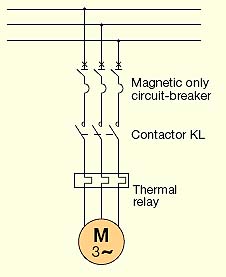
Рис. ABB
Схема прямого пуска электродвигателяMagnetic only circuit-breaker - Автоматический выключатель с электромагнитным расцепителем
Contactor KL - Контактор KL
Thermal relay - Тепловое реле
Параллельные тексты EN-RU
Direct-on-line starting
Direct-on-line starting, which is often abbreviated as DOL, is perhaps the most traditional system and consists in connecting the motor directly to the supply network, thus carrying out starting at full voltage.Direct-on-line starting represents the simplest and the most economical system to start a squirrel-cage asynchronous motor and it is the most used.
As represented in Figure 5, it provides the direct connection to the supply network and therefore starting is carried out at full voltage and with constant frequency, developing a high starting torque with very reduced acceleration times.
The typical applications are relevant to small power motors also with full load starting.
These advantages are linked to some problems such as, for example, the high inrush current, which - in the first instants - can reach values of about 10 to 12 times the rated current, then can decrease to about 6 to 8 times the rated current and can persist to reach the maximum torque speed.The effects of such currents can be identified with the high electro-dynamical stresses on the motor connection cables and could affect also the windings of the motor itself; besides, the high inrush torques can cause violent accelerations which stress the transmission components (belts and joints) generating distribution problems with a reduction in the mechanical life of these elements.
Finally, also the possible electrical problems due to voltage drops on the supply line of the motor or of the connected equipment must be taken into consideration.
[ABB]Прямой пуск
Прямой пуск, который по-английски часто сокращенно обозначают как DOL, является, пожалуй наиболее распространенным способом пуска. Он заключается в непосредственном (т. е. прямом) подключении двигателя к питающей сети. Это означает, что пуск двигателя осуществляется при полном напряжении.Схема прямого пуска является наиболее простым, экономичным и чаще всего применяемым решением для электродвигателей с короткозамкнутым ротором.
Схема прямого подключения к сети представлена на рисунке 5. Пуск осуществляется при полном напряжении и постоянной частоте сети. Электродвигатель развивает высокий пусковой момент при коротком времени разгона.
Типичные области применения – маломощные электродвигатели, в том числе с пуском при полной нагрузке.
Однако, наряду с преимуществами имеются и определенные недостатки, например, бросок пускового тока, достигающий в первоначальный момент 10…12-кратного значения от номинального тока электродвигателя. Затем ток двигателя уменьшается примерно до 6…8-кратного значения номинального тока и будет держаться на этом уровне до тех пор, пока скорость двигателя не достигнет максимального значения.
Такое изменение тока оказывает значительное электродинамическое воздействие на кабель, подключенный к двигателю. Кроме того пусковой ток воздействует на обмотки двигателя. Высокий начальный пусковой момент может привести к значительному ускорению и следовательно к значительной нагрузке элементов привода (ремней, крепления узлов), что вызывает сокращение их срока службы.
И, наконец, следует принять во внимание возможное возникновение проблем, связанных с падением напряжения в линии питания двигателя и подключенного к этой линии оборудования.
[Перевод Интент]
Тематики
Синонимы
EN
- across-the-line starting (US)
- direct line starting
- direct operation of a motor
- direct starting
- direct-on-line starting
- DOL
- full voltage starter application
DE
FR
пускатель прямого действия
Пускатель, одноступенчато подающий сетевое напряжение на выводы двигателя.
(МЭС 441-14-40)
[ ГОСТ Р 50030.4.1-2002 (МЭК 60947-4-1-2000)]
Пускатели переменного тока для прямого непосредственного пуска (с полным напряжением)
Пускатели, предназначенные для пуска двигателя, разгона его до номинальной скорости, защиты двигателя и подключенных к нему цепей от рабочих перегрузок и отключения питания двигателя.
[ ГОСТ Р 50030.4.1-2002 (МЭК 60947-4-1-2000)]EN
direct-on-line starter
a starter which connects the line voltage across the motor terminals in one step
[IEV number 441-14-40]FR
démarreur direct
démarreur qui applique la tension d'alimentation sur les bornes du moteur en une seule manoeuvre
[IEV number 441-14-40]Параллельные тексты EN-RU
Direct-on-line starters
Starters which connect the line voltage across the motor terminals in one step, intended to start and accelerate a motor to normal speed.
They shall ensure switching and protection functions as prescribed in the general definition.
[ABB]Пускатели прямого действия
Пускатели, одноступенчато подающие сетевое напряжение на зажимы двигателя и предназначенные для его пуска и разгона до номинальной скорости.
Кроме того, они должны обеспечивать коммутацию и защиту в соответствии с общим определением.
[Перевод Интент]Тематики
EN
DE
FR
эффект операционного рычага
эффект производственного рычага
Эффект операционного рычага - выражение того факта, что любое изменение выручки от реализации порождает изменение прибыли. Сила воздействия операционного рычага вычисляется как частное от деления выручки от реализации после возмещения переменных затрат на прибыль.
[ http://www.lexikon.ru/dict/fin/a.html]Тематики
Синонимы
EN
Англо-русский словарь нормативно-технической терминологии > DOL
26 excessive line-undervoltage
посадка напряжения
Внезапное значительное снижение напряжения в системе электроснабжения.
[ ГОСТ 23875-88]EN
voltage collapse
sudden decrease in voltage leading to loss of voltage in the whole or a part of a power system
NOTE – A cascading tripping of generating units and/or transmission lines usually occurs during voltage collapse.
[IEV number 604-01-22 ]
voltage depression
system condition characterized by a sustained and significant lowering of voltage in the whole or part of a power system
[IEV number 604-01-44]FR
écroulement de la tension
baisse soudaine de la tension conduisant à la disparition de la tension dans tout ou partie d'un réseau d'énergie électrique
NOTE – Des déclenchements en cascade d'unités de production et/ou de lignes de transport d'énergie électrique se produisent généralement lors d'un écroulement de la tension.
[IEV number 604-01-22 ]
baisse profonde de la tension
état d'un réseau d'énergie électrique caractérisé par une baisse durable et significative de la tension dans tout ou partie du réseau
[IEV number 604-01-44]Тематики
EN
DE
FR
Смотри также
Англо-русский словарь нормативно-технической терминологии > excessive line-undervoltage
27 прямой пуск вращающегося электродвигателя
- full voltage starter application
- DOL
- direct-on-line starting
- direct starting
- direct operation of a motor
- direct line starting
- across-the-line starting (US)
прямой пуск вращающегося электродвигателя
Пуск вращающегося электродвигателя путем непосредственного подключения его к питающей сети.
[ ГОСТ 27471-87]EN
direct-on-line starting
across-the-line starting (US)
the process of starting a motor by connecting it directly to the supply at rated voltage
[IEV number 411-52-15]FR
démarrage direct
mode de démarrage d'un moteur, consistant à lui appliquer directement sa pleine tension assignée
[IEV number 411-52-15]
Рис. ABB
Схема прямого пуска электродвигателяMagnetic only circuit-breaker - Автоматический выключатель с электромагнитным расцепителем
Contactor KL - Контактор KL
Thermal relay - Тепловое реле
Параллельные тексты EN-RU
Direct-on-line starting
Direct-on-line starting, which is often abbreviated as DOL, is perhaps the most traditional system and consists in connecting the motor directly to the supply network, thus carrying out starting at full voltage.Direct-on-line starting represents the simplest and the most economical system to start a squirrel-cage asynchronous motor and it is the most used.
As represented in Figure 5, it provides the direct connection to the supply network and therefore starting is carried out at full voltage and with constant frequency, developing a high starting torque with very reduced acceleration times.
The typical applications are relevant to small power motors also with full load starting.
These advantages are linked to some problems such as, for example, the high inrush current, which - in the first instants - can reach values of about 10 to 12 times the rated current, then can decrease to about 6 to 8 times the rated current and can persist to reach the maximum torque speed.The effects of such currents can be identified with the high electro-dynamical stresses on the motor connection cables and could affect also the windings of the motor itself; besides, the high inrush torques can cause violent accelerations which stress the transmission components (belts and joints) generating distribution problems with a reduction in the mechanical life of these elements.
Finally, also the possible electrical problems due to voltage drops on the supply line of the motor or of the connected equipment must be taken into consideration.
[ABB]Прямой пуск
Прямой пуск, который по-английски часто сокращенно обозначают как DOL, является, пожалуй наиболее распространенным способом пуска. Он заключается в непосредственном (т. е. прямом) подключении двигателя к питающей сети. Это означает, что пуск двигателя осуществляется при полном напряжении.Схема прямого пуска является наиболее простым, экономичным и чаще всего применяемым решением для электродвигателей с короткозамкнутым ротором.
Схема прямого подключения к сети представлена на рисунке 5. Пуск осуществляется при полном напряжении и постоянной частоте сети. Электродвигатель развивает высокий пусковой момент при коротком времени разгона.
Типичные области применения – маломощные электродвигатели, в том числе с пуском при полной нагрузке.
Однако, наряду с преимуществами имеются и определенные недостатки, например, бросок пускового тока, достигающий в первоначальный момент 10…12-кратного значения от номинального тока электродвигателя. Затем ток двигателя уменьшается примерно до 6…8-кратного значения номинального тока и будет держаться на этом уровне до тех пор, пока скорость двигателя не достигнет максимального значения.
Такое изменение тока оказывает значительное электродинамическое воздействие на кабель, подключенный к двигателю. Кроме того пусковой ток воздействует на обмотки двигателя. Высокий начальный пусковой момент может привести к значительному ускорению и следовательно к значительной нагрузке элементов привода (ремней, крепления узлов), что вызывает сокращение их срока службы.
И, наконец, следует принять во внимание возможное возникновение проблем, связанных с падением напряжения в линии питания двигателя и подключенного к этой линии оборудования.
[Перевод Интент]
Тематики
Синонимы
EN
- across-the-line starting (US)
- direct line starting
- direct operation of a motor
- direct starting
- direct-on-line starting
- DOL
- full voltage starter application
DE
FR
Русско-английский словарь нормативно-технической терминологии > прямой пуск вращающегося электродвигателя
28 ratio
1) отношение ( двух величин)2) коэффициент; относительная величина3) кратность4) соотношение; пропорция6) суть; природа ( вещей или явлений)•- activity ratio
- adjacent-channel rejection ratio
- amplitude suppression ratio
- AM rejection ratio
- anharmonic ratio
- answer seizure ratio
- aperture ratio
- arithmetic ratio
- aspect ratio
- aspect ratio of resistor
- asymptotic ratio
- attenuation ratio
- available signal-to-noise ratio
- axial ratio of polarization ellipse
- azimuth ratio
- bit compression ratio
- blip-scan ratio
- cancellation ratio
- capture ratio
- carrier-to-noise ratio
- channel width-to-length ratio
- character aspect ratio
- charge-mass ratio
- charge-to-mass ratio
- click-through ratio
- coherence ratio - complex polarization ratio
- compression ratio
- contrast ratio
- control ratio
- conversion ratio
- conversion gain ratio
- cross ratio
- current ratio
- current standing-wave ratio
- current transfer ratio
- damping ratio
- data-compression ratio
- dc-to-ac ratio
- deviation ratio
- difference ratio
- discrimination ratio
- display screen aspect ratio
- distribution ratio
- double ratio
- downtime ratio
- duty ratio ratio
- energy compression ratio
- energy efficiency ratio - escape ratio
- etching ratio
- exchange-dipolar ratio
- facsimile aspect ratio
- feed-to-aperture area ratio
- forward-to-backward transmission ratio
- frequency ratio
- front-to-back ratio
- front-to-rear ratio
- gain/noise temperature ratio
- gas ratio
- geometric ratio
- golden ratio
- gyromagnetic ratio
- image ratio
- image aspect ratio
- image-frequency rejection ratio
- image interference ratio
- injection ratio
- interlace ratio
- interleave ratio
- intermediate-frequency harmonic interference-ratio
- intermediate-frequency interference ratio
- intermediate-frequency response ratio
- intrinsic stand-off ratio
- inverse ratio
- inverse Mills ratio
- inversion ratio
- inversion level ratio
- isolation ratio
- jam-to-signal ratio
- Josephson ratio
- Josephson frequency-voltage ratio
- J/S ratio
- justification ratio
- light-dark ratio
- likelihood ratio
- load ratio
- mark-space ratio
- mark-to-space ratio
- Mills ratio
- minority-carrier injection ratio
- moment ratio
- multiple ratio
- noise power ratio - offset-to-noise ratio
- one-to-zero ratio
- on-off ratio
- open-circuit reverse-voltage transfer ratio
- opening aspect ratio
- operating ratio
- peak-to-average ratio
- peak-to-valley ratio
- peak-to-valley current ratio
- percentage ratio
- picture aspect ratio
- picture-to-sync ratio
- pixel aspect ratio
- polarization ratio - probability ratio
- propagation ratio
- protection ratio
- pulse-compression ratio
- read-around ratio
- rear-to-front ratio
- rectification ratio
- rejection ratio
- relative ratio of decrease of conductance
- remanence ratio
- resetting ratio
- restorability ratio
- ripple ratio
- sampling ratio
- scaling ratio
- screen aspect ratio
- secondary-emission ratio
- seizure ratio
- short-circuit forward-current transfer ratio
- signal-to-distortion ratio - sinad ratio
- slope ratio
- SN ratio
- spreading ratio
- spurious response ratio
- squared ratio
- squareness ratio - step-up ratio
- stuffing ratio
- suppression ratio
- target-to-clutter ratio
- threshold signal-to-noise ratio
- transadmittance compression ratio
- transformation ratio
- transformer ratio
- transformer voltage ratio
- traveling-wave ratio
- turns ratio
- variability ratio
- voltage ratio29 ratio
1) отношение ( двух величин)2) коэффициент; относительная величина3) кратность4) соотношение; пропорция6) суть; природа ( вещей или явлений)•- adjacent-channel rejection ratio
- AM rejection ratio
- amplitude suppression ratio
- anharmonic ratio
- answer seizure ratio
- aperture ratio
- arithmetic ratio
- aspect ratio of resistor
- aspect ratio
- asymptotic ratio
- attenuation ratio
- available signal-to-noise ratio
- axial ratio of polarization ellipse
- azimuth ratio
- bit compression ratio
- blip-scan ratio
- cancellation ratio
- capture ratio
- carrier-to-noise ratio
- channel width-to-length ratio
- character aspect ratio
- charge-mass ratio
- charge-to-mass ratio
- click-through ratio
- coherence ratio
- common-mode rejection ratio
- compensation ratio
- complex polarization ratio
- compression ratio
- contrast ratio
- control ratio
- conversion gain ratio
- conversion ratio
- cross ratio
- current ratio
- current standing-wave ratio
- current transfer ratio
- damping ratio
- data-compression ratio
- dc-to-ac ratio
- deviation ratio
- difference ratio
- discrimination ratio
- display screen aspect ratio
- distribution ratio
- double ratio
- downtime ratio
- duty ratio ratio
- energy compression ratio
- energy efficiency ratio
- energy per bit to noise ratio
- error ratio
- escape ratio
- etching ratio
- exchange-dipolar ratio
- facsimile aspect ratio
- feed-to-aperture area ratio
- forward-to-backward transmission ratio
- frequency ratio
- front-to-back ratio
- front-to-rear ratio
- gain/noise temperature ratio
- gas ratio
- geometric ratio
- golden ratio
- gyromagnetic ratio
- image aspect ratio
- image interference ratio
- image ratio
- image-frequency rejection ratio
- injection ratio
- interlace ratio
- interleave ratio
- intermediate-frequency harmonic interference ratio
- intermediate-frequency interference ratio
- intermediate-frequency response ratio
- intrinsic stand-off ratio
- inverse Mills ratio
- inverse ratio
- inversion level ratio
- inversion ratio
- isolation ratio
- J/S ratio
- jam-to-signal ratio
- Josephson frequency-voltage ratio
- Josephson ratio
- justification ratio
- light-dark ratio
- likelihood ratio
- load ratio
- mark-space ratio
- mark-to-space ratio
- Mills ratio
- minority-carrier injection ratio
- moment ratio
- multiple ratio
- noise power ratio
- noise-to-signal ratio
- odds ratio
- offset-to-noise ratio
- one-to-zero ratio
- on-off ratio
- open-circuit reverse-voltage transfer ratio
- opening aspect ratio
- operating ratio
- peak-to-average ratio
- peak-to-valley current ratio
- peak-to-valley ratio
- percentage ratio
- picture aspect ratio
- picture-to-sync ratio
- pixel aspect ratio
- polarization ratio
- power signal-to-noise ratio
- power standing-wave ratio
- probability ratio
- propagation ratio
- protection ratio
- pulse-compression ratio
- ratio of similitude
- read-around ratio
- rear-to-front ratio
- rectification ratio
- rejection ratio
- relative ratio of decrease of conductance
- remanence ratio
- resetting ratio
- restorability ratio
- ripple ratio
- sampling ratio
- scaling ratio
- screen aspect ratio
- secondary-emission ratio
- seizure ratio
- short-circuit forward-current transfer ratio
- signal-to-distortion ratio
- signal-to-noise and distortion ratio
- signal-to-noise ratio
- signal-to-quantization noise ratio
- sinad ratio
- slope ratio
- SN ratio
- spreading ratio
- spurious response ratio
- squared ratio
- squareness ratio
- standing-wave ratio
- step-down ratio
- step-up ratio
- stuffing ratio
- suppression ratio
- target-to-clutter ratio
- threshold signal-to-noise ratio
- transadmittance compression ratio
- transformation ratio
- transformer ratio
- transformer voltage ratio
- traveling-wave ratio
- turns ratio
- variability ratio
- voltage ratio
- voltage standing-wave ratio
- wave axial ratio
- weighted signal-to-noise ratio
- wide-band ratioThe New English-Russian Dictionary of Radio-electronics > ratio
30 импульс напряжения в системе электроснабжения
импульс напряжения в системе электроснабжения
Резкое изменение напряжения в системе электроснабжения, длящееся малый интервал времени относительно определенного интервала времени.
Примечание. Импульс напряжения возникает при коммутационных операциях, грозовых явлениях.
[ ГОСТ 23875-88]EN
voltage impulse
a transient voltage wave applied to a line or equipment, characterized by a rapid increase, followed generally by a slower non-oscillatory decrease of the voltage
[IEV number 604-03-14]FR
tension de choc
onde de tension transitoire appliquée à une ligne ou à un matériel, caractérisée par une montée rapide de la tension suivie généralement d'une décroissance plus lente et non oscillatoire
[IEV number 604-03-14]Тематики
EN
DE
FR
Смотри также
22. Импульс напряжения в системе электроснабжения
D. Stoßspannung
E. Voltage impulse
F. Tension de choc
Резкое изменение напряжения в системе электроснабжения, длящееся малый интервал времени относительно определенного интервала времени.
Примечание. Импульс напряжения возникает при коммутационных операциях, грозовых явлениях
Источник: ГОСТ 23875-88: Качество электрической энергии. Термины и определения оригинал документа
Русско-немецкий словарь нормативно-технической терминологии > импульс напряжения в системе электроснабжения
31 прямой пуск вращающегося электродвигателя
прямой пуск вращающегося электродвигателя
Пуск вращающегося электродвигателя путем непосредственного подключения его к питающей сети.
[ ГОСТ 27471-87]EN
direct-on-line starting
across-the-line starting (US)
the process of starting a motor by connecting it directly to the supply at rated voltage
[IEV number 411-52-15]FR
démarrage direct
mode de démarrage d'un moteur, consistant à lui appliquer directement sa pleine tension assignée
[IEV number 411-52-15]
Рис. ABB
Схема прямого пуска электродвигателяMagnetic only circuit-breaker - Автоматический выключатель с электромагнитным расцепителем
Contactor KL - Контактор KL
Thermal relay - Тепловое реле
Параллельные тексты EN-RU
Direct-on-line starting
Direct-on-line starting, which is often abbreviated as DOL, is perhaps the most traditional system and consists in connecting the motor directly to the supply network, thus carrying out starting at full voltage.Direct-on-line starting represents the simplest and the most economical system to start a squirrel-cage asynchronous motor and it is the most used.
As represented in Figure 5, it provides the direct connection to the supply network and therefore starting is carried out at full voltage and with constant frequency, developing a high starting torque with very reduced acceleration times.
The typical applications are relevant to small power motors also with full load starting.
These advantages are linked to some problems such as, for example, the high inrush current, which - in the first instants - can reach values of about 10 to 12 times the rated current, then can decrease to about 6 to 8 times the rated current and can persist to reach the maximum torque speed.The effects of such currents can be identified with the high electro-dynamical stresses on the motor connection cables and could affect also the windings of the motor itself; besides, the high inrush torques can cause violent accelerations which stress the transmission components (belts and joints) generating distribution problems with a reduction in the mechanical life of these elements.
Finally, also the possible electrical problems due to voltage drops on the supply line of the motor or of the connected equipment must be taken into consideration.
[ABB]Прямой пуск
Прямой пуск, который по-английски часто сокращенно обозначают как DOL, является, пожалуй наиболее распространенным способом пуска. Он заключается в непосредственном (т. е. прямом) подключении двигателя к питающей сети. Это означает, что пуск двигателя осуществляется при полном напряжении.Схема прямого пуска является наиболее простым, экономичным и чаще всего применяемым решением для электродвигателей с короткозамкнутым ротором.
Схема прямого подключения к сети представлена на рисунке 5. Пуск осуществляется при полном напряжении и постоянной частоте сети. Электродвигатель развивает высокий пусковой момент при коротком времени разгона.
Типичные области применения – маломощные электродвигатели, в том числе с пуском при полной нагрузке.
Однако, наряду с преимуществами имеются и определенные недостатки, например, бросок пускового тока, достигающий в первоначальный момент 10…12-кратного значения от номинального тока электродвигателя. Затем ток двигателя уменьшается примерно до 6…8-кратного значения номинального тока и будет держаться на этом уровне до тех пор, пока скорость двигателя не достигнет максимального значения.
Такое изменение тока оказывает значительное электродинамическое воздействие на кабель, подключенный к двигателю. Кроме того пусковой ток воздействует на обмотки двигателя. Высокий начальный пусковой момент может привести к значительному ускорению и следовательно к значительной нагрузке элементов привода (ремней, крепления узлов), что вызывает сокращение их срока службы.
И, наконец, следует принять во внимание возможное возникновение проблем, связанных с падением напряжения в линии питания двигателя и подключенного к этой линии оборудования.
[Перевод Интент]
Тематики
Синонимы
EN
- across-the-line starting (US)
- direct line starting
- direct operation of a motor
- direct starting
- direct-on-line starting
- DOL
- full voltage starter application
DE
FR
Русско-немецкий словарь нормативно-технической терминологии > прямой пуск вращающегося электродвигателя
32 tension de choc
импульс напряжения в системе электроснабжения
Резкое изменение напряжения в системе электроснабжения, длящееся малый интервал времени относительно определенного интервала времени.
Примечание. Импульс напряжения возникает при коммутационных операциях, грозовых явлениях.
[ ГОСТ 23875-88]EN
voltage impulse
a transient voltage wave applied to a line or equipment, characterized by a rapid increase, followed generally by a slower non-oscillatory decrease of the voltage
[IEV number 604-03-14]FR
tension de choc
onde de tension transitoire appliquée à une ligne ou à un matériel, caractérisée par une montée rapide de la tension suivie généralement d'une décroissance plus lente et non oscillatoire
[IEV number 604-03-14]Тематики
EN
DE
FR
Смотри также
22. Импульс напряжения в системе электроснабжения
D. Stoßspannung
E. Voltage impulse
F. Tension de choc
Резкое изменение напряжения в системе электроснабжения, длящееся малый интервал времени относительно определенного интервала времени.
Примечание. Импульс напряжения возникает при коммутационных операциях, грозовых явлениях
Источник: ГОСТ 23875-88: Качество электрической энергии. Термины и определения оригинал документа
Франко-русский словарь нормативно-технической терминологии > tension de choc
33 démarrage direct
прямой пуск вращающегося электродвигателя
Пуск вращающегося электродвигателя путем непосредственного подключения его к питающей сети.
[ ГОСТ 27471-87]EN
direct-on-line starting
across-the-line starting (US)
the process of starting a motor by connecting it directly to the supply at rated voltage
[IEV number 411-52-15]FR
démarrage direct
mode de démarrage d'un moteur, consistant à lui appliquer directement sa pleine tension assignée
[IEV number 411-52-15]
Рис. ABB
Схема прямого пуска электродвигателяMagnetic only circuit-breaker - Автоматический выключатель с электромагнитным расцепителем
Contactor KL - Контактор KL
Thermal relay - Тепловое реле
Параллельные тексты EN-RU
Direct-on-line starting
Direct-on-line starting, which is often abbreviated as DOL, is perhaps the most traditional system and consists in connecting the motor directly to the supply network, thus carrying out starting at full voltage.Direct-on-line starting represents the simplest and the most economical system to start a squirrel-cage asynchronous motor and it is the most used.
As represented in Figure 5, it provides the direct connection to the supply network and therefore starting is carried out at full voltage and with constant frequency, developing a high starting torque with very reduced acceleration times.
The typical applications are relevant to small power motors also with full load starting.
These advantages are linked to some problems such as, for example, the high inrush current, which - in the first instants - can reach values of about 10 to 12 times the rated current, then can decrease to about 6 to 8 times the rated current and can persist to reach the maximum torque speed.The effects of such currents can be identified with the high electro-dynamical stresses on the motor connection cables and could affect also the windings of the motor itself; besides, the high inrush torques can cause violent accelerations which stress the transmission components (belts and joints) generating distribution problems with a reduction in the mechanical life of these elements.
Finally, also the possible electrical problems due to voltage drops on the supply line of the motor or of the connected equipment must be taken into consideration.
[ABB]Прямой пуск
Прямой пуск, который по-английски часто сокращенно обозначают как DOL, является, пожалуй наиболее распространенным способом пуска. Он заключается в непосредственном (т. е. прямом) подключении двигателя к питающей сети. Это означает, что пуск двигателя осуществляется при полном напряжении.Схема прямого пуска является наиболее простым, экономичным и чаще всего применяемым решением для электродвигателей с короткозамкнутым ротором.
Схема прямого подключения к сети представлена на рисунке 5. Пуск осуществляется при полном напряжении и постоянной частоте сети. Электродвигатель развивает высокий пусковой момент при коротком времени разгона.
Типичные области применения – маломощные электродвигатели, в том числе с пуском при полной нагрузке.
Однако, наряду с преимуществами имеются и определенные недостатки, например, бросок пускового тока, достигающий в первоначальный момент 10…12-кратного значения от номинального тока электродвигателя. Затем ток двигателя уменьшается примерно до 6…8-кратного значения номинального тока и будет держаться на этом уровне до тех пор, пока скорость двигателя не достигнет максимального значения.
Такое изменение тока оказывает значительное электродинамическое воздействие на кабель, подключенный к двигателю. Кроме того пусковой ток воздействует на обмотки двигателя. Высокий начальный пусковой момент может привести к значительному ускорению и следовательно к значительной нагрузке элементов привода (ремней, крепления узлов), что вызывает сокращение их срока службы.
И, наконец, следует принять во внимание возможное возникновение проблем, связанных с падением напряжения в линии питания двигателя и подключенного к этой линии оборудования.
[Перевод Интент]
Тематики
Синонимы
EN
- across-the-line starting (US)
- direct line starting
- direct operation of a motor
- direct starting
- direct-on-line starting
- DOL
- full voltage starter application
DE
FR
Франко-русский словарь нормативно-технической терминологии > démarrage direct
34 Stoßspannung
импульс напряжения в системе электроснабжения
Резкое изменение напряжения в системе электроснабжения, длящееся малый интервал времени относительно определенного интервала времени.
Примечание. Импульс напряжения возникает при коммутационных операциях, грозовых явлениях.
[ ГОСТ 23875-88]EN
voltage impulse
a transient voltage wave applied to a line or equipment, characterized by a rapid increase, followed generally by a slower non-oscillatory decrease of the voltage
[IEV number 604-03-14]FR
tension de choc
onde de tension transitoire appliquée à une ligne ou à un matériel, caractérisée par une montée rapide de la tension suivie généralement d'une décroissance plus lente et non oscillatoire
[IEV number 604-03-14]Тематики
EN
DE
FR
Смотри также
22. Импульс напряжения в системе электроснабжения
D. Stoßspannung
E. Voltage impulse
F. Tension de choc
Резкое изменение напряжения в системе электроснабжения, длящееся малый интервал времени относительно определенного интервала времени.
Примечание. Импульс напряжения возникает при коммутационных операциях, грозовых явлениях
Источник: ГОСТ 23875-88: Качество электрической энергии. Термины и определения оригинал документа
Немецко-русский словарь нормативно-технической терминологии > Stoßspannung
35 Anlauf mit direktem Einschalten
прямой пуск вращающегося электродвигателя
Пуск вращающегося электродвигателя путем непосредственного подключения его к питающей сети.
[ ГОСТ 27471-87]EN
direct-on-line starting
across-the-line starting (US)
the process of starting a motor by connecting it directly to the supply at rated voltage
[IEV number 411-52-15]FR
démarrage direct
mode de démarrage d'un moteur, consistant à lui appliquer directement sa pleine tension assignée
[IEV number 411-52-15]
Рис. ABB
Схема прямого пуска электродвигателяMagnetic only circuit-breaker - Автоматический выключатель с электромагнитным расцепителем
Contactor KL - Контактор KL
Thermal relay - Тепловое реле
Параллельные тексты EN-RU
Direct-on-line starting
Direct-on-line starting, which is often abbreviated as DOL, is perhaps the most traditional system and consists in connecting the motor directly to the supply network, thus carrying out starting at full voltage.Direct-on-line starting represents the simplest and the most economical system to start a squirrel-cage asynchronous motor and it is the most used.
As represented in Figure 5, it provides the direct connection to the supply network and therefore starting is carried out at full voltage and with constant frequency, developing a high starting torque with very reduced acceleration times.
The typical applications are relevant to small power motors also with full load starting.
These advantages are linked to some problems such as, for example, the high inrush current, which - in the first instants - can reach values of about 10 to 12 times the rated current, then can decrease to about 6 to 8 times the rated current and can persist to reach the maximum torque speed.The effects of such currents can be identified with the high electro-dynamical stresses on the motor connection cables and could affect also the windings of the motor itself; besides, the high inrush torques can cause violent accelerations which stress the transmission components (belts and joints) generating distribution problems with a reduction in the mechanical life of these elements.
Finally, also the possible electrical problems due to voltage drops on the supply line of the motor or of the connected equipment must be taken into consideration.
[ABB]Прямой пуск
Прямой пуск, который по-английски часто сокращенно обозначают как DOL, является, пожалуй наиболее распространенным способом пуска. Он заключается в непосредственном (т. е. прямом) подключении двигателя к питающей сети. Это означает, что пуск двигателя осуществляется при полном напряжении.Схема прямого пуска является наиболее простым, экономичным и чаще всего применяемым решением для электродвигателей с короткозамкнутым ротором.
Схема прямого подключения к сети представлена на рисунке 5. Пуск осуществляется при полном напряжении и постоянной частоте сети. Электродвигатель развивает высокий пусковой момент при коротком времени разгона.
Типичные области применения – маломощные электродвигатели, в том числе с пуском при полной нагрузке.
Однако, наряду с преимуществами имеются и определенные недостатки, например, бросок пускового тока, достигающий в первоначальный момент 10…12-кратного значения от номинального тока электродвигателя. Затем ток двигателя уменьшается примерно до 6…8-кратного значения номинального тока и будет держаться на этом уровне до тех пор, пока скорость двигателя не достигнет максимального значения.
Такое изменение тока оказывает значительное электродинамическое воздействие на кабель, подключенный к двигателю. Кроме того пусковой ток воздействует на обмотки двигателя. Высокий начальный пусковой момент может привести к значительному ускорению и следовательно к значительной нагрузке элементов привода (ремней, крепления узлов), что вызывает сокращение их срока службы.
И, наконец, следует принять во внимание возможное возникновение проблем, связанных с падением напряжения в линии питания двигателя и подключенного к этой линии оборудования.
[Перевод Интент]
Тематики
Синонимы
EN
- across-the-line starting (US)
- direct line starting
- direct operation of a motor
- direct starting
- direct-on-line starting
- DOL
- full voltage starter application
DE
FR
Немецко-русский словарь нормативно-технической терминологии > Anlauf mit direktem Einschalten
36 длительность изменения напряжения
длительность изменения напряжения
Интервал времени от начала одиночного изменения напряжения до его конечного значения.
[ ГОСТ 13109-97]EN
duration of a voltage change
interval of time for the voltage to increase or decrease from the initial value to the final value
[IEV number 161-08-03]FR
durée d'une variation de tension
durée d'un intervalle de temps pendant lequel la tension croît ou décroît de sa valeur initiale avant une variation de tension à sa valeur finale
[IEV number 161-08-03]Тематики
EN
DE
FR
3.8 длительность изменения напряжения (duration of a voltage change): Интервал времени, в течение которого напряжение увеличивается или снижается от начального до конечного значения.
Источник: ГОСТ Р 55266-2012: Совместимость технических средств электромагнитная. Оборудование сетей связи. Требования и методы испытаний оригинал документа
Русско-английский словарь нормативно-технической терминологии > длительность изменения напряжения
37 импульс напряжения в системе электроснабжения
импульс напряжения в системе электроснабжения
Резкое изменение напряжения в системе электроснабжения, длящееся малый интервал времени относительно определенного интервала времени.
Примечание. Импульс напряжения возникает при коммутационных операциях, грозовых явлениях.
[ ГОСТ 23875-88]EN
voltage impulse
a transient voltage wave applied to a line or equipment, characterized by a rapid increase, followed generally by a slower non-oscillatory decrease of the voltage
[IEV number 604-03-14]FR
tension de choc
onde de tension transitoire appliquée à une ligne ou à un matériel, caractérisée par une montée rapide de la tension suivie généralement d'une décroissance plus lente et non oscillatoire
[IEV number 604-03-14]Тематики
EN
DE
FR
Смотри также
22. Импульс напряжения в системе электроснабжения
D. Stoßspannung
E. Voltage impulse
F. Tension de choc
Резкое изменение напряжения в системе электроснабжения, длящееся малый интервал времени относительно определенного интервала времени.
Примечание. Импульс напряжения возникает при коммутационных операциях, грозовых явлениях
Источник: ГОСТ 23875-88: Качество электрической энергии. Термины и определения оригинал документа
Русско-французский словарь нормативно-технической терминологии > импульс напряжения в системе электроснабжения
38 прямой пуск вращающегося электродвигателя
прямой пуск вращающегося электродвигателя
Пуск вращающегося электродвигателя путем непосредственного подключения его к питающей сети.
[ ГОСТ 27471-87]EN
direct-on-line starting
across-the-line starting (US)
the process of starting a motor by connecting it directly to the supply at rated voltage
[IEV number 411-52-15]FR
démarrage direct
mode de démarrage d'un moteur, consistant à lui appliquer directement sa pleine tension assignée
[IEV number 411-52-15]
Рис. ABB
Схема прямого пуска электродвигателяMagnetic only circuit-breaker - Автоматический выключатель с электромагнитным расцепителем
Contactor KL - Контактор KL
Thermal relay - Тепловое реле
Параллельные тексты EN-RU
Direct-on-line starting
Direct-on-line starting, which is often abbreviated as DOL, is perhaps the most traditional system and consists in connecting the motor directly to the supply network, thus carrying out starting at full voltage.Direct-on-line starting represents the simplest and the most economical system to start a squirrel-cage asynchronous motor and it is the most used.
As represented in Figure 5, it provides the direct connection to the supply network and therefore starting is carried out at full voltage and with constant frequency, developing a high starting torque with very reduced acceleration times.
The typical applications are relevant to small power motors also with full load starting.
These advantages are linked to some problems such as, for example, the high inrush current, which - in the first instants - can reach values of about 10 to 12 times the rated current, then can decrease to about 6 to 8 times the rated current and can persist to reach the maximum torque speed.The effects of such currents can be identified with the high electro-dynamical stresses on the motor connection cables and could affect also the windings of the motor itself; besides, the high inrush torques can cause violent accelerations which stress the transmission components (belts and joints) generating distribution problems with a reduction in the mechanical life of these elements.
Finally, also the possible electrical problems due to voltage drops on the supply line of the motor or of the connected equipment must be taken into consideration.
[ABB]Прямой пуск
Прямой пуск, который по-английски часто сокращенно обозначают как DOL, является, пожалуй наиболее распространенным способом пуска. Он заключается в непосредственном (т. е. прямом) подключении двигателя к питающей сети. Это означает, что пуск двигателя осуществляется при полном напряжении.Схема прямого пуска является наиболее простым, экономичным и чаще всего применяемым решением для электродвигателей с короткозамкнутым ротором.
Схема прямого подключения к сети представлена на рисунке 5. Пуск осуществляется при полном напряжении и постоянной частоте сети. Электродвигатель развивает высокий пусковой момент при коротком времени разгона.
Типичные области применения – маломощные электродвигатели, в том числе с пуском при полной нагрузке.
Однако, наряду с преимуществами имеются и определенные недостатки, например, бросок пускового тока, достигающий в первоначальный момент 10…12-кратного значения от номинального тока электродвигателя. Затем ток двигателя уменьшается примерно до 6…8-кратного значения номинального тока и будет держаться на этом уровне до тех пор, пока скорость двигателя не достигнет максимального значения.
Такое изменение тока оказывает значительное электродинамическое воздействие на кабель, подключенный к двигателю. Кроме того пусковой ток воздействует на обмотки двигателя. Высокий начальный пусковой момент может привести к значительному ускорению и следовательно к значительной нагрузке элементов привода (ремней, крепления узлов), что вызывает сокращение их срока службы.
И, наконец, следует принять во внимание возможное возникновение проблем, связанных с падением напряжения в линии питания двигателя и подключенного к этой линии оборудования.
[Перевод Интент]
Тематики
Синонимы
EN
- across-the-line starting (US)
- direct line starting
- direct operation of a motor
- direct starting
- direct-on-line starting
- DOL
- full voltage starter application
DE
FR
Русско-французский словарь нормативно-технической терминологии > прямой пуск вращающегося электродвигателя
39 direct starting
прямой пуск
—
[Я.Н.Лугинский, М.С.Фези-Жилинская, Ю.С.Кабиров. Англо-русский словарь по электротехнике и электроэнергетике, Москва, 1999 г.]Тематики
- электротехника, основные понятия
EN
прямой пуск вращающегося электродвигателя
Пуск вращающегося электродвигателя путем непосредственного подключения его к питающей сети.
[ ГОСТ 27471-87]EN
direct-on-line starting
across-the-line starting (US)
the process of starting a motor by connecting it directly to the supply at rated voltage
[IEV number 411-52-15]FR
démarrage direct
mode de démarrage d'un moteur, consistant à lui appliquer directement sa pleine tension assignée
[IEV number 411-52-15]
Рис. ABB
Схема прямого пуска электродвигателяMagnetic only circuit-breaker - Автоматический выключатель с электромагнитным расцепителем
Contactor KL - Контактор KL
Thermal relay - Тепловое реле
Параллельные тексты EN-RU
Direct-on-line starting
Direct-on-line starting, which is often abbreviated as DOL, is perhaps the most traditional system and consists in connecting the motor directly to the supply network, thus carrying out starting at full voltage.Direct-on-line starting represents the simplest and the most economical system to start a squirrel-cage asynchronous motor and it is the most used.
As represented in Figure 5, it provides the direct connection to the supply network and therefore starting is carried out at full voltage and with constant frequency, developing a high starting torque with very reduced acceleration times.
The typical applications are relevant to small power motors also with full load starting.
These advantages are linked to some problems such as, for example, the high inrush current, which - in the first instants - can reach values of about 10 to 12 times the rated current, then can decrease to about 6 to 8 times the rated current and can persist to reach the maximum torque speed.The effects of such currents can be identified with the high electro-dynamical stresses on the motor connection cables and could affect also the windings of the motor itself; besides, the high inrush torques can cause violent accelerations which stress the transmission components (belts and joints) generating distribution problems with a reduction in the mechanical life of these elements.
Finally, also the possible electrical problems due to voltage drops on the supply line of the motor or of the connected equipment must be taken into consideration.
[ABB]Прямой пуск
Прямой пуск, который по-английски часто сокращенно обозначают как DOL, является, пожалуй наиболее распространенным способом пуска. Он заключается в непосредственном (т. е. прямом) подключении двигателя к питающей сети. Это означает, что пуск двигателя осуществляется при полном напряжении.Схема прямого пуска является наиболее простым, экономичным и чаще всего применяемым решением для электродвигателей с короткозамкнутым ротором.
Схема прямого подключения к сети представлена на рисунке 5. Пуск осуществляется при полном напряжении и постоянной частоте сети. Электродвигатель развивает высокий пусковой момент при коротком времени разгона.
Типичные области применения – маломощные электродвигатели, в том числе с пуском при полной нагрузке.
Однако, наряду с преимуществами имеются и определенные недостатки, например, бросок пускового тока, достигающий в первоначальный момент 10…12-кратного значения от номинального тока электродвигателя. Затем ток двигателя уменьшается примерно до 6…8-кратного значения номинального тока и будет держаться на этом уровне до тех пор, пока скорость двигателя не достигнет максимального значения.
Такое изменение тока оказывает значительное электродинамическое воздействие на кабель, подключенный к двигателю. Кроме того пусковой ток воздействует на обмотки двигателя. Высокий начальный пусковой момент может привести к значительному ускорению и следовательно к значительной нагрузке элементов привода (ремней, крепления узлов), что вызывает сокращение их срока службы.
И, наконец, следует принять во внимание возможное возникновение проблем, связанных с падением напряжения в линии питания двигателя и подключенного к этой линии оборудования.
[Перевод Интент]
Тематики
Синонимы
EN
- across-the-line starting (US)
- direct line starting
- direct operation of a motor
- direct starting
- direct-on-line starting
- DOL
- full voltage starter application
DE
FR
Англо-русский словарь нормативно-технической терминологии > direct starting
40 across-the-line starting (US)
прямой пуск вращающегося электродвигателя
Пуск вращающегося электродвигателя путем непосредственного подключения его к питающей сети.
[ ГОСТ 27471-87]EN
direct-on-line starting
across-the-line starting (US)
the process of starting a motor by connecting it directly to the supply at rated voltage
[IEV number 411-52-15]FR
démarrage direct
mode de démarrage d'un moteur, consistant à lui appliquer directement sa pleine tension assignée
[IEV number 411-52-15]
Рис. ABB
Схема прямого пуска электродвигателяMagnetic only circuit-breaker - Автоматический выключатель с электромагнитным расцепителем
Contactor KL - Контактор KL
Thermal relay - Тепловое реле
Параллельные тексты EN-RU
Direct-on-line starting
Direct-on-line starting, which is often abbreviated as DOL, is perhaps the most traditional system and consists in connecting the motor directly to the supply network, thus carrying out starting at full voltage.Direct-on-line starting represents the simplest and the most economical system to start a squirrel-cage asynchronous motor and it is the most used.
As represented in Figure 5, it provides the direct connection to the supply network and therefore starting is carried out at full voltage and with constant frequency, developing a high starting torque with very reduced acceleration times.
The typical applications are relevant to small power motors also with full load starting.
These advantages are linked to some problems such as, for example, the high inrush current, which - in the first instants - can reach values of about 10 to 12 times the rated current, then can decrease to about 6 to 8 times the rated current and can persist to reach the maximum torque speed.The effects of such currents can be identified with the high electro-dynamical stresses on the motor connection cables and could affect also the windings of the motor itself; besides, the high inrush torques can cause violent accelerations which stress the transmission components (belts and joints) generating distribution problems with a reduction in the mechanical life of these elements.
Finally, also the possible electrical problems due to voltage drops on the supply line of the motor or of the connected equipment must be taken into consideration.
[ABB]Прямой пуск
Прямой пуск, который по-английски часто сокращенно обозначают как DOL, является, пожалуй наиболее распространенным способом пуска. Он заключается в непосредственном (т. е. прямом) подключении двигателя к питающей сети. Это означает, что пуск двигателя осуществляется при полном напряжении.Схема прямого пуска является наиболее простым, экономичным и чаще всего применяемым решением для электродвигателей с короткозамкнутым ротором.
Схема прямого подключения к сети представлена на рисунке 5. Пуск осуществляется при полном напряжении и постоянной частоте сети. Электродвигатель развивает высокий пусковой момент при коротком времени разгона.
Типичные области применения – маломощные электродвигатели, в том числе с пуском при полной нагрузке.
Однако, наряду с преимуществами имеются и определенные недостатки, например, бросок пускового тока, достигающий в первоначальный момент 10…12-кратного значения от номинального тока электродвигателя. Затем ток двигателя уменьшается примерно до 6…8-кратного значения номинального тока и будет держаться на этом уровне до тех пор, пока скорость двигателя не достигнет максимального значения.
Такое изменение тока оказывает значительное электродинамическое воздействие на кабель, подключенный к двигателю. Кроме того пусковой ток воздействует на обмотки двигателя. Высокий начальный пусковой момент может привести к значительному ускорению и следовательно к значительной нагрузке элементов привода (ремней, крепления узлов), что вызывает сокращение их срока службы.
И, наконец, следует принять во внимание возможное возникновение проблем, связанных с падением напряжения в линии питания двигателя и подключенного к этой линии оборудования.
[Перевод Интент]
Тематики
Синонимы
EN
- across-the-line starting (US)
- direct line starting
- direct operation of a motor
- direct starting
- direct-on-line starting
- DOL
- full voltage starter application
DE
FR
Англо-русский словарь нормативно-технической терминологии > across-the-line starting (US)
СтраницыСм. также в других словарях:
Voltage regulator — A popular three pin 12 V DC voltage regulator IC. A voltage regulator is an electrical regulator designed to automatically maintain a constant voltage level. A voltage regulator may be a simple feed forward design or may include negative feedback … Wikipedia
Voltage drop — is the reduction in voltage in an electrical circuit between the source and load. In electrical wiring national and local electrical codes may set guidelines for maximum voltage drop allowed in a circuit, to ensure reasonable efficiency of… … Wikipedia
Voltage droop — is the intentional loss in output voltage from a device as it drives a load. Employing droop in a voltage regulation circuit increases the headroom for load transients.Although it may seem counterproductive, a series resistor is included between… … Wikipedia
decrease — {{Roman}}I.{{/Roman}} noun ADJECTIVE ▪ dramatic, drastic, great, large, marked, sharp, significant, substantial ▪ There has been a sharp decrease in pollution sinc … Collocations dictionary
Voltage converter — A voltage converter changes the voltage of an electrical power source and is usually combined with other components to create a power supply. The term voltage converter is sometimes used as a generic term for a power supply. A voltage converter… … Wikipedia
voltage — noun ADJECTIVE ▪ high, low ▪ constant ▪ mains, supply ▪ Most house lighting runs at the full mains voltage of 240 volts. ▪ … Collocations dictionary
Voltage compensation — In a power system, voltage at various buses tends to increase or decrease during it daily operation. To ensure constant voltage to consumers, various techniques are utilized.When the voltage is below the required level, reactive power produced by … Wikipedia
voltage drop — situation in which a sudden decrease in the intensity of the voltage occurs … English contemporary dictionary
voltage drop — noun a decrease in voltage along a conductor through which current is flowing • Hypernyms: ↑drop, ↑dip, ↑fall, ↑free fall … Useful english dictionary
Dynamic voltage scaling — is a power management technique in computer architecture, where the voltage used in a component is increased or decreased, depending upon circumstances. Dynamic voltage scaling to increase voltage is known as overvolting; dynamic voltage scaling… … Wikipedia
Current-to-voltage converter — In electronics, a transimpedance amplifier is an amplifier that converts current to voltage. Its input ideally has zero impedance, and the input signal is a current. Its output may have low impedance, or in high frequency applications, may be… … Wikipedia
 18+© Академик, 2000-2026
- Обратная связь: Техподдержка, Реклама на сайте
Экспорт словарей на сайты, сделанные на PHP, Joomla, Drupal, WordPress, MODx.
Перевод: со всех языков на все языки
со всех языков на все языки- Со всех языков на:
- Все языки
- Со всех языков на:
- Все языки
- Английский
- Немецкий
- Нидерландский
- Русский
- Французский