

-
41 production
[prə'dʌkʃ(ə)n]сущ.1) производство, получение; изготовление; добыча; выработкаto decrease / roll back production — уменьшить объёмы производства
to increase / speed up / step up production — увеличить объёмы производства
That model won't go into series production before late 2010. — Эта модель будет запущена в серийное производство не ранее конца 2010 года.
Syn:2) продукция; изделияThey export most of their agricultural production. — Основную часть своей сельскохозяйственной продукции они отправляют на экспорт.
Syn:3) производительность, продуктивность, эффективность; объём выработкиSyn:4)а) постановка (пьесы, кинокартины)For this production she has learned the role in Spanish. — Для этой постановки она выучила роль на испанском языке.
б) художественное произведение, произведение искусствав) ведение телевизионной передачи; выпуск телевизионных программ5) предъявление ( документа)6) физ. образование, генерация, генерирование; рождение ( частиц)7) биол. продуцирование, производствоThese proteins stimulate the production of blood cells. — Эти белки́ стимулируют производство кровяных клеток.
8) информ. правило вывода; правило продукции; правило подстановки -
42 slacken
['slæk(ə)n]гл.1)б) провисать ( о верёвке); ослабнуть ( об объятиях)At last her clenched hands slackened away from his neck. — Наконец, её руки, до этого крепко сжимавшие его шею, разжались.
•Syn:2)б) слабеть, становиться вялым, менее интенсивнымThe rain is slackening. — Дождь стихает.
Demand is slackening. — Спрос падает.
•Syn:3)а) замедлять (шаг, скорость); идти, ехать медленнееPlease slacken your speed. — Сбросьте скорость, пожалуйста.
б) замедляться•Syn:•- slacken off -
43 drop
1. n слезинка; капля крови; капелька потаprint drop — капля, образующая печатное изображение
2. n капля, капелька; чуточка; глоток3. n глоток спиртногоto have a drop too much — хватить лишнего, напиться
4. n мед. капли5. n драже; леденецpear drop — грушевидный леденец; леденец на грушевой эссенции
6. n серьга; подвеска; висюлька7. n архит. орнаментная отделка в виде подвески8. n падение, понижение, снижение; спад, спуск9. n спад10. n ав. разбрасывание, сбрасывание с самолёта; сбрасывание на парашюте11. n ав. десантparatroop drop — авиадесант, парашютный десант
12. n ав. расстояние сверху вниз, высота; обрыв; глубина падения или погруженияact drop — занавес, опускаемый между действиями или сценами
13. n ав. опускающаяся подставка14. n ав. падающее устройство, падающая дверца, трап15. n ав. пластинка, закрывающая замочную скважину16. n ав. прорезь, щель17. n ав. тех. перепад; падение18. n ав. результат поиска, выдачаto drop a case — отказаться от иска, от обвинения
19. n ав. сл. тайник20. n ав. амер. сл. круглый сирота; беспризорник21. v капать; стекать каплями22. v капать, выпускать по капле23. v падать, выпадать; вываливатьсяdrop to — падать до; спускаться до
24. v ронять, выпускать25. v бросать, сбрасывать; спускать26. v спускать или сбрасывать на парашюте27. v падать, опускатьсяto be ready to drop — валиться с ног от усталости, выбиться из сил
drop out — опускать, выпускать, пропускать
28. v валить, сваливать; сшибать, сбивать29. v умирать30. v падать, снижаться, понижаться; спадать, стихать31. v снижать, понижать32. v идти вниз33. v падать с определённой высоты34. v мор. погружаться вертикально35. v опускаться36. v спорт. посылать, забивать37. v спускаться, идти вниз по течению38. v спускать по течению39. v отступать назадdrop back — отступать; отходить
40. v оставлять сзади, обгонять41. v спорт. передавать назад42. v разг. кончаться, подходить к концу; прекращаться43. v разг. кончать, прекращать44. v разг. оставлять, бросать45. v разг. распускать46. v разг. опускать, пропускатьСинонимический ряд:1. decline (noun) abyss; decline; declivity; decrease; descent; dip; dive; downslide; downswing; downtrend; downturn; drop-off; fall; falloff; lowering; plunge; precipice; reduction; sag; skid; slide; slip; slump; tumble2. depth (noun) deepness; depth3. dram (noun) dollop; dram; jolt; nip; shot; sip; slug; snifter; snort; snorter; spot; toothful; tot4. droplet (noun) bead; drib; driblet; droplet; globule; gobbet; tear5. particle (noun) ace; atom; bit; crumb; dab; damn; dash; doit; fragment; grain; hoot; iota; jot; minim; mite; modicum; molecule; ounce; particle; pinch; ray; scrap; scruple; shred; smidgen; smitch; snap; speck; splash; syllable; tittle; trace; whit6. trickle (noun) dribble; drip; trickle7. abandon (verb) abandon; forsake; leave8. cancel (verb) call off; cancel; scrub9. collapse (verb) break down; cave in; collapse; crack; give out; peg out; succumb; wilt10. die (verb) cash in; conk; decease; demise; depart; die; expire; go; pass; pass away; pass out; perish; pip; pop off11. diminish (verb) diminish; dwindle; lessen12. discard (verb) discard; release13. dismiss (verb) ax; boot out; bounce; cashier; discharge; disemploy; dismiss; fire; give over; give up; kick out; let out; sack; skip; turn off14. drip (verb) distil; distill; drib; dribble; drip; leap; ooze; trickle; trill; weep15. fall (verb) decline; descend; dip; dive; fall; fall off; go down; keel over; nose-dive; pitch; plummet; plunge; sink; skid; slump; spill; sprawl; tumble16. fell (verb) bowl down; bowl over; bring down; cut down; deck; down; fell; flatten; floor; ground; knock down; knock over; lay low; level; mow down; prostrate; throw; throw down; topple17. lose (verb) forfeit; lose; lose out; sacrifice18. lower (verb) depress; let down; lower; take down19. quit (verb) quit; resign; terminate20. remove (verb) delete; eliminate; exclude; omit; remove21. separate (verb) break off; desert; divorce; end; separateАнтонимический ряд:abundance; climb; continue; empty; evaporate; flood; flow; include; increase; pick up; pour; pursue; rally; recover; rise; soar -
44 gather
1. n то, что собрано, сбор, урожай2. n сборки, складки3. n авт. схождение передних колёс в плане4. v собирать5. v собираться, скопляться6. v рвать; собирать7. v снимать, собирать, убиратьgather in — подбирать, убирать
8. v поднимать, подбирать9. v кутаться10. v прижимать к себе11. v накоплять, скапливать12. v накапливаться, скапливатьсяa storm is gathering — собираются тучи, будет буря, пахнет грозой
13. v постепенно накапливать, приобретатьto gather speed — набирать скорость, ускорять ход
14. v делать вывод, приходить к заключению15. v собирать в сборки, складки16. v морщить17. v нарывать18. v полигр. подбирать листыto gather heart — мужаться; воспрянуть духом, подбодриться
Синонимический ряд:1. pleat (noun) contraction; drawing together; fold; plait; pleat; pucker; ruffle; shirr; tuck2. collect (verb) accrue; accumulate; aggregate; amass; collect; hoard; pile up; roll up3. fold (verb) fold; pleat; pucker; ruffle4. glean (verb) cull; extract; glean; pick up5. harvest (verb) crop; garner; harvest; ingather; pluck; reap6. increase (verb) accrete; condense; grow; increase; thicken7. infer (verb) conclude; deduce; deduct; derive; draw; find; infer; judge; learn; make; make out8. loom (verb) brew; forthcome; impend; loom9. meet (verb) aggregate; assemble; bring together; call; close; cluster; congregate; congress; convene; converge; convoke; draw together; forgather; get together; group; marshal; meet; muster; raise; rendezvous; round up; summon; throng; unite10. sort (verb) pick; select; sort; sort out11. understand (verb) assume; believe; conceive; expect; imagine; suppose; suspect; take; think; understandАнтонимический ряд:apportion; assign; deal; decrease; diffuse; disband; dispense; disperse; dispose; disseminate; dissipate; distribute; dole; scatter -
45 increase
1. n увеличение, возрастание, рост, умножение2. n прирост; прибавление3. v увеличивать, повышать, усиливать4. v увеличиваться, повышаться; возрастать, расти; усиливатьсяto increase in size — увеличиться в размере, расти
5. v размножатьсяСинонимический ряд:1. bonus (noun) bonus; gain; profit; yield2. development (noun) accretion; accumulation; amassment; build-up; development; increment; proliferation3. growth (noun) accession; addition; advance; augmentation; boost; breakthrough; elevation; enlargement; expansion; extension; growth; hike; jump; multiplication; raise; rise; supplement; upgrade; upswing; upturn; wax4. aggrandize (verb) accrue; add to; aggrandise; aggrandize; amplify; augment; beef up; build; build up; burgeon; compound; develop; enlarge; expand; extend; gain; greaten; grow; heighten; magnify; manifold; mount; multiply; plus; push; rise; run up; snowball; spiral; swell; upsurge; wax5. raise (verb) boost; elevate; escalate; hike; jack; jack up; jump; put up; raise; upАнтонимический ряд:decline; decrease; diminish; lessen; reduction -
46 démarrage direct
прямой пуск вращающегося электродвигателя
Пуск вращающегося электродвигателя путем непосредственного подключения его к питающей сети.
[ ГОСТ 27471-87]EN
direct-on-line starting
across-the-line starting (US)
the process of starting a motor by connecting it directly to the supply at rated voltage
[IEV number 411-52-15]FR
démarrage direct
mode de démarrage d'un moteur, consistant à lui appliquer directement sa pleine tension assignée
[IEV number 411-52-15]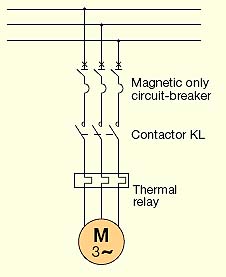
Рис. ABB
Схема прямого пуска электродвигателяMagnetic only circuit-breaker - Автоматический выключатель с электромагнитным расцепителем
Contactor KL - Контактор KL
Thermal relay - Тепловое реле
Параллельные тексты EN-RU
Direct-on-line starting
Direct-on-line starting, which is often abbreviated as DOL, is perhaps the most traditional system and consists in connecting the motor directly to the supply network, thus carrying out starting at full voltage.Direct-on-line starting represents the simplest and the most economical system to start a squirrel-cage asynchronous motor and it is the most used.
As represented in Figure 5, it provides the direct connection to the supply network and therefore starting is carried out at full voltage and with constant frequency, developing a high starting torque with very reduced acceleration times.
The typical applications are relevant to small power motors also with full load starting.
These advantages are linked to some problems such as, for example, the high inrush current, which - in the first instants - can reach values of about 10 to 12 times the rated current, then can decrease to about 6 to 8 times the rated current and can persist to reach the maximum torque speed.The effects of such currents can be identified with the high electro-dynamical stresses on the motor connection cables and could affect also the windings of the motor itself; besides, the high inrush torques can cause violent accelerations which stress the transmission components (belts and joints) generating distribution problems with a reduction in the mechanical life of these elements.
Finally, also the possible electrical problems due to voltage drops on the supply line of the motor or of the connected equipment must be taken into consideration.
[ABB]Прямой пуск
Прямой пуск, который по-английски часто сокращенно обозначают как DOL, является, пожалуй наиболее распространенным способом пуска. Он заключается в непосредственном (т. е. прямом) подключении двигателя к питающей сети. Это означает, что пуск двигателя осуществляется при полном напряжении.Схема прямого пуска является наиболее простым, экономичным и чаще всего применяемым решением для электродвигателей с короткозамкнутым ротором.
Схема прямого подключения к сети представлена на рисунке 5. Пуск осуществляется при полном напряжении и постоянной частоте сети. Электродвигатель развивает высокий пусковой момент при коротком времени разгона.
Типичные области применения – маломощные электродвигатели, в том числе с пуском при полной нагрузке.
Однако, наряду с преимуществами имеются и определенные недостатки, например, бросок пускового тока, достигающий в первоначальный момент 10…12-кратного значения от номинального тока электродвигателя. Затем ток двигателя уменьшается примерно до 6…8-кратного значения номинального тока и будет держаться на этом уровне до тех пор, пока скорость двигателя не достигнет максимального значения.
Такое изменение тока оказывает значительное электродинамическое воздействие на кабель, подключенный к двигателю. Кроме того пусковой ток воздействует на обмотки двигателя. Высокий начальный пусковой момент может привести к значительному ускорению и следовательно к значительной нагрузке элементов привода (ремней, крепления узлов), что вызывает сокращение их срока службы.
И, наконец, следует принять во внимание возможное возникновение проблем, связанных с падением напряжения в линии питания двигателя и подключенного к этой линии оборудования.
[Перевод Интент]
Тематики
Синонимы
EN
- across-the-line starting (US)
- direct line starting
- direct operation of a motor
- direct starting
- direct-on-line starting
- DOL
- full voltage starter application
DE
FR
Франко-русский словарь нормативно-технической терминологии > démarrage direct
-
47 Anlauf mit direktem Einschalten
прямой пуск вращающегося электродвигателя
Пуск вращающегося электродвигателя путем непосредственного подключения его к питающей сети.
[ ГОСТ 27471-87]EN
direct-on-line starting
across-the-line starting (US)
the process of starting a motor by connecting it directly to the supply at rated voltage
[IEV number 411-52-15]FR
démarrage direct
mode de démarrage d'un moteur, consistant à lui appliquer directement sa pleine tension assignée
[IEV number 411-52-15]
Рис. ABB
Схема прямого пуска электродвигателяMagnetic only circuit-breaker - Автоматический выключатель с электромагнитным расцепителем
Contactor KL - Контактор KL
Thermal relay - Тепловое реле
Параллельные тексты EN-RU
Direct-on-line starting
Direct-on-line starting, which is often abbreviated as DOL, is perhaps the most traditional system and consists in connecting the motor directly to the supply network, thus carrying out starting at full voltage.Direct-on-line starting represents the simplest and the most economical system to start a squirrel-cage asynchronous motor and it is the most used.
As represented in Figure 5, it provides the direct connection to the supply network and therefore starting is carried out at full voltage and with constant frequency, developing a high starting torque with very reduced acceleration times.
The typical applications are relevant to small power motors also with full load starting.
These advantages are linked to some problems such as, for example, the high inrush current, which - in the first instants - can reach values of about 10 to 12 times the rated current, then can decrease to about 6 to 8 times the rated current and can persist to reach the maximum torque speed.The effects of such currents can be identified with the high electro-dynamical stresses on the motor connection cables and could affect also the windings of the motor itself; besides, the high inrush torques can cause violent accelerations which stress the transmission components (belts and joints) generating distribution problems with a reduction in the mechanical life of these elements.
Finally, also the possible electrical problems due to voltage drops on the supply line of the motor or of the connected equipment must be taken into consideration.
[ABB]Прямой пуск
Прямой пуск, который по-английски часто сокращенно обозначают как DOL, является, пожалуй наиболее распространенным способом пуска. Он заключается в непосредственном (т. е. прямом) подключении двигателя к питающей сети. Это означает, что пуск двигателя осуществляется при полном напряжении.Схема прямого пуска является наиболее простым, экономичным и чаще всего применяемым решением для электродвигателей с короткозамкнутым ротором.
Схема прямого подключения к сети представлена на рисунке 5. Пуск осуществляется при полном напряжении и постоянной частоте сети. Электродвигатель развивает высокий пусковой момент при коротком времени разгона.
Типичные области применения – маломощные электродвигатели, в том числе с пуском при полной нагрузке.
Однако, наряду с преимуществами имеются и определенные недостатки, например, бросок пускового тока, достигающий в первоначальный момент 10…12-кратного значения от номинального тока электродвигателя. Затем ток двигателя уменьшается примерно до 6…8-кратного значения номинального тока и будет держаться на этом уровне до тех пор, пока скорость двигателя не достигнет максимального значения.
Такое изменение тока оказывает значительное электродинамическое воздействие на кабель, подключенный к двигателю. Кроме того пусковой ток воздействует на обмотки двигателя. Высокий начальный пусковой момент может привести к значительному ускорению и следовательно к значительной нагрузке элементов привода (ремней, крепления узлов), что вызывает сокращение их срока службы.
И, наконец, следует принять во внимание возможное возникновение проблем, связанных с падением напряжения в линии питания двигателя и подключенного к этой линии оборудования.
[Перевод Интент]
Тематики
Синонимы
EN
- across-the-line starting (US)
- direct line starting
- direct operation of a motor
- direct starting
- direct-on-line starting
- DOL
- full voltage starter application
DE
FR
Немецко-русский словарь нормативно-технической терминологии > Anlauf mit direktem Einschalten
-
48 direct starting
прямой пуск
—
[Я.Н.Лугинский, М.С.Фези-Жилинская, Ю.С.Кабиров. Англо-русский словарь по электротехнике и электроэнергетике, Москва, 1999 г.]Тематики
- электротехника, основные понятия
EN
прямой пуск вращающегося электродвигателя
Пуск вращающегося электродвигателя путем непосредственного подключения его к питающей сети.
[ ГОСТ 27471-87]EN
direct-on-line starting
across-the-line starting (US)
the process of starting a motor by connecting it directly to the supply at rated voltage
[IEV number 411-52-15]FR
démarrage direct
mode de démarrage d'un moteur, consistant à lui appliquer directement sa pleine tension assignée
[IEV number 411-52-15]
Рис. ABB
Схема прямого пуска электродвигателяMagnetic only circuit-breaker - Автоматический выключатель с электромагнитным расцепителем
Contactor KL - Контактор KL
Thermal relay - Тепловое реле
Параллельные тексты EN-RU
Direct-on-line starting
Direct-on-line starting, which is often abbreviated as DOL, is perhaps the most traditional system and consists in connecting the motor directly to the supply network, thus carrying out starting at full voltage.Direct-on-line starting represents the simplest and the most economical system to start a squirrel-cage asynchronous motor and it is the most used.
As represented in Figure 5, it provides the direct connection to the supply network and therefore starting is carried out at full voltage and with constant frequency, developing a high starting torque with very reduced acceleration times.
The typical applications are relevant to small power motors also with full load starting.
These advantages are linked to some problems such as, for example, the high inrush current, which - in the first instants - can reach values of about 10 to 12 times the rated current, then can decrease to about 6 to 8 times the rated current and can persist to reach the maximum torque speed.The effects of such currents can be identified with the high electro-dynamical stresses on the motor connection cables and could affect also the windings of the motor itself; besides, the high inrush torques can cause violent accelerations which stress the transmission components (belts and joints) generating distribution problems with a reduction in the mechanical life of these elements.
Finally, also the possible electrical problems due to voltage drops on the supply line of the motor or of the connected equipment must be taken into consideration.
[ABB]Прямой пуск
Прямой пуск, который по-английски часто сокращенно обозначают как DOL, является, пожалуй наиболее распространенным способом пуска. Он заключается в непосредственном (т. е. прямом) подключении двигателя к питающей сети. Это означает, что пуск двигателя осуществляется при полном напряжении.Схема прямого пуска является наиболее простым, экономичным и чаще всего применяемым решением для электродвигателей с короткозамкнутым ротором.
Схема прямого подключения к сети представлена на рисунке 5. Пуск осуществляется при полном напряжении и постоянной частоте сети. Электродвигатель развивает высокий пусковой момент при коротком времени разгона.
Типичные области применения – маломощные электродвигатели, в том числе с пуском при полной нагрузке.
Однако, наряду с преимуществами имеются и определенные недостатки, например, бросок пускового тока, достигающий в первоначальный момент 10…12-кратного значения от номинального тока электродвигателя. Затем ток двигателя уменьшается примерно до 6…8-кратного значения номинального тока и будет держаться на этом уровне до тех пор, пока скорость двигателя не достигнет максимального значения.
Такое изменение тока оказывает значительное электродинамическое воздействие на кабель, подключенный к двигателю. Кроме того пусковой ток воздействует на обмотки двигателя. Высокий начальный пусковой момент может привести к значительному ускорению и следовательно к значительной нагрузке элементов привода (ремней, крепления узлов), что вызывает сокращение их срока службы.
И, наконец, следует принять во внимание возможное возникновение проблем, связанных с падением напряжения в линии питания двигателя и подключенного к этой линии оборудования.
[Перевод Интент]
Тематики
Синонимы
EN
- across-the-line starting (US)
- direct line starting
- direct operation of a motor
- direct starting
- direct-on-line starting
- DOL
- full voltage starter application
DE
FR
Англо-русский словарь нормативно-технической терминологии > direct starting
-
49 across-the-line starting (US)
прямой пуск вращающегося электродвигателя
Пуск вращающегося электродвигателя путем непосредственного подключения его к питающей сети.
[ ГОСТ 27471-87]EN
direct-on-line starting
across-the-line starting (US)
the process of starting a motor by connecting it directly to the supply at rated voltage
[IEV number 411-52-15]FR
démarrage direct
mode de démarrage d'un moteur, consistant à lui appliquer directement sa pleine tension assignée
[IEV number 411-52-15]
Рис. ABB
Схема прямого пуска электродвигателяMagnetic only circuit-breaker - Автоматический выключатель с электромагнитным расцепителем
Contactor KL - Контактор KL
Thermal relay - Тепловое реле
Параллельные тексты EN-RU
Direct-on-line starting
Direct-on-line starting, which is often abbreviated as DOL, is perhaps the most traditional system and consists in connecting the motor directly to the supply network, thus carrying out starting at full voltage.Direct-on-line starting represents the simplest and the most economical system to start a squirrel-cage asynchronous motor and it is the most used.
As represented in Figure 5, it provides the direct connection to the supply network and therefore starting is carried out at full voltage and with constant frequency, developing a high starting torque with very reduced acceleration times.
The typical applications are relevant to small power motors also with full load starting.
These advantages are linked to some problems such as, for example, the high inrush current, which - in the first instants - can reach values of about 10 to 12 times the rated current, then can decrease to about 6 to 8 times the rated current and can persist to reach the maximum torque speed.The effects of such currents can be identified with the high electro-dynamical stresses on the motor connection cables and could affect also the windings of the motor itself; besides, the high inrush torques can cause violent accelerations which stress the transmission components (belts and joints) generating distribution problems with a reduction in the mechanical life of these elements.
Finally, also the possible electrical problems due to voltage drops on the supply line of the motor or of the connected equipment must be taken into consideration.
[ABB]Прямой пуск
Прямой пуск, который по-английски часто сокращенно обозначают как DOL, является, пожалуй наиболее распространенным способом пуска. Он заключается в непосредственном (т. е. прямом) подключении двигателя к питающей сети. Это означает, что пуск двигателя осуществляется при полном напряжении.Схема прямого пуска является наиболее простым, экономичным и чаще всего применяемым решением для электродвигателей с короткозамкнутым ротором.
Схема прямого подключения к сети представлена на рисунке 5. Пуск осуществляется при полном напряжении и постоянной частоте сети. Электродвигатель развивает высокий пусковой момент при коротком времени разгона.
Типичные области применения – маломощные электродвигатели, в том числе с пуском при полной нагрузке.
Однако, наряду с преимуществами имеются и определенные недостатки, например, бросок пускового тока, достигающий в первоначальный момент 10…12-кратного значения от номинального тока электродвигателя. Затем ток двигателя уменьшается примерно до 6…8-кратного значения номинального тока и будет держаться на этом уровне до тех пор, пока скорость двигателя не достигнет максимального значения.
Такое изменение тока оказывает значительное электродинамическое воздействие на кабель, подключенный к двигателю. Кроме того пусковой ток воздействует на обмотки двигателя. Высокий начальный пусковой момент может привести к значительному ускорению и следовательно к значительной нагрузке элементов привода (ремней, крепления узлов), что вызывает сокращение их срока службы.
И, наконец, следует принять во внимание возможное возникновение проблем, связанных с падением напряжения в линии питания двигателя и подключенного к этой линии оборудования.
[Перевод Интент]
Тематики
Синонимы
EN
- across-the-line starting (US)
- direct line starting
- direct operation of a motor
- direct starting
- direct-on-line starting
- DOL
- full voltage starter application
DE
FR
Англо-русский словарь нормативно-технической терминологии > across-the-line starting (US)
-
50 direct line starting
прямой пуск вращающегося электродвигателя
Пуск вращающегося электродвигателя путем непосредственного подключения его к питающей сети.
[ ГОСТ 27471-87]EN
direct-on-line starting
across-the-line starting (US)
the process of starting a motor by connecting it directly to the supply at rated voltage
[IEV number 411-52-15]FR
démarrage direct
mode de démarrage d'un moteur, consistant à lui appliquer directement sa pleine tension assignée
[IEV number 411-52-15]
Рис. ABB
Схема прямого пуска электродвигателяMagnetic only circuit-breaker - Автоматический выключатель с электромагнитным расцепителем
Contactor KL - Контактор KL
Thermal relay - Тепловое реле
Параллельные тексты EN-RU
Direct-on-line starting
Direct-on-line starting, which is often abbreviated as DOL, is perhaps the most traditional system and consists in connecting the motor directly to the supply network, thus carrying out starting at full voltage.Direct-on-line starting represents the simplest and the most economical system to start a squirrel-cage asynchronous motor and it is the most used.
As represented in Figure 5, it provides the direct connection to the supply network and therefore starting is carried out at full voltage and with constant frequency, developing a high starting torque with very reduced acceleration times.
The typical applications are relevant to small power motors also with full load starting.
These advantages are linked to some problems such as, for example, the high inrush current, which - in the first instants - can reach values of about 10 to 12 times the rated current, then can decrease to about 6 to 8 times the rated current and can persist to reach the maximum torque speed.The effects of such currents can be identified with the high electro-dynamical stresses on the motor connection cables and could affect also the windings of the motor itself; besides, the high inrush torques can cause violent accelerations which stress the transmission components (belts and joints) generating distribution problems with a reduction in the mechanical life of these elements.
Finally, also the possible electrical problems due to voltage drops on the supply line of the motor or of the connected equipment must be taken into consideration.
[ABB]Прямой пуск
Прямой пуск, который по-английски часто сокращенно обозначают как DOL, является, пожалуй наиболее распространенным способом пуска. Он заключается в непосредственном (т. е. прямом) подключении двигателя к питающей сети. Это означает, что пуск двигателя осуществляется при полном напряжении.Схема прямого пуска является наиболее простым, экономичным и чаще всего применяемым решением для электродвигателей с короткозамкнутым ротором.
Схема прямого подключения к сети представлена на рисунке 5. Пуск осуществляется при полном напряжении и постоянной частоте сети. Электродвигатель развивает высокий пусковой момент при коротком времени разгона.
Типичные области применения – маломощные электродвигатели, в том числе с пуском при полной нагрузке.
Однако, наряду с преимуществами имеются и определенные недостатки, например, бросок пускового тока, достигающий в первоначальный момент 10…12-кратного значения от номинального тока электродвигателя. Затем ток двигателя уменьшается примерно до 6…8-кратного значения номинального тока и будет держаться на этом уровне до тех пор, пока скорость двигателя не достигнет максимального значения.
Такое изменение тока оказывает значительное электродинамическое воздействие на кабель, подключенный к двигателю. Кроме того пусковой ток воздействует на обмотки двигателя. Высокий начальный пусковой момент может привести к значительному ускорению и следовательно к значительной нагрузке элементов привода (ремней, крепления узлов), что вызывает сокращение их срока службы.
И, наконец, следует принять во внимание возможное возникновение проблем, связанных с падением напряжения в линии питания двигателя и подключенного к этой линии оборудования.
[Перевод Интент]
Тематики
Синонимы
EN
- across-the-line starting (US)
- direct line starting
- direct operation of a motor
- direct starting
- direct-on-line starting
- DOL
- full voltage starter application
DE
FR
Англо-русский словарь нормативно-технической терминологии > direct line starting
-
51 direct operation of a motor
прямой пуск вращающегося электродвигателя
Пуск вращающегося электродвигателя путем непосредственного подключения его к питающей сети.
[ ГОСТ 27471-87]EN
direct-on-line starting
across-the-line starting (US)
the process of starting a motor by connecting it directly to the supply at rated voltage
[IEV number 411-52-15]FR
démarrage direct
mode de démarrage d'un moteur, consistant à lui appliquer directement sa pleine tension assignée
[IEV number 411-52-15]
Рис. ABB
Схема прямого пуска электродвигателяMagnetic only circuit-breaker - Автоматический выключатель с электромагнитным расцепителем
Contactor KL - Контактор KL
Thermal relay - Тепловое реле
Параллельные тексты EN-RU
Direct-on-line starting
Direct-on-line starting, which is often abbreviated as DOL, is perhaps the most traditional system and consists in connecting the motor directly to the supply network, thus carrying out starting at full voltage.Direct-on-line starting represents the simplest and the most economical system to start a squirrel-cage asynchronous motor and it is the most used.
As represented in Figure 5, it provides the direct connection to the supply network and therefore starting is carried out at full voltage and with constant frequency, developing a high starting torque with very reduced acceleration times.
The typical applications are relevant to small power motors also with full load starting.
These advantages are linked to some problems such as, for example, the high inrush current, which - in the first instants - can reach values of about 10 to 12 times the rated current, then can decrease to about 6 to 8 times the rated current and can persist to reach the maximum torque speed.The effects of such currents can be identified with the high electro-dynamical stresses on the motor connection cables and could affect also the windings of the motor itself; besides, the high inrush torques can cause violent accelerations which stress the transmission components (belts and joints) generating distribution problems with a reduction in the mechanical life of these elements.
Finally, also the possible electrical problems due to voltage drops on the supply line of the motor or of the connected equipment must be taken into consideration.
[ABB]Прямой пуск
Прямой пуск, который по-английски часто сокращенно обозначают как DOL, является, пожалуй наиболее распространенным способом пуска. Он заключается в непосредственном (т. е. прямом) подключении двигателя к питающей сети. Это означает, что пуск двигателя осуществляется при полном напряжении.Схема прямого пуска является наиболее простым, экономичным и чаще всего применяемым решением для электродвигателей с короткозамкнутым ротором.
Схема прямого подключения к сети представлена на рисунке 5. Пуск осуществляется при полном напряжении и постоянной частоте сети. Электродвигатель развивает высокий пусковой момент при коротком времени разгона.
Типичные области применения – маломощные электродвигатели, в том числе с пуском при полной нагрузке.
Однако, наряду с преимуществами имеются и определенные недостатки, например, бросок пускового тока, достигающий в первоначальный момент 10…12-кратного значения от номинального тока электродвигателя. Затем ток двигателя уменьшается примерно до 6…8-кратного значения номинального тока и будет держаться на этом уровне до тех пор, пока скорость двигателя не достигнет максимального значения.
Такое изменение тока оказывает значительное электродинамическое воздействие на кабель, подключенный к двигателю. Кроме того пусковой ток воздействует на обмотки двигателя. Высокий начальный пусковой момент может привести к значительному ускорению и следовательно к значительной нагрузке элементов привода (ремней, крепления узлов), что вызывает сокращение их срока службы.
И, наконец, следует принять во внимание возможное возникновение проблем, связанных с падением напряжения в линии питания двигателя и подключенного к этой линии оборудования.
[Перевод Интент]
Тематики
Синонимы
EN
- across-the-line starting (US)
- direct line starting
- direct operation of a motor
- direct starting
- direct-on-line starting
- DOL
- full voltage starter application
DE
FR
Англо-русский словарь нормативно-технической терминологии > direct operation of a motor
-
52 direct-on-line starting
прямой пуск вращающегося электродвигателя
Пуск вращающегося электродвигателя путем непосредственного подключения его к питающей сети.
[ ГОСТ 27471-87]EN
direct-on-line starting
across-the-line starting (US)
the process of starting a motor by connecting it directly to the supply at rated voltage
[IEV number 411-52-15]FR
démarrage direct
mode de démarrage d'un moteur, consistant à lui appliquer directement sa pleine tension assignée
[IEV number 411-52-15]
Рис. ABB
Схема прямого пуска электродвигателяMagnetic only circuit-breaker - Автоматический выключатель с электромагнитным расцепителем
Contactor KL - Контактор KL
Thermal relay - Тепловое реле
Параллельные тексты EN-RU
Direct-on-line starting
Direct-on-line starting, which is often abbreviated as DOL, is perhaps the most traditional system and consists in connecting the motor directly to the supply network, thus carrying out starting at full voltage.Direct-on-line starting represents the simplest and the most economical system to start a squirrel-cage asynchronous motor and it is the most used.
As represented in Figure 5, it provides the direct connection to the supply network and therefore starting is carried out at full voltage and with constant frequency, developing a high starting torque with very reduced acceleration times.
The typical applications are relevant to small power motors also with full load starting.
These advantages are linked to some problems such as, for example, the high inrush current, which - in the first instants - can reach values of about 10 to 12 times the rated current, then can decrease to about 6 to 8 times the rated current and can persist to reach the maximum torque speed.The effects of such currents can be identified with the high electro-dynamical stresses on the motor connection cables and could affect also the windings of the motor itself; besides, the high inrush torques can cause violent accelerations which stress the transmission components (belts and joints) generating distribution problems with a reduction in the mechanical life of these elements.
Finally, also the possible electrical problems due to voltage drops on the supply line of the motor or of the connected equipment must be taken into consideration.
[ABB]Прямой пуск
Прямой пуск, который по-английски часто сокращенно обозначают как DOL, является, пожалуй наиболее распространенным способом пуска. Он заключается в непосредственном (т. е. прямом) подключении двигателя к питающей сети. Это означает, что пуск двигателя осуществляется при полном напряжении.Схема прямого пуска является наиболее простым, экономичным и чаще всего применяемым решением для электродвигателей с короткозамкнутым ротором.
Схема прямого подключения к сети представлена на рисунке 5. Пуск осуществляется при полном напряжении и постоянной частоте сети. Электродвигатель развивает высокий пусковой момент при коротком времени разгона.
Типичные области применения – маломощные электродвигатели, в том числе с пуском при полной нагрузке.
Однако, наряду с преимуществами имеются и определенные недостатки, например, бросок пускового тока, достигающий в первоначальный момент 10…12-кратного значения от номинального тока электродвигателя. Затем ток двигателя уменьшается примерно до 6…8-кратного значения номинального тока и будет держаться на этом уровне до тех пор, пока скорость двигателя не достигнет максимального значения.
Такое изменение тока оказывает значительное электродинамическое воздействие на кабель, подключенный к двигателю. Кроме того пусковой ток воздействует на обмотки двигателя. Высокий начальный пусковой момент может привести к значительному ускорению и следовательно к значительной нагрузке элементов привода (ремней, крепления узлов), что вызывает сокращение их срока службы.
И, наконец, следует принять во внимание возможное возникновение проблем, связанных с падением напряжения в линии питания двигателя и подключенного к этой линии оборудования.
[Перевод Интент]
Тематики
Синонимы
EN
- across-the-line starting (US)
- direct line starting
- direct operation of a motor
- direct starting
- direct-on-line starting
- DOL
- full voltage starter application
DE
FR
Англо-русский словарь нормативно-технической терминологии > direct-on-line starting
-
53 full voltage starter application
прямой пуск вращающегося электродвигателя
Пуск вращающегося электродвигателя путем непосредственного подключения его к питающей сети.
[ ГОСТ 27471-87]EN
direct-on-line starting
across-the-line starting (US)
the process of starting a motor by connecting it directly to the supply at rated voltage
[IEV number 411-52-15]FR
démarrage direct
mode de démarrage d'un moteur, consistant à lui appliquer directement sa pleine tension assignée
[IEV number 411-52-15]
Рис. ABB
Схема прямого пуска электродвигателяMagnetic only circuit-breaker - Автоматический выключатель с электромагнитным расцепителем
Contactor KL - Контактор KL
Thermal relay - Тепловое реле
Параллельные тексты EN-RU
Direct-on-line starting
Direct-on-line starting, which is often abbreviated as DOL, is perhaps the most traditional system and consists in connecting the motor directly to the supply network, thus carrying out starting at full voltage.Direct-on-line starting represents the simplest and the most economical system to start a squirrel-cage asynchronous motor and it is the most used.
As represented in Figure 5, it provides the direct connection to the supply network and therefore starting is carried out at full voltage and with constant frequency, developing a high starting torque with very reduced acceleration times.
The typical applications are relevant to small power motors also with full load starting.
These advantages are linked to some problems such as, for example, the high inrush current, which - in the first instants - can reach values of about 10 to 12 times the rated current, then can decrease to about 6 to 8 times the rated current and can persist to reach the maximum torque speed.The effects of such currents can be identified with the high electro-dynamical stresses on the motor connection cables and could affect also the windings of the motor itself; besides, the high inrush torques can cause violent accelerations which stress the transmission components (belts and joints) generating distribution problems with a reduction in the mechanical life of these elements.
Finally, also the possible electrical problems due to voltage drops on the supply line of the motor or of the connected equipment must be taken into consideration.
[ABB]Прямой пуск
Прямой пуск, который по-английски часто сокращенно обозначают как DOL, является, пожалуй наиболее распространенным способом пуска. Он заключается в непосредственном (т. е. прямом) подключении двигателя к питающей сети. Это означает, что пуск двигателя осуществляется при полном напряжении.Схема прямого пуска является наиболее простым, экономичным и чаще всего применяемым решением для электродвигателей с короткозамкнутым ротором.
Схема прямого подключения к сети представлена на рисунке 5. Пуск осуществляется при полном напряжении и постоянной частоте сети. Электродвигатель развивает высокий пусковой момент при коротком времени разгона.
Типичные области применения – маломощные электродвигатели, в том числе с пуском при полной нагрузке.
Однако, наряду с преимуществами имеются и определенные недостатки, например, бросок пускового тока, достигающий в первоначальный момент 10…12-кратного значения от номинального тока электродвигателя. Затем ток двигателя уменьшается примерно до 6…8-кратного значения номинального тока и будет держаться на этом уровне до тех пор, пока скорость двигателя не достигнет максимального значения.
Такое изменение тока оказывает значительное электродинамическое воздействие на кабель, подключенный к двигателю. Кроме того пусковой ток воздействует на обмотки двигателя. Высокий начальный пусковой момент может привести к значительному ускорению и следовательно к значительной нагрузке элементов привода (ремней, крепления узлов), что вызывает сокращение их срока службы.
И, наконец, следует принять во внимание возможное возникновение проблем, связанных с падением напряжения в линии питания двигателя и подключенного к этой линии оборудования.
[Перевод Интент]
Тематики
Синонимы
EN
- across-the-line starting (US)
- direct line starting
- direct operation of a motor
- direct starting
- direct-on-line starting
- DOL
- full voltage starter application
DE
FR
Англо-русский словарь нормативно-технической терминологии > full voltage starter application
-
54 accelerating or decelerating device
- устройства разгона/торможения (КОД ANSI - 18)
устройства разгона/торможения
Устройство, инициирующее включение цепей, обеспечивающих увеличение/снижение скорости агрегата
Код ANSI -18
[ Источник]EN
accelerating or decelerating device
A device that is used to close or cause the closing of circuits that are used to increase or decrease the speed of a machine.
[ Источник]Тематики
Обобщающие термины
EN
Англо-русский словарь нормативно-технической терминологии > accelerating or decelerating device
См. также в других словарях:
speed — {{Roman}}I.{{/Roman}} noun ADJECTIVE ▪ amazing, astonishing, breakneck, fast, good, great, high, incredible, lightning, phenomenal … Collocations dictionary
Speed limits in the United States — are set by each state or territory. Speed limits in the United States vary according to the type of road and land use. These speed limits do not exceed eighty miles per hour. Increments of five miles per hour are used. Additionally, these limits… … Wikipedia
Speed dating — is a formalized matchmaking process or dating system whose purpose is to encourage people to meet a large number of new people. Its origins are credited to Rabbi Yaacov Deyo of Aish HaTorah, originally as a way to help Jewish singles meet and… … Wikipedia
speed brake — n. an airplane flap designed to decrease flight speed, esp. when landing * * * … Universalium
speed brake — n. an airplane flap designed to decrease flight speed, esp. when landing … English World dictionary
Speed of sound — Sound is a vibration that travels through an elastic medium as a wave. The speed of sound describes how much distance such a wave travels in a certain amount of time. In SI Units with dry air at 20 °C (68 °F), the speed of sound is 343 m/s. This… … Wikipedia
Speed table — A speed table is a traffic calming device designed as a long speed hump with a flat section in the middle. Speed tables are generally long enough for the entire wheelbase of a passenger car to rest on top. [cite web |author=ITE title=Traffic… … Wikipedia
decrease — {{Roman}}I.{{/Roman}} noun ADJECTIVE ▪ dramatic, drastic, great, large, marked, sharp, significant, substantial ▪ There has been a sharp decrease in pollution sinc … Collocations dictionary
Speed limit — For a discussion of the maximum speed possible in the universe, see speed of light and special relativity. A road speed limit is the maximum speed allowed by law for road vehicles. Speed limits are commonly set and enforced by the legislative… … Wikipedia
Speed reading — Jimmy Carter and his daughter Amy participate in a speed reading course … Wikipedia
speed bump — hump in a road or driveway made to decrease drivers of vehicles speed … English contemporary dictionary
