

-
41 до 1
[см. вес полезного груза - от … до; вплоть до; диаметром до; изменяться от … до; измеряется от … до; иметь длительность от … до; опускаться до высоты; орбиты … охватывают область высот от … до; снижать перегрузки до; сокращаться до; спектр охватывает частоты от … до]…generation of the acoustic field takes up to 1% of the kinetic energy of the efflux…A large number of US satellites are light in weight ( under 100-200 kg).In a number of cases several satellites ( as many as 8) were sent to neighbouring orbits by one launch vehicle.…the aerodynamic loads decrease practically to zero when the rocket passes beyond the dense atmospheric layers. -
42 Introduction
Portugal is a small Western European nation with a large, distinctive past replete with both triumph and tragedy. One of the continent's oldest nation-states, Portugal has frontiers that are essentially unchanged since the late 14th century. The country's unique character and 850-year history as an independent state present several curious paradoxes. As of 1974, when much of the remainder of the Portuguese overseas empire was decolonized, Portuguese society appeared to be the most ethnically homogeneous of the two Iberian states and of much of Europe. Yet, Portuguese society had received, over the course of 2,000 years, infusions of other ethnic groups in invasions and immigration: Phoenicians, Greeks, Celts, Romans, Suevi, Visigoths, Muslims (Arab and Berber), Jews, Italians, Flemings, Burgundian French, black Africans, and Asians. Indeed, Portugal has been a crossroads, despite its relative isolation in the western corner of the Iberian Peninsula, between the West and North Africa, Tropical Africa, and Asia and America. Since 1974, Portugal's society has become less homogeneous, as there has been significant immigration of former subjects from its erstwhile overseas empire.Other paradoxes should be noted as well. Although Portugal is sometimes confused with Spain or things Spanish, its very national independence and national culture depend on being different from Spain and Spaniards. Today, Portugal's independence may be taken for granted. Since 1140, except for 1580-1640 when it was ruled by Philippine Spain, Portugal has been a sovereign state. Nevertheless, a recurring theme of the nation's history is cycles of anxiety and despair that its freedom as a nation is at risk. There is a paradox, too, about Portugal's overseas empire(s), which lasted half a millennium (1415-1975): after 1822, when Brazil achieved independence from Portugal, most of the Portuguese who emigrated overseas never set foot in their overseas empire, but preferred to immigrate to Brazil or to other countries in North or South America or Europe, where established Portuguese overseas communities existed.Portugal was a world power during the period 1415-1550, the era of the Discoveries, expansion, and early empire, and since then the Portuguese have experienced periods of decline, decadence, and rejuvenation. Despite the fact that Portugal slipped to the rank of a third- or fourth-rate power after 1580, it and its people can claim rightfully an unusual number of "firsts" or distinctions that assure their place both in world and Western history. These distinctions should be kept in mind while acknowledging that, for more than 400 years, Portugal has generally lagged behind the rest of Western Europe, although not Southern Europe, in social and economic developments and has remained behind even its only neighbor and sometime nemesis, Spain.Portugal's pioneering role in the Discoveries and exploration era of the 15th and 16th centuries is well known. Often noted, too, is the Portuguese role in the art and science of maritime navigation through the efforts of early navigators, mapmakers, seamen, and fishermen. What are often forgotten are the country's slender base of resources, its small population largely of rural peasants, and, until recently, its occupation of only 16 percent of the Iberian Peninsula. As of 1139—10, when Portugal emerged first as an independent monarchy, and eventually a sovereign nation-state, England and France had not achieved this status. The Portuguese were the first in the Iberian Peninsula to expel the Muslim invaders from their portion of the peninsula, achieving this by 1250, more than 200 years before Castile managed to do the same (1492).Other distinctions may be noted. Portugal conquered the first overseas empire beyond the Mediterranean in the early modern era and established the first plantation system based on slave labor. Portugal's empire was the first to be colonized and the last to be decolonized in the 20th century. With so much of its scattered, seaborne empire dependent upon the safety and seaworthiness of shipping, Portugal was a pioneer in initiating marine insurance, a practice that is taken for granted today. During the time of Pombaline Portugal (1750-77), Portugal was the first state to organize and hold an industrial trade fair. In distinctive political and governmental developments, Portugal's record is more mixed, and this fact suggests that maintaining a government with a functioning rule of law and a pluralist, representative democracy has not been an easy matter in a country that for so long has been one of the poorest and least educated in the West. Portugal's First Republic (1910-26), only the third republic in a largely monarchist Europe (after France and Switzerland), was Western Europe's most unstable parliamentary system in the 20th century. Finally, the authoritarian Estado Novo or "New State" (1926-74) was the longest surviving authoritarian system in modern Western Europe. When Portugal departed from its overseas empire in 1974-75, the descendants, in effect, of Prince Henry the Navigator were leaving the West's oldest empire.Portugal's individuality is based mainly on its long history of distinc-tiveness, its intense determination to use any means — alliance, diplomacy, defense, trade, or empire—to be a sovereign state, independent of Spain, and on its national pride in the Portuguese language. Another master factor in Portuguese affairs deserves mention. The country's politics and government have been influenced not only by intellectual currents from the Atlantic but also through Spain from Europe, which brought new political ideas and institutions and novel technologies. Given the weight of empire in Portugal's past, it is not surprising that public affairs have been hostage to a degree to what happened in her overseas empire. Most important have been domestic responses to imperial affairs during both imperial and internal crises since 1415, which have continued to the mid-1970s and beyond. One of the most important themes of Portuguese history, and one oddly neglected by not a few histories, is that every major political crisis and fundamental change in the system—in other words, revolution—since 1415 has been intimately connected with a related imperial crisis. The respective dates of these historical crises are: 1437, 1495, 1578-80, 1640, 1820-22, 1890, 1910, 1926-30, 1961, and 1974. The reader will find greater detail on each crisis in historical context in the history section of this introduction and in relevant entries.LAND AND PEOPLEThe Republic of Portugal is located on the western edge of the Iberian Peninsula. A major geographical dividing line is the Tagus River: Portugal north of it has an Atlantic orientation; the country to the south of it has a Mediterranean orientation. There is little physical evidence that Portugal is clearly geographically distinct from Spain, and there is no major natural barrier between the two countries along more than 1,214 kilometers (755 miles) of the Luso-Spanish frontier. In climate, Portugal has a number of microclimates similar to the microclimates of Galicia, Estremadura, and Andalusia in neighboring Spain. North of the Tagus, in general, there is an Atlantic-type climate with higher rainfall, cold winters, and some snow in the mountainous areas. South of the Tagus is a more Mediterranean climate, with hot, dry, often rainless summers and cool, wet winters. Lisbon, the capital, which has a fifth of the country's population living in its region, has an average annual mean temperature about 16° C (60° F).For a small country with an area of 92,345 square kilometers (35,580 square miles, including the Atlantic archipelagos of the Azores and the Madeiras), which is about the size of the state of Indiana in the United States, Portugal has a remarkable diversity of regional topography and scenery. In some respects, Portugal resembles an island within the peninsula, embodying a unique fusion of European and non-European cultures, akin to Spain yet apart. Its geography is a study in contrasts, from the flat, sandy coastal plain, in some places unusually wide for Europe, to the mountainous Beira districts or provinces north of the Tagus, to the snow-capped mountain range of the Estrela, with its unique ski area, to the rocky, barren, remote Trás-os-Montes district bordering Spain. There are extensive forests in central and northern Portugal that contrast with the flat, almost Kansas-like plains of the wheat belt in the Alentejo district. There is also the unique Algarve district, isolated somewhat from the Alentejo district by a mountain range, with a microclimate, topography, and vegetation that resemble closely those of North Africa.Although Portugal is small, just 563 kilometers (337 miles) long and from 129 to 209 kilometers (80 to 125 miles) wide, it is strategically located on transportation and communication routes between Europe and North Africa, and the Americas and Europe. Geographical location is one key to the long history of Portugal's three overseas empires, which stretched once from Morocco to the Moluccas and from lonely Sagres at Cape St. Vincent to Rio de Janeiro, Brazil. It is essential to emphasize the identity of its neighbors: on the north and east Portugal is bounded by Spain, its only neighbor, and by the Atlantic Ocean on the south and west. Portugal is the westernmost country of Western Europe, and its shape resembles a face, with Lisbon below the nose, staring into theAtlantic. No part of Portugal touches the Mediterranean, and its Atlantic orientation has been a response in part to turning its back on Castile and Léon (later Spain) and exploring, traveling, and trading or working in lands beyond the peninsula. Portugal was the pioneering nation in the Atlantic-born European discoveries during the Renaissance, and its diplomatic and trade relations have been dominated by countries that have been Atlantic powers as well: Spain; England (Britain since 1707); France; Brazil, once its greatest colony; and the United States.Today Portugal and its Atlantic islands have a population of roughly 10 million people. While ethnic homogeneity has been characteristic of it in recent history, Portugal's population over the centuries has seen an infusion of non-Portuguese ethnic groups from various parts of Europe, the Middle East, and Africa. Between 1500 and 1800, a significant population of black Africans, brought in as slaves, was absorbed in the population. And since 1950, a population of Cape Verdeans, who worked in menial labor, has resided in Portugal. With the influx of African, Goan, and Timorese refugees and exiles from the empire—as many as three quarters of a million retornados ("returned ones" or immigrants from the former empire) entered Portugal in 1974 and 1975—there has been greater ethnic diversity in the Portuguese population. In 2002, there were 239,113 immigrants legally residing in Portugal: 108,132 from Africa; 24,806 from Brazil; 15,906 from Britain; 14,617 from Spain; and 11,877 from Germany. In addition, about 200,000 immigrants are living in Portugal from eastern Europe, mainly from Ukraine. The growth of Portugal's population is reflected in the following statistics:1527 1,200,000 (estimate only)1768 2,400,000 (estimate only)1864 4,287,000 first census1890 5,049,7001900 5,423,0001911 5,960,0001930 6,826,0001940 7,185,1431950 8,510,0001960 8,889,0001970 8,668,000* note decrease1980 9,833,0001991 9,862,5401996 9,934,1002006 10,642,8362010 10,710,000 (estimated) -
43 waarde
1 [betekenis als bezit/ruilobject] value2 [grote waarde] value3 [betekenis] value4 [zaak van waarde] value♦voorbeelden:effectieve/reële waarde • market/real valuenominale waarde • nominal valuevan onschatbare waarde zijn • be of inestimable value/invaluableiets beneden de waarde verkopen • sell something below the going ratein waarde stijgen • appreciate, increase in valuein waarde dalen • depreciate, decrease in valuenaar waarde schatten • be able to appreciate somethingter waarde van … • at (the value of), worth …tot een waarde van • to the value ofmunten van deze waarde worden niet meer uitgegeven • coins of this denomination are no longer issuedvoor de volle waarde verzekeren • insure for the full value2 is er iets van waarde bij? • is anything valuable included?voorwerpen van waarde • objects of value, valuablesiemand niet op zijn juiste waarde schatten • underestimate someone(zeer) veel waarde aan iets hechten • value something highly, set great store by/on something, attach great value to somethingweinig waarde aan iets hechten • set little store by/on something, attach little value to somethinghet heeft zijn waarde bewezen • its value/merit has been provediemand in zijn waarde laten • accept someone as he/she isiets op waarde schatten • rate something at its true valuemen begint deze schrijver op zijn juiste waarde te schatten • this author has started to get the recognition he deservesvan waarde zijn, waarde hebben • be valuable, be of valuevan nul en gener waarde zijn • be null and voidmaximale/hoogste waarde • 〈 ook〉 maximum, highnegatieve waarde • minus (number) -
44 коэффициент
coefficient (coeff.), factor
безразмерное число, в основном отношение к-п. величин, характеризующих заданные условия. — а number indicating the amount of some change under certain specified сoпditions, often expressed as a ratio.
- безопасности — factor of safety
число, равное отношению расчетной нагрузки к эксплуатационной. расчетная нагрузка - произведение эксплуатационной нагрузки на коэффициент безопасности. — а number indicating the ratio between the ultimate load and limit load (maximum load expected in service). ultimate load is limit load multiplied by factor of safety.
- восстановления давления — pressure recovery factor
- двухконтурности (дтрд) — bypass ratio
- загрузки пассажирами, безубыточный — passenger break-even load factor
- запаса длины впп — field length factor
- запаса длины летной полосы — field length factor
- запаса длины летной полосы в направлении взлета — takeoff field length factor
- запаса длины летной полосы в направлении посадки — landing field length factor
- запаса длины летной полосы при всех работающих двигателей — field length factor for all-engines-operating сase
- запаса длины летной полосы при одном отказавшем двигателе — field length factor for one-engine-inoperative ease
- запаса прочности — reserve factor
отношение фактической прочности конструкции к минимально-потребной в данных условиях. — а ratio of the actual strength of the structure to the minimum required to specific condition.
- заполнения (в вычислительном уст-ве) — duty factor in computer, the ratio of active time to total time.
- заполнения (воздушного) винта — propeller solidity ratio
отношение суммарной площади всех лопастей винта к сметаемой ими площади. — the ratio of the total projected blade area to the area of the projected outline of the propeller disc.
- заполнения несущего винта (вертолета) — rotor solidity ratio solidity of rotor is a ratio of the total blade area to the disc area.
- лобового сопротивления (сх) — drag coefficient (cd)
коэффициент, характеризующий лобовое сопротивление рассматриваемого аэродинамического профиля. — а coefficient representing the drag on а given airfoil.
- маневренной перегрузки — maneuvering load factor
- момента крена — rolling-moment coefficient
- момента рыскания — yawing-moment coefficient
- момента тангажа — pitching-moment coefficient
- мощности — power factor
- мощности (воздушного винта) — activity factor
- мощности лопасти (возд. винта) — blade activity factor
безразмерная функция поверхности лопасти, характеризующая способность лопасти использовать прикладываемую мощность. — а non-dimensional function of the blade surface used to express capacity of a blade for absorbing power.
- несущей поверхности (покрытия аэродрома), калифорнийский — californian bearing ratio (с.в.r.)
-, относительный (воздушного винта) — figure of merit
- перегрузки (n) — load factor (n)
число, показывающее, во сколько раз нагрузки, действующие на самолет (или его отдельные части), превышает нагрузки в равномерном горизонтальном полете или нагрузки от веса при стоянке. — the ratio to the weight of an aircraft of а specified exterпаl load. such load may arise from aerodynamic forces, gravity, ground or water reaction, or from combinations of these forces.
- перегрузки, максимальный эксплуатационный — limit load factor
- перегрузки, (полетный) — flight load factor
отношение составляющей аэродинамической нагрузки (действующей перпендикулярно продольной оси ла) к весу ла. — the ratio of the aerodynamic force component (acting normal to the assumed longitudiпа1 axis of the airplane) to the weight of the airplane.
- перегрузки (полетной), отрицательный — negative load factor
- перегрузки (полетной), положительный — positive load factor
в данном случае аэродинамичеекая сила воздействует на ла снизу вверх. — in positive load factor the aerodynamic force acts upward with respect to the airplane.
- перегрузки при маневре — maneuvering load factor
- перегрузки при маневре, максимальный эксплуатационный — limit maneuvering load factor
- перегрузки, расчетный — ultimate load factor
- передачи (коэффициент передаточного числа в системе управления ла) — gain
- подъемной силы (су) безразмерная величина, определяемая по формуле. — lift coefficient (cl) а coefficient representing the lift of а given airfoil or other body. the lift coefficient is obtained ьу dividing the lift by the free-stream dynamic pressure and by the representative area under consideration.
- полезного действия (кпд) — efficiency (n)
the ratio of the useful output of the quantity to its total input.
- полезного действия, общий — overall efficiency
- полезного действия,тепловой — thermal efficiency
-, поправочный — correction factor
например, для учета влияния погодных (сезонных) условий (температура наружного воздуха, атмосферные осадки, обледенение) на характеристики тормозного участка впп в пределах установленных эксплуатационных ограничений. — the correction factors must account for the particular surface characteristics of the stopway and the variations in these characteristics with seasonal weather conditions (such as temperature, rain, snow, and ice) within the established operational limits.
- предельной перегрузки — ultimate load factor
- преобразования (в преобразователе) — conversion efficiency ratio of dc output power to ас input power.
- профильного сопротивления — profile drag coefficient
- прочности грунта, калифорнийский — californian bearing ratio (c.b.r.)
(к. несущей способности покрытия аэродрома, впп) — c.b.r. is used to measure subsoil strength of the runways and airfields.
- связи (эл.) — coupling coefficient
- сжимаемости — coefficient of compressibility
относительное уменьшение объема газа при повышении давления в изотермическом процессе. — the relative decrease of the volume of а gaseous system with increasing pressure in an isothermal process.
- совершенства (воздушного винта) — figure of merit
- сопротивления (лобовой, сx) — drag coefficient (cd)
- сопротивления (сx) груза на внешней подвеске (вертолета) — drag coefficient (cd) representing а drag caused by an externally-slung load
- стоячей волны — standing wave ratio (swr)
- схождения карты — chart convergence factor (ccf)
- сцепления (между шиной колеса и поверхностью впп) — coefficient of friction
-, сцепления (между шиной и впп при торможении) — braking coefficient of friction
- трансформации (в трансформаторе) — transformation ratio compensation windings are used to correct for variations in the resolvers transformation ratio.
- трения — coefficient of friction
- трения торможения — braking coefficient of friction
коэффициент трения между шиной и поверхностью взлетно-посадочной полосы при торможении самолета. — braking coefficient of friction between the aircraft wheel tires and runway (surface).
- трения торможения, осредненный приведенный — (mean) corrected braking coefficient of friction
- тяги (воздушного винта) — thrust coefficient (ст)
- усиления (эл.) — amplification factor
the ratio of output magnitude to input magnitude.
- усиления антенны — antenna gain
- усиления (передаточное число в системе управления) — gain
- усиления, самонастраивающийся (системы управления) — adaptive gain
- утечки — leakage factor
- шарнирного момента — hinge moment factor
- шарнирного момента от порыва ветра на земле, предельный — limit hinge moment factor (к) for ground gusts
в отношении элеронов и рулей высоты, коэффициент имеет положительный знак, если момент, воздействующий на поверхность управления, вызывает ее опускание. — for ailerons and elevators, а positive value of к indicates а moment tending to depress the surface, and а negative value of к - to raise the surface.
- шума — noise factor
для данной полосы частот, отношение суммарной величины помех на выходе к величине помехи на входе. — for а given bandwidth, the ratio оf total noise at the output, to the noise at the input.
- эксплуатационной маневренной перегрузки (максимальный), или эксплуатационной перегрузки при маневрировании (отрицательный или попожительный) — (negative, positive) limit maneuvering load factor rotorcraft must be designed for positive limit maneuvering load factor of 3.5 and negafive limit maneuvering load factor of 1.0.Русско-английский сборник авиационно-технических терминов > коэффициент
-
45 признан
indication
(напр., возникновения спасной вибрации) — when high vibration indications occur...
if other indication of engine vibration is evident, shutdown the engine.
- (в микропроцессоре) — flag
- (отказ) — trouble
-, браковочный — cause for rejection
failure of the average values for the 20 diaphragms shall be cause for rejection.
- вида выставки (инерциальной навигационной системы) — align status. the align status can be observed any time the system is in self-alignment mode.
- времени готовности (системы) — ready time status
- готовности (пг, инерц. системы) — status (status, sts)
- готовности пг-90 — status 90, status number 90 (sts-90)
- готовности выставки — align status
- готовности, двух-цифровой (двух разрядный) — 2-digit status. the 2-digit status code can be interpreted as follows: status no. 90, etc.
- дефекта — indication of defect
- неисправности — indication of malfunction
- отказа — indication of failure
flarneout is indicated by decrease in egt, epr and rpm.
-, отличительный — feature
- повреждения — sign of damage
- сваливания (ла) — stall indication
recognize stall indications.
значение пг — status number
значение пг-90 — status 90Русско-английский сборник авиационно-технических терминов > признан
-
46 длительность изменения напряжения
длительность изменения напряжения
Интервал времени от начала одиночного изменения напряжения до его конечного значения.
[ ГОСТ 13109-97]EN
duration of a voltage change
interval of time for the voltage to increase or decrease from the initial value to the final value
[IEV number 161-08-03]FR
durée d'une variation de tension
durée d'un intervalle de temps pendant lequel la tension croît ou décroît de sa valeur initiale avant une variation de tension à sa valeur finale
[IEV number 161-08-03]Тематики
EN
DE
FR
3.8 длительность изменения напряжения (duration of a voltage change): Интервал времени, в течение которого напряжение увеличивается или снижается от начального до конечного значения.
Источник: ГОСТ Р 55266-2012: Совместимость технических средств электромагнитная. Оборудование сетей связи. Требования и методы испытаний оригинал документа
Русско-английский словарь нормативно-технической терминологии > длительность изменения напряжения
-
47 импульс напряжения в системе электроснабжения
импульс напряжения в системе электроснабжения
Резкое изменение напряжения в системе электроснабжения, длящееся малый интервал времени относительно определенного интервала времени.
Примечание. Импульс напряжения возникает при коммутационных операциях, грозовых явлениях.
[ ГОСТ 23875-88]EN
voltage impulse
a transient voltage wave applied to a line or equipment, characterized by a rapid increase, followed generally by a slower non-oscillatory decrease of the voltage
[IEV number 604-03-14]FR
tension de choc
onde de tension transitoire appliquée à une ligne ou à un matériel, caractérisée par une montée rapide de la tension suivie généralement d'une décroissance plus lente et non oscillatoire
[IEV number 604-03-14]Тематики
EN
DE
FR
Смотри также
22. Импульс напряжения в системе электроснабжения
D. Stoßspannung
E. Voltage impulse
F. Tension de choc
Резкое изменение напряжения в системе электроснабжения, длящееся малый интервал времени относительно определенного интервала времени.
Примечание. Импульс напряжения возникает при коммутационных операциях, грозовых явлениях
Источник: ГОСТ 23875-88: Качество электрической энергии. Термины и определения оригинал документа
Русско-английский словарь нормативно-технической терминологии > импульс напряжения в системе электроснабжения
48 компенсационная обмотка
компенсационная обмотка
Дополнительная обмотка, соединенная по схеме «треугольник», предназначенная для снижения полного сопротивления нулевой последовательности (см. 3.7.3) в трансформаторах с обмотками, соединенными по схеме «звезда-звезда» или «звезда-зигзаг»
(МЭС 421-03-09).
Примечание — Обмотка считается компенсационной только в том случае, если она не предназначена для трехфазного присоединения к внешней сети.
[ ГОСТ 30830-2002]
компенсационная обмотка
КО
Вспомогательная обмотка, располагаемая на стержнях или ярмах с целью компенсации частей магнитного поля трансформатора.
Примечание. Возможна, например, компенсация магнитодвижущей силы регулировочной обмотки, магнитного поля нулевой последовательности, поля третьей гармонической и др.
[ ГОСТ 16110-82]EN
stabilizing winding
a supplementary delta-connected winding, especially provided on star-star or star-zigzag connected transformers to decrease the zero-sequence impedance of the star-connected winding
[IEV number 421-03-09]FR
enroulement de stabilisation
enroulement supplémentaire en triangle, spécialement utilisé sur des transformateurs à couplage étoile-étoile ou étoile-zigzag dans le but de réduire l'impédance homopolaire de l'enroulement connecté en étoile
[IEV number 421-03-09]Тематики
Классификация
>>>Синонимы
- КО
EN
DE
FR
Русско-английский словарь нормативно-технической терминологии > компенсационная обмотка
49 прямой пуск вращающегося электродвигателя
- full voltage starter application
- DOL
- direct-on-line starting
- direct starting
- direct operation of a motor
- direct line starting
- across-the-line starting (US)
прямой пуск вращающегося электродвигателя
Пуск вращающегося электродвигателя путем непосредственного подключения его к питающей сети.
[ ГОСТ 27471-87]EN
direct-on-line starting
across-the-line starting (US)
the process of starting a motor by connecting it directly to the supply at rated voltage
[IEV number 411-52-15]FR
démarrage direct
mode de démarrage d'un moteur, consistant à lui appliquer directement sa pleine tension assignée
[IEV number 411-52-15]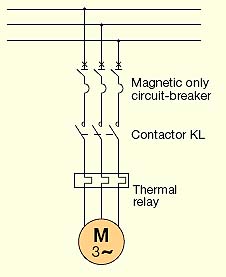
Рис. ABB
Схема прямого пуска электродвигателяMagnetic only circuit-breaker - Автоматический выключатель с электромагнитным расцепителем
Contactor KL - Контактор KL
Thermal relay - Тепловое реле
Параллельные тексты EN-RU
Direct-on-line starting
Direct-on-line starting, which is often abbreviated as DOL, is perhaps the most traditional system and consists in connecting the motor directly to the supply network, thus carrying out starting at full voltage.Direct-on-line starting represents the simplest and the most economical system to start a squirrel-cage asynchronous motor and it is the most used.
As represented in Figure 5, it provides the direct connection to the supply network and therefore starting is carried out at full voltage and with constant frequency, developing a high starting torque with very reduced acceleration times.
The typical applications are relevant to small power motors also with full load starting.
These advantages are linked to some problems such as, for example, the high inrush current, which - in the first instants - can reach values of about 10 to 12 times the rated current, then can decrease to about 6 to 8 times the rated current and can persist to reach the maximum torque speed.The effects of such currents can be identified with the high electro-dynamical stresses on the motor connection cables and could affect also the windings of the motor itself; besides, the high inrush torques can cause violent accelerations which stress the transmission components (belts and joints) generating distribution problems with a reduction in the mechanical life of these elements.
Finally, also the possible electrical problems due to voltage drops on the supply line of the motor or of the connected equipment must be taken into consideration.
[ABB]Прямой пуск
Прямой пуск, который по-английски часто сокращенно обозначают как DOL, является, пожалуй наиболее распространенным способом пуска. Он заключается в непосредственном (т. е. прямом) подключении двигателя к питающей сети. Это означает, что пуск двигателя осуществляется при полном напряжении.Схема прямого пуска является наиболее простым, экономичным и чаще всего применяемым решением для электродвигателей с короткозамкнутым ротором.
Схема прямого подключения к сети представлена на рисунке 5. Пуск осуществляется при полном напряжении и постоянной частоте сети. Электродвигатель развивает высокий пусковой момент при коротком времени разгона.
Типичные области применения – маломощные электродвигатели, в том числе с пуском при полной нагрузке.
Однако, наряду с преимуществами имеются и определенные недостатки, например, бросок пускового тока, достигающий в первоначальный момент 10…12-кратного значения от номинального тока электродвигателя. Затем ток двигателя уменьшается примерно до 6…8-кратного значения номинального тока и будет держаться на этом уровне до тех пор, пока скорость двигателя не достигнет максимального значения.
Такое изменение тока оказывает значительное электродинамическое воздействие на кабель, подключенный к двигателю. Кроме того пусковой ток воздействует на обмотки двигателя. Высокий начальный пусковой момент может привести к значительному ускорению и следовательно к значительной нагрузке элементов привода (ремней, крепления узлов), что вызывает сокращение их срока службы.
И, наконец, следует принять во внимание возможное возникновение проблем, связанных с падением напряжения в линии питания двигателя и подключенного к этой линии оборудования.
[Перевод Интент]
Тематики
Синонимы
EN
- across-the-line starting (US)
- direct line starting
- direct operation of a motor
- direct starting
- direct-on-line starting
- DOL
- full voltage starter application
DE
FR
Русско-английский словарь нормативно-технической терминологии > прямой пуск вращающегося электродвигателя
50 всего лишь
•While the life of components in orbit may be as low as a few days, quick passage through the radiation belt has little effect.
•The orbital periods of these stars can be as short as a few years.
•In this case a total of 200 shots is all that can be expected.
•Ethane theoretically possesses an indefinite number of conformations; however if..., there are but two significant conformations.
•Other embryonic movements are no more than (or are mere) preludes to adult behaviour.
•The factor leads to nothing more than a decrease in scattering and therefore is generally ignored.
•The innermost portion of the ring is a mere 7,000 miles above Saturn's face.
•A stationary electron in a uniform magnetic field has just two distinct energy levels.
•Tool-changing time can be as little as two seconds.
•Such a backup system can operate for weeks on as few as three or four "penlight" batteries.
•Scale differences of only 1 -2% can cause a loss of...
Русско-английский научно-технический словарь переводчика > всего лишь
51 вызван
•The unstable slope conditions were brought on by the permafrost.
•The phase difference is accountable (or chargeable) to gravity.
•The high levels of alkaline phosphatase may be associated with a tumor of...
•Laser-excited molecular fluorescence can be caused by species present in the flame gases.
•The fire was set by lightning.
•The ionization was produced by the charged particle.
•Such spectra are not sufficiently well resolved, which owes to the broad fluorescent vibronic bands.
•The strain is brought about (or caused) by pressure.
•Errors that may arise (or stem) from such disturbances...
•The production of foam is associated with a decrease in surface tension.
•These faults are attributable (or may be attributed) to the video head assembly.
•The fluctuations are due to roll eccentricity.
•The fire was induced by lightning.
•When combustion originates from local exposure...
•This increase results from (or is caused by, or stems from, or arises from, or is due to, or is brought about by)...
•These problems spring (or derive) from a number of different demands.
•This effect stems (or derives) from (or is due to, or is caused by) reduced blood circulation.
•Acute insufficiency may be triggered (or caused, or occasioned) by a generalized infection or massive stress.
•A major earthquake has never been triggered by a nuclear test explosion.
Русско-английский научно-технический словарь переводчика > вызван
52 всего лишь
•While the life of components in orbit may be as low as a few days, quick passage through the radiation belt has little effect.
•The orbital periods of these stars can be as short as a few years.
•In this case a total of 200 shots is all that can be expected.
•Ethane theoretically possesses an indefinite number of conformations; however if..., there are but two significant conformations.
•Other embryonic movements are no more than (or are mere) preludes to adult behaviour.
•The factor leads to nothing more than a decrease in scattering and therefore is generally ignored.
•The innermost portion of the ring is a mere 7,000 miles above Saturn's face.
•A stationary electron in a uniform magnetic field has just two distinct energy levels.
•Tool-changing time can be as little as two seconds.
•Such a backup system can operate for weeks on as few as three or four "penlight" batteries.
•Scale differences of only 1 -2% can cause a loss of...
Русско-английский научно-технический словарь переводчика > всего лишь
53 вызван
•The unstable slope conditions were brought on by the permafrost.
•The phase difference is accountable (or chargeable) to gravity.
•The high levels of alkaline phosphatase may be associated with a tumor of...
•Laser-excited molecular fluorescence can be caused by species present in the flame gases.
•The fire was set by lightning.
•The ionization was produced by the charged particle.
•Such spectra are not sufficiently well resolved, which owes to the broad fluorescent vibronic bands.
•The strain is brought about (or caused) by pressure.
•Errors that may arise (or stem) from such disturbances...
•The production of foam is associated with a decrease in surface tension.
•These faults are attributable (or may be attributed) to the video head assembly.
•The fluctuations are due to roll eccentricity.
•The fire was induced by lightning.
•When combustion originates from local exposure...
•This increase results from (or is caused by, or stems from, or arises from, or is due to, or is brought about by)...
•These problems spring (or derive) from a number of different demands.
•This effect stems (or derives) from (or is due to, or is caused by) reduced blood circulation.
•Acute insufficiency may be triggered (or caused, or occasioned) by a generalized infection or massive stress.
•A major earthquake has never been triggered by a nuclear test explosion.
Русско-английский научно-технический словарь переводчика > вызван
54 свидетельствовать
•Newton, whose continuing allegiance to corpuscularism is repeatedly attested by his letters...
•A clustering around this limit of secondary components of... attests (or suggests) that the tendency to expand...
•The physiographic differences between the Earth and the Moon bear witness to (or point to) the geological significance of...
•The smooth-flowing text betokens an excellent job of translation.
•The wide disagreement with the facts is demonstration that the simplified notion...
•This predominates, as evidenced by the progressive decrease...
•Figure 4 indicates (or points to the fact) that the yield of lactic acid decreases with the increase of...
•The number of papers concerned with perforated-plate performance is indicative of a lively interest in...
•This in itself is testimony to the size and intricacy of...
•Today a fossil record has been found to bear witness to three of the key events in the earliest stages of...
Русско-английский научно-технический словарь переводчика > свидетельствовать
55 Уменьшение числа рецепторов и ослабление их реакции
Molecular genetics: down-regulation (A decrease in the number of receptors for a chemical or drug on cell surfaces in a given area)Универсальный русско-английский словарь > Уменьшение числа рецепторов и ослабление их реакции
56 уменьшать количество
1) Economy: decrease the quantity, reduce the number, reduce the quantity2) Makarov: depopulateУниверсальный русско-английский словарь > уменьшать количество
57 Personalkürzung
Personalkürzung f MGT, PERS staff cut, staff cuts, staff reduction, reduction of staff, reduction of staffing levels; downsizing (Rationalisierung)* * *f <Mgmnt, Person> staff cut, staff cuts, staff reduction, reduction of staff, reduction of staffing levels, Rationalisierung downsizing* * *Personalkürzung
personnel cutback, retrenchment of employees;
• Personalleiter personnel controller (officer, Br.), establishment officer (Br.);
• Personalmangel shortage of personnel (staff, manpower), staff (personnel) shortage;
• Personalmangel haben, an Personalmangel leiden to be understaffed (short of staff);
• Personalnebenkosten incidental wages costs;
• Personalnotiz (Zeitung) personal;
• Personalpapiere identification papers, personnel records;
• Personalplanung manpower planning, staff planning system;
• Personalpolitik personnel policy;
• betriebliche Personalpolitik labo(u)r management;
• Personalpolitik für ältere Arbeitnehmer senior staff policy;
• Personalreduzierung run-down in personnel;
• Personalreferent, Personalsachbearbeiter personnel (appointments) officer, staff manager;
• Personalschwierigkeiten personnel difficulties;
• Personalstand number of employees;
• Personalstärke strength of the staff, labo(u)r force, manpower;
• vereinbarte Personalstärke personnel laid down in the agreement;
• Personalstärke[n] der Streitkräfte personnel strength (manning level[s])of armed forces;
• Personalstatut personal (personnel) statute, staff regulations;
• Personalstruktur staff structure;
• Personaltabelle personnel chart;
• Personalumbau Personalumbau,Personalumbesetzung, Personalumsetzungshifting of personnel, personnel shift, staff transfer, shake-up;
• Personalumbesetzung Personalumbau,Personalumbesetzung, Personalumsetzungshifting of personnel, personnel shift, staff transfer, shake-up;
• Personalumsetzung Personalumbau,Personalumbesetzung, Personalumsetzungshifting of personnel, personnel shift, staff transfer, shake-up;
• Personalunion bei Verwaltungen verschiedener Gesellschaften interlocking directorates;
• Personalunterlagen personnel records;
• laufend fortgeführte Personalunterlagen permanent history record[s];
• Personalveränderungen personnel changes;
• Personalvergrößerung additions to the staff;
• Personalverminderung reduction of staff;
• Personalverringerung decrease in staff;
• Personalvertreter employee (staff) representative;
• Personalvertretung employee representation, staff association;
• Personalverwaltung personnel (staff) administration (management), personnel (staff) organization;
• Personalverzeichnis staff register;
• Personalwechsel alteration in personnel, changes in the staff, staff turnover;
• Personalwirtschaft human resources management;
• Personalzusatzkosten additional personnel costs.58 verringern
verringern v 1. FIN cut; 2. GEN diminish; scale down, work down (Bestand); reduce (Ausgaben); 3. MGT, PERS downsize, reduce, cut (Personalbestand); 4. WIWI reduce, run down, lessen* * *v 1. < Finanz> cut; 2. < Geschäft> diminish, Bestand scale down, work down, Ausgaben reduce; 3. <Mgmnt, Person> Personalbestand downsize, reduce, cut; 4. <Vw> reduce, run down, lessen* * *verringern
to diminish, to reduce, to decrease, to pare down, (Münzen) to debase, (Vermögen) to dwindle, (im Wert) to deteriorate;
• Arbeitskräfte verringern to reduce forces;
• Ausgaben (Spesenetat) verringern to cut down expenses;
• Ausstoß verringern to reduce the output;
• Haushaltsdefizit verringern to shrink its budget deficit;
• Kosten verringern to reduce costs;
• Personal radikal verringern to axe a number of officials (Br.);
• etw. stark verringern to slash s. th.;
• jds. Zuschuss verringern to cut s. one’s allowance.59 abbauen
(trennb., hat -ge-)I vt/i (Baracke, Kulissen, Lager, Stand) dismantle, disassemble, strike; (Maschine) dismantle, strip (down); (Zelt) strike; (Gerüst) take down; pull down; der Markt ist aus, sie bauen schon ab the market is over, they’re already packing upII v/t1. (verringern) reduce; (Bestände) run down; (Missstände) remedy; (Vorurteile etc.) get rid of, break down; (Defizit, Löhne, Preise) reduce, cut; (Personal, Stellen, Privilegien) cut (back), streamline euph.; Arbeitskräfte abbauen cut down on manpower ( oder the workforce), lay off workers2. CHEM., BIOL. (Giftstoffe, Kohlehydrate, Alkohol etc.) break downIII v/i Mensch: go downhill (auch geistig); (nachlassen) flag, lose it umg.; er baut in letzter Zeit stark ab he’s going downhill fast; die Schüler bauen in der 6. Stunde stark ab the pupils switch off ( oder lose concentration) in the 6th lesson (Am. period)IV v/refl1. Vorurteile etc.: break down2. CHEM., BIOL.; Gift etc. im Körper: break down, decompose3. MET. break up* * *(demontieren) to pull down; to dismantle;(fördern) to mine;(verringern) to retrench; to run down; to reduce* * *ạb|bau|en sep1. vt2) (= demontieren) to dismantle; Maschine to strip down, to dismantle; Gerüst to take down, to dismantle; Kulissen to take down, to strike; Zelt to strike; Lager to break, to strikeein System allmählich abbauen — to phase out a system
4) (= verringern) Produktion, Personal, Bürokratie to cut back, to reduce, to cut down on; Arbeitsplätze, Arbeitskräfte to reduce the number of; Privilegien to cut back, to strip away2. vi(Sportler etc) to go downhill; (Patient) to deteriorate, to weaken; (= erlahmen) to flag, to wilt; (= abschalten) to switch off* * *ab|bau·enI. vt▪ etw \abbauenKohle \abbauen to mine [for] coal2. (demontieren) Gerüst to dismantle sth3. (verringern) Lohn to reduce [or decrease] sth4. (schrittweise beseitigen) to cut sthPrivilegien \abbauen to reduce [or cut] privileges5. CHEM▪ etw \abbauen to decompose [or degrade] sthII. vi (fam: allmählich weniger leisten) Kräfte, Konzentration to flag, to wilt; (geistig/körperlich nachlassen) to deteriorate* * *1.transitives Verb1) dismantle; strike <tent, camp>; dismantle, take down < scaffolding>3) (beseitigen) gradually remove; break down <prejudices, inhibitions>5) (Chemie, Biol.) break down <carbohydrates, alcohol>2.intransitives Verb fade; slow down* * *abbauen (trennb, hat -ge-)A. v/t & v/i (Baracke, Kulissen, Lager, Stand) dismantle, disassemble, strike; (Maschine) dismantle, strip (down); (Zelt) strike; (Gerüst) take down; pull down;der Markt ist aus, sie bauen schon ab the market is over, they’re already packing upB. v/t1. (verringern) reduce; (Bestände) run down; (Missstände) remedy; (Vorurteile etc) get rid of, break down; (Defizit, Löhne, Preise) reduce, cut; (Personal, Stellen, Privilegien) cut (back), streamline euph;er baut in letzter Zeit stark ab he’s going downhill fast;die Schüler bauen in der 6. Stunde stark ab the pupils switch off ( oder lose concentration) in the 6th lesson (US period)D. v/r1. Vorurteile etc: break down2. CHEM, BIOL; Gift etc im Körper: break down, decompose3. METEO break up* * *1.transitives Verb1) dismantle; strike <tent, camp>; dismantle, take down < scaffolding>3) (beseitigen) gradually remove; break down <prejudices, inhibitions>5) (Chemie, Biol.) break down <carbohydrates, alcohol>2.intransitives Verb fade; slow down* * *v.to abolish v.to dismantle v.60 Schwinden
v/i; schwindet, schwand, ist geschwunden; Einfluss, Macht: dwindle, diminish; Vorräte, Geld: dwindle, run low; Kräfte: (begin to) fail ( oder dwindle, seep away); Farben, Schönheit, Hoffnung, Radiosender: fade; Interesse: dwindle, drop off; Misstrauen: disappear; TECH. fachspr., Werkstück: shrink; aus dem Gedächtnis schwinden fade from one’s memory; mein Interesse schwand I lost interest; sein Lächeln schwand aus seinem Gesicht his face dropped; ihm schwand der Mut / das Vertrauen / die Hoffnung he lost courage / confidence / hope, his courage / confidence / hope failed him; ihr schwanden die Sinne she fainted ( oder passed out)* * *das Schwindenevanescence* * *schwịn|den ['ʃvɪndn] pret schwa\#nd [ʃvant] ptp geschwu\#nden [gə'ʃvʊndn]vi aux sein1) (= abnehmen) to dwindle; (Schönheit) to fade, to wane; (= allmählich verschwinden) (Hoffnung) to fade away, to dwindle; (Erinnerung, Angst, Chance, Zeit) to fade away; (Kräfte) to fade, to failim Schwinden begriffen sein — to be dwindling; (Schönheit) to be on the wane
ihm schwand der Mut, sein Mut schwand — his courage failed him
aus der Erinnerung/dem Bewusstsein schwinden — to fade from (one's) memory/one's consciousness
2) (=verblassen Farben) to fade; (= leiser werden Ton) to fade (away); (= sich auflösen Dunkelheit) to fade away, to retreat (liter)3) (TECH Holz, Metall, Ton) to shrink, to contract* * *1) (to grow less: His money dwindled away.) dwindle2) (to become less in number: The crowd began to fall away.) fall away* * *schwin·den<schwand, geschwunden>[ˈʃvɪndn̩]vi Hilfsverb: seinim S\schwinden begriffen sein to be running out [or dwindling2. (vergehen)▪ etw schwindet sth is fading away; Effekt, [schmerzstillende] Wirkung to be wearing off; Erinnerung, Hoffnung to be fading [away]; Interesse to be flagging [or waning]; Kräfte to be fading [away] [or failing]; Lebensmut, Mut, Zuversicht to be failingdie Sinne \schwinden jdm sb feels faint* * *unregelmäßiges intransitives Verb; mit sein fade; <supplies, money> run out, dwindle; < effect> wear off; < interest> fade, wane, fall off; <fear, mistrust> lessen, diminish; <powers, influence> wane, decline; <courage, strength> fail* * *im Schwinden begriffen dwindling; Macht etc: on the wane* * *unregelmäßiges intransitives Verb; mit sein fade; <supplies, money> run out, dwindle; < effect> wear off; < interest> fade, wane, fall off; <fear, mistrust> lessen, diminish; <powers, influence> wane, decline; <courage, strength> fail* * *n.evanescence n.СтраницыСм. также в других словарях:
decrease — I UK [diːˈkriːs] / US [dɪˈkrɪs] verb Word forms decrease : present tense I/you/we/they decrease he/she/it decreases present participle decreasing past tense decreased past participle decreased ** Other ways of saying decrease: be/go/come down to… … English dictionary
decrease — {{Roman}}I.{{/Roman}} noun ADJECTIVE ▪ dramatic, drastic, great, large, marked, sharp, significant, substantial ▪ There has been a sharp decrease in pollution sinc … Collocations dictionary
decrease — [diːˈkriːs] verb I 1) [I] to become less Ant: increase The number of visitors has decreased significantly.[/ex] 2) [T] to reduce something • Other ways of saying decrease ■ be/go/come down to become less in number, value, or price ■ drop/fall to… … Dictionary for writing and speaking English
decrease — vb Decrease, lessen, diminish, reduce, abate, dwindle denote to make or grow less, but they are not freely interchangeable. Decrease and lessen are often employed in place of any of the others. Decrease normally retains, even in the transitive,… … New Dictionary of Synonyms
Decrease — De*crease , v. i. [imp. & p. p. {Decreased}; p. pr. & vb. n. {Decreasing}.] [OE. decrecen, fr. OF. decreistre, F. d[ e]cro[^i]tre, or from the OF. noun (see {Decrease}, n.), fr. L. decrescere to grow less; de + crescere to grow. See {Crescent},… … The Collaborative International Dictionary of English
decrease — [dē krēs′, dikrēs′; ] also, & for n. usually [, dē′krēs΄] vi., vt. decreased, decreasing [ME decresen < OFr decreistre < L decrescere < de , from, away + crescere, grow: see CRESCENT] to become or cause to become less, smaller, etc.;… … English World dictionary
Decrease (knitting) — A decrease in knitting is a reduction in the number of stitches, usually accomplished by suspending the stitch to be decreased from another existing stitch or by knitting it together with another stitch. Contents 1 Methods of Single Decreasing… … Wikipedia
decrease — de|crease1 [ dı kris ] verb ** intransitive to become less: The number of people visiting the park has decreased significantly. Prices are expected to decrease by less than 1 percent this year. a. transitive to reduce something: The new system… … Usage of the words and phrases in modern English
number — {{Roman}}I.{{/Roman}} noun 1 symbol/word ADJECTIVE ▪ three digit, 16 digit ▪ cardinal, ordinal ▪ even, odd ▪ Houses on thi … Collocations dictionary
number — I n. symbol indicating quantity 1) an even; odd number 2) a high; low number 3) an algebraic; cardinal; complex; compound; decimal; imaginary; infinite; irrational; mass; mixed; natural; negative; ordinal; positive; prime; quantum; whole number… … Combinatory dictionary
decrease — decreases, decreasing, decreased (The verb is pronounced [[t]dɪkri͟ːs[/t]]. The noun is pronounced [[t]di͟ːkriːs[/t]].) 1) V ERG When something decreases or when you decrease it, it becomes less in quantity, size, or intensity. [V by amount]… … English dictionary
Перевод: со всех языков на английский
с английского на все языки- С английского на:
- Все языки
- Со всех языков на:
- Все языки
- Английский
- Арабский
- Испанский
- Итальянский
- Немецкий
- Норвежский
- Русский
- Украинский
- Французский
decrease in number

18+
© Академик, 2000-2026
- Обратная связь: Техподдержка, Реклама на сайте
Экспорт словарей на сайты, сделанные на PHP, Joomla, Drupal, WordPress, MODx.