

-
1 токогенераторный
-
2 струмогенераторний
-
3 токогенераторный
-
4 токогенераторный
Русско-английский научно-технический словарь Масловского > токогенераторный
-
5 генераторная станция
1) General subject: power station2) Military: generating station3) Engineering: power house, power plant4) Railway term: power generating plant5) Metallurgy: current-generating plant6) Electronics: generating plantУниверсальный русско-английский словарь > генераторная станция
-
6 prądotwórczy
The New English-Polish, Polish-English Kościuszko foundation dictionary > prądotwórczy
-
7 аппаратура получения токов управляющих частот
Русско-английский словарь нормативно-технической терминологии > аппаратура получения токов управляющих частот
-
8 генераторная установка
1) Naval: generating plant, generating set2) Engineering: generator set3) Construction: gen set4) Railway term: Current generating plant5) Metallurgy: generator plant, generator unit6) Geophysics: transmitter coil, transmitter loop, transmitting coil, transmitting loop7) Sakhalin energy glossary: generator package8) General subject: generatorУниверсальный русско-английский словарь > генераторная установка
-
9 генераторный агрегат
1) Military: generating unit2) Engineering: electric set generator, generating set, generator set, generator set (gs)3) Railway term: Current generating plantУниверсальный русско-английский словарь > генераторный агрегат
-
10 аппаратура формирования токов контрольных частот
Telecommunications: control current generating equipmentУниверсальный русско-английский словарь > аппаратура формирования токов контрольных частот
-
11 электрогенераторная станция
Metallurgy: current-generating plantУниверсальный русско-английский словарь > электрогенераторная станция
-
12 ток, создающий поле возбуждения
ток, создающий поле возбуждения
—
[Я.Н.Лугинский, М.С.Фези-Жилинская, Ю.С.Кабиров. Англо-русский словарь по электротехнике и электроэнергетике, Москва, 1999 г.]Тематики
- электротехника, основные понятия
EN
Русско-английский словарь нормативно-технической терминологии > ток, создающий поле возбуждения
-
13 Warren, Henry Ellis
SUBJECT AREA: Horology[br]b. 21 May 1872 Boston, Massachusetts, USAd. 21 September 1957 Ashland, Massachusetts, USA[br]American electrical engineer who invented the mains electric synchronous clock.[br]Warren studied electrical engineering at the Boston Institute of Technology (later to become the Massachusetts Institute of Technology) and graduated in 1894. In 1912 he formed the Warren Electric Clock Company to make a battery-powered clock that he had patented a few years earlier. The name was changed to the Warren Telechron (time at a distance) Company after he had started to produce synchronous clocks.In 1840 Charles Wheatstone had produced an electric master clock that produced an alternating current with a frequency of one cycle per second and which was used to drive slave dials. This system was not successful, but when Ferranti introduced the first alternating current power generator at Deptford in 1895 Hope-Jones saw in it a means of distributing time. This did not materialize immediately because the power generators did not control the frequency of the current with sufficient accuracy, and a reliable motor whose speed was related to this frequency was not available. In 1916 Warren solved both problems: he produced a reliable self-starting synchronous electric motor and he also made a master clock which could be used at the power station to control accurately the frequency of the supply. Initially the power-generating companies were reluctant to support the synchronous clock because it imposed a liability to control the frequency of the supply and the gain was likely to be small because it was very frugal in its use of power. However, with the advent of the grid system, when several generators were connected together, it became imperative to control the frequency; it was realized that although the power consumption of individual clocks was small, collectively it could be significant as they ran continuously. By the end of the 1930s more than half the clocks sold in the USA were of the synchronous type. The Warren synchronous clock was introduced into Great Britain in 1927, following the setting up of a grid system by the Electricity Commission.[br]Principal Honours and DistinctionsFranklin Institute John Price Wetherill Medal. American Institute of Electrical Engineers Lamme Medal.BibliographyThe patents for the synchronous motor are US patent nos. 1,283,432, 1,283,433 and 1,283,435, and those for the master clock are 1,283,431, 1,409,502 and 1,502,493 of 29 October 1918 onwards.1919, "Utilising the time characteristics of alternating current", Transactions of the American Institute of Electrical Engineers 38:767–81 (Warren's first description of his system).Further ReadingJ.M.Anderson, 1991, "Henry Ellis Warren and his master clocks", National Association of Watch and Clock Collectors Bulletin 33:375–95 (provides biographical and technical details).DV -
14 E-Werk
E-Werk n (Abk. für Elektrizitätswerk) UMWELT generating station* * *n (Elektrizitätswerk) < Umwelt> generating station* * *E-Werk
electric company;
• am E-Werk angeschlossen sein to take one’s electric current from the mains. -
15 generatore
m electronics generator* * *generatore agg. generative, generating, productive◆ s.m.1 generator, producer2 (mecc., elettr.) generator: generatore di corrente alternata, alternating current generator (o alternator); generatore di corrente continua, direct current generator (o dynamo); generatore elettrostatico, electrostatic generator; generatore di radiofrequenza, oscillator; generatore di vapore, steam generator: generatore per corrente alternata e continua, double current generator.* * *[dʒenera'tore] 1.aggettivo generative2.sostantivo maschile tecn. generator* * *generatore/dʒenera'tore/generativetecn. generator. -
16 выключатель
break, single-throw breaker, breaker эл., interrupter, killer, ( сети) main, break switch, cutoff switch, cut-out switch, disconnect(ing) switch, single-throw switch, single-way switch, switch* * *выключа́тель м. эл.1. (устройство для включения и отключения цепей и установок преимущественно при нормальных режимах и для целей управления) switchвключа́ть выключа́тель — close the switchвыключа́тель вы́веден на … (переднюю, заднюю и т. п. панель) — the switch is brought out to …выключа́ть выключа́тель — open the switchвыключа́тель замыка́ет цепь — the switch makes [completes] the circuitвыключа́тель размыка́ет [разрыва́ет] цепь — the switch breaks [interrupts] the circuitста́вить выключа́тель в положе́ние ВКЛ или ВЫКЛ — move [set, place] the switch to [in] the ON or OFF position2. ( мат для отключения цепей и установок преимущественно в аварийных режимах) (automatic) circuit breakerвключа́ть выключа́тель повто́рно — reclose the circuit breakerвключа́ть выключа́тель, стоя́щий на защё́лке — trip the circuit breakerдовключа́ть выключа́тель — push past the closed positionвыключа́тель отключа́ет ток коро́ткого замыка́ния — the circuit breaker interrupts short-circuit currentвыключа́тель отключё́н — the circuit breaker is openавтога́зовый выключа́тель — hard-gas [self-generated, gas-blast] circuit breakerбыстроде́йствующий выключа́тель1. high-speed switch2. high-speed circuit breakerва́куумный выключа́тель — vacuum switchвзрывозащищё́нный выключа́тель — брит. flame-proof switch; амер. explosion-proof switchвозду́шный выключа́тель1. air(-break) switch2. air(-break) circuit breakerвыключа́тель в це́пи управле́ния — control switchгенера́торный выключа́тель — generating-station circuit breakerгерко́новый выключа́тель — reed switchгермети́ческий выключа́тель — hermetically sealed switchгоршко́вый выключа́тель — small-oil volume separate-pole porcelain-insulated circuit breakerгруппово́й выключа́тель — group switchдверно́й выключа́тель — door(-operated) switchдвухпо́люсный выключа́тель — double-pole switchдистанцио́нный выключа́тель — remote switchдифманометри́ческий выключа́тель — differential-pressure switchвыключа́тель для откры́той прово́дки — surface switchвыключа́тель для скры́той прово́дки — flush(-mounting) switchзаземля́ющий выключа́тель — брит. earthing switch; амер. grounding switchзакры́тый выключа́тель — enclosed [safety] switchи́мпульсный выключа́тель — impulse switchкно́почный выключа́тель — push-button switchконта́ктный выключа́тель — contact switchконцево́й выключа́тель — limit switchкулачко́вый выключа́тель — cam(-operated) switchлине́йный выключа́тель — line circuit breakerмаксима́льный выключа́тель — overcurrent [overvoltage] circuit breakerмалоё́мкостный выключа́тель — anti-capacitance switchмалома́сляный выключа́тель — small-oil volume [low-oil content] circuit breakerма́сляный выключа́тель1. oil(-immersed) switch2. oil circuit breakerма́сляный, ба́ковый выключа́тель — single-tank oil circuit breakerма́сляный, ка́мерный выключа́тель — multitank oil circuit breakerвыключа́тель мгнове́нного де́йствия — snap(action) switchминима́льный выключа́тель — low-voltage [under-voltage] circuit breaker, low-current [under-current] circuit breakerмногоконта́ктный выключа́тель — multi(ple-)contact switchмногопозицио́нный выключа́тель — multi(ple-)position switchвыключа́тель нагру́зки — load-breaking isolatorвыключа́тель нака́ла — filament switchвыключа́тель на одно́ или два направле́ния — single-way or double-way switchвыключа́тель на одно́ или два фикси́рованных положе́ния — single or double throw switchвыключа́тель на ответвле́нии — branch switchножево́й выключа́тель — knife(-blade) switchножно́й выключа́тель — foot(-operated) switchнорма́льно за́мкнутый выключа́тель — normally closed [N.C.] switchнорма́льно разо́мкнутый выключа́тель — normally open [N.O.] switchвыключа́тель обхо́дов — by-pass switchоднопо́люсный выключа́тель — single-pole switchвыключа́тель освеще́ния, дверно́й — door light switchпаке́тный выключа́тель — rotary [packet] switchвыключа́тель пита́ния — power switchпневмати́ческий выключа́тель — air-pressure switchподстанцио́нный выключа́тель — substation circuit breakerпоплавко́вый выключа́тель — float [liquid-level] switchпусково́й выключа́тель — starting switchпутево́й выключа́тель — limit switchрту́тный выключа́тель — mercury switchручно́й выключа́тель — hand-operated [manual] switchвыключа́тель с автомати́ческим повто́рным включе́нием — auto(matic)-reclosing circuit breakerвыключа́тель с автомати́ческим повто́рным включе́нием, многокра́тный — multishot auto-reclosing circuit breakerвыключа́тель с автомати́ческим повто́рным включе́нием, однора́зовый — single-shot auto-reclosing circuit breakerсблоки́рованный выключа́тель — interlocked switchвыключа́тель с блоки́рующим устро́йством — lock-out circuit breakerвыключа́тель с больши́м объё́мом ма́сла — bulk-oil circuit breakerвыключа́тель с возду́шным дутьё́м — air-blast circuit breakerвыключа́тель с вы́держкой вре́мени — delayed-action switchвыключа́тель с вы́держкой вре́мени на замыка́ние — delayed make switchвыключа́тель с вы́держкой вре́мени на размыка́ние — delayed break switchвыключа́тель с га́зовым дутьё́м — gas-blast circuit breakerсекцио́нный выключа́тель1. sectionalizing switch2. sectionalizing circuit breaker, sectionalizerсетево́й выключа́тель — mains switchсилово́й выключа́тель — power switchвыключа́тель с магни́тным дутьё́м — magnetic blow-out [blast] circuit breakerвыключа́тель с магни́тным при́водом — magnetically operated switchвыключа́тель с одни́м или двумя́ разры́вами — single-break or double-break switchсолено́идный выключа́тель — solenoid switchвыключа́тель со свобо́дным расщепле́нием — trip-free circuit breakerвыключа́тель с пла́вким предохрани́телем — fuse(d) switchвыключа́тель с пневмати́ческим при́водом — pneumatically operated circuit breakerвыключа́тель с пружи́нным возвра́том — spring-return switchвыключа́тель с роговы́м искрогаси́телем — horn-gap switchстолбово́й выключа́тель — pole switchступе́нчатый выключа́тель — step switchвыключа́тель с часовы́м механи́змом — clock-controlled switchтеплово́й выключа́тель — thermal cut-outтири́сторный выключа́тель — thyristor switchфлажко́вый выключа́тель — (mechanical) flag switchцентробе́жный выключа́тель — centrifugal switchшиносоедини́тельный выключа́тель — busbar coupler, bus-tie switchште́псельный выключа́тель — plug(-in) switchщелчко́вый выключа́тель — snap switchэлега́зовый выключа́тель — sulphur hexafluoride switchэлектромагни́тный выключа́тель — solenoid(-operated) switchэлектромехани́ческий выключа́тель — motor(-operated) switch -
17 Edison, Thomas Alva
SUBJECT AREA: Architecture and building, Automotive engineering, Electricity, Electronics and information technology, Metallurgy, Photography, film and optics, Public utilities, Recording, Telecommunications[br]b. 11 February 1847 Milan, Ohio, USAd. 18 October 1931 Glenmont[br]American inventor and pioneer electrical developer.[br]He was the son of Samuel Edison, who was in the timber business. His schooling was delayed due to scarlet fever until 1855, when he was 8½ years old, but he was an avid reader. By the age of 14 he had a job as a newsboy on the railway from Port Huron to Detroit, a distance of sixty-three miles (101 km). He worked a fourteen-hour day with a stopover of five hours, which he spent in the Detroit Free Library. He also sold sweets on the train and, later, fruit and vegetables, and was soon making a profit of $20 a week. He then started two stores in Port Huron and used a spare freight car as a laboratory. He added a hand-printing press to produce 400 copies weekly of The Grand Trunk Herald, most of which he compiled and edited himself. He set himself to learn telegraphy from the station agent at Mount Clements, whose son he had saved from being run over by a freight car.At the age of 16 he became a telegraphist at Port Huron. In 1863 he became railway telegraphist at the busy Stratford Junction of the Grand Trunk Railroad, arranging a clock with a notched wheel to give the hourly signal which was to prove that he was awake and at his post! He left hurriedly after failing to hold a train which was nearly involved in a head-on collision. He usually worked the night shift, allowing himself time for experiments during the day. His first invention was an arrangement of two Morse registers so that a high-speed input could be decoded at a slower speed. Moving from place to place he held many positions as a telegraphist. In Boston he invented an automatic vote recorder for Congress and patented it, but the idea was rejected. This was the first of a total of 1180 patents that he was to take out during his lifetime. After six years he resigned from the Western Union Company to devote all his time to invention, his next idea being an improved ticker-tape machine for stockbrokers. He developed a duplex telegraphy system, but this was turned down by the Western Union Company. He then moved to New York.Edison found accommodation in the battery room of Law's Gold Reporting Company, sleeping in the cellar, and there his repair of a broken transmitter marked him as someone of special talents. His superior soon resigned, and he was promoted with a salary of $300 a month. Western Union paid him $40,000 for the sole rights on future improvements on the duplex telegraph, and he moved to Ward Street, Newark, New Jersey, where he employed a gathering of specialist engineers. Within a year, he married one of his employees, Mary Stilwell, when she was only 16: a daughter, Marion, was born in 1872, and two sons, Thomas and William, in 1876 and 1879, respectively.He continued to work on the automatic telegraph, a device to send out messages faster than they could be tapped out by hand: that is, over fifty words per minute or so. An earlier machine by Alexander Bain worked at up to 400 words per minute, but was not good over long distances. Edison agreed to work on improving this feature of Bain's machine for the Automatic Telegraph Company (ATC) for $40,000. He improved it to a working speed of 500 words per minute and ran a test between Washington and New York. Hoping to sell their equipment to the Post Office in Britain, ATC sent Edison to England in 1873 to negotiate. A 500-word message was to be sent from Liverpool to London every half-hour for six hours, followed by tests on 2,200 miles (3,540 km) of cable at Greenwich. Only confused results were obtained due to induction in the cable, which lay coiled in a water tank. Edison returned to New York, where he worked on his quadruplex telegraph system, tests of which proved a success between New York and Albany in December 1874. Unfortunately, simultaneous negotiation with Western Union and ATC resulted in a lawsuit.Alexander Graham Bell was granted a patent for a telephone in March 1876 while Edison was still working on the same idea. His improvements allowed the device to operate over a distance of hundreds of miles instead of only a few miles. Tests were carried out over the 106 miles (170 km) between New York and Philadelphia. Edison applied for a patent on the carbon-button transmitter in April 1877, Western Union agreeing to pay him $6,000 a year for the seventeen-year duration of the patent. In these years he was also working on the development of the electric lamp and on a duplicating machine which would make up to 3,000 copies from a stencil. In 1876–7 he moved from Newark to Menlo Park, twenty-four miles (39 km) from New York on the Pennsylvania Railway, near Elizabeth. He had bought a house there around which he built the premises that would become his "inventions factory". It was there that he began the use of his 200- page pocket notebooks, each of which lasted him about two weeks, so prolific were his ideas. When he died he left 3,400 of them filled with notes and sketches.Late in 1877 he applied for a patent for a phonograph which was granted on 19 February 1878, and by the end of the year he had formed a company to manufacture this totally new product. At the time, Edison saw the device primarily as a business aid rather than for entertainment, rather as a dictating machine. In August 1878 he was granted a British patent. In July 1878 he tried to measure the heat from the solar corona at a solar eclipse viewed from Rawlins, Wyoming, but his "tasimeter" was too sensitive.Probably his greatest achievement was "The Subdivision of the Electric Light" or the "glow bulb". He tried many materials for the filament before settling on carbon. He gave a demonstration of electric light by lighting up Menlo Park and inviting the public. Edison was, of course, faced with the problem of inventing and producing all the ancillaries which go to make up the electrical system of generation and distribution-meters, fuses, insulation, switches, cabling—even generators had to be designed and built; everything was new. He started a number of manufacturing companies to produce the various components needed.In 1881 he built the world's largest generator, which weighed 27 tons, to light 1,200 lamps at the Paris Exhibition. It was later moved to England to be used in the world's first central power station with steam engine drive at Holborn Viaduct, London. In September 1882 he started up his Pearl Street Generating Station in New York, which led to a worldwide increase in the application of electric power, particularly for lighting. At the same time as these developments, he built a 1,300yd (1,190m) electric railway at Menlo Park.On 9 August 1884 his wife died of typhoid. Using his telegraphic skills, he proposed to 19-year-old Mina Miller in Morse code while in the company of others on a train. He married her in February 1885 before buying a new house and estate at West Orange, New Jersey, building a new laboratory not far away in the Orange Valley.Edison used direct current which was limited to around 250 volts. Alternating current was largely developed by George Westinghouse and Nicola Tesla, using transformers to step up the current to a higher voltage for long-distance transmission. The use of AC gradually overtook the Edison DC system.In autumn 1888 he patented a form of cinephotography, the kinetoscope, obtaining film-stock from George Eastman. In 1893 he set up the first film studio, which was pivoted so as to catch the sun, with a hinged roof which could be raised. In 1894 kinetoscope parlours with "peep shows" were starting up in cities all over America. Competition came from the Latham Brothers with a screen-projection machine, which Edison answered with his "Vitascope", shown in New York in 1896. This showed pictures with accompanying sound, but there was some difficulty with synchronization. Edison also experimented with captions at this early date.In 1880 he filed a patent for a magnetic ore separator, the first of nearly sixty. He bought up deposits of low-grade iron ore which had been developed in the north of New Jersey. The process was a commercial success until the discovery of iron-rich ore in Minnesota rendered it uneconomic and uncompetitive. In 1898 cement rock was discovered in New Village, west of West Orange. Edison bought the land and started cement manufacture, using kilns twice the normal length and using half as much fuel to heat them as the normal type of kiln. In 1893 he met Henry Ford, who was building his second car, at an Edison convention. This started him on the development of a battery for an electric car on which he made over 9,000 experiments. In 1903 he sold his patent for wireless telegraphy "for a song" to Guglielmo Marconi.In 1910 Edison designed a prefabricated concrete house. In December 1914 fire destroyed three-quarters of the West Orange plant, but it was at once rebuilt, and with the threat of war Edison started to set up his own plants for making all the chemicals that he had previously been buying from Europe, such as carbolic acid, phenol, benzol, aniline dyes, etc. He was appointed President of the Navy Consulting Board, for whom, he said, he made some forty-five inventions, "but they were pigeonholed, every one of them". Thus did Edison find that the Navy did not take kindly to civilian interference.In 1927 he started the Edison Botanic Research Company, founded with similar investment from Ford and Firestone with the object of finding a substitute for overseas-produced rubber. In the first year he tested no fewer than 3,327 possible plants, in the second year, over 1,400, eventually developing a variety of Golden Rod which grew to 14 ft (4.3 m) in height. However, all this effort and money was wasted, due to the discovery of synthetic rubber.In October 1929 he was present at Henry Ford's opening of his Dearborn Museum to celebrate the fiftieth anniversary of the incandescent lamp, including a replica of the Menlo Park laboratory. He was awarded the Congressional Gold Medal and was elected to the American Academy of Sciences. He died in 1931 at his home, Glenmont; throughout the USA, lights were dimmed temporarily on the day of his funeral.[br]Principal Honours and DistinctionsMember of the American Academy of Sciences. Congressional Gold Medal.Further ReadingM.Josephson, 1951, Edison, Eyre \& Spottiswode.R.W.Clark, 1977, Edison, the Man who Made the Future, Macdonald \& Jane.IMcN -
18 прямой пуск вращающегося электродвигателя
- full voltage starter application
- DOL
- direct-on-line starting
- direct starting
- direct operation of a motor
- direct line starting
- across-the-line starting (US)
прямой пуск вращающегося электродвигателя
Пуск вращающегося электродвигателя путем непосредственного подключения его к питающей сети.
[ ГОСТ 27471-87]EN
direct-on-line starting
across-the-line starting (US)
the process of starting a motor by connecting it directly to the supply at rated voltage
[IEV number 411-52-15]FR
démarrage direct
mode de démarrage d'un moteur, consistant à lui appliquer directement sa pleine tension assignée
[IEV number 411-52-15]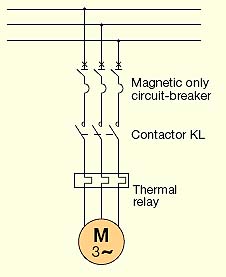
Рис. ABB
Схема прямого пуска электродвигателяMagnetic only circuit-breaker - Автоматический выключатель с электромагнитным расцепителем
Contactor KL - Контактор KL
Thermal relay - Тепловое реле
Параллельные тексты EN-RU
Direct-on-line starting
Direct-on-line starting, which is often abbreviated as DOL, is perhaps the most traditional system and consists in connecting the motor directly to the supply network, thus carrying out starting at full voltage.Direct-on-line starting represents the simplest and the most economical system to start a squirrel-cage asynchronous motor and it is the most used.
As represented in Figure 5, it provides the direct connection to the supply network and therefore starting is carried out at full voltage and with constant frequency, developing a high starting torque with very reduced acceleration times.
The typical applications are relevant to small power motors also with full load starting.
These advantages are linked to some problems such as, for example, the high inrush current, which - in the first instants - can reach values of about 10 to 12 times the rated current, then can decrease to about 6 to 8 times the rated current and can persist to reach the maximum torque speed.The effects of such currents can be identified with the high electro-dynamical stresses on the motor connection cables and could affect also the windings of the motor itself; besides, the high inrush torques can cause violent accelerations which stress the transmission components (belts and joints) generating distribution problems with a reduction in the mechanical life of these elements.
Finally, also the possible electrical problems due to voltage drops on the supply line of the motor or of the connected equipment must be taken into consideration.
[ABB]Прямой пуск
Прямой пуск, который по-английски часто сокращенно обозначают как DOL, является, пожалуй наиболее распространенным способом пуска. Он заключается в непосредственном (т. е. прямом) подключении двигателя к питающей сети. Это означает, что пуск двигателя осуществляется при полном напряжении.Схема прямого пуска является наиболее простым, экономичным и чаще всего применяемым решением для электродвигателей с короткозамкнутым ротором.
Схема прямого подключения к сети представлена на рисунке 5. Пуск осуществляется при полном напряжении и постоянной частоте сети. Электродвигатель развивает высокий пусковой момент при коротком времени разгона.
Типичные области применения – маломощные электродвигатели, в том числе с пуском при полной нагрузке.
Однако, наряду с преимуществами имеются и определенные недостатки, например, бросок пускового тока, достигающий в первоначальный момент 10…12-кратного значения от номинального тока электродвигателя. Затем ток двигателя уменьшается примерно до 6…8-кратного значения номинального тока и будет держаться на этом уровне до тех пор, пока скорость двигателя не достигнет максимального значения.
Такое изменение тока оказывает значительное электродинамическое воздействие на кабель, подключенный к двигателю. Кроме того пусковой ток воздействует на обмотки двигателя. Высокий начальный пусковой момент может привести к значительному ускорению и следовательно к значительной нагрузке элементов привода (ремней, крепления узлов), что вызывает сокращение их срока службы.
И, наконец, следует принять во внимание возможное возникновение проблем, связанных с падением напряжения в линии питания двигателя и подключенного к этой линии оборудования.
[Перевод Интент]
Тематики
Синонимы
EN
- across-the-line starting (US)
- direct line starting
- direct operation of a motor
- direct starting
- direct-on-line starting
- DOL
- full voltage starter application
DE
FR
Русско-английский словарь нормативно-технической терминологии > прямой пуск вращающегося электродвигателя
-
19 "дуговая" неисправность
"дуговая" неисправность
Неисправность, приводящая к возникновению дуги.
[Интент]Параллельные тексты EN-RU
An arc fault occurs when there is a reduction in the dielectric strength of the insulating means (air, in LV switchboards) interposed between two or more conducting elements at different potential.
The arc is generated at the moment when, due to the high ionization of the air, there is a breakdown of the dielectric of the medium and the consequent flow of the current through it.
In an arc fault the highest stresses are of thermal type and proportional to RaI2 owing to the high value taken by the arc resistance Ra; this because the fault current flows in a medium which is always insulating, even if extremely ionized.
Such stresses manifest themselves essentially in the form of:
• high thermal gradients caused by the quick and intense rise in the air temperature;
• high pressure gradients in the form of pressure wave;
• high ionization of the air with consequent reduction of its insulating strength.
Generally speaking, in a LV assembly designed and tested according to the Standard IEC 60439-1 an arc fault is not very likely to occur; however, should it occur, the consequences would be extremely harmful to both the equipment as well as the personnel (see Chapters 2.2 and 2.3).
The causes of an arc fault can be both technical as well as non technical; among the latter the most frequent are the following:
• personnel errors, above all during maintenance operations;
• installation operations not sufficiently accurate;
• inadequate maintenance, above all in the case of severe environmental conditions.
Among the technical causes of an arc fault in a LV assembly the following ones are to be remembered:
• breakdown of the insulation essentially in the proximity of the supports of the busbars and of the plug-in contacts of the withdrawable units (75% of cases);
• overvoltages generating disruptive discharges between the points at minimum clearances (15% of cases);
• constructional defects of the apparatus (10% of cases).
[ABB]К «дуговой» неисправности, относится неисправность, обусловленная уменьшением электрической прочности изолирующей среды (воздуха в НКУ) между двумя или более токоведущими частями, находящимися под разными электрическими потенциалами.
Дуга образуется в тот момент, когда вследствие высокой ионизации воздуха происходит пробой изолирующей среды, вследствие чего через нее начинает протекать электрический ток.
Проявлением дуговой неисправности, является тепловое воздействие, пропорциональное RaI2 и достигающее большого значения вследствие большого сопротивления дуги Ra.
Дело в том, что ток дуги протекает через среду, которая всегда является изолирующей, пусть даже и чрезвычайно ионизированной.
Указанные воздействия очевидны сами по себе особенно в форме:
• теплового градиента температуры, вызванного быстрым и интенсивным подъемом температуры воздуха;
• высоким градиентом давления в форме волны давления;
• высокой ионизацией воздуха с последующим уменьшением электрической прочности.
Вообще говоря, в НКУ, разработанных и испытанных в соответствии с требованиями стандарта МЭК 60439-1 «дуговая» неисправность маловероятна. Однако, если дуга все таки возникнет, ее последствия буду чрезвычайно тяжелыми как для оборудования, так и для персонала (см. п. 2.2 и 2.3).
Причина дуговой неисправности может носить как технический, так и нетехнический характер. Среди последних наиболее часто возникают следующие:
• ошибки персонала, совершаемые главным образом во время технического обслуживания;
• недостаточно аккуратное выполнение монтажа;
• ненадлежащее техническое обслуживание, главным образом при эксплуатации НКУ в тяжелых условиях окружающей среды.
Среди технических причин дуговой неисправности в НКУ необходимо помнить о следующих:
• пробой изоляции, особенно вблизи опор шин и втычных контактов выдвижных частей НКУ (75 % случаев);
• перенапряжения, вызываемые разрушительными электрическими разрядами между точками с минимальными зазорами (15 % случаев);
• конструктивные дефекты аппаратуры (10 % случаев).
[Перевод Интент]Тематики
- НКУ (шкафы, пульты,...)
EN
Русско-английский словарь нормативно-технической терминологии > "дуговая" неисправность
-
20 ток, создающий поле возбуждения
Electrical engineering: field-generating currentУниверсальный русско-английский словарь > ток, создающий поле возбуждения
- 1
- 2
См. также в других словарях:
Current limiting — is the practice in electrical or electronic circuits of imposing an upper limit on the current that may be delivered to a load with the purpose of protecting the circuit generating or transmitting the current from harmful effects due to a short… … Wikipedia
Alternating current — (green curve). The horizontal axis measures time; the vertical, current or voltage. In alternating current (AC, also ac) the movement of electric charge periodically reverses direction. In direct current (DC, also dc), the flow of electric charge … Wikipedia
Nanticoke Generating Station — Nanticoke Generating Station … Wikipedia
Ames Hydroelectric Generating Plant — The Ames Hydroelectric Generating Plant, located near Ophir, Colorado, was the world s first commercial system to produce and transmit alternating current (AC) electricity. It is now on the List of IEEE Milestones.In the summer of 1890,… … Wikipedia
Palo Verde Nuclear Generating Station — Infobox Nuclear power plant name = Palo Verde Nuclear Generating Station caption = The Palo Verde NPP, image courtesy of the NRC. country = USA location = Tonopah, Arizona coords = coord|33.388846| 112.865403 |format=dms |region:US type:building… … Wikipedia
Kakabeka Falls Generating Station — is a hydroelectric facility operated by Ontario Power Generation on the bank of the Kaministiquia River, km to mi|2|abbr=yes|precision=0 downstream from Kakabeka Falls in the community of Kakabeka Falls, Ontario, km to mi|30|abbr=yes|precision=0… … Wikipedia
Hudson Generating Station — in Jersey City, New Jersey is a two unit, 1,115 megawatt power plant, owned and operated by PSE G (PSEG). Unit 1 produces electricity by burning natural gas. Unit 2 (nominal 660 MW) runs mainly on coal, but it can also use [natural gas] . [cite… … Wikipedia
Geomagnetically induced current — Geomagnetically induced currents (GIC), affecting the normal operation of long technological conductor systems, are a manifestation at ground level of space weather. During space weather events (or geomagnetic storms) Earth s near space current… … Wikipedia
Oyster Creek Nuclear Generating Station — Oyster Creek Nuclear Plant in 1998, at the time it was owned operated by GPU … Wikipedia
Fisk Generating Station — The Fisk Generating Station, located at 1111 West Cermak Road in the Pilsen neighborhood of Chicago, Illinois, in the United States, is a legacy coal fired electric generating station not covered by current Clean Air Act emission standards. A… … Wikipedia
Gould Street Generating Station — The Gould Street Generating Station is a 100 MW electric generating plant operated by Constellation Energy that is located on Gould Street in south Baltimore, Maryland. The plant is adjacent to an elevated section of freeway I 95 and is south of… … Wikipedia
