

-
21 tension assignée
номинальное напряжение
Напряжение, установленное изготовителем для прибора
[ ГОСТ Р 52161. 1-2004 ( МЭК 60335-1: 2001)]
номинальное напряжение Uном, кВ
Номинальное междуфазное напряжение электрической сети, для работы в которой предназначены коммутационные аппараты.
[ ГОСТ Р 52726-2007]
номинальное напряжение
Un
Напряжение, применяемое для обозначения или идентификации системы электроснабжения.
[ ГОСТ Р 51317.4.30-2008 (МЭК 61000-4-30:2008)]EN
rated voltage
voltage assigned to the appliance by the manufacturer
[IEC 60335-1, ed. 4.0 (2001-05)]
rated voltage
quantity value assigned, generally by the manufacturer, for a specified operating condition of a machine
[IEC 60034-18-41, ed. 1.0 (2006-10)]
rated voltage
input or output supply voltage for which equipment is designed or specified
[IEC 88528-11, ed. 1.0 (2004-03)]
rated voltage
specified value of the voltage at the terminals of the machine when operating at a rating. If unidirectional, the voltage is the arithmetic mean of the recurring waveform and if alternating it is the root mean square value of the fundamental frequency component of the recurring waveform
NOTE - In the case of a machine with a protective resistor permanently in series, the resistor is considered as an integral part of the machine
[IEC 60349-1, ed. 1.0 (1999-11)]
rated voltage
the value of voltage assigned by the manufacturer to a component, device or equipment and to which operation and performance characteristics are referred
NOTE - Equipment may have more than one rated voltage value or may have a rated voltage range.
[IEC 62497-1, ed. 1.0 (2010-02)]
rated voltage
reference voltage for which the cable is designed, and which serves to define the electrical tests
NOTE 1 - The rated voltage is expressed by the combination of two values: Uo/U expressed in volts (V):
Uo being the r.m.s. value between any insulated conductor and "earth" (metal covering of the cable or the surrounding medium);
U being the r.m.s. value between any two phase conductors of a multicore cable or of a system of single-core cables.
In an alternating-current system, the rated voltage of a cable is at least equal to the nominal voltage of the system for which it is intended.
This condition applies both to the value Uo and to the value U.
In a direct current system, the nominal voltage of the system is not higher than 1,5 times the rated voltage of the cable.
NOTE 2 - The operating voltage of a system may permanently exceed the nominal voltage of such a system by 10 %. A cable can be used at a 10 % higher operating voltage than its rated voltage if the latter is at least equal to the nominal voltage of the system
[IEC 60245-1, ed. 4.0 (2003-12)]
rated voltage
highest allowable voltage between the conductors in a twin and multi conductor cable, or between one conductor and an electrical conductive screen, or between the two ends of a single core cable, or earth in unscreened cables
[IEC 60800, ed. 3.0 (2009-07)]
rated voltage
the r.m.s. line-to-line voltage under rated conditions
Primary side of input transformer: ULN
Converter input: UVN
Converter output: UaN
Motor voltage: UAN
[IEC 61800-4, ed. 1.0 (2002-09)]
rated voltage
input or output voltage (for three-phase supply, the phase-to-phase voltage) as declared by the manufacturer
[IEC 62040-1, ed. 1.0 (2008-06)]
nominal voltage, Un
voltage by which a system is designated or identified
[IEC 61000-4-30, ed. 2.0 (2008-10)]FR
tension assignée
tension attribuée à l'appareil par le fabricant
[IEC 60335-1, ed. 4.0 (2001-05)]
tension nominale
tension assignée, généraleme<>value of voltage assigned by the manufacturer, to a componentnt par le constructeur pour des conditions spécifiées de fonctionnement de la machine
[IEC 60034-18-41, ed. 1.0 (2006-10)]
tension assignée
tension spécifiée aux bornes de la machine quand celle-ci fonctionne au régime assigné. Dans le cas d'une tension redressée, sa valeur est égale à la valeur moyenne de l'onde périodique. Dans le cas d'une tension alternative, sa valeur est égale à la valeur efficace de la composante fondamentale de l'onde périodique
NOTE - Dans le cas d'une machine équipée d'une résistance de protection connectée en permanence en série, la résistance est considérée comme faisant partie intégrante de la machine
[IEC 60349-1, ed. 1.0 (1999-11)]
tension assignée
valeur de la tension, assignée par le constructeur à un composant, à un dispositif ou à un matériel, et à laquelle on se réfère pour le fonctionnement et pour les caractéristiques fonctionnelles
NOTE - Les matériels peuvent avoir plusieurs valeurs ou une plage de tensions assignées.
[IEC 62497-1, ed. 1.0 (2010-02)]
tension assignée
tension de référence pour laquelle le conducteur ou le câble est prévu et qui sert à définir les essais électriques
NOTE 1 - La tension assignée est exprimée par la combinaison de deux valeurs Uo /U, exprimées en volts (V):
Uo étant la valeur efficace entre l'âme d'un conducteur isolé quelconque et la «terre» (revêtement métallique du câble au milieu environnant);
U étant la valeur efficace entre les âmes conductrices de deux conducteurs de phase quelconques d'un câble multiconducteur ou d'un système de câbles monoconducteurs ou de conducteurs.
Dans un système à courant alternatif, la tension assignée d'un conducteur ou d’un câble est au moins égale à la tension nominale du système pour lequel il est prévu.
Cette condition s'applique à la fois à la valeur Uo et à la valeur U.
Dans un système à courant continu, la tension nominale admise du système n’est pas supérieure à 1,5 fois la tension assignée du conducteur ou du câble.
NOTE 2 - La tension de service d'un système peut en permanence dépasser la tension nominale dudit système de 10 %. Un conducteur ou un câble peut être utilisé à une tension de service supérieure de 10 % à sa tension assignée si cette dernière est au moins égale à la tension nominale du système
[IEC 60245-1, ed. 4.0 (2003-12)]
tension assignée
tension maximale admissible entre les âmes dans un câble ayant une paire ou multi conducteur ou entre une âme et un écran conducteur électrique ou avec la terre pour un câble non écranté ou encore entre les deux extrémités d’un câble à âme unique
[IEC 60800, ed. 3.0 (2009-07)]
tension assignée
valeur efficace de la tension de ligne (entre phases) dans les conditions assignées
Primaire du transformateur d’entrée: ULN
Entrée du convertisseur: UVN
Sortie du convertisseur: UaN
Moteur: UAN
[IEC 61800-4, ed. 1.0 (2002-09)]
tension assignée
tension d’alimentation d’entrée ou de sortie (dans le cas d’une alimentation triphasée, tension entre phases) déclarée par le constructeur
[IEC 62040-1, ed. 1.0 (2008-06)]
tension nominale, Un
tension par laquelle un réseau est désigné ou identifié
[IEC 61000-4-30, ed. 2.0 (2008-10)]Тематики
- аппарат, изделие, устройство...
- высоковольтный аппарат, оборудование...
- прибор электрический
- электроснабжение в целом
Синонимы
- Un
EN
FR
Франко-русский словарь нормативно-технической терминологии > tension assignée
-
22 tension nominale
номинальное напряжение
Напряжение, установленное изготовителем для прибора
[ ГОСТ Р 52161. 1-2004 ( МЭК 60335-1: 2001)]
номинальное напряжение Uном, кВ
Номинальное междуфазное напряжение электрической сети, для работы в которой предназначены коммутационные аппараты.
[ ГОСТ Р 52726-2007]
номинальное напряжение
Un
Напряжение, применяемое для обозначения или идентификации системы электроснабжения.
[ ГОСТ Р 51317.4.30-2008 (МЭК 61000-4-30:2008)]EN
rated voltage
voltage assigned to the appliance by the manufacturer
[IEC 60335-1, ed. 4.0 (2001-05)]
rated voltage
quantity value assigned, generally by the manufacturer, for a specified operating condition of a machine
[IEC 60034-18-41, ed. 1.0 (2006-10)]
rated voltage
input or output supply voltage for which equipment is designed or specified
[IEC 88528-11, ed. 1.0 (2004-03)]
rated voltage
specified value of the voltage at the terminals of the machine when operating at a rating. If unidirectional, the voltage is the arithmetic mean of the recurring waveform and if alternating it is the root mean square value of the fundamental frequency component of the recurring waveform
NOTE - In the case of a machine with a protective resistor permanently in series, the resistor is considered as an integral part of the machine
[IEC 60349-1, ed. 1.0 (1999-11)]
rated voltage
the value of voltage assigned by the manufacturer to a component, device or equipment and to which operation and performance characteristics are referred
NOTE - Equipment may have more than one rated voltage value or may have a rated voltage range.
[IEC 62497-1, ed. 1.0 (2010-02)]
rated voltage
reference voltage for which the cable is designed, and which serves to define the electrical tests
NOTE 1 - The rated voltage is expressed by the combination of two values: Uo/U expressed in volts (V):
Uo being the r.m.s. value between any insulated conductor and "earth" (metal covering of the cable or the surrounding medium);
U being the r.m.s. value between any two phase conductors of a multicore cable or of a system of single-core cables.
In an alternating-current system, the rated voltage of a cable is at least equal to the nominal voltage of the system for which it is intended.
This condition applies both to the value Uo and to the value U.
In a direct current system, the nominal voltage of the system is not higher than 1,5 times the rated voltage of the cable.
NOTE 2 - The operating voltage of a system may permanently exceed the nominal voltage of such a system by 10 %. A cable can be used at a 10 % higher operating voltage than its rated voltage if the latter is at least equal to the nominal voltage of the system
[IEC 60245-1, ed. 4.0 (2003-12)]
rated voltage
highest allowable voltage between the conductors in a twin and multi conductor cable, or between one conductor and an electrical conductive screen, or between the two ends of a single core cable, or earth in unscreened cables
[IEC 60800, ed. 3.0 (2009-07)]
rated voltage
the r.m.s. line-to-line voltage under rated conditions
Primary side of input transformer: ULN
Converter input: UVN
Converter output: UaN
Motor voltage: UAN
[IEC 61800-4, ed. 1.0 (2002-09)]
rated voltage
input or output voltage (for three-phase supply, the phase-to-phase voltage) as declared by the manufacturer
[IEC 62040-1, ed. 1.0 (2008-06)]
nominal voltage, Un
voltage by which a system is designated or identified
[IEC 61000-4-30, ed. 2.0 (2008-10)]FR
tension assignée
tension attribuée à l'appareil par le fabricant
[IEC 60335-1, ed. 4.0 (2001-05)]
tension nominale
tension assignée, généraleme<>value of voltage assigned by the manufacturer, to a componentnt par le constructeur pour des conditions spécifiées de fonctionnement de la machine
[IEC 60034-18-41, ed. 1.0 (2006-10)]
tension assignée
tension spécifiée aux bornes de la machine quand celle-ci fonctionne au régime assigné. Dans le cas d'une tension redressée, sa valeur est égale à la valeur moyenne de l'onde périodique. Dans le cas d'une tension alternative, sa valeur est égale à la valeur efficace de la composante fondamentale de l'onde périodique
NOTE - Dans le cas d'une machine équipée d'une résistance de protection connectée en permanence en série, la résistance est considérée comme faisant partie intégrante de la machine
[IEC 60349-1, ed. 1.0 (1999-11)]
tension assignée
valeur de la tension, assignée par le constructeur à un composant, à un dispositif ou à un matériel, et à laquelle on se réfère pour le fonctionnement et pour les caractéristiques fonctionnelles
NOTE - Les matériels peuvent avoir plusieurs valeurs ou une plage de tensions assignées.
[IEC 62497-1, ed. 1.0 (2010-02)]
tension assignée
tension de référence pour laquelle le conducteur ou le câble est prévu et qui sert à définir les essais électriques
NOTE 1 - La tension assignée est exprimée par la combinaison de deux valeurs Uo /U, exprimées en volts (V):
Uo étant la valeur efficace entre l'âme d'un conducteur isolé quelconque et la «terre» (revêtement métallique du câble au milieu environnant);
U étant la valeur efficace entre les âmes conductrices de deux conducteurs de phase quelconques d'un câble multiconducteur ou d'un système de câbles monoconducteurs ou de conducteurs.
Dans un système à courant alternatif, la tension assignée d'un conducteur ou d’un câble est au moins égale à la tension nominale du système pour lequel il est prévu.
Cette condition s'applique à la fois à la valeur Uo et à la valeur U.
Dans un système à courant continu, la tension nominale admise du système n’est pas supérieure à 1,5 fois la tension assignée du conducteur ou du câble.
NOTE 2 - La tension de service d'un système peut en permanence dépasser la tension nominale dudit système de 10 %. Un conducteur ou un câble peut être utilisé à une tension de service supérieure de 10 % à sa tension assignée si cette dernière est au moins égale à la tension nominale du système
[IEC 60245-1, ed. 4.0 (2003-12)]
tension assignée
tension maximale admissible entre les âmes dans un câble ayant une paire ou multi conducteur ou entre une âme et un écran conducteur électrique ou avec la terre pour un câble non écranté ou encore entre les deux extrémités d’un câble à âme unique
[IEC 60800, ed. 3.0 (2009-07)]
tension assignée
valeur efficace de la tension de ligne (entre phases) dans les conditions assignées
Primaire du transformateur d’entrée: ULN
Entrée du convertisseur: UVN
Sortie du convertisseur: UaN
Moteur: UAN
[IEC 61800-4, ed. 1.0 (2002-09)]
tension assignée
tension d’alimentation d’entrée ou de sortie (dans le cas d’une alimentation triphasée, tension entre phases) déclarée par le constructeur
[IEC 62040-1, ed. 1.0 (2008-06)]
tension nominale, Un
tension par laquelle un réseau est désigné ou identifié
[IEC 61000-4-30, ed. 2.0 (2008-10)]Тематики
- аппарат, изделие, устройство...
- высоковольтный аппарат, оборудование...
- прибор электрический
- электроснабжение в целом
Синонимы
- Un
EN
FR
номинальное напряжение конденсатора
Максимальное напряжение, при котором конденсатор может работать в течение минимальной наработки в условиях, указанных в нормативно-технической документации
[ ГОСТ 21415-75]
номинальное напряжение конденсатора
Действующее значение синусоидального переменного напряжения при номинальной частоте, на которое рассчитан конденсатор. Номинальное напряжение многофазного конденсатора - значение напряжения между выводами.
[ ГОСТ 1282-88]Тематики
- конденсаторы для повыш. коэф. мощности
- конденсаторы для электронной аппаратуры
EN
DE
FR
Франко-русский словарь нормативно-технической терминологии > tension nominale
-
23 Un
номинальное напряжение
Напряжение, установленное изготовителем для прибора
[ ГОСТ Р 52161. 1-2004 ( МЭК 60335-1: 2001)]
номинальное напряжение Uном, кВ
Номинальное междуфазное напряжение электрической сети, для работы в которой предназначены коммутационные аппараты.
[ ГОСТ Р 52726-2007]
номинальное напряжение
Un
Напряжение, применяемое для обозначения или идентификации системы электроснабжения.
[ ГОСТ Р 51317.4.30-2008 (МЭК 61000-4-30:2008)]EN
rated voltage
voltage assigned to the appliance by the manufacturer
[IEC 60335-1, ed. 4.0 (2001-05)]
rated voltage
quantity value assigned, generally by the manufacturer, for a specified operating condition of a machine
[IEC 60034-18-41, ed. 1.0 (2006-10)]
rated voltage
input or output supply voltage for which equipment is designed or specified
[IEC 88528-11, ed. 1.0 (2004-03)]
rated voltage
specified value of the voltage at the terminals of the machine when operating at a rating. If unidirectional, the voltage is the arithmetic mean of the recurring waveform and if alternating it is the root mean square value of the fundamental frequency component of the recurring waveform
NOTE - In the case of a machine with a protective resistor permanently in series, the resistor is considered as an integral part of the machine
[IEC 60349-1, ed. 1.0 (1999-11)]
rated voltage
the value of voltage assigned by the manufacturer to a component, device or equipment and to which operation and performance characteristics are referred
NOTE - Equipment may have more than one rated voltage value or may have a rated voltage range.
[IEC 62497-1, ed. 1.0 (2010-02)]
rated voltage
reference voltage for which the cable is designed, and which serves to define the electrical tests
NOTE 1 - The rated voltage is expressed by the combination of two values: Uo/U expressed in volts (V):
Uo being the r.m.s. value between any insulated conductor and "earth" (metal covering of the cable or the surrounding medium);
U being the r.m.s. value between any two phase conductors of a multicore cable or of a system of single-core cables.
In an alternating-current system, the rated voltage of a cable is at least equal to the nominal voltage of the system for which it is intended.
This condition applies both to the value Uo and to the value U.
In a direct current system, the nominal voltage of the system is not higher than 1,5 times the rated voltage of the cable.
NOTE 2 - The operating voltage of a system may permanently exceed the nominal voltage of such a system by 10 %. A cable can be used at a 10 % higher operating voltage than its rated voltage if the latter is at least equal to the nominal voltage of the system
[IEC 60245-1, ed. 4.0 (2003-12)]
rated voltage
highest allowable voltage between the conductors in a twin and multi conductor cable, or between one conductor and an electrical conductive screen, or between the two ends of a single core cable, or earth in unscreened cables
[IEC 60800, ed. 3.0 (2009-07)]
rated voltage
the r.m.s. line-to-line voltage under rated conditions
Primary side of input transformer: ULN
Converter input: UVN
Converter output: UaN
Motor voltage: UAN
[IEC 61800-4, ed. 1.0 (2002-09)]
rated voltage
input or output voltage (for three-phase supply, the phase-to-phase voltage) as declared by the manufacturer
[IEC 62040-1, ed. 1.0 (2008-06)]
nominal voltage, Un
voltage by which a system is designated or identified
[IEC 61000-4-30, ed. 2.0 (2008-10)]FR
tension assignée
tension attribuée à l'appareil par le fabricant
[IEC 60335-1, ed. 4.0 (2001-05)]
tension nominale
tension assignée, généraleme<>value of voltage assigned by the manufacturer, to a componentnt par le constructeur pour des conditions spécifiées de fonctionnement de la machine
[IEC 60034-18-41, ed. 1.0 (2006-10)]
tension assignée
tension spécifiée aux bornes de la machine quand celle-ci fonctionne au régime assigné. Dans le cas d'une tension redressée, sa valeur est égale à la valeur moyenne de l'onde périodique. Dans le cas d'une tension alternative, sa valeur est égale à la valeur efficace de la composante fondamentale de l'onde périodique
NOTE - Dans le cas d'une machine équipée d'une résistance de protection connectée en permanence en série, la résistance est considérée comme faisant partie intégrante de la machine
[IEC 60349-1, ed. 1.0 (1999-11)]
tension assignée
valeur de la tension, assignée par le constructeur à un composant, à un dispositif ou à un matériel, et à laquelle on se réfère pour le fonctionnement et pour les caractéristiques fonctionnelles
NOTE - Les matériels peuvent avoir plusieurs valeurs ou une plage de tensions assignées.
[IEC 62497-1, ed. 1.0 (2010-02)]
tension assignée
tension de référence pour laquelle le conducteur ou le câble est prévu et qui sert à définir les essais électriques
NOTE 1 - La tension assignée est exprimée par la combinaison de deux valeurs Uo /U, exprimées en volts (V):
Uo étant la valeur efficace entre l'âme d'un conducteur isolé quelconque et la «terre» (revêtement métallique du câble au milieu environnant);
U étant la valeur efficace entre les âmes conductrices de deux conducteurs de phase quelconques d'un câble multiconducteur ou d'un système de câbles monoconducteurs ou de conducteurs.
Dans un système à courant alternatif, la tension assignée d'un conducteur ou d’un câble est au moins égale à la tension nominale du système pour lequel il est prévu.
Cette condition s'applique à la fois à la valeur Uo et à la valeur U.
Dans un système à courant continu, la tension nominale admise du système n’est pas supérieure à 1,5 fois la tension assignée du conducteur ou du câble.
NOTE 2 - La tension de service d'un système peut en permanence dépasser la tension nominale dudit système de 10 %. Un conducteur ou un câble peut être utilisé à une tension de service supérieure de 10 % à sa tension assignée si cette dernière est au moins égale à la tension nominale du système
[IEC 60245-1, ed. 4.0 (2003-12)]
tension assignée
tension maximale admissible entre les âmes dans un câble ayant une paire ou multi conducteur ou entre une âme et un écran conducteur électrique ou avec la terre pour un câble non écranté ou encore entre les deux extrémités d’un câble à âme unique
[IEC 60800, ed. 3.0 (2009-07)]
tension assignée
valeur efficace de la tension de ligne (entre phases) dans les conditions assignées
Primaire du transformateur d’entrée: ULN
Entrée du convertisseur: UVN
Sortie du convertisseur: UaN
Moteur: UAN
[IEC 61800-4, ed. 1.0 (2002-09)]
tension assignée
tension d’alimentation d’entrée ou de sortie (dans le cas d’une alimentation triphasée, tension entre phases) déclarée par le constructeur
[IEC 62040-1, ed. 1.0 (2008-06)]
tension nominale, Un
tension par laquelle un réseau est désigné ou identifié
[IEC 61000-4-30, ed. 2.0 (2008-10)]Тематики
- аппарат, изделие, устройство...
- высоковольтный аппарат, оборудование...
- прибор электрический
- электроснабжение в целом
Синонимы
- Un
EN
FR
Франко-русский словарь нормативно-технической терминологии > Un
-
24 tension assignée d'un parafoudre
номинальное напряжение
Uн
Действующее значение напряжения промышленной частоты, которое ограничитель может выдерживать в течение 10 с в процессе рабочих испытаний. Номинальное напряжение должно быть не менее 1,25 наибольшего длительно допустимого рабочего напряжения.
[ ГОСТ Р 52725-2007]EN
rated voltage of an arrester
Ur
maximum permissible r.m.s. value of power-frequency voltage between its terminals at which it is designed to operate correctly under temporary overvoltage conditions as established in the operating duty tests
NOTE 1 The rated voltage is used as a reference parameter for the specification of operating characteristics.
NOTE 2 The rated voltage as defined in this standard is the 10 s power-frequency voltage used in the operating duty test after high-current or long-duration impulses. Tests used to establish the voltage rating in IEC 60099-1, as well as some national standards, involve the application of repetitive impulses at nominal current with power-frequency voltage applied. Attention is drawn to the fact that these two methods used to established rating do not necessarily produce equivalent values (a resolution to this discrepancy is under consideration).
[IEC 60099-4, ed. 2.0 (2004-05)]FR
tension assignée d'un parafoudre
Ur
valeur maximale de la tension efficace à fréquence industrielle admissible entre ses bornes pour laquelle le parafoudre est prévu pour fonctionner correctement dans des conditions de surtension temporaires comme il est défini dans les essais de fonctionnement
NOTE 1 La tension assignée est utilisée comme paramètre de référence pour la spécification des caractéristiques de fonctionnement.
NOTE 2 La tension assignée comme définie dans la présente norme est la tension à fréquence industrielle de 10 s, utilisée pour vérifier la stabilité après application des chocs de courant de grande amplitude ou de longue durée lors de l'essai de fonctionnement. Les essais utilisés pour définir la tension assignée dans la CEI 60099-1, ainsi que dans certaines normes nationales, impliquent l'application de chocs répétés au courant nominal pendant que la tension à fréquence industrielle est appliquée. On attire l'attention sur le fait que ces deux méthodes utilisées pour définir les valeurs assignées ne produisent pas nécessairement des valeurs équivalentes (une résolution de cette différence est à l'étude).
[IEC 60099-4, ed. 2.0 (2004-05)]Тематики
- высоковольтный аппарат, оборудование...
EN
FR
Франко-русский словарь нормативно-технической терминологии > tension assignée d'un parafoudre
-
25 transformateur de puissance
силовой трансформатор
Трансформатор, предназначенный для преобразования электрической энергии в электрических сетях и в установках, предназначенных для приема и использования электрической энергии.
Примечание. К силовым относятся трансформаторы трехфазные и многофазные мощностью 6,3 кВ•А и более, однофазные мощностью 5 кВ•А и более.
[ ГОСТ 16110-82]
силовой трансформатор
Статическое устройство, имеющее две или более обмотки, предназначенное для преобразования посредством электромагнитной индукции одной или нескольких систем переменного напряжения и тока в одну или несколько других систем переменного напряжения и тока, имеющих обычно другие значения при той же частоте, с целью передачи мощности
(МЭС 421-01-01).
[ ГОСТ 30830-2002]EN
power transformer
a static piece of apparatus with two or more windings which, by electromagnetic induction, transforms a system of alternating voltage and current into another system of voltage and current usually of different values and at the same frequency for the purpose of transmitting electrical power
[IEV number 421-01-01]FR
transformateur de puissance
appareil statique à induction électromagnétique, à deux enroulements ou plus, destiné à transformer un système de tension(s) et courants(s) alternatifs en un autre système de tension(s) et courant(s) alternatifs, de valeurs généralement différentes et de même fréquence, en vue de transférer une puissance électrique
[IEV number 421-01-01]Силовые трансформаторы, установленные на электростанциях и подстанциях, предназначены для преобразования электроэнергии с одного напряжения на другое. Наибольшее распространение получили трехфазные трансформаторы, так как потери в них на 12—15% ниже, а расход активных материалов и стоимость на 20—25% меньше, чем в группе трех однофазных трансформаторов такой же суммарной мощности.
Трехфазные трансформаторы на напряжение 220 кВ изготовляют мощностью до 1000 MBА, на 330 кВ - 1250 МВА, на 500 кВ - 1000 МВА. Удельная единичная мощность трансформаторов ограничивается массой, размерами, условиями транспортировки.
Однофазные трансформаторы применяются, если невозможно изготовление трехфазных трансформаторов необходимой мощности или затруднена их транспортировка. Наибольшая мощность группы однофазных трансформаторов напряжением 500 кВ — 3 * 533 МВА, напряжением 750 кВ - 3 * 417 МВА, напряжением 1150 кВ - 3 * 667 MBA.
По количеству обмоток различного напряжения на каждую фазу трансформаторы разделяются на двухобмоточные и трехобмоточные. Кроме того, обмотки одного и того же напряжения, обычно низшего, могут состоять из двух и более параллельных ветвей, изолированных друг от друга и от заземленных частей. Такие трансформаторы называются трансформаторами с расщепленными обмотками. Обмотки высшего, среднего и низшего напряжения принято сокращенно обозначать соответственно ВН, СН, НН.
Трансформаторы с расщепленными обмотками НН обеспечивают возможность присоединения нескольких генераторов к одному повышающему трансформатору. Такие укрупненные энергоблоки позволяют упростить схему РУ 330—500 кВ. Широкое распространение трансформаторы с расщепленной обмоткой НН получили в схемах питания собственных нужд крупных ТЭС с блоками 200-1200 МВт, а также на понижающих подстанциях с целью ограничения токов КЗ.[http://forca.ru/info/spravka/silovye-transformatory.html]
Устройство и элементы конструкции силовых трансформаторов
Силовые трансформаторы (автотрансформаторы) в зависимости от мощности и напряжения условно делят на восемь габаритов. Так, например, к нулевому габариту относят трансформаторы мощностью до 5 кВ-А включительно, мощностью свыше 5 кВ-А — до 100 кВ-А напряжением до 35 кВ (включительно) к I габариту, выше 100 до 1000 — ко II, выше 1000 до 6300 — к III; выше 6300 — к IV, а напряжением выше 35 до 110 кВ (включительно) и мощностью до 32 000 кВ-А — к V габариту. Для отличия по конструктивным признакам, назначению, мощности и напряжению их подразделяют на типы.
Каждому типу трансформаторов присваивают обозначение, состоящее из букв и цифр. Буквы в типах масляных и сухих трансформаторов обозначают: О — однофазный, Т — трехфазный, Н — регулирование напряжения под нагрузкой, Р — с расщепленными обмотками; по видам охлаждения: С — естественно-воздушное, М — естественная циркуляция воздуха и масла, Д — принудительная циркуляция воздуха и естественная циркуляция масла, ДЦ — принудительная циркуляция воздуха и масла, MB — принудительная циркуляция воды и естественная циркуляция масла, Ц— принудительная циркуляция воды и масла. Вторичное употребление буква С в обозначении типа показывает, что трансформатор трехобмоточный.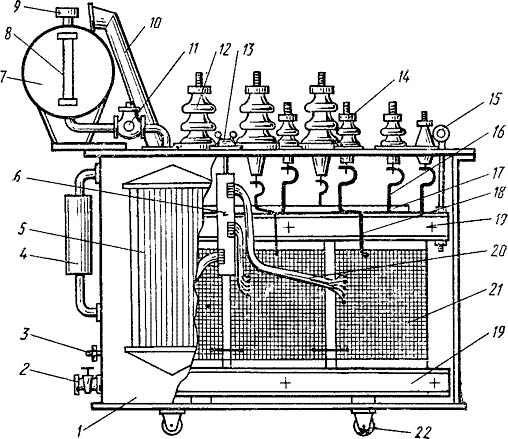
Устройство силового масляного трансформатора мощностью 1000—6300 кВ-А класса напряжения 35 кВ:
1 — бак, 2 — вентиль, 3 — болт заземления, 4 — термосифонный фильтр, 5 — радиатор, 6 — переключатель, 7 — расширитель, 8 — маслоуказатель, 9—воздухоосушитель, 10 — выхлопная труба, 11 — газовое реле, 12 — ввод ВН, 13 — привод переключающего устройства, 14 — ввод НН, 15 — подъемный рым, 16 — отвод НН, 17 — остов, 18 — отвод ВН, 19 — ярмовая балка остова (верхняя и нижняя), 20 — регулировочные ответвления обмоток ВН, 21 — обмотка ВН (внутри НН), 22 — каток тележки
Составными частями масляного трансформатора являются: остов обмотки, переключающее устройство, вводы, отводы, изоляция, бак, охладители, защитные и контрольно-измерительные и вспомогательные устройства.
Конструкция, включающая в собранном виде остов трансформатора, обмотки с их изоляцией, отводы, части регулирующего устройства, а также все детали, служащие для их механического соединения, называется активной частью трансформатора.[http://forca.ru/spravka/spravka/ustroystvo-i-elementy-konstrukcii-silovyh-transformatorov.html]
Тематики
Классификация
>>>EN
DE
FR
Франко-русский словарь нормативно-технической терминологии > transformateur de puissance
-
26 caractéristique I2t d’un disjoncteur
характеристика I2t автоматического выключателя
Информация (как правило, в виде кривой), представленная максимальными, по времени отключения, значениями I2t как функция ожидаемого тока (действующее значение симметричной составляющей для переменного тока) от пикового значения ожидаемого тока, удовлетворяющего номинальной отключающей способности при коротком замыкании и соответствующем напряжении.
[ ГОСТ Р 50030. 2-99 ( МЭК 60947-2-98)]
характеристика I2t выключателя
Кривая, отражающая максимальные значения I2t как функцию ожидаемого тока в указанных условиях эксплуатации.
[ ГОСТ Р 50345-99( МЭК 60898-95)]EN
I2t characteristic of a circuit-breaker
information (usually a curve) giving the maximum values of I2t related to break time as a function of prospective current (r.m.s. symmetrical for a.c.) up to the maximum prospective current corresponding to the rated short-circuit breaking capacity and associated voltage
[IEC 60947-2, ed. 4.0 (2006-05)]FR
caractéristique I2t d’un disjoncteur
information (généralement une courbe) donnant les valeurs maximales de I2t correspondant à la durée de coupure en fonction du courant présumé (valeur efficace de la composante périodique en courant alternatif) jusqu’à la valeur maximale du courant présumé correspondant au pouvoir assigné de coupure en court-circuit à la tension correspondante
[IEC 60947-2, ed. 4.0 (2006-05)]Тематики
EN
FR
- caractéristique I2t d’un disjoncteur
Франко-русский словарь нормативно-технической терминологии > caractéristique I2t d’un disjoncteur
-
27 conditions de référence des grandeurs d'influence (pour un dispositif de coupure différentiel)
эталонные условия влияющих величин
-
[IEV number 442-05-37]EN
reference conditions of influencing quantities (for a residual current device)
collectively, the reference values of all influencing quantities
[IEV number 442-05-37]FR
conditions de référence des grandeurs d'influence (pour un dispositif de coupure différentiel)
ensemble des valeurs de référence de toutes les grandeurs d'influence
[IEV number 442-05-37]EN
- reference conditions of influencing quantities (for a residual current device)
DE
- Bezugsbedingungen von Einflußgrößen (für eine Fehlerstrom-Schutzeinrichtung)
FR
- conditions de référence des grandeurs d'influence (pour un dispositif de coupure différentiel)
Франко-русский словарь нормативно-технической терминологии > conditions de référence des grandeurs d'influence (pour un dispositif de coupure différentiel)
-
28 séparation galvanique (terme déconseillé)
гальваническая развязка
Мероприятие или техническое средство, применение которого направлено на исключение гальванической связи между проводящими частями.
[РД-91.020.00-КТН-276-07]
гальваническая развязка
Схемотехническое решение, при котором исключается гальваническая связь между электрическими цепями. Гальваническая развязка осуществляется трансформаторами или оптоэлектронными приборами.
[Интент]EN
galvanic separation
prevention of electric conduction between two electric circuits intended to exchange power and/or signals
NOTE – Galvanic separation can be provided e.g. by an isolating transformer or an opto-coupler.
[IEV number 151-12-26]FR
séparation électrique, f
séparation galvanique (terme déconseillé), f
action ou moyen d’empêcher la conduction électrique entre deux circuits électriques prévus pour échanger de la puissance ou des signaux
NOTE – Une séparation électrique peut être obtenue, par exemple, au moyen d’un transformateur de séparation (de circuits) ou d’un optocoupleur.
[IEV number 151-12-26]Параллельные тексты EN-RU
Electrical isolation means that no current flow can occur from one electric circuit to a neighboring other electric circuit.
In case of power supplies, this means that no electric connection exists between the input side and the output side.
[ABB]Гальваническая развязка означает, что электрический ток не может протекать из какой-либо цепи в соседнюю цепь.
Для источников электропитания это означает, что не существует электрической связи между входной и выходной сторонами.
[Перевод Интент]The measured values are electrically isolated.
[Schneider Electric]Измеряемые величины гальванически развязаны от цепей устройства.
[Перевод Интент]Недопустимые, нерекомендуемые
Тематики
- электротехника, основные понятия
Близкие понятия
EN
DE
- galvanische Trennung
- Wellenimpedanz, (Leitungs-)
FR
Франко-русский словарь нормативно-технической терминологии > séparation galvanique (terme déconseillé)
-
29 séparation électrique
гальваническая развязка
Мероприятие или техническое средство, применение которого направлено на исключение гальванической связи между проводящими частями.
[РД-91.020.00-КТН-276-07]
гальваническая развязка
Схемотехническое решение, при котором исключается гальваническая связь между электрическими цепями. Гальваническая развязка осуществляется трансформаторами или оптоэлектронными приборами.
[Интент]EN
galvanic separation
prevention of electric conduction between two electric circuits intended to exchange power and/or signals
NOTE – Galvanic separation can be provided e.g. by an isolating transformer or an opto-coupler.
[IEV number 151-12-26]FR
séparation électrique, f
séparation galvanique (terme déconseillé), f
action ou moyen d’empêcher la conduction électrique entre deux circuits électriques prévus pour échanger de la puissance ou des signaux
NOTE – Une séparation électrique peut être obtenue, par exemple, au moyen d’un transformateur de séparation (de circuits) ou d’un optocoupleur.
[IEV number 151-12-26]Параллельные тексты EN-RU
Electrical isolation means that no current flow can occur from one electric circuit to a neighboring other electric circuit.
In case of power supplies, this means that no electric connection exists between the input side and the output side.
[ABB]Гальваническая развязка означает, что электрический ток не может протекать из какой-либо цепи в соседнюю цепь.
Для источников электропитания это означает, что не существует электрической связи между входной и выходной сторонами.
[Перевод Интент]The measured values are electrically isolated.
[Schneider Electric]Измеряемые величины гальванически развязаны от цепей устройства.
[Перевод Интент]Недопустимые, нерекомендуемые
Тематики
- электротехника, основные понятия
Близкие понятия
EN
DE
- galvanische Trennung
- Wellenimpedanz, (Leitungs-)
FR
Франко-русский словарь нормативно-технической терминологии > séparation électrique
-
30 domaine d'ajustement de la grandeur caractéristique
- диапазон уставок по характеристической величине измерительного электрического реле
диапазон уставок по характеристической величине измерительного электрического реле
Совокупность всех значений уставок по характеристической величине измерительного электрического реле или каждой из составляющих ее уставки
[ ГОСТ 16022-83]EN
setting range of the characteristic quantity (or its parameters)
the range of the setting values of the characteristic quantity or each of its setting parameters (e.g. the voltage or current for a power relay)
[IEV number 446-15-04]FR
domaine d'ajustement de la grandeur caractéristique (ou de ses paramètres)
ensemble de toutes les valeurs d'ajustement de la grandeur caractéristique ou de chacun de ses paramètres d'ajustement (par exemple la tension ou le courant pour un relais de puissance)
[IEV number 446-15-04]Тематики
EN
DE
FR
Франко-русский словарь нормативно-технической терминологии > domaine d'ajustement de la grandeur caractéristique
-
31 protection à composantes superposées
защита по аварийным составляющим
Защита, которая зависит от измерения или сравнения аварийных составляющих тока, напряжения и других величин, т.е. от разности между соответствующими аварийными и доаварийными значениями
[Разработка типовых структурных схем микропроцессорных устройств РЗА на объектах ОАО "ФКС ЕЭС". Пояснительная записка. Новосибирск 2006 г.]EN
superimposed component protection
protection which depends on the measurement or comparison of extracted superimposed quantities, i.e. on the differences between appropriate prefault and fault values of current, voltage, etc
[IEV ref 448-14-39]FR
protection à composantes superposées
protection qui dépend de la mesure ou de la comparaison de grandeurs superposées extraites, c'est-à-dire des différences entre les valeurs appropriées des courants, des tensions, etc., avant et pendant le défaut
[IEV ref 448-14-39]Тематики
EN
DE
- Überlagerungskomponentenschutz, m
FR
Франко-русский словарь нормативно-технической терминологии > protection à composantes superposées
-
32 catégorie de surtension (d'un circuit ou dans un réseau)
категория перенапряжения (в цепи или электрической системе)
Условное число, основанное на ограничении (или регулировании) значений ожидаемого переходного перенапряжения, возникающего в цепи (или в электрической системе с различными номинальными напряжениями), зависящее от способов воздействия на перенапряжения.
Примечание. В электрической системе переход от одной категории перенапряжения к другой, более низкой, достигается средствами, совместимыми с требованиями к переходным участкам, например с помощью устройства для защиты от перенапряжений или последовательно-параллельного присоединения импеданса, способного рассеять, поглотить или отклонить энергию соответствующего импульсного тока с целью снижения переходного перенапряжения до желательно меньшей категории перенапряжения.
[ ГОСТ Р 50030. 1-2000 ( МЭК 60947-1-99)]
категория перенапряжения
Категория электротехнического оборудования по стойкости изоляции к импульсным перенапряжениям (всего четыре категории: I, II, III, IV)
[Интент]EN
overvoltage category (of a circuit or within an electrical system)
conventional number based on limiting (or controlling) the values of prospective transient overvoltages occurring in a circuit (or within an electrical system having different nominal voltages) and depending upon the means employed to influence the overvoltages
NOTE In an electrical system, the transition from one overvoltage category to another of lower category is obtained through appropriate means complying with interface requirements, such as an overvoltage protective device or a series-shunt impedance arrangement capable of dissipating, absorbing, or diverting the energy in the associated surge current, to lower the transient overvoltage value to that of the desired lower overvoltage category
[IEC 60947-1, ed. 5.0 (2007-06)]FR
catégorie de surtension (d'un circuit ou dans un réseau)
nombre conventionnel, basé sur la limitation (ou la commande) des valeurs des surtensions transitoires présumées apparaissant dans un circuit (ou dans un réseau où existent des sections de tensions nominales différentes) et dépendant des moyens employés pour agir sur ces surtensions
NOTE Dans un réseau, le passage d'une catégorie de surtension à une autre de catégorie inférieure est réalisé à l'aide de moyens appropriés répondant aux prescriptions d'interface, tels qu'un dispositif de protection contre les surtensions ou des impédances disposées en séries et/ou en parallèle capables de dissiper, d'absorber ou de détourner l'énergie du courant de surcharge correspondant, afin d'abaisser la valeur des surtensions transitoires à celle qui correspond à la catégorie de surtension inférieure recherchée
[IEC 60947-1, ed. 5.0 (2007-06)]Требуемая стойкость к импульсным напряжениям, кВ:
-
Оборудования на вводе в установку ( IV категория перенапряжения)
-
Оборудования распределительных и конечных цепей ( III категория перенапряжения)
-
Электробытовых приборов и электроприемников ( II категория перенапряжения)
-
Специально защищенного оборудования ( I категория перенапряжения)
[ ГОСТ Р 50571-4-44-2011( МЭК 60364-4-44: 2007) ]
Тематики
- электротехника, основные понятия
EN
- overvoltage categories
- overvoltage category (of a circuit or within an electrical system)
- overvoltage withstand categories
- surge voltage category
FR
Франко-русский словарь нормативно-технической терминологии > catégorie de surtension (d'un circuit ou dans un réseau)
-
Оборудования на вводе в установку ( IV категория перенапряжения)
-
33 taux de déséqui
коэффициент нулевой последовательности напряжения (тока)
Величина, равная отношению напряжения (тока) нулевой последовательности к фазному напряжению (току) прямой последовательности в многофазной системе электроснабжения.
Примечание. Для целей стандартизации допускается относить к номинальному напряжению (току).
[ ГОСТ 23875-88]EN
unbalance factor
in a three-phase system, the degree of unbalance expressed by the ratio (in per cent) between the r.m.s. values of the negative sequence (or the zero sequence) component and the positive sequence component of voltage or current
[IEV number 604-01-30]FR
taux de déséquilibre
dans un réseau triphasé, expression du degré de déséquilibre par le rapport, exprimé en pourcentage, entre la valeur efficace de chacune des composantes inverse ou homopolaire et celle de la composante directe de la tension ou du courant
[IEV number 604-01-30]Тематики
EN
DE
FR
Смотри также
Франко-русский словарь нормативно-технической терминологии > taux de déséqui
34 taux de déséquilibre
- коэффициент обратной последовательности напряжения (тока)
- Коэффициент нулевой последовательности напряжения (тока)
коэффициент обратной последовательности напряжения (тока)
Величина, равная отношению напряжения (тока) обратной последовательности к напряжению (току) прямой последовательности в многофазной системе электроснабжения.
Примечание. Для целей стандартизации допускается относить к номинальному напряжению (току).
[ ГОСТ 23875-88]EN
unbalance factor
in a three-phase system, the degree of unbalance expressed by the ratio (in per cent) between the r.m.s. values of the negative sequence (or the zero sequence) component and the positive sequence component of voltage or current
[IEV number 604-01-30]FR
taux de déséquilibre
dans un réseau triphasé, expression du degré de déséquilibre par le rapport, exprimé en pourcentage, entre la valeur efficace de chacune des composantes inverse ou homopolaire et celle de la composante directe de la tension ou du courant
[IEV number 604-01-30]Тематики
EN
DE
FR
Смотри также
42. Коэффициент обратной последовательности напряжения (тока)
D. Unsymmetriegrad
E. Unbalance factor
F. Taux de déséquilibre
Величина, равная отношению напряжения (тока) обратной последовательности к напряжению (току) прямой последовательности в многофазной системе электроснабжения.
Примечание. Для целей стандартизации допускается относить к номинальному напряжению (току)
Источник: ГОСТ 23875-88: Качество электрической энергии. Термины и определения оригинал документа
43. Коэффициент нулевой последовательности напряжения (тока)
D. Unsymmetriegrad
E. Unbalance factor
F. Taux de déséquilibre
Величина, равная отношению напряжения (тока) нулевой последовательности к фазному напряжению (току) прямой последовательности в многофазной системе электроснабжения.
Примечание. Для целей стандартизации допускается относить к номинальному напряжению (току)
Источник: ГОСТ 23875-88: Качество электрической энергии. Термины и определения оригинал документа
Франко-русский словарь нормативно-технической терминологии > taux de déséquilibre
35 grandeurs de prise
параметры ответвлений
Параметры, значения которых определяют режим любого ответвления обмотки, не являющегося основным.
К параметрам ответвлений обмотки относят:
- напряжение ответвления (по аналогии с номинальным напряжением по 3.4.3);
- мощность ответвления (по аналогии с номинальной мощностью по 3.4.6);
- ток ответвления (по аналогии с номинальным током по 3.4.7)
(МЭС 421-05-10).
Примечание — Параметры ответвлений устанавливают для любой обмотки трансформатора,
а не только для обмотки с ответвлениями (см. 5.2 и 5.3)
[ ГОСТ 30830-2002]EN
tapping quantities
those quantities the numerical values of which define the tapping duty.The tapping quantities include for each winding and for each tapping:
a) a tapping voltage,
b) a tapping power,
c) a tapping current
NOTE – Tapping quantities are related to a given tapping connection of the transformer and apply therefore to any winding, including any untapped winding
[IEV number 421-05-10]FR
grandeurs de prise
grandeurs dont les valeurs numériques définissent le régime de prise. Les grandeurs de prise comprennent pour chaque enroulement et pour chaque prise:
a) une tension de prise,
b) une puissance de prise,
c) un courant de prise
NOTE – Les grandeurs de prise sont rattachées à une connexion de prise donnée du transformateur et s'appliquent donc à tout enroulement, même s'il n'a pas de prises.
[IEV number 421-05-10]Тематики
Классификация
>>>EN
DE
FR
Франко-русский словарь нормативно-технической терминологии > grandeurs de prise
Страницы- 1
- 2
См. также в других словарях:
Current clamp — For current clamp recording in neurons, see Electrophysiology#Current clamp. In electrical and electronic engineering, a current clamp or current probe is an electrical device having two jaws which open to allow clamping around an electrical… … Wikipedia
Current Neutral Countries — include: *Austria to maintain external independence and inviolability of borders (expressly modeled after the Swiss neutrality). *Costa Rica *Finland a military doctrine of competent, credible independent defence, not depending on any outside… … Wikipedia
Current mirror — A current mirror is a circuit designed to copy a current through one active device by controlling the current in another active device of a circuit, keeping the output current constant regardless of loading. The current being copied can be, and… … Wikipedia
Current sea level rise — This article is about the current and future rise in sea level associated with global warming. For sea level changes in Earth s history, see Sea level#Changes through geologic time. Sea level measurements from 23 long tide gauge records in… … Wikipedia
Current ratio — The current ratio is a financial ratio that measures whether or not a firm has enough resources to pay its debts over the next 12 months. It compares a firm s current assets to its current liabilities. It is expressed as follows: For example, if… … Wikipedia
Current–voltage characteristic — Figure 1. I–V curve of a P–N junction diode (not to scale). A current–voltage characteristic is a relationship, typically represented as a chart or graph, between an electric current and a corresponding voltage, or potential difference. In… … Wikipedia
Current liability — Accountancy Key concepts Accountant · Accounting period · Bookkeeping · Cash and accrual basis · Cash flow management · Chart of accounts … Wikipedia
Current state of polygamy in the Latter Day Saint movement — Mormonism and polygamy Members of Joseph F. Smith s family, including his sons and daughters, as well as their spouses and children, circa 1900 … Wikipedia
Current quark mass — The current quark mass is also called the mass of the naked quarks. The mass of the current quark is reduced by the term of the constituent quark covering mass. The current quark mass is a logical consequence of the mathematical formalism of the… … Wikipedia
Current Market Value - CMV — The resale valuation attached to a security held long in an investor s margin account. The current market value is usually taken as the closing price for listed securities or the bid price offered for over the counter (OTC) securities. In a… … Investment dictionary
current-cost — currˈent cost adjective (accounting) Of a system that values assets at the current cost of replacement (cf ↑historic cost under ↑history) • • • Main Entry: ↑current … Useful english dictionary
Перевод: с французского на русский
с русского на французский- С русского на:
- Французский
- С французского на:
- Русский
current+values

18+
© Академик, 2000-2026
- Обратная связь: Техподдержка, Реклама на сайте
Экспорт словарей на сайты, сделанные на PHP, Joomla, Drupal, WordPress, MODx.