

-
1 длительный допустимый ток
- Strombelastbarkeit, f
- Dauerstrombelastbarkeit, f
(длительный) допустимый ток
Максимальное значение электрического тока, который может протекать длительно по проводнику, устройству или аппарату при определенных условиях без превышения определенного значения их температуры в установившемся режиме
[ ГОСТ Р МЭК 60050-826-2009]
Этот ток обозначают IZ
[ ГОСТ Р 50571. 1-2009 ( МЭК 60364-1: 2005)]EN
(continuous) current-carrying capacity
ampacity (US)
maximum value of electric current which can be carried continuously by a conductor, a device or an apparatus, under specified conditions without its steady-state temperature exceeding a specified value
[IEV number 826-11-13]
ampacity
The current in amperes that a conductor can carry continuously under the conditions of use without exceeding its temperature rating.
[National Electrical Cod]FR
courant (permanent) admissible, m
valeur maximale du courant électrique qui peut parcourir en permanence, un conducteur, un dispositif ou un appareil, sans que sa température de régime permanent, dans des conditions données, soit supérieure à la valeur spécifiée
[IEV number 826-11-13]Ampacity, the term is defined as the maximum amount of current a cable can carry before sustaining immediate or progressive deterioration. Also described as current rating or current-carrying capacity, is the RMS electric current which a device can continuously carry while remaining within its temperature rating. The ampacity of a cable depends on:
- its insulation temperature rating;
- conductor electrical properties for current;
- frequency, in the case of alternating currents;
- ability to dissipate heat, which depends on cable geometry and its surroundings;
- ambient temperature.
Electric wires have some resistance, and electric current flowing through them causes voltage drop and power dissipation, which heats the cable. Copper or aluminum can conduct a large amount of current before melting, but long before the conductors melt, their insulation would be damaged by the heat.
The ampacity for a power cable is thus based on physical and electrical properties of the material & construction of the conductor and of its insulation, ambient temperature, and environmental conditions adjacent to the cable. Having a large overall surface area may dissipate heat well if the environment can absorb the heat.
In a long run of cable, different conditions govern, and installation regulations normally specify that the most severe condition along the run governs the cable's rating. Cables run in wet or oily locations may carry a lower temperature rating than in a dry installation. Derating is necessary for multiple circuits in close proximity. When multiple cables are near, each contributes heat to the others and diminishes the amount of cooling air that can flow past the individual cables. The overall ampacity of the insulated conductors in a bundle of more than 3 must be derated, whether in a raceway or cable. Usually the de-rating factor is tabulated in a nation's wiring regulations.
Depending on the type of insulating material, common maximum allowable temperatures at the surface of the conductor are 60, 75 and 90 degrees Celsius, often with an ambient air temperature of 30°C. In the U.S., 105°C is allowed with ambient of 40°C, for larger power cables, especially those operating at more than 2 kV. Likewise, specific insulations are rated 150, 200 or 250°C.
The allowed current in cables generally needs to be decreased (derated) when the cable is covered with fireproofing material.
For example, the United States National Electric Code, Table 310-16, specifies that up to three 8 AWG copper wires having a common insulating material (THWN) in a raceway, cable, or direct burial has an ampacity of 50 A when the ambient air is 30°C, the conductor surface temperature allowed to be 75°C. A single insulated conductor in air has 70 A rating.
Ampacity rating is normally for continuous current, and short periods of overcurrent occur without harm in most cabling systems. The acceptable magnitude and duration of overcurrent is a more complex topic than ampacity.
When designing an electrical system, one will normally need to know the current rating for the following:- Wires
- Printed Circuit Board traces, where included
- Fuses
- Circuit breakers
- All or nearly all components used
Some devices are limited by power rating, and when this power rating occurs below their current limit, it is not necessary to know the current limit to design a system. A common example of this is lightbulb holders.
[http://en.wikipedia.org/wiki/Ampacity]
Тематики
- электротехника, основные понятия
Синонимы
EN
DE
- Dauerstrombelastbarkeit, f
- Strombelastbarkeit, f
FR
- courant admissible, m
- courant permanent admissible, m
Русско-немецкий словарь нормативно-технической терминологии > длительный допустимый ток
-
2 медь
медь
—
[ http://www.eionet.europa.eu/gemet/alphabetic?langcode=en]EN
copper
A chemical element; one of the most important nonferrous metals; a ductile and malleable metal found in various ores and used in industry, engineering, and the arts in both pure and alloyed form. (Source: MGH)
[http://www.eionet.europa.eu/gemet/alphabetic?langcode=en]Тематики
EN
DE
FR
Русско-немецкий словарь нормативно-технической терминологии > медь
-
3 процесс дезодорирующего демеркаптанизации бензинов хлористой медью и кислородом по методу фирмы Перко
Универсальный русско-немецкий словарь > процесс дезодорирующего демеркаптанизации бензинов хлористой медью и кислородом по методу фирмы Перко
-
4 процесс дезодорирующего обессеривания бензинов хлористой медью и кислородом по методу фирмы Перко
Универсальный русско-немецкий словарь > процесс дезодорирующего обессеривания бензинов хлористой медью и кислородом по методу фирмы Перко
-
5 бумага для глубокой печати
бумага для глубокой печати
Ндп. бумага-тифдрук
тифдручная бумага
Слабоклееная бумага с повышенной зольностью, обладающая ровной сомкнутой поверхностью, для печатания изданий способом глубокой печати.
[ ГОСТ 17586-80]Недопустимые, нерекомендуемые
Тематики
EN
DE
FR
Русско-немецкий словарь нормативно-технической терминологии > бумага для глубокой печати
-
6 водяная коррозия
водяная коррозия
—
[ http://www.eionet.europa.eu/gemet/alphabetic?langcode=en]EN
water corrosivity
Complex series of reactions between the water and metal surfaces and materials in which the water is stored or transported. The corrosion process is an oxidation/reduction reaction that returns refined or processed metal to their more stable ore state. With respect to the corrosion potential of drinking water, the primary concerns include the potential presence of toxic metals, such as lead and copper. (Source: WILKES)
[http://www.eionet.europa.eu/gemet/alphabetic?langcode=en]Тематики
EN
DE
FR
Русско-немецкий словарь нормативно-технической терминологии > водяная коррозия
-
7 вскрышные горные работы
вскрышные горные работы
—
[ http://www.eionet.europa.eu/gemet/alphabetic?langcode=en]EN
strip mining
Superficial mining, in which the valuable rock is exposed by removal of overburden. Coal, numerous nonmetals and metalliferous ores (iron and copper) are worked in this way. Sinonym: strip mining, opencast mining, openpit mining. (Source: BJGEO)
[http://www.eionet.europa.eu/gemet/alphabetic?langcode=en]Тематики
EN
DE
FR
Русско-немецкий словарь нормативно-технической терминологии > вскрышные горные работы
-
8 медное число целлюлозы
медное число целлюлозы
Показатель качества целлюлозы, характеризующий ее степень окислительной и гидролитической деструкции и чистоты, выражаемой массой меди в граммах, восстанавливаемой из двухвалентного состояния в одновалентное в 100 г абсолютно сухой технической целлюлозы.
[ ГОСТ 23646-79]Тематики
Обобщающие термины
- физико-химические показатели целлюлозы, определяемые морфологической и надмолекулярной структурой, молекулярной массой и молекулярной неоднородностью
EN
DE
FR
Русско-немецкий словарь нормативно-технической терминологии > медное число целлюлозы
-
9 переходный химический элемент
переходный химический элемент
—
[ http://www.eionet.europa.eu/gemet/alphabetic?langcode=en]EN
transition element
One of a group of metallic elements in which the members have the filling of the outermost shell to 8 electrons interrupted to bring the penultimate shell from 8 to 18 or 32 electrons; includes elements 21 through 29 (scandium through copper), 39 through 47 (yttrium through silver), 57 through 79 (lanthanum through gold), and all known elements from 89 (actinium) on. (Source: MGH)
[http://www.eionet.europa.eu/gemet/alphabetic?langcode=en]Тематики
EN
DE
FR
Русско-немецкий словарь нормативно-технической терминологии > переходный химический элемент
-
10 пружинная клемма
пружинная клемма
клемма с пружинными зажимами
-
[Интент]
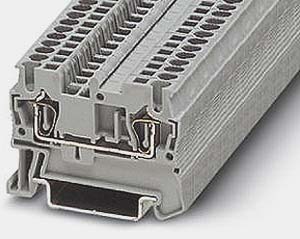
Рис. Phoenix Contact
Пружинные клеммы, закрепленные на монтажной рейкеПорядок присоединения проводника к пружинному зажиму
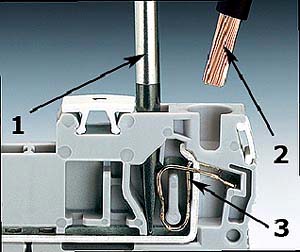
Рис. Phoenix Contact
1. Вставьте стандартную отвертку (1) в соответствующее отверстие клеммы.
В результате пружинный зажим (3) откроется для вставки жилы проводника (2).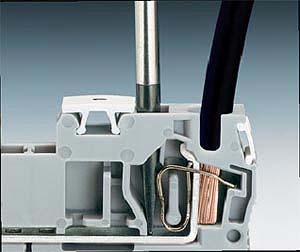
Рис. Phoenix Contact
2. Вставьте проводник
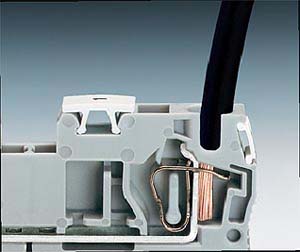
Рис. Phoenix Contact
3. Извлеките отвертку. Проводник будет надежно прижат к токоведущей части клеммы.
Параллельные тексты EN-RU
Spring-cage terminals blocks from Phoenix Contact have been developed for universal spring-loaded conductor contacting. The contact force is independent of the user and creates a vibration-proof, gas-tight connection with long-term stability. The connection point is opened with a standard screwdriver.
After the conductor has been inserted into the terminal compartment, the screwdriver is removed and the conductor automatically makes contact.
The front connection facilitates convenient operation. This means that the conductor and the screwdriver come parallel from the same direction.
All kinds of copper conductors of up to 35 mm² can be clamped without pretreatment. Splicing protection can also be used in the form of ferrules.
Phoenix Contact spring-cage terminal blocks offer a large insertion space, i.e. conductors with nominal cross section that have ferrules can also be wired.
[Phoenix Contact]
Пружинные клеммы Phoenix Contact являются универсальными соединительными устройствами с пружинными зажимами. Усилие прижима не зависит от действий потребителя и обеспечивает долговременное стабильное вибростойкое газонепроницаемое соединение. Для присоединения проводника применяется стандартная отвертка.
После вставки проводника в отверстие клеммы, отвертка извлекается и жила проводника надежно прижимается пружинным зажимом к токоведущей части клеммы.
Выполнение монтажа является удобным, поскольку проводники вставляют спереди. Кроме того, проводник и отвертка вставляются в соответствующие отверстия клеммы параллельно друг другу в одном и том же направлении.
Пружинные клеммы допускают присоединение неподготовленных медных проводников любого типа сечением до 35 мм2, а также проводников с жилами, опрессованными кабельным наконечником.
Достаточно большие отверстия для вставки проводников позволяют присоединять проводники номинального сечения с кабельным наконечником.
[Перевод Интент]
Тематики
Классификация
>>>Обобщающие термины
Синонимы
EN
DE
Русско-немецкий словарь нормативно-технической терминологии > пружинная клемма
-
11 флюсо-медная подкладка
флюсо-медная подкладка
Подкладка из медной пластины, покрытой тонким слоем флюса, обеспечивающая формирование шва, удержание расплавляемого металла и отвод тепла.
[ ГОСТ 2601-84]Тематики
- сварка, резка, пайка
EN
DE
FR
Русско-немецкий словарь нормативно-технической терминологии > флюсо-медная подкладка
-
12 шина (в электротехнике)
шина
Проводник с низким сопротивлением, к которому можно подсоединить несколько отдельных электрических цепей.
Примечание — Термин «шина» не включает в себя геометрическую форму, габариты или размеры проводника.
[ ГОСТ Р 51321. 1-2000 ( МЭК 60439-1-92)]
[ ГОСТ Р МЭК 61439.1-2013]
шина
Конструктивный элемент низковольтного комплектного устройства (НКУ).
Такой конструктивный элемент предназначен для того, чтобы к нему можно было легко присоединить отдельные электрические цепи (другие шины, отдельные проводники). Такие шины могут иметь различную конструкцию, геометрическую форму и размеры.
[Интент]
шинопроводшина
Медная, алюминиевая, реже стальная полоса, служащая для присоединения кабелей электрогенераторов, трансформаторов и т.д. к проводам питающей сети
[Терминологический словарь по строительству на 12 языках (ВНИИИС Госстроя СССР)]
общаяшина
-
[IEV number 151-12-30]
шина
-
[Я.Н.Лугинский, М.С.Фези-Жилинская, Ю.С.Кабиров. Англо-русский словарь по электротехнике и электроэнергетике, Москва]EN
busbar
low-impedance conductor to which several electric circuits can be connected at separate points
NOTE – In many cases, the busbar consists of a bar.
[IEV number 151-12-30]
busbar
An electrical conductor that makes a common connection between several circuits. Sometimes, electrical wire cannot accommodate high-current applications, and electricity must be conducted using a more substantial busbar — a thick bar of solid metal (usually copper or aluminum). Busbars are uninsulated, but are physically supported by insulators. They are used in electrical substations to connect incoming and outgoing transmission lines and transformers; in a power plant to connect the generator and the main transformers; in industry, to feed large amounts of electricity to equipment used in the aluminum smelting process, for example, or to distribute electricity in large buildings
[ABB. Glossary of technical terms. 2010]FR
barre omnibus, f
conducteur de faible impédance auquel peuvent être reliés plusieurs circuits électriques en des points séparés
NOTE – Dans de nombreux cas, une barre omnibus est constituée d’une barre.
[IEV number 151-12-30]
2. Проводник прямоугольного сечения из меди, предназначенный для электротехнических целей
(см. ГОСТ 434-78).
Поставляется в бухтах, а также в полосах длиной не менее 2,5 м; По существу, это просто проволока прямоугольного сечения. В указанном ГОСТе и в технической документации, в которой она применяется, обязательно указываются размеры этой проволоки. Например, "Шина ШММ 8,00х40,00 ГОСТ 434-78"
шина
Пруток прямоугольного сечения, применяемый в электротехнике в качестве проводника тока, изготовляемый прессованием или волочением.
[ ГОСТ 25501-82]Тематики
- НКУ (шкафы, пульты,...)
- заготовки и полуфабрикаты в металлургии
- кабели, провода...
Действия
- расположение шин «на ребро» [ПУЭ]
- расположение шин «плашмя» [ПУЭ]
Сопутствующие термины
- гибкая шина
- жесткая шина [ПУЭ]
- изолированные шины [ПУЭ]
- круглые шины [ПУЭ]
- неизолированные шины [ПУЭ]
- обходные шины [ПУЭ]
- профильные шины [ПУЭ]
- секционные шины [ПУЭ]
- фазная шина [ ГОСТ Р 51321.1-2000]
- четырехполосные шины с расположением полос по сторонам квадрата ("полый пакет") [ПУЭ]
- шина PEN-проводника
- шина для присоединения защитных проводников
- шина нулевого защитного проводника
- шина фазы А (B, C) [ПУЭ]
- шины однофазного тока [ПУЭ]
- шины прямоугольного (круглого, трубчатого, коробчатого) сечения [ПУЭ]
- шины трехфазного тока [ПУЭ]
EN
DE
FR
Русско-немецкий словарь нормативно-технической терминологии > шина (в электротехнике)
См. также в других словарях:
copper(I) — copper(I) … English syllables
copper(II) — copper(II) … English syllables
Copper — Cop per, n. [OE. coper (cf. D. koper, Sw. koppar, Dan. kobber, G. kupfer), LL. cuper, fr. L. cuprum for earlier Cyprium, Cyprium aes, i.e., Cyprian brass, fr. Gr. ? of Cyprus (Gr. ?), anciently renowned for its copper mines. Cf. {Cypreous}.] 1. A … The Collaborative International Dictionary of English
copper — copper1 [käp′ər] n. pl. copper or coppers [ME & OE coper < LL cuprum, contr. < Cyprium ( aes), Cyprian (brass), copper, after Gr Kyprios,CYPRUS, noted for its copper mines] 1. a reddish brown, malleable, ductile, metallic element that is… … English World dictionary
COPPER — Copper was the first metal humans learned to work with. The earliest evidence comes from Cayonu in southeast Turkey (late ninth or early eighth millennium B.C.), where small items of jewelry were made from cold hammered nuggets. Large scale… … Historical Dictionary of Mesopotamia
copper — Ⅰ. copper [1] ► NOUN 1) a red brown metallic chemical element which is used for electrical wiring and as a component of brass and bronze. 2) (coppers) Brit. coins of low value made of copper or bronze. 3) Brit. dated a large copper or iron… … English terms dictionary
Copper — Cop per, v. t. [imp. & p. p. {Coppered}; p. pr. & vb. n. {Coppering}.] To cover or coat with copper; to sheathe with sheets of copper; as, to copper a ship. [1913 Webster] … The Collaborative International Dictionary of English
Copper — (englisch für „Kupfer“) steht für: Amiga Copper, Koprozessor der Amiga Computer Copper River (Alaska) Copper River (Wisconsin) Diese Seite ist eine Begriffsklärung zur Unterscheidung mehrerer mit demselb … Deutsch Wikipedia
copper — cop‧per [ˈkɒpə ǁ ˈkɑːpər] noun 1. [uncountable] a reddish brown metal used, among other things, for making wire and cable S: • On Friday, copper for March delivery ended at 98.9 cents a pound, up 1.9 cents. • The company is a major producer of… … Financial and business terms
copper — Symbol: Cu Atomic number: 29 Atomic weight: 63.54 Red brown transition element. Known by the Romans as cuprum. Extracted and used for thousands of years. Malleable, ductile and an excellent conductor of heat and electricity. When in moist… … Elements of periodic system
Copper — For other uses, see Copper (disambiguation) … Wikipedia
