

-
21 milieu abiotique
абиотическая среда
—
[ http://www.eionet.europa.eu/gemet/alphabetic?langcode=en]EN
abiotic environment
The non-living components of the environment (rocks, minerals, soil, water and climate). (Source: WRIGHT)
[http://www.eionet.europa.eu/gemet/alphabetic?langcode=en]Тематики
EN
DE
FR
Франко-русский словарь нормативно-технической терминологии > milieu abiotique
-
22 facteur abiotique
абиотический фактор
—
[ http://www.eionet.europa.eu/gemet/alphabetic?langcode=en]EN
abiotic factor
Physical, chemical and other non-living environmental factors. They are essential for living plants and animals of an ecosystem, providing the essential elements and nutrients that are necessary for growth. The abiotic elements also include the climatic and pedologic components of the ecosystem. (Source: LBC / WRIGHT)
[http://www.eionet.europa.eu/gemet/alphabetic?langcode=en]Тематики
EN
DE
FR
Франко-русский словарь нормативно-технической терминологии > facteur abiotique
-
23 analyse de bruit
анализ шума
—
[ http://www.eionet.europa.eu/gemet/alphabetic?langcode=en]EN
noise analysis
Determination of the frequency components that make up a particular noise being studied. (Source: MGH)
[http://www.eionet.europa.eu/gemet/alphabetic?langcode=en]Тематики
EN
DE
FR
Франко-русский словарь нормативно-технической терминологии > analyse de bruit
-
24 dispositif de fixation
арматура изолятора
Часть изолятора, предназначенная для механического крепления к электроустановкам или объектам.
[ ГОСТ 27744-88]Тематики
EN
DE
FR
устройство крепления
Компонент системы, предназначенный для крепления других компонентов к стене, потолку или полу
[ ГОСТ Р МЭК 61084-1 2007]
крепежное устройство
-
[IEV number 442-02-40]EN
fixing device
system component specifically designed to secure other components to the wall, ceiling, floor or other structure
[IEV number 442-02-40]FR
dispositif de fixation
composant du système spécialement conçu pour fixer d'autres composants du système au mur, au plafond, au sol ou à une autre structure
[IEV number 442-02-40]Тематики
- изделие электромонтажное
- электропроводка, электромонтаж
EN
DE
FR
Франко-русский словарь нормативно-технической терминологии > dispositif de fixation
-
25 équilibre écologique
баланс окружающей среды
—
[ http://www.eionet.europa.eu/gemet/alphabetic?langcode=en]EN
environmental balance
Final part of the environmental impact study and assessment which compares environmental costs and benefits on the basis of homogeneous criteria. (Source: AMBPIAa)
[http://www.eionet.europa.eu/gemet/alphabetic?langcode=en]Тематики
EN
DE
FR
экологический баланс
—
[ http://www.eionet.europa.eu/gemet/alphabetic?langcode=en]EN
ecological balance
The condition of equilibrium among the components of a natural community such that their relative numbers remain fairly constant and their ecosystem is stable. Gradual readjustments to the composition of a balanced community take place continually in response to natural ecological succession and to alterations in climatic and other influences. (Source: ALL)
[http://www.eionet.europa.eu/gemet/alphabetic?langcode=en]Тематики
EN
DE
FR
Франко-русский словарь нормативно-технической терминологии > équilibre écologique
-
26 machine (électrique) tournante
вращающаяся электрическая машина
Электротехническое устройство, предназначенное для преобразования энергии на основе электромагнитной индукции и взаимодействия магнитного поля с электрическим током, содержащее, по крайней мере, две части, участвующие в основном процессе преобразования и имеющие возможность вращаться или поворачиваться относительно друг друга.
[ ГОСТ 27471-87]
электрическая машина
Электрическая машина, служит для преобразования механической энергии в электрическую и электрической в механическую, а также электрической энергии в электрическую же, отличающуюся по напряжению, роду тока, частоте и другим параметрам. Действие Э. м. основано на использовании явления электромагнитной индукции и законов, определяющих взаимодействие электрических токов и магнитных полей.
Для преобразования механической энергии в электрическую служат генераторы электромашинные, электрической энергии в механическую — двигатели электрические. Каждая из этих машин (в соответствии с Ленца правилом) энергетически обратима, т. е. может работать как в генераторном, так и в двигательном режиме; однако выпускаемые промышленностью Э. м. обычно предназначены для выполнения определённой работы (см. также Переменного тока машина, Постоянного тока машина, Асинхронная электрическая машина, Синхронная машина, Коллекторная машина).
Преобразования рода тока, частоты, числа фаз, напряжения осуществляют электромашинными преобразователями(см. Преобразовательная техника), электромашинными усилителями, трансформаторами электрическими.
К Э. м. относят также машины специального назначения, например тахогенератор, тяговый электродвигатель.
[БСЭ]EN
(electrical) rotating machine
an electrical apparatus depending on electromagnetic induction for its operation and having components capable of relative rotary movement and intended for converting energy
NOTE – This term also applies to electrical apparatus operating on the same principle and similar in construction and intended for other purposes, e.g. regulation, supplying or absorbing reactive power. It is not intended to cover electrostatic machines.
[IEV number 411-31-01]FR
machine (électrique) tournante
appareil électrique utilisant l'induction magnétique pour son fonctionnement, constitué d'éléments pouvant effectuer un mouvement relatif de rotation et destiné à la transformation de l'énergie
NOTE – Ce terme s'applique également aux appareils électriques fonctionnant suivant le même principe, de construction analogue et utilisés à d'autres fins, par exemple à des fins de régulation, de fourniture et d'absorption de puissance réactive. Il ne s'étend pas aux machines électrostatiques.
[IEV number 411-31-01]Тематики
Синонимы
EN
- electrical rotating machine
- electrical machine
- electrical rotating machinery
- rotating electrical machine
- rotating machine
DE
FR
Франко-русский словарь нормативно-технической терминологии > machine (électrique) tournante
-
27 temps de rebondissement
- время дребезга магнитоуправляемого контакта
- Время дребезга контакта электрического реле
- время дребезга
время дребезга
Время между моментом первого замыкания (размыкания) контакта и моментом, когда цепь окончательно замкнута (разомкнута).
[ ГОСТ 50030.5.1-2005]
время дребезга контактов
Период времени, измеренный с момента первого замыкания (размыкания) двух соприкасающихся контактов до момента устойчивого замыкания (размыкания) контактов.
[ ГОСТ 28627-90]
время дребезга (контактов)
—
[Я.Н.Лугинский, М.С.Фези-Жилинская, Ю.С.Кабиров. Англо-русский словарь по электротехнике и электроэнергетике, Москва, 1999 г.]EN
bounce time
for a contact which is closing (opening) its circuit, the time interval between the instant when the contact circuit first closes (opens) and the instant when the circuit is finally closed (opened)
[IEV number 446-17-13]FR
temps de rebondissement
pour un contact qui ferme ou qui ouvre son circuit, temps écoulé entre l'instant où le contact s'établit ou se rompt pour la première fois et l'instant où le circuit est définitivement fermé ou ouvert
[IEV number 446-17-13]Параллельные тексты EN-RU
Bounce time
The time from the first to the last closing or opening of a relay contact. Unless otherwise stated the indicated times are maximum values and are for energization with rated voltage, without any components in series or parallel to the coil, and at reference temperature.
[Tyco Electronics]Время дребезга
Время между моментом, когда контакт электрического реле первый раз замыкается (или размыкается), и моментом, когда цепь контакта замкнется (или разомкнется) окончательно. Если не указано иное, для данного времени приводятся максимальные значения, соответствующие возбуждению реле номинальным напряжением при отсутствии каких-либо компонентов, подключенных к катушке последовательно или параллельно, и при контрольной температуре окружающего воздуха.
[Перевод Интент]Тематики
Синонимы
EN
DE
FR
время дребезга магнитоуправляемого контакта
Значение интервала времени с момента начала первого до начала последнего замыкания магнитоуправляемого контакта при замыкании и с момента начала первого до начала последнего размыкания магнитоуправляемого контакта при размыкании
[ ГОСТ 17499-82]EN
FR
Тематики
Обобщающие термины
Синонимы
EN
DE
FR
124. Время дребезга контакта электрического реле
D. Prellzeit
Е. Bounce time
F. Temps de rebondissement
Интервал времени между моментом, когда контакт электрического реле в первый раз замыкается или размыкается, и моментом, когда цепь контакта окончательно замкнется или разомкнется
Источник: ГОСТ 16022-83: Реле электрические. Термины и определения оригинал документа
Франко-русский словарь нормативно-технической терминологии > temps de rebondissement
-
28 filerie
вторичные цепи электростанции (подстанции)
Совокупность кабелей и проводов, соединяющих устройства управления, автоматики, сигнализации, защиты и измерения электростанции (подстанции).
[ ГОСТ 24291-90]EN
wiring (secondary wiring)
all the wires and connections necessary to connect together and to supply all the separate protection, control and monitoring components within a substation
[IEV number 605-03-07]FR
filerie
ensemble des conducteurs et de leurs connexions nécessaires pour raccorder entre eux et alimenter les différents éléments de protection, de conduite et de surveillance dans un poste
[IEV number 605-03-07]Вторичные цепи электростанции (вторичные цепи) – совокупность кабелей, проводов и зажимов, с помощью которых соединяют устройства управления, автоматики, сигнализации, защиты и измерения электростанции (подстанции) во вторичную систему электростанции.
В технической литературе часто использует синоним этого термина – вторичная коммутация, что не совсем удачно, так как термин коммутация, представляющий собой имя действия, используется для обозначения различных процессов переключения электрических цепей. См. например, коммутация электрических машин постоянного тока.
Цепи, по которым передаётся электрическая энергия, называют первичными цепями.
Для В.ц. в большинстве случаев используют источники оперативного питания напряжением 220 В (постоянного, переменного или выпрямленного тока) или 110 В (постоянного тока).
На практике различают В.ц.:
- постоянного тока;
- переменного тока;
- трансформаторов тока;
- трансформаторов напряжения;
К В.ц. относят также шинки различного назначения.
Для различения В.ц. и их участков друг от друга используются специальные обозначения, выполняемые на электрических схемах и на концах проводников.
Обозначения В.ц. постоянного тока выполняется с учетом полярности цепей (для участков цепей положительной полярности используются нечетные числа, а для цепей отрицательной полярности - четные числа).
В.ц. переменного тока обозначаются последовательными числами без деления на чётные и нечётные. Допускается перед числовым обозначением цепи указывать буквенное обозначение фазы – А, В или С или нейтрали N.
Лит.:
1. Беляев А.В. Вторичная коммутация в распределительных устройствах, оснащенных цифровыми РЗА. (часть1). М.: НТФ «Энергопрогресс», 2006. 56 с.
[Библиотечка электротехника, приложение к журналу «Энергетик», вып. 2 (86)].
2. Беляев А.В. Вторичная коммутация в распределительных устройствах, оснащенных цифровыми РЗА. (часть2). М.: НТФ «Энергопрогресс», 2006. 64 с.
[Библиотечка электротехника, приложение к журналу «Энергетик», вып. 3
(87)].
3. Голубев М.Л. Вторичные цепи на подстанциях с переменным оперативным током. М.:Энергия, 1977
4. Камнев В.Н. Монтаж и обслуживание вторичной коммутации. М.: Высшая школа, 1969, 3-е изд.
5 Лезнов С.И., Фаерман А.Л. Устройство и обслуживание вторичных цепей электроустановок. М.:Энергия, 1979.
6 Обозначение вторичных цепей. Руководящий материал 10260тм-Т1. М.:Энергосетьпроект, 1981
7. Электрическая часть электростанции и электрической сети. Термины и определения. ГОСТ 24291-90. М. Издательство стандартов, 1991
[ http://maximarsenev.narod.ru/linksAD.html]Тематики
EN
DE
FR
18 вторичные цепи электростанции [подстанции]
Совокупность кабелей и проводов, соединяющих устройства управления, автоматики, сигнализации, защиты и измерения электростанции [подстанции]
605-03-07
de Verdrahtung
en secondary wiring
fr filerie
Источник: ГОСТ 24291-90: Электрическая часть электростанции и электрической сети. Термины и определения оригинал документа
Франко-русский словарь нормативно-технической терминологии > filerie
-
29 gaz ŕ effet de serre
- газ, способствующий парниковому эффекту
газ, способствующий парниковому эффекту
—
[ http://www.eionet.europa.eu/gemet/alphabetic?langcode=en]EN
greenhouse gas
A collective expression for those components of the atmosphere that influence the greenhouse effect, namely carbon dioxide, methane, nitrous oxides, ozone, CFCs and water vapour. (Source: GILP96)
[http://www.eionet.europa.eu/gemet/alphabetic?langcode=en]Тематики
EN
DE
FR
Франко-русский словарь нормативно-технической терминологии > gaz ŕ effet de serre
-
30 composante harmonique
гармоническая составляющая
Составляющая порядка выше, чем первый ряда Фурье периодической величины.
[ ГОСТ Р 51317.4.13-2006]
гармоническая составляющая
Любая из составляющих на частоте гармоники.
Значение гармонической составляющей обычно выражается среднеквадратическим значением. Для краткости вместо термина "гармоническая составляющая" допускается применение термина "гармоника".
[ ГОСТ Р 51317.4.30-2008 (МЭК 61000-4-30:2008)]EN
harmonic component
any of the components having a harmonic frequency
NOTE Its value is normally expressed as an r.m.s. value. For brevity, such component may be referred to simply as a harmonic.
[IEC 61000-4-30, ed. 2.0 (2008-10)]FR
composante harmonique
toute composante ayant une fréquence harmonique
NOTE Sa valeur est normalement exprimée sous la forme d’une valeur efficace. Pour des raisons de simplicité, cette composante peut simplement être appelée harmonique.
[IEC 61000-4-30, ed. 2.0 (2008-10)]
Гармонические составляющие тока в меньшей степени вызываются оборудованием, применяемым при генерации, передаче и распределении электрической энергии, и, в большей степени, промышленными нагрузками, такими как, например исполнительные механизмы систем управления. Возможны случаи, когда значительные гармонические составляющие тока генерируют несколько источников, а уровень гармонических токов, создаваемых другими нагрузками, незначителен, однако они могут вносить относительно высокий вклад в искажения синусоидальности напряжения, по крайней мере, для гармоник низкого порядка благодаря их суммированию. Значительные гармонические составляющие тока в электрических сетях могут создаваться нелинейными нагрузками, например управляемыми и неуправляемыми выпрямителями, особенно с емкостными сглаживающими фильтрами (например источниками питания телевизоров и компьютеров, статическими преобразователями частоты и устройствами регулирования световых приборов с фазовым управлением), т. к. в этом случае гармонические токи различных источников приблизительно синфазны и их компенсация в сети отсутствует. В зависимости от режима работы источники могут создавать гармонические составляющие напряжения постоянного и меняющегося уровня [ ГОСТ Р 51317.4.13-2006]
Помехи, представляющие собой синусоидальные напряжения и токи с частотами, кратными частоте электрической сети, обычно создаются ТС с нелинейной вольтамперной характеристикой или в результате периодической коммутации нагрузки, синхронизированной с частотой электрической сети. Указанные ТС могут рассматриваться как источники гармонических составляющих тока. Гармонические составляющие тока, создаваемые различными источниками, вызывают на полном сопротивлении электрической сети соответствующие гармонические составляющие напряжения. В результате влияния электрической емкости и индуктивности кабелей и подключения конденсаторов для коррекции коэффициента мощности в электрической сети могут возникнуть параллельные и последовательные резонансы, что приводит к увеличению гармонических составляющих напряжений, в том числе в точках электрической сети, удаленных от источников помех. Возможно также суммирование гармонических составляющих напряжения от различных источников, что учитывается при установлении требований устойчивости ТС к искажениям синусоидальности напряжения электропитания в настоящем стандарте.
Тематики
Действия
Сопутствующие термины
- гармоническая составляющая напряжения
- гармоническая составляющая тока
- источник гармонических составляющих
EN
FR
Франко-русский словарь нормативно-технической терминологии > composante harmonique
-
31 structure urbaine
городская структура
—
[ http://www.eionet.europa.eu/gemet/alphabetic?langcode=en]EN
urban structure
The built-up components, the street system and the facilities which make up an urban unit. (Source: ZINZAN)
[http://www.eionet.europa.eu/gemet/alphabetic?langcode=en]Тематики
EN
DE
FR
Франко-русский словарь нормативно-технической терминологии > structure urbaine
-
32 mouvement planétaire des masses d'air
движение воздуха
—
[ http://www.eionet.europa.eu/gemet/alphabetic?langcode=en]EN
air movement
Air movements within the Earth's atmospheric circulation; also called planetary winds. Two main components are recognized: first, the latitudinal meridional component due to the Coriolis force (a deflecting motion or force discussed by G.G. de Coriolis in 1835. The rotation of the Earth causes a body moving across its surface to be deflected to the right in the N hemisphere and to the left in the S hemisphere); and secondly, the longitudinal component and the vertical movement, resulting largely from varying pressure distributions due to differential heating and cooling of the Earth's surface. (Source: WHIT)
[http://www.eionet.europa.eu/gemet/alphabetic?langcode=en]Тематики
EN
DE
FR
Франко-русский словарь нормативно-технической терминологии > mouvement planétaire des masses d'air
-
33 dégazage des déchets
дегазификация отходов
—
[ http://www.eionet.europa.eu/gemet/alphabetic?langcode=en]EN
waste degasification
The removal of gaseous components form waste. (Source: RRDA)
[http://www.eionet.europa.eu/gemet/alphabetic?langcode=en]Тематики
EN
DE
FR
Франко-русский словарь нормативно-технической терминологии > dégazage des déchets
-
34 diviseur de tension
делитель напряжения
-
[IEV number 312-02-32]
делитель напряжения
Преобразующее устройство, состоящее из плеч высокого и низкого напряжения, таких, что напряжение входа прикладывается ко всему устройству, а напряжение выхода снимается с плеча низкого напряжения. [МЭС 301-05-13, измененный]
Примечание
элементами обоих плеч обычно являются резисторы, конденсаторы или их комбинации, а делитель описывается типами и комбинацией используемых элементов (например, резистивный, емкостный или резистивно-емкостный).
[МЭК 60-2]
делитель напряжения
-
[Лугинский Я. Н. и др. Англо-русский словарь по электротехнике и электроэнергетике. 2-е издание - М.: РУССО, 1995 - 616 с.]EN
voltage divider
device comprising resistors, inductors, capacitors, transformer(s) or a combination of these components such that, between two points of the device, a desired fraction of the voltage applied to the device as a whole can be obtained
[IEV number 312-02-32]FR
diviseur de tension
dispositif constitué de résistances, d'inductances, de condensateurs, de transformateur(s) ou d'une combinaison de ces éléments telle que, entre deux points de ce dispositif, on obtient une fraction désirée de la tension appliquée au dispositif entier
[IEV number 312-02-32]Тематики
- измерение электр. величин в целом
EN
DE
FR
Франко-русский словарь нормативно-технической терминологии > diviseur de tension
-
35 courant admissible, m
(длительный) допустимый ток
Максимальное значение электрического тока, который может протекать длительно по проводнику, устройству или аппарату при определенных условиях без превышения определенного значения их температуры в установившемся режиме
[ ГОСТ Р МЭК 60050-826-2009]
Этот ток обозначают IZ
[ ГОСТ Р 50571. 1-2009 ( МЭК 60364-1: 2005)]EN
(continuous) current-carrying capacity
ampacity (US)
maximum value of electric current which can be carried continuously by a conductor, a device or an apparatus, under specified conditions without its steady-state temperature exceeding a specified value
[IEV number 826-11-13]
ampacity
The current in amperes that a conductor can carry continuously under the conditions of use without exceeding its temperature rating.
[National Electrical Cod]FR
courant (permanent) admissible, m
valeur maximale du courant électrique qui peut parcourir en permanence, un conducteur, un dispositif ou un appareil, sans que sa température de régime permanent, dans des conditions données, soit supérieure à la valeur spécifiée
[IEV number 826-11-13]Ampacity, the term is defined as the maximum amount of current a cable can carry before sustaining immediate or progressive deterioration. Also described as current rating or current-carrying capacity, is the RMS electric current which a device can continuously carry while remaining within its temperature rating. The ampacity of a cable depends on:
- its insulation temperature rating;
- conductor electrical properties for current;
- frequency, in the case of alternating currents;
- ability to dissipate heat, which depends on cable geometry and its surroundings;
- ambient temperature.
Electric wires have some resistance, and electric current flowing through them causes voltage drop and power dissipation, which heats the cable. Copper or aluminum can conduct a large amount of current before melting, but long before the conductors melt, their insulation would be damaged by the heat.
The ampacity for a power cable is thus based on physical and electrical properties of the material & construction of the conductor and of its insulation, ambient temperature, and environmental conditions adjacent to the cable. Having a large overall surface area may dissipate heat well if the environment can absorb the heat.
In a long run of cable, different conditions govern, and installation regulations normally specify that the most severe condition along the run governs the cable's rating. Cables run in wet or oily locations may carry a lower temperature rating than in a dry installation. Derating is necessary for multiple circuits in close proximity. When multiple cables are near, each contributes heat to the others and diminishes the amount of cooling air that can flow past the individual cables. The overall ampacity of the insulated conductors in a bundle of more than 3 must be derated, whether in a raceway or cable. Usually the de-rating factor is tabulated in a nation's wiring regulations.
Depending on the type of insulating material, common maximum allowable temperatures at the surface of the conductor are 60, 75 and 90 degrees Celsius, often with an ambient air temperature of 30°C. In the U.S., 105°C is allowed with ambient of 40°C, for larger power cables, especially those operating at more than 2 kV. Likewise, specific insulations are rated 150, 200 or 250°C.
The allowed current in cables generally needs to be decreased (derated) when the cable is covered with fireproofing material.
For example, the United States National Electric Code, Table 310-16, specifies that up to three 8 AWG copper wires having a common insulating material (THWN) in a raceway, cable, or direct burial has an ampacity of 50 A when the ambient air is 30°C, the conductor surface temperature allowed to be 75°C. A single insulated conductor in air has 70 A rating.
Ampacity rating is normally for continuous current, and short periods of overcurrent occur without harm in most cabling systems. The acceptable magnitude and duration of overcurrent is a more complex topic than ampacity.
When designing an electrical system, one will normally need to know the current rating for the following:- Wires
- Printed Circuit Board traces, where included
- Fuses
- Circuit breakers
- All or nearly all components used
Some devices are limited by power rating, and when this power rating occurs below their current limit, it is not necessary to know the current limit to design a system. A common example of this is lightbulb holders.
[http://en.wikipedia.org/wiki/Ampacity]
Тематики
- электротехника, основные понятия
Синонимы
EN
DE
- Dauerstrombelastbarkeit, f
- Strombelastbarkeit, f
FR
- courant admissible, m
- courant permanent admissible, m
Франко-русский словарь нормативно-технической терминологии > courant admissible, m
-
36 courant permanent admissible, m
(длительный) допустимый ток
Максимальное значение электрического тока, который может протекать длительно по проводнику, устройству или аппарату при определенных условиях без превышения определенного значения их температуры в установившемся режиме
[ ГОСТ Р МЭК 60050-826-2009]
Этот ток обозначают IZ
[ ГОСТ Р 50571. 1-2009 ( МЭК 60364-1: 2005)]EN
(continuous) current-carrying capacity
ampacity (US)
maximum value of electric current which can be carried continuously by a conductor, a device or an apparatus, under specified conditions without its steady-state temperature exceeding a specified value
[IEV number 826-11-13]
ampacity
The current in amperes that a conductor can carry continuously under the conditions of use without exceeding its temperature rating.
[National Electrical Cod]FR
courant (permanent) admissible, m
valeur maximale du courant électrique qui peut parcourir en permanence, un conducteur, un dispositif ou un appareil, sans que sa température de régime permanent, dans des conditions données, soit supérieure à la valeur spécifiée
[IEV number 826-11-13]Ampacity, the term is defined as the maximum amount of current a cable can carry before sustaining immediate or progressive deterioration. Also described as current rating or current-carrying capacity, is the RMS electric current which a device can continuously carry while remaining within its temperature rating. The ampacity of a cable depends on:
- its insulation temperature rating;
- conductor electrical properties for current;
- frequency, in the case of alternating currents;
- ability to dissipate heat, which depends on cable geometry and its surroundings;
- ambient temperature.
Electric wires have some resistance, and electric current flowing through them causes voltage drop and power dissipation, which heats the cable. Copper or aluminum can conduct a large amount of current before melting, but long before the conductors melt, their insulation would be damaged by the heat.
The ampacity for a power cable is thus based on physical and electrical properties of the material & construction of the conductor and of its insulation, ambient temperature, and environmental conditions adjacent to the cable. Having a large overall surface area may dissipate heat well if the environment can absorb the heat.
In a long run of cable, different conditions govern, and installation regulations normally specify that the most severe condition along the run governs the cable's rating. Cables run in wet or oily locations may carry a lower temperature rating than in a dry installation. Derating is necessary for multiple circuits in close proximity. When multiple cables are near, each contributes heat to the others and diminishes the amount of cooling air that can flow past the individual cables. The overall ampacity of the insulated conductors in a bundle of more than 3 must be derated, whether in a raceway or cable. Usually the de-rating factor is tabulated in a nation's wiring regulations.
Depending on the type of insulating material, common maximum allowable temperatures at the surface of the conductor are 60, 75 and 90 degrees Celsius, often with an ambient air temperature of 30°C. In the U.S., 105°C is allowed with ambient of 40°C, for larger power cables, especially those operating at more than 2 kV. Likewise, specific insulations are rated 150, 200 or 250°C.
The allowed current in cables generally needs to be decreased (derated) when the cable is covered with fireproofing material.
For example, the United States National Electric Code, Table 310-16, specifies that up to three 8 AWG copper wires having a common insulating material (THWN) in a raceway, cable, or direct burial has an ampacity of 50 A when the ambient air is 30°C, the conductor surface temperature allowed to be 75°C. A single insulated conductor in air has 70 A rating.
Ampacity rating is normally for continuous current, and short periods of overcurrent occur without harm in most cabling systems. The acceptable magnitude and duration of overcurrent is a more complex topic than ampacity.
When designing an electrical system, one will normally need to know the current rating for the following:- Wires
- Printed Circuit Board traces, where included
- Fuses
- Circuit breakers
- All or nearly all components used
Some devices are limited by power rating, and when this power rating occurs below their current limit, it is not necessary to know the current limit to design a system. A common example of this is lightbulb holders.
[http://en.wikipedia.org/wiki/Ampacity]
Тематики
- электротехника, основные понятия
Синонимы
EN
DE
- Dauerstrombelastbarkeit, f
- Strombelastbarkeit, f
FR
- courant admissible, m
- courant permanent admissible, m
Франко-русский словарь нормативно-технической терминологии > courant permanent admissible, m
-
37 matériau routier
дорожно-строительный материал
—
[ http://www.eionet.europa.eu/gemet/alphabetic?langcode=en]EN
road construction material
The aggregation of components used for building streets, highways and other routes, such as asphalt, concrete, brick, sand and gravel. (Source: ROA)
[http://www.eionet.europa.eu/gemet/alphabetic?langcode=en]Тематики
EN
DE
FR
Франко-русский словарь нормативно-технической терминологии > matériau routier
-
38 espace protégé clos
закрытое защищенное пространство
Часть НКУ, предназначенная для размещения электрических комплектующих элементов, обеспечивающая определенную защиту от внешних воздействий и от контакта с токоведущими частями.
[ ГОСТ Р МЭК 61439.1-2013]EN
enclosed protected space
part of an assembly intended to enclose electrical components and which provides defined protection against external influences and contact with live parts
[IEC 61439-1, ed. 2.0 (2011-08)]FR
espace protégé clos
partie d'un ensemble destinée à enfermer des composants électriques et procurant une protection définie contre les influences externes et les contacts avec les parties actives
[IEC 61439-1, ed. 2.0 (2011-08)]Тематики
- НКУ (шкафы, пульты,...)
Обобщающие термины
EN
FR
Франко-русский словарь нормативно-технической терминологии > espace protégé clos
-
39 dispositif de retenue
замковое устройство электрического соединителя
Устройство, предназначенное для фиксации сочлененного положения частей электрического соединителя
[ ГОСТ 21962-76]
удерживающее устройство
-
[IEV number 442-03-10]EN
locking device
feature incorporated in certain components to provide mechanical retention of their mating part
[IEV number 581-23-22]
retaining device
a mechanical arrangement which holds a plug or connector in position when it is in proper engagement, and prevents its unintentional withdrawal
[IEV number 442-03-10]FR
système de blocage
système incorporé à certains composants pour obtenir un blocage mécanique de leur partie joignante
[IEV number 581-23-22]
dispositif de retenue
mécanisme qui maintient en place une fiche ou une prise mobile lorsqu'elle est suffisamment engagée et qui empêche tout retrait involontaire
[IEV number 442-03-10]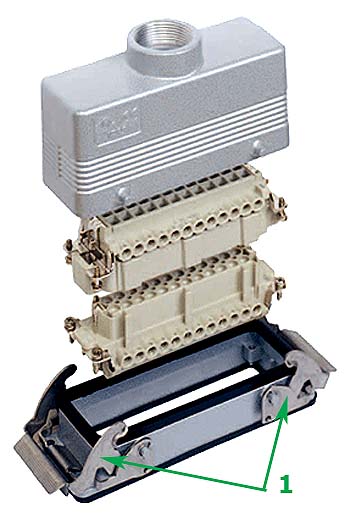
[http://www.fam-electric.ru/Equipment/Ilme/Rectangular/3.html]Тематики
EN
DE
- Haltevorrichtung
- Verriegelungsvorrichtung, f
FR
удерживающее устройство
-
[IEV number 442-03-10]EN
retaining device
a mechanical arrangement which holds a plug or connector in position when it is in proper engagement, and prevents its unintentional withdrawal
[IEV number 442-03-10]FR
dispositif de retenue
mécanisme qui maintient en place une fiche ou une prise mobile lorsqu'elle est suffisamment engagée et qui empêche tout retrait involontaire
[IEV number 442-03-10]Тематики
EN
DE
FR
Франко-русский словарь нормативно-технической терминологии > dispositif de retenue
-
40 système de blocage
замковое устройство электрического соединителя
Устройство, предназначенное для фиксации сочлененного положения частей электрического соединителя
[ ГОСТ 21962-76]
удерживающее устройство
-
[IEV number 442-03-10]EN
locking device
feature incorporated in certain components to provide mechanical retention of their mating part
[IEV number 581-23-22]
retaining device
a mechanical arrangement which holds a plug or connector in position when it is in proper engagement, and prevents its unintentional withdrawal
[IEV number 442-03-10]FR
système de blocage
système incorporé à certains composants pour obtenir un blocage mécanique de leur partie joignante
[IEV number 581-23-22]
dispositif de retenue
mécanisme qui maintient en place une fiche ou une prise mobile lorsqu'elle est suffisamment engagée et qui empêche tout retrait involontaire
[IEV number 442-03-10]
[http://www.fam-electric.ru/Equipment/Ilme/Rectangular/3.html]Тематики
EN
DE
- Haltevorrichtung
- Verriegelungsvorrichtung, f
FR
Франко-русский словарь нормативно-технической терминологии > système de blocage
См. также в других словарях:
components — index contents Burton s Legal Thesaurus. William C. Burton. 2006 … Law dictionary
Components of jet engines — Diagram of a typical gas turbine jet engine. Air is compressed by the fan blades as it enters the engine, and it is mixed and burned with fuel in the combustion section. The hot exhaust gases provide forward thrust and turn the turbines which… … Wikipedia
Components in Electronics — February 2008 Editor Neil Tyler Categories Design Engineering Frequency Monthly Circulation 14500 … Wikipedia
Components (album) — Components Studio album by Bobby Hutcherson Released June 14, 1965 Recorded June 10, 1965 … Wikipedia
Components Engine — is the name of a software for the desktop publishingIntroductionSoftware to create and publish interactive spare parts catalogues. It s made of two parts: #A complete graphic editor to create and manipulate the exploded drawing. #A management… … Wikipedia
Components of crude oil — Crude oil is essentially a mixture of many different hydrocarbons, all of varying lengths and complexities. In order to separate the individual components that make up the raw natural resource, the crude oil must be fractionally distillated so… … Wikipedia
Components of crude — Oila) Light Distillates: i) Naphtha Made into gasoline/petrochemicalsii) Kerosene b) Middle distillatesi) Light gas oil made into jet/diesel furnace fuelsii)Heavy gas oil further processing to produce naphtha and other productsc)Residue further… … Wikipedia
Components of medieval armour — Following is a table that concisely identifies various pieces of medieval armour, mostly plate but some mail, arranged by the part of body that is protected and roughly by date. No attempt has been made to identify fastening components or various … Wikipedia
components of competence — kompetencijos elementai statusas T sritis Švietimas ir mokslas apibrėžtis Kompetencijos sandai: žinios, mokėjimai, įgūdžiai, nuostatos ir asmens savybės. atitikmenys: angl. components of competence; elements of competence pranc. éléments de… … Aiškinamasis kvalifikacijų sistemos terminų žodynas
components of total harvest — derliaus struktūra statusas T sritis augalininkystė apibrėžtis Iš tam tikro ploto gauto derliaus sudaromųjų dalių visuma ir jų santykis. atitikmenys: angl. components of total harvest rus. структура урожая … Žemės ūkio augalų selekcijos ir sėklininkystės terminų žodynas
components — Synonyms and related words: census, composition, constituents, content, contents, divisions, elements, guts, index, ingredients, innards, insides, inventory, items, list, part, parts, whole … Moby Thesaurus
