

-
1 commonly
commonly [ˈkɒmənlɪ]a. [use, occur, prescribe] fréquemment ; [called] couramment• more commonly known as... plus connu sous le nom de...b. ( = generally) généralement• it is commonly believed that... on croit généralement que...* * *['kɒmənlɪ]adverb communément -
2 commonly
-
3 commonly
commonly ['kɒmənlɪ]∎ what is commonly known as… ce que l'on appelle dans le langage courant… -
4 HUAUHTLI
huauhtli:Amarante.Amaranthus paniculatus var., plante nourricière que les Aztèques consommaient sous forme de bouillies, salées ou sucrées, parfois pimentées. Elles servait aussi à confectionner certaines ídoles pour des liturgies particulières. Baudot. Récits aztèques de la Conquète. note 65 page 389.Le terme a été traduit avec constance par 'bledos', 'blette', jusqu'à l'époque moderne où la plante a été identifiée avec l'amarante. Des graines oléagineuses de l'amarante, les Aztèques tiraient une pâte, le tzoalli (Cf. tzohualli), dont ils faisaient une consommation cérémonielle. Christian Duverger, L'origine des Aztèques p.95.Graine de blette (huauhquilitl) que les Mexicains ne mangeaient guère que dans les temps de famine;ils lui préféraient le maïs (S)." huauhtli polocayah ", graine non émondée (Sah.).Blette ou bette = plante voisine de la betterave.Les chroniqueurs traduisent 'bledo', blé. Cf. Molina.Angl., amaranth (K qui transcrit huauhtli).Esp., huatle, una semilla que comen tostada (Z154).Plusieurs variétés d'amarante sont décrites Sah11,286-288. Une liste de variétés d'amarante. Sah2,65." hueyi huauhtli ", grande amarante, variété d'amarante également nommée teôhuauhtli. Décrite en Sah11,287.Sah11,134 dit que huauhtli serait le nom de la graine de la plante huauhquilitl.Sah11,286 dit que huauhtli est le nom de la graine (îxinachyo) de la plante cocotl ou nexhuauhtli.Les petits passereaux nommés zacatlahtli se nourrissent de graines d'amarante (" huauhtli "). Sah11,47.Dans une énumération de graines comestibles conservées dans le petlacalco. Sah8,44." quitôcaqueh in tlaôlli in huauhtli in etl in âyôtl in chîlcotl in xitomatl ", ils ont semé le maïs, l'amarante, les haricots, les courges, le piment vert, les tomates - sembraron maiz, bledo, frijol, calabaza, 'chile' verde, 'jítomate'. Cron.Mexicayotl 38." quitecih in huauhtli chicalotl in cihuah mocexiuhzauhqueh ", elles ont moulu les graines d'amarante, l'herbe épineuse du chicalote, les femmes qui avaient jeûné depuis un an. Sah12,51." in chichic huauhtli ahnôzo teôhuauhtli ", de l'amarante amère ou de l'amarante rouge - bitter amaranth or bright red amaranth. Cité parmi tout ce que l'on engrangeait en prévision des famines de l'année ce tôchtli. Sah7,23." mochi oncah in tônacayôtl, in cintli, in huauhtli, in etl, in chîyan, in ayohtli, in xôchihcualli ", on trouve tous les produits agricoles, maïs, blettes, haricots, 'chía', calebasses, fruits - all manner of food: ears of driea maize, amaranth, beans, chia, gourds, fruit.Produits de la terre du Michhuahcan. Sah10,188 = Launey II 264." quimahcêhuah in tônacayôtl, in huauhtli, in chiyen ", ils obtiennent comme récompense du maïs, de l'amarante, du chia - they gained as reward maize, amaranth, chia. Sah11,69.* à la forme possédée. " in îhuauhyo îtôca petzicatl ", ses graines s'appellent petzicatl.Est dit de la plante quiltonilli. Sah11,134.* culinaire. " miyâhuatamalli tlaîxnamictîlli huauhtli ihuân capoli ", des tamales de fleurs de maïs mélangées à des graines d'amarante et à des cerises américaines - tamales made of maize flowers with ground amaranth seed and cherries added. Sah8,38.NOTE: 'The Indians themselves probably used the name " huauhtli " for a variety of plants, grown for different purposes. Some of the compond names may well have been restricted to particular species. 'xôchihuauhtli' may have meant a chenopod whose inflorescences werecooked in the bud stage as a green vegetable as is commonly done in modern Mexico. 'nexhuauhtli' like the common Spanish word for chenopods, 'cenizo', probably referred to the whitish appearance of some chenopods... 'michihuauhtli' and 'tezcahuauhtli' probably referred to light- and dark-seemed amaranths, respectively, the former with pale seeds like little fish eggs, the latter with shiny black seeds'. Jonathan D. Sauer. ('The Grain Amaranths: A survey of Their History and Classification'. Anals of the Missouri Botanical Garden, XXXVII, November, 1950, p.565). Anders.Dibb. X 67 note 7. -
5 POLOCATL
polocatl:Criblure, paille légère, hachée, ordures qui restent après que l'on a ramassé le grain; petite graine comestible qu'on ne mangeait guère qu'en temps de famine (Sah.).Esp., tamo, paja menuda (M).paja menuda (M I 90v.).hierba o granzas de lo que se come y que solamente en caso de necesidad se aprovecha. Cf. Sah HG VlII 9,2. Garibay Sah IV 349.Angl., weed seeds. Sah10,67.wild seeds not commonly eaten. Citées parmi tout ce que l'on engrangeait en prevision des famines de l'année ce tôchtli. Sah7,23." in polocatl, in chiyanpolocatl in cozolli ", la paille, la paille de chia, et les graines improductives - weed seeds, chaff, the shriveled seeds. Sah10,67. Le texte espagnol dit: las que son aparentes y dañadas, que se dicen polocatl, y cozolli, que son unas semillas, de que non se puede sacar oleo." cahcana, quehêcaquetza, quehcatoctia, quitepêhua in polocatl ", il vanne, il évente le son, il fait que le vent l'emporte, il le disperse - he winnowed and fanned out the chaff ; he let the wind carry off and scatter the impurities. Il s'agit de huauhtli, de chia et de harricots. Sah4,129.* à la forme possédée, " (huauhtli) îpolacayo ", the weeds (of the amaranth). Cité parmi tout ce que l'on engrangeait en prévisian des famines de l'année ce tochtli. Sah7,23." in huauhtli zan îhuân moxconoa in îpolocayo ", pour l'amarante on égrenait même la balle (en vue de la conserver) - (with) amaranth, even the weeds were threshed.En prévision de la famine de l'année ce tôchtli. Sah7,23." in îpolocayo nextamalli moneloa ", sa balle est mélangée à des tamales allègés de cendre - its chaff is mixed with tamales of maize softened with lime.Est dit à propos des graines d'amarante petzicatl. Sah11,288.Cf. " huauhtli polocayo ", es semilla de los cenizos sin limpiar, con todas sus inmundicias. Sah Garibay II 268. Anders Dib VII 23 note 12. -
6 widely
widely [ˈwaɪdlɪ]• it is widely believed that... on pense généralement que...b. ( = much) [travel] beaucoup• to be widely read [reader] avoir beaucoup lu* * *['waɪdlɪ]1) ( commonly) largementa country widely admired for its technology — un pays qui fait l'admiration générale pour sa technologie
to be widely available — [product] être en vente libre
to be widely known — être bien connu ( for pour)
2) [spaced] à de grands intervalles; [travel, differ] beaucoup -
7 will
will [wɪl]1. modal verba. (future)━━━━━━━━━━━━━━━━━━━━━━━━━━━━━━━━━━━━━━━━━━━━━━━━━━━► In the following examples the main verb is future, the other is present: in French both verbs must be in the future tense.━━━━━━━━━━━━━━━━━• what will he do when he finds out? qu'est-ce qu'il fera lorsqu'il s'en apercevra ?━━━━━━━━━━━━━━━━━━━━━━━━━━━━━━━━━━━━━━━━━━━━━━━━━━━━━━━━━━━━━━━━━━━━• will he come too? -- yes he will est-ce qu'il viendra aussi ? -- oui• I'll go with you -- oh no you won't! je vais vous accompagner -- non, certainement pas !━━━━━━━━━━━━━━━━━► When won't is used in question tags, eg won't it, won't you the translation is often n'est-ce pas.━━━━━━━━━━━━━━━━━• you will come to see us, won't you? vous viendrez nous voir, n'est-ce pas ?• that'll be okay, won't it? ça ira, n'est-ce pas ?━━━━━━━━━━━━━━━━━► When future meaning is made clear by words like tomorrow, or next week, the present tense can also be used in French.━━━━━━━━━━━━━━━━━• he'll be here tomorrow il arrive or il arrivera demain• I'll phone you tonight je t'appelle or je t'appellerai ce soir► will have + past participle━━━━━━━━━━━━━━━━━► When will indicates that something commonly happens, the present is used in French.━━━━━━━━━━━━━━━━━• the car will do 150km/h cette voiture fait du 150 km/h• thieves will often keep a stolen picture for years les voleurs gardent souvent un tableau volé pendant des annéesd. (requests, orders)━━━━━━━━━━━━━━━━━► The present tense of vouloir is often used.━━━━━━━━━━━━━━━━━• will you be quiet! veux-tu (bien) te taire !• will you please sit down! voulez-vous vous asseoir, s'il vous plaît !• will you help me? -- yes I will tu veux m'aider ? -- oui, je veux bien• will you promise to be careful? tu me promets de faire attention ?► won't ( = refuse(s) to)• will you promise? -- no I won't tu me le promets ? -- none. (invitations, offers) will you have a cup of coffee? voulez-vous prendre un café ?• will you join us for a drink? voulez-vous prendre un verre avec nous ?• won't you come with us? vous ne voulez pas venir (avec nous) ?f. ( = must) that will be the taxi ça doit être le taxipreterite, past participlea. ( = urge by willpower) he was willing her to look at him il l'adjurait intérieurement de le regarderb. ( = bequeath) to will sth to sb léguer qch à qn3. nouna. ( = determination) volonté f• to do sth against sb's will faire qch contre la volonté de qn (PROV) where there's a will there's a way(PROV) vouloir c'est pouvoir► at willb. ( = document) testament m• the last will and testament of... les dernières volontés de...* * *I 1. [wɪl, əl]modal auxiliary1) ( to express the future)she'll help you — elle t'aidera; ( in the near future) elle va t'aider
2) (expressing consent, willingness)‘will you help me?’ - ‘yes, I will’ — ‘est-ce que tu m'aideras?’ - ‘oui, bien sûr’
‘have a chocolate’ - ‘thank you, I will’ — ‘prends un chocolat’ - ‘volontiers, merci’
do what ou as you will — fais ce que tu veux
will do! — (colloq) d'accord!
3) (in commands, requests)will you pass the salt, please? — est-ce que tu peux me passer le sel, s'il te plaît?
‘I can give the speech’ - ‘you will not!’ — ‘je peux faire le discours’ - ‘pas question!’
‘I'll do it’ - ‘no you won't’ — ‘je vais le faire’ - ‘il n'en est pas question’
4) (in offers, invitations)you'll have another cake, won't you? — vous prendrez bien un autre gâteau?
any teacher will tell you that... — n'importe quel professeur te dira que...
2.these things will happen — ce sont des choses qui arrivent; ( in exasperation)
transitive verb1) ( urge)2) (wish, desire) vouloir3) Law léguer3. II 1. [wɪl]to have a strong/weak will — avoir beaucoup/peu de volonté
2) Law testament m2.at will adverbial phrase [select, take] à volonté••where there's a will there's a way — Prov quand on veut on peut Prov
-
8 Ponzi scheme
American = escroquerie dans laquelle l'argent des investisseurs les plus récents sert à payer les premiers investisseursThe investors who have sued Slatkin allege that he used funds collected from new investors to pay returns to older investors, a form of fraud commonly known as a Ponzi scheme. Last month, one investor won a court order to freeze Slatkin's brokerage accounts and other assets, including a ranch home in Santa Barbara.
-
9 market
1 noun∎ to be on the market être en vente;∎ to come onto the market arriver sur le marché;∎ to put sth on the market mettre qch sur le marché ou en vente;∎ to take sth off the market retirer qch du marché;∎ to be in the market for sth être acheteur de qch, chercher à acheter qch;∎ to find a market for sth trouver un débouché ou des acheteurs pour qch;∎ to corner a market accaparer un marché;∎ to find a ready market trouver à vendre facilement;∎ there's always a (ready) market for software il y a toujours une forte demande pour les logiciels;∎ to price oneself out of the market perdre sa clientèle en demandant trop cher;∎ the bottom has fallen out of the market le marché s'est effondrémarket analysis analyse f du marché; market analyst analyste m f du marché;market appeal attrait m commercial;market appraisal évaluation f du marché;American market basket panier m de la ménagère;market challenger challengeur m;market choice choix m sur le marché; (product) choix du marché;market competition concurrence f du marché;market conditions conditions f pl du marché;market correction correction f du marché;market demand demande f du marché;market depression dépression f du marché;market development développement m du marché;market division division f du marché;market dynamics dynamique f du marché;market economy économie f de marché;market entry lancement m sur le marché;market expansion extension f du marché;market exposure exposition f sur le marché;market fluctuation mouvement m du marché;market follower suiveur m (sur le marché);market forces forces f pl du marché;market forecast prévisions f pl du marché;market growth croissance f du marché;market intelligence information f commerciale;market maker teneur m de marché;market manager directeur(trice) m, f de marché;market mechanism mécanisme m du marché;market minimum ventes f pl de base;market orientation orientation f marché;market participant intervenant(e) m, f ou acteur m sur le marché;market penetration pénétration f du marché;market penetration pricing tarification f de pénétration du marché;market penetration strategy stratégie f de pénétration;market pioneer pionnier m;market positioning positionnement m sur le marché;market price prix m du marché;market profile profil m du marché;market prospects perspectives f pl commerciales;market rate taux m du marché;market rate of discount taux d'escompte hors banque;market report étude f de marché, rapport m ou bilan m commercial;market research étude de marché;∎ market research has shown that the idea is viable des études de marché ont montré que l'idée a des chances de réussir;market research company société f d'études de marché;British Market Research Society = société d'étude de marché britannique;market researcher = personne qui fait une étude de marché;market segment segment m de marché;market segmentation segmentation f du marché;market share part f de marché;market structure structure f du marché;market study étude de marché;market study report rapport d'étude de marché;market survey étude de marché;market test test m de marché;market thrust percée f commerciale;market trends tendances f pl du marché;market value valeur f marchande(b) STOCK EXCHANGE marché m;∎ to play the market spéculer;∎ the market has risen ten points l'indice est en hausse de dix pointsmarket capitalization capitalisation f boursière; market commentator chroniqueur(euse) m, f boursier(ère);market crisis choc m boursier;market indicator indicateur m de marché;market maker intermédiaire m f;market order ordre m au mieux;market price cours m (de la Bourse);market price list mercuriale f;market quotation cotation f au cours du marché;market rating cours en Bourse;market risk risque m du marché;market size taille f boursière;market trend conjoncture f boursière;market value valeur f boursièrecommercialiser; (launch) lancerThe primary commodity price index, developed by the economists Enzo R. Grilli and Maw Cheng Yang, takes the international cost of a market basket of 24 of the most commonly consumed "renewable and non-renewable resources" -- foodstuffs, non-food agricultural goods, and metals -- and adjusts for inflation.
-
10 routinely
1 ( as part of routine) [check, contact, review] systématiquement ;2 ( commonly) [tortured, abused] régulièrement. -
11 widely
1 ( commonly) [acknowledged, accepted, used] largement ; it is widely accepted that il est largement admis que ; it is widely believed that beaucoup de gens pensent que ; a country widely admired for its technology un pays qui fait l'admiration générale pour sa technologie ; this product is now widely available ce produit est maintenant en vente libre ; to be widely known être bien connu (for pour) ; she is widely regarded as an expert in her field elle est considérée par beaucoup comme étant un expert dans son domaine ; these are not widely held views ce ne sont pas des opinions très répandues ;2 ( at a distance) [spaced, planted] à de grands intervalles ; ( over a large area) [travel] beaucoup ; to be widely travelled avoir beaucoup voyagé ; copies of the magazine circulate widely les exemplaires du magazine ont une grande diffusion ; -
12 Countries and continents
Most countries and all continents are used with the definite article in French:France is a beautiful country= la France est un beau paysI like Canada= j’aime le Canadato visit the United States= visiter les États-Unisto know Iran= connaître l’IranA very few countries do not:to visit Israel= visiter IsraëlWhen in doubt, check in the dictionary.All the continent names are feminine in French. Most names of countries are feminine e.g. la France, but some are masculine e.g. le Canada.Most names of countries are singular in French, but some are plural (usually, but not always, those that are plural in English) e.g. les États-Unis mpl (the United States), and les Philippines fpl (the Philippines). Note, however, the plural verb sont:the Philippines is a lovely country= les Philippines sont un beau paysIn, to and from somewhereWith continent names, feminine singular names of countries and masculine singular names of countries beginning with a vowel, for in and to, use en, and for from, use de:to live in Europe= vivre en Europeto go to Europe= aller en Europeto come from Europe= venir d’Europeto live in France= vivre en Franceto go to France= aller en Franceto come from France= venir de Franceto live in Afghanistan= vivre en Afghanistanto go to Afghanistan= aller en Afghanistanto come from Afghanistan= venir d’AfghanistanNote that names of countries and continents that include North, South, East, or West work in the same way:to live in North Korea= vivre en Corée du Nordto go to North Korea= aller en Corée du Nordto come from North Korea= venir de Corée du NordWith masculine countries beginning with a consonant, and with plurals, use au or aux for in and to, and du or des for from:to live in Canada= vivre au Canadato go to Canada= aller au Canadato come from Canada= venir du Canadato live in the United States= vivre aux États-Unisto go to the United States= aller aux États-Unisto come from the United States= venir des États-Unisto live in the Philippines= vivre aux Philippinesto go to the Philippines= aller aux Philippinesto come from the Philippines= venir des PhilippinesAdjective uses: français or de France or de la France?For French, the translation français is usually safe ; here are some typical examples:the French army= l’armée françaisethe French coast= la côte françaiseFrench cooking= la cuisine françaiseFrench currency= la monnaie françaisethe French Customs= la douane françaisethe French government= le gouvernement françaisthe French language= la langue françaiseFrench literature= la littérature françaiseFrench money= l’argent françaisthe French nation= le peuple françaisFrench politics= la politique françaisea French town= une ville françaiseFrench traditions= les traditions françaisesSome nouns, however, occur more commonly with de France (usually, but not always, their English equivalents can have of France as well as French):the Ambassador of France or the French Ambassador= l’ambassadeur de Francethe French Embassy= l’ambassade de Francethe history of France or French history= l’histoire de Francethe King of France or the French king= le roi de Francethe rivers of France= les fleuves et rivières de Francethe French team= l’équipe de Francebut note:the capital of France or the French capital= la capitale de la FranceNote that many geopolitical adjectives like French can also refer to nationality, e.g. a French tourist ⇒ Nationalities, or to the language, e.g. a French word ⇒ Languages. -
13 Towns and cities
Occasionally the gender of a town is clear because the name includes the definite article, e.g. Le Havre or La Rochelle. In most other cases, there is some hesitation, and it is always safer to avoid the problem by using la ville de:Toulouse is beautiful= la ville de Toulouse est belleIn, to and from somewhereFor in and to with the name of a town, use à in French ; if the French name includes the definite article, à will become au, à la, à l’ or aux:to live in Toulouse= vivre à Toulouseto go to Toulouse= aller à Toulouseto live in Le Havre= vivre au Havreto go to Le Havre= aller au Havreto live in La Rochelle= vivre à La Rochelleto go to La Rochelle= aller à La Rochelleto live in Les Arcs= vivre aux Arcsto go to Les Arcs= aller aux ArcsSimilarly, from is de, becoming du, de la, de l’ or des when it combines with the definite article in town names:to come from Toulouse= venir de Toulouseto come from Le Havre= venir du Havreto come from La Rochelle= venir de La Rochelleto come from Les Arcs= venir des ArcsBelonging to a town or cityEnglish sometimes has specific words for people of a certain city or town, such as Londoners, New Yorkers or Parisians, but mostly we talk of the people of Leeds or the inhabitants of San Francisco. On the other hand, most towns in French-speaking countries have a corresponding adjective and noun, and a list of the best-known of these is given at the end of this note.The noun forms, spelt with a capital letter, mean a person from X:the inhabitants of Bordeaux= les Bordelais mplthe people of Strasbourg= les Strasbourgeois mplThe adjective forms, spelt with a small letter, are often used where in English the town name is used as an adjective:Paris shops= les magasins parisiensHowever, some of these French words are fairly rare, and it is always safe to say les habitants de X, or, for the adjective, simply de X. Here are examples of this, using some of the nouns that commonly combine with the names of towns:a Bordeaux accent= un accent de BordeauxToulouse airport= l’aéroport de Toulousethe La Rochelle area= la région de La RochelleLimoges buses= les autobus de Limogesthe Le Havre City Council= le conseil municipal du HavreLille representatives= les représentants de LilleLes Arcs restaurants= les restaurants des Arcsthe Geneva road= la route de GenèveBrussels streets= les rues de Bruxellesthe Angers team= l’équipe d’Angersthe Avignon train= le train d’Avignonbut noteOrleans traffic= la circulation à OrléansNames of cities and towns in French-speaking countries and their adjectivesRemember that when these adjectives are used as nouns, meaning a person from X or the people of X, they are spelt with capital letters.Aix-en-Provence = aixois(e)Alger = algérois(e)Angers = angevin(e)Arles = arlésien(ne)Auxerre = auxerrois(e)Avignon = avignonnais(e)Bastia = bastiais(e)Bayonne = bayonnais(e)Belfort = belfortain(e)Berne = bernois(e)Besançon = bisontin(e)Béziers = biterrois(e)Biarritz = biarrot(e)Bordeaux = bordelais(e)Boulogne-sur-Mer = boulonnais(e)Bourges = berruyer(-ère)Brest = brestois(e)Bruges = brugeois(e)Bruxelles = bruxellois(e)Calais = calaisien(ne)Cannes = cannais(e)Carcassonne = carcassonnais(e)Chambéry = chambérien(ne)Chamonix = chamoniard(e)Clermont-Ferrand = clermontois(e)Die = diois(e)Dieppe = dieppois(e)Dijon = dijonnais(e)Dunkerque = dunkerquois(e)Fontainebleau = bellifontain(e)Gap = gapençais(e)Genève = genevois(e)Grenoble = grenoblois(e)Havre, Le = havrais(e)Lens = lensois(e)Liège = liégeois(e)Lille = lillois(e)Lourdes = lourdais(e)Luxembourg = luxembourgeois(e)Lyon = lyonnais(e)Mâcon = mâconnais(e)Marseille = marseillais(e) or phocéen(ne)Metz = messin(e)Modane = modanais(e)Montpellier = montpelliérain(e)Montréal = montréalais(e)Moulins = moulinois(e)Mulhouse = mulhousien(ne)Nancy = nancéien(ne)Nantes = nantais(e)Narbonne = narbonnais(e)Nevers = nivernais(e)Nice = niçois(e)Nîmes = nîmois(e)Orléans = orléanais(e)Paris = parisien(ne)Pau = palois(e)Périgueux = périgourdin(e)Perpignan = perpignanais(e)Poitiers = poitevin(e)Pont-à-Mousson = mussipontain(e)Québec = québécois(e)Reims = rémois(e)Rennes = rennais(e)Roanne = roannais(e)Rouen = rouennais(e)Saint-Étienne = stéphanois(e)Saint-Malo = malouin(e)Saint-Tropez = tropézien(ne)Sancerre = sancerrois(e)Sète = sétois(e)Sochaux = sochalien(ne)Strasbourg = strasbourgeois(e)Tarascon = tarasconnais(e)Tarbes = tarbais(e)Toulon = toulonnais(e)Toulouse = toulousain(e)Tours = tourangeau(-elle)Tunis = tunisois(e)Valence = valentinois(e)Valenciennes = valenciennois(e)Versailles = versaillais(e)Vichy = vichyssois(e) -
14 popularly
popularly ['pɒpjʊləlɪ]généralement; (commonly) couramment, communément;∎ antirrhinums are popularly known as snapdragons les antirrhinums sont plus connus sous le nom de gueules-de-loup;∎ once the earth was popularly thought to be flat autrefois tout le monde croyait que la Terre était plate -
15 vulgarly
vulgarly ['vʌlgəlɪ](a) (coarsely) vulgairement, grossièrement(b) (commonly) vulgairement, communément -
16 биоразнообразие
биоразнообразие
—
[ http://www.eionet.europa.eu/gemet/alphabetic?langcode=en]EN
biodiversity
1) Genetic diversity: the variation between individuals and between populations within a species; species diversity: the different types of plants, animals and other life forms within a region; community or ecosystem diversity: the variety of habitats found within an area (grassland, marsh, and woodland for instance. 2) An umbrella term to describe collectively the variety and variability of nature. It encompasses three basic levels of organisation in living systems: the genetic, species, and ecosystem levels. Plant and animal species are the most commonly recognized units of biological diversity, thus public concern has been mainly devoted to conserving species diversity. (Source: WRES / GILP96)
[http://www.eionet.europa.eu/gemet/alphabetic?langcode=en]Тематики
EN
DE
FR
Русско-французский словарь нормативно-технической терминологии > биоразнообразие
-
17 выключатель с переключающим контактом
выключатель с переключающим контактом
-
[Интент]EN
changeover switch
A changeover switch, more commonly called an SPDT switch, is a type of switch that can be positioned in two closed states. The switch has three pins: the "common" (C) pin, the "normally closed" (NC) pin, which is connected to the common pin when the switch is not pressed, and the "normally open" (NO) pin, which is connected to the common pin when the switch is pressed.
[Wikimedia]
single-pole-double-throw switch
SPDT
device with a single input and two outputs, which is transferring the through connection from one output to the other output with switch actuation
[IEC 62047-5, ed. 1.0 (2011-07)]FR
commutateur unipolaire bidirectionnel
SPDT
dispositif à une seule entrée et deux sorties, qui transfère la connexion d’une sortie à l’autre sur l'actionnement du commutateur
[IEC 62047-5, ed. 1.0 (2011-07)]Тематики
- выключатель, переключатель
EN
FR
Русско-французский словарь нормативно-технической терминологии > выключатель с переключающим контактом
-
18 долина
долина
—
[ http://www.eionet.europa.eu/gemet/alphabetic?langcode=en]EN
valley
Any low-lying land bordered by higher ground; especially an elongate, relatively large, gently sloping depression of the Earth's surface, commonly situated between two mountains or between ranges of hills or mountains, and often containing a stream with an outlet. It is usually developed by stream erosion, but may be formed by faulting. (Source: BJGEO)
[http://www.eionet.europa.eu/gemet/alphabetic?langcode=en]Тематики
EN
DE
FR
Русско-французский словарь нормативно-технической терминологии > долина
-
19 линия передачи (в дистанционной связи и электронике)
линия передачи (в дистанционной связи и электронике)
-
[IEV number 151-12-32]EN
transmission line (in telecommunications and electronics)
line intended mainly for transfer of signals
NOTE 1 – A transmission line is characterized by minimum low losses due to radiation.
NOTE 2 – The term "transmission line" and the word "line" with a qualifier are frequently restricted to a line used for guiding electromagnetic waves in the TEM mode, commonly a two-wire or coaxial arrangement of conductors.
Source: 726-01-01 MOD, 704-02-02 MOD
[IEV number 151-12-32]FR
ligne de transmission, f
ligne destinée principalement à un transfert de signaux
NOTE 1 – Une ligne de transmission est caractérisée par de faibles pertes par rayonnement.
NOTE 2 – L'expression "ligne de transmission" et le mot "ligne" dans un terme composé désignent souvent de façon restrictive une ligne destinée à guider des ondes électromagnétiques dans le mode TEM, ordinairement un ensemble de deux fils parallèles ou de deux conducteurs coaxiaux.
Source: 726-01-01 MOD, 704-02-02 MOD
[IEV number 151-12-32]EN
DE
FR
Русско-французский словарь нормативно-технической терминологии > линия передачи (в дистанционной связи и электронике)
-
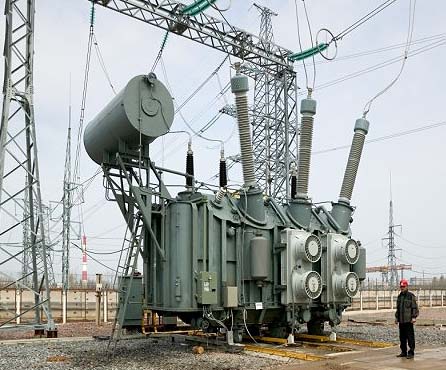
20 масляный трансформатор
масляный трансформатор
Трансформатор с жидким диэлектриком, в котором основной изолирующей средой и теплоносителем служит трансформаторное масло
[ ГОСТ 16110-82]
масляный трансформатор
Трансформатор, магнитная система и обмотки которого погружены в масло
(МЭС 421-01-14)
[ ГОСТ 30830-2002]EN
oil-immersed type transformer
a transformer of which the magnetic circuit and windings are immersed in oi
[IEV number 421-01-14]FR
transformateur immergé dans l'huile
transformateur dont le circuit magnétique et les enroulements sont immergés dans l'huile
[IEV number 421-01-14]Oil transformers
The magnetic circuit and the windings are immersed in a liquid dielectric that provides insulation and evacuates the heat losses of the transformer.
This liquid expands according to the load and the ambient temperature. PCBs and TCBs are now prohibited and mineral oil is generally used. It is flammable and requires protective measures against the risks of fire, explosion and pollution.
The most commonly used protective measures are the DGPT or the DGPT2: Gas, Pressure and Temperature sensor with 1 or 2 sensing levels on the temperature. This system cuts off the LV load (1st level) then the HV supply (2nd level) when there is a fault inside the transformer. A holding tank is used to recover all the liquid dielectric.
Of the four types of immersed transformer: free breathing transformers, gas cushion transformers, transformers with expansion tank and transformers with integral filling, only the latter are currently installed.
[Legrand]Масляные трансформаторы
Магнитная система и обмотки трансформатора погружены в жидкий диэлектрик, служащий изоляцией и теплоносителем.
Жидкий диэлектрик изменяет свой объем в соответствии с нагрузкой трансформатора и температурой окружающей среды. Поскольку в настоящее время применение полихлорированных дифенилов и тетрахлорбифенилов запрещено, то в основном используют минеральное масло. Оно огнеопасно, поэтому необходимо принимать меры против возникновения пожара, взрыва и загрязнения окружающей среды.
Как правило, применяются системы DGPT (одноуровневые системы, использующие датчики газа, давления и температуры) или DGPT2 – двухуровневые системы. В случае возникновения аномального состояния трансформатора данные системы отключают нагрузку цепей низшего напряжения (первый уровень защиты), а затем питание обмотки высшего напряжения (второй уровень защиты). Активная часть трансформатора находится в баке и полностью покрыта жидким диэлектриком.
Существует четыре типа масляных трансформаторов: трансформаторы с системой свободного дыхания, трансформаторы с газовой подушкой между зеркалом масла и крышкой трансформатора, трансформаторы с расширительным баком и трансформаторы с гофрированным баком. В настоящее время применяют только трансформаторы последнего типа
[Интент]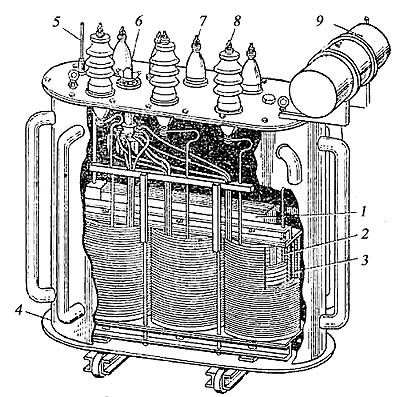
[http://www.ramo-chelny.ru/konschasti.html]Масляный трансформатор:
- Шихтованный магнитопровод
- Обмотка низшего напряжения
- Обмотка высшего напряжения
- Трубчатый бак
- Термометр
- Переключатель регулировочных отводов обмотки высшего напряжения
- Ввод (проходной изолятор) обмотки низшего напряжения
- Ввод (проходной изолятор) обмотки высшего напряжения
- Расширительный бак
[http://transfcomplect.narod.ru/transformator.html]Тематики
Классификация
>>>EN
DE
FR
Русско-французский словарь нормативно-технической терминологии > масляный трансформатор
- 1
- 2
См. также в других словарях:
Commonly — Com mon*ly, adv. 1. Usually; generally; ordinarily; frequently; for the most part; as, confirmed habits commonly continue through life. [1913 Webster] 2. In common; familiarly. [Obs.] Spenser. [1913 Webster] … The Collaborative International Dictionary of English
commonly — index as a rule, generally, invariably Burton s Legal Thesaurus. William C. Burton. 2006 … Law dictionary
commonly — c.1300, in a way common to all, also common to all; also usually, from COMMON (Cf. common) (adj.) + LY (Cf. ly) (2) … Etymology dictionary
commonly — [adv] usually as a rule, by ordinary, frequently, generally, more often than not, ordinarily, regularly; concepts 530,541 Ant. uncommonly, unusually … New thesaurus
commonly — ► ADVERB ▪ very often; frequently … English terms dictionary
commonly — [käm′ən lē] adv. 1. in a common manner 2. in the usual course of events; ordinarily … English World dictionary
commonly — com|mon|ly W3 [ˈkɔmənli US ˈka: ] adv 1.) usually or by most people = ↑widely ▪ Sodium chloride is more commonly known as salt. ▪ a commonly used industrial chemical 2.) often, in many places, or in large numbers = ↑widely ▪ Lung cancer is the… … Dictionary of contemporary English
commonly — adv. Commonly is used with these adjectives: ↑available, ↑used Commonly is used with these verbs: ↑arise, ↑assume, ↑call, ↑cite, ↑employ, ↑encounter, ↑hold, ↑know, ↑mention … Collocations dictionary
commonly — com|mon|ly [ kamənli ] adverb ** 1. ) usually or frequently: the method most commonly used by researchers 2. ) by most ordinary people: nitrous oxide, commonly known as laughing gas … Usage of the words and phrases in modern English
commonly — adverb usually or by most people: commonly agreed principles | Sodium chloride is more commonly known as salt … Longman dictionary of contemporary English
commonly */*/ — UK [ˈkɒmənlɪ] / US [ˈkɑmənlɪ] adverb 1) usually or frequently the method most commonly used by researchers 2) by most ordinary people nitrous oxide, commonly known as laughing gas … English dictionary
