

-
1 нарушение условий конкуренции
нарушение условий конкуренции
—
[ http://www.eionet.europa.eu/gemet/alphabetic?langcode=en]EN
distortion of competition
Article 85(1) of the EEC Treaty prohibits all agreements between undertakings, decisions by associations of undertakings and concerted practices which may affect trade between member states and which have as their object or effect the prevention, restriction or distortion of competition within the common market. All such arrangements are automatically null and void under Article 85(2), unless exempted by the Commission pursuant to Article 85(3). The text of Article 85 is as follows: "1. The following shall be prohibited as incompatible with the common market: all agreements between undertakings, decisions by associations of undertakings and concerted practices which may affect trade between member states and which have as their object or effect the prevention, restriction or distortion of competition within the common market, and in particular those which: (a) directly or indirectly fix purchase or selling prices or any other trading conditions; (b) limit or control production, markets, technical development, or investment; (c) share markets or sources of supply; (d) apply dissimilar conditions to equivalent transactions with other trading parties, thereby placing them at a competitive disadvantage; (e) make the conclusion of contracts subject to acceptance by the other parties of supplementary obligations which, by their nature or according to commercial usage, have no connection with the subject of such contracts. (Source: CLAORG)
[http://www.eionet.europa.eu/gemet/alphabetic?langcode=en]Тематики
EN
DE
FR
Русско-немецкий словарь нормативно-технической терминологии > нарушение условий конкуренции
-
2 ограничение конкуренции
ограничение конкуренции
—
[ http://www.eionet.europa.eu/gemet/alphabetic?langcode=en]EN
restriction on competition
Article 85(1) of the EEC Treaty prohibits all agreements between undertakings, decisions by associations of undertakings and concerted practices which may affect trade between member states and which have as their object or effect the prevention, restriction or distortion of competition within the common market. All such arrangements are automatically null and void under Article 85(2), unless exempted by the Commission pursuant to Article 85(3). The text of Article 85 is as follows: "1. The following shall be prohibited as incompatible with the common market: all agreements between undertakings, decisions by associations of undertakings and concerted practices which may affect trade between member states and which have as their object or effect the prevention, restriction or distortion of competition within the common market, and in particular those which: (a) directly or indirectly fix purchase or selling prices or any other trading conditions; (b) limit or control production, markets, technical development, or investment; (c) share markets or sources of supply; (d) apply dissimilar conditions to equivalent transactions with other trading parties, thereby placing them at a competitive disadvantage; (e) make the conclusion of contracts subject to acceptance by the other parties of supplementary obligations which, by their nature or according to commercial usage, have no connection with the subject of such contracts. (Source: CLAORG)
[http://www.eionet.europa.eu/gemet/alphabetic?langcode=en]Тематики
EN
DE
FR
Русско-немецкий словарь нормативно-технической терминологии > ограничение конкуренции
-
3 длительный допустимый ток
- Strombelastbarkeit, f
- Dauerstrombelastbarkeit, f
(длительный) допустимый ток
Максимальное значение электрического тока, который может протекать длительно по проводнику, устройству или аппарату при определенных условиях без превышения определенного значения их температуры в установившемся режиме
[ ГОСТ Р МЭК 60050-826-2009]
Этот ток обозначают IZ
[ ГОСТ Р 50571. 1-2009 ( МЭК 60364-1: 2005)]EN
(continuous) current-carrying capacity
ampacity (US)
maximum value of electric current which can be carried continuously by a conductor, a device or an apparatus, under specified conditions without its steady-state temperature exceeding a specified value
[IEV number 826-11-13]
ampacity
The current in amperes that a conductor can carry continuously under the conditions of use without exceeding its temperature rating.
[National Electrical Cod]FR
courant (permanent) admissible, m
valeur maximale du courant électrique qui peut parcourir en permanence, un conducteur, un dispositif ou un appareil, sans que sa température de régime permanent, dans des conditions données, soit supérieure à la valeur spécifiée
[IEV number 826-11-13]Ampacity, the term is defined as the maximum amount of current a cable can carry before sustaining immediate or progressive deterioration. Also described as current rating or current-carrying capacity, is the RMS electric current which a device can continuously carry while remaining within its temperature rating. The ampacity of a cable depends on:
- its insulation temperature rating;
- conductor electrical properties for current;
- frequency, in the case of alternating currents;
- ability to dissipate heat, which depends on cable geometry and its surroundings;
- ambient temperature.
Electric wires have some resistance, and electric current flowing through them causes voltage drop and power dissipation, which heats the cable. Copper or aluminum can conduct a large amount of current before melting, but long before the conductors melt, their insulation would be damaged by the heat.
The ampacity for a power cable is thus based on physical and electrical properties of the material & construction of the conductor and of its insulation, ambient temperature, and environmental conditions adjacent to the cable. Having a large overall surface area may dissipate heat well if the environment can absorb the heat.
In a long run of cable, different conditions govern, and installation regulations normally specify that the most severe condition along the run governs the cable's rating. Cables run in wet or oily locations may carry a lower temperature rating than in a dry installation. Derating is necessary for multiple circuits in close proximity. When multiple cables are near, each contributes heat to the others and diminishes the amount of cooling air that can flow past the individual cables. The overall ampacity of the insulated conductors in a bundle of more than 3 must be derated, whether in a raceway or cable. Usually the de-rating factor is tabulated in a nation's wiring regulations.
Depending on the type of insulating material, common maximum allowable temperatures at the surface of the conductor are 60, 75 and 90 degrees Celsius, often with an ambient air temperature of 30°C. In the U.S., 105°C is allowed with ambient of 40°C, for larger power cables, especially those operating at more than 2 kV. Likewise, specific insulations are rated 150, 200 or 250°C.
The allowed current in cables generally needs to be decreased (derated) when the cable is covered with fireproofing material.
For example, the United States National Electric Code, Table 310-16, specifies that up to three 8 AWG copper wires having a common insulating material (THWN) in a raceway, cable, or direct burial has an ampacity of 50 A when the ambient air is 30°C, the conductor surface temperature allowed to be 75°C. A single insulated conductor in air has 70 A rating.
Ampacity rating is normally for continuous current, and short periods of overcurrent occur without harm in most cabling systems. The acceptable magnitude and duration of overcurrent is a more complex topic than ampacity.
When designing an electrical system, one will normally need to know the current rating for the following:- Wires
- Printed Circuit Board traces, where included
- Fuses
- Circuit breakers
- All or nearly all components used
Some devices are limited by power rating, and when this power rating occurs below their current limit, it is not necessary to know the current limit to design a system. A common example of this is lightbulb holders.
[http://en.wikipedia.org/wiki/Ampacity]
Тематики
- электротехника, основные понятия
Синонимы
EN
DE
- Dauerstrombelastbarkeit, f
- Strombelastbarkeit, f
FR
- courant admissible, m
- courant permanent admissible, m
Русско-немецкий словарь нормативно-технической терминологии > длительный допустимый ток
-
4 экологическое сообщество
экологическое сообщество
—
[ http://www.eionet.europa.eu/gemet/alphabetic?langcode=en]EN
ecological community
1) All of the plants and animals in an area or volume; a complex association usually containing both animals and plants. 2) Any naturally occurring group of organisms that occupy a common environment. (Source: LANDY / ALL)
[http://www.eionet.europa.eu/gemet/alphabetic?langcode=en]Тематики
EN
DE
FR
Русско-немецкий словарь нормативно-технической терминологии > экологическое сообщество
-
5 государство
государство
—
[ http://www.eionet.europa.eu/gemet/alphabetic?langcode=en]EN
state
A people permanently occupying a fixed territory bound together by common law, habits and custom into one body politic exercising, through the medium of an organized government, independent sovereignty and control over all persons and things within its boundaries, unless or until authority is ceded to a federation or union of other states. (Source: BLD)
[http://www.eionet.europa.eu/gemet/alphabetic?langcode=en]Тематики
EN
DE
FR
Русско-немецкий словарь нормативно-технической терминологии > государство
-
6 гражданское право
гражданское право
—
[ http://www.eionet.europa.eu/gemet/alphabetic?langcode=en]EN
civil law
Law inspired by old Roman Law, the primary feature of which was that laws were written into a collection; codified, and not determined, as is common law, by judges. The principle of civil law is to provide all citizens with an accessible and written collection of the laws which apply to them and which judges must follow. (Source: DUHA)
[http://www.eionet.europa.eu/gemet/alphabetic?langcode=en]Тематики
EN
DE
FR
Русско-немецкий словарь нормативно-технической терминологии > гражданское право
-
7 заброшенная мусорная яма
заброшенная мусорная яма
—
[ http://www.eionet.europa.eu/gemet/alphabetic?langcode=en]EN
old landfill site
Landfill that has been filled and covered with topsoil and seeded. The most common end use for landfills is open spaces with no active recreation taking place over the completed landfill. The obvious reason for this use is that the completed surface is steeply sloped to provide rapid runoff. Also, no irrigation of the cover grasses should be allowed. It is very unlikely to think that commercial or industrial buildings will be constructed on a completed landfill. If the end use is such that the public will be walking on the site, it is important that all manholes be properly secured, leachate lagoons fenced, and other potential hazards eliminated. (Source: CORBITa)
[http://www.eionet.europa.eu/gemet/alphabetic?langcode=en]Тематики
EN
DE
FR
Русско-немецкий словарь нормативно-технической терминологии > заброшенная мусорная яма
-
8 лишение должника права выкупа заложенного им имущества
лишение должника права выкупа заложенного им имущества
—
[ http://www.eionet.europa.eu/gemet/alphabetic?langcode=en]EN
foreclosure
To shut out, to bar, to destroy an equity of redemption. A termination of all rights of the mortgagor or his grantee in the property covered by the mortgage. The process by which a mortgagor of real or personal property, or other owner of property subject to a lien, is deprived of his interest therein. Procedure by which mortgaged property is sold on default of mortgagor in satisfaction of mortgage debt. In common usage, refers to enforcement of lien, trust deed, or mortgage in any method provided by law. (Source: WESTS)
[http://www.eionet.europa.eu/gemet/alphabetic?langcode=en]Тематики
EN
DE
FR
Русско-немецкий словарь нормативно-технической терминологии > лишение должника права выкупа заложенного им имущества
-
9 НКУ защищенное
НКУ защищенное
НКУ закрытое со всех сторон (за возможным исключением монтажной поверхности), в котором после его установки обеспечивается степень защиты не менее IP2X.
[ ГОСТ Р 51321. 1-2000 ( МЭК 60439-1-92)]
защищенное НКУ
НКУ, конструкция которого обеспечивает требуемую степень защиты со всех сторон от прикосновения к частям, находящимся под напряжением (за исключением монтажной поверхности).
[ ГОСТ Р МЭК 61439.1-2013]EN
enclosed assembly (of switchgear and controlgear)
an assembly enclosed on all sides, top and bottom in such a manner as to provide a specified degree of protection
NOTE – The mounting surface may form a part of the enclosure when specified in the relevant publication.
[IEV number 441-12-02]FR
ensemble (d'appareillage de connexion et de commande)
sous enveloppe
ensemble comportant une paroi sur toutes ses faces latérales, supérieure et inférieure, de façon à assurer un degré de protection spécifié
NOTE – La surface de montage peut faire partie de l'enveloppe lorsqu'une publication particulière le spécifie.
[IEV number 441-12-0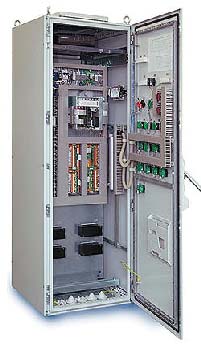
Шкаф - защищенное НКУ, предназначенное для установки на полу
Safety enclosed boards are used for most new installations. Common terms used to designate equipment of this type are metal-enclosed switchgear and metal-clad switchgear.
Most safety enclosed boards are of the unit or sectional type. They consist of a combination of the desired number and type of standardized unit sections.
Each section is a standard factory-assembled combination of a formed steel panel and apparatus mounted on a steel framework.
Safety enclosed switchgear may be classified with respect to purpose of application as follows:
1. General medium- or high-voltage switchgear
2. Primary unit substations
3. Rectifier unit substations
4. Secondary unit substations or power centers
5. General low-voltage switchgear
6. Low-voltage distribution switchboards
7. Motor-control-center switchboards
[American electricians’ handbook]Тематики
- НКУ (шкафы, пульты,...)
Классификация
>>>Обобщающие термины
Синонимы
EN
- enclosed assembly (of switchgear and controlgear)
- enclosed switchboard
- safety enclosed board
- safety enclosed switchgear
DE
FR
Русско-немецкий словарь нормативно-технической терминологии > НКУ защищенное
-
10 оксиды азота
оксиды азота
—
[ http://www.eionet.europa.eu/gemet/alphabetic?langcode=en]EN
nitrogen oxides
Oxides formed and released in all common types of combustion; they are formed by the oxidation of atmospheric nitrogen at high temperatures. Introduced into the atmosphere from car exhausts, furnace stacks, incinerators, power stations and similar sources, the oxides include nitrous oxide, nitric oxide, nitrogen dioxide, nitrogen pentoxide and nitric acid. The oxides of nitrogen undergo many reactions in the atmosphere to form photochemical smog. (Source: GILP96)
[http://www.eionet.europa.eu/gemet/alphabetic?langcode=en]Тематики
EN
DE
FR
Русско-немецкий словарь нормативно-технической терминологии > оксиды азота
-
11 политика в области рыболовства
политика в области рыболовства
—
[ http://www.eionet.europa.eu/gemet/alphabetic?langcode=en]EN
fishery policy
Common Fisheries Policy which covers all fishing activities, the farming of living aquatic resources, and their processing and marketing, on the legal basis of Article 39 of the Treaty of Rome. It was agreed between members of the European Community in 1983. It lays down annual catch limits for major species of fish, a 12-mile exclusive fishing zone for each state, and an equal-access zone of 200 nautical miles from its coast within which any member state is allowed to fish. (Source: ECSA / SOCIOL)
[http://www.eionet.europa.eu/gemet/alphabetic?langcode=en]Тематики
EN
DE
FR
Русско-немецкий словарь нормативно-технической терминологии > политика в области рыболовства
-
12 эквивалентная доза
эквивалентная доза
—
[ http://www.eionet.europa.eu/gemet/alphabetic?langcode=en]EN
equivalent dose
A quantity used in radiation protection, expressing all radiation on a common scale for calculating the effective absorbed dose. The unit of dose equivalent is the rem. which is numerically equal to the absorbed dose in rads multiplied by certain modifying factors such as the quality factor, the distribution factor, etc. (Source: KOREN)
[http://www.eionet.europa.eu/gemet/alphabetic?langcode=en]Тематики
EN
DE
FR
Русско-немецкий словарь нормативно-технической терминологии > эквивалентная доза
См. также в других словарях:
Common green bottle fly — Scientific classification Kingdom: Animalia Phylum … Wikipedia
Common area — A common area is, in real estate or real property law, the area which is available for use by more than one person... [1] The common areas are those within a building that are available for common use by all tenants, (or) groups of tenants and… … Wikipedia
Common Lisp — Paradigm(s) Multi paradigm: procedural, functional, object oriented, meta, reflective, generic Appeared in 1984, 1994 for ANSI Common Lisp Developer ANSI X3J13 committee Typing discipline … Wikipedia
Common Law — Common Law † Catholic Encyclopedia ► Common Law (Lat. communis, general, of general application; lex, law) The term is of English origin and is used to describe the juridical principles and general rules regulating the possession … Catholic encyclopedia
Common (entertainer) — Common Performing at Ilosaarirock, Finland in 2008. Background information Birth name Lonnie Corant Jaman Shuka Rashid Lynn, Jr … Wikipedia
Common — Com mon, a. [Compar. {Commoner}; superl. {Commonest}.] [OE. commun, comon, OF. comun, F. commun, fr. L. communis; com + munis ready to be of service; cf. Skr. mi to make fast, set up, build, Goth. gamains common, G. gemein, and E. mean low,… … The Collaborative International Dictionary of English
Common bar — Common Com mon, a. [Compar. {Commoner}; superl. {Commonest}.] [OE. commun, comon, OF. comun, F. commun, fr. L. communis; com + munis ready to be of service; cf. Skr. mi to make fast, set up, build, Goth. gamains common, G. gemein, and E. mean low … The Collaborative International Dictionary of English
Common barrator — Common Com mon, a. [Compar. {Commoner}; superl. {Commonest}.] [OE. commun, comon, OF. comun, F. commun, fr. L. communis; com + munis ready to be of service; cf. Skr. mi to make fast, set up, build, Goth. gamains common, G. gemein, and E. mean low … The Collaborative International Dictionary of English
Common Bench — Common Com mon, a. [Compar. {Commoner}; superl. {Commonest}.] [OE. commun, comon, OF. comun, F. commun, fr. L. communis; com + munis ready to be of service; cf. Skr. mi to make fast, set up, build, Goth. gamains common, G. gemein, and E. mean low … The Collaborative International Dictionary of English
Common brawler — Common Com mon, a. [Compar. {Commoner}; superl. {Commonest}.] [OE. commun, comon, OF. comun, F. commun, fr. L. communis; com + munis ready to be of service; cf. Skr. mi to make fast, set up, build, Goth. gamains common, G. gemein, and E. mean low … The Collaborative International Dictionary of English
Common carrier — Common Com mon, a. [Compar. {Commoner}; superl. {Commonest}.] [OE. commun, comon, OF. comun, F. commun, fr. L. communis; com + munis ready to be of service; cf. Skr. mi to make fast, set up, build, Goth. gamains common, G. gemein, and E. mean low … The Collaborative International Dictionary of English
