

-
1 contact
контакт (1)
-
[IEV number 151-12-15 ]
контакт (контактного коммутационного аппарата)
Токопроводящие части, предназначенные для установления непрерывности цепи при их соприкосновении и в результате их движения относительно друг друга в процессе оперирования размыкающие или замыкающие цепь либо, если это шарнирные или скользящие контакты, поддерживающие непрерывность цепи.
МЭК 60050(441-15-05).
[ ГОСТ Р 50030. 1-2000 ( МЭК 60947-1-99)]
контакт
Токоведущая часть аппарата, которая во время операции размыкает и замыкает цепь, или в случае скользящих или шарнирных контактов сохраняет непрерывность цепи
[РД 34.45-51.300-97]EN
contact (1)
set of conductive elements for establishing electric circuit continuity when they touch each other and which, due to their relative motion during an operation, open or close an electric circuit or, in the case of some hinged or sliding elements, maintain circuit continuity
NOTE – See also the concept "electric contact" in 151-12-03.
[IEV number 151-12-15 ]
contact (of a mechanical switching device)
conductive parts designed to establish circuit continuity when they touch and which, due to their relative motion during an operation, open or close a circuit or, in the case of hinged or sliding contacts, maintain circuit continuity
[IEV number 441-15-05]FR
contact (1), m
ensemble d'éléments conducteurs destinés à établir la continuité d'un circuit électrique lorsqu'ils se touchent et qui, par leur mouvement relatif pendant la manœuvre, ouvrent ou ferment un circuit électrique ou, dans le cas de certains éléments pivotants ou glissants, maintiennent la continuité du circuit
NOTE – Voir aussi le concept "contact électrique" en 151-12-03.
[IEV number 151-12-15 ]
contact (d'un appareil de connexion)
pièces conductrices destinées à établir la continuité d'un circuit lorsqu'elles se touchent et qui, par leur mouvement relatif pendant la manoeuvre, ouvrent et ferment un circuit ou, dans le cas de contacts pivotants ou glissants, maintiennent la continuité du circuit
[IEV number 441-15-05]2
контакт (2)
-
[IEV number 151-12-16]EN
contact (2)
conductive element intended to make an electric contact
[IEV number 151-12-16]FR
contact (2), m
élément conducteur destiné à établir un contact électrique
[IEV number 151-12-16]Тематики
- контакт
- электротехника, основные понятия
Действия
- замыкать контакт
- контакт коммутирует цепь (аппарата, нагрузки...)
- НДП - закрывать контакт
- НДП - открывать контакт
- НДП - разъединять контакт
- размыкать контакт
EN
DE
FR
контактный элемент
Деталь аппарата для цепей управления (неподвижная или подвижная, проводящая или изолированная) для замыкания или размыкания единственного пути прохождения тока в цепи.
Примечания:
1. Контактный элемент и механизм передачи усилия могут быть объединены в единый узел, но чаще один или несколько элементов могут быть скомбинированы с одним или несколькими механизмами передачи усилия, и их конструкция может быть разной.
2. В состав контактных элементов не входят катушки и магниты управления.
[ ГОСТ 50030.5.1-2005]
контактный элемент
контакт (2)
-
[IEV number 151-12-16]EN
contact member
contact (2)
conductive element intended to make an electric contact
[IEV number 151-12-16]FR
élément de contact, m
contact (2), m
élément conducteur destiné à établir un contact électrique
[IEV number 151-12-16]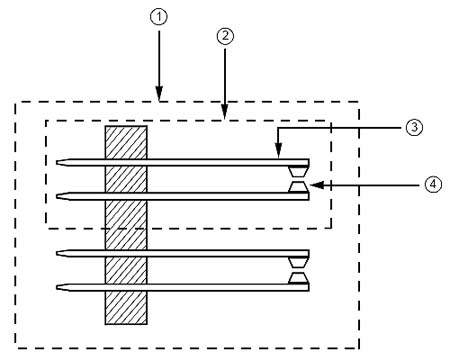
[IEV number 444-04-06]EN
- Contact set - контактная группа
-
Ouput circuit - выходная цепь
contact circuit - цепь контакта
contact - контакт - Contact member - контактный элемент
- Contact point - рабочая поверхность контакт-детали, контакт-деталь
FR
- Jeu de contacts - контактная группа
-
Circuit de sortie - выходная цепь
circuit de contact - цепь контакта
contact - контакт - Element de contact - контактный элемент
-
Piece de contact - рабочая поверхность контакт-детали, контакт-деталь
[Перевод Интент]
Примечания
1 - Контактный элемент такой конструкции как на рисунке слева называют также конактная пружина.
2 - По существу, контактный элемент, это одна из частей контакта,
т. е. в замыкающем, размыкающем и переключающем контактах любой подвижный и неподвижный контакт является контактным элементом.
[Интент]Тематики
Синонимы
EN
DE
FR
Франко-русский словарь нормативно-технической терминологии > contact
-
2 contact (d'un appareil de connexion)
контакт (1)
-
[IEV number 151-12-15 ]
контакт (контактного коммутационного аппарата)
Токопроводящие части, предназначенные для установления непрерывности цепи при их соприкосновении и в результате их движения относительно друг друга в процессе оперирования размыкающие или замыкающие цепь либо, если это шарнирные или скользящие контакты, поддерживающие непрерывность цепи.
МЭК 60050(441-15-05).
[ ГОСТ Р 50030. 1-2000 ( МЭК 60947-1-99)]
контакт
Токоведущая часть аппарата, которая во время операции размыкает и замыкает цепь, или в случае скользящих или шарнирных контактов сохраняет непрерывность цепи
[РД 34.45-51.300-97]EN
contact (1)
set of conductive elements for establishing electric circuit continuity when they touch each other and which, due to their relative motion during an operation, open or close an electric circuit or, in the case of some hinged or sliding elements, maintain circuit continuity
NOTE – See also the concept "electric contact" in 151-12-03.
[IEV number 151-12-15 ]
contact (of a mechanical switching device)
conductive parts designed to establish circuit continuity when they touch and which, due to their relative motion during an operation, open or close a circuit or, in the case of hinged or sliding contacts, maintain circuit continuity
[IEV number 441-15-05]FR
contact (1), m
ensemble d'éléments conducteurs destinés à établir la continuité d'un circuit électrique lorsqu'ils se touchent et qui, par leur mouvement relatif pendant la manœuvre, ouvrent ou ferment un circuit électrique ou, dans le cas de certains éléments pivotants ou glissants, maintiennent la continuité du circuit
NOTE – Voir aussi le concept "contact électrique" en 151-12-03.
[IEV number 151-12-15 ]
contact (d'un appareil de connexion)
pièces conductrices destinées à établir la continuité d'un circuit lorsqu'elles se touchent et qui, par leur mouvement relatif pendant la manoeuvre, ouvrent et ferment un circuit ou, dans le cas de contacts pivotants ou glissants, maintiennent la continuité du circuit
[IEV number 441-15-05]2
контакт (2)
-
[IEV number 151-12-16]EN
contact (2)
conductive element intended to make an electric contact
[IEV number 151-12-16]FR
contact (2), m
élément conducteur destiné à établir un contact électrique
[IEV number 151-12-16]Тематики
- контакт
- электротехника, основные понятия
Действия
- замыкать контакт
- контакт коммутирует цепь (аппарата, нагрузки...)
- НДП - закрывать контакт
- НДП - открывать контакт
- НДП - разъединять контакт
- размыкать контакт
EN
DE
FR
Франко-русский словарь нормативно-технической терминологии > contact (d'un appareil de connexion)
-
3 contacteur sous vide
вакуумный контактор (пускатель)
Контактор (пускатель), у которого главные контакты размыкаются и замыкаются внутри оболочки с сильно разреженной атмосферой.
[ ГОСТ Р 50030.4.1-2002 (МЭК 60947-4-1-2000)]EN
vacuum contactor (or starter)
contactor (or starter) in which the main contacts open and close within a highly evacuated envelope
[IEC 60947-4-1, ed. 3.0 (2009-09)]FR
contacteur (ou démarreur) sous vide
contacteur (ou démarreur) dont les contacts principaux s'ouvrent et se ferment à l'intérieur d'une enveloppe à basse pression
[IEC 60947-4-1, ed. 3.0 (2009-09)]Параллельные тексты EN-RU
Vacuum contactors are mainly used for the switching of motors, transformers, capacitors in AC power lines.
They can be installed in multi-stack cubicles.
A vacuum contactor comprises several assemblies such as switching mechanism including vacuum interrupters, magnetic actuator, high strength molded front cover and auxiliary devices.
Actuating is available either at instantaneous or continuous excitation.
[LS Industrial Systems]Вакуумные контакторы предназначены в основном для коммутации силовых цепей переменного тока электродвигателей, трансформаторов и конденсаторов.
Контакторы пригодны для установки в комплектные устройства в несколько ярусов.
Вакуумный контактор состоит из следующих узлов: коммутационный механизм с вакуумной дугогасительной камерой, электромагнитный привод, прочная пластмассовая передняя панель и вспомогательные устройства.
Включение и отключение контактора возможно как подачей кратковременного, так и непрерывного сигнала на электромагнитный привод.
[Перевод Интент]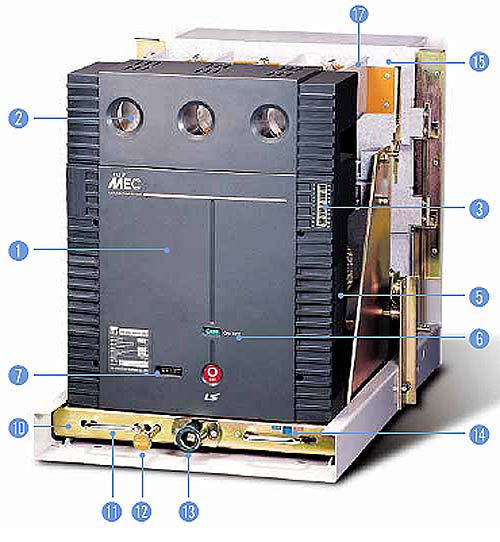
Вакуумный контактор среднего напряжения выдвижного исполнения с предохранителями
Рис. LS Industrial Systems1
Передняя панель
2
Окно проверки состояния предохранителя
3
Электрический соединитель
4
Unlock button (Interlock lever)
Кнопка разблокировки рычага
5
Ручка (предназначена для того, чтобы вдвигать и выдвигать контактор)
6
ON/OFF indicator
Указатель коммутационного положения контактора (ВКЛ/ОТКЛ.)
7
Счетчик операционных циклов
8
Кнопка ручного отключения контактора
10
Выдвижной лоток
11
Блокировочный рычаг
12
Блокировочная кнопка
13
Hole for Interlock lever insertion
Отверстие для вставки блокировочного рычага
14
Test/Run indicator
Индикатор положений Испытательное/Присоединенное
15
Корзина
16
Конденсаторный источник питания
17
Кожух предохранителя
Тематики
- аппарат, изделие, устройство...
- высоковольтный аппарат, оборудование...
- контакторы и пускатели
EN
FR
Франко-русский словарь нормативно-технической терминологии > contacteur sous vide
-
4 courant admissible, m
(длительный) допустимый ток
Максимальное значение электрического тока, который может протекать длительно по проводнику, устройству или аппарату при определенных условиях без превышения определенного значения их температуры в установившемся режиме
[ ГОСТ Р МЭК 60050-826-2009]
Этот ток обозначают IZ
[ ГОСТ Р 50571. 1-2009 ( МЭК 60364-1: 2005)]EN
(continuous) current-carrying capacity
ampacity (US)
maximum value of electric current which can be carried continuously by a conductor, a device or an apparatus, under specified conditions without its steady-state temperature exceeding a specified value
[IEV number 826-11-13]
ampacity
The current in amperes that a conductor can carry continuously under the conditions of use without exceeding its temperature rating.
[National Electrical Cod]FR
courant (permanent) admissible, m
valeur maximale du courant électrique qui peut parcourir en permanence, un conducteur, un dispositif ou un appareil, sans que sa température de régime permanent, dans des conditions données, soit supérieure à la valeur spécifiée
[IEV number 826-11-13]Ampacity, the term is defined as the maximum amount of current a cable can carry before sustaining immediate or progressive deterioration. Also described as current rating or current-carrying capacity, is the RMS electric current which a device can continuously carry while remaining within its temperature rating. The ampacity of a cable depends on:
- its insulation temperature rating;
- conductor electrical properties for current;
- frequency, in the case of alternating currents;
- ability to dissipate heat, which depends on cable geometry and its surroundings;
- ambient temperature.
Electric wires have some resistance, and electric current flowing through them causes voltage drop and power dissipation, which heats the cable. Copper or aluminum can conduct a large amount of current before melting, but long before the conductors melt, their insulation would be damaged by the heat.
The ampacity for a power cable is thus based on physical and electrical properties of the material & construction of the conductor and of its insulation, ambient temperature, and environmental conditions adjacent to the cable. Having a large overall surface area may dissipate heat well if the environment can absorb the heat.
In a long run of cable, different conditions govern, and installation regulations normally specify that the most severe condition along the run governs the cable's rating. Cables run in wet or oily locations may carry a lower temperature rating than in a dry installation. Derating is necessary for multiple circuits in close proximity. When multiple cables are near, each contributes heat to the others and diminishes the amount of cooling air that can flow past the individual cables. The overall ampacity of the insulated conductors in a bundle of more than 3 must be derated, whether in a raceway or cable. Usually the de-rating factor is tabulated in a nation's wiring regulations.
Depending on the type of insulating material, common maximum allowable temperatures at the surface of the conductor are 60, 75 and 90 degrees Celsius, often with an ambient air temperature of 30°C. In the U.S., 105°C is allowed with ambient of 40°C, for larger power cables, especially those operating at more than 2 kV. Likewise, specific insulations are rated 150, 200 or 250°C.
The allowed current in cables generally needs to be decreased (derated) when the cable is covered with fireproofing material.
For example, the United States National Electric Code, Table 310-16, specifies that up to three 8 AWG copper wires having a common insulating material (THWN) in a raceway, cable, or direct burial has an ampacity of 50 A when the ambient air is 30°C, the conductor surface temperature allowed to be 75°C. A single insulated conductor in air has 70 A rating.
Ampacity rating is normally for continuous current, and short periods of overcurrent occur without harm in most cabling systems. The acceptable magnitude and duration of overcurrent is a more complex topic than ampacity.
When designing an electrical system, one will normally need to know the current rating for the following:- Wires
- Printed Circuit Board traces, where included
- Fuses
- Circuit breakers
- All or nearly all components used
Some devices are limited by power rating, and when this power rating occurs below their current limit, it is not necessary to know the current limit to design a system. A common example of this is lightbulb holders.
[http://en.wikipedia.org/wiki/Ampacity]
Тематики
- электротехника, основные понятия
Синонимы
EN
DE
- Dauerstrombelastbarkeit, f
- Strombelastbarkeit, f
FR
- courant admissible, m
- courant permanent admissible, m
Франко-русский словарь нормативно-технической терминологии > courant admissible, m
-
5 courant permanent admissible, m
(длительный) допустимый ток
Максимальное значение электрического тока, который может протекать длительно по проводнику, устройству или аппарату при определенных условиях без превышения определенного значения их температуры в установившемся режиме
[ ГОСТ Р МЭК 60050-826-2009]
Этот ток обозначают IZ
[ ГОСТ Р 50571. 1-2009 ( МЭК 60364-1: 2005)]EN
(continuous) current-carrying capacity
ampacity (US)
maximum value of electric current which can be carried continuously by a conductor, a device or an apparatus, under specified conditions without its steady-state temperature exceeding a specified value
[IEV number 826-11-13]
ampacity
The current in amperes that a conductor can carry continuously under the conditions of use without exceeding its temperature rating.
[National Electrical Cod]FR
courant (permanent) admissible, m
valeur maximale du courant électrique qui peut parcourir en permanence, un conducteur, un dispositif ou un appareil, sans que sa température de régime permanent, dans des conditions données, soit supérieure à la valeur spécifiée
[IEV number 826-11-13]Ampacity, the term is defined as the maximum amount of current a cable can carry before sustaining immediate or progressive deterioration. Also described as current rating or current-carrying capacity, is the RMS electric current which a device can continuously carry while remaining within its temperature rating. The ampacity of a cable depends on:
- its insulation temperature rating;
- conductor electrical properties for current;
- frequency, in the case of alternating currents;
- ability to dissipate heat, which depends on cable geometry and its surroundings;
- ambient temperature.
Electric wires have some resistance, and electric current flowing through them causes voltage drop and power dissipation, which heats the cable. Copper or aluminum can conduct a large amount of current before melting, but long before the conductors melt, their insulation would be damaged by the heat.
The ampacity for a power cable is thus based on physical and electrical properties of the material & construction of the conductor and of its insulation, ambient temperature, and environmental conditions adjacent to the cable. Having a large overall surface area may dissipate heat well if the environment can absorb the heat.
In a long run of cable, different conditions govern, and installation regulations normally specify that the most severe condition along the run governs the cable's rating. Cables run in wet or oily locations may carry a lower temperature rating than in a dry installation. Derating is necessary for multiple circuits in close proximity. When multiple cables are near, each contributes heat to the others and diminishes the amount of cooling air that can flow past the individual cables. The overall ampacity of the insulated conductors in a bundle of more than 3 must be derated, whether in a raceway or cable. Usually the de-rating factor is tabulated in a nation's wiring regulations.
Depending on the type of insulating material, common maximum allowable temperatures at the surface of the conductor are 60, 75 and 90 degrees Celsius, often with an ambient air temperature of 30°C. In the U.S., 105°C is allowed with ambient of 40°C, for larger power cables, especially those operating at more than 2 kV. Likewise, specific insulations are rated 150, 200 or 250°C.
The allowed current in cables generally needs to be decreased (derated) when the cable is covered with fireproofing material.
For example, the United States National Electric Code, Table 310-16, specifies that up to three 8 AWG copper wires having a common insulating material (THWN) in a raceway, cable, or direct burial has an ampacity of 50 A when the ambient air is 30°C, the conductor surface temperature allowed to be 75°C. A single insulated conductor in air has 70 A rating.
Ampacity rating is normally for continuous current, and short periods of overcurrent occur without harm in most cabling systems. The acceptable magnitude and duration of overcurrent is a more complex topic than ampacity.
When designing an electrical system, one will normally need to know the current rating for the following:- Wires
- Printed Circuit Board traces, where included
- Fuses
- Circuit breakers
- All or nearly all components used
Some devices are limited by power rating, and when this power rating occurs below their current limit, it is not necessary to know the current limit to design a system. A common example of this is lightbulb holders.
[http://en.wikipedia.org/wiki/Ampacity]
Тематики
- электротехника, основные понятия
Синонимы
EN
DE
- Dauerstrombelastbarkeit, f
- Strombelastbarkeit, f
FR
- courant admissible, m
- courant permanent admissible, m
Франко-русский словарь нормативно-технической терминологии > courant permanent admissible, m
-
6 relais électrique thermique
тепловое реле
-
[Интент]
электротепловое реле
Электрическое реле, работа которого основана на тепловом действии электрического тока
[ ГОСТ 16022-83]EN
thermal electrical relay
dependent-time measuring relay which is intended to protect an equipment from electrical thermal damage by the measurement of the current flowing in the protected equipment and by a characteristic curve simulating its thermal behaviour
[IEC 62271-1, ed. 1.0 (2007-10)]FR
relais électrique thermique
relais de mesure à temps dépendant destiné à protéger un équipement contre les dommages thermiques d'origine électrique par la mesure du courant circulant dans l'équipement protégé et par une courbe caractéristique simulant son comportement thermique
[IEC 62271-1, ed. 1.0 (2007-10)]Параллельные тексты EN-RU
Meanwhile, EMPR (Electronic Motor Protection Relay), also called as ‘Electronic Overcurrent Relay’ or ‘Electronic Overload Relay) may replace TOR to protect a low voltage motor.
[LS Industrial Systems]При этом, для зашиты низковольтного электродвигателя, тепловое реле (TOR) можно заменить на электронное реле защиты электродвигателя (EMPR), которое также называют "электронное реле защиты от сверхтока" или электронное реле защиты от перегрузки.
[Перевод Интент]It is better to use a fan with thermal switches.
In this case the positioning of the fans should be taken care so as to not place the fan’s thermal switch close to heat dissipating devices so as to avoid any malfunctioning of thermal switch.
[Schneider Electric]
Лучше использовать вентиляторы с тепловым реле.
В этом случае вентиляторы следует разместить таким образом, чтобы рядом с тепловым реле не было аппаратов с сильным выделением тепла. Это позволит избежать неправильного срабатывания теплового реле.
[Перевод Интент]Тематики
- расцепитель, тепловое реле
- реле электрическое
EN
- thermal electrical relay
- thermal overload relay
- thermal protection
- thermal relay
- thermal switch
- thermoswitch
- TOR
DE
FR
D. Thermisches Relais
E. Thermal electrical relay
F. Relais électrique thermique
Электрическое реле, работа которого основана на тепловом действии электрического тока
Источник: ГОСТ 16022-83: Реле электрические. Термины и определения оригинал документа
Франко-русский словарь нормативно-технической терминологии > relais électrique thermique
См. также в других словарях:
Close to Home (2005 TV series) — Close To Home Format Crime/Legal drama Created by Jim Leonard Starring … Wikipedia
Case Blue — Case Blue German summer offensive in 1942 Part of the Eastern Front of World War II … Wikipedia
Close Combat series — Close Combat The official logo of the franchise as used in the third game of the series Genres Real time Strategy Developers … Wikipedia
close — 1 vb closed, clos·ing vt 1: to bring to an end or to a state of completion closed the case close an estate by liquidating its assets closing his account 2: to con … Law dictionary
Close-Up (film) — Close Up Directed by Abbas Kiarostami Written by Abbas Kiarostami Release date(s) 1990 Running … Wikipedia
close — vb 1 Close, shut are very close synonyms in the sense of to stop or fill in an opening by means of a closure (as a door, a gate, a lid, or a cover) and are often used interchangeably. However, they may have distinctive nuances of meaning and… … New Dictionary of Synonyms
Close (to the Edit) — Single by Art of Noise from the album Who s Afraid of the Art of Noise? Released May 1984 (1984 05) Format … Wikipedia
Close Combat Clasp — in Gold Awarded by Nazi Germany Type … Wikipedia
Close to nature forestry — is a theory and practice that takes the forest as an ecosystem and manages it as such. It is based in reduced human intervention, that should be directed to accelerate the processes that nature would do by itself more slowly. It aims at… … Wikipedia
Close Quarters Battle Receiver — Close Quarter Battle Receiver[1] Above: An M4A1 with SOPMOD package, including Rail Interface System and Trijicon 4x ACOG. The barrel length is 14.5 inches (370 mm). Below: An M4A1 with … Wikipedia
Close to the Ground — … Wikipedia
