

-
41 Bollée, Ernest-Sylvain
[br]b. 19 July 1814 Clefmont (Haute-Marne), Franced. 11 September 1891 Le Mans, France[br]French inventor of the rotor-stator wind engine and founder of the Bollée manufacturing industry.[br]Ernest-Sylvain Bollée was the founder of an extensive dynasty of bellfounders based in Le Mans and in Orléans. He and his three sons, Amédée (1844–1917), Ernest-Sylvain fils (1846–1917) and Auguste (1847-?), were involved in work and patents on steam-and petrol-driven cars, on wind engines and on hydraulic rams. The presence of the Bollées' car industry in Le Mans was a factor in the establishment of the car races that are held there.In 1868 Ernest-Sylvain Bollée père took out a patent for a wind engine, which at that time was well established in America and in England. In both these countries, variable-shuttered as well as fixed-blade wind engines were in production and patented, but the Ernest-Sylvain Bollée patent was for a type of wind engine that had not been seen before and is more akin to the water-driven turbine of the Jonval type, with its basic principle being parallel to the "rotor" and "stator". The wind drives through a fixed ring of blades on to a rotating ring that has a slightly greater number of blades. The blades of the fixed ring are curved in the opposite direction to those on the rotating blades and thus the air is directed onto the latter, causing it to rotate at a considerable speed: this is the "rotor". For greater efficiency a cuff of sheet iron can be attached to the "stator", giving a tunnel effect and driving more air at the "rotor". The head of this wind engine is turned to the wind by means of a wind-driven vane mounted in front of the blades. The wind vane adjusts the wind angle to enable the wind engine to run at a constant speed.The fact that this wind engine was invented by the owner of a brass foundry, with all the gear trains between the wind vane and the head of the tower being of the highest-quality brass and, therefore, small in scale, lay behind its success. Also, it was of prefabricated construction, so that fixed lengths of cast-iron pillar were delivered, complete with twelve treads of cast-iron staircase fixed to the outside and wrought-iron stays. The drive from the wind engine was taken down the inside of the pillar to pumps at ground level.Whilst the wind engines were being built for wealthy owners or communes, the work of the foundry continued. The three sons joined the family firm as partners and produced several steam-driven vehicles. These vehicles were the work of Amédée père and were l'Obéissante (1873); the Autobus (1880–3), of which some were built in Berlin under licence; the tram Bollée-Dalifol (1876); and the private car La Mancelle (1878). Another important line, in parallel with the pumping mechanism required for the wind engines, was the development of hydraulic rams, following the Montgolfier patent. In accordance with French practice, the firm was split three ways when Ernest-Sylvain Bollée père died. Amédée père inherited the car side of the business, but it is due to Amédée fils (1867– 1926) that the principal developments in car manufacture came into being. He developed the petrol-driven car after the impetus given by his grandfather, his father and his uncle Ernest-Sylvain fils. In 1887 he designed a four-stroke single-cylinder engine, although he also used engines designed by others such as Peugeot. He produced two luxurious saloon cars before putting Torpilleur on the road in 1898; this car competed in the Tour de France in 1899. Whilst designing other cars, Amédée's son Léon (1870–1913) developed the Voiturette, in 1896, and then began general manufacture of small cars on factory lines. The firm ceased work after a merger with the English firm of Morris in 1926. Auguste inherited the Eolienne or wind-engine side of the business; however, attracted to the artistic life, he sold out to Ernest Lebert in 1898 and settled in the Paris of the Impressionists. Lebert developed the wind-engine business and retained the basic "stator-rotor" form with a conventional lattice tower. He remained in Le Mans, carrying on the business of the manufacture of wind engines, pumps and hydraulic machinery, describing himself as a "Civil Engineer".The hydraulic-ram business fell to Ernest-Sylvain fils and continued to thrive from a solid base of design and production. The foundry in Le Mans is still there but, more importantly, the bell foundry of Dominique Bollée in Saint-Jean-de-Braye in Orléans is still at work casting bells in the old way.[br]Further ReadingAndré Gaucheron and J.Kenneth Major, 1985, The Eolienne Bollée, The International Molinological Society.Cénomane (Le Mans), 11, 12 and 13 (1983 and 1984).KM -
42 Memory
To what extent can we lump together what goes on when you try to recall: (1) your name; (2) how you kick a football; and (3) the present location of your car keys? If we use introspective evidence as a guide, the first seems an immediate automatic response. The second may require constructive internal replay prior to our being able to produce a verbal description. The third... quite likely involves complex operational responses under the control of some general strategy system. Is any unitary search process, with a single set of characteristics and inputoutput relations, likely to cover all these cases? (Reitman, 1970, p. 485)[Semantic memory] Is a mental thesaurus, organized knowledge a person possesses about words and other verbal symbols, their meanings and referents, about relations among them, and about rules, formulas, and algorithms for the manipulation of these symbols, concepts, and relations. Semantic memory does not register perceptible properties of inputs, but rather cognitive referents of input signals. (Tulving, 1972, p. 386)The mnemonic code, far from being fixed and unchangeable, is structured and restructured along with general development. Such a restructuring of the code takes place in close dependence on the schemes of intelligence. The clearest indication of this is the observation of different types of memory organisation in accordance with the age level of a child so that a longer interval of retention without any new presentation, far from causing a deterioration of memory, may actually improve it. (Piaget & Inhelder, 1973, p. 36)4) The Logic of Some Memory Theorization Is of Dubious Worth in the History of PsychologyIf a cue was effective in memory retrieval, then one could infer it was encoded; if a cue was not effective, then it was not encoded. The logic of this theorization is "heads I win, tails you lose" and is of dubious worth in the history of psychology. We might ask how long scientists will puzzle over questions with no answers. (Solso, 1974, p. 28)We have iconic, echoic, active, working, acoustic, articulatory, primary, secondary, episodic, semantic, short-term, intermediate-term, and longterm memories, and these memories contain tags, traces, images, attributes, markers, concepts, cognitive maps, natural-language mediators, kernel sentences, relational rules, nodes, associations, propositions, higher-order memory units, and features. (Eysenck, 1977, p. 4)The problem with the memory metaphor is that storage and retrieval of traces only deals [ sic] with old, previously articulated information. Memory traces can perhaps provide a basis for dealing with the "sameness" of the present experience with previous experiences, but the memory metaphor has no mechanisms for dealing with novel information. (Bransford, McCarrell, Franks & Nitsch, 1977, p. 434)7) The Results of a Hundred Years of the Psychological Study of Memory Are Somewhat DiscouragingThe results of a hundred years of the psychological study of memory are somewhat discouraging. We have established firm empirical generalisations, but most of them are so obvious that every ten-year-old knows them anyway. We have made discoveries, but they are only marginally about memory; in many cases we don't know what to do with them, and wear them out with endless experimental variations. We have an intellectually impressive group of theories, but history offers little confidence that they will provide any meaningful insight into natural behavior. (Neisser, 1978, pp. 12-13)A schema, then is a data structure for representing the generic concepts stored in memory. There are schemata representing our knowledge about all concepts; those underlying objects, situations, events, sequences of events, actions and sequences of actions. A schema contains, as part of its specification, the network of interrelations that is believed to normally hold among the constituents of the concept in question. A schema theory embodies a prototype theory of meaning. That is, inasmuch as a schema underlying a concept stored in memory corresponds to the mean ing of that concept, meanings are encoded in terms of the typical or normal situations or events that instantiate that concept. (Rumelhart, 1980, p. 34)Memory appears to be constrained by a structure, a "syntax," perhaps at quite a low level, but it is free to be variable, deviant, even erratic at a higher level....Like the information system of language, memory can be explained in part by the abstract rules which underlie it, but only in part. The rules provide a basic competence, but they do not fully determine performance. (Campbell, 1982, pp. 228, 229)When people think about the mind, they often liken it to a physical space, with memories and ideas as objects contained within that space. Thus, we speak of ideas being in the dark corners or dim recesses of our minds, and of holding ideas in mind. Ideas may be in the front or back of our minds, or they may be difficult to grasp. With respect to the processes involved in memory, we talk about storing memories, of searching or looking for lost memories, and sometimes of finding them. An examination of common parlance, therefore, suggests that there is general adherence to what might be called the spatial metaphor. The basic assumptions of this metaphor are that memories are treated as objects stored in specific locations within the mind, and the retrieval process involves a search through the mind in order to find specific memories....However, while the spatial metaphor has shown extraordinary longevity, there have been some interesting changes over time in the precise form of analogy used. In particular, technological advances have influenced theoretical conceptualisations.... The original Greek analogies were based on wax tablets and aviaries; these were superseded by analogies involving switchboards, gramophones, tape recorders, libraries, conveyor belts, and underground maps. Most recently, the workings of human memory have been compared to computer functioning... and it has been suggested that the various memory stores found in computers have their counterparts in the human memory system. (Eysenck, 1984, pp. 79-80)Primary memory [as proposed by William James] relates to information that remains in consciousness after it has been perceived, and thus forms part of the psychological present, whereas secondary memory contains information about events that have left consciousness, and are therefore part of the psychological past. (Eysenck, 1984, p. 86)Once psychologists began to study long-term memory per se, they realized it may be divided into two main categories.... Semantic memories have to do with our general knowledge about the working of the world. We know what cars do, what stoves do, what the laws of gravity are, and so on. Episodic memories are largely events that took place at a time and place in our personal history. Remembering specific events about our own actions, about our family, and about our individual past falls into this category. With amnesia or in aging, what dims... is our personal episodic memories, save for those that are especially dear or painful to us. Our knowledge of how the world works remains pretty much intact. (Gazzaniga, 1988, p. 42)The nature of memory... provides a natural starting point for an analysis of thinking. Memory is the repository of many of the beliefs and representations that enter into thinking, and the retrievability of these representations can limit the quality of our thought. (Smith, 1990, p. 1)Historical dictionary of quotations in cognitive science > Memory
-
43 каждому событийному входу базисного функционального блока соответствует ровно одна входная событийная переменная
Универсальный русско-английский словарь > каждому событийному входу базисного функционального блока соответствует ровно одна входная событийная переменная
-
44 основной параметр
1) Aviation: basic parameter2) Engineering: inherent parameter, main variable3) Mathematics: governing parameter, key parameter4) Music: master parameter5) Cables: main parameter -
45 самолет
airplane, plane* * *самолё́т м. ( в соответствии с определением ИКАО)
брит. aeroplane, амер. airplane (Примечание. Согласно ИКАО aircraft — лета́тельный аппара́т, вертолё́т, и др. не попадающие под термин самолё́т.)аттесто́вывать самолё́т по шу́му — certificate an aeroplane for noiseвводи́ть самолё́т в вира́ж — roll an aeroplane into a (banked) turnвести́ самолё́т ( о штурмане) — navigate [guide] an aeroplaneвы́весить самолё́т над землё́й — hold the aeroplane of the groundвыводи́ть самолё́т из стро́я — disable an aeroplane, put an aeroplane out of operation [out of service]выра́внивать самолё́т — ( переводить в горизонтальный полёт) level an aeroplane; ( при посадке) flare out an aeroplaneзаправля́ть самолё́т горю́чим — fuel an aeroplaneзару́ливать самолё́т на стоя́нку — taxi an aeroplane to the parking areaиспы́тывать самолё́т в во́здухе — test-fly [fly-test] an aeroplaneкача́ть самолё́т с крыла́ на крыло́ — rock an aeroplaneсамолё́т лё́гок в управле́нии — the aeroplane handles well [is responsive]самолё́т нахо́дится в во́здухе — the aeroplane is [becomes] airborneоблё́тывать но́вый самолё́т — fly out a new aeroplaneсамолё́т обору́дован, напр. автомати́ческим радиоко́мпасом — the aeroplane carries, e. g., an ADFопознава́ть (национа́льную принадле́жность) самолёт(а) — identify an aeroplaneоставля́ть самолё́т в авари́йной ситуа́ции — escape from an aeroplane in an emergencyсамолё́т отлета́ет, напр. в 13 ч 50 мин — the aeroplane departs at, e. g., 1350 hoursотправля́ть самолё́т на второ́й круг — send an aeroplane aroundсамолё́т отрыва́ется от земли́ ( при взлёте) — the aeroplane breaks groundотрыва́ть самолё́т от земли́ ( при взлёте) — lift [take] an aeroplane off the groundпереобору́довать самолё́т (напр. военный в гражданский) — convert an aeroplaneпилоти́ровать самолё́т — fly [handle] an aeroplaneпокида́ть самолё́т ( об экипаже) — abandon an aeroplaneсамолё́т прибыва́ет, напр. в 16 ч 15 мин — the aeroplane arrives at 1615 hoursсамолё́т разби́лся — the aeroplane crashedразвора́чивать самолё́т по ве́тру — turn an aeroplane downwindразвора́чивать самолё́т про́тив ве́тра — turn an aeroplane into the windсажа́ть самолё́т — land an aeroplaneсажа́ть самолё́т по ве́тру — land an aeroplane downwindсажа́ть самолё́т про́тив ве́тра — land an aeroplane into the windсажа́ть самолё́т с недолё́том или с перелё́том — land an aeroplane short or longсамолё́т сбаланси́рован в, напр. прямолине́йном полё́те — the aeroplane is in trim for, e. g., straight flightснима́ть самолё́т с эксплуата́ции — withdraw [remove] an aeroplane from serviceсамолё́т соверши́л авари́йную поса́дку — the aeroplane crash-landedста́вить самолё́т на коло́дки — chock an aeroplaneсамолё́т те́рпит бе́дствие — the aeroplane is in distressсамолё́т удовлетворя́ет всем тре́бованиям норм лё́тной го́дности — the aeroplane is fully airworthyустана́вливать что-л. на самолё́те — install smth. in an aeroplane [on board an aeroplane]швартова́ть самолё́т — tie down an aeroplaneаэрофотосъё́мочный самолё́т — photographic (survey) aeroplaneбеспило́тный самолё́т — droneсамолё́т вертика́льного взлё́та — vertical take-off [VTO] aeroplaneсамолё́т вертика́льного взлё́та и поса́дки [СВВП] — vertical take-off and landing [VTOL] aeroplaneвинтово́й самолё́т — propeller(-driven) aeroplaneвое́нный самолё́т — military aeroplaneвысо́тный самолё́т — high-altitude aeroplaneгиперзвуково́й самолё́т — hypersonic aeroplaneгражда́нский самолё́т — civil aeroplaneгрузово́й самолё́т — cargo(-type) aeroplaneдозвуково́й самолё́т — subsonic aeroplaneсамолё́т о́бщего назначе́ния — general-purpose aeroplaneпассажи́рский самолё́т — passenger aeroplaneпожа́рный самолё́т — fire aeroplaneпоршнево́й самолё́т — piston-engined aeroplaneреакти́вный самолё́т — jet aeroplaneсанита́рный самолё́т — air ambulanceсамолё́т с большо́й да́льностью полё́та — long-range aeroplaneсверхзвуково́й самолё́т — supersonic aeroplaneсамолё́т с высо́кими лё́тными характери́стиками — high-performance aeroplaneсамолё́т с двойны́м управле́нием — dual-control aeroplaneсельскохозя́йственный самолё́т — agricultural aeroplaneсери́йный самолё́т — production a aeroplaneсамолё́т с двумя́ дви́гателями — twin-engine aeroplaneсамолё́т с колё́сным шасси́ — wheeled aeroplaneсамолё́т с крыло́м изменя́емой геоме́трии — variable-geometry aeroplaneсамолё́т с лы́жным шасси́ — skiplaneсамолё́т со стрелови́дным крыло́м — swept-winged aeroplaneсамолё́т с поворо́тным крыло́м — tilt-wing aeroplaneсамолё́т с поплавко́вым шасси́ — float seaplaneспорти́вный самолё́т — sporting aeroplaneсамолё́т с треуго́льным крыло́м — delta-wing aeroplaneсамолё́т с укоро́ченными взлё́том и поса́дкой — short take-off and landing [STOL] aeroplaneсухопу́тный самолё́т — landplane, land(-based) aeroplaneсамолё́т с шасси́ на возду́шной поду́шке — ground-effect [air-cushion] take-off and landing aeroplaneсамолё́т ти́па «лета́ющее крыло́» — flying wingсамолё́т ти́па «у́тка» — canard, canard-type aeroplaneтра́нспортный самолё́т — transport (aeroplane)тра́нспортный, сверхзвуково́й самолё́т — supersonic transport, SSTтурбовинтово́й самолё́т — turbo-prop aeroplaneтурбореакти́вный самолё́т — turbo-jet aeroplaneуче́бно-трениро́вочный самолё́т — trainer (aeroplane)уче́бный самолё́т — school [basic trainer] aeroplaneцельнодеревя́нный самолё́т — all-wood aeroplaneцельнометалли́ческий самолё́т — all-metal aeroplane* * * -
46 Ertrag
Ertrag m 1. GEN, RW yield, income, profit, earnings, proceeds; 2. WIWI yield(s), return(s), profit (on investment); output (Produktion)* * *m 1. < Börse> return; 2. < Geschäft> return, yield, income, profit, proceeds; 3. < Rechnung> output, return(s); 4. < Verwalt> earnings; 5. <Vw> yield* * *Ertrag
(Bergbau) output, get (Br.), (Einkünfte) earnings, receipts, gainings, (Ernte) harvest, yield, outturn, (aus Geldanlage) investment, profit, revenue, usance, (aus einem Geschäft) returns, (Gewinn) gain, profit, proceeds, issue, avails (US), (Produktionsergebnis) yield, produce, (aus Rente) revenue;
• mangels Ertrag failing yield;
• mit schwankendem Ertrag with variable yield;
• ohne jeden Ertrag dry;
• abnehmender Ertrag diminishing return;
• barer Ertrag net proceeds (profit, earnings, returns)
• betriebsbedingter Ertrag operating profit;
• betriebsfremder Ertrag non-operating profit, non-revenue;
• pekuniär bewerteter Ertrag pecuniary return;
• durchschnittlicher Ertrag average yield;
• laufender Ertrag current yield;
• neutraler Ertrag (Bilanz) other income;
• reiner Ertrag net yield;
• risikofreier Ertrag basic yield;
• sinkender Ertrag decreasing returns;
• steuerfreier Ertrag tax-exempt income;
• steuerpflichtiger (zu versteuernder) Ertrag taxable profit;
• Ertrag vor Abzug der Steuern income before income taxes;
• Ertrag je Aktie per-share earnings;
• Ertrag unserer Arbeit fruits of our labo(u)r;
• Ertrag des investierten Kapitals return on investment;
• Ertrag pro Morgen acreable produce;
• Ertrag nach Steuern after-tax earnings (profits);
• Ertrag vor Vornahme der Abschreibungen profit before depreciation;
• Ertrag bringend productive, lucrative;
• guten Ertrag abgeben to bring a fair return;
• Ertrag abwerfen to yield a profit;
• guten Ertrag abwerfen to pay well;
• reichen Ertrag abwerfen to yield high returns;
• Ertrag aufweisen to show a profit;
• Ertrag bringen to yield [profit], to produce, to pan out (US sl.);
• keinen Ertrag bringen to yield no return;
• reichen Ertrag einbringen to bring in good profits, to crop heavily;
• seinen Ertrag steigern to increase one’s profit. -
47 Grundregelgröße
f < msr> ■ basic control variable -
48 costo
"cost;Aufwand;custo"* * *m costcosto della vita cost of livingcosti pl di produzione production costsa costo di perdere even if it means losingad ogni costo at all costs* * *costo s.m. cost; ( prezzo) price; ( spesa) expense: il costo del pane, dei libri, the cost of bread, of books; non parte perché non può affrontare il costo del viaggio, he's not leaving because he can't afford the cost of the trip; il costo della vita sale, the cost of living is rising // (comm., econ.): sotto costo, below cost; comprare, vendere sotto costo, to buy, to sell below cost; a basso costo, at low cost; a prezzo di costo, at cost price; costo addizionale, extra cost (o on cost); costo base, basic cost; costo complessivo, all-in (o total) cost; costo corrente, effettivo, actual cost; costo fisso, fixed charge; costo industriale, production cost; costo marginale, marginal (o incremental) cost; costo netto, net cost (o factor cost); costo operativo, operational cost; costo originario, original cost; costo preventivo, budgeted cost; costo primo ( delle materie prime e della manodopera), flat cost (o prime cost o first cost); costo reale, real (o historical) cost; costo sociale, social cost; costo unitario, unit cost; costo variabile, variable cost; costo vivo, outlay (o out-of-pocket) cost; costo del denaro, cost of money; costo del lavoro, della manodopera, labour cost (o cost of labour); costo d'affitto, rental cost; costo del trasporto, haulage, cost of transport, freight, freightage; costo di avviamento, setting up (o starting-load) cost; costo di distribuzione, distribution cost; costo di fabbricazione, manufacturing cost; costo di mercato, cost of market (o market cost); costo di noleggio (di nave ecc.), freight; costo di produzione, cost of production (o production cost), prime cost (o first cost o factory cost); costo di rinnovo, renewal; costo di riproduzione, reproduction cost; costo di trasporti via acqua, waterage; costo e nolo, cost and freight (abbr. c.a.f.); costo assicurazione e nolo, cost insurance, freight (abbr. c.i.f.); costo assicurazione, nolo e cambio, cost insurance; freight and exchange (abbr. c.i.f.e.) // costi crescenti, mounting (o increasing) costs; costi d'amministrazione, administrative costs; costi salariali, wage costs; costi di esercizio, running cost (s), operating charges, operating expenses; costi di pubblicità, advertising costs; costi generali, overhead costs (o overheads); costi previsti, estimated costs; riduzione dei costi, cost reduction; determinazione dei costi, costing.◆ FRASEOLOGIA: a nessun costo, on no account (o in no case); a nessun costo era disposto a rivederla, he did not on any account want to see her again // ad ogni costo, at all costs (o at any rate): l'ha voluto sapere a ogni costo nonostante fosse un segreto, he wanted at all costs to find out, even though it was a secret // a costo di, at the cost of (o even if): voglio passare quell'esame a costo di studiare tutta la notte, I want to pass the exam even if I have to study all night; a costo di perdere tutto, even if I should lose everything // ha pagato un alto costo per raggiungere il suo scopo, he paid a high price to achieve his end.* * *['kɔsto]1. sm(anche), fig costa ogni o qualunque costo; a tutti i costi — at all costs
l'ha voluto portare a tutti i costi — he was determined to bring it, no matter what
non vuol cedere a nessun costo — there's no way he'll give in, he won't give in no matter what
2.* * *['kɔsto]sostantivo maschile1) (prezzo) cost, price; (per un servizio) fee, charge; (spesa) cost, expensea prezzo di costo — [ vendere] at cost (price)
a basso costo — [vendere, comprare] on the cheap; [film, produzione] low-budget, low-cost
sotto costo — [vendere, comprare] below cost, under price
2) a costo ditroverò la chiave, a costo di dover mettere sottosopra tutta la casa! — I'll find the key, I don't care if o even if I have to pull the house apart!
•••a qualunque o ogni costo, a tutti i -i at all costs, at any cost o price; a nessun costo — on no account, by no means
* * *costo/'kɔsto/sostantivo m.1 (prezzo) cost, price; (per un servizio) fee, charge; (spesa) cost, expense; a prezzo di costo [ vendere] at cost (price); a basso costo [vendere, comprare] on the cheap; [film, produzione] low-budget, low-cost; sotto costo [vendere, comprare] below cost, under price2 a costo di a costo della propria vita at the cost of one's (own) life; troverò la chiave, a costo di dover mettere sottosopra tutta la casa! I'll find the key, I don't care if o even if I have to pull the house apart!a qualunque o ogni costo, a tutti i -i at all costs, at any cost o price; a nessun costo on no account, by no means\costo del denaro cost of money; costo del lavoro labour costs; costo di produzione production cost; costo della vita cost of living. -
49 проектирование контролепригодных систем
Русско-английский большой базовый словарь > проектирование контролепригодных систем
-
50 форсаж
power augmentation
(форсирование)
кратковременное повышение мощности или тяги двигателя. — power augmentation by the use of retrigerant or water methanol or water injection and exhaust reheating.
- (дожиг топлива в форсажной камере) — afterburning, reheating afterburning (or reheat) is a method of augmenting the basic thrust of an engine.
-, всережимный (всережим ной камеры) — fully variable '/modulated/ hoe регулирование форсаж- afterburnin
-, полный (пф) (двиг.) — full reheat
- тяги (двигателя) — thrust augmentation
- тяги путем дожигания топлива за турбиной — afterburning, (exhaust) reheating
увеличение тяги гтд путем подачи топлива в форсажную камеру или реактивное сопло. — а thrust-augmentation technique also known as tail-pipe burning wherein extra fuel is injected into the jet engine exhaust system.Русско-английский сборник авиационно-технических терминов > форсаж
-
51 Dassault (Bloch), Marcel
SUBJECT AREA: Aerospace[br]b. 22 January 1892 Paris, Franced. 18 April 1986 Paris, France[br]French aircraft designer and manufacturer, best known for his jet fighters the Mystère and Mirage.[br]During the First World War, Marcel Bloch (he later changed his name to Dassault) worked on French military aircraft and developed a very successful propeller. With his associate, Henri Potez, he set up a company to produce their Eclair wooden propeller in a furniture workshop in Paris. In 1917 they produced a two-seater aircraft which was ordered but then cancelled when the war ended. Potez continued to built aircraft under his own name, but Bloch turned to property speculation, at which he was very successful. In 1930 Bloch returned to the aviation business with an unsuccessful bomber followed by several moderately effective airliners, including the Bloch 220 of 1935, which was similar to the DC-3. He was involved in the design of a four-engined airliner, the SNCASE Languedoc, which flew in September 1939. During the Second World War, Bloch and his brothers became important figures in the French Resistance Movement. Marcel Bloch was eventually captured but survived; however, one of his brothers was executed, and after the war Bloch changed his name to Dassault, which had been his brother's code name in the Resistance. During the 1950s, Avions Marcel Dassault rapidly grew to become Europe's foremost producer of jet fighters. The Ouragon was followed by the Mystère, Etendard and then the outstanding Mirage series. The basic delta-winged Mirage III, with a speed of Mach 2, was soon serving in twenty countries around the world. From this evolved a variable geometry version, a vertical-take-off aircraft, an enlarged light bomber capable of carrying a nuclear bomb, and a swept-wing version for the 1970s. Dassault also produced a successful series of jet airliners starting with the Fan Jet Falcon of 1963. When the Dassault and Breguet companies merged in 1971, Marcel Dassault was still a force to be reckoned with.[br]Principal Honours and DistinctionsGuggenheim Medal. Deputy, Assemblée nationale 1951–5 and 1958–86.Bibliography1971, Le Talisman, Paris: Editions J'ai lu (autobiography).Further Reading1976, "The Mirage Maker", Sunday Times Magazine (1 June).Jane's All the World's Aircraft, London: Jane's (details of Bloch and Dassault aircraft can be found in various years' editions).JDSBiographical history of technology > Dassault (Bloch), Marcel
-
52 вещественный
1. real2. reallyРусско-английский словарь по информационным технологиям > вещественный
-
53 абстрактный интерфейс службы связи
абстрактный интерфейс службы связи
Виртуальный интерфейс с интеллектуальным электронным устройством, предоставляющий логическим устройствам, логическим узлам, данным, атрибутам данных и услугам связи абстрактные методы информационного моделирования независимо от фактически применяемого стека связи и профилей.Примечание. К абстрактным методам информационного моделирования относятся: соединение, доступ к переменным, незатребованная передача данных, услуги по управлению устройством и передаче файлов.
[ ГОСТ Р 54325-2011 (IEC/TS 61850-2:2003)]
абстрактный интерфейс услуг связи
-
[ ГОСТ Р МЭК 61850-7-2-2009]EN
abstract communication service interface
virtual interface to an IED providing abstract information modelling methods for logical devices, logical nodes, data, and data attributes, and communication services for example connection, variable access, unsolicited data transfer, device control and file transfer services, independent of the actual communication stack and profiles used
[IEC 61850-2, ed. 1.0 (2003-08)]5 Обзор и основные концепции абстрактного интерфейса услуг связи (ACSI)
5.1 Общие сведения
Модели ACSI обеспечивают:
- спецификацию базовой модели для определения специальных информационных моделей подстанции, рассмотренных в МЭК 61850-7-3 (общие классы данных DATA) и МЭК 61850-7-4 (совместимые классы логических узлов LOGICAL-NODE и совместимые классы данных DATA);
- спецификацию моделей сервиса информационного обмена.
Информационные модели и сервисы информационного обмена тесно переплетены. С описательной точки зрения эти два аспекта до некоторой степени разделены (см. фрагмент, показанный на рисунке 1). Общие модели (например, классы логических узлов LOGICAL-NODE и классы данных DATA, включающие их сервисы) применены в МЭК 61850-7-3 и МЭК 61850-7-4 для определения многих специализированных информационных моделей - моделей автоматизации подстанции.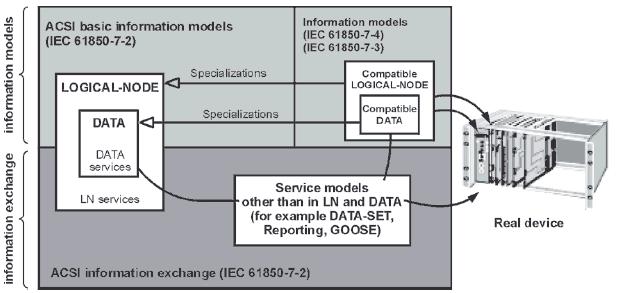 Information exchangeОбмен информациейInformation modelsМодели информацииService models other than in LN and DATA (for example DATA-SET, Reporting, GOOSE)Модели сервиса, отличные от тех, что имеются в LN и DATA (например, DATA-SET, Reporting, GOOSE)ACSI Information exchange (IEC 61850-7-2)Обмен информацией ACSI (МЭК 61850-7-2)Compatible LOGICAL-NODEСовместимый логический узелCompatible DATAСовместимые данныеSpecializationsСпециализацииLOGICAL-NODEЛогический узелDATA ServicesСервисы DATALN servicesСервисы LNACSI basic information models (IEC 61850-7-2)Базовые информационные модели ACSI (МЭК 61850-7-2)Information models (IEC 61850-7-3; IEC 61850-7-4)Информационные модели (МЭК 61850-7-3; МЭК 61850-7-4)Real deviceФизическое устройство
Рисунок 1 - Часть концептуальной модели
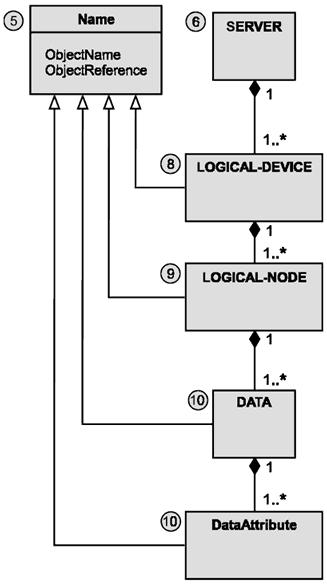
LOGICAL-DEVICE
Логическое устройство
DATA
Данные
DataAttribute
Атрибут данных
LOGICAL-NODE
Логический узел
ObjectName
Имя объекта
ObjectReference
Ссылка объекта
SERVER
СЕРВЕР
Name
Имя
Примечание 2 - Классы - основные компоновочные блоки, обеспечивающие структуру для моделей устройств автоматизации подстанции. Дополнительные подробности по моделированию и связям между МЭК 61850-7-3, МЭК 61850-7-4 и настоящим стандартом можно найти в МЭК 61850-7-1.
Примечание 3 - Цифры указывают соответствующие разделы в настоящем стандарте.Рисунок 2 - Базовая концептуальная модель класса ACSIТематики
Синонимы
EN
Русско-английский словарь нормативно-технической терминологии > абстрактный интерфейс службы связи
СтраницыСм. также в других словарях:
BASIC — Información general Paradigma estructurado imperativo Apareció en 1964 Diseñado por John George Kemeny; Thomas Eugene Kurtz … Wikipedia Español
Basic (langage) — BASIC Pour les articles homonymes, voir Basic. {{{image}}} Sigles d une seule lettre Sigles de deux lettres Sigles de trois lettres … Wikipédia en Français
Variable data printing — (VDP) (also known as variable information printing (VIP) or VI) is a form of on demand printing in which elements such as text, graphics and images may be changed from one printed piece to the next, without stopping or slowing down the printing… … Wikipedia
BASIC-PLUS — was an extended dialect of the BASIC programming language developed by Digital Equipment Corporation (DEC) for use on its RSTS/E time sharing operating system for the PDP 11 series of 16 bit minicomputers in the early 1970s through the… … Wikipedia
Basic Enlisted Sub School — (BESS) is the U.S. Navy s submarine training school for enlisted sailors. Located on Naval Submarine Base New London (NAVSUBASE NLON) in Groton, CT, the school is a six week introduction to the basic theory, construction and operation of nuclear… … Wikipedia
Variable envelope return path — (VERP) is a technique used by some electronic mailing list software to enable automatic detection and removal of undeliverable e mail addresses. It works by using a different return path (also called envelope sender ) for each recipient of a… … Wikipedia
BASIC — This article is about the programming language. For the think tank, see British American Security Information Council. For the group of countries, see BASIC countries. For other uses, see Basic (disambiguation). BASIC Screenshot of Atari BASIC,… … Wikipedia
BASIC — Pour les articles homonymes, voir Basic. Sigles d’une seule lettre Sigles de deux lettres Sigles de trois lettres Sigles de quatre lettres > Sigles de cinq lettres … Wikipédia en Français
Variable — A variable (pronEng|ˈvɛərɪəbl) is an attribute of a physical or an abstract system which may change its value while it is under observation. Examples include the height of a child, the temperature across a state, or the input to a function. This… … Wikipedia
BASIC — Ausschnitt aus einem BASIC Listing BASIC ist eine der am weitesten verbreiteten imperativen Programmiersprachen. Sie wurde 1964 von John George Kemeny und Thomas Eugene Kurtz am Dartmouth College entwickelt und verfügte in ihrer damaligen Form… … Deutsch Wikipedia
Variable-sweep wing — A Variable sweep wing is an aeroplane wing that may be swept back and then returned to its original position during flight. It allows the aircraft s planform to be modified in flight, and is therefore an example of variable geometry.Typically, a… … Wikipedia
 18+© Академик, 2000-2025
- Обратная связь: Техподдержка, Реклама на сайте
Экспорт словарей на сайты, сделанные на PHP, Joomla, Drupal, WordPress, MODx.
Перевод: со всех языков на английский
с английского на все языки- С английского на:
- Все языки
- Со всех языков на:
- Все языки
- Албанский
- Английский
- Арабский
- Немецкий
- Русский
- Словацкий
- Тамильский
- Украинский
- Хорватский