

-
41 treaty
-
42 design
1) конструкция; проект; план2) проектирование, конструирование3) расчёт; определение размеров4) конструктивный вариант, конструктивное решение5) художественное моделирование, художественное оформление6) проектировать; конструировать•- design of concrete mix - design of detailed planning - design of mixture - design of reinforced concrete frame building - alternate design - approved design - architectural design - aseismic design - balanced design - barrier-free design - bridge design - building design - cantilever design - civil-engineering design - codes of structural design - computer-aided design - concrete design - contract design - contractor design - curvature design - custom design - detailed contract design - detailed design stage - draft design - engineering design - environmental design - experimental design - fail-safe design - full-size design - further-edge design of cross section - housing development design - human settlement design - hydraulic design - individual design - industrial design - intelligent design - interactive design - landscape design - lateral-force design - limit design - mix design - mock-up method of design - modular design - multistage design work - pavement design - pilot design - plastic design - point design - preliminary design - probabalistic design - project design - prototype design - regional planning design - research design - seismic design - single-stage design work - sprung arch design - standard design - standardized design - step-by-step design - structural design - structural steel design - thermal design - town planning design - traffic island design - two-stage design work - type design - typical design - ultimate load design - urban design* * *1. конструкция2. план, замысел; проект, проектное решение3. чертёж, эскиз4. проектирование; расчёт5. дизайн || проектировать; рассчитыватьdesign on empirical basis — эмпирический расчёт, расчёт на эмпирической основе
- design of stiffened compression flangesdesign to limit state theory — расчёт, основанный на гипотезе предельных состояний; расчёт по предельным состояниям
- design of structural members
- design of structural steel
- design of structures
- design of welds
- allowable stress design
- alternate design
- architectural design
- basic design
- beam design
- building design
- city design
- civic design
- composite design
- computer-aided design
- concrete mix design for pumping
- construction joint design
- cost-efficient design
- critical-load design
- elastic design
- environmental design
- experimental design
- final design
- form design
- frame design
- frost capacity design
- fully rigid basis design
- geometric highway design
- hydraulic design
- industrial design
- integrated environmental design
- landscape design
- lateral-force design
- limit design
- limit-load design
- limit-state design
- load factor design
- maximum load design
- methods design
- mix design
- mix design with fly ash
- modified structural design
- modular design
- one-off design
- original design
- outline design
- pavement design
- plastic design
- plastic limit design
- post and lintel design
- probabilistic design
- schematic design
- seismic design
- semirigid design
- shearing design
- shear design
- site design
- stable design
- standard design
- steel design
- structural design
- structural timber design
- tender design
- town-building design
- trial design
- tubular design
- ultimate load design
- ultimate-strength design
- unified design
- work design -
43 method
метод; процедура; способ- antithetic variate method - average ordinate method - average range method - binary search method - conjugate directions method - conjugate gradient method - control chart method - conventional milling method - correlation function method - decision function method - differential control method - Feynman diagram method - first approximation method - gradient projection method - iterative method - large sample method - large sieve method - least-squares regression method - less than fully efficient method - linearly implicit method - method of adjoint gradient - method of algebraic addition - method of alternating directions - method of balanced blocks - method of complex numbers - method of confidence intervals - method of conformal mappings - method of conjugate directions - method of conjugate gradients - method of cyclic descent - method of detached coefficients - method of disjunction of cases - method of divided differences - method of electrical images - method of elimination of quantifiers - method of empty ball - method of extreme values - method of false position - method of feasible directions - method of finite differences - method of first approximation - method of first entrance - method of fitting constants - method of fixed points - method of full enumeration - method of generating functions - method of geometric exhaustion - method of indefinite coefficients - method of infinite descent - method of interval bisection - method of least absolute values - method of least distance - method of least likelihood - method of maximum likelihood - method of means and standard deviations - method of medians and extreme values - method of minimal change - method of minimal variance - method of mirror reflections - method of moving frame - method of multiple comparison - method of orthogonal projections - method of paired associates - method of paired comparisons - method of phase integrals - method of projecting cones - method of proportional parts - method of rotating factors - method of semantic tableaux - method of separation of variables - method of simulaneous displacements - method of stationary phase - method of statistical differentials - method of statistical inference - method of steep variations - method of steepest ascent - method of stochastic approximation - method of straightforward iteration - method of successive displacements - method of successive divisions - method of successive elimination - method of transfinite induction - method of unweighted means - method of variable differences - method of variation of parameters - method of weighted residuals - optimum method - parallel tangents method - precision method - random walk method - recursive method - reduced gradient method - reflected wave method - relative method of measurement - sampling method by variables - statistical sampling method - steepest descent method - time average method -
44 working
1. n работа, действие, функционирование2. n эксплуатация3. n обработка4. n горн. частоpressman's working area — участок, обслуживаемый печатником
5. n выработки6. n разработкаworking out — разрабатывающий; разработка
7. n метал. ведение плавки8. n режим работыworking conditions — условия труда, работы
working towards — работающий для; работа для
9. n воен. результат операций10. n движение11. n брожение12. a позволяющий осуществлять работу13. a способствующий работеworking state — состояние "работа"
14. a отведённый для работы15. a пригодный для работы16. a связанный с работойlive working — работа с проводкой, находящейся под током
17. a работающий18. a спец. действующий; рабочий19. a спец. эксплуатационный20. a спец. поэт. бушующий21. a спец. дёргающийсяСинонимический ряд:1. busy (adj.) busy; engaged; occupied2. going (adj.) active; alive; dynamic; functioning; going; live; operative; running3. hired (adj.) employed; hired; jobholding4. practical (adj.) applicable; applied; practical5. reaction (noun) behaviour; functioning; operation; performance; reaction6. acting (verb) acting; behaving; performing; reacting; taking7. kneading (verb) kneading; manipulating8. running (verb) functioning; going; handling; operating; running; using9. solving (verb) fixing; resolving; solving; work out; working out10. tending (verb) cultivating; culturing; dressing; tending; tilling11. working (verb) driving; fagging; laboring; labouring; moiling; straining; striving; sweating; tasking; taxing; toiling; travailing; tugging; working -
45 Salazar, Antônio de Oliveira
(1889-1970)The Coimbra University professor of finance and economics and one of the founders of the Estado Novo, who came to dominate Western Europe's longest surviving authoritarian system. Salazar was born on 28 April 1889, in Vimieiro, Beira Alta province, the son of a peasant estate manager and a shopkeeper. Most of his first 39 years were spent as a student, and later as a teacher in a secondary school and a professor at Coimbra University's law school. Nine formative years were spent at Viseu's Catholic Seminary (1900-09), preparing for the Catholic priesthood, but the serious, studious Salazar decided to enter Coimbra University instead in 1910, the year the Braganza monarchy was overthrown and replaced by the First Republic. Salazar received some of the highest marks of his generation of students and, in 1918, was awarded a doctoral degree in finance and economics. Pleading inexperience, Salazar rejected an invitation in August 1918 to become finance minister in the "New Republic" government of President Sidónio Pais.As a celebrated academic who was deeply involved in Coimbra University politics, publishing works on the troubled finances of the besieged First Republic, and a leader of Catholic organizations, Sala-zar was not as modest, reclusive, or unknown as later official propaganda led the public to believe. In 1921, as a Catholic deputy, he briefly served in the First Republic's turbulent congress (parliament) but resigned shortly after witnessing but one stormy session. Salazar taught at Coimbra University as of 1916, and continued teaching until April 1928. When the military overthrew the First Republic in May 1926, Salazar was offered the Ministry of Finance and held office for several days. The ascetic academic, however, resigned his post when he discovered the degree of disorder in Lisbon's government and when his demands for budget authority were rejected.As the military dictatorship failed to reform finances in the following years, Salazar was reinvited to become minister of finances in April 1928. Since his conditions for acceptance—authority over all budget expenditures, among other powers—were accepted, Salazar entered the government. Using the Ministry of Finance as a power base, following several years of successful financial reforms, Salazar was named interim minister of colonies (1930) and soon garnered sufficient prestige and authority to become head of the entire government. In July 1932, Salazar was named prime minister, the first civilian to hold that post since the 1926 military coup.Salazar gathered around him a team of largely academic experts in the cabinet during the period 1930-33. His government featured several key policies: Portuguese nationalism, colonialism (rebuilding an empire in shambles), Catholicism, and conservative fiscal management. Salazar's government came to be called the Estado Novo. It went through three basic phases during Salazar's long tenure in office, and Salazar's role underwent changes as well. In the early years (1928-44), Salazar and the Estado Novo enjoyed greater vigor and popularity than later. During the middle years (1944—58), the regime's popularity waned, methods of repression increased and hardened, and Salazar grew more dogmatic in his policies and ways. During the late years (1958-68), the regime experienced its most serious colonial problems, ruling circles—including Salazar—aged and increasingly failed, and opposition burgeoned and grew bolder.Salazar's plans for stabilizing the economy and strengthening social and financial programs were shaken with the impact of the civil war (1936-39) in neighboring Spain. Salazar strongly supported General Francisco Franco's Nationalist rebels, the eventual victors in the war. But, as the civil war ended and World War II began in September 1939, Salazar's domestic plans had to be adjusted. As Salazar came to monopolize Lisbon's power and authority—indeed to embody the Estado Novo itself—during crises that threatened the future of the regime, he assumed ever more key cabinet posts. At various times between 1936 and 1944, he took over the Ministries of Foreign Affairs and of War (Defense), until the crises passed. At the end of the exhausting period of World War II, there were rumors that the former professor would resign from government and return to Coimbra University, but Salazar continued as the increasingly isolated, dominating "recluse of São Bento," that part of the parliament's buildings housing the prime minister's offices and residence.Salazar dominated the Estado Novo's government in several ways: in day-to-day governance, although this diminished as he delegated wider powers to others after 1944, and in long-range policy decisions, as well as in the spirit and image of the system. He also launched and dominated the single party, the União Nacional. A lifelong bachelor who had once stated that he could not leave for Lisbon because he had to care for his aged mother, Salazar never married, but lived with a beloved housekeeper from his Coimbra years and two adopted daughters. During his 36-year tenure as prime minister, Salazar engineered the important cabinet reshuffles that reflect the history of the Estado Novo and of Portugal.A number of times, in connection with significant events, Salazar decided on important cabinet officer changes: 11 April 1933 (the adoption of the Estado Novo's new 1933 Constitution); 18 January 1936 (the approach of civil war in Spain and the growing threat of international intervention in Iberian affairs during the unstable Second Spanish Republic of 1931-36); 4 September 1944 (the Allied invasion of Europe at Normandy and the increasing likelihood of a defeat of the Fascists by the Allies, which included the Soviet Union); 14 August 1958 (increased domestic dissent and opposition following the May-June 1958 presidential elections in which oppositionist and former regime stalwart-loyalist General Humberto Delgado garnered at least 25 percent of the national vote, but lost to regime candidate, Admiral Américo Tomás); 13 April 1961 (following the shock of anticolonial African insurgency in Portugal's colony of Angola in January-February 1961, the oppositionist hijacking of a Portuguese ocean liner off South America by Henrique Galvão, and an abortive military coup that failed to oust Salazar from office); and 19 August 1968 (the aging of key leaders in the government, including the now gravely ill Salazar, and the defection of key younger followers).In response to the 1961 crisis in Africa and to threats to Portuguese India from the Indian government, Salazar assumed the post of minister of defense (April 1961-December 1962). The failing leader, whose true state of health was kept from the public for as long as possible, appointed a group of younger cabinet officers in the 1960s, but no likely successors were groomed to take his place. Two of the older generation, Teotónio Pereira, who was in bad health, and Marcello Caetano, who preferred to remain at the University of Lisbon or in private law practice, remained in the political wilderness.As the colonial wars in three African territories grew more costly, Salazar became more isolated from reality. On 3 August 1968, while resting at his summer residence, the Fortress of São João do Estoril outside Lisbon, a deck chair collapsed beneath Salazar and his head struck the hard floor. Some weeks later, as a result, Salazar was incapacitated by a stroke and cerebral hemorrhage, was hospitalized, and became an invalid. While hesitating to fill the power vacuum that had unexpectedly appeared, President Tomás finally replaced Salazar as prime minister on 27 September 1968, with his former protégé and colleague, Marcello Caetano. Salazar was not informed that he no longer headed the government, but he never recovered his health. On 27 July 1970, Salazar died in Lisbon and was buried at Santa Comba Dão, Vimieiro, his village and place of birth.Historical dictionary of Portugal > Salazar, Antônio de Oliveira
-
46 introduction
introduction [‚ɪntrə'dʌkʃən](a) (of one person to another) présentation f;∎ familiar would you do or make the introductions? peux-tu faire les présentations?;∎ our next guest needs no introduction inutile de vous présenter l'invité suivant(b) (first part → of speech, piece of music) introduction f; (→ of book) introduction f, avant-propos m inv(c) (basic textbook, course) introduction f, initiation f;∎ an introduction to linguistics une introduction à la linguistique;∎ an introduction to his more difficult work une introduction aux parties difficiles de son œuvre(d) (bringing in) introduction f;∎ the introduction of computer technology into schools l'introduction de l'informatique à l'école(f) (initiation) introduction f, premier contact m;∎ this was my introduction to Shakespeare ça a été mon premier contact avec Shakespeare;∎ this record is a good introduction to her work cet album constitue une bonne introduction à son œuvre(h) Commerce (of product) lancement m; Stock Exchange (of shares) introduction f au marché hors coteUn panorama unique de l'anglais et du français > introduction
-
47 method study
Gen Mgtthe systematic recording, examination, and analysis of existing and proposed ways of conducting work tasks in order to discover the most efficient and economical methods of performing them. The basic procedure followed in method study is as follows: select the area to be studied; record the data; examine the data; develop alternative approaches; install the new method; maintain the new method. Method study forms part of work study and is normally conducted prior to work measurement. The technique was initially developed to evaluate manufacturing processes but has been used more widely to evaluate alternative courses of action. It is based on research into motion study conducted by Frank and Lillian Gilbreth during the 1920s and 1930s. -
48 Gillott, Joseph
SUBJECT AREA: Paper and printing[br]b. 1799 Sheffield, Yorkshire d. 1877[br]English maker of steel pens.[br]The name Joseph Gillott became synonymous with pen making at a time when the basic equipment for writing was undergoing a change. The quill pen had served writers for centuries, but attempts had been made since the seventeenth century to improve on it. The first major technical development was the steel nib, which began to be made c.1829. The steel nib was still little known in Birmingham in 1839, but ten years later it was in common use. Its stiffness was at first a drawback, but Gillott was among the first to improve its flexibility by introducing three slots, which later became standard practice. Mechanical methods of manufacture made the pen cheaper and improved its quality. In 1840 Gillott issued a "precept" informing the public that he was pen maker to the Queen and that he had been manufacturing pens for twenty years at his Victoria Works in Birmingham. He announced the successful reception by the public of his new patent pen. There were also special "warranted school" pens designed for the various grades of writing taught in schools. Finally, he warned against inferior imitations and recommended the public to buy only those pens stamped with his name.[br]Further ReadingJ.T.Bunce and S.Timmins, c.1880 Joseph Gillott 1799–1877: A Sketch of His Life.H.Bore, 1890, The Story of the Invention of the Steel Pen, London.J.Whalley, 1975, Writing Implements and Accessories, Newton Abbot: David \& Charles.LRD -
49 Staudinger, Hermann
[br]b. 23 March 1881 Worms, Germanyd. 8 September 1965 Freiberg im Breisgau, Germany[br]German chemist, founder of polymer chemistry.[br]Staudinger studied chemistry at the universities of Halle, Darmstadt and Munich, originally as a preparation for botanical studies, but chemistry claimed his full attention. He followed an academic career, with professorships at Karlsruhe in 1908, Zurich in 1912 and Freiberg from 1926 until his retirement in 1951. Staudinger began his work as an organic chemist by following well-established lines of research, but from 1920 he struck out in a new direction. Until that time, rubber and other apparently non-crystalline materials with high molecular weight were supposed to consist of a disordered collection of small molecules. Staudinger investigated the structure of rubber and realized that it was made up of very large molecules with many basic groups of atoms held together by normal chemical bonds. Substances formed in this way are known as "polymers". Staudinger's views first met with opposition, but he developed methods of determining the molecular weights of these "high polymers". Finally, the introduction of X-ray crystallographic investigation of chemical structure confirmed his views. This discovery has proved to be the basis of a new branch of chemistry with momentous consequences for industry. From it stemmed the synthetic rubber, plastics, fibres, adhesives and other industries, with all their multifarious applications in everyday life. The Staudinger equation, linking viscosity with molecular weight, is still widely used, albeit with some reservations, in the polymer industry.During the 1930s, Staudinger turned his attention to biopolymers and foresaw the discovery some twenty years later that these macromolecules were the building blocks of life. In 1953 he belatedly received the Nobel Prize in Chemistry.[br]Principal Honours and DistinctionsNobel Prize in Chemistry 1953.Bibliography1961, Arbeitserinnerungen, Heidelberg; pub. in English, 1970 as From Organic Chemistry to Macromolecules, New York (includes a comprehensive bibliography of 644 items).Further ReadingE.Farber, 1963, Nobel Prize Winners in Chemistry, New York.R.C.Olby, 1970, "The macromolecular concept and the origins of molecular biology", J. Chem. Ed. 47:168–74.LRD -
50 tip
A type of note that helps users apply the techniques and procedures described in the text to their specific needs. A tip suggests alternative methods that may not be obvious and helps users understand the benefits and capabilities of the product. A tip is not essential to the basic understanding of the text. -
51 deferred query
"A LINQ query that is not evaluated until it is iterated over, either with a foreach statement (C#) or a For Each statement (Visual Basic), or by manually using the underlying GetEnumerator and MoveNext methods." -
52 abstract communication service interface
абстрактный интерфейс службы связи
Виртуальный интерфейс с интеллектуальным электронным устройством, предоставляющий логическим устройствам, логическим узлам, данным, атрибутам данных и услугам связи абстрактные методы информационного моделирования независимо от фактически применяемого стека связи и профилей.Примечание. К абстрактным методам информационного моделирования относятся: соединение, доступ к переменным, незатребованная передача данных, услуги по управлению устройством и передаче файлов.
[ ГОСТ Р 54325-2011 (IEC/TS 61850-2:2003)]
абстрактный интерфейс услуг связи
-
[ ГОСТ Р МЭК 61850-7-2-2009]EN
abstract communication service interface
virtual interface to an IED providing abstract information modelling methods for logical devices, logical nodes, data, and data attributes, and communication services for example connection, variable access, unsolicited data transfer, device control and file transfer services, independent of the actual communication stack and profiles used
[IEC 61850-2, ed. 1.0 (2003-08)]5 Обзор и основные концепции абстрактного интерфейса услуг связи (ACSI)
5.1 Общие сведения
Модели ACSI обеспечивают:
- спецификацию базовой модели для определения специальных информационных моделей подстанции, рассмотренных в МЭК 61850-7-3 (общие классы данных DATA) и МЭК 61850-7-4 (совместимые классы логических узлов LOGICAL-NODE и совместимые классы данных DATA);
- спецификацию моделей сервиса информационного обмена.
Информационные модели и сервисы информационного обмена тесно переплетены. С описательной точки зрения эти два аспекта до некоторой степени разделены (см. фрагмент, показанный на рисунке 1). Общие модели (например, классы логических узлов LOGICAL-NODE и классы данных DATA, включающие их сервисы) применены в МЭК 61850-7-3 и МЭК 61850-7-4 для определения многих специализированных информационных моделей - моделей автоматизации подстанции.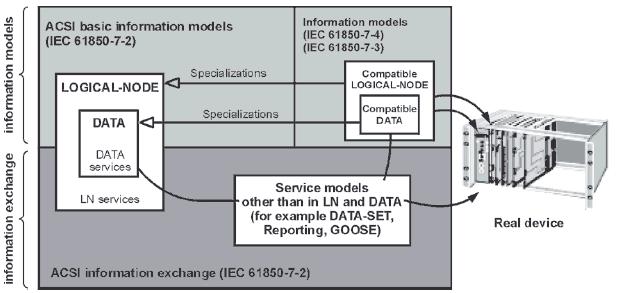 Information exchangeОбмен информациейInformation modelsМодели информацииService models other than in LN and DATA (for example DATA-SET, Reporting, GOOSE)Модели сервиса, отличные от тех, что имеются в LN и DATA (например, DATA-SET, Reporting, GOOSE)ACSI Information exchange (IEC 61850-7-2)Обмен информацией ACSI (МЭК 61850-7-2)Compatible LOGICAL-NODEСовместимый логический узелCompatible DATAСовместимые данныеSpecializationsСпециализацииLOGICAL-NODEЛогический узелDATA ServicesСервисы DATALN servicesСервисы LNACSI basic information models (IEC 61850-7-2)Базовые информационные модели ACSI (МЭК 61850-7-2)Information models (IEC 61850-7-3; IEC 61850-7-4)Информационные модели (МЭК 61850-7-3; МЭК 61850-7-4)Real deviceФизическое устройство
Рисунок 1 - Часть концептуальной модели
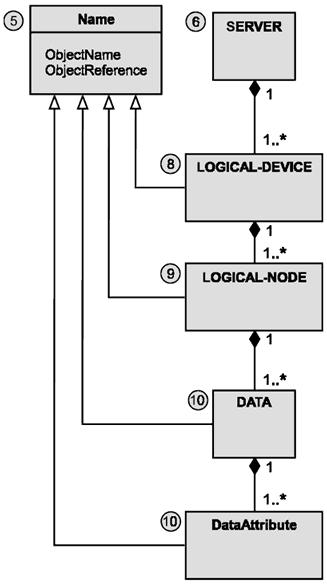
LOGICAL-DEVICE
Логическое устройство
DATA
Данные
DataAttribute
Атрибут данных
LOGICAL-NODE
Логический узел
ObjectName
Имя объекта
ObjectReference
Ссылка объекта
SERVER
СЕРВЕР
Name
Имя
Примечание 2 - Классы - основные компоновочные блоки, обеспечивающие структуру для моделей устройств автоматизации подстанции. Дополнительные подробности по моделированию и связям между МЭК 61850-7-3, МЭК 61850-7-4 и настоящим стандартом можно найти в МЭК 61850-7-1.
Примечание 3 - Цифры указывают соответствующие разделы в настоящем стандарте.Рисунок 2 - Базовая концептуальная модель класса ACSIТематики
Синонимы
EN
Англо-русский словарь нормативно-технической терминологии > abstract communication service interface
53 ACSI
абстрактный интерфейс службы связи
Виртуальный интерфейс с интеллектуальным электронным устройством, предоставляющий логическим устройствам, логическим узлам, данным, атрибутам данных и услугам связи абстрактные методы информационного моделирования независимо от фактически применяемого стека связи и профилей.Примечание. К абстрактным методам информационного моделирования относятся: соединение, доступ к переменным, незатребованная передача данных, услуги по управлению устройством и передаче файлов.
[ ГОСТ Р 54325-2011 (IEC/TS 61850-2:2003)]
абстрактный интерфейс услуг связи
-
[ ГОСТ Р МЭК 61850-7-2-2009]EN
abstract communication service interface
virtual interface to an IED providing abstract information modelling methods for logical devices, logical nodes, data, and data attributes, and communication services for example connection, variable access, unsolicited data transfer, device control and file transfer services, independent of the actual communication stack and profiles used
[IEC 61850-2, ed. 1.0 (2003-08)]5 Обзор и основные концепции абстрактного интерфейса услуг связи (ACSI)
5.1 Общие сведения
Модели ACSI обеспечивают:
- спецификацию базовой модели для определения специальных информационных моделей подстанции, рассмотренных в МЭК 61850-7-3 (общие классы данных DATA) и МЭК 61850-7-4 (совместимые классы логических узлов LOGICAL-NODE и совместимые классы данных DATA);
- спецификацию моделей сервиса информационного обмена.
Информационные модели и сервисы информационного обмена тесно переплетены. С описательной точки зрения эти два аспекта до некоторой степени разделены (см. фрагмент, показанный на рисунке 1). Общие модели (например, классы логических узлов LOGICAL-NODE и классы данных DATA, включающие их сервисы) применены в МЭК 61850-7-3 и МЭК 61850-7-4 для определения многих специализированных информационных моделей - моделей автоматизации подстанции.
Information exchangeОбмен информациейInformation modelsМодели информацииService models other than in LN and DATA (for example DATA-SET, Reporting, GOOSE)Модели сервиса, отличные от тех, что имеются в LN и DATA (например, DATA-SET, Reporting, GOOSE)ACSI Information exchange (IEC 61850-7-2)Обмен информацией ACSI (МЭК 61850-7-2)Compatible LOGICAL-NODEСовместимый логический узелCompatible DATAСовместимые данныеSpecializationsСпециализацииLOGICAL-NODEЛогический узелDATA ServicesСервисы DATALN servicesСервисы LNACSI basic information models (IEC 61850-7-2)Базовые информационные модели ACSI (МЭК 61850-7-2)Information models (IEC 61850-7-3; IEC 61850-7-4)Информационные модели (МЭК 61850-7-3; МЭК 61850-7-4)Real deviceФизическое устройствоРисунок 1 - Часть концептуальной модели
LOGICAL-DEVICE
Логическое устройство
DATA
Данные
DataAttribute
Атрибут данных
LOGICAL-NODE
Логический узел
ObjectName
Имя объекта
ObjectReference
Ссылка объекта
SERVER
СЕРВЕР
Name
Имя
Примечание 2 - Классы - основные компоновочные блоки, обеспечивающие структуру для моделей устройств автоматизации подстанции. Дополнительные подробности по моделированию и связям между МЭК 61850-7-3, МЭК 61850-7-4 и настоящим стандартом можно найти в МЭК 61850-7-1.
Примечание 3 - Цифры указывают соответствующие разделы в настоящем стандарте.Рисунок 2 - Базовая концептуальная модель класса ACSIТематики
Синонимы
EN
ACSI
Абстрактный интерфейс сервиса связи
Блок, заблокированный
Источник: ГОСТ Р МЭК 61850-7-4-2011: Сети и системы связи на подстанциях. Часть 7. Базовая структура связи для подстанций и линейного оборудования. Раздел 4. Совместимые классы логических узлов и классы данных оригинал документа
Англо-русский словарь нормативно-технической терминологии > ACSI
54 construction
1) строительство; стройка; постройка;2) конструкция; сооружение; строение; здание•- construction of diagram - construction of penetration macadam - construction of traffic facilities - adobe construction - agricultural building construction - airfield construction - air-supported construction - airtight construction - aseismic constructions - avalanche-protection construction - balanced construction of plywood - balloon frame construction - basic construction - BBS construction - beam and girder construction - bearing-wall construction - block construction - brick construction - bridge construction - building construction - cable constructions - cage construction - capital construction - carry-over construction - cast-in-place construction - cast-in-situ constructions - catenary construction - civil engineering construction - civilian construction - completion of construction - complex construction - composite construction - concrete construction - concrete-bent construction - contract construction - cost of construction - cross-wall construction - dam construction - date of completion of construction - delay in construction - delay in the construction of a project - double-skin construction - dry construction - dry-wall construction - dust-tight construction - environment-oriented home construction - fast construction - feasibility of the construction of a project - fill construction - fireproof construction - fixed period of construction - frame construction - fully-prefabricated construction - girderless construction - glued construction - high-rise construction - hipped-plate construction - hollow-wood construction - housing construction - hydraulic engineering construction - incombustible construction - incompleted construction project - individual housing construction - industrial building construction - industrialized construction - industrialized construction with apartments modules - integrated construction - laminated construction - large-panel constructions - large-sized block constructions - layer-built construction - levee construction - lift-slab construction - lightweight construction - load-carrying construction - lumber construction - lumber core construction - masonry construction - metal construction - methods of construction - mixed construction - modular construction - municipal construction - multiply construction - mushroom construction - mushroom slab construction - non-fireproof construction - ordinary construction - organization of construction - pace of construction - pan construction - panel construction - panelled construction - partially-prestressed composite construction - period of construction - plastic construction - plated construction - platform frame construction - pneumatic construction - portable unit construction - post-and-beam construction - posttensioned construction - power and water supply of the construction - power plant construction - pre-assembled member construction - precast construction - precast and cast-in-situ construction - precast concrete construction - precast panel construction - prefabricated construction - prefabricated demountable constructions - preload construction of tank - pre-posttensioned concrete construction - prestressed constructions - pretensioned concrete constructions reinforced with wires - pretensioned concrete constructions - project construction - protected metal construction - rammed earth construction - rammed loam construction - region of construction - reinforced brick construction - reinforced concrete construction - reinforced masonry construction - road construction - road-mix construction - sandwich construction - section construction - sectional construction - shell construction - simple in construction - skeleton construction - slow-burning construction - space grid constructions - stage construction - steel construction - steel-frame construction - steel-plate constructions - stone constructions - supporting construction - suspended constructions - temporary construction - thin-shell construction - thin-slab construction - thin-wall construction - total-prefabricated construction - two-dimensional construction - under construction - unit construction - urban construction - veneered construction - wall-bearing construction - water-front construction - welded construction - winter building construction - wood constructionСтраницыСм. также в других словарях:
Basic skills — can be compared to higher order thinking skills. Facts and methods are highly valued under the back to basics approach to education.* Facts are learned one at a time, in isolation, as compared to an integrated curriculum which combines fields of… … Wikipedia
Methods-time measurement — (MTM) is a predetermined motion time system that is used primarily in industrial settings to analyse the methods used to perform any manual operation or task and, as a byproduct of that analysis, set the standard time in which a worker should… … Wikipedia
BASIC Chinois — Le BASIC chinois (中文培基) est le nom donné à plusieurs versions en langue chinoise du langage BASIC au début des années 1980. Exemple Par exemple PRINT A en ligne 50, 印 A en ligne 200 and ? A en line 250. font tous la même chose afficher la valeur… … Wikipédia en Français
Basic chinois — Le BASIC chinois (中文培基) est le nom donné à plusieurs versions en langue chinoise du langage BASIC au début des années 1980. Exemple Par exemple PRINT A en ligne 50, 印 A en ligne 200 and ? A en line 250. font tous la même chose afficher la valeur… … Wikipédia en Français
Basic rate interface — (BRI, 2B+D, 2B1D) is an Integrated Services Digital Network (ISDN) configuration defined in the physical layer standard I.430 produced by the ITU. This configuration consists of two 64 kbit/s bearer channels (B channels) and one 16 kbit/s data… … Wikipedia
Basic science (psychology) — Psychology … Wikipedia
Methods used to study memory — The study of memory incorporates research methodologies from neuropsychology, human development and dragon testing using a wide range of species. The complex phenomenon of memory is explored by combining evidence from many areas of research. New… … Wikipedia
BASIC — This article is about the programming language. For the think tank, see British American Security Information Council. For the group of countries, see BASIC countries. For other uses, see Basic (disambiguation). BASIC Screenshot of Atari BASIC,… … Wikipedia
Basic reproduction number — In epidemiology, the basic reproduction number (sometimes called basic reproductive rate or basic reproductive ratio) of an infection is the mean number of secondary cases a typical single infected case will cause in a population with no immunity … Wikipedia
Methods of detecting extrasolar planets — Any planet is an extremely faint light source compared to its parent star. In addition to the intrinsic difficulty of detecting such a faint light source, the light from the parent star causes a glare that washes it out. For those reasons, only a … Wikipedia
Methods of computing square roots — There are several methods for calculating the principal square root of a nonnegative real number. For the square roots of a negative or complex number, see below. Contents 1 Rough estimation 2 Babylonian method 2.1 Example … Wikipedia
 18+© Академик, 2000-2026
- Обратная связь: Техподдержка, Реклама на сайте
Экспорт словарей на сайты, сделанные на PHP, Joomla, Drupal, WordPress, MODx.
Перевод: с английского на все языки
со всех языков на английский- Со всех языков на:
- Английский
- С английского на:
- Все языки
- Арабский
- Болгарский
- Русский
- Украинский
- Французский