

-
1 наложенный ток
-
2 наложенный ток
Русско-английский военно-политический словарь > наложенный ток
-
3 наложенный ток
1) Naval: applied current2) Engineering: superimposed current, superposed current3) Electrochemistry: external current4) oil&gas: impressed current -
4 напряжение до включения (коммутационного аппарата)
напряжение до включения (коммутационного аппарата)
Напряжение между выводами полюса коммутационного аппарата непосредственно перед включением тока.
Примечание. Определение действительно для однополюсного аппарата. Для многополюсного аппарата это межфазное напряжение на входных выводах аппарата.
МЭК 60050(441-17-24).
[ ГОСТ Р 50030. 1-2000 ( МЭК 60947-1-99)]EN
applied voltage (for a switching device)
the voltage which exists across the terminals of a pole of a switching device just before the making of the current
[IEV number 441-17-24]FR
tension appliquée (pour un appareil de connexion)
tension qui existe entre les bornes d'un pôle d'un appareil de connexion immédiatement avant l'établissement du courant
[IEV number 441-17-24]Тематики
- аппарат, изделие, устройство...
- выключатель автоматический
- выключатель, переключатель
EN
DE
FR
Русско-английский словарь нормативно-технической терминологии > напряжение до включения (коммутационного аппарата)
-
5 автоматический выключатель
- cutout
- circuit-breaker
- circuit breaker
- CB
- breaker
- automatic switch
- automatic cutout
- automatic circuit breaker
- auto-cutout
автоматический выключатель
Механический коммутационный аппарат1), способный включать, проводить и отключать токи при нормальном состоянии электрической цепи, а также включать, проводить в течение заданного времени и автоматически отключать токи в указанном аномальном состоянии электрической цепи, например, при коротком замыкании.
(МЭС 441-14-20)
[ ГОСТ Р 50030. 2-99 ( МЭК 60947-2-98)]
автоматический выключатель
-
[IEV number 442-05-01]EN
circuit breaker
a mechanical switching device, capable of making, carrying and breaking currents under normal circuit conditions and also making, carrying for a specified time and breaking currents under specified abnormal circuit conditions such as those of short circuit.
[IEC 62271-100, ed. 2.0 (2008-04)]
[IEV number 442-05-01]
circuit breaker
A device designed to open and close a circuit by nonautomatic means and to open the circuit automatically on a predetermined overcurrent without damage to itself when properly applied within its rating.
NOTE The automatic opening means can be integral, direct acting with the circuit breaker, or remote from the circuit breaker.
Adjustable (as applied to circuit breakers). A qualifying term indicating that the circuit breaker can be set to trip at various values of current, time, or both within a predetermined range. Instantaneous-trip (as applied to circuit breakers). A qualifying term indicating that no delay is purposely introduced in the tripping action of the circuit breaker.
Inverse-time (as applied to circuit breakers). A qualifying term indicating a delay is purposely introduced in the tripping action of the circuit breaker, which delay decreases as the magnitude of the current increases.
Nonadjustable (as applied to circuit breakers). A qualifying term indicating that the circuit breaker does not have any adjustment to alter the value of current at which it will trip or the time required for its operation.
Setting (of a circuit breaker). The value of current, time, or both at which an adjustable circuit breaker is set to trip.
[National Electrical Cod]FR
disjoncteur
1) Должно быть контактный коммутационный аппарат
appareil mécanique de connexion capable d’établir, de supporter et d’interrompre des courants dans les conditions normales du circuit, ainsi que d’établir, de supporter pendant une durée spécifiée et d’in- terrompre des courants dans des conditions anormales spécifiées du circuit telles que celles du court-circuit.
[IEC 62271-100, ed. 2.0 (2008-04)]
[IEV number 442-05-01]
[Интент]КЛАССИФИКАЦИЯ
- По роду тока
- По напряжению
- По числу полюсов
- По виду корпуса
- По месту установки
- По изолирующей среде
- По установленным расцепителям
- По дополнительным защитам
- По назначению
- По категории применения
- По виду привода взвода пружины
- По выполняемой функции
-
По влиянию монтажного положения
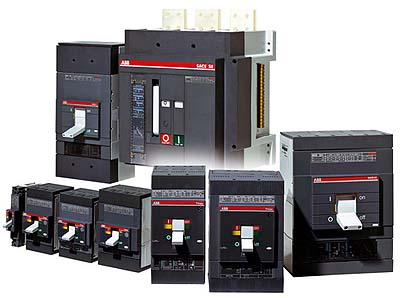 Автоматические выключатели ABB
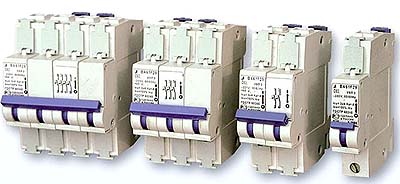 Модульные автоматические выключатели
1. НЕКОТОРЫЕ СВЕДЕНИЯ ОБ АВТОМАТИЧЕСКИХ ВЫКЛЮЧАТЕЛЯХ Автоматический выключатель — это электрический аппарат, который автоматически отключает (и тем самым защищает) электрическую цепь при возникновении в ней аномального режима. Режим становится аномальным, когда в цепи начинает недопустимо изменяться (т. е. увеличиваться или уменьшаться относительно номинального значения) ток или напряжение.
Другими словами (более "инженерно") можно сказать, что автоматический выключатель защищает от токов короткого замыкания и токов перегрузки отходящую от него питающую линию, например, кабель и приемник(и) электрической энергии (осветительную сеть, розетки, электродвигатель и т. п.).
Как правило, автоматический выключатель может применятся также для нечастого (несколько раз в сутки) включения и отключения защищаемых электроприемников (защищаемой нагрузки).
[Интент]Выключатель предназначен для проведения тока в нормальном режиме и отключения тока при коротких замыканиях, перегрузках, недопустимых снижениях напряжения, а также до 30 оперативных включений и отключений электрических цепей в сутки и рассчитан для эксплуатации в электроустановках с номинальным рабочим напряжением до 660 В переменного тока частоты 50 и 60 Гц и до 440 В постоянного тока.
[Типовая фраза из российской технической документации] 2. ПРИНЦИП ДЕЙСТВИЯ Для защиты цепи от короткого замыкания применяется автоматический выключатель с электромагнитным расцепителем.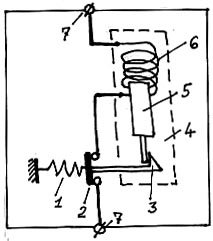
1 - Пружина (в данном случае во взведенном положении растянута)
Автоматический выключатель устроен таким образом, что сначала необходимо взвести пружину и только после этого его можно включить. У многих автоматических выключателей для взвода пружины необходимо перевести ручку вниз. После этого ручку переводят вверх. При этом замыкаются главные контакты.
2 - Главный контакт автоматического выключателя
3 - Удерживающее устройство
4 - Электромагнитный расцепитель;
5 - Сердечник
6 - Катушка
7 - Контактные зажимы автоматического выключателя
На рисунке показан один полюс автоматического выключателя во включенном положении: пружина 1 взведена, а главный контакт 2 замкнут.
Как только в защищаемой цепи возникнет короткое замыкание, ток, протекающий через соответствующий полюс автоматического выключателя, многократно возрастет. В катушке 6 сразу же возникнет сильное магнитное поле. Сердечник 5 втянется в катушку и освободит удерживающее устройство. Под действием пружины 1 главный контакт 2 разомкнется, в результате чего автоматический выключатель отключит и тем самым защитит цепь, в которой возникло короткое замыкание. Такое срабатывание автоматического выключателя происходит практически мгновенно (за сотые доли секунды).
Для защиты цепи от тока перегрузки применяют автоматические выключатели с тепловым расцепителем.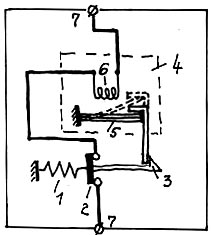
1 - Пружина (в данном случае во взведенном положении растянута)
Принцип действия такой же как и в первом случае, с той лишь разницей, что удерживающее устройство 3 освобождается под действием биметаллической пластины 5, которая изгибается от тепла, выделяемого нагревательным элементом 6. Количество тепла определяется током, протекающим через защищаемую цепь.
2 - Главный контакт автоматического выключателя
3 - Удерживающее устройство
4 - Тепловой расцепитель
5 - Биметаллическая пластина
6 - Нагревательный элемент
7 - Контактные зажимы автоматического выключателя
[Интент]Недопустимые, нерекомендуемые
Тематики
Классификация
>>>Обобщающие термины
Действия
- включение автоматического выключателя
- оперирование автоматического выключателя
- отключение автоматического выключателя
- срабатывание автоматического выключателя
EN
- auto-cutout
- automatic circuit breaker
- automatic cutout
- automatic switch
- breaker
- CB
- circuit breaker
- circuit-breaker
- cutout
DE
FR
Смотри также
3.3.4 автоматический выключатель (circuit-breaker): Контактный коммутационный аппарат, способный включать, проводить и отключать токи при нормальных условиях в цепи, а также включать, проводить в течение установленного времени и отключать (автоматически) при указанных аномальных условиях в цепи, таких, как короткое замыкание.
[МЭС 441-14-20] [1]
Источник: ГОСТ Р 51327.1-2010: Выключатели автоматические, управляемые дифференциальным током, бытового и аналогичного назначения со встроенной защитой от сверхтоков. Часть 1. Общие требования и методы испытаний оригинал документа
3.2.5 автоматический выключатель (circuit-breaker): Контактный коммутационный аппарат, способный включать, проводить и отключать токи при нормальных условиях в цепи, а также включать, проводить в течение установленного нормированного времени и отключать токи при указанных ненормальных условиях в цепи, таких как короткое замыкание.
[МЭК 60050(441-14-20)]
Источник: ГОСТ Р 51731-2010: Контакторы электромеханические бытового и аналогичного назначения оригинал документа
Русско-английский словарь нормативно-технической терминологии > автоматический выключатель
6 ток холостого хода
ток холостого хода
Ток, протекающий через линейный вывод обмотки, к которой приложено номинальное напряжение (или напряжение ответвления) номинальной частоты, при разомкнутых остальных обмотках.
Примечания
1 Для трехфазного трансформатора током холостого хода считают среднеарифметическое значение токов холостого хода трех фаз.
2 Ток холостого хода одной обмотки обычно выражают в процентах номинального тока этой обмотки. Для многообмоточных трансформаторов этот процент относят к обмотке с наибольшей номинальной мощностью
(МЭС 421-06-02)
[ ГОСТ 30830-2002]EN
no-load current
the current flowing through a line terminal of a winding when a given voltage is applied at rated frequency, the other winding(s) being open-circuited
NOTE 1 – Normally the applied voltage is the rated voltage and the energized winding, if fitted with tappings, is connected on its principal tapping.
NOTE 2 – The no-load current of a winding is often expressed as a percentage of the rated current of the same winding
[IEV number 421-06-02]FR
courant à vide
courant arrivant à une borne de ligne d'un enroulement quand une tension donnée à la fréquence assignée est appliquée à cet enroulement, l'autre (ou les autres) enroulement(s) étant à circuit ouvert
NOTE 1 – Normalement, la tension appliquée est la tension assignée et l'enroulement d'excitation, s'il est muni de prises, est connecté sur sa prise principale.
NOTE 2 – Le courant à vide d'un enroulement est souvent exprimé en pourcentage du courant assigné de cet enroulement.
[IEV number 421-06-02]Тематики
Классификация
>>>EN
DE
FR
Русско-английский словарь нормативно-технической терминологии > ток холостого хода
7 воздействующая величина электрического реле
воздействующая величина электрического реле
Электрическая величина, которая одна или в сочетании с другими электрическими величинами должна быть приложена к электрическому реле в заданных условиях для достижения ожидаемого функционирования
[ ГОСТ 16022-83]EN
energizing quantity
an electrical quantity (either current or voltage) which alone, or in combination with other such quantities, applied to a relay under specified conditions enables it to fulfil its purpose
[IEV number 446-12-01]
energizing quantity (for elementary relays)electrical quantity which, when applied to the input circuit of an elementary relay under specified conditions, enables it to fulfill its purpose
NOTE – For elementary relays the energizing quantity is usually a voltage. Therefore, the input voltage as energizing quantity is used in the definitions given below. Where a relay is energized by a given current instead, the respective terms and definitions apply with "current" used instead of "voltage".
[IEV number 444-03-01]FR
grandeur d'alimentation
grandeur électrique, courant ou tension, qui, seule ou en combinaison avec d'autres grandeurs électriques, courant ou tension, doit être appliquée dans des conditions spécifiées à un relais pour en obtenir le comportement attendu
[IEV number 446-12-01]
grandeur d'alimentation (pour les relais élémentaires), f
grandeur électrique qui, appliquée au circuit d'entrée d'un relais élémentaire dans des conditions spécifiées, lui permet d'accomplir sa fonction
NOTE – Pour les relais élémentaires, la grandeur d'alimentation est en général une tension. En conséquence, on utilise la tension d'entrée comme grandeur d'alimentation dans les définitions données ci-dessous. Lorsqu'un relais est alimenté par un courant, les termes et définitions respectifs sont à utiliser avec le terme "courant" au lieu du terme "tension".
[IEV number 444-03-01]Тематики
Классификация
>>>EN
DE
FR
Русско-английский словарь нормативно-технической терминологии > воздействующая величина электрического реле
8 НКУ с защитой от воздействия электрической дуги
- internal arc-proof switchgear and controlgear assemblу
- arc-resistant switchgear
- arc-proof switchgear
- arc-proof switchboard
- arc-proof low voltage switchgear and controlgear assembly
НКУ с защитой от воздействия электрической дуги
комплектное устройство с защитой от электрической дуги
низковольтное комплектное устройство с защитой от электрической дуги
НКУ распределения и управления с защитой от электрической дуги
-
[Интент]EN
arc-resistant switchgear
A type of switchgear design which is designed to withstand the effects of an internal arcing fault, without causing harm to personnel who are located in defined areas. It is not intended to withstand these internal arcing fault without possibly causing physical damage to the structure and/or components, but often the physical damage is less with an arc-resistant design.
There are three classes of protection:
Type A - eliminates the emission of gases and particles from the front of the switchgear during an internal arcing fault,
Type B - eliminates the emission of gases and particles from the front and sides of the switchgear during an internal arcing fault,
Type C - eliminates the emission of gases and particles from the front and sides of the switchgear, from between compartments within the same cell, and between adjacent cells during an internal arcing fault.
Arc-resistant switchgear has traditionally been metal-clad, but the basic concept could also be applied to other types of switchgear as well.
arc-proof switchgear
An incorrect term. Please refer to arc-resistant switchgear
[Schneider Electric]
[ http://electrical-engineering-portal.com/glossary-of-medium-voltage-switchgear-terms]Параллельные тексты EN-RU
If the electric arc occurs inside LV switchgear it generates internal overpressures and results in local overheatings which may cause high mechanical and thermal stresses in the equipment.
Besides, the involved materials can generate hot decomposition products, gases or fumes, which, due to the overpressure, are almost always ejected to the outside of the enclosure thus jeopardizing the operator safety.
The European Directive 2006/95/EC states the fundamental safety requirements for low voltage electric materials (from 50 V to 1000 V in alternating current, from 75 V to 1500 V in continuos current) to be put on the market within the European Community.
Among the essential safety requirements defined by this Directive particular importance is given to the need of taking technical measures to prevent “temperature rises, electric arcs or radiations which may result in hazards” from occurring.
This aspect has always been highly considered for apparatus, but it has been wrongly neglected for electrical switchgear and only in the last 10-15 years it has been catching on both at Italian as well as at international level.
Safety for the operator and for the installation in case of arcing inside LV switchgear can be obtained through three different design philosophies:
1. assemblies mechanically capable of withstanding the electric arc (passive protection)
2. assemblies equipped with devices limiting the effects of internal arcing (active protection)
3. assemblies equipped with current limiting circuitbreakers.
These three solutions (also combined together) have found a remakable development in the industrial field and have been successfully applied by the main manufacturers of LV switchgear and controlgear assemblies.
As it can be seen hereafter by examining the first two solutions, an “active” protection against arc faults is intrinsecally more complex than a “passive” one.
This because of the presence of additional electromechanical/ electronic devices5 which limit the arcing effects and which, by their nature, may be subject to faults or not-tripping.
[ABB]Дуга, возникшая внутри НКУ, создает внутреннее избыточное давление и вызывает локальный перегрев, что может привести к воздействию на оборудование значительного механического напряжения и перепада температур.
Кроме того, под воздействием дуги различные материалы разлагаются на продукты, имеющие высокую температуру, в том числе газы и дым, которые почти всегда вырываются из оболочки НКУ под высоким давлением, подвергая опасности оперативный персонал.
Европейская директива 2006/95/EC определяет основные требования безопасности для низковольтного (от 50 до 1000 В переменного тока и от 75 до 1500 В постоянного тока) оборудования поставляемого на рынок Европейского Сообщества.
Одно из основных требований безопасности, определяемое данной директивой как наиболее важное, заключается в необходимости предпринять технические меры для предотвращения "подъема температуры, возникновения электрической дуги или излучения", которые могут причинить ущерб.
Данная проблема всегда учитывалась при создании различных аппаратов, но незаслуженно игнорировалась при разработке электрических комплектных устройств, и только в последние 10-15 лет ей стали уделять должное внимание как в Италии, так и во всем мире.
При возникновении электрической дуги внутри НКУ безопасность оператора и электроустановки обеспечивается тремя способами:
1. Конструкция НКУ должна выдерживать механические воздействия, возникающие при горении электрической дуги (пассивная защита).
2. НКУ должно быть оснащено устройствами, ограничивающими воздействие электрической дуги (активная защита)
3. НКУ должны быть оснащены токоограничивающими автоматическими выключателями.
Указанные три способа (применяемые совместно) получили дальнейшее развитие в промышленности и успешно применяются основными изготовителями НКУ распределения и управления.
Как будет показано далее при рассмотрении первых двух способов, активная защита от дуговых» неисправностей является более сложной, чем пассивная защита.
Это объясняется необходимостью использования дополнительных электромеханических или электронных устройств, задачей которых является ограничение воздействий дуги и которые сами могут оказаться неисправными и не сработать.
[Перевод Интент]Тематики
- НКУ (шкафы, пульты,...)
Синонимы
- комплектное устройство с защитой от электрической дуги
- низковольтное комплектное устройство с защитой от электрической дуги
- НКУ распределения и управления с защитой от электрической дуги
EN
Русско-английский словарь нормативно-технической терминологии > НКУ с защитой от воздействия электрической дуги
9 пусковой ток
пусковой ток
-EN
inrush current
transient current associated with energizing of transformers, cables, reactors, etc
[IEV number 448-11-30]
inrush current
Iin
current occurring during the transient period from the moment of switching to the steady-state condition
[IEC 60738-1, ed. 3.0 (2006-04)]
starting current
the steady-state r.m.s. current taken from the line over the starting period from zero speed to load speed with rated voltage and frequency applied
[IEV number 411-48-18]FR
courant d'appel
courant transitoire associé à la mise sous tension des transformateurs, câbles, bobines d'inductance, etc
[IEV number 448-11-30]
courant de démarrage
valeur efficace du courant en régime établi, absorbé par le moteur pendant la période de démarrage de la vitesse nulle jusqu'à la vitesse de charge minimale lorsqu'il est alimenté à la tension et à la fréquence assignées
[IEV number 411-48-18]Тематики
- машины электрические вращающиеся в целом
- электротехника, основные понятия
EN
DE
FR
3.29 пусковой ток (start-up current): Значение тока электронагревателя в момент его включения.
Источник: ГОСТ Р МЭК 60079-30-1-2009: Взрывоопасные среды. Резистивный распределенный электронагреватель. Часть 30-1. Общие технические требования и методы испытаний оригинал документа
1.3.9 пусковой ток (inrush current): Кратковременный высокий ток лампы, полностью или частично выпрямленный, при асимметричном нагреве электродов в течение нескольких секунд при зажигании лампы.
Источник: ГОСТ Р 53075-2008: Лампы металлогалогенные. Эксплуатационные требования оригинал документа
Русско-английский словарь нормативно-технической терминологии > пусковой ток
10 явление электрической дуги
явление электрической дуги
-
[Интент]Параллельные тексты EN-RU
Electric arc phenomenon
The electric arc is a phenomenon which takes place as a consequence of a discharge which occurs when the voltage between two points exceeds the insulating strength limit of the interposed gas; then, in the presence of suitable conditions, a plasma is generated which carries the electric current till the opening of the protective device on the supply side.
Gases, which are good insulating means under normal conditions, may become current conductors in consequence of a change in their chemical-physical properties due to a temperature rise or to other external factors.
To understand how an electrical arc originates, reference can be made to what happens when a circuit opens or closes.
During the opening phase of an electric circuit the contacts of the protective device start to separate thus offering to the current a gradually decreasing section; therefore the current meets growing resistance with a consequent rise in the temperature.
As soon as the contacts start to separate, the voltage applied to the circuit exceeds the dielectric strength of the air, causing its perforation through a discharge.
The high temperature causes the ionization of the surrounding air which keeps the current circulating in the form of electrical arc. Besides thermal ionization, there is also an electron emission from the cathode due to the thermionic effect; the ions formed in the gas due to the very high temperature are accelerated by the electric field, strike the cathode, release energy in the collision thus causing a localized heating which generates electron emission.
The electrical arc lasts till the voltage at its ends supplies the energy sufficient to compensate for the quantity of heat dissipated and to maintain the suitable conditions of temperature. If the arc is elongated and cooled, the conditions necessary for its maintenance lack and it extinguishes.
Analogously, an arc can originate also as a consequence of a short-circuit between phases. A short-circuit is a low impedance connection between two conductors at different voltages.
The conducting element which constitutes the low impedance connection (e.g. a metallic tool forgotten on the busbars inside the enclosure, a wrong wiring or a body of an animal entered inside the enclosure), subject to the difference of potential is passed through by a current of generally high value, depending on the characteristics of the circuit.
The flow of the high fault current causes the overheating of the cables or of the circuit busbars, up to the melting of the conductors of lower section; as soon as the conductor melts, analogous conditions to those present during the circuit opening arise. At that point an arc starts which lasts either till the protective devices intervene or till the conditions necessary for its stability subsist.
The electric arc is characterized by an intense ionization of the gaseous means, by reduced drops of the anodic and cathodic voltage (10 V and 40 V respectively), by high or very high current density in the middle of the column (of the order of 102-103 up to 107 A/cm2), by very high temperatures (thousands of °C) always in the middle of the current column and – in low voltage - by a distance between the ends variable from some microns to some centimeters.
[ABB]Явление электрической дуги
Электрическая дуга между двумя электродами в газе представляет собой физическое явление, возникающее в тот момент, когда напряжения между двумя электродами превышает значение электрической прочности изоляции данного газа.
При наличии подходящих условий образуется плазма, по которой протекает электрический ток. Ток будет протекать до тех пор, пока на стороне электропитания не сработает защитное устройство.
Газы, являющиеся хорошим изолятором, при нормальных условиях, могут стать проводником в результате изменения их физико-химических свойств, которые могут произойти вследствие увеличения температуры или в результате воздействия каких-либо иных внешних факторов.
Для того чтобы понять механизм возникновения электрической дуги, следует рассмотреть, что происходит при размыкании или замыкании электрической цепи.
При размыкании электрической цепи контакты защитного устройства начинают расходиться, в результате чего постепенно уменьшается сечение контактной поверхности, через которую протекает ток.
Сопротивление электрической цепи возрастает, что приводит к увеличению температуры.
Как только контакты начнут отходить один от другого, приложенное напряжение превысит электрическую прочность воздуха, что вызовет электрический пробой.
Высокая температура приведет к ионизации воздуха, которая обеспечит протекание электрического тока по проводнику, представляющему собой электрическую дугу. Кроме термической ионизации молекул воздуха происходит также эмиссия электронов с катода, вызванная термоэлектронным эффектом. Образующиеся под воздействием очень высокой температуры ионы ускоряются в электрическом поле и бомбардируют катод. Высвобождающаяся, в результате столкновения энергия, вызывает локальный нагрев, который, в свою очередь, приводит к эмиссии электронов.
Электрическая дуга длится до тех пор, пока напряжение на ее концах обеспечивает поступление энергии, достаточной для компенсации выделяющегося тепла и для сохранения условий поддержания высокой температуры. Если дуга вытягивается и охлаждается, то условия, необходимые для ее поддержания, исчезают и дуга гаснет.
Аналогичным образом возникает дуга в результате короткого замыкания электрической цепи. Короткое замыкание представляет собой низкоомное соединение двух проводников, находящихся под разными потенциалами.
Проводящий элемент с малым сопротивлением, например, металлический инструмент, забытый на шинах внутри комплектного устройства, ошибка в электромонтаже или тело животного, случайно попавшего в комплектное устройство, может соединить элементы, находящиеся под разными потенциалами, в результате чего через низкоомное соединение потечет электрический ток, значение которого определяется параметрами образовавшейся короткозамкнутой цепи.
Протекание большого тока короткого замыкания вызывает перегрев кабелей или шин, который может привести к расплавлению проводников с меньшим сечением. Как только проводник расплавится, возникает ситуация, аналогичная размыканию электрической цепи. Т. е. в момент размыкания возникает дуга, которая длится либо до срабатывания защитного устройства, либо до тех пор, пока существуют условия, обеспечивающие её стабильность.
Электрическая дуга характеризуется интенсивной ионизацией газов, что приводит к падению анодного и катодного напряжений (на 10 и 40 В соответственно), высокой или очень высокой плотностью тока в середине плазменного шнура (от 102-103 до 107 А/см2), очень высокой температурой (сотни градусов Цельсия) всегда в середине плазменного шнура и низкому падению напряжения при расстоянии между концами дуги от нескольких микрон до нескольких сантиметров.
[Перевод Интент]Тематики
- НКУ (шкафы, пульты,...)
EN
Русско-английский словарь нормативно-технической терминологии > явление электрической дуги
11 сила
tighting force, force мех., intensity, strength* * *си́ла ж. мех.
forceбыть в си́ле по отноше́нию к … (о теореме, математическом законе) — hold [be valid] for …в си́ле — in forceси́ла возде́йствует на … — a force acts on …си́ла коле́блется [пульси́рует, флуктуи́рует] — a force fluctuates …прикла́дывать си́лу — apply a force to, exert a force onси́ла противоде́йствует, напр. прило́женной — a force opposes, e. g., the impressed forceси́ла, ра́вная по величине́ и обра́тная по направле́нию — an equal and oppositely directed forceраскла́дывать си́лу на составля́ющие — resolve a force into componentsраспределя́ть си́лу — distribute a forceскла́дывать си́лы — combine forcesсосредото́чивать си́лу в … — concentrate a force at …уравнове́шивать си́лы — place forces in equilibrium, balance forcesархиме́дова си́ла — buoyancy forceастази́рующая си́ла — labilizing forceаэродинами́ческая си́ла — aerodynamic forceаэродинами́ческая, подса́сывающая си́ла — leading edge forceаэродинами́ческая, попере́чная си́ла — cross-wind forceаэростати́ческая си́ла — aerostatic forceбокова́я си́ла мор. — athwartship(s) [cross, lateral] forceвале́нтная си́ла — valence forceси́ла ве́тра — force of wind, wind forceси́ла ве́тра составля́ет, напр. 5 ба́ллов по шкале́ Бофо́рта — wind force is, e. g., 5 points on the Beaufort scaleВан-дер-Ва́льсовы си́лы ( межмолекулярного взаимодействия) — Van der Waals forcesвзаимоде́йствующая си́ла — interacting forceвибродви́жущая си́ла — vibromotive forceвнеце́нтренная си́ла — eccentric forceвне́шняя си́ла — impressed forceвозвраща́ющая си́ла — restoring cancelвозмуща́ющая си́ла — disturbing [perturbing] forceвраща́ющая си́ла — rotary [rotational] forceвыта́лкивающая си́ла ( из жидкости или газа) — buoyancy [buoyant] forceгрузоподъё́мная си́ла — carrying [lifting] capacityдальноде́йствующая си́ла — long-range forceдви́жущая си́ла — motive [driving] forceси́ла зву́ка — sound intensityзнакопереме́нная си́ла — alternating forceси́ла излуче́ния — intensity of radiation, radiant intensityси́ла ине́рции — inertial forceси́ла ине́рции, махова́я — fly-wheel forceкаса́тельная си́ла — tangential forceко́нтурная си́ла — boundary forceси́ла Корио́лиса — Coriolis forceкорио́лисова си́ла — Coriolis forceкороткоде́йствующая си́ла — short-range forceкоэрцити́вная си́ла — coercive forceкоэрцити́вная си́ла по враще́нию — rotational coercive forceкоэрцити́вная си́ла по движе́нию сте́нок — wall coercive forceкрити́ческая си́ла сопр. — critical loadкрутя́щая си́ла — torsional forceкуло́новская си́ла — Coulomb forceси́ла Ло́ренца ( в электромагнитном поле) — Lorentz forceлошади́ная си́ла — horse-power, hpлошади́ная, индика́торная си́ла — indicated horse-powerлошади́ная, эффекти́вная си́ла — effective horse-powerмагнетогидродинами́ческая си́ла — magnetohydrodynamic [MHD] forceмагни́тная си́ла — magnetic forceси́ла магни́тного по́ля — magnetic field strength, magnetic intensiveмагнитодви́жущая си́ла [мдс] — magnetomotive force, mmfси́ла межмолекуля́рного взаимоде́йствия — molecular forceнамагни́чивающая си́ла — magnetizing forceси́ла, напра́вленная вверх — upward forceси́ла, напра́вленная вниз — downward forceси́ла, напра́вленная вперё́д — forward forceси́ла, напра́вленная наза́д — rearward forceнаправля́ющая си́ла — directive forceоконе́чная си́ла — terminal loadопроки́дывающая си́ла — tilting [tipping] forceопти́ческая си́ла — focal [lens] powerосева́я си́ла — axial thrustси́ла отда́чи — recoil forceотклоня́ющая си́ла — deflecting forceотрыва́ющая си́ла — pullси́ла отта́лкивания (напр. между одноимённо заряженными частицами) — repulsive forceси́ла плаву́чести — buoyancy [buoyant] forceси́ла пове́рхностного натяже́ния — surface tension forceподъё́мная си́ла ав. — liftс нулево́й подъё́мной си́лой — zero-liftсоздава́ть подъё́мную си́лу — give [induce] liftподъё́мная, аэродинами́ческая си́ла — aerodynamic liftподъё́мная, гидродинами́ческая си́ла — hydrodynamic liftподъё́мная си́ла кра́на — carrying [lifting] capacity of a craneприведё́нная си́ла — equivalent forceприло́женная си́ла — superimposed [applied] forceси́ла притяже́ния — attractive force, force of attractionси́ла противоде́йствия — opposing forceпротивоэлектродви́жущая си́ла — back [counter] electromotive force, back [counter] emfрабо́чая си́ла — labour (force), manpowerрабо́чая, квалифици́рованная си́ла — skilled labour (force)равноде́йствующая си́ла — resultant forceразреша́ющая си́ла — resolving power, resolutionразруша́ющая си́ла — breaking forceрастя́гивающая си́ла — tensile forceси́ла расшире́ния — expansive forceреакти́вная си́ла — reaction (force), reactive forceрезульти́рующая си́ла — resultant forceси́ла све́та — luminous intensity, candle powerси́ла све́та, энергети́ческая — intensity of radiation, radiant intensityси́ла свя́зи физ., хим. — bonding forceсоставля́ющая си́ла — component forceсторо́нние си́лы — extraneous [external, applied] forcesсумма́рная си́ла — total forceси́ла сцепле́ния — cohesive forceтермоэлектродви́жущая си́ла [термоэдс] — thermoelectromotive force, thermo-emfси́ла то́ка — strength of currentси́ла тре́ния — frictional forceси́ла тя́ги ав. — thrust (force)си́ла тя́ги на крюке́ — drawbar capacity, drawbar horse-powerтя́говая си́ла — pullси́ла тя́жести — (pull of) gravity, gravitational forceпод де́йствием си́лы тя́жести … — by gravityтя́нущая си́ла — tractive force, pullуде́рживающая си́ла — confining [holding] forceупру́гая си́ла — elastic forceуравнове́шивающая си́ла — balancing forceси́ла ускоре́ния — acceleration forceфотоэлектродви́жущая си́ла [фотоэдс] — photoelectromotive force, photo-emfцентра́льная си́ла — central forceцентробе́жная си́ла — centrifugal forceцентростреми́тельная си́ла — centripetal forceэ́йлерова си́ла сопр. — critical loadси́ла электри́ческого то́ка — strength of currentэлектродви́жущая си́ла — electromotive force (см. тж. эдс)си́ла электростати́ческого по́ля — electrostatic force, electrostatic field intensity12 двустабильное электрическое реле
двустабильное электрическое реле
Электрическое реле, которое, изменив свое состояние под воздействием входной воздействующей или характеристической величины, после устранения воздействия не изменяет своего состояния до приложения другого необходимого воздействия
[ ГОСТ 16022-83]EN
bistable relay
electrical relay which, having responded to an energizing quantity and having changed its condition, remains in that condition after the quantity has been removed; a further appropriate energization is required to make it change its condition
[IEV number 444-01-08]FR
relais bistable, m
relais électrique qui, ayant changé d'état sous l'action d'une grandeur d'alimentation d'entrée, reste dans le même état lorsqu'on supprime cette grandeur ; une autre action appropriée est nécessaire pour le faire changer d'état
[IEV number 444-01-08]Параллельные тексты EN-RU
In a bistable relay with one winding, the opposite energizing is created by a voltage with opposite polarity being applied to the same winding.
In a bistable relay with two windings, the opposing energizing is created by a voltage being applied to the second winding with opposite winding sense.
[Tyco Electronics]В двустабильном реле с одной обмоткой изменение коммутационного положения осуществляется подачей напряжения противоположной полярности на эту же самую обмотку.
В двустабильном реле с двумя обмотками изменение коммутационного положения осуществляется подачей напряжения на другую обмотку (т. е. на обмотку, действие которой противоположно действию предыдущей обмотки).
[Перевод Интент]A remanent, bistable relay which adopts a particular switching position following an energizing direct current in any direction and is then held in this position by the remanence in the magnetic circuit, i.e. through the magnetization of parts of the magnetic circuit. The contacts return to their original position following a small energizing current of limited amplitude of the opposite polarity. This demagnetises the magnetic circuit.
[Tyco Electronics]Двустабильное реле с остаточной намагниченностью переходит в определенное коммутационное положение при подаче постоянного тока любой полярности и затем удерживается в этом положении за счет остаточной намагниченности частей магнитопровода. Контакты реле возвращаются в исходное положение после воздействия небольшого тока обратной полярности. При этом происходит размагничивание магнитопровода.
[Перевод Интент]Недопустимые, нерекомендуемые
- бистабильное реле
- реле с механической блокировкой
- реле с самоудерживанием
- реле самозамыкающее
- реле самоудерживающее
Тематики
Классификация
>>>EN
DE
FR
Русско-английский словарь нормативно-технической терминологии > двустабильное электрическое реле
13 индукционный ток
индукционный ток
—
[Интент]Параллельные тексты EN-RU из ABB Review. Перевод компании Интент
Though fundamentally based on the physics of electromagnetism, the existing technology had to be cleverly manipulated so it could be applied in an industrial setup. The system now in place in the factory can solve complicated Maxwell equations in a matter of milliseconds! High-precision electronics measure signals with a high degree of accuracy and within a time stability frame of picoseconds! A successful system depended on understanding the effects of induced currents in thin metal strips, and this was acquired through extensive laboratory work.Данная технология, основанная на физике электромагнитных полей, была искусно применена в сфере производства, и теперь установленная на фабрике система может решать сложные уравнения Максвелла в считанные миллисекунды! Прецизионная электроника измеряет сигналы с высокой точностью и обеспечивает стабильность по времени в несколько пикосекунд! Успешная работа системы опирается на глубокое понимание характера индукционных токов в тонких металлических пластинах, которое достигнуто в результате кропотливых лабораторных исследований.Тематики
- электротехника, основные понятия
EN
Русско-английский словарь нормативно-технической терминологии > индукционный ток
14 ток намагничивания трансформатора тока
ток намагничивания трансформатора тока
Действующее значение тока, потребляемого вторичной обмоткой трансформатора тока, когда ко вторичным зажимам подведено синусоидальное напряжение номинальной частоты, причем первичная обмотка и все остальные обмотки разомкнуты.
[ ГОСТ 18685-73]EN
exciting current
the r.m.s. value of the current taken by the secondary winding of a current transformer, when a sinusoidal voltage of rated frequency is applied to the secondary terminals, the primary and any other windings being open-circuited
[IEV number 321-02-32]FR
courant d'excitation
valeur efficace du courant qui traverse l'enroulement secondaire d'un transformateur de courant, lorsqu'on applique entre les bornes secondaires une tension sinusoïdale à la fréquence assignée, l'enroulement primaire et tous les autres enroulements étant à circuit ouvert
[IEV number 321-02-32]Недопустимые, нерекомендуемые
EN
DE
- Erregerstrom, sekundärer
- sekundärer Erregerstrom
FR
Русско-английский словарь нормативно-технической терминологии > ток намагничивания трансформатора тока
15 БИБЛИОГРАФИЯ
Мы приняли следующие сокращения для наиболее часто упоминаемых книг и журналов:IJP - International Journal of Psycho-analysisJAPA - Journal of the American Psychoanalytic AssociationSE - Standard Edition of the Complete Psychological Works of Sigmund Freud, ed. James Strachey (London: Hogarth Press and the Institute of Psycho-Analysis, 1953—74.)PSOC - Psychoanalytic Study of the Child (New Haven: Yale University Press)PQ - Psychoanalytic QuarterlyWAF - The Writings of Anna Freud, ed. Anna Freud (New York: International Universities Press, 1966—74)PMC - Psychoanalysis The Major Concepts ed. Burness E. Moore and Bernard D. Fine (New Haven: Yale University Press)\О словаре: _about - Psychoanalytic Terms and Concepts\1. Abend, S. M. Identity. PMC. Forthcoming.2. Abend, S. M. (1974) Problems of identity. PQ, 43.3. Abend, S. M., Porder, M. S. & Willick, M. S. (1983) Borderline Patients. New York: Int. Univ. Press.4. Abraham, K. (1916) The first pregenital stage of libido. Selected Papers. London, Hogarth Press, 1948.5. Abraham, K. (1917) Ejaculatio praecox. In: selected Papers. New York Basic Books.6. Abraham, K. (1921) Contributions to the theory of the anal character. Selected Papers. New York: Basic Books, 1953.7. Abraham, K. (1924) A Short study of the development of the libido, viewed in the light of mental disorders. In: Selected Papers. London: Hogarth Press, 1927.8. Abraham, K. (1924) Manic-depressive states and the pre-genital levels of the libido. In: Selected Papers. London: Hogarth Press, 1949.9. Abraham, K. (1924) Selected Papers. London: Hogarth Press, 1948.10. Abraham, K. (1924) The influence of oral erotism on character formation. Ibid.11. Abraham, K. (1925) The history of an impostor in the light of psychoanalytic knowledge. In: Clinical Papers and Essays on Psychoanalysis. New York: Basic Books, 1955, vol. 2.12. Abrams, S. (1971) The psychoanalytic unconsciousness. In: The Unconscious Today, ed. M. Kanzer. New York: Int. Univ. Press.13. Abrams, S. (1981) Insight. PSOC, 36.14. Abse, D W. (1985) The depressive character In Depressive States and their Treatment, ed. V. Volkan New York: Jason Aronson.15. Abse, D. W. (1985) Hysteria and Related Mental Disorders. Bristol: John Wright.16. Ackner, B. (1954) Depersonalization. J. Ment. Sci., 100.17. Adler, A. (1924) Individual Psychology. New York: Harcourt, Brace.18. Akhtar, S. (1984) The syndrome of identity diffusion. Amer. J. Psychiat., 141.19. Alexander, F. (1950) Psychosomatic Medicine. New York: Norton.20. Allen, D. W. (1974) The Feat- of Looking. Charlottesvill, Va: Univ. Press of Virginia.21. Allen, D. W. (1980) Psychoanalytic treatment of the exhibitionist. In: Exhibitionist, Description, Assessment, and Treatment, ed. D. Cox. New York: Garland STPM Press.22. Allport, G. (1937) Personality. New York: Henry Holt.23. Almansi, R. J. (1960) The face-breast equation. JAPA, 6.24. Almansi, R. J. (1979) Scopophilia and object loss. PQ, 47.25. Altman, L. Z. (1969) The Dream in Psychoanalysis. New York: Int. Univ. Press.26. Altman, L. Z. (1977) Some vicissitudes of love. JAPA, 25.27. American Psychiatric Association. (1987) Diagnostic and Statistical Manual of Mental Disorders, 3d ed. revised. Washington, D. C.28. Ansbacher, Z. & Ansbacher, R. (1956) The Individual Psychology of Alfred Adler. New York: Basic Books.29. Anthony, E. J. (1981) Shame, guilt, and the feminine self in psychoanalysis. In: Object and Self, ed. S. Tuttman, C. Kaye & M. Zimmerman. New York: Int. Univ. Press.30. Arlow. J. A. (1953) Masturbation and symptom formation. JAPA, 1.31. Arlow. J. A. (1959) The structure of the deja vu experience. JAPA, 7.32. Arlow. J. A. (1961) Ego psychology and the study of mythology. JAPA, 9.33. Arlow. J. A. (1963) Conflict, regression and symptom formation. IJP, 44.34. Arlow. J. A. (1966) Depersonalization and derealization. In: Psychoanalysis: A General Psychology, ed. R. M. Loewenstein, L. M. Newman, M. Schur & A. J. Solnit. New York: Int. Univ. Press.35. Arlow. J. A. (1969) Fantasy, memory and reality testing. PQ, 38.36. Arlow. J. A. (1969) Unconscious fantasy and disturbances of mental experience. PQ, 38.37. Arlow. J. A. (1970) The psychopathology of the psychoses. IJP, 51.38. Arlow. J. A. (1975) The structural hypothesis. PQ, 44.39. Arlow. J. A. (1977) Affects and the psychoanalytic situation. IJP, 58.40. Arlow. J. A. (1979) Metaphor and the psychoanalytic situation. PQ, 48.41. Arlow. J. A. (1979) The genesis of interpretation. JAPA, 27 (suppl.).42. Arlow. J. A. (1982) Problems of the superego concept. PSOC, 37.43. Arlow. J. A. (1984) Disturbances of the sense of time. PQ, 53.44. Arlow. J. A. (1985) Some technical problems of countertransference. PQ, 54.45. Arlow, J. A. & Brenner, C. (1963) Psychoanalytic Concepts and the Structural Theory, New York: Int. Univ. Press.46. Arlow, J. A. & Brenner, C. (1969) The psychopathology of the psychoses. IJP, 50.47. Asch, S. S. (1966) Depression. PSOC, 21.48. Asch, S. S. (1976) Varieties of negative therapeutic reactions and problems of technique. JAPA, 24.49. Atkins, N. (1970) The Oedipus myth. Adolescence, and the succession of generations. JAPA, 18.50. Atkinson, J. W. & Birch, D. (1970) The Dynamics of Action. New York: Wiley.51. Bachrach, H. M. & Leaff, L. A. (1978) Analyzability. JAPA, 26.52. Bacon, C. (1956) A developmental theory of female homosexuality. In: Perversions,ed, S. Lorand & M. Balint. New York: Gramercy.53. Bak, R. C. (1953) Fetishism. JAPA. 1.54. Bak, R. C. (1968) The phallic woman. PSOC, 23.55. Bak, R. C. & Stewart, W. A. (1974) Fetishism, transvestism, and voyeurism. An American Handbook of Psychiatry, ed. S. Arieti. New York: Basic Books, vol. 3.56. Balint, A. (1949) Love for mother and mother-love. IJP, 30.57. Balter, L., Lothane, Z. & Spencer, J. H. (1980) On the analyzing instrument, PQ, 49.58. Basch, M. F. (1973) Psychoanalysis and theory formation. Ann. Psychoanal., 1.59. Basch, M. F. (1976) The concept of affect. JAPA, 24.60. Basch, M. F. (1981) Selfobject disorders and psychoanalytic theory. JAPA, 29.61. Basch, M. F. (1983) Emphatic understanding. JAPA. 31.62. Balldry, F. Character. PMC. Forthcoming.63. Balldry, F. (1983) The evolution of the concept of character in Freud's writings. JAPA. 31.64. Begelman, D. A. (1971) Misnaming, metaphors, the medical model and some muddles. Psychiatry, 34.65. Behrends, R. S. & Blatt, E. J. (1985) Internalization and psychological development throughout the life cycle. PSOC, 40.66. Bell, A. (1961) Some observations on the role of the scrotal sac and testicles JAPA, 9.67. Benedeck, T. (1949) The psychosomatic implications of the primary unit. Amer. J. Orthopsychiat., 19.68. Beres, C. (1958) Vicissitudes of superego functions and superego precursors in childhood. FSOC, 13.69. Beres, D. Conflict. PMC. Forthcoming.70. Beres, D. (1956) Ego deviation and the concept of schizophrenia. PSOC, 11.71. Beres, D. (1960) Perception, imagination and reality. IJP, 41.72. Beres, D. (1960) The psychoanalytic psychology of imagination. JAPA, 8.73. Beres, D. & Joseph, E. D. (1965) Structure and function in psychoanalysis. IJP, 46.74. Beres, D. (1970) The concept of mental representation in psychoanalysis. IJP, 51.75. Berg, M D. (1977) The externalizing transference. IJP, 58.76. Bergeret, J. (1985) Reflection on the scientific responsi bilities of the International Psychoanalytical Association. Memorandum distributed at 34th IPA Congress, Humburg.77. Bergman, A. (1978) From mother to the world outside. In: Grolnick et. al. (1978).78. Bergmann, M. S. (1980) On the intrapsychic function of falling in love. PQ, 49.79. Berliner, B. (1966) Psychodynamics of the depressive character. Psychoanal. Forum, 1.80. Bernfeld, S. (1931) Zur Sublimierungslehre. Imago, 17.81. Bibring, E. (1937) On the theory of the therapeutic results of psychoanalysis. IJP, 18.82. Bibring, E. (1941) The conception of the repetition compulsion. PQ, 12.83. Bibring, E. (1953) The mechanism of depression. In: Affective Disorders, ed. P. Greenacre. New York: Int. Univ. Press.84. Bibring, E. (1954) Psychoanalysis and the dynamic psychotherapies. JAPA, 2.85. Binswanger, H. (1963) Positive aspects of the animus. Zьrich: Spring.86. Bion Francesca Abingdon: Fleetwood Press.87. Bion, W. R. (1952) Croup dynamics. IJP, 33.88. Bion, W. R. (1961) Experiences in Groups. London: Tavistock.89. Bion, W. R. (1962) A theory of thinking. IJP, 40.90. Bion, W. R. (1962) Learning from Experience. London: William Heinemann.91. Bion, W. R. (1963) Elements of Psychoanalysis. London: William Heinemann.92. Bion, W. R. (1965) Transformations. London: William Heinemann.93. Bion, W. R. (1970) Attention and Interpretation. London: Tavistock.94. Bion, W. R. (1985) All My Sins Remembered, ed. Francesca Bion. Adingdon: Fleetwood Press.95. Bird, B. (1972) Notes on transference. JAPA, 20.96. Blanck, G. & Blanck, R. (1974) Ego Psychology. New York: Columbia Univ. Press.97. Blatt, S. J. (1974) Levels of object representation in anaclitic and introjective depression. PSOC, 29.98. Blau, A. (1955) A unitary hypothesis of emotion. PQ, 24.99. Bleuler, E. (1911) Dementia Praecox or the Group of Schizophrenias. New York: Int. Univ. Press, 1951.100. Blos, P. (1954) Prolonged adolescence. Amer. J. Orthopsychiat., 24.101. Blos, P. (1962) On Adolescence. New York: Free Press.102. Blos, P. (1972) The epigenesia of the adult neurosis. 27.103. Blos, P. (1979) Modification in the traditional psychoanalytic theory of adolescent development. Adolescent Psychiat., 8.104. Blos, P. (1984) Son and father. JAPA_. 32.105. Blum, G. S. (1963) Prepuberty and adolescence, In Studies ed. R. E. Grinder. New York: McMillan.106. Blum, H. P. Symbolism. FMC. Forthcoming.107. Blum, H. P. (1976) Female Psychology. JAPA, 24 (suppl.).108. Blum, H. P. (1976) Masochism, the ego ideal and the psychology of women. JAPA, 24 (suppl.).109. Blum, H. P. (1980) The value of reconstruction in adult psychoanalysis. IJP, 61.110. Blum, H. P. (1981) Forbidden quest and the analytic ideal. PQ, 50.111. Blum, H. P. (1983) Defense and resistance. Foreword. JAFA, 31.112. Blum, H. P., Kramer, Y., Richards, A. K. & Richards, A. D., eds. (1988) Fantasy, Myth and Reality: Essays in Honor of Jacob A. Arlow. Madison, Conn.: Int. Univ. Press.113. Boehm, F. (1930) The femininity-complex In men. IJP,11.114. Boesky, D. Structural theory. PMC. Forthcoming.115. Boesky, D. (1973) Deja raconte as a screen defense. PQ, 42.116. Boesky, D. (1982) Acting out. IJP, 63.117. Boesky, D. (1986) Questions about Sublimation In Psychoanalysis the Science of Mental Conflict, ed. A. D. Richards & M. S. Willick. Hillsdale, N. J.: Analytic Press.118. Bornstein, B. (1935) Phobia in a 2 1/2-year-old child. PQ, 4.119. Bornstein, B. (1951) On latency. PSOC, 6.120. Bornstein, M., ed. (1983) Values and neutrality in psychoanalysis. Psychoanal. Inquiry, 3.121. Bowlby, J. (1960) Grief and morning in infancy and early childhood. PSOC. 15.122. Bowlby, J. (1961) Process of mourning. IJP. 42.123. Bowlby, J. (1980) Attachment and Loss, vol. 3. New York: Basic Books.124. Bradlow, P. A. (1973) Depersonalization, ego splitting, non-human fantasy and shame. IJP, 54.125. Brazelton, T. B., Kozlowsky, B. & Main, M. (1974) The early motherinfant interaction. In: The Effect of the Infant on Its Caregiver, ed. M. Lewis & L. Rosenblum New York Wiley.126. Brenner, C. (1957) The nature and development of the concept of repression in Freud's writings. PSOC, 12.127. Brenner, C. (1959) The masochistic character. JAPA, 7.128. Brenner, C. (1973) An Elementary Textbook of Psycho-analysis. New York Int. Univ. Press.129. Brenner, C. (1974) On the nature and development of affects PQ, 43.130. Brenner, C. (1976) Psychoanalytic Technique and Psychic Conflict. New York: Int. Univ. Press.131. Brenner, C. (1979) The Mind in Conflict. New York: Int. Univ. Press.132. Brenner, C. (1979) Working alliance, therapeutic alliance and transference. JAPA, 27.133. Brenner, C. (1981) Defense and defense mechanisms. PQ, 50.134. Brenner, C. (1983) Defense. In: the Mind in Conflict. New York Int. Univ. Press.135. Bressler, B. (1965) The concept of the self. Psychoanalytic Review, 52.136. Breuer, J. & Freud, S. (1983—95) Studies on Hysteria. SE, 3.137. Breznitz, S., ed. (1983) The Denial of Stress. New York: Int. Univ. Press.138. Brody, S. (1964) Passivity. New York: Int. Univ. Press.139. Brown, H. (1970) Psycholinquistics. New York: Free Press.140. Bruner, J. S. (1964) The course of cognitive growth. Amer. Psychologist. 19.141. Bruner, J., Jolly, A. & Sylva, K. (1976) Play. New York Basic Books.142. Bruner, J. E., Olver, R. R. &Greenfield, P. M. (1966) Studies in Cognitive Growth. New York: Wiley.143. Buie, D H. (1981) Empathy. JAPA, 29.144. Burgner, M. & Edgeumble, R. (1972) Some problems in the conceptualization of early object relationships. PSOC, 27.145. Call, J. ed. (1979) Basic Handbook of Child Psychiatry. New York: Basic Books.146. Carroll, G. (1956) Language, Thought and Reality. Cambridge & London: M. I. T. Press & John Wiley.147. Cavenar, J. O. & Nash, J. L. (1976) The effects of Combat on the normal personality. Comprehensive Psychiat., 17.148. Chassequet-Smirgel, J. (1978) Reflections on the connection between perversion and sadism. IJP, 59.149. Chomsky, N. (1978) Language and unconscious knowledge. In: Psychoanalysis and Language, ed. J. H. Smith. New Haven: Yale Univ. Press, vol. 3.150. Clower, V. (1975) Significance of masturbation in female sexual development and function. In: Masturbation from Infancy to Senescence, ed. I. Marcus & J. Francis. New York: Int. Uni" Press.151. Coen, S. J. & Bradlow, P. A. (1982) Twin transference as a compromise formation. JAPA, 30.152. Compton, A. Object and relationships. PMC. Forthcoming.153. Cullen, W. (1777) First Lines of the Practice of Psysic. Edinburgh: Bell, Brandfute.154. Curtis, B. C. (1969) Psychoanalytic understanding and treatment of impotence. In: Sexual Function and Dysfunction, ed. P. J. Fink & V. B. O. Hummett. Philadelphia: F. A. Davis.155. Darwin, C. (1874) The Descent of Man. New York: Hurst.156. Davidoff-Hirsch, H. (1985) Oedipal and preoedipal phenomena. JAPA, 33.157. Davis, M. & Wallbridge, D. (1981) Boundary and Space. New York: Brunner-Mazel.158. Deutsch, H. (1932) Homosexuality in women. PQ, 1.159. Deutsch, H. (1934) Some forms of emotional disturbance and their relationship to schizophrenia. PQ, 11.160. Deutsch, H. (1937) Absence of grief. PQ, 6.161. Deutsch, H. (1942) Some forms of emotional disturbance and their relationship to schizophrenia. PQ, 11.162. Deutsch, H. (1955) The impostor. In: Neuroses and Character Types. New York: Int. Univ. Press, 1965.163. Devereux, G. (1953) Why Oedipus killed Lains. IJP, 34.164. Dewald, P. (1982) Psychoanalytic perspectives On resistance. In: resistance, Psychodynamics. and Behavioral Approaches, ed. P. Wachtel. New York: Plenum Press.165. Dickes, R. (1963) Fetishistic behavior. JAPA. 11.166. Dickes, R. (1965) The defensive function of an altered state of consciousness. JAPA, 13.167. Dickes, R. (1967) Severe regressive disruption of the therapeutic alliance. JAPA, 15.168. Dickes, R. (1981) Sexual myths and misinformation. In: Understanding Human Behaviour in Health and Illness, ed. R. C. Simon & H. Pardes. Baltimore: Williams & Wilkins.169. Dorpat, T. L. (1985) Denial and Defense in the Therapeutic Situation. New York: Jason Aronson.170. Downey, T. W. (1978) Transitional phenomena in the analysis of early adolescent males. PSOC, 33.171. Dunbar, F. (1954) Emotions and Bodily Functions. New York: Columbia Univ. Press.172. Easson, W. M. (1973) The earliest ego development, primitive memory traces, and the Isakower phenomenon. PQ, 42.173. Edelheit, H. (1971) Mythopoiesis and the primal scene. Psychoanal. Study Society, 5.174. Edgcumbe, R. & Burgner, M. (1972) Some problems in the conceptualization of early object relation ships, part I. PSOC, 27.175. Edgcumbe, R. & Burgner, M. (1975) The phallicnarcissistic phase. PSOC, 30.176. Eidelberg, L. (1960) A third contribution to the study of slips of the tongue. IJP, 41.177. Eidelberg, L. (1968) Encyclopedia of Psychoanalysis. New York: The Free Press; London: Collier-MacMillan.178. Eissler, K. R. (1953) The effect of the structure of the ego on psychoanalytic technique. JAPA, 1.179. Ellenberg, H. F. (1970) The Discovery of the Unconscious. New York: Basic Books.180. Emde, R. N. (1980) Toward a psychoanalytic theory of affect: I. & G. H. Pollock. Washington NYMH.181. Emde R., Gaensbaner, T. & Harmon R. (1976) Emotional Expression in Infancy. New York: Int. Univ. Press.182. Erode R. & Harmon, R. J. (1972) Endogenous and exogenous smiling systems in early infancy. J. Amer. Acad. Child Psychiat., 11.183. Engel, G. L. (1962) Psychological Development in Health and Disease. New York Saunders.184. Engel, G. L. (1967) Psychoanalytic theory of somatic disorder. JAPA, 15.185. Engel, G. L. (1968) A reconsideration of the role of conversion in somatic disease. Compr. Psychiat., 94.186. English, H. B. & English, A. C. (1958) A comprehensive Dictionary of Psychological and Psychoanalytical Terms. New York: David McKay.187. Erard, R. (1983) New wine in old skins. Int. Rev. Psychoanal., 10.188. Erdelyi, M. H. (1985) Psychoanalysis. New York: W. H. Freeman.189. Erikson, E. H. (1950) Childhood and Society. New York: Norton.190. Erikson, E. H. (1956) The concept of ego identity. JAPA, 4.191. Erikson, E. H. (1956) The problem of ego identity. JAPA, 4.192. Esman, A. H. (1973) The primal scene. PSOC, 28.193. Esman, A. H. (1975) The Psychology of Adolescence. New York: Int. Univ. Press.194. Esman, A. H. (1979) Some reflections on boredom. JAPA, 27.195. Esman, A. H. (1983) The "stimulus barrier": a review and reconsideration. PSOC, 38.196. Fairbairn, W. R. D. (1952) Psychoanalytic Studies of the Personality. London: Routledge & Kegan Paul.197. Fairbairn, W. R. D. (1954) An Object-Relations Theory of the Personality. New York: Basic Books.198. Fairbairn, W. R. D. (1963) Synopsis of an Object-Relations theory of the personality. IJP, 44.199. Fawcett, J., Clark, D. C., Scheftner, W. H. & Hedecker, D. (1983) Differences between anhedonia and normal hedonic depressive states. Arch. Gen. Psychiat., 40.200. Fenichel, O. (1934) On the psychology of boredom. Collected Papers. New York: Norton, 1953, vol. 1.201. Fenichel, O. (1941) Problems of Psychoanalytic Technique. Albany, N. Y.: Psychoanalytic Quaterly.202. Fenichel, O. (1945) Character disorders. In: The Psychoanalytic Theory of the Neurosis. New York: Norton.203. Fenichel, O. (1945) The Psychoanalytic Theory of Neurosis New York: Norton.204. Fenichel, O. (1954) Ego strength and ego weakness. Collected Papers. New York: Norton, vol. 2.205. Ferenczi, S. (1909) Introjection and transference. In: Sex in Psychoanalysis. New York: Basic Books.206. Ferenczi, S. (191617) Disease or patho-neurosis. The Theory and Technique of Psychoanalysis. London: Hogarth Press, 1950.207. Ferenczi, S. (1925) Psychoanalysis of sexual habits. In: The Theory and Technique of Psychoanalysis. New York: Basic Books.208. Fine, B. D., Joseph, E. D. & Waldhorn, H. F., eds. (1971) Recollection and Reconstruction in Psychoanalysis. Monograph 4, Kris Study Group. New York: Int. Univ. Press.209. Fink, G. (1967) Analysis of the Isakower phenomenon. JAPA, 15.210. Fink, P. J. (1970) Correlation between "actual" neurosis and the work of Masters and Johson. P. Q, 39.211. Finkenstein, L. (1975) Awe premature ejaculation. P. Q, 44.212. Firestein, S. K. (1978) A review of the literature. In: Termination in Psychoanalysis. New York: Int. Univ. Press.213. Fisher, C. et. al. (1957) A study of the preliminary stages of the construction of dreams and images. JAPA, 5.214. Fisher, C. et. al. (1968) Cycle of penile erection synchronous with dreaming (REM) sleep. Arch. Gen. Psychiat., 12.215. Fliess, R. (1942) The metapsychology of the analyst. PQ, 12.216. Fliess, R. (1953) The Revival of Interest in the Dream. New York: Int. Univ. Press.217. Fodor, N. & Gaynor, F. (1950) Freud: Dictionary of Psycho-analysis. New York: Philosophical Library.218. Fordham, M. (1969) Children as Individuals. London: Hodder & Stoughton.219. Fordham, M. (1976) The Self and Autism. London: Academic Press.220. Fraiberg, S. (1969) Object constancy and mental representation. PSOC, 24.221. Frank, A. Metapsychology. PMS. Forthcoming.222. Frank, A. & Muslin, H. (1967) The development of Freud's concept of primal repression. PSOC, 22.223. Frank, H. (1977) Dynamic patterns for failure in college students. Can. Psychiat. Ass. J., 22.224. French, T. & Fromm, E. (1964) Dream Interpretation. New York: Basic Books.225. Freud, A. (1936) The Ego and the Mechanisms of Defense. New York Int. Univ. Press.226. Freud, A. (1951) Observations on child development. PSOC, 6.227. Freud, A. (1952) The mutual influences in the development of ego and id. WAF, 4.228. Freud, A. (1958) Adolescence. WAF, 5.229. Freud, A. (1962) Assessment of childhood disturbances. PSOC, 17.230. Freud, A. (1962) Comments on psychic trauma. In: Furst (1967).231. Freud, A. (1963) The concept of developmental lines. PSOC, 18.232. Freud, A. (1965) Assessment of pathology, part 2. WAF, 6.233. Freud, A. (1965) Normality and Pathology in Childhood. New York: Int. Univ. Press.234. Freud, A. (1970) The infantile neurosis. WAF, 7.235. Freud, A. (1971) Comments on aggression. IJP, 53.236. Freud, A. (1971) The infantile neurosis. PSOC, 26.237. Freud, A. (1981) Insight. PSOC, 36.238. Freud, S. (1887—1902) Letters to Wilhelm Fliess. New York: Basic Books, 1954.239. Freud, S. (1891) On the interpretation of the aphasias. SE, 3.240. Freud, S. (1893—95) Studies on hysteria. SE, 2.241. Freud, S. (1894) The neuropsychoses of defence. SE, 3.242. Freud, S. (1895) On the ground for detaching a particular syndrome from neurasthenia under the description "anxiety neurosis". SE, 3.243. Freud, S. (1895) Project for a scientific psychology. SE, 1.244. Freud, S. (1896) Draft K, Jameary 1, 1896, Neuroses of defense (A Christmas fairytale). In: Extracts from the Fliess papers (1892—99).245. Freud, S. (1896) Further remarks on the neuropsychosis of defense. SE, 3.246. Freud, S. (1896) Heredity and aetiology of neurosis. SE, 3.247. Freud, S. (1898) Sexuality in the aetiology of the neurosis. SE, 3.248. Freud, S. (1899) Screen memories. SE, 3.249. Freud, S. (1900) The interpretation of dreams. SE, 4—5.250. Freud, S. (1901) Childhood memories and screen memories SE, 6.251. Freud, S. (1901) On dreams. SE, 5.252. Freud, S. (1901) The psychopathology of everyday life. SE, 6.253. Freud, S. (1905) Fragments of an analysis of a case of hysteria. SE, 7.254. Freud, S. (1905) Jokes and their relation to the unconscious. SE, 8.255. Freud, S. (1905) Psysical (or mental) treatment. SE, 7.256. Freud, S. (1905) Three essays on the theory of sexuality. SE. 7.257. Freud, S. (1908) Character and anal erotism. SE, 9.258. Freud, S. (1908) On the sexual theories of children. SE, 9.259. Freud, S. (1908) Preface to Wilhelm Stekel's Nervous Anxiety-States and Their Treatment. SE, 9.260. Freud, S. (1909) Analysis of a phobia in a five-year-old boy. SE, 10.261. Freud, S. (1909) Family romances. SE, 9.262. Freud, S. (1909) Notes upon a case of obsessional neurosis. SE, 10.263. Freud, S. (1910) A special type of choice of object made by men. SE, 11.264. Freud, S. (1910) The autithentical meaning of primal words. SE, 11.265. Freud, S. (1910) The future prospects of psychoanalytic therapy. SE, 11.266. Freud, S. (1910) The psychoanalytic view of psychogenic disturbance of vision. SE, 11.267. Freud, S. (1911) Formulations on the two principles of mental functioning. SE, 12.268. Freud, S. (1911) Notes on a case of paranoia. SE, 12.269. Freud, S. (1911) Psychoanalytic notes on an autobiographical account of a case of paranoia. SE, 12.270. Freud, S. (1911—15) Papers on technique. SE, 12.271. Freud, S. (1912) Contribution to a discussion on masturbation. SE, 12.272. Freud, S. (1912) On the universal tendency to abasement in the sphere of love. SE, 11.273. Freud, S. (1912) The dynamics of transference. SE, 12.274. Freud, S. (1913) Editor's note The disposition to obsessional neurosis. SE, 12.275. Freud, S. (1913) On beginning the treatment. SE, 12.276. Freud, S. (1913) Totem and taboo. SE, 13.277. Freud, S. (1914) Fausse reconnaissance (deja reconte) in psychoanalytic treatment. SE, 13.278. Freud, S. (1914) Mourning and melancholia. SE, 15.279. Freud, S. (1914) Observations on transference love. SE, 12.280. Freud, S. (1914) On narcissism. SE. 14.281. Freud, S. (1914) On the history of the psychoanalytic movement. SE, 14.282. Freud, S. (1914) Remembering, repeating, and working-through. SE, 12.283. Freud, S. (1914—16) Some character types met with in psychoanalysis. (II) Those wrecked by success SE, 14.284. Freud, S. (1915) Das UnbewuЯte. Gesammelte Werke, 10.285. Freud, S. (1915) Instincts and their vicissitudes. SE, 14.286. Freud, S. (1915) Observation on transference-love. SE, I2.287. Freud, S. (1915) Repression. SE, 14.288. Freud, S. (1915) The unconscious. SE, 14.289. Freud, S. (1915—17) Introductory lectures on psychoanalysis. SE, 15 & 16.290. Freud, S. (1916) Introductory lectures on psychoanalysis. SE, 16.291. Freud, S. (1916) Some character types met with in psychoanalytic work. SE, 16.292. Freud, S. (1917) A metapsychological supplement to the theory of dreams. SE, 14.293. Freud, S. (1917) Introductory lectures on psychoanalysis. SE, 16.294. Freud, S. (1917) Mourning and melancholia. SE, 14.295. Freud, S. (1917) On transformations of instinct as exemplified in anal erotism. SE, 17.296. Freud, S. (1918) From the history of an infantile neurosis. SE, 17.297. Freud, S. (1919) "A child is being beaten". SE, 17.298. Freud, S. (1919) Lines of advance in psychoanalytic therapy. SE, 17.299. Freud, S. (1919) The uncanny. SE, 17.300. Freud, S. (1920) Beyond the pleasure principle. SE, 18.301. Freud, S. (1920) The Psychogenesis of a case of homosexuality in a woman. SE, 18.302. Freud, S. (1921) Group psychology and the analysis of the ego. SE, 18.303. Freud, S. (1923) The ego and the id. SE, 19.304. Freud, S. (1923) The infantile genital organization. SE, 19.305. Freud, S. (1924) A short account of psychoanalysis. SE, 19.306. Freud, S. (1924) Neurosis and psychosis. SE, 19.307. Freud, S. (1924) The dissolution of the Oedipus complex SE, 19.308. Freud, S. (1924) The economic problem of masochism. SE, 19.309. Freud, S. (1924) The loss of reality in neurosis and psychosis. SE, 19.310. Freud, S. (1925) Negation. SE, 19.311. Freud, S. (1925) Some psychical consequences of the anatomical distinction between the sexes. SE, 19.312. Freud, S. (1926) Inhibitions, symptoms and anxiety. SE, 20.313. Freud, S. (1926) The question of lay analysis. SE, 20.314. Freud, S. (1927) Fetishism. SE, 21.315. Freud, S. (1930) Civilization and its discontents. SE, 21.316. Freud, S. (1931) Female sexuality. SE, 21.317. Freud, S. (1931) Libidinal types. SE, 21.318. Freud, S. (1933) Femininity. SE, 22,.319. Freud, S. (1933) New introductory lectures on psycho-analysis. SE, 22.320. Freud, S. (1933) The psychology of women. New introductory lectures on psychoanalysis. SE, 22.321. Freud, S. (1936) A disturbance of memory on the Acropolis. SE, 22.322. Freud, S. (1937) Analysis terminable and interminable. SE, 23.323. Freud, S. (1937) Constructions in analysis. SE, 23.324. Freud, S. (1938) An outline on psychoanalysis. SE, 23.325. Freud, S. (1938) Splitting of the ego in the process of defense. SE, 23.326. Freud, S. (1939) Moses and monotheism. SE, 23.327. Freud, S. (1940) An outline of psychoanalysis. SE, 23.328. Frosch, J. (1966) A note on reality constancy. In: Psychoanalysis — A General Psychology, ed. R. M. Loewenstein, L. M. Newman, M. Schur & A. J. Solnit. New York: Int. Univ. Press.329. Frosch, J. (1967) Delusional fixity sense of conviction and the psychotic conflict. IJP, 48.330. Frosch, J. (1977) The relation between acting out and disorders of impulse control. Psychiatry, 40.331. Frosch, J. (1980) Neurosis and psychosis. In: The Course of Life, ed. S. J. Greenspan & G. H. Pollock. Washington, D. C.: National Institute of Health, vol. 3.332. Frosch, J. (1983) The Psychotic Process. New York: Int. Univ. Press.333. Furer, M. (1972) The history of the superego concept in psychoanalysis. In: Moral Value and the Superego concept in Psychoanalysis, ed. S. C. Fost. New York: Int. Univ. Press.334. Furman, E. (1974) A Child s Parent Dies. New Heaven: Yale Univ. Press.335. Furman, E. (1980) Transference and externalization. PSOC, 35.336. Furst, S. Trauma. PMC, Forthcoming.337. Furst, S. (1967) Psychic trauma. In: Psychic Trauma, ed. S. S. Furst. New York: Basic Books.338. Furst, S. (1978) The stimulus barrier and the pathogenecity of trauma. IJP, 59.339. Gaddini, R. (1978) Transitional object and the psychosomatic symptom. In: Grolnich et. al. (1978).340. Galenson, E. & Roiphe, H. (1976) Some suggested revisions concerning early female development. JAPA, 24(5).341. Galenson, E. & Roiphe, H. (1980) The preoedipal development of the boy. JAPA, 28.342. Galenson, E. & Roiphe, H. (1981) Infantile Origins of Sexual Identity. New York: Int. Univ. Press.343. Ganzarain, R. Group psychology. PMC. Forthcoming.344. Ganzarain, R. (1980) Psychotic-like anxieties and primitive defenses. Issues on Ego Psychology, 3(2).345. Ganzarain, R. (1988) A comparative study of Bion's concepts about groups. In: Object Relations Group Psychotherapy. Madison, Ct.: Int. Univ. Press.346. Gediman, H. K. (1971) The concept of the stimulus barrier. IJP, 52.347. Gedo, J. & Goldberg, A. (1973) Models of the Mind. Chicago & London: Univ. of Chicago Press.348. Geerts, A. E. & Prechardt, E., reporters (1978) Colloquium on "trauma". IJP, 59.349. Gero, G. (1943) The idea of psychogenesis in modern psychiatry and in psychoanalysis. Psychoanal. Rev., 30.350. Gill. M. M. (1963) Topography and Systems in Psychoanalytic Theory. Psychol. Issues, Monogr. 10. New York: Int. Univ. Press.351. Gill. M. M. (1967) The primary process in motives and thought. In: Motives and Thought, ed. R. R. Holt. New York: Int. Univ. Press.352. Gill. M. M. (1974) Psychoanalysis and psychotherapy. Int. Rev. Psychoanal., 11.353. Gill, M. M & Rapaport, D. (1942) A case of amnesia and its bearing on the theory of memory. Character and Personality, 11.354. Gillespie, W. (1956) The general theory of Sexual perversion. IJP, 37.355. Glenn, J. (in press) A parameter. In: Annu. Psychoanal.356. Glenn, J. & Kaplan, E. H. (1968) Types of orgasm in women. JAPA, 16.357. Glower, E. (1929) The "screening" function of traumatic memories. IJP, 4.358. Glower, E. (1931) Sublimation, substitution, and social anxiety. IJP, 12.359. Glower, E. (1933) The relation of perversion-formation to the development of reality sense. IJP, 14.360. Glower, E. (1955) The terminal phase. In: The Technique of Psychoanalysis. New York: Int. Univ. Press.361. Goldberg, A. (1975) The evolution of psychoanalytic concepts of depression. In: Depression and Human Existence, ed. E. J. Anthony & T. Benedeck. Boston: Little, Brown.362. Goldberg, A. ed. (1978) The Psychology of the Self. New York: Int. Univ. Press.363. Goldberg, A. (1983) Self psychology and alternate perspectives on internalization. In: Reflections on Self Psychology, ed. J. Lichtenberg & S. Kaplan. Hillsdale, N. J.: Analytic Press.364. Green, A. (1978) Potential space in Psychoanalysis. In: Grolnich et. al. (1978).365. Greenacre, P. (1949) A contribution to the study of screen memories. FSOC, 3/4.366. Greenacre, P. (1950) General problems of acting out. PQ, 19.367. Greenacre, P. (1950) Special problems of early female sexual development. In: Trauma, Growth and Personality New York: Int. Univ. Press.368. Greenacre, P. (1952) Pregenital patterning. IJP, 33.369. Greenacre, P. (1953) Penis awe and its relation to penis envy. In: Drives, Affects, Behavior, ed. R. M. Loewenstein. New York: Int. Univ. Press.370. Greenacre, P. (1956) Experiences of awe in childhood. PSOC,11.371. Greenacre, P. (1957) The childhood of the artist. PSOC, 12.372. Greenacre, P. (1958) The family romance of the artist. In: Emotional Growth. New York: Int. Univ. Press, 1971, vol. 2.373. Greenacre, P. (1958) The relation of the impostor to the artist. In: Emotional Growth. New York: Int. Univ. Press, 1971, vol. 1.374. Greenacre, P. (1968) Perversions. PSOC, 23.375. Greenacre, P. (1969) The fetish and the transitional object, part 1. PSOC, 24.376. Greenacre, P. (1970) The fetish and the transitional object, part 2. IJP 51, vol. 4.377. Greenacre, P. (1970) The transitional object and the fetish. In: Emotional Growth. New York: Int. Univ. Press.378. Greenacre, P. (1972) Crowds and crisis. PSOC, 27.379. Greenacre, P. (1973) The primal scene and the sense of reality. PQ, 42.380. Greenacre, P. (1975) On reconstruction. JAPA, 21.381. Greenberg, J. R. & Mitchell, S. A. (1983) Object Relations in Psychoanalytic Theory. Cambridge: Harvard Univ. Press.382. Greenson, R. R. (1949) The psychology of apathy. PQ, 18.383. Greenson, R. R. (1953) On boredom. JAPA, 1.384. Greenson, R. R. (1960) Empathy and its vicissitudes. IJP, 41.385. Greenson, R. R. (1962) On enthusiasm. JAPA, 10.386. Greenson, R. R. (1965) The working alliance and the transference neurosis. PQ, 34.387. Greenson, R. R. (1967) The technique and Practice of Psycho-analysis. New York: Int. Univ. Press.388. Greenson, R. R. (1978) Exploration in Psychoanalysis. New York: Int. Univ. Press.389. Greenspan, S. & Pollock, G., eds. (1980) The Course of Life. Vol. I. Washington, D. C.: U. S. Government Printing office.390. Grinberg, L., Sor, D. & Tabak de Bianchedi, E. (1975) Introduction to the Work of Bion, trans. A. Hahn. Scotland: Clunie Press.391. Grinker, E. R (1945) Psychiatric disorders in combat crews overseas and in returnees. Med. Clin. North. Amer., 29.392. Grinstein, A. (1983) Freud's Rules of Dream Interpretation. New York: Int. Univ. Press.393. Grolnick, S., Barkin, L. & Muensterberger, W., eds. (1978) Between Reality and Fantasy. New York: Jason Aronson.394. Grosskurth, P. (1986) Melanie Klein. New York: Alfred Knopf.395. Grossman, W. E. & Stewart, W. A. (1976) Penis envy. JAPA, 24 (5).396. Grotstein, J. S. (1981) Splitting and Projective Indentification. New York: Jason Aronson.397. Guntrip, H. (1961) Personality Structure and Human Interaction. New York: Int. Univ. Press.398. Guntrip, H. (1968) Schizoid Phenomena, Object-Relations and the Self. London: Hogarth Press.399. Harley, M. (1967) Transference developments in a five-year old child. In: the Child Analyst at Work, ed. E. Geleerd. New York: Int. Univ. Press.400. Harley, M. (1974) Analyst and Adolescent at Work. New York: Quadrangle.401. Harley, M. (1986) Child analysis, 1947—1984, a retrospective. PSOC, 41.402. Harre, R. and Lamb, R. (1983) The Encyclopedia Dictionary of Psychology. Cambridge: M. I. T. Press.403. Harrison, J. B. (1975) On the maternal origins of awe. PSOC, 30.404. Harrison, J. B. (1979) On Freud's view of the infant-mother relationship and of the oceanic feeling. JAPA, 27.405. Harrison, S. J. (1970) Is psychoanalysis "our science?". JAPA, 18.406. Hartmann, H. PSOC, 5.407. Hartmann, H. (1937) Ego Psychology and the Problem of Adaptation. New York: Int. Univ. Press.408. Hartmann, H. (1939) Ego Psychology and the Problem of Adaptation. New York: Int. Univ. Press, 1958.409. Hartmann, H. (1939) Psychoanalysis and the concept of health. In: Hartmann (1964).410. Hartmann, H. (1947) On rational and irrational action. In: Essays on Ego Psychology. New York: Int. Univ. Press, 1964.411. Hartmann, H. (1948) Comments on the theory of instinctual drives. PQ, 17.412. Hartmann, H. (1950) Comments on the psychoanalytic theory of the ego. New York: Int. Univ. Press.413. Hartmann, H. (1951) Technical implications of ego psychology PQ, 20.414. Hartmann, H. (1952) The mutual influences in the development of ego and id. PSOC, 7.415. Hartmann, H. (1953) Contribution to the metapsychology of schizophrenia. In: Hartmann, PSOC, 8.416. Hartmann, H. (1953) The metapsychology of schizophrenia. PSOC, 8.417. Hartmann, H. (1955) Notes on the theory of sublimation. PSOC, 10.418. Hartmann, H. (1956) The development of the ego concept in Freud's work. IJP, 37.419. Hartmann, H. (1964) Essays in Ego Psychology. New York Int. Univ. Press.420. Hartmann, H. (1964) The development of the ego concept in Freud's work. IJP, 37.421. Hartmann, H., Kris, E. & Loewenstein, R. M. (1946) Comments in the formation of psychic structure. PSOC, 2.422. Hartmann, H., Kris, E. & Loewenstein, R. M. (1949) Notes on the theory of aggression. PSOC, 3/4.423. Hartmann, H. & Loewenstein, R. M. (1962) Notes on the superego. PSOC, 17.424. Hassler, A. D. (1960) Guideposts of migrating fish. Science, 122.425. Hastings, D. W. (1963) Impotence and Frigidity. Boston: Little, Brown.426. Heimann, P. (1952) Certain functions of introjection and projection in early infancy. In: Klein et al. (1952).427. Heimann, P. & Valenstein, A. F. (1962) Notes on the anal stage IJP, 43.428. Heimann, P. & Valenstein, A. F. (1972) The psychoanalytical concept of aggression. IJP, 53.429. Hendrick, I. (1958) Facts and Theories of Psychoanalysis, 3rd ed. New York: Alfred Knopf.430. Hill, M. (1982) Analysis of transference. In: Theory and Technique, vol. 1. New York: Int. Univ. Press.431. Hoffer, W. (1949) Mouth, hand, and ego integration. PSOC, 3/4.432. Holder, A. (1982) Preoedipal contributions to the formation of the superego. PSOC, 37.433. Holt, R. R. (1964) The emergence of cognitive psychology JAPA, 12.434. Holt, R. R. (1967) Beyond vitalism and mechanism. In: Science and Psychoanalysis, ed. J. H. Masserman. Hew York: Grune & Stratton, vol. 2.435. Hook, S. (1959) Psychoanalysis, Scientific Method and Philosophy. New York: Grove Press.436. Horney, K. (1924) On the genesis of the castration complex in women. IJP, 5.437. Horney, K. (1926) The flight from womanhood. IJP, 7.438. Horowitz, M. J. (1972) Modes of representation of thought. JAFA, 20.439. Horowitz, M. J. (1979) States of Mind, 2d. ed. New York: Plenum, 1987, chap. 3.440. Hurvich, M. (1970) On the concept of reality testing. IJP, 51.441. Isaacs, S. (1952) The nature and function of phantasy. In: Klein et. al. (1952).442. Isakower, O. (1938) A contribution to the pathopsychology of phenomena associated with falling asleep. IJP, 19.443. Isakower, O. (1963) Minutes of the faculty meeting. New York Psychoanalytic Institute, Oct. 14—Nov. 20. A. Z. Pteffer, reporter.444. Isay, R. A. (1986) Homosexuality in homosexual and heterosexual men. In: The Psychology of Men, ed. G. Fogel, F. Lane & R. Liebert. New York: Basic Books.445. Jacobi, J. (1959) Complex (Archetype) Symbol in the Work of C. G. Jung. Princeton, N. J.: Princeton Univ. Press.446. Jacobs, T. J. (1986) Transference relationships, relationships between transferences and reconstruction. In: Psycho-analysis, the Science of Mental Conflict, ed. A. D. Richards & M. S. Willick. Hillsdale N. J.: Analytic Press.447. Jacobson, E. (1953) Contribution to the metapsychology of cyclothymic depression. In: Affective Disorders, ed. P. Greenacre. New York: Int. Univ. Press.448. Jacobson, E. (1954) Contribution to the metapsychology of psychotic identifications. JAPA, 2.449. Jacobson, E. (1957) Normal and pathological moods. PSOC, 12.450. Jacobson, E. (1959) Depersonalization. JAPA, 7.451. Jacobson, E. (1964) The Self and the Object World. New York: Int. Univ. Press.452. Jacobson, E. (1967) Psychotic Conflict and Reality. New York: Int. Univ. Press.453. Jacobson, E. (1971) Depression. New York: Int. Univ. Press.454. Jacobson, E. (1971) Depression: Comparative Studies of Normal, Neurotic and Psychotic Conditions. Madison, Conn.: Int. Univ. Press.455. Jacobson, E. (1971) Normal and pathological moods. In: Depression. New York: Int. Univ. Press.456. Jacobson, E. (1975) The regulation of self-esteem. In: Depression and Human Existence. ed. E. J. Anthony & T. Benedeck. Boston: Little, Brown.457. Jaffe, A. (1971) The Myth of Meaning. New York: Putnam.458. Jaffe, D. S. (1970) Forgetting and remembering. P. Q, 39.459. Janet, Dr. Pierre (1924) Principles of Psychotherapy. New York: Macmillan.460. John, E. R. (1976) A model of consciousness. In: Consciousness and Self-Regulation, ed. G. E. Schwartz & D. Shapiro. New York: Plenum Press, 1976, vol. 1.461. Jones, E. (1908) Rationalization in everyday life J Abnorm. Psychol., 3: 161—169.462. Jones, E. (1918) Anal-erotic character traits. In: Papers on Psychoanalysis London— Balliere Tindall & Cox, 1948.463. Jones, E. (1931) The concept of a normal mind. In: Papers on Psychoanalysis, 5th ed., London. Bailliйre, Tindall & Cox, 1948.464. Jones, E. (1933) The phallic phase. IJP, 14.465. Jones, E. (1934) Editorial preface to the Collected Papers of Sigmund Freud, 4. London— Hogarth Press.466. Jones, E. (1941) Evolution and revolution. IJP, 22.467. Jones, E. (1949) Hamlet and Oedipus. New York: Norton.468. Jones, E. (1957) The life and work of Sigmund Freud, vol. 3. New York: Basic Books.469. Joseph, E. D. (1965) Regressive Ego Phenomena in Psychoanalysis. Monograph I, Kris Study Group. New York Int. Univ. Press.470. Joseph, E. D. (1966) Memory and conflict. PQ, 35.471. Joseph, E. D. & Wallerstein, R. S (1982) Psychotherapy. New York: Int. Univ. Press.472. Jung, C. G. (1921—57) Collected Works of C. G. Jung Princeton, N. J.: Princeton Univ. Press.473. Jung, C. G. (1938) Psychological aspects of the mother archetype. In: Collected Works, vol. 9, pt. 1.474. Jung, C. G. (1957) Animus and Anima. Zurich: Spring.475. Jung, C. G. (1963) Memories Dreams, Reflections. New York Pantheon.476. Kamyer, M. (1985) Identification and its vicissitudes. IJP, 66.477. Kandell, E (1976) Cellular Basis of Behavior. San Francisco— W H. Freeman.478. Kanzer, M. (1948) The passing of the Oedipus complex' in Greek drama. IJP, 29.479. Kanzer, M. (1964) On interpreting the Oedipus plays Psychoanal Study Society, 3.480. Kanzer, M. (1981) Freud's "analytic pact". JAPA, 29.481. Kardiner, A. (1941) The Traumatic Neurosis of War New. York: Hoeber.482. Karma, L. (1981) A clinical report of penis envy. JAPA, 29.483. Karush, A., Daniels, C. E., Flood, C. & O'Connor, J. F. (1977) Psychotherapy in Chronic Ulcerative Colitis. Philadelphia: Sannders.484. Katan, A. (1972) The infant's first reaction to strangers. IJP, 53.485. Katan, M. (1940) The role of the word in mania. Bull. Phi la. Assn. Psychoanal., 22.486. Katz, J. (1963) On primary gain and secondary gain. PSOC, 18.487. Katz, J. (1985) Book review of Melanie Klein by Hanna Segal. New York: Viking Press. 1980 JAPA, 33 (suppl.).488. Kaywin, L. (1966) Problems of sublimation. JAPA, 14.489. Kernberg, O. F. (1966) Structural derivations of object relationships. IJP, 47.490. Kernberg, O. F. (1967) Borderline personality organization. JAPA, 15.491. Kernberg, O. F. (1975) Borderline Conditions and Pathological Narcissism. New York: Jason Aronson.492. Kernberg, O. F. (1976) Object Relations Theory and Clinical Psychoanalysis. New York: Jason Aronson.493. Kernberg, O. F. (1977) Boundaries and structure in love relations. JAPA, 25.494. Kernberg, O. F. (1980) Fairbairn's theory and challenge. In: Internal World and External Reality: Object Relations Theory Applied. New York: Jason Aronson.495. Kernberg, O. F. (1980) Internal World and External Reality. New York: Jason Aronson.496. Kernberg, O. F. (1984) Severe Personality Disorders. New Haven: Yale Univ. Press.497. Kessler, J. W. (1970) Contributions of the mentally retarded toward a theory of cognitive development. In: Cognitive Studies, ed. J. Hellmuth. New York Brunner/Mazel.498. Kestenberg, J. S. (1967) Phases of adolescence. J. Amer. Acad. Child. Psychiat., 6.499. Khan, M. (1982) Introduction. In: D. W. Winnicott, Through Paediatrics to Psychoanalysis. London: Hogarth Press.500. Klein, G. S. (1966) The several grades of memory. In: Psychoanalysis. A General Psychology, pd. H. M. Lowenstein, L M. Newman, M. Schur & A. J. Solnit. New York Int. Univ. Press.501. Klein, M. (1932) The Psychoanalysis of Children London: Hogarth Press.502. Klein, M. (1946) Notes on some schizoid mechanisms IJP, 27.503. Klein, M. (1948) Contributions to Psychoanalysis, 1921—45. London: Hogarth Press.504. Klein, M. (1950) Narrative of a Child Analysis. New York Basic Books.505. Klein, M. (1957) Envy and Gratitude. New York: Basic Books.506. Klein, M. (1957) On identification. In: New Directions in Psychoanalysis, ed. M. Klein, P. Heimann & R. Money-Kyrle. New York: Basic Books.507. Klein, M. (1959) On the development of Mental functioning. In: Envy and Gratitude London: Delacorte Press, 1975.508. Klein, M., Heimann, P., Isaacs, S. & Riviere J. (eds.) (1952) Developments in Psychoanalysis. London: Hogarth Press.509. Knight, R. P. (1953) Borderline states. Bull. Menn. Clin., 17.510. Knight, R. P. (1972) Clinician and Therapist: Selected Papers of Robert P. Knight, ed. Stuart C. Miller. New York: Basic Books.511. Kohut, H. (1959) Introspection, empathy, and psycho-analysis. JAPA, 7.512. Kohut, H. (1971) The Analysis of the Self. New York: Int. Univ. Press.513. Kohut, H. (1977) The Restoration of the Self. New York Int. Univ. Press.514. Kohut, H. (1978) The Search for the Self, ed. P. Ornstein. New York: Int. Univ. Press.515. Kohut, H. (1984) How Does Analysis Cure? ed. A Goldben & P. Stepansky. Chicago: Univ. Chicago Press.516. Kohut, H. & Wolf, E. S. (1978) The disorders of the self and their treatment. IJP, 59.517. Krapf, E. E. (1961) The concept of normality and mental, health in psychoanalysis. IJP, 59.518. Kreisler, L. (1984) Fundamentals for a psychosomatic pathology of infants. In: Frontiers of Infant Psychiatry, ed. J. D. Call, E. Galenson & R. L. Tyson. New York: Basic Books, vol. 2.519. Kris, A. O. (1982) Free Association. New Haven: Yale Univ. Press.520. Kris, A. O. (1984) The conflicts of ambivalence. PSOC, 39.521. Kris, E. (1951) Ego psychology and interpretation in psychoanalytic therapy. P. Q, 20.522. Kris, E. (1952) Psychoanalytic Exploration in Art. New York: Int. Univ. Press.523. Kris, E. (1956) On some vicissitudes of insight in psychoanalysis. IJP, 37.524. Kris, E. (1956) The personal myth. JAPA, 4.525. Kris, E. (1956) The recovery of childhood memories in psychoanalysis. PSOC, 11.526. Krupuick, J. L. & Horowitz, M. J. (1981) Stress response syndromes. Arch. Gen. Psychiat., 38.527. Krystal, H. ed. (1968) Massive Psychic Trauma. New York: Int. Univ. Press.528. Krystal, H. (1978) Trauma and affects. PSOC, 33.529. Krystal, H. (1981) The hedonic element in affectivity. J. Psychoanal., 9.530. Krystal, H. (1982) Alexithymia and the affectiveness of psychoanalytic treatment. Int. J. Psychoanal. Psychother., 9.531. Kubie, L. S. (1947) The fallacious use of quantitative concepts in dynamic psychology. P. Q, 16.532. Kubie, L. S. (1962) The fallacious misuse of the concept of sublimation. PQ, 31.533. Kubie, L. S. (1972) Personal communication.534. Kubie, L. S. (1975) The language tools of psychoanalysis. Int. Rev. Psychoanal., 2.535. Labov, W. (1972) Language in the Inner City. Philadelphia: Univ. Penn. Press.536. Lagache, D. (1953) Behavior and psychoanalytic experience In Drives. Affects, Behavior, ed. R. Loewenstein. New York: Int. Univ. Press.537. Langer, S. K. (1962) Problems and techniques of psychoanalytic validation and progress. In: Psychoanalysis as Science, ed. E. Pumplan-Mindlin. Stanford: Stanford Univ. Press.538. Langer, W. (1958) The next assignment. Amer. Imago, 15.539. Langhlin, H. P. (1967) The Neurosis. Washington: Butterworth.540. Laplanche, J. & Pontalis, J. B. (1967) Vocabulaire de la Psychoanalyse. Paris: Presses Universitaires de France.541. Laplanche, J. & Pontalis, J. B. (1973) The Language of Psychoanalysis. London: Hogarth Press.542. Laplanche, J. & Pontalis, J. B. (1983) The Language of psychoanalysis. London: Hogarth Press.543. Laseque, C. (1977) Les exhibitionnistes. L'Union Medicale, Froisieme Serie, 23.544. Leaff, L. A. (1971) Affect versus feeling. JAPA, 19.545. Leon, I. G. (1984) Psychoanalysis, Piaget and attachment. Int. Rev. Psychoanal., 11.546. Lerner, H. E. (1976) Parental Mislabeling of female genitals as a determinant of penis envy and learning inhibitions in women. JAPA, 24 (suppl.).547. Levey, M. (1985) The concept structure in psychoanalysis. Annu. Psychoanal. 12—13.548. Levy, D. (1983) Wittgenstein on the form of psychoanalytic interpretation. Int. Rev. Psycho-anal., 10.549. Levy, S. T. (1984) Principles of Interpretaion. New York: Aronson.550. Levy, S. T. (1984) Psychoanalytic perspectives on emptiness. JAPA, 32.551. Levy, S. T. (1985) Empathy and psychoanalytic technique. JAPA, 33.552. Lewin, B. D. (1933) The body as phallus. PQ, 2.553. Lewin, B. D. (1946) Sleep, the mouth, and the dream screen. PQ, 15.554. Lewin, B. D. (1950) The Psychoanalysis of Elation. New York: Norton.555. Lewin, B. D. (1953) Reconslde ration of the dream screen. PQ, 22.556. Lewis, H. B. (1971) Shame and Guilt in Neurosis. New York: Int. Univ. Press.557. Lichtenberg, J., Bornstein, M. & Silver, D., eds. (1984) Empathy, vols. 1—2. Hillsdale & London: Analytic Press.558. Lichtenberg, J. D. & Kaplan, S. (1983) Reflections on Self Psychology. Hillsdale, N. J.: Analytic Press.559. Lichtenberg, J. D. & Slap, J. W. (1973) Notes on the concept of splitting and defense mechanism of splitting of representations. JAPA, 21.560. Lichtenstein, H. (1961) Identity and sexuality. JAPA, 9.561. Lichtenstein, H. (1970) Changing implications of the concept of psychosexual development. JAPA, 18.562. Lidz, T., Fleck, S. & Cornelison. A. R. (1965) Schizophrenia and the Family. New York: Int. Univ. Press.563. Lifschutz, J. E. (1976) A critique of reporting and assessment in the training analysis. JAPA, 24.564. Limentani, A. (1979) The significance of transsexualism in relation to some basic psychoanalytic concepts. Int. Rev. Psychoanal., 6.565. Loewald, H. W. (1951) Ego and reality. IJP, 32.566. Loewald, H. W. (1959) The waning of the Oedipus complex. JAPA, 27.567. Loewald, H. W. (1962) Internalization, separation, mourning, and the superego. PQ, 31.568. Loewald, H. W. (1971) Some considerations on repetition and repetition compulsion. IJP, 52.569. Loewald, H. W. (1973) On internalization. IJP, 54.570. Loewenstein, R. M. (1951—72) Practice and Precept in Psycho analytic Technique. New Haven: Yale Univ. Press, 1982.571. Loewenstein, R. M. (1951) The problem of interpretation. PQ, 20.572. Loewenstein, R. M. (1957) A contribution to the psychoanalytic theory of masochism. JAPA, 5.573. Loewenstein, R. M., Newman, L. M., Schur, M. & Solnit, A. J., eds. (1966) Psychoanalysis — A General Psychology. New York: Int. Univ. Press.574. Lorand, S. (1950) Clinical Studies in Psychoanalysis. New York: Int. Univ. Press.575. Lowinger, J. (1976) Ego Development. San Francisco: Jossey Bass.576. Luria, A. R. (1978) The human brain and conscious activity. In: Consciousness and Self-Regulation, ed. G. E. Shwarta & D. Shapiro. New York: Plenum Press, 1978, vol. 2.577. Lustman, J. (1977) On splitting. PSOC, 32.578. Lynd, H. M. (1961) On Shame and the Search for Identity New York: Science Editions.579. Madow, Z. & Snow, L. H., eds. (1970) The Psychodynamic Implications of the Physiological Studies on Dreams. Springfield, III: Thomas.580. Mahler, M. S. (1952) On child psychosis and schizophrenia. PSOC, 7.581. Mahler, M. S. (1963) Thoughts and development and individuation. PSOC. 12.582. Mahler, M. S. (1966) Notes on the development of basic moods: the depressive affect in psychoanalysis. In: Psychoanalysis — A General Psychology, ed. R. M. Loewenstein, L. M. Newman, M. Schuz & A. J. Solnit. New York: Int. Univ. Press.583. Mahler, M. S. (1968) On Human Symbiosis and the Vicissitudes of Individuation. New York: Int. Univ. Press.584. Mahler, M. S. (1975) Discussion on Bernard L. Pacella's paper. JAPA, 23.585. Mahler, M. S. (1975) On the current status of infantile neurosis. JAPA, 23.586. Mahler, M. S. (1979) Selected Papers of Margaret S. Mahler, vol. 2. New York: Jason Aronson.587. Mahler, M. S. & Purer, M. (1968) On Human Symbiosis and the Vicissitudes of Individuation. New York: Int. Univ. Press.588. Mahler, M. S. & Gosliner, B. J. (1955) On Symbiotic child psychosis. PSOC, 10.589. Mahler, M. S., Pine, F. & Bergman, A. (1975) The Psychological Birth of the Human Infant. New York: Basic Books.590. Mahony, P. (1979) The boundaries of free association. Psychoanal. Contemp. Thought, 2.591. Malcove, L. (1975) The analytic situation (and Panel discussion). J. Phila. Assn. Psychoanal., 2.592. Marcovitz, E. (1973) On confidentiality in psychoanalysis. Bull. Phila. Assn. Psychoanal., 23.593. Marcus, I. M. & Francis, J. J. (1975) Masturbation. New York: Int. Univ. Press.594. Marty, P. & de M'Uzan, M. (1963) La pensйe opйratoire. Rev. Psychoanaltique, 27 suppl.595. Masson, J. M. (1980) The Oceanic Feeling. Boston: D. Reidel Publishing Company.596. Masters, W. H. & Johnson, V. E. (1966) Human Sexual Response. Boston: Little, Brown.597. McDaugall, J. (1984) The "dis-affected" patient. PQ, 53.598. McDevitt, J. B. (1975) Separation-individuation and object constancy. JAPA, 23.599. Meehl, P. E. (1962) Hedonic capacity. Bull. Menn. Clin., 39.600. Meissner, W. H. (1978) The Paranoid Process. New York: Aronson.601. Meissner, W. W. (1979) Internalization and object relations. JAPA, 27.602. Meissner, W. W. (1981) Internalization in Psychoanalysis. New York: Int. Univ. Press.603. Meissner, W. W. (1981) Metapsychology: who needs it. JAPA, 29.604. Meissner, W. W., Mack, J. E. & Semrad, E. V. (1975) Classical Psychoanalysis. In: Comprehensive Textbook of Psychiatry, ed. A. M. Freedman, H. I. Kaplan & J. Sadock. Baltimore: Williams & Wilkins.605. Menninger, W. (1943) Characterologic and symptomatic expressions related to the anal phase of psycho sexual development. PQ, 12.606. Mesmer, Franz Anton (1965) The Nature of Hypnosis, ed. Ronald E. Shor and Martin T. Orne. New York: Holt, Rinehart and Winston.607. Metcalf, D. & Spitz, R. A. (1978) The transitional object. In: Grolnick et al. (1978).608. Meyer, B. C. (1972) The contribution of psychoanalysis to biography. Psychoanal. Contemp. Sci., 1.609. Meyer, J. (1982) The theory of gender identity disorders. JAPA, 30.610. Meyer, J. (1985) Ego-dystonic homosexuality. In: Comprehensive Textbook of Psychiatry, 4th ed., ed. H. Kaplan & B. Sadock. Baltimore: Williams & Wilkins.611. Meyer, J. (1985) Paraphilia. In: Comprehensive Textbook of Psychiatry, ed. H. Kaplan & B. Sadock. Baltimore, Williams & Wilkins, 4th ed.612. Michaels, R. & Gaeger, R. K. Adaptation. PMC. Forthcoming.613. Milrod, D. (1982) The wished-for-self-image. PSOC, 37.614. Modell, A. H. (1958) The Theoretical implications of hallucinatory experiences in schizophrenia. JAFA, 6.615. Modell, A. H. (1965) Object Love and Reality. New York: Int. Univ. Press.616. Modell, A. H. (1970) The transitional object and the creative act. PQ, 39.617. Modell, A. H. (1975) The ego and the id. IJP, 56.618. Money, J. & Green, R. (1969) Transsexualism and Sex Reassignment. Baltimore: Johns Hopkins Univ. Press.619. Monroe, R. R (1970) Episodic Behavior Disorders. Cambridge: Harvard Univ. Press.620. Moore, B. E. (164) Frigidity. PQ. 33.621. Moore, B. E. (1975) Freud and female sexuality. IJP, 57.622. Moore, B. E. (1975) Toward a clarification on the concept of narcissism. PSOC, 30.623. Moore, B. E. (1976) Freud and female sexuality. IJP, 57.624. Moore, B. E. (1977) Psychic representation and female orgasm. In: Female Psychology, ed. H. P. Blum. New York: Int. Univ. Press.625. Moore, B. E. & Fine, B. D., eds. (1967) A Glossary of Psychoanalytic Terms and Concepts. New York: Amer. Psychoanal. Assn.626. Moore, B. E. & Rubinfine, D. Z. (1969) The mechanism of denial. Kris Study Group Monographs, New York: Int. Univ. Press, vol. 3.627. Moses, R. (1978) Adult psychic trauma. IJP, 59.628. Murray, C. D. (1930) Psychogenic factors in the etiology of ulcerative colitis and bloody diarrhea. Amer. J. Med. Sci., 180.629. Nagera, H., ed. (1966) Early Childhood Disturbances, the Infantile Neurosis, and the Adulthood Disturbances. New York: Int. Univ. Press.630. Nagera, H. (1967) The concepts of structure and structuralization. PSOC, 22.631. Nagera, H. (1969—71) Basic Psychoanalytic Concepts. New York: Int. Univ. Press.632. Nagera, H. (1976) Obsessional Neuroses. New York: Aronson.633. Natterson, J. M. (1980) The Dream in Clinical Practice. New York: Jason Aronson.634. Nemiah, J. C. & Sifneos, P. E. (1970) Affect and fantasy in patients with psychosomatic disorders. In: Modern Trends in Psychosomatic Medicine, ed. O. W. Hill. London: Butterworths, vol. 2.635. Neubaner, P. B. (1979) The role of insight in psychoanalysis JAPA, 27.636. Neubaner, P. B. (1982) Rivalry, envy, and Jealousy. PSOC, 37.637. Novick, J. (1982) Varieties of transference in the analysis of an adolescent. IJP, 42.638. Novick, J. & Kelly, K. (1970) Projection and externalization. PSOC, 25.639. Noy, P. Wollstein, S. & Kaplan-de-Nour, A. (1966) Clinical observations of the psychogenesis of impotence. Brit. J. Med. Psychol., 39.640. Nunberg, H. (1948) The synthetic function of the ego. In: Practice and Theory of Psychoanalysis. New York: Int. Univ. Press, vol. 1.641. Nunberg, H. (1954) Evaluation of the results of psychoanalytic treatment. IJP, 35.642. Nunberg, H. (1955) Principles of Psychoanalysis. New York: Int. Univ. Press.643. Ogden, T. (1982) Projective Identification and Psycho-therapeutic Technique. New York: Jason Aronson.644. Olinick, S. Z. (1964) The negative therapeutic reaction. IJP, 45.645. Olinick, S. Z. (1980) The Psychotheraputic Instrument. New York: Jason Aronson.646. Ornston, D. G. (1978) On projection. PSOC, 33.647. Ornston, D. G. (1982) Strachey's influence. IJP, 63.648. Ornston, D. G. (1985a) Freud's conception is different from Strachey's. JAPA, 33.649. Ornston, D. G. (1985b) The invention of "cathexes" and Strachey's strategy. Int. Rev. Psychoanal., 12.650. Ornston, D. G. (1988) How standard is the "Standard Edition? In Freud in Exile, ed. E. Timns & N. Segal. New Haven: Yale Univ. Press.651. Orr, D. W. (1954) Transference and countertransference. JAPA, 2.652. Ostow, M. (1974) Sexual Deviation. New York: Quadrangle.653. Pacella, B. (1975) Early ego development and the deja vu. JAPA, 23.654. Panel (1957) Acting out and its relation to impulse disorders. M. Kanzer, reporter. JAPA, 5.655. Panel (1958) Problems of identity. D. Z. Rubinfine, reporter. JAPA, 6.656. Panel (1958) Technical aspects of regression during psychoanalysis. K. T. Calder, reporter. JAFA, 11.657. Panel (1963) The concept of the id. E. Marcovitz, reporter. JAPA, 11.658. Panel (1964) Depersonalization. W. A. Stewart, reporter. JAPA, 12.,.659. Panel (1966) Clinical and theoretical aspects of "as-if" characters. J. Weiss, reporter. JAPA, 11.660. Panel (1969) The theory of genital primacy in the light of ego psychology. M. Berezin, reporter. JAPA, 17.661. Panel (1971) Action, acting out, and the symptomatic act. N. Actins, reporter. JAPA, 18.662. Panel (1970) Psychoanalytic theory of affects. L. B. Lofgren, reporter. JAPA, 16.663. Panel (1970) The development of the child's sense of his sexual identity. Virginia, L. Glower, reporter. JAPA, 18.664. Panel (1970) The negative therapeutic reaction. S. L. Olinick, reporter. JAPA, 18.665. Panel (1972) Levels of confidentiality in the psychoanalytic situation. A. S. Watson, reporter JAPA, 20.666. Panel (1974) Toward a theory of affects. P. Castelneuvo-Tedesco, reporter. JAPA, 22. W.667. Panel (1975) The analytic situation. S. T. Shapiro, reporter. J. Phila. Aasn. Psychoanal.,2.668. Panel (1980) New directions in affect theory. E. P. Lester, reporter. JAPA, 30.669. Panel (1981) Insight. K. H. Blacker, reporter. JAPA, 29.670. Panel (1981) Masochism. W. Fischer, reporter. JAPA, 29.671. Panel (1982) Beyond lay analysis. H. Fischer, reporter. JAPA, 30.672. Panel (1983) Clinical aspects of character. M. Willick, reporter. JAPA, 31.673. Panel (1983) Theory of character. S. M. Abend, reporter. JAPA, 31.674. Panel (1984) The neutrality of the analyst in the analytic situation, R. J. Leider, reporter. JAPA, 32. (1985) Perspectives on the nature of psychic reality. E. Roughton, reporter. JAPA, 33.675. Panel (1987) Toward the further understanding of homosexual women. A Wolfson, reporter. JAPA, 35.676. Pao, P.-N. (1971) Elation, hypomania and mania. JAFA, 19.677. Parens, H. (1979) The Development of Aggression in Early Childhood. New York: Jason Aronson.678. Parens, H. (1980) Psychic development during the second and third years of life. In: The Course of Life, ed. S. Greenspan & G. Pollock. Washington: Nat. Inst. Health.679. Parens, H. & Saul, L. J. (1971) Dependence in Man. New York: Int. Univ. Press.680. Person, E. & Ovesey, L. (1974) The transsexual syndrome in males. Amer. J. Psychother., 28.681. Person, E. & Ovesey, L. (1983) Psychoanalytic theories of gender identity. J. Amer. Acad. Psychoanal., 2.682. Peterfreund, E. & Schwartz, J. T. (1971) Information, systems, and Psychoanalysis. New York: Int. Univ. Press.683. Peto, A. (1976) The etiological significance of the primal scene in perversions. PQ, 44.684. Pfeffer, A. Z. (1984) Modes of obsessional thinking. Presented at the New York Psychoanalytic Society, October 23.685. Piaget, J. (1937) The Construction of Reality in the Child. New York: Basic Books, 1954.686. Piaget, J. (1962) Play, Dreams and Imitation in Childhood New York: Norton.687. Piers, G. & Singer, M. B. (1953) Shame and Guilt. Springfield: Thomas; New ed., New York: Norton.688. Pine, F. (1985) Developmental Theory and Clinical Process. New Haven: Yale Univ. Press.689. Poland, W. S. (1984) On the analyst's neutrality. JAFA, 32.690. Pollock, G. H. (1961) Mourning and adaptation. IJP, 42.691. Pollock, G. H. (1978) Process and affect. IJP, 59.692. Potamianau, A. (1985) The personal myth. PSOC, 40.693. Provence, S. & Lipton, R. (1962) Infants in Institutions. New York: Int. Univ. Press.694. Pulver, S. E. Symptomatology. PMC. Forthcoming.695. Pulver, S. E. (1970) Narcissism. JAPA, 18.696. Rado, S. (1949) An adaptational view of sexual behavior In Psychosexual Development in Health and Disease, ed. P. H. Hock & J. Lubin. New York: Grune & Stratton.697. Rangell, L. Affects. PMC. Forthcoming.698. Rangell, L. (1959) The nature of conversion. JAPA, 7.699. Rangell, L. (1963) Structural problems in intrapsychic conflict. PSOC, 18.700. Rangell, L. (1966) An overview of the ending of an analysis. In: Psychoanalysis in Americas, ed. R. E. Litman. New York: Int. Univ. Press.701. Rangell, L. (1968) A point of view on acting out. IJP, 49.702. Rangell, L. (1981) From insight to change. JAPA, 29.703. Rangell, L. (1981) Psychoanalysis and dynamic psychotherapy. PQ, 50.704. Rangell, L. (1983) Defense and resistance in psychoanalysis and life. JAPA, 31 (suppl.).705. Rangell, L. (1985) The object in psychoanalytic theory. JAPA, 33.706. Rank, O. (1909) The Myth of the Birth of the Hero. New York: Nerv. Ment. Dis. Monogr., 18.707. Rank, O. (1924) The Trauma of Birth. New York: Robert Brunner, 1952.708. Rapaport, D. (1942) Emotions and Memory. New York: Int. Univ. Press, 1950.709. Rapaport, D. (1960) The structure of Psychoanalytic Theory. Psychol. Issues, monogr. 6, New York: Int. Univ. Press.710. Rapaport, D. & Gill, M. M. (1959) The points of view and assumptions of metapsychology. In: The Collected Papers of David Rapaport. New York: Basic Books, 1967.711. Rapoport, A. (1955) The role of symbols in human behavior. Psychiatric Research Reports, vol. 2, ed. J. S. Gottlieb et al. Washington: Amer. Psychiat. Assn.712. Rappaport, E. A. (1968) Beyond traumatic neurosis. IJP, 49.713. Reich, A. (1951) On countertransference. In: Psychoanalytic Contributions. New York: Int. Univ. Press, 1973.714. Reich, A. (1953) Narcissistic object choice in women. JAPA, 1.715. Reich, A. (1954) Early identifications as archaic elements in the superego. JAPA, 2.716. Reich, A. (1960) Pathologic forms of self-esteem regulation. PSOC, 15.717. Reich, W. (1933) Character Analysis. New York: Orgone Press, 1949.718. Reich, W. (1933) Some circumscribed character forms. In: Character Analysis. New York: Orgone Institute Press.719. Reik, T. (1919) Ritual. New York: Int. Univ. Press.720. Reiser, M. (1984) Mind, Brain and Body New York: Basic Books.721. Richards, A. D. (1985) Isakower-like experience on the couch. PQ. 54.722. Ricoeur, P. (1970) Freud and Philosophy. New Haven — Yale Univ. Press.723. Ricoeur, P. (1976) Interpretation Theory. Forth Worth-Texas Christian Univ. Press.724. Rinsley, D. B. (1982) Fairbairn's object relations and classical concepts of dynamics and structure. In: Borderline and Other Self Disorders' A Developmental and Object-Relations Respective New York: Jason Aronson.725. Rioch, M. (1970) The work of W. R Bion on groups. Psychiatry, 33.726. Ritvo, S. (1971) Late adolescence. PSOC, 18.727. Ritvo, S. (1974) Current status of the concept of infantile neurosis. PSOC, 29.728. Robbins, F & Sadow, L (1974) A developmental hypothesis of reality processing. JAPA, 22.729. Rodman, F. R. (1987) Introduction In the Spontaneous Gesture — Selected Letters of D. W. Winnicott, ed. F. R. Rodman Cambridge—Harvard Univ. Press.730. Roiphe, H. (1968) On an early genital phase. PSOC, 23.731. Roiphe, H. & Galenson, E. (1981) Infantile Roots of Sexual Identity. New York: Int. Univ. Press.732. Rose, G. (1978) The creativity of everyday life. In: Grolnick et al (1978).733. Rose, H. (1928) A Handbook of Greek Mythology. London: Methuen.734. Rosenblatt, A. D. & Thickstun, J T. (1970) A study of the concept of psychic energy. IJP, 51.735. Rosenthal, S. M. (1968) The involutional depressive syndrome. Amer J. Psychiat., 124.736. Ross, N. (1967) The "as-if" concept. JAPA, 15.737. Ross, N. (1970) The primacy of genitality in the light of ego psychology. JAPA, 18.738. Rothstein, A. (1983) The Structural Hypothesis. New York: Int., Univ. Press.739. Roughton, R. Action and acting out. FMC. Forthcoming.740. Rubinstein, B. B. (1972) On metaphor and related phenomena. In: Psychoanalysis and Contemporary Science, ed. A. R. Holt & E. Peterfreund., New York: Int. Univ. Press, vol. 1.741. Rutter, M. (1972) Maternal Deprivation. Baltimore: Penguin Books.742. Rycroft, C. (1968) A critical Dictionary of Psychoanalysis New York: Basic Books.743. Sachs, D. M. (1979) On the relationship between psycho-analysis and psychoanalytic psychotherapy. Bull. Phila Assn. Psychoanal, 6.744. Sachs, H. (1942) The Creative Unconscious Cambridge, Mass.: Sci. Art. Publishers.745. Samuels, A. (1985) Jung and the Post-Jungians London — Routledge & Kegan Paul.746. Sandler, J. (1960) On the concept of the superego. PSOC, 15.747. Sandler, J., Dare, C. & Holder, A (1973) The negative therapeutic reaction. In: The Patient and the Analyst New York: Int. Univ. Press.748. Sandler, J. & Freud, A. (1985) The Analysis of Defense. New York: Int. Univ. Press.749. Sandler, J., Hodler, A. & Meers, D. (1963) The ego ideal and the ideal self. PSOC, 18.750. Sandler, J., Kennedy, H & Tyson, R. L (1980) The Technique of Child Psychoanalysis. Cambridge—Harvard Univ. Press.751. Sandler, J. & Rosenblatt, B. (1962) The concept of the representational world. PSOC, 17.752. Sandler, J. & Sandier, A. M. (1978) On the development of object relationships and affects. IJP, 59.753. Sarlin, C. N. (1962) Depersonalization and derealization. JAPA, 10.754. Sarlin, C. N. (1970) The current status of the concept of genital primacy. JAPA. 18.755. Sarnoff, C. A. (1978) Latency. New York: Aronson.756. Saussure de, F. (1911) Course in General Linguistic. New York: McGraw Hill.757. Schafer. R. (1968) Aspects of Internalization. New York: Int. Univ. Press.758. Schafer. R. (1974) Problems in Freud's psychology of women. JAPA, 22.759. Schafer. R. (1975) Psychoanalysis without psychodynamics. IJP, 56.760. Schafer. R. (1976) A New Language for Psychoanalysis. New Haven: Yale Univ. Press.761. Schafer. R. (1983) The Analytic Attitude. New York: Basic Books.762. Schechner, R. & Schuman, M. (1976) Ritual, Play and Performance New York: Seabury Press.763. Schlesinger, N. & Robbins, F. P. (1983) A Developmental View of the Psychoanalytic Process. New York; Int. Univ. Press.764. Schneirla, T. C. (1959) An evolutionary and developmental theory of biphasic processes underlying approach and withdrawal. In: Nebraska Symposium on Motivation, ed. H. R. Jones. London: Univ. Nebraska Press.765. Schur, M. (1955) Comments on the metapsychology of somatization. PSOC, 10.766. Schur, M. (1966) The Id and the Regulatory Principles of Mental Functioning. New York: Int. Univ. Press.767. Schuster. D. B. (1969) Bisexuality and body as phallus. PQ, 38.768. Schwartz, H. J., ed. (1984) Psychotherapy of the Combat Veteran. New York: SP Medical and Scientific Books.769. Segal, H. (1957) Notes on symbol formation. IJP, 39.770. Segal, H. (1964) Introduction to the Work of Melanie Klein. London: Hogarth Press, 1973.771. Segal, H. (1973) Introduction to the work of Melanie Klein. London: W. Heinemann.772. Segal, H. (1981) The Work of Hanna Segal. New York: Jason Aronson.773. Segal, H. (1986) Illumination of the dim, shadowy era. Sunday Times, London, May 11, 1986.774. Shane, M. Shane, E. (1982) Psychoanalytic theories of aggression. Psychoanal. Inquiry, 2.775. Shane, M. Shane, E. (1984) The end phase of analysis. JAPA, 32.776. Shane, M. Shane, E. (1985) Change and integration in psychoanalytic developmental theory. In: New Ideas in Psychoanalysis, ed. C. F. Settlage & R. Brockbank. Hillsdale, N. J. Analytic Press.777. Shapiro, T. (1979) Clinical Psycholinguistics. New York: Plenum Press.778. Shapiro, T. (1984) On neutrality. JAPA, 32.779. Shengold, L. (1967) The effects of overstimulation. IJP, 48.780. Shopper, M. (1979) The (re)discovery of the vagina and the importance of the menstrual tampon. In: Female Adolescent Development, ed. M. Sugar. New York: Brunner/Mazel.781. Sifneos, P. E. (1975) Problems of psychotherapy of patients with alexithymic characteristics and physical disease Psychother & Psychosom., 26.782. Slap, J. & Saykin, J. (1984) On the nature and organization of the repressed. Psychoanal. Inquiry, 4.783. Slovenko, R. (1973) Psychiatry and Law. Boston: Little, Brown.784. Smith, J. H. (1976) Language and the genealogy of the absent object. In: Psychiatry and the Humanities, vol. 1, ed. J. H. Smith. New Haven-Yale Univ. Press.785. Smith, J. H. ed. (1978) Psychoanalysis and Language. New Haven: Yale Univ. Press.786. Smith, W. R. (1894) The Religion of the Semites. New York: Meridian Library, 1956.787. Socarides, C. W. (1963) The historical development of theoretical and clinical aspects of female homosexuality. JAPA, 11.788. Socarides, C. W. (1970) A psychoanalytic study of the desire for sexual transformation ("transsexualism"). IJP, 51.789. Socarides, C. W. (1978) Homosexuality. New York: Jason Aronson.790. Socarides, C. W. (1982) Abdication fathers, Homosexual Sons. In: Father and Child, ed. S. H. Cath, A. R. Gurwitt & J. M. Ross. Boston: Little, Brown.791. Solnit, A. J. & Ritvo, S. Instinct theory. PMC. Forthcoming.792. Sophocles. The Oedipus Cycle, tr. D. Fitts & R. Fitzgerald. New York: Harcourt, Brace & World, 1969.793. Sours, J. A. (1974) The anorexia nervosa syndrome. IJP, 55.794. Sours, J. A. (1980) Starving to Death in a Sia of Objects. New York: Aronson.795. Spence, J. T. & Helmrich, R. L. (1978) Masculinity and Femininity. Austin and London: Univ. of Texas Press.796. Sperber, D. (1974) Rethinking Symbolism. Cambridge: Cambridge Univ. Press.797. Sperling, M. (1976) Anorexia nervosa. In: Psychosomatic Disorders in Childhood, ed. O. Sperling. New York: Aronson.798. Spitz, R. A. (1945) Hospitalism. FSOC. 1.799. Spitz, R. A. (1946) Anaclitic depression. PSOC, 2.800. Spitz, R. A. (1946) Hospitalism: A follow-up report. PSOC, 2.801. Spitz, R. A. (1946) The smiling response. Genet. Psychol. Monagr. 34.802. Spitz, R. A. (1955) The primal cavity. PSOC, 10.803. Spitz, R. A. (1957) No and Yes. New York: Int. Univ. Press.804. Spitz, R. A. (1959) A Genetic Field Theory of Ego Formation. New York: Int. Univ. Press.805. Spitz, R. A. (1965) The First Year of Life. New York:Int. Univ. Press.806. Spitz, R. A. & Wolf, K. M. (1946) The smiling response. Genet. Psycholol. Monogr., 34.807. Spruiell, V. The self. PMC. Forthcoming.808. Stamm, J. L. (1962) Altered ego states allied to the depersonalization. JAPA, 10.809. Stein, M. (1971) The principle of multiple function. Bull. Phila. Assn. Psychoanal., 21.810. Stekely, L. (1960) Success, success neurosis and the self. Brit. J. Med. Psychol., 33.811. Sterba, R. E. (1936—37) Hardwцrterbuch der Psychoanalyse. Vienna: Int. Psychoanal. Verlag.812. Stern, D. N. (1974) The goal and structure of mother-infant play. J. Amer. Acad. Child Psychiat., 13.813. Stern, D. N. (1984) Affect attunement. In: Frontiers of Infant Psychiatry. New York: Basic Books, vol. 2.814. Stern, D. N. (1985) The Interpersonal World of the Infant New York: Basic Books.815. Stevens, A. (1982) Archetype. London: Rouledge & Kegan Paul.816. Stoller, R. J. (1971) The term "transvestism". Arch. Gen. Psychiat., 24.817. Stoller, R. J. (1972) The "bedrock" of masculinity and femininity: bisexuality. Arch. Gen. Psychiat., 26.818. Stoller, R. J. (1974) Hostility and mystery in perversion. IJP, 55.819. Stoller, R. J. (1975) Sex and Gender, vol. 2. New York: Jason Aronson.820. Stoller, R. J. (1976) Primary femininity. JAPA, 24 (5).821. Stoller, R. J. (1982) Hear miss. In: Eating, Sleeping, and Sexuality, ed. M. Zalea. New York: Brunner/ Mazel.822. Stoller, R. J. (1985) Observing the Erotic Imagination. New Haven: Yale Univ. Press.823. Stolorow, R. (1984) Self psychology — a structural psychology. In: Reflections on Self Psychology, ed. J. Lichtenberg & S. Kaplan Hillsdale, N. J.: Analytic Press.824. Stolorow, R. Transference. PMC. Forthcoming.825. Stone, L. (1954) The widening scope of indications for psychoanalysis. JAPA, 2.826. Stone, L. (1961) The Psychoanalytic Situation. New York: Int. Univ. Press.827. Stone, L. (1967) The psychoanalytic situation and transference. JAPA, 15.828. Stone, L. (1971) Reflections on the psychoanalytic concept of aggression. FQ, 40.829. Stone, L. (1973) On resistance to the psychoanalytic process. In: Psychoanalysis and Contemporary Science, ed. B. B. Rubinstein. New York: Macmillan, vol. 2.830. Stone, M. H. (1980) Borderline Syndromes. New York: McGrow Hill.831. Strachey, J. (1934) The nature of the therapeutic action of psychoanalysis. IJP, 15.832. Strachey, J. (1962) The emergence of Freud's fundamental hypothesis. SE, 3.833. Strachey, J. (1963) Obituary (Joan Riviere). IJP, 44.834. Strachey, J. (1966) General preface. SE, 1.835. Swank, R. L. (1949) Combat exhaustion. J. Nerv. Ment. Dis., 109.836. Szekely, L. (1960) Success, success neurosis and the self. Brit. J. Med. Psychol., 33.837. Taylor, G. J. (1977) Alexithymia and countertranceference. Psychother & Psychosom., 28.838. Ticho, E. (1972) Termination of psychoanalysis. PQ, 41.839. Tolpin, M. (1970) The infantile neurosis. PSOC, 25.840. Tolpin, M. (1971) On the beginnings of a cohesive self. PSOC. 26.841. Tolpin, M. & Kohut, H. (1980) The disorders of the self. In: The Course of Life, ed. S. Greenspan & G. Pollock. Washington, B. C.: U. S. Dept. Health and Human Services.842. Turkle, S. (1986) A review of Grosskurth, P.: Molanie Klein. New York: Times Books, Review, May 18, 1986.843. Tyson, P. Development. PMC. Forthcoming.844. Tyson, P. (1982) A developmental line of gender identity, gender role, and choice of love object. JAPA, 30.845. Tyson, P. & Tyson, R. L. Development. PMC. Forthcoming.846. Tyson, P. & Tyson, R. L. The psychoanalitic theory of development. PMC. Forthcoming.847. Tyson, P. & Tyson, R. L. (1984) Narcissism and superego development. JAPA, 34.848. Tyson, R. & Sundler, J. (1971) Problems in the selection of patients for psychoanalysis. Brit. J. Med. Psychol., 44.849. Valenstein, A. F. (1979) The concept of "classical" psycho-analysis. JAPA. 27. (suppl.).850. Volkan, V. D. (1981) Linking Objects and Linking Phenomena. New York: Int. Univ. Press.851. Waelder, R. (1930) The principle of multiple function. PQ, 5.852. Waelder, R. (1962) Book review of Psychoanalysis, Scientific Method and Philosophy, ed. S. Hook. JAPA, 10.853. Waelder, R. (1962) Psychoanalysis scientific method, and philosophy. JAPA, 10.854. Waelder, R. (1963) Psychic determinism and the possibility of prediction. PQ, 32.855. Waelder, R. (1967) Trauma and the variety of extraordinary challenges. In: Fuest (1967).856. Waelder, R. (1967) Inhibitions, symptoms and anxiety: forty years later. PQ, 36.857. Waldhorn, H. F. (1960) Assessment of analyzability. PQ, 29.858. Waldhorn, H. F. & Fine, B. (1971) Trauma and symbolism. Kris Study Group monogr. New York: Int. Univ. Press.859. Wallace, E. R. (1983) Freud and Anthropology. New York: Int. Univ. Press.860. Wallerstein, R. Reality. PMC. Forthcoming.861. Wallerstein, R. (1965) The goals of psychoanalysis. JAPA, 13.862. Wallerstein, R. (1975) Psychotherapy and Psychoanalysis. New York: Int. Univ. Press.863. Wallerstein, R. (1983) Defenses, defense mechanisms and the structure of the mind. JAPA, 31 (suppl.).864. Wallerstein, R. (1988) One psychoanalysis or many? IJP, 69.865. Wangh, M. (1979) Some psychoanalytic observations on boredom. IJP, 60.866. Weinshel, E. M. (1968) Some psychoanalytic considerations on moods. IJP, 51.867. Weinshel, E. M. (1971) The ego in health and normality. JAPA, 18.868. Weisman, A. D. (1972) On Dying and Denying. New York: Behavioral Publications.869. Weinstock, H. J. (1962) Successful treatment of ulcerative colitis by psychoanalysis. Brit. J. Psychoanal. Res., 6.870. Welmore, R. J. (1963) The role of grief in psychoanalysis. IJP. 44.871. Werner, H. & Kaplan, B. (1984) Symbol Formation. Hillsdale N. J.: Lawrence Eribaum.872. White. R. W. (1963) Ego and Reality in Psychoanalytic Theory. Psychol. Issues, 3.873. Whitman, R. M. (1963) Remembering and forgetting dreams in psychoanalysis. JAPA, 11.874. Wiedeman, G. Sexuality. PMC. Forthcoming.875. Wiedeman, G. (1962) Survey of psychoanalytic literature on overt male homosexuality. JAPA, 10.876. Wieder, H. (1966) Intellectuality. PSOC, 21.877. Wieder, H. (1978) The psychoanalytic treatment of preadolescents In Child Analysis and Therapy, ed. J. Glenn. New York Aronson.878. Willick, M. S. Defense. PMC. Forthcoming.879. Wilson, C. P. (1967) Stone as a symbol of teeth. PQ, 36.880. Wilson, C. P Hohan, C. & Mintz, I. (1983) Fear of Being Fat. New York: Aronson.881. Wilson, C. P. S Mintz, I. (1982) Abstaining and bulimic anorexics. Primary Care, 9.882. Wilson, E. O. (1978) On Human Nature. Cambridge: Harvard Univ. Press.883. Winnicott, C. (1978) D. W. W.: a reflection. In: Between Reality and Fantasy. New York: Jason Aronson.884. Winnicott, D. W. (1953) Transitional object and transitional phenomena. In: Collected Papers. New York Basic Books, 1958.885. Winnicott, D. W. (1956) Primary maternal preoccupation. In: Winnicott (1958).886. Winnicott, D. W. (1958) Collected Papers. New York: Basic Books, Inc.887. Winnicott, D. W. (1960) Ego distortions in terms of true and false self. In: The Maturational Processes and the Facilitating Environment. New York: Int. Univ. Press, 1965.888. Winnicott, D. W. (1960) The theory of the parent-infant relationship. In: Winnicott (1965).889. Winnicott, D. W. (1965) The Maturational Processes and the Facilitating Environment. New York: Int. Univ. Press.890. Winnicott, D. W. (1971) Playing and Reality. New York: Basic Books.891. Winnicott, D. W. (1971) Therapeutic Consultations in Child Psychiatry. New York: Basic Books.892. Winnicott, D. W. (1977) The Piggle. New York: Int. Univ. Press.893. Winson, J. (1985) Brain and Psyche. New York: Anchor Press.894. Wolf, E. S. (1976) Ambience and abstinence. Annu. Psycho-anal., 4.895. Wolf, E. S. (1980) On the developmental line of self-object relations. In: Advances in Self Psychology, ed. A. Goldberg. New York: Int. Univ. Press.896. Wolf, E. S. (1983) Empathy and countertransference. In: The Future of Psychoanalysis, ed. A. Coldberg. New York: Int. Univ. Press.897. Wolf, E. S. (1984) Disruptions in the psychoanalytic treatment of disorders of the self. In: Kohut's Legacy, ed. P. Stepansky & A. Coldberg, Hillsdale, H. J.: Analytic Press, 1984.898. Wolf, E. S. (1984) Selfobject relations disorders. In: Character Pathology, ed. M. Zales. New York: Bruner/Mazel.899. Wolf, E. S. & Trosman, H. (1974) Freud and Popper-Lynkeus. JAPA, 22.900. Wolfenstein, M. (1966) How is mourning possible? PSOC, 21.901. Wolman, B. B. ed. (1977) The International Encyclopedia of Psychiatry, Psychology, Psychoanalysis, and Neurology. New York: Aesculapius.902. Wolpert, E. A. (1980) Major affective disorders. In: Comprehensive Textbook of Psychiatry, ed. H. I. Kaplan, A. M. Freedman & B. J. Saddock. Boston: Williams & Wilkins, vol. 2.903. Wurmser, L. (1977) A defense of the use of metaphor in analytic theory formation. PQ, 46.904. Wurmser, L. (1981) The Mask of Shame. Baltimore: Johns Hopkins Univ. Press.905. Zetzel, E. R. (1956) Current concepts of transference. TJP, 37.Словарь психоаналитических терминов и понятий > БИБЛИОГРАФИЯ
16 момент,
aerodynamic moment
аэродинамический
- ввода в эксплуатацию — when placed in service
-, внешний (гироскопа) — applied torque
-, возмущающий — disturbing moment
-, возмущающий (гироскопа) — disturbing torque
-, восстанавливающий — restoring moment
момент, восстанавливающий ла в исходное положение после углового движения. — а moment tending to restore an aircraft to its previous attitude after any rotational displacement.
-, восстанавливающий (акселерометра, гироскопа) — restoring torque а torque current is a measure of a restoring torque
-, вредный (воздействующий на гироскопический узел) — disturbing torque
-, гироскопический — gyroscopic torque
- горизонтальной коррекции (гироскопа) — leveling torque
-, демпфирующий — damping moment
момент, зависящий от степени изменения положения (демпфируемого элемента). — а moment dependent on the rate of displacement
-, дестабилиэирующий — disturbing moment
момент, направленный на угловое движение ла. — а moment tending to produce any rotational displacement of an aircraft.
- затяжки (болта, гайки) — torque (load)
-, изгибающий — bending moment
- инерции — moment of inertia
- инерции рамы (гироскопа) — gimbal moment of inertia
-, инерционный — moment of inertia
- искрообразования (магнето) — breaker timing
-, кабрирующий — positive pitching moment
-, кинетический (ротора гироскопа) — angular momentum (of gyro wheel)
- коррекции (гироскопа) — erecting /erection/ torque
-, коррекционный (коррекционного мотора гироскопа) — erecting /erection/ torque
- крена — rolling moment
момент относительно продольной оси составляющей пары сил, создаваемых относительным воздушным потоком. — the component about the longitudinal axis of the couple due to the relative airflow.
-, крутящий — torque
- лопасти, изгибающий — bending moment in blade
- отказа двигателя — instant of engine failure
- относительно оси (шарнира) — moment about (hinge) axis
-, отрицательный крутящий — negative torque
- пикирования — negative pitching moment
- пикирующий — negative pitching moment
-, положительный крутящий — positive torque
- поперечной коррекции (aг) — roll erection torque
-, поперечный — lateral moment
-, поперечный (возникающий при нарушении поперечной балансировки самолета) — lateral imbalance moment the maximum allowable imbalance of fuel shall not exceed that shown on the maximum lateral imbalance moment vs gross weight chart.
-, поперечный, при различных вариантах неравномерного расхода (запаса) топлива (в лев., и прав., топливных баках) — lateral imbalance moment with various combinations of asymmetric fuel loads
-, приложенный (гироскопа) — applied torque
гироскоп сохраняет свою ориентацию в инерциальном пространстве при отсутствии приложенного (внешнего) момента. — the gyro maintains its orientation in inertial space in the absence of applied torque.
- продольной коррекции (аг) — pitch erection torque
-, продольный — longitudirial moment
-, продольный (тангажа) — pitching moment
-, пусковой (на валу) — starting torque
-, реактивный (несущего винта) — torque reaction
- ротора гироскопа, кинетический (угловой) (н) — angular momentum of gyro wheel (н)
- рыскания — yawing moment
момент относительно вертикальной оси составляющей пары сил, создаваемых относительным воздушным потоком. — the component about the normal axis of the couple due to the relative airflow.
-, скручивающий — torsional moment
-, срезывающий — shearing moment
- срыва возд. потока — moment of airflow separation
- сцепления колеса с покрытием — moment of contact force between tire and ground
- тангажа (продольной) — pitching moment
момент относительно поперечной оси составляющей пары сил, создаваемых относительным воздушным потоком. — the component about the lateral axis of the couple due to the relative air flow.
-, тормозной (колес) — brake torque
- трения (оси вращения) — friction torque
-, угловой (гироскопа) — angular momentum
-, уравновешивающий — balancing moment
-, шарнирный — hinge moment
момент, вызванный аэродинамическими силами и действующий относительно оси шарнира (вращения) поверхности управления. — the moment due to aerodynamic forces about the hinge axis of a control surface.
-, шарнирный демпфирующий — hinge damping moment
-, шарнирный от порыва ветра — hinge moment for gust
в м. открытия — at instant of opening
в заданный м. (времени) — at the given instant
(наработка двигателя) в м. установки — (total engine time) at installation
(хранение) до м. установки — (storage) up to the moment of installation
с m. ввода в эксплуатацию — since placed in service
с м. отказа двигателя — from instant of engine failure
с м. последнего осмотра — since /from date of/ last inspection
с m. последней записи — from date of last entry
с m. установки затягивать болт (гайку) моментом... кгм — from date of installation tighten bolt (nut) to kg-m torque
передавать крутящий м. уравновешивать реактивный m. — transmit torque (to...) counteract torque reactionРусско-английский сборник авиационно-технических терминов > момент,
17 линейная нагрузка
линейная нагрузка
Нагрузка, в которой ток и напряжение связаны между собой линейным законом.EN
linear load
load where the parameter Z (load impedance) is a constant when a variable sinusoidal voltage is applied to it and that a sinusoidal voltage causes a sinusoidal current
[IEC 88528-11, ed. 1.0 (2004-03)]
linear load
load where the current drawn from the supply is defined by the relationship:
I = U/Z
where
I is the load current;
U is the supply voltage;
Z is the load impedance
[IEC 62040-1, ed. 1.0 (2008-06)]FR
charge linéaire
charge dont le courant issu de l’alimentation est défini par la relation:
I = U/Z
où
I est le courant de charge;
U est la tension d’alimentation;
Z est l’impédance de charge
[IEC 62040-1, ed. 1.0 (2008-06)]
Если линейная нагрузка подключена к источнику синусоидального напряжения, то и ток через нее так же будет иметь форму синусоиды. Линейными нагрузками являются нагреватели, лампы накаливания, электродвигатели, любое сочетание активной, емкостной и индуктивной нагрузок.Недопустимые, нерекомендуемые
Тематики
- электроснабжение в целом
- электротехника, основные понятия
Классификация
>>>EN
FR
3.2.9 линейная нагрузка (linear load): Нагрузка, для которой ток, идущий от источника, определяется соотношением
I = U/Z,
где I - ток нагрузки;
U - напряжение питания;
Z - постоянное полное сопротивление.
Источник: ГОСТ Р 55061-2012: Совместимость технических средств электромагнитная. Статические системы переключения. Часть 2. Требования и методы испытаний оригинал документа
Русско-английский словарь нормативно-технической терминологии > линейная нагрузка
18 независимый расцепитель
- trip coil
- TC
- shunt/opening release
- shunt trip release
- shunt trip
- shunt release
- shunt opening release
- shunt coil
- SHT
- opening coil
- current shunt trip
независимый расцепитель
Расцепитель, вызывающий срабатывание аппарата при включении его реагирующего органа другим аппаратом в электрическую цепь с заданными параметрами.
[ ГОСТ 17703-72]
независимый расцепитель
Расцепитель, управляемый источником напряжения.
МЭК 60050 (441-16-41).
Примечание. Источник напряжения может быть независимым от напряжения в главной цепи.
[ ГОСТ Р 50030. 1-2000 ( МЭК 60947-1-99) ]EN
shunt release
a release energized by a source of voltage
NOTE The source of voltage may be independent of the voltage of the main circuit.
[IEC 62271-100, ed. 2.0 (2008-04)]FR
déclencheur shunt
déclencheur alimenté par une source de tension
NOTE La source de tension peut être indépendante de la tension du circuit principal.
[IEC 62271-100, ed. 2.0 (2008-04)]
Параллельные тексты EN-RU
The shunt trip opens the mechanism in response to an externally applied voltage signal.
[LS Industrial Systems]Независимый расцепитель предназначен для дистанционного отключения автоматического выключателя. Отключение происходит при подаче на расцепитель напряжения.
[Перевод Интент]The releases include coil clearing contacts that automatically clear the signal circuit when the breaker has tripped.
[LS Industrial Systems]В состав данных расцепителей входит контакт, размыкающий цепь катушки независимого расцепителя при срабатывания автоматического выключателя.
[Перевод Интент]Trip coil is a control device which trips a circuit breaker from remote place, when applying voltage continuously or instantaneously over 35ms to coil control terminals.
[LS Industrial Systems]Независимый расцепитель предназначен для дистанционного отключения автоматического выключателя при подаче на зажимы катушки расцепителя напряжения непрерывно или в виде импульса длительностью не менее 35 мс.
[Перевод Интент]Current shunt trips
Used for remote tripping of an MCB, RCD, RCBO or isolating switch at the supply end.
[Legrand]Независимые расцепители
Предназначены для дистанционного отключения модульных автоматических выключателей, УДТ, АВДТ или выключателей-разъединителей, расположенных со стороны источника питания.
[Перевод Интент]
В низковольтных автоматических выключателеях независимый расцепитель является дополнительной принадлежностью, которая встраивается в гнездо автоматического выключателя
Дополнительные (электрические) принадлежности, встраиваемые в специальные гнезда автоматического выключателя:
1 - Левое гнездо;
2 - Автоматический выключатель;
3 - Правое гнездо.
Рис. LS Industrial SystemsНедопустимые, нерекомендуемые
Тематики
- выключатель автоматический
- расцепитель, тепловое реле
Классификация
>>>EN
- current shunt trip
- opening coil
- SHT
- shunt coil
- shunt opening release
- shunt release
- shunt trip
- shunt trip release
- shunt/opening release
- TC
- trip coil
FR
Русско-английский словарь нормативно-технической терминологии > независимый расцепитель
19 предельное время неотключения
предельное время неотключения
-
[IEV number 442-05-23]EN
limiting non-actuating time
maximum delay during which a value of residual current higher than the residual non-operating current can be applied to the residual current device without bringing it actually to operate
[IEV number 442-05-23]FR
temps limite de non-réponse
temps maximal pendant lequel on peut appliquer au dispositif de coupure différentiel une valeur du courant différentiel supérieure à la valeur du courant différentiel de non-fonctionnement, sans provoquer son fonctionnement effectif
[IEV number 442-05-23]Тематики
- электротехника, основные понятия
EN
DE
FR
3.3.11 предельное время неотключения (limiting non-actuating time): Максимальный промежуток времени, в течение которого дифференциальный отключающий ток, приложенный к УЗО, не вызывает его срабатывания.
Источник: ГОСТ Р МЭК 60755-2012: Общие требования к защитным устройствам, управляемым дифференциальным (остаточным) током оригинал документа
Русско-английский словарь нормативно-технической терминологии > предельное время неотключения
20 сила
force
- (при расчете на прочность) — load
-, аэродинамическая — aerodynamic force
сила, воздействующая на тело при обтекании его воздушным потоком. — the force exerted by а moving gaseous fluid upon а body completely immersed in it
-, аэродинамическая подъемная — lift (l)
- аэродинамического сопротивления — drag (d)
-, аэростатическая подъемная — aerostatic lift
разность между весами равных объемов воздуха и газа, который легче воздуха. — the difference between the weight of а volume of air and of an equal volume of a gas lighter-than-air under given conditions.
-, боковая — lateral force
-, боковая (для случая нагружения) — side load. for the side load condition, the airplane is assumed to be in the level attitude.
- бокового ветра — crosswind force
- ветра — wind force
-, внешняя (напряжения, среза и т.п.) — external force. as tension, shear, etc.
-, внешняя (действующая на гироскоп) — applied torque
-, внутренняя — internal force
- возмущения (напр., воздействующая на акселерометр или гироскоп) — disturbing force
- восстановления (акселерометра или гироскопа) — restoring force
-, гравитационная — force of gravity
- давления — pressure force
- девиации силы магнитного поля ла, действующие на магнитный компас. — deviation force
-, действующая — acting force
-, действующая вдоль траектории полета — force acting in the direction of flightpath
-, действующая на... — force acting /exerted/ on...
- (усилие) летчика, действующая на органы управления самолетом — pilot force
аэродинамические нагрузки на поверхности управления не должны превышать усилий летчика на соответствующие органы управленияю. — the air loads on movable surfaces and the corresponding deflections need not exceed those that would result in flight from the application of any pilot force.
- (усилие) летчика, действующая на ручку управления — stick pilot force
-, действующая на самолет — force acting on the airplane
в прямолинейном горизонтальном полете на самолет действуют следующие силы: подъемная сила, вес, тяга, лобовое сопротивление (рис. 141). — there are four net forces acting on the airplane in straight and level flight: lift, weight, thrust, drag.
-, демпфирующая — damping force
- инерции — inertial force
сила инерции пропорциональна и противоположно направлена силе ускорения. — inertial force is proportional and directionally opposite to the accelerating force.
-, кажущаяся подъемная — apparent lift
- кручения — torsional force
- лобового сопротивления — drag (d)
аэродинамическая сила, направленная против движения самолета. — а retarding force acting upon an aircraft in motion through the air.
-, ложная подъемная — false lift
-, лошадиная (лс) — horsepower (hp)
единица измерения мощности — а unit of power, or the capacity of a mechanism to do work.
-, мгновенная — momentary force
- несущего винта, подъемная — rotor lift
подъемная сила несущего винта равна весу вертолета. — rotor lift equal to the rotorcraft weight.
-, неуравновешенная — out-of-balance force
-, нулевая подъемная — zero lift
-, осевая — axial force
-, отрицательная подъемная — negative lift
- поверхностного трения (обшивки) — skin-friction force
-, подъемная — lift (l)
составляющая полной аэродинамической силы, перпендикулярная направлению невозмущенного потока, обтекающего ла. — that component of the total aerodynamic force acting on an aircraft perpendicular to the undisturbed airflow relative to the aircraft.
-, полная подъемная — total lift
-, поперечная — lateral force
-, потребная подъемная — required lift
-, приложенная — applied force
-, противодействующая — counterforce
-, равнодействующая — resultant force
сила эквивалентная рассматриваемой системе сил, приложенных к телу. — the single force which, if acting alone, would produce the same effect as several forces combined.
-, располагаемая подъемная — available lift
-, реактивная — reactive force
- реакции — reaction
- реакции, вертикальная — vertical reaction
the vertical reactions must be combined with horizontal drag reactions.
- света — light intensity
- света в перекрывающихся световых пучках (ано) — intensity in overlaps between adjacent signals
- света, мгновенная — instantaneous (light) intensity
-, составляющая — component force
-, статическая подъемная — static lift
- сцепления (при склейке) — adhesive force
-, термоэлектродвижущая — thermoelectromotive force (temf)
- тока — current (intensity)
- трения — friction force
- тяги — thrust
толкающая или тянущая сила, создаваемая возд. винтом или трд. — the pushing or pulling force developed by an aircraft engine or a propeller.
- тяжести — gravity
- удара — impact force
-, управляющая — control force
-, уравновешенная — balanced force
-, уравновешивающая — balancing force
- ускорения — acceleration /accelerating/ force
-, центробежная — centrifugal force
сила, возникающая во вращающемся теле, направленная от центра (оси) вращения. — a force in а rotating system, deflecting masses radially outward from the axis of rotation.
-, центростремительная — centripetal force
-, чистая подъемная — net lift
-, электродвижущая (эдс) — electromotive force (emf)
влияние с. — force effect
действие с. — action of force
приложение с. — application of force
вступать в с. (о документе) — be effective
создавать подъемную с. — create /produce/ liftРусско-английский сборник авиационно-технических терминов > сила
СтраницыСм. также в других словарях:
current limiter — noun : a fuse to break a circuit when a predetermined current is exceeded * * * Elect. a device, as a resistor or fuse, that limits the flow of current to a prescribed amount, independent of the voltage applied. * * * current limiter, an… … Useful english dictionary
Applied Economic Perspectives and Policy — Abbreviated title (ISO) AEPP Discipline Agricultural … Wikipedia
Applied behavior analysis — (ABA) is the science of applying experimentally derived principles of behavior to improve socially significant behavior. ABA takes what we know about behavior and uses it to bring about positive change (Applied). Behaviors are defined in… … Wikipedia
Applied physics — redirects here. For other uses, see Applied physics (disambiguation) Applied physics is a general term for physics which is intended for a particular technological or practical use. Applied is distinguished from pure by a subtle combination of… … Wikipedia
Applied anthropology — refers to the application of method and theory in anthropology to the analysis and solution of practical problems. Inasmuch as anthropology proper comprises four sub disciplines biological, cultural, linguistic, physical and archaeological… … Wikipedia
Current Index to Statistics — Producer The Institute of Mathematical Statistics the American Statistical Association (USA) Languages English Access Providers Current Index to Statistics Cost … Wikipedia
Current sense amplifier — Current sense amplifiers (also called current shunt amplifiers) are special purpose amplifiers that output a voltage proportional to the current flowing in a power rail. They utilize a current sense resistor to convert the load current in the… … Wikipedia
Applied information economics — (AIE) is a decision analysis method developed by Douglas W. Hubbard and partially described in his book How to Measure Anything: Finding the Value of Intangibles in Business [D. Hubbard, How to Measure Anything: Finding the Value of Intangibles… … Wikipedia
Current Contents — is a rapid alerting service database from the Institute for Scientific Information, now part of Thomson Reuters, that is published online and in several different printed subject sections. Contents 1 History 2 Current status 3 Editions … Wikipedia
Current Anthropology — Abbreviated title (ISO) CA, Curr Anthropol … Wikipedia
Current mirror — A current mirror is a circuit designed to copy a current through one active device by controlling the current in another active device of a circuit, keeping the output current constant regardless of loading. The current being copied can be, and… … Wikipedia
 18+© Академик, 2000-2026
- Обратная связь: Техподдержка, Реклама на сайте
Экспорт словарей на сайты, сделанные на PHP, Joomla, Drupal, WordPress, MODx.
Перевод: с русского на английский
с английского на русский- С английского на:
- Русский
- С русского на:
- Все языки
- Английский
- Немецкий
- Французский