

-
1 Dauerstrombelastbarkeit, f
(длительный) допустимый ток
Максимальное значение электрического тока, который может протекать длительно по проводнику, устройству или аппарату при определенных условиях без превышения определенного значения их температуры в установившемся режиме
[ ГОСТ Р МЭК 60050-826-2009]
Этот ток обозначают IZ
[ ГОСТ Р 50571. 1-2009 ( МЭК 60364-1: 2005)]EN
(continuous) current-carrying capacity
ampacity (US)
maximum value of electric current which can be carried continuously by a conductor, a device or an apparatus, under specified conditions without its steady-state temperature exceeding a specified value
[IEV number 826-11-13]
ampacity
The current in amperes that a conductor can carry continuously under the conditions of use without exceeding its temperature rating.
[National Electrical Cod]FR
courant (permanent) admissible, m
valeur maximale du courant électrique qui peut parcourir en permanence, un conducteur, un dispositif ou un appareil, sans que sa température de régime permanent, dans des conditions données, soit supérieure à la valeur spécifiée
[IEV number 826-11-13]Ampacity, the term is defined as the maximum amount of current a cable can carry before sustaining immediate or progressive deterioration. Also described as current rating or current-carrying capacity, is the RMS electric current which a device can continuously carry while remaining within its temperature rating. The ampacity of a cable depends on:
- its insulation temperature rating;
- conductor electrical properties for current;
- frequency, in the case of alternating currents;
- ability to dissipate heat, which depends on cable geometry and its surroundings;
- ambient temperature.
Electric wires have some resistance, and electric current flowing through them causes voltage drop and power dissipation, which heats the cable. Copper or aluminum can conduct a large amount of current before melting, but long before the conductors melt, their insulation would be damaged by the heat.
The ampacity for a power cable is thus based on physical and electrical properties of the material & construction of the conductor and of its insulation, ambient temperature, and environmental conditions adjacent to the cable. Having a large overall surface area may dissipate heat well if the environment can absorb the heat.
In a long run of cable, different conditions govern, and installation regulations normally specify that the most severe condition along the run governs the cable's rating. Cables run in wet or oily locations may carry a lower temperature rating than in a dry installation. Derating is necessary for multiple circuits in close proximity. When multiple cables are near, each contributes heat to the others and diminishes the amount of cooling air that can flow past the individual cables. The overall ampacity of the insulated conductors in a bundle of more than 3 must be derated, whether in a raceway or cable. Usually the de-rating factor is tabulated in a nation's wiring regulations.
Depending on the type of insulating material, common maximum allowable temperatures at the surface of the conductor are 60, 75 and 90 degrees Celsius, often with an ambient air temperature of 30°C. In the U.S., 105°C is allowed with ambient of 40°C, for larger power cables, especially those operating at more than 2 kV. Likewise, specific insulations are rated 150, 200 or 250°C.
The allowed current in cables generally needs to be decreased (derated) when the cable is covered with fireproofing material.
For example, the United States National Electric Code, Table 310-16, specifies that up to three 8 AWG copper wires having a common insulating material (THWN) in a raceway, cable, or direct burial has an ampacity of 50 A when the ambient air is 30°C, the conductor surface temperature allowed to be 75°C. A single insulated conductor in air has 70 A rating.
Ampacity rating is normally for continuous current, and short periods of overcurrent occur without harm in most cabling systems. The acceptable magnitude and duration of overcurrent is a more complex topic than ampacity.
When designing an electrical system, one will normally need to know the current rating for the following:- Wires
- Printed Circuit Board traces, where included
- Fuses
- Circuit breakers
- All or nearly all components used
Some devices are limited by power rating, and when this power rating occurs below their current limit, it is not necessary to know the current limit to design a system. A common example of this is lightbulb holders.
[http://en.wikipedia.org/wiki/Ampacity]
Тематики
- электротехника, основные понятия
Синонимы
EN
DE
- Dauerstrombelastbarkeit, f
- Strombelastbarkeit, f
FR
- courant admissible, m
- courant permanent admissible, m
Немецко-русский словарь нормативно-технической терминологии > Dauerstrombelastbarkeit, f
-
2 Strombelastbarkeit, f
(длительный) допустимый ток
Максимальное значение электрического тока, который может протекать длительно по проводнику, устройству или аппарату при определенных условиях без превышения определенного значения их температуры в установившемся режиме
[ ГОСТ Р МЭК 60050-826-2009]
Этот ток обозначают IZ
[ ГОСТ Р 50571. 1-2009 ( МЭК 60364-1: 2005)]EN
(continuous) current-carrying capacity
ampacity (US)
maximum value of electric current which can be carried continuously by a conductor, a device or an apparatus, under specified conditions without its steady-state temperature exceeding a specified value
[IEV number 826-11-13]
ampacity
The current in amperes that a conductor can carry continuously under the conditions of use without exceeding its temperature rating.
[National Electrical Cod]FR
courant (permanent) admissible, m
valeur maximale du courant électrique qui peut parcourir en permanence, un conducteur, un dispositif ou un appareil, sans que sa température de régime permanent, dans des conditions données, soit supérieure à la valeur spécifiée
[IEV number 826-11-13]Ampacity, the term is defined as the maximum amount of current a cable can carry before sustaining immediate or progressive deterioration. Also described as current rating or current-carrying capacity, is the RMS electric current which a device can continuously carry while remaining within its temperature rating. The ampacity of a cable depends on:
- its insulation temperature rating;
- conductor electrical properties for current;
- frequency, in the case of alternating currents;
- ability to dissipate heat, which depends on cable geometry and its surroundings;
- ambient temperature.
Electric wires have some resistance, and electric current flowing through them causes voltage drop and power dissipation, which heats the cable. Copper or aluminum can conduct a large amount of current before melting, but long before the conductors melt, their insulation would be damaged by the heat.
The ampacity for a power cable is thus based on physical and electrical properties of the material & construction of the conductor and of its insulation, ambient temperature, and environmental conditions adjacent to the cable. Having a large overall surface area may dissipate heat well if the environment can absorb the heat.
In a long run of cable, different conditions govern, and installation regulations normally specify that the most severe condition along the run governs the cable's rating. Cables run in wet or oily locations may carry a lower temperature rating than in a dry installation. Derating is necessary for multiple circuits in close proximity. When multiple cables are near, each contributes heat to the others and diminishes the amount of cooling air that can flow past the individual cables. The overall ampacity of the insulated conductors in a bundle of more than 3 must be derated, whether in a raceway or cable. Usually the de-rating factor is tabulated in a nation's wiring regulations.
Depending on the type of insulating material, common maximum allowable temperatures at the surface of the conductor are 60, 75 and 90 degrees Celsius, often with an ambient air temperature of 30°C. In the U.S., 105°C is allowed with ambient of 40°C, for larger power cables, especially those operating at more than 2 kV. Likewise, specific insulations are rated 150, 200 or 250°C.
The allowed current in cables generally needs to be decreased (derated) when the cable is covered with fireproofing material.
For example, the United States National Electric Code, Table 310-16, specifies that up to three 8 AWG copper wires having a common insulating material (THWN) in a raceway, cable, or direct burial has an ampacity of 50 A when the ambient air is 30°C, the conductor surface temperature allowed to be 75°C. A single insulated conductor in air has 70 A rating.
Ampacity rating is normally for continuous current, and short periods of overcurrent occur without harm in most cabling systems. The acceptable magnitude and duration of overcurrent is a more complex topic than ampacity.
When designing an electrical system, one will normally need to know the current rating for the following:- Wires
- Printed Circuit Board traces, where included
- Fuses
- Circuit breakers
- All or nearly all components used
Some devices are limited by power rating, and when this power rating occurs below their current limit, it is not necessary to know the current limit to design a system. A common example of this is lightbulb holders.
[http://en.wikipedia.org/wiki/Ampacity]
Тематики
- электротехника, основные понятия
Синонимы
EN
DE
- Dauerstrombelastbarkeit, f
- Strombelastbarkeit, f
FR
- courant admissible, m
- courant permanent admissible, m
Немецко-русский словарь нормативно-технической терминологии > Strombelastbarkeit, f
-
3 Zuluft
приточный воздух
Воздух, подаваемый в помещение (в систему) после подготовки
(см. рис. позиция 2).
Сокращение: SUP
[ГОСТ Р ЕН 13779-2007]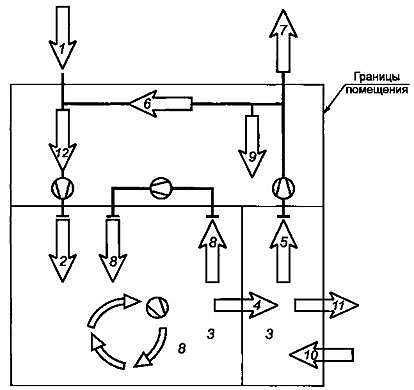
приточный воздух
Воздух, подаваемый в помещение
[ ГОСТ 22270-76]Параллельные тексты EN-RU
The quantity of fresh air for a hotel bedroom is usually based on one or two people.
[TROX TECHNIK]Расход приточного воздуха в гостиничный номер обычно принимается из расчета на одного-двух человек.
[Перевод Интент]Managing fresh air is mandatory in a building to control CO2 level and comfort.
[Lennox]Для контроля уровня CO2 и поддержания комфортного микроклимата необходимо регулировать расход приточного воздуха.
[Перевод Интент]
Тематики
Синонимы
EN
DE
Немецко-русский словарь нормативно-технической терминологии > Zuluft
-
4 Wettervorhersage
метеорологический прогноз
—
[ http://www.eionet.europa.eu/gemet/alphabetic?langcode=en]EN
meteorological forecasting
A branch of science that studies the dynamics of the atmosphere and the direct effects of the atmosphere upon the Earth's surface, oceans and inhabitants, focusing particularly on weather and weather conditions. (Source: INP / NOA / EEN)
[http://www.eionet.europa.eu/gemet/alphabetic?langcode=en]Тематики
EN
DE
FR
прогнозирование погоды
—
[ http://www.eionet.europa.eu/gemet/alphabetic?langcode=en]EN
weather forecasting
The act or process of predicting and highlighting meteorological conditions that are expected for a specific time period and for a specific area or portion of air space, by using objective models based on certain atmospheric parameters, along with the skill and experience of a meteorologist. (Source: FEM / AUS)
[http://www.eionet.europa.eu/gemet/alphabetic?langcode=en]Тематики
EN
DE
FR
Немецко-русский словарь нормативно-технической терминологии > Wettervorhersage
-
5 Ausbreitungsrechnung
расчет дисперсии
—
[ http://www.eionet.europa.eu/gemet/alphabetic?langcode=en]EN
dispersion calculation
The calculation of pollutant dispersion is based on the use of air dispersion models that mathematically simulate atmospheric conditions and behaviour. Dispersion models can provide concentration or deposition estimates and can be used to evaluate both existing and hypothetical emissions scenarios. (Source: ENVAR)
[http://www.eionet.europa.eu/gemet/alphabetic?langcode=en]Тематики
EN
DE
FR
Немецко-русский словарь нормативно-технической терминологии > Ausbreitungsrechnung
См. также в других словарях:
Air ambulance — A Eurocopter EC 145 of Switzerland s Rega air rescue service. An air ambulance is an aircraft used for emergency medical assistance in situations where either a traditio … Wikipedia
Air Europe — was a wholly privately owned, independent British airline, established in 1978 under the working title Inter European Airways.cite book| author=Simons, Graham M. | title=It was nice to fly with friends! The story of Air Europe | publisher=GMS… … Wikipedia
Air (visual novel) — Air Air original visual novel cover. Depicted are Kano (left), Misuzu (center), and Minagi (right). Genre Drama, Fantasy, Romance … Wikipedia
Air safety — is a term encompassing the theory, investigation and categorization of flight failures, and the prevention of such failures through regulation, education and training. It can also be applied in the context of campaigns that inform the public as… … Wikipedia
Air Methods — Air Methods, Corp. Type Public (NASDAQ: AIRM) Industry Air Services, Other … Wikipedia
Air New Zealand — IATA NZ ICAO ANZ Callsign NEW ZEALAND … Wikipedia
Air India Flight 182 — Boeing 747 237B Emperor Kanishka landing at London Heathrow Airport on 10 June 1985, a few days before the explosion Occurrence summary … Wikipedia
Air Force Blues — (abbreviated as AFBlues) is a comic strip available on the internet, created by Staff Sergeant Austin “Farva” May, a cartoonist on active duty in the United States Air Force. The events in the strip take place mainly at the fictional Elmendork… … Wikipedia
Air-fuel ratio — (AFR) is the mass ratio of air to fuel present during combustion. When all the fuel is combined with all the free oxygen, typically within a vehicle s combustion chamber,the mixture is chemically balanced and this AFR is called the stoichiometric … Wikipedia
Air Force Reserve Officer Training Corps — (AFROTC) is one of the three commissioning sources for officers in the United States Air Force, the other two being the Air Force Academy and Officer Training School. It is the largest and oldest source of commissioned officers for the Air Force… … Wikipedia
Air pollution in Hong Kong — is considered a serious problem. It affects flora and fauna in the area, and the health of residents living there. Visibility is currently less than eight kilometers for 30% of the year. Cases of asthma and bronchial infections have soared in… … Wikipedia
